My Facade Safaris
I have been scurrying all over London to photograph examples of facadism suggested by readers for inclusion in my forthcoming book. I call these expeditions ‘facade safaris’ and, as you can see from my collection of trophies below, I shot some prime specimens.
THE CREEPING PLAGUE OF GHASTLY FACADISM combines a gallery of the most notorious facades and a humorous analysis of facadism – the unfortunate practice of destroying everything apart from the front wall and constructing a new building behind it – revealing why this is happening and what it means.
I am still seeking a couple more investors for my book, so if you would like to help please write to me at spitalfieldslife@gmail.com . You can also support the book by preordering and you will receive a signed copy when it is published in October.
Click here to preorder your copy
Please suggest more London facades I should include.

Corner of Berwick St & Broadwick St, Soho
Whenever you see an old facade with a new structure behind it, this tells you that a building of distinction once stood there that could not simply be demolished and the compromise which arose was to keep the front wall. None of these facaded buildings should have been destroyed, but it happens because the economic forces driving redevelopment are greater than the legislation to protect what exists already. The recent rise in façadism is a barometer of how far the power balance has shifted away from conservation towards redevelopment. The result has been the loss of too many important and attractive old buildings that once enhanced our city and their replacement with generic monoliths.
No-one believes the original building still exists because the front wall still stands. There are a few examples where an attempt has been made to hide the join but, in my experience, this is a fiction that developers do not strive to maintain. Mostly, retaining the facade is an unwelcome condition of planning permission when their preference would have been complete demolition. Abnegating responsibility, the developers either complain that they were forced to keep the front wall or occasionally boast that they retained the period features, while the local community grieves that a beloved building and landmark has been destroyed. Nobody really wins and the uneasy physical form of the buildings manifests the tensions which arise in such compromises.
The front wall alone can never be a sufficient replacement for the loss of a building. Even the assumption that it could be raises questionable notions about how we experience the urban landscape. Cynically, it implies we perceive the world as mere surface and it does not matter if what is behind changes, as long as the superficial appearance is preserved. Yet a facade becomes a mask when it conceals a building’s change of use – from a philanthropic institution into luxury flats or from a public building into a corporate headquarters – distracting our attention from the reality of the transformation.
Unsurprisingly, architects dislike the requirement of incorporating an existing facade into a new building, which may have been conceived in the hope of fulfilling their own design without such compromise. Yet too often financial subservience overrides self-respect in these cases. No wonder the treatment of the facade is often perfunctory and the resentment is visible. These circumstances explain the strange discontinuities in this hybrid architecture where sometimes a gap is inserted between the facade and the building, and the architectural styles of the facade and the new building are often at odds with each other. It is disappointing when architects pay so little attention to the architectural whole and the rest of us have to live with these grotesque monsters that confront us only with what we have lost.
This curious phenomena first came to my attention when I was shown a facaded nineteenth century office building near Smithfield in the nineties. Only the exterior shell had been retained. The developer had increased capacity by replacing high-ceilinged Victorian offices with low-ceilinged modern workspaces. Consequently, the new interior structure did not coincide with the exterior walls, which meant that floors bisected windows.
At the time, it was merely an isolated curiosity. I observed this early indication of a world out of joint with the innocence of an unwitting protagonist in a science fiction drama who ignores the first sign of a warp in reality that will grow to engulf the universe.

Union Hall, Union Street, Borough, opened as Surrey Magistrates Court in 1782, facaded for offices in 2005

Bayswater Rd

Queen Elizabeth Children’s Hospital in Hackney, established 1867, closed in 1996 and facaded for luxury flats in 2014

Royal Arsenal Co-operative Society in Upper Tooting Rd built in 1923

Archway Rd, Highgate

Staycity Aparthotel, Blackheath Rd, Deptford

UCL student housing in Caledonian Rd, winner of the Carbuncle Cup 2013

Replica of the facade of Gaumont Cinema 1914 built in 2018 in Pitfield St, Hoxton

Ludgate Hill

Sainsbury’s, Townmead Rd, Fulham

The Westminster Arms, Praed St, Paddington, since 1869, facaded in 1989 by the Metropole Hotel.

The exterior cover of the book…

…which opens to reveal the title.
CLICK HERE TO ORDER A COPY OF THE CREEPING PLAGUE OF GHASTLY FACADISM
The Motor Mechanics Of Bow

Yaima at Bow Tyres
Over the years, Contributing Photographer Sarah Ainslie & I have visited many railway arches documenting the life of these charismatic spaces where people have sought the liberty of earning a living indepently and enriching the city in the process.
At Arnold Rd in Bow, we dropped in on a parade of a dozen arches where garages offering all aspects of motor repair have thrived over recent decades, supplying a reliable and conscientious service to local people.
In common with other railway arches across London and the entire country, we found these small businesses are subject to escalating rent increases which mean they are struggling to make a living and which threaten to destroy their livelihoods entirely.
Yet in spite of this crisis, we received a generous welcome from this mutually-supportive community of twenty-five to thirty mechanics who work together across their different garages, sharing skills and helping each other out as necessary.
Learn more about the campaign to save these businesses at Guardians of the Arches

Sultan Ahmed at Bow Motor Aid

Minar Uddin and his son Mostafa at Jonota Motors
Mostafa Uddin – “We do mechanics and some body work, small jobs. I have been working here for ten years, learning from my dad. I began by doing stuff with him and now I am running it. My dad set up the business thirteen years ago. He had another garage before this one in Bancroft Rd, but he had to leave that one because the rent was high. Now this rent is sky-high as well, our last recent increase was nearly double. With the amount of rent we have to pay, it is not worth us working for the small income we can make. If the business continues like this, we cannot carry on.”


Opal Meah, proprietor at S Motors
“I do car mechanics and electrics. I have been in business since I left school, over twenty-five years now, and I have been in this arch for about eight years. Every year the rent goes up and now they are increasing it more. I am not making any money. One month you are lucky and you make enough to pay the bills but other months are very hard. I don’t know what I am going to do, I don’t know anything else but car mechanics. I want to stay here, but if I cannot afford the rent how am I going to stay? Before it was good but now it is so tight.”

Mohammed Chowdhury at S Motors –
“It’s really close knit here – like a big family – and everyone looks after everyone else if anyone gets stuck. Everyone has their own speciality and their own trades, so we can always ask everyone else to help us out. Yesterday, I was not too sure how to remove a panel from a Volkswagen golf but the bodyshop next door gave me a hand and I had the job done in a matter of minutes. Round here, it is beautiful because you can rely on each other, if anyone needs help or a push for a car. It is brilliant.
Quite a few new businesses have established themselves here in small arches and then grown substantially and looked for bigger premises and are doing really well. Some of these arches have been renovated and everybody has enough business to keep themselves afloat and cover their wages. It is a great starting point.
Some customers are drive-throughs, other are local. Word of mouth and friends and family have built our business. No-one who works here lives too far off from here.
If someone has background knowledge and they are looking to get into it and pick up some skills, there are opportunities here for young people to learn, develop themselves and climb up the ladder.
Rents are increased here without any reasoning and the landlords want to move this place upmarket, trying to get in other kinds of businesses. But if they are constantly bumping the rent up, how are people supposed to survive? Everyone’s struggling to survive here now, to be honest.”

Faisal Siddiqi at Ali Auto Repairs

Shajhan at Jonota Motors

Arif Giulam at Reliance Motors

Tommy, Misa Sheink, Sayed Uddin, Arif Giulam and Naiem at Reliance Motors

Shajahan Ali at Ali’s Body Work

Ali Noor at Ali Auto Repairs

Ahmed Shuhel at Spanner Work
Photographs copyright © Sarah Ainslie
You may also like to take a look at
Nineteenth Century East End Darlings
In sharp contrast to Horace Warner’s Spitalfields Nippers, this selection from Philip Mernick‘s collection of cartes de visite by nineteenth century East End photographers, gathered over the past twenty years, shows the offspring of the bourgeois professional classes. No doubt the doting parents delighted in these portraits of their little darlings trussed up like turkeys in their fancy outfits, but there is not a single smile among them.

1865

1870

1870

1870

1870s

1870s

1880

1885

1880s

1880s

1880s

1898

1890

1900

1900

1900

1910

1910

1910
Photographs reproduced courtesy of Philip Mernick
You may also like to take a look at
Portraits from Philip Mernick’s Collection
Charles Spurgeon’s Street Traders
Charles Spurgeon the Younger, son of the Evangelist Charles Haddon Spurgeon, took over the South St Baptist Chapel in Greenwich in the eighteen-eighties and commissioned an unknown photographer to make lantern slides of the street traders of Greenwich that he could use in his preaching. We shall never know exactly how Spurgeon showed these pictures, taken between 1884 and 1887, but – perhaps inadvertently – he was responsible for the creation of one of the earliest series of documentary portraits of Londoners.

Champion Pie Man – W.Thompson, Pie Maker of fifty years, outside his shop in the alley behind Greenwich Church

Hokey-Pokey Boy – August Bank Holiday, Stockwell St, Greenwich

Knife Grinder – posed cutting out a kettle bottom from a tin sheet

Rabbit Seller

Toy Seller – King William St outside Royal Naval College, Greenwich

Ginger Cakes Seller – King St, near Greenwich Park

Sweep

Shrimp Sellers – outside Greenwich Park

Crossing Sweeper (& News Boy) – Clarence St, Greenwich

Sherbert Seller – outside Greenwich Park

Third Class Milkman – carrying two four-gallon cans on a yoke, King William’s Walk, Greenwich

Second Class Milkman – with a hand cart and seventeen-gallon churn

Master Milkman – in his uniform, outside Royal Naval College, Greenwich

Chairmender – Corner of Prince Orange Lane, Greenwich

Kentish Herb Woman – Greenwich High Rd

Muffin Man

Fishmongers

Try Your Weight – outside Greenwich Park

Glazier

News Boy (& Crossing Sweeper) – delivering The Daily News at 7:30am near Greenwich Pier

Old Clo’ Man – it was a crime to dispose of infected clothing during the Smallpox epidemics of the eighteen-eighties and the Old Clo’ Man plied a risky trade.

Blind Fiddler – outside Crowders’ Music Hall Greenwich
You may also like to take a look at
At Aldgate Pump
Since Aldgate Pump is currently shrouded for renovation, I thought it was time to recount the notorious tale of this celebrated East End landmark

See these people come and go at the junction of Fenchurch St and Leadenhall St in the City of London in 1927. Observe the boy idling in the flat cap. They all seem unaware they are in the presence of the notorious “Pump of Death” – that switched to mains supply fifty years earlier in 1876, when the water began to taste strange and was found to contain liquid human remains which had seeped into the underground stream from cemeteries.
Several hundred people died in the resultant Aldgate Pump Epidemic as a result of drinking polluted water – though this was obviously a distant memory by the nineteen twenties when Whittard’s tea merchants used to “always get the kettles filled at the Aldgate Pump so that only the purest water was used for tea tasting.”
Yet before it transferred to a supply from the New River Company of Islington, the spring water of the Aldgate Pump was appreciated by many for its abundant health-giving mineral salts, until – in an unexpectedly horrific development – it was discovered that the calcium in the water had leached from human bones.
This bizarre phenomenon quickly entered popular lore, so that a bouncing cheque was referred to as “a draught upon Aldgate Pump,” and in rhyming slang “Aldgate Pump” meant to be annoyed – “to get the hump.” The terrible revelation confirmed widespread morbid prejudice about the East End, of which Aldgate Pump was a landmark defining the beginning of the territory. The “Pump of Death” became emblematic of the perceived degradation of life in East London and it was once declared with superlative partiality that “East of Aldgate Pump, people cared for nothing but drink, vice and crime.”
Today this sturdy late-eighteenth century stone pump stands sentinel as the battered reminder of a former world, no longer functional, and lost amongst the traffic and recent developments of the modern City. No-one notices it anymore and its fearsome history is almost forgotten, despite the impressive provenance of this dignified ancient landmark, where all mileages East of London are calculated. Even in the old photographs you can trace how the venerable pump became marginalised, cut down and ultimately ignored.
Aldgate Well was first mentioned in the thirteenth century – in the reign of King John – and referred to by sixteenth century historian, John Stowe, who described the execution of the Bailiff of Romford on the gibbet “near the well within Aldgate.” In “The Uncommercial Traveller,” Charles Dickens wrote, “My day’s business beckoned me to the East End of London, I had turned my face to that part of the compass… and had got past Aldgate Pump.” And before the “Pump of Death” incident, Music Hall composer Edgar Bateman nicknamed “The Shakespeare of Aldgate Pump,” wrote a comic song in celebration of Aldgate Pump – including the lyric line “I never shall forget the gal I met near Aldgate Pump…”
The pump was first installed upon the well head in the sixteenth century, and subsequently replaced in the eighteenth century by the gracefully tapered and rusticated Portland stone obelisk that stands today with a nineteenth century gabled capping. The most remarkable detail to survive to our day is the elegant brass spout in the form of a wolf’s head – still snarling ferociously in a vain attempt to maintain its “Pump of Death” reputation – put there to signify the last of these creatures to be shot outside the City of London.
In the photo from 1927, you can see two metal drinking cups that have gone now, leaving just the stubs where the chains attaching them were fixed. Tantalisingly, the brass button that controls the water outlet is still there, yet, although it is irresistible to press it, the water ceased flowing in the last century. A drain remains beneath the spout where the stone is weathered from the action of water over centuries and there is an elegant wrought iron pump handle – enough details to convince me that the water might return one day.


Looking towards Aldgate.

The water head, reputed to be an image of the last wolf shot in London.

The pump was closed in 1876 and the outlet switched to mains water supply.


Archive photographs copyright © Bishopsgate Institute
Tessa Hunkin At London Zoo

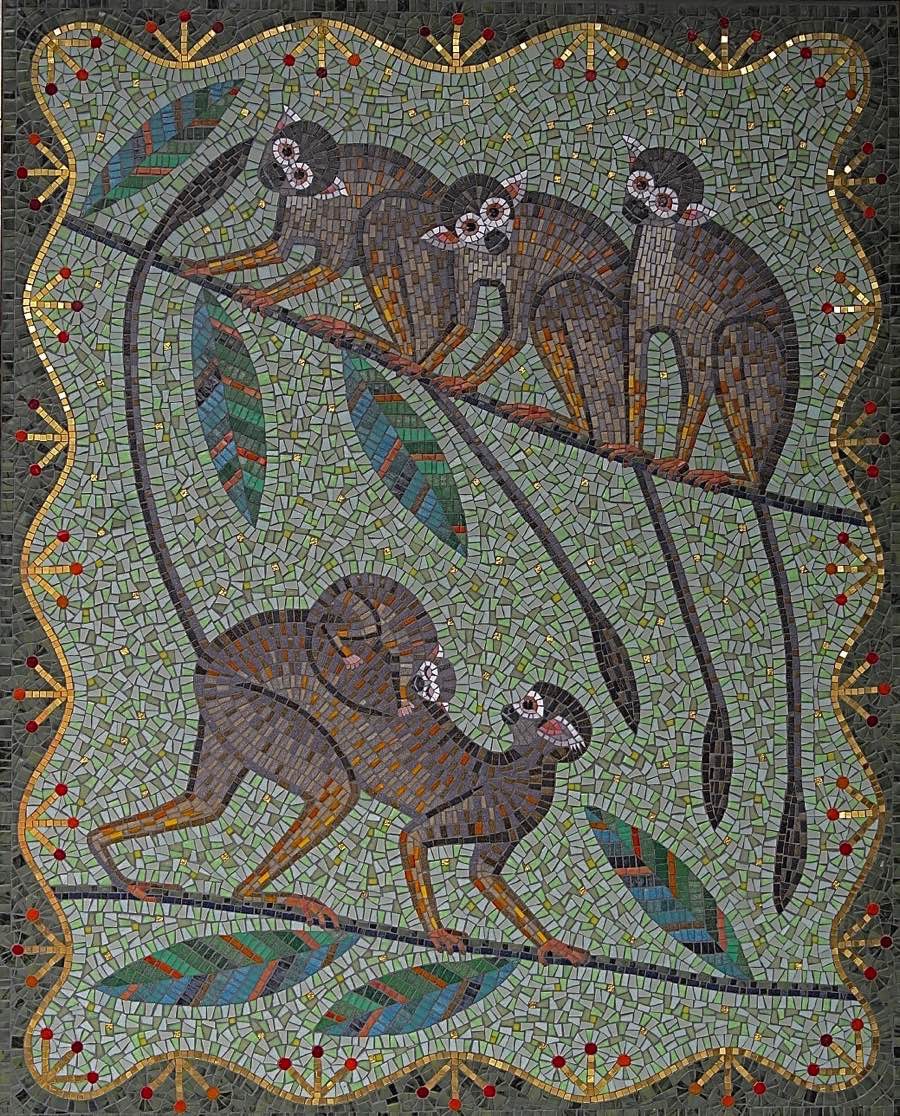
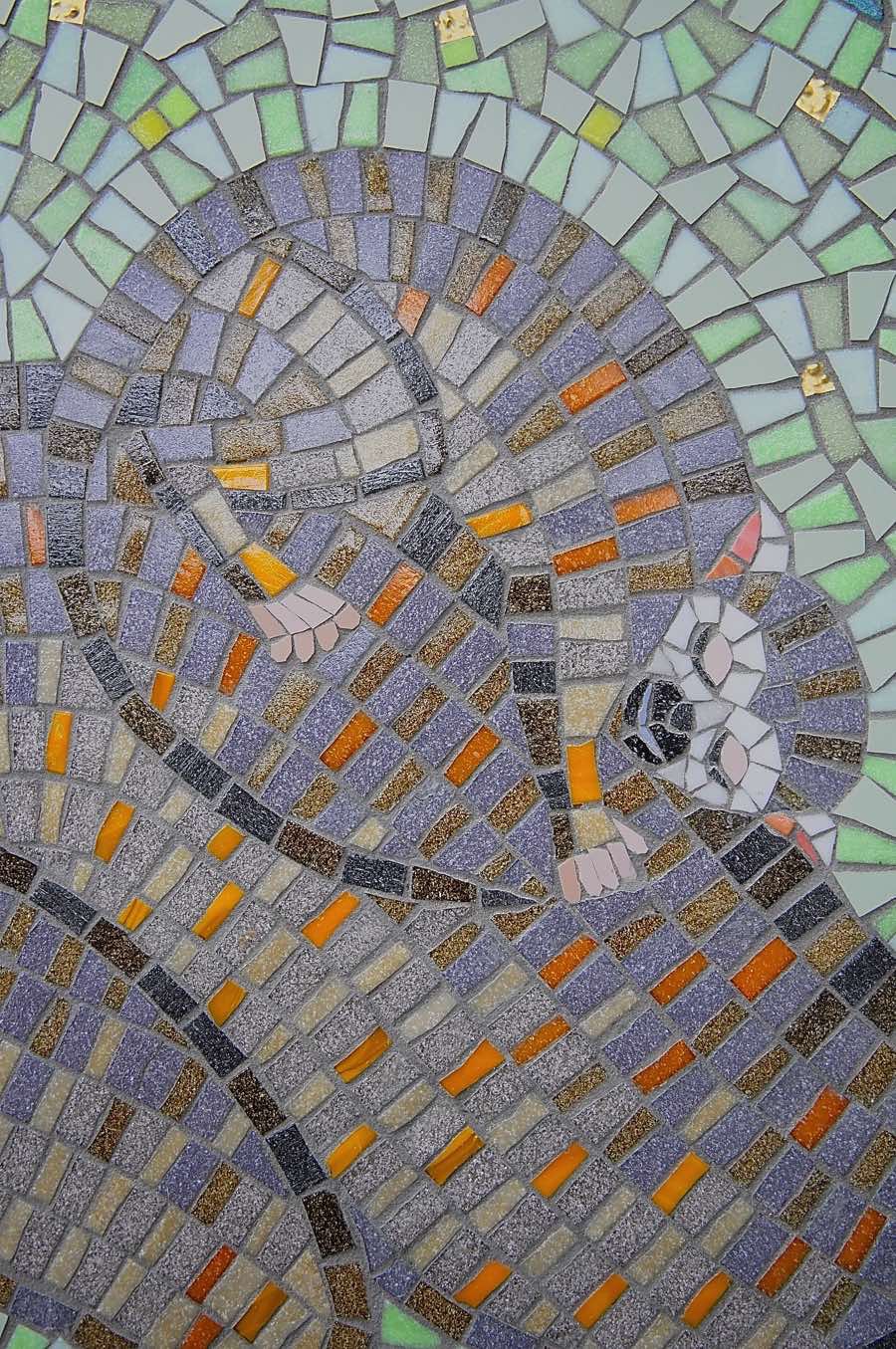
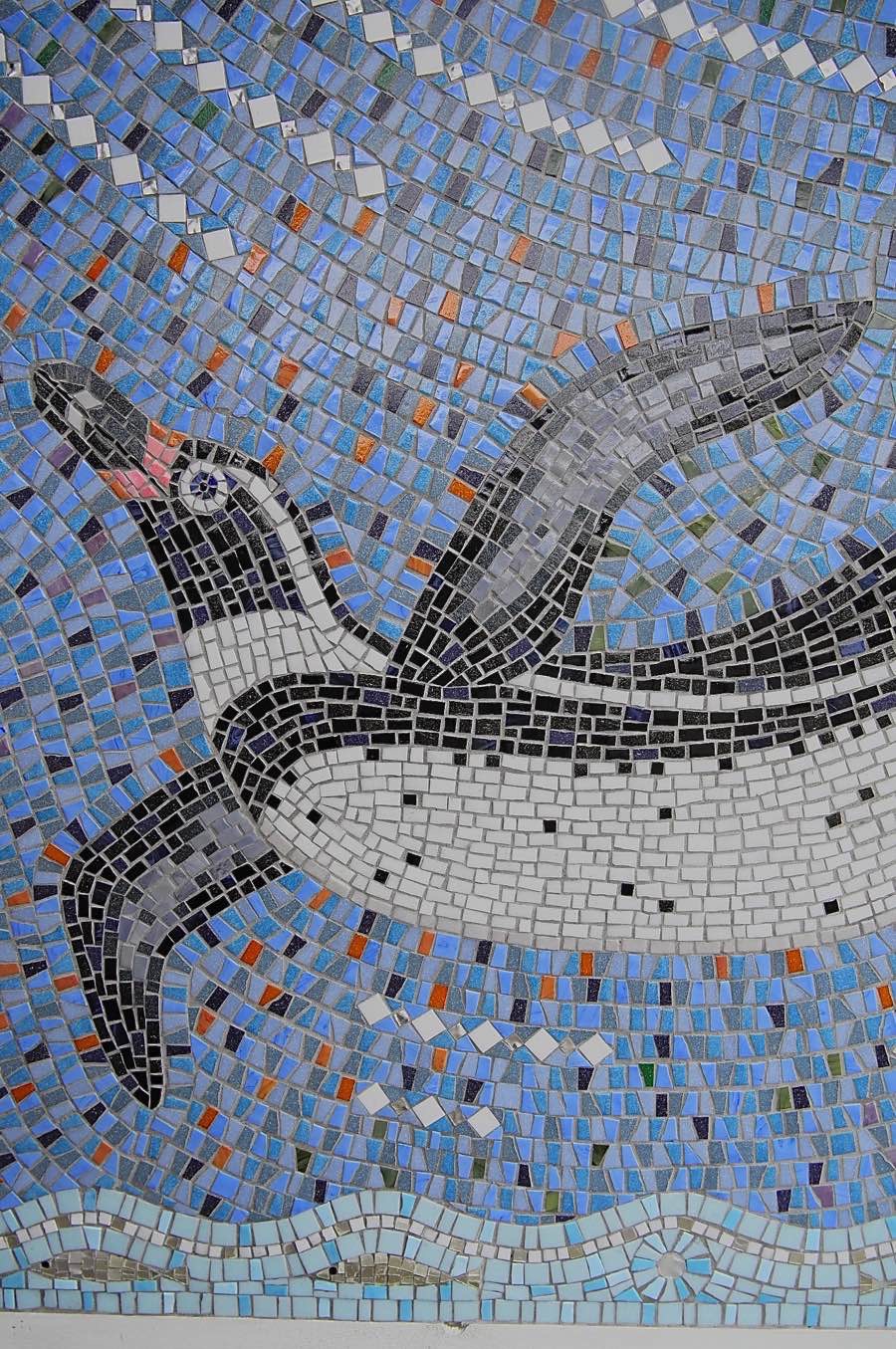
Visitors to London Zoo this week have enjoyed the additional attraction of watching Tessa Hunkin and her crew from Hackney Mosaic Project installing two joyous masterpieces of mosaic on either side of the main entrance
On the left, a pair of Humboldt Penguins dip and dive to create a pleasantly dynamic composition while, on the right, five mischievous Squirrel Monkeys perch on branches, poised to leap.
‘I especially like the Squirrel Monkeys at the zoo,’ Tessa confided to me, ‘because they love mobile phones and enjoy taking them off visitors and dropping them from the tops of trees.’


Humboldt Penguins

Robson Cezar, Ken Edwards & Tess Hunkin (from left to right)

Squirrel Monkeys


THE HACKNEY MOSAIC PROJECT is seeking commissions, so if you would like a mosaic please get in touch hackneymosaic@gmail.com
You may also like to read about
The Mosaic Makers of Hackney Downs
The Award-Winning Mosaic Makers of Hackney
The Inescapable Melancholy Of Phone Boxes

Red phone boxes are a cherished feature of my personal landscape because, in my childhood, we never had a telephone at home and, when I first made a phone call at the age of fifteen, it was from a box. In fact, for the major part of my life, all my calls were made from boxes – thus telephone calls and phone boxes were synonymous for me. I grew up with the understanding that you went out to make a phone call just as you went out to post a letter.
Yet the culture of mobile phones is now so pervasive I was shocked to discover I had hardly noticed as the red telephone boxes have vanished from our streets and those few that remain stand redundant and unused. So I set out with my camera to photograph the last of them, lest they should disappear without anybody noticing. It was a curious and lonely pilgrimage because, whereas they were once on every street, they have now almost all gone and I had to walk miles to find enough specimens to photograph.
Reluctantly, I must reveal that on my pitiful quest in search of phone boxes, I never saw anyone use one though I did witnessed the absurd spectacle of callers standing beside boxes to make calls on their mobiles several times. The door has fallen off the one in Spitalfields, which is perhaps for the best as it has been co-opted into service as a public toilet while the actual public toilet nearby is now a vintage boutique.
Although I must confess I have not used one myself for years, I still appreciate phone boxes as fond locations of emotional memory where I once experienced joy and grief at life-changing news delivered down the line. But like the horse troughs that accompany them on Clerkenwell Green and outside Christ Church, Spitalfields, phone boxes are now vestiges of a time that has passed forever. I imagine children must ask their mothers what these quaint red boxes are for.
The last phone boxes still stand proud in their red livery but like sad clowns they are weeping inside. Along with pumps, milestones, mounting blocks and porters’ rests these redundant pieces of street furniture serve now merely as arcane reminders of a lost age – except that era was the greater part of my life. This is the inescapable melancholy of phone boxes.

Redundant in Whitechapel

Ignored in Whitechapel

Abandoned in Whitechapel

Rejected in Bow

Abused in Spitalfields

Irrelevant in Bethnal Green

Shunned in Bethnal Green

Empty outside York Hall
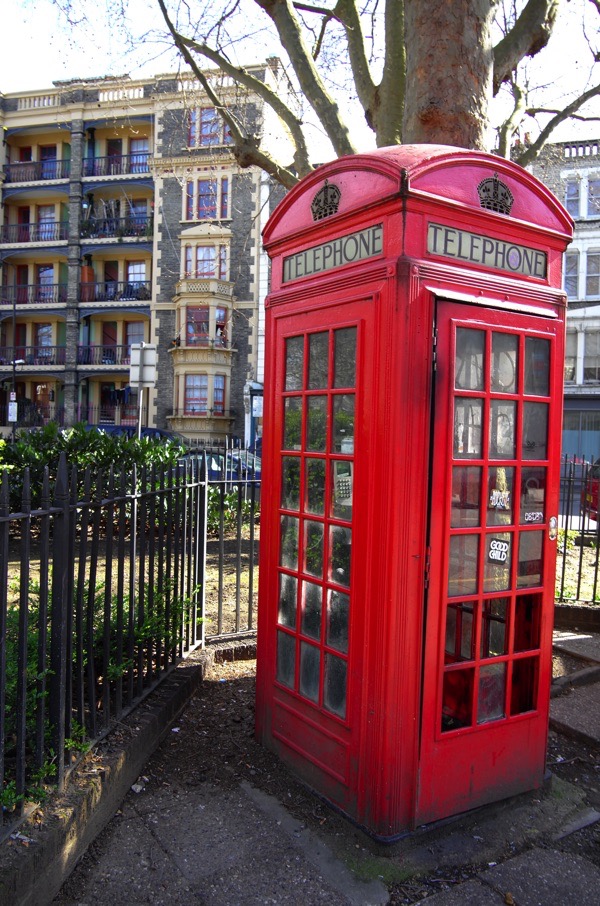
Desolate in Hackney Rd

Pointless in St John’s Sq

Unwanted on Clerkenwell Green

Invisible in Smithfield

Forgotten outside St Bartholomew’s Hospital

In service outside St Paul’s as a quaint location for tourist shots
You may also like to take a look at