
At The Caslon Letter Foundry

Tickets are available for my walking tours now
Click here to book your ticket for THE GENTLE AUTHOR’S TOUR OF SPITALFIELDS on Saturday 19th July

22/23 Chiswell St with Caslon’s delivery van outside the foundry
For centuries, Caslon was the default typeface in the English language. William Caslon set up his type foundry in Chiswell St in 1737, where it operated without any significant change in the methods of production until 1937. These historic photographs taken in 1902, upon the occasion of the opening of the new Caslon factory in Hackney Wick, record both the final decades of the unchanged work of traditional type-founding, as well as the mechanisation of the process that would eventually lead to the industry being swept away by the end of the century.

The Directors’ Room with portraits of William Caslon and Elizabeth Caslon.

Sydney Caslon Smith in his office

Clerks’ office, 15th November 1902. A woman sits at her typewriter in the centre of the office.

Type store with fonts being made up in packets by women and boys working by candlelight.

Another view of the type store with women making up packets of fonts.

Another view of the type store.

Another part of the type store.

In the type store.

A boy makes up a packet of fonts in the type store.

Room of printers’ supplies including type cases, forme trolleys and electro cabinets.

Another view of the printers’ supplies store.

Printing office on an upper floor with pages of type specimens being set and printed on Albion and Imperial handpresses.

Packing department with crates labelled GER, GWR, LNWR, CALCUTTA, BOMBAY, and SYDNEY.

New Caslon Letter Foundry at Rothbury Rd, Hackney Wick, 1902.

Harold Arthur Caslon Smith at his rolltop desk in Hackney Wick with type specimens from 1780 on the wall, Friday 7th November, 1902.

Machine shop with plane, lathes and overhead belting.

Gas engines and man with oil can.

Lathes in the Machine Shop.

Hand forging in the Machine Shop.

Another view of lathes in the Machine Shop.

Type store with fonts being made up into packets.

Type matrix and mould store.

Metal store with boy hauling pigs upon a trolley.

Casting Shop, with women breaking off excess metal and rubbing the type at the window.

Another view of the Casting Shop.

Another view of the Casting Shop.

Founting Shop, with women breaking up the type and a man dressing the type.

Casting metal furniture.

Boys at work in the Brass Rule Shop.

Boys making packets of fonts in the Despatch Shop, with delivery van waiting outside the door.

Machine shop on the top floor with a fly-press in the bottom left.

Woodwork Shop.
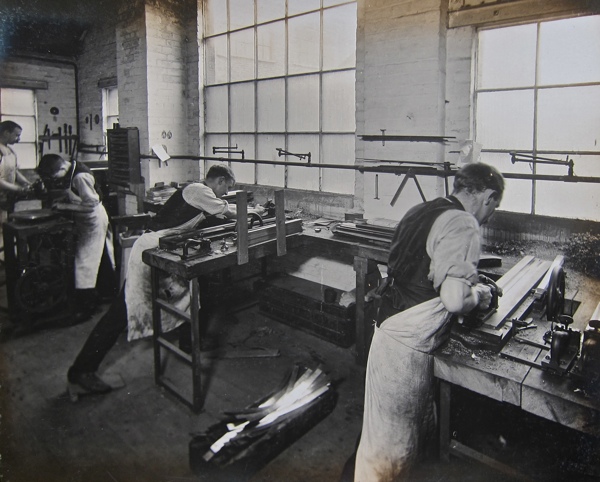
Brass Rule Shop, hand-planing the rules.

Caretaker’s cottage with caretaker’s wife and the factory cat.
Photographs courtesy St Bride Printing Library
You may also like to read about
William Caslon, Letter Founder
Save Leila’s Shop

Leila’s Shop by Eleanor Crow
In common with five other shops in Calvert Avenue – leading up to Arnold Circus on the Boundary Estate – Leila’s Shop is being challenged by Tower Hamlets Council with eviction or 300% rent increase this October.
Over the past twenty-three years that Leila McAlister has run her shop and cafe it has become a beloved community hub, and – as a consequence – the Friends of Arnold Circus mustered residents to renovate the park, creating a popular public space where once there was only dereliction. There is no doubt that Leila’s Shop has been instrumental in the community-led regeneration of the Boundary Estate in recent decades.
It is pitiful irony that Tower Hamlets Council is opening a ‘community hub’ in one of the shops in Calvert Avenue this week, while simultaneously engineering the closure of Leila’s Shop and other independent business that line this small street.
We need as many people as possible – both local and far flung – to sign the petition which will be presented to the council at the Town Hall next week on Wednesday 16th July.
CLICK HERE TO SIGN THE PETITION

15 Calvert Avenue, c.1900

15 Calvert Avenue, 2010
The top photograph of 15 Calvert Avenue is believed to have been taken one Sunday in 1900 around the time Prince Edward and Princess Alexandra came to open the Boundary Estate, and I snapped the lower photograph in December 2010, more than a century later.
One day, Joan Rose visited Leila’s Cafe next door at 17 Calvert Avenue and brought out the old photograph (which she always carries in her purse) to show Leila McAlister, explaining that the little boy standing in the doorway was her father. A copy now hangs proudly in Leila’s Shop, and served as the inspiration for my project when a class from Virginia Rd School in Arnold Circus turned out to assist and we stopped the traffic to take the new picture.
Joan (unmarried name Raymond) told me that her father Alfred was born in 1896 and is approximately six years old in the picture. The woman beside him in the doorway is Phoebe Raymond his mother, Joan’s grandmother, and the man on the left is his father, Joan’s grandfather Albert Alfred Raymond (known as Alf), the first proprietor of the newly built shop. They all lived in the flat up above and you can see their songbird in the cage, a cock linnet.
Phoebe has her smart apron with frills and everyone is wearing their Sunday best – remarkably for the time, everyone has good quality boots. I like the sacks with SPITALFIELDS printed on them, indicating produce from the fruit and vegetable market half a mile away, and the porters’ baskets which Leila still uses today. You can see the awning has been taken up to permit enough light for the photograph and then it has rained. We had the same problem with the weather, but were blessed with a few hours between a sleet shower and a blizzard to snatch our picture.
Joan Rose told me she believes her family are of French Huguenot origin and the original surname was Raymond de Foir, which means the people you see in the old photograph are probably descended from the Huguenot immigrants that came here in the eighteenth century. What touched me most was to learn from Joan that Alfred her father (pictured here eternally six years old in his Sunday best on the threshold of his father’s shop), went off to fight in the First World War and, aged twenty-two, was there at the battle of the Somme when so many died, but returned to run the shop in Calvert Avenue carrying on his father’s business in the same premises until his death in 1966.

Preparing for opening at Leila’s Shop
In Old Rotherhithe


St Mary Rotherhithe Free School founded 1613
To be candid, there is not a lot left of old Rotherhithe – yet what remains is still powerfully evocative of the centuries of thriving maritime industry that once defined the identity of this place. Most visitors today arrive by train – as I did – through the Brunel tunnel built between 1825 and 1843, constructed when the growth of the docks brought thousands of tall ships to the Thames and the traffic made river crossing by water almost impossible.
Just fifty yards from Rotherhithe Station is a narrow door through which you can descend into the 1825 shaft via a makeshift staircase. You find yourself inside a huge round cavern, smoke-blackened as if the former lair of a fiery dragon. Incredibly, Marc Brunel built this cylinder of brick at ground level – fifty feet high and twenty-five feet in diameter – and waited while it sank into the damp earth, digging out the mud from the core as it descended, to create the shaft which then became the access point for excavating the tunnel beneath the river.
It was the world’s first underwater tunnel. At a moment of optimism in 1826, a banquet for a thousand investors was held at the bottom of the shaft and then, at a moment of cataclysm in 1828, the Thames surged up from beneath filling it with water – and Marc’s twenty-two-year-old son Isambard was fished out, unconscious, from the swirling torrent. Envisaging this diabolic calamity, I was happy to leave the subterranean depths of the Brunels’ fierce imaginative ambition – still murky with soot from the steam trains that once ran through – and return to the sunlight of the riverside.
Leaning out precariously upon the Thames’ bank is an ancient tavern known as The Spread Eagle until 1957, when it was rechristened The Mayflower – in reference to the Pilgrims who sailed from Rotherhithe to Southampton in 1620, on the first leg of their journey to New England. Facing it across the other side of Rotherhithe St towers John James’ St Mary’s Rotherhithe of 1716 where an attractive monument of 1625 to Captain Anthony Wood, retrieved from the previous church, sports a fine galleon in full sail that some would like to believe is The Mayflower itself – whose skipper, Captain Christopher Jones, is buried in the churchyard.
Also in the churchyard, sits the handsome tomb of Prince Lee Boo. A native of the Pacific Islands, he befriended Captain Wilson of Rotherhithe and his two sons who were shipwrecked upon the shores of Ulong in 1783. Abba Thule, the ruler of the Islands, was so delighted when the Europeans used their firearms to subdue his enemies and impressed with their joinery skills in constructing a new vessel, that he asked them to take his second son, Lee Boo, with them to London to become an Englishman.
Arriving in Portsmouth in July 1784, Lee Boo travelled with Captain Wilson to Rotherhithe where he lived as one of the family, until December when it was discovered he had smallpox – the disease which claimed the lives of more Londoners than any other at that time. At just twenty years old, Lee Boo was buried inside the Wilson family vault in Rotherhithe churchyard, but – before he died – he sent a plaintive message home to tell his father “that the Captain and Mother very kind.”
Across the churchyard from The Mayflower is Rotherhithe Free School, founded by two Peter Hills and Robert Bell in 1613 to educate the sons of seafarers. Still displaying a pair of weathered figures of schoolchildren, the attractive schoolhouse of 1797 was vacated in 1939 yet the school may still be found close by in Salter Rd. Thus, the pub, the church and the schoolhouse define the centre of the former village of Rotherhithe with a line of converted old warehouses extending upon the river frontage for a just couple of hundred yards in either direction beyond this enclave.
Take a short walk to the west and you will discover The Angel overlooking the ruins of King Edward III’s manor house but – if you are a hardy walker and choose to set out eastward along the river – you will need to exercise the full extent of your imagination to envisage the vast vanished complex of wharfs, quays and stores that once filled this entire peninsular.


At the entrance to the Rotherhithe road tunnel stands the Norwegian Church with its ship weather vane


Chimney of the Brunel Engine House seen from the garden on top of the tunnel’s access shaft

Isambard Kingdom Brunel presides upon his audacious work

Visitors gawp in the diabolic cavern of Brunel’s smoke-blackened shaft descending to the Thames tunnel

John James’ St Mary’s Rotherhithe of 1716

The tomb of Prince Lee Boo, a native of the Pelew or Pallas Islands ( the Republic of Belau), who died in Rotherhithe of smallpox in 1784 aged twenty

Graffiti upon the church tower

Monument in St Mary’s, retrieved from the earlier church

Charles Hay & Sons Ltd, Barge Builders since 1789

Peeking through the window into the costume store of Sands Films


Inside The Mayflower


A lone survivor of the warehouses that once lined the river bank

Looking east towards Rotherhithe from The Angel

The Angel

The ruins of King Edward III’s manor house

Bascule bridge

Nelson House

Metropolitan Asylum Board china from the Smallpox Hospital Ships once moored here
You may also like to read
Music Hall Artistes Of Abney Park Cemetery

When the summer heat hits the city and the streets get dusty and dry, I like to seek refuge in the green shade of a cemetery. Commonly, I visit Bow Cemetery – but recently I went along to explore Abney Park Cemetery in Stoke Newington to find the graves of the Music Hall Artistes resting there.
John Baldock, Cemetery Keeper, led me through the undergrowth to show me the memorials restored by the Music Hall Guild and then left me to my own devices. Alone in the secluded leafy glades of the overgrown cemetery with the Music Hall Artistes, I swore I could hear distant singing accompanied by the tinkling of heavenly ivories.

George Leybourne, Songwriter, Vocalist and Comedian, also known as Champagne Charlie (1842 – 1884) & Albert Chevalier (1861- 1923), Coster Comedian and Actor. Chevalier married Leybourne’s daughter Florrie and they all rest together.

George Leybourne – “Champagne Charlie is my name, Champagne Charlie is my name ,There’s no drink as good as fizz, fizz, fizz, I’ll drink every drop there is, is, is!”

Albert Chevalier – “We’ve been together now for forty years, An’ it don’t seem a day too much, There ain’t a lady livin’ in the land, As I’d swop for my dear old Dutch.”

G W Hunt (1838 – 1904) Composer and Songwriter, his most famous works were “MacDermott’s War Song” (The Jingo Song), “Dear Old Pals” and “Up In A Balloon” for George Leybourne and Nelly Power.

G W Hunt

Fred Albert George Richard Howell (1843 – 1886) Songwriter and Extempore Vocalist

Fred Albert

Dan Crawley (1871 – 1912) Comedian, Vocalist, Dancer and Pantomime Dame rests with his wife Lilian Bishop, Actress and Male Impersonator. He made his London debut at nineteen at Royal Victor Theatre, Victoria Park, and for many years performed three shows a day on the sands at Yarmouth, where he met his wife.They married in Hackney in 1893 and had four children, and toured together as a family, including visiting Australia, before they both died at forty-one years old.

Dan Crawley

Herbert Campbell (1844 – 1904) Comedian and Pantomime Star. The memorial behind the tombstone was erected by a few of his friends. Herbert Campbell played the Dame in Pantomime at Drury Lane for forty years alongside Dan Leno, until his death at at sixty-one.

Herbert Campbell, famous comedian and dame of Drury Lane

Walter Laburnum George Walter Davis (1847 – 1902) Singer, Patter Vocalist and Songwriter

Walter Laburnum

Nelly Power Ellen Maria Lingham (1854 – 1887) started her theatrical career at the age of eight, and was a gifted songstress and exponent of the art of male impersonation. Her most famous song was ‘The Boy I Love Is Up In The Gallery.” She died from pleurisy on 19th January 1887, aged just thirty-two.

Nelly Power – Vesta Tilley was once her understudy
Ron McCormick’s Spitalfields
Here is a selection of Ron McCormick’s splendid pictures from the seventies when he lived in Princelet St, Spitalfields.

Knifegrinder, Spitalfields

Fishman’s tobacconist & sweet shop, Flower & Dean St, Spitalfields

Entrance to Chevrah Shass Synagogue, Old Montague St

Clock seller, Sclater St

Dressed up for the Sunday market, Cheshire St

Maurice, Gents’ Hairdresser, Buxton St

Gunthorpe St

Club Row

Steps down to Black Lion Yard, Old Montague St

Old Castle St, Synagogue

Sunday market, Cheshire St

Corner of Gun St & Artillery Lane

Shopkeeper, Old Montague St

Inter-generational conflict on Princelet St

Goldstein’s Kosher Butcher & Poulterer, Old Montague St

Great Eastern Buildings, Quaker St

Convenience Store, Artillery Lane

Soup Kitchen for the Jewish Poor, Brune St

Alf’s Fish Bar, Brick Lane

Waiting for the night shelter to open, Christ Church Spitalfields

Resting, Spitalfields Market Barrows, Commercial St

Great Eastern Buildings, Quaker St

Rough sleeper, Spitalfields

Mother and her new-born baby in a one bedroom flat, Spitalfields
Photographs copyright © Ron McCormick
You may also like to take a look at
At Billingsgate Roman Bath House

Tepidarium at Billingsgate Roman bathhouse
In Lower Thames St, where the traffic roars past old Billingsgate Market and around the Tower of London, there is an anonymous door that leads to the past. It is a piece of spine-tingling magic. You walk through a modern door into an unremarkable corporate building and descend a staircase to discover the best preserved piece of Roman archaeology in London.
Here is a second century riverside villa with an bathhouse of cruciform shape complete with an elaborate underfloor heating system. You can see the square frigidarium with its tessellated floor and then the smaller rooms with curved walls, the tepidarium and the caldarium, with tiled floors supported upon pilae permitting the hot air to travel underneath. In these rooms, water could be thrown upon the heated floor to create clouds of steam. For those who originated in warmer climes, the bathhouse provided a welcome antidote to the misery of cold winters in London.
The bathhouse was first uncovered in 1848 during the construction of the London Coal Exchange and drew a response of such wonder that – unlike many other ancient remains discovered in the City in that era – it was preserved. When the Coal Exchange was demolished in the last century for the widening of Lower Thames St, more of the Roman ruins were uncovered before being concealed in the basement of the block where they are housed today.
A century after the bathhouse was constructed, a six metre defensive wall was built along the water front, concealing the river view and blocking out the light. It was then that the bathhouse was expanded within the garden of the villa and perhaps the dwelling changed from a desirable private house to some form of temporary lodging, with the added attraction of a steam bath.
In use until the Romans departed London in the fifth century, the bathhouse then fell into disrepair and collapsed before being covered with a layer of silt, preserving the remains and preventing anyone carrying off the building materials for reuse. Tantalisingly, a Saxon brooch was found on top of the pile of collapsed roof tiles dating from a time when this part of the City of London was uninhabited. Did someone from the nearby Saxon settlements come to explore the Roman ruins one day and slip upon the rubble, dropping a brooch?
When you walk upon the metal gantries over the Roman walls, you feel you are a ghost from the future eavesdropping on another time. The scale of the rooms is apparent, the stone bench in the steam room is discernible and you can see the fragments of worn floor, smoothed with centuries of use by the long-dead. Square pipes, tiles and other details of the construction reveal the work of skilled craftsmen in ceramic and brick, and a single tile bears the imprint of a dog’s paw that wandered through the brick maker’s yard in London seventeen hundred years ago.
Explore Billingsgate Roman Bathhouse for yourself any Saturday until November. Tours run at 11am, 12noon and 1pm. Click here to book a tour.

The hot air from the furnace entered the building and circulated under the floor

The curved walls of the caldarium

Tiles supported on pilae as part of the underfloor heating system in the tepidarium


Tessellated floor in the frigidarium

Fragment of tessellated floor


The stone bench in the tepidarium

The paw print of a dog in London seventeen hundred years ago
You may also like to read about
Ed Gray’s Streetlife Serenade
Ed Gray introduces his new exhibition, Streetlife Serenade: 30 Years of Painting City Life, which opens tomorrow at House of Annetta, 25 Princelet St, E1 6QH and runs until 20th July. Open Mondays & Tuesdays 11am-5pm, Wednesdays, Thursdays, Fridays, Saturdays & Sundays 11am-8pm.

Lucky Tiger, Whitechapel Market 2008
‘This exhibition Streetlife Serenade features my paintings of London life loaned from collectors from my thirty-year career as an artist, with street drawings and some prints of highlights from along the way. In addition, there are two large new paintings of London exhibited for the first time Remembrance, West Lane War Memorial Rotherhithe exploring the motionless silence of loss, tribalism, sacrifice, conflict and ritual and Triumph of Shoreditch, Shoreditch High St Station dramatising the vital call of the roaring city and the unrehearsed choreography of the street – the eternal dance of life that leads us onwards.
In 1995, I left art college in Cardiff to return to my home city of London. I knew I wanted to paint people, that was what I had always done. One day my dad showed me a book of William Hogarth’s work. I did not understand the narratives in Hogarth’s scenes back then but I recognised the Londoners romping, raving and roving through his clustered scenes. In Cardiff, I had begun to paint fish markets and caffs, learning to befriend and persuade fishmongers and caff owners that I would be no bother and keep out of their way as I drew.
In 1996, I left my studio in a squat on the Old Kent Rd, pacing self-consciously up and down the ancient highway, trying to find a way to draw what I thought I was seeing. It was another five years before I felt able to venture into the city with my sketchbook and pencils and really begin to sketch life of the city. I cast my net in different city streams and brought my haul back to a bedroom in Brixton, filleting my drawings to piece together moment, memory, echoes and rework all these elements into a canvas.
I tried to learn to be bold enough to stand in the street and draw faces, finding ways to record flitting and fleeting urbanites, to capture character in a few strokes with only a few seconds’ observation. I was learning to hold a stare, to avoid confrontation, to blend and be a part of the street, to be visibly invisible, but most of all I was learning to be present enough to really look.’
– Ed Gray, Rotherhithe 2025

Triumph Of Shoreditch, Shoreditch High St Station 2025

Adoration in the Lions Den, Milwall 2014

Blackfriars Skittles, 2008

Brockwell Kiss, Brockwell Lido 2005

Full English, Rock Steady Eddies, Camberwell 2005

Golden Day, Bar Italia, Soho 2010

I am Bacchanale, Notting Hill Carnival 2010

Let Me Eat My Wings On Camberwell Green, 2010

Night Bus, Old Kent Rd 2004

Nighthawks, Whitehall 2000

Nothing To See Here, 2007

Remembrance, West Lane, Rotherhithe 2024

Sledgers, Primrose Hill 2008

Tooting Lido, 2004

Xmas With The Camden Cat, Camden Town Station 2008

Ed Gray in his studio
Paintings copyright © Ed Gray


