
Adam Dant’s Map Of Iconoclastic London
In these strange days, Contributing Cartographer Adam Dant has drawn a map of iconoclastic London to remind us all that this is a city which has always been in a state of flux

Click map to enlarge
ADAM DANT INTRODUCES HIS ICONOCLASTIC LONDON MAP
‘Whether due to conquest, protest, dogma, lunacy, obsession, righteous anger, prurience – or just because they were in the wrong place at the wrong time – London’s statuary, monuments and works of art have often found themselves the subject of all manner of deliberate, destructive actions.
Even my depiction of ‘Iconoclastic London’ has been the target of a wanton map-tearer who has peeled back the fabric of my chart to reveal London’s various encounters with iconoclasts, in just the same way that acts of destruction are often recognised as a liberating deeds deployed to reveal truth and expose stagnant or corrupt belief systems.
Who knows what it was about Frank Dobson’s sculpture, ‘Woman with Fish’ on Cambridge Heath Rd, that made it the target for acts of vandalism ? Or why the figure of a woman from 1797 above the entrance to the former Huguenot Soup Kitchen in Brick Lane was chipped off with a chisel ? In 1769, when a sailor attacked the statue of Queen Anne outside St Paul’s Cathedral he was simply whisked off to the madhouse.
A story discovered too late for inclusion on map is that of the Match Girls who in 1888 went on strike over poor pay and exploitative working conditions at Bryant & May. Each year, their descendants paint the hands red of the statue of Gladstone in Bow as an act of perpetual iconoclasm. As long he is there and they continue to do so, we will know why.’
Adam Dant’s Iconoclastic London Map was commissioned by The Critic

CLICK TO ORDER A COPY OF MAPS OF LONDON & BEYOND BY ADAM DANT
Adam Dant’s MAPS OF LONDON & BEYOND is a mighty monograph collecting together all your favourite works by Spitalfields Life‘s Contributing Cartographer in a beautiful big hardback book.
Including a map of London riots, the locations of early coffee houses and a colourful depiction of slang through the centuries, Adam Dant’s vision of city life and our prevailing obsessions with money, power and the pursuit of pleasure may genuinely be described as ‘Hogarthian.’
Unparalleled in his draughtsmanship and inventiveness, Adam Dant explores the byways of London’s cultural history in his ingenious drawings, annotated with erudite commentary and offering hours of fascination for the curious.
The book includes an extensive interview with Adam Dant by The Gentle Author.
Adam Dant’s limited edition prints including the ICONOCLASTIC LONDON MAP are available to purchase through TAG Fine Arts
The Townhouse Open Exhibition
Back in the spring, I announced the Town House Gallery‘s inaugural Open Exhibition of paintings on an East End theme. This show opens next Saturday 12th September at Town House in Spitalfields and runs until 25th October (Wednesdays to Sundays). Please email fiona@townhousespitalfields.
The selection committee was Fiona Atkins, David Buckman, Doreen Fletcher & The Gentle Author, but in the happy event all thirty pictures submitted are being hung which makes it a truly open exhibition.
Below I have picked out a few works to show you, some of which are by familiar names and others by artists who are new to me. Casting my eyes over these works, I am delighted that the century-old painting tradition of East End Vernacular flourishes to this day.

Callegari’s Restaurant, Commercial Rd, by Doreen Fletcher
‘This facade is an echo of the days when independent coffee bars proliferated in London, run mainly by Greek or Italian families. I first came across Callegari’s in the eighties, then one day in the early nineties the wire grille remained in place and a handwritten sign said ‘Gone on holiday’. Ten years later the grille and the note were still there. It had faded in the sunlight to the point of illegibility and I wondered what had happened to the owner. He was Italian, perhaps Sicilian.’

Interior of Leila’s Shop by Eleanor Crow
‘I am embarking on a series of interiors in East London. The display of wares in Leila’s Shop, backlit by daylight falling onto the ranks of containers and display of cheeses, the rolled pats of butter on a slate slab, the upended bottles on a French rack, and the recent arrivals of produce still in their cardboard boxes, exude a calm, quiet beauty.
East London, that part ‘beyond the Tower’, offers many glimpses into its past, through shops, houses, businesses and architecture. By focussing on the interiors, I want to record some of the timeless qualities of this region of London, despite perpetual change.’

Arnold Circus by Melissa Scott Miller
‘I discovered Arnold Circus about forty years ago when I was a student at the Slade and wandered around that area when I was going to Brick Lane on Sundays.
As lockdown was easing I started to think about painting there, timing it so I would catch the hollyhocks in flower. On the first day, a white cat strolled across the path and I put him in.
I had chats with the gardeners and there was a great feeling of camaraderie amongst them. I love the red brick blocks of flats and schools. I go into a reverie when I am painting outside and think about the past and the present, and I hope all that goes into my painting.’

The Lipton Building, Shoreditch, by Louise Burston
‘My grandparents lived in Ceylon, now Sri Lanka, during the twenties, where my grandfather was a manager on a large tea estate. Thomas Lipton purchased his own tea gardens there, where he packaged and sold the first Lipton tea. Built in 1931, The Lipton Building still dominates the junction of Shoreditch High St and Bethnal Green Rd.’

View from the 242 Dalston Lane by Jes Liberty

Star of the East by Julie Price
‘My family is originally from the East End and I have worked next to Spitalfields for over thirty years. I am interested in the history and conservation of the area and am passionate about painting buildings that tell stories about times gone by.’

Bell Lane, Spitalfields by Bridget Strevens Marzo
‘Seizing colour and movement on paper in real time is a kind of sport for me. What will get me going on slower-paced watercolours of buildings, like those in Bell Lane, is the play of light across coloured surfaces. Then, as I work, I will sense a story behind the traces that people have left there. Something as commonplace as the marks on an old shop front, a shuttered window, street furniture and graffiti can take on a depth as intriguing and mysterious as a sculpture on a cathedral porch.’

Man in the Window by Trevor Burgess
‘I have been painting the East End for nearly twenty years and find an endless source of subject matter in the streets, markets and public places. I am interested in ordinary life, what is going on around me as I walk about the city. Then came the lockdown and we were all trapped in our houses. So this is an unusually empty painting of a guy sitting in the window of a house in Hackney.’

Limekiln Dock, Limehouse by Stewart Smith
Stewart Smith was born in Hackney and is a painter and sometime stone carver and printmaker. Recently Stewart painted a series of East End views, exploring the old and the new in quiet spots away from the slums, tower blocks and underpasses.

De Walvisch at Hermitage Wharf, Wapping by Peta Bridle
‘De Walvisch means ‘The Whale’ and she is a Dutch sailing clipper boat from 1896 that delivered eels along The Thames. There is so much to draw and inspire me in London and I keep a sketchbook of ink drawings that I make on the spot when I visit.’

The Black Horse by Jonathan Madden
‘I was born in East London but have lived and worked in many different parts of the city. The main subject in my work is the overlooked spaces and buildings that fall victim to the developer and the bulldozer. Many of these are pubs, so I started painting them back in 2014, representing them as they appear now, often ignored but still culturally relevant.’

Ezra St by Marc Gooderham
‘I have always lived and worked in London. The city is my main source of inspiration with our capital’s unsettled skies creating the perfect backdrop. I paint the streets around me, predominantly the East End. Concentrating on the city’s decaying, unique architecture I try to capture buildings that hold an attractive melancholy, those that have been neglected and fallen into disrepair as the living city continues to evolve around them.’

Liverpool St Station by Nicholas Borden
‘I work from life, my subjects are usually local and I prefer to find a perspective that is from above and afar. I am drawn to activity and a sense of busyness, so these are reoccurring themes in my paintings.
I want to depict a truthful visual world but my compositions are not photographic, instead I seek a personal vision without contrivance. Being known for having an original vision of my own is what is important to me.’

Building Site, Folgate St, Spitalfields by Jane Smith
‘I have lived and worked around East London for over twenty-five years as an artist and illustrator. I have a love of architecture and the built environment.’

The Last Pie by Sarah Brownlee
‘This depicts the final days of the pie & mash shop F Cooke on Broadway Market. I produced studies towards the end of last year but completed the painting when F Cooke closed its doors for good this year. It was an East End institution, I was desperate to capture a moment there before we lost it forever.
I love scenes from everyday life, mostly people in their favourite places. This can be anywhere from Hackney, where I live, to Northumberland, where I am from.’

Brick Lane Memory 1973 by Tony Norman
‘I work with the rejected, the neglected and the washed up. I am interested in the forgotten faces of a past era. I try to combine this and the materials with respect and a little gentle humour.’

Christchurch, Spitalfields, seen from 3 Fournier St by Suzanne McGilloway
‘I am an Irish painter from Derry in the North West of Ireland. With a love of Georgian architecture, I am moved to record and explore the urban landscape of Spitalfields. I am drawn by the distinctive quality of the place, its continuity and its ever changing landscape, working to capture a contemporary interpretation of the streets and its inhabitants.’
Town House Gallery, 5 Fournier St, Spitalfields, E1 6QE
You may also like to take a look at
Eleventh Annual Report

‘It feels audacious to speak of hope in these times, yet I believe we share an obligation to do so.’
In such a year as this, when so many have died, I count myself fortunate to have survived the virus and recovered to be here today writing my eleventh annual report. It will be a long time before any of us understand fully what has happened. At this moment, while we continue to struggle in the midst of a crisis without resolution, I am resolved to live quietly, striving to maintain sufficient equilibrium to face whatever may come next.
Never before I have I received so many messages of gratitude from readers for my daily stories as this year. They hearten my resolve by reminding me of the value of storytelling and celebrating the sacred nature of everyday life. It means that, in spite of the disruption that has befallen us, I have always known what to do. I am grateful that my daily task of preparing a story for publication has sustained me through the difficult days.
Perhaps the most significant achievement of this year was in May when we managed to raise several thousand pounds for the Solidarity Britannia Food Bank, supporting those with no recourse to public funds. This happened thanks to an article written by Delwar Hussain with photographs by Sarah Ainslie, published while I was recovering from the virus.
This year, I had so many plans for holding events, running courses and publishing books, all of which have been postponed. The collapse of Bertrams, Britain’s largest book wholesaler, leaving massive debts was a significant blow to all publishers in this country including Spitalfields Life Books. In spite of this I have been working with photographer David Hoffman, developing a book of his inspirational and humane pictures from the seventies, exploring the housing crisis, racism and the rise of protest in the East End in ways that have a startling immediacy for us today. I hope to share David’s work with you by publishing his book next year.
Although we await the fight to save the Bethnal Green Mulberry at a Judicial Review in the High Court, we were heartened that – thanks in no small part to letters written by you the readers – we were able to persuade the Secretary of State to call a Public Inquiry into the future of the Whitechapel Bell Foundry. The Inquiry will be held under socially distanced conditions beginning 6th October at Tower Hamlets Town Hall. I will supply further information in September.
During the lockdown I was forced to recognise the virtue in doing less and thinking more. The outcome of this extended contemplation has been the hatching of new plans and projects for the future which I will reveal to you over the months to come. Surviving the unthinkable has given me the courage to look forward. It feels audacious to speak of hope in these times, yet I believe that we share a human obligation to do so.
Thus, with these thoughts in mind, ends the eleventh year in the pages of Spitalfields Life.
I am your loyal servant
The Gentle Author
Spitalfields, 17th August 2020
I am taking my annual holiday now and will resume with new stories on September 7th

Schrodinger takes a nap
You may like to read my earlier Annual Reports
Lucy Hart, Head Gardener At Fulham Palace

One of my favourite gardens in London is that at Fulham Palace. So it was a great delight last week to cycle over from Spitalfields to meet the horticultural genius behind this wondrous creation, Lucy Hart, Head Gardener. Contributing Photographer Sarah Ainslie joined us, driving from Bethnal Green to create the accompanying photoessay.
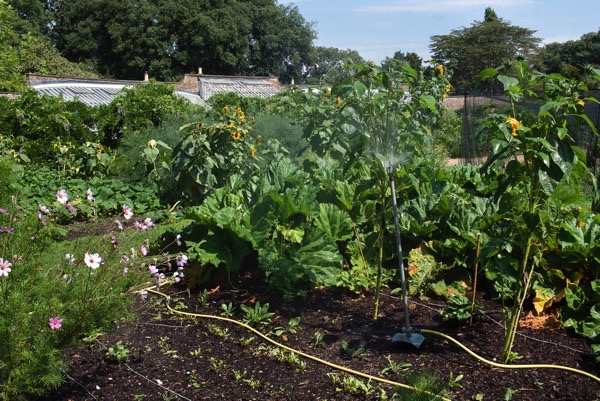
In recent years, Lucy has created an enchanted vegetable garden interwoven by flowers within the confines of this ancient walled enclave overlooked by the tower of All Saints, Fulham. I defy anyone not to be seduced by Lucy’s inspired planting combinations – purple gladioli and cabbages or carrots and marigolds – enfolded among old fruit trees and punctuated by long lines of runner beans.
This is the ultimate walled garden of romance, recalling The Secret Garden or Tom’s Midnight Garden, with a fine knot garden and magnificent architectural glasshouses filled by the pungent fragrance of tomato leaves, all within the embrace of crumbling Tudor walls lined with deep herbaceous borders.
Escaping the blinding sunlight at noon, Lucy, Sarah & I sought refuge within the shadow of a venerable apple tree. Lucy told us her story, revealing her horticultural passions, while the sprinklers tick-ticked around us casting rainbows as their showers of waterdrops fell upon the verdant foliage.
‘”For three and a half months, during lockdown, we had to close the gardens but we gardeners came in as usual. It was a strange, exciting time when we had this amazing garden to ourselves. Usually have a team of around fifty volunteers but we had none, so we prioritised the work to ensure we had vegetables and flowers to sell. A lot of the garden has been left to get on with it which is not a bad thing. We have loads of nettles now which support the butterfly population.
From March, we did online plant sales while all the garden centres were shut and people were desperate to plant something in their gardens – cosmos, zinnias, antirrhinums, that sort of thing, which I had propagated from seeds. All our tomato plants just went and we sold out of everything which we have never done before.
Yet we were desperate to open to public and we eventually did so on 29th June and that was when our volunteers came back again. I remember that being a really exciting and emotional time for us. It was sad that there had been non-one but us to see the echiums or the wisteria flowering in May. It took a lot of the fun out of it.
I have two small children as well, so I had to pay attention to them and their home schooling. I think everyone has had a busy year in different ways.
When I was thirteen, I started working on Saturdays at my local nursery in Wallington, Surrey, paying attention to the pelargoniums and seasonal bedding plants, salvias and busy lizzies. I took the job because I needed some cash but I thought, ‘I like this and I really quite enjoy it.’ I used to go home with my arms covered in little cuts from potting up roses but it was good fun.
I went to horticultural college at sixteen and worked at Merrist Wood for three years doing a diploma while living in halls. It was just so much fun and, for a year out, I worked on a nursery in Littlehampton. Then I did a degree in Horticulture at Writtle College and that broadened my horizons in terms of the scientific side. My background is in the production and propagation of plants.
It was then I started working in gardens, working for landscape companies doing domestic gardens, and got accepted for the Kew Diploma. That opened my eyes further to the botanical side of it all, which was a life-changing experience for me. I worked at Great Dixter, Powis Castle and for Beth Chatto, expanding my ideas of what a garden could be. Before that I was only working with seedlings, I never saw plants in flower!
I stayed at Kew Gardens for eight years before I got the job here at Fulham Palace Gardens. The walled garden was used to grow municipal wallflowers for the borough when I arrived. My brief was to bring the place back to life with a vegetable garden, involve the community and create a visitor attraction. The nineteenth century glasshouses had just been rebuilt and they dug out the moat. The wisteria was here and some old fruit trees, but otherwise it was quite empty.
Debs Goodenough, Head Gardener at Highgrove, came to give me advice and I remember walking round with her asking her, ‘Got any ideas?’ She had done a similar project at Osborne House.
We have a Tudor wall but the garden was laid out by Bishop Terrick in 1767 and planted by Bishop Longford in the eighteen-thirties. He put in the knot garden with box hedges, so I replanted that first. It means that when people walk through the gate, they immediately see flowers.
An archaeological investigation revealed that there were cross paths which we have reinstated. We did a big community archaeological dig, looking for garden archaeology revealing signs of how it might have been and we found these diagonal bed shapes, which inspired the layout for the vegetable garden we have today. But because there are no surviving plans I had free rein to do what I wanted, so it only has a loose relationship to an eighteenth century garden.
I was keen to plant around the existing trees and we also found old tree pits lined with clay to retain the moisture – it is so well drained here next to the Thames – so I decided to plant an orchard too. There is a record of there having been a plum orchard here. This garden is an ancient scheduled monument which brings some restrictions where we can plant trees. I have added espalier fruit trees – pears, quinces, apples, peaches, cherries and plums – and herbaceous borders along the walls, including the pollinators border which I only planted last year.
This garden has multiple roles. It is for education and I have three apprentices who each have a flower bed to grow their crop. They have to nurture and know it intimately, deciding when to water and when to thin it out. We also teach volunteers to grow vegetables and I do an introduction to vegetable growing for the general public too. The garden has a display value, people come to see the flowers and we sell our produce which is an important source of income.
We plant flowers among the vegetables so that beds are not bare but these companion plants are selected to repel parasites. We plant French marigolds throughout because they have an oily fragrance which repels aphids and black fly. The calendula are also the host of a beneficial insect which predates on pests. We grow organically here without using pesticides. Our worst pests are the squirrels who eat all the apples and the parakeets who are such lazy eaters, they just take one bite out of each apple. We even have a rabbit that lives in the churchyard who gnaws the newly-planted trees. I have only seen the one and I am still trying to find his burrow.
We sell all our vegetables and flowers but do I get a bit funny about the cabbages and lilies because I think they are so beautiful growing in the ground. We count ourselves really lucky to have this walled garden of thirteen acres for gardening in the middle of London.”




Photographs copyright © Sarah Ainslie
You may also like to read about my first visit
Geoffrey Fletcher’s Pavement Pounders
The work of Geoffrey Fletcher (1923–2004) is an inspiration to me, and today I am publishing his drawings of London’s street people in the nineteen sixties from Geoffrey Fletcher’s Pavement Pounders of 1967.

Charlie Sylvester -“I’m Charlie Sylvester, Charlie of Whitechapel. I’ve been on the markets over forty years. I can’t keep still too long, as I have to serve the customers. Then I must take me pram and go fer some more stock. Stock’s been getting low. I go all over with me pram, getting stock, I sell anythin’ – like them gardening tools, them baking tins and plastic mugs. All kinds of junk. Them gramophone records is classic, Ma, real classic stuff. Course they ain’t long playing? Wot do you expect? Pick where you like out of them baking tins. Well, I’ll be seeing you next you’re in Whitechapel. Don’t forget. Sylvester’s the name.”

Peanuts, Tower Hill – “We’ve only been doin’ this for a few months, me peanut pram and I. I only comes twice a week, Saturdays and Sundays. Sundays is best. It’s a hot day. Hope it will stay. I’m counting on it. How many bags do I sell in a day? I’ve never counted ’em. All I want is for to sell ’em out.”

Doing the Spoons, Leicester Sq -“I’ve been in London since 1932, doin’ the spoons, mostly. I does it when I’m not with the group – if they’re away or don’t show up. I’m about the only spoon man left. No, the police don’t bother us much – they know we’re old timers. We’re playing the Square tonight, later when the crowds will come.”

The Man with the X-Ray Eyes – “It’s the facial characteristics. I can usually guess within a year. It’s the emanations – that’s why they call me the man with the X-ray eyes. I’ve been doing it thirty-two years. Thirty -two years is a long time. I’m off-form today. Sometimes I am off-form and then I won’t take their money. I’m in show business. You see me on TV before the cameras. My show took London, Paris and New York by storm.”

Selections from ‘The Merry Widow,’ Oxford St – “You need a good breath for one o’ these. It’s called a euphonium. Write it down, same as when a man makes a euphemism at dinner. If I smoked or got dissipated, I couldn’t play. I can’t play the cornet, as it is, but that’s because I only have one tooth, as I’ll show you – central eating, as you say, Guv. I come from Oldham. When I was a boy of ten, I worked in Yates’ Wine Lodge, but I broke the glasses. I’m seventy-three now, too old for a job. But I don’t want a job, I have this – the euphonium. Life is an adventure, but things is bad today. People will do you down and not be ashamed of it. They’ll glory in it. Well, that’s it. My mother-in-law is staying with us so we have plenty to eat. She gives me the cold shoulder. I’m going for a cuppa tea. Have a nice summer and lots of luck.”

Lucky White Heather – “I’ve been selling on the London streets all my life, dearie. Selling various things – gypsy things – clothes pegs – it used to be clothes pegs. The men used to make them, but they won’t now – they’re onto other things. There wasn’t much profit in them, either. You sold them at three ha’pence a dozen. That was in the old days, dearie. Now I could be earning a pound while you’re drawing me. We comes every day from Kent. People like the lucky heather. But I’ll give you the white elephant – they’re very lucky. If they weren’t, we wouldn’t be selling them on the streets of London now, would we, dearie?”

Pavement Artist at Work, Trafalgar Sq – “I’ve been away two years, I haven’t been well, but I’m back again now. I’ve worked in other parts, but nearly always in London. Used to be outside the National Gallery, where I did Constable. I used to do copies of Constable. I do horses, dogs and other animals. The children like animals best, and give me money. I’m only playing about today, you might say. I haven’t prepared the stone. It gives it a smooth surface, makes the chalks sparkle. Makes them bright and clear, y’know. These pastels are too hard. I like soft ones, but everything’s gone up and I can’t afford them. Oh yes, I always clean off the stones. I won the prize for the best pavement artist in London.”

L.S.D. the Only Criterion, Tavistock Sq – “I’ve been here thirty years. I became a combined tipster and pavement artist because I had the talent, and because I believe in independence. Some people buy my drawings. I don’t go to the races now. I used to – Epsom, Ascot and all that. I have my regulars who come to see me and leave me money in my cap. That’s what it’s for. The rank and file are no good. It’s quiet Saturdays except when there’s a football match – Scoltand, say – and they stay round here. Weather’s been terrible – no-one about. Trafalgar Sq is where the money is, but they fights. I’ve sen the po-leece intervene when they’ve been fighting among themselves, and they say, ‘ere, move on, you?’ It’s money what’s at the bottom of it. Money an’ greed. Like I’ve got written here.”

The Best Friend You Have is Jesus – “Forty years I’ve been selling plants in London, and for over thirty years the Lord’s work has been done. In 1935, I was backing a dog – funnily enough it was called ‘Real Work’ – at New Cross. All at once, a small voice, the voice of the Lord, spoke to me and said ‘Abel (My name is Abel), I’ve got some real work for you to do.’ I gave up drink and dogs and got the posters on the barrow – the messages. I’ve been thousands of miles all over London doing the work of the Lord. London is wicked, and it’s getting worse. But God is merciful, and always gives a warning. It’s like Sodom and Gomorrah. The Lord says ‘Repent’ before His wrath comes. He could destroy London with an earthquake. Remember Noah? – how God wanted them to go in the Ark? But they wouldn’t. They said, ‘We’re going to have a good time…’ The Lord could destroy London with His elements. It dosen’t worry me as I’m doing the Lord’s work. Let these iris stand in water when you get ’em home.”

One Minute Photos, Westminster Bridge – “‘Happy Len,’ they call me, but my real name’s Anthony. Fifty years on the bridge. 1920 I came, and my camera was made in 1903. It’s the only one left. I have to keep patching it up. The man who made it was called ‘Moore,’ and he came from Dr Barnardo’s. They sent him to Canada, and he and a Canadian got together, a bit sharp like, and they brought out this camera. Died a millionaire. I’m seventy-three, and I’ve seen some rum ‘uns on the bridge. There was a woman who came up and took all her clothes off, and the bobby arrested her for indecent behaviour. Disgraceful. The nude, I mean. She was spoiling my pitch.”

Music in the Strand – “I had to make some money to live, and so I came to play in the streets. I’ve never played professionally, I play the piano as well but I never had much training. I’m usually here in the Strand but sometimes I play in Knightsbridge, sometimes in Victoria St. There’s not so many lady musicians about now. I only play classical pieces.”

Horrible Spiders – “Christmas time is the best for us, Guv, if the weather ain’t wet or cold. Then the crowds are good humoured. I like my picture and I’m going to pick out an extra horrible spider for you in return. I’ll tell you a secret – some of the spiders ain’t made of real fur. They’re nylon. But yours is real fur, and it’s very squeaky.”

Salty Bob – “Come round behind the stall and have a bottle of ale. It’s a sort of club, a private club. It’s a grand life sitting here drinking, watching the world go by. I’ve been selling salt and vinegar for fifty years and I’m seventy now. I’ve seen some changes. Take Camden Passage, it’s all antiques, like Chelsea, none of the originals left hardly. Let me pour you another drink. Here we are snug and happy in the sun. I’ve just picked up nine pounds on a horse, and I’ve got another good one for the four-thirty. Next time you’re passing, join me for another drop of ale. No, you can’t pay for it. You’ll be my guest, same as now, at our private club behind the bottles of non-brewed, an’ the bleach.”

Don’t Squeeze Me Till I’m Yours – “That’s a German accordion – they’re the best. Bought it cheap up in the Charing Cross Rd. I do the mouth organ too, this is an English one – fourteen shillings from Harrods. I began with a tin whistle and worked me way up. I’ve a room in Mornington Crescent. My wife died, luvly woman, thrombosis. I could see here everywhere, lying in bed and what not, so I cleared out. I got to livin’ in hostels. But I couldn’t stand the class of men. I work here Mondays, Fridays sometimes. I also work Knightsbridge and ‘ere. I work Aldgate Sundays. I do well there. I gets a fair livin.’ So long as I’ve got me rent, two pounds ten, and baccy money, I don’t want nothing else.”

A Barrel Organ Carolling Across a Golden Street – They received their maximum appreciation in the East End, in the days when the area was a world apart from the rest of London, and the appearance of a barrel organ in Casey Court, among patrons almost as hard pressed as the organist, meant an interval for music and dancing, while the poor little monkey, often a prey to influenza, performed his sad little capers on the organ lid.

Sandwich Man – Consult Madame Sandra – “It’s a poor life, you only get twelve shillings and sixpence a day and you can’t do much on that now, can you, sir? It was drink that got me, the drink. When I come off the farms, I became a porter at Clapham Junction, sir. I worked on the railways, but I couldn’t hold my job. So I dropped down, and this is what I do now. All you can say is you’re in the open air. Sometimes I sleep in a hostel, sometimes I stay out. Just now I’m sleeping out. It was the drink that done it, sir.”

Matchseller – “I was a labourer – a builder’s labourer – an’ I come frae Glasgow. I’ve not been down here in London verra long – eight years. Do i like it here? Weel, the peepull, the peepull are sociable, but they not gie you much, so you only exist. Just exist. I don’t sleep in no hostel, I sleep rough. I haven’t slept in a bed in four weeks. I sleep anywhere. I like a bench in the park or on the embankment. I like the freedom. Anywhere I hang my hat, it’s home sweet home to me.”

A Romany – Apart from the Romany women who sell heather and lucky charms in such places as Villiers St and Oxford St, the gypsies are rapidly disaapearing from Central London. Only occasionally do you see them at their traditional trade of selling. lace paper flowers of cowslips. Modern living vans are invariably smart turn-outs that have little in common with the carved and painted caravans of fifty years ago. They are with-it-gypises-O! Small colonies can still be found on East End bombsites, which the Romanies favour for winter quarters.

‘A Tiny Seed of Love,’ Piccadilly – “Oh yes, Guvnor, they’re good to me if the weather’s fine. Depends on the weather. I can’t play well enough, as you might say. I used to travel all over, four or five of us, saxo, drums, like that. Sometimes there was as many as eight of us. Then it got dodgy. I’m an old hand now. I’ve settled down. I got two rooms at thirty-two bob a week, Islington way. Where could you get two rooms for sixteen shillings each in London? I can easily get along at the price I pay. What’s more, I’ve married the woman who owns the house, too. She’s eight years older than I am, but we get along amicable.”
You may also like to read
Down Among the Meths Men with Geoffrey Fletcher
and take a look at
On Missing Mr Pussy In Summer
In these dreamy days of high summer, I often think of my old cat Mr Pussy

While Londoners luxuriate in the warmth of summer, I miss Mr Pussy who endured the hindrance of a fur coat, spending his languorous days stretched out upon the floor in a heat-induced stupor. As the sun reached its zenith, his activity declined and he sought the deep shadow, the cooling breeze and the bare wooden floor to stretch out and fall into a deep trance that could transport him far away to the loss of his physical being. Mr Pussy’s refined nature was such that even these testing conditions provided an opportunity for him to show grace, transcending dreamy resignation to explore an area of meditation of which he was the supreme proponent.
In the early morning and late afternoon, you would see him on the first floor window sill here in Spitalfields, taking advantage of the draught of air through the house. With his aristocratic attitude, Mr Pussy took amusement in watching the passersby from his high vantage point on the street frontage and enjoyed lapping water from his dish on the kitchen window sill at the back of the house, where in the evenings he also liked to look down upon the foxes gambolling in the yard.
Whereas in winter it was Mr Pussy’s custom to curl up in a ball to exclude drafts, in these balmy days he preferred to stretch out to maximize the air flow around his body. There was a familiar sequence to his actions, as particular as stages in yoga. Finding a sympathetic location with the advantage of cross currents and shade from direct light, at first Mr Pussy sat to consider the suitability of the circumstance before rolling onto his side and releasing the muscles in his limbs, revealing that he was irrevocably set upon the path of total relaxation.
Delighting in the sensuous moment, Mr Pussy stretched out to his maximum length of over three feet long, curling his spine and splaying his legs at angles, creating an impression of the frozen moment of a leap, just like those wooden horses on fairground rides. Extending every muscle and toe, his glinting claws unsheathed and his eyes widened gleaming gold, until the stretch reached it full extent and subsided in the manner of a wave upon the ocean, as Mr Pussy slackened his limbs to lie peacefully with heavy lids descending.
In this position that resembled a carcass on the floor, Mr Pussy could undertake his journey into dreams, apparent by his twitching eyelids and limbs as he ran through the dark forest of his feline unconscious where prey were to be found in abundance. Vulnerable as an infant, sometimes Mr Pussy cried to himself in his dream, an internal murmur of indeterminate emotion, evoking a mysterious fantasy that I could never be party to. It was somewhere beyond thought or language. I could only wonder if his arcadia was like that in Paolo Uccello’s “Hunt in the Forest” or whether Mr Pussy’s dreamscape resembled the watermeadows of the River Exe, the location of his youthful safaris.
There was another stage, beyond dreams, signalled when Mr Pussy rolled onto his back with his front paws distended like a child in the womb, almost in prayer. His back legs splayed to either side, his head tilted back, his jaw loosened and his mouth opened a little, just sufficient to release his shallow breath – and Mr Pussy was gone. Silent and inanimate, he looked like a baby and yet very old at the same time. The heat relaxed Mr Pussy’s connection to the world and he fell, he let himself go far away on a spiritual odyssey. It was somewhere deep and somewhere cool, he was out of his body, released from the fur coat at last.
Startled upon awakening from his trance, like a deep-sea diver ascending too quickly, Mr Pussy squinted at me as he recovered recognition, giving his brains a good shake, once the heat of the day had subsided. Lolloping down the stairs, still loose-limbed, he strolled out of the house into the garden and took a dust bath under a tree, spending the next hour washing it out and thereby cleansing the sticky perspiration from his fur.
Regrettably the climatic conditions that subdued Mr Pussy by day, also enlivened him by night. At first light, when the dawn chorus commenced, he stood on the floor at my bedside, scratched a little and called to me. I woke to discover two golden eyes filling my field of vision. I rolled over at my peril, because this provoked Mr Pussy to walk to the end of the bed and scratch my toes sticking out under the sheet, causing me to wake again with a cry of pain. I miss having no choice but to rise, accepting his forceful invitation to appreciate the manifold joys of early morning in summer in Spitalfields, because it was not an entirely unwelcome obligation.

You may also like to read
Mr Pussy Gives his First Interview

Click here to order a signed copy for £15

John Bringhurst, Seditious Printer
Sally Jeffery, author of DISSENTING PRINTERS, the intractable men and women of a
17th century Quaker Press, introduces seditious printer John Bringhurst who was apprenticed in Holywell Lane in Shoreditch and set up his press in Gracechurch St in the City of London

The book printer by Jan Luyken, 1694
On 3rd October 1685, a spy named Edmund Everard sent this intelligence from Amsterdam to the British envoy at the Hague, revealing the treasonous duplicity of a London printer:
‘A quaker, who is a german & a bookseller whose shop was about Peters ally in Gracious Street London who was concerned in printing the said Monm. Declaration is expected evry day to make his Escape from London, as I am told by his own brother a journey man shoemaker & young printer likewise (who was in Atterbury the Messengers hand for some time) this young man tells me the found of that matter thus, that Thomas Weeks a silkman in Peters allee (Landlord to the said Quaking bookseller) together with Mr Disny procured Churchill (him that is here fled) to lend his Presse to the said quaker for to print the said treasonable Declaration.’
The individual expected in Amsterdam was John Bringhurst. He rented premises on Gracechurch St from Thomas Weeks, a lutestring merchant in Corbet’s Court. The trade had nothing to do with musical instruments, it was just a word-shift from French lustrine and Weeks dealt in lustrous silk fabrics for dresses. He was also politically engaged. In 1683 he had been involved in the Rye House plot to assassinate Charles II and his brother James. Although it never got beyond the planning stage, it led to multiple trials and executions.
Two years later when the openly Catholic James succeeded his brother as king, the cause took on a new urgency. The plan now was to overthrow James II and in his place install Charles’s natural son, James Duke of Monmouth. For some of the much-persecuted Quakers, a new revolt offered a better hope of religious freedom than a court in thrall to the absolutist French king. The rebellion failed disastrously and there was a hurried exodus of London conspirators to Amsterdam.
John Bringhurst was not German – as the intelligence believed – he was baptised in 1652 at St Michael Bassishaw in the City of London, son of a navy surgeon. When his father died, he was apprenticed to the Shoreditch printing house of Andrew Sowle, the first Quaker printer in London. The press was in Holywell Lane, once the location of a priory of Augustinian nuns and still there today.
Andrew Sowle’s press was frequently raided by Stationers’ Company men. Although Shoreditch was outside the City’s jurisdiction the Company operated as an arm of government, looking for evidence of sedition. In 1678 while Bringhurst was a journeyman there, they discovered ‘a private printing press and cases in two upper rooms, to which there was no passage but through trap doors. There they found parts of several scandalous and unlicensed books, printing and printed, which the said Souls acknowledged he had printed. He is the person that a considerable parcel of books was taken from formerly.’
That earlier raid referred to was on premises in Moorfields belonging to one John Casimere, which had produced ‘three cartloads of unlicensed and seditious bookes written by a sort of people called Quakers’. Bringhurst would have experienced many such raids, as would Andrew Sowle’s three daughters, all of whom grew up to be printers. The youngest, Tace, succeeded her father, moved the press to Lombard Street and ran it for fifty years.
Bringhurst set up on his own in 1680 with George Fox’s support and became a printer to the Friends with a shop was on Gracechurch Street at the sign of the Book. Nearby was the Gracechurch Meeting House, the centre of Quaker life, and many of the businesses in the surrounding streets were owned by Friends. It was a progressive enclave lodged within the mercantile city.
Bringhurst married Rosina Prache Matern, daughter and widow of Behmenist refugees from Silesia. When her family arrived in London the Friends rented a house in Holywell Court for them. Rosina’s first husband worked as a schoolmaster at the Friends’ school at Edmonton, her scholarly father Hilarius Prache corrected proofs for Andrew Sowle at £10 per annum while her mother and sister were engaged in silk-weaving in Spitalfields.
In 1683 the Bringhursts crossed Gracechurch St to Leadenhall’s eastern side, with a shop at ‘the sign of the Book and Three-Black-Birds in Leaden-Hall Mutton-Market, commonly called the Green-Yard’. It was reached by a passage from Gracechurch Street between the Black Bull and Colchester Arms. Bull’s Head Passage is still there, across the street from Corbet Court.
When Thomas Weeks recruited Bringhurst to print the Duke of Monmouth’s incendiary ‘Declaration for the defence and vindication of the protestant religion and of the laws, rights and privileges of England from the invasion made upon them, and for delivering the Kingdom from the usurpation and tyranny of us by the name of James, Duke of York,’ they took the precaution of doing it outside the City of London.
A sympathetic bookseller let them use his press in Lambeth and the printing was supervised by another conspirator, William Disney. Bringhurst brought along an assistant – his wife’s younger brother Ephraim who, as a bored shoemaker’s apprentice, may simply have been hoping for a bit of adventure. What happened next would change his life too.
Four days after Monmouth landed at Lyme Regis in Dorset with his army, the Lambeth press was raided. Only Disney was caught, because work had paused for the night. At the trial, a messenger gave evidence that he broke into Disney’s apartment and found him in bed with his maid. He then got into the printing house where he discovered about 750 Declarations printed on one side and five completed.
Disney was tried for treason and hanged, the Declarations were burned by the public hangman, but Weeks disappeared. Bringhurst made no immediate move until he heard a rumour that Weeks was taken, then he fled across the channel. ‘Speedier means & wings were afforded to him to gett out of the way’, reported Edmund Everard in Amsterdam.
Amsterdam was already crowded with fugitives, the survivors of several seditious conspiracies. By the time William of Orange landed at Torbay in 1688, most of them had returned home but John Bringhurst remained in Amsterdam with his wife Rosina who had followed him there. When her father Hilarius Prache died, her remaining family in London emigrated once more, to Germantown in Philadelphia. They tried to persuade the Bringhursts to join them, but John ‘could not be prevaild with to cross the ocean to a new Country in his old age’.
Bringhurst was only in his forties, no great age even then. Perhaps he felt unwilling to return to life among the Quakers who had turned away from him in 1685, even though he had not taken up arms but simply printed a call for liberty of conscience. He chose to remain in the pluralistic Dutch Republic and died there in 1700, buried in the Westerkerkhof in Amsterdam.

This grimy copy of Monmouth’s Declaration was taken from a captured rebel

An initial with pinks printed by John Bringhurst in a George Fox epistle

Holywell Lane, Shoreditch, where John Bringhurst was apprenticed to Andrew Sowle, the first Quaker printer in London

Bull’s Head Passage, City of London, where John Bringhurst set up his printing shop in 1683

In London, the Bringhurts lived around the corner from Leadenhall Market. Depicted in the The Microcosm of London, 1809 ( Courtesy Bishopsgate Institute)

In Amsterdam, the Bringhursts lived around the corner from this market. The Nieuwezijds Voorburgswal with the Flower Market, Amsterdam, Gerrit Adriaensz Berckheyde, 1686 (Courtesy Museo Thyssen-Bornemisza, Madrid)
You may also like to read about


