
List Of Local Shops Open For Business

Boy in Woolworths, Exmouth Market, Clerkenwell, 1954
This is the list of essential shops that are open in Spitalfields and vicinity during the current lockdown. Readers are especially encouraged to support small independent businesses who offer an invaluable service to the community. This list confirms that it is possible to source all essential supplies locally without recourse to supermarkets.
Be advised many shops are operating limited opening hours at present, so I recommend you call in advance to avoid risking a wasted journey. Please send any additions or amendments for next week’s list to spitalfieldslife@gmail.com
This week’s photographs are by Colin O’Brien.

Two women and a baby in Woolworths, Exmouth Market, Clerkenwell, 1954
GROCERS & FOOD SHOPS
The Albion, 2/4 Boundary St
Ali’s Mini Superstore, 50d Greatorex St
AM2PM, 210 Brick Lane
Planet Organic, 132 Commercial St
Banglatown Cash & Carry, 67 Hanbury St
Breid Bakery, Arch 72, Dunbridge St
Brick Lane Minimarket, 100 Brick Lane
The Butchery Ltd, 6a Lamb St
City Supermarket, 10 Quaker St
Costprice Minimarket, 41 Brick Lane
Faizah Minimarket, 2 Old Montague St
JB Foodstore, 97 Brick Lane
Haajang’s Corner, 78 Wentworth St
Leila’s Shop, 17 Calvert Avenue
Nisa Local, 92 Whitechapel High St
Pavilion Bakery, 130 Columbia Rd
Rinkoff’s Bakery, 224 Jubilee Street & 79 Vallance Rd
Sylhet Sweet Shop, 109 Hanbury St
Taj Stores, 112 Brick Lane
Zaman Brothers, Fish & Meat Bazaar, 19 Brick Lane

Girl with ice cream cone, 1963
TAKE AWAY FOOD SHOPS
Before you order from a delivery app, why not call the take away or restaurant direct?
Absurd Bird Fried Chicken, 54 Commercial St
Al Badam Fried Chicken, 37 Brick Lane
Allpress Coffee, 58 Redchurch St
The Association, 10-12 Creechurch Lane
Band of Burgers, 22 Osborn St
Beef & Birds, Brick Lane
Beigel Bake, 159 Brick Lane
Beigel Shop, 155 Brick Lane
Bellboi Coffee, 104 Sclater St
Bengal Village, 75 Brick Lane
Big Moe’s Diner, 95 Whitechapel High St
Burro E Salvia Pastificio, 52 Redchurch St
Cafe 388, 388 Bethnal Green Rd
China Feng, 43 Commercial St
Circle & Slice Pizza, 11 Whitechapel Rd
Crosstown Doughnuts, 157 Brick Lane
Dark Sugars, 45a Hanbury St (Take away ice cream and deliveries of chocolate)
Donburi & Co, Korean & Japanese, 13 Artillery Passage
Eastern Eye Balti House, 63a Brick Lane
Enso Thai & Japanese, 94 Brick Lane
Exmouth Coffee Shop, 83 Whitechapel High St
Grounded Coffee Shop, 9 Whitechapel Rd
Holy Shot Coffee, 155 Bethnal Green Rd
Hotbox Smoked Meats, 46-48 Commercial St
Jack The Chipper, 74 Whitechapel High St
Jonestown Coffee, 215 Bethnal Green Rd
Laboratorio Pizza, 79 Brick Lane
La Cucina, 96 Brick Lane
Leon, 3 Crispin Place, Spitalfields Market
Madhubon Sweets, 42 Brick Lane
Mooshies Vegan Burgers, 104 Brick Lane
Nude Expresso, The Roastery, 25 Hanbury St
E. Pellicci, 332 Bethnal Green Rd
Pepe’s Peri Peri, 82 Brick Lane
Peter’s Cafe, 73 Aldgate High St
Picky Wops Vegan Pizza, 53 Brick Lane
Polo Bar, 176 Bishopsgate
Poppies, 6-8 Hanbury St
Quaker St Cafe, 10 Quaker St
Rajmahal Sweets, 57 Brick Lane
Rosa’s Thai Cafe, 12 Hanbury St
Shawarma Lebanese, 84 Brick Lane
Shoreditch Fish & Chips, 117 Redchurch St
Sichuan Folk, 32 Hanbury St
String Ray Globe Cafe, 109 Columbia Road
Sushi Show, 136 Bethnal Green Rd
Vegan Yes, Italian & Thai Fusion, 64 Brick Lane
The Watch House, 139 Commercial St
White Horse Kebab, 336 Bethnal Green Rd
Yuriko Sushi & Bento, 48 Brick Lane

Clothes shop cat, seventies
OTHER SHOPS & SERVICES
Brick Lane Bookshop, 166 Brick Lane (Books ordered by phone or email are delivered free locally)
Brick Lane Bikes, 118 Bethnal Green Rd
Day Lewis Pharmacy, 14 Old Montague St
E1 Cycles, 4 Commercial St
Eden Floral Designs, 10 Wentworth St (Order fresh flowers online for free delivery)
Flashback Records, 131 Bethnal Green Rd (Order records online for delivery)
GH Cityprint, 58-60 Middlesex St
Harry Brand, 122 Columbia Road (Order gifts online for delivery)
Leyland Hardware, 2-4 Great Eastern St
Newman’s Stationery, 324 Bethnal Green Rd (Call for local delivery)
Post Office, 160a Brick Lane
Rose Locksmith & DIY, 149 Bethnal Green Rd
Sid’s DIY, 2 Commercial St

Girl with pram, Kingsland Rd, eighties
ELSEWHERE
E1 Dry Cleaners, Cannon Street Rd, E1 2LY
E5 Bakehouse, Arch 395, Mentmore Terrace, London Fields (Customers are encouraged to order online and collect in person)
Gold Star Dry Cleaning & Laundry, 330 Burdett Rd
Hackney Essentials, 235 Victoria Park Rd
Quality Dry Cleaners, 16a White Church Lane
Newham Books, 747 Barking Rd (Books ordered by phone or email are posted out)
Old Bank Vault Gallery, 283 Hackney Rd (Order online)
Rajboy, 564 Commercial Rd, E14 7JD (Take away service available)
Region Choice Chemist, 68 Cambridge Heath Rd
Symposium Italian Restaurant, 363 Roman Road (Take away service available)
Thompsons DIY, 442-444 Roman Rd

Woman in a summer dress, Chatsworth Rd, Hackney, eighties
Images copyright @ Estate of Colin O’Brien
You may also like to take a look at
Lew Tassell’s Day Trip
Lew Tassell sent me these pictures that he took on a trip to London at fifteen years old in 1966

Old London Bridge
‘These pictures were taken in March 1966 with my first proper camera, albeit only a Zeiss Ikon Ikonette with a 35mm fixed lens viewfinder that cost me £7 secondhand. I loved that camera and wish I still had it, it had no metering or any features so it taught me a lot.
Film and developing were very expensive, so I had to be frugal with my picture-taking and then wait for them to be developed to see if I had judged the exposure correctly.
I was fifteen years old, living with my parents in South London and just about to leave school. I used to catch a train from Elmers End to Charing Cross – returning via London Bridge – and explore, usually taking in a visit to the National Gallery.’

‘My school friend, Paul, on one of Landseer’s Lions in Trafalgar Sq, he was instantly told to ‘get orf’ by a policeman’

‘I always found Piccadilly Circus magical and ever-changing. There was not much neon during the sixties and the buildings were generally dirty and grey, but the West End was a place with lively streets, especially this spot with the cinemas and theatres.’

The classic Coca-Cola sign

‘Carnaby St was a tremendously exciting place for a teenager to wander about. I didn’t have the money to buy anything but just to be there was enough’

John Stephen’s celebrated menswear shop in Carnaby St, clothes worn by The Who, The Kinks, The Rolling Stones and The Small Faces

‘Spot the Rolls Royce coming round the corner’

‘Spot the sandwich man for ‘Champagne Temps”

Looking across Carnaby St to Foubert’s Place

Lord Kitchener’s Valet sold military uniform as fashion, customers included Jimi Hendrix, John Lennon and Mick Jagger

Crowded pavements in Carnaby St

Old Cannon St Railway Station from Southwark Bridge

Eastcheap corner of Pudding Lane

Guy’s Hospital under construction by London Bridge Station

Tower of London in the mist

Old men sitting by the Tower

Cannons on the waterfront at the Tower

A foggy, soot-stained Tower Bridge

‘In the Pool Of London – one of my earliest memories is standing in this spot with my father, watching the ships being unloaded in the centre of the City’

‘Police launch on the Thames – four years later I joined the City of London Police’
Photographs copyright © Lew Tassell
You may also like to take a look at
On Night Patrol With Lew Tassell
On Top Of Britannic House With Lew Tassell
A Walk Around The Docks With Lew Tassell
Minor Stepney Disasters Of The Seventies
Photographer Philip Cunningham set me this series of minor Stepney disasters of the seventies

Milk spillage in Bancroft Rd
“In the seventies, when I was studying photography, I carried a camera with me most of the time. The East End was a very lively place in those days and all sorts of things happened, both good and bad, all the time. I never sought out disasters, I just stumbled upon them and the wonder is that, as far as I know, nobody was seriously harmed.
The Mile End Rd leads right into the city and it is straight and safe, but drivers took incredible risks. The car crash happened just at the end of Mile End Place where I lived.
The flat fire in Alderney Rd was tragic, I do not know how it started but everything inside was destroyed. The poor occupant was standing in her dressing gown, devastated. Many more people smoked then and fire-proofed furniture had not been heard of.
One day, after I had dropped my daughter off at school in Cephas St and was late for college, I heard a smash of breaking glass. I ran back to discover the milk disaster. I took a few photos but, curiously, the milkman had disappeared. When I returned in the afternoon to collect my daughter from school, everything had been cleared up, not a even a trace of any broken glass or spilt milk.
The dustcart fire was in Harford St. Like the other disasters, it something I just happened to stumble across. The engine had caught fire and the cart was a write-off, but no-one was hurt.”
Philip Cunningham

Fire in Alderney Rd


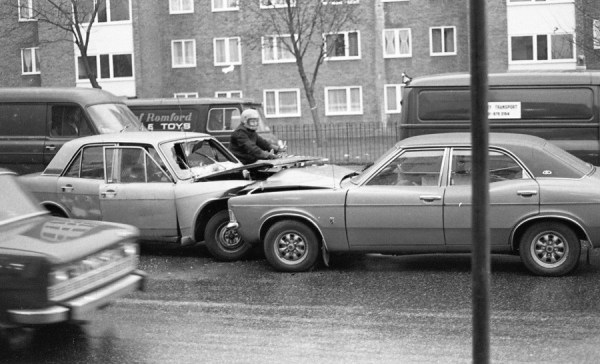
Car crash in Mile End Rd


Dustcart fire in Harford St


Milk spillage in Bancroft Rd


Photographs copyright © Philip Cunningham
You may also like to take a look at
The Juvenile Almanac
Now that we can look forward to life beyond lockdown, I thought this might be a good moment to present this almanac from the eighteen-twenties, published by Hodgson & Co, 10 Newgate St. I am grateful to Sian Rees for drawing my attention to these wonderful images.


Images courtesy University of California Libraries
You may also like to take a look at
Wilful Destruction At The Truman Brewery

“What has happened is unquestionably vandalism” – Dan Cruickshank
Last year, Dan Cruickshank made a survey of the historic fabric of the Old Truman Brewery to ensure that these elements would be preserved in any redevelopment of the site, which sits within the Fournier St and Brick Lane Conservation Area. The owners have responded by destroying a large area of old granite paviours and setts in the large yard east of Brick Lane that Dan identified as original, thus avoiding the possibility of any restriction upon their future development plans in this area.
The work was undertaken covertly on Thursday 28th and Friday 29th January when the yard was cordoned off by security guards while mechanical diggers removed the surface and the debris was hastily taken away on trucks.
When the Spitalfields Trust contacted Tower Hamlet Council on Thursday 28th to halt the destruction, the owners of the brewery justified their action as ‘repair.’ The enforcement officers accepted this explanation and took no action.
On Monday 1st February, when the Trust supplied photographic evidence, Planning Enforcement acknowledged that “the works appear to go beyond that which may be considered a repair.”
On Tuesday 2nd February, when the Trust formally requested the reinstatement of the historic paving, Planning Enforcement admitted that what had taken place was unlawful – “the extent of the work that has been carried out is such that there is a breach of planning control.” By this point the entire surface of the yard had gone.
The owners of the Old Truman Brewery are currently seeking planning permission to build an ugly shopping mall with four floors of corporate offices on top at the corner of Brick Lane and Woodseer St. The Spitalfields Trust are campaigning to halt this development and advocating the creation of a Planning Brief for the entire brewery site which takes into account both conservation and the needs of the local community, especially for housing.
Through their destructive action, the brewery owners have revealed themselves to be unscrupulous with no respect for history or the community. These pitiful events emphasise the importance of stopping their proposed development and the necessity of a Planning Brief for the entire brewery site that will curb their greedy profit-driven ambitions.
Please register your objection to the redevelopment if you have not yet done so. You will find instructions below.

Original granite paving dug up and removed
“The central square, now once again largely open, also retains some remarkable areas of paving… This combination of materials gives this area something of the beauty and mystery of an antique ruin, like parts of Pompeii, with the well judged and skilful laying of the setts reminiscent of a Roman tessellated pavement. The central area of the court also retains large areas of early and well laid setts, their form and location marking, to a degree, the location of lost brewery buildings. These historic and well-crafted surfaces possess great beauty.” Dan Cruickshank
Click here to read Dan Cruickshank’s Survey of the Truman Brewery

Workshop in the eastern yard of the brewery with granite setts

Joiner’s shop in the eastern yard of the brewery with granite setts

The former cooperage in the eastern yard with granite setts

The large pale grey areas in this aerial view are the granite paving that has ben removed

Will these granite surfaces marked with centuries of use by drays be dug up next?

These original granite setts from when this was once part of Wilkes St are at risk of destruction


Photographs by Dan Cruickshank

THE BLOCK ON BRICK LANE
The owners of the Old Truman Brewery want to build an ugly shopping mall with four floors of corporate offices on top at the corner of Woodseer St and Brick Lane.
- It will undermine the authentic cultural quality of Brick Lane.
- The generic architecture is too tall and too bulky, ruining the Brick Lane & Fournier St Conservation Area.
- It offers nothing to local residents whose needs are for genuinely affordable homes and workspaces.
- It is an approach that is irrelevant to a post-Covid world, with more people working from home and shopping locally or online.
- Where it meets the terraces of nineteenth century housing, the development is out of scale and causes up to 60% loss of light.
HOW TO OBJECT
Lodge an objection to the Old Truman Brewery development by writing a personal letter to Tower Hamlets Council as soon as possible.
Please write in your own words and head it OBJECTION.
Quote Planning Application PA/20/00415/A1
Anyone can object wherever they live. Members of one household can each write separately. You must include your postal address.
Send your objection by email to Patrick.Harmsworth@towerhamlets.gov.uk
Or by post to:
Planning Department,
Town Hall, Mulberry Place,
5 Clove Crescent,
London, E14 2BG
Frank Merton Atkins, Photographer
A collection of photographs by Frank Merton Atkins – including these splendid pictures of City churches – were given to the Bishopsgate Institute by his daughter Enid Ghent who had kept them in her loft since he died in 1964.
‘My father worked as a cartographer for a company of civil engineers in Westminster and he drew maps of tram lines,’ Enid recalled, ‘Both his parents were artists and he carried a camera everywhere. He loved to photograph old pubs, especially those that were about to be demolished. Sometimes he got up early in the morning to take photographs before work and at other times he went out on photography excursions in his lunch break. He was always looking around for photographs.’
Captions by Frank Merton Atkins

Christ Church, Spitalfields, 1 October 1957

All Hallows Staining Tower, 25 June 1957, 1.22pm

Cannon Street, looking west from corner of Bush Lane, 7 June 1957, 8.21am

St Botolph Aldgate, from Minories, 31 May 1960, 1.48pm

St Bride from Carter Lane, 31 May 1956, 8.20am

St Clement Danes Church, Strand, from Aldwych, 14 October 1958, 1.22pm

St Dunstan in the East (seen from pavement in front of Custom House), 13 June 1956, 1.14pm

St George Southwark, from Borough High Street, 14 August 1956, 8.15am

St James Garlickhithe, from Queenhithe, 20 May 1957, 8.23am

St Katherine Creechurch, 27 May 1957, 8.32am

St Magnus the Martyr, from the North, 26 June 1956, 8.17am

St Magnus the Martyr, Lower Thames Street, 26 June 1956, 8.23am

St Margaret Lothbury, 2 August 1957, 1.12pm

St Margaret Pattens, from St Mary At Hill, 13 June 1956, 1pm

St Mary Woolnoth, 8 August 1956, 5.49pm

St Pauls Church, Dock Street, Whitechapel, 3 September 1957, 1.09pm

St Pauls and St Augustine from Watling Street, 7 May 1957, 8.25am

St Vedast, from Wood Street, 30 July 1956, 8.17am
Photographs courtesy Bishopsgate Institute
You may also like to look at
List Of Local Shops Open For Business

Rabbits! Who will buy my nice fat rabbits?
This is the list of essential shops that are open in Spitalfields and vicinity during the current lockdown. Readers are especially encouraged to support small independent businesses who offer an invaluable service to the community. This list confirms that it is possible to source all essential supplies locally without recourse to supermarkets.
Be advised many shops are operating limited opening hours at present, so I recommend you call in advance to avoid risking a wasted journey. Please send any additions or amendments for next week’s list to spitalfieldslife@gmail.com
This week’s illustrations are by William Craig Marshall’s from his ‘Itinerant Traders of London in their Ordinary Costume with Notices of Remarkable Places given in the Background’ of 1804. Click here to see more

Mackerel, Billingsgate
GROCERS & FOOD SHOPS
The Albion, 2/4 Boundary St
Ali’s Mini Superstore, 50d Greatorex St
AM2PM, 210 Brick Lane
Planet Organic, 132 Commercial St
Banglatown Cash & Carry, 67 Hanbury St
Breid Bakery, Arch 72, Dunbridge St
Brick Lane Minimarket, 100 Brick Lane
The Butchery Ltd, 6a Lamb St
City Supermarket, 10 Quaker St
Costprice Minimarket, 41 Brick Lane
Faizah Minimarket, 2 Old Montague St
JB Foodstore, 97 Brick Lane
Haajang’s Corner, 78 Wentworth St
Leila’s Shop, 17 Calvert Avenue
Nisa Local, 92 Whitechapel High St
Pavilion Bakery, 130 Columbia Rd
Rinkoff’s Bakery, 224 Jubilee Street & 79 Vallance Rd
Sylhet Sweet Shop, 109 Hanbury St
Taj Stores, 112 Brick Lane
Zaman Brothers, Fish & Meat Bazaar, 19 Brick Lane

Cats & Dogs Meat, outside Bethlem Hospital, Moorfields
TAKE AWAY FOOD SHOPS
Before you order from a delivery app, why not call the take away or restaurant direct?
Absurd Bird Fried Chicken, 54 Commercial St
Al Badam Fried Chicken, 37 Brick Lane
Allpress Coffee, 58 Redchurch St
The Association, 10-12 Creechurch Lane
Band of Burgers, 22 Osborn St
Beef & Birds, Brick Lane
Beigel Bake, 159 Brick Lane
Beigel Shop, 155 Brick Lane
Bellboi Coffee, 104 Sclater St
Bengal Village, 75 Brick Lane
Big Moe’s Diner, 95 Whitechapel High St
Burro E Salvia Pastificio, 52 Redchurch St
Cafe 388, 388 Bethnal Green Rd
China Feng, 43 Commercial St
Circle & Slice Pizza, 11 Whitechapel Rd
Crosstown Doughnuts, 157 Brick Lane
Dark Sugars, 45a Hanbury St (Take away ice cream and deliveries of chocolate)
Donburi & Co, Korean & Japanese, 13 Artillery Passage
Eastern Eye Balti House, 63a Brick Lane
Enso Thai & Japanese, 94 Brick Lane
Exmouth Coffee Shop, 83 Whitechapel High St
Grounded Coffee Shop, 9 Whitechapel Rd
Holy Shot Coffee, 155 Bethnal Green Rd
Hotbox Smoked Meats, 46-48 Commercial St
Jack The Chipper, 74 Whitechapel High St
Jonestown Coffee, 215 Bethnal Green Rd
Laboratorio Pizza, 79 Brick Lane
La Cucina, 96 Brick Lane
Leon, 3 Crispin Place, Spitalfields Market
Madhubon Sweets, 42 Brick Lane
Mooshies Vegan Burgers, 104 Brick Lane
Nude Expresso, The Roastery, 25 Hanbury St
E. Pellicci, 332 Bethnal Green Rd
Pepe’s Peri Peri, 82 Brick Lane
Peter’s Cafe, 73 Aldgate High St
Picky Wops Vegan Pizza, 53 Brick Lane
Polo Bar, 176 Bishopsgate
Poppies, 6-8 Hanbury St
Quaker St Cafe, 10 Quaker St
Rajmahal Sweets, 57 Brick Lane
Rosa’s Thai Cafe, 12 Hanbury St
Shawarma Lebanese, 84 Brick Lane
Shoreditch Fish & Chips, 117 Redchurch St
Sichuan Folk, 32 Hanbury St
String Ray Globe Cafe, 109 Columbia Road
Sushi Show, 136 Bethnal Green Rd
Vegan Yes, Italian & Thai Fusion, 64 Brick Lane
The Watch House, 139 Commercial St
White Horse Kebab, 336 Bethnal Green Rd
Yuriko Sushi & Bento, 48 Brick Lane

Hair & Hearth Brooms, outside Shoreditch Church
OTHER SHOPS & SERVICES
Brick Lane Bookshop, 166 Brick Lane (Books ordered by phone or email are delivered free locally)
Brick Lane Bikes, 118 Bethnal Green Rd
Day Lewis Pharmacy, 14 Old Montague St
E1 Cycles, 4 Commercial St
Eden Floral Designs, 10 Wentworth St (Order fresh flowers online for free delivery)
Flashback Records, 131 Bethnal Green Rd (Order records online for delivery)
GH Cityprint, 58-60 Middlesex St
Harry Brand, 122 Columbia Road (Order gifts online for delivery)
Leyland Hardware, 2-4 Great Eastern St
Newman’s Stationery, 324 Bethnal Green Rd (Call for local delivery)
Post Office, 160a Brick Lane
Rose Locksmith & DIY, 149 Bethnal Green Rd
Sid’s DIY, 2 Commercial St

Bellows to Mend, Smithfield
ELSEWHERE
E1 Dry Cleaners, Cannon Street Rd, E1 2LY
E5 Bakehouse, Arch 395, Mentmore Terrace, London Fields (Customers are encouraged to order online and collect in person)
Gold Star Dry Cleaning & Laundry, 330 Burdett Rd
Hackney Essentials, 235 Victoria Park Rd
Quality Dry Cleaners, 16a White Church Lane
Newham Books, 747 Barking Rd (Books ordered by phone or email are posted out)
Rajboy, 564 Commercial Rd, E14 7JD (Take away service available)
Region Choice Chemist, 68 Cambridge Heath Rd
Symposium Italian Restaurant, 363 Roman Road (Take away service available)
Thompsons DIY, 442-444 Roman Rd

Hot Spiced Gingerbread
Images courtesy Bishopsgate Institute
You may also like to take a look at


