
Bethnal Green Mulberry At The High Court
The public hearing of our Judicial Review commences at the High Court at 2pm today, Wednesday 5th May. Proceedings will run until 4:30pm this afternoon and recommence tomorrow at 10:30am.
Click this link to watch the hearing live
Please note you must not make any recording of any part of this hearing and to do so would be a contempt of court.

It was April 24th 2015 when I first encountered the Bethnal Green Mulberry, the oldest tree in the East End. Little did I imagine then where that introduction might lead.
Today – thanks to generosity of our supporters – a Judicial Review commences at the High Court of Tower Hamlets’ decision to grant permission to Crest Nicholson for their redevelopment of the former London Chest Hospital, including digging up the five hundred year old Bethnal Green Mulberry. Top QC Richard Harwood OBE will be leading our case, dissecting the six ways in which we believe Tower Hamlets Council acted unlawfully in approving this planning application.
It has been a long and eventful journey over the past six years since April 2015, including photographing many other historic London Mulberries, gathering a petition of over 16,000 signatures, welcoming Dame Judi Dench as patron of our campaign and breaking my right arm, falling out of a Mulberry Tree in Bethnal Green while picking fruit.
We have taken cuttings from a scion of Shakespeare’s Mulberry Tree, grown from a branch rescued by David Garrick in 1770 when the tree planted by the bard in Stratford Upon Avon in 1610 was cut down. My good friend, nurseryman Lyndon Osborn of Columbia Rd Market, has kindly taken the responsibility of rooting these cuttings and, once they are ready, we shall be distributing them to our supporters this summer.
The wonderful Kitty Travers of La Grotta Ices has made Mulberry sorbet with fruit harvested from historic London Mulberries and this summer we shall also be distributing large pots to supporters who chose this option.
It will be a few weeks after today’s Judicial Review before the verdict is given. The Secretary of State’s decision on the Public Inquiry into the future of the Whitechapel Bell Foundry will also be announced this month.
In response to over 7000 objections to the proposed Truman Brewery development for an ugly shopping mall with four floors of corporate offices on top, Tower Hamlets council have deferred their decision until June to consider the impact of scheme upon local businesses and the community.
I hope that the outcomes of the Bethnal Green Mulberry Judicial Review and the Whitechapel Bell Foundry Public Inquiry will serve as a lesson to Tower Hamlets Council not to ignore public opinion and planning policy by approving the Truman Brewery redevelopment.
If they act unlawfully again, as we believe they did in the case of the Bethnal Green Mulberry, then the Truman Brewery application is likely to result in further legal action. A pattern is becoming evident.
Visit www.battleforbricklane.com

Click here to read my feature in The Daily Telegraph about the scandal of the Bethnal Green Mulberry
Read more here about the Bethnal Green Mulberry
The Fate of the Bethnal Green Mulberry
The Reckoning With Crest Nicholson
Bluebells At Bow

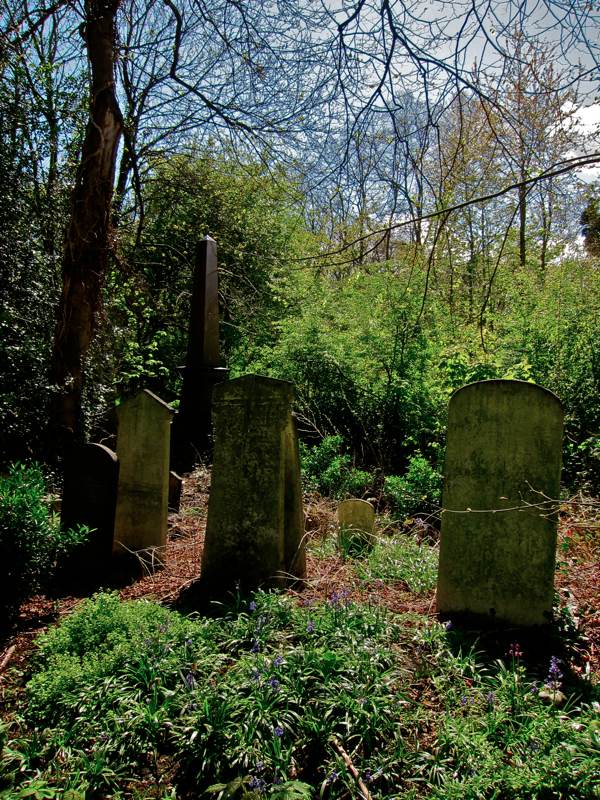
With a few bluebells in flower in my garden in Spitalfields, I was inspired make a visit to Bow Cemetery and view the display of bluebells sprouting under the tall forest canopy that has grown over the graves of the numberless East Enders buried there. In each season of the the year, this hallowed ground offers me an arcadian refuge from the city streets and my spirits always lift as I pass between the ancient brick walls that enclose it, setting out to lose myself among the winding paths, lined by tombstones and overarched with trees.
Equivocal weather rendered the timing of my trip as a gamble, and I was at the mercy of chance whether I should get there and back in sunshine. Yet I tried to hedge my bets by setting out after a shower and walking quickly down the Whitechapel Rd beneath a blue sky of small fast-moving clouds – though, even as I reached Mile End, a dark thunderhead came eastwards from the City casting gloom upon the land. It was too late to retrace my steps and instead I unfurled my umbrella in the cemetery as the first raindrops fell, taking shelter under a horse chestnut, newly in leaf, as the shower became a downpour.
Standing beneath the dripping tree in the half-light of the storm, I took a survey of the wildflowers around me, primroses spangling the green, the white star-like stitchwort adorning graves, a scattering of palest pink ladies smock highlighting the ground cover, yellow celandines sharp and bright against the dark green leaves, violets and wild strawberries nestling close to the earth and may blossom and cherry blossom up above – and, of course, the bluebells’ hazy azure mist shimmering between the lines of stones tilting at irregular angles. Alone beneath the umbrella under the tree in the heart of the vast graveyard, I waited. It was the place of death, but all around me there was new growth.
Once the rain relented sufficiently for me to leave my shelter, I turned towards the entrance in acceptance that my visit was curtailed. The pungent aroma of wild garlic filled the damp air. But then – demonstrating the quick-changing weather that is characteristic of April – the clouds were gone and dazzling sunshine descended in shafts through the forest canopy turning the wet leaves into a million tiny mirrors, reflecting light in a vision of phantasmagoric luminosity. Each fresh leaf and petal and branch glowed with intense colour after the rain. I stood still and cast my eyes around to absorb every detail in this sacred place. It was a moment of recognition that has recurred throughout my life, the awe-inspiring rush of growth of plant life in England in spring.




You may also like to read about
Find out more at www.towerhamletscemetery.org
The High Days & Holidays Of Old London
On Bank Holiday Monday, let us to consider the high days & holidays of old London in the days before social distancing.

Boys lining up at The Oval, c.1930
School is out. Work is out. All of London is on the lam. Everyone is on the streets. Everyone is in the parks. What is going on? Is it a jamboree? Is it a wingding? Is it a shindig? Is it a bevy? Is it a bash?
These are the high days and holidays of old London, as recorded on glass slides by the London & Middlesex Archaeological Society and once used for magic lantern shows at the Bishopsgate Institute.
No doubt these lectures had an educational purpose, elucidating the remote origins of London’s quaint old ceremonies. No doubt they had a patriotic purpose to encourage wonder and sentiment at the marvel of royal pageantry. Yet the simple truth is that Londoners – in common with the rest of humanity – are always eager for novelty, entertainment and spectacle, always seeking any excuse to have fun. And London is a city ripe with all kinds of opportunities for amusement, as illustrated by these magnificent photographs of its citizens at play.
Are you ready? Are you togged up? Did you brush your hair? Did you polish your shoes? There is no time to lose. We need the make the most of our high days and holidays. And we need to get there before the parade passes by.

At Hampstead Heath, c.1910.

Walls Ice Cream vendor, c.1920.

At Hampstead Heath, c.1910.

At Hampstead Heath, c.1910.

Balloon ascent at Crystal Palace, Sydenham, c.1930.

At the Round Pond in Kensington Gardens, 1896.

Christ’s Hospital Procession across bridge on St Matthews Day, 1936.

A cycle excursion to The Spotted Dog in West Ham, 1930.

Pancake Greaze at Westminster School on Shrove Tuesday, c.1910.

Variety at the Shepherds Bush Empire, c.1920.

Dignitaries visit the Chelsea Royal Hospital, c.1920.

Games at the Foundling Hospital, Bloomsbury, c.1920.

Riders in Rotten Row, Hyde Park, c.1910.

Physiotherapy at a Sanatorium, 1916.

Vintners’ Company, Master’s Installation procession, City of London, c.1920.

Boating on the lake in Battersea Park, c.1920.

The King’s Coach, c.1911.

Queen Victoria’s Diamond Jubilee procession, 1897.

Lord Mayor’s Procession passing St Paul’s, 1933.

Policemen gives directions to ladies at the coronation of Edward VII, 1902.

After the procession for the coronation of George V, c.1911.

Observance of the feast of Charles I at Church of St. Andrew-by-the-Wardrobe, 1932.

Chief Yeoman Warder oversees the Beating of the Bounds at the Tower of London, 1920.

Schoolchildren Beating the Bounds at the Tower of London, 1920.

A cycle excursion to Chingford Old Church, c.1910.

Litterbugs at Hampstead Heath, c.1930.

The Foundling Hospital Anti-Litter Band, c.1930.

Distribution of sixpences to widows at St Bartholomew the Great on Good Friday, c.1920.

Visiting the Cast Court to see Trajan’s Column at the Victoria & Albert Museum, c.1920.
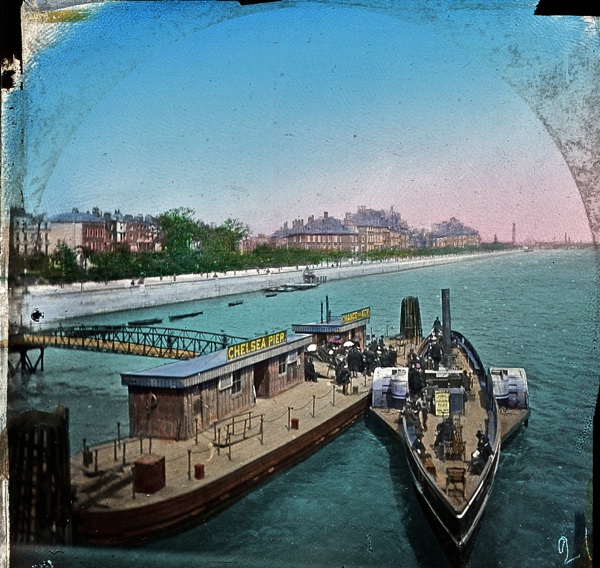
A trip from Chelsea Pier, c.1910.

Doggett’s Coat & Badge Race, c.1920.

Feeding pigeons outside St Paul’s, c.1910.

Building the Great Wheel, Earls Court, c.1910.
Glass slides copyright © Bishopsgate Institute
You may also like to take a look at
Roland Collins’ East End
It is my pleasure to show this selection of Roland Collins‘ evocative photographs of the East End and the City. For a spell in the sixties, while he was working as a Commercial Artist for the Scientific Publicity Agency in Fleet St, Roland Collins had access to a darkroom which enabled him to develop his own photography, and he produced striking photoessays exploring aspects of London life.

Fairground on the Hackney Marshes.


Salvation Army prayer meeting in the Lea Bridge Rd.

In Petticoat Lane.

In the East India Dock Rd.

Porters at Billingsgate.

Spirits are high as a porter is hoist onto his own shellfish barrow by his sixteen stone son.
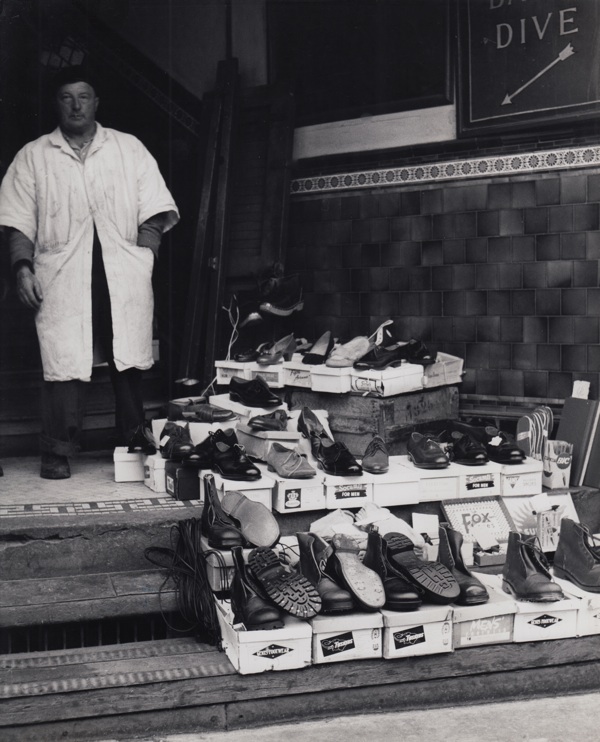
A porter makes a bit extra on the side, street trading in boots and shoes.

The Monument.

View from the top of the Monument.

Looking down Eastcheap from the Monument.

Fish shop by the Monument.

Visitors at the top of the Monument.

The shadow of the Monument cast upon King William St.

Relief upon the Danish Embassy at Wellclose Sq at the time of demolition – now removed to Belgravia.

In Albury Rd, Rotherhithe.

At Limehouse Basin.
Photographs copyright © Estate of Roland Collins
You may also like to take a look at
James Boswell’s East End

A few years ago, I visited a leafy North London suburb to meet Ruth Boswell – an elegant woman with an appealing sense of levity – and we sat in her beautiful garden surrounded by raspberries and lilies, while she told me about her visits to the East End with her late husband James Boswell who died in 1971. She pulled pictures off the wall and books off the shelf to show me his drawings, and then we went round to visit his daughter Sal who lives in the next street and she pulled more works out of her wardrobe for me to see. And when I left with two books of drawings by James Boswell under my arm as a gift, I realised it had been an unforgettable introduction to an artist who deserves to be better remembered.
From the vast range of work that James Boswell undertook, I have selected these lively drawings of the East End done over a thirty year period between the nineteen thirties and the fifties.There is a relaxed intimate quality to these – delighting in the human detail – which invites your empathy with the inhabitants of the street, who seem so completely at home it is as if the people and cityscape are merged into one. Yet, “He didn’t draw them on the spot,” Ruth revealed as I pored over the line drawings trying to identify the locations, “he worked on them when he got back to his studio. He had a photographic memory, although he always carried a little black notebook and he’d just make few scribbles in there for reference.”
“He was in the Communist Party, that’s what took him to the East End originally,” she continued, “And he liked the liveliness, the life and the look of the streets, and and it inspired him.” In fact, James Boswell joined the Communist Party in 1932 after graduating from the Royal College of Art and his lifelong involvement with socialism informed his art, from drawing anti-German cartoons in style of George Grosz during the nineteen thirties to designing the posters for the successful Labour Party campaign of 1964.
During World War II, James Boswell served as a radiographer yet he continued to make innumerable humane and compassionate drawings throughout postings to Scotland and Iraq – and his work was acquired by the War Artists’ Committee even though his Communism prevented him from becoming an official war artist. After the war, as an ex-Communist, Boswell became art editor of Lilliput influencing younger artists such as Ronald Searle and Paul Hogarth – and he was described by critic William Feaver in 1978 as “one of the finest English graphic artists of this century.”
Ruth met James in the nineteen-sixties and he introduced her to the East End. “We spent quite a bit of time going to Blooms in Whitechapel in the sixties. We went regularly to visit the Whitechapel when Robert Rauschenberg and the new Americans were being shown, and then we went for a walk afterwards,” she recalled fondly, “James had been going for years, and I was trying to make my way as a journalist and was looking at the housing, so we just wandered around together. It was a treat to go the East End for a day.”
James Boswell’s work is featured in East End Vernacular
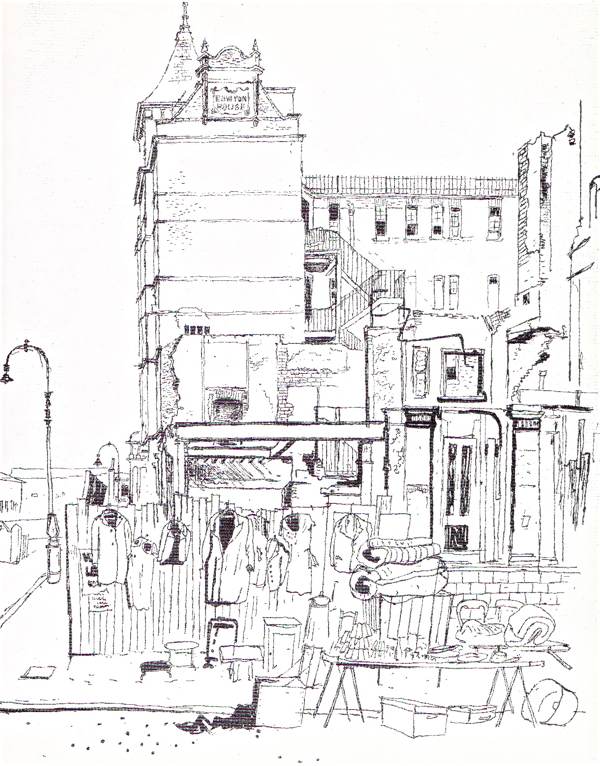
Rowton House

Old Montague St, Whitechapel

Gravel Lane, Wapping

Brushfield St, Spitalfields


Wentworth St, Spitalfields


Brick Lane


Fashion St, illustration by James Boswell from “A Kid for Two Farthings” by Wolf Mankowitz, 1953.

Russian Vapour Baths in Brick Lane from “A Kid for Two Farthings.”

James Boswell (1905-1971)


Leather Lane Market, 1937
Images copyright © Estate of James Boswell
You might also like to take a look at
In the footsteps of Geoffrey Fletcher
The Spitalfields Nobody Knows (Part One)
The Spitalfields Nobody Knows (Part Two)

Click here to order a copy of EAST END END VERNACULAR for £25
Jeffrey Johnson’s Favourite Spots
Enigmatic Photographer Jeffrey Johnson deposited a stack of his appealing pictures from the seventies and eighties with Archivist Stefan Dickers at the Bishopsgate Institute, including these photos of favourite spots in London. I cannot resist the feeling that Jeffrey is one after my own heart when I examine these characterful pictures of the capital’s forgotten corners.


Apostal’s

Buitifull Buttons

Arlington Way, N1


Broadway Market

Commercial Rd

Royal Exchange, City of London

Royal Exchange, City of London


King’s Cross

King’s Cross

King’s Cross

King’s Cross

King’s Cross


Teeth bought


Brick Lane

Barter St, Holborn

Great Ormond St, Bloomsbury

Little Montague Court, City of London

St Bartholomew’s Close, Smithfield

Albion Buildings


Alderney Rd

Photographs copyright © Jeffrey Johnson
You may also like to take a look at
The Forgotten Corners of Old London
Mystery Pictures of Brick Lane
Franta Belsky’s Sculpture in Bethnal Green

The Lesson by Franta Belsky (1959)
For years, I passed Franta Belsky’s bronze sculpture in Bethnal Green every Sunday on my way to and from the flower market in Columbia Rd without knowing the name of the artist. Born in 1921 in Brno, Czechoslovakia, Belsky fled to England after the German invasion and fought for the Czech Exile Army in France. Returning to Prague after the war, he discovered that most of his Jewish family had perished in the Nazi Holocaust, before fleeing again in 1948 when the Communists took over.
Creating both figurative and abstract work, Belsky believed that sculpture was for everyone. “You have to humanise the environment,” he said once, “A housing estate does not only need newspaper kiosks and bus-stop shelters but something that gives it spirit.”As you can see from this film of 1959, some local residents in Bethnal Green were equivocal about Belsky’s scupture at first – but more than half a century later it has become a much-loved landmark.


The Lesson by Franta Belsky (1921-2000)
You might also like to read about


