
Fifty Years Since The Stepney School Strike
Alan Dein recalls the Stepney School Strike of 1971, fifty years ago this week

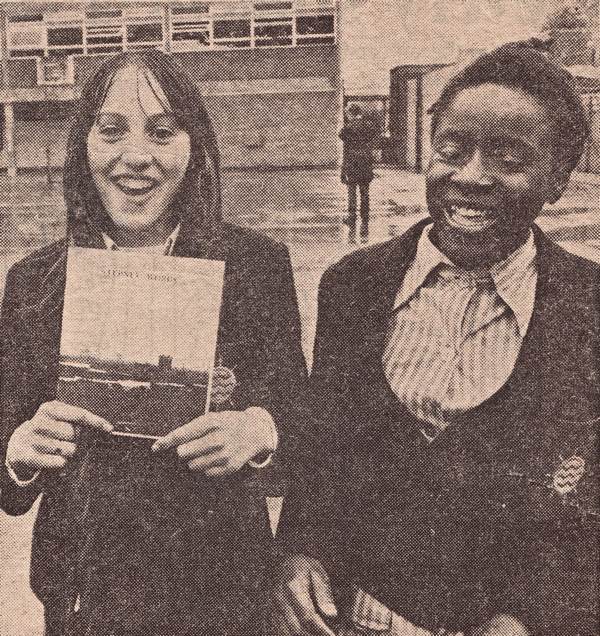
When I found a copy of Stepney Words in a school jumble sale, I had no idea what a remarkable discovery I had made. I can still remember reading the poems while walking home through the very same East London streets depicted in many of the poems. With titles like ‘The Chance,’ ‘Death in a Churchyard,’ ‘The World is Dim and Dull,’ ‘Let it Flow Joe,’ and writing that was vivid and raw and utterly captivating, I had stumbled upon the inner thoughts and observations of young people aged eleven to fifteen years from another time.
The beautifully atmospheric cover photograph confirmed that their Stepney was a world when the dockyard cranes and heavy industry depicted in a brown haze were still a part of the working life of the River Thames. I knew I had found a precious document and I felt compelled to find out more. A visit to Tower Hamlets Local History Library helped me discover the remarkable story and I made a BBC Radio documentary in 1997 about the astonishing impact this thirty-two-page booklet had on so many people’s lives, and upon the meaning of classroom education .
In May 1971, Chris Searle, a young English teacher was sacked by the governors of Sir John Cass Foundation School in Stepney for publishing Stepney Words, a collection of his students’ poems. Searle had encouraged his pupils to write about their lives and their neighbourhood. These were same streets where his own literary hero, the great poet Isaac Rosenberg, had once lived.
In response to Searle’s dismissal, on the 27th May 1971, eight hundred pupils, including those from neighbouring schools, went on strike. With banners aloft and chanting ‘We Shall Overcome’ in the pouring rain, they refused to return to school until Chris Searle was reinstated.
Following a spate of industrial disputes that had seen dustcarts and the postal system out of action, many of the youngsters had seen their parents on picket lines, so they followed their pattern. Several strikers marched into the offices of the local paper, who then called the national papers. The children’s strike was front page news, and the next day the strikers took to the streets of London, marching from Stepney to Trafalgar Sq, making sure that their route took them right through Fleet St which generated even more coverage.
The publication of Stepney Words extended beyond the strike. There was a second volume later in the year, readings by the young writers at poetry festivals, and some of the Stepney poets set up a pioneering arts project in Cable St, the Basement Writers, a multi-disciplinary platform for working class writers and performers.
Behind the scenes, controversy raged surrounding of the reinstatement of Searle. In 1973, with support from the National Union of Teachers and the Inner London Education Authority, Chris Searle did get his job back. The student strikers were vindicated. But by then the older ones had already left school and, on his return, Searle was ostracised by other staff and denied a class of his own.
He moved to Langdon Park School in Poplar where he helped to publish The People Marching On, a ground-breaking anthology of key events in East End history written by the English students.
Stepney Words remained in print throughout the seventies and into the eighties, selling tens of thousands of copies.
In 1973 Hackney’s Centerprise compiled the two volumes of Stepney Words into a single edition and hailed “the great upsurge in community and working class publishing … where the movement to write and publish was taken up in a small area of East London, today it is being continued in many other towns and cities throughout the country.”
Over the years since my documentary, I have been invited to a number of reunions of the Stepney Poets and strikers, along with Chris Searle, who went on to head a secondary school in Sheffield after working in East Africa and the Caribbean. In the course of these gatherings, the events of 1971 have been described as extraordinary and life-changing by those who were there. They are all in agreement that it is their former English teacher whose creativity and vision was their inspiration. For Searle, it was the energy and actions of those young people who set the course of his life’s work in education.
Later this year, we are planning to celebrate the fiftieth anniversary with a symposium held at Queen Mary University in Mile End exploring the events of 1971 and their legacy, with teachers, students, young poets and community groups discussing both the immediate impact and the longer-term influence, encouraging new generations of young people to find their own voices.




You may also like to read about
So Long, James McBarron
James Mc Barron died on Monday at the fine age of ninety-four, he was born in Hoxton on 21st September 1926

James McBarron
When I published Horace Warner’s photographs of Spitalfields Nippers from around 1900, I never expected to meet anyone who knew them. Yet Lynne Ellis wrote to say her father James McBarron recognised Celia Compton whom Horace Warner photographed at the age of fifteen in 1901. By the time James knew Celia, when he was a child in the thirties, she was Mrs Hayday and he encountered her as a money-lender when he was sent to make weekly repayments on his mother’s loans.
Intrigued by this unexpected connection to a photograph of more than a century ago, I took the train from Fenchurch St down to Stanford Le Hope to meet James McBarron and learn more of his story. This is what he told me.
“I am from Hoxton, Shoreditch, I was born in George Sq at the back of Hoxton Sq – it’s not there anymore. There were seven tenements and another building where Mrs Hayday lived, all around a yard with a lamppost in the middle. We attached a rope onto the lamppost and swung on it. We used to have a bonfire there in November and all the families came along. It was like a village and a lot of people were related, and everyone knew each other. We were clannish and there were quite a few families with members in different flats – my grandmother and grandfather lived there in one flat and I had two aunts in another.
Eighty years later I can still remember Mrs Hayday, even though I was only seven, eight or nine at the time. It was in 1936 or thereabouts. She was a money-lender and I was sent by my mother every Sunday to pay sixpence to her, but it didn’t mean anything to me at the time. To my eyes, as young boy, she was overwhelming. I was shown into the bedroom by her daughter and she was always lying there in bed. She took out a book from the bedside and made a note of the money. I recall an impression of crisp white sheets and she had dyed blonde hair. She was a buxom woman, a little blowsy. She smelled of scent – Phul Nana by Grossmith – the only scent I knew as a young boy, the factory was in Newgate St. I was awestruck because she was so unlike any of the other people I knew. There was a never a man there or a Mr Hayday. She was a very nice lady, she said, ‘Hello’ and ‘Say ‘Hello’ to your mum and dad,’And that was Mrs Hayday.’
My father, George, was a carpenter from Sunderland and he served in the Great War. My mother worked at Tom Smith’s Cracker Factory in Old St. My parents met in London and my mother’s family already lived in George Sq. My grandfather, he was an inventor and I admired him very much. He made a little working steam engine, and he tapped the gas main and had a tube with a little flame, so he could light his roll-ups. He played the violin and read music, and he never went to work. My gran used to go round to the pub for a jug of beer and they’d all go upstairs to my grandparents’ flat and play darts, and he’d play the violin.
We kids used to chop firewood to make money. The boys and girls used to go around collecting tea-chests and packing-boxes from the back of all the furniture factories, and say ‘Can we take it away, Mister?’ We chopped it up into sticks and made bundles, and we’d sell them for a penny or a ha-penny. We used to go to Spitalfields Market and ask for ‘Any spunks?’ or ‘Spunky oranges and apples?’ and they’d chuck the fruit that was going bad to us.
We didn’t think we were poor, except there was a family called Laban who were better off than us. He was a bookmaker and had touts. I remember their son had a jacket with pleats in the back and I wanted one like it, but when my mum eventually got me one it wasn’t so good. My father had a blue serge suit and it was pawned each Monday to pay the rent and bought back each Friday when he got paid. On Sundays, we went down to Stephenson’s Bakery in Curtain Rd to get a penny loaf.
When you came out of George Sq, there was a little alleyway leading through to Hoxton Market. There was Marcus the Newsagent, and next to it was Pollock’s and they had toy theatres in the window and these glass bottles with coloured liquid – it was a tiny shop. Next to that was Neville’s where my father bought our boots and shoes. I can remember every shop in the Market. Hoxton St was different then, bustling with stalls and there were barrows selling roasted chestnuts and boiled sheep’s heads.
William was the eldest child in our family, then I was born, then Peter, then Johnny and last of all Margaret. There was twenty-one years between us and she was born while I was away in the army, so she didn’t know me when I came back. I knocked them up at seven in the morning and called, ‘Here’s your boy, back again!’ We had three rooms – two bedrooms and a living room, and that’s why we had to move.
After the war, they moved us up to Haggerston to a new building in Stean St and George Sq was demolished because it was a slum. Everything broke up when people moved out. They took out all our furniture – including a table and chest of drawers my father made – and put it in a closed van and fumigated it because of the bugs. I’ve still got his tool box. It was a ragtag and bobtail existence, but I think we were a little better off than some. “

Celia Compton photographed at age fifteen by Horace Warner in 1901. Years later in 1936, a year after her husband died and when James McBarron was a child, she lived at 5e George Sq and he knew her by her married name of Celia Hayday.

James McBarron with his father’s carpentry box

Margaret & George McBarron in Haggerston

James and his brother Peter

As a boy, James visited Benjamin Pollock’s Toy Theatre shop at 208 Hoxton Old Town

James’ younger brother Johnny in the new flat when the family were rehoused in Stean St, Haggerston, in 1946

James’ elder brother William at the piano

James & June McBarron

James & June McBarron got married in St Leonard’s Shoreditch on 5th June 1954

James McBarron, 1965

James catches mackerel on holiday in Devon

James & June McBarron’s children, Lynne & Ian, in the sixties
You may also like to read these other Hoxton stories
Joseph Markovitch, I’ve live in Hoxton for eight-six and a half years
The Battle For Brick Lane Exhibition

Dan Cruickshank shows his son the model of the Truman Brewery
The Battle For Brick Lane exhibition that I curated for the Spitalfields Trust – as part of their campaign to stop the proposed Truman Brewery shopping mall with corporate offices on top – reopens this Saturday and can be viewed for the next three weekends. If you have not seen Annetta Pedretti’s extraordinary house at 25 Princelet St this is also your opportunity to pay a visit.
Sebastian Harding’s model of the Truman Brewery forms the centrepiece of the exhibition, complemented with displays of documentary photography by Phil Maxwell and Saif Osmani, celebrating the culture of Brick Lane.
The Battle For Brick Lane exhibition is open at Annetta Pedretti’s House, 25 Princelet St, E1 6QH, from noon until 6pm every weekend
We need volunteer invigilators for the exhibition. If you can help please send an email to Heloise Palin at Spitalfields Trust heloise@spitalfieldstrust.com
VISIT WWW.BATTLEFORBRICKLANE.COM

Louis Shultz, Seyi Adelekun & Fran Edgerley of Assemble Studio who manage Annetta’s House


Dan Cruickshank cuts the ribbon held by Seyi Adelekun and Gillian Tindall, opening the exhibition

Photographs copyright © Sarah Ainslie
You may also like to take a look at
A Door In Cornhill

The Bronte sisters visit their publisher in Cornhill, 1848
An ancient thoroughfare with a mythic past, Cornhill takes its name from one of the three former hills of the City of London – an incline barely perceptible today after centuries of human activity upon this site, building and razing, rearranging the land. This is a place does not declare its multilayered history – even though the Roman forum was here and the earliest site of Christian worship in England was here too, dating from 179 AD, and also the first coffee house was opened here by Pasqua Rosee in 1652, the Turk who introduced coffee to London. Yet a pair of carved mahogany doors, designed by the sculptor Walter Gilbert in 1939 at 32 Cornhill – opposite the old pump – bring episodes from this rich past alive in eight graceful tableaux.
Walter Gilbert (1871-1946) was a designer and craftsman who developed his visual style in the Arts & Crafts movement at the end of the nineteenth century and then applied it to a wide range of architectural commissions in the twentieth century, including the gates of Buckingham Palace, sculpture for the facade of Selfridges and some distinctive war memorials. In this instance, he modelled the reliefs in clay which were then translated into wood carvings by B.P Arnold at H. H. Martyn & Co Ltd of Cheltenham.
Gilbert’s elegant reliefs appeal to me for the laconic humour that observes the cool autocracy of King Lucius and the sullen obedience of his architects, and for the sense of human detail that emphasises W. M. Thackeray’s curls at his collar in the meeting with Anne and Charlotte Bronte at the offices of their publisher Smith, Elder & Co. In each instance, history is given depth by an awareness of social politics and the selection of telling detail. These eight panels take us on a journey from the early medieval world of omnipotent monarchy and religious penance through the days of exploitative clergy exerting controls on the people, to the rise of the tradesman and merchants who created the City we know today.

“St Peter’s Cornhill founded by King Lucius 179 AD to be an Archbishop’s see and chief church of his kingdom and so it endured for the space of four hundred years until the coming of Augustine the monk of Canterbury.”

“Eleanor, Duchess of Gloucester, did penance walking barefoot to St Michael’s Church from Queen Hithe, 1441.”

“Cornhill was an ancient soke of the Bishop of London who had the Seigneurial oven in which all tenants were obliged to bake their bread and pay furnage or baking dues.”

“Cornhill is the only market allowed to be held afternoon in the fourteenth century.”

“Birchin Lane, Cornhill, place of considerable trade for men’s apparel, 1604.”

“Garraway’s Coffee House, a place of great commercial transaction and frequented by people of quality.”

“Pope’s Head Tavern in existence in 1750 belonging to Merchant Taylor’s Company, the Vinters were prominent in the life of Cornhill Ward.”

You might also like to read about
Jim Howett, Designer

In my opinion, Jim Howett is the best dressed man in Spitalfields. Here he is with a characteristically shy smile, sitting on a seventeen-twenties staircase in a houses in Fournier St he was restoring for the Spitalfields Trust. Jim was entirely at home in this shabby yet elegantly proportioned old house, a specifically localised environment that over time has become his natural habitat and is now the place you are most likely to find him.
For years, I admired Jim’s artisan clothing whenever I caught glimpses of him, always crossing Commercial St and disappearing through the market or off down Folgate St preoccupied with some enigmatic intent. When we were introduced, I discovered that Jim sleeps each night in the attic at Dennis Severs’ House and crosses the market every day to work in Fournier St with Marianna Kennedy, designing the furniture and lamps that have become ubiquitous in the houses around Spitalfields. I also learnt Jim is responsible for a significant number of the most appealing shopfronts in the neighbourhood.
At first, I assumed Jim was Irish on account of his soft vowels and quietly spoken manner, almost whispering sometimes, even swallowing his words before he utters them, and thereby drawing your attention to listen, concentrating to gather both what is said and what is unspoken. Such is the nature of his mind that Jim will begin a sentence and then pursue a digression that leads to another and yet another – though such is the intelligence of the man, that when he leads you back to the resolution of the original thought, it acquires a more precise import on account of all the qualifications and counter arguments. Without a doubt, Jim is a consummate prose talker.
Jim’s origins lie in Ohio in the foothills of the Appalachians, where he grew up in Salem. But Jim’s father worked in international development and in the nineteen-sixties the family moved to the Congo and then his father was transferred Vietnam, with the family ending up in London in 1967. Jim studied at the Architectural Association under the tutelage of Dan Cruickshank, subsequently working for a few years in prehistoric archaeology, before deciding to study at the London College of Furniture which was then in Commercial Rd.
Renting a room on Brick Lane, Jim dropped a card to his former tutor who wrote back to say he had just bought a house in Elder St full of broken furniture, so Jim set up a workbench in Dan’s basement to undertake the repairs.
“Dennis Severs knocked upon the door one day, looking for Dan,” Jim told me. “He said he’d just bought a house round the corner and wanted to do tours, and we thought he was crazy but we helped him set it up. I made the shutters, the partition with the arch in the dining room and I copied the fireplace from one in Princelet St.” he added, revealing the origin of his own involvement with 18 Folgate St, where today he is the sole resident. Before long, Jim was sharing a workshop with Marianna Kennedy and ceramicist Simon Pettet in Gibraltar Walk, sharing aspirations to create new work inspired by historical models by applying traditional craft skills. They found themselves amidst a community centred around the restoration of the eighteenth century houses, dubbed ‘Neo-Georgians’ by the media – a moment recorded today in the collection of magazines and photo features, illustrating the renaissance of Spitalfields, that Jim keeps in a box in his workshop.
Jim taught himself furniture making by copying a Hepplewhite chair – constructing four versions until he could get the proportion right – before he discovered that there was no market for them because dealers considered them too dangerously close to the originals as to approach fakes. Yet this irony, which was to hamper Jim’s early career as a furniture maker, served as a lesson in the significance of proportion in engaging with historical designs.
When Jim won a commission to design an armoire for Julie Christie, he thought he had found the path to success. “She gave me tip of half the value of my commission fee and I thought ‘This is as good as it gets’, but she remains the best client I ever had.” admits Jim, wistfully recognising the severely limited market for custom-built new furniture in antique styles. “I used to make these pieces and have no money left over to buy coffee afterwards,” he declared with a shrug.
The renovation of Spitalfields gave Jim the opportunity to become one of those who has created the visual language of our streets, through his subtle approach to restoring the integrity of old shopfronts that have been damaged or altered. Perhaps the most famous are A.Gold and Verdes in Brushfields St, 1 & 3 Fournier St and 86 Commercial St. In these and numerous other examples, through conscientious research, Jim has been responsible for retaining the quality of vernacular detail and proportion that makes this Spitalfields, rather than any other place. The beauty of Jim’s work is that these buildings now look as if they had always been like they are today.
Yet Jim is quick to emphasise that he is not an architect, explaining that his work requires both more detailed knowledge of traditional building techniques and less ego, resisting the urge to add personal embellishments. “The difference between me and architects, working on historic buildings is that I restrict myself to organising the space. I believe if a building has survived for two hundred years, it has survived because it has certain qualities. The reason, I don’t put my finger in the pie is because I can express myself in other things.”
While Jim spoke, he produced file after file of photographs, plans and maps, spreading them out upon the table in his workshop to create a huge collage, whilst maintaining an extraordinary monologue of interwoven stories about the people, the place and the buildings. I was fascinated by Jim’s collection of maps, spanning the last five hundred years in Spitalfields and I realised that he carries in his mind a concrete picture of how the place has evolved. When I have seen him walking around, he is walking in awareness of all the incarnations of this small parish, the buildings that have come and gone through past centuries.
It fired my imagination when Jim took me into the cellar of 15 Fournier St and pointed out the path across the yard belonging to the sixteenth century building that stood there before the eighteenth century house was built, telling me about the pieces of charred wood they found, because this was where debris was dumped after the Fire of London in 1666.
Simon Pettet portrayed Jim on one of his tiles as a fly on the wall, reflecting Jim’s omnipresence in Spitalfields. “I think if my father had not taken us to the Congo, I should still be there in Salem, Ohio,” confessed Jim with a weary smile, “because at heart I am a localist.” Jim showed me the missing finger on his left hand, sliced off while cutting a mitre from left to right, a mark that today he regards as the proud badge of his carpenter’s trade. In his work and through his modest personal presence, Jim has become an inextricable part of the identity of Spitalfields – after more than forty years, I hope we may now describe him as a local.

Jim at Jocasta Innes’ house in Heneage St, 1990

Jim with Dennis Severs and Simon Pettet, pictured in a magazine feature of 1991

Jim modelling his calfskin apron, 1991

Jim pictured in the penurious weavers’ garret at Dennis Severs’ House that today is his bedroom

In the Victorian Parlour at Dennis Severs’ House

Hoisting up the new cornice in Commercial St
You may also like to read about
Some Favourite London Mulberries
In celebration of the news that the Bethnal Green Mulberry is saved, here is a gallery of some of my favourite London Mulberries

At the Tower of London

At Charlton House

At Middle Temple

At KIng’s Bench Walk

In Haggerston

In Whitechapel

In Stoke Newington

At Charterhouse

In Victoria Park

In the Commissioner’s Garden at Chatham Royal Naval Dockyard

At Mile End Place

At Abbey Wood

At Syon

At Sayes Court, Deptford

In Bunhill Fields

In Dalston

At the London Chest Hospital
You may also like to read about
The Bethnal Green Mulberry Verdict

Nurses dancing around the Bethnal Green Mulberry
After campaigning to Save the Bethnal Green Mulberry since 2017, I am overjoyed to report yesterday’s decision of the High Court to refuse Crest Nicholson’s redevelopment of the former London Chest Hospital and stop the developer digging up the 400 hundred year old tree.
I would like to thank the hundreds of people who funded our legal action, the 17,000 who signed our petition and especially Dame Judi Dench for being patron of our campaign.
Crest Nicholson’s overblown development would have blighted the Victoria Park Conservation Area for generations to come. It demolished a listed building, removed a large number of mature trees and delivered far too few affordable homes.
At the Tower Hamlets Planning meeting in September 2018, Gareth Gwynne, Head of Planning confirmed that it would be possible for Crest Nicholson to avoid disturbing the tree without any loss to their development by simply reconfiguring the design. Yet rather than do this, they made the decision to pursue digging up the historic mulberry and moving it, even though there is no successful precedent for moving such an old mulberry and this would be likely to kill it. I hope Crest Nicholson learn a lesson from this judgement and go back to the drawing board.
In the light of the recent decision to approve the redevelopment of the Whitechapel Bell Foundry, I am dismayed by the shameful way Tower Hamlets Council have repeatedly advocated bad developments, without regard for the community or heritage. But I am delighted that in this case justice has prevailed and the Bethnal Green Mulberry is saved.
At this time of Climate Emergency and, as we move to recover from the coronavirus pandemic, it is obvious that London should not be building such densely-crowded housing and that we need planning decisions which are environmentally responsible.
The Bethnal Mulberry is the oldest tree in the East End, surviving plague, fire and blitz. I hope it will flourish for centuries more to inspire us all.
CLICK HERE TO READ THE FULL VERDICT
We will contact all those supporters who opted to receive a cutting of Shakespeare’s Mulberry this summer once the cuttings have rooted and are ready for collection. When summer arrives, we will also write to those who chose to receive a tub of mulberry sorbet to arrange collection.

Click here to read my feature in The Daily Telegraph about the scandal of the Bethnal Green Mulberry
Read more here about the Bethnal Green Mulberry
The Fate of the Bethnal Green Mulberry


