
At The Jewish Soup Kitchen

Originally established in 1854 in Leman St, the Jewish Soup Kitchen opened in Brune St in 1902 and, even though it closed in 1992, the building in Spitalfields still proclaims its purpose to the world in bold ceramic lettering across the fascia. These days few remember when it was supplying groceries to fifteen hundred people weekly, which makes Photographer Stuart Freedman’s pictures especially interesting as a glimpse of one of the last vestiges of the Jewish East End.
“After I finished studying Politics at university, I decided I wanted to be a photographer but I didn’t know how to do it,” Stuart recalled, contemplating these pictures taken in 1990 at the very beginning of his career. “Although I was brought up in Dalston, my father had grown up in Stepney in the thirties and, invariably, when we used to go walking together we always ended up in Petticoat Lane, which seemed to have a talismanic quality for him. So I think I was following in his footsteps.”
“I used to wander with my camera and, one day, I was just walking around taking pictures, when I moseyed in to the Soup Kitchen and said ‘Can I take photographs?’ and they said, ‘Yes.’ “I didn’t realise what I was doing because now they seem to be the only pictures of this place in existence. You could smell that area then – the smell of damp in old men’s coats and the poverty.”
For the past twenty-five years Stuart Freedman has worked internationally as a photojournalist, yet he was surprised to come upon new soup kitchens recently while on assignment in the north of England. “The poverty is back,” he revealed to me in regret,“which makes these pictures relevant all over again.”

Groceries awaiting collection

A volunteer offers a second hand coat to an old lady

An old woman collects her grocery allowance

A volunteer distributes donated groceries

View from behind the hatch

A couple await their food parcel

An ex-boxer arrives to collect his weekly rations

An old boxer’s portrait, taken while waiting to collect his groceries

An elderly man leaves the soup kitchen with his supplies
Photographs copyright © Stuart Freedman
You can read more about the Soup Kitchen here
You may also like to take a look at
Ed Gray, Painter

This is Ed Gray sitting in his studio in Mile End, beside the canal and next to the Ragged School Museum. I found him in a large empty room with windows overlooking Mile End stadium and just three sketches on the wall for a street scene in the City of London which was his work in progress.
Ed’s visceral paintings capture the tumultuous street life of the capital superlatively, teeming with diverse characters and delighting in the multiple dramas of daily existence. Despite his mild manners, his is an epic, near-apocalyptic vision that glories in the endless struggle of humanity within the urban stew. Yet the overriding impression is not cynical but rather a life-affirming raucous celebration of the indefatigable vitality of Londoners.
“I paint people and I make art about scenes of daily life. But I do not see this kind of picture represented very much in the contemporary art world. In their view, this work is not cool, happening or sensational. Yet I find so much stimulus when I go out onto the street drawing. I could make dozens of paintings about any single location. London is such a mixture of different places, there are different energies in every place, so I do not want to stay in one place, I keep moving on.
I have been painting a lot for the last twenty years, doing figurative scenes, and I work hard to have exhibitions and find an audience for my paintings, and provoke conversations about the city. It feels like an underground thing. My shows are popular and I am lucky because my paintings sell, so that keeps me going. It seems a shame that more artists do not go out and paint the people of the city.
It is a challenge because the city changes so quickly. If I am working on a painting for three months in my studio and then I go back out into the city, it is different place. The place I painted has changed and the people have changed too. Sometimes buildings I painted are not there anymore, even in a short space of time. It is an incredible challenge and hard to know where to begin.
I studied at art college in Wimbledon and then Cardiff, where I used to go down to the docks. It was before they regenerated them. I painted the docks and the buildings – landscapes without people. Then I got interested in the fish market in Cardiff and I painted the people there. On my mother’s side, my grandfather was a fish merchant in Grimsby so I had an interest in those scenes. It took off from there and I became more and more interested in painting people, which I had always done as a kid but I had not found the confidence to paint people the way that I wanted. It took that experience to put me on that path.
I left college in 1995 and moved back to London, and I had a studio in a squat in the Elephant & Castle. I was trying to paint big oil paintings seven foot across, but I had no money so I could not afford to do it. I lasted a few years doing odd jobs and trying to keep that going. Eventually I thought, ‘I can’t do this!’ so I took a full time job working as a security guard at the Natural History Museum. I thought I would go into some kind of educational work, I had been working in a youth club in Battersea and I knew I had something I could pass on to the kids. I liked making art with them.
So, during my two years at the Natural History Museum, I would paint in the evenings just for myself. And I read all the books I was supposed to read at art college and secured my knowledge. Then I did my PGCE in art education at Exeter University and for a year I was teaching in Cornwall. When I came back to London, I realised I could teach and paint. So I taught part time at a school in Peckham for four years while painting the rest of the time. I had studio on the Old Kent Rd in a building which is no longer there. Over time, I accumulated a lot of paintings in the flat that I was sharing with friends and they said, ‘You need to do something with these pictures.’
By then, I had found a way that I wanted to work, which was based in going to a location, making direct observations with my sketch book for however many days it takes until I have soaked up the scene, before going back to my bedroom and making a paintings over a period of weeks. These were much smaller than the work I am doing now but it was keeping me going, it was an outlet for all the things I wanted to say about the city. In the nineties, there was a negativity about the city and city life, but I had just come back from Cornwall and I thought it was the most exciting place, with so much to paint.
I had all these paintings but I had no experience of galleries, so we took a car load of work around and the only place that would give me an exhibition was a little pop-up space in Brixton. I had my first solo show there in 2001 with ten paintings in it. It was amazing, loads of people came the private view and some could not even get into the building! It was real eye-opener to me that my painting was communicating something. All kinds of people came in from the street in Brixton, there was not a single demographic that came to see that show. It was a really exciting thing.
I applied for a residency in Bermuda and I got it, so I took a sabbatical from my teaching job. I had some money because I had sold a couple of paintings from my show. I had a studio in Bermuda and I had three exhibitions out there. It was the first time I was able to think entirely about making art and not having to pay my rent. It was an incredible time and I can hardly believe it happened. Afterwards, I travelled from Panama to Mexico City, making paintings and drawings. I was learning about making work on the hoof.
When I came back to London, I went back to the school and, after another year, I had another exhibition. A gallery in Camberwell gave me a show in 2003. I did ten paintings and they all sold, so I left my teaching job and concentrated on painting. Acme offered me a studio in Mile End next to the canal in 2006. I have always lived south of the river, first in Bermondsey and now Rotherhithe, so I am very familiar with those scenes and I have painted some of them. But separating where I live and really work is really important to me, coming across the river. The amount of life and lives you encounter here is more diverse in the East End. There is so much I could paint.
My picture of the Whitechapel Rd felt like a beginning for me of the paintings I could make about Whitechapel. I have so many scenes in mind. I wanted to start in the Whitechapel Rd because it is this long ancient road that comes out of the City of London. I used to cycle or walk that way to work and come through the market. I love markets, people are drawn to them and the characters are fantastic for painting. The history and the politics, the combination of the hospital and the market, and so many people from different lands that have come to work in London – for all of theses things, it is a meeting point.”

‘Lucky Tiger,’ Whitechapel Road, 2008 (Click on this painting to enlarge)
“I often walk through Whitechapel Market on my way to the studio. From a cafe, I watched the men set up the cardboard boxes and I took out my pencil and I began to draw. There is no ‘Lucky Tiger’ in this painting because there is no luck here, no punter will win. The child senses this and she can see past the man’s arm which is covering the switch he is about to make.”

‘Adoration in the East,’ Mile End Tube, 2014 (Click on this painting to enlarge)

‘Adoration at the Lion’s Den,’ Milwall Football Club, 2014 (Click on this painting to enlarge)

‘Adoration at the Emirates,’ Arsenal Football Club, 2014 (Click on this painting to enlarge)

‘Adoration of Thomas A Becket,’ Old Kent Rd, 2016 (Click on this painting to enlarge)

Liverpool St Station, 2007 (Click on this painting to enlarge)

Liverpool St Station, 2007 (Click on this painting to enlarge)
 St Mary Axe, 2012 (Click on this painting to enlarge)
“I have always painted the Gherkin when I can, I use it to navigate around the City while I am drawing. This painting is about the banking crisis that began in 2008. I sat by the Aviva building in windswept St Mary Axe and drew the faces of the brokers and bankers, the secretaries and the construction workers.”

‘Skittles,’ Blackfriars Bridge 2008 (Click on this painting to enlarge)
“For a few wintry mornings, I stood on Blackfriars Bridge in 2008 making sketches of the waves of flowing commuters. An icy wind whipped up the Thames, blowing through me. A boy crept unwillingly to school dragging a figure through the soot on the bridge and leaving his mark in defiance of the journey he had to make. He dropped a ‘Skittles’ wrapper and it occured to me that these Londoners are like skittles bracing themselves against the next blast that could topple them.”

Mile End Beginning, 2008 (Click on this painting to enlarge)
“This pair of Mile End paintings are about my working day and how inspiration arrives for me, they are both views from my studio window. ‘Beginning’ is about arriving at work for the day in the summer, I’m optimistic and full of ideas after walking from home in Rotherhithe through the streets of London.”

Mile End End, 2008 (Clickon this painting to enlarge)
“I began ‘Mile End End’ as the nights became darker and the autumn set in. When I turned out the studio light at night, the glowing green of the Mile End sports stadium seemed so intense that I had to paint it. I wore a head torch while I worked to capture the intensity of the light and I studied the movements of the night time characters – the addicts, the sportsmen, the fishermen and the lovers.”

Night on Mare St, Pig’s Ear Beer Festival 2010 (Click on this painting to enlarge)
“At the Ocean Leisure Centre in Hackney, the faithful gathered for the annual Pig’s Ear Beer Festival, with beer and cider from every corner of the British Isles to be sampled. The painting is a celebration of this country.”

Billingsgate Porters 2005 (Click on this painting to enlarge)
 ‘Rock of Eye,’ Threadneedleman Tailor, Walworth Rd 2014 (Click on this painting to enlarge)
“I have had the pleasure of knowing George Dyer ever since I asked him to make my wedding suit several years ago. A Jamaican by birth with some Cuban added to the mix, young George flew to England aged five to be reunited with his family who had emigrated earlier. George is the go-to man for sharp tailoring in addition to philosophical discussions about our place in the cosmos, all of which he offers from a small shop in the Walworth Rd.”

York Hall Boxers 2011 (Click on this painting to enlarge)
“I spent an evening sketching in the crowd at York Hall thanks to the late great Dean Powell, manager and fight manager for the legendary Frank Warren. Dean is seated at the top of the ring. It was a successful night for him. I filled three sketchbooks, hypnotised by the rhythm of the dancing boxers and jabbing my pencil at the paper with the violence of their blows.”

‘Adoration of the Cockney Rebels,’ Bermondsey Carnival 2016 (Click on this painting to enlarge)

Ed Gray at his studio in Mile End
Paintings copyright © Ed Gray
Photographs copyright © Sarah Ainslie
The Renewal Of Dennis Severs’ House
Dennis Severs’ House in Spitalfields has been closed for the past year but, behind the scenes, a small army has been working to renew the house for reopening this week. Lucinda Douglas Menzies did their portraits.
The piece of promenade theatre I have created, as a re-imagination of the tours that Dennis Severs gave in the eighties, commences this Thursday 29th July and booking is open until the end of November.

Gilbert Bastien, Clock Specialist
“I love the finesse of this French clock and it’s my favourite at Dennis Severs’ House. I love taking an old clock that has not being cleaned for many years and bringing it back to life as it would have been in the eighteenth century. There are a variety of clocks in the house and they are all different – a French clock, an American clock, a lantern clock and a nice grandfather clock dating from 1720. In Dennis Severs’ House, it is as if time stood still.”

Luis Buitrago, Gardener
“In Spitalfields the gardens are micro-climates that are shady and very sheltered. The challenge for a gardener is the lack of light, but there is scope for plants that like shade and humidity. Dennis Severs had an urn as the central feature, so I introduced these huge ferns. Dennis was all about drama. I am not sure how knowledgeable he was about horticulture but if he had chosen a plant, it would have been one with drama – not something you feel indifferent about.”

Dan Cruickshank, Friend of Dennis Severs & Trustee
“Dennis believed you have to be open-minded and ‘innocent’ to really see the world he created, which is a powerful evocation of the past rather than an attempt at its literal recreation. As he said, ‘you either see it or you don’t’, and over twenty years after Dennis Severs’ death his house continues to weave its spell and remains a place where – invisible to sceptics – ghosts walk in splendid array.”

Pia Matikka, Copper Plate Calligrapher
“Over the winter, I have been doing copper plate calligraphy for the house. A few years ago, I taught myself at home, it’s almost like meditation for me. This house is very different to any other because it has so much atmosphere and is entirely authentic. Working here, I have heard stories about Dennis Severs and it has become a more personal experience for me. The more I have learnt the more interesting it has grown and it has become a great pleasure to do things for the house.”

Johannna Garrad, Fabric Specialist
“I’ve been cleaning and dressing fabrics – all the drapery, curtains, beds and pieces of costume. Many drapes had fallen down and it was often a puzzle to rehang something that had once been hung up in a haphazard fashion yet to magnificent effect. We looked at photos of how the rooms evolved over the decades to guide us. I was fascinated by the degree to which the house is not a museum collection but a theatre set, and we needed to be aware of that theatricality when we put things back.”

Ian Harper, Wood Grainer & Marbling
“I remember gilding ornaments for Dennis in the eighties, while he lectured me and we even discussed me painting his portrait. Recently, I wood-grained cupboards in the basement and restored the painted floor. Spitalfields has been consistently in my life because I keep coming back to work here. You would think there wasn’t anything left to paint after all these years, but whenever I walk down the street, people ask ‘Will you come and do something for me.’”

Jim Howett, Designer
“Dennis Severs knocked upon the door one day and said he’d just bought a house round the corner, I thought he was crazy but I helped him set it up. I made the shutters and I copied the fireplace from one in Princelet Street. The damp and decay in the paupers’ attic has always been a remarkable feature and Dennis added to it with fungus retrieved from dead wood in Brompton Cemetery, and asked me to fit it into place. Over the years, I have added pieces as some have fallen away.”

David Milne, Steward
“I think I have a good understanding of what the life of a servant must have been like, except I am the servant to an imaginary family, though I am also a very taxing master – because everything has to be right. When you live with candlelight, you learn how to use it. I like to place things together in the manner of ‘still life’ and I love the light of seventeenth century paintings, you see it everywhere in this house.”

Heloise Palin, Administrator
“With its constantly changing light, this house has a life of its own. You walk down a staircase and spot something you have never seen before, because the sun is in a different place. I have been working here on my own a lot which is quite a weird experience, when there is no light or heating, especially in the middle of winter. People ask if it’s spooky or creepy but I’ve not found that, I have grown to love it.”

Wioletta Ruczynska, Cleaner
“When I first came here a year ago, I didn’t know where to start. There were cobwebs everywhere and few centimetres of dust over everything – we had to remove that to see what was underneath. The house is much cleaner now and a lot of things have been repaired to bring them back to life. This is such a beautiful house that it deserves to be taken care of, so visitors can come and see how people lived hundreds of years ago. ”

Joel Saxon, Actor
“It’s a magical experience, bringing the house to life as Dennis Severs intended it to be seen. I hope the tour will inspire visitors and spark their imaginations, I want them to feel we are pulling them through the picture frame and into the eighteenth century. For an actor, this is much more intimate than performing to an audience in a theatre because you get to look into the whites of their eyes and communicate directly. People come to be entertained and, with an audience limited to six, you get a lovely opportunity to connect with each person individually.”

Orlando Spurling, Painter & Plasterer
“Over the years I have patched bits and pieces of Dennis Severs’ House. It’s finishing I do, the plastering and the painting. It’s lime plaster I use, I learnt on the job. I fell into it twenty-five years ago while helping renovate a derelict house in Brushfield Street. I don’t use rollers or sprays in Georgian houses. I prefer old houses. I love the history and character, it makes you wonder who’s been there before you. You get a sense that people have lived there and had a life and moved on. It’s like a continuous living thing and it gives me real satisfaction to repair something to bring it more life.”
Photographs copyright © Lucinda Douglas Menzies
You may also like to read about
Where Dennis Severs Enjoyed A Pint
The immersive tour of Dennis Severs House I created for the Spitalfields Trust, as a re-imagination of the tours that Dennis Severs gave in the eighties, commences this Thursday 29th July and booking is open until the end of November.

One day, David Milne of Dennis Severs’ House in Folgate St took me along to the Hoop & Grapes in Aldgate for a pint, revisiting a special haunt that he was introduced to by Dennis Severs back in the nineteen eighties.
We walked together from Spitalfields up through Petticoat Lane until we arrived at the busy junction in Aldgate where traffic careers in every direction.“This was the major road in and out of London and it would always have been as full of people as it is now.” said David, as he peered down the road towards Whitechapel, wrinkling his brow to imagine centuries of travellers, before fixing his gaze directly across the road at three of the last remaining timber frame buildings surviving from before the fire of London. The central building, squeezed between its neighbours like a skinny waif sat between two fat people on a bus, was the Hoop & Grapes.
It is the oldest licensed house in the City, built in 1593 and originally called The Castle, then the Angel & Crown, then Christopher Hills, finally becoming the Hoop & Grapes – referring to the sale of both beer and wine – in the nineteen twenties. The first impression when you turn your back on the traffic to enter, is of the appealingly crooked Tudor frontage with sash windows fitted in the seventeen twenties at eccentric angles, and of two ancient oak posts guarding the entrance, each with primitive designs of vines incised upon them.
Stepping through the heavy door patched together over centuries, the plan of the narrow house is still apparent even though the partition walls have been removed. A narrow passageway ran ahead down the left of the building with small rooms leading off to the right, a structure which is revealed today by the placing of the beams in the ceiling and the bulges in the wall where the fireplaces in each room have been sealed up. Opening to your left is the bar, where the premises have expanded into the next house and to the back is flagged floor next to the largest chimney breast in a space that was a kitchen in the sixteenth century.
David and I enjoyed the privilege of access to the cellar where the landlady led us through a sequence of narrowing brick vaults built in the thirteenth century, until we reached the front of the building where she pointed out an old iron hook in the ceiling, held back by a lead catch. “No-one knows what this was for,” she admitted, prompting David to look down at his feet where a metal cover was set into the floor.“There was a well beneath,” he said, speculating,“the Aldgate pump was not far from here and the water table is high.” Then the landlady released the hook to hang vertical and it hung directly over the centre of the cover, perfect for hauling up a bucket. We all exchanged a smile of triumph at solving the puzzle, and stood together to appreciate this rare medieval space, essentially unchanged since Elizabeth I met Mary Tudor fifty yards away at Aldgate in 1553.
Upstairs, the landlady pointed out the site of a listening tube, centuries old yet covered over when a speaker system was fitted recently. This tube enabled whoever was in the cellar to hear what was spoken in the bar and vice versa. David believes it was used in the days of Oliver Cromwell by the landlord, who was in the pay of the authorities, to eavesdrop upon conspirators who chose this pub just outside the City gate for illicit liaisons, and there is no doubt that – thanks to the sparse renovations – once you have been here for a while you can begin to imagine the picture.
We sat down at the quiet corner table next to the crooked window with our drinks. “Dennis and I had this way of looking at things and making it more than it is,” confessed David to me with a contemplative affectionate smile “and that’s what we called ‘the theatre of life’. I used to come and visit him, and we’d go for walks around Spitalfields and end up here for a pint. We were looking for what remains – the signposts to the great City of old – the street that ran down to the City of London was full of houses like this. We would sit here and create a story about the merchants who lived in these ancient houses.”
In this no-man’s land between the City and Whitechapel, the Hoop & Grapes is a reliably peaceful place to go where just a few commuters drop in for a pint and tourists rarely appear – because it does not readily declare its history. Yet time gathers here in the stillness of this modest Tudor building – constructed atop a medieval foundation with eighteenth, nineteenth and twentieth century accretions – while the world rushes past as it always has done.
Through his house in Folgate St, Dennis Severs’ reinvented the way that historic buildings are presented. When David Milne came here with Dennis Severs over forty years ago, all that was in the future, and today more than twenty years after his death, David is one of those who maintains Dennis Severs’ creation. “He was a remarkable man,” confided David, as we took our leave of the Hoop & Grapes, “and now this place is a signpost to my past with him.”


David Milne first came here with Dennis Severs over forty years ago

The thirteenth century cellars

An ancient hook above the well in the cellar

Two venerable oak posts carved with vines guard the door, and sash windows added in the seventeen twenties sit within a crooked sixteenth century structure

An insurance plate from 1782 still adorns the frontage

The three sixteenth century timber frame houses in Aldgate, predating the fire of London which came within fifty yards. The house on the right was refaced in brick in the eighteenth century
Archive photograph of the Hoop & Grapes courtesy Bishopsgate Institute
Other Dennis Severs’ House stories
Where Dennis Severs Bought His China
The immersive tour of Dennis Severs House I created for the Spitalfields Trust, as a re-imagination of the tours that Dennis Severs gave in the eighties, commences this Thursday 29th July and booking is open until the end of November.

One day, David Milne of Dennis Severs’ House, got in touch to tell me about Stephen Long, an antique dealer who had dealt in early nineteenth century English china from a shop in the Fulham Rd since the nineteen sixties.
This was where Dennis Severs bought much of the china that graces the house in Folgate St, he revealed – adding that by Stephen Long had died and within the week the contents of his shop would be cleared out by an auction house. But before that happened, there might be an opportunity to visit and photograph one of London’s last traditional antique shops, he suggested.
Until then, I had not quite noticed how the old school antique shops have been vanishing from the world. In Kensington Church St and in the Portobello Rd, in streets formerly lined with antique dealers – where once I used to wander, window shopping at all the beautiful old things I would never buy – such businesses are thinning out and becoming sparser. Similarly in Fulham and Chelsea, part of the accepted landscape of London is quietly dissolving away.
David and I walked through Brompton Cemetery to reach the quiet stretch of the Fulham Rd where Stephen Long had his shop, beyond the fashionable street life of Chelsea yet not proxy to the bustle of Fulham Broadway either. “I had no idea he was ill,” David confessed, “I saw his shop was shut and a glass panel was broken. Nobody could contact him, so in mid-December they broke in and found him sick upstairs, where he lived. And he died in hospital in January.”
In a fine nineteenth century terrace, only one premises had its original shopfront intact, still in architectural unity with the upper storeys where the rest had been crudely modernised at street level to discordant effect. The name of Stephen Long caught my eye at once in its classic typeface, above the elegant five-bay Victorian display window. And, even before we entered, I recognised the shop as of the familiar kind I had visited a hundred times with my parents, for the delight of admiring the wonders yet ever wary that we might break something expensive. There were colourful old plates on wire stands and other pieces of china formally placed in symmetrical arrangements, their decorum offset by the whimsy of artificial fruit and flowers, and cheerful coloured paper lining the shelves.
“Stephen used to sit behind a low desk at the back of the shop – so that you couldn’t see him from the street, there in the shop in the darkness with beautiful stuff piled up around him,” recalled David, explaining how he discovered the connection with Dennis Severs, “I used to buy stuff from him and one day he told he knew a guy in Spitalfields.” Before Dennis Severs bought the house in Folgate St by which he is remembered, he lived in a mews in Gloucester Rd and gave rides around London in an open-top landau. Stephen Long told David, he remembered Dennis Severs parking the horse and carriage outside and coming in to buy things. Then, two years ago, Stephen Long visited Dennis Severs’ house at David’s invitation and when he saw the china, exclaimed, “I sold him all this!” At Dennis Severs’ House, the mass of china that decks the old dresser in the kitchen, the royal memorabilia in the parlour, the creamware and the teapots – it came from Stephen Long and his discreet price labels still remain on the underneath of the items to this day.
“What I loved about going into this shop, it was like stepping into the nineteenth century,” David confided to me as we entered the half light of the showroom, where most of the objects had been in stock for over twenty years but were now only resting in their former owner’s arrangements for one last afternoon. “In all the years I came to the shop, I never met anyone else in here,” David whispered, almost speaking to himself as he absorbed the atmosphere for the final time.
David told me Stephen Long was in his eighties, a quiet man, gentle, charming and of the old school, a dealer who knew his stuff. The shop was the manifestation of his sensibility and taste, after a lifetime of looking at things, displaying his eye for colour and form, and his playful delight in contrast and in gathering collections. “Like all the best dealers, he was a collector who only sold things to make room for the new,” said David and there it was, gleaming through the gloom – the last moment of one man’s treasure trove – just as he left it.


“He used to sit behind a low desk at the back of the shop – so that you couldn’t see him from the street.”


You may also like to read about
David Milne, Curator at Dennis Severs’ House
At Highgate Cemetery

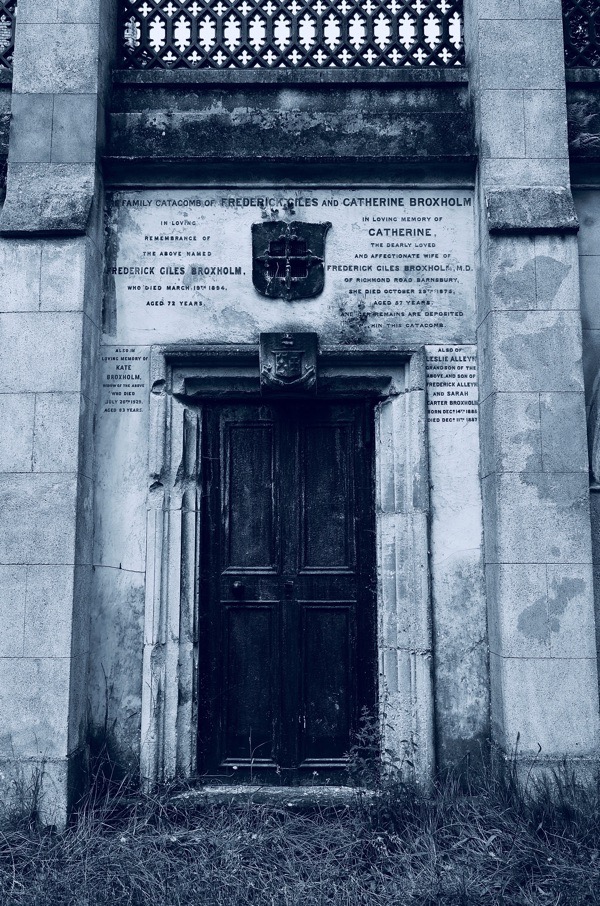
If you seek to lose yourself in London and escape the scorching summer heat, Highgate Cemetery is the ideal destination. You step through the gothic-inspired gatehouse and take the winding path up the hill among the trees, with gracious architectural monuments, tombs and statues on either side. Foliage and shadow enclose the cemetery, shielding it from the city.
At the top of the hill you arrive at a grand entrance with exotically carved stone pillars and iron gates, hung with dense growth of ivy and creepers. You encounter deep shadows at the portal and, unavoidably, confront your own mortality. As you ascend the shady path alone towards the light, lined with doors, it is as if you are entering the ancient metropolis of a lost civilisation. But the residents have not fled, they are all still here under the permanent lockdown of death.
You wonder what you will find at the other end of this passageway. Yet you emerge again into the light to discover a narrow street of doorways leading to the left and the right, open to the sky and lined with flowers. As you pace around, you recognise that each one is subtly distinct from the others, with names to enable the holy postman. Within minutes, you discover this street is circular. You have arrived at the heart of the necropolis and you can walk for eternity around this street. You can change direction, but you can only travel in a circle.
Thank goodness there are stairs that permit you to escape and return to the world of the living, where you can stand and impassively observe this curious architectural feature at the heart of the cemetery. If you seek the soul of London, you will find it here in the rotunda at Highgate Cemetery.




Highgate Cemetery, Swain’s Lane, London N6 6PJ
You may also like to read about
The Queenhithe Mosaic
Queenhithe is a natural inlet of the Thames in the City of London, it means ‘Queen’s harbour’ and is named after Queen Matilda who granted a charter for the use of the dock at the beginning of the twelfth century. This is just one of two thousand years of historical events illustrated in a twenty metre mosaic installed upon the river wall at Queenhithe.
Commissioned by the City of London and paid for by 4C Hotel Group, it was designed by Tessa Hunkin and executed by South Bank Mosaics under the supervision of Jo Thorpe – and I recommend you take a stroll down through the City to the river, and study the intricate and lively detail of this epic work for yourself.


You may also like to read about


