
Eleanor Crow’s ‘Step Inside’
A few places are available for my last-ever course HOW TO WRITE A BLOG THAT PEOPLE WILL WANT TO READ on November 20th & 21st. This is your final chance to come to Spitalfields and spend a weekend with me in an eighteenth century weaver’s house in Fournier St, enjoy delicious lunches from Leila’s Cafe, eat cakes baked to historic recipes by Townhouse and learn how to write your own blog. Email spitalfieldslife@gmail.com to book a place.
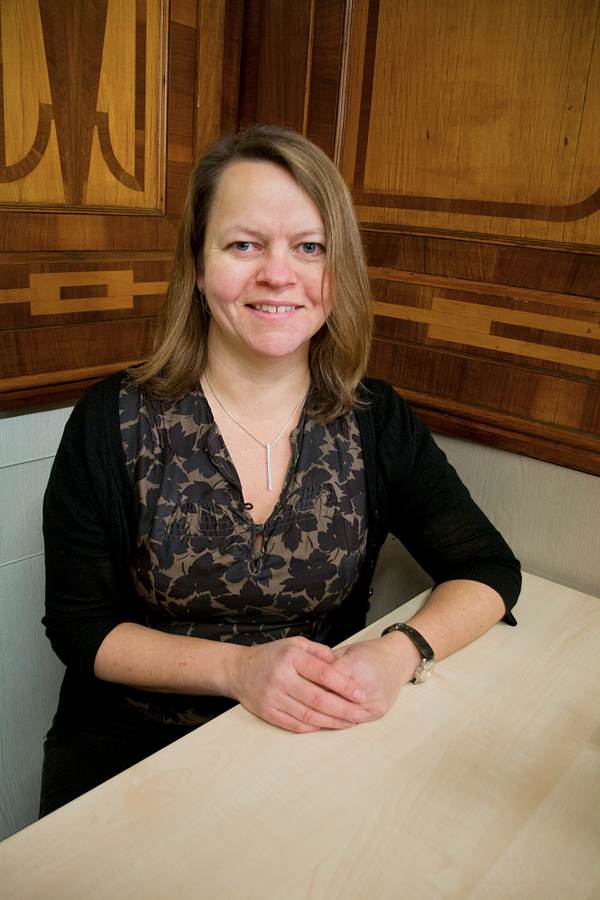
Portrait of Eleanor Crow at E. Pellicci by Colin O’Brien
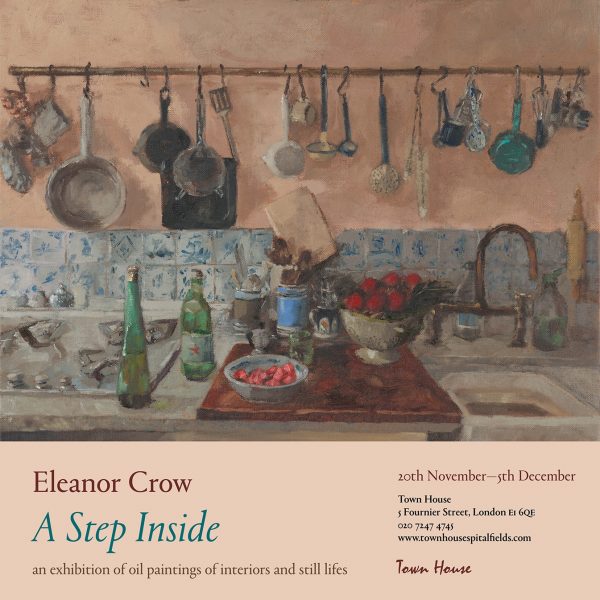
I am delighted to present this preview of Eleanor Crow‘s exhibition A Step Inside opening at Townhouse, Spitalfields, next Saturday 20th November. Readers will be familiar with Eleanor’s illustrations that we published in a book as Shopfronts of London, but now she has turned her hand to paintings of interiors and still lifes.
‘I became interested in the play of light across the interiors of shops, kitchens and domestic settings, and this forms the basis of my new work,’ Eleanor admitted to me. ‘I am fascinated by the way light falls from windows across chairs and tables, over pots, brushes and baskets, across lines of bottles and jars – as well as the particular quality of a room. I am attracted to views through doors, a glimpse, a step inside.’
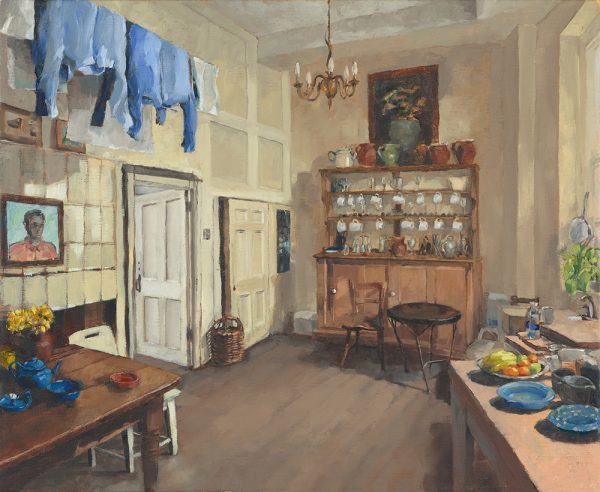
Kitchen at the George Tavern, Stepney
‘I was struck by the asymmetric shape of the kitchen and the huge window casting a soft light across the interior. I love the cream panelled walls and array of pots on the dresser, as well as the blues of the utilitarian plates, bowls and teapot, and the hanging shirts.’
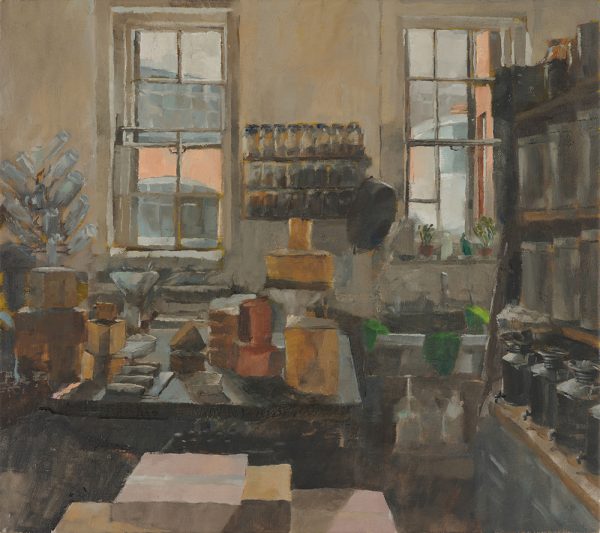
Leila’s Shop, Calvert Avenue
‘The display of wares, backlit by light falling on the ranks of containers and the wedges of cheeses, the pats of butter, the upended bottles, and the arrivals of new produce still in their boxes, exude a calm, quiet beauty. I want to convey how it feels to enter this shop, with its sense of timelessness. I have always admired Dutch interior paintings, and to me this place embodies some of these qualities.’

Straw, Columbia Rd
‘This is a small shop that sells baskets, pots, brushes, candles – items of utility and beauty, new and old. Each basket has its individual form. The daylight is subdued, with a glancing light coming from the west, catching the shapes in the window display. The edges of the room and the baskets frame the composition.’
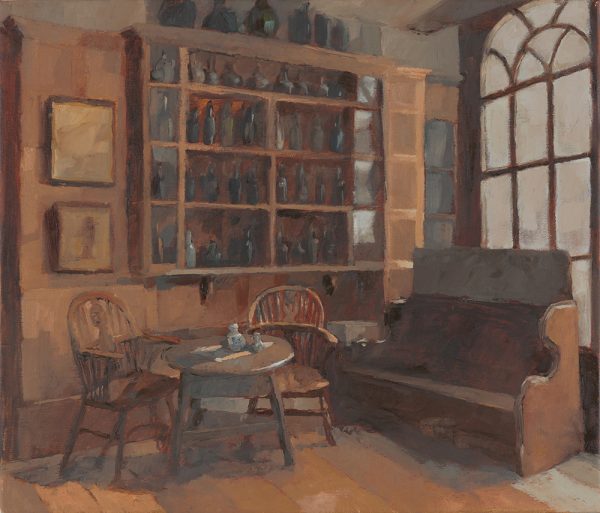
Berry Brothers Rudd, St James
‘I was delighted to visit the historic rooms at Berry Bros. & Rudd, the family-run wine and spirit merchant founded in the seventeenth century. This interior at No.3 St. James’s St, lit by huge arched windows, is little changed since it opened in 1698. The array of antique wine bottles above the waiting table and chairs, and the wide bench, all attest to the history.’
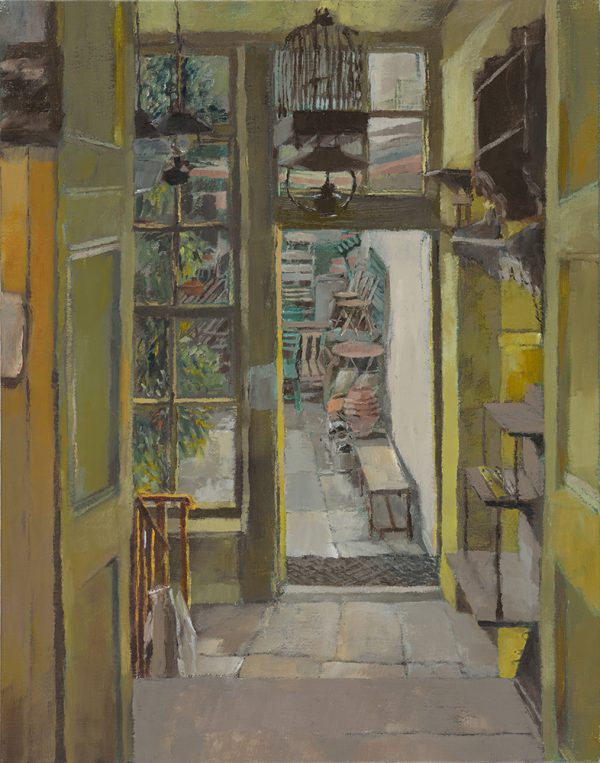
Courtyard at the Lacquer Chest, Kensington Church St
‘This antique shop opened in the fifties, put on the map by customers including David Hockney, Ossie Clarke, Alan Bennett and Jean Shrimpton. I first encountered it when seeking items for a photograph for a book cover, and have returned to buy pots and vases. I am particularly drawn to this yellow-painted hallway, looking through to the courtyard. Antique shops lure us in with the promise of serendipitous discoveries and this place never disappoints.’
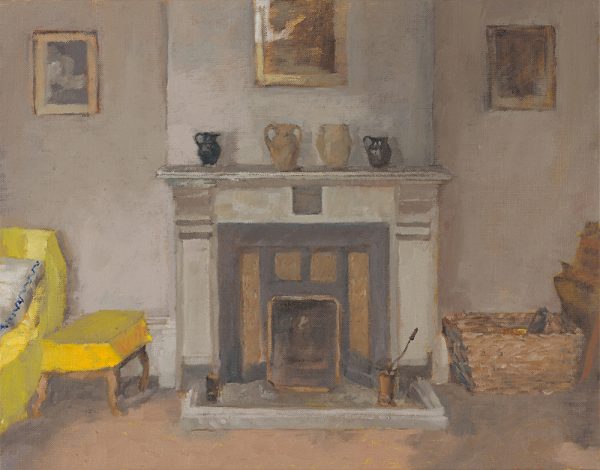
At the George Tavern
‘I am interested in natural light and I liked the brightness of the yellow couch and stool against the soft greys of the room, and the pots not quite symmetrically placed on the mantelpiece. This is a house filled with life and people.’

Kitchen at Sutton House
‘This is the view from the Tudor kitchen of the five hundred-year-old manor house in Hackney. I chose to depict a domestic setting, looking through to a courtyard beyond, and only the face mask and trainers on the woman standing there indicate the modern era.’
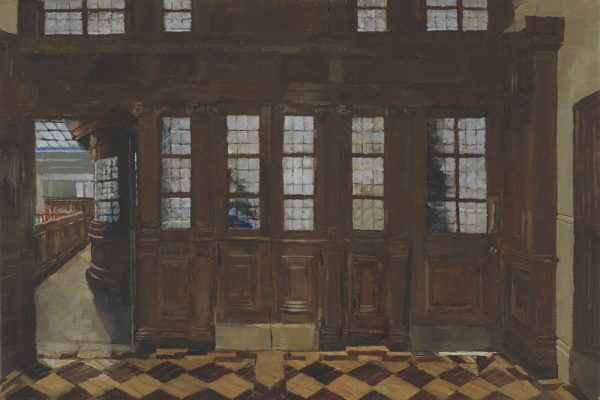
Bethnal Green Library
‘Only one door into the library from the entrance hall was open and the library’s future was hanging in the balance of council decision-making. During the pandemic, the library became a vaccine trial centre, causing concern locally whether it would ever reopen. This beautiful building has served the East End for nearly a hundred years, offering the opportunity of reading to countless children and adults, including through the Blitz.’
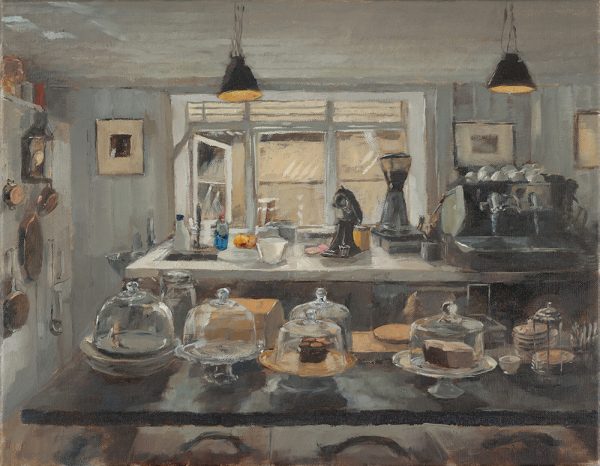
Kitchen at Townhouse, Spitalfields
‘This basement kitchen is a warm and inviting place, with wooden walls and ceiling painted in muted greys, and copper pans and jelly moulds catching the light. I like the mixture of beauty and utility – the cakes under their glass cloches, the oranges on the counter top and the dark shapes of the cake mixer, coffee grinder and coffee machine, crowned by a pile of white cups.’
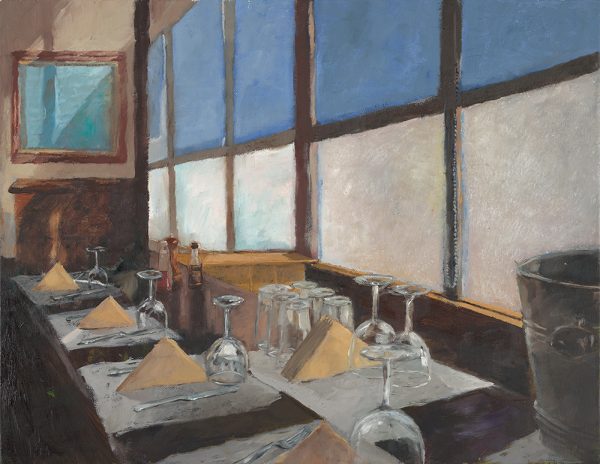
Sweetings, City of London
‘This is London’s oldest fish and oyster restaurant, which opened in 1830. The beautiful corner site on Queen Victoria St has been little changed for over one hundred years and is a much-loved institution in the City. I chose this corner because of the light cast from the frosted windows with their blue roller blinds, reflected in the tall mirrored wall panel and bouncing off the rows of glasses and cutlery.’
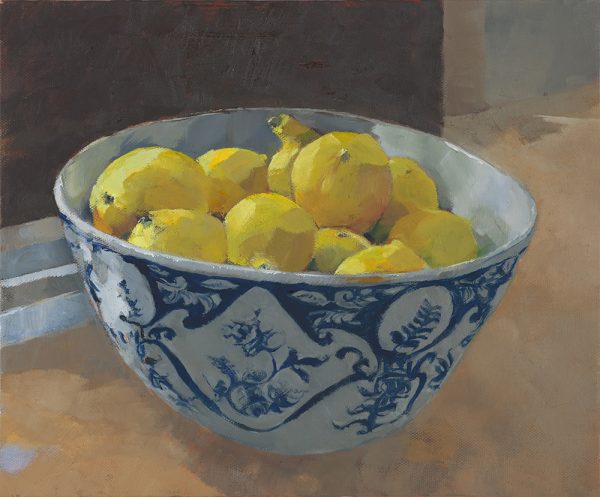
Bowl of Lemons
‘I like the acidic yellow of the lemons against the blue and white glaze of the bowl, and the imperfections of both.’
So Long, Huguenots Of Spitalfields
A few places are available for my last-ever course HOW TO WRITE A BLOG THAT PEOPLE WILL WANT TO READ on November 20th & 21st. This is your final chance to come to Spitalfields and spend a weekend with me in an eighteenth century weaver’s house in Fournier St, enjoy delicious lunches from Leila’s Cafe, eat cakes baked to historic recipes by Townhouse and learn how to write your own blog. Email spitalfieldslife@gmail.com to book a place.
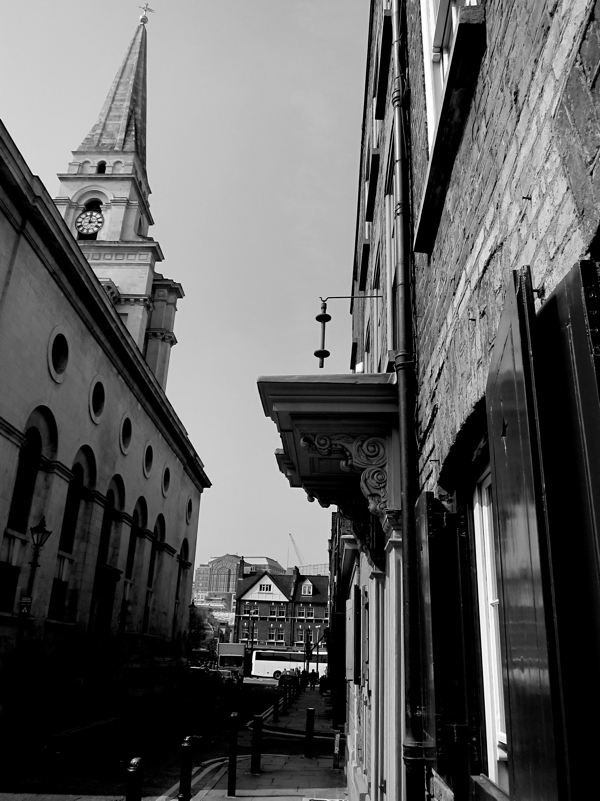
After more than ten years, the cultural organisation devoted to the Huguenots of Spitalfields is closing down. This unexpected imaginative flourishing was the brainchild of the estimable Charlie De Wet, who worked voluntarily for a decade, inspiring us with stories of this first wave of immigrants and, by doing so, transformed our perceptions of the Huguenots’ contribution to our society.
The wooden spools that you see hanging in the streets of Spitalfields indicate houses where Huguenots once resided. These symbols were put there in 1985, commemorating the tercentenary of the Revocation of the Edict of Nantes which brought the Huguenots to London and introduced the word ‘refugee’ to the English language.
I set out in search of any visual evidence that remains of the many thousands who once passed through these narrow streets and Dr Robin Gwynn, author of The Huguenots of London, explained to me how they came to be here.
“Spitalfields was the most concentrated Huguenot settlement in England, there was nowhere else in 1700 where you would expect to hear French spoken in the street. If you compare Spitalfields with Westminster, it was the gentry that stayed in Westminster and the working folk who came to Spitalfields – there was a significant class difference. And whereas half the churches in Westminster followed the French style of worship, in Spitalfields they were not interested in holding services in English.
The Huguenots were religious refugees, all they needed to do to stop the persecution in France was to sign a piece of paper that acknowledged the errors of John Calvin and turn up at church each Sunday. Yet if they tried to leave they were subject to Draconian punishments. It was not a planned immigration, it was about getting out when you could. And, because their skills were in their hands, weavers could leave whereas those whose livelihood was tied up in property or land couldn’t go.
Those who left couldn’t choose where they were going, it was wherever the ship happened to be bound – whether Dover or Falmouth. Turning up on the South Coast, they would head for a place where there were other French people to gain employment. Many sought a place where they could set their conscience at rest, because they may have been forced to take communion in France and needed to atone.
The best-known church was “L’Eglise Protestant” in Threadneedle St in the City of London, it dealt with the first wave of refugees by building an annexe, “L’Eglise de l’Hôpital,” in Brick Lane on the corner of Fournier St. This opened in 1743, sixty years after a temporary wooden shack was first built there. There were at least nine other Huguenot Chapels in Spitalfields by then, yet they needed this huge church – it was an indicator of how large the French community was. I don’t think you could have built a French Church of that size anywhere else in Britain at that time.The church was run by elders who made sure the religious and the secular sides tied up so, if you arrived at the church in Threadneedle St, they would send you over to Spitalfields and find you work.
It was such a big migration, estimated now at between twenty to twenty-five thousand, that among the population in the South East more than 90% have Huguenot ancestors.“
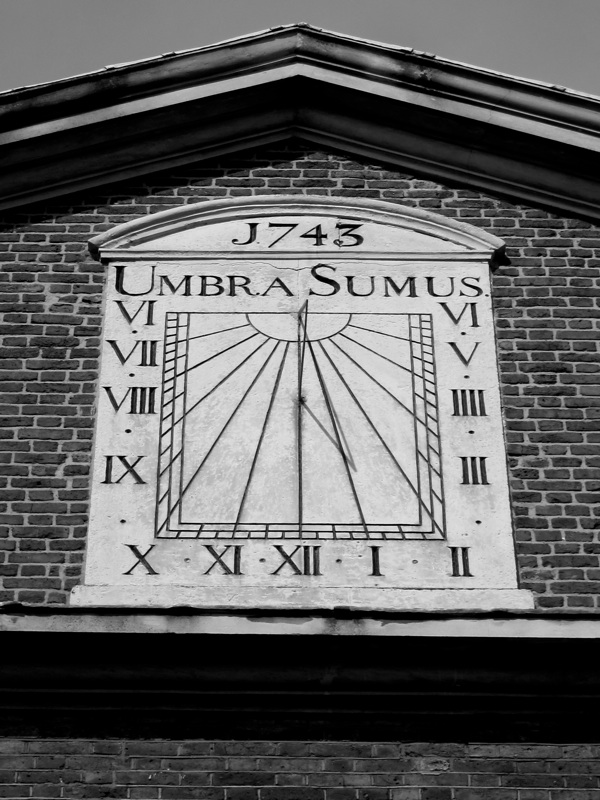
Sundial in Fournier St recording the date of the building of the Huguenot Church.
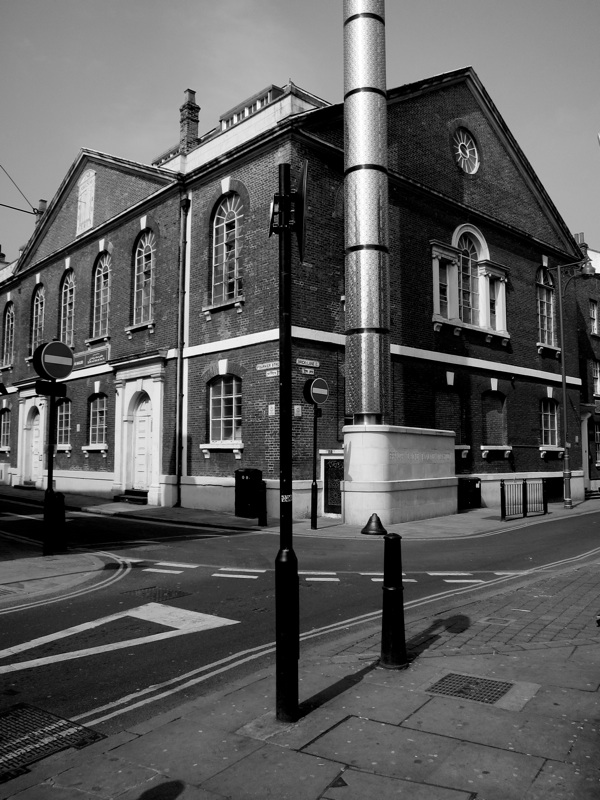
Brick Lane Mosque was originally built in 1743 as a Huguenot Church, “L’Eglise de l’Hôpital,” replacing an earlier wooden chapel on the same site, and constructed with capacious vaults which could be rented out to brewers or vintners to subsidise running costs.
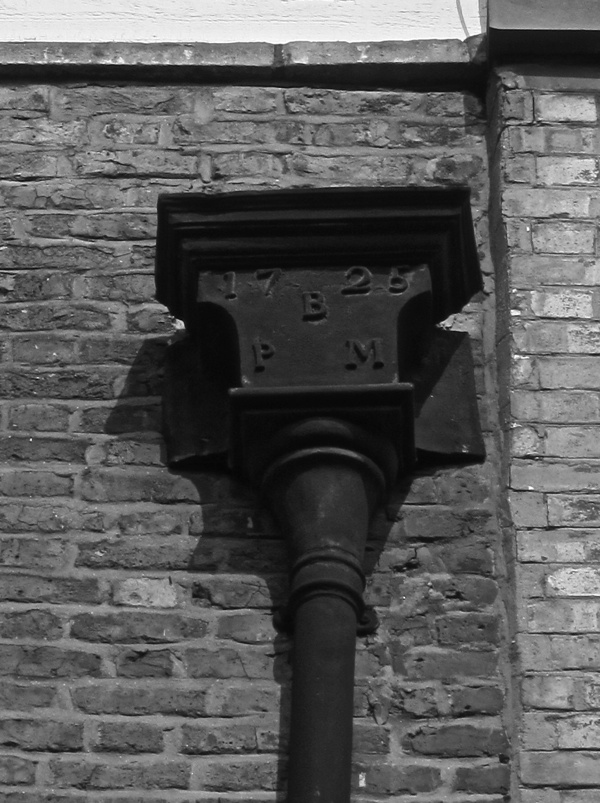
Water head from 1725 at 27 Fournier St with the initials of Pierre Bourdain, a wealthy Huguenot weaver who became Headborough and had the house built for him.
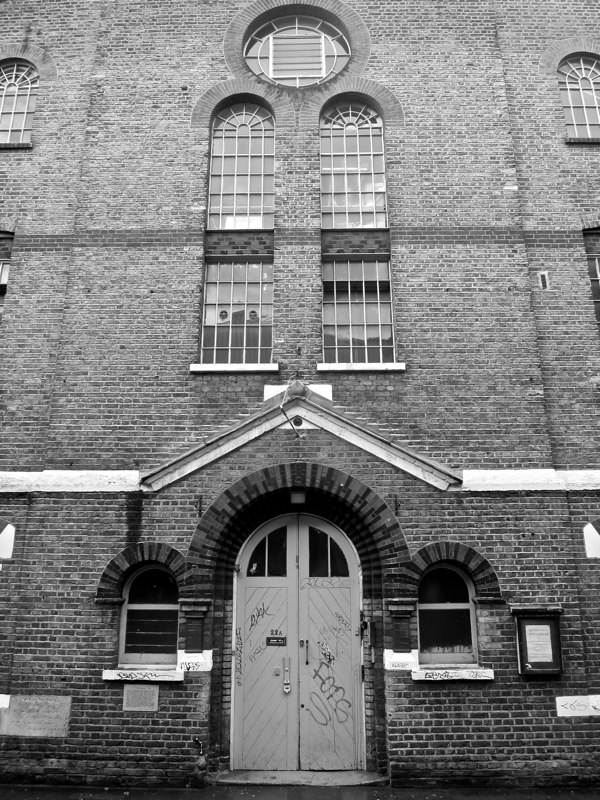
The Hanbury Hall in Hanbury St was built in 1719 as a Huguenot Church, standing back from the road behind a courtyard with a pump. The building was extended in 1864 and is now the church hall for Christ Church, Spitalfields.
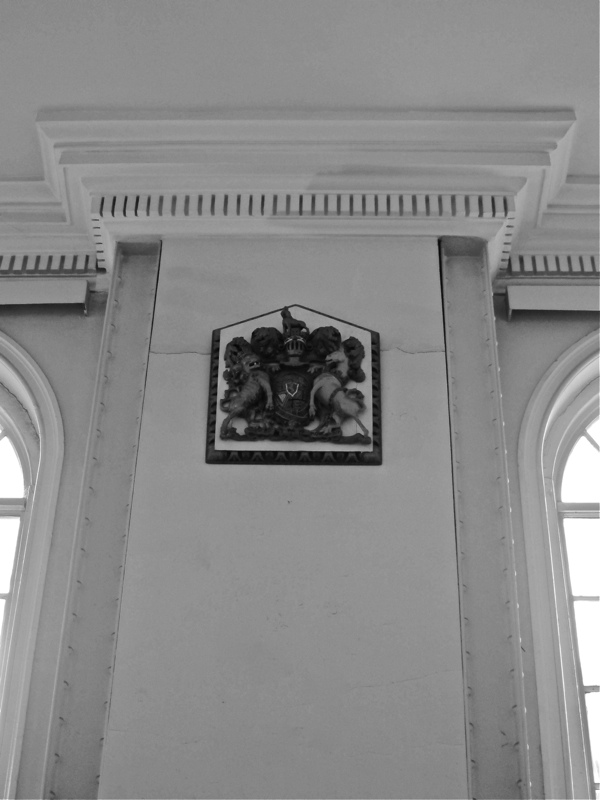
Coat of arms in the Hanbury Hall dating from 1740, when “La Patente” Church moved into the building, signifying the patent originally granted by James II.
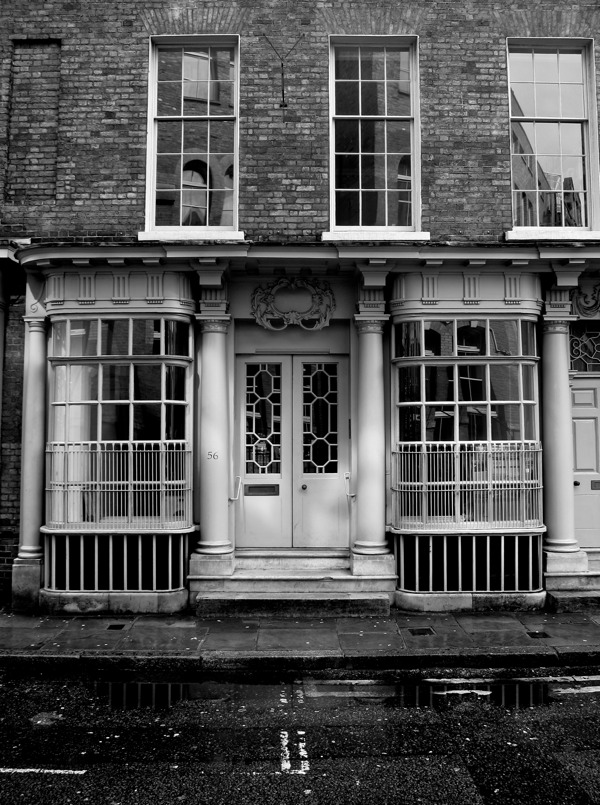
In Artillery Lane, one of London oldest shop fronts, occupied from 1720 by Nicholas Jourdain, Huguenot Silk Mercer and Director of the French Hospital.
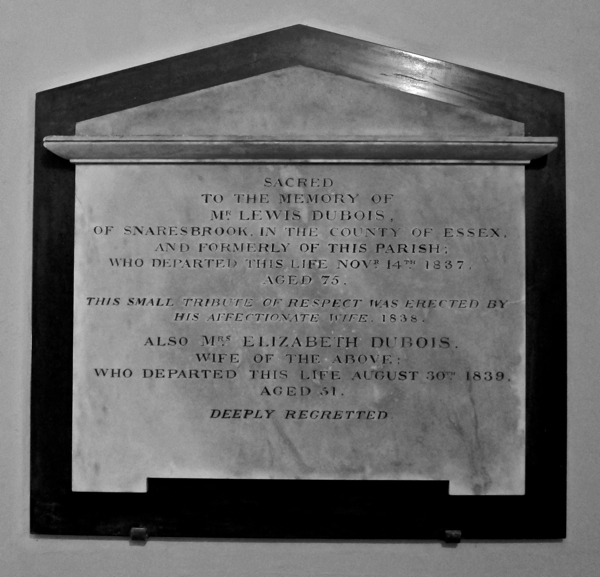
Memorial in Christ Church.
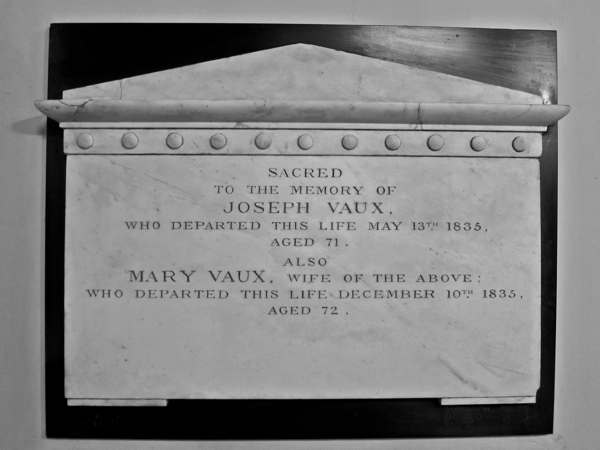
Memorial in Christ Church.
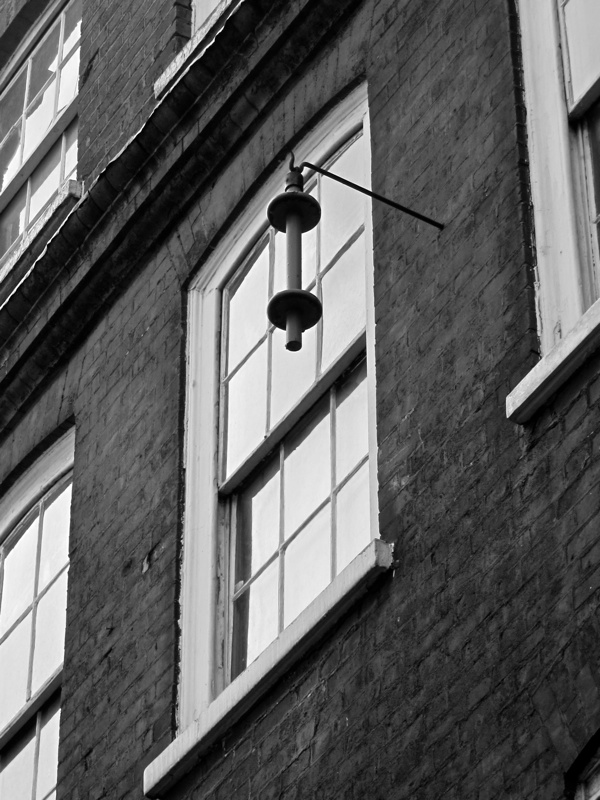
At Dennis Severs’ House in Folgate St.
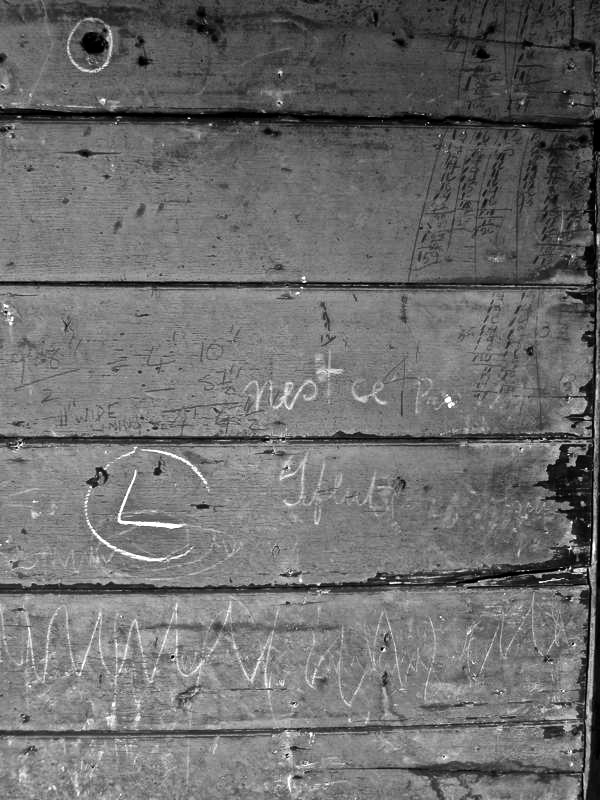
Graffiti in French recently uncovered in a weavers’ loft in Elder St
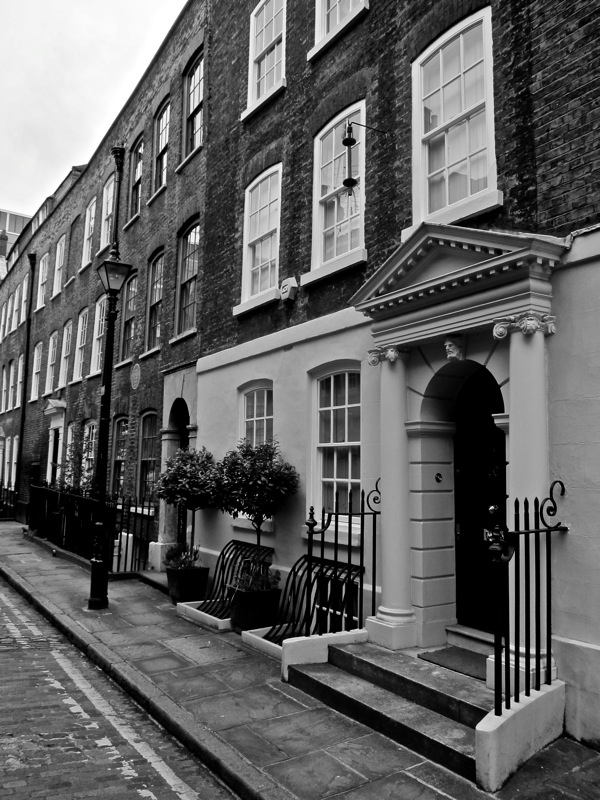
Former Huguenot residence in Elder St.
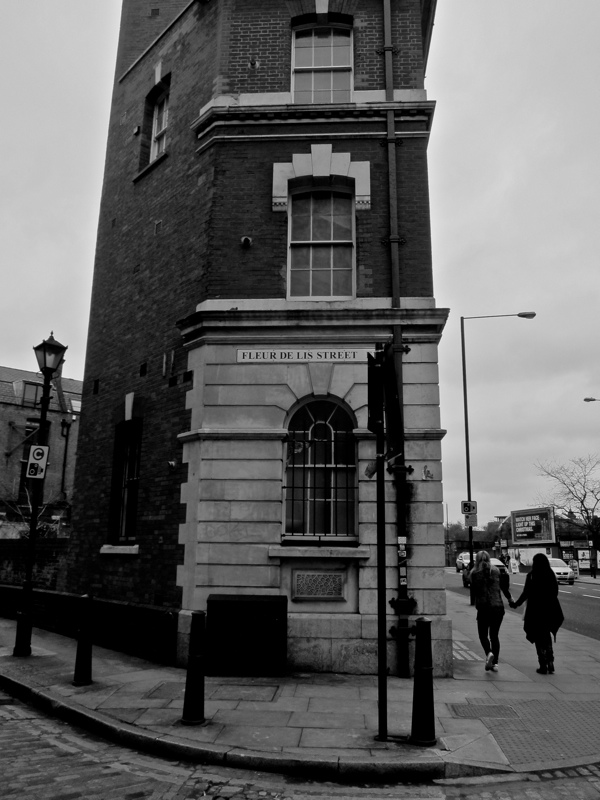
The Fleur de Lis was adopted as the symbol of the Huguenots.
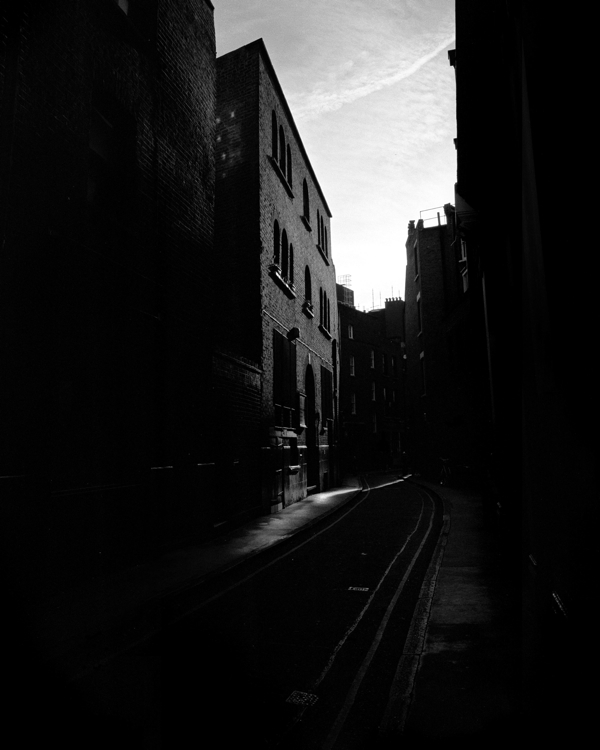
Sandys Row Synagogue was originally built by the Huguenots as “L’Eglise de l’Artillerie” in 1766.
Sandys Row Photograph copyright © Jeremy Freedman
You may also like to take a look at
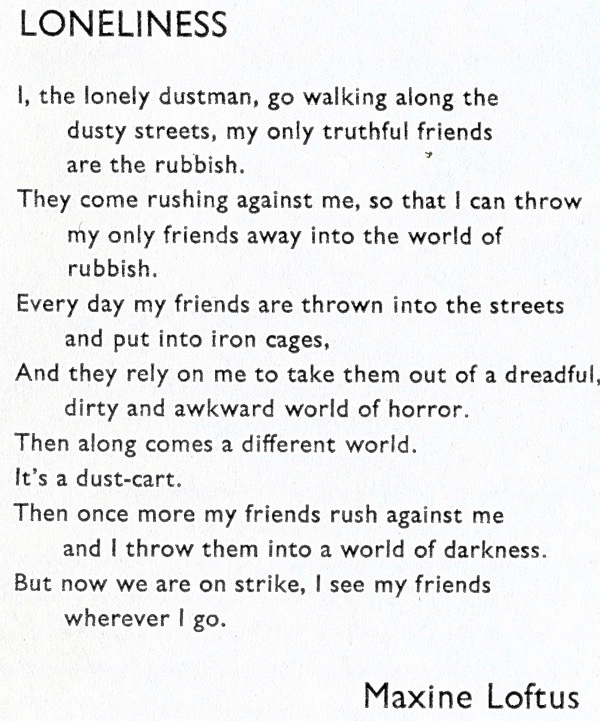
Celebrating The Stepney School Strike
A few places are available for my last-ever course HOW TO WRITE A BLOG THAT PEOPLE WILL WANT TO READ on November 20th & 21st. This is your final chance to come to Spitalfields and spend a weekend with me in an eighteenth century weaver’s house in Fournier St, enjoy delicious lunches from Leila’s Cafe, eat cakes baked to historic recipes by Townhouse and learn how to write your own blog. Email spitalfieldslife@gmail.com to book a place.
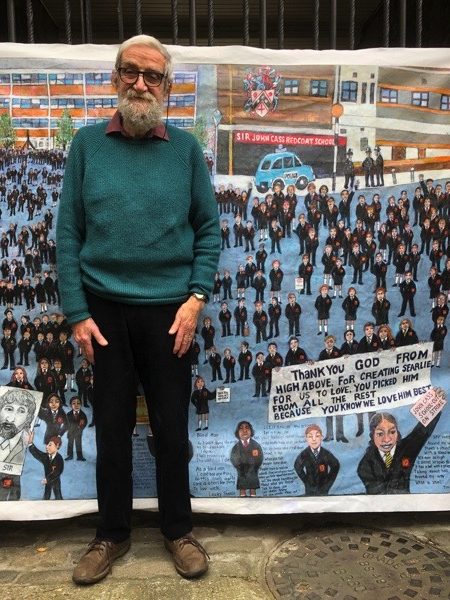
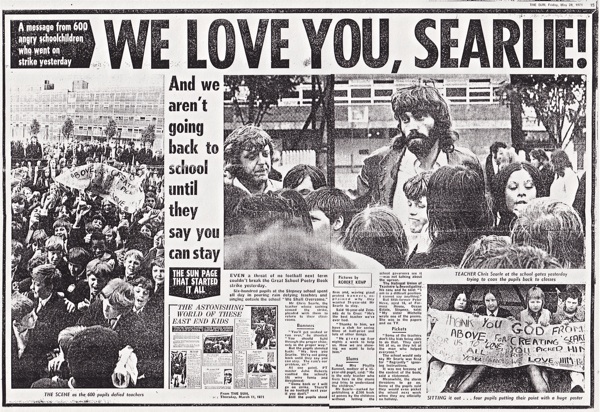
Broadcaster Alan Dein introduces a celebration this Sunday afternoon at Queen Mary University in Mile End, remembering the Stepney School Strike of 1971
‘It was such an extraordinary event. I’ve wanted to do a painting of it for such a long time – and now I’ve done it!,’ admitted Dan Jones, artist and former community worker, speaking of his newly completed banner commemorating the fiftieth anniversary of the Stepney School Strike.
It is the latest painting in a lifetime’s work, depicting the day-to-day lives of Eastenders, past and present. What began as a small picture in acrylic is now a canvas larger than a school blackboard. Yet this is the ideal size to portray hundreds of striking school children and a familiar scale for an artist who has created many beautifully painted banners that have been carried through the East End streets, now hung in galleries, archives and – famously – at the TUC Headquarters.
When Nadia Valman & I visited Dan in Cable St for sneak preview of his painting before it is unveiled publicly this Sunday at the People’s Palace, he revealed his motivation for portraying the celebrated school strike which has a personal meaning for him.
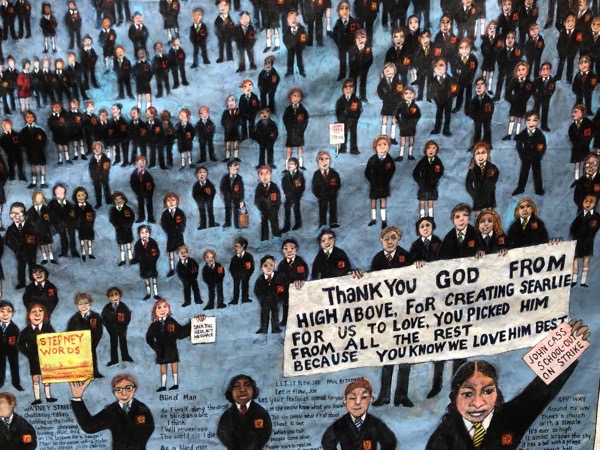
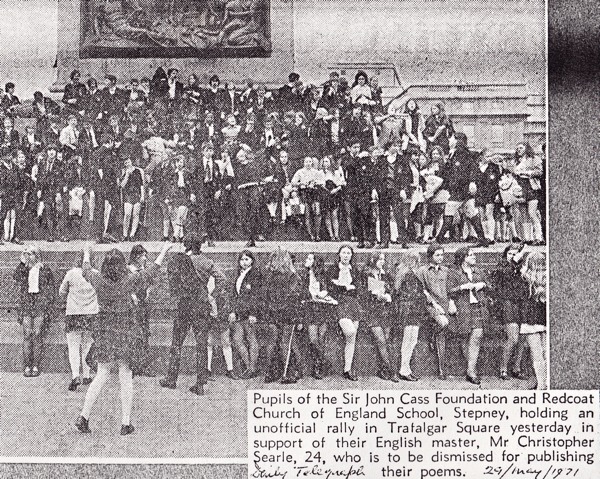
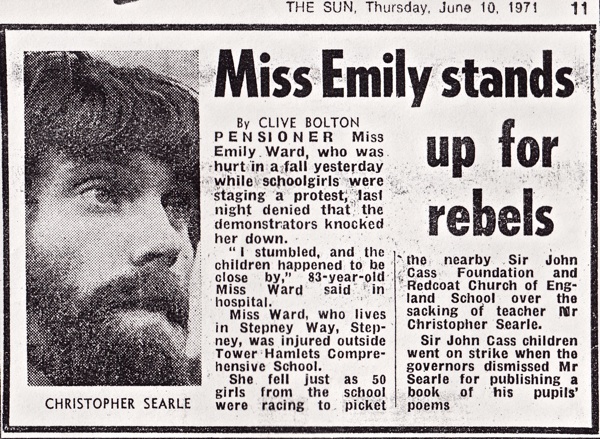
‘The teacher Chris Searle is a friend,’ he told us, ‘this is the story of a gifted writer and remarkable bloke being sacked. He got up the noses of the school governors – at what was then ‘Sir John Cass’ – for publishing a book of his students’ poems, but he was a popular teacher. The kids were furious and eight hundred teenagers marched to Trafalgar Sq protesting and demanding that Chris got his job back.’
Dan Jones did not use archive photographs as a reference, nor did he have access to any portraits of the kids. His approach was to work from imagination and draw inspiration from friends who were there at the time.
‘I’ve painted in about two hundred of the eight hundred schoolchildren who refused to go through the school gates,’ Dan explained. ‘It conveys the positive power of young people. Organised by playground gossip, effectively the whole school said this is an outrage. I wanted to get images of determination and fight. I feel proud to be doing it. There are smiles, banners, some of the poems themselves, I’ve squeezed them in – and you’ll see a portrait of Chris Searle, that’s most probably the only correct part of the painting!’
Like Dan Jones’ other paintings of crowds and public gatherings, there is a wonderful sense of the atmosphere created by people brought together in a fleeting moment for a cause that will change them forever.
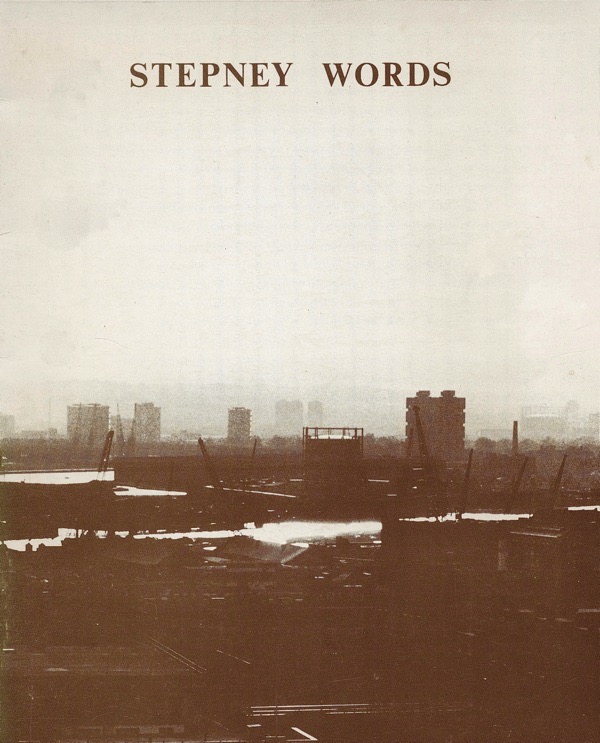
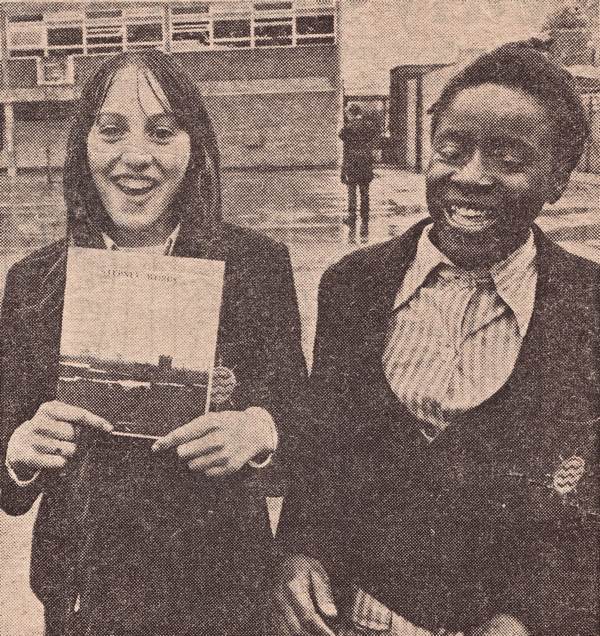
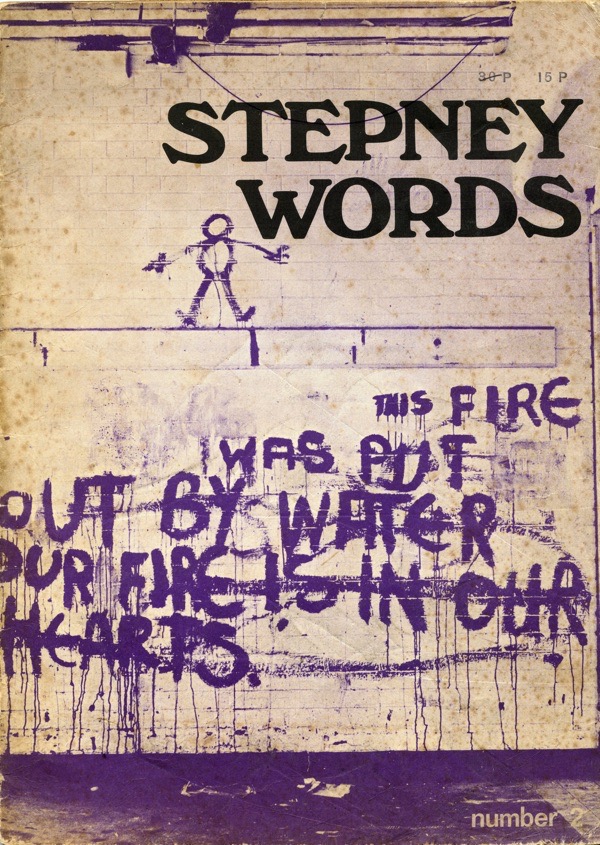
Fifty years on, Chris Searle, original Stepney poets and strikers, together with academics, community activists and poets are gathering at Queen Mary University this Sunday 14th November to discuss the legacy of Stepney Words and the school strike.
Now known as ‘Stepney All Saints,’ the school has invited Chris Searle and some of his class of 1971 to collaborate with a group of current pupils in poetry workshops, and film of these sessions will be screened.
‘There were remarkable people in that group of striking kids,’ concluded Dan Jones, ‘it’s a lovely end to the story that fifty years on the sacked teacher has been welcomed back and has taught again at the very school he was sacked from. To be welcomed back as an honoured friend – it’s completely bonkers, and lovely!’
Click here to book for STEPNEY WORDS FIFTY YEARS ON, 2-6:15pm Sunday 14th November 2021




You may also like to read about
Henry Mayhew’s Street Traders
A few places are available for my last-ever course HOW TO WRITE A BLOG THAT PEOPLE WILL WANT TO READ on November 20th & 21st. This is your final chance to come to Spitalfields and spend a weekend with me in an eighteenth century weaver’s house in Fournier St, enjoy delicious lunches from Leila’s Cafe, eat cakes baked to historic recipes by Townhouse and learn how to write your own blog. Email spitalfieldslife@gmail.com to book a place.
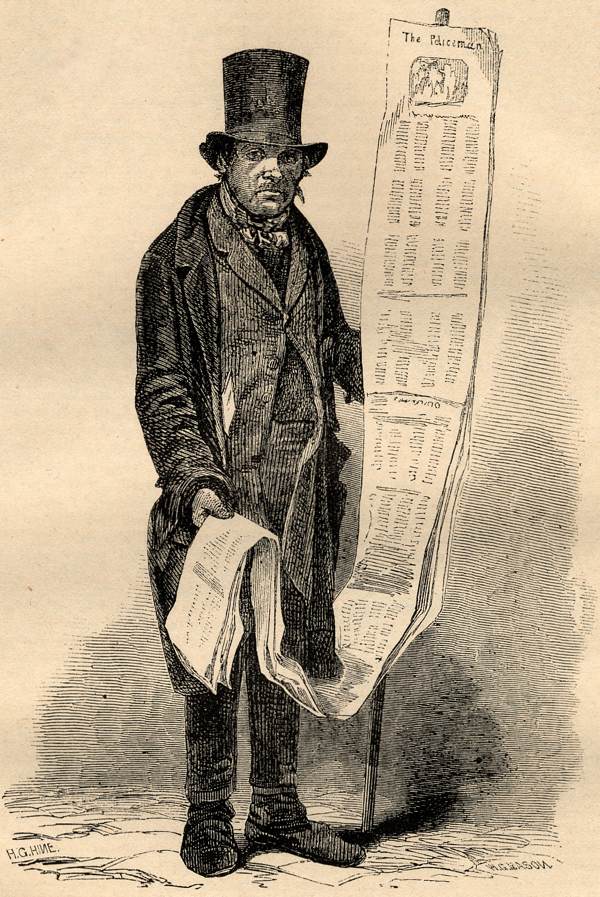
The Long-Song Seller
There is a silent ghost who accompanies me in my work, following me down the street and sitting discreetly in the corner while I am doing my interviews. He is always there in the back of my mind. He is Henry Mayhew, whose monumental work,”London Labour & London Poor,” was the first to give ordinary people the chance to speak in their own words. I often think of him, and the ambition and quality of his work inspires me. And I sometimes wonder what it was like for him, pursuing his own interviews, one hundred and fifty years ago, in a very different world.
Mayhew’s interviews and pen portraits appeared in the London Chronicle and were published in two volumes in 1851, eventually reaching their final form in five volumes published in 1865. In his preface, Mayhew described it as “the first attempt to publish the history of the people, from the lips of the people themselves – giving a literal description of their labour, their earnings, their trials and their sufferings in their own unvarnished language.”
These works were produced before photography was widely used to illustrate books, and although photographer Richard Beard produced a set of portraits to accompany Mayhew’s interviews, these were reproduced by engraving. Fortunately, since Beard’s photographs have not survived, the engravings were skillfully done. And they are fascinating images, because they exist as the bridge between the popular prints of the Cries of London that had been produced for centuries and the development of street photography, initiated by JohnThomson’s “Street Life in London” in 1876.
Primarily, Mayhew’s intention was to create a documentary record, educating his middle class readers about the lives of the poor to encourage social change. Yet his work transcends the tragic politics of want and deprivation that he set out to address, because the human qualities of his subjects come alive on the page and command our respect. Henry Mayhew bears witness not only to the suffering of poor people in nineteenth century London, but also to their endless resourcefulness and courage in carving out lives for themselves in such unpromising circumstances.
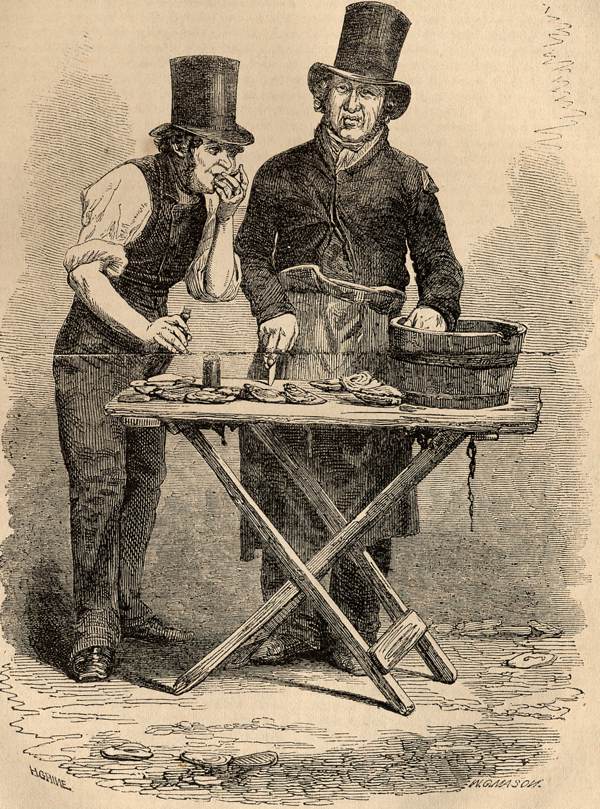
The Oyster Stall. “I’ve been twenty years and more, perhaps twenty-four, selling shellfish in the streets. I was a boot closer when I was young, but I had an attack of rheumatic fever, and lost the use of my hands for my trade. The streets hadn’t any great name, as far as I knew, then, but as I couldn’t work, it was just a choice between street selling and starving, so I didn’t prefer the last. It was reckoned degrading to go into the streets – but I couldn’t help that. I was astonished at my success when I first began, I made three pounds the first week I knew my trade. I was giddy and extravagant. I don’t clear three shillings a day now, I average fifteen shillings a week the year through. People can’t spend money in shellfish when they haven’t got any.”

The Irish Street-Seller. “I was brought over here, sir, when I was a girl, but my father and mother died two or three years after. I was in service, I saved a little money and got married. My husband’s a labourer, he’s out of worruk now, and I’m forced to thry and sill a few oranges to keep a bit of life in us, and my husband minds the children. Bad as I do, I can do a penny or tuppence a day better profit than him, poor man! For he’s tall and big, and people thinks, if he goes round with a few oranges, it’s just from idleniss.”
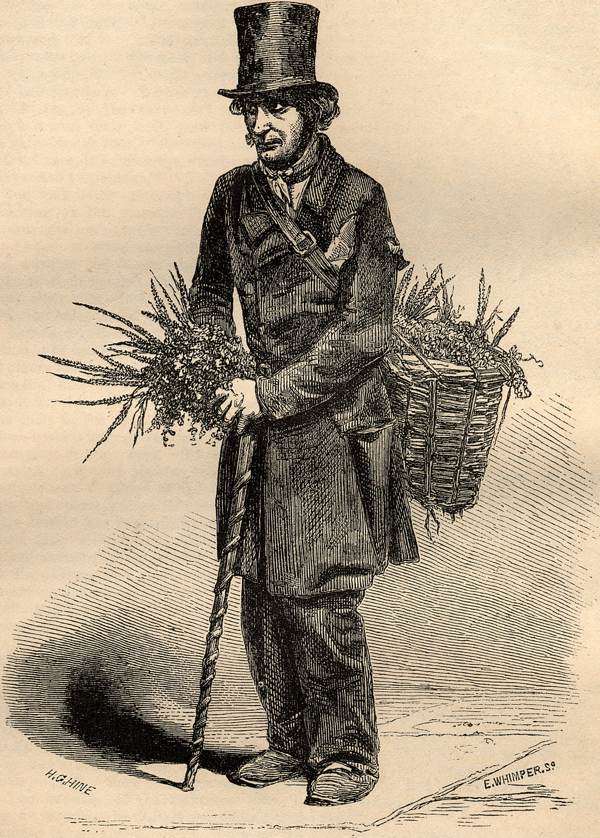
The Groundsel Man. “I sell chickweed and grunsell, and turfs for larks. That’s all I sell, unless it’s a few nettles that’s ordered. I believe they’re for tea, sir. I gets the chickweed at Chalk Farm. I pay nothing for it. I gets it out of the public fields. Every morning about seven I goes for it. I’ve been at business about eighteen year. I’m out till about five in the evening. I never stop to eat. I am walking ten hours every day – wet and dry. My leg and foot and all is quite dead. I goes with a stick.”
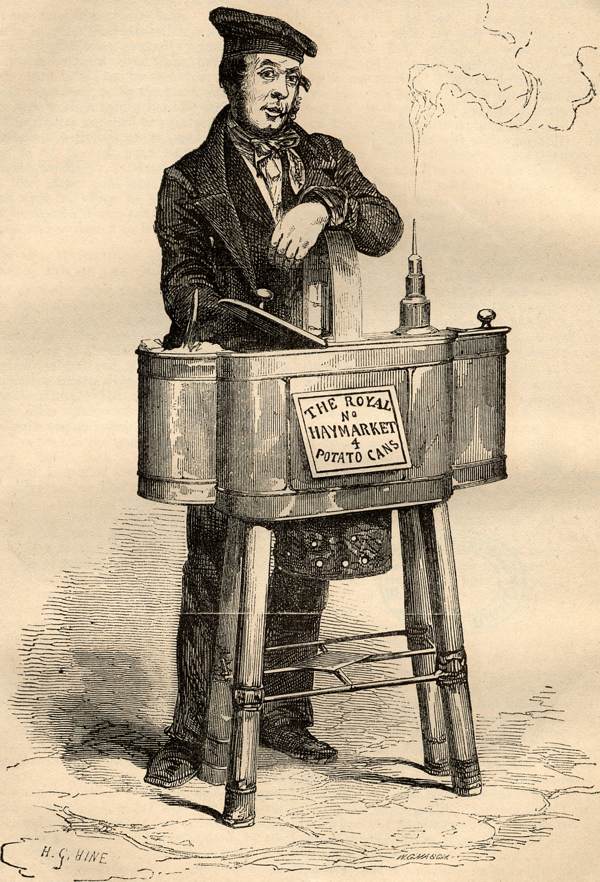
The Baked Potato Man. “Such a day as this, sir, when the fog’s like a cloud come down, people looks very shy at my taties. They’ve been more suspicious since the taty rot. I sell mostly to mechanics, I was a grocer’s porter myself before I was a baked taty. Gentlemen does grumble though, and they’ve said, “Is that all for tuppence?” Some customers is very pleasant with me, and says I’m a blessing. They’re women that’s not reckoned the best in the world, but they pays me. I’ve trusted them sometimes, and I am paid mostly. Money goes one can’t tell how, and ‘specially if you drinks a drop as I do sometimes. Foggy weather drives me to it, I’m so worritted – that is, now and then, you’ll mind, sir.”

The London Coffee Stall. “I was a mason’s labourer, a smith’s labourer, a plasterer’s labourer, or a bricklayer’s labourer. I was for six months without any employment. I did not know which way to keep my wife and child. Many said they wouldn’t do such a thing as keep a coffee stall, but I said I’d do anything to get a bit of bread honestly. Years ago, when I as a boy, I used to go out selling water-cresses, and apples, and oranges, and radishes with a barrow. I went to the tinman and paid him ten shillings and sixpence (the last of my savings, after I’d been four or five months out of work) for a can. I heard that an old man, who had been in the habit of standing at the entrance of one of the markets, had fell ill. So, what do I do, I goes and pops onto his pitch, and there I’ve done better than ever I did before.”

Coster Boy & Girl Tossing the Pieman. To toss the pieman was a favourite pastime with costermonger’s boys. If the pieman won the toss, he received a penny without giving a pie, if he lost he handed it over for nothing. “I’ve taken as much as two shillings and sixpence at tossing, which I shouldn’t have done otherwise. Very few people buy without tossing, and boys in particular. Gentlemen ‘out on the spree’ at the late public houses will frequently toss when they don’t want the pies, and when they win they will amuse themselves by throwing the pies at one another, or at me. Sometimes I have taken as much as half a crown and the people of whom I had the money has never eaten a pie.”

The Street- Seller of Nutmeg Graters. “Persons looks at me a good bit when I go into a strange place. I do feel it very much, that I haven’t the power to get my living or to do a thing for myself, but I never begged for nothing. I never thought those whom God had given the power to help themselves ought to help me. My trade is to sell brooms and brushes, and all kinds of cutlery and tinware. I learnt it myself. I was never brought up to nothing, because I couldn’t use my hands. Mother was a cook in a nobleman’s family when I was born. They say I was a love child. My mother used to allow so much a year for my schooling, and I can read and write pretty well. With a couple of pounds, I’d get a stock, and go into the country with a barrow, and buy old metal, and exchange tinware for old clothes, and with that, I’m almost sure I could make a decent living.”

The Crockery & Glass Wares Street-Seller. “A good tea service we generally give for a left-off suit of clothes, hat and boots. We give a sugar basin for an old coat, and a rummer for a pair of old Wellington boots. For a glass milk jug, I should expect a waistcoat and trowsers, and they must be tidy ones too. There is always a market for old boots, when there is not for old clothes. I can sell a pair of old boots going along the streets if I carry them in my hand. Old beaver hats and waistcoats are worth little or nothing. Old silk hats, however, there’s a tidy market for. There is one man who stands in Devonshire St, Bishopsgate waiting to buy the hats of us as we go into the market, and who purchases at least thirty a week. If I go out with a fifteen shilling basket of crockery, maybe after a tidy day’s work I shall come home with a shilling in my pocket and a bundle of old clothes, consisting of two or three old shirts, a coat or two, a suit of left-off livery, a woman’s gown maybe or a pair of old stays, a couple of pairs of Wellingtons, and waistcoat or so.”
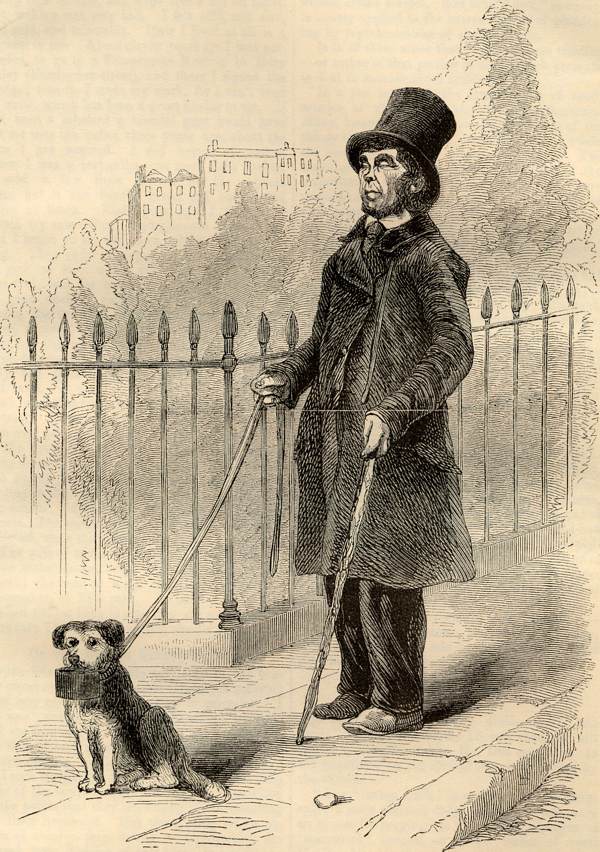
The Blind Bootlace Seller. “At five years old, while my mother was still alive, I caught the small pox. I only wish vaccination had been in vogue then as it is now or I shouldn’t have lost my eyes. I didn’t lose both my eyeballs till about twenty years after that, though my sight was gone for all but the shadow of daylight and bright colours. I could tell the daylight and I could see the light of the moon but never the shape of it. I never could see a star. I got to think that a roving life was a fine pleasant one. I didn’t think the country was half so big and you couldn’t credit the pleasure I got in going about it. I grew pleaseder and pleaseder with the life. You see, I never had no pleasure, and it seemed to me like a whole new world, to be able to get victuals without doing anything. On my way to Romford, I met a blind man who took me in partnership with him, and larnt me my business complete – and that’s just about two or three and twenty year ago.”

The Street Rhubarb & Spice Seller. “I am one native of Mogadore in Morocco. I am an Arab. I left my countree when I was sixteen or eighteen years of age, I forget, sir. Dere everything sheap, not what dey are here in England. Like good many, I was young and foolish – like all dee rest of young people, I like to see foreign countries. The people were Mahomedans in Mogadore, but we were Jews, just like here, you see. In my countree the governemen treat de Jews very badly, take all deir money. I get here, I tink, in 1811 when de tree shilling pieces first come out. I go to de play house, I see never such tings as I see here before I come. When I was a little shild, I hear talk in Mogadore of de people of my country sell de rhubarb in de streets of London, and make plenty money by it. All de rhubarb sellers was Jews. Now dey all gone dead, and dere only four of us now in England. Two of us live in Mary Axe, anoder live in, what dey call dat – Spitalfield, and de oder in Petticoat Lane. De one wat live in Spitalfield is an old man, I dare say going on for seventy, and I am little better than seventy-three.”
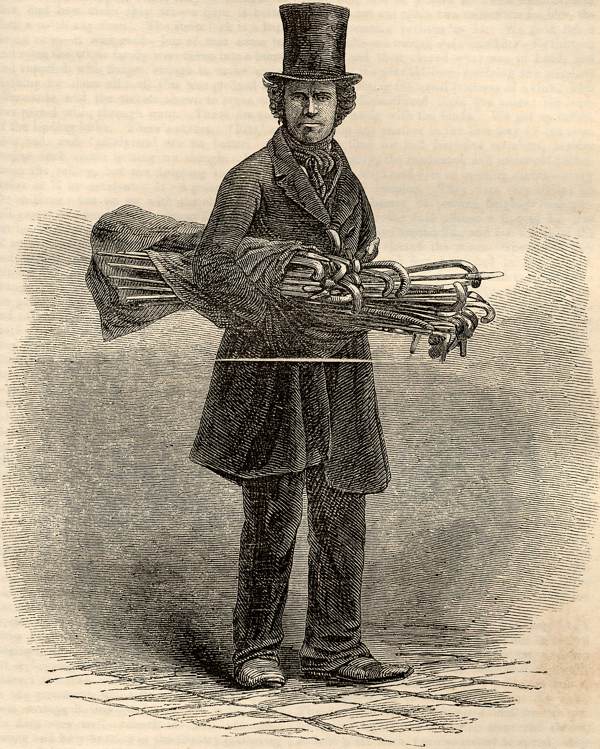
The Street-Seller of Walking Sticks. “I’ve sold to all sorts of people, sir. I once had some very pretty sticks, very cheap, only tuppence a piece, and I sold a good many to boys. They bought them, I suppose, to look like men and daren’t carry them home, for once I saw a boy I’d sold a stick to, break it and throw it away just before he knocked at the door of a respectable house one Sunday evening. There’s only one stick man on the streets, as far as I know – and if there was another, I should be sure to know.”

The Street Comb Seller. “I used to mind my mother’s stall. She sold sweet snuff. I never had a father. Mother’s been dead these – well, I don’t know how long but it’s a long time. I’ve lived by myself ever since and kept myself and I have half a room with another young woman who lives by making little boxes. She’s no better off nor me. It’s my bed and the other sticks is her’n. We ‘gree well enough. No, I’ve never heard anything improper from young men. Boys has sometimes said when I’ve been selling sweets, “Don’t look so hard at ’em, or they’ll turn sour.” I never minded such nonsense. I has very few amusements. I goes once or twice a month, or so, to the gallery at the Victoria Theatre, for I live near. It’s beautiful there, O, it’s really grand. I don’t know what they call what’s played because I can’t read the bills. I’m a going to leave the streets. I have an aunt, a laundress, she taught me laundressing and I’m a good ironer. I’m not likely to get married and I don’t want to.”

The Grease-Removing Composition Sellers. “Here you have a composition to remove stains from silks, muslins, bombazeens, cords or tabarets of any kind or colour. It will never injure or fade the finest silk or satin, but restore it to its original colour. For grease on silks, rub the composition on dry, let it remain five minutes, then take a clothes brush and brush it off, and it will be found to have removed the stains. For grease in woollen cloths, spread the composition on the place with a piece of woollen cloth and cold water, when dry rub it off and it will remove the grease or stain. For pitch or tar, use hot water instead of cold, as that prevents the nap coming off the cloth. Here it is. Squares of grease removing composition, never known to fail, only a penny each.”
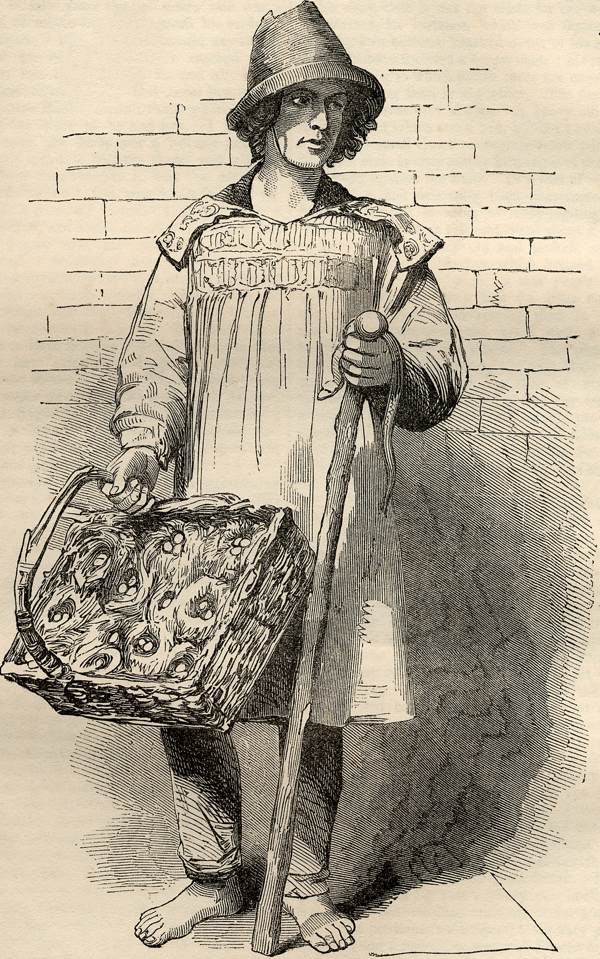
The Street Seller of Birds’ Nests. “I am a seller of birds’-nesties, snakes, slow-worms, adders, “effets” – lizards is their common name – hedgehogs (for killing black beetles), frogs (for the French – they eats ’em), and snails (for birds) – that’s all I sell in the Summertime. In the Winter, I get all kinds of of wild flowers and roots, primroses, buttercups and daisies, and snowdrops, and “backing” off trees (“backing,” it’s called, because it’s used to put at the back of nosegays, it’s got off yew trees, and is the green yew fern). The birds’ nests I get from a penny to threepence a piece for. I never have young birds, I can never sell ’em, you see the young things generally die of cramp before you can get rid of them. I gets most of my eggs from Witham and Chelmsford in Essex. I know more about them parts than anybody else, being used to go after moss for Mr Butler, of the herb shop in Covent Garden. I go out bird nesting three times a week. I’m away a day and two nights. I start between one or two in the morning and walk all night. Oftentimes, I wouldn’t take ’em if it wasn’t for the want of the victuals, it seems such a pity to disturb ’em after they made their little bits of places. Bats I never take myself – I can’t get over ’em. If I has an order of bats, I buys ’em off boys.”
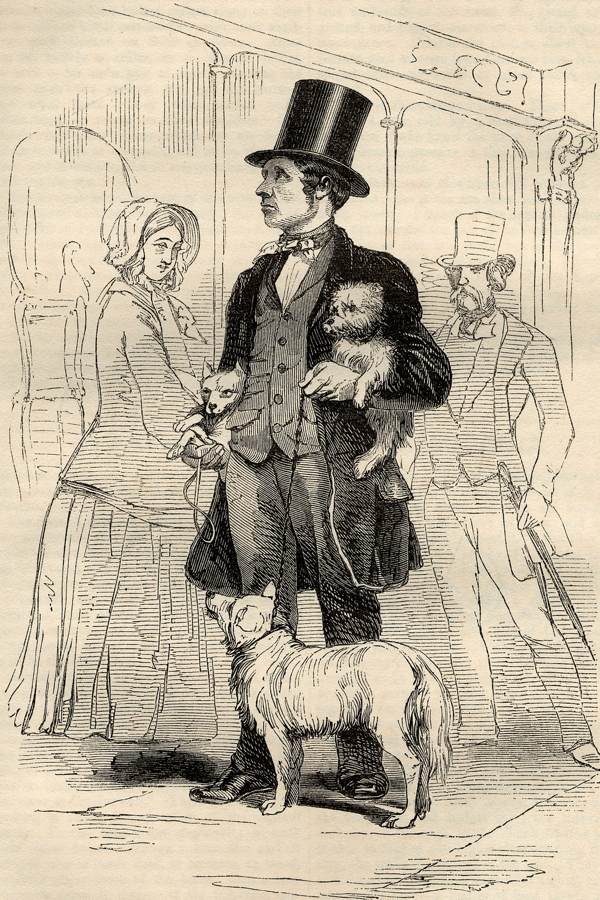
The Street-Seller of Dogs. “There’s one advantage in my trade, we always has to do with the principals. There’s never a lady would let her favouritist maid choose her dog for her. Many of ’em, I know dotes on a nice spaniel. Yes, and I’ve known gentleman buy dogs for their misses. I might be sent on with them and if it was a two guinea dog or so, I was told never to give a hint of the price to the servant or anybody. I know why. It’s easy for a gentleman that wants to please a lady, and not to lay out any great matter of tin, to say that what had really cost him two guineas, cost him twenty.”
Images courtesy © Bishopsgate Institute
You may like to take a look at
John Thomson’s Street Life in London
Aunt Busy Bee’s New London Cries
Marcellus Laroon’s Cries of London
More John Player’s Cries of London
William Nicholson’s London Types
Francis Wheatley’s Cries of London
John Thomas Smith’s Vagabondiana of 1817
Thomas Rowlandson’s Lower Orders
Tony Hall’s Shops
A few places are available for my last-ever course HOW TO WRITE A BLOG THAT PEOPLE WILL WANT TO READ on November 20th & 21st. This is your final chance to come to Spitalfields and spend a weekend with me in an eighteenth century weaver’s house in Fournier St, enjoy delicious lunches from Leila’s Cafe, eat cakes baked to historic recipes by Townhouse and learn how to write your own blog. Email spitalfieldslife@gmail.com to book a place.
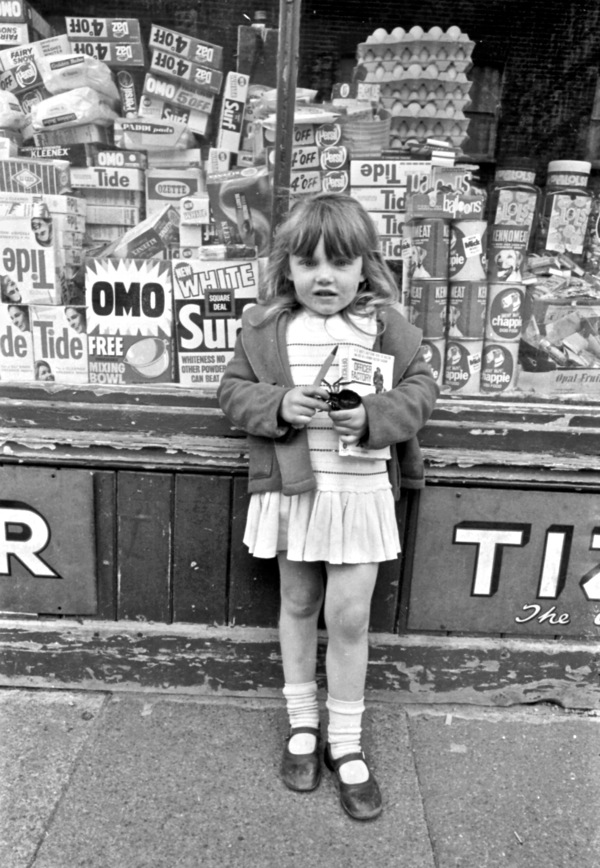
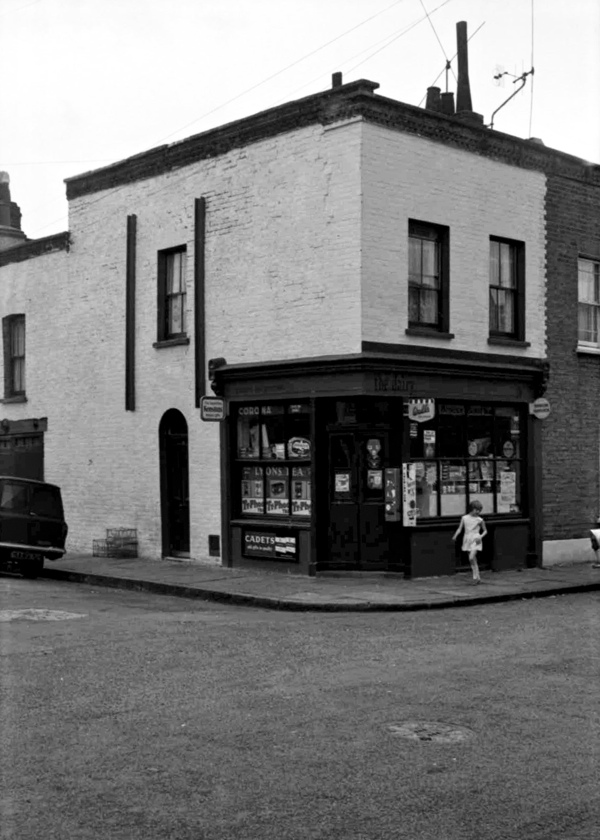
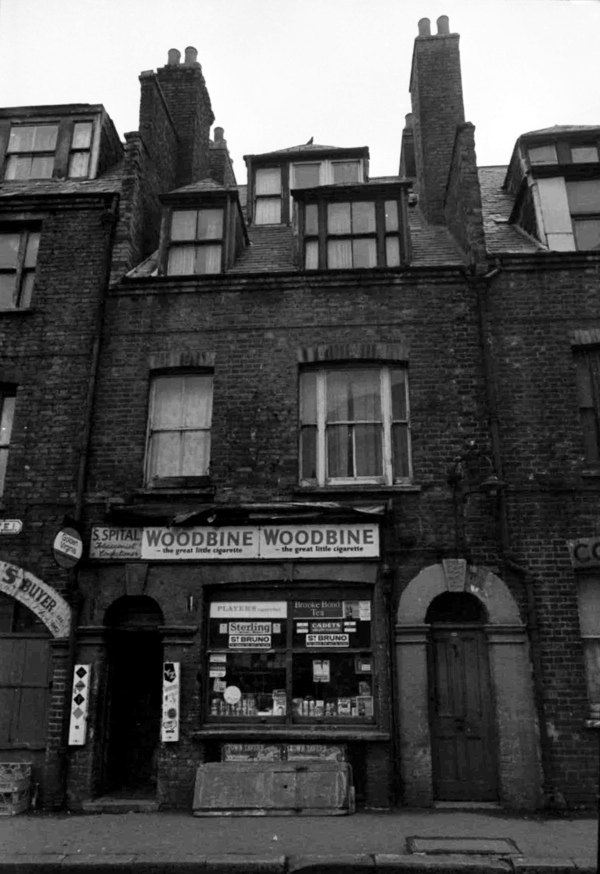
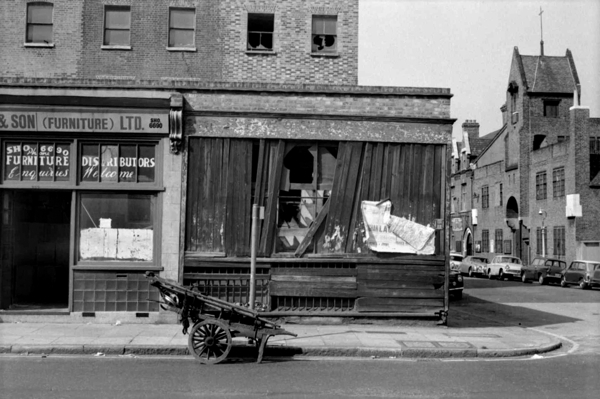
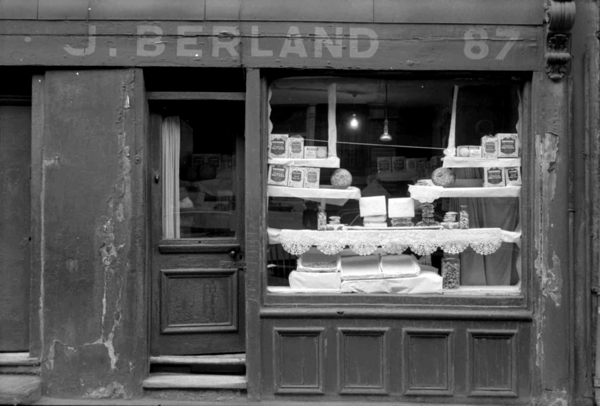
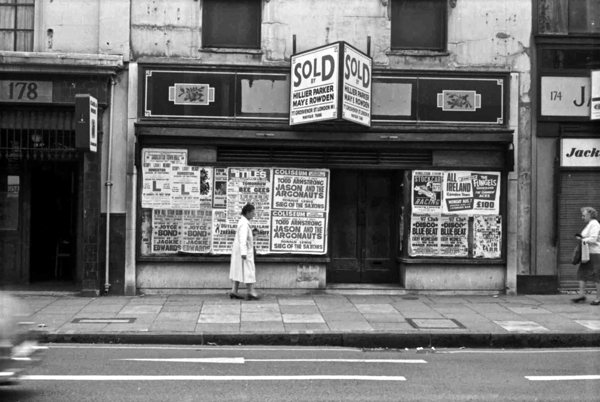
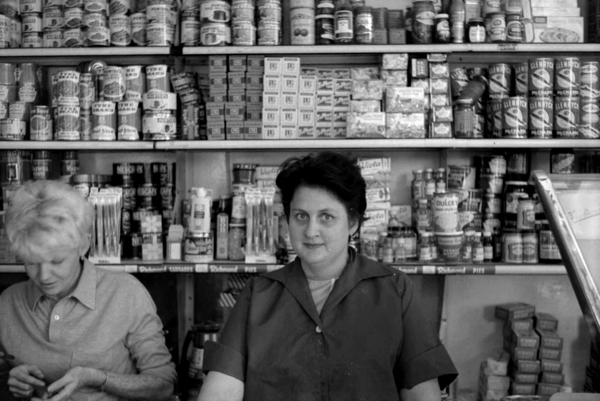
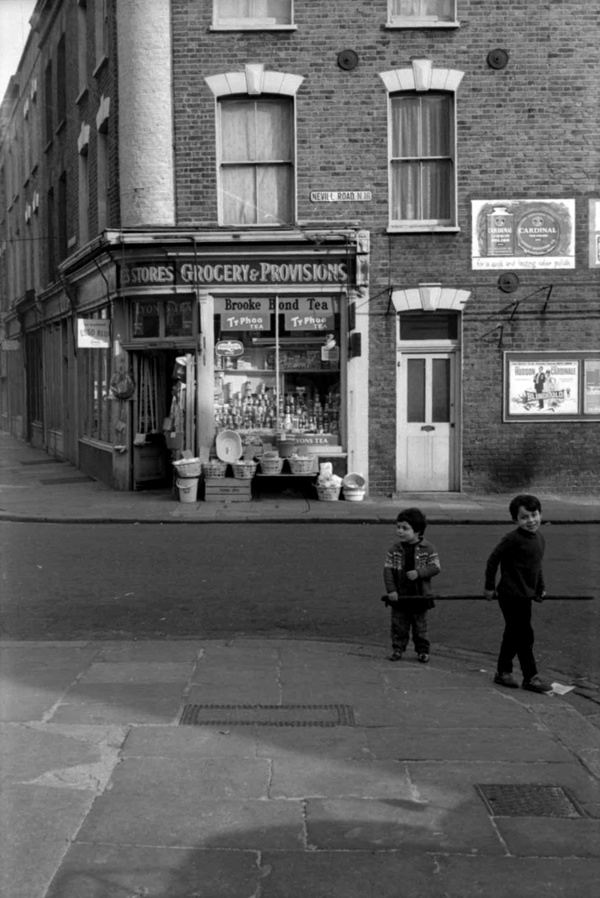
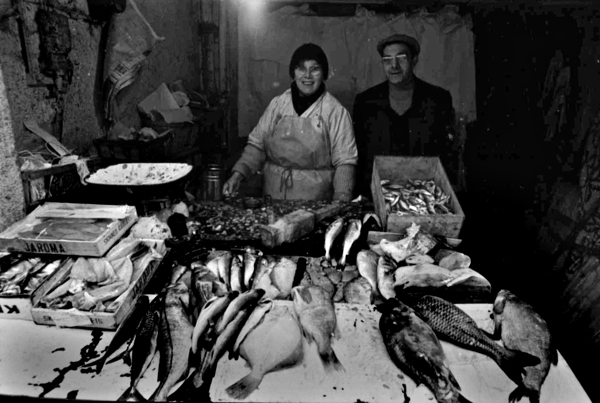
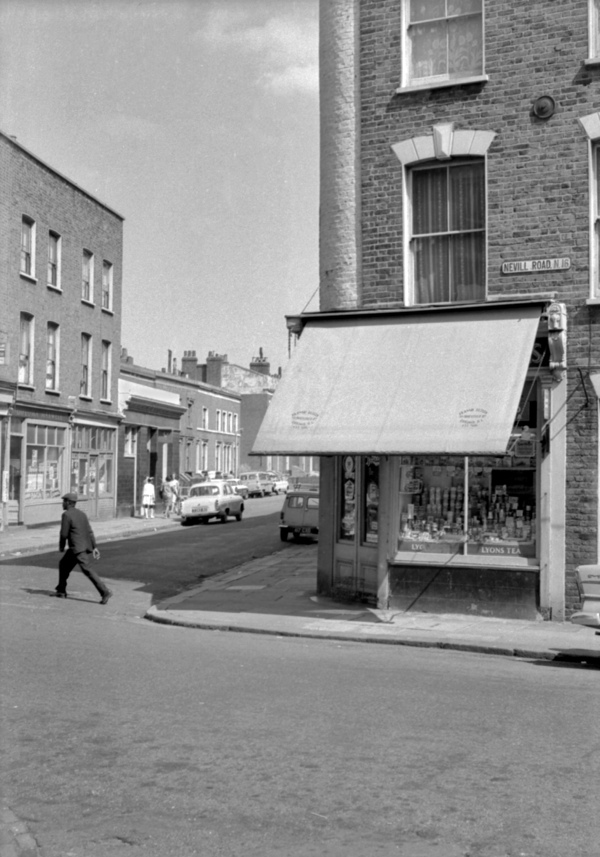
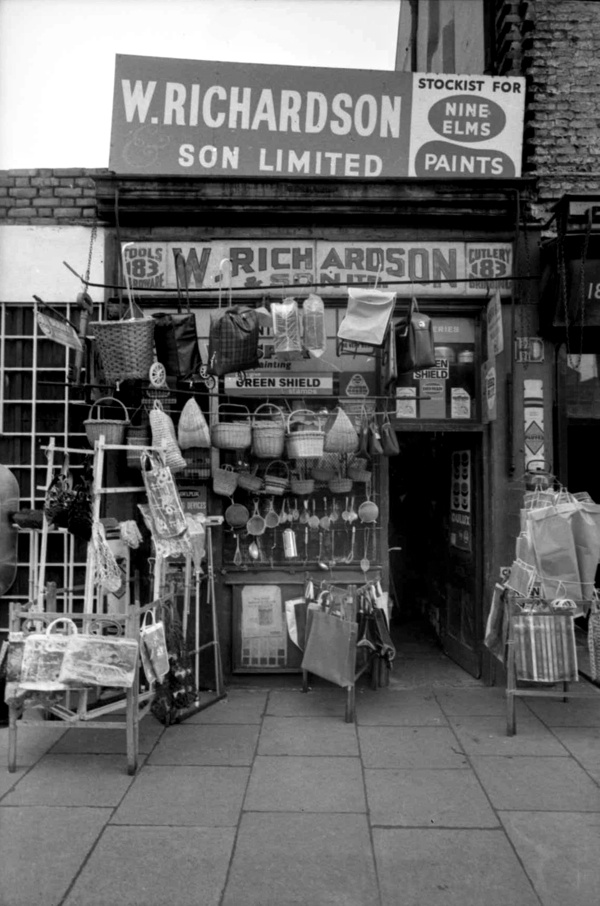
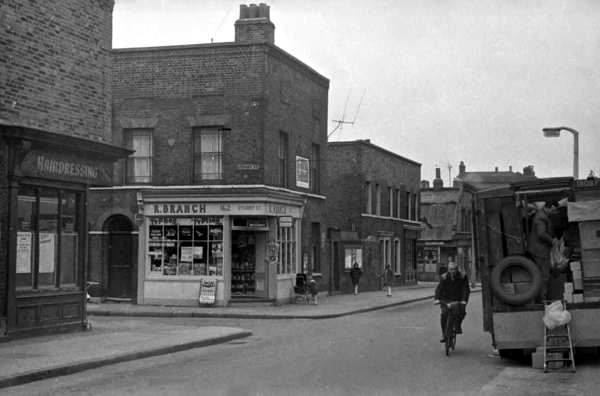
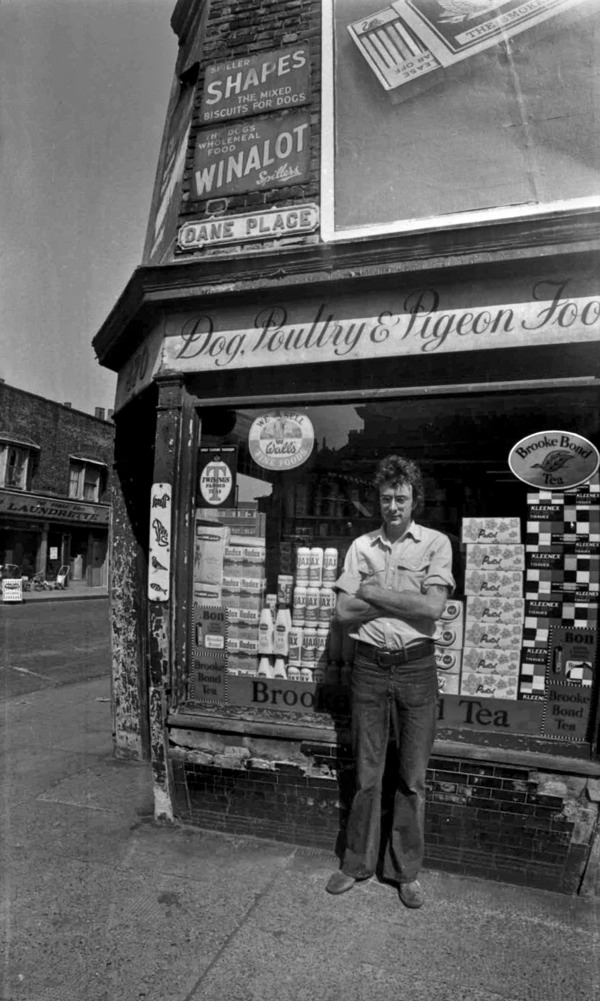
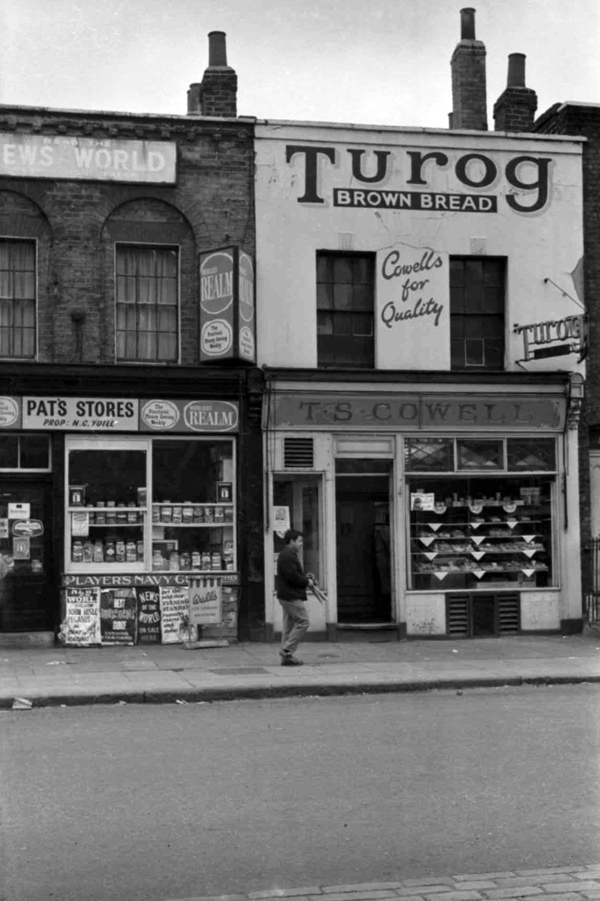
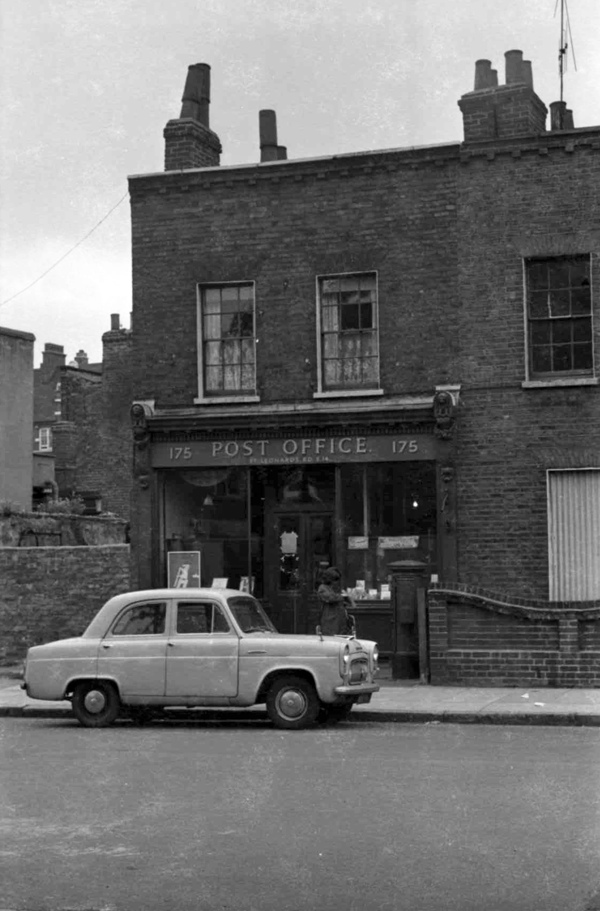
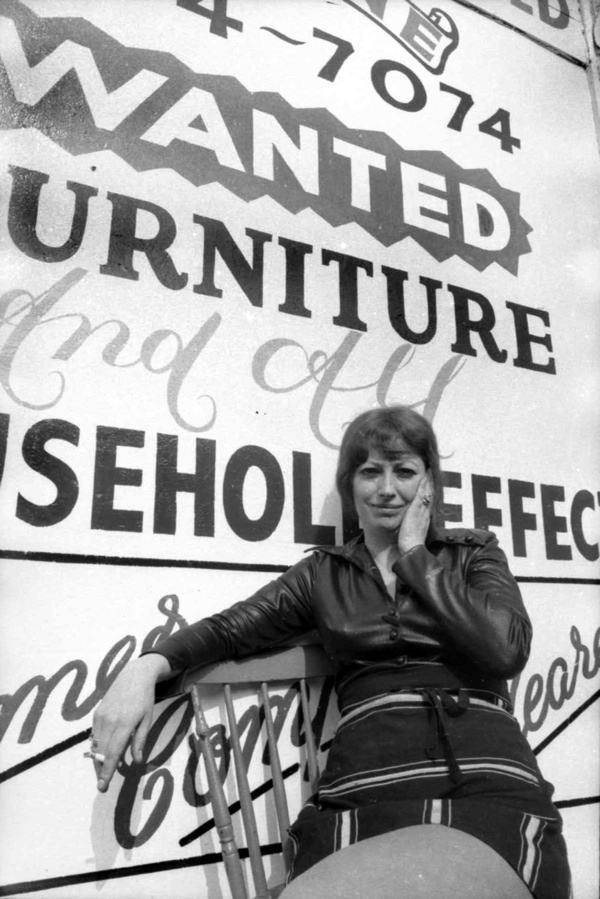
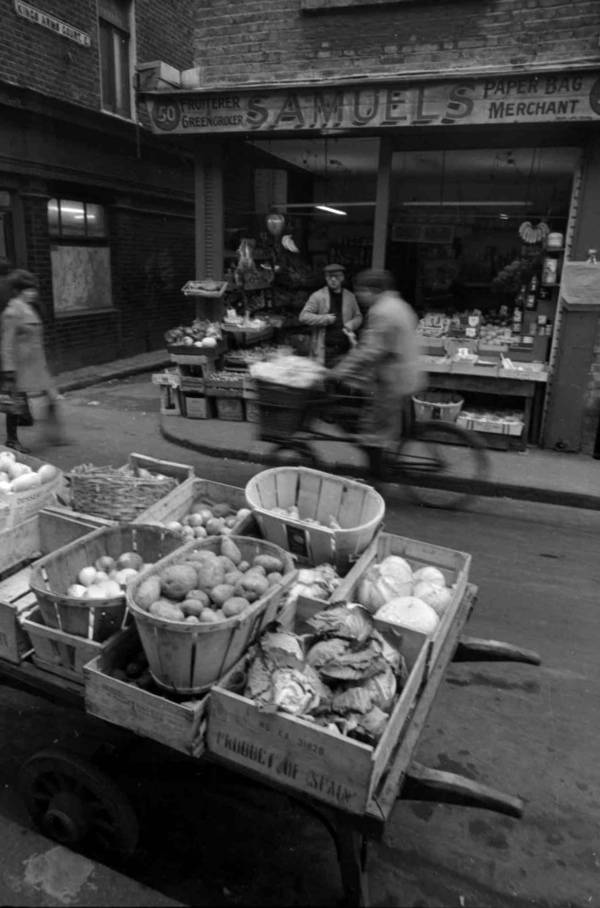
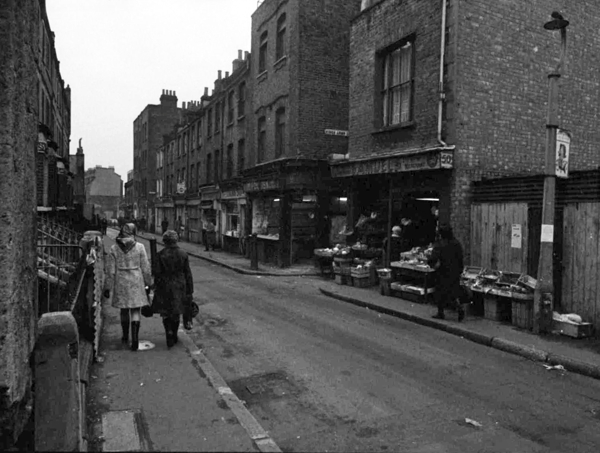
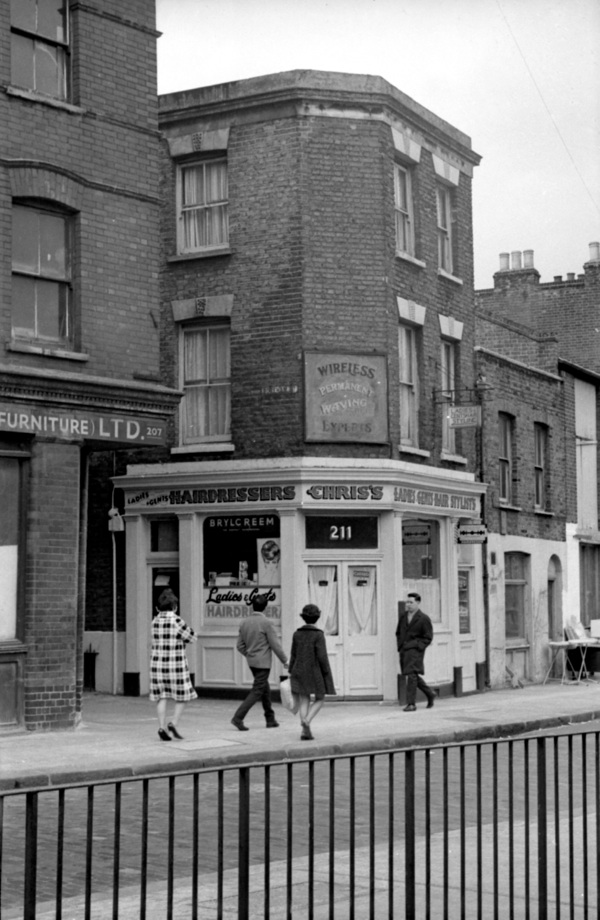
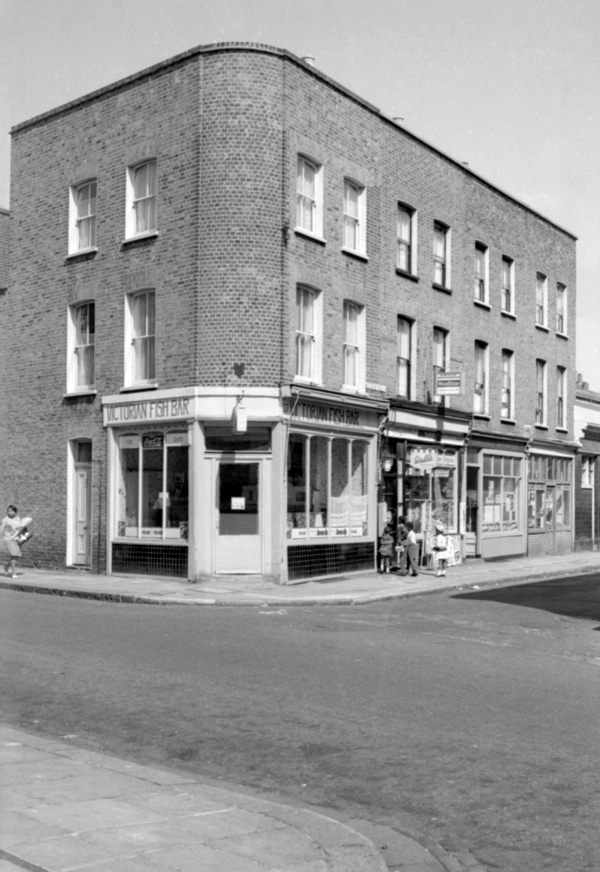
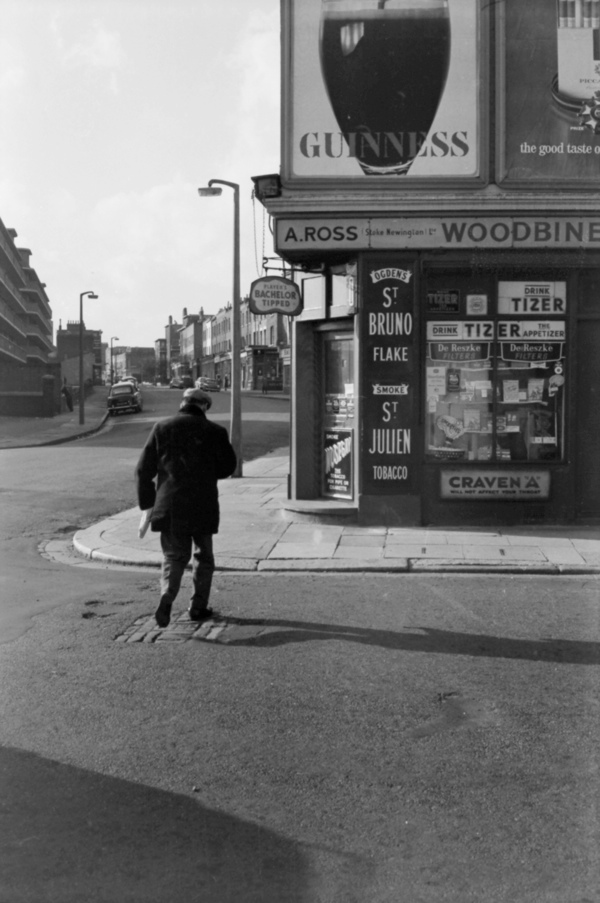
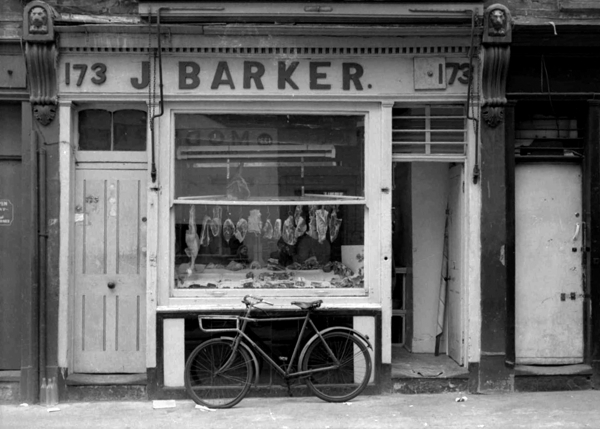
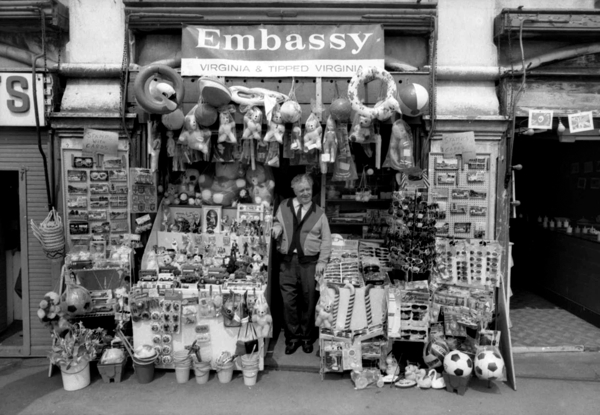
Tony Hall loved shops, as you can see from this magnificent array of little shops in the East End that he captured for eternity, selected from the thousand or so photographs which survive him.
In the sixties and seventies when these pictures were taken, every street corner that was not occupied by a pub was home to a shop offering groceries and general supplies to the residents of the immediate vicinity. The owners of these small shops took on mythic status as all-seeing custodians of local information, offering a counterpoint to the pub as a community meeting place for the exchange of everybody’s business. Shopkeepers were party to the smallest vacillations in the domestic economy of their customers and it was essential for children to curry their good favour if the regular chore of going to fetch a packet of butter or a tin of custard, or any other domestic essential, might be ameliorated by the possibility of reward in the form of sweets, whether there was any change left over or not.
Yet, even in the time these photographs were taken, the small shops were in decline and Tony Hall knew he was capturing the end of a culture, erased by the rise of the chain-stores and the supermarkets. To the aficionado of small shops there are some prize examples here – of businesses that survived beyond their time, receptacles of a certain modest history of shopkeepers. It was a noble history of those who created lives for themselves by working long hours serving the needs of their customers. It was a familiar history of shopkeepers who made a living but not a fortune. Above all, it was a proud history of those who delighted in shopkeeping.



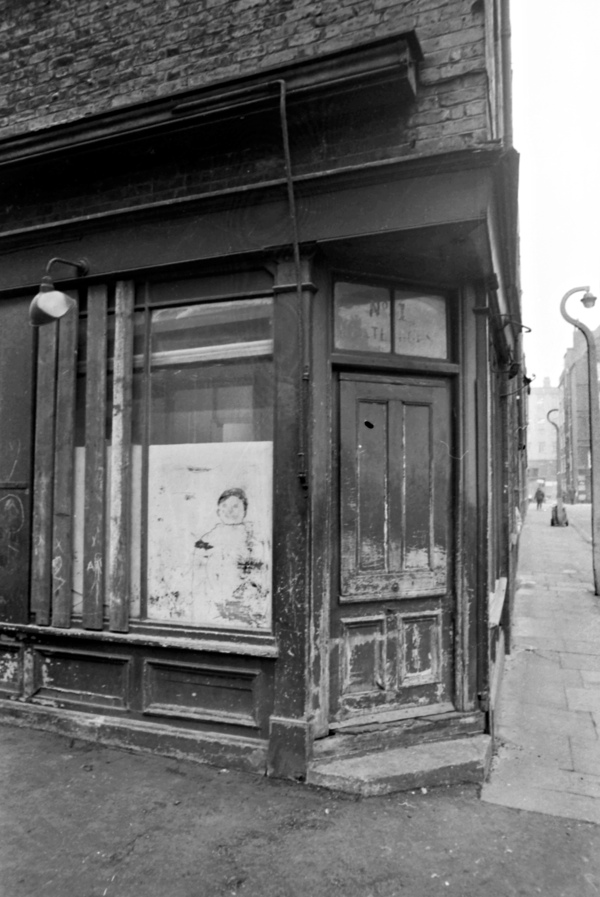
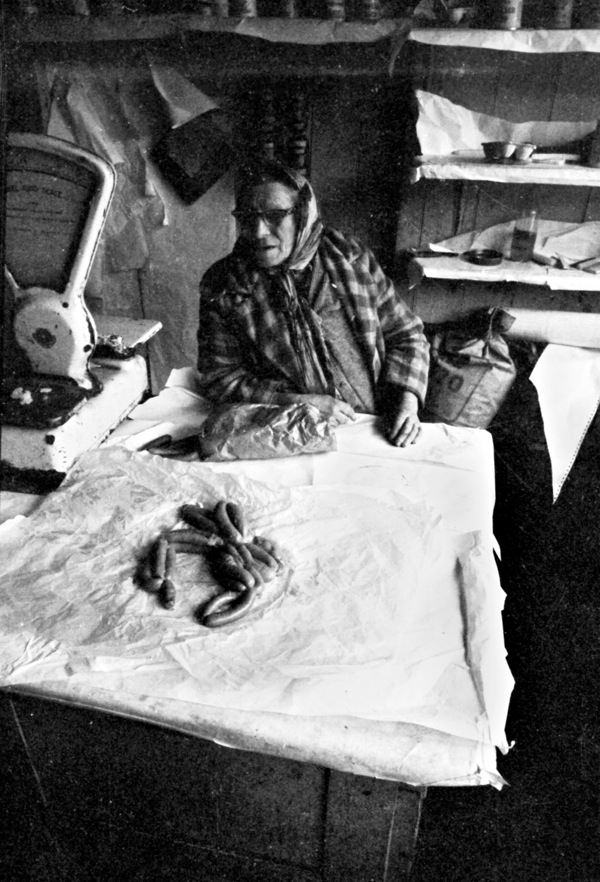


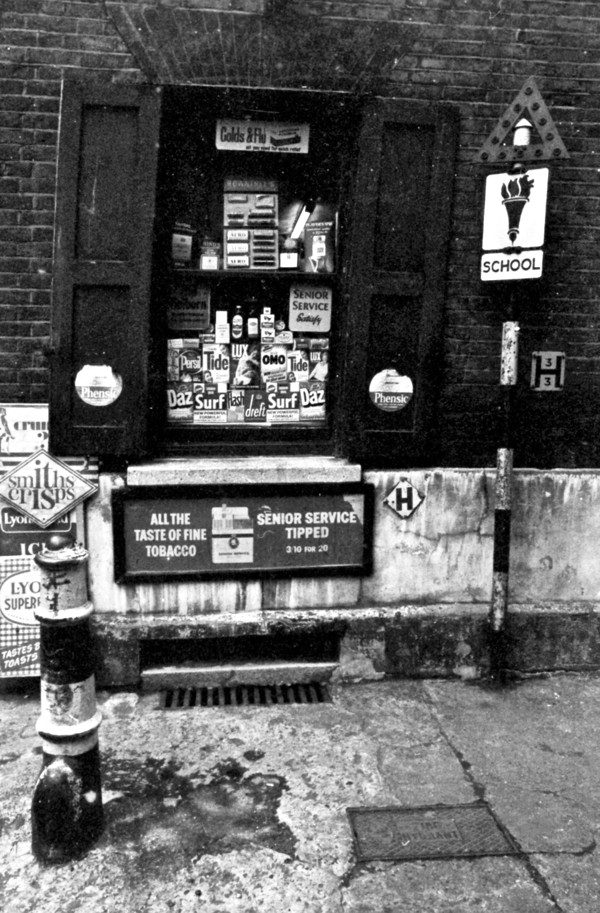
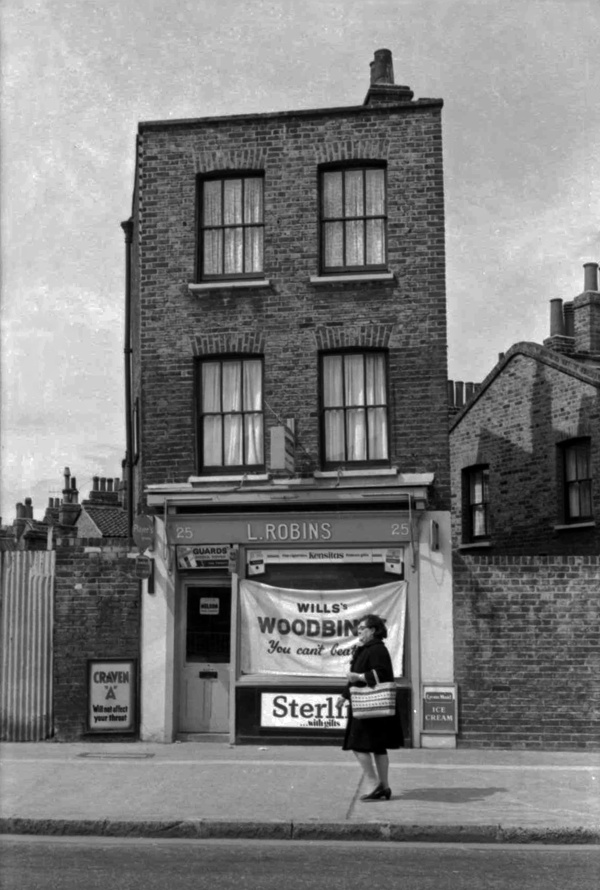




Photographs copyright © Libby Hall
Images courtesy of the Tony Hall Collection at the Bishopsgate Institute
You may also like to read
Libby Hall, Collector of Dog Photography
and take a look at these other pictures of East End Shops
Kyriacos Hadjikyriacou, Pleater
A few places are available for my last-ever course HOW TO WRITE A BLOG THAT PEOPLE WILL WANT TO READ on November 20th & 21st. This is your final chance to come to Spitalfields and spend a weekend with me in an eighteenth century weaver’s house in Fournier St, enjoy delicious lunches from Leila’s Cafe, eat cakes baked to historic recipes by Townhouse and learn how to write your own blog. Email spitalfieldslife@gmail.com to book a place.
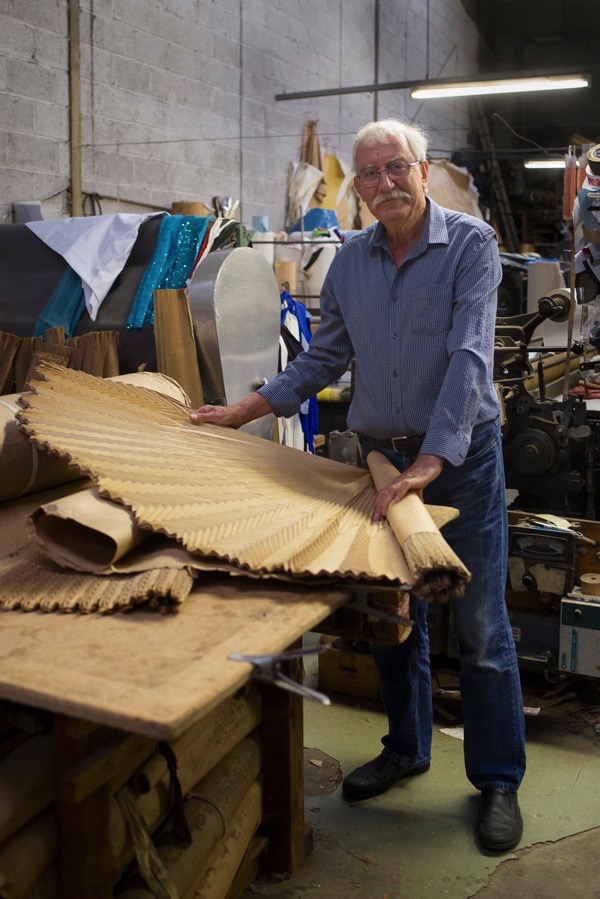
Kyri demonstrates a pattern for a circular pleat
In a remote corner of Tottenham, in the midst of an industrial estate, sandwiched between a kosher butcher and a panel beater, Contributing Photographer Sarah Ainslie & I found Rosamanda Pleaters. We dipped our heads and stepped through a low door to enter a crowded factory. As our eyes accustomed to the gloom, we peered into the depths where lines of machines filled the space, appearing to recede into the infinite distance. We expected a horde of ghostly workers shrouded in cobwebs, but on closer examination the machines were all idle.
Yet, in a pool of bright light, one man worked alone, wrestling cloth, cardboard, sticks and string, subjecting them to his will with expert control. This was the legendary pleater Kyriacos Hadjikyriacou, universally known as Kyri. He removed a piece of silk from between a pair of cardboard patterns that were folded into an intricate design which they imparted to the cloth, as delicate as a butterfly wing and as richly coloured as the plumage of an exotic bird. We were entranced.
The magic of pleating is to take diaphanous fabric and give it volume and structure through a geometric series of creases. These pleats move, amplifying the gesture and motion of the wearer in unexpected and sensuous ways. This is the spell that pleating can impart to clothes. Kyri is the grand master of it.
He has contrived hundreds of unique designs for pleats, spending months conjuring his intricate notions. Pleating is his imaginative world. ‘This one is stars on one side and squares on the other,’ he explained unrolling an elaborately folded piece of cardboard that quivered as if it had a life of its own. ‘I call it ‘Crown Pleat,” he confided to me in a proud conspiratorial whisper. ‘I have never used it yet.’ Kyri finds inspiration for new designs in pantiles, scallop shells and hieroglyphics.
All day the phone rings and breathless fashion assistants arrive from London’s top designers – Christopher Kane, Alexander McQueen, Jasper Conran, among others so fancy we are not permitted to mention – bringing lengths of cloth for Kyri to work his transformative wizardry upon.
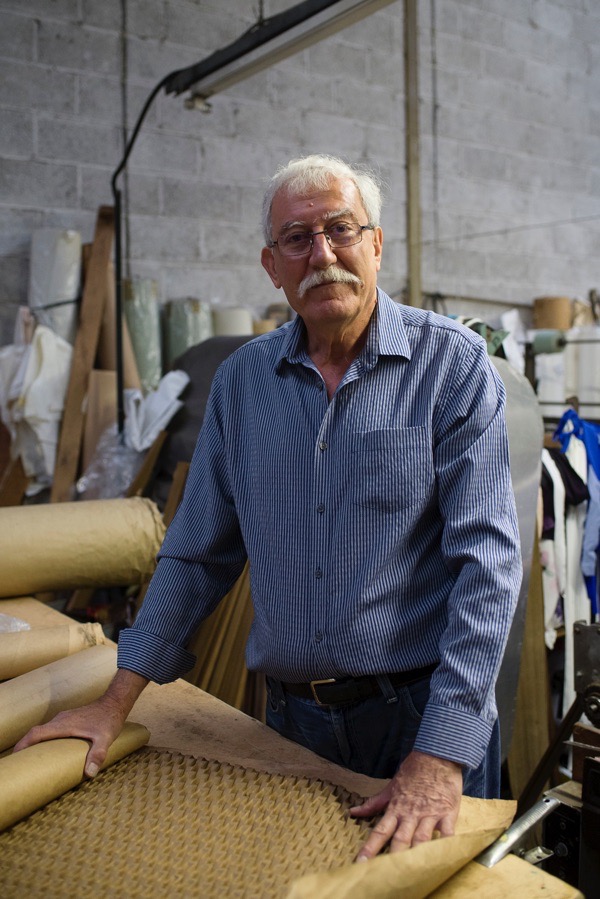
A tall slim man with pale grey hair and straggling white moustache set off by his mediterranean colouring, Kyri cuts a handsome figure. Of philosophical nature, he is untroubled by the endless to and fro, delighting in the attention and maintaining a confident equanimity throughout. He may serve the capricious world of fashion, but his is the realm of geometry and chemistry. Cardboard, sticks and string are his tools, and steam is the alchemical essence that enables him to work his sorcery upon the cloth, subjecting it to his desire.
“As a pleater, you are always learning. Even after forty-three years of pleating, I am learning. It is not just a question of mastering three or five styles, you have to use your imagination. You have know engineering and about how machines work, you have to know geometry to understand how the patterns function, you have to know chemistry to predict how the material will react.
There’s a lot of things you have to know to be a pleater. It’s a talent. I create new things everyday. I design my own patterns. If I see something I like, I work how it is done and I design my own version. At the beginning, I used to come in every Saturday just to experiment with styles. I tried different ways to use the machines to find new styles. I have two hundred different designs of my own.
Hand pleating is done by placing the cloth between two paper patterns, known as ‘pleating crafts.’ They are made of a special paper that is water resistant and does not get wet. You open the craft, stretch the two papers and lay down the material, sandwiched between the two papers. Then you tie them tight and put them in the steam.
The easiest fabric for pleating is polyester. It holds the pleats well, you can even put it in a washing machine. In hand-pleating, you use only steam but in machine-pleating you use the heat of the machine and steam too, so it is more powerful and will resist washing. I have all these machines. One can do fifteen hundred different styles, another is a fancy one that do a couple of thousand different styles.
I don’t need to advertise, people come and find me, and they keep coming back. I tell them,’If you need me, you find me!’ If I make something, it has to be of the standard that I would like to buy – which means it is good to give to a customer.
My work is perfect pleating. It is rare. There are some patterns, I am the only person in England who can do them. Other pleaters do standard pleats and they think that’s everything but it is not. It can take six months to design a pattern. I might start work on it at Christmas and finish in June. I did not know how to do it, but slowly I work it out. I enjoy pleating because I am always creating things. When I started, I didn’t know anything about this.
I have an Msc in Agriculture. I finished my studies in Athens in 1975 and, because of the war in which Turkey invaded Cyprus, I came to England as a refugee. I married my wife Eleni and in the beginning I worked in a knitting factory, Sharon Fabrics in Holloway. After they closed down, I worked at a water plant, analysing water in Crews Hill in Enfield for bacteria. But somebody told me to push a wheelbarrow and I didn’t like it so I left.
After that, I was asked to work for a pleater in Hackney and that was how I started. In 1980, me and two other people, we opened a knitting factory in Clerkenwell near Smithfield Market. My wife worked in Holborn as a bookkeeper then. She asked me, ‘How much does it cost to set up a pleating factory? I told her, ‘Maybe two or three thousand pounds.’ So that’s what we did, we started in business together and we employed two boys. Eighteen months later, we had a fire and all the others left but I carried on.
I have been here in this workshop in Tottenham for twenty-six years. I had a pleater who passed away before my wife eighteen months ago, so I am on my own. There’s just me now but in the past I used to have seven pleaters working for me. All these machines I have are from factories that closed and nobody else wants them There is no business any more for volume. All the High St shops manufacture in the Far East, my business is just with designers now.
I used to work on Sundays, I arrived at eight o’clock every morning and worked until seven. Now I arrive at nine o’clock and work until five, just weekdays. I will carry on as long as I can. I said to my children, ‘I am not going to retire because – for me – if somebody retires they are waiting for death.’ It’s true! If you put your car outside for six months and don’t use it, the tyres and battery go flat. The human being is like that I think.”
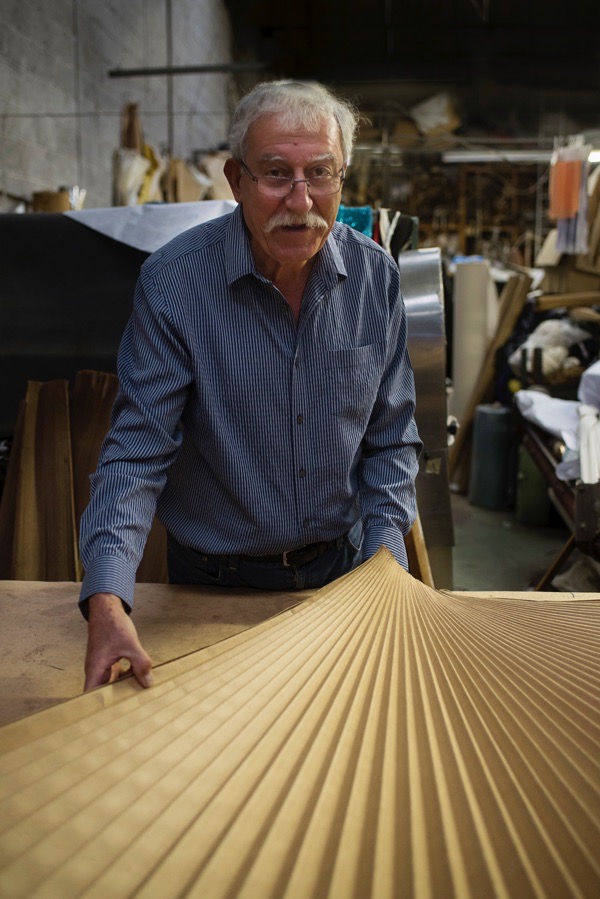
Kyri lays a pattern on the table
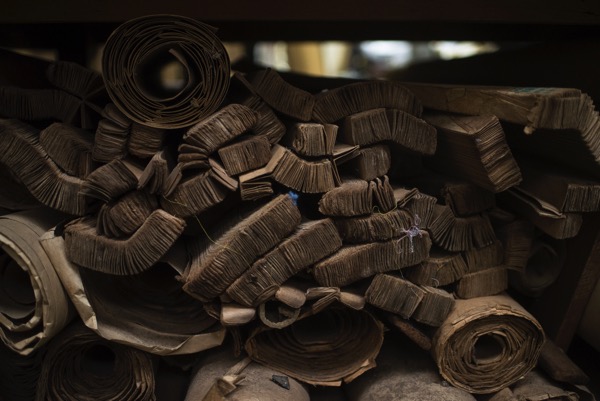
Kyri has over two hundred patterns for pleating that he has designed
Kyri shows off a favourite pleating pattern

‘I call this ‘Crown Pleat”
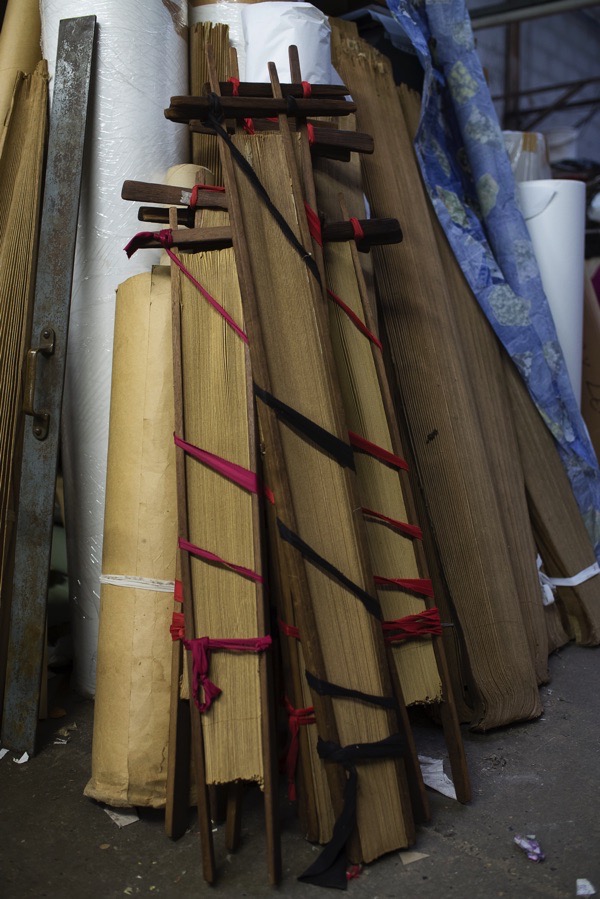
‘Craft pleats’ ready for use
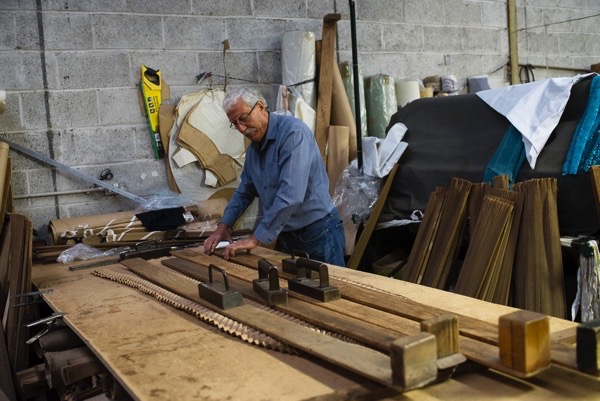
Kyri places weights upon the patterns to make sure the fabric is tightly sandwiched
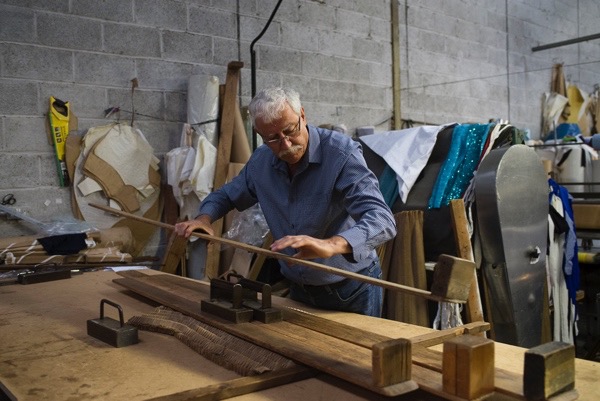
Kyri removes the weights once the pattern is compressed
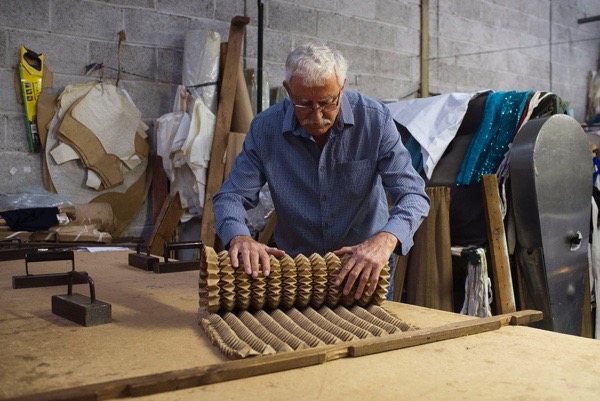
Kyri rolls the patterns to squeeze the fabric into the form of the patterns
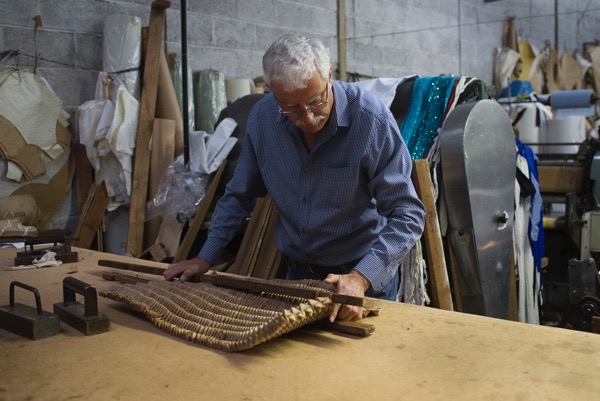
Kyri places the patterns between two splints
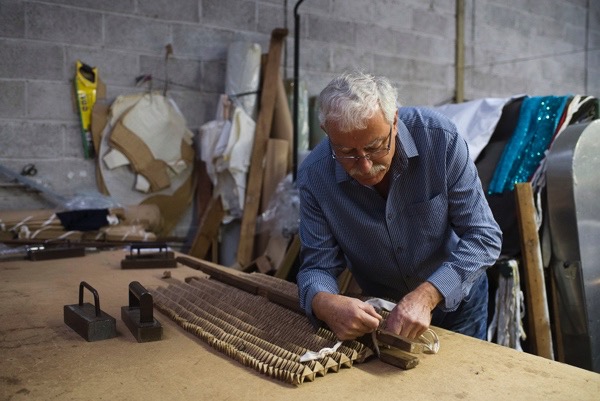
Kyri ties the splints together
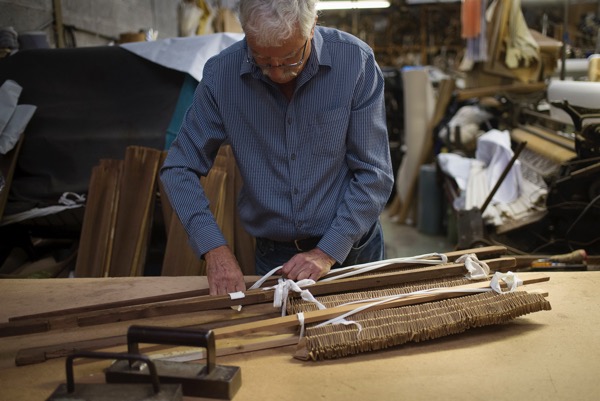
Kyri concertinas the patterns as tight as possible between the splints
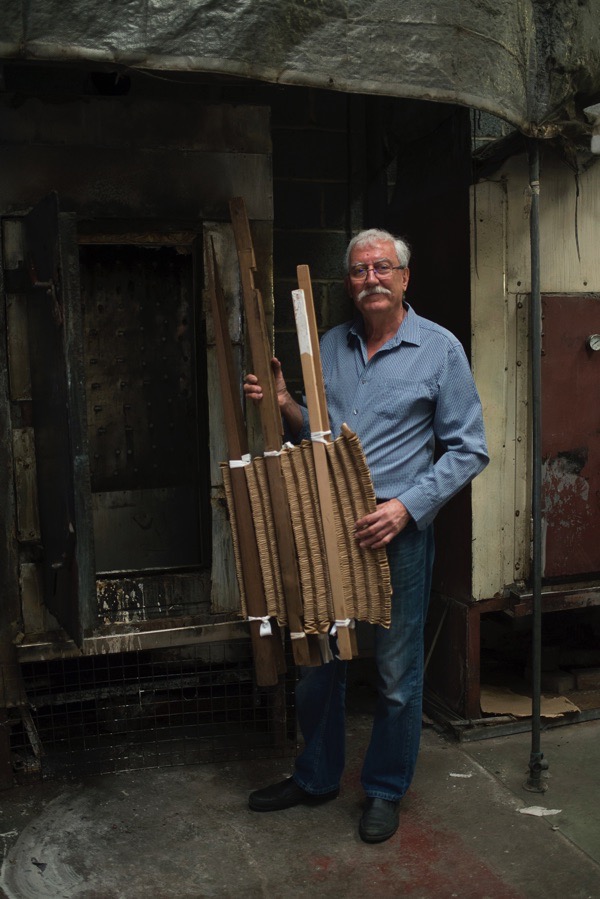
The completed ‘pleating craft’ is ready for the steam oven
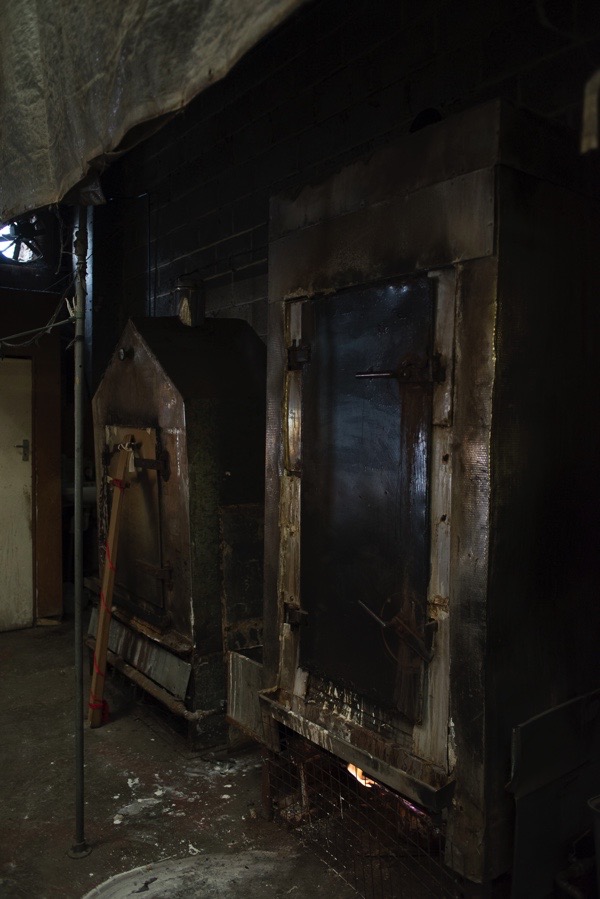
Kyri’s steam ovens where the pleats are baked
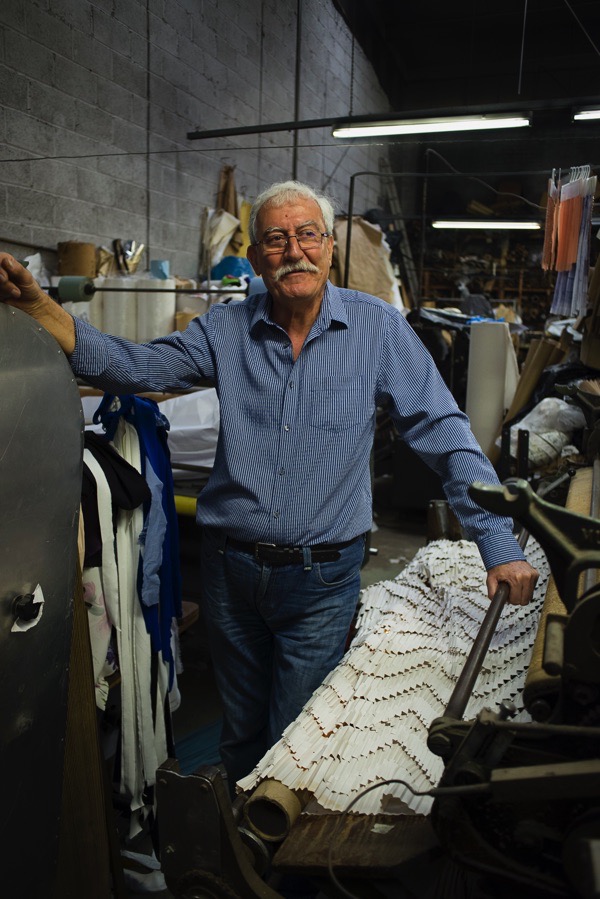
Kyri shows off his pleating machine
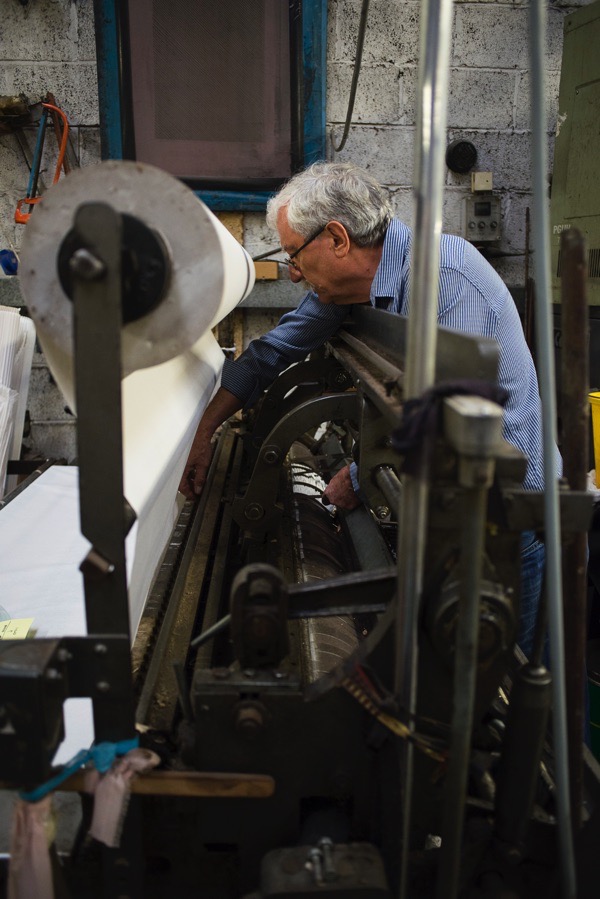
Last minute maintenance to the steamer
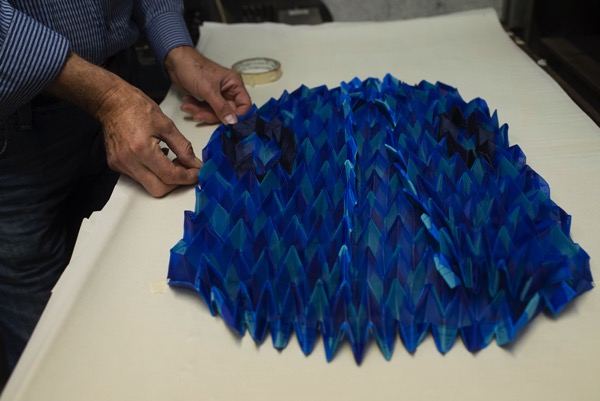
A pleated silk shirt ready to be steamed flat
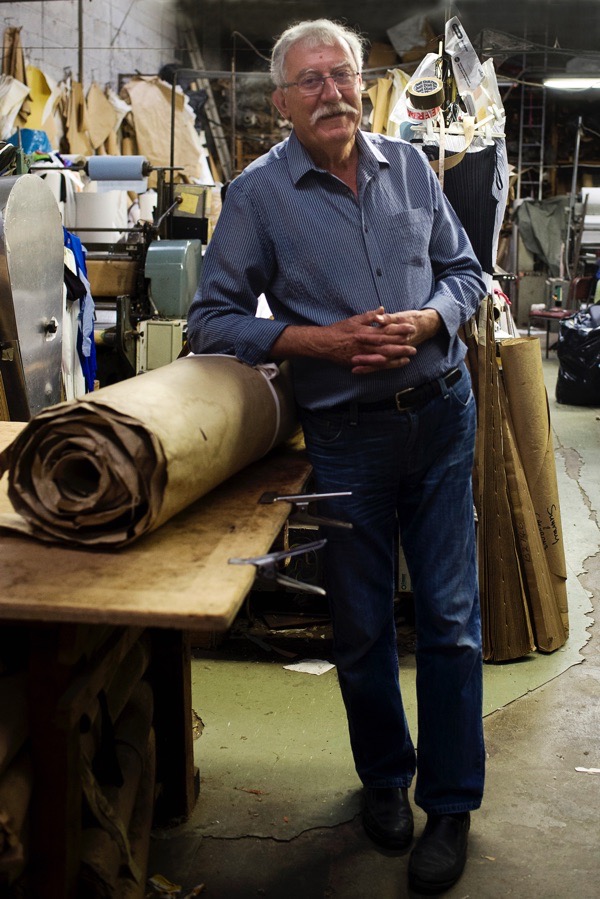
Kyri the pleater
Photographs copyright © Sarah Ainslie
You may also like to read about
So Long, Doris Halsall
Doris Halsall died on 29th October aged one hundred and one
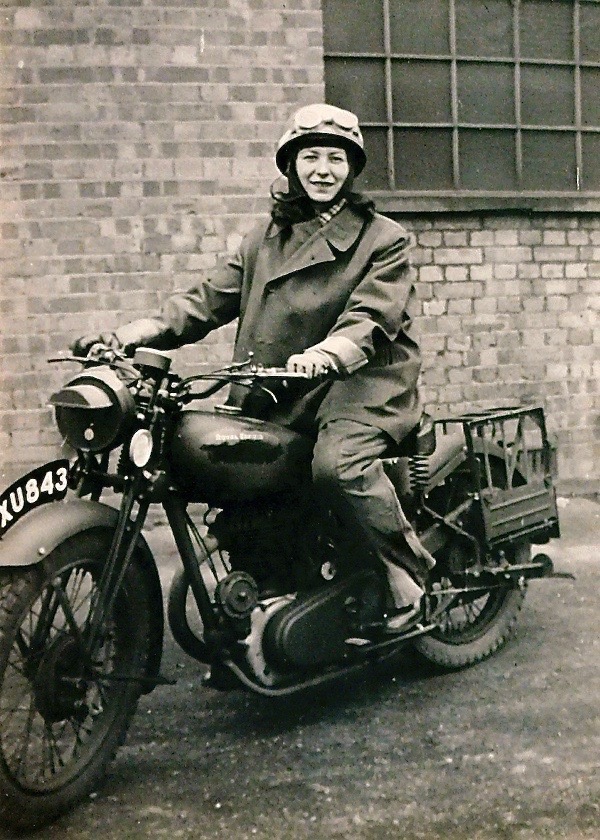
Doris Halsall, Despatch Rider, 1944
I took the train over to Chigwell to visit Doris Halsall – still vital and independent up to her one hundredth year – who recounted for me the story of her circuitous journey through the twentieth century and away from the East End. Blessed with keen intelligence and an adventurous nature, Doris embraced the possibilities for advancement that came her way – especially riding a motor bicycle – with enthusiasm and fearless determination, boldly constructing a life for herself that transcended her modest beginnings.
“I was born in 3 Venner Rd in Bow in 1920. My mother, Rosina & father, Alfred White lived in the downstairs with my sister, Rose and I. But later, when my mother’s sister died leaving a little boy of ten days old, Jack, my father said ‘Let us adopt him,’ even though my mother had eight or nine sisters.
Mrs Blewdon, who owned the house, lived upstairs and she came down every morning with her bucket and jug to empty them in the outside toilet and fill them again in the scullery. She stayed the whole day in her room and, each evening, she left us a note on the stairs, ‘I’m in for the night, Mrs White, Good Night.’ I always laughed because I used to love that little note on the stairs.
My father was in the army in the 1914-18 War and I’ve got a certificate to say that in 1916 he was unfit for service. There was no reason given but my mother always insisted that he was gassed and he was ill because of it, although his death certificate said ‘tuberculosis.’ When he came out of the army he did all sorts of jobs. I remember one day he was hoping it would snow, so he could go and do some snow shovelling. Eventually he joined the GPO and he would always bring newspapers to show me the events of the day. He died when I was ten years old in 1930. We were all there at the very last when he was dying. We didn’t think it was terrible, we just accepted it. In the family, there were others that died of tuberculosis.
My mother worked at home and we all helped her. I could cover you an umbrella now! She used to go up to the City and came back with the cloth and the umbrella frames, and we would fit the covers, the three of us – my mother, my sister & I – preventing, tying-in and tipping. Then next day, my mother would take the bundle back on the tram. It was hard for her schlepping up to the City everyday. I still have one of her tram tickets which I use as a bookmark. Later on, she used to knit angora berets and I sewed them up. She was always afraid we’d go into the workhouse, Bromley by Bow Workhouse was nearby.
After my father died, we were no more or less poor than we were when he was alive. My mother had a ten shillings a week pension, five shillings for my sister and three shillings for me – nothing for my cousin. We never saw ourselves as poor. We just accepted life. I was quite a happy child but my sister wasn’t, she was always unhappy and I don’t know why – I think it’s the way you are born. So I was never unhappy, but our circumstances were dreadfully poor. The coalman came round to our road but we couldn’t afford to have a sack of coal, it was half a crown for a hundredweight.
In Burdett Rd nearby, there was a little row of shops including a sweet shop with these different kinds of sweets in sections. All I ever wanted was to buy a quarter of pear drops for tuppence and I thought, ‘When I grow up, I’ll buy them.’ There were fruit stalls with oranges that came in fine crates made of wood which the stallholders would just throw down and the council would come and collect them, but we could go along and pick up the wood and take it home and put it on the fire. So why did you need to buy a hundredweight of coal for half a crown?
My sister & I played all the time in the street with my brother-come-cousin sat in the pushchair outside the house. We had all our friends on the street, our neighbour Mrs Franklin had nine children, and there was always entertainment on the street. The barrel organ would come along with these men dressed as women. We didn’t know anything abut transvestites, but they sang and danced and someone turned the barrel organ. The milk cart came along with a big churn and we would take a jug out. We’d buy jam at the little corner shop. We took a cup along and they’d weigh the cup and then they’d fill it with two penny worth of jam from a big jar.
When I was about twelve, I remember walking up to a shop in the City next to the Aldgate Pump to buy a postcard of Leonardo Da Vinci that I had learnt about from a very good art teacher at my school. The question was, ‘How to get tuppence?’ so there was no question of taking the tram or bus, I walked there. I can’t remember if I ever went to the West End but my mother used to take us to Southend for the day by train. I remember looking over the bridge from Bromley by Bow station at the workhouse. All the women used to sit along the wall in their blue and white dresses and, on the other side, sat all the men in their blue and white shirts, separated.
I remember Mosley’s blackshirts when they came down as far as Canal Bridge and I remember going down to see them. I was sixteen and I didn’t think too much about it. They were marching and they’d strayed over as far as Canal Rd. They’d been pushed back and after the Battle of Cable St and they were milling about trying to find a way home.
Opposite Stepney Green station, there was a Methodist Mission and there was this couple, Mr & Mrs Mackie and they took a group of girls under their wing. They took us on holiday for a week and we paid them ten shillings. They were very good to us. They ran a competition for ‘Recitation’ but I called it ‘Elocution.’ I went to a school where they always impressed on us that, if you come from the East End, it doesn’t mean you have to speak like someone from the East End. My cousins made fun of me because I spoke differently, mimicking me, but I didn’t care. I won the District and then the All-London Competition and I got invited stay to tea. That was a real treat. I still have my medal. My recitation began ‘No strong drink for this champion..’ and I had to sign the Temperance pledge. Conveniently, my memory is clouded about when I broke that.
I went to a very good school and I won a Junior County Scholarship with a grant of twelve pounds a year and, when I was fourteen, another grant of twenty-one pounds a year. It was very sad really. Most of the parents wanted their children to leave school and go to work. You were brought up to go and work when you were fourteen. My sister had left at fourteen and was already working and my mother wanted me to leave, but when I did she had to give me money for fares to London and for lunches so she wasn’t much better off.
I wanted to go into the Civil Service which most of my friends were doing but you couldn’t take the exam until you were eighteen. I worked in an office and went to night school, after I left school at sixteen, and finished my education that way. This lady in the office, who seemed ever so much older than me, said ‘Don’t stay here.’ Fortunately, I passed the Civil Service exam and went to work at the Ministry of Agriculture office in Leonard St in Shoreditch and it was all very nice until the War came along.
I was evacuated up to Lytham St Anne’s. We were put into seaside boarding houses and every morning we could smell our rations going past our doors! It was all girls, eight or nine of us, and Mrs Brooks did us well. We had a great time. We borrowed each other’s clothes and went out to the Tower Ballrooms. It was lovely. I was promoted in the Ministry of Agriculture and sent to Bournemouth. We were importing agricultural machinery from America and my job was to look after the shipments as they came in.
My mother stayed in the East End of London all through the war, even though she had a bomb drop next door and had to move out for a while, but she went to work in munitions and became quite well off. She had the Anderson shelter in the garden and she wasn’t a worrier. Yet all the bomb debris in the East End was horrible and cousin of mine was killed in her house with her two little children.
During the war, I wanted to go into the forces but I was considered too useful so I wasn’t allowed to be released from my job. I tried to get into the airforce, in the Meteorological section. I was attracted to the challenge but I wasn’t allowed to do this. Then an offer came along to be a Despatch Rider for the Home Office. My friend Claire & I signed up for that right away, and we went to Hendon Police for week and learnt to ride a motorbike. It was great.
At that time, we were quite sure there was going to be an invasion. In preparation for this, we had to drive around to Police Stations and hand in ‘despatches’ but we never knew what they were – probably a blank sheet. It was just practice and quite soon we knew exactly how to get to the various police stations.
Claire & I often got caught up in the American convoys with all the GIs sitting out on the tailboards while we were on our bikes. They would shout ‘Gee, they’re dames!’ and they wouldn’t let us overtake them – so we had a high time, until they turned left. I had various boyfriends. All the girls in the office had boyfriends or fiances and ever so many of them were killed. I had some boyfriends that weren’t English who went off and I never knew what happened to them.
When the invasion was expected, I was brought back from Bournemouth to London and I went back to live with my mother and she made a great fuss of me. My mother had married again, to Jim Mason, a crane driver in Ilford and they had moved out to Seven Kings. He was a nice man and I liked him ever so much. My mother was glad to leave the East End.
I was married in 1947. I met my husband, Harold Halsall at holiday camp on the East Coast. I had a travelling job then for the Ministry of Agriculture and I visited regional offices examining the accounts. Leaving London by train, I remember once I realised I had left some papers at the office, so I left my case on the platform and went back to the office and, when I returned, it was still there.
After we married we bought a house and lived in Ilford and had two little girls, Pauline & Julia. Rationing continued after the war but there were ways and means of getting hold of what you needed. When I was travelling I visited all the farming towns, so I had eggs and bacon and cheese and milk – and I stayed in hotels, there was no rationing in hotels. It was lovely. I was very fortunate. I have had such a great time. I don’t miss the East End because I wanted to have something better. It was hard, a tough existence and this was a much nicer life.”
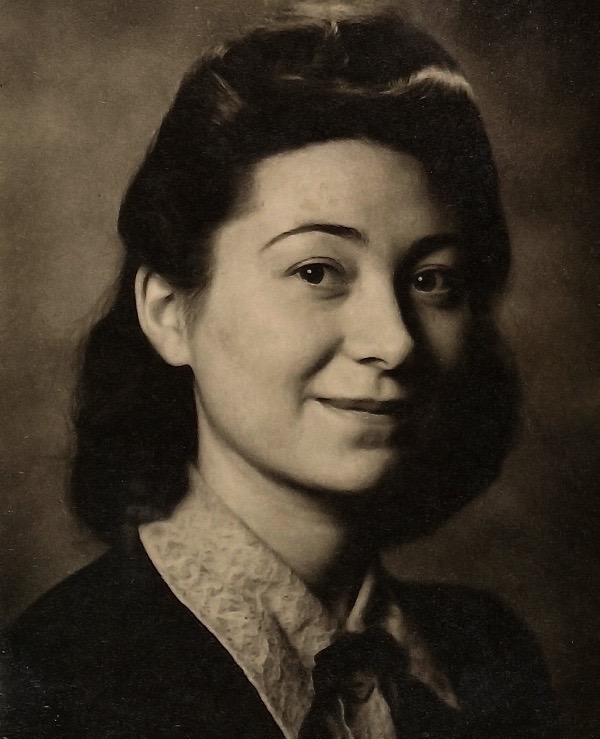
Doris in the forties
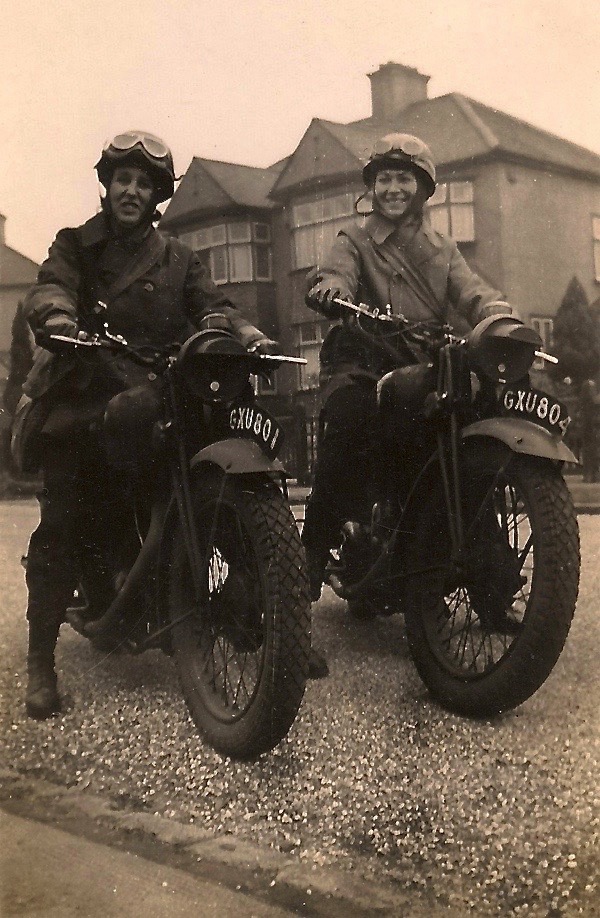
Doris & her friend Claire, Despatch Riders in 1944
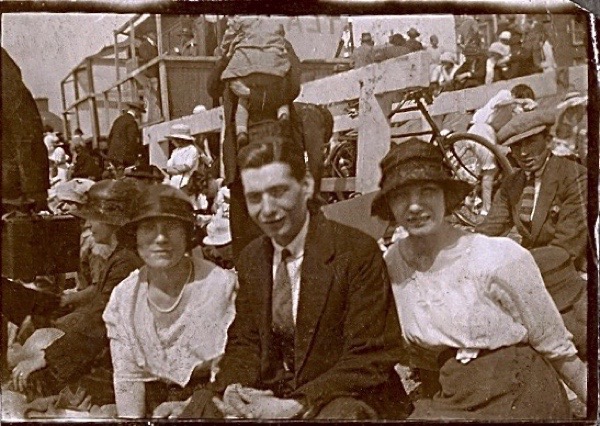
Doris’ mother Rosina and father Alfred, and his sister Emily, photographed at Southend in 1919
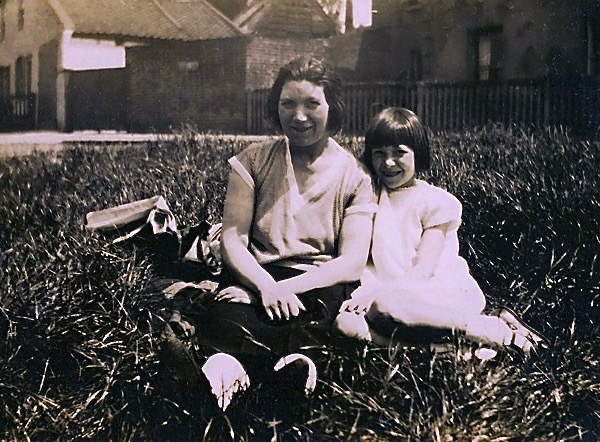
Doris with her mother, Rosina, in the twenties
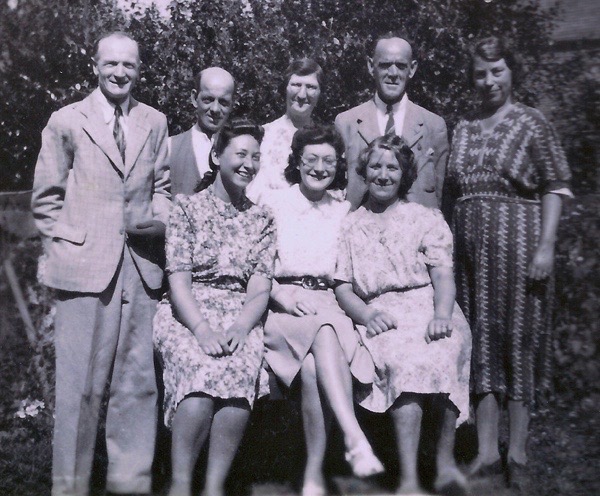
Doris’ family in 1940 – Doris, her sister Rose and their mother Rosina in front.
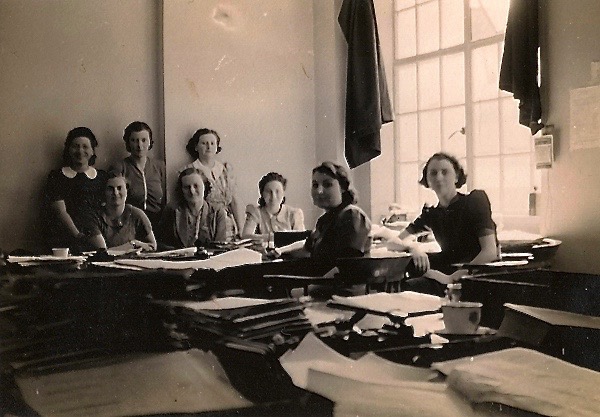
Doris at the Ministry of Agriculture, Baker St Office, 21st May 1940
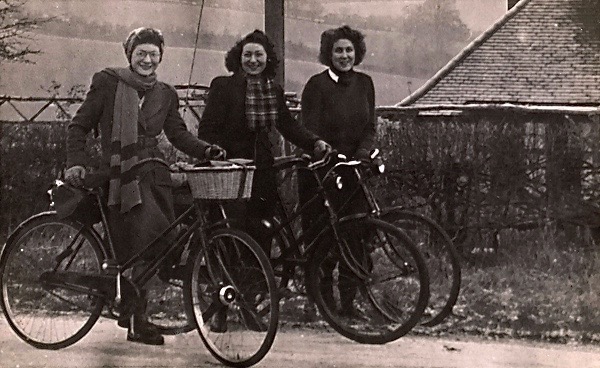
Youth Hostelling – Doris’ sister Rose, Doris, Doris’ friend Claire
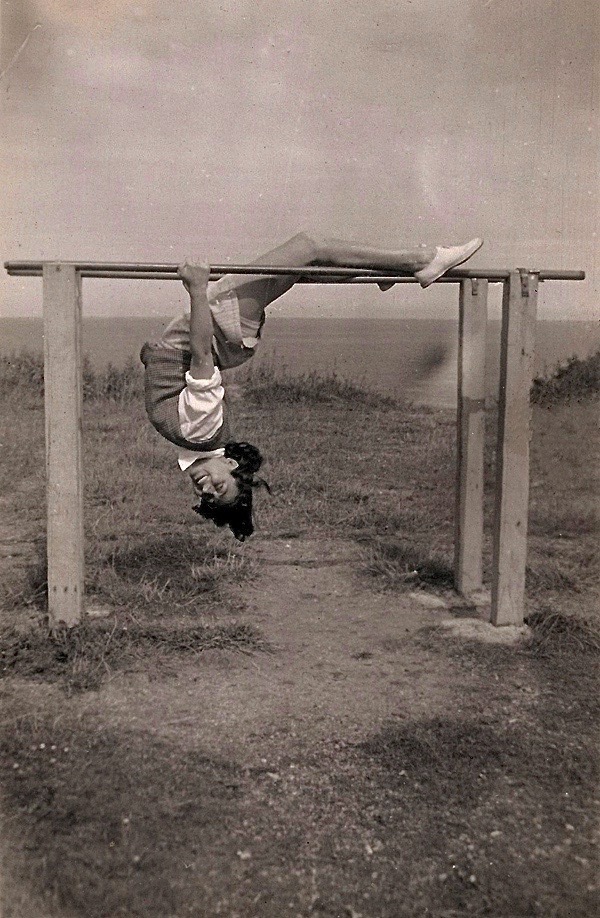
Acrobatics by ‘Daredevil Doris,’ Corton, 1948
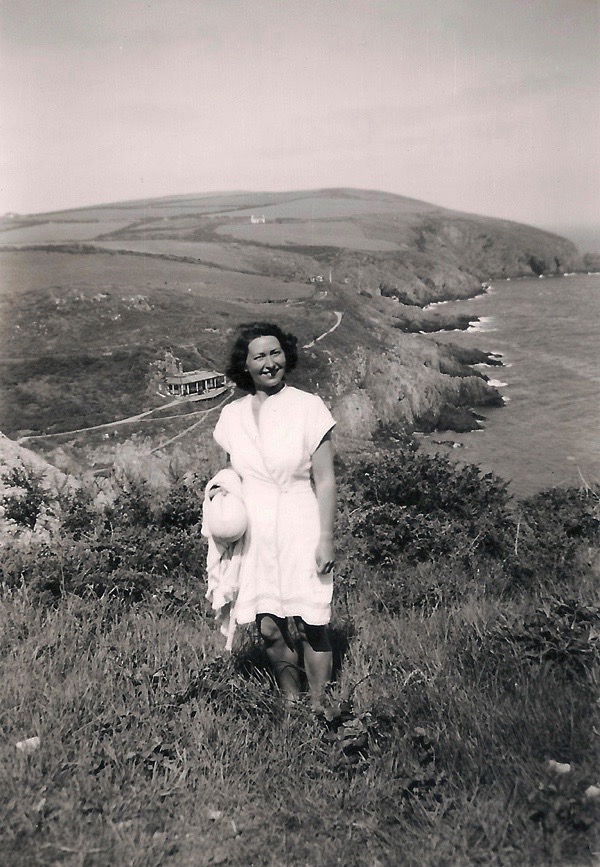
Doris in her new beach-robe, Howstrakes, June 1947
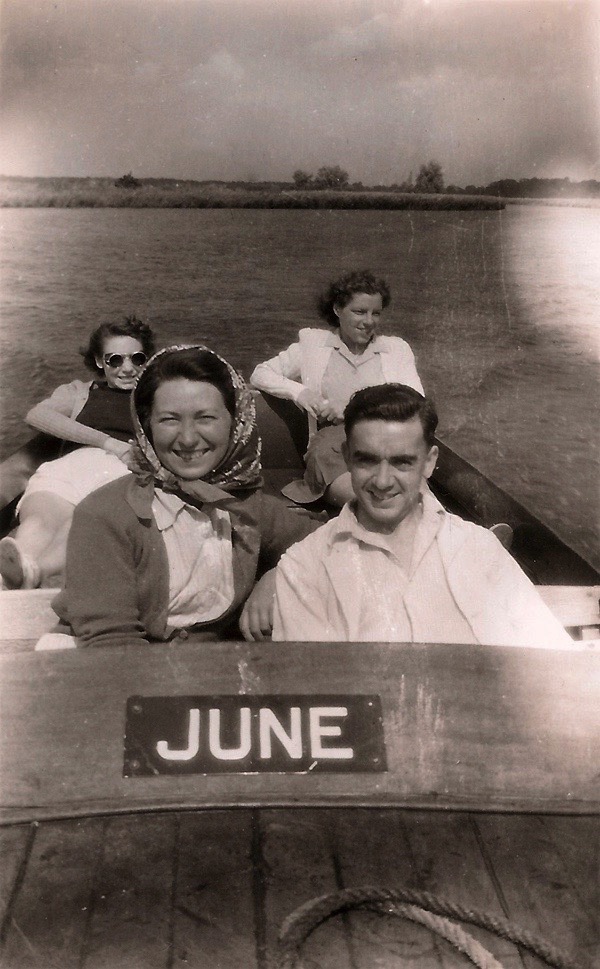
Doris with Harold Halsall on Oulton Broad, July 1947 – the year of their marriage
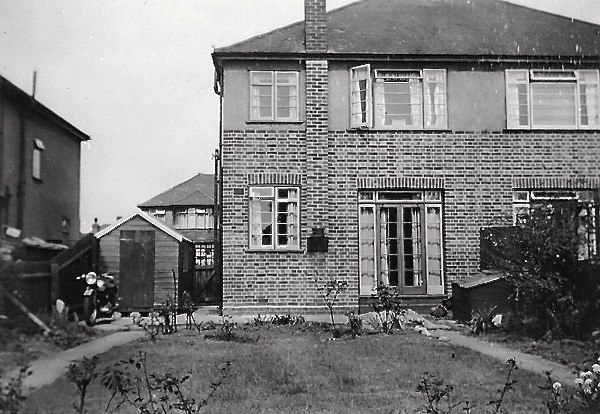
The first house which Doris and Harold bought on Kirkland Avenue in Ilford – note Doris’ motorbike
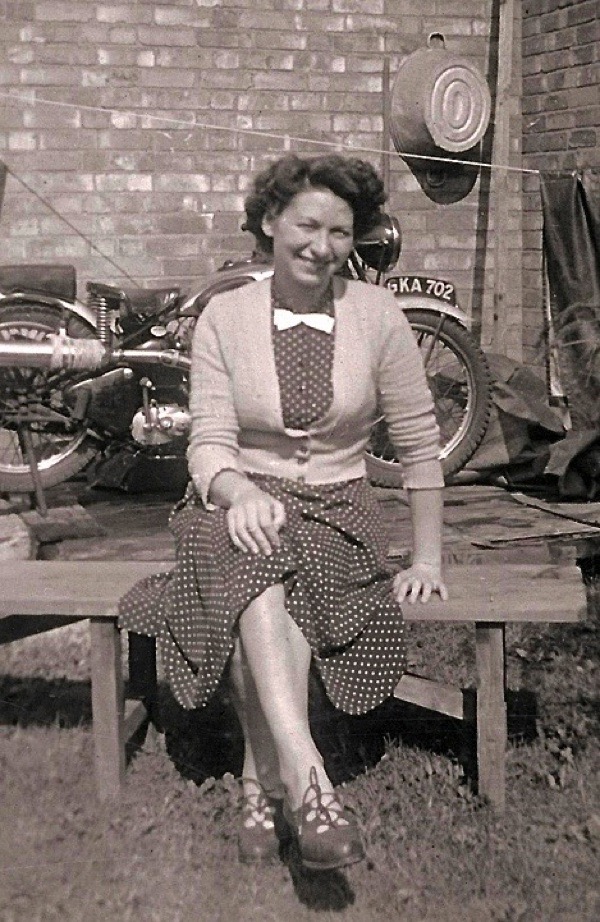
Doris, 1949
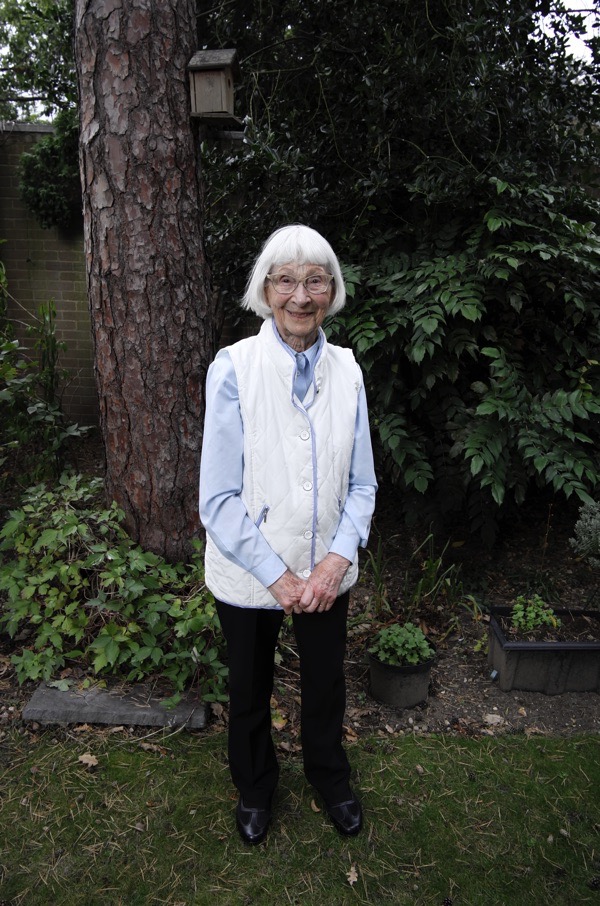
Doris Halsall (1920-2021)
You may also like to read about












