
Dick Turpin, Highwayman & Butcher
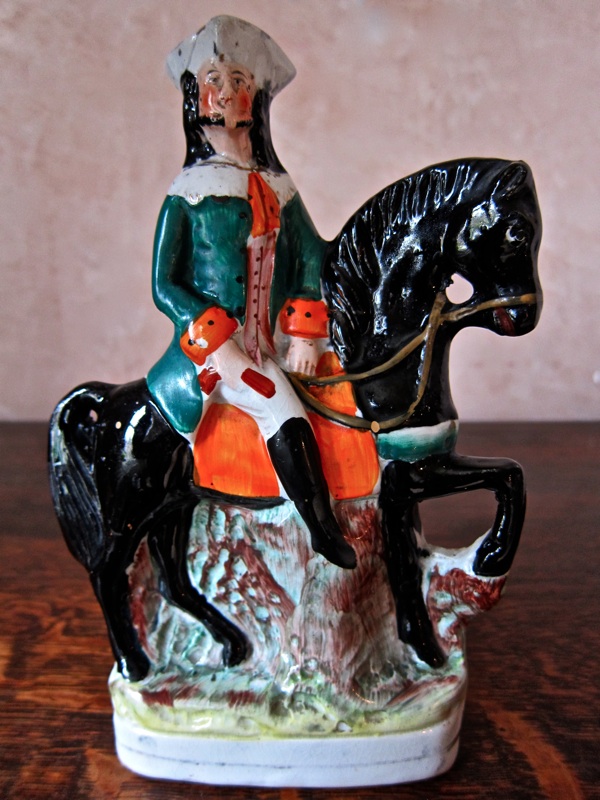
Dick Turpin upon Black Bess
There is a story that Dick Turpin was apprenticed as a butcher in Whitechapel, and – whatever the truth of it – he returned consistently to this area of East London. There are further stories connecting him to the Red Lion in Whitechapel and the Nag’s Head in the Hackney Rd. Yet, as one who led an elusive transitory criminal existence and who achieved fame only after his death, the actuality of Dick Turpin’s life remains uncertain, overshadowed by the vivid fictions that were contrived later.
Richard Bayes, landlord of the Green Man in Leytonstone, was author of one of the earliest accounts, published in 1739 shortly after Turpin’s execution in York.“He was placed apprentice to a Butcher in White-chaple, where he served his Time, he was frequently guilty of Misdemeanours, and behaved in a loose disorderly Manner…” wrote Bayes, emphasising the authenticity of his narrative by taking a role in it himself. After a horse theft near Waltham Forest in 1736, Bayes tracked the stolen animal to the Red Lion Inn in Whitechapel and was attempting to retrieve it from Turpin’s accomplice Tom King when Turpin himself appeared in Red Lion St, a thoroughfare later subsumed into Commercial St.
“Turpin, who was waiting not far off on horseback, hearing a skirmish came up, when King cried out, ‘Dick, shoot him, or we are taken by God,’ at which instant Turpin fired his pistol, and it missed Mr. Bayes, and shot King in two places, who cried out, ‘Dick, you have killed me,’ which Turpin hearing, he rode away as hard as he could. King fell at the shot, though he lived a Week after, and gave Turpin the character of a coward…”
Yet it was primarily due to Harrison Ainsworth and his illustrator George Cruikshank in the novel “Rookwood” of 1834 that the story of the butcher-turned-brutal-petty-thief from Essex was transformed into the myth of Dick Turpin – the swashbuckling highwayman who stole from the rich and gave to the poor while charming the ladies with his valour and flamboyant style.
A century after Turpin’s death, highway robbery ceased to be a threat, permitting the possibility of a romantic fiction upon the subject. In constructing the myth we recognise today, Ainsworth invented the notion of the death-defying ride to York upon Black Bess to establish an alibi. He ignored the banal fact that Turpin had been operating in Yorkshire for over a year before he was arrested under the name of John Palmer for shooting a “tame fowl,” and his true identity discovered after his arrest only when a letter he signed was recognised in the mail.
Born in Essex in 1705, Richard Turpin set up his own butchery business in Waltham and when trade was slow, he took to poaching venison in Epping Forest and became drawn into robbery as a member of the Gregory Brothers’ Essex Gang – one of many criminal gangs that existed on the margins of large cities when times were hard and law enforcement ineffectual.
Far from being the “gentleman” as Ainsworth characterised him, Turpin was capable of savage violence to achieve his desired ends, which this account from Read’s Weekly Journal of February 1735 reveals – “On Saturday night last, about seven o’clock, five rogues entered the house of the Widow Shelley at Loughton in Essex, having pistols &c. and threatened to murder the old lady, if she would not tell them where her money lay, which she obstinately refusing for some time. They threatened to lay her across the fire, if she did not instantly tell them, which she would not do. But her son being in the room, and threatened to be murdered, cried out, he would tell them, if they would not murder his mother, and did. Whereupon they went upstairs, and took near £100, a silver tankard, and other plate, and all manner of household goods.”
After the killing of Tom King, Turpin took refuge in Epping Forest where he shot one of the Forest-Keepers who tried to capture him, and the offer of a reward for his arrest for murder published in the Gentleman’s Magazine in June 1737 gives the only contemporary description – “Turpin was born at Thackſted in Eſſex, is about Thirty, by Trade a Butcher, about five Feet nine Inches high, brown Complexion, very much mark’d with the Small Pox, his Cheek-bones broad, his Face thinner towards the Bottom, his Viſage ſhort, pretty upright, and broad about the Shoulders.”
This account of the pock-marked broad-shoulder butcher does not quite match the devilishly handsome highwayman of popular lore, yet Turpin is recorded as meeting his death with remarkable courage. Sir George Cooke, Sheriff of Yorkshire, recalled that, “he behav’d himself with amazing assurance” at the execution and “bow’d to the spectators as he passed.” When it came to the moment and his head was in the noose,“he threw himself off the ladder and expired directly.” As the life of Dick Turpin ended, the legend of Dick Turpin was born.
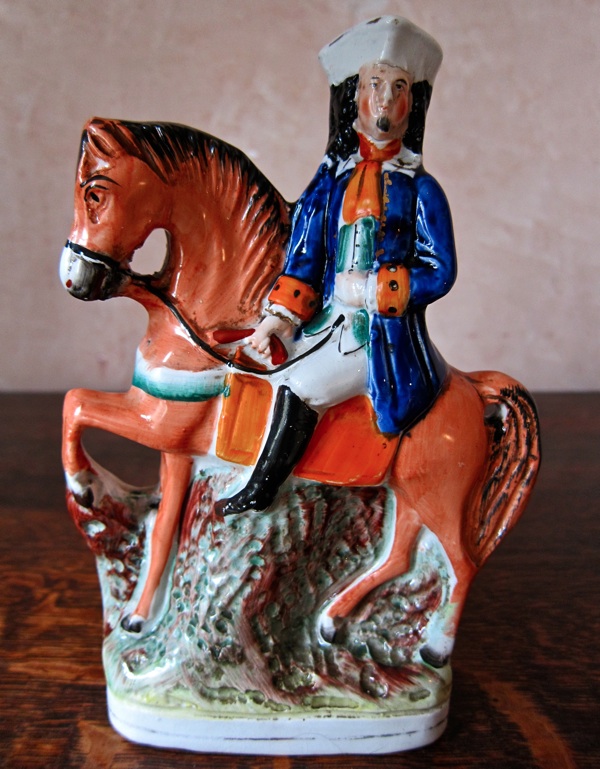
Dick Turpin’s accomplice Tom King – shot in Commercial St.
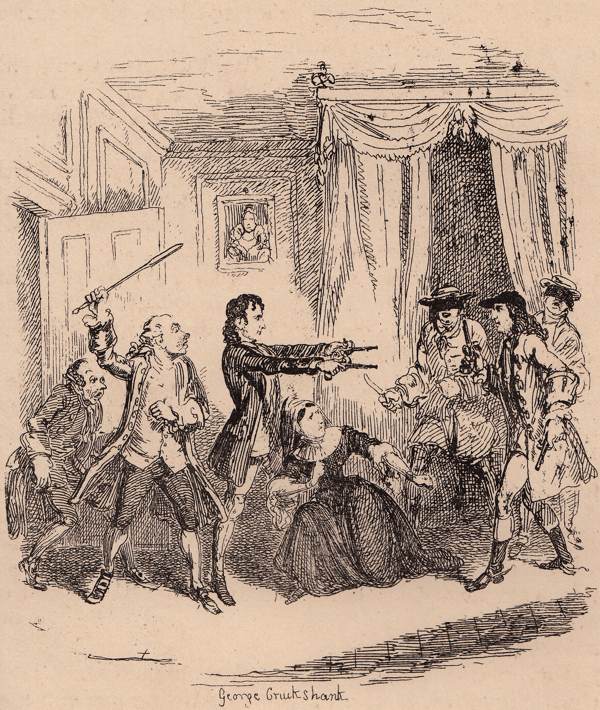
Rescue of Lady Rookwood by Dick Turpin.
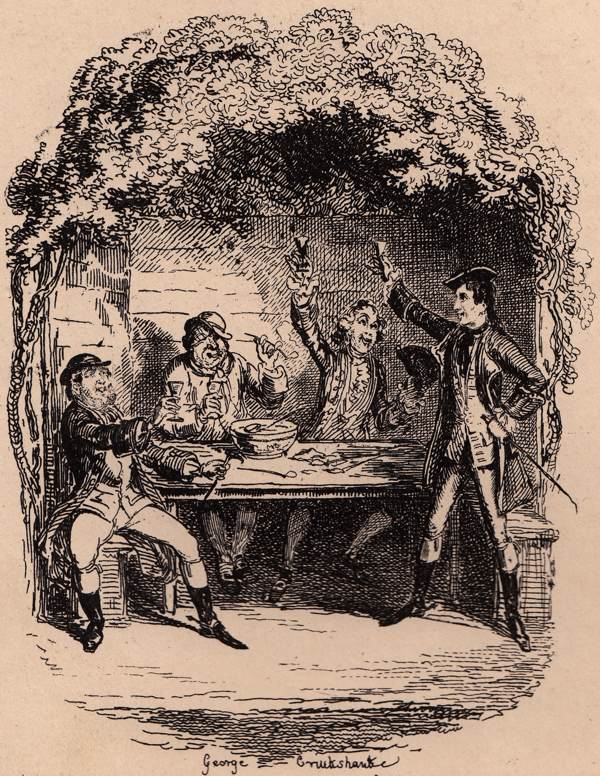
Dick Turpin & Tom King in the Arbour at Kiburn.
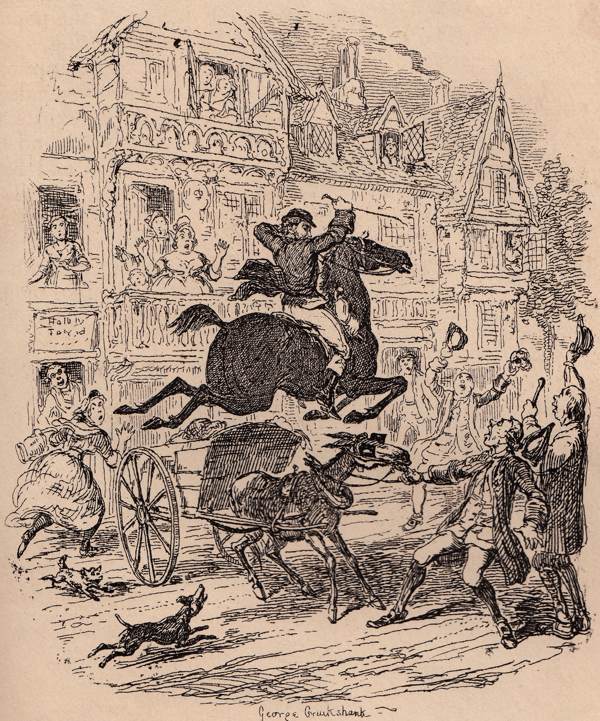
Dick Turpin’s flight through Edmonton.
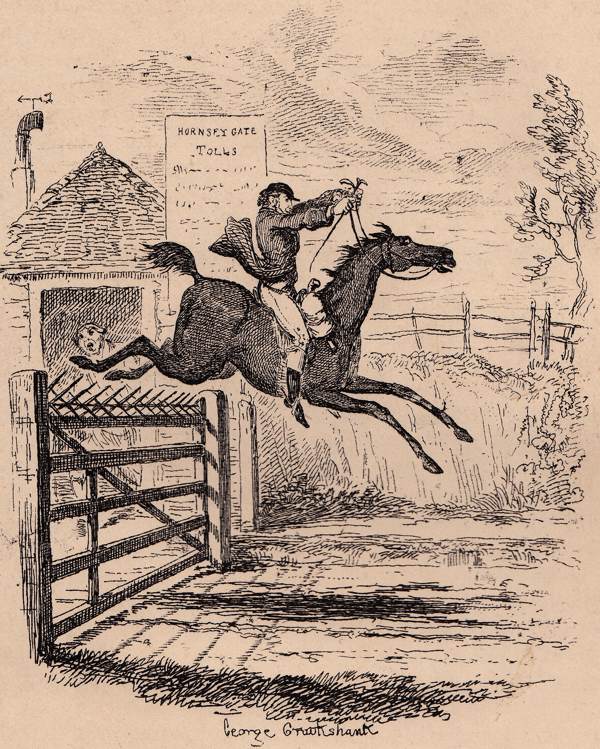
Dick Turpin leaps the Hornsey Gate.
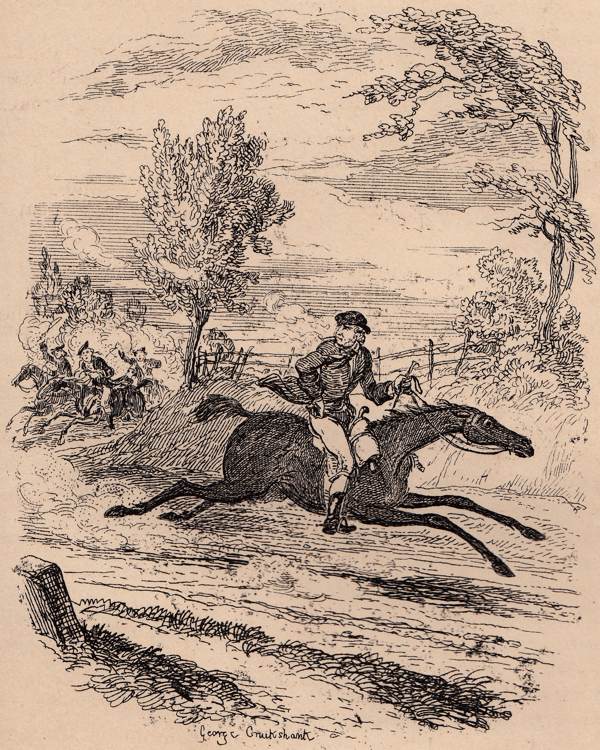
“I’ll let ’em see what I think of ’em!”
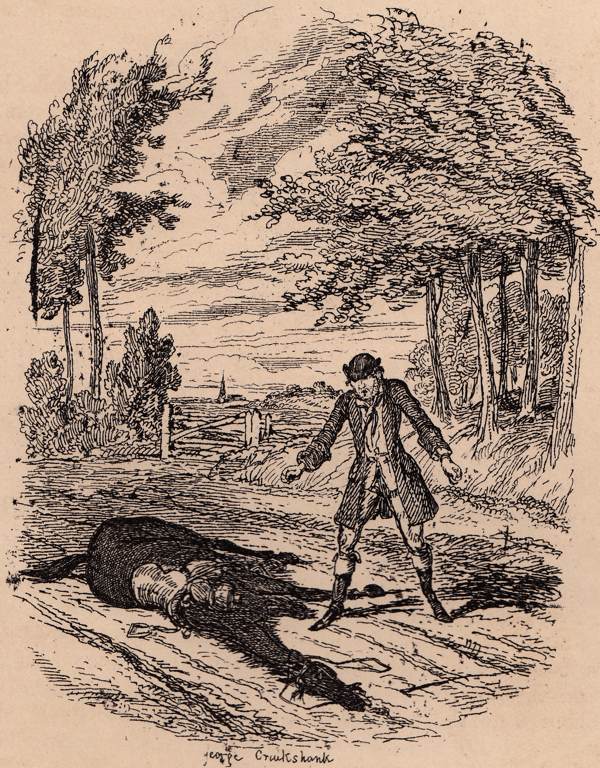
The death of Black Bess at the end of the ride to York.
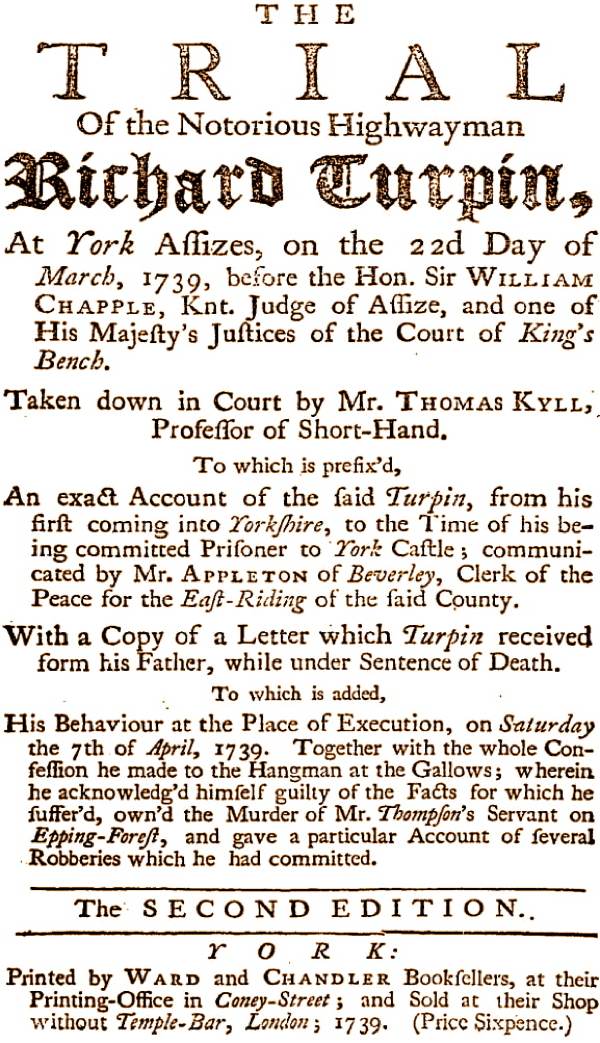
Cover of a pamphlet published in York after Turpin’s execution.
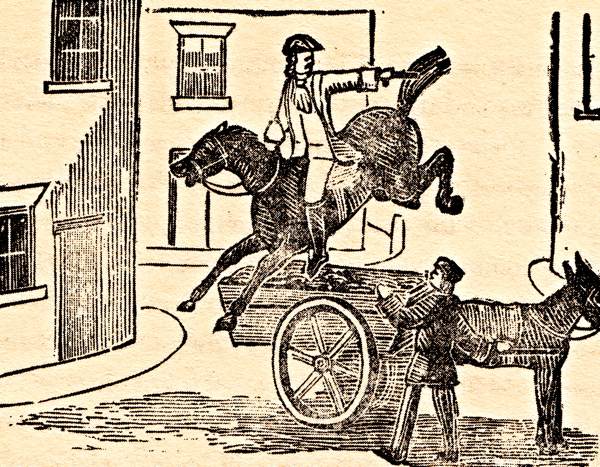
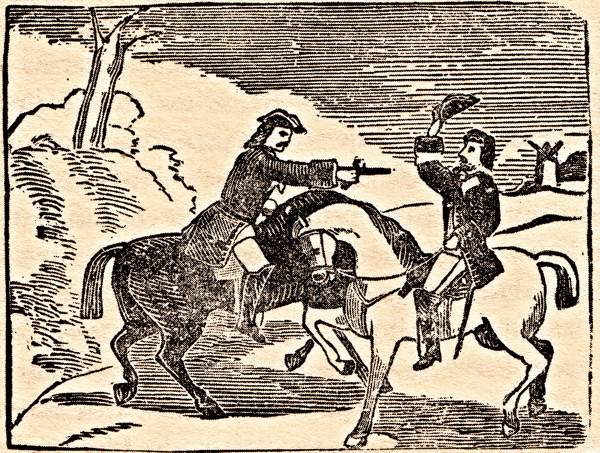
Plates from “The Life of Richard Turpin” by Richard Bayes.
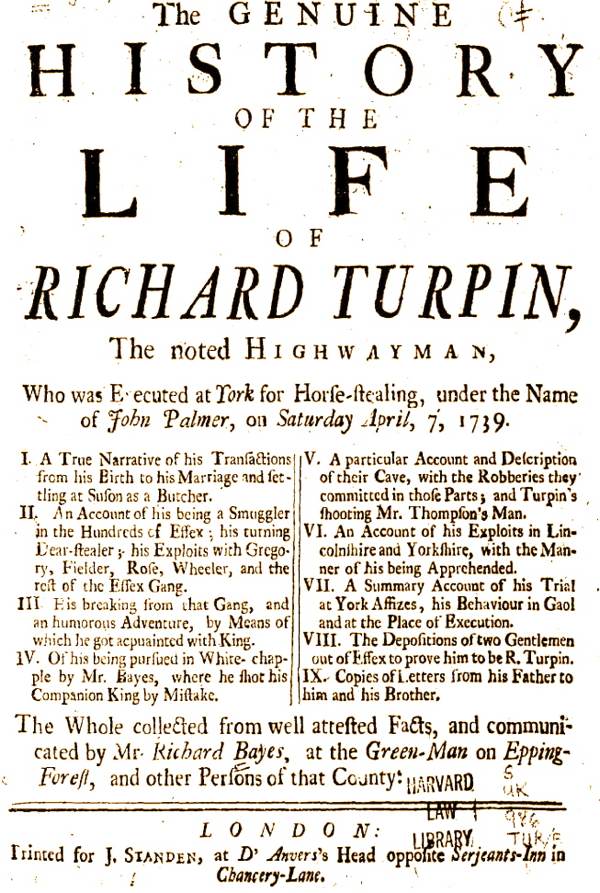
Title page of the life of Dick Turpin written by Richard Bayes, landlord of the Green Man in Leytonstone.
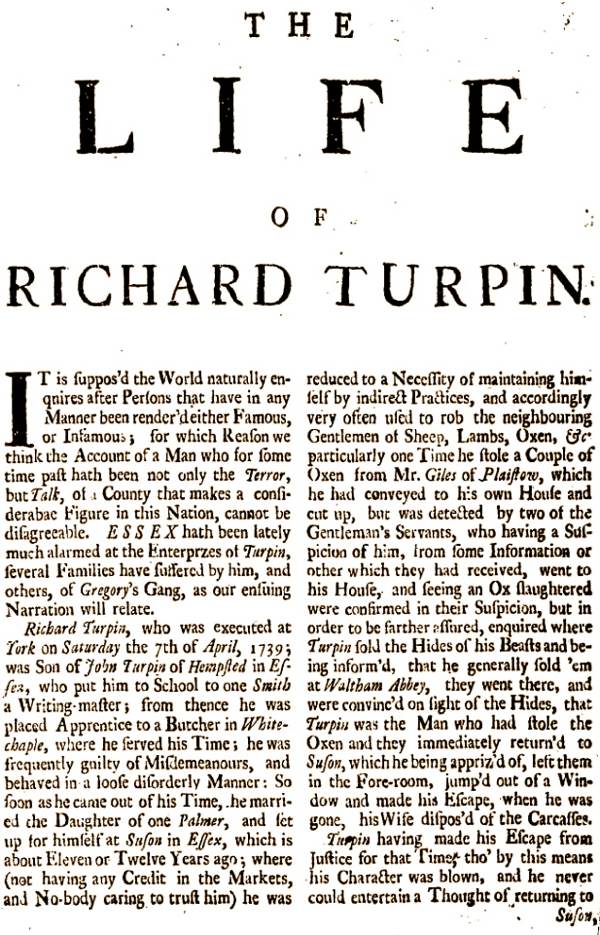
The opening page of Richard Bayes’account, placing Turpin as an apprentice butcher in Whitechapel.
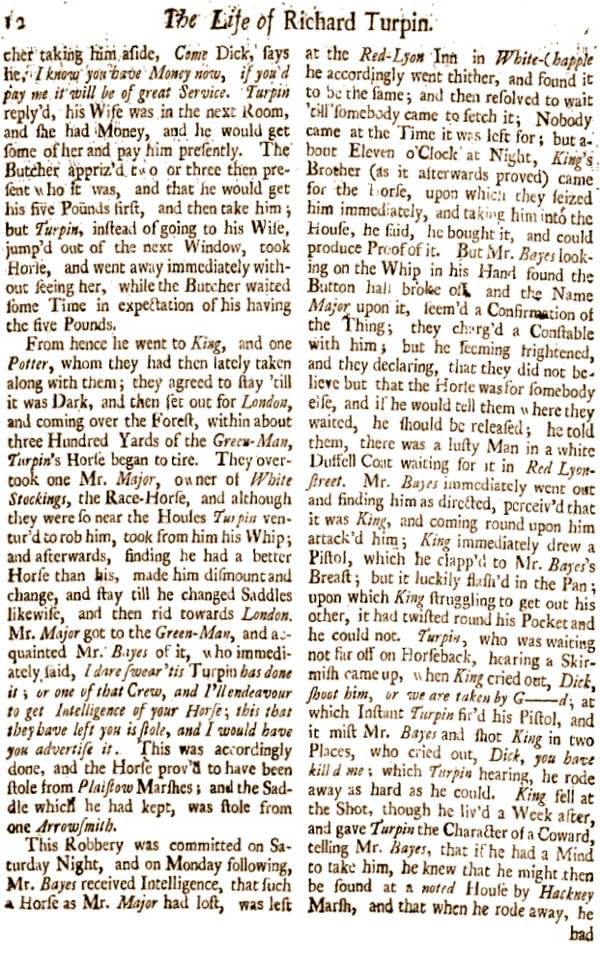 Richard Bayes’ account of his skirmish with Dick Turpin at the Red Lion in Whitechapel.
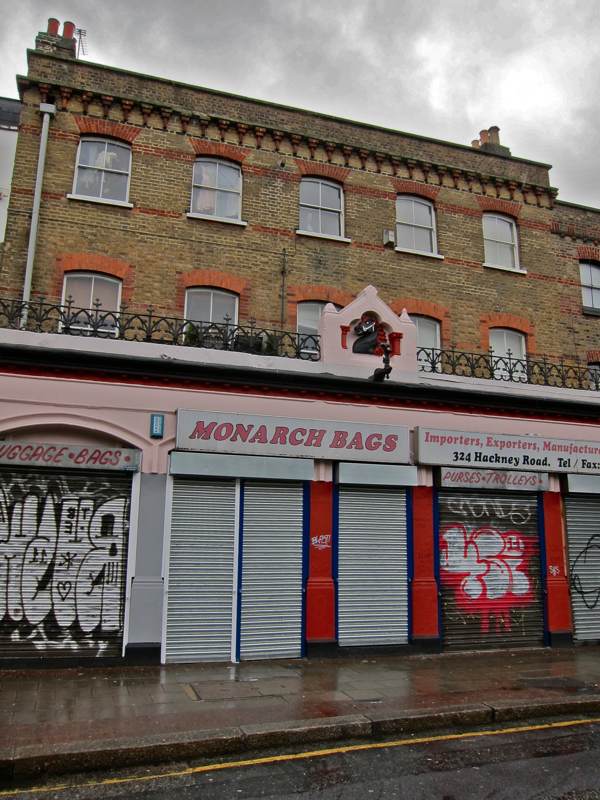
The former Nag’s Head opposite Hackney City Farm in the Hackney Rd. Dick Turpin was reputed to frequent an earlier coaching inn known as The Nag’s Head upon this site.
You may also like to read about
At Dirty Dick’s
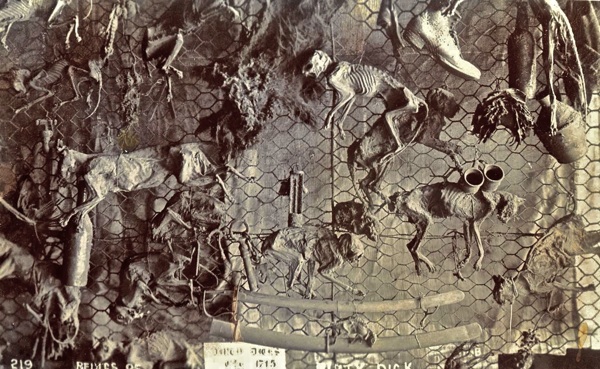
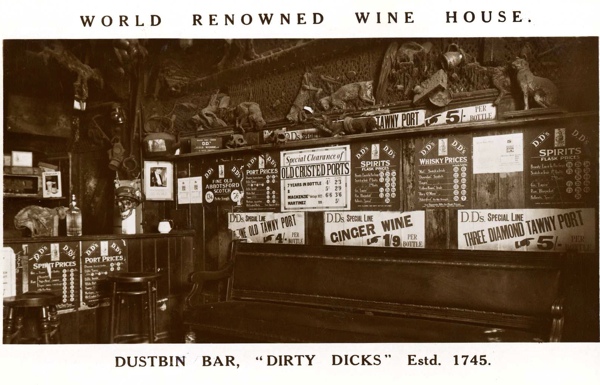
These are the dead cats that once hung behind the counter of the celebrated “Dustbin Bar” at Dirty Dick’s Old Port Wine & Spirit House in Bishopsgate. It is a location that holds a special place in my affections as the first pub I ever went into in London, one day after work at the Bishopsgate Institute.
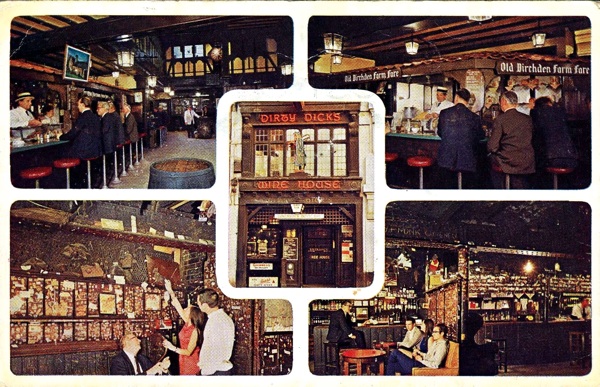
Although this was longer ago than I care to admit and regrettably the cats in this picture had already gone by then, yet I still recall the sense of expectation, entering the narrow frontage and walking back, and back, and back through the warren of rooms with sawdust on the floor – descending ever deeper into the bowels of the city, it seemed. And I can only imagine how this strange drama might have been enhanced by the presence of umpteen dead cats suspended from the ceiling.
This was how it was described in 1866 – “A small public house or rather a tap of a wholesale wine and spirit business…a warehouse or barn without floorboards – a low ceiling, with cobweb festoons dangling from the black rafters – a pewter bar battered and dirty, floating with beer – numberless gas pipes tied anyhow along the struts and posts to conduct the spirits from the barrels to the taps – sample phials and labelled bottles of wine and spirits on shelves – everything covered with virgin dust and cobwebs.”
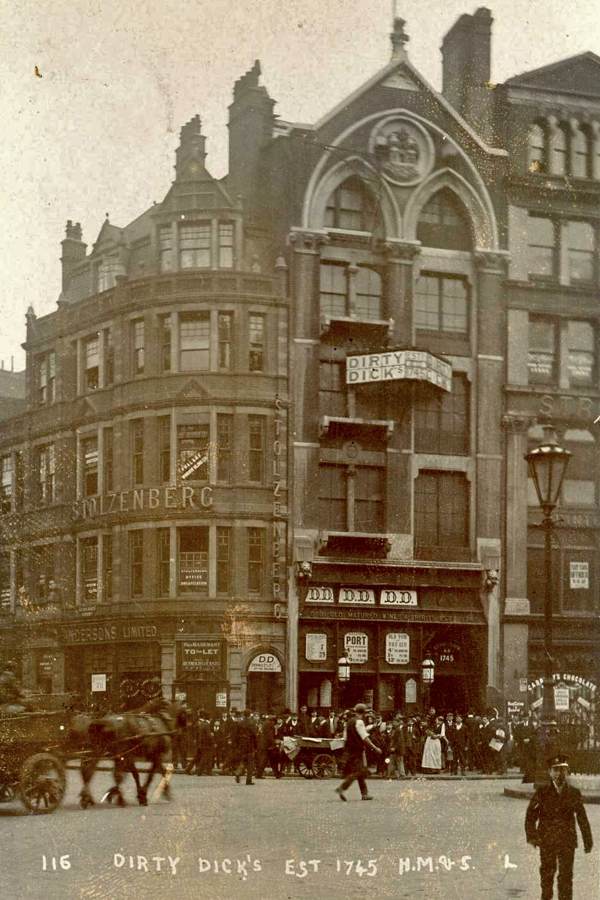
Yet all was not as it might seem, because the presence of these curious artefacts was not due to unselfconscious eccentricity, it was an early and highly successful example of what we should call a “theme pub.” Established in 1745 as The Old Jerusalem, the drinking house took the name of Dirty Dick’s in 1814 and adopted his story along with it. The original of Dirty Dick was Nathaniel Bentley, a successful merchant with a hardware shop and warehouse in Leadenhall St in the mid-eighteenth century. After his bride-to-be died on their wedding day – so the legend goes – he never cleaned up again, never washed or changed his clothes. “It’s of no use, if I wash my hands today, they will be dirty again tomorrow,” he declared. Bentley died in 1809, and the Bishopsgate Distillers appropriated this story of the notorious dirty hardware merchant, adorning their bar with dead cats and cobwebs to perpetuate the legend.
Charles Dickens knew Dirty Dick’s and was fascinated with this myth of one who sealed up the door on the wedding breakfast and left the cake and table decorations to acquire dust eternally. In a letter to the printer of his weekly publication “Household Words” dated 30th December 1852, he wrote “Don’t leave out the Dirty Old Man, he is capital.” And it has been suggested that Nathaniel Bentley was the inspiration for the character of Miss Havisham in “Great Expectations.”
Dirty Dick’s was rebuilt in the eighteen seventies, though the cellars are of an earlier date, and now the bizarre artefacts are banished to a glass case, yet it is still worth a visit. Explore the wonky half-timbered spaces and seek out the secluded panelled rooms at the rear, where you can enjoy a quiet drink away from the commotion of Bishopsgate to contemplate the ancient coaching inns that once lined this street, long before the age of the train and the motor car.
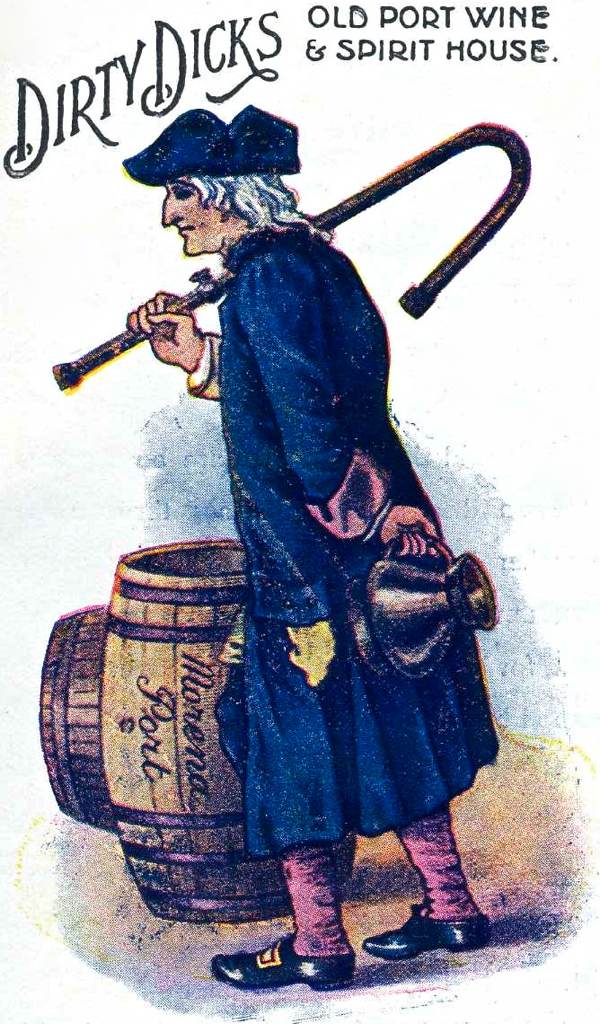
Nathaniel Richard Bentley – the origin of the myth of Dirty Dick.

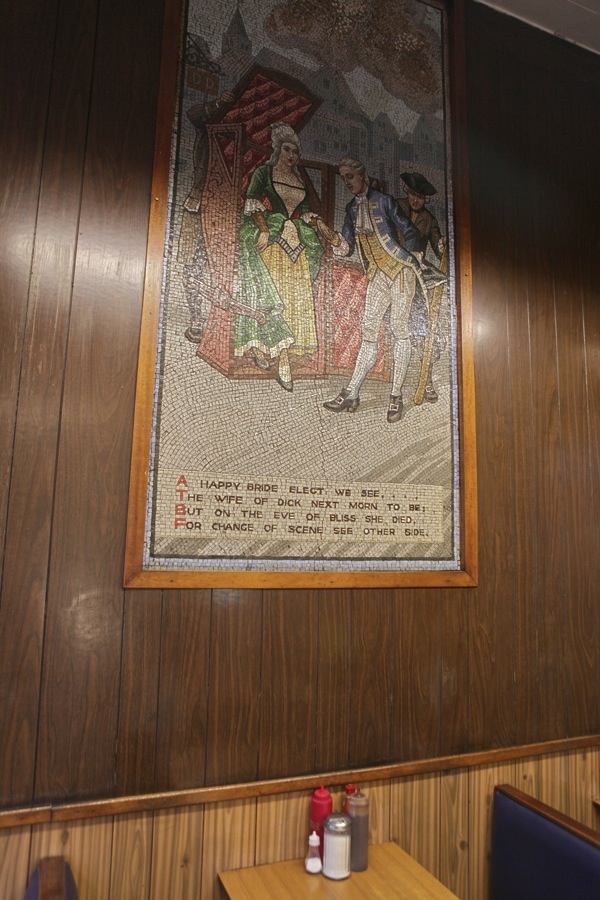
Part of the former City Corner Cafe – now a takeaway food joint -was once an alley leading into Dirty Dick’s adorned with a series of these mosaics which illustrated the tale.


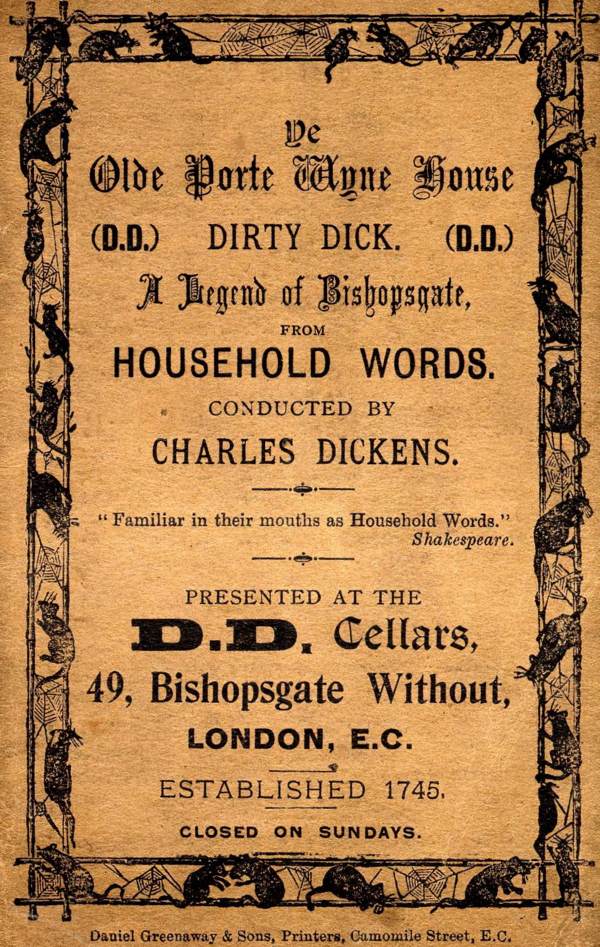
Dirty Dick by William Allingham
A Lay of Leadenhall
In a dirty old house lived a Dirty Old Man.
Soap, towels or brushes were not in his plan;
For forty long years as the neighbours declared,
His house never once had been cleaned or repaired.
‘Twas a scandal and a shame to the business-like street,
One terrible blot in a ledger so neat;
The old shop with its glasses,black bottles and vats,
And the rest of the mansion a run for the rats.
Outside, the old plaster, all splatter and stain,
Looked spotty in sunshine, and streaky in rain;
The window-sills sprouted with mildewy grass,
And the panes being broken, were known to be glass.
On a rickety signboard no learning could spell,
The merchant who sold, or the goods he’d to sell;
But for house and for man, a new title took growth,
Like a fungus the dirt gave a name to them both.
Within these there were carpets and cushions of dust,
The wood was half rot, and the metal half rust;
Old curtains—half cobwebs—hung grimly aloof;
‘Twas a spiders’ elysium from cellar to roof.
There, king of the spiders, the Dirty Old man,
Lives busy, and dirty, as ever he can;
With dirt on his fingers and dirt on his face,
The dirty old man thinks the dirt no disgrace.
From his wig to his shoes, from his coat to his shirt,
His clothes are a proverb—a marvel of dirt;
The dirt is prevading, unfading, exceeding,
Yet the Dirty Old Man has learning and breeding.
Fine folks from their carriages, noble and fair,
Have entered his shop, less to buy than to stare,
And afterwards said, though the dirt was so frightful,
The Dirty Man’s manners were truly delightful.
But they pried not upstairs thro’ the dirt and the gloom,
Nor peeped at the door of the wonderful room
That gossips made much of in accents subdued,
But whose inside no one might brag to have viewed.
That room, forty years since, folks settled and decked it,
The luncheon’s prepared, and the guests are expected,
The handsome young host he is gallant and gay,
For his love and her friends are expected today.
With solid and dainty the table is dressed—
The wine beams its brightest—flowers bloom their best;
Yet the host will not smile, and no guest will appear,
For his sweetheart is dead, as he shortly shall hear.
Full forty years since turned the key in that door,
‘Tis a room deaf and dumb ’mid the city’s uproar;
The guests for whose joyance that table was spread,
May now enter as ghosts, for they’re everyone dead.
Though a chink in the shutter dim lights come and go,
The seats are in order, the dishes a row;
But the luncheon was wealth to the rat and the mouse,
Whose descendants have long left the dirty old house.
Cup and platter are masked in thick layers of dust,
The flowers fallen to powder, the wine swath’d in crust,
A nosegay was laid before one special chair,
And the faded blue ribbon that bound it is there.
The old man has played out his part in the scene
Wherever he now is let’s hope he’s more clean;
Yet give we a thought, free of scoffing or ban,
To that Dirty Old House and that Dirty Old Man.
(First published by Charles Dickens in Household Words, 1853)
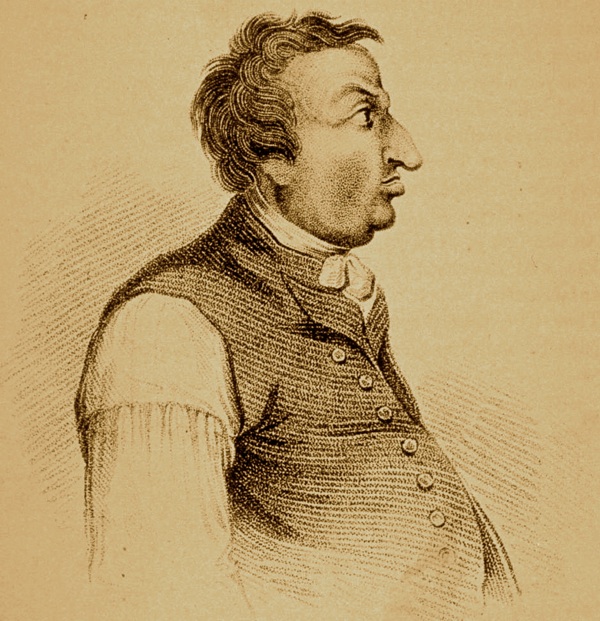
Nathaniel Bentley, Eccentric Character & Hardwareman of Leadenhall St – the well-known Dirty Dick
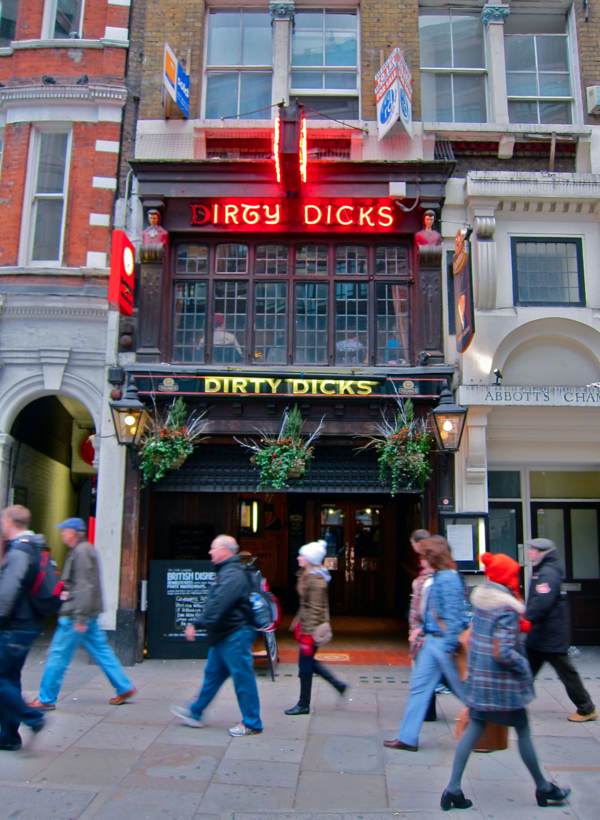
Photograph of City Corner Cafe copyright © Patricia Niven
Archive pictures courtesy of Bishopsgate Institute
You may also like to read about
Moyra Peralta’s Portraits

Sylvia in Tenterground, Spitalfields
This compelling photograph has been haunting me with its tender emotional resonance. Sylvia’s once-smart shoes and flowery dress tell us about the life she wished to lead – and maybe about the life she had led – yet it is apparent from Moyra Peralta‘s affectionate portrait that the life Sylvia aspired to was lost to her forever. Unwillingly to enter a night shelter, she slept rough in Spitalfields in the seventies and today this photograph exists as the only lasting evidence that, in spite of her straitened circumstance, Sylvia kept her self-respect.
Through the seventies and until the end of the nineties, Moyra Peralta befriended people living on the street in the capital, visiting them several times each week. “I miss that world terribly,” she admitted to me, looking back on it, “my relationships were more social than photographic, but in the process of those relationships I took portraits – there are those here that I knew over thirty years, most of these people I knew for well over twenty to thirty years.”
“Definitions of the homeless lost all meaning for me.” Moyra emphasised, “As a photographer, I tried to show the human face, rather than the problem of homelessness itself because those termed ‘homeless’ are not an alien grouping – they are people of all ages and backgrounds, many of whom have met with crippling misfortunes.”
Moyra’s intimate photographs succeed as portraits of heroic individuals, evoking the human dignity of those marginalised by society. “To me, those I have photographed are an important part of our social history.” Moyra asserted to me, “I want my photographs to rescue people from oblivion and celebrate their lives lived in a climate of disregard.”

John T in Lincoln’s Inn Fields.

Bert known as ‘Birdman’ slept outdoors since the age of fourteen. He had an affinity with the black swans and sparrows in St James’ Park and was treated with tolerance by the Park Police.

Two men sitting in a cellar.

Maxie on the steps of the Cumberland Hotel, Marble Arch.

Maxie pours Stan a drink at Marble Arch.

Eddie and Brian tell tall stories on Kinsgway

Brian raps on the church door, Kingsway

Man and a cat in a Cyrenian short stay hostel, 1974.

Grant and pal laughing at the Bullring, South Bank

Mary reads the Big Issue in Holborn

Tommy M in Lincoln’s Inn Fields

Bill H, Cyrenian House, Barons Court, in the seventies.

Brian D at Middlesex Hospital, 1997

Brian’s begging hand.
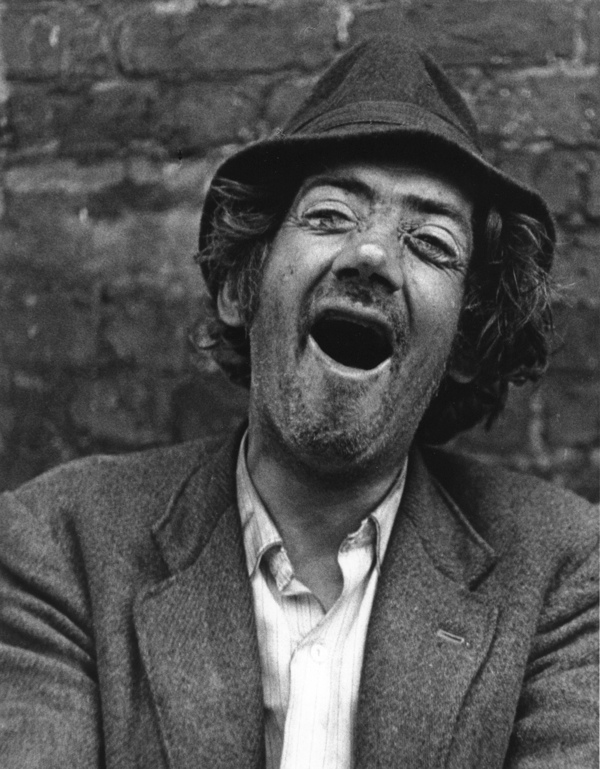
Francis at Cable St

JW and Jim at Pratt St, Camden

John T, Storyteller, Whetstone 1995.
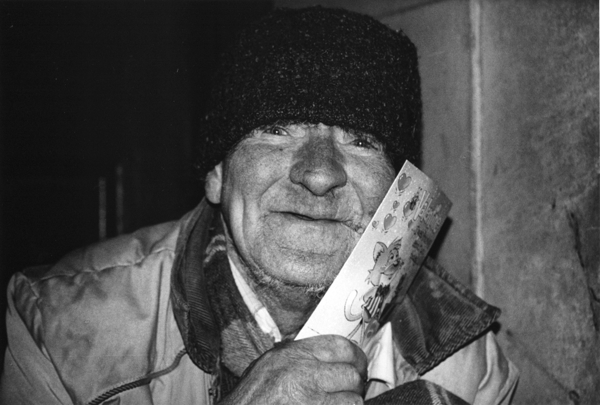
John T, the valentine.

Kerry’s Christmas Tree, Kingsway 1994.

Drag artistes from the Vauxhall Tavern give a surprise performance to entertain guests at a night shelter, 1974

Drag artistes improvise costumes at the Vauxhall shelter.

Billy and Maxie, two ex-servicemen at Marble Arch, 1976. Billy (left) died of a broken heart the year after Maxie’s death

Billy at Marble Arch in the seventies.
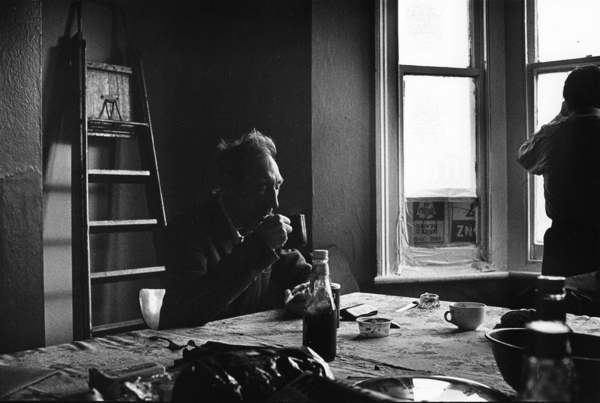
Sid takes tea at Ashmore Rd short stay hostel in West London.

Resident washing dishes at West London Mission, St Luke’s House – part of former Old Lambeth Workhouse, 1974.

Tiny, ex-circus hand and born wanderer extends a greeting at the Vauxhall Night Shelter, 1974.

Man and his bottle in Central London, seventies

Disabled Showman Zy with his wheels.

Zy plays a trick with his teeth

Brian the Poet in Kingsway, 1994.

Photographs copyright © Moyra Peralta
Signed copies of ‘NEARLY INVISIBLE,’ including these photographs and more by Moyra Peralta plus writing by John Berger & Alan Bennett, are available directly from Moyra. Email moyra.peralta@zen.co.uk to get your copy.
You may also like to read about
In Old Globetown
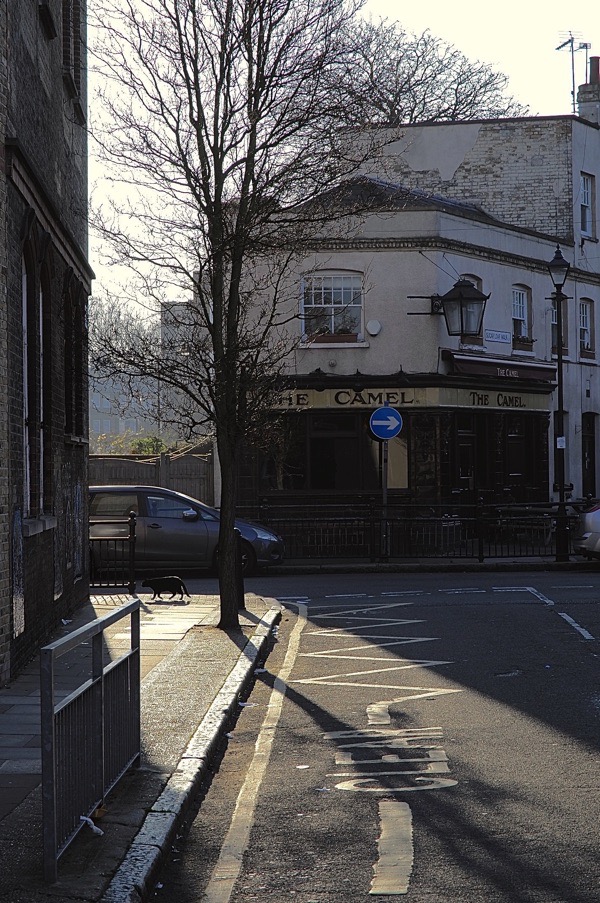
I took advantage of rare hours of January sunlight to take a stroll over to Globetown. You walk east from Museum Gardens in Bethnal Green through Sugar Loaf Walk and immediately recognise you have entered a different neighbourhood, where an atmosphere of domestic quietude prevails in distinct contrast to the clamour you encountered at the junction of Bethnal Green Rd and Cambridge Heath Rd. Cats prowl the empty streets while the residents are either snug in their homes or enjoying a long afternoon in The Camel or The Florists’ Arms.
This former marshland bisected by Globe Lane – now Globe Rd – takes its name from a old tavern that once stood here. The area was built up in the early nineteenth century by exploitative developers, throwing up poor quality homes for weavers on low incomes. Before long, commentators were comparing the notorious Globetown slum with Saffron Hill and St Giles High St. Consequently, most of the good quality nineteenth century building that remains today was constructed as social housing to alleviate the legacy of this poor development.
In Globe Rd, the first structure that you come upon is the handsome red brick Merceron Houses constructed by East End Dwellings Company in 1901. It was built upon the garden of Joseph Merceron, the most reprehensible eighteenth century resident of Bethnal Green, whose notoriety had faded by the end of the nineteenth century. Across the road is a modest sequence of terraces of workers’ cottages in the Arts & Crafts style from 1906 and, directly to the south, towers the handsome Board School with Mendip House and Shepton House beyond. All these buildings were the work of East End Dwellings Company and together they form a sympathetic complex of streets on a human scale, with The Camel adorned with its attractive Art Nouveau tiles at the centre.
Walking south and turning east into the Roman Rd, I was dismayed to discover the beloved Victoria Fish Bar has closed forever. After a lifetime of service behind the fryer, the proprietors have finally retired. On Sunday, Globetown Market Sq was empty but on weekdays this is a popular destination with stalls of keenly-priced fresh produce and the East End’s best wet fish barrow run by Del Downey, third generation fishmonger in this location.
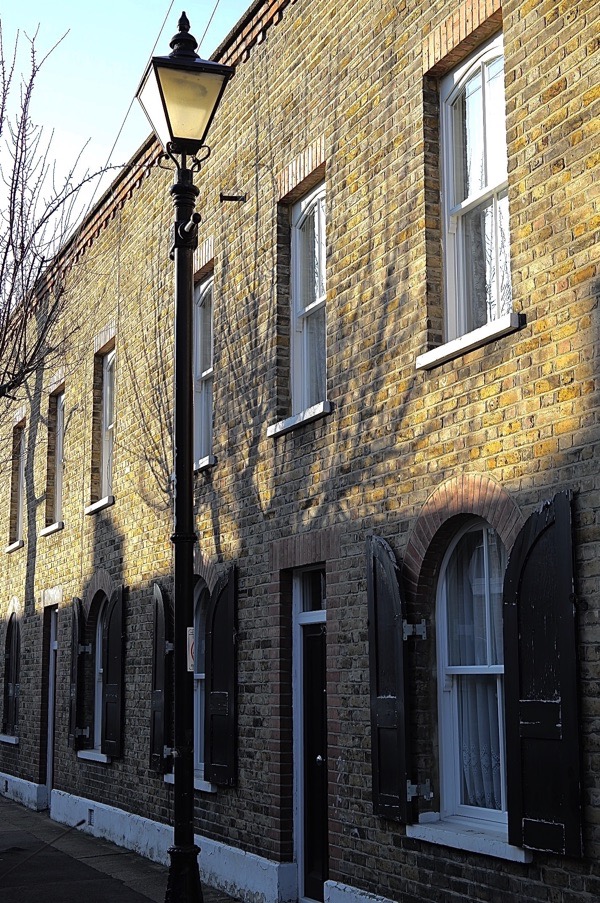
I walked north up Bonner St and turned west again at the former Bishop Bonner pub into Cyprus St, built in a distinctly aspiration style as ‘Wellington St’ in 1850, still remembered in the name of the former Duke of Wellington pub. This is an astonishing and handsome example of an unaltered mid-nineteenth century streetscape.
These distinguished nineteenth century survivals are surrounded by twentieth century housing of greater and lesser quality, evidencing the continuing struggle to overcome the grim legacy of exploitative development – both historical and recent – and give everyone in the East End a decent home.
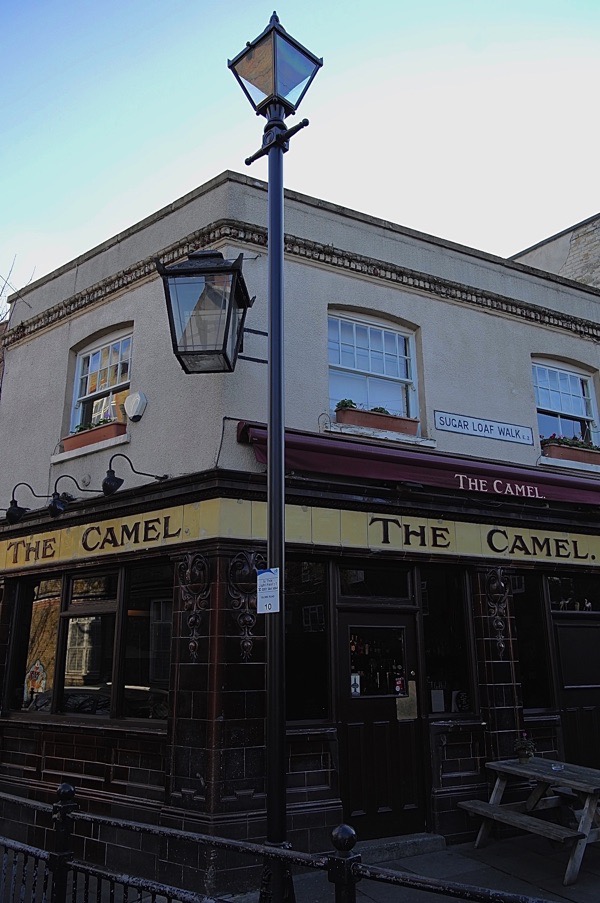
The Camel on Sugar Loaf Walk dates from before 1861 when it was named as the Museum Beer Shop
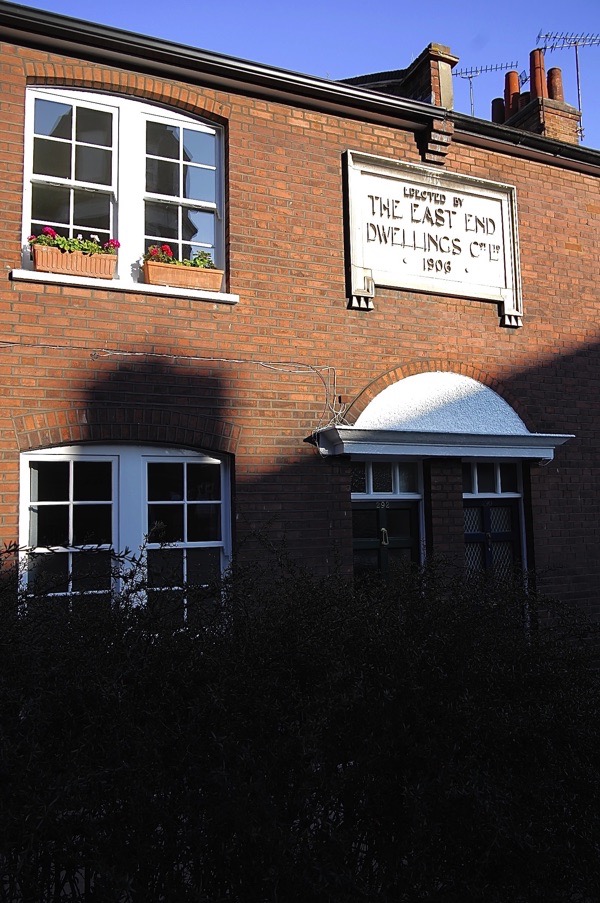
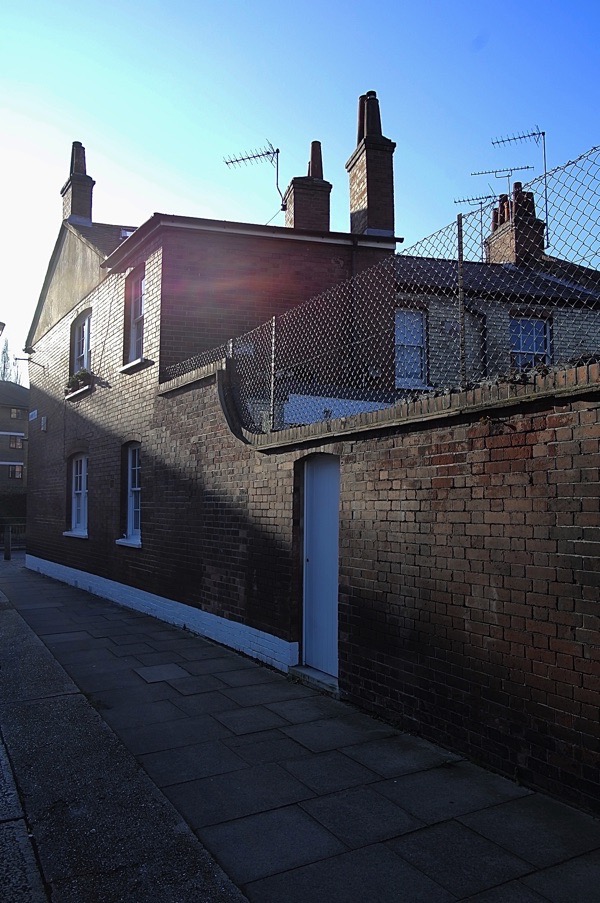
Cottages built by East End Dwellings company in Globe Rd
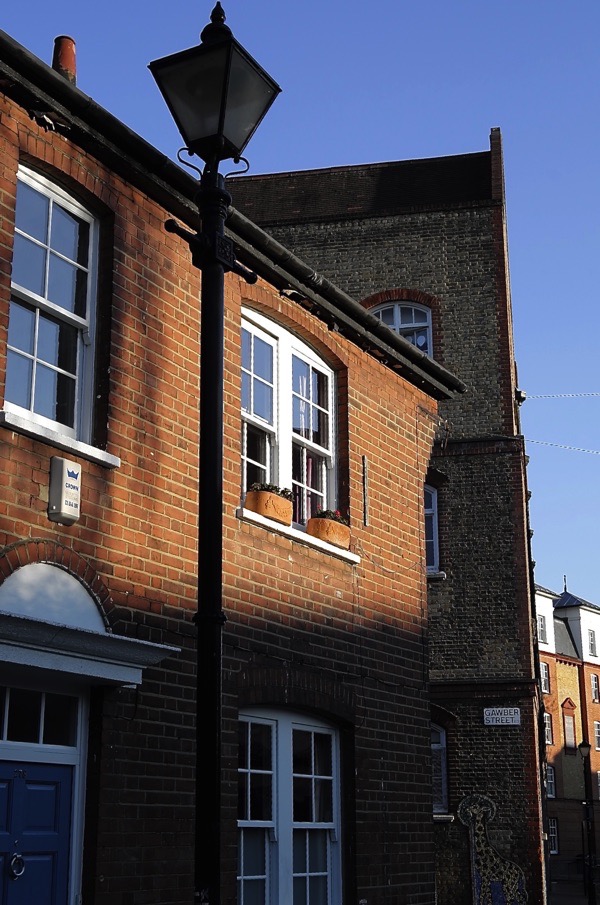
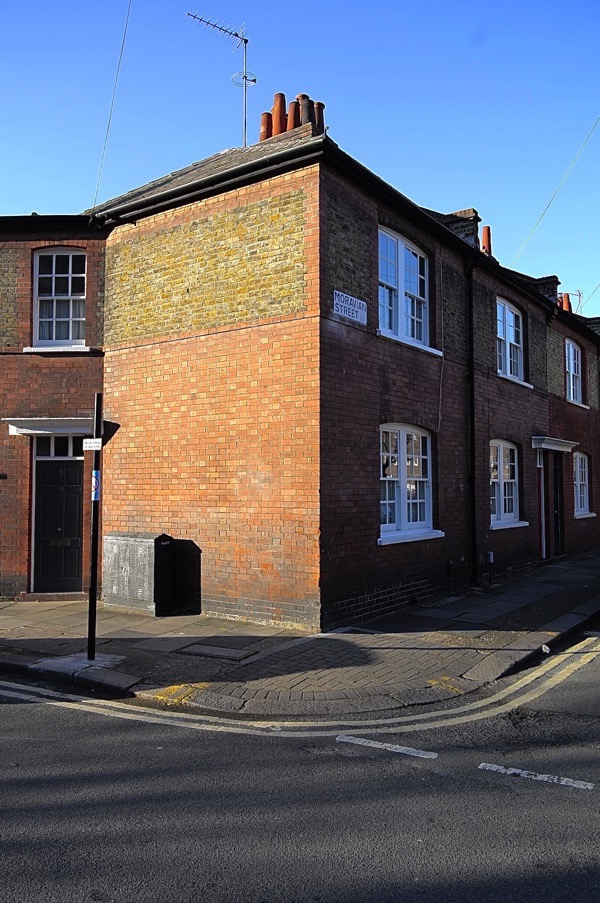
In Gawber Rd

Board School of 1900 in Welwyn St
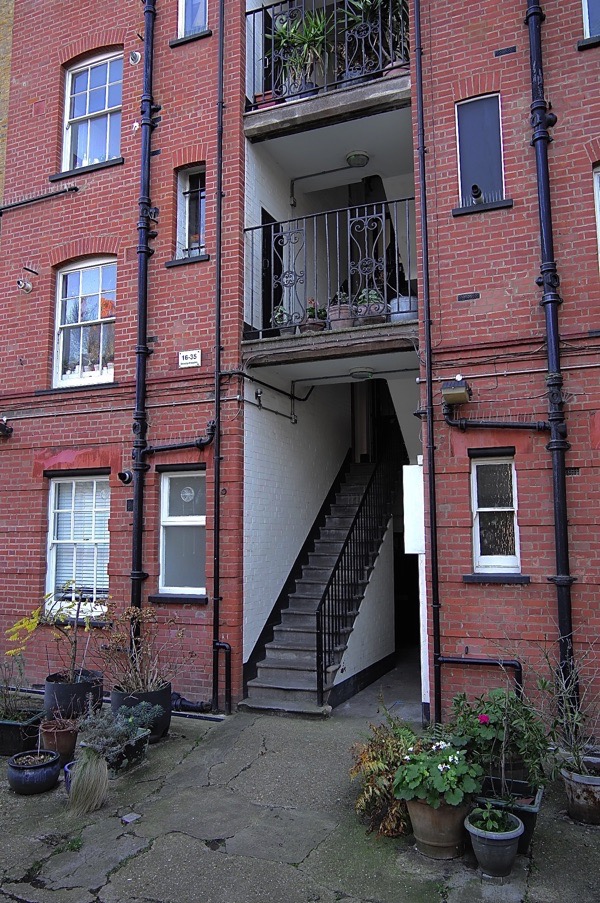
Open staircase at Mendip Dwellings built by East End Dwellings Company in 1900
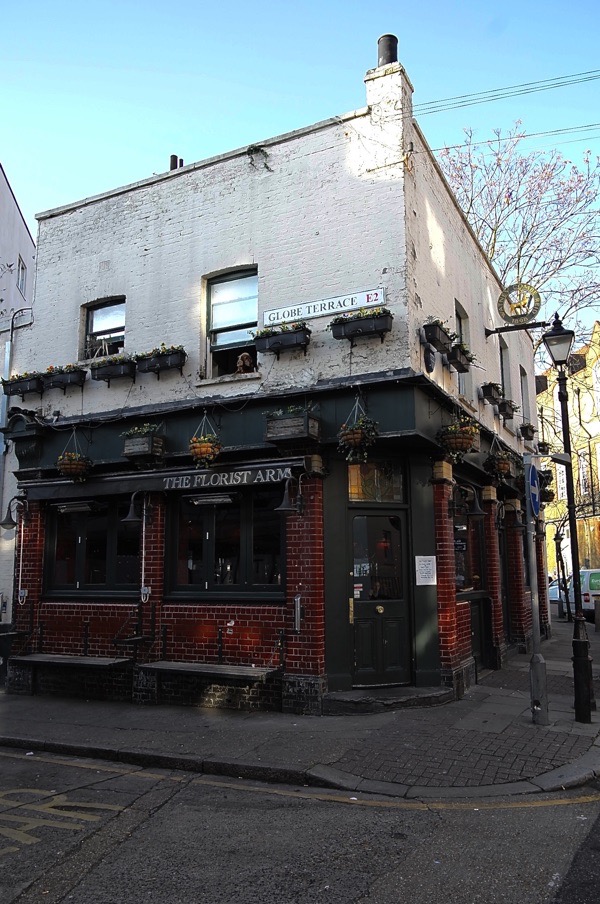
The Florists’ Arms in Globe Rd dates from before 1871 and its name refers to the former local culture of competitive flower growing introduced by the Huguenots
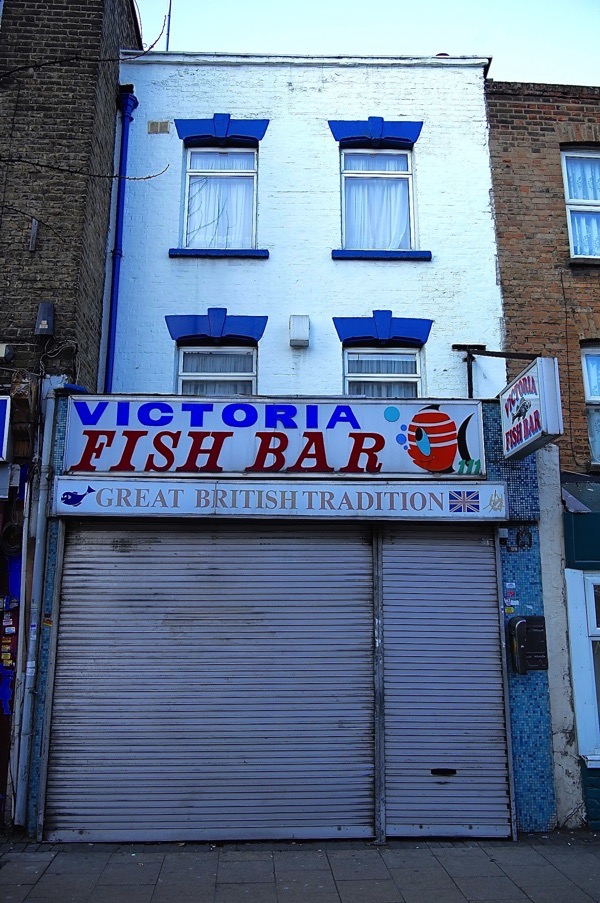
The Victoria Fish Bar in Roman Rd has closed forever
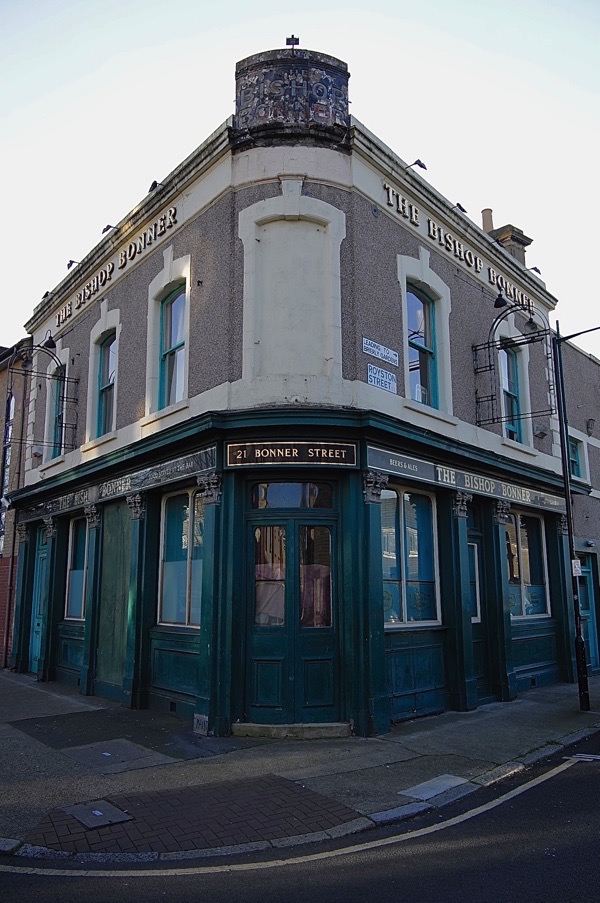
The Bishop Bonner, Bonner St, dates from before 1863 and its name refers to Bishop Bonner whose palace formerly stood nearby on the site of the London Chest Hospital

In Cyprus St
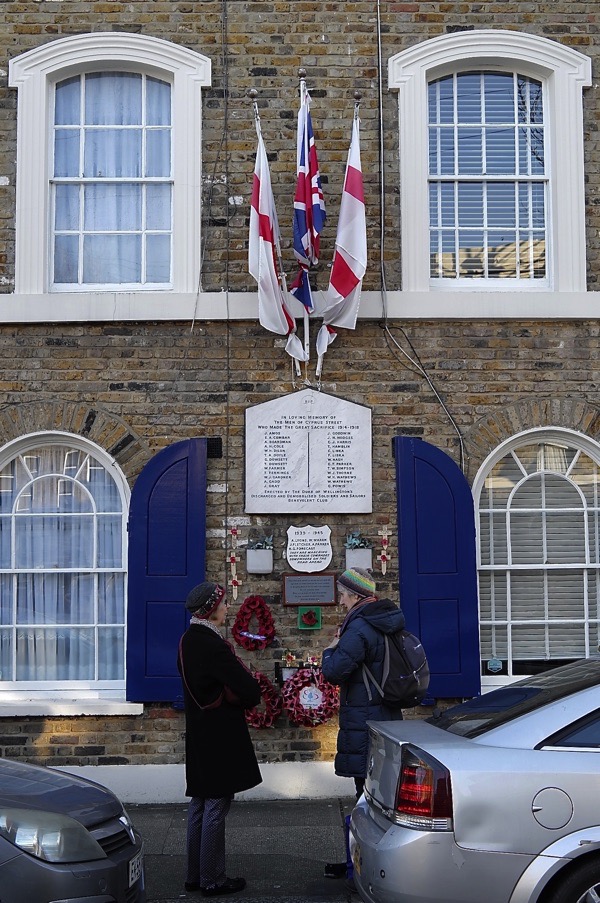
Memorial to former residents of Cyprus St who died in war – Bethnal Green provided the highest number of volunteers of any London borough in the First World War
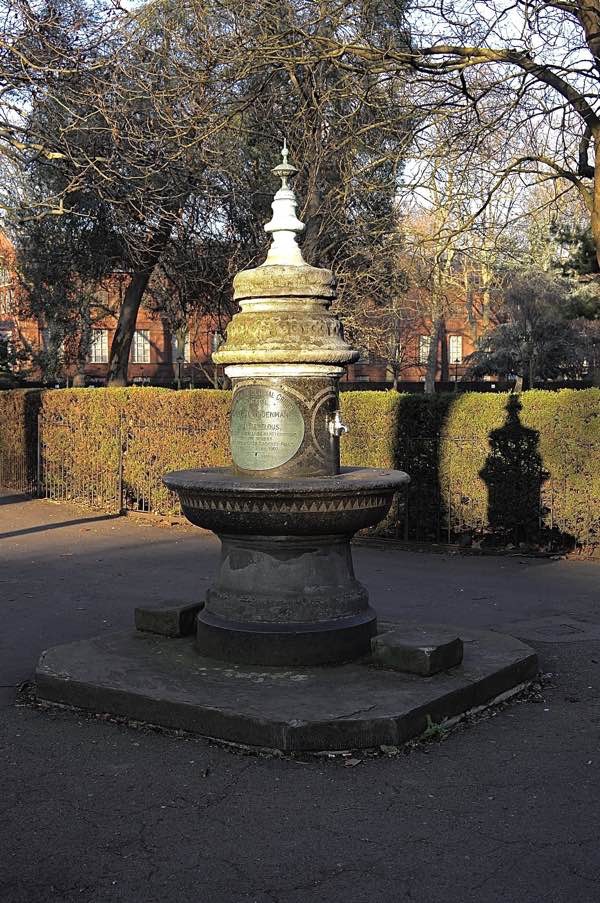
Drinking fountain in Museum Gardens
You may also like to take a look at
Ann Sotheran’s West End Champions

The Champion
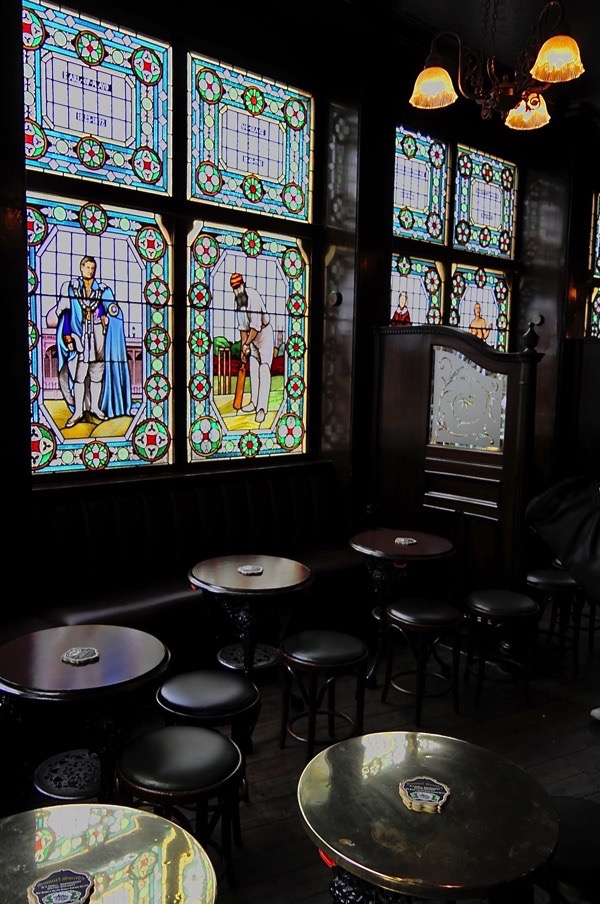
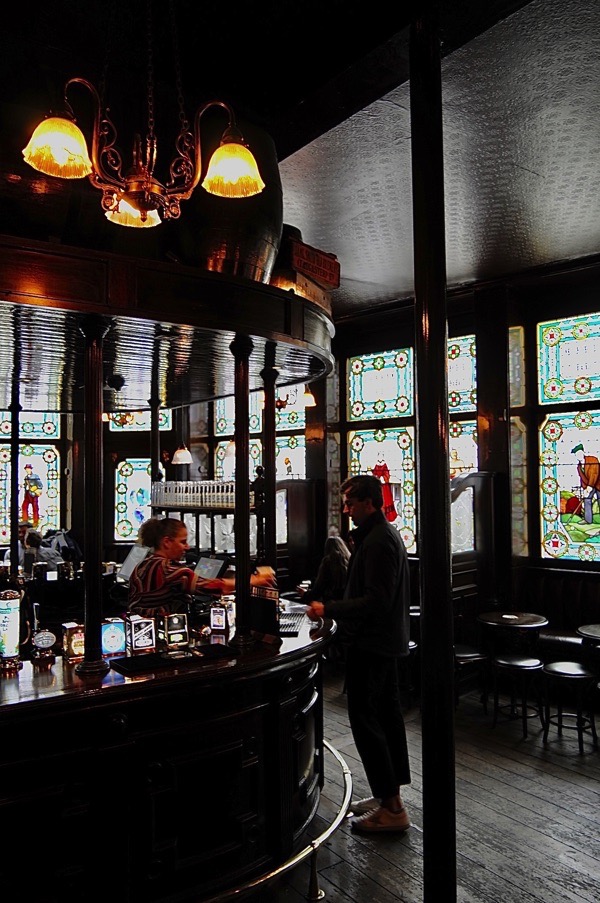
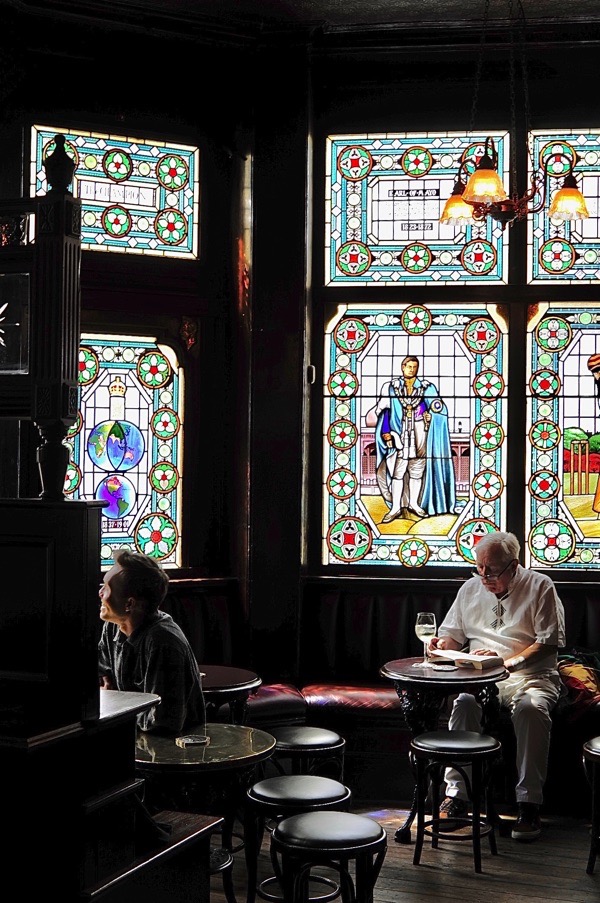
Perhaps more than anywhere else in London, Oxford St is where the grief of the world can descend upon me without warning – especially when I make the foolish mistake of going to the West End to buy a pillowcase. In such circumstances, there is fortunately a nearby refuge where I can seek respite from the urban clamour. It is The Champion in Well St – just minutes walk from the nightmarish agglomeration of chain stores – where Ann Sotheran‘s magnificent stained glass windows cast a spell of benign quietude.
The Champion has been there on the corner of Wells St and Eastcastle St since before 1869 and you would be forgiven for assuming that the glorious array of stained glass dates from this era, but you would be mistaken because it was designed and installed in 1989. The husband and wife publicans who live upstairs informed me that this imaginative notion was the inspiration of a member of the Samuel Smith family of brewers who own the pub and commissioned the glass from Ann Sotheran to endow it with distinction.
Thirty years later these gaudy portraits of Victorian worthies offer a generous welcome to the weary shopper, proving that there is still mileage in the traditional pub when it is as cherished and as handsome as The Champion.
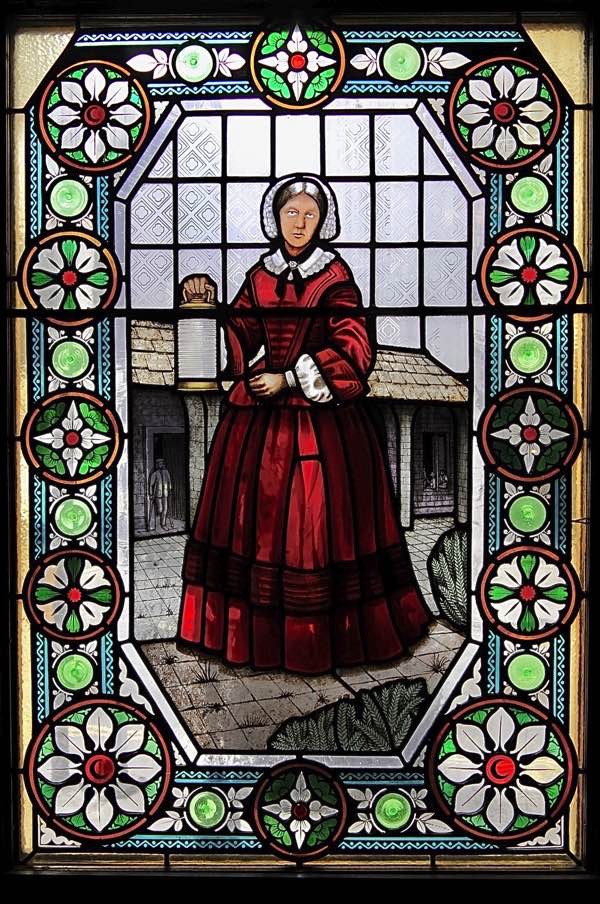
Florence Nightingale (1820-1910) gained professional status for nurses and raised hospital standards in the Crimea
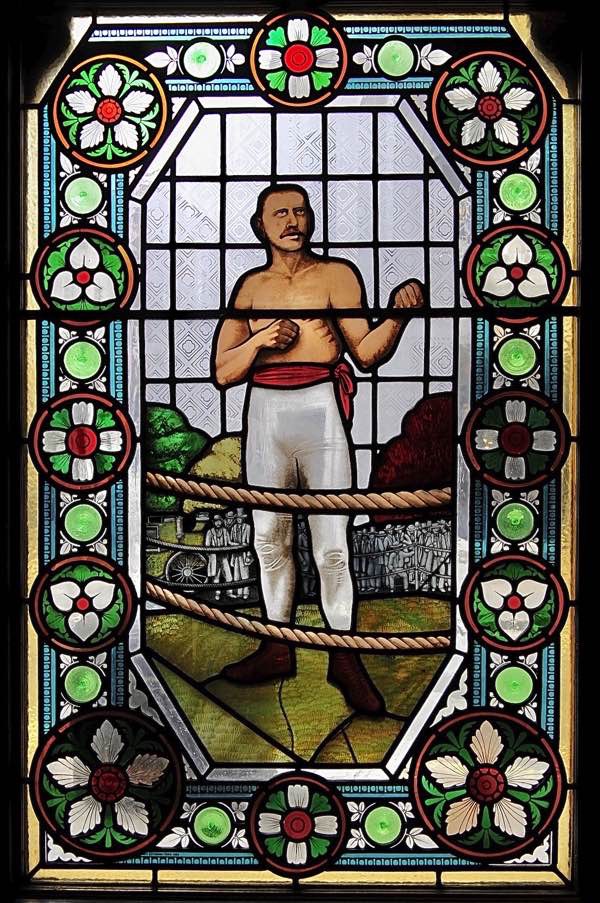
Bob Fitzsimmons (1862-1917) The only Englishman to have won three world titles at different weights
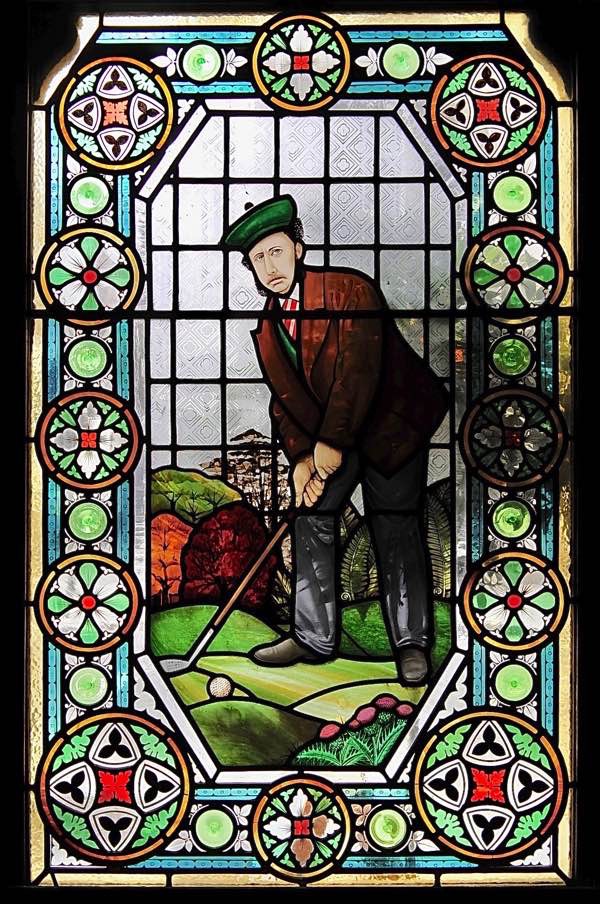
Young Tom Morris (1851-1875) won four consecutive Open Championships, first at the age of seventeen
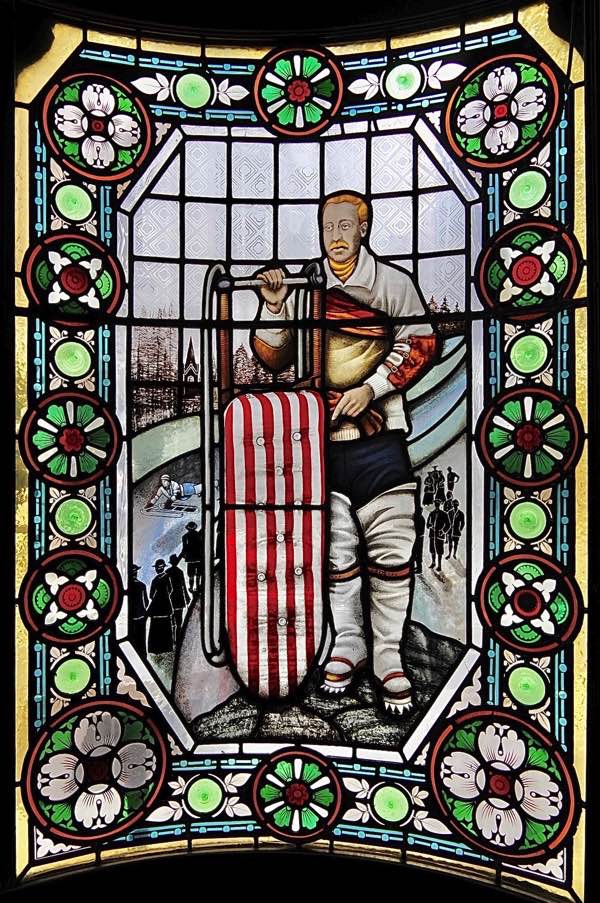
Capt Bertie Dwyer (1872-1967) ‘Flying Bertie Dwyer was one of the early Cresta riders, a President of the St Moritz Tobogganing Club and winner of several trophies
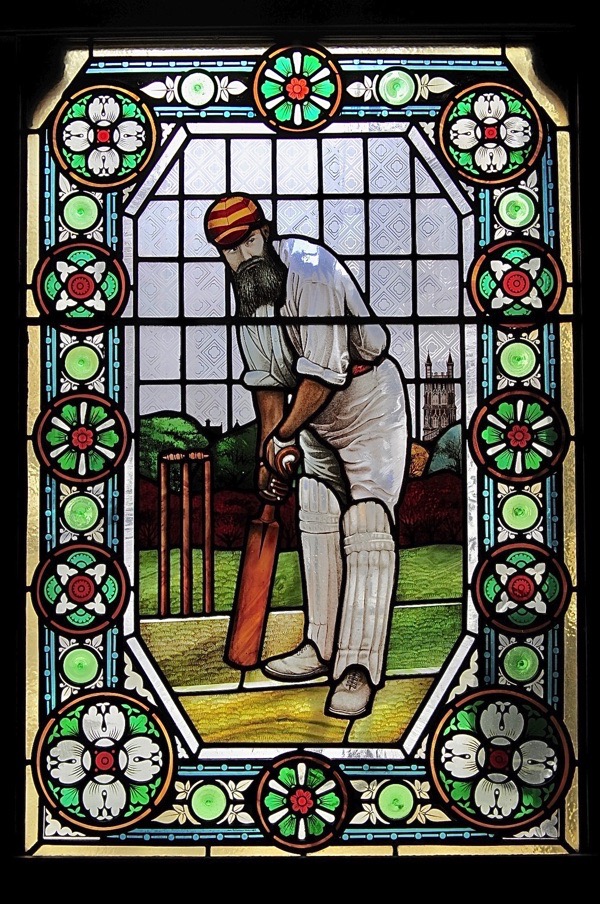
W G Grace (1848-1915) A legendary figure whose all round ability and enthusiasm dominated cricket for over thirty years
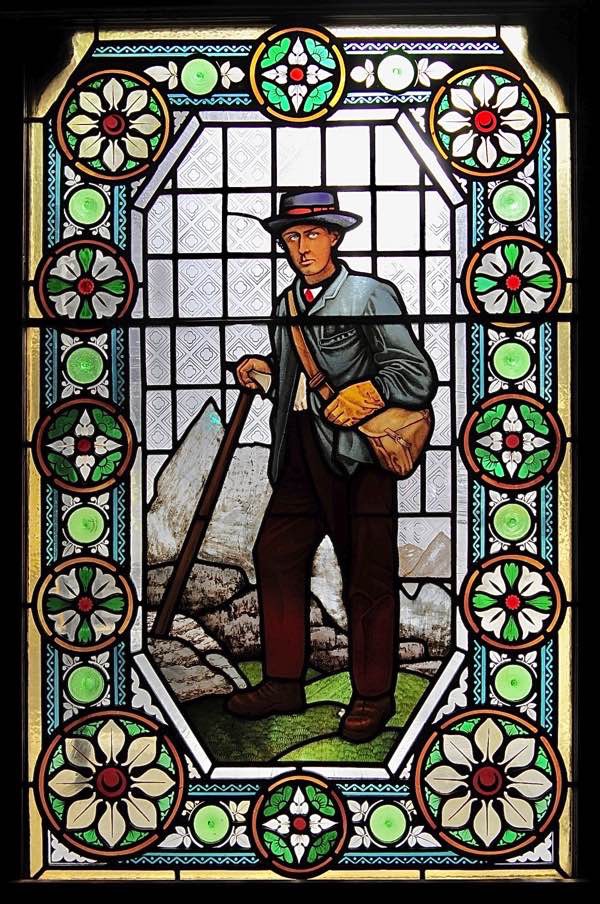
Edward Whymper (1840-1911) became a traveller and mountaineer, the first man to climb the Matterhorn and Chimborazo in the Andes
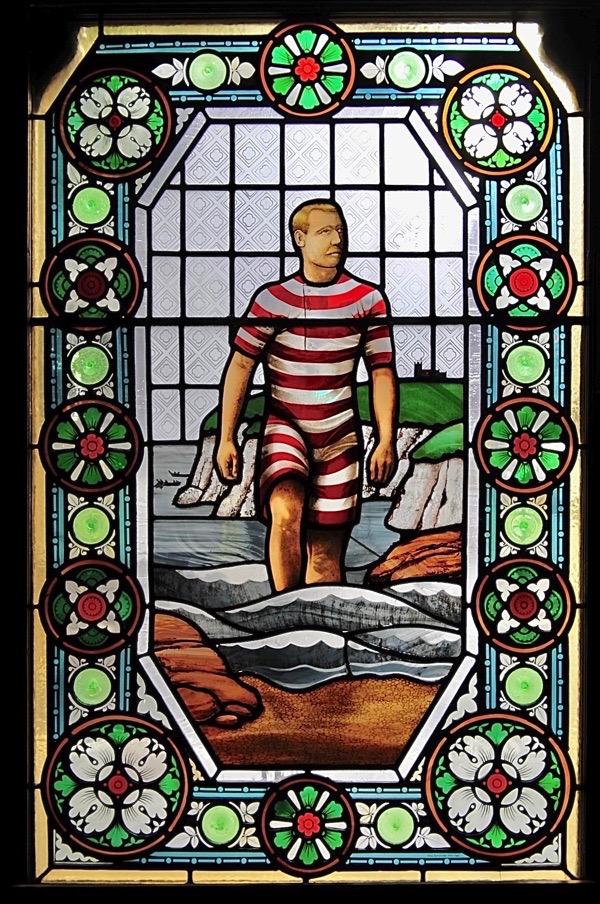
Capt Matthew Webb (1848-1883) was the first to swim the English Channel (thirty-four miles in twenty-one hours) He died swimming below Niagara Falls
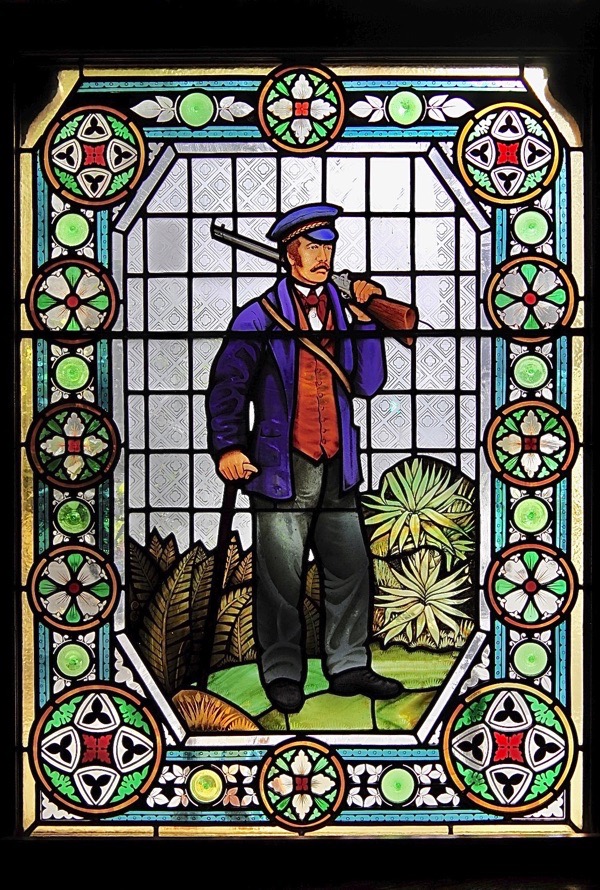
David Livingstone (1813-1873) Originally sent to Africa as a missionary, he mapped and explored vast areas of the continent
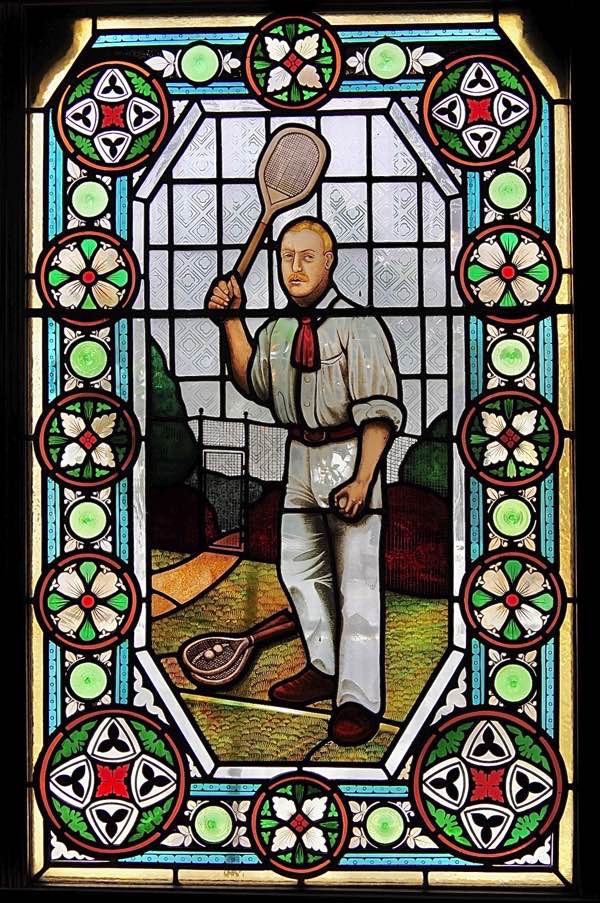
William Renishaw (1861-1904) Winner of seven singles and seven doubles cups, he with his brother, made Lawn Tennis into a sport
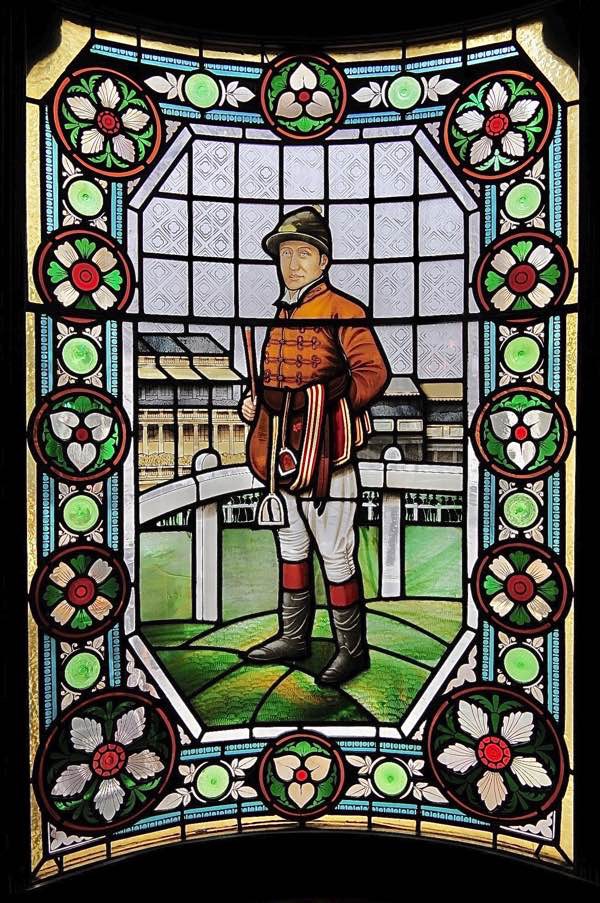
Fred Archer (1857-1886) Possibly the greatest jockey ever, being Champion Jockey for thirteen consecutive years, with twenty-one classic victories
You may also like to read about
At Nichols Bros, Woodturners

Geoff Nichols standing at his father Stanley’s lathe
‘We are the last proper woodturners in London,’ boasts Geoff Nichols of Nichols Bros (Woodturners) Ltd in Walthamstow. It sounds like quite a bold claim, but since I have learned the story of Geoff’s family endeavour stretching back over a century, examined their work and enjoyed a tour of the premises, I am more than happy to endorse Nichols Bros as ‘proper’ woodturners indeed.
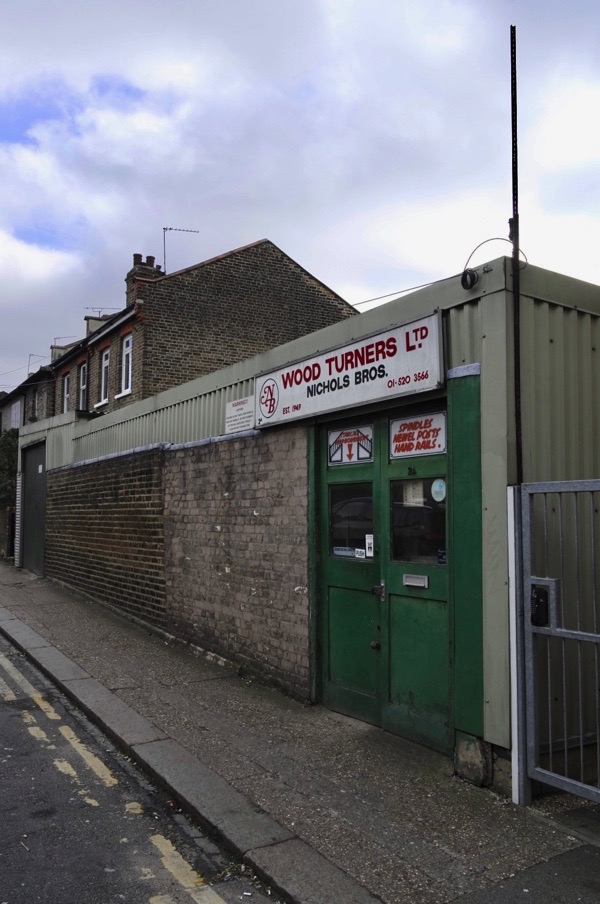
An undistinguished single storey building in a side street gives no hint of the wonders within. For eighty years, the Nichols family have been woodturning at this location and proved themselves masters of the art and the craft. Passing through double green doors from the street, you turn directly left and discover yourself in another kingdom, filled with glowing golden timber and lined with wood chips.
In a long low-ceilinged brick room sit venerable lathes surrounded by stacks of new pine and off-cuts, while the walls are adorned with intricate examples of woodturning hanging like stalactites. Geoff Nichols and his trusty partner Harry Morrow have worked here for the past half century, and they step forward to greet you – looking the epitome of master craftsmen in their long blue twill coats.
Yet further delights await your gaze. Widening his eyes in excitement, Geoff leads you into the yard beyond where blue tarpaulins conceal a unique spectacle, accumulated in a series of old sheds. One after the other, he lifts the tarpaulins to reveal rooms filled with a seemingly infinite array of spindles, all meticulously organised by style and disappearing into the gloom like gothic grottos.
‘We have a collection in the region of three thousand different spindles,’ underestimates Geoff proudly, ‘We try to display as many as we can for ease of reference but we have lots more that are stored in boxes too.’
Unquestionably the largest collection in London and perhaps the largest collection in the world, this is – in effect – our national archive of stair spindles. It is a secret museum that tells the story of the growth of the capital in spindles – a cultural asset of the greatest significance and it will not come again. Perhaps most fascinating was the ‘London spindle’ – the most common design in the capital yet also the one with the most variants.
Geoff led me to the tiny cubby hole which serves as the office, where we competed over who should sit upon the only chair in the place, before I plonked myself down upon a trestle and he told me the full story of Nichols Bros.
“My dad Stanley Nichols and his brother Arthur started on this site in Walthamstow in 1949. They were two youngest out of five brothers, the two eldest – there was about a twenty year age difference – already had a woodturning business, Nichols & Nichols, in the Kingsland Rd in Shoreditch which they started before the First World War.
After Stanley and Arthur left school, they went to work for their elder brothers until the Second World War began, then they went off to the forces. After the war, they carried on with their elder brothers for a year or so before they decided to set up their own woodturning business here, Nichols Bros.
I came into it the day I left school at fifteen, that was fifty years ago now in 1969, and Harry joined about four or five years after me. My Uncle Arthur retired about five years after I started, he used to handle the paperwork, so Harry took over from him. I was more involved in the practical side of the business, especially hand woodturning.
We probably had about five or six employees at our peak which was about twenty years ago. Since then the trade has changed quite dramatically because the trend has moved away from wood towards glass and metal. In pubs in the East End, all the glass racks were made of turned wood spindles but that is no longer the case. Once upon a time, we made a lot of mangle rollers but obviously that is work we will never get asked to do again. We used to do a lot of table legs and when I first joined the business all we were really doing was standard lamps.
The furniture industry disappeared in the East End a quarter of a century ago and we are now tied in to the building trade. People spend a lot of money on their properties these days, adding rooms in the loft which needs staircases – newel posts, handrails and spindles. Spindles for staircases is the work we are asked to do now, although we still make the occasional four-poster bed and table legs for the furniture trade which does exist.
A lot of woodturning is imported from China but we cannot try to compete by producing volume, instead we do bespoke woodturning if a customer wants spindles or newel posts matched up. Skill is very important. When I first started working here, we used to get an influx of people asking if there was a job or could they learn the trade, but it seems the younger generation tend to shy away from manual trades today.
My dad was an exceptionally good woodturner, better at some things than me although I think I am better than him at others. You can be the most skilled woodturner in the world but you have to do it within a certain time, because time is money. It is all about earning a living, it is not a hobby. If you turn one spindle by hand, you have then got to be able to replicate it again quickly. Being able to get sharp definition in your work is very important. I can look at any piece of woodturning and tell straight away whether it was made by a highly skilled turner or not.
In woodturning, the trick is you must not pick up any tools and put them down again too many times. You have to do as much as you can with either the chisel or the gouge. When you change tools you are wasting time, so you must be able to do the maximum before you change tools. That is the secret to fast woodturning and to be able to turn nice bead, a fillet or a jug. The ridge around the shaft is called a ‘bead,’ like beading. The ridge between the bead and the shaft of the spindle is called the ‘fillet’ and it gives definition of the bead. The ‘jug’ is the wave profile, like on a jug. Any woodturning you see is beads, fillets, bands, hollows and jugs. That is all woodturning is.
It gives me pleasure to take a square blank and turn it into an artistic shape. You alone know the difficulty in turning it. You can see that you have made something that looks beautiful and will be there for a long time. When you visit old buildings, you appreciate the tremendous work that was involved in the woodturning, especially since they were working on primitive lathes compared to ours.
My children will not be coming into the business. My son works in the City and my daughter has an Estate Agents, so no-one in the family can take it over which is a real shame. I would be open to train someone if they came and asked me. It would be lovely if we could find someone who wanted to start a woodturning business, because over the last seventy years we have collected so many machines and tools which are irreplaceable.“

Geoff as a young man with his father Stanley Nichols

Stanley Nichols working at his lathe


Geoff at work on a barley-sugar twist spindle


Harry Morrow and Geoff Nichols at work at their lathes


Harry Morrow


The yard where the collection of more than three thousand spindles are kept

Some of the collection

Geoff Nichols

Multiple variants of the ‘London spindle’ – a distinctive style which evolved during the nineteenth century with the expansion of the capital
Nichols Bros (Woodturning) Ltd, 2A Milton Rd, Walthamstow, E17 4SR
You may also like to read about
The Metropolitan Machinists’ Company
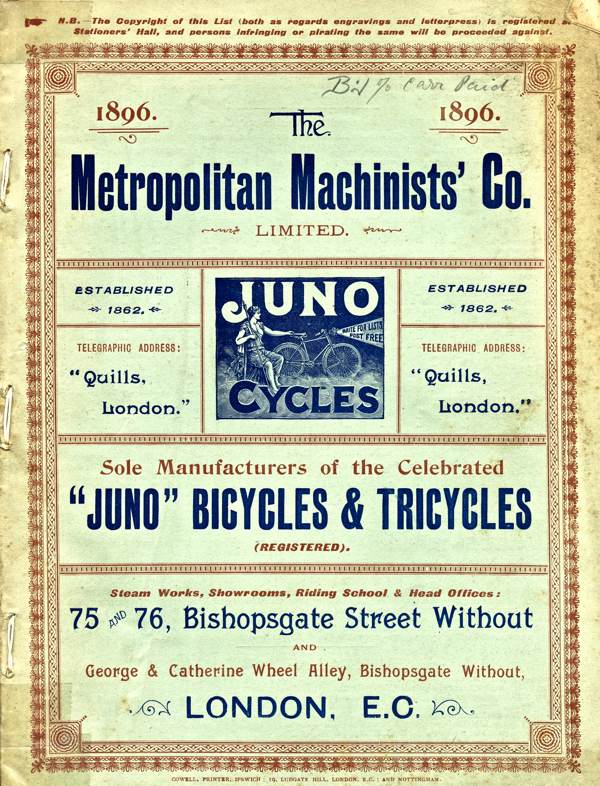
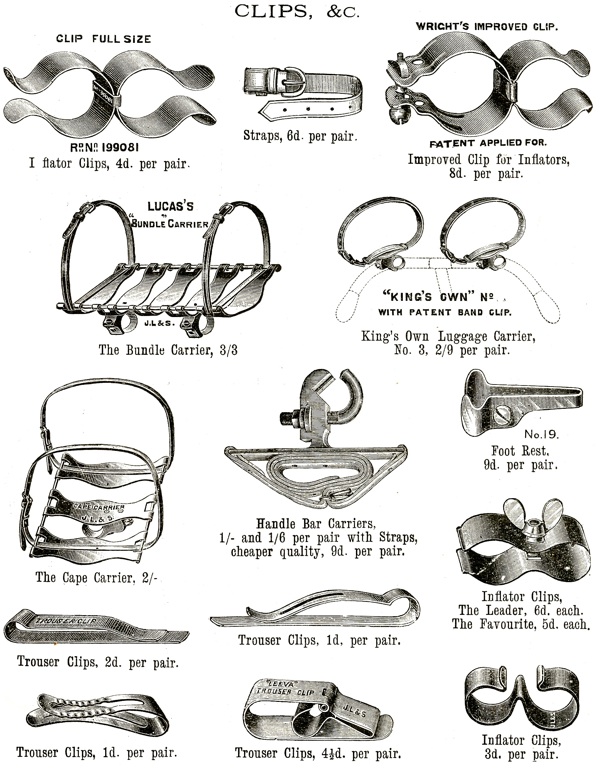
Since the first lockdown I have eschewed public transport and become a committed cyclist, so I was delighted to discover this 1896 catalogue for The Metropolitan Machinists’ Co, yet another of the lost trades of Bishopsgate, reproduced courtesy of the Bishopsgate Institute



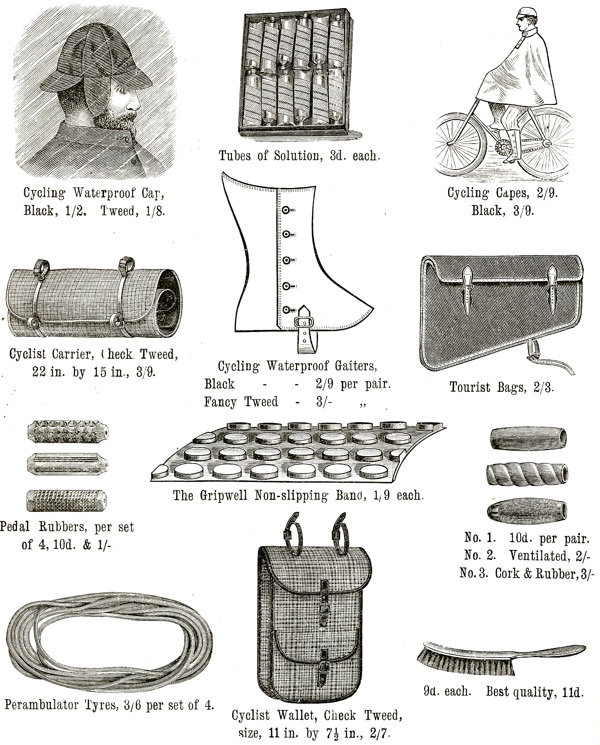

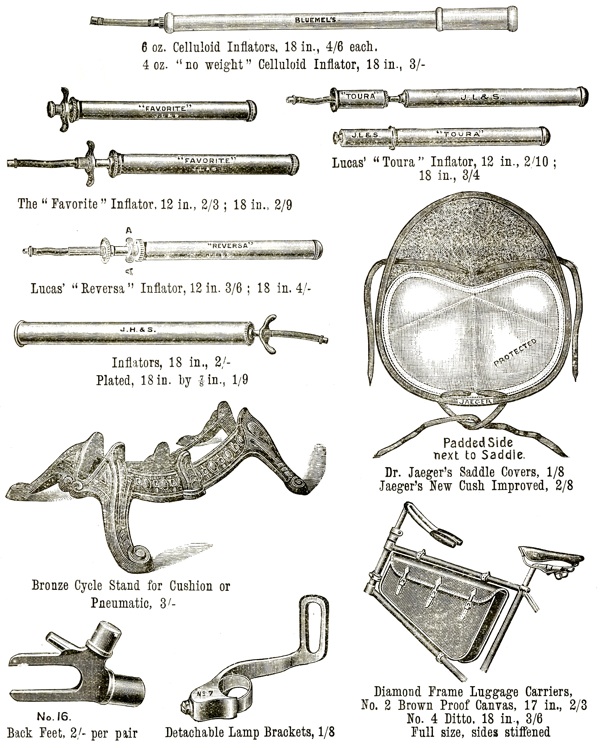


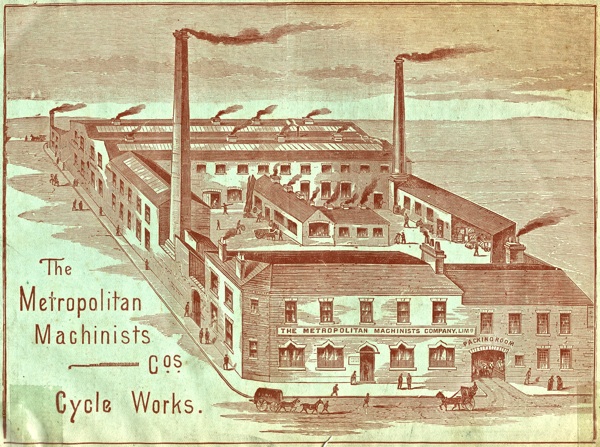
Images courtesy Bishopsgate Institute
You may also like to take a look at












