
Readings At Midwinter

Sarah Winman
On Midwinter’s Night, 21st December at 6:30pm, I shall be giving a reading with my friend, novelist Sarah Winman, at BURLEY FISHER BOOKS in Haggerston. Sarah will be reading from her celebrated new novel STILL LIFE and I shall be reading my Christmas stories.
Click here to book your ticket
Still Life is a richly tapestried story of characters brought together by love, war, art, flood, and the ghost of E.M. Forster. It is 1944 and in the ruined wine cellar of a Tuscan villa, as the Allied troops advance and bombs fall around them, two strangers meet and share an extraordinary evening together.

Burley Fisher Books, 400 Kingsland Rd, E8 4AA

Schrodinger will be otherwise engaged on Midwinter’s Night
You may like to read these stories by Sarah Winman
The Lives Of George Lansbury & Will Crooks
In this second feature from his recently-published book, Out of Sight, Out of Mind – Abuse, Neglect and Fire in a London Children’s Workhouse, John Walker considers how Will Crooks and George Lansbury continued the nineteenth century welfare reforms which Henrietta Barnett began.
This Wednesday 15th December at 7:30pm, John Walker will be giving an online lecture about the work of Henrietta Barnett to improve conditions for children in the Whitechapel workhouse.

‘He lived and died a servant of the People’
I wrote recently of the significant role played by Henrietta Barnett in ending the workhouse system in which children were taken away from their parents as young as two years old and became prey to abuse. After a twenty-year campaign to humanise conditions, she obtained government agreement to close down the barrack schools in 1896 – just as her quarter of a century as governor of the Forest Gate District School came to an end.
When she left, two men who were to complete her mission arrived, setting the standard for children in care in the twentieth century. Future Labour members of parliament Will Crooks and George Lansbury were both guardians of the Poplar Union, one of the other unions controlling the Forest Gate School. Each cut his public service teeth as governors there, closing the school and replacing it with better, more suitable accommodation.
Will Crooks was a former workhouse boy, born into poverty in Poplar in 1852. His father was disabled by an industrial accident and he was put into the workhouse at eight years old. The guardians sent him and his brother to the South Metropolitan District School in Sutton, Surrey, which made a lasting impression on him and shaped his stewardship of the Forest Gate institution.
According to Crooks’ biographer, George Haw, he was separated from his younger brother on entering the school and ‘in the great hall of the school he would strain his eyes hoping to get a glimpse of the lone little fellow among the other lads, but never set his eyes upon him until the day they went home together.’
Crooks told Haw ‘Every day I spent in that school is burned on my soul.’ From that day, he was determined to change the system for Poor Law children.
Crooks first came to public prominence during the great London Dock Strike of 1889 and, three years later, was elected to the recently established London County Council under the Progressive banner. One of his early achievements was to change the eligibility criteria for elections to local boards of guardians – which were responsible for running workhouses – to enable working-class people to stand for election.
Taking advantage of the change he had engineered, he was elected to the Poplar Board in 1893 and, within four years, had himself appointed as a governor of the Forest Gate School. He was reminded of his own childhood as soon as he entered, observing that the youngsters ‘got no schooling and no training, save for the training that fitted them for pauperism.’
He became Chairman of the Poplar Board in 1899 and was elected Chair of the Forest Gate School governors, setting himself the task of removing the stigma of the Poor Law. According to biographer Haws his mission was to make the children ‘feel like ordinary working-class children … to grow up like them, becoming ordinary working-men and working-women themselves, so the Poor Law knew them no longer.’
Crooks furthered this ambition through public speaking, petitioning government, forcing school managers to improve conditions and encouraging children to grow in confident in the world outside the school. He took particular pride in entering Forest Gate’s pupils in sporting competitions and encouraging young musicians to perform in public, increasing the children’s social confidence.
By 1906, Poor Law schools’ inspector, Dugard, declared ‘There is very little, if anything of the institutional mark about the children … They compare very favourably with the best elementary schools.’
George Lansbury was born in Suffolk, the son of a railway worker, in 1859. He came to London as a young man, married, and after a brief spell in Australia, moved to Bow where he became involved with politics, working as agent for the local Liberal MP. Frustrated by the party’s lack of radicalism, he joined the Social Democratic Federation. Within a year, Lansbury was one of its Poor Law guardian candidates for the Poplar Union and his manifesto included a commitment to improving the Forest Gate School, writing ‘All children left to the care of the Board shall not be made to feel their dependence is criminal or disgraceful, and shall not be marked out by dress or treatment from their fellows.’
He wanted the children to be educated in local schools alongside non-workhouse pupils. In his election address the following year, he called for the abolition of workhouse school uniforms and that ‘the food given shall be sufficient of good quality and properly prepared.’
In 1895, after serving on Poplar’s Board of Guardians for two years, he was appointed a governor of the Forest Gate School, along with Crooks. They spent the next ten years improving conditions for the children while trying to replace the school with much more suitable accommodation, deeper in the Essex countryside. They identified Charles Duncan, the school’s superintendent, as the major obstacle and pensioned him off, along with other unsympathetic staff. They introduced camping holidays for boys in Essex and London excursions for girls.
But their reforms did not go unopposed. Poplar ratepayers complained at the cost and there were arguments in parliament decrying the fact the children were now being cared for rather than simply disciplined. The national press condemned the ‘extravagancies’ in treating the children humanely. Yet when a parliamentary committee was established to examine this apparent scandal, Lansbury & Crooks were exonerated.
From 1898, they were planning to move the children to purpose-built accommodation in Brentwood at a cost of £100,000, spending a great deal of time raising the money and looking for a buyer for the Forest Gate site while seeking loans to bridge the difference.
The scheme they devised was Hutton Poplars, opening in 1908. It was a series of houses, each catering for around thirty children under the care of a house-mother rather than an ex-army sergeant. Swimming baths, a gymnasium and recreation rooms were provided, and children attended local schools, without having to wear pauper uniforms.
Outrage at Lansbury & Crooks’ reforms were ultimately silenced when Hutton Poplars received a national seal of approval, ordained by a royal visit.
George Lansbury & Will Crooks’ lives afterwards
Both became Labour MPs – Will Crooks for Woolwich and George Lansbury for Bromley & Bow – although they had very different political careers.
Will Crooks was an MP between 1902 and 1921. A century later, we condemn his record and the causes he championed as reprehensible. He was anti-immigrant, particularly during the First World War when he became a flag-waver in favour of conflict. He was also a eugenicist with shameful views towards those with disabilities.
George Lansbury’s activity as a Labour MP was of a different timbre. He was a champion of women’s suffrage and an ally of Sylvia Pankhurst, resigning his seat to fight a by-election on the issue of suffrage which he lost. He was the founding editor of the Daily Herald during his period out of office. On his return to Westminster he became one of the minority of pacifist MPs, opposed to the First World War. As leader of Poplar Council, he led a successful, campaign of civil disobedience that saw him and his fellow councillors imprisoned to get the funding of local government reformed so it no longer disadvantaged poor communities.
He became leader of the Labour MPs in the thirties after Ramsey Macdonald deserted the party, taking most of it with him to lead a ‘national’ government. Lansbury’s pacifism cost him the leadership in 1935 and he spent the last five years of his life valiantly persuading leaders around Europe to disarm and avoid a Second World War.
He failed, dying within months of the outbreak of war, but in 1950 A.J.P Taylor described George Lansbury as ‘the most lovable figure in modern British politics.’

George Lansbury’s memorial in Bow Rd – ‘A great servant of the people’

George Lansbury

George Lansbury’s 1893 election handbill to become a member of the Poplar Boards of Guardians

Will Crooks

Forest Gate District School

Pupils at Forest Gate School photographed by Henrietta Barnett in he eighteen-eighties

Pupils at Forest Gate School photographed by Henrietta Barnett in the eighteen-eighties

Hutton Poplars which replaced Forest Gate School
You may also like to read about
Walk Through Time With The Gentle Author
 Map of the Gentle Author’s Tour drawn by Adam Dant
In celebration of the festive season, I shall be hosting a walk on Boxing Day at noon.
Ramble with me through two thousand years of culture in the streets of Spitalfields and encounter some of the people and places that make this historic neighbourhood distinctive.
I invite you to join my tour in the footsteps of all those who came before, with a keen eye and an open heart, to discover the manifold wonders of this place.
Tickets cost £50 and include a signed copy of one of The Gentle Author’s books of your choice as a souvenir. To book please email spitalfieldslife@gmail.com

Sandys Row from the north
After seeing the work of photographer C.A.Mathew in these pages, Adam Tuck was inspired to revisit the locations of the pictures taken over a century ago. Subtly blending his own photographs with C.A.Mathew’s images of Spitalfields in 1912, Adam initiated an unlikely collaboration with a photographer of the beginning of the last century and created a new series of images of compelling resonance.
In these montages, people of today co-exist in the same space with people of the past, manifesting a sensation I have always felt in Spitalfields – that all of history is present here. Yet those of the early twentieth century ago knew they were being photographed and many are pictured looking at the camera, whereas passersby in the present day are mostly self-absorbed. The effect is of those from the past wondering at a vision of the future, while those of our own day are entirely unaware of this ghostly audience.
It is hard to conceive of the meaning of time beyond our own lifespan. But these photographs capture something unseen, something usually hidden from human perception – they are pictures of time passing and each one contains more than a hundred years.

Sandys Row from the south

Looking from Bishopsgate down Brushfield St, towards Christ Church

Looking down Widegate St towards Sandys Row

Looking down Middlesex St towards Bishopsgate

From Bishopsgate looking up Middlesex St

In Bell Lane

In Artillery Lane looking towards Artillery Passage

From Bishopsgate through Spital Sq

Frying Pan Alley
Montages copyright © Adam Tuck
C.A.Mathew photographs courtesy Bishopsgate Institute
You may like to read the original stories
The Lantern Slides Of Old London
Hundreds of lantern slides from the London & Middlesex Archaeological Society Collection are published in THE GENTLE AUTHOR’S LONDON ALBUM, making it the ideal present for lovers of London’s history.


A few years ago, I became enraptured by a hundred-year-old collection of four thousand lantern slides. They were once used for educational lectures by the London & Middlesex Archaeological Society at the Bishopsgate Institute in Spitalfields. When Stefan Dickers became archivist there, he discovered the slides in dusty old boxes – abandoned and forgotten since they became obselete. Yet it has become apparent that these slides, which were ignored for so long, are one of the greatest treasures in the collection. And it is my delight to be the one responsible for publishing a selection of these wonderful images in my London Album.
When I was first offered the opportunity of presenting these lantern slides which have been unseen for generations, I was overwhelmed by the number of pictures and did not know where to start. The first to catch my fancy were the ancient signs and symbols, dating from an era before street numbering located addresses and lettered signs advertised trades to Londoners.
Before long, I grew spellbound by the slide collection because, alongside the famous landmarks and grand occasions of state, there were pictures of forgotten corners and of ordinary people going about their business. It was a delight to discover hundreds of images of things that people do not usually photograph and I was charmed to realise that the anonymous photographers of the London & Middlesex Archaeological Society were as interested in pubs as they were in churches.
The more I studied the glass slides, the more joy I found in these arcane pictures, since every one contained the rich potential of hidden stories, seducing the imagination to flights of fancy regarding the ever-interesting subject of Old London. Once I had published The Signs of Old London, I realised there were many other such sets to be found among the slides, as a result of the systematic recording of London which underscored the original project by the London & Middlesex Archaeological Society, a hundred years ago, and parallels my own work in Spitalfields Life, today.
I arranged them quite literally – in terms of doors, or night, or dinners, or streets, or staircases. I did this because I was interested to explore how the pictures might speak to me and to you, the readers. No evidence has survived to indicate in what sequence or order they were originally shown and it was my intention to avoid imposing any grand narratives of power or poverty, although these pictures do speak powerfully of these subjects. Recognising that objects and images are capable of many interpretations, I am one that prefers museums which permit the viewer to decide for themselves, rather than be presented with artefacts subject to a single meaning within an ordained story and so, with the Album, we have presented the pictures and invited the reader to draw their own conclusions.
Equally, in publishing the slides, we chose not to clean them up or remove imperfections and dirt. Similarly, we did not standardise the colour to black or a uniform sepia, either. Instead, we have cherished the subtle variations of hues present in these slides and savoured the beautiful colour contrasts between them, when laid side by side. There is a melancholic poetry in these shabby images, in which their damage and their imperfections speak of their history, and I came to glory in the patina and murk.
Above all, in publishing these pictures in my Album, I wanted to communicate the pleasure I have found in scrutinising them at length and entering another world imaginatively through the medium of this sublime photography. Today I publish this serendipitous selection of glass slides which fascinate me but that did not make it into my Album.

In the Inns of Court

At Eltham Palace

At Euston Station

The Anchor at Bankside

Crocodiles at the Natural History Museum

Reading Room at the British Museum

Chelsea Pensioner

In Fleet St

In Fleet St

St John’s Gate, Clerkenwell

Between the inner & outer dome of St Paul’s

Along the Embankment

The Old Dick Whittington, Clothfair, Smithfield

Firemen take a tea break

Lightermen on the Thames


Flood in Water St, Tower of London

The White Tower, London’s oldest building
Glass slides courtesy of Bishopsgate Institute
Take a look at these sets of the glass slides of Old London
The High Days & Holidays of Old London
The Fogs & Smogs of Old London
The Forgotten Corners of Old London
The Statues & Effigies of Old London
The City Churches of Old London


Chapter 2. Horrid Murder
I am looking forward to welcoming readers to the BLOOMSBURY JAMBOREE this weekend, 11th & 12th December at Art Workers Guild, 6 Queens Sq, WC1N 3AT. My readings are sold out, but I shall be on hand each day and delighted to sign and inscribe books.

The River Thames Police Office occupies the same site today on the Thames beside Wapping New Stairs as it did in 1811. Once news of the murders on the Ratcliffe Highway reached here in the early hours of December 8th, Police Officer Charles Horton who was on duty at the time, ran up Old Gravel Lane (now Wapping Lane) and forced his way through the crowd that had gathered outside the draper’s shop. He searched the house systematically and, apart from the mysterious chisel on the counter, he found five pounds in Timothy Marr’s pocket, small change in the till and £152 in cash in a drawer in the bedroom – confirming this was no simple robbery.
In the bedroom, he also found the murder weapon, a maul or heavy iron mallet such as a ship’s carpenter would use. It was covered in wet blood with human hair sticking to it. At least two distinct pairs of footprints were discerned at the rear door, containing traces of blood and sawdust – the carpenters had been at work in the shop that day. A neighbour confirmed a rumbling in the house as “about ten or twelve men” were heard to rush out.
Primary responsibility for fighting crime in the parish of St George’s-in-the-East lay with the churchwardens who advertised a £50 reward for information, including the origin of the maul. The Metropolitan Police was only established in 1829 – in 1811 there was no police force at all as we would understand it and, as news of the mystery spread through newspaper reports, a disquiet grew so that people no longer felt the government was capable of keeping then safe in their own homes. Indicative of government concern at the national implications of the case, the Home Secretary offered a reward of £100.
Meanwhile a constant stream of sightseers passed through the Marr’s house, viewing the bodies laid out on their beds, and some left coins in a dish because Mr Marr had only left sufficient capital for his creditors to be paid nineteen shillings in the pound. The bill for the renovation of the shop was yet to settled.
Three days after the crime, on 10th December 1811, when the inquest was held at the Jolly Sailor public house just across the Highway from Marr’s shop, a vast crowd gathered outside rendering the wide Ratcliffe Highway impassable. Walter Salter, the surgeon who had examined the bodies, Margaret Jewell the servant, John Murray the neighbour and George Olney the watchman all told their stories. The jury gave a verdict of wilful murder.
For two centuries the Ratcliffe Highway had an evil reputation. Wapping was the place of execution for pirates, hanged on the Thames riverbank at low water mark until three tides had flowed over them. Slums spread across the marshy ground between the Highway and the Thames, creating the twisted street plan of Wapping that exists today. This unsavoury neighbourhood grew up around the docks to service the needs of sailors and relieve them as completely as possible of their returning pay. Now it seemed that these murders had confirmed everyone’s prejudices, superstitions and fears of the Highway – sometimes referred to as the Devil’s Highway.
Whoever was responsible for these terrible crimes was still abroad walking the streets.
Expect further reports over coming days as new developments in this case occur.

River Police Headquarters, Wapping New Stairs

Click on Paul Bommer’s map of the Ratcliffe Highway Murders to explore further
I am indebted to PD James’ ‘The Peartree & The Maul’ which stands as the authoritative account of these events. Thanks are also due to the Bishopsgate Institute and Tower Hamlets Local History Archive.
You may like to read the first instalment of this serial which runs throughout December
Matyas Selmeczi, Silhouette Artist
Have your silhouette cut by Matyas Selmeczi at the BLOOMSBURY JAMBOREE this weekend, 11th & 12th December at Art Workers Guild, 6 Queens Sq, WC1N 3AT.

With his weathered features, grizzled beard, sea captain’s cap and denim bib overalls, Silhouette Artist Matyas Selmeczi looks like he has just stepped off a boat and out of another century.
Such is his gentle, unassuming personality that it is possible you may not have noticed Matyas sitting in his booth in Spitalfields, yet I urge you to seek him out because this man is possessed of a talent that verges on the magical. With intense concentration, he can slice through a piece of paper with a pair of scissors to produce a lifelike portrait in silhouette in less than three minutes, and he does this all day.
Once his subject sits in front of him looking straight ahead, Matyas takes a single considered glance at the profile and then begins to cut a line through the paper, looking up just a couple of times without pausing in his work, until – hey presto! – a likeness is produced. The medium is seemingly so simple and the effect so evocative.
Silhouettes were invented in France in the eighteenth century and named after Etienne de Silhouette, a finance minister who was a notorious cheapskate. These inexpensive portraits became commonplace across Europe until they were surpassed by the age of photography and when you meet Matyas, you know that he is the latest in a long line of silhouette artists on the streets of London through the centuries.
In spite of photography, silhouettes retain their currency today as vehicles to capture and convey human personality in ways that are distinctive in their own right. And for less than a tenner, getting your silhouette done is both a souvenir to cherish and an unforgettable piece of theatre.
“I have always been able to draw and I trained as an architect in St Petersburg. When my daughter was eight years old, I tried to teach her to draw but it was too early and she would cry. A pair of scissors were on the table so I picked them up and cut her silhouette to make her smile – that was my very first. When she was twelve, I was able to teach my daughter to draw and now she has become an architect.
In 2009, I was working in Budapest as an architect, but there was a crash in Hungary so I came to London. I found there was also a crash here, so I couldn’t get a job and I decided to do silhouettes instead. The first two years were hard but interesting. I did not know anything, I started in Trafalgar Sq. A friendly policeman explained that I could not charge, instead I had to ask for donations.
Then I was on the South Bank for two years and I used to have a line of people waiting to have their silhouettes done. In winter it was very hard, I had gloves and put my hands in my pockets to keep them warm so I was ready to work, but it was very windy and the wind blew away my easel and folding chair.
So I came to Brick Lane where I can charge money but I have to pay rent, and I’ve been here every weekend since, and I am in Camden from Wednesday to Friday. On Monday and Tuesday, I am free to do my own drawing and painting.
To draw a portrait you start from the brow and draw the profile but with a silhouette you begin with the neck. It is like a drawing but you only make one line and you cannot make any mistake in the middle. It is like a shadow or a ghost. It takes me three minutes but it is not hard for me.
I like to do father and son, mother and daughter and it is very interesting to see the similarities and the differences, and how the profile changes over time.
Anybody can take photographs but silhouettes require skill. It is not really an art but a beautiful craft. You must have good eyes and very good hands.
The first time I saw a silhouette being cut was in Milos Forman’s ‘Ragtime.’ In the first few minutes of the film, you are in the Jewish quarter of New York and you see a silhouette artist on the street.
Once on the South Bank, I had a very old lady at the end of the queue watching me and I thought she had no money, so I offered to cut her silhouette for free – but she said, ‘No, I am a silhouette artist.’
She had come to this country as a child with her family from Vienna in the thirties escaping Hitler and cut silhouettes on the streets of London. Her name was Inge Ravilson and she was eighty-eight years old. She invited me to her home, and I visited her and we drank tea.
We became friends. She was wonderful and she taught me her tricks. She could cut a silhouette very fast, in one minute, and she told me I am too slow but my work is more characterful, so I was very proud. I know I am not the best, but she told me I am good and she gave me her scissors. That’s good enough for me.”


Photographs copyright © Estate of Colin O’Brien
Matyas Selmeczi is available for parties, weddings and events.
You may also like to read about
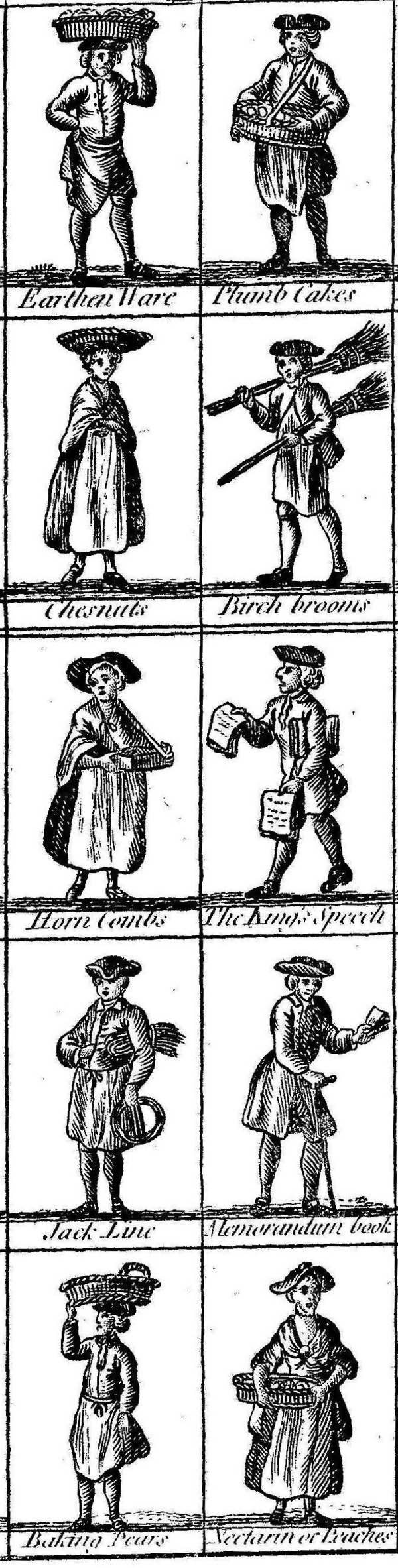
Matilda Moreton & The Cries Of London
When I met ceramicist Matilda Moreton, I knew that she was one after my own heart in her love for THE CRIES OF LONDON. So I am delighted that Matilda will be presenting her work at the BLOOMSBURY JAMBOREE this weekend, 11th & 12th December at Art Workers Guild, 6 Queens Sq, WC1N 3AT.
We still need volunteers over the weekend – if you can help please email spitalfieldslife@gmail.com

Cries of London mugs by Matilda Moreton
‘I have a passion for Bowles & Carver’s eighteenth century street cries and they are my favourite of all those I discovered while researching my ceramics degree project at Central St Martin’s nearly twenty years ago. The richness of London’s history always inspired me through the challenges of living as a country mouse in town. The Thames is an extraordinary archaeological resource and I became a mudlark in more ways than one, both getting my hands dirty along the foreshore and gardening in London clay.
I make quite different work now I live in Somerset, where I set up a studio in an old log shed with clay roof tiles. It has companionable scurrying in the rafters, cows out at the back and chickens coming in to clear up the spiders. Here I have returned to the whirling mud pit that is throwing on the wheel, but sometimes I use my old potshards from the Thames, impressing textures from long-gone Bellarmine jugs and the like.
The Bloomsbury Jamboree is the ideal opportunity for me to revisit my work inspired by the history of London, add in my mud-larking, introduce my new work from Somerset and tie things together.’
Matilda Moreton


Click here to buy a copy for £20


