
Luke Clennell’s London Melodies

I saw a raggedy man with crazy eyes disappear down Catherine Wheel Alley, so I followed to see what he was up to. When I entered the putrid alley, he disappeared around the corner, yet I heard him cry, “Rabbit, Rabbit. Nice Fat Rabbit!” So I hurried to catch up, and found myself lost in the maze of passages and back streets that fill the space between Bishopsgate and Middlesex St. Arriving at a cross-ways where several paths met, I could not see him anywhere. Uncertain which way to turn, I spotted a large woman swathed in layers of old clothes and wielding a heavy basket, trudging off down another alley with evident fatigue. Once she turned the corner, I followed her at a discreet distance and I could hear her shrill cry, “Lilies of the Valley, Sweet Lilies of the Valley,” echoing between the high walls. But again, when I turned the corner, she had vanished. Then, I heard another behind me, crying, “Hot Mutton Dumplings – Nice Dumplings, All Hot!” and so I retraced my steps.
Let me explain, I had just spent the morning in the Bishopsgate Institute poring over a small book of prints entitled, “London Melodies; or Cries of the Seasons.” Published anonymously and bound in non-descript brown boards, and printed on cheap paper with several torn pages – even so, the appreciative owner had inscribed it with his name and the date 1823 in a careful italic script.
This book entranced me with the vivid quality of its beautiful wood engravings of street hawkers. Commonly in the popular prints illustrating Cries of London, the peddlers are sentimentalised, portrayed with cheerful faces and rosy cheeks, ever jaunty as they ply their honest trades.
These lively wood engravings could not be more different. These people look filthy, with bad skin and teeth, dressed in ragged clothes, either skinny as cadavers or fat as thieves, and with hands as scrawny as rats’ claws. You can almost smell their bad breath and sweaty unwashed bodies, pushing themselves up against you in the crowd to make a hard sell. These Cries of London are never going to be illustrated on a tea caddy or tin of Yardley Talcum Powder and they do not give a toss. They are a rough bunch with ready fists, that you would not wish to encounter in a narrow byway on a dark night, yet they are survivors who know the lore of the streets and how to turn a shilling as easily as a groat. With unrivalled spirit, savage humour, profane vocabulary and a rapacious appetite, they are the most human of all the Cries of London I have come across. And they call to me across the centuries, crying, “Sweet and Pretty Beau-Pots – One a-Penny” and “Buy my Live Scate.”
Luke Clennell, Thomas Bewick’s most talented apprentice, is believed to be responsible for these superlative wood engravings, which capture the vigorous life of these loud characters with such art. From a contemporary perspective these portraits that sit naturally alongside the work of Ronald Searle, Ralph Steadman, Ian Pollock, Quentin Blake and Martin Honeysett. Clennell artist glories in the grotesque features and unrestrained personalities of street people, while also permitting them a humanity which we can recognise and respect. How I wish I could catch up with them all and record their stories for you.

Rabbit, Rabbit – Nice fat Rabbit

All Round & Sound, Full Weight, Threepence a Pound, my Ripe Kentish Cherries.

Buy my Fresh Herrings, Fresh Herrings, O! Three a Groat, Herrings, O!

Buy a Nice Wax Doll – Rosy and Fresh.

The King’s Speech, The King’s Speech to both Houses of Parliament.

Here’s all a Blowing, Alive and Growing – Choice Shrubs and Plants, Alive and Growing.

Hot Spice Gingerbread, Hot – Come buy my Spice Gingerbread, Smoaking Hot – Hot Spice Gingerbread, All Hot.

Any Earthen Ware, Plates, Dishes, or Jugs, today – any Clothes to Exchange, Madam?

Hot Mutton Dumplings – Nice Dumplings, All Hot.

Buy a Hat Box, Cap Box, or Bonnet Box.

Buy my Baskets, a Work, Fruit, or a Bread Basket.

Chickens, a Nice Fat Chicken – Chicken, or a Young Fowl.

Sweet and Pretty Beau-Pots, One a-Penny – Chickweed and Groundsel for your Birds.

Buy my Wooden Ware – a Bowl, Dish, Spoon or Platter.

Six Bunches a-Penny, Sweet Lavender – Six Bunches a-Penny, Sweet Blooming Lavender.

Here’s One a-Penny – Here’s Two a-Penny, Hot Cross Buns.

Lilies of the Valley, Sweet Lilies of the Valley.

Cats Meat, Dogs Meat – Any Cat’s or Dog’s Meat Today?

Buy my Live Scate, Live Scate – Buy my Dainty Fresh Salmon.

Mackerel, O! Four for shilling, Mackerel, O!

Hastings Green and Young Hastings. Here’s Young Peas, Tenpence a Peck, Marrow-fat Peas.
Images courtesy © Bishopsgate Institute
You may like to take a look at
H.W.Petherick’s London Characters
John Thomson’s Street Life in London
Aunt Busy Bee’s New London Cries
Marcellus Laroon’s Cries of London
More John Player’s Cries of London
William Nicholson’s London Types
Francis Wheatley’s Cries of London
John Thomas Smith’s Vagabondiana of 1817
Thomas Rowlandson’s Lower Orders
The Principal Operations of Weaving, 1748
Read my feature about Dennis Severs’ House with twelve pages of photographs by Antony Crolla in the March issue of World Of Interiors out now.
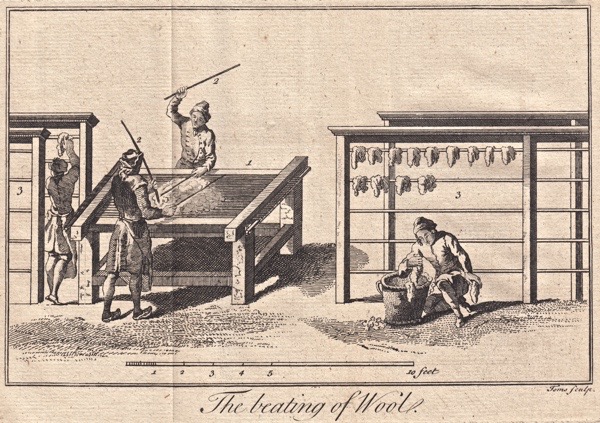
These copperplate engravings published below illustrate The Principal Operations of Weaving reproduced from a book of 1748 in the collection at Dennis Severs’ House. As you will discover, there was far more to weaving than sitting at a loom and many of these activities would have been a familiar sight in Spitalfields three centuries ago.


Ribbon Weaving




Dennis Severs House, 18 Folgate House, Spitalfields, E1
Click here to book for DENNIS SEVERS’ TOUR devised by The Gentlle Author
You make also like to read about
Dennis Anthony’s Petticoat Lane

If you are looking to spruce up your linen cupboard with some fresh bolster cases or if it is time to replace those tired tea towels and soiled doilies, then these two lovely gentlemen are here to help. They have some super feather eiderdowns and quality blanket sets to keep you snug and cosy on frosty nights, and it is all going for a song.
One Summer Sunday in the nineteen fifties, Dennis Anthony took his camera down Petticoat Lane to capture the heroes of the epic drama of market life – all wearing their Sunday best, properly turned out, and even a little swanky. There is plenty of flash tailoring and some gorgeous florals to be admired in his elegant photographs, composed with dramatic play of light and shade, in compositions which appear simultaneously spontaneous and immaculately composed. Each of these pictures captures a dramatic moment – selling or buying or deliberating – yet they also reward second and third glances to scrutinise the bystanders and all the wonderful detail of knick-knacks gone long ago.
When the West End shops shut on Sundays, Petticoat Lane was the only place to go shopping and hordes of Londoners headed East, pouring through Middlesex St and the surrounding streets that comprised its seven “tributaries,” hungry for bargains and mad for novelty. How do I know this? Because it was the highlight of my parents’ honeymoon, when they visited around the same time as Dennis Henry, and I grew up hearing tales of the mythic Petticoat Lane market.
I wish I could buy a pair of those hob-nailed boots and that beret hung up beside the two sisters in shorts, looking askance. But more even than these, I want the shirt with images of records and Lonnie Donegan and his skiffle group, hung up on Jack’s stall in the final photograph. Satisfied with my purchases, I should go round to Necchi’s Cafe on the corner of Exchange Buildings and join those distinguished gentlemen for refreshment. Maybe, if I sat there long enough, I might even glimpse my young parents come past, newly wed and excited to be in London for the first time?
I am grateful to the enigmatic Dennis Anthony for taking me to Petticoat Lane in its heyday. I should like to congratulate him on his superlative photography, only I do not know who he is. Stefan Dickers, the archivist at the Bishopsgate Institute, bought the prints you see here on ebay and although they are labelled Dennis Anthony upon the reverse, we can find nothing more about the mysterious photographer. So if anyone can help us with information or if anyone knows where there are further pictures by Dennis Anthony – Stefan & I would be delighted to learn more.


You might also like to see
Laurie Allen of Petticoat Lane
The Wax Sellers of Wentworth St
Lewis Lupton In Spitalfields
In the spring of 1968, artist Lewis Frederick Lupton came to Spitalfields and submitted this illustrated report on his visit to the Christ Church Spitalfields Crypt Newsletter.

Interior of Christ Church, Spitalfields, 1968 – without galleries or floor
On Ash Wednesday 1968, I set off at eleven for Spitalfields to see the Rev. Dennis Downham about his work among alcoholic vagrants. Walking up the road from the Underground Station, I saw a man very poorly dressed, his face a pearly white, obviously ill. Then came a tramp, as lean, dirty, unkempt, bearded and ragged as any I have seen. This was a district where there was real poverty.

The Rectory was a substantial Georgian house such as one sees in many a country village. The study overlooked a small garden and the east end of the church, where plane trees grew among old tombstones.

After lunch, we went out to see something of the parish. The first person we encountered was a fine-looking young American in search of his ancestors, who asked for the parish registers. After directing him to County Hall, we crossed over into a narrow street between tall old brick houses with carved and moulded eighteenth century doorways. Out of one of these popped a little Jewish man with a white beard, black hat and coat.

Round the corner in Hanbury St, the Rector unlocked (“You have to be careful about locks here”) the door of a building in which the church now worships ( “Christ Church itself needs a lot spending in restoration before it can be used again”). The building now employed once belonged to a Huguenot church, of which there were seven in the parish, and still has the coat of arms granted by Elizabeth I carved above the communion table.

Thousands of French Protestants found a refuge from persecution in this parish. The large attic windows belonging to the rooms where they kept their looms may still be seen in many streets and the street names bear record of the exiles – Fournier St, Calvin St etc

Crossing Commercial St, we came across a charming seventeenth century shop in a good state of preservation. Its fresh paint made it stand out like a jewel from the surrounding drabness.

A stone’s throw further on, photographs pasted in a window advertised the attractions of one of the many night clubs in the area.

Opposite a kosher chicken shop, one of a the staff – a Jewish man with a beard, black hat and white coat was throwing pieces of bread to the pigeons.

Round the corner, we plunged into an offshoot of the famous Petticoat Lane which forms the western boundary of Spitalfields.

Turning eastwards, we tramped along the broken pavements of a narrow lane running through the heart of the district. It seemed to contain the undiluted essence of the parish in its fullest flavour, a mixture of food shops, warehouses, prison-like blocks of flats, derelict houses and bomb-sites. “There are twenty-five thousand people living in my parish. It is the only borough in central London which has residential life of its own,” revealed the Rector.
 Christ Church stands out like a temple of light in the surrounding squalor. Designed by Nicholas Hawksmoor, its scale is much larger than life and the newly-gilded weathervane is as high as the Monument. “I climbed up the ladders to the top last year when steeplejacks were at work upon it,” commented the Rector.

Were it not for the brave work which has been begun in the cellars, the building would only be a proud symbol of the Faith, no more.

Down the steps, to the left of the porch, there is a reception area with an office and a clothes store.

One sleeping fellow had a tough expression. “False nose,” said the Rector, “he had his real one bitten off in a fight.” The central area is devoted to the work for which the crypt was opened. Except for a billiard table, it is like a hospital ward, mainly taken up with beds on which the patients rest and sleep.
Yet, a crypt is crypt and the lack of daylight is a handicap but, with air-conditioning throughout, spotless cleanliness and a colour scheme of cream and turqoise blue, the cellars of Christ Church have been turned into a refuge which offers help and hope to those of the homeless alcoholics who have a desire to be rescued from their predicament. – L.F.L.
You may also like to read about
Cockney Cats

These are Cockney Cats by Warren Tute, with photographs by Felix Fonteyn from 1953, in the archive at Bishopsgate Institute

Micky is the centre of the Day family of Copley St in the parish of Stepney. The whole family pamper him and have a wonderful time

Bill on weekdays, William on Sundays, the cat at the Bricklayers Arms in Commercial Rd has a wonderful life since the Guv’nor Jim Meade was once a Dumb Animals’ Food Purveyor. At seventy-seven Jim looks back on a long and distinguished life in Stepney during his thirty-two years as Guv’nor.

Yeoman Warder Clark & Pickles on Tower Green

On duty at the Tower of London

The tail-less cat of the guardroom who came out to watch Pickles being photographed

Min, Port of London Authority cat has many friends among the dockers and very good ratting at night

Min of the magnificent whiskers has made her home in the office of K Warehouse in the Milwall Docks

Customs & Excise cat guards the Queen’s Warehouse and is paid a Treasury Allowance of sixpence a day

Mitzi has the run of her ship from the lifeboats to the Officers’ Mess

Old Bill the railway cat, his favourite position is the entrance to Blackfriars Station

Old Bill takes cover when necessary in the rush hour

Tibs the Great (1950-64), the official Post Office cat at Headquarters, does not normally live in this 1856 pillarbox

This cat’s curiosity unearthed a box of ancient stamps and seals, some dating back to Queen Anne

Minnie the Stock Exchange cat was a self-willed and determined kitten who adopted the dealing floor as her own preserve

Minnie enjoys the banter in the tea room

Tiger of The Times is the best office cat in Fleet St

Tiger of The Times is equally at ease whether in the Board Room …

… or doing his rounds in the Print Room

Sneaking back into Lloyds of London is difficult even for the resident cat

Cecil is the Front of House cat at the Theatre Royal Drury Lane

Cecil is very elusive in his many hiding places from which he has to be coaxed by the Royal Waiter before the performance can begin

When thirteen people sit down to dine at the Savoy and the thirteenth guest is Jimmy Edwards, almost anything can happen. The famous black cat is invited to occupy the fourteenth place so that everyone can enjoy the sparkling conversation.

Bill at the Tower of London (1935-47)
Images courtesy Bishopsgate Institute
You may also like to take a look at
Schroedinger, Shoreditch Church Cat
Doorkins Magnificat, Southwark Cathedral Cat
The Cats of Spitalfields (Part One)
At God’s Convenience

“Slovenliness is no part of Religion. Cleanliness is indeed close to Godliness” – John Wesley, 1791
Oftentimes, walking between Spitalfields and Covent Garden, I pass through Bunhill Fields where – in passing – I can pay my respects to William Blake, Daniel Defoe and John Bunyan who are buried there, and sometimes I also stop off at John Wesley’s Chapel’s in the City Rd to pay a visit to the underground shrine of Thomas Crapper – the champion of the flushing toilet and inventor of the ballcock.
It seems wholly appropriate that here, at the mother church of the Methodist movement, is preserved one of London’s finest historic toilets, still in a perfect working order today. Although installed in 1899, over a century after John Wesley’s death, I like to think that if he returned today Wesley would be proud to see such immaculate facilities provided to worshippers at his chapel – thereby catering to their mortal as well as their spiritual needs. The irony is that even those, such as myself, who come here primarily to fulfil a physical function cannot fail to be touched by the stillness of this peaceful refuge from the clamour of the City Rd.
There is a sepulchral light that glimmers as you descend beneath the chapel to enter the gleaming sanctum where, on the right hand side of the aisle, eight cedar cubicles present themselves, facing eight urinals to the left, with eight marble washbasins behind a screen at the far end. A harmonious arrangement that reminds us of the Christian symbolism of the number eight as the number of redemption – represented by baptism – which is why baptismal fonts are octagonal. Appropriately, eight was also the number of humans rescued from the deluge upon Noah’s Ark.
Never have I seen a more beautifully kept toilet than this, every wooden surface has been waxed, the marble and mosaics shine, and each cubicle has a generous supply of rolls of soft white paper. It is both a flawless illustration of the rigours of the Methodist temperament and an image of what a toilet might be like in heaven. The devout atmosphere of George Dance’s chapel built for John Wesley in 1778, and improved in 1891 for the centenary of Wesley’s death – when the original pillars made of ships’ masts were replaced with marble from each country in the world where Methodists preached the gospel – pervades, encouraging solemn thoughts, even down here in the toilet. And the extravagant display of exotic marble, some of it bearing an uncanny resemblance to dog meat, complements the marble pillars in the chapel above.
Sitting in a cubicle, you may contemplate your mortality and, when the moment comes, a text on the ceramic pull invites you to “Pull & Let Go.” It is a parable in itself – you put your trust in the Lord and your sins are flushed away in a tumultuous rush of water that recalls Moses parting the Red Sea. Then you may wash your hands in the marble basin and ascend to the chapel to join the congregation of the worthy.
Yet before you leave and enter Methodist paradise, a moment of silent remembrance for the genius of Thomas Crapper is appropriate. Contrary to schoolboy myth, he did not give his name to the colloquial term for bowel movements, which, as any etymologist will tell you, is at least of Anglo-Saxon origin. Should you lift the toilet seat, you will discover “The Venerable” is revealed upon the rim, as the particular model of the chinaware, and it is an epithet that we may also apply to Thomas Crapper. Although born to humble origins in 1836 as the son of a sailor, Crapper rose to greatness as the evangelist of the flushing toilet, earning the first royal warrant for sanitary-ware from Prince Edward in the eighteen eighties and creating a business empire that lasted until 1963.
Should your attention be entirely absorbed by this matchless parade of eight Crapper’s Valveless Waste Preventers, do not neglect to admire the sparkling procession of urinals opposite by George Jennings (1810-1882) – celebrated as the inventor of the public toilet. 827,280 visitors paid a penny for the novelty of using his Monkey Closets in the retiring rooms at the Great Exhibition of 1851, giving rise to the popular euphemism, “spend a penny,” still in use today in overly polite circles.
Once composure and physical comfort are restored, you may wish to visit the chapel to say a prayer of thanks or, as I like to do, visit John Wesley’s house seeking inspiration in the life of the great preacher. Wesley preached a doctrine of love to those who might not enter a church, and campaigned for prison reform and the abolition of slavery, giving more than forty thousand sermons in his lifetime, often several a day and many in the open air – travelling between them on horseback. In his modest house, where he once ate at the same table as his servants, you can see the tiny travelling lamp that he carried with him to avoid falling off his horse (as he did frequently), his nightcap, his shoes, his spectacles, his robe believed to have been made out of a pair of old curtains, the teapot that Josiah Wedgwood designed for him, and the exercising chair that replicated the motion of horse-riding, enabling Wesley to keep his thigh muscles taut when not on the road.
A visit to the memorial garden at the rear of the chapel to examine Wesley’s tomb will reveal that familiar term from the toilet bowl “The Venerable” graven in stone in 1791 to describe John Wesley himself, which prompts the question whether this was where Thomas Crapper got the idea for the name of his contraption, honouring John Wesley in sanitary-ware.
Let us thank the Lord if we are ever caught short on the City Rd because, due to the good works of the venerable Thomas Crapper and the venerable John Wesley, relief and consolation for both body and soul are readily to hand at God’s convenience.


Nineteenth century fixtures by Thomas Crapper, still in perfect working order.


“The Venerable”

Put your trust in the Lord.

Cubicles for private worship.

Stalls for individual prayer.

In memoriam, George Jennings, inventor of the public toilet.


Upon John Wesley’s Tomb.

John Wesley’s Chapel

John Wesley’s exercise chair to simulate the motion of horseriding,

John Wesley excused himself unexpectedly from the table …

New wallpaper in John Wesley’s parlour from an eighteenth century design at Kew Palace.

The view from John Wesley’s window across to Bunhill Fields where, when there were no leaves upon the trees, he could see the white tombstone marking his mother’s grave.
You may also like to take a look at
At William Gee, Haberdashers

Speaking as a lifelong connoisseur of quality haberdashery, let me say that if you are in need of a button or a reel of thread, there is no finer place to go than William Gee Ltd at 520 Kingsland Rd. For the haberdashery lover, even the windows at William Gee set the pulse racing with their ingenious displays of words contrived from zips – yet it was my privilege recently to explore behind the scenes at this glamorous theatre of smallwares, trimmings, threads, buttons and zippers, visiting the mysterious warren of storerooms at the rear of the shop, where I met the self-respecting guardians of this beloved Dalston institution that styles itself as “trimmings for all trades.”
My guide was Jeffrey Graham, maestro of the proud company boasting London’s largest selection of zip fasteners. He led me up an old brown lino-covered staircase between walls panelled in wood-effect formica to the locked, dusty upper room lined with happy photos of works’ outings and jamborees of long ago. Here Jeffrey brought the title deed to the property dating from the sixteenth century when this was Henry VIII’s land – Henry was the king that the Kingsland Rd refers to – and he had stables here for hunting when there was still forest, recalled today only in the name of Forest Rd. Then, once we had established this greater chronological perspective, Jeffrey brought out the tiny sepia photograph of William Goldstein that illustrates where the haberdashery business began.
“William Goldstein started in 1906 with two pounds in the kitty selling buttons and trimmings, and he changed the company name to William Gee. This was across the road where Albert’s Cafe is now, but after several years he needed larger premises and moved into the current building. He had two sons, Alfred & Sidney, and I knew both of them. Alfred died in 1970 and Sidney worked until he was eighty-five, and died four or five years ago. They grew the business and made it one of the largest of its type in the country, at a time when there was a large textile industry in the East End – which was full of clothing factories until a few years ago.
In the middle of the last century, there were more than eighty people working here. I remember coming in as a child and there were twelve ladies who all had their own button-making machines for covering buttons and they’d all be sitting there jabbering away making buttons, and some had machines at home and even carried on making them there too. When I was twelve or fourteen, I did a holiday job helping out and going out on deliveries with the drivers, so I saw a lot of the places we delivered to. My impression was that everything was bustling, everyone was busy, no-one had any patience and everyone knew everyone.
My father, David Graham, had a similar business at 77 Commercial St. He served all the factories in the little streets around Spitalfields and my grandfather had a haberdashery shop before him, on Brick Lane, M.Courts – it was still there in name until very recently. In the early sixties, the two businesses merged and my father became managing director of William Gee and we were supplying manufacturing companies that made uniforms and corporatewear, brideswear companies, hospitals, sportswear companies, hatters in Luton, – anyone really.We were doing a wholesale business in bulk that was very competitive.
The heyday was in the sixties through into the eighties, before manufacturers began to have their clothes made by cheaper labour in Eastern Europe, North Africa, or the Far East where much of the clothing is made today. It closed many factories and suppliers, they could not compete. It was no accident that people talk about “sweatshops,” because there wasn’t legislation to control how they should be organised then, but after legislation was enforced employers could not compete with overseas competitors.
It became a thing that you were delivering to shippers rather than factories, and then the types of customers became smaller and more varied – from engineers and printers, to film and theatre companies like the Royal Shakespeare Company and the Royal Opera, and lots of designers including, Gareth Pugh, Alexander McQueen Matthew Williamson, Vivienne Westwood, Caroline Charles and Old Town. What has come instead is a cottage industry, where individual designers are setting up and making a business out of it, and one of the largest sources of sales in recent years have been the colleges for fashion, textiles and art departments. But there are so many of them now that I wonder what will all the students do afterwards?”
Leaving this question to resolve itself we set out to visit the departments. First the button department which fills the shop next door, where buttonmaker, Janet Vanderpeer, presides over neat shelves stacked with rare ancient buttons from companies that closed years ago. Here I found her secreted behind a curtain in a cosy den, placidly making fabric-covered buttons at a press. Did she like it? A nod to the affirmative. How long had she been doing it? “A good while.” And without missing a beat she kept the buttons coming.
From here, we passed behind the shop to the three storey warehouse where the comprehensive supply of zip fasteners are kept and tended by their own designated keeper “You might think a zip is just zip,” said Jeffrey, rolling his eyes and gesturing to the lines of shelves. Then we stepped out into Forest Close whence the works’ coach parties departed in the nineteen fifties and crossed the road to the large warehouse where Janet’s brother David Vanderpeer, despatch manager, who joined the company thirty years ago at the age of sixteen, inhabits his own cosy den complete with microwave and ceramic leopard.
All fourteen staff at William Gee today have been there at least ten years and there is a sense of quiet mutual understanding which enables everything to run smoothly. Jeffrey told me a man will come in to say that his grandmother sent him here to buy buttons as a child and then ten minutes later another senior gentleman will come in to say the same thing. Yet in this appealingly utilitarian shop, that appears sublimely unaffected by any modern intervention, whoever comes through the door to stand between the two long counters is met with respect and patience. Even the old lady who did a high kick to place her ankle on the counter, when I was there, in order to display the kind of elastic she required was met with unblinking courtesy. And when Jeffrey Graham informed me authoratively, “The styles of clothing may have changed but the basic components are the same whatever the fashion.” I could hardly disagree.

William Goldstein’s haberdashery shop in 1906, that became William Gee.

A leaving party for Ivy Brandon in the seventies, with David Graham on the far right and Sidney Gee on the far left.

Sidney Gee & David Graham celebrate the seventy-fifth anniversary in 1981

The warehouse round the corner in Forest Rd.

Princess Diana in a coat with lining supplied by William Gee, 1986.


Jeffrey Graham, Managing Director of William Gee.

Janet Vanderpeer, Buttonmaker.

David Vanderpeer, Despatch Manager.


William Gee Ltd, 520-522 Kingsland Rd, E8 4AH
You may also like to read about


