
Anthony Cairns’ East End Pubs
CLICK HERE TO BOOK
When I discovered Antony Cairns‘ series of pub portraits, I realised I had found a kindred spirit. His soulful photographs manage to record the death and evoke the life of these lost hostelries simultaneously.
An East Ender who studied photography at the London College of Printing in the nineties, Antony printed these intriguing pictures using the Van Dyke Brown process which was commonly used at the end of the nineteenth century when these pubs were in their prime.
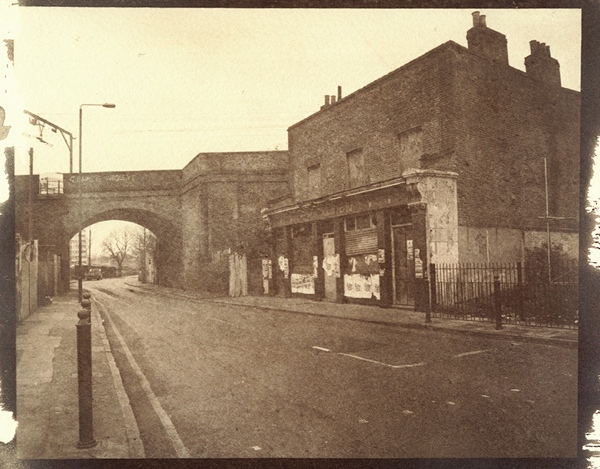
The Albion, Bow Common – (1881-2005)
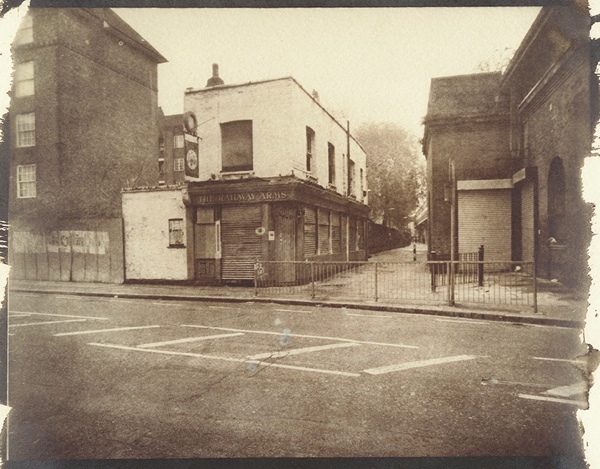
The Railway Arms, Sutton St – (1881-2001)
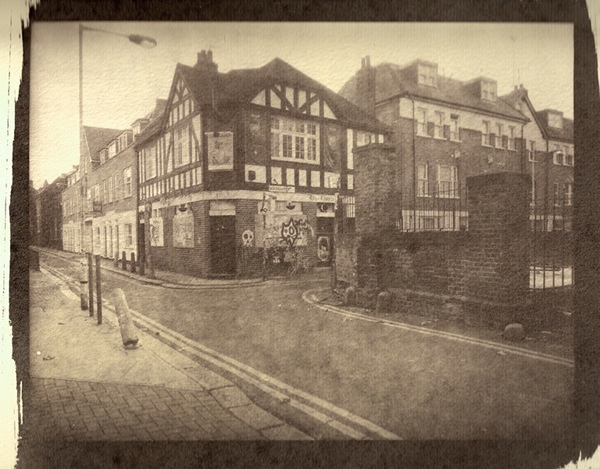
The Conqueror, Austin St/Boundary St – (1899-2001)
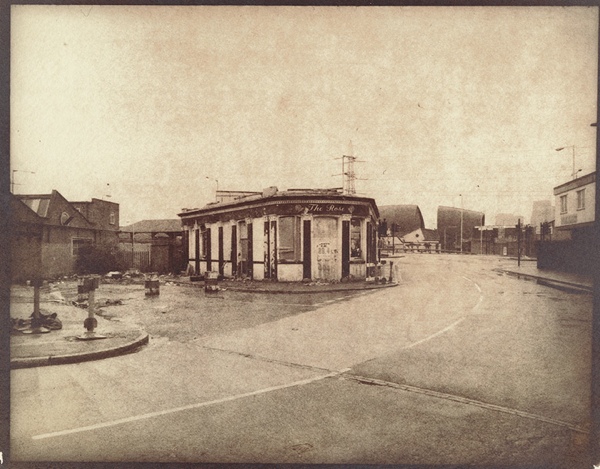
The Rose, Woolwich
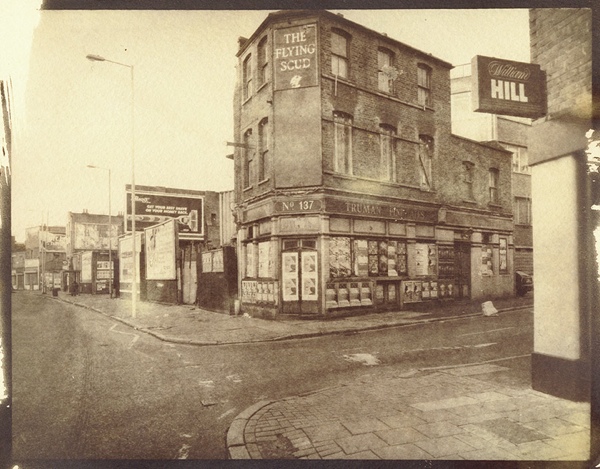
The Flying Scud, Hackney Rd – (1874-1994)
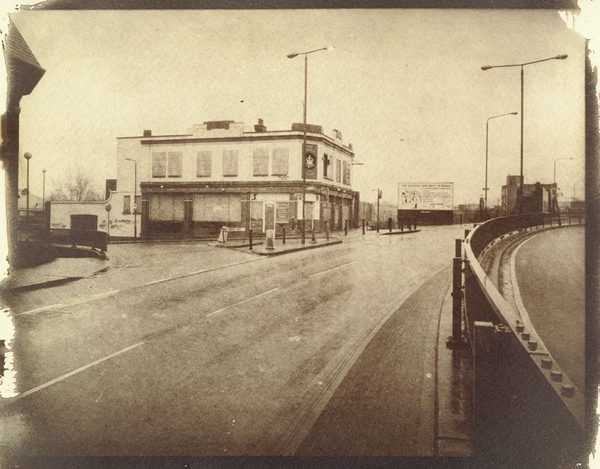
The Crown & Cushion, Market Hill, Woolwich – (1840-2008)
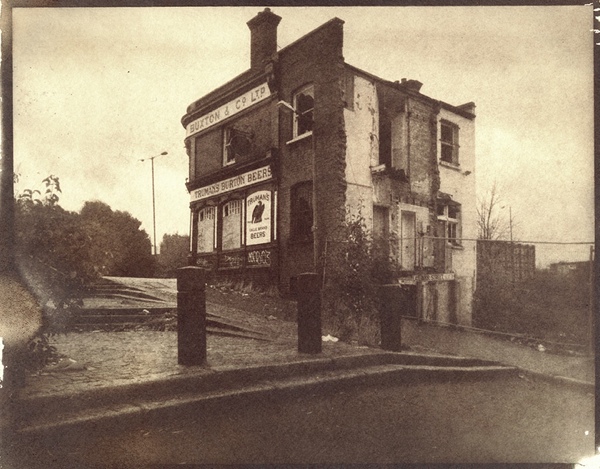
The Victoria, Woolwich Rd, Charlton – (1881-?)
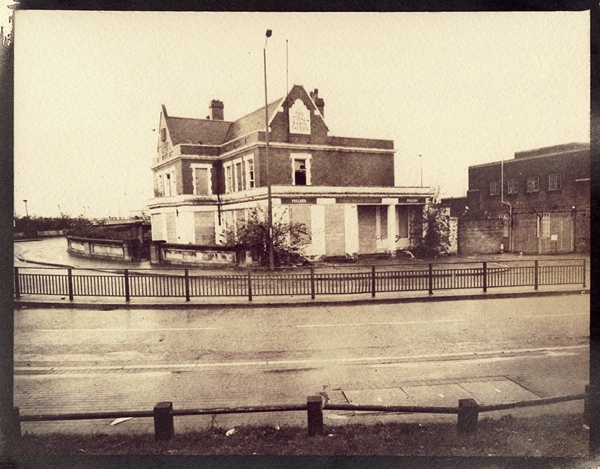
The Tidal Basin, Canning Town – (1862-1997)
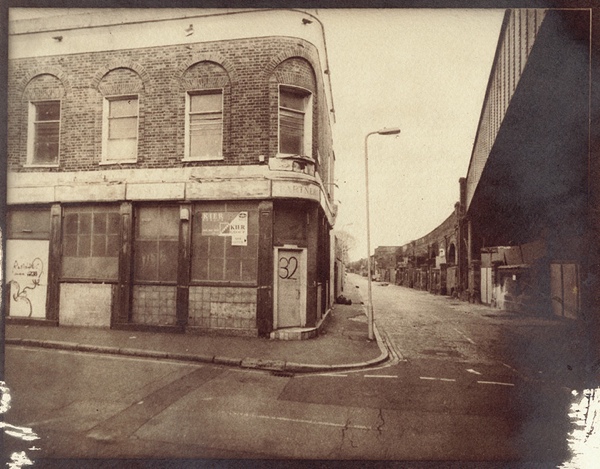
The Marquis of Lansdowne – (1838- 2000 & now to be restored)
Photographs copyright © Antony Cairns
You may also like to take a look at
Alex Pink’s East End Pubs, Then & Now
The Tercentenary Of Sir John Vanbrugh
This year is the tercentenary of the death of John Vanbrugh, the playwright-turned-architect who designed Castle Howard and Blenheim. Charles Saumarez Smith, former Director of the National Gallery and an East End resident, has written a biography John Vanbrugh: The Drama of Architecture. Below he writes about Vanbrugh Castle in Greenwich where Vanbrugh lived at the end of his life.
Charles will be talking about Vanbrugh at the Hanbury Hall in Spitalfields next Thursday 19th March. Click here for tickets
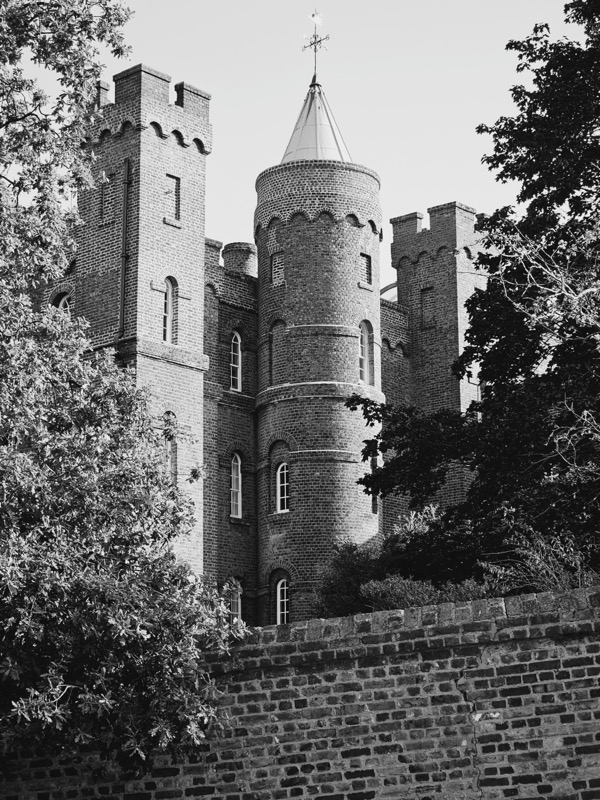
Vanbrugh Castle
If you walk up the hill in Greenwich Park from the Queen’s House or from Greenwich itself, you may spot the battlements of a small, fortified castle poking above the park wall and wonder what it is. Is it an eighteenth-century folly? Or the house of a nineteenth-century antiquarian?
Vanbrugh Castle, as the house is called, was built by John Vanbrugh as a rural retreat for himself, his new wife and their family in the early 1720s. He signed a lease for a small plot of land, immediately next door to the park, together with an adjacent twelve-acre field on 3rd March 1718, apparently planning to build a set of houses for himself and members of his close family — his two younger brothers, Charles and Philip, both officers in the Royal Navy, and two younger sisters, Victoria and Robina.
It was just at the moment that Richard Boyle, third Earl of Burlington, was promulgating the importance of designing in an orthodox Palladian style. Burlington travelled out to Italy in the summer of 1719 and returned with vast numbers of Palladio’s drawings which he bought from the owner of the Villa Maser. Vanbrugh was perfectly capable of designing in an orthodox Palladian style if required as he demonstrated in his design for the Temple of the Four Winds, one of his last works at Castle Howard. But for his own house, Vanbrugh decided to design in a pseudo-medieval style with a circular turret attached in front, with a very inconvenient, steep staircase, and two corner towers with battlements. What on earth made him do this?
When he was supervising the construction of Blenheim, Vanbrugh had become very attached to living in the ruins of the medieval Woodstock Manor which still survived in the grounds of Woodstock Park. Vanbrugh adapted them for his own use, introducing new windows and making small-scale repairs, including adding a bog-house. When the Duchess of Marlborough discovered that he had spent money on this, she was livid and ordered the ruins to be demolished. But Vanbrugh held his ground and, possibly unwisely, sent her a long paper in which he described how important these medieval ruins were, how full of historical associations, and that they were an important historical landmark in the view from the new palace.
At almost exactly the time that Vanbrugh was making plans for his new house, he also encouraged his friend, Charles Howard, third Earl of Carlisle, to build a whole line of medieval fortification on the edge of his estate at Castle Howard. These fortifications are in exactly the same style as Vanbrugh Castle, not intended to be authentically medieval, but in the medieval style, a kind of free-form medievalism in which the house is reduced to a bare geometry.
Vanbrugh not only designed a castle for himself but a number of other buildings nearly, including another large-ish house flanked by turrets for his younger brother, Charles, and a very curious single storey building like a castellated bungalow which was known as ‘The Nunnery’, lived in by his unmarried sisters, although in the early 1720s, it was another brother, Philip, who paid the rates. Maybe all three of them lived there together.
On either side of the Nunnery were two tower houses, known as the White Towers, four stories high in their central section, so, in contrast to the low-level The Nunnery. Imposing, although, as he described the houses in a letter to Lord Carlisle, there was only a single room and closet on each floor. He told Carlisle that he was designing these houses for his sons, although his younger son, John, known as Jack, was dead by 1723.
Plans and outline drawings for these houses survive in a large cache of drawings in the Victoria and Albert Museum, bought in 1992 with help from the National Lottery Heritage Fund. There are many other outline sketches for small houses in this collection. These are freehand, experimental doodles, in which Vanbrugh tries out different ground-floor room arrangements and how even a small house can be made to look interesting through the use of abstract geometry and with a limited amount of, again abstract, articulation, much in the style of Goose-Pie House which he had built for himself in Whitehall and which Jonathan Swift satirised as being like a mud-pie, copied from children playing in the street.
It seems that in the last few years of his life, when Vanbrugh was no longer involved with Blenheim (he had fallen out terminally with the Duchess of Marlborough in November 1716 and was never allowed back), he focused his attention, instead, on designing smaller houses for himself, his family and friends. It may have been an early form of property development.
An antiquary, William Stukeley, Secretary of the recently established Society of Antiquaries, visited Greenwich in June 1721, not long after Vanbrugh Castle had been built and drew it in exactly the same way that he drew medieval ruins, labelling it ‘Castellum Vanbrugiense apud Grenovicum’. The following August, he returned to draw his brother’s house which he called a ‘castellulum’, a baby castle. It is a very odd idea: an earnest antiquary drawing them as it they were authentic medieval buildings.
Another Scottish antiquary, Sir John Clerk of Penicuik, visited in 1727, the year after Vanbrugh’s death. He was equally surprised and wrote:
‘Vanbrugh was a famous architect but of an odd taste. These houses of his consist of great heaps of brick and thick walls but little accommodation within. There is scarcely a room in them above 8 or 10 foot square and some much less. The ornaments are such which the Goths and their successors used to place in Castles and Prisons, viz. battlements, round-towers, little windows and doors. And yet this was the man chosen to build Blenheim House for the Duke of Marlborough!’
Vanbrugh was a very independent-minded man. Was he, when he came to design a house for himself, nostalgic for his youth when he had served in the army? Or was it an elaborate stage-set built to impress his young wife ? He had been a playwright in his youth.
After being kicked out of the ruins of Woodstock Manor by the Duchess of Marlborough, he was no doubt enjoying the fact that he had been able to build a castle for himself, cocking a snook at the Duchess and enjoying the view from his own little castle over Greenwich. I like to imagine him at the gate with his spy-glass.
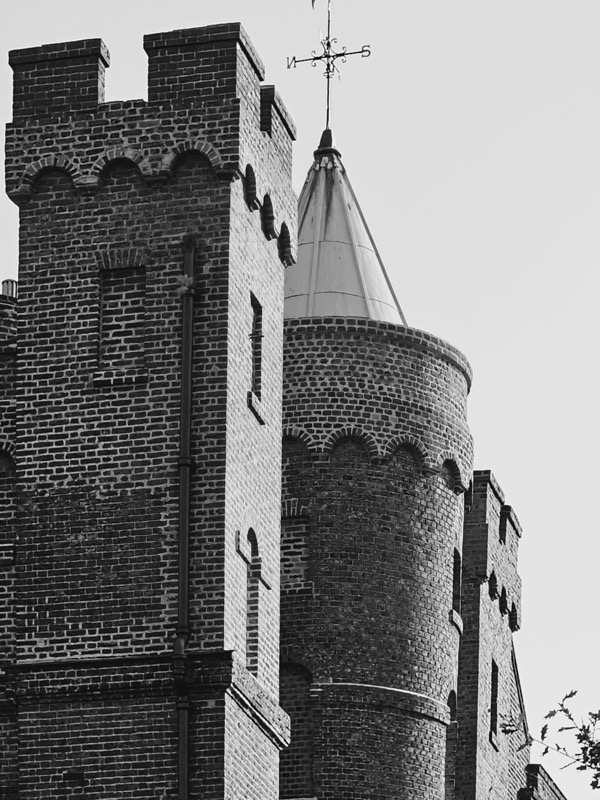
Photograph by Charles Saumarez Smith
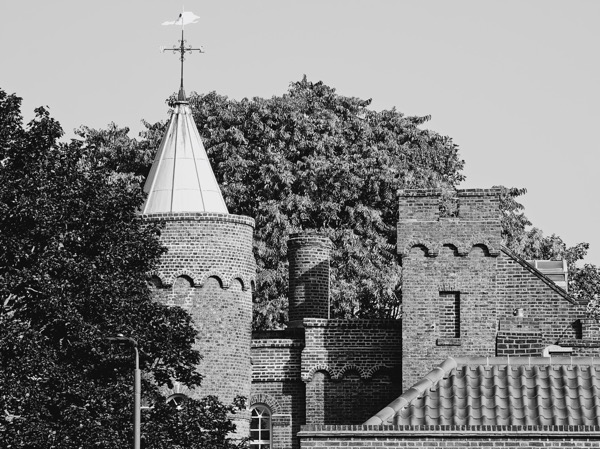
Photograph by Charles Saumarez Smith
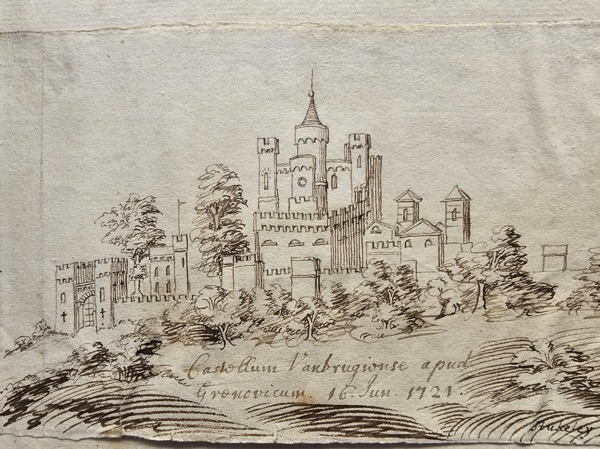
Vanbrugh Castle, drawing by William Stukeley 1721
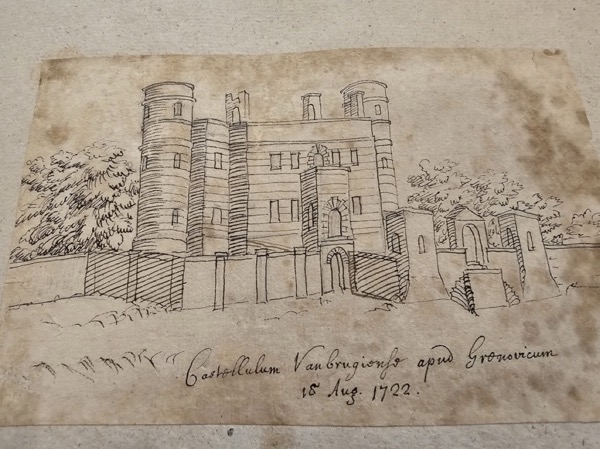
Vanbrugh Castle, drawing by William Stukeley 1722
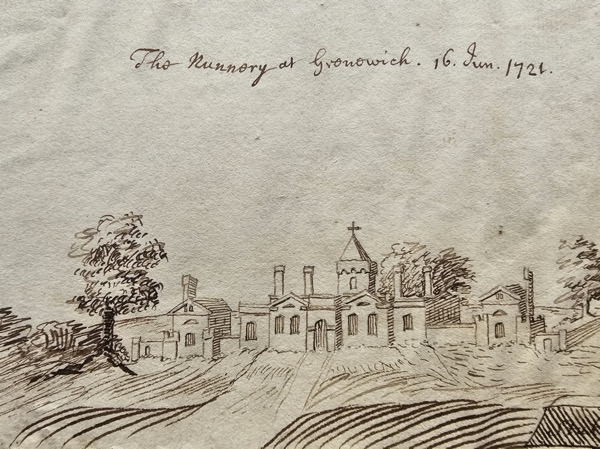
The Nunnery, drawing by William Stukeley 1721
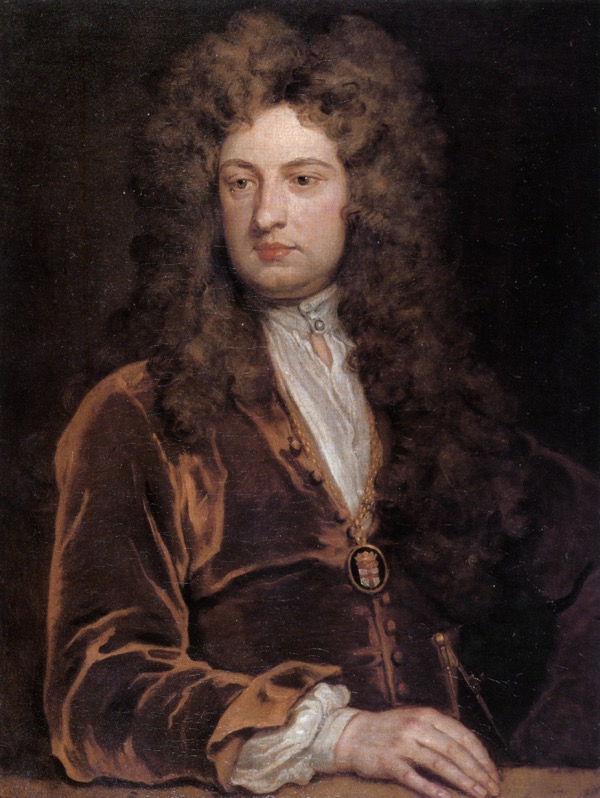
John Vanbrugh by Godfrey Kneller, c. 1704 and c. 1710 (courtesy of National Portrait Gallery)
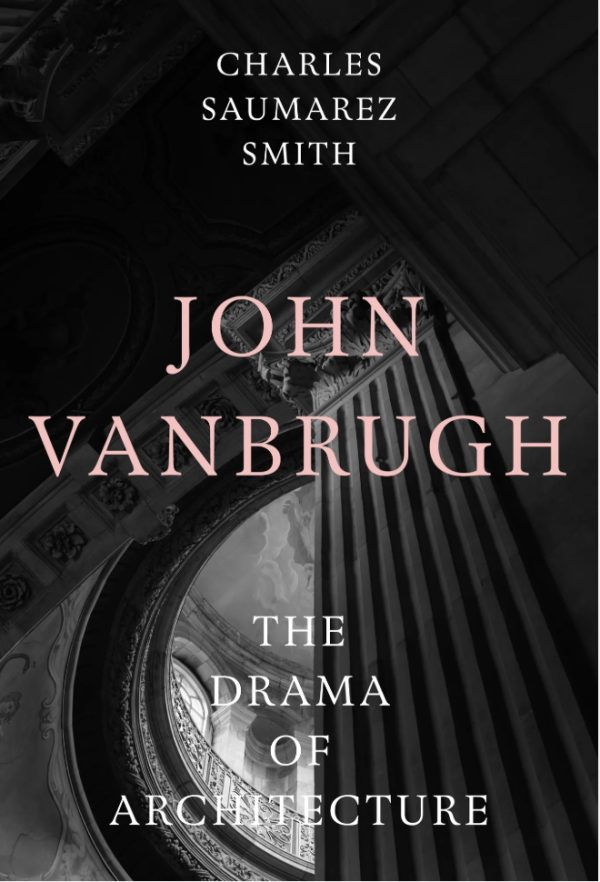
Charles Saumarez Smith’s John Vanbrugh: The Drama of Architecture is published by Lund Humphries. A free exhibition of Vanbrugh’s drawings has just opened at Sir John Soane’s Museum.
David Hoffman At St Botoloph’s
Remembering Reverend Malcom Johnson who died in February
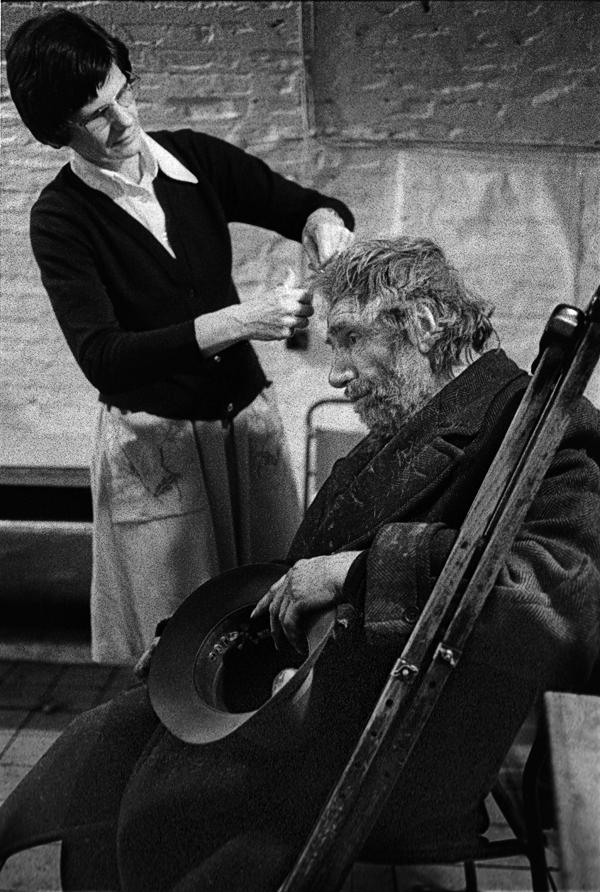
Bobbie Beecroft cuts Mr Sheridan’s hair, 1976
When photographer David Hoffman was squatting in Fieldgate Mansions in Whitechapel in the seventies, he was asked by Rev Malcolm Johnson to do fund-raising shots for the shelter in the crypt of St Botolph’s in Aldgate which offered refuge to all homeless people without distinction. Yet this commission turned into a photographic project that extended over many years and resulted in a distinguished body of work documenting the lives of the dispossessed in hundreds of intimate and unsentimental images.
Initially, David found the volatile conditions of the crypt challenging but, over months and years, he became accepted by those at the shelter who adopted him as their own photographer. Malcolm Johnson was the enlightened priest responsible for opening the crypt but, once he moved on, his brave endeavour was closed down. More than thirty years later, most of the people in David’s pictures are dead and forgotten, and his soulful photographs are now the only record of their existence and of the strange camaraderie they discovered in the crypt at St Botolph’s.
“St Botolph’s in Aldgate had a ‘wet shelter,’ an evening shelter for damaged or lost souls where alcohol and drugs were permitted. It was run by Rev Malcolm Johnson and Terry Drummond, who were very generous and accepting, and the purpose was a Christian one, based on the notion that you are accepted whoever you are. I’m not keen on organised religion, but here they were doing something that needed to be done.
I was asked if I could do some photographs to raise funds for the work and I remember arriving at the top of the steps outside the crypt and standing there for five minutes because I didn’t dare to go down. The noise was deafening and it really stank of piss and unwashed bodies. I was frightened I’d get attacked and my camera smashed but, equally, I thought it needed documenting, it was a part of life I’d never seen before. It was very noisy, very smelly, chaotic, and there was a lot of violence.
It was a place to get something to eat, get washed and get clean clothing. Not everybody was on drink or drugs but ninety per cent were. A lot were ex-servicemen who had travelled the world and would reminisce about bars in Cairo or Baghdad. It was amazing what they would talk about.
When I returned, I gave them eighth-size A4 prints so they could put them in their pockets. They gave me permission to take their pictures and, on each visit, I’d bring them prints from the previous evening. So I became their photographer.
Over six or seven years, I’d go every night for two or three months at a stretch. It was important to be regular while you were doing it. You needed to come frequently, so people relaxed and accepted you as part of the scene. I’d go every night for a couple of months. It was a place where nobody else goes, it was a humble part of life.”
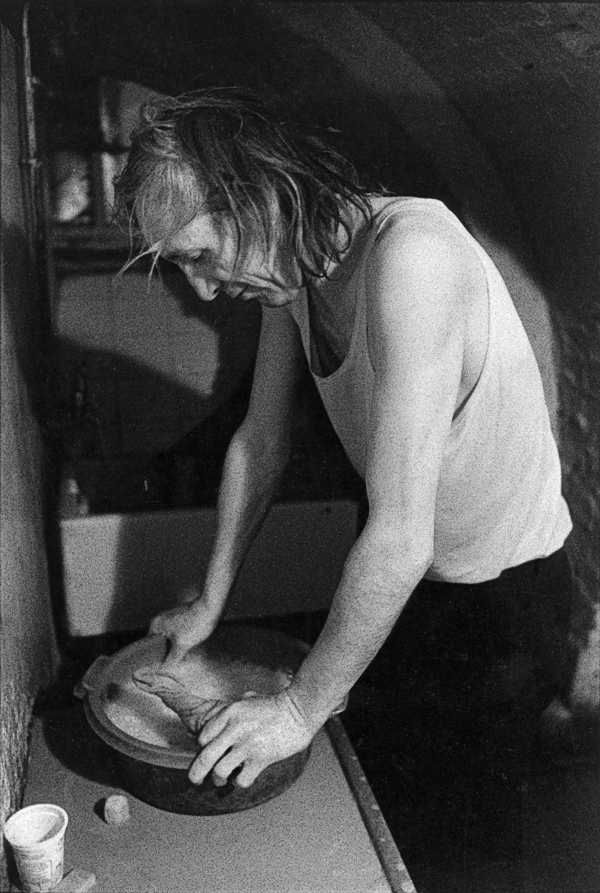
Washing a shirt at St Botolph’s, 1978
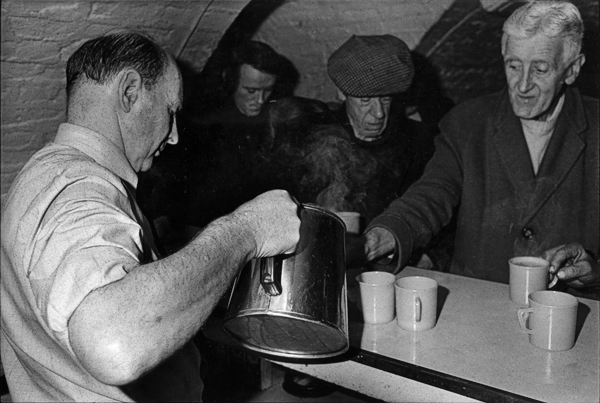
A volunteer serves tea and sandwiches
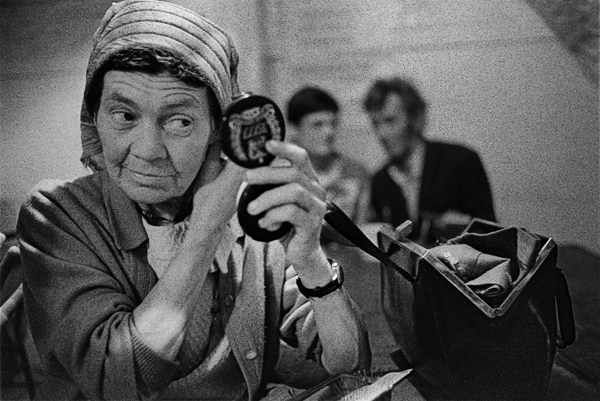
Azella, a regular at St Botolph’s, makes herself up before heading to the pub with a pal in 1977. Later that year, Azella was killed when a lorry drove over the cardboard box where she slept in Spitalfields Market.
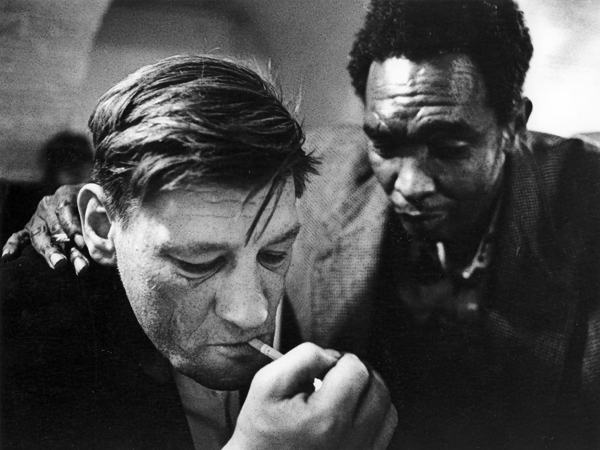
At St Botolph’s, 1978
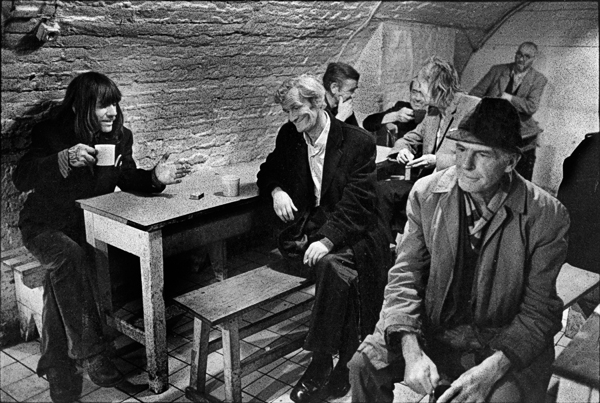
At St Botolph’s, 1976
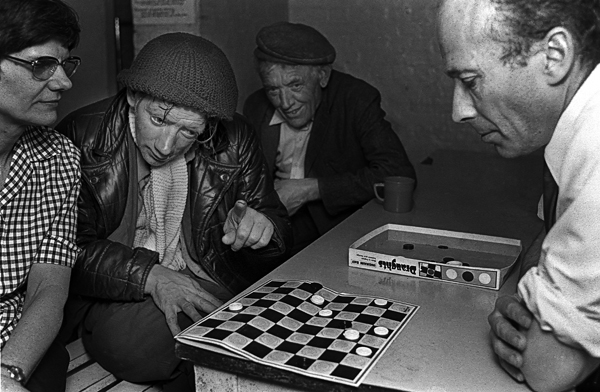
At St Botolph’s, 1978
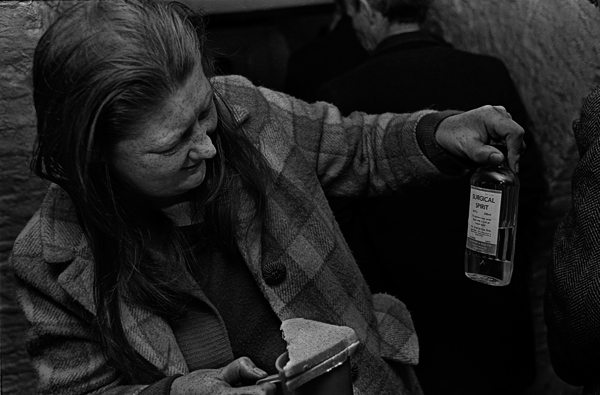
At St Botolph’s, 1978
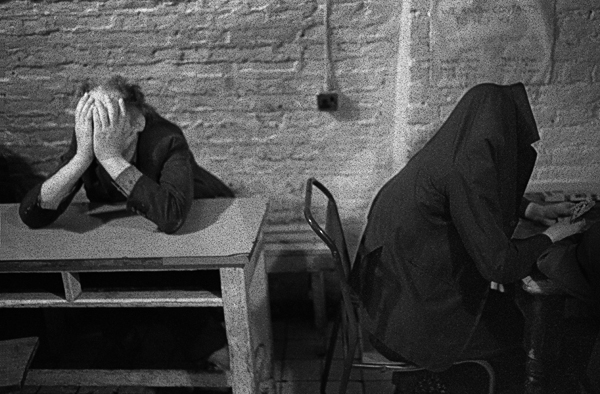
At St Botolph’s, 1978
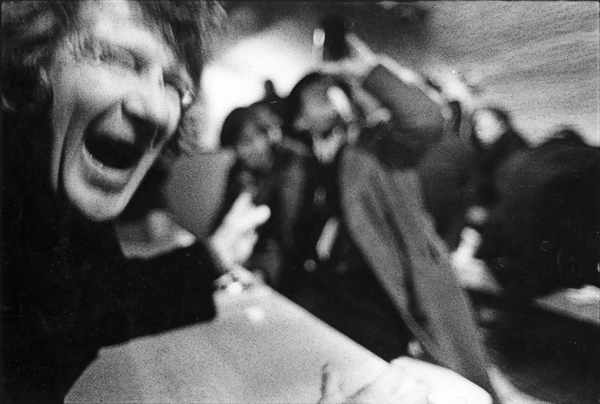
At St Botolph’s, 1978
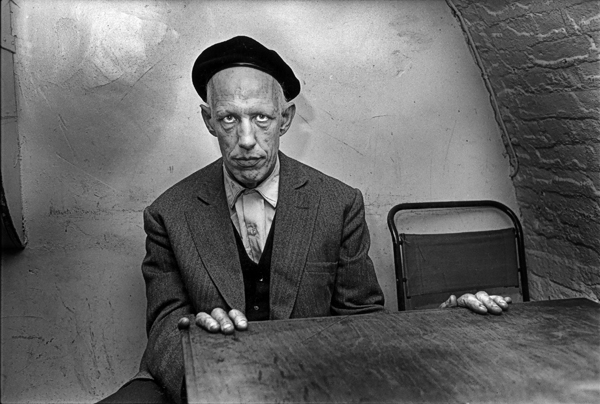
Leo, eighty-two years old and a non-drinker at St Botolph’s, 1976
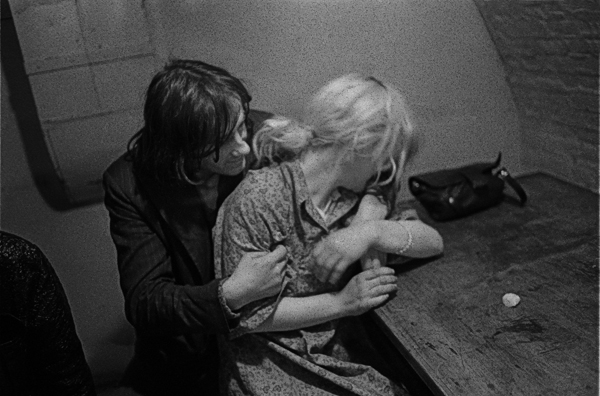
At St Botolph’s, 1978
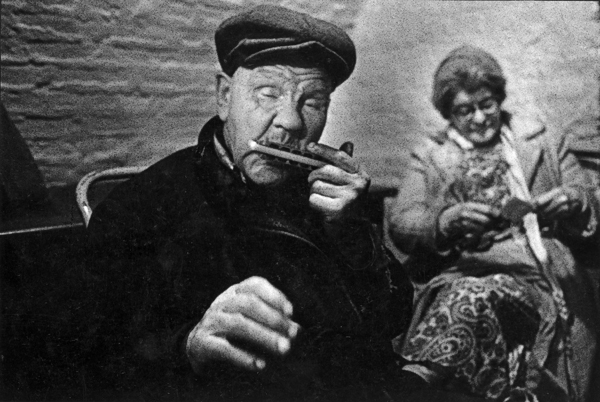
Percy & Jane, non-drinkers, at St Botolph’s, 1978
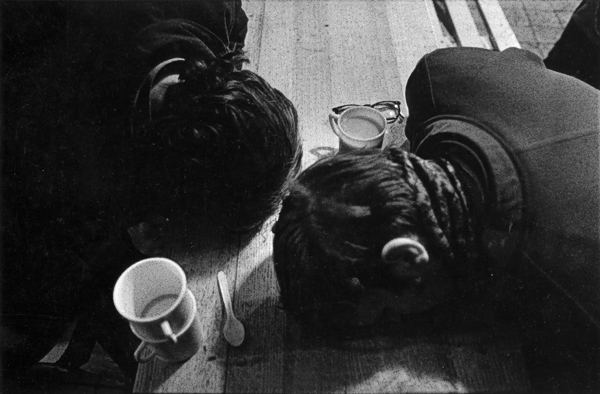
At St Botolph’s, 1978
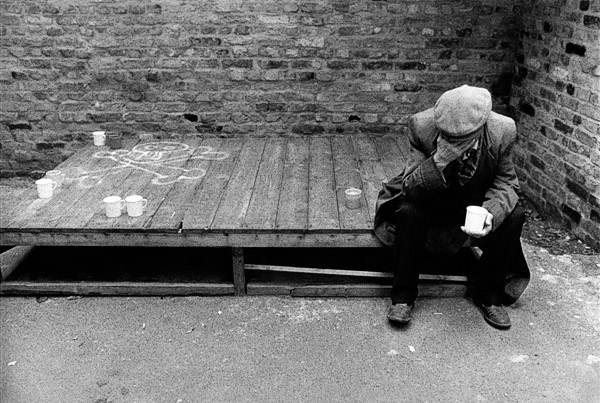
At St Botolph’s, 1977
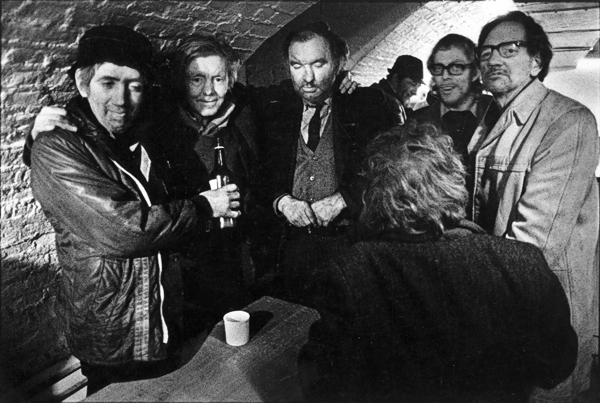
At St Botolph’s, 1978
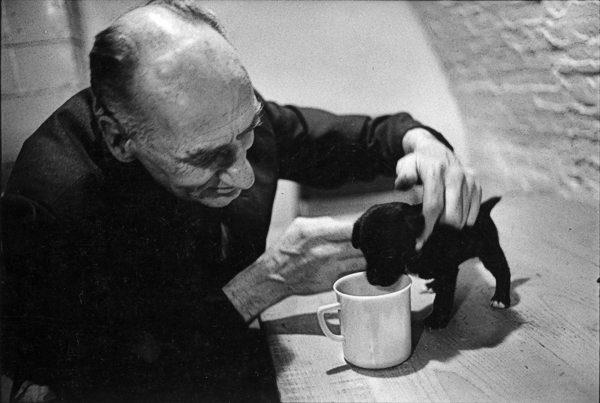
At St Botolph’s, 1978
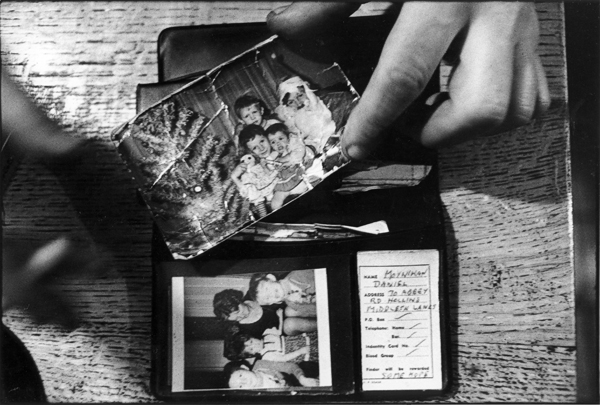
At St Botolph’s, 1978
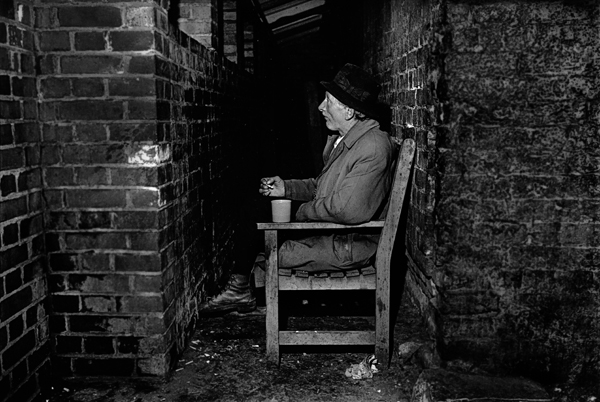
At St Botolph’s, 1978
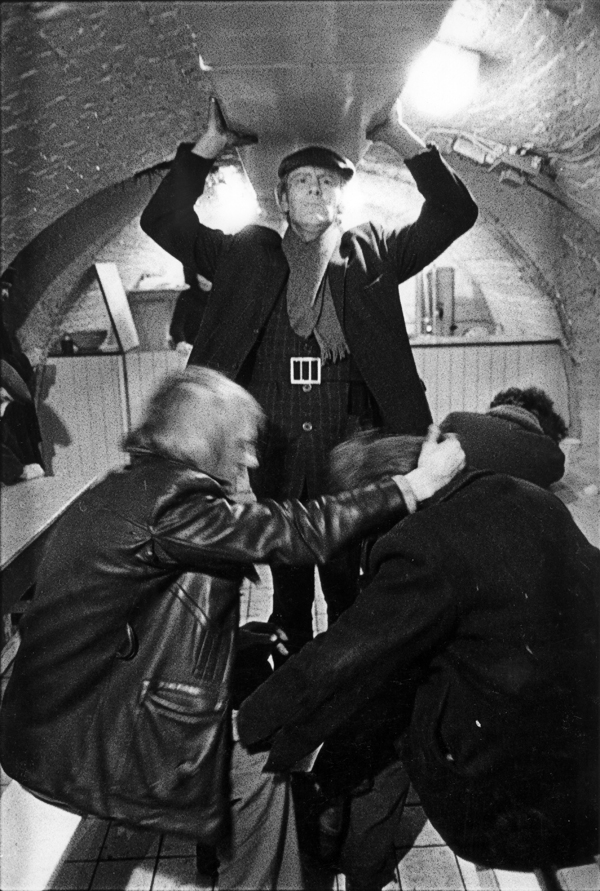
At St Botolph’s, 1978
Photographs copyright © David Hoffman
You may also like to take a look at
So Long, Rev Dr Malcolm Johnson
We were sorry to learn that Malcolm Johnson died at the end of February
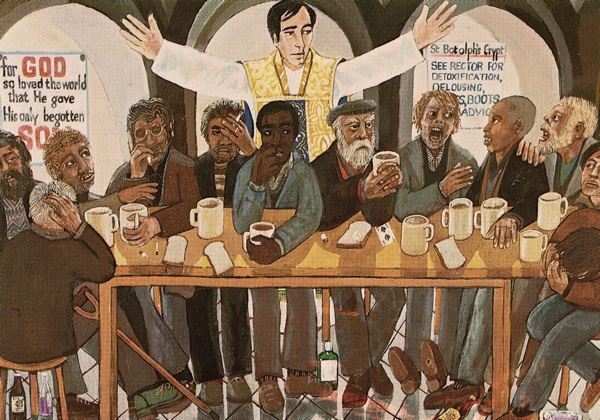
Dan Jones’ painting of Malcolm Johnson at Botolph’s, Aldgate 1982
With his gentle blue eyes and white locks, Reverend Dr Malcolm Johnson was one of the most even-tempered radicals that you could meet, yet the work he did at St Botolph’s in Aldgate was truly extraordinary in its bold and compassionate nature. From 1974 until 1992, Malcolm was responsible for the ‘wet’ shelter that operated in the crypt, offering sustenance, showers and moral support to those that everyone else turned away. While other shelters refused admission to homeless people with alcohol or drugs in their possession, St Botolph’s did not and when I sought further, asking Malcolm to explain the origin of this decision, he simply said, “I believe you have to accept people as they are.”
The project at St Botolph’s was eminently pragmatic, working with people individually to find long-term accommodation in hostels and providing support in establishing a life beyond their homelessness and addiction. But shortly after Malcolm left St Botolph’s in 1992, the shelter was closed and it sat unused for the next twenty years, making it a disappointing experience for Malcolm when he returned to be confronted with the shadow of his former works.
“I can’t tell you how upsetting it is, seeing it like this – it used to be such a wonderful place, full of energy and life, and now its just a store” he admitted to me when Photographer David Hoffman & I accompanied him on a visit to the disused crypt. Yet it proved to be a pertinent moment for reflection, as Malcolm told me the story of how it all happened.
“I had been Chaplain at Queen Mary University for seven years and specialised in counselling gay and lesbian people, so the Bishop thought I needed a quiet City parish where I could get on with my writing next. But, when I arrived. the crypt had been operating for five years and was catering for seventy homeless people each night, and I felt that wasn’t enough. I realised that we were here in the City of London surrounded by big companies, so I went to ask their assistance and I was lucky because they helped me, and I persuaded the City of London Corporation to give us seventy-thousand pounds a year too. The volunteers were all sorts, housewives, city workers after a day at the office and students from the polytechnic. I decided that it would be a wet crypt and we wouldn’t charge for food.
I was the rector upstairs and the director down here in the crypt – I believed the church had to be one outfit, upstairs and down. I went to Eddy Stride at Christ Church Spitalfields to ask what I should do, I had no experience so I had to learn. Over time, we expanded the shelter, we had quite a lot of full-time workers and we established four long-term hostels in Hackney. We were getting about two to three hundred people a night and it was quite an experience, but I was never frightened. Only once did a man take a swing at me, and all the others gathered round and grabbed him.
I missed this place so desperately when I left because you never knew what was going to happen when you walked through the door, it was wonderful, but I felt eighteen years was enough. Then, quite suddenly after I left in 1992, my successor closed the crypt and they said it went bankrupt, although I never understood what happened because we’d done a benefit at the Bank of England shortly before and, if there had been problems, I know my City friends would have come in to save it.”
When Malcolm and I visited, the crypt of St Botolph’s was still equipped as a homeless shelter, functional but abandoned, pretty much as he left it and still harbouring emotive memories of those who passed through, many of whom were dead then. Encouragingly, Malcolm told me the current rector was considering whether it could be reopened.
This would itself be sufficient story and achievement for one man, yet there was another side to Malcolm Johnson’s ministry. As one of the first in the Church of England to come out as gay in 1969, he established the office of the Gay & Lesbian Christian Movement at St Botolph’s and even became known as the Pink Bishop for his campaigning work.
“I had always thought that if clergy can bless battleships and budgerigars, we could bless two people in love,” was his eloquent justification for his blessing of gay couples. Unsurprisingly, it was a subject that met opposition within the Church of England but, by the mid-eighties, the subject of AIDS became an unavoidable one and St Botolph’s was the first church to appoint a full-time minister to care for those affected by the HIV virus, as well as opening a dedicated hostel for this purpose.
In spite of his sadness at the closure of his shelter in the crypt, it was inspiring to meet Malcolm Johnson, a man with an open heart and a keen intelligence, who had the moral courage to recognise the truth of his own experience and apply that knowledge to better the lives of others.

“If clergy can bless battleships and budgerigars, we could bless two people in love…”
At St Botolph’s, 1978

Malcolm Johnson visiting the wet shelter in the crypt, now disused
At St Botolph’s, 1978

“I believe you have to accept people as they are.”
At St Botolph’s, 1978

“I can’t tell you how upsetting it is seeing it like this, it used to be such a wonderful place full of energy and life, and now it’s just a store”

Malcolm Johnson stands left at this midnight mass for the homeless at St Dunstan’s Stepney in 1978
Photographs copyright © David Hoffman
Geoffrey Fletcher’s Pavement Pounders
The work of Geoffrey Fletcher (1923–2004) is an inspiration to me, and today I am publishing his drawings of London’s street people in the nineteen sixties from Geoffrey Fletcher’s Pavement Pounders of 1967.

Charlie Sylvester -“I’m Charlie Sylvester, Charlie of Whitechapel. I’ve been on the markets over forty years. I can’t keep still too long, as I have to serve the customers. Then I must take me pram and go fer some more stock. Stock’s been getting low. I go all over with me pram, getting stock, I sell anythin’ – like them gardening tools, them baking tins and plastic mugs. All kinds of junk. Them gramophone records is classic, Ma, real classic stuff. Course they ain’t long playing? Wot do you expect? Pick where you like out of them baking tins. Well, I’ll be seeing you next you’re in Whitechapel. Don’t forget. Sylvester’s the name.”

Peanuts, Tower Hill – “We’ve only been doin’ this for a few months, me peanut pram and I. I only comes twice a week, Saturdays and Sundays. Sundays is best. It’s a hot day. Hope it will stay. I’m counting on it. How many bags do I sell in a day? I’ve never counted ’em. All I want is for to sell ’em out.”

Doing the Spoons, Leicester Sq -“I’ve been in London since 1932, doin’ the spoons, mostly. I does it when I’m not with the group – if they’re away or don’t show up. I’m about the only spoon man left. No, the police don’t bother us much – they know we’re old timers. We’re playing the Square tonight, later when the crowds will come.”

The Man with the X-Ray Eyes – “It’s the facial characteristics. I can usually guess within a year. It’s the emanations – that’s why they call me the man with the X-ray eyes. I’ve been doing it thirty-two years. Thirty -two years is a long time. I’m off-form today. Sometimes I am off-form and then I won’t take their money. I’m in show business. You see me on TV before the cameras. My show took London, Paris and New York by storm.”

Selections from ‘The Merry Widow,’ Oxford St – “You need a good breath for one o’ these. It’s called a euphonium. Write it down, same as when a man makes a euphemism at dinner. If I smoked or got dissipated, I couldn’t play. I can’t play the cornet, as it is, but that’s because I only have one tooth, as I’ll show you – central eating, as you say, Guv. I come from Oldham. When I was a boy of ten, I worked in Yates’ Wine Lodge, but I broke the glasses. I’m seventy-three now, too old for a job. But I don’t want a job, I have this – the euphonium. Life is an adventure, but things is bad today. People will do you down and not be ashamed of it. They’ll glory in it. Well, that’s it. My mother-in-law is staying with us so we have plenty to eat. She gives me the cold shoulder. I’m going for a cuppa tea. Have a nice summer and lots of luck.”

Lucky White Heather – “I’ve been selling on the London streets all my life, dearie. Selling various things – gypsy things – clothes pegs – it used to be clothes pegs. The men used to make them, but they won’t now – they’re onto other things. There wasn’t much profit in them, either. You sold them at three ha’pence a dozen. That was in the old days, dearie. Now I could be earning a pound while you’re drawing me. We comes every day from Kent. People like the lucky heather. But I’ll give you the white elephant – they’re very lucky. If they weren’t, we wouldn’t be selling them on the streets of London now, would we, dearie?”

Pavement Artist at Work, Trafalgar Sq – “I’ve been away two years, I haven’t been well, but I’m back again now. I’ve worked in other parts, but nearly always in London. Used to be outside the National Gallery, where I did Constable. I used to do copies of Constable. I do horses, dogs and other animals. The children like animals best, and give me money. I’m only playing about today, you might say. I haven’t prepared the stone. It gives it a smooth surface, makes the chalks sparkle. Makes them bright and clear, y’know. These pastels are too hard. I like soft ones, but everything’s gone up and I can’t afford them. Oh yes, I always clean off the stones. I won the prize for the best pavement artist in London.”

L.S.D. the Only Criterion, Tavistock Sq – “I’ve been here thirty years. I became a combined tipster and pavement artist because I had the talent, and because I believe in independence. Some people buy my drawings. I don’t go to the races now. I used to – Epsom, Ascot and all that. I have my regulars who come to see me and leave me money in my cap. That’s what it’s for. The rank and file are no good. It’s quiet Saturdays except when there’s a football match – Scoltand, say – and they stay round here. Weather’s been terrible – no-one about. Trafalgar Sq is where the money is, but they fights. I’ve sen the po-leece intervene when they’ve been fighting among themselves, and they say, ‘ere, move on, you?’ It’s money what’s at the bottom of it. Money an’ greed. Like I’ve got written here.”

The Best Friend You Have is Jesus – “Forty years I’ve been selling plants in London, and for over thirty years the Lord’s work has been done. In 1935, I was backing a dog – funnily enough it was called ‘Real Work’ – at New Cross. All at once, a small voice, the voice of the Lord, spoke to me and said ‘Abel (My name is Abel), I’ve got some real work for you to do.’ I gave up drink and dogs and got the posters on the barrow – the messages. I’ve been thousands of miles all over London doing the work of the Lord. London is wicked, and it’s getting worse. But God is merciful, and always gives a warning. It’s like Sodom and Gomorrah. The Lord says ‘Repent’ before His wrath comes. He could destroy London with an earthquake. Remember Noah? – how God wanted them to go in the Ark? But they wouldn’t. They said, ‘We’re going to have a good time…’ The Lord could destroy London with His elements. It dosen’t worry me as I’m doing the Lord’s work. Let these iris stand in water when you get ’em home.”

One Minute Photos, Westminster Bridge – “‘Happy Len,’ they call me, but my real name’s Anthony. Fifty years on the bridge. 1920 I came, and my camera was made in 1903. It’s the only one left. I have to keep patching it up. The man who made it was called ‘Moore,’ and he came from Dr Barnardo’s. They sent him to Canada, and he and a Canadian got together, a bit sharp like, and they brought out this camera. Died a millionaire. I’m seventy-three, and I’ve seen some rum ‘uns on the bridge. There was a woman who came up and took all her clothes off, and the bobby arrested her for indecent behaviour. Disgraceful. The nude, I mean. She was spoiling my pitch.”

Music in the Strand – “I had to make some money to live, and so I came to play in the streets. I’ve never played professionally, I play the piano as well but I never had much training. I’m usually here in the Strand but sometimes I play in Knightsbridge, sometimes in Victoria St. There’s not so many lady musicians about now. I only play classical pieces.”

Horrible Spiders – “Christmas time is the best for us, Guv, if the weather ain’t wet or cold. Then the crowds are good humoured. I like my picture and I’m going to pick out an extra horrible spider for you in return. I’ll tell you a secret – some of the spiders ain’t made of real fur. They’re nylon. But yours is real fur, and it’s very squeaky.”

Salty Bob – “Come round behind the stall and have a bottle of ale. It’s a sort of club, a private club. It’s a grand life sitting here drinking, watching the world go by. I’ve been selling salt and vinegar for fifty years and I’m seventy now. I’ve seen some changes. Take Camden Passage, it’s all antiques, like Chelsea, none of the originals left hardly. Let me pour you another drink. Here we are snug and happy in the sun. I’ve just picked up nine pounds on a horse, and I’ve got another good one for the four-thirty. Next time you’re passing, join me for another drop of ale. No, you can’t pay for it. You’ll be my guest, same as now, at our private club behind the bottles of non-brewed, an’ the bleach.”

Don’t Squeeze Me Till I’m Yours – “That’s a German accordion – they’re the best. Bought it cheap up in the Charing Cross Rd. I do the mouth organ too, this is an English one – fourteen shillings from Harrods. I began with a tin whistle and worked me way up. I’ve a room in Mornington Crescent. My wife died, luvly woman, thrombosis. I could see here everywhere, lying in bed and what not, so I cleared out. I got to livin’ in hostels. But I couldn’t stand the class of men. I work here Mondays, Fridays sometimes. I also work Knightsbridge and ‘ere. I work Aldgate Sundays. I do well there. I gets a fair livin.’ So long as I’ve got me rent, two pounds ten, and baccy money, I don’t want nothing else.”

A Barrel Organ Carolling Across a Golden Street – They received their maximum appreciation in the East End, in the days when the area was a world apart from the rest of London, and the appearance of a barrel organ in Casey Court, among patrons almost as hard pressed as the organist, meant an interval for music and dancing, while the poor little monkey, often a prey to influenza, performed his sad little capers on the organ lid.

Sandwich Man – Consult Madame Sandra – “It’s a poor life, you only get twelve shillings and sixpence a day and you can’t do much on that now, can you, sir? It was drink that got me, the drink. When I come off the farms, I became a porter at Clapham Junction, sir. I worked on the railways, but I couldn’t hold my job. So I dropped down, and this is what I do now. All you can say is you’re in the open air. Sometimes I sleep in a hostel, sometimes I stay out. Just now I’m sleeping out. It was the drink that done it, sir.”

Matchseller – “I was a labourer – a builder’s labourer – an’ I come frae Glasgow. I’ve not been down here in London verra long – eight years. Do i like it here? Weel, the peepull, the peepull are sociable, but they not gie you much, so you only exist. Just exist. I don’t sleep in no hostel, I sleep rough. I haven’t slept in a bed in four weeks. I sleep anywhere. I like a bench in the park or on the embankment. I like the freedom. Anywhere I hang my hat, it’s home sweet home to me.”

A Romany – Apart from the Romany women who sell heather and lucky charms in such places as Villiers St and Oxford St, the gypsies are rapidly disaapearing from Central London. Only occasionally do you see them at their traditional trade of selling. lace paper flowers of cowslips. Modern living vans are invariably smart turn-outs that have little in common with the carved and painted caravans of fifty years ago. They are with-it-gypises-O! Small colonies can still be found on East End bombsites, which the Romanies favour for winter quarters.

‘A Tiny Seed of Love,’ Piccadilly – “Oh yes, Guvnor, they’re good to me if the weather’s fine. Depends on the weather. I can’t play well enough, as you might say. I used to travel all over, four or five of us, saxo, drums, like that. Sometimes there was as many as eight of us. Then it got dodgy. I’m an old hand now. I’ve settled down. I got two rooms at thirty-two bob a week, Islington way. Where could you get two rooms for sixteen shillings each in London? I can easily get along at the price I pay. What’s more, I’ve married the woman who owns the house, too. She’s eight years older than I am, but we get along amicable.”
You may also like to read
Down Among the Meths Men with Geoffrey Fletcher
and take a look at
Sarah Ainslie’s Hatton Garden Portraits
I enjoyed the privilege of accompanying Contributing Photographer Sarah Ainslie into high security workshops to meet some of the most skilled craftsworkers in the creation of precious jewellery in Hatton Garden and Clerkenwell. These portraits were commissioned by The Goldsmith’s Centre
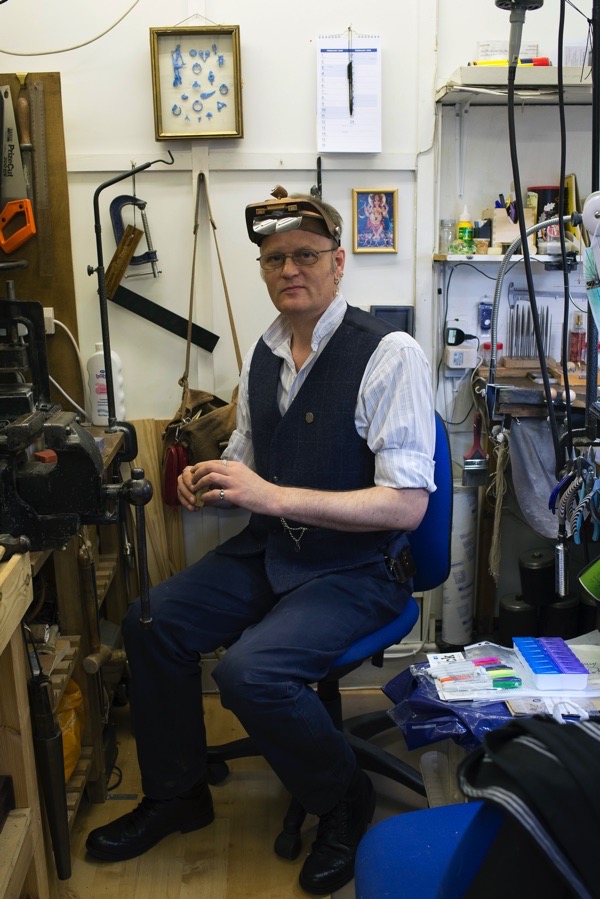
Russell Lownsbough, Designer, Wax-Carver & Goldsmith
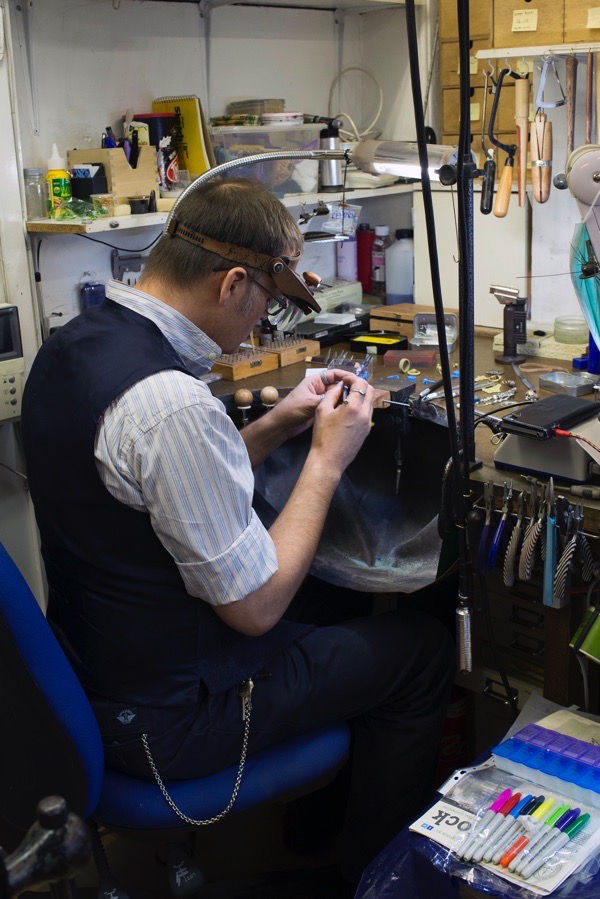
Russell Lownsbough
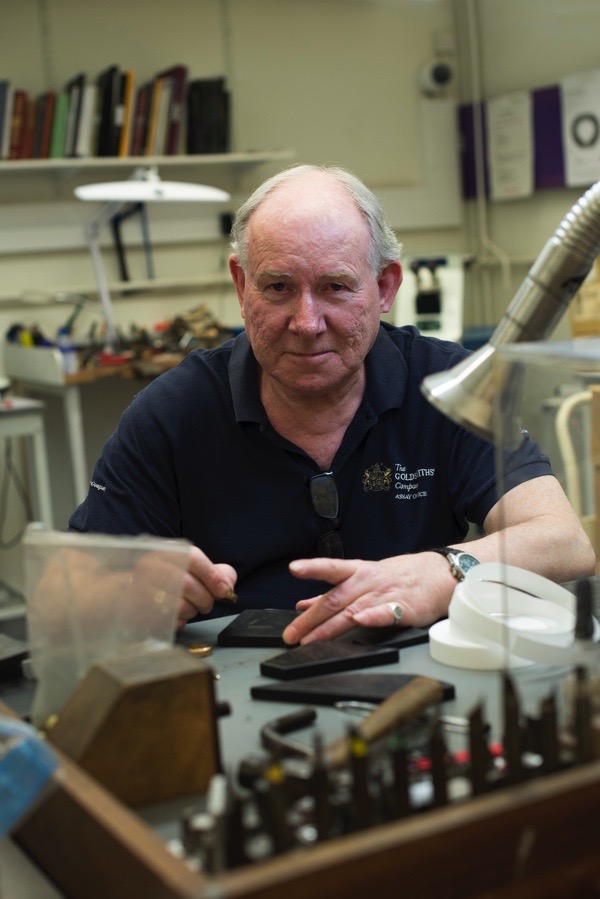
Dave Merry, Hallmarking Expert at the Assay Office, Goldsmiths Hall – “I am responsible for training and apprenticeships at the Assay Office but I am also a maker and a sampler. We employ twenty-two people and test six thousand articles every day. An exciting part of my job is going out on raids with the police to shops where they are selling counterfeit jewellery.”
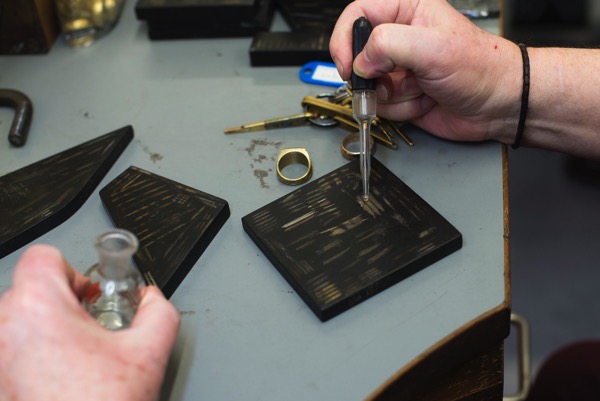
Dave Merry – “The phrase ‘up to scratch’ derives from the ancient practice of testing precious metals by rubbing them against a touchstone and applying aqua regia – known as ‘the acid test.’ I have had this stone for forty-seven years, since I was given it when I first walked in the door.”
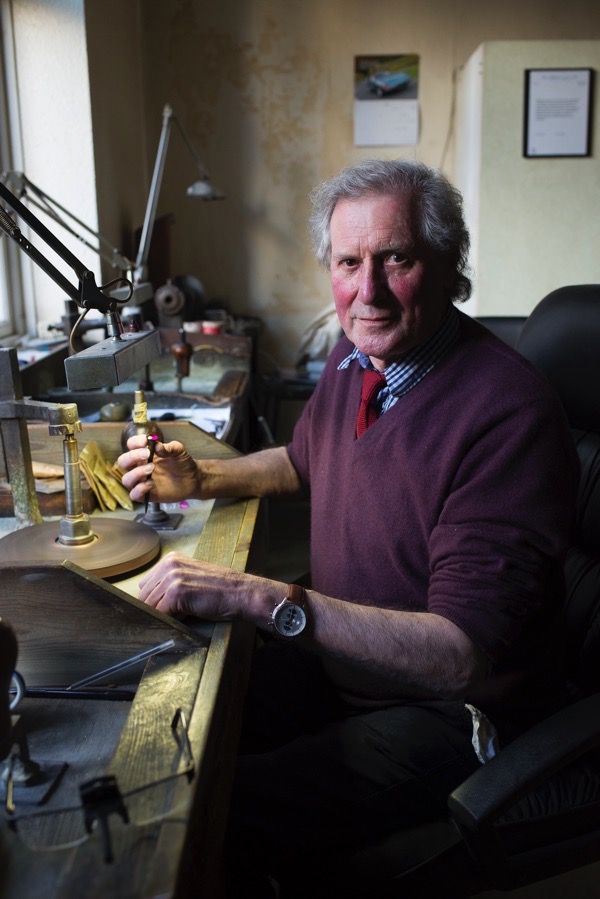
John Taylor, Gemstone Cutter
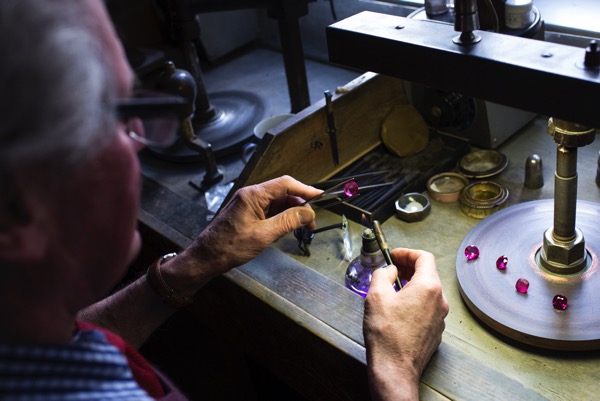
John Taylor
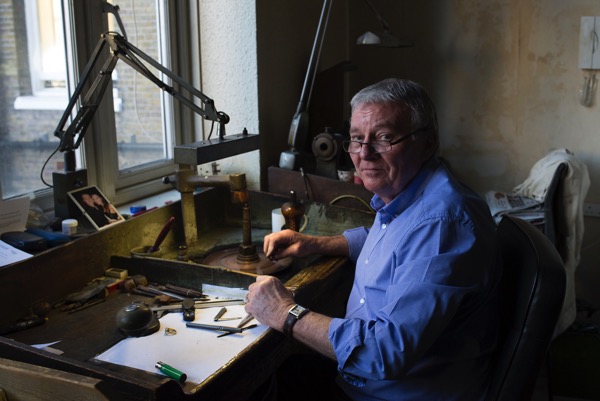
Pete Rome, Gemstone Cutter
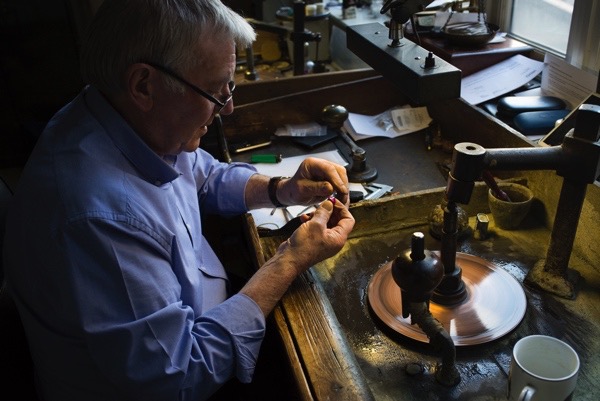
Pete Rome
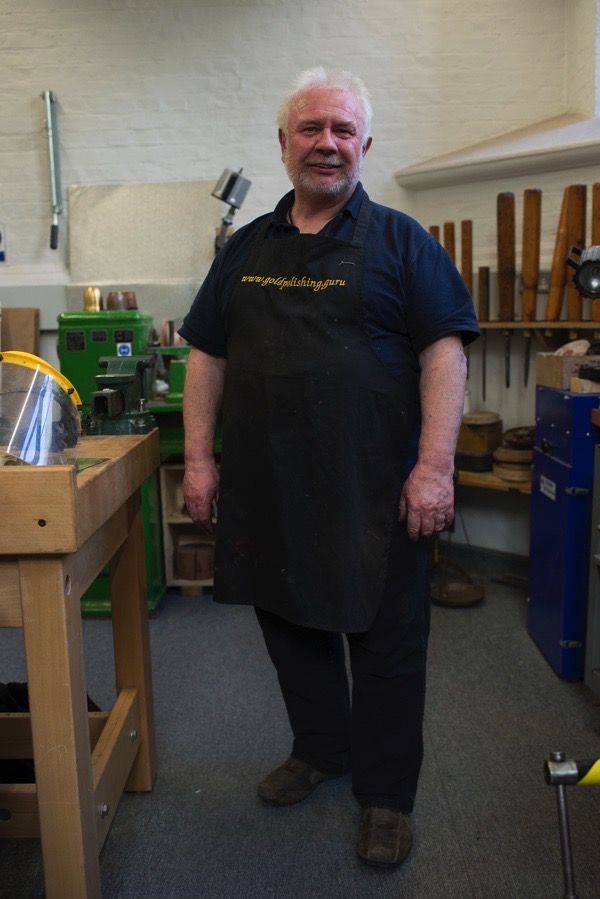
Steve Goldsmith, Polisher
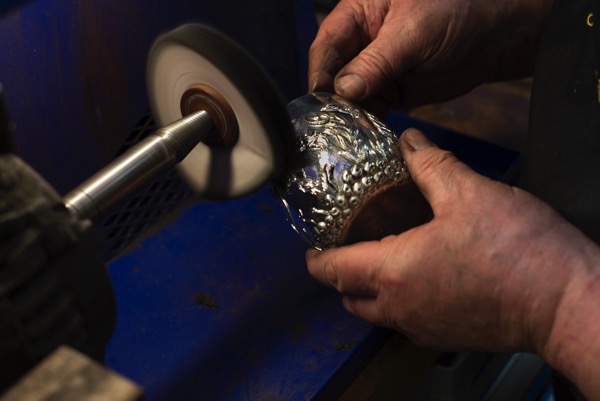
Steve Goldsmith
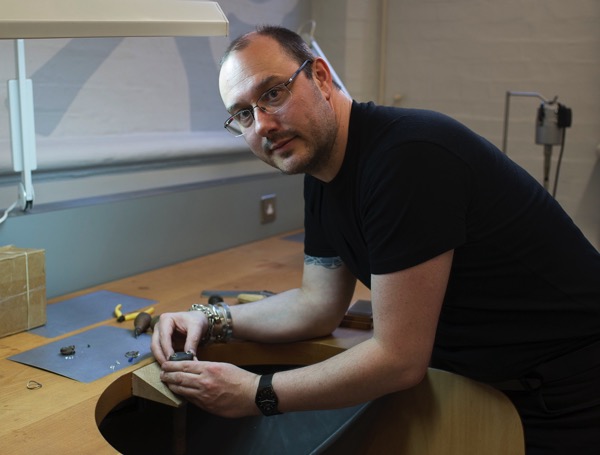
Niall Paisley, Diamond Setter – “I’ve been in the trade twenty-seven years, I started at sixteen. You learn a lot by heating stones, the hardness of the stones and the stress they will endure – diamonds can take any level of abuse whereas emeralds are brittle.”
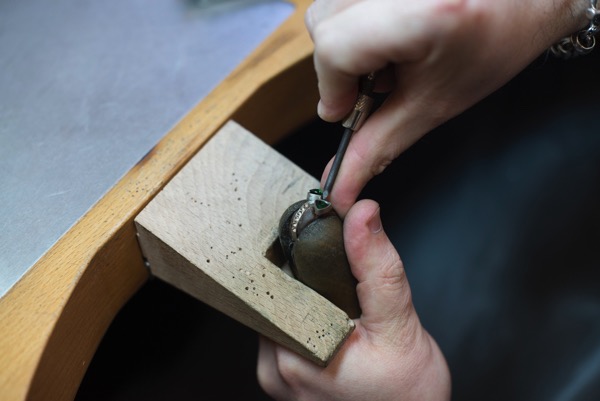
Niall Paisley
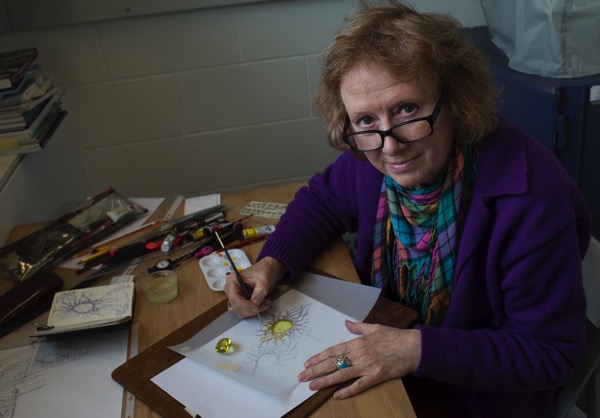
Jennifer Bloy, Designer of Jewellery, Silverware & Objet d’Art – “I wanted to be a smith but they wouldn’t let me because I am a woman, so I started making reproductions – but then there was a job going as a designer in Hatton Garden and I got it. Because I worked as a maker, I know how things are made, so I can design for making.”
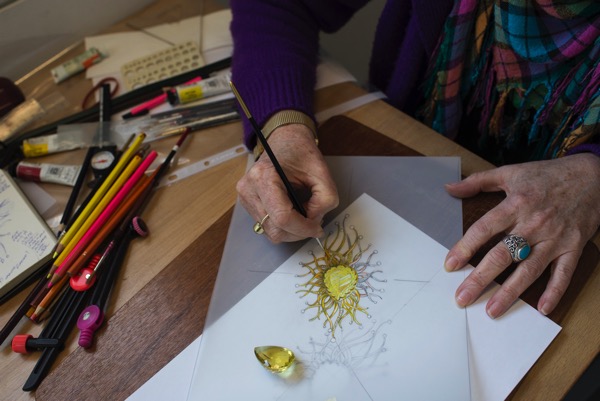
Jennifer Bloy – “I bought this stone, I love stones and I love colour.”
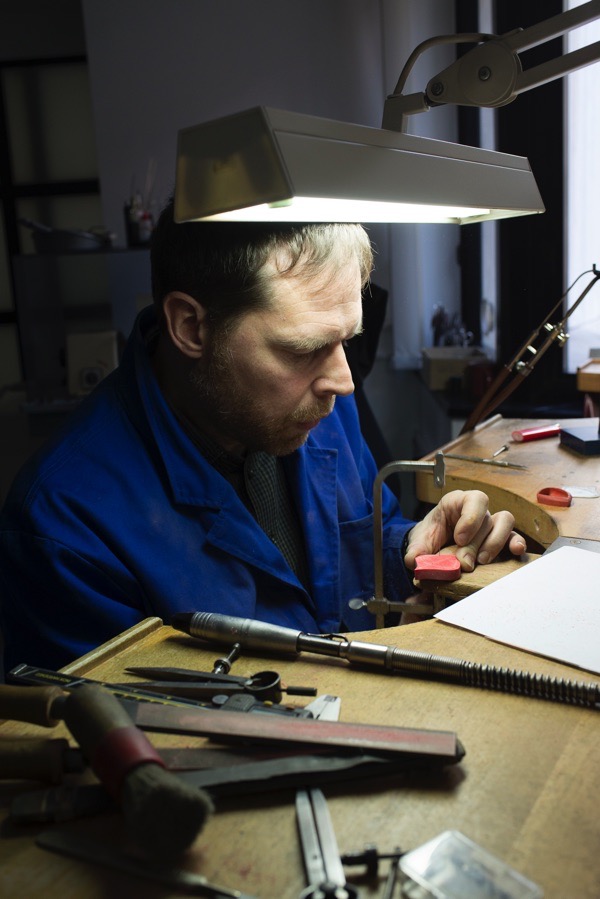
Ingo Henn, Master Goldsmith, Henn of London – “My great grandfather started in 1900, he was a stone cutter. He came from a family of fifteen and at twelve years old he was sent to be trained. When I was seventeen, I started as an apprentice in the family company but I have been designing since I was sixteen and I have been in London twenty-two years now. Any gemstone is valuable but it is not just down to its monetary value. The key is never to overpower a stone if the setting is too big or the design is too busy.”
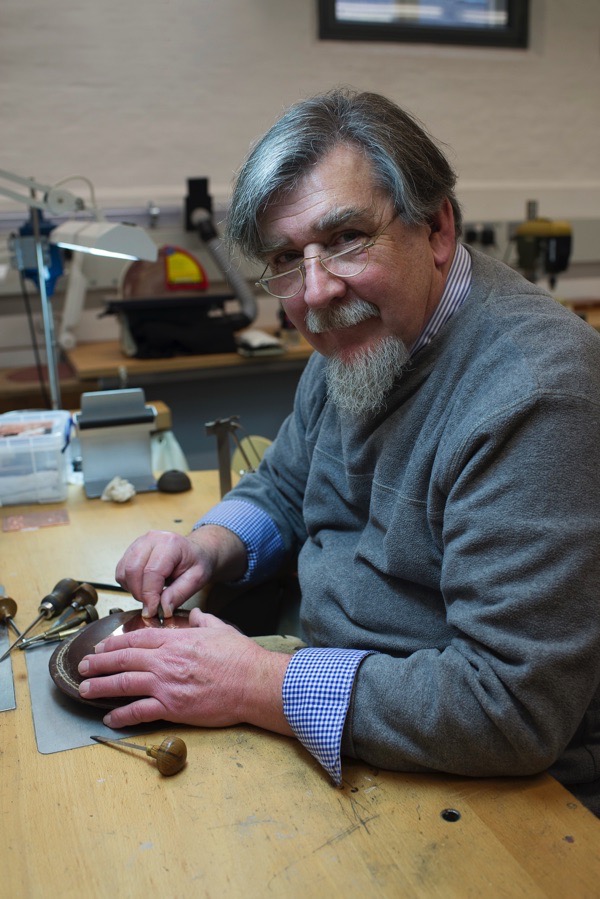
Wayne Parrott, Master Engraver – “In 1908, the security engravers at the Bank of England earned more than the governors. I began at thirteen years old, attending evening classes at Sir John Cass College and I was taught by George Friend. Later, I returned to the Cass as a teacher and lectured for over forty years. We are all artists in what we do and I have produced countless designs.”
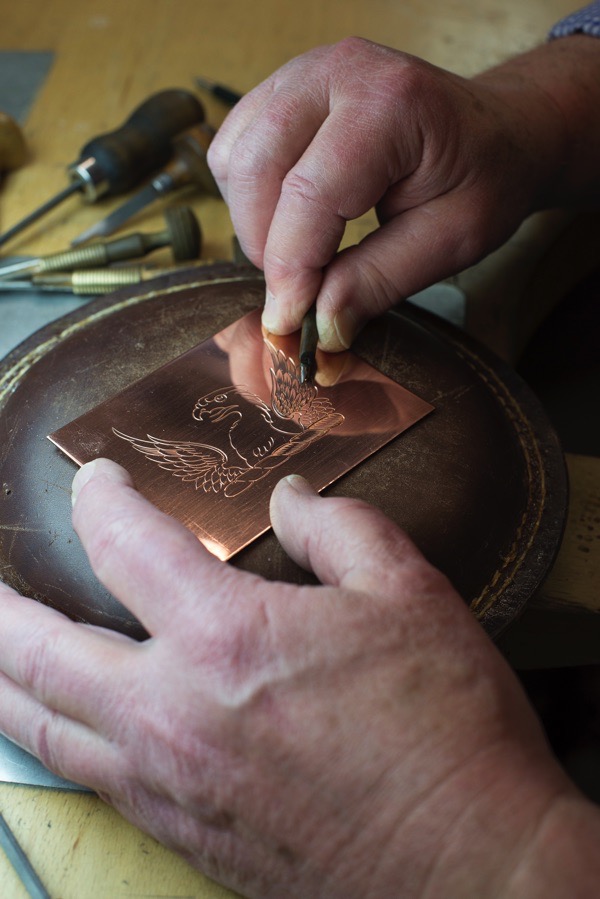
Wayne Parrott – “I specialise in designing seals.”
Photographs copyright © Sarah Ainslie
You may also like to read about
Photos From London’s Oldest Ironmonger
David Lewis (the former proprietor of London’s oldest ironmongers, specialising in serving the coach-building trade and operating from the same location in the Hackney Rd from 1797-2013) was the proud custodian of this archive of photographs which illustrate the history of the business and some of its key protagonists.
Originally opened as H. M. Presland & Sons, the business became W. H. Clark Ltd in the eighteen-nineties and traded as Daniel Lewis & Son Ltd – The One Stop Metal Shop from 2002 -2013. In a rare and astonishing survival, the company traded from premises built to suit their purpose in the early nineteenth century, remaining largely unaltered over two hundred years until parking restrictions resulted in the loss of their customers and they left the Hackney Rd forever.
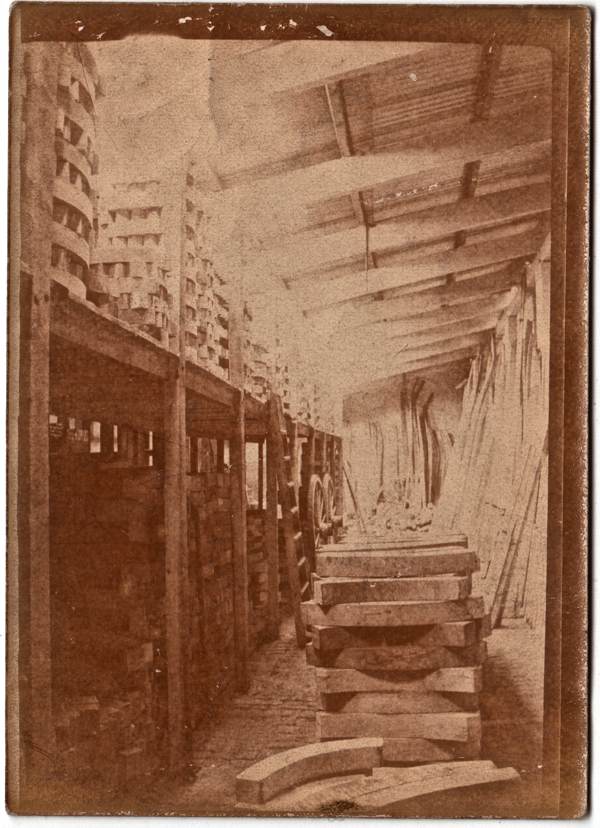 Timber components for assembling wagon wheels in the wheelwright’s shop, c.1900.
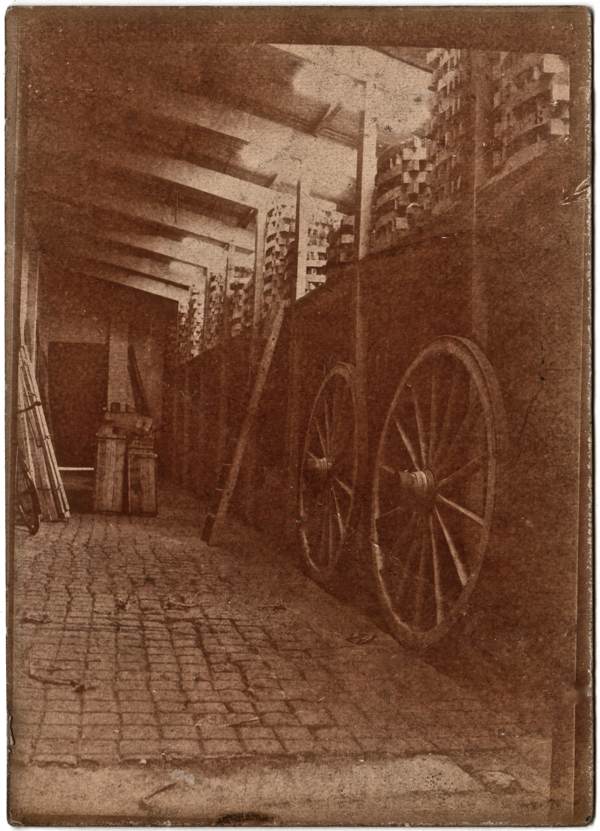
This wheelwright’s shop, c. 1900.

Mayor of Hackney, W.H.Clark’s car parked outside his business in 1920.
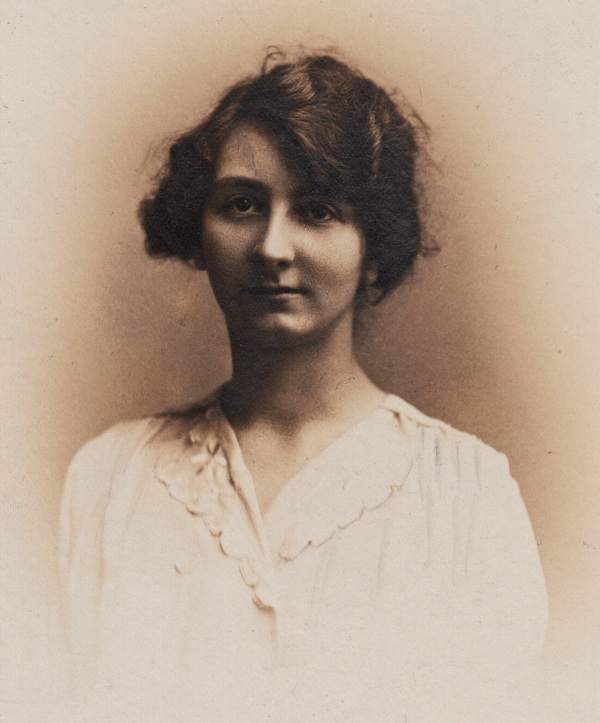
Mrs W.H.Clark who managed the business on her husband’s behalf – she was a member of the businesswomen’s league and an active participant in many local social charitable projects.
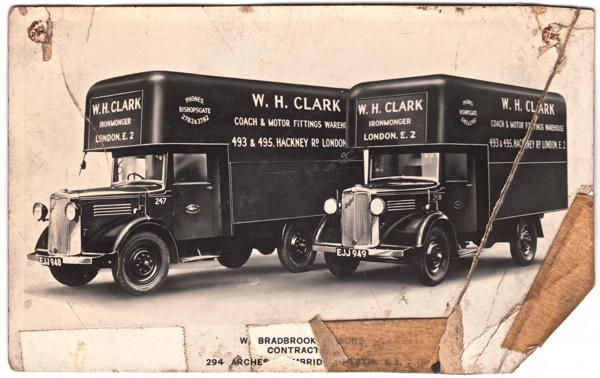
W.H. Clark vans, 1930
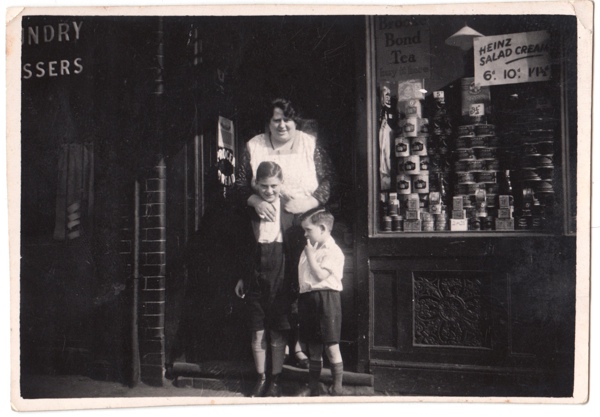
Gwladys Lewis outside her grocer shop and dairy in the Hackney Rd with her son Daniel on the right.

The gasometer at the rear of the premises next to the Regent’s Canal.
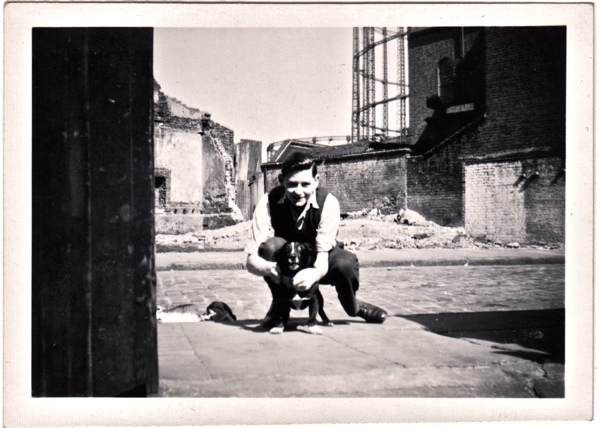
Daniel Lewis and his dog in the yard with the bombsite of the Chandler & Wiltshire Brewery, 1945.
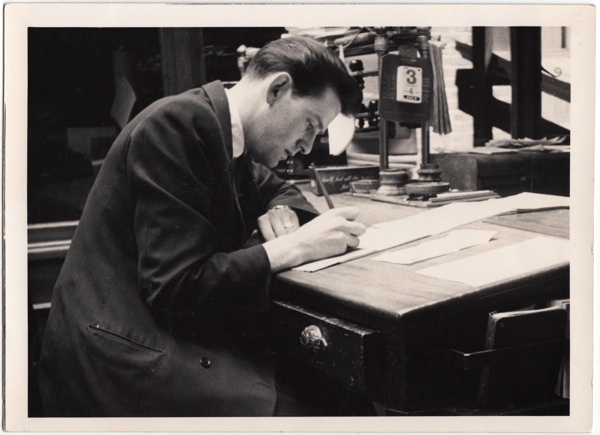
Daniel Lewis at his sloped-top desk in 1953.

Daniel & Audrey Lewis.
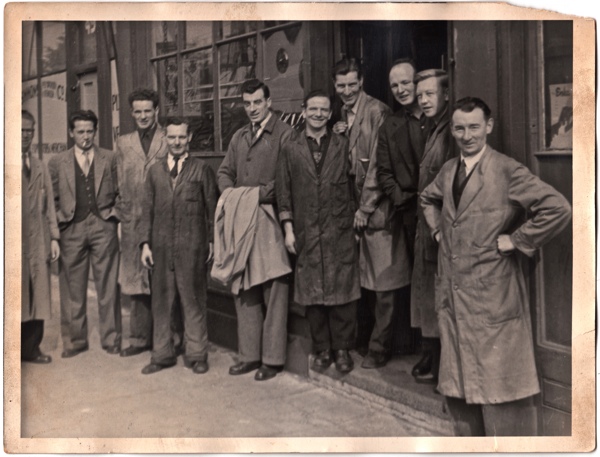
The staff, 1950.

Daniel Lewis outside the premises, 1963.
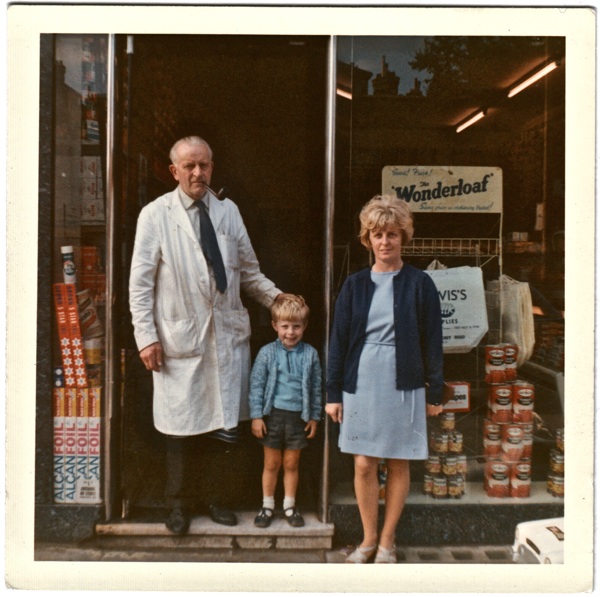
Lewis Lewis, dairyman, outside his grocer’s shop and dairy in the Hackney Rd with his grandson David and daughter-in-law Audrey, nineteen sixties.

Lewis Lewis and David in the nineteen sixties.

Daniel Lewis with the Royal Carriage for which he supplied two-hundred-year-old-oak panelling from his stock for restoration, 1975.
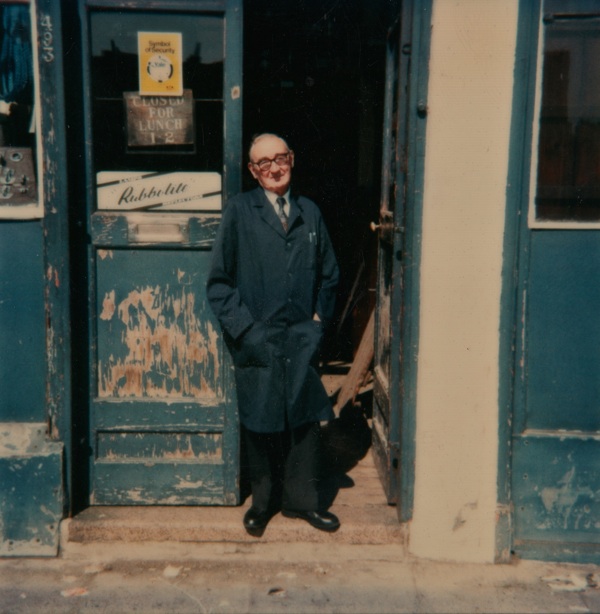
Arthur Hinton, shop manager, 1980.
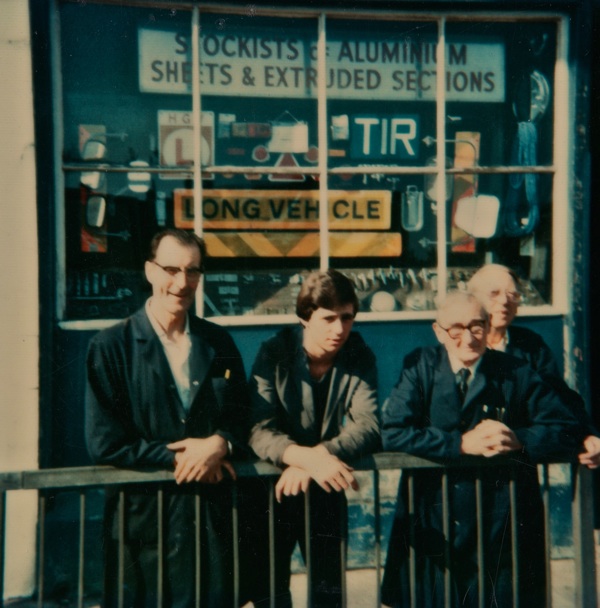
Shop staff, 1980
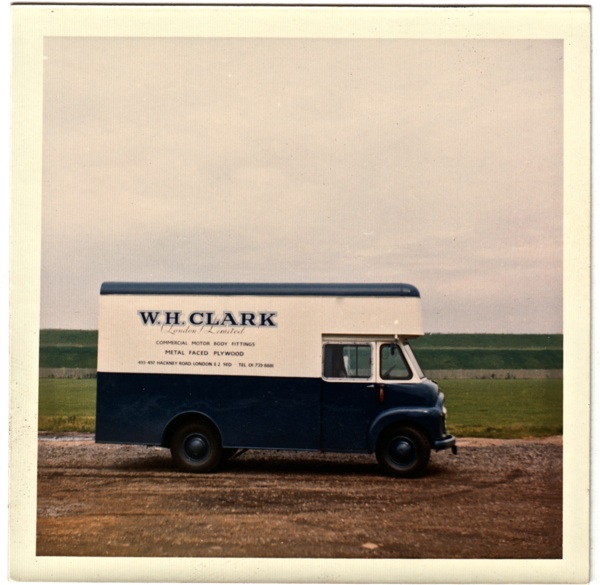
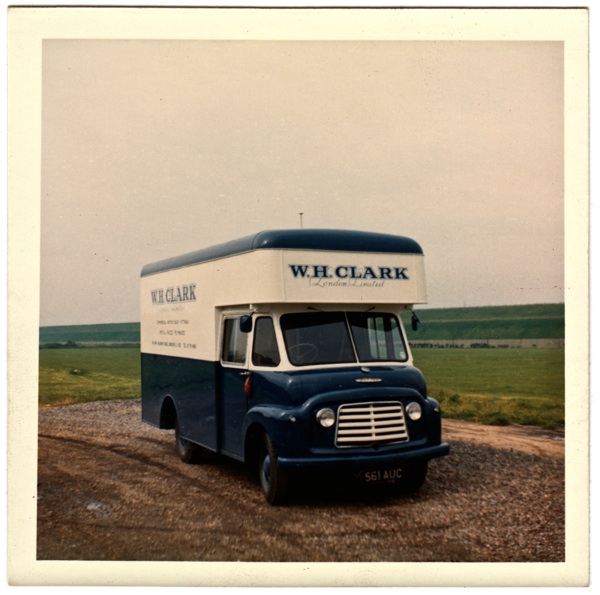
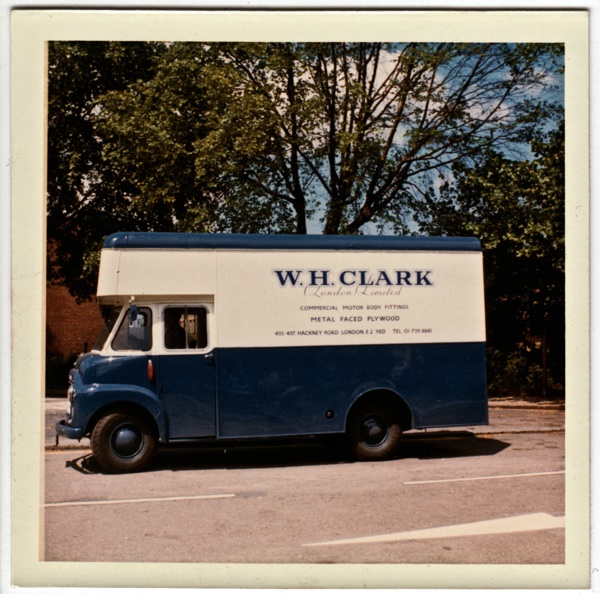
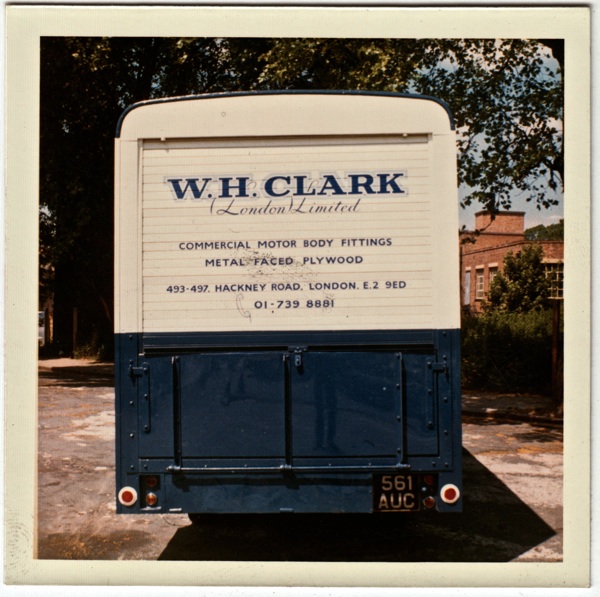
W.H.Clark van, 1960.
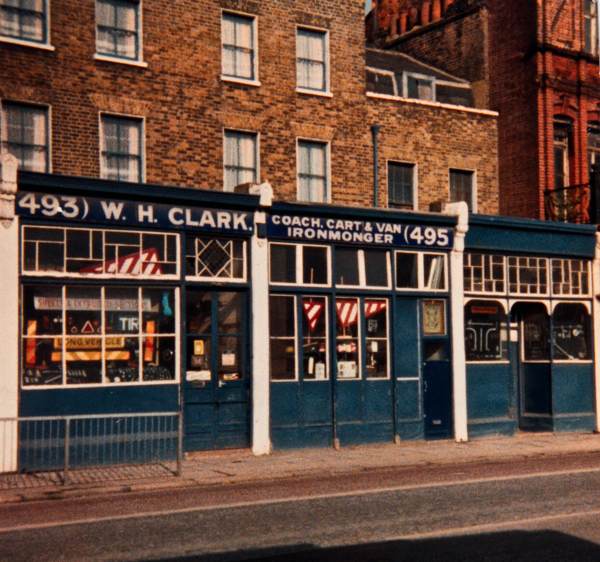
In the twentieth century.

In the nineteenth century
You may also like to read about












