
Ken Sequin’s Badge Collection
From hundreds in his magnificent collection, Ken Sequin kindly selected badges for me with a local connection – and they comprise an unexpected history of the East End.
Button badges were invented in 1896, when Benjamin Whitehead of Whitehead & Hoag in New York filed a patent for a celluloid-covered metal badge, swiftly opening offices in London, Toronto & Sydney as the craze went global.
Adopted first as a means of advertising by tobacco companies, button badges were quickly exploited for political, religious and fund-raising purposes by all kinds of clubs and organisations.

Kingsland Rd Costermongers Association manufactured by E. Simons, late nineteenth century – one of the rarest badges, possibly a unique survivor

Souvenir of Dirty Dick’s in Bishopsgate, twenties or thirties

St John at Hackney Parochial School founded in 1275 is one of the oldest in the country, early twentieth century

Woolwich Arsenal Football Club, 1907

Hackney Band Club, hat badge c1873, one of the most radical Working Men’s Clubs

Boer War, 1900 – one of the very earliest button badges in this country

Reverse of previous badge, note local manufacturer

Royal Eye Hospital, Moorfields – early twentieth century

Lea Bridge Speedway Supporters’ Club – 1928-32

Dartford Pageant, 1932

Possibly the Regal Edmonton, 1934

Bethnal Green Men’s Institute, Gymnastics, Turin St, early twentieth century

Temperance and Salvation Army buttons, early twentieth century

Dockers Trade Union Badge, established 1889

A cache of badges found in an allotment shed in Walthamstow

World War II propaganda badges

Salvage. Dulwich Council

St George’s Sunday School, Weslyan Mission House, in the eighteen-nineties it took over Wilton’s Music Hall

Reverse of previous badge

WWII National Air Raid Precautions Animals Committee, dog’s identity badge

World War II badges for fundraising clubs to build airplanes

WWII Fundraising club to buy a destroyer

First Labour Mayor of Poplar, Will Crooks was elected MP for Woolwich in 1902

Reverse of buttons above

Dulwich & District Defence League, a Home Front battalion established in 1915

The Mildmay Hospital in Shoreditch was named after Francis Bingham Mildmay in 1890

Early twentieth century silver badge rewarding service in hospital ‘meals on wheels’ service

Barnado’s Young Helpers’ Badge with a portrait of the founder, early twentieth century

Tilbury Seamen’s Hospital, ‘For services rendered’ – possibly thirties

John Groom’s Crippleage & Flower Girls Mission, fund-raising rosettes, c 1900
Photographs copyright © Ken Sequin
You might also like to take a look at
John Gillman’s Bus Ticket Collection
Viscountess Boudica’s Domestic Appliances
Libby Hall’s Dog Photography Collection
Clive Murphy’s Matchbox Label Collection
Spires Of City Churches

Spire of St Margaret Pattens designed by Christopher Wren in the medieval style
I took my camera and crossed over Middlesex St from Spitalfields to the City of London. I had been waiting for a suitable day to photograph spires of City churches and my patience was rewarded by the dramatic contrast of strong, low-angled light and deep shadow, with the bonus of showers casting glistening reflections upon the pavements.
Christopher Wren’s churches are the glory of the City and, even though their spires no longer dominate the skyline as they once did, these charismatic edifices are blessed with an enduring presence which sets them apart from the impermanence of the cheap-jack buildings surrounding them. Yet they are invisible, for the most part, to the teeming City workers who come and go in anxious preoccupation, barely raising their eyes to the wonders of Wren’s spires piercing the sky.
My heart leaps when the tightly woven maze of the City streets gives way unexpectedly to reveal one of these architectural marvels. It is an effect magnified when walking in the unrelieved shade of a narrow thoroughfare bounded on either side by high buildings and you lift your gaze to discover a tall spire ascending into the light, and tipped by a gilt weathervane gleaming in sunshine.
While these ancient structures might appear redundant to some, in fact they serve a purpose that was never more vital in this location, as abiding reminders of the existence of human aspiration beyond the material.

In the porch of St James Garlickhythe where I sheltered from the rain

St Margaret Pattens viewed from St Mary at Hill

The Monument with St Magnus the Martyr
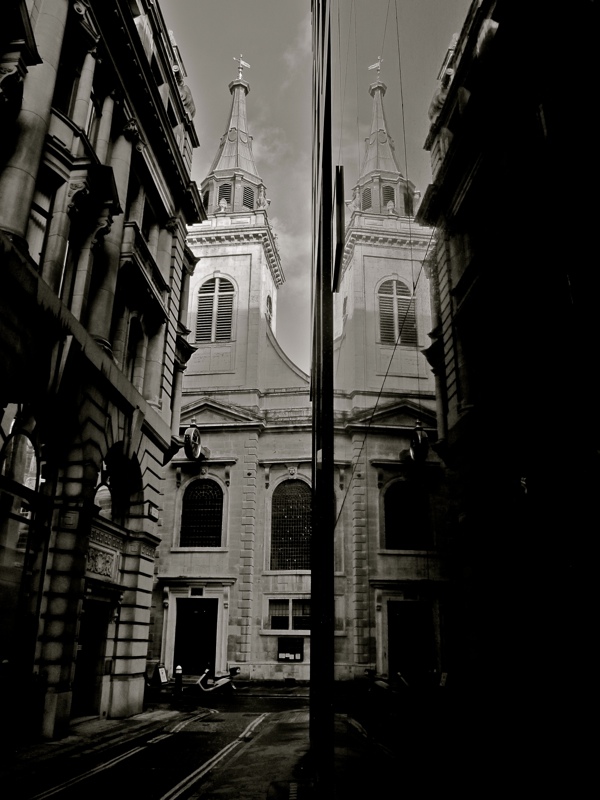
St Edmund, King & Martyr, Lombard St

St Michael Paternoster Royal, College Hill

Wren’s gothic spire for St Mary Aldermary

St Augustine, Watling Street

St Brides, Fleet St

In St Brides churchyard

St Martin, Ludgate

St Sepulchre’s, Snow Hill

St Michael, Cornhill

St Mary Le Bow, Cheapside

St Alban, Wood St

St Mary at Hill, Lovat Lane

St Peter Upon Cornhill

At St James Garlickhythe
You may also like to take a look at
My Spring Shirt
Thanks to your magnificent support, we have reached our crowdfunding target to launch THE GENTLE AUTHOR’S TOUR OF SPITALFIELDS. The booking website will go live at the beginning of next month and tours will commence at Easter, running throughout the summer.

I pulled this shirt out of my cupboard this week in advance of the arrival of spring. If you look closely, you will see the collar is wearing through but this does not diminish my affection for this favoured garment that I have worn for years now, bringing it out just for these few months at the end of winter. Although most of the clothes I own are of undecorated design, there is a gentle lyrical quality about this pattern that appeals to me.
When I wear this shirt with a dark jacket, the colours really sing and I feel am doing my bit in participating in the seasonal change. This contrast of formal clothing with a sprigged shirt can express dignified restraint while at the same time revealing an attachment to flowers, plants, gardens and nature – a contrast that I recognise in my own personality.
I love the conceit of having violets on my shirt when those in my garden are in flower and I enjoy the subtle tones of all the flowers portrayed, remaining as recognisable species while artfully stylised to make a pattern. The evocation of the natural world in this simple design touches a chord for me and, as with so many things that trigger an emotional response, I discovered that my passion for these floral patterns from Liberty goes back a long way.
When I came across the familiar photograph of my mother Valerie as a child, which you can see below, I did a double-take when I recognised the pattern on the dress. It was a Liberty print, very similar to my spring shirt which I hold in such affection. In that moment, I recalled that my grandmother Katherine bought fabric at Liberty in London and had it made up into dresses for my mother in the nineteen-thirties. This was a gesture which made such an unforgettable impression on my mother that for her whole life she carried her delight in these cotton dresses, which were so magical to her as a little girl in Somerset. Floral prints fed her innocent imagination, nurtured by ‘Songs of the Flower Fairies’ and performing as one of Titania’s attendants in a school play.
A generation later, I grew up with the received emotion of this memory – a story my mother told me when I was a child. I thought I had forgotten, but I realised it was through an unconscious recollection of the photograph of my mother in the Liberty dress that I was attracted to this flowery shirt, without understanding the origin of my desire at the time.
The story was confirmed when my Uncle Richard moved out of the old house where he and my mother grew up and, in my grandmother’s dressing table, I found a small leather pocket diary from the thirties recording her London trip with the entry, “Stayed at Claridges. Ordered carpet and sideboard at Harvey Nichols and bought materials at Liberty.” My grandmother was the daughter of a diminished aristocratic family who married my grandfather Leslie, a bank manager, and adopted an autocratic manner to ameliorate her loss of status. Consequently, my mother, with admirable resourcefulness, ran away from home at nineteen to escape my bossy grandmother and married my father Peter, who was a professional footballer – an act of social rebellion that my grandmother never forgave.
Nevertheless, the taste I acquired for these old-fashioned designs reflects the fondness my mother carried for that special moment in her childhood which she never forgot, when my grandmother showed maternal kindness to her little daughter in the gift of flowery cotton dresses. An act which came to represent everything about my grandmother that my mother could embrace with unqualified affection, and she encouraged me to remember the best of people too, a prerogative I claim in this instance as the sole living representative of these characters.
Today, I wear my shirt as the sympathetic illustration of a narrative which extends over three generations, culminating in my own existence upon this earth, and as I button my spring shirt, before walking out to celebrate sunshine and a new beginning, I am reminded that I alone carry these emotional stories now, clothing me in the humble affections of my forebears.

The Gentle Author’s mother ‘Valerie’ in the nineteen-thirties

Liberty of London
You may like to read these other stories of The Gentle Author’s family
A Final Push!

Map drawn by Adam Dant
Thanks to your generosity, over the past month we have already reached over 90% of our target and now we have until midnight on Monday to raise the final £400.
The amount of goodwill has been truly uplifting with over three hundred and fifty supporters so far from across London, UK and the world.
If you know of anyone who you think might like to help, please drop them a line this weekend or forward this email to your family, friends, neighbours and colleagues.
Tours will commence at Easter and run throughout the summer.
CLICK HERE TO SUPPORT THIS PROJECT

A FEW SELECTED COMMENTS FROM OVER 100 BY SUPPORTERS FROM AROUND THE WORLD
There are more stories to be told about Spitalfields and I want to hear them !
Jonathan Pryce
Wishing you great success!
Hallie Rubenhold
It is wonderful to be able to support such a lovely project telling the true human stories of the people of the East End of London. Thank you to The Gentle Author who has brought us so much pleasure to start our day with such a gentle morning blog . This Community Tourism Project is a privilege to contribute to. It is going to be a real enhancement to this part of London. I love London. I am a Londoner I proudly have my name on the Globe, the Millennium Bridge, the National Theatre, the William Morris Gallery. We are proud to be in the stones of London.
Jane Jewell
My father’s family came from the area. My great-grandfather who was a cabinet maker had a workshop off Brick Lane and met his wife there. The Gentle Author deserves our support for this wonderful work revealing the history and characters of the East End.
Novel Entertainment
Oh what a truly wonderful endeavour – I think Polly, Annie, Elizabeth Catherine and Mary Jane will be soo glad and proud and relieved too wish they were here to join in … perhaps they will…
Sophie Thompson
Another brilliant initiative from that most gentle of authors and showing a steely determination not only to push back against naff exploitation tourism but to practically offer something much more interesting.
Iain B
I am pleased to support this project. I have ancestors who lived and worked in Spitalfields in the weaving and carpentry industries. My paternal family owned a furniture business in Old Castle Street. I have a 5x great grandfather who was a Master Weaver trading in Grey Eagle Street.
Sarah Cartwright
What a great idea. I’ve long thought that the emphasis on the negative sides of London’s East End was a bad thing for both the people of the area and education. This will go some way towards righting that wrong.
Marie Nicholson
We wish you every success with these tours celebrating the rich and diverse history of Spitalfields. They will be a superb alternative to the awful and exploitative tours which troop through the area in their fifties and more. Thank you.
Jonathan Critchley
Sharing stories of real people is so important. It will help ‘populate’ this incredible area with figures from the past in our imaginations; and I know that The Gentle Author will genuinely represent that past with accuracy too!
Ngaire Bushell
Yvonne Cheyney, Southern California follows the Gentle Author each day. Her sister, Audrey Kneller, was featured in one of the stories about Elder Street and the Jewish East End. We look forward to going on one of the tours in the future.
Yvonne Cheyney
This is an absolutely necessary project, and one I support with every atom I have. Although I am not from the East End of London, or even the UK, the opposition to the darker and sinister tours of the same area, this project by The Gentle Author needs all the support possible.
Sebastiaan Eldritch-Boersen
It’s very simple really – the truth does set us free – so we need to learn the truth about the world we have all come from. And it is an amazing story.
George Staw
Best of luck to you, from Arizona!
Leah Wolfe
Thank you for your much needed example.
Susan Thorne
Have been reading your blog for many years and now want to walk with those beautiful words in my head.
David Warwick
Great project and initiative – which should have a really positive impact in ensuring the amazing story of this special area of London is properly shared and in a sustainable way. All the very best.
Howard Davies
In honour of our Gentle Author
Ellen R Sippel
I worked on Fashion Street for seven years — it’s a fascinating area, with a fascinating history, and deserves so much more than the ghoulish tours. I do hope you get this project off the ground.
Andrew Beaven
Dear Gentle Author, I totally support your cause to share the extraordinarily rich history of the people and buildings of Spitalfields with a wider audience and to take back the subject matter from the ghoulish, crowd-pleasing topic of Jack the Ripper. I have for years brought groups for tours of Spitalfields with Charlie de Wet but at present, she is, as you may know, unable to do them but I have an audience who would love to discover the important history of Spitalfields on one of your tours. Very best wishes with the project.
Sue Stamp
Hello from Australia. Always read your ‘feed’. Best of luck!
Jim Carroll
You are the only person, Gentle Author, to tell my school life story on a public site. You gave me back my dignity and heralded my poetry. Thank you.
Andy Strowman
Thanks from a Canadian fan for all the entertaining stories about the life and times of the people & places in Spitalfields.
Bonnie Burgess
Particularly admire your calling out the misogyny which is all too endemic and has to be challenged. I hope you wont overlook, by name, the profound influence of many out and proud same-sex attracted people in the neighbourhood through the ages.
Richard Kirker
It is so important to celebrate the many and varied individuals who live and work in Spitalfields. It has a rich history that could add so much to the understanding of those who visit London. Spitalfields must not continue to be defined by the murderous acts of one vile individual.
Vivienne Palmer
Wonderful endeavour. There is so much history of creativity, beauty and also pain and poverty in our area. It will be lovely to see this told well, as inimitably it shall be. Thankyou.
Linda Wilkinson
I’ll probably never get a chance to do one of your tours (Vancouver, Canada is a LONG way away), but I am happy to support you.
Susan Henry
What a brilliant idea. My ancestors lived in Spitalfields, some were silk weavers, and I’d love for people to learn more about their way of life that doesn’t revolve around a certain serial killer or the workhouse! Wish I could chip in more, but good luck!
Helena Smith
There is so much more to the Spitalfields area than Ripper tours. A strong change of focus is an excellent idea. We are happy to support with our best wishes.
London Historians
This is REALLY important work led by a person of great integrity with a genuine commitment to his community and home area. Its brilliant to have something really positive for Spitalfields and Spitalfields people happening and be able to support it.
yellowferret
From across the sea: When my grandsons (now aged seven) make their first visit to London in a few years’ time, I want to be able to place them in the hands of the Gentle Author! I have so much enjoyed the blog and the books.
Heather E Cole
Three cheers for the Gentle Author’s tour of Spitalfields!
Julie
This is a great initiative to hear the real voices and experiences of real East Enders! #SaveBrickLane
Saif
Man, what a great idea. I’ve always thought Jack the Ripper tours were gross, and I’d love to go on something like this.
Jean Ping
So glad to see The Tour about to become available to everyone who wants to walk in the footsteps of Spitalfields past, present, and future. We Torontonians may not get there this year but we’ll hold onto the tickets. Thank you, GA, for all you do for your blog followers and the residents of London! All best wishes to you.
Linda Grandfield
I’m happy to help. I regularly (at least before the pandemic) bring university students with me to London. I’m looking forward to booking a tour when we return to traveling! The blog is fabulous and can’t wait for the tour.
Kathy J Callahan
Jonathan Madden’s East End Pub Paintings
THANK YOU to everyone who has already contributed to my crowdfund to launch a COMMUNITY TOURISM PROJECT in Spitalfields as a BETTER ALTERNATIVE to the serial killer tours that monetise misogyny.
We have UNTIL MONDAY to raise the final £2,000 and meet our target, so please spread the word and search down the back of your sofa.
CLICK HERE TO SUPPORT THIS PROJECT
Today it is my pleasure to introduce the work of painter Jonathan Madden

Last Orders at The Still Star
My family had lodgings nearby, above a shop in Aldgate High St during the early twenties, so it is quite conceivable that they frequented this ancient pub. During the early nineteen-hundreds this pub, along with the The Hoop & Grapes nearby, was frequented by many of the slaughtermen and meat porters who worked on Butcher’s Row. I frequently used to drop in on my way home from St Katharine Docks where I worked in the early two-thousands. There has been a pub here since 1820 but it closed its doors finally in 2017, prior to demolition and reconstruction as part of a huge office development on the site.
JONATHAN MADDEN, PUB PAINTER
‘I have lived and worked in and around London for over sixty-five years and, from my early days at art school in the seventies, I was encouraged to keep a sketchbook and record the scene in front of me. I have always enjoyed spending time in a decent pub, although the decline of many of them saddens me more and more as the years pass.
I decided to start painting them in 2015 and these first paintings were from areas around Aldgate, Whitechapel and the Highway, which is where my father’s family and his parents all lived from the late nineteenth century. I wanted to create a connection back to them. Then I expanded my search to Limehouse, Ratcliffe, Wapping and Southwark and wherever I found pubs that were architecturally interesting.
All these neighbourhoods, due to their proximity to London’s Docks, were traditionally working class. The pubs were focal points for their community, warm, mostly welcoming and often splendrous, and their demise was acutely felt. Regretfully we have lost far too many, they stand on corners like memorials now, mournful but with a quiet dignity, often covered in tags and flyposters, their life and soul dissipated.”
Jonathan Madden

The Prince of Wales, Grove Rd
The Prince of Wales on Grove Road was one of the first pubs I painted back in 2016. I isolated it from the surrounding buildings and added a stormy sky. Called the Prince of Prussia until the outbreak of WW1, it has a chequered past. In 2002, a murder was committed by the landlord which did not help its reputation and it closed in 2005. It was popular in the late nineties as a stopping place before heading off to Benjys nightclub in the Mile End Rd. I believe it is now a burger bar.

The Albion, Albion St
I painted this pub 2018, along with another in Albion St called The Little Crown. These mock Tudor pubs are often derided architecturally but I really like them. There are many decent examples around London, mainly in the outer suburbs near Underground stations. There is currently a fight from locals to save The Albion from a developer.

The Lord Napier, Hackney Wick
This was a commission and when I began the painting in 2019 it had probably been the most graffitied and most photographed pub after it pulled its last ‘official’ pint back in 1996. My client was a music producer who used to run club nights there and had good memories and affection for it. But after squatters, parties and countless raves, I am pleased to say it has now reinvented itself and is a very popular local called The Lord Napier Star.

The Star in the East, Reborn
This was in a sorry state a few years ago but is a wonderful example of Moorish influenced Victorian splendour on the Commercial Rd, an architectural gem. I am pleased to say after many incarnations, closures and re-openings it was given a new lease of life in 2019 by The Old Spot Pub Company. It is truly magnificent and I just had to paint it. I began it in mid-2021 and completed it in time to reproduce it as a Christmas card, which I thought fitting.

The Albion
There are so many Albions, I did consider producing a series of them from around the country. This abandoned pub was in a sorry state of repair when I visited Lauriston Rd back in 2018. I drew some preliminary sketches on site and from these produced an initial painting which was completed in 2019. However I was not happy with the result so during 2020, prompted by the pandemic, I decided take a different approach. I placed the pub in a new and different landscape in which I included rising water levels and a low setting sun. The graffiti on the building was how I saw 2020.

The Black Horse, Stepney
Although there are many repurposed pubs lining the Whitechapel and Mile End roads, many are easy to ignore. Nearly all are mid-to-late-nineteeth-century and this one is Grade 2 listed. Most have been converted to betting shops, fast food outlets or clothing shops. I wanted to pick one to record in paint, so I chose The Black Horse which has good proportions. It is opposite Stepney Green station and has had many incarnations, including as a gay bar before finally closing its doors in 2009.

The Royal Duke
I have walked past this pub many times and always wanted to record it. It is on the busy Commercial Rd and has been derelict for many years. It was built in 1879 and finally stopped serving beer in 1995. It then was repurposed as The Royal Duke Superstore, a supermarket, that has now closed. It has some lovely cream plaster detailing and a stone corner-splay. Owned by Trumans’ Brewery, as were many in this area, it is identified by the brewery’s signature dark green tiling on the entire ground floor.

The Rising Sun
This was commissioned in 2020 by a friend whose family used to live in the area around Upper Norwood. I explored the ghost pubs of the area and found this neat little building standing on its own on Spa Hill. I love its symmetry and its pleasant setting backing on to a small park.

The Anchor & Hope, E14
This old pub caught my attention because it stood defiant amongst the towers of steel and glass in Canary Wharf. Like a few in the area it was a local pub and very popular during the London Marathon. Unfortunately, this was not enough to save it and it closed in 2011. An successful application was made for change of use and since 2018, it has been used as a fitness centre. It is now barely recognisable as a former pub.

The Thames after the Great Flood
Known as the Rose & Crown until a fire in 1986, the Campaign for Real Ale’s South-East London Pub Guide from two years later records the Thames as being “a large single bar with aquarium,” adding “The ex-docker ghost who haunted the cellar has extended his range to the rest of the pub.” This picture is set fifty years in the future. The River Thames has flooded and a group of walkers have chanced upon the abandoned building. Its composition is loosely based on ‘Landscape with Aeneas at Delos’ by Claude Lorrain, the master of light. Canary Wharf is on the distant shore and nature has begun to spread its arms around the pub.

The Old Rose, Ratcliff Highway
I have strong family connections with the surrounding area, so felt compelled to paint this pub. Its location is on the once notorious and dangerous ‘Ratcliff Highway’, a very lively place in the nineteenth Century as a gathering place for sailors and dock labourers. From 1986 it became popular with journalists from News International when Rupert Murdoch moved his printing presses to ‘Fortress Wapping.’ Today it stands semi-derelict, with an endless stream of heavy traffic thundering past, where its primary function is to support a huge illuminated advertising hoarding on its west wall.
Paintings copyright © Jonathan Madden
You may also like to read about
At The Halal Restaurant
THANK YOU to everyone who has contributed to my crowdfund to launch a COMMUNITY TOURISM PROJECT in Spitalfields as a BETTER ALTERNATIVE to the serial killer tours that monetise misogyny.
We have 4 DAYS LEFT to raise the final £2,359 and meet our target, so please spread the word and search down the back of your sofa.
CLICK HERE TO SUPPORT THIS PROJECT

It is just before midday at the Halal Restaurant, the East End’s oldest Indian restaurant, and Mahaboob Narangali braces himself for the daily rush of curry hounds that have been filling his dining room every lunchtime since 1939. On the corner of Alie St and St Mark’s Place, occupying a house at the end of an eighteenth century terrace, the Halal Restaurant has plain canteen-style decor and an unpretentious menu, yet most importantly it has a distinctive personality that is warm and welcoming.
For the City workers who come here between midday and three each day – nipping across the border into the East End – the Halal Restaurant is a place of retreat, and the long-serving staff are equally comfortable at this establishment that opens seven days a week for lunch and dinner but only get busy at lunchtime on weekdays. Stepping in by the modest side door of the Halal Restaurant, it is apparent that the small dining room to your right was the original front room of the old house while the larger room to your left is an extension added more recently. The atmosphere is domestic and peaceful, a haven from the nearby traffic thundering along Aldgate High St and down Leman St.
Even though midday was approaching, Mahaboob was happy to talk to me about his beloved restaurant and I was fascinated to listen, because I realised that what I was hearing was not simply the story of the Halal Restaurant but of the origin of all the curry restaurants for which the East End is celebrated today.
“Usman, my father, started working here in 1969. He came to Britain in the merchant navy and at first he worked in this restaurant, but then he became very friendly with the owner Mr Chandru and soon he was managing all three restaurants they had at that time. The other two were in Collum St in the City and in Ludgate Circus. Mr Chandru was the second owner, before that was Mr Jaffer who started the Halal Restaurant in 1939. Originally, this place was the mess of the hostel for Indian merchant seamen, with rooms up above. They cooked for themselves and then friends came round to eat, and it became a restaurant. At first it was just three kinds of curry – meat, meatball or mince curry. Then Vindaloos came along, that was more spicy – and now we sell more Vindaloos than any other dish. In the early nineties, Tandoori started to come in and that’s still popular.
My father worked hard and was very successful and, in 1981, he bought the restaurant from Mr Chandru. At twenty-one years old, I came to work here. It was just on and off at first because I was studying and my father didn’t want me to join the business, he wanted me to complete my studies and do something else, but I always had my eye on it. I thought, ‘Why should I work for someone else, when I could have this?’ And in 1988, I started running the restaurant. The leases of the other restaurants ran out, but we own the freehold here and I enjoy this work. I’ve only been here thirty-four years while many of our customers having been coming for forty years and one gentleman, Mr Maurice, he has been coming since 1946! He told me he started coming here when was twelve.”
Intrigued to meet this curry enthusiast of so many years standing, I said my farewells to the Halal Restaurant and walked over from Aldgate to Stepney to find Mr Maurice Courtnell of the Mansell St Garage in Cannon St Row. I discovered him underneath a car and he was a little curious of my mission at first, but once I mentioned the name of the Halal Restaurant he grew eager to speak to me, describing himself proudly as “a true East Ender from Limehouse, born within the sound of Bow Bells.” A little shy to reveal his age by confirming that he had been going to the Halal Restaurant from the age of twelve, yet Maurice became unreservedly enthusiastic in his praise of this best-loved culinary insitution. “My father and my uncles, we all started going round there just after the Second World War.” he recalled with pleasure, “Without a doubt it is the best restaurant of any kind that I know – the place is A1, beautiful people and lovely food. I remember Mr Jaffer that started it, I remember holding Mahaboob in my arms when he was a new-born baby. Every Christmas we go round there for our Christmas party. It is the only restaurant I recommend, and I’ve fifteen restaurateurs as regular customers at my garage. When Leman St Police Station was open, all the police officers used to be in there. It is always always full.”
Held in the affections of East Enders and City Gents alike, the Halal Restaurant is an important landmark in our culinary history, still busy and still serving the same dishes to an enthusiastic clientele after more than eighty years. Of the renowned Halal Restaurant, it may truly be said, it is the daddy of all the curry restaurants in the East End.

Asab Miah, Head Chef at the Halal Restaurant, has been cooking for forty-two years. Originally at the Clifton Restaurant in Brick Lane, he has been at the Halal Restaurant for the last nineteen years.

Quayum, Moshahid Ali, Ayas Miah, Mahadoob Narangoli, Asab Miah and Sayed.

At 12:01pm, the first City gent of the day arrives for curry at the Halal Restaurant.

Abdul Wahab, Mohammed Muayeed Khan and J.A. Masum.

At 12:02pm, the second City gent of the day arrives for curry at the Halal Restaurant.

Maurice Courtnell, owner of the Mansell St Garage and the Halal Restaurant’s biggest advocate, has been going round for curry since 1946. – “The place is A1, beautiful people and lovely food. I remember Mr Jaffer that started it, I remember holding Mahaboob in my arms when he was a new-born baby.”

Mahaboob Narangoli, owner of the East End’s oldest Indian restaurant.
At M & G Hardware & Ironmongery
THANK YOU to everyone who has contributed to my crowdfund to launch a COMMUNITY TOURISM PROJECT in Spitalfields as a BETTER ALTERNATIVE to the serial killer tours that monetise misogyny.
We have 5 DAYS LEFT to raise the final £3,000 and meet our target, so please spread the word and search down the back of your sofa.
CLICK HERE TO SUPPORT THIS PROJECT

Sarfaraz Loonat
If you need to have a key cut, get scissors sharpened or buy a sturdy metal bucket, there is no better place in Whitechapel to go than M&G Building Supplies, Hardware & Ironmongery at 20 Cambridge Heath Rd, where you can be assured of a generous welcome by proprietor Sarfaraz Loonat. Sitting behind the counter like the captain at the bridge of a great ship, he waits poised to supply your every need in do-it-yourself and household maintenance. In his mind, Sarfaraz has an exact virtual replica of the shop and, by searching this mental labyrinth, he can instantly recall where every single size and type of nut, bolt, watering can, hinge or spanner can be located in the crowded shelving, cupboards, racks and draws of his actual shop. Sarfaraz relishes the opportunity to offer a personal service that cannot be matched by the superstores and, for connoisseurs of ironmongery and hardware, M & G is a rare delight.
If you should ask, Sarfaraz will be proud to tell you that the business was started in 1884 by James de Hailes, as a locksmith and ironmongers, just around the corner in the appropriately-named Key Close. He will bring out the old photographs and explain that the shop moved to its present location after the original premises was destroyed in the blitz, and he will inform you that it once occupied three generations of the de Hailes family. First there was James, then his son James George, and finally his daughter Dorothy who ran it with her husband Ronald Bull until September 1985, when they put the shop up for sale. At sixty-two, Dorothy, who had worked for her grandfather James since she was a small girl, recalled affectionately, “My only clear memory of him was when burnt me with his cigar by accident.” Adding regretfully, “It is sad to go, but we have worked here a long time and we want a bit of enjoyment.”
Fortunately, Malagar Singh bought the shop, succumbing inexorably to the irresistible magnetism of ironmongery and cherishing the endeavour with equal devotion to that shown by the de Hailes family – so that when he came to retire four years ago, he was diligent to appraise his successor. This was the point at which the young contender appeared, ambitious twenty-seven year old Sarfaraz, graduate in business management and rising employee of Philip Green’s Arcadia Group in the West End. “For two years I enjoyed working there,” Sarfaraz admitted to me, leaning over the counter at M&G to confide, “but when I decided to get married, I need more money to buy a flat for me and my wife to live in. And, even though I saved the company hundreds of thousands of pounds in my work preventing fraud, they refused to give me a pay rise. It was always my dream to have a business of my own. So I sat down with my grandfather, my uncles and my father, explained my situation and told them that I needed to do something with my life.”
Sarfaraz was overjoyed when his grandfather suggested that he consider the hardware store.“We had a family meeting and they said they’d back me,” Sarfaraz explained, “It was a bit daunting though, when I went along to meet Mr Singh. He was quite up for it, but he said, ‘You’ve got to work here for two weeks and if I like you, you can have it.'” Then, once Sarfaraz confessed that he had no holiday weeks left that year, Mr Singh turned dogmatic. “If you really want this, you must hand in your notice,” he insisted, challenging Sarfaraz to show the whole-hearted commitment which running a hardware store entails.“I wanted to implement the corporate way of doing things at once,” Sarfaraz told me with a blush at his former self, “but Mr Singh insisted I abide by the traditional way. My wife Mohsina came along and worked with me – and, after four weeks, Mr Singh handed over the keys and left.”
And so, with an interest-free loan from his family and after selling his car, Sarfaraz began a new life at M&G Ironmongers as a married man. “It was a complete unknown but with the love and support of my family, it was possible,” Sarfaraz assured me with a tender smile, “they gave me the confidence to believe I could do it.”
“After four years, I have paid back my family. I remember the first day I woke up and had no debt on my head – the shackles were off! I had two fantastic years at first, followed by one year of not taking a penny home due to a drop in sales caused by the economic crisis – we lived hand to mouth – but then this past year has been my best yet. People search on Google to learn how to do-it-yourself, and they are slowly buying tools and making their own toolkits. Through the recession, they have gained confidence in doing household repairs themselves. Often couples come in together, fathers come in with their children or they bring their friends. People are working together to get things done.”
In the meantime, Sarfaraz and his wife had two daughters, and all their friends and relatives now assist in keeping the shop staffed until the children are of school age. “Then it will be me and my wife together in this shop full-time and our aim will be to work towards buying a house for our family.” said Sarfaraz, eagerly envisaging his future.
“Most Asian shopkeepers they go for takeaway chicken or mobile phone shops, but I wanted to do something different. There aren’t many Indian Gujaratis in the hardware trade, it’s mostly white guys and some Sikhs.” he declared, growing passionate in his personal manifesto, “Offering a friendly service is very important to me. If people come in to buy two screws, I will give them five. I want them to know I am trying to look after them, it’s not just about the money. I expect to be here behind the counter with my wife in twenty years time. This shop has a story and a history, and I’m not going to be the one to let it die.”
Making an unexpected radical choice, Sarfaraz Loonat swapped the corporate world for that of the independent shopkeeper and, at thirty-two years old, he has found that the challenge has given him more self-respect and and satisfaction, as well as bringing him back to heart of his family and the centre of his local community in Whitechapel.

Sarfaraz Loonat – “It was always my dream to have a business of my own.”


Sarfaraz’s nephew Mohammed Mayat helps out in the shop.


De Hailes’ Locksmith & Ironmongery in Key Close, Whitechapel, 1890. James George de Hailes stands on the far right with his father James next to him.
M&G Building Supplies, Hardware & Ironmongery, 20 Cambridge Heath Rd, Whitechapel, E1 5QH
You may also like to read about Sarfaraz’s father and uncles


