At John Keats’ House
Tickets are available for my walking tour throughout July.
Click here to book your ticket for THE GENTLE AUTHOR’S TOUR OF SPITALFIELDS

“Much more comfortable than a dull room upstairs, where one gets tired of the pattern of the bed curtains” – Keats was moved to this room on 8th February 1820 at the onset of tuberculosis
I set out with the intention to photograph the morning sunshine in John Keats’ study at his house in Hampstead. Upon my arrival, the sky turned occluded yet I realised this overcast day was perhaps better suited to the literary history that passed between these walls two centuries ago. The property was never Keats’ House in any real sense but, rather, where he had a couple of rooms for eighteen months as a sub-let in a shared dwelling.
Born in a tavern in Moorgate in 1795, where the Globe stands today, and baptised at St Botolph’s Bishopsgate, John Keats was ridiculed by John Gibson Lockhart in Blackwood’s magazine in 1817 for being of the ‘Cockney School,’ implying his rhymes suggested working class speech. Qualifying at first as an Apothecary and then studying to be a Surgeon, in 1816 John Keats sacrificed both these professions in favour of poetry. “It is a better and a wiser thing to be a starved Apothecary than a starved Poet, so back to the shop Mr John, back to plasters, pills, and ointment boxes,” wrote Lockhart condescendingly, but Keats was not dissuaded from his chosen path.
Early on the morning of 1st December 1818, after passing the night nursing his brother Tom through the terminal stage of tuberculosis at 1 Well Walk, Hampstead, John Keats walked down the hill to the semi-detached villas known as Wentworth Place to visit his friend Charles Armitage Brown. He invited Keats to move in with him, sharing his half of the house and contributing to the household expenses.
John Keats’ arrival at Wentworth Place was also the entry to a time when he found love with Fanny Brawne, who moved in with her mother to the other half of the villa, as well as his arrival at the period of his greatest creativity as a poet. It was a brief interlude that was brought to an end in early 1820 when Keats discovered he had tuberculosis like his brother, from whom he had almost certainly contracted the infection.
Within three weeks of moving in, Keats suffered from a severe sore throat and worried for his own health as he struggled to complete his epic ‘Hyperion,’ yet his spirits were raised by an invitation for Christmas from Mrs Brawne at Elm Cottage and the growing attachment to her daughter Fanny, whom he had previously described as “animated, lively and even witty.”
In April, the tenants vacated the other part of Wentworth Place and Mrs Brawne moved in with her daughters, which meant that John Keats met the eighteen-year-old Fanny Brawne continuously in the gardens that surround the house. At any moment, he might glance her from the window and thus their affection grew, leading to the understanding of an engagement for marriage between them. This romance coincided with a flowering of creativity on Keats’ part, including the composition of of his celebrated ‘Ode to a Nightingale,’ inspired by hearing the nightingale sing while on a walk across Hampstead Heath
Yet Keats spent the summer away from Hampstead, visiting the Isle of Wight, Winchester and Bath, while engaging in an emotionally-conflicted correspondence with Fanny and pursuing the flow of poetic composition that had begun in the spring. Although Keats wrote to Brown of his attraction to return to Fanny, admitting “I like and cannot help it,” perversely he took rooms in Great College St rather than moving back to Wentworth Place. But on Keats’ return to Hampstead to collect his possessions on 10th October, Fanny Brawne opened the door to him and he was smitten by her generosity and confidence, and his hesitation dissolved. He moved back to Wentworth Place almost at once and presented Fanny with a garnet ring, even though he could not afford to marry.
Living in such close proximity to the object of his affection led Keats to adopt a vegetarian diet in the hope of lessening his physical desire. During the long harsh winter that followed, Keats was often isolated at Wentworth Place by heavy snow and freezing fog, making only occasional trips down to London to visit literary friends. Catching a late coach back to Hampstead, Keats had left his new warm coat behind at Wentworth Place and sat on the top of the coach to save money. Descending in Pond St, Keats felt feverish but, by the time he reached Wentworth Place, he was coughing blood and realised he had suffered a lung haermorrhage. Yet he wrote that all he could think of was, “the love that has been my pleasure and torment.” He was twenty-four years old.
At first Mrs Brawne tried to keep Fanny and John Keats apart in the tiny house and he wrote her twenty-two letters in six weeks, but it proved impossible to sustain the separation and she permitted her daughter to visit him every day while he was recuperating. Keats could not see her without recognising that death would separate them and he wrote a poem entitled ‘To Fanny’ in recrimination against himself.
The tragedy of the situation was compounded when Brown, Keats’ landlord, decided to lease his part of Wentworth Place, forcing Keats to leave in the spring. At the beginning of May, he moved to cheaper lodgings in Kentish Town, still within a mile of Fanny Brawne. In July, ‘Hyperion’ was published but by then he realised was living in the shadow of death and told a friend he was suffering from a broken heart.
In August, Keats went to Wentworth Place in distress and laid himself upon the mercy of Mrs Brawne, who took him in and permitted him to live under the same roof as her daughter for a few weeks before he travelled to Italy for his health. On Wednesday 13th September 1820, John Keats walked with Fanny Brawne from Wentworth Place to the coach stop in Pond Place and they said their last farewells. Fanny went home and wrote “Mr Keats left Hampstead” in her copy of the Literary Pocket Book that he gave her for Christmas 1818. They did not meet again and Keats never returned to Wentworth Place, dying in Rome on 23rd February 1821.
Within decades, the railway came to Hampstead and then the tube train, and the village became a suburb. An actress bought Wentworth Place, redeveloping it by combining the two houses into one and adding a large dining room on the side. In 1920, the house was threatened with demolition to make way for a block of flats. However, funds were raised to restore the house as a memorial to Keats. Thus you may visit it today and enter the place John Keats and Fanny Brawne fell in love, and where he wrote some of the greatest poems in our language.

John Keats in 1819 when he lived at Wentworth Place

Wentworth Place, completed 1816 as one of the first houses to be built in Lower Hampstead Heath

John Keats lived here

In John Keats’ study

The right hand room on the ground floor was John Keats’ study and the room above was his bedroom

Keats’ room where he learnt he had tuberculosis which had killed his brother Tom a year earlier

“Dearest Fanny … They say I must remain confined to this room for some time. The consciousness that you love me will make a pleasant prison of the house next to yours.” 4th February, 1820

In Fanny Brawne’s room


The boiler for hot water. The house had no running water which had to be brought from the pump.

The Mulberry tree is believed to have been planted in the seventeenth century and predates the house.

The death mask in John Keats’ bedroom at Wentworth Place

The font at St Botolph’s, Bishopsgate, where John Keats was baptised in 1795
Visit Keats House, Keats Grove, Hampstead, NW3 2RR
You may also like to read about
The Alleys Of Old London
Tickets are available for my walking today and throughout July.
Click here to book your ticket for THE GENTLE AUTHOR’S TOUR OF SPITALFIELDS
I set out in the footsteps of Alan Stapleton seeking London’s Alleys, Byways & Courts that he drew and published in a book in 1923, which I first encountered in the archive at Bishopsgate Institute.
It is a title that is an invitation to one as susceptible as myself to meander through the capital’s forgotten thoroughfares and my surprising discovery was how many of these have survived in recognisable form today.
Clearly a kindred spirit, Stapleton prefaces his work with the following quote from Dr Johnson (who lived in a square at the end of an alley) – ‘If you wish to have a notion of the magnitude of this great city, you must not be satisfied with seeing its great streets and squares, but survey its innumerable little lanes and courts.’

Jerusalem Passage, Clerkenwell

Jerusalem Passage, Clerkenwell

St John’s Passage, Clerkenwell

St John’s Passage, Clerkenwell

Passing Alley, Clerkenwell

Passing Alley, Clerkenwell

In Pear Tree Court, Clerkenwell

In Pear Tree Court, Clerkenwell

Faulkner’s Alley, Clerkenwell

Faulkner’s Alley, Clerkenwell

Red Lion Passage, Holborn

Red Lion Passage is now Lamb’s Conduit Passage, Holborn

Devereux Court, Strand

Devereux Court, Strand

Corner of Kingly St & Foubert’s Place, Soho

Corner of Kingly St & Foubert’s Place, Soho

Market St, Mayfair

Market St is now Shepherd Market, Mayfair

Crown Court, St James

Crown Court is now Crown Place, St James

Rupert Court, Soho

Rupert Court, Soho

Meard St, Soho

Meard St, Soho
Alan Stapleton’s images courtesy Bishopsgate Institute
You may also like to read about
Townhouse Open Exhibition 2022
Tickets are available for my walking tour this weekend and throughout July.
Click here to book your ticket for THE GENTLE AUTHOR’S TOUR OF SPITALFIELDS

The George Tavern, Commercial Rd, by Jonathan Madden
Here are a few favourites from this year’s Townhouse Open Exhibition which opens on Wednesday 13th July. Meanwhile, you only have today to catch Doreen Fletcher’s show which closes this afternoon at 5pm.

In The City It’s Hard To Be Alone by Steve Wilde

Interior In Morning Light, Breakfast, by Eleanor Crow

Street Painting by Dave Edmond

Summer by Janet Keith

Last Orders by Michelle Heron

Candy by Emma Davis

On The 254 Bus by Nicholas Borden

Home Inside by Cinzia Castellano

Time For Tea by Lara Voce

London Fields by Marie Lenclos

New Cross Barbers by Paul Flanders

Remembering Dennis Severs
Tickets are available for my walking tour this weekend and throughout July.
Click here to book your ticket for THE GENTLE AUTHOR’S TOUR OF SPITALFIELDS

Reflections at Dennis Severs’ House
Over recent months, Contributing Photographer Lucinda Douglas Menzies has begun a series of portraits of those who knew and remember Dennis Severs (1948-99), while I have undertaken the accompanying interviews which reveal different aspects of his multi-facetted personality.

Martin Lane
‘I was his good friend and neighbour. Dennis often came round for coffee or I would come here and sit in the kitchen. Mostly this was in the morning, seldom in the evening. Though, if I was giving a dinner party, I would invite Dennis to make up numbers.
I recall he told stories of his youth in America, coming over to London and meeting people who were interested in old houses and restoration. But details of our frivolous conversation at these drink-fuelled parties are now beyond me to remember.
One was very excited that Dennis had taken a wreck and was recreating it. He was operating on a shoestring and he needed to earn the money to keep it going and he ploughed it back in. It was an endless string of botched rescue jobs with minimal money.
As a member of the public, one was mesmerised by Dennis’ tours. You left the parlour with a tear in your eye at the death of Queen Victoria. Eventually he achieved such a high profile that if anyone interrupted and he did not like them, he simply threw them out of the house.
Dennis slotted in anywhere and could mix with anyone from a dustman to a duke. I liked his style and imagination. I think it took an American to appreciate our local history.
When he first arrived, he was going through his English stage, clean shaven with flowing hair, in a Harris tweed sports jacket. Then there came a time when he grew sufficiently relaxed with his sexuality and became himself, with t-shirt and jeans – the butch look.
Why, once he got the credit for being an American who rescued a bit of British history, should he act any other than as an American? Until the day he died, his bomber jacket hung in Mrs Jervis’ bedroom where he slept with his typewriter.’

Anna Skrine, former secretary of Spitalfields Trust
‘My sister Fiona & I moved into a derelict Georgian house in Wilkes St in the seventies when the houses had been uninhabited for a long time. Bengali people saw us and asked, ‘What are you doing? You’re mad!’
Of course, we met Dennis very quickly. At that time, he was slowly doing up his house and collecting pallets from the old fruit and vegetable market – it was in full swing then – and making panelling out of them. We often saw each other at the Brick Lane junk market too.
We became good mates. Dennis was the most vital person you could meet – effusive, full-on, generous and kind – and with such an interesting take on life, history and imagination. It was incredible what he did, collecting all these chipped bits and pieces, he knew exactly what he needed and would take them back to his house and slot them in.
Of course, his tours were just amazing – magical from the moment you walked in the door. I loved the stories he told about the house. But it was not just the stories, he explained how particular words came into the language too.
There was a side of him that was very intolerant of anyone that did not ‘get’ what he was on about, so occasionally he would tell someone, ‘Off you go, out the door!’ I came on quite a few tours and brought quite a few people because I did love them.
My most special memories are of his Christmas parties. The beauty of the Drawing Room hung with red apples and, on the landing outside, a beautiful piece of china full of the most elegant looking sweets and candied fruits.
Occasionally, we would all dress up in eighteenth century things we found in flea markets and have a get-together here. Once I said something that would have been quite of place in the eighteenth century and Dennis told me later, ‘That was the end of it when you said that!!’
We were great friends for quite a number of years. I was studying nutrition because I wanted to sing and, when he became ill, I used to bring him over healthy salads.’

Stephen Furniss, Antiques Dealer
‘I worked at Bonhams and Dennis turned up one day in 1973 to work as a porter and we became good chums. We were porters together in the picture department.
I understood that his grandfather had built a petrol station in Pasadena and the city grew up around it so they made a large amount of money as the only petrol station.
Most Saturdays, he and I would go to Portobello together. We started off at the Westway and walked the entire length of the market. He would buy damaged items because they were fine for display and I would buy perfect things to sell. He was particularly fond of an English porcelain called ‘Amherst Japan,’ and you have it all downstairs in the kitchen today.
Then he started up his carriage tours and I remember seeing him doing the tours around South Kensington. He was friendly with a lady called Jane Seabrook who ran a florists and one day she looked out of her shop and there was Dennis with the coach going by. She thought he was so marvellous that they became good friends. I remember the three of us went fly-pitching in Brick Lane Market. She was selling flowerpots while Dennis was buying more than he was selling.
One day, Dennis came into Bonhams and said, ‘I’ve just bought this house in Spitalfields.’ I said, ‘Where on earth is that?’ and he explained ‘It’s right out in the East End of London, I’d like you to come and see it.’ So one lunch break, a number of us from Bonhams trooped over here and we had never seen anything like it, it was unbelievable. Firstly, the whole experience of the East End was very Dickensian. Dennis had bought the house with a sitting tenant, an elderly Jewish gentleman, and on the day Dennis signed the lease, the tenant died so he got freehold possession.
Dennis worked on the house room by room and we would come back to see how he was getting on. He invited us for meals, consisting of vegetables that he had picked out of the gutter in the Spitalfields Fruit & Vegetable Market. All the walnuts for the Grinling Gibbons style swags came out of the gutter too!’

Ricardo Cinalli, Artist
‘Dennis & I met in Gloucester Rd once, accidentally. I saw this man with a coach and horses, and a grand hat, formally dressed. I said to myself, ‘This is fantastic, this is London – what a crazy, eccentric person!’
A couple of years later, when I was restoring the door case on Eric Elstob’s house, 14 Fournier St, I saw Dennis standing on the other side of the road. I asked myself, ‘What is he doing in Spitalfields?’ because in the late seventies very few people walked around here. Then I went to the Market Cafe and there he was. And we ate roast beef together and got on like wildfire. We became very close because we were both in the same boat.
I followed his project from the very beginning. The house Eric & I lived in was much grander and Dennis’ house more compact, but it had this atmosphere.
I visited his house for parties – a million parties – they were amazing because you were transported to another time and another life, especially in the Smoking Room where Dennis prepared his delicious punch. They were parties for ‘gentlemen’ in the Smoking Room.
Dennis had a lavish life, a day life and a night life. I always asked ‘Dennis, please take me out at night,’ but he told me ‘You are too soft…’ Except one day, he said, ‘Let’s go to a party’ and we went just around the corner from here. I could not believe it because the place was completely ‘Sodom & Gomorrah,’ full of people and machines. It was a sex dungeon. I was not uncomfortable, but at some point I left.
Dennis was one of the most peculiar characters I ever encountered. He had the most extraordinary life and he was a celebrity too because everybody knew about his house.
He was one of the first men I knew to get HIV and then life was different once he knew he was ill. It was very sad. What happened to Simon Pettet was a tragedy because he was adored by everybody and so talented. The house was a great inspiration to Simon and he made the wonderful fireplace of Delft tiles with all the portraits. Simon was very much loved by Dennis and it was a big blow to him when Simon died.’

Fiona Skrine
‘You could never take California out of Dennis. He was passionate, enthusiastic and very opinionated. It was refreshing. He was a Californian in his use of language, his cutting through stuffiness or fustiness, his enthusiasm – being round the markets collecting all the bits and pieces – and his appreciation of this country. Growing up in California there were not the historic houses that we have, so he just loved it here.
I met Dennis when my sister Anna and I restored an eighteenth century house in Wilkes St. She was the secretary of the Spitalfields Trust, so we knew everybody. The Market Cafe in Fournier St was key for us because we had no windows and barely any floors – a decent lunch was vital – and Dennis would there at the cafe. There would be bickering and gossiping, ‘Have you seen the colour that so-and-so has painted their walls, isn’t it awful?!’ We all fed off each other’s enthusiasm and it was great fun.
I loved his Christmas parties, everyone who had an old house locally was invited. It was great fun, the darkness and the gossip – it was a great opportunity to get into a huddle with somebody and have a really good conversation.
I was a mother with three small children at the time but I used to pop round. I remember he had a couple of assistants who helped him with tours, scurrying around organising sound effects and making sure the smells were just right. I used to hear a lot from other people about doing the tours and who had been thrown for being a Guardian reader or sniggering or not taking Dennis seriously enough. He was pretty brutal in this respect.
I met someone in Ireland the other day who said, ‘I went on one of those tours and I was derogatory because I like things to be authentic and it was not, so we got thrown out.’ ‘They just didn’t get it!’ was what Dennis would say.’

Simon de Courcy-Wheeler, Photographer
‘Dennis was an absolute true eccentric. I did not see a great deal of him but, whenever I did, I thoroughly enjoyed him.
He was a sort of genius and he was in the middle of creating this house. He did most of it through Brick Lane which was full of junk markets them. So he was a real inspiration and the centre of the Spitalfields movement for everybody.
I am a photographer and I was looking for free accommodation because I had very little money. My uncle said, ‘I can help you, you can look after 17 Princelet St.’ And lived there for a couple of years.
At that time, Fiona Skrine (my future wife) lived nearby in Wilkes with her sister Anna who was secretary of the Spitalfields Trust. In those days, everyone knew everyone else – friends one day then falling out the next day and friends again the next!
Dennis, in particular, had a very fiery relationship with all sorts of people, but then he always seemed to make it up again.
Of course, the Spitalfields Fruit & Vegetable Market was still here. There were working girls on the street, and tramps sitting around the bonfire and peeing into your basement. We knew them all by name. It was dirty and there were rats on the street, but everybody was passionate about saving these old houses.
Fiona and her sister fell in love with the idea of doing up a Georgian house – I think they paid fourteen thousand for 14 Wilkes St. It did not have windows or a great many original features but it had enough to be seductive.
Dennis was always organising parties and they were a good craic. There was a lot of drinking and hilarity. It is a sort of environment you do not find anymore. Old Dublin where I come from was like that – a very informal way of entertaining. You just turned up and Dennis’ parties were heaving.
He was a real mover and shaker, and it was tragedy that he and his boyfriend, Simon, both died. Looking back on it now, it was such a loss.’

Grant Burnside
‘I met Dennis in a leather bar, The Coleherne in Earls Court, when I was twenty-two. I was a pretty boy and he liked me because I was cute and had an East London accent. He thought I was rough trade, I was the East End ginger boy and he liked that.
We had a kiss and I found him very attractive. He was a handsome man with a close-shaved beard – a good-looking fella and different to all the other guys. They were dressed in an eighties clone style with vests, leather jackets, moustaches and caps, it was all very Tom of Finland.
Dennis stood out because he was wearing a coloured baseball jacket and cap, and he was American and I had just come back from a trip to New York. I was an Essex boy living with my parents, but itching to discover and explore life.
Then I bumped into him one day in Bishopsgate. ‘What are you doing here?’ he asked me and I explained, ‘I work up the road.’ I was working in a bank in Basinghall St as a messenger boy. We often went for a cup of tea in the City Corner Cafe in Middlesex St during my lunch hour.
I didn’t see Dennis again for ten years but then I met him again at the Copacabana in Earls Court Rd which was one of the first bear bars in London. By then I had a boyfriend and there is a photograph of us chatting with Dennis which was published in the ‘Out on the Scene’ section of ‘Boyz’ magazine. He was trying to get us both to come back with him but we were not into that kind of thing.
He was interesting and sexy, and every time we met we had a nice little snog. When he first invited me back to his house, I said, ‘I can’t go back to a house that doesn’t have any lights or hot water! I have to get up in the morning and wash and go to work in a suit.’ I was not so daring in those days but, had I come back here, it might have spoiled a nice connection that we had.
I first visited his house not long after he died and it filled my senses, I thought ‘I can do this,’ and I renovated a grade II listed Georgian cottage in Walmer outside Deal.
I was really sad when I found out he had died.’

Patrick Handscombe, Friend of Simon Pettet & Dennis Severs
“I met Dennis first in the seventies when he was tousle-haired Californian surfing boy.
In 1989 at The Market Tavern, a gay pub at Nine Elms, I met Simon Pettet who came to stand beside me, eating cheese and onion crisps. ‘They smell dreadful,’ I said and he replied, ‘I’m only eating them to stand next to you. Do you want to come back to my place in Spitalfields?’ So we go out to my Rolls Royce and he said, ‘Is this your car?’ and I said, ‘It’s not the most usual car!’ and he said, ‘I live in a very unusual house.’ I replied, ‘I guess you live in Dennis Severs’ House?’
We spent a night of passion, it was wonderful. Dennis was in America but when he returned Simon rang and asked me to dinner. Dennis was delighted Simon had found someone he already knew and Simon was pleased that Dennis approved. I spent a lot of nights here and then I lived here for about nine months, until Simon switched me off. I was floored.
Dennis put me onto Rodney Archer so I lived at 31 Fournier St for four years. Then one morning the phone rang and it was Simon. He said, ‘Don’t panic, I’m in hospital.’ He had pneumonia and the question was where would he live. He knew already that he had HIV but now he had AIDS.
Dennis said Simon could not live in his house any more. He had HIV himself. Deep down, I think he was frightened. Dennis was the love of Simon’s life but, in the end, Dennis was a loner and one of the most promiscuous men in London.
Marianna Kennedy arranged for Simon to live at 27 Fournier St and he lasted a couple of years there until he died at twenty-eight years old. He opened up to me again and I looked after him. There was no treatment then and Simon got ill with different things, but he was terrifically brave.
Late one night, I lost my leg driving Simon’s motorbike – I left it in Lewisham High St. I swerved and caught my leg on an unlit skip, and it ripped my leg off. The bike was undamaged but I lay with my leg hanging off.
I got out of hospital and went back to Simon. The doctor said, ‘If you had not had Simon to look after, you would have wallowed.’’
Photographs copyright © Lucinda Douglas-Menzies
Tickets are available for Dennis Severs’ Tour at Dennis Severs’ House
George Cruikshank’s London Summer
Tickets are available for my tour this weekend and throughout July.
Click here to book your ticket for THE GENTLE AUTHOR’S TOUR OF SPITALFIELDS

JULY 1838 – Flying Showers in Battersea Fields
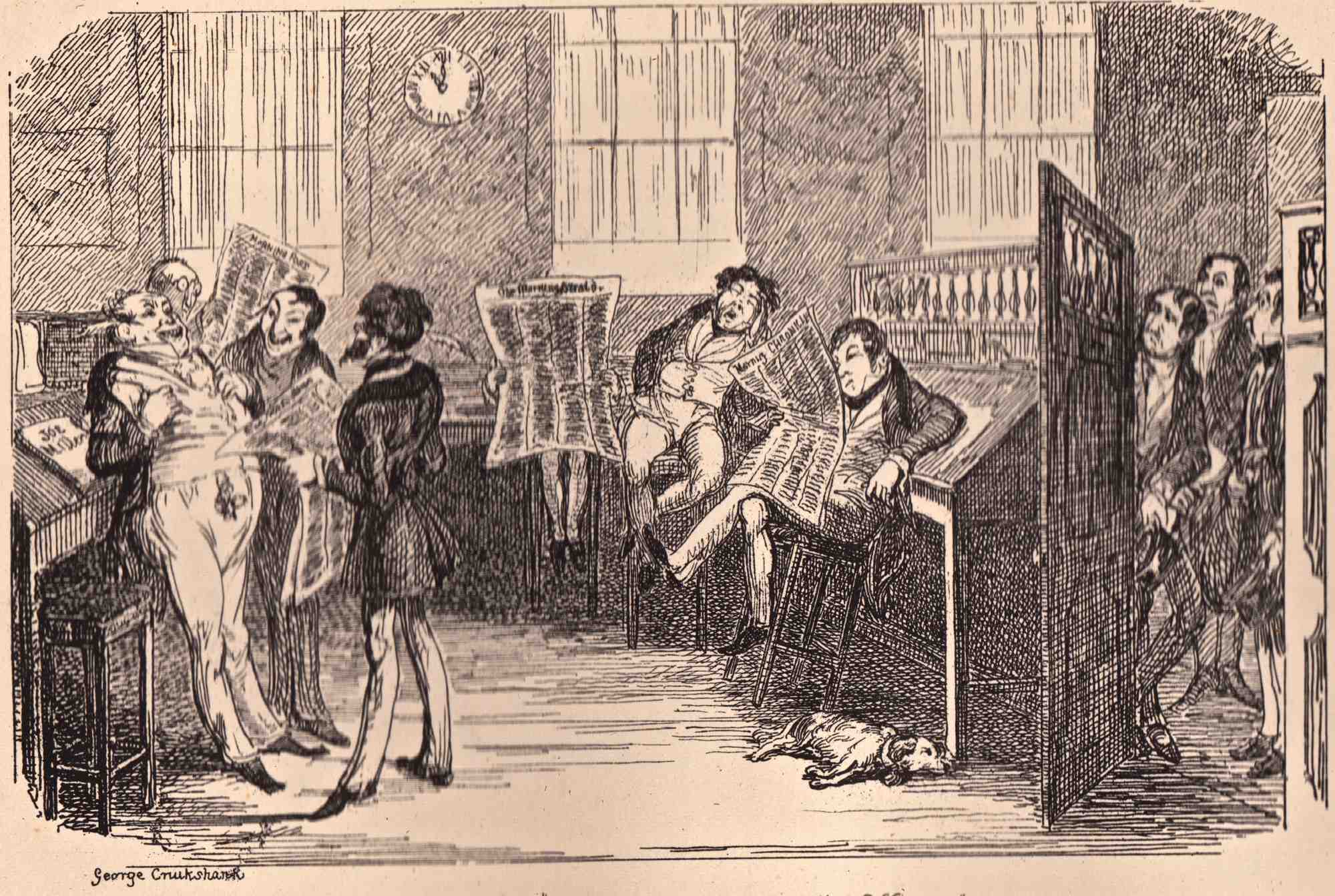
Should you ever require it, here is evidence of the constant volatility of English summer weather, courtesy of George Cruikshank’s Comic Almanack published by Henry Tilt of Fleet St annually between 1835 & 1853, illustrating the festivals and seasons of the year for Londoners. (Click on any of these images to enlarge)

JUNE 1835 – At the Royal Academy

JUNE 1836 – Holidays at the Public Offices

JUNE 1837 – Haymaking

JULY 1835 – At Vauxhall Gardens

JULY 1836 – Dog Days in Houndsditch

JULY 1837 – Fancy Fair

AUGUST 1836 – Bathing at Brighton

AUGUST 1837 – Regatta

SEPTEMBER 1835 – Bartholomew Fair

SEPTEMBER 1837 – Cockney Sportsmen
You may also like to take a look at
A Plaque For The Matchgirls
Tickets are available for my tour this weekend and throughout July.
Click here to book your ticket for THE GENTLE AUTHOR’S TOUR OF SPITALFIELDS

Yesterday a blue plaque was unveiled by Anita Dobson in recognition of the heroic achievements of the Matchgirls at the former Bryant & May Match Factory, Bow Quarter, Fairfield Rd, Bow. Today Samantha Johnson outlines the story of her great-grandmother Sarah Chapman, who was one of the strike leaders.

Sarah Chapman (1862 – 1945)
My great-grandmother was born on 31st October in 1862 to Samuel Chapman and Sarah Ann Mackenzie. At the time of her birth, her father was employed as a Brewer’s Servant and was also known to have worked in the docks. The fifth of seven children, Sarah’s early years were spent at number 26 Alfred Terrace in Mile End but, by the time she was nine, the family had moved to 2 Swan Court (now the back of the American Snooker Hall on Mile End Rd), where they stayed for the next seventeen years. For a working class family at this time to stay in one place for such a long time was uncommon. Other evidence of the stability of the Chapman family is that Sarah and her siblings were educated, as they were listed as Scholars in the census and could all read and write.
At the age of nineteen, Sarah was working alongside her mother and her older sister, Mary, as a Matchmaking Machinist, and by 1888 she was an established member of the workforce at the Bryant & May factory in Bow. At the time of the Strike, Sarah is listed as working in the patent area of the business, as a Booker, and was on relatively good wages, which perhaps placed her in a position of esteem among other workers. She was certainly paid more than most and this may have been because of her position as a Booker, or perhaps because she just managed to avoid the liberal fines which were meted out by the employers.
There was a high degree of unrest in the factory due to the low wages, long hours, appalling working conditions and the unfair fines system, which caused the women at the factory to grow increasingly frustrated. External influences, particularly the Fabian Society, also provided an impetus for the Strike. Ultimately, 1400 girls and women marched out of the factory, en masse, on that fateful day of 5th July 1888. The next day some 200 girls marched from Mile End down to Bouverie St in the Strand to see Annie Besant, one of the Fabians and a campaigner for women’s rights. A deputation of three (my great-grandmother Sarah Chapman, Mrs Mary Cummings and Mrs Naulls) went into her office to ask for her support. Although Annie was not an advocate of strike action, she did agree to help them organise a Strike Committee.
“We’d ‘ave come out before only we wasn’t agreed”
“You stood up for us and we wasn’t going back on you”
The first meeting of the striking Matchgirls was held on Mile End Waste on 8th July and both the Pall Mall Gazette and The Star provided positive publicity. This was followed by meetings with Members of Parliament at the House of Commons. The Strike Committee was formed and the following Matchgirls were named as members: Mrs Naulls, Mrs Mary Cummings, Sarah Chapman, Alice Francis, Kate Slater, Mary Driscoll, Jane Wakeling and Eliza Martin.
Following further intervention by Toynbee Hall and the London Trades Council, the Strike Committee was given the chance to make their case. They met with the Bryant & May Directors and by 17th July, their demands were met and terms agreed in principle. It was agreed that:
- All fines should be abolished.
- All deductions for paint, brushes, stamps, etc., should be put an end to.
- The 3d. should be restored to the packers.
- The “pennies” should be restored or an equivalent advantage given in the system of payment of the boys who do the racking.
- All grievances should be laid directly before the firm, before any hostile action was taken.
- All the girls to be taken back.
It was also agreed that a union be formed, that Bryant & May provide a room for meals away from where the work was done and that barrows be provided to transport boxes, replacing the practice of young girls having to carry them on their heads. The Strike Committee put the proposals to the rest of the workforce and they enthusiastically approved. Thus the inaugural meeting of the new Union of Women Match Makers took place at Stepney Meeting Hall on 27th July and twelve women were elected, including Sarah Chapman.
An indicator of the belief her fellow workers put in Sarah’s ability, was her election as the first TUC representative of the Match Makers’ Union. Sarah was one of seventy-seven delegates to attend the 1888 International Trades Union Congress in London and at the 1890 TUC she is recorded as having seconded a motion.
On the night of the 1891 census, Sarah was still a Booker at the match factory and living with her mother in Blackthorn St, Bromley by Bow, but in December of that same year, she married Charles Henry Dearman, a Cabinet Maker. By this time she had ceased working at Bryant & May.
Sarah and Charles had their first child, Sarah Elsie in 1892. They had five more children, one was my grandfather, William Frederick, born in 1898 when they had moved to Bethnal Green. Sarah’s two youngest sons, William and Frederick lived with her, on and off, into the thirties and she lived out her years there, dying in Bethnal Green hospital on 27th November 1945 aged eighty-three. She was survived by three of her six children, Sarah, William and Fred.
Sarah was buried alongside five other elderly people in a pauper’s plot at Manor Park Cemetery. It was a sad end to a brave life filled with challenges, not least a leading role in a Strike that was the vanguard of the New Labour Movement and helped establish Trade Unionism in this country.

Sarah as a member of the Matchgirls Union Committee

Sarah with her husband Charles Henry Dearman

Sarah with her grandson, Frederick William

Sarah in later years
You may also like to take a look at
In Old Deptford
Tickets are available for my tour this weekend and throughout July.
Click here to book your ticket for THE GENTLE AUTHOR’S TOUR OF SPITALFIELDS

In Albury St
Today Contributing Writer, the distinguished historian, Gillian Tindall goes in search of old Deptford
In my distant childhood, Deptford, with its unfair resonance of ‘debt,’ figured to the outside world as a place of sinister poverty. On that south side of the Thames, Bermondsey and Rotherhithe sounded faintly exciting, with overtones of putting out to sea. Greenwich, just downriver, with its park, Palace and College, was a different world. But Deptford, lost in between, lodged in many people’s minds, and in children’s stories, as a classic London slum. Nor, of course, was this image helped by the severe bombing it suffered in World War Two nor by the dreary estates built by post-war planners.
Yet Deptford, long ago, was a place of fertile green water-meadows, facing the Thames and adjacent to a creek. Here Henry VIII established his Royal Dockyard, in the days when he was a popular young sovereign rather than an obese tyrant. Ships built in Deptford went out all over the world for the next three-and-a-half centuries. By Shakespeare’s time, the scattered country village that had been medieval Deptford had expanded into a riverside settlement. Well-to-do Londoners came down by river to drink there on summer evenings. The fact that one such evening ended in the mysterious death of Shakespeare’s fellow playwright ‘Kit’ Marlow gives a false impression – Deptford was the Maidenhead or Henley of that time, a gentlemanly place to reside, and remained so for the next two centuries.
Marlowe lies buried somewhere in the flowery churchyard of the ancient parish church of St Nicholas. Two generations later, a regular attender at the church was John Evelyn, land owner, man of letters, diarist and courtier (the equivalent of a modern high-ranking civil servant). Through marriage, Evelyn had acquired Sayes Court Manor House, the largest house in Deptford, and from here he went back and forth to visit Charles II in Whitehall palace, often on naval business. Yet wealth and privilege could not protect against an all-too-common grief, also buried in St Nicholas churchyard are three of Evelyn’s children who died young, including one particularly bright little boy over whom his father mourned much. Evelyn wrote in his diary of ‘our extreme sorrow,’ and that ‘This evening, after the service, was my baby buried near the tower with his brothers. All my dear children.’
Evelyn, a great horticulturalist, laid out a splendid garden at Sayes Court, with evergreen and hawthorn hedges and new tree-species imported from abroad. He was one of the first to understand the role of trees in keeping the environment clean and he advised a mass planting operation across London – advice which, unfortunately, was not taken. Late in life, when he and his wife had retired to the Evelyn family country seat at Wootton, in Surrey, he rented his house and gardens at Deptford to a series of tenants, most notably to Peter the Great, the Russian Czar, who wanted to study English ship-building in particular and English life in general. Peter the Great, in spite of some brutally medieval habits towards his enemies, real or supposed, saw himself as a great innovator and the one who was going to drag Russia into the West and the modern age. He was responsible for founding St Petersburg on the western edge of his vast country, and employed European architects to design its palaces.
A statue of Peter the Great, looking oddly elongated in a heavy European coat and a tricorn hat, stands today on an elevated platform on the Thames path not far from the site of Sayes Court, beside a new estate overlooking the river and Deptford creek. Inexplicably, he is flanked by a dwarf and an ornate empty chair in which passing walkers love to sit. The inscription states that he arrived in England in January 1698 and stayed in Evelyn’s house for four months – ‘This monument is erected near the Royal ship-yard where Peter the Great studied English science of ship-building. The monument is a gift from the Russian people and commemorates the visit of Peter the Great to this country in search of knowledge and experience.’
But exactly what experience? It is not mentioned that, during the months he was at Sayes Court, Peter confirmed the common British perception of Russians as a barbaric, backward people by doing a great deal of damage both to the house and the garden. In particular, it is recorded he trashed a number of Evelyn’s carefully tended hedgerows by driving through them for fun in a barrow. The Russian oligarch as hate-figure is clearly not a new phenomenon in this country.
The Royal Dockyard declined in importance in the nineteenth century with the advent of large new warships too big for the Thames, and was closed in 1869. Various uses were found for it and by the twentieth century, when its Tudor vestiges were gradually destroyed or buried, its final use was as a paper-wharf for International Newspapers. Today, under the name ‘Convoys Wharf,’ it is scheduled for redevelopment with high tower blocks, in which few of the flats will be ‘affordable’ in any real sense.
A vestige of the Sayes Court garden does remain. In the mid-nineteenth century, when Deptford was being covered in small terrace houses for dockers, the Evelyn family, who still owned the land, gave a piece of it to the local authority to create a public garden. It survives today, though a refuge for drunks now. Better tended than it was a few years back when I first discovered it, the garden is currently on the World Monument Fund’s list of endangered spaces – presumably because of the looming Wharf development. In the centre of the garden, surrounded by railings, stands a giant mulberry tree, its knotted limbs trailing on the ground. I am sure it dates from John Evelyn’s own high summer of planting, and is another for the Gentle Author’s short list of ancient London mulberries.
Towards the end of Evelyn’s life, the old church was substantially rebuilt, and a new, more elegant one, St Paul’s, just off Deptford High St, offered extra space for the district’s expanding population. A few rows of fine town houses went up also, including Albury St which was built on land belonging to the Evelyn family and was called after their country retreat. Fine brick, and an elegant variety of porches decorated with cherubs, angels, fruit and flowers, made these houses fit homes for the sea-captains, ship-builders and Honourable Company men who were the new affluent middle class of Deptford.
One side of Albury St alone remains as a precious survival in a district that has seen so much destruction through war and bone-headed planning decisions. This enclave at least is now being carefully looked after, while what were once the wastelands of abandoned dockside uses are filling up with tall buildings. Like it or not, regret it or not, Deptford is being hauled into twenty-first century London.

Deptford Dockyard, 1775

Albury St

Entrance to the churchyard of St Nicholas, Deptford, where Christopher Marlowe is buried

St Nicholas, Deptford, dates from the twelfth century

Door to St Nicholas

Charnel House at St Nicholas

Graves at St Nicholas

St Paul’s church by Thomas Archer, c.1720

Manze’s in Deptford High St

Wellbeloved, Butcher & Grazier

In Deptford High St

In Deptford High St

In Deptford High St

In Deptford Market

In Deptford Market

In Deptford Market

Peter the Great by Sir Godfrey Kneller

Peter the Great at Deptford Creek by Mikhail Shemyakin

John Evelyn, engraving by T. Bragg after Sir Godfrey Kneller (Courtesy Wellcome Library)

John Evelyn’s Mulberry at Sayes Court Garden
You may also like to read about