
The Doors Of Old London

The door to Parliament
Look at all the doors where the dead people walked in and out. These are the doors of old London. Some are inviting you in and some are shutting you out. Doors that lead to power and doors that lead to prison. Doors that lead to the parlour, doors that lead to the palace, and doors that lead to prayer.
These are the doors that I found among hundreds of glass slides once used for magic lantern shows by the London & Middlesex Archaeological Society, many more than a century old, and housed today at the Bishopsgate Institute.
Looking at life through a doorway, we are all either on the way in or on the way out. Like the door to your childhood home that got sold long ago, each one pictured here is evidence of the transient nature of existence, reminding you that you cannot go back through the portal of time.
Yet there is a powerful enigma conjured by these murky pictures of old doors, most of which will never open again. Like the pauper or the lost soul condemned to wander the streets, we cannot enter to learn what lies behind these doors of old London. But a closed door is an invitation to the imagination and we can wonder and dream, entering those hidden spaces in our fancy.
London has always been a city of doors, inviting both the curiosity and the suspicion of the passerby. In each street, there is a constant anticipation of people popping out, regurgitated onto the street by the building, and the glimpse to be snatched of the interior before the door closes again.
I cannot resist the notion that every door contains a mystery and all I need is a skeleton key. Then we can set out to explore as we please, going in one door and out another, until we have passed through all the doors of old London.


The entrance to the Carpenters’ Hall


The doors of Lambeth Palace


Door in the cloisters in Westminster Abbey

The door to the chamber of Little Ease at the Tower of London.


In St Benet’s Church, Paul’s Wharf.


Back door of 33 Mark Lane

Back door to Lancaster House.

In Crutched Friars.

14 Cavendish Sq.

The door to 10 Downing St

39a Devonshire St.


The door to the House of Lords

Wren doorway, Kensington Palace.

The door to Westminster Abbey


St Dunstan’s in the West

The entrance to Christ Church, Greyfriars.

The door to St Bartholomew’s, Smithfield

Temple Church

The Watchhouse, St Sepulcre’s, Smithfield.

Door by Inigo Jones at St Helen’s Bishopsgate.

Prior Bolton’s Door at St Bartholomew the Great.


At the Tower of London
Glass slides courtesy Bishopsgate Institute
You may also like to take a look at
Bud Flanagan In Spitalfields

Bud Flanagan was born above his family’s fish & chip shop in Hanbury St
Today I publish reminiscences of Spitalfields written in 1961 by Bud Flanagan, the celebrated Music Hall comedian, part of the Crazy Gang and half of the legendary Flanagan & Allen double act. Born as Chaim Reeven Weintrop in 1896 into a Polish immigrant family who ran a fried fish shop in Hanbury St, Bud Flanagan began his performing career as a child in East End End Music Hall and came under the spell of street performers beneath the Braithwaite arches in Wheler St – that later featured in the song by which he and Chesney Allen are most remembered today, “Underneath The Arches.”
In common with Charlie Chaplin, who was his close contemporary and performed in Spitalfields at the Royal Cambridge Theatre of Varieties in 1899 where Bud Flanagan became a Call Boy in 1906, he adopted the persona and ragged costume of the dispossessed, revealing pathos and affectionate humour in the lives of those who were seen as downtrodden and marginal.
“The labyrinth of streets that go to make up the district of Spitalfields are narrow and mean. The hub of my world was the churchyard or, as the locals called it, “Itchy Park,” after the doss house habitues who would sun themselves on the benches or low stone walls that surrounded the park. They would sit there every day, scratching, yawning and looking into space. The cemetery was old and derelict, but it was a reminder that at one time Spitalfields was the centre of the weaving trade because nearly all the tombstones bore the inscription, “weaver.” Most of them were dated 1790-1820 and a few were still upright. Several had fallen over and on our way to school we would hop, skip and jump over them.
Hanbury St – where I was born – crawled rather than ran from Commercial St, where Spitalfields Market stood at one end, to Vallance Rd at the other, an artery that spewed itself into Whitechapel Rd at the other. On one corner stood Godfrey Philips’ tobacco factory, with its large ugly enamel signs, black on yellow, advertising “B. D. V. ” – Best Dark Virginia. It took up the whole block until the first turning, a narrow lane with little houses and a small sweet shop.
On the next corner was a barber’s shop and a tobacconist’s which my father owned. Next door to us was a kosher restaurant with wonderful smells of hot salt beef and other spicy dishes, then came the only Jewish blacksmith I ever met. His name was Libovitch, a fine black-bearded man, strong as an ox. From seven in the morning until seven at night, Saturdays excepted, you could hear the sound of hammer on anvil all over the street. Horses from the local brewery, Truman, Hanbury & Buxton, were lined up outside his place waiting to be shod.
Then came another court, all alleys and mean streets. Adjoining was Olivestein, the umbrella man, a fruiterer, a grocer, and then Wilkes St. On one side of it was a row of neat little houses and on the other, the brewery taking up streets and streets, sprawling all over the district. On the corner of Wilkes St stood The Weavers’ Arms, a public house owned by Mrs Sarah Cooney, a great friend of Marie Lloyd. She stood out like a tree in a desert of Jews. Stapletons depository, where horses were bought and sold, was next door to a fried fish shop, number fourteen Hanbury St where I was born. Next to that was Rosenthal, tailors and trimming merchants, then a billiard saloon, after that a money-lenders house where once lived the Burdett-Coutts.
Hanbury St was a patchwork of small shops, pubs, church halls, Salvation Army Hostels, doss houses, pubs, factories and sweat shops where tailors with red-rimmed eyes sewed by the gas-mantlelight. It was typical of the Jewish quarters in the nineties. The houses were clean inside but exteriors were shoddy. The street was narrow and ill-lit. The whole of the East End in those days was sinister.
Neighbours who slaved hard at their businesses left the district (once they began to save money) and moved to what was then nearly the country – Stamford Hill, a suburb in North London that was rapidly becoming a haven for the successful Jewish businessman and artisan. It was only a penny tram ride from Spitalfields to Stamford Hill, but often it took a lifetime of savings and struggle to make the move. When they got there, most were like fish out of water, sad at the parting from old friends and missing the old surroundings. Homesick, they even came all the way back to the East End to do their shopping. Eventually they were joined by their old neighbours, who too had crossed into the Promised Land.
Not everyone was lucky enough to move and among the stay-puts were my parents. First of all, they couldn’t afford it, and secondly the fish shop and barber’s made barely enough to keep a big family of five daughters and five sons. I first saw the light of day, if kids are not like kittens, on 14th October 1896. My parents, who had been in the country for years, could hardly be understood when speaking English. When a child was born the Registrar wrote down a rough phonetic version. I was named Chaim Reeven, which is Hebrew for Reuben and became Robert. My father’s name was Weintrop which the Registrar abruptly changed to “Winthrop.”
Ours was a district where the weak went to the wall and you had to keep your eyes open. When my father opened his fried fish shop, the salt cans were chained to each table and to the counter. But, as in every Jewish home, education was important and apart from ordinary school, I attended cheder for Hebrew lessons three nights a week. The East End at that time had several boys’ and girls’ clubs. I joined the Brady, named after a street tucked behind Hanbury St. We had ping pong, gymnastics and chess and it was a treat to get off the streets into the warm and play games without having fights, of which I had my share.
I became interested in conjuring and used to walk to Gamages in High Holborn and look longingly at the tricks they sold but without the coppers to buy them. To raise the money, I took a job as a Call Boy at the Cambridge Music Hall in Commercial St at the age of ten. The job was very handy. When the pros wanted fish & chips – and they wanted them every night – I went to my father’s shop. There were no wages, only tips, but I was soon able to buy my tricks and those I couldn’t afford I made. When the fish shop was closed on a Sunday, I let the kids in for a farthing, charging the older ones a ha’penny and gave them a show. Mothers would bring their children and soon there was a good sprinkling of grown-ups.
I was making a local name until one Sunday a big rat came out of nowhere and evil-eyed the audience. There were screams and before you could say “Abracadrabra!” the place had emptied. It did not do me any harm but word soon spread, “There are rats in the fish shop,” which was not surprising as we were next to a horse repository with its hay and oats. There wasn’t a morning when the traps had fewer than three or four big ones. I used to watch in fascinated horror as they drowned in a deep tub of water.
That was in 1908, the year the Music Hall artists decided to strike. Being only a call boy, I wasn’t worried by the strikers who picketed the Stage Door trying to persuade the non-strikers to come out. They weren’t really rough, only to the extent if grabbing a bottle of stout or some fish & chips out of my hand and asking whom they were for. I’d tell them and the lot would finish in the gutter. With tears in my eyes, I would run down the long corridor to the Stage Manager at the Prompt Corner and let him know what happened, but mostly I was left alone.
The management who owned the Cambridge also ran the London Music Hall in Shoreditch High St and Collins in Islington. The three halls were known as the L.C.C. – London, Collins & Cambridge. It was at the London that I made my first stage appearance.
Every Saturday at the 2:30pm they had an extra matinee when the acts worked for nothing. The place was packed with a good sprinkling of agents out front to see the fun and maybe pick up an act. The audience were like wolves, all ready for their Roman holiday, booing and jeering at anything they didn’t like. The Stage Manager in the corner, with his hand on the lever, was only too happy to join in the fun and bring down the curtain. The orchestra played with one eye on the music and one eye on the coins or rubbish that would be thrown at some unlucky act on the stage.
I was nearly thirteen and not too bad at manipulating cards and doing other tricks when I went to the London one Saturday afternoon together with my conjuring table and other props. I gave my name as Fargo, the Boy Wizard. The first prize was fifty shillings and a week’s work at the theatre.
The matinee produced some sixteen acts, most old-timers anxious for a week’s job and the cash, together with beginners who had never done a show outside their front room at home. The audience was as rough as ever and, at about 3:30pm, I came on. Being a kid, they were sympathetic towards me, but I was nervous and messed up my first trick. I had to pour water into a tumbler to make it beer and then pour it into another tumbler to make it milk. Alas, in my excitement, I had forgotten to smear the glasses with chemicals and instead of applause came jeers. Foolishly, I then asked to borrow a bowler hat. A bowler in Shoreditch! There was no such thing in the whole of the East End, let alone at the London Music Hall, Shoreditch. Well, I couldn’t do the trick with a cap and had to drop that illusion.
That started them off. Friends were in front, fellow scouts and Brady boys, but I got the bird. The curtain was rung down. I collected my props and and sneaked out of the Stage Door. There stood my father, waiting for me. A stinging right-hander caught me across the face, my ear is twisted, and I heard him saying, “I’ll give you, working on the Sabbath!” I was punched and pushed all the way home. My props lay somewhere in Shoreditch High St. I never saw them again.
I was growing to be a big boy but still working at the Cambridge. On my one free night, Sunday, we would go to the home of a man named Alf Caplin to sing songs and enjoy ourselves. He was a great pianist and one Sunday we decided to form our own quartet. We rehearsed an act and soon landed an engagement at a Dutch Club called “The Netherlands” situated in Bell Lane. The small stage was at the far end of the room and every Sunday there would be five acts, whose pay packet averaged about five shillings each. Dutch clog dancers and yodellers were the favourites. We called ourselves “The Four Hanburys, Juvenile Songsters,” and as there was plenty of club work in London on Sundays, we hoped to be recommended to other clubs.
We opened in harmony and it was nice bright tune, but after about eight bars the harmony was lost and we were all singing the melody but not not in tune. That was the first and only time I have ever been hit by a Dutch herring. I don’t know whether you have seen one but the brine and skin stick to your fingers when you eat them. So you can imagine what it does when one lands on your face. Several more came and that was the Four Hanburys finale.
Competitions were regular feature of the Music Halls and nearly every week the Cambridge had one. A singer, who also ran a competition, was a nice woman named Dora Lyric, married to a successful agent, Walter Bentley. Well, Dora was appearing at the Cambridge and also running the competition. One night there was scarcity of entrants. In desperation, her husband poked me with his stick and said, “Boy, you go on and sing one of Miss Lyric’s songs.” “Who me?” I echoed, trying to hide my eagerness and looking at the Stage Manager who nodded, “Yes.”
Dora Lyric had a popular song, “If you want to be a Somebody,” and I decided to sing that one. Being the only boy in the competition at that house, I won hands down and was picked for the final on Friday night. At the final, there were ten competitors who had won their respective heats, but I won the competition and that precious thirty shillings.
American acts had been coming over to play the Halls for some time now and they fascinated me with their new style and approach to the public and especially by their way of talking. British artists soon cottoned on and before time there was a spate of imitators of American-style acts, watching them from the gallery and then going round the corner to the Arches – a long street under a railway which carried the mainline to Liverpool St Station and ran from Commercial St to Club Row, a Sunday market where they sold mostly dogs and canaries. There the pros would practise to mouth-organ acompaniment, night after night, until they had copied the Yanks most intricate steps.
I became so interested in the Americans that I decided, after talking with them and reading about the States, that I must go there one day. The year was 1910, I was still at school and had about three months to finish. We were still in Hanbury St and on the day before I was fourteen, I made up my mind I was going to the New World, the place my dad tried to get to and never did. But my first impression of New York was a sad shock – Hanbury St, Spitalfields, seemed like the Mall in comparision…”

Chaim Reeven Weintrop (later known as Bud Flanagan) at the age of two with his brother Simon

The red premises are the former fish and chip run by Bud Flanagan’s family, where the young comedian staged magic shows on Sunday afternoons until a rat appeared and put a stop to it. The yard to the right was where Libovitch the blacksmith shoed the horses from the Truman Brewery.

Wolf & Yetta Weintrop fled Poland in the eighteen-eighties hoping to get to New York but settling in Spitalfields where they ran a fish & chip shop in Hanbury St

“On one corner stood Godfrey Phillips’ tobacco factory, with its large ugly enamel signs”

“Stapletons depository, where horses were bought and sold”

Cambridge Theatre of Varieties in Commercial St where Bid Flanagan was a Call Boy at ten years old

Handbill for Cambridge Theatre of Varieties

Bud Flanagan at the peak of his fame

“The Arches – a long street under a railway which carried the mainline to Liverpool St Station and ran from Commercial St to Club Row, a Sunday market where they sold mostly dogs and canaries. There the pros would practise to mouth-organ acompaniment, night after night, until they had copied the Yanks most intricate steps.”

You may also like to read about
Hogarth At St Bartholomew’s Hospital

In 1733, when William Hogarth heard that the governors of St Bartholomew’s Hospital were considering commissioning the Venetian artist, Jocopo Amigoni, to paint a mural in the newly constructed North Wing of the hospital, he offered his own services free. Always insecure about his social status, it was a gesture of largesse that made him look good and provided the opportunity for Hogarth to prove that an English artist could excel in the grand historical style. Yet such was the mistaken nature of Hogarth’s ambition that his “Jesus at the Pool of Bethesda” is a curious hybrid at best. Illustrating Christ healing the sick, each of the figures in the painting illustrate different ailments, a bizarre notion that undermines Hogarth’s aspiration to the sublime classical style and results in a surreal vision of a dystopian arcadia instead. In plain words, it is a mighty piece of kitsch.
At the centre of the composition is Christ reaching out to the crippled man at the Pool of Bethesda, as described in the Gospel of St John. The bible tells us this man had been incapacitated by the pool for thirty-eight years, which makes the muscular physique that Hogarth gave him a little far fetched. It owes more to the requirements of the classical style than to veracity, although Hogarth did choose to portray him with a chronic leg ulcer to introduce an element of authenticity to the figure.
In the background, a man is accepting a bribe from the servant of the naked woman with the wanton attitude on the right of the composition, this is to push the mother with the sick baby out of the way so that his mistress can get to the healing water of the pool first. The reason for her unscrupulous haste is that she has a sexually transmitted disease, most likely gonorrhea, indicated by the rashes upon her knees and elbows. Finally, we complete the sorry catalogue with the pitiful man with the swollen abdomen on the extreme right of the canvas, he has liver cancer.
Hogarth painted “Jesus at the Pool of Bethesda” in his studio in St Martin’s Lane in early 1737 and it was put in place at Bart’s in April. Although it is a huge painting, approximately thirty feet across, its position on the stairwell means that you see just a portion of the picture from the foot of the stairs, then you pass close by it as you ascend the staircase and only achieve a vision of the entire work from the head of the stairs. Let me confess that this arrangement does the painting no service. When you see it close up, the broad theatrical brushstrokes of the framing scrolls and of the background, which were painted by George Lambert, scenery painter at Covent Garden, become crudely apparent.
Perhaps these ungainly miscalculations in “Jesus at the Pool of Bethesda” were what led Hogarth to paint the companion piece “The Good Samaritan” in situ, from a scaffolding frame. Did he get seduced by the desire for monumentalism while painting the “Jesus at the Pool of Bethesda” in his studio and forget that it would be seen close to, as well as from a distance? Time has done the picture no favours either. With innumerable cleanings and restorations, the canvas has buckled and now daylight prevents you from seeing the painting without reflections, blanking out whole areas of the image. Maybe this was the reason for Hogarth’s instruction that the picture should never be varnished? It was ignored.
I cannot avoid the conclusion that “Jesus at the Pool of Bethesda” was a misdirection for Hogarth. He aspired to be an artist in the high classical style, yet we love Hogarth for his satires and his portraits. We love his humanity, recording the teeming society that flourished in the filth of eighteenth century London. These pictures speak more of life than any idealised visions of nymphs and swains frolicking in a bucolic paradise. And, even in this, his attempt at a classical composition, Hogarth’s natural sympathy is with the figures at the margins. Far from proving that an English artist could excel at the grand historical style,”Jesus at the Pool of Bethesda” illustrates why this mode never suited the native temperament. All the qualities that make this painting interesting, the human drama and pitiful ironies, are out of place in the idealised landscape that suited the tastes of our continental cousins.
Hogarth was born in Bartholomew Close and baptised around the corner from the hospital at St Bartholomew’s Church. At the time of “Jesus at the Pool of Bethesda,” Hogarth’s mother still lived nearby and she must have been proud to see her son’s painting installed in the fine new hospital buildings. It was symbol of how far he had come. Yet, for obvious reasons, the painting is mostly ignored in books of Hogarth’s work today, so the next time you are in Smithfield, go in and take a look, and savour its bizarre qualities for yourself.


This woman has a sexually transmitted disease

This man has cancer of the liver


The poor box at the entrance to the North wing.

The new entrance to St Bartholomew’s Hospital built in 1702, with the north wing containing Hogarth’s mural just visible through the gate

St Batholomew’s Church in Smithfield where William Hogarth was baptised.
Photographs of the mural © Patricia Niven
You might also like to read about
Ken Sequin’s Badge Collection
From hundreds in his magnificent collection, Ken Sequin kindly selected badges for me with a local connection – and they comprise an unexpected history of the East End.
Button badges were invented in 1896, when Benjamin Whitehead of Whitehead & Hoag in New York filed a patent for a celluloid-covered metal badge, swiftly opening offices in London, Toronto & Sydney as the craze went global.
Adopted first as a means of advertising by tobacco companies, button badges were quickly exploited for political, religious and fund-raising purposes by all kinds of clubs and organisations.

Kingsland Rd Costermongers Association manufactured by E. Simons, late nineteenth century – one of the rarest badges, possibly a unique survivor

Souvenir of Dirty Dick’s in Bishopsgate, twenties or thirties

St John at Hackney Parochial School founded in 1275 is one of the oldest in the country, early twentieth century

Woolwich Arsenal Football Club, 1907

Hackney Band Club, hat badge c1873, one of the most radical Working Men’s Clubs

Boer War, 1900 – one of the very earliest button badges in this country

Reverse of previous badge, note local manufacturer

Royal Eye Hospital, Moorfields – early twentieth century

Lea Bridge Speedway Supporters’ Club – 1928-32

Dartford Pageant, 1932

Possibly the Regal Edmonton, 1934

Bethnal Green Men’s Institute, Gymnastics, Turin St, early twentieth century

Temperance and Salvation Army buttons, early twentieth century

Dockers Trade Union Badge, established 1889

A cache of badges found in an allotment shed in Walthamstow

World War II propaganda badges

Salvage. Dulwich Council

St George’s Sunday School, Weslyan Mission House, in the eighteen-nineties it took over Wilton’s Music Hall

Reverse of previous badge

WWII National Air Raid Precautions Animals Committee, dog’s identity badge

World War II badges for fundraising clubs to build airplanes

WWII Fundraising club to buy a destroyer

First Labour Mayor of Poplar, Will Crooks was elected MP for Woolwich in 1902

Reverse of buttons above

Dulwich & District Defence League, a Home Front battalion established in 1915

The Mildmay Hospital in Shoreditch was named after Francis Bingham Mildmay in 1890

Early twentieth century silver badge rewarding service in hospital ‘meals on wheels’ service

Barnado’s Young Helpers’ Badge with a portrait of the founder, early twentieth century

Tilbury Seamen’s Hospital, ‘For services rendered’ – possibly thirties

John Groom’s Crippleage & Flower Girls Mission, fund-raising rosettes, c 1900
Photographs copyright © Ken Sequin
You might also like to take a look at
John Gillman’s Bus Ticket Collection
Viscountess Boudica’s Domestic Appliances
Libby Hall’s Dog Photography Collection
Clive Murphy’s Matchbox Label Collection
Spires Of City Churches

Spire of St Margaret Pattens designed by Christopher Wren in the medieval style
I took my camera and crossed over Middlesex St from Spitalfields to the City of London. I had been waiting for a suitable day to photograph spires of City churches and my patience was rewarded by the dramatic contrast of strong, low-angled light and deep shadow, with the bonus of showers casting glistening reflections upon the pavements.
Christopher Wren’s churches are the glory of the City and, even though their spires no longer dominate the skyline as they once did, these charismatic edifices are blessed with an enduring presence which sets them apart from the impermanence of the cheap-jack buildings surrounding them. Yet they are invisible, for the most part, to the teeming City workers who come and go in anxious preoccupation, barely raising their eyes to the wonders of Wren’s spires piercing the sky.
My heart leaps when the tightly woven maze of the City streets gives way unexpectedly to reveal one of these architectural marvels. It is an effect magnified when walking in the unrelieved shade of a narrow thoroughfare bounded on either side by high buildings and you lift your gaze to discover a tall spire ascending into the light, and tipped by a gilt weathervane gleaming in sunshine.
While these ancient structures might appear redundant to some, in fact they serve a purpose that was never more vital in this location, as abiding reminders of the existence of human aspiration beyond the material.

In the porch of St James Garlickhythe where I sheltered from the rain

St Margaret Pattens viewed from St Mary at Hill

The Monument with St Magnus the Martyr
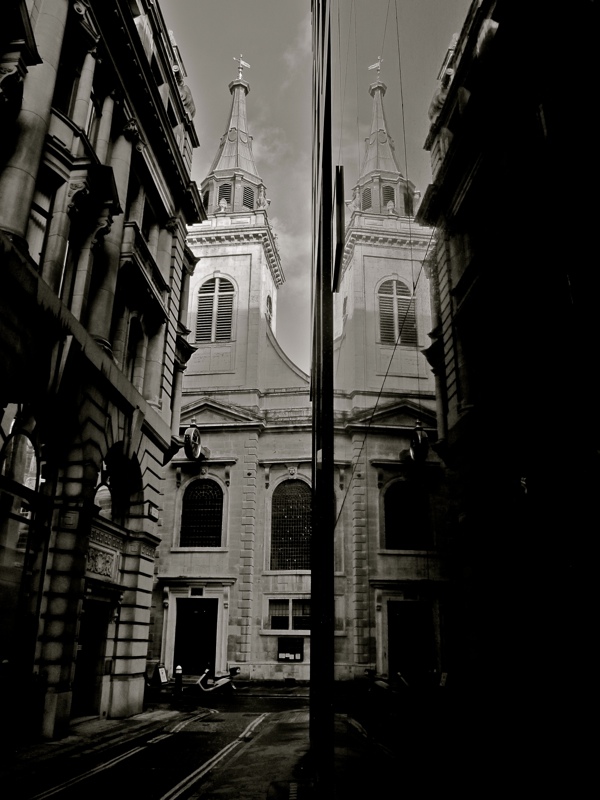
St Edmund, King & Martyr, Lombard St

St Michael Paternoster Royal, College Hill

Wren’s gothic spire for St Mary Aldermary

St Augustine, Watling Street

St Brides, Fleet St

In St Brides churchyard

St Martin, Ludgate

St Sepulchre’s, Snow Hill

St Michael, Cornhill

St Mary Le Bow, Cheapside

St Alban, Wood St

St Mary at Hill, Lovat Lane

St Peter Upon Cornhill

At St James Garlickhythe
You may also like to take a look at
My Spring Shirt
Thanks to your magnificent support, we have reached our crowdfunding target to launch THE GENTLE AUTHOR’S TOUR OF SPITALFIELDS. The booking website will go live at the beginning of next month and tours will commence at Easter, running throughout the summer.

I pulled this shirt out of my cupboard this week in advance of the arrival of spring. If you look closely, you will see the collar is wearing through but this does not diminish my affection for this favoured garment that I have worn for years now, bringing it out just for these few months at the end of winter. Although most of the clothes I own are of undecorated design, there is a gentle lyrical quality about this pattern that appeals to me.
When I wear this shirt with a dark jacket, the colours really sing and I feel am doing my bit in participating in the seasonal change. This contrast of formal clothing with a sprigged shirt can express dignified restraint while at the same time revealing an attachment to flowers, plants, gardens and nature – a contrast that I recognise in my own personality.
I love the conceit of having violets on my shirt when those in my garden are in flower and I enjoy the subtle tones of all the flowers portrayed, remaining as recognisable species while artfully stylised to make a pattern. The evocation of the natural world in this simple design touches a chord for me and, as with so many things that trigger an emotional response, I discovered that my passion for these floral patterns from Liberty goes back a long way.
When I came across the familiar photograph of my mother Valerie as a child, which you can see below, I did a double-take when I recognised the pattern on the dress. It was a Liberty print, very similar to my spring shirt which I hold in such affection. In that moment, I recalled that my grandmother Katherine bought fabric at Liberty in London and had it made up into dresses for my mother in the nineteen-thirties. This was a gesture which made such an unforgettable impression on my mother that for her whole life she carried her delight in these cotton dresses, which were so magical to her as a little girl in Somerset. Floral prints fed her innocent imagination, nurtured by ‘Songs of the Flower Fairies’ and performing as one of Titania’s attendants in a school play.
A generation later, I grew up with the received emotion of this memory – a story my mother told me when I was a child. I thought I had forgotten, but I realised it was through an unconscious recollection of the photograph of my mother in the Liberty dress that I was attracted to this flowery shirt, without understanding the origin of my desire at the time.
The story was confirmed when my Uncle Richard moved out of the old house where he and my mother grew up and, in my grandmother’s dressing table, I found a small leather pocket diary from the thirties recording her London trip with the entry, “Stayed at Claridges. Ordered carpet and sideboard at Harvey Nichols and bought materials at Liberty.” My grandmother was the daughter of a diminished aristocratic family who married my grandfather Leslie, a bank manager, and adopted an autocratic manner to ameliorate her loss of status. Consequently, my mother, with admirable resourcefulness, ran away from home at nineteen to escape my bossy grandmother and married my father Peter, who was a professional footballer – an act of social rebellion that my grandmother never forgave.
Nevertheless, the taste I acquired for these old-fashioned designs reflects the fondness my mother carried for that special moment in her childhood which she never forgot, when my grandmother showed maternal kindness to her little daughter in the gift of flowery cotton dresses. An act which came to represent everything about my grandmother that my mother could embrace with unqualified affection, and she encouraged me to remember the best of people too, a prerogative I claim in this instance as the sole living representative of these characters.
Today, I wear my shirt as the sympathetic illustration of a narrative which extends over three generations, culminating in my own existence upon this earth, and as I button my spring shirt, before walking out to celebrate sunshine and a new beginning, I am reminded that I alone carry these emotional stories now, clothing me in the humble affections of my forebears.

The Gentle Author’s mother ‘Valerie’ in the nineteen-thirties

Liberty of London
You may like to read these other stories of The Gentle Author’s family
A Final Push!

Map drawn by Adam Dant
Thanks to your generosity, over the past month we have already reached over 90% of our target and now we have until midnight on Monday to raise the final £400.
The amount of goodwill has been truly uplifting with over three hundred and fifty supporters so far from across London, UK and the world.
If you know of anyone who you think might like to help, please drop them a line this weekend or forward this email to your family, friends, neighbours and colleagues.
Tours will commence at Easter and run throughout the summer.
CLICK HERE TO SUPPORT THIS PROJECT

A FEW SELECTED COMMENTS FROM OVER 100 BY SUPPORTERS FROM AROUND THE WORLD
There are more stories to be told about Spitalfields and I want to hear them !
Jonathan Pryce
Wishing you great success!
Hallie Rubenhold
It is wonderful to be able to support such a lovely project telling the true human stories of the people of the East End of London. Thank you to The Gentle Author who has brought us so much pleasure to start our day with such a gentle morning blog . This Community Tourism Project is a privilege to contribute to. It is going to be a real enhancement to this part of London. I love London. I am a Londoner I proudly have my name on the Globe, the Millennium Bridge, the National Theatre, the William Morris Gallery. We are proud to be in the stones of London.
Jane Jewell
My father’s family came from the area. My great-grandfather who was a cabinet maker had a workshop off Brick Lane and met his wife there. The Gentle Author deserves our support for this wonderful work revealing the history and characters of the East End.
Novel Entertainment
Oh what a truly wonderful endeavour – I think Polly, Annie, Elizabeth Catherine and Mary Jane will be soo glad and proud and relieved too wish they were here to join in … perhaps they will…
Sophie Thompson
Another brilliant initiative from that most gentle of authors and showing a steely determination not only to push back against naff exploitation tourism but to practically offer something much more interesting.
Iain B
I am pleased to support this project. I have ancestors who lived and worked in Spitalfields in the weaving and carpentry industries. My paternal family owned a furniture business in Old Castle Street. I have a 5x great grandfather who was a Master Weaver trading in Grey Eagle Street.
Sarah Cartwright
What a great idea. I’ve long thought that the emphasis on the negative sides of London’s East End was a bad thing for both the people of the area and education. This will go some way towards righting that wrong.
Marie Nicholson
We wish you every success with these tours celebrating the rich and diverse history of Spitalfields. They will be a superb alternative to the awful and exploitative tours which troop through the area in their fifties and more. Thank you.
Jonathan Critchley
Sharing stories of real people is so important. It will help ‘populate’ this incredible area with figures from the past in our imaginations; and I know that The Gentle Author will genuinely represent that past with accuracy too!
Ngaire Bushell
Yvonne Cheyney, Southern California follows the Gentle Author each day. Her sister, Audrey Kneller, was featured in one of the stories about Elder Street and the Jewish East End. We look forward to going on one of the tours in the future.
Yvonne Cheyney
This is an absolutely necessary project, and one I support with every atom I have. Although I am not from the East End of London, or even the UK, the opposition to the darker and sinister tours of the same area, this project by The Gentle Author needs all the support possible.
Sebastiaan Eldritch-Boersen
It’s very simple really – the truth does set us free – so we need to learn the truth about the world we have all come from. And it is an amazing story.
George Staw
Best of luck to you, from Arizona!
Leah Wolfe
Thank you for your much needed example.
Susan Thorne
Have been reading your blog for many years and now want to walk with those beautiful words in my head.
David Warwick
Great project and initiative – which should have a really positive impact in ensuring the amazing story of this special area of London is properly shared and in a sustainable way. All the very best.
Howard Davies
In honour of our Gentle Author
Ellen R Sippel
I worked on Fashion Street for seven years — it’s a fascinating area, with a fascinating history, and deserves so much more than the ghoulish tours. I do hope you get this project off the ground.
Andrew Beaven
Dear Gentle Author, I totally support your cause to share the extraordinarily rich history of the people and buildings of Spitalfields with a wider audience and to take back the subject matter from the ghoulish, crowd-pleasing topic of Jack the Ripper. I have for years brought groups for tours of Spitalfields with Charlie de Wet but at present, she is, as you may know, unable to do them but I have an audience who would love to discover the important history of Spitalfields on one of your tours. Very best wishes with the project.
Sue Stamp
Hello from Australia. Always read your ‘feed’. Best of luck!
Jim Carroll
You are the only person, Gentle Author, to tell my school life story on a public site. You gave me back my dignity and heralded my poetry. Thank you.
Andy Strowman
Thanks from a Canadian fan for all the entertaining stories about the life and times of the people & places in Spitalfields.
Bonnie Burgess
Particularly admire your calling out the misogyny which is all too endemic and has to be challenged. I hope you wont overlook, by name, the profound influence of many out and proud same-sex attracted people in the neighbourhood through the ages.
Richard Kirker
It is so important to celebrate the many and varied individuals who live and work in Spitalfields. It has a rich history that could add so much to the understanding of those who visit London. Spitalfields must not continue to be defined by the murderous acts of one vile individual.
Vivienne Palmer
Wonderful endeavour. There is so much history of creativity, beauty and also pain and poverty in our area. It will be lovely to see this told well, as inimitably it shall be. Thankyou.
Linda Wilkinson
I’ll probably never get a chance to do one of your tours (Vancouver, Canada is a LONG way away), but I am happy to support you.
Susan Henry
What a brilliant idea. My ancestors lived in Spitalfields, some were silk weavers, and I’d love for people to learn more about their way of life that doesn’t revolve around a certain serial killer or the workhouse! Wish I could chip in more, but good luck!
Helena Smith
There is so much more to the Spitalfields area than Ripper tours. A strong change of focus is an excellent idea. We are happy to support with our best wishes.
London Historians
This is REALLY important work led by a person of great integrity with a genuine commitment to his community and home area. Its brilliant to have something really positive for Spitalfields and Spitalfields people happening and be able to support it.
yellowferret
From across the sea: When my grandsons (now aged seven) make their first visit to London in a few years’ time, I want to be able to place them in the hands of the Gentle Author! I have so much enjoyed the blog and the books.
Heather E Cole
Three cheers for the Gentle Author’s tour of Spitalfields!
Julie
This is a great initiative to hear the real voices and experiences of real East Enders! #SaveBrickLane
Saif
Man, what a great idea. I’ve always thought Jack the Ripper tours were gross, and I’d love to go on something like this.
Jean Ping
So glad to see The Tour about to become available to everyone who wants to walk in the footsteps of Spitalfields past, present, and future. We Torontonians may not get there this year but we’ll hold onto the tickets. Thank you, GA, for all you do for your blog followers and the residents of London! All best wishes to you.
Linda Grandfield
I’m happy to help. I regularly (at least before the pandemic) bring university students with me to London. I’m looking forward to booking a tour when we return to traveling! The blog is fabulous and can’t wait for the tour.
Kathy J Callahan


