
In Old Deptford
Tickets are available for my tour this weekend and throughout July.
Click here to book your ticket for THE GENTLE AUTHOR’S TOUR OF SPITALFIELDS

In Albury St
Today Contributing Writer, the distinguished historian, Gillian Tindall goes in search of old Deptford
In my distant childhood, Deptford, with its unfair resonance of ‘debt,’ figured to the outside world as a place of sinister poverty. On that south side of the Thames, Bermondsey and Rotherhithe sounded faintly exciting, with overtones of putting out to sea. Greenwich, just downriver, with its park, Palace and College, was a different world. But Deptford, lost in between, lodged in many people’s minds, and in children’s stories, as a classic London slum. Nor, of course, was this image helped by the severe bombing it suffered in World War Two nor by the dreary estates built by post-war planners.
Yet Deptford, long ago, was a place of fertile green water-meadows, facing the Thames and adjacent to a creek. Here Henry VIII established his Royal Dockyard, in the days when he was a popular young sovereign rather than an obese tyrant. Ships built in Deptford went out all over the world for the next three-and-a-half centuries. By Shakespeare’s time, the scattered country village that had been medieval Deptford had expanded into a riverside settlement. Well-to-do Londoners came down by river to drink there on summer evenings. The fact that one such evening ended in the mysterious death of Shakespeare’s fellow playwright ‘Kit’ Marlow gives a false impression – Deptford was the Maidenhead or Henley of that time, a gentlemanly place to reside, and remained so for the next two centuries.
Marlowe lies buried somewhere in the flowery churchyard of the ancient parish church of St Nicholas. Two generations later, a regular attender at the church was John Evelyn, land owner, man of letters, diarist and courtier (the equivalent of a modern high-ranking civil servant). Through marriage, Evelyn had acquired Sayes Court Manor House, the largest house in Deptford, and from here he went back and forth to visit Charles II in Whitehall palace, often on naval business. Yet wealth and privilege could not protect against an all-too-common grief, also buried in St Nicholas churchyard are three of Evelyn’s children who died young, including one particularly bright little boy over whom his father mourned much. Evelyn wrote in his diary of ‘our extreme sorrow,’ and that ‘This evening, after the service, was my baby buried near the tower with his brothers. All my dear children.’
Evelyn, a great horticulturalist, laid out a splendid garden at Sayes Court, with evergreen and hawthorn hedges and new tree-species imported from abroad. He was one of the first to understand the role of trees in keeping the environment clean and he advised a mass planting operation across London – advice which, unfortunately, was not taken. Late in life, when he and his wife had retired to the Evelyn family country seat at Wootton, in Surrey, he rented his house and gardens at Deptford to a series of tenants, most notably to Peter the Great, the Russian Czar, who wanted to study English ship-building in particular and English life in general. Peter the Great, in spite of some brutally medieval habits towards his enemies, real or supposed, saw himself as a great innovator and the one who was going to drag Russia into the West and the modern age. He was responsible for founding St Petersburg on the western edge of his vast country, and employed European architects to design its palaces.
A statue of Peter the Great, looking oddly elongated in a heavy European coat and a tricorn hat, stands today on an elevated platform on the Thames path not far from the site of Sayes Court, beside a new estate overlooking the river and Deptford creek. Inexplicably, he is flanked by a dwarf and an ornate empty chair in which passing walkers love to sit. The inscription states that he arrived in England in January 1698 and stayed in Evelyn’s house for four months – ‘This monument is erected near the Royal ship-yard where Peter the Great studied English science of ship-building. The monument is a gift from the Russian people and commemorates the visit of Peter the Great to this country in search of knowledge and experience.’
But exactly what experience? It is not mentioned that, during the months he was at Sayes Court, Peter confirmed the common British perception of Russians as a barbaric, backward people by doing a great deal of damage both to the house and the garden. In particular, it is recorded he trashed a number of Evelyn’s carefully tended hedgerows by driving through them for fun in a barrow. The Russian oligarch as hate-figure is clearly not a new phenomenon in this country.
The Royal Dockyard declined in importance in the nineteenth century with the advent of large new warships too big for the Thames, and was closed in 1869. Various uses were found for it and by the twentieth century, when its Tudor vestiges were gradually destroyed or buried, its final use was as a paper-wharf for International Newspapers. Today, under the name ‘Convoys Wharf,’ it is scheduled for redevelopment with high tower blocks, in which few of the flats will be ‘affordable’ in any real sense.
A vestige of the Sayes Court garden does remain. In the mid-nineteenth century, when Deptford was being covered in small terrace houses for dockers, the Evelyn family, who still owned the land, gave a piece of it to the local authority to create a public garden. It survives today, though a refuge for drunks now. Better tended than it was a few years back when I first discovered it, the garden is currently on the World Monument Fund’s list of endangered spaces – presumably because of the looming Wharf development. In the centre of the garden, surrounded by railings, stands a giant mulberry tree, its knotted limbs trailing on the ground. I am sure it dates from John Evelyn’s own high summer of planting, and is another for the Gentle Author’s short list of ancient London mulberries.
Towards the end of Evelyn’s life, the old church was substantially rebuilt, and a new, more elegant one, St Paul’s, just off Deptford High St, offered extra space for the district’s expanding population. A few rows of fine town houses went up also, including Albury St which was built on land belonging to the Evelyn family and was called after their country retreat. Fine brick, and an elegant variety of porches decorated with cherubs, angels, fruit and flowers, made these houses fit homes for the sea-captains, ship-builders and Honourable Company men who were the new affluent middle class of Deptford.
One side of Albury St alone remains as a precious survival in a district that has seen so much destruction through war and bone-headed planning decisions. This enclave at least is now being carefully looked after, while what were once the wastelands of abandoned dockside uses are filling up with tall buildings. Like it or not, regret it or not, Deptford is being hauled into twenty-first century London.

Deptford Dockyard, 1775

Albury St

Entrance to the churchyard of St Nicholas, Deptford, where Christopher Marlowe is buried

St Nicholas, Deptford, dates from the twelfth century

Door to St Nicholas

Charnel House at St Nicholas

Graves at St Nicholas

St Paul’s church by Thomas Archer, c.1720

Manze’s in Deptford High St

Wellbeloved, Butcher & Grazier

In Deptford High St

In Deptford High St

In Deptford High St

In Deptford Market

In Deptford Market

In Deptford Market

Peter the Great by Sir Godfrey Kneller

Peter the Great at Deptford Creek by Mikhail Shemyakin

John Evelyn, engraving by T. Bragg after Sir Godfrey Kneller (Courtesy Wellcome Library)

John Evelyn’s Mulberry at Sayes Court Garden
You may also like to read about
A Few Diversions By John Claridge
Tickets are available for my tour this weekend and throughout July.
Click here to book your ticket for THE GENTLE AUTHOR’S TOUR OF SPITALFIELDS

The Daily Message in E3, 1972
Taken between 1959 and 1982, each one of these East End pictures by John Claridge contains a diversion of some kind – either illustrating an activity that is incidental to the flow of life or presenting an observation that is itself a distraction. “These are small incidents, humdrum diversions like going to the hairdresser or the baths, not shattering moments but part of the life of the community all the same,” he assured me. Yet although these sly visual anecdotes may refer to marginal or quotidian experiences, they can sometimes reveal as much or more about the texture and tenor of their times than any news photo of the day.
John collected his observations of life out of a fascination to explore the strange poetry of existence, revealing his interest in reflections upon images seen through glass, his passion for lettering and design, and especially his delight in people. He takes pleasure in observing how they inhabit a place, and how they show their creativity when they strive to make themselves at home, even in the most unlikely or inopportune of circumstances.

Bridalwear shop, Spitalfields 1966. “Wherever you went at that time, there was always a bridal shop.”

Twenty past one? Spitalfields 1967. “You couldn’t design it better!”

American wrestler and trainer, Walthamstow Town Hall 1982. “They asked me to take the picture.”

Barbers, Spitalfields 1964. (note spelling of ‘closing’)

Accordion player, Spitalfields, 1970. “He was playing under an arch and the sound drifted around, it was wonderful.”

Corsetiere, Whitechapel 1961. “A man came up to me while I was doing this and asked, ‘What are you doing?’ ‘I’m taking a picture,’ I said. ‘There’s something wrong with you, lad,’ he replied.”

East Ham baths, E6 1961. “After Saturday morning football, we always went to East Ham baths to have a bath.”

Football in the street, Spitalfields 1959.

Sweet kiosk, Spitalfields 1967. “See my reflection in this picture. She was so proud. Afterwards, she and her friends came out to be photographed.”

Snack bar – cold drinks, Spitalfields 1982.

Boy on a rocking horse, E2 1982. “Look at the conditions he’s living in. The bars look like a prison and he’s got nowhere to go.”

At the 59 bikers’ club, E9 1973. Founded by Father William Shergold, biker priest, in 1959 to bring mods and rockers together.

Lady on the balcony, Spitalfields 1962. “Her diversion for the day was standing there and watching the world go by.”

Windmill seller, E2 1961.

Washing day, E14 1961. “I just came out of my girlfriend’s house and she said, ‘Look, it’s washday across the road.'”

Man with jobs poster, Spitalfields 1963. “I asked him, ‘Are you alright for a couple of bob?’ and he sat in the sun for me for a moment.”

Ear piercing, Spitalfields 1964. Is this ear piercing done to people over five years of age, or has the jeweller been piercing ears since five years of age?

Hotdog van, Spitalfields 1961.

Cup of tea, Spitalfields 1964. “Settled onto this old sofa in the market, enjoying his cup of tea, he looks like he should be wearing an eighteenth century wig and coat.”
Photographs copyright © John Claridge
You may also like to take a look at
So Long, Old Church Nursery School
Tickets are available for my tour this weekend and throughout July.
Click here to book your ticket for THE GENTLE AUTHOR’S TOUR OF SPITALFIELDS

Guest Writer Jonathan Moules celebrates the remarkable history of a much-loved Stepney educational institution and the inspirational work of Bridget Cass, with pictures by Contributing Photographer Rachel Ferriman.
The end of term beckons for children across England. But for Stepney’s Old Church Nursery School, whose pioneering work has been encouraging the East End’s youngest pupils into formal learning for nigh on a century, July brings the end of an era.
Old Church opened in August 1930 – one of just two such institutions in London – to meet a growing need for formal children’s education because of women entering the workplace.
Its generously proportioned clapperboard classrooms are little changed from the day the nursery nurses, as well as teaching staff, welcomed their first three and four year olds, ensuring children were clean, nourished and healthy as well as ready to learn.
But from this September, Old Church will no longer be a standalone school. Instead it will be downsized to an adjunct teaching space for the standard nursery teaching provision at nearby Marion Richardson Primary School.
It is the end of an era too for Old Church’s chair of governors for the last three decades, Bridget Cass. She invited me over for one last tour of the site, during which she recalled how she first came to Old Church in the early nineties as a young parent and immediately fell in love with place on account of the straggly climbing tree that still provides refuge for curious young people.
“This tree was the first thing we saw, and the marvellous thing was that there were children in it,” Bridget says, pointing out how its boughs are still strong enough for today’s pupils to clamber over and hang from – which they do with gusto during break time.
“When I was growing up we had a reasonably sized garden and as a parent I felt it was very important that our children had trees to climb,” Bridget adds. “But my husband and I had moved to Mile End where we didn’t have that much outdoor space. When [my daughter] Rachel saw that tree, she loved it.”
After Bridget’s second child joined the school in 1991, she was asked to become a governor, quickly followed by a rapid – and unexpected – promotion to lead the team of trustees.
“They asked me to come on board in part because they were having difficulty finding governors,” Bridget recalls. “At my first meeting, the chair didn’t turn up and they asked me to chair. I’ve been doing it ever since.”
The Old Church site is a local secret, hidden behind postwar housing estates at the end of a cul-de-sac. But it is known by those that count: not just education experts but the many and varied local families – rich and poor, of all religions and none – that live cheek by jowl in this corner of the East End.
One of the great achievements of Old Church has been to bring these families together. The school aspires to make Old Church “a safe, joyful place where everyone is known and valued as a unique individual; and where needs are acknowledged, accepted and met”.
This is obvious from the range of parents with young ones queueing at the gate at the start of the school day, or gathered around the teachers in each of the classrooms.
One of the joys of her time as governor, Bridget adds, has been to see the crossover between different communities as a result of parents feeling encouraged to be themselves, then getting to know one another as neighbours in need of each another’s support.
“I remember once at a parents’ coffee morning where an obviously middle class parent was talking with someone clearly unable to speak much English and said that they would take them to the shops after the meeting was over. There were huge differences between these people but they saw that they were similar in that they were all having difficulties as parents.”
Such cultural interchange – alongside the children’s polite and considerate behaviour to one another – was noted by Ofsted in its most recent report, in which it restated the outstanding rating that Old Church has held since 2012.
Yet Old Church is more than just a place of learning. From its inception, the school employed nursery nurses and later special educational needs support staff to work alongside the classroom teachers, ensuring that developmental issues could be spotted and addressed at this formative stage.
This kind of facility would be welcomed in most communities around the country, but in Stepney it is particularly important.
“This year we have, out of almost eighty children, over thirty who have some sort of delay, some of them severe, including children with visual impairment,” Bridget says.
“All of these children need to be assessed and supported appropriately. We therefore need a highly skilled staff team.”
This concern for the child’s whole development, in addition to the concept of learning through exploration, goes back to the original school design, which included drying, lavatory and bathing rooms plus a medical inspection room, in addition to the classroom.
Like other state schools in Tower Hamlets, there was a period where Old Church was in need of significant improvement. That changed in the nineties thanks largely to the Labour government elected in 1997, but also because support came from the local authority.
“What I am really proud of is Tower Hamlets,” Bridget says, adding that it was “the most extraordinary story” of a turnaround in educational attainment.
“When I first started as a governor, I would go to meetings and people would say wouldn’t it be good to get Tower Hamlets up to the national average for child attainment. That has been transformed in my thirty years as governor. Tower Hamlets is now way ahead of the national average and other local authorities wonder how they can be as good as us.”
Changes in central government funding for education since the coalition government was elected in 2010 have made finding this money to maintain standards increasingly difficult. While Tower Hamlets continues to perform above most other local authorities in London as well as the rest of England, the way education funding has been redistributed nationally has meant that the writing has been on the wall for a while at Old Church.
Before the decision to amalgamate Old Church with Marion Richardson, Tower Hamlets had already cut the number of places it would fund at Old Church. This has meant halving staff numbers over the last two years, from twenty-six to thirteen posts.
“What we lose by going into a primary [school] is that the head there, quite rightly, will be thinking about how to make these kids into ones that are academically prepared for reception or year one. The risk is that in doing this they will miss what we can spot at Old Church because of the people we employ in addition to teachers,” Bridget says.
“When my daughter started at Old Church, she liked to play with this toy that enabled children to make electrical circuits. There was this one boy who worked alongside her who could wire up a circuit board like there was no tomorrow. My daughter could wire it up to make one bell ring but he could make all the bells ring at once.
“That boy couldn’t read when he left Old Church but he knew he could do something.”
Bridget says she will find other ways to serve the community after Old Church, including as a member of St Dunstan’s Church, helping to stage events such as the recent Jubilee party in the churchyard. However, Bridget is clearly still passionate about supporting education and urges others to get involved in their local schools.
“It is the end of an era for me and I have learned more than I ever thought I would have done. I have learnt about managing people and about how to win battles with borough officials to try to make things work. But most importantly I have learnt about what really matters to people by getting an insight into my community.
“Every thinking person should be involved in education.”

Bridget Cass, Chair of the Governors for thirty years

Old Church Nursery School

Pupils from the thirties

The climbing frame among trees

Pupils from the thirties


 ‘I have learned more than I ever thought I would have done’ – Bridget Cass
Photographs copyright © Rachel Ferriman
You may also like to read about
Danny Tabi, Furrier
Danny Tabi is one of the many local people you will meet on my tour. Tickets are available this weekend and throughout July, so come along and let me show you Danny’s old haunts.
Click here to book your ticket for THE GENTLE AUTHOR’S TOUR OF SPITALFIELDS

At six yesterday morning, Brick Lane was empty of people but Danny Tabi, the last furrier in Spitalfields was already at work when I arrived at Gale Furs. When Danny started in 1963, hundreds worked in the fur trade and the streets thronged with workers from all the different garment industries making their way to work at six, but now there is just Danny.
Today Danny just does repairs and – in response to the controversial nature of the trade – works from an undisclosed address. Others who merely import furs call themselves furriers, but Danny is the only one still working here with a lifetime’s expertise, at an occupation that must surely rate as one of the oldest known to mankind. I sat alone with Danny in the empty workshop at Gale Furs as the sun rose over Whitechapel and he told me his story.
“I was walking down Fournier St looking for a job one day and above the Market Cafe was a furrier, he interviewed me and said could I start on Monday. So I got a job starting the next week. Then, as I came out of there and walked back towards Brick Lane along Fournier St, when I got to Gale furs at number 8, I asked if they had any vacancies. The proprietor, Solly Shamroth, said “yes” and I could start the following day. So I went there rather than the other place and this was how my association started with Gale Furs. If I had turned left rather than right that day in Fournier St, my life would have been different.
I started at the firm, working with a guy called Max Ross, as a nailer. That’s a person that used to shape the furs by stretching them when they were wet. I picked up the nails off the floor and dampened the skins for him, then I used to go downstairs and pick up the needles from between the cracks in the floorboards with a magnet – nothing was wasted. In those days when you started in a firm like that you did everything, swept floors, did errands and got the cheese rolls too. Also on Friday my job was to clean three cars!
I could tell you a million stories of the street and the customers, and all the characters. Everyone had their special way of doing things. Morrie Klass, who taught me how to cut, he turned up for work in detachable collars, immaculately turned out, dapper like a city gent. He read The Guardian and The Times and spoke perfect Queen’s English. Maxie Ross, the nailer, he was a chain smoker always with a cigarette or a cigar. He used to leave a pint of milk on the window sill until it had congealed for a week and drank it sour because he loved it that way. He picked up nails and pieces of string and made use of it. He couldn’t walk past something he could use. One time, he had to go to a funeral but he had no proper black tie, so he wore a bow tie! Maxie was champion ballroom dancer, and he and Morrie won competitions in the ballrooms. That’s where Maxie met his wife, and his son used to play drums for Joe Loss. That was how I got to go to West End clubs because he got complimentary tickets and passed them onto me as a young lad of sixteen and seventeen.
Along the way I learnt all my skills and, as the factory started dwindling in workers, I found myself taking the places of the people who had left. People just retired but no-one came in to the trade, instead they were encouraged to go into office work.When you couldn’t replace them, you had to do certain things yourself. I found myself doing more cutting, making and sewing too. I learnt my trade during the sixties and seventies, then I started using my skills in the late seventies and eighties. During the sixties when there were eighteen people working in the furriers – it was a beautiful thing – turning out coats, collars, cuffs, stoles and hats, you name it we made it. It wasn’t just the work, it was the atmosphere.
Every single time you make a garment, it’s different because fur is a living thing. You work from scratch, one skin at a time, every time – when you match up pieces, the fur has to be same length. It’s definitely an art, you can’t explain what you did from arriving in the morning to going home at night. I’ve enjoyed my work over the years. I made a white collar from fake fur for Princess Diana. I’ve worked for lords and ladies. Katy Price is wearing one of my coats at present, and Kate Moss and Jemima Khan both have pieces of my work. They go to the West End stores to buy stuff but we make them here.
I was born in 136 Brick Lane in the attic in a one room flat, my mother lived there with me and my brother Ray. We weren’t brought up in luxury. At one point we lived in a hostel in Cable St because housing wasn’t available to mixed race families. I’ve worked since I left school, I never claimed benefits and I can count on my two hands the days off. I must be one of the longest-serving people in Brick Lane, I’ve always worked here.
I love walking down Brick Lane at five thirty in the morning, I can hear echoes from the past of when I walked down there suited and booted. I get emotional. People have moved away but I have always been drawn to the area. This used to be the dregs here, but here’s nothing wrong with Brick Lane. I’m pleased to see lots of young people come now. I pop out to get something and there’s crowds of young people. It’s incredible.”
Danny worked for Gale Furs for thirty years before he took it over, and now he is the proprietor and sole employee. Leaving the factory premises at 8 Fournier St in 1994 (it has become a private house now), today Danny works from a small nondescript second floor space on Whitechapel High St. On one side are the rails of coats and other pieces that have come in for renovation and repair, with prime garments displayed upon stands as superlative examples of the furrier’s art, and on the opposite side is the work table, pierced with infinite lines of little holes created when Danny transfers the pattern to the skins. Everywhere, scraps of fur are piled and paper patterns hang in sheaves from the wall.
Danny is justifiably proud of his skill and accomplishments and retains an appealing enthusiasm, shrewd yet bright. I was fascinated to watch Danny work at his cutting table, displaying natural dexterity, confidence and love of what he does, using all the tools that have always been with the company, many of which are a hundred years old or more, but still serviceable and in fact perfectly suited to the job. I felt privileged to be there in this sanctum and to understand that Danny extended his trust and welcome to me.
“It’s going to die a death” he declared without any regret, explaining that the Chinese are now the whole world’s furriers, as he took me through all the various tools of his trade demonstrating the purpose and telling the story for each one. A new world opened to me as Danny outlined the enormous number of processes and techniques that meet in the creation of garments of fur. We kept eye contact, like teacher and pupil, as he took me through what it takes to make a fur coat that might require seven weeks work. Picking up the tools, he mimed how he used them, specifying each of the distinctive requirements of the job and sometimes losing words when there were none to describe the methods of how you work with fur, and I had simply to follow his expert demonstration.
Today, Danny does all the different jobs and possesses all the skills of the eighteen staff that once worked for Gale Furs. He is widely respected for his talent and forty-seven years of experience at the high-end of an exclusive luxury trade. No-one is learning from Danny and, irrespective of your feelings about the origin of fur, there is an undeniable poignancy about the culture of the furrier which is an intricate refined expression of a certain vein of human ingenuity, with its own language, history and tools, and of which Danny is now the last exponent in a place where once so many people pursued this ancient trade.


The tool at the top is for stretching skins. Danny has used these scissors his entire career, they have a perfect balance and silken movement, and are over a hundred years old.

These irons which Danny uses as weights are over a century old too.

Newly acquired rolls of the highest quality silk lining, dated last day of December 1948.

Danny uses this machine from the Fournier St factory, the cloth with pins on it has been there since before he started in the trade. Note the Bishopsgate phone number carved into the wooden base on the right.

The tool on the left is a homemade device for snapping a razor into two triangular blades, it works perfectly. The other two are stretching blocks for stretching skins into shape, the one in the centre is marked with its owner’s initials.

An old weaver’s stool of traditional design that Danny uses when he sits at his sewing machine.

The magnet Danny used to pick up pins from the floor when he started work at Gale Furs in Fournier St in 1963.
The Custom House Is Saved
Tickets are available for my tour this coming weekend and throughout July.
Click here to book your ticket for THE GENTLE AUTHOR’S TOUR OF SPITALFIELDS

Custom House by Robert Smirke, 1825, with elements by David Laing, 1817
I am delighted to report that, further to the Public Inquiry into the future of the Custom House in the City of London, the Planning Inspector has refused permission for conversion to a boutique hotel. Significantly, this verdict contradicts Historic England’s disappointing approval of the hotel scheme.
The Planning Inspector’s decision paves the way for this magnificent building and the waterfront to become public spaces for cultural use in the manner of Somerset House. Thank you to all the readers to who wrote to the Planning Inspectorate in January urging the rejection of the boutique hotel and contributing to this happy outcome.
Meanwhile, the Judicial Review into Tower Hamlets Council’s approval of the Truman Brewery Shopping Mall took place at the High Court this week. We will publish the verdict here as soon as it is given.
One day, I walked down from Spitalfields to the Custom House. For years, I was unaware of the nature of this enormous austere building which presents an implacable front of Portland stone to the Thames between the Tower of London and old Billingsgate Market. Once I understood its purpose, then its commanding position over the Pool of London became evident.
For more than seven hundred years, this is where all cargoes passing through the Port of London were declared and duties paid, as well as serving as a passport office for migrants, registering upon arrival and departure. Perhaps no building is as central to our history as a seafaring nation than the Custom House. In recent years, we have come to re-evaluate the morality of the creation of Empire and the wealth it delivered. London was the financial capital of the system of slavery and the centre of the sugar trade, and the Custom House was part of this.
The evolution of the Custom House through the centuries follows the growth of Britain’s status as a trading nation, which makes this a pertinent moment to reflect upon the history of the building and the legacy it embodies.
In the eighteenth and nineteenth centuries, the epic Long Room – claimed to be the longest in Europe – at the heart of the Custom House was renowned as a wonder in its own right. Londoners came to observe the variety of races of traders from across the globe who attended to fulfil their obligations in the form of tariffs and taxes.
When Geoffrey Chaucer worked as Comptroller of the Customs of Wools, Skins and Tanned Hides in the Custom House, constructed by John Churchman in 1382, duties had formerly been collected since 1203 at Wool Quay just to the east. Tudor expansionism was reflected in an enlarged Custom House of 1559, destroyed a century later by the Great Fire.
Afterwards, the rebuilding of the Custom House was the first priority and it was Christopher Wren who established the pattern of the central Long Room surrounded by smaller offices, which has been maintained in the subsequent buildings each larger than the one before. It is a template that has been replicated in Custom Houses around the world.
Wren’s Custom House was destroyed by fire in 1717, initiating a series of ill-fated replacements that suffered multiple calamities. The next Custom House, designed by Thomas Ripley, caught fire in 1814, resulting in an explosion of gunpowder and spirits that dispersed paperwork as far as the Hackney Marshes. Simultaneously, the unfinished replacement, designed by David Laing, foundered when builder John Peto died unexpectedly leaving the project with insufficient financial backing.
Within two years of completion, Laing’s new Custom House developed structural problems, revealed when the ceiling of the Long Room partially collapsed in 1824. Canny architect Robert Smirke advised occupants to move out of the Long Room two days before it fell down and undertook an investigation which exposed shoddy workmanship and unstable riverfront foundations done on the cheap.
Unsurprisingly, Smirke was employed to rebuild and repair the Custom House, and he replaced the entire central section containing the Long Room in 1825. It is Smirke’s sober sensibility that prevails today, incorporating Laing’s east and west wings into an authoritative frontage of uniformity with an institutional restraint in embellishment and a spare, sombre proportion throughout.
For decades, the Custom House has been inaccessible to the public which is why a building of such central significance has become relatively unnoticed, yet it is publicly-owned. Now Her Majesty’s Revenue & Customs has vacated it and it has been leased to an offshore property developer based in the Bermuda tax haven. Their rejected planning application was for an unsympathetic conversion to a luxury hotel that was destructive to the fabric of the grade I listed building, erasing its meaning and significance.
Meanwhile, SAVE Britain’s Heritage and The Georgian Group have prepared an imaginative alternative scheme which takes advantage of its spectacular location. The Long Room should be returned as a space for Londoners and south-facing quayside opened for permanent public access with riverside cafes, restaurants and bars, like a square in Venice.
The obvious precedents of Somerset House and Tate Modern demonstrate how the Custom House could be put successfully to public use again.

Christopher Wren’s Custom House

“The Custom House, in the uppermost of which is a magnificent room running the whole length of the building. On this spot is a busy concourse of nations who pay their tribute towards the support of Great Britain. In front of this building, ships of three hundred and fifty tons burthen can lie and discharge their cargoes.” From The Microcosm of London by Augustus Pugin & Thomas Rowlandson 1805 (Image courtesy Bishopsgate Institute)

Thomas Ripley’s Custom House from The Microcosm of London by Augustus Pugin & Thomas Rowlandson, 1805

David Laing’s Custom House, 1817

Plan of Laing’s Custom House

“Between London Bridge and the Tower, and – separating it from the Thames – a broad quay that was for long almost the only riverside walk in London open to the public, is the Custom House. Five earlier buildings on the same site were destroyed by fire, and the present structure was erected in 1814-17, the fine facade being designed by Sir R. Smirke. Some 2,000 officials are employed at the Custom House, and in its famous Long Room alone -190 ft by 66 ft – eighty clerks are habitually engaged. This is not surprising, for the trade of the Port of London is by far the greatest of any port in the world. The building, which is entered from Lower Thames St, contains an interesting Smuggling Museum.”
From The Queen’s London: a Pictorial & Descriptive Record of the Streets, Buildings, Parks & Scenery of the Great Metropolis, 1896

Custom House c. 1910 (Image courtesy LAMAS Collection, Bishopsgate Institute)


Boundaries of the parishes of All Hallows by the Tower and St Dunstan in the East, marked on the river wall which was designed by John Rennie, 1819

The Lower Thames St frontage with the main entrance


The Custom House as it appeared before the Great Fire by Wenceslas Hollar, 1647
Neville Turner Of Elder St
Neville Turner is one of the many local people you will meet on my tour. Tickets are available this coming weekend and throughout July, so come along and let me show you Neville’s old haunts.
Click here to book your ticket for THE GENTLE AUTHOR’S TOUR OF SPITALFIELDS

This is Neville Turner sitting on the step of number seven Elder St, just as he used to when he was growing up in this house in the nineteen forties and fifties. Once upon a time, young Neville carved his name upon a brick on the left hand side of the door, but that has been removed and replaced now that these are prized houses of historic importance.
When Neville lived here, the landlords did no maintenance and the building was dilapidated. But Neville’s Uncle Arthur wallpapered the living room with attractive wisteria wallpaper, which became the background to the happy family life they all enjoyed, in the midst of the close-knit community in Elder St during the war and afterwards. Subsequently, the same wisteria wallpaper appeared as a symbol of decay, hanging off the wall, in photographs taken to illustrate the dereliction of Elder St when members of the Spitalfields Trust squatted it to save the eighteenth century houses from demolition.
It was only when an artist appeared – one Sunday morning in Neville’s childhood – sketching the pair of weaver’s houses at number five and seven, that Neville became aware that he was growing up in a dwelling of historic importance. Yet to this day, Neville protests he carries no sentiment about old houses. “This affection for the Dickensian past is no substitute for hot and cold running water,” he admitted to me frankly, explaining that the family had to go the bathhouse in Goulston St each week when he lived in Elder St.
However, in spite of his declaration, it soon became apparent that this building retains a deep personal significance for Neville on account of the emotional history it contains, as he revealed to me when he returned to Spitalfields this week.
“My parents moved from Lambeth into number seven Elder St in 1931 and lived there until they were rehoused in 1974. The roof leaked and the landlords let these houses fall into disrepair, I think they wanted the plots for redevelopment. But then, after my parents were rehoused in Bethnal Green, the Spitalfields Trust took them over in 1977.
I was born in 1939 just before the war began and my mother called me Neville after Neville Chamberlain, who she saw as the bringer of peace. I got a lot of stick for that at school. I had two elder brothers, Terry born in 1932 and Douglas born in 1936. My father was a firefighter and consequently we saw a lot of him. I felt quite well off, I never felt deprived. In the house, there was a total of six rooms plus a basement and an outside basement, and we lived in four rooms on the ground floor and on the first floor, and there was a docker and his wife who lived up on the top floor.
My earliest memory is of the basements of Elder St being reinforced as air raid shelters in case the buildings collapsed – and of going down there when the sirens sounded. Even people passing in the street took shelter there. Pedlars and knife-grinders, they would bang on the door and come on down to the basement. That was normal, we were all part and parcel of the same lot. I recall the searchlights, I found it interesting and I wondered what all the excitement was about. War seemed quite mad to me and, when it ended, I remember the street party with bonfires at each end of the street and everybody overjoyed, but I couldn’t understand why they were all so happy. None of the houses in Elder St were damaged.
We used to play out in the street, games like Hopscotch and Tin Can Copper. All the houses had a door where you could go up onto the roof and it was normal for people in the terrace to walk along the roof, visiting each other. You’d be sitting in your living room and there’d be a knock on the window from above, and it was your neighbours coming down the stairs. As children, we used to go wandering in the City of London, and I remember seeing typists typing and thinking that they did not actually make anything and wondering, ‘Who makes the cornflakes?’ Across Commercial St, it was all manufacturing, clothing, leather and some shoemaking – quite a contrast.
After the war, my father worked as a bookie’s runner in the Spitalfields Market, where the porters and traders were keen gamblers, and he operated from the Starting Price Office in Brushfield St. He never got up before ten but he worked late. They were not allowed to function legally and the police would often take them in for a charge – the betting slips had to be hidden if the police came round. At some parts of the year, we were well off but other parts were call the ‘Kipper Season’ which was when the horse-racing stopped and the show-jumping began, then we had very little. I knew this because my pocket money vanished.
I joined the Vallance Youth Club in Chicksand St run by Mickey Davis. He was only four foot tall but he was quite a strong character. He was attacked a few times in the street on account of being short and a few of us used to call up to his flat above the Fruit & Wool Exchange, so that he could walk with us to the club, but then he got ill and died. Tom Darby and Ashel Collis took over running the club, one was a silversmith and the other was a passer in the tailoring trade. We did boxing, table tennis and football, and they took us camping to Abridge in Essex. We got a bus all the way there and it only cost sixpence.
I moved on to the Brady Club in Hanbury St – it changed my outlook on life. They had a music society, a chess society, a drama society and we used to go to stay at Skeate House in Surrey at weekends. If you signed up to pay five shillings a week, you could go on a trip to Switzerland for £15. Yogi Mayer was the club captain. He called me in and said, ‘This is a private chat. We are asking every boy – If you can’t manage the £15, we will make up the shortfall. But this is between you and I, nobody else will know. I believe that everybody in the East End should be able to have an overseas holiday each year.’ It endeared him to me and made a big impression. When I woke in Switzerland, the sight of the lakes and the mountains was such a contrast to Elder St, and when we came back from our fortnight away I got very down – depressed, you would say now. I was the only non-Jewish person in the Brady Club, only I didn’t realise it. On one of the weekends at Skeate House, I did the washing up and dried it with the yellow towel on a Saturday. But Yogi Mayer said, ‘I won’t tell anyone.’
A friend of my brother’s worked in Savile Row and I thought it would be good for me too. I went to French & Stanley just behind Savile Row and they said they did need somebody but not just yet. So then I went to G.Ward & Co and asked if they wanted anybody, and there was this colonel type and he said, ‘Start tomorrow!’ I was fifteen and a bit, I had left school that Christmas-time. It lasted a couple of years and they were good to me. The cutter would give you the roll of work to be made up and say, ‘It’s for a friend of yours, Hugh Gaitskell.’ When I asked the manager what this meant, he said, ‘We’re Labour and they’re not.’
In 1964, I left Elder St for good, when I got married. I met my wife Margaret at work, she was the machinist and I was the cutter. She used to bring in Greek food and I liked it, and she said, ‘Would you like to come and have it where I live? You’ll have no excuse for forgetting the address because it’s Neville Rd!’
When I started in tailoring, the rateable value of the houses in Elder St was low because of the sitting tenants and low rents, and nobody ever moved. We thought it was good, it was a kind of security. The money people had they spent on decorating and, in my memory, it was always warm and brightly decorated. There was a good sense of well-being, that did seem generally to be the case. We were offered to buy both the houses, five and seven Elder St, for eighteen hundred quid but my father refused because we didn’t want them both.”

Neville with his grandmother.

Neville’s mother Ada Sims.

Neville’s father Charles Turner was in the fire service during the war (fourth from left in back row).

Neville as a schoolboy.

Neville’s ration book.

Coker’s Dairy in Fleur de Lis St used to take care of their regular customers – “If you were loyal to them, they’d give you an extra piece of cheese under the counter.”

Neville aged eleven in 1951, photographed by Griffiths of Bethnal Green.
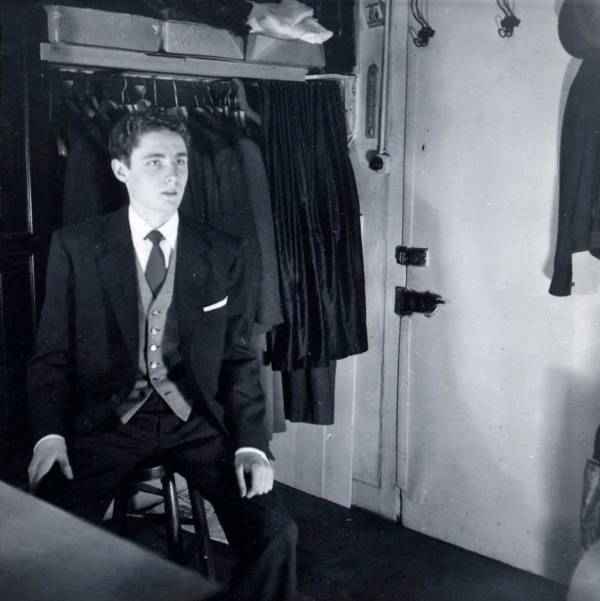
Neville at Saville Row when he began his career as a pattern cutter at sixteen.

Neville’s friend Aubrey Silkoff, photographed when they hitched to Amsterdam in 1961.

Neville’s father Charles owned the only car in Elder St – “We had a car in Elder St when nobody had a car in Elder St, but it vanished when we had no money.”

Neville as a young man.

A family Christmas in Elder St, 1968 – Neville sits next to his father at the dinner table.

Neville’s father, Charles.

Neville and Margaret.

Margaret and Minas.

Neville, Margaret and their son Minas.


Neville’s Uncle Arthur who hung the wisteria wallpaper.

Minas and Terry.

The living room of number seven photographed by the Spitalfields Trust in 1977 with Uncle Arthur’s wisteria wallpaper hanging off the walls.

Dan Cruickshank and others staged a sit-in at number seven to save the house from demolition in 1977.

Neville Turner outside number seven Elder St where he grew up.
You may also like to read about Neville’s childhood friend
Audrey Kneller Of Elder St
Audrey Kneller is one of the many local people you will meet on my tour. Tickets are available this coming weekend and throughout July, so come along and let me show you Audrey’s old haunts.
Click here to book your ticket for THE GENTLE AUTHOR’S TOUR OF SPITALFIELDS

Audrey on trip to Epping Forest, aged twelve in 1957
Audrey Kneller sent me this evocative memoir of her years in Spitalfields describing her life in Elder St.
Elder St was not a pretty place in spite of its name. No buds burst forth each spring to awaken our spirits and no birds sang merrily to remind us of the wonders of nature. Instead soot lay unmolested in every crevice of the ancient brickwork, while the clanking and hissing of steam trains shunting reminded us of the presence of the large London terminus. Poverty was a mantle we refused to wear, but it lurked menacingly on every street corner.
Early in 1953, my Auntie Sophie happened to bump into Millie Berman, an old school friend of my mother’s. This chance meeting was to bring great changes. Millie lived with her daughter on the upper floors of a rented house in Elder St and was looking for someone to take over the tenancy as she was intending to move. Clearly this was an opportunity not be missed.
Shortly after the Coronation in June 1953, we left the comfort of our temporary home in Edgware and moved into the four-storey terraced house at 20 Elder St, Norton Folgate, E1. Our first impressions were far from favourable. The tallness of the houses and total absence of trees or even a blade of grass was very forbidding. However we gradually settled and discovered the bizarre fascinations of an urban existence.
At the back, towards Bishopsgate, there was a large bomb site where I joined some boys playing cowboys and indians, and had a lovely time amid the dirt and rubble. My mother, being a genteel person, was quite horrified when I returned home looking the worse for wear. Thereafter I played more civilised games with my sister and the other refined children of the neighbourhood inside the safe confines of the street. The bomb site, however, came into its own on Guy Fawkes Night when the sky was lit up with the flames of a huge bonfire and accompanying fireworks, watched by us from a third floor bedroom window.
Our part of Elder St was an ideal playground, not only because it sheltered us from traffic but also because of the numbers of children living in the surrounding houses and tenements, so we were seldom short of playmates. In those days, the threat of the motor car was almost non-existent, leaving us to play unrestricted and unhampered, a freedom children cannot enjoy today.
In fact, I cannot remember ever, in the early days of our life in Elder St, seeing a car impinge on our games of higher and higher, piggy in the middle and others too numerous to mention. We played in the road outside our door and no-one ever prevented us from chalking out our squares on the pavement for hopscotch. The black-painted iron bars above the basement in front of the some of the houses could easily be squeezed behind, if a side bar was missing, in order to retrieve a lost ball. These hump-shaped grills were nicknamed “airies,” and a cry would often go up, “It’s gone down the airy!” It was up to the smallest and bravest of us to crawl down into the tiny space below, and once down there you had an awful feeling of being trapped in a cage until you emerged triumphant with the lost ball.
I remember long summer evenings spent playing in the street and the man who came along on his three-wheeler, peddling ices. “Yum Yum” was the brand name and yum yum his ice lollies were, delicious and creamy. A good selling point was that every so often one of the lolly sticks would have the name “YUM YUM” printed on it and whoever had such a stick could have another lolly free on presenting it to the ice cream man. Once this fact became known, some of us sat in the gutter scratching the words “YUM YUM” on our spare sticks. But the ice cream man was not fooled and, some time later, when he came round again after an unexpectedly long interval, the name of the product had been changed to “WHIM”. The lollies were the same but somehow the gilt had gone from the gingerbread.
I recall with affection the Josephs family. Simon Josephs was my age and lived with his parents, two maiden aunts and an elderly grandmother around the corner in Fleur-de-Lis St. Their house was much smaller than ours and poorly built but they were a happy family. They even had a television set, which we did not have, and we lost no opportunity when invited to view. We also spent happy hours playing with Simon and his games, especially my favourite one of Monopoly.
Next door to the Josephs lived an elderly spinster and her bachelor brother who was disabled, having been afflicted with shell shock in the First World War, and I remember sitting with them one Yom Kippur evening waiting for the fast to end. One by one, the tiny houses and the dark overcrowded tenements in Fleur-de-Lis St became empty and boarded up awaiting demolition. The Josephs, we heard later, were re-housed in a new flat on the Ocean Estate in Mile End.
Number 26 Elder St was a tall narrow house accommodating two families, one Jewish and the one Gentile. My sister Yvonne and I would sometimes sit on the steps of the house playing gobs or five stones with the daughters of the respective families. Avril Levy from the Jewish family had a famous auntie, Adele Leigh a renowned opera singer, who would often call round, leaving her sporty two-seater Sunbeam Rapier outside the house.
In Blossom St lived a family that to me epitomised poverty both materially and spiritually. The children were neglected and ran around with bare feet and bare bottoms. I was very shocked because they were so different from us yet lived almost on our doorstep. One day, Christine, a little girl who lived at 16 Elder St, decided that we should venture into the house in Blossom St. We peered inside what seemed to be a dark hole with no semblance of what I considered to be the trappings of a home. Dirt and decay lay all around and I caught a glimpse of a man lying asleep on an old armchair which, instead of cushions, was covered with sacks filled with horse hair. Overcome by feelings of horror, disbelief and the foul stench that pervaded the building, we stepped backwards into the street, and quickly walked back to the welcome ‘civilisation’ of Elder St, never to set foot again in Blossom St.
As to the past history of our house, we were led to believe that it was built in the early eighteen-hundreds. I cannot support the validity of this but the house certainly contained some unusual features.
Looking through the windows at the back, high walls surrounded the yard which was no more than ten feet in depth, just enough space for a coal storage area and a washing line to be strung across. Our convenient position near Liverpool St Station could also be a disadvantage, if the wind was blowing in the wrong direction our clean laundry would be showered with a fine layer of soot.
Ours was the only house in Elder St – and for all we knew anywhere else in Norton Folgate – to have a bathroom. The fittings were brass and, instead of having a normal plughole, there was a tall brass post affair which had to be lifted up to let the water run away. Hot water came from an ancient geyser on the wall above the bath but woe betides anyone who fell foul of the delicate lighting-up procedure. I did once and was greeted with a loud bang. The secret was to run the water first and then ignite the gas. Henceforth, unless my mother or sister were there to do the honours, I felt it safer to spend my bath times in an old zinc tub in front of the fireplace in the living room.
Nevertheless, it was handy to have a bathroom, especially as a connecting door led into the back bedroom thereby giving us a bathroom en suite! The toilet was situated next to the bathroom on the first floor landing. To have an inside toilet was again untypical of the area, most toilets being situated outside in the backyard, as I found at our cousin’s house in Buxton St.
A house of this size required regular maintenance and my mother employed a spare-time handyman to keep the interior in a good state of repair. He came and went for six years, painting, papering, plumbing and fixing, and no sooner had he finished on the top floor than it was time to start again at the bottom, rather like the Forth Bridge.
An interesting feature of the house was a long speaking tube with a whistle at one end, extending from the top floor right down to the basement. Presumably a device once used by servants, this was a source of amusement. Another source of great amusement to us, as well as to other children in our street, was the wall panelling. We succeeded in convincing them that one on the first floor landing slid back to reveal a secret passageway, such as the ones used by Cavaliers to escape the Roundheads during the Civil War.
One day, my sister told some children playing in the street that there was something strange in our basement and they immediately came to investigate. Meanwhile, I had dressed up a tailor’s dummy in an old red frock and hid behind it. As the children descended the basement stairs, I slowly moved the dummy forward, calling out in an eerie voice. The inquisitive children scattered in haste, believing me to be a headless ghost!
Not long after we moved into Elder St, we discovered the presence of unwelcome lodgers lurking behind the skirting boards. After mousetraps failed to catch them, we acquired the services of a cat. One day, one of our cousins from Buxton St called round with a tabby who had the perfect markings of a tiger, so the name stuck. Tiger was a wonderfully docile pet but he lived up this name in keeping the rodent community at bay.
One day I found him sitting on the landing and tried to pick him to carry him downstairs but he would not budge. I could not understand it until my mother pointed out that he was standing guard over a small hole in the skirting board. We left him there all that day and eventually he returned to us of his own accord, presumably having accomplished his mission.
As to the other houses in Elder St, I am sure that none of us children had any idea of their historic value. As far as I could see, we were surrounded by decaying walls and we had to make the best of the situation until circumstances improved.
Although we may have been devoid of pastoral pleasures in Spitalfields, life was far from dull. We were living on the fringes of a great nucleus of Jewish enterprise and culture – consisting of delicatessens, bakeries, butcher shops and kosher restaurants, intermingled with other Jewish-owned businesses in the garment, jewellery and shoe trades, bookshops, a Yiddish theatre and numerous synagogues – stretching from Brick Lane southward to Houndsditch and eastward as far as Bow. This was our heritage, we had returned to the roots set down by our grandparents and thousands of other immigrants fifty years earlier.

Audrey’s tenth birthday tea in 1955


