
Mr Punch’s 360th Birthday
Join the celebration of Mr Punch’s 360th Birthday this Sunday at St Paul’s, Covent Garden, with a procession at 11am, a service with Mr Punch in the pulpit at noon, followed by maypole dancing and Punch & Judy shows in the churchyard.

Carmen Baggs with figures made by her father
On 9th May 1662, Samuel Pepys wrote in his diary “Thence to Covent Garden… to see an Italian puppet play that is within the rayles there, which is very pretty, the best that ever I saw, and a great resort of gallants …” It was the first record of a Punch & Judy show in London and, as a consequence, May 9th has become celebrated as Mr Punch’s birthday – when the all Punch & Judy “professors” gather each year upon the leafy green behind the church.
After an early morning shower on the day of my visit, the sun broke through to impart a lustre to the branches of may blossom growing in the churchyard, which create an elegant foliate surround to the freshly sprouting lawn, where the Punch & Judy booths were being assembled as the centrepiece of the May Fayre. As they set up their booths, the professors were constantly interrupted by the arrival of yet another member of their clan, and emotional greetings were exchanged as they reunited after another year on the road. Yet before long, a whole line of booths encircled the lawn and vibrant red stripes filled my vision whichever direction I chose to turn.
Peter Batty, a Punch & Judy professor of forty years, who has been coming here for thirty years, could not help feeling a touch of melancholy in the churchyard in spite of the beauty of the morn. “We go from one box to another,” he said, reaching up with the hand that was not holding Mr Punch to touch his booth protectively, and recalling those professors who will not be seen upon this green again. “I think of Joe Beeby, Percy Press – the first and the second, Hugh Cecil and Smoky the Clown,” he confided to me regretfully – “People keep getting old.”
Yet Peter works in partnership with his youthful wife, Mariake, and their fourteen year old son, Martin, who is just starting out with his own shows. “It’s such a lovely way of life, we’re really lucky when so many people have to do proper jobs, and it’s a brilliant way to bring up children.” she assured me, cradling Judy, while Martin nodded in agreement, holding the Policeman. “We play together and have a fantastic time – it suits us very well and it’s completely stress free.” she declared. They were an appealing paradox, this contented family who had found happiness in performing Mr Punch and his bizarre drama of domestic violence.
“I was just a bored housewife,” recalled Mrs Back to Front, a lively Punch & Judy professor with her brightly coloured clothes reversed, “twenty-nine years ago, I had a six month old baby and a three year old son, and I was asked to do a puppet show for a fete at his school and I was converted to it. I came here to Covent Garden and I bought a set of Punch & Judy puppets, and I got a swozzle too and found I could use it straightaway.” Then, with a chuckle of satisfaction at the exuberant life she has invented for herself and batting her glittery eyelashes in pleasure, she announced – “My six month old baby is now Dizzy Lolly – she does magic and she’s very good with a monkey puppet too.”
My next encounter was with Geoff Felix, an experienced puppeteer with a background in film, television and theatre who has been doing Punch & Judy since 1982.“I was influenced by Joe Beeby,” he explained, revealing his source of inspiration, “he saw a show in 1926, which the player learnt from someone in the nineteenth century, and Joe kept it going. And that’s how the oral tradition has been preserved.” Geoff explained that the Punch & Judy characters we recognise today, both in appearance and in the story, are based upon those of Giovanni Piccini whose play was transcribed by John Payne Collier in 1828 and illustrated by George Cruikshank. Casting his eyes around at his peers, “It is the swozzle that unites us,” he whispered to me, as if it were a sacred bond, when referring to the metal instrument in the mouth used to make the shrill voice of Mr Punch – “it forces us to create shows based in action.”
Then, Alix Booth, a feisty Scotswoman in a top hat, who has been a Punch & Judy professor for thirty-seven years, told me, “When I was eleven, I inherited a set of paper mache figures. I started working with them and in the end I was doing small shows in Lanark. I still have the figures, over a hundred years old, and although I had to replace Mr Punch’s coat, his waistcoat and trousers are perfect. My figures are based on the Piccini book of 1828, they have their mouths turned down at the ends and huge staring eyes – nowadays Mr Punch is sometimes given a smile, but I prefer him with his mouth turned down, it’s more realistic.”
“I have learnt my craft, and I can keep a children’s party happy for an hour and a half without any trouble at all.” she informed me plainly. “But it was very much for adults originally – entertainment for the Georgian man in the street and it’s full of laughs – it’s all in the timing.”
After my conversations with the professors, I was delighted to stand and enjoy the surreal quality of all the booths lined up like buses at a terminus when I have only ever seen them alone before – yet what was fascinating were the differences in spite of the common qualities. There were short fat ones and tall skinny ones, plain and fancy, with the height defined by the reach of each individual puppeteer. And while the red and white theatres standing under the great chestnut tree awaited their audiences, the professors enjoyed the quiet of the morning to catch up and swap stories.
“It has established a club, brought us all together and kept the tradition alive,” Alix asserted, turning impassioned in her enthusiasm, “And that’s so important, because every year new young performers come along and join us.” But then we were interrupted by the brass band heralding the arrival of Mr Punch and we realised that, as we had been talking, crowds of people had gathered. It was a perfect moment of early summer in London, but for Punch & Judy professors it was the highlight of the year.


Professor David Wilde has the largest collection of Punch & Judy puppets – over six hundred.

Professor Geoffrey Felix, scenery based upon a design by Jesson and Mr Punch in the style of Piccini.


Professor James Arnott restores and repaints old figures.


Mrs Back To Front


Professor Alix Booth, thirty-seven years doing Punch & Judy professionally.


The Batty Family of Puppeteers, Mariake, Martin and Peter.


Professor Brian Baggs, also known as “Bagsie.”


Professor Paul Tuck – “I’ve only been let out for today – I’m really a ladies’ hairdresser.”

Parade to celebrate the arrival of Mr Punch in Covent Garden.
You may also like to read about
At the Pearly Kings & Queens Harvest Festival
At the 65th Annual Grimaldi Service
Beating the Bounds in the City of London
James Leman, Silk Designer

The oldest surviving set of silk designs in the world, James Leman’s album contains ninety ravishingly beautiful patterns created in Steward St, Spitalfields between 1705 and 1710 when he was a young man. It was my delight to visit the Victoria & Albert Museum and study the pages of this unique artefact, which is the subject of an interdisciplinary research project under the auspices of the V&A Research Institute, funded by the Andrew W. Mellon Foundation. The Leman Album offers a rare glimpse into an affluent and fashionable sphere of eighteenth century high society, as well as demonstrated the astonishing skill of the journeyman weavers in East London three hundred years ago.
James Leman (pronounced ‘lemon’ like Leman St in Aldgate) was born in London around 1688 as the second generation of a Huguenot family and apprenticed at fourteen to his father, Peter, a silk weaver. His earliest designs in the album, executed at eighteen years old, are signed ‘made by me, James Leman, for my father.’ In those days, when silk merchants customarily commissioned journeyman weavers, James was unusual in that he was both a maker and designer. In later life, he became celebrated for his bravura talent, rising to second in command of the Weavers’ Company in the City of London. A portrait of the seventeen-twenties in the V&A collection, which is believed to be of James Leman, displays a handsome man of assurance and bearing, arrayed in restrained yet sophisticated garments of subtly-toned chocolate brown silk and brocade.
His designs are annotated with the date and technical details of each pattern, while many of their colours are coded to indicate the use of metallic cloth and different types of weave. Yet beyond these aspects, it is the aesthetic brilliance of the designs which is most striking, mixing floral and architectural forms with breathtaking flair in a way that appears startling modern. The Essex Pink and Rosa Mundi are recognisable alongside whimsical architectural forms which playfully combine classical and oriental motifs within a single design. The breadth of James Leman’s knowledge of botany and architecture as revealed by his designs reflects a wide cultural interest that, in turn, reflected flatteringly upon the tastes of his wealthy customers.
Until last year, the only securely identified woven example of a James Leman pattern was a small piece of silk in the collection of the Art Gallery of South Australia. Miraculously, just as the V&A’s research project on the Leman Album was launched, a length of eighteenth-century silk woven to one of his designs was offered to the museum by a dealer in historical textiles, who recognised it from her knowledge of the album. The Museum purchased the silk and is investigating the questions that arise once design and textile may be placed side by side for the first time. With colours as vibrant as the day they were woven three hundred years ago, the sensuous allure of this glorious piece of deep pink silk adorned with elements of lustrous green, blue, red and gold shimmers across the expanse of time and is irresistibly attractive to the eye. Such was the extravagant genius of James Leman, Silk Designer.


On the left is James Leman’s design and on the right is a piece of silk woven from it, revealing that colours of the design are not always indicative of the woven textile

The reverse of each design gives the date and details of the fabric and weave

Portrait of a Master Silk Weaver by Michael Dahl, 1720-5 – believed to be James Leman
All images copyright © Victoria and Albert Museum, London
With grateful thanks to: Dr Olivia Horsfall Turner, Senior Curator of Designs – Dr Victoria Button, Senior Paper Conservator – Clare Browne, Senior Curator of Textiles – Dr Lucia Burgio, Senior Scientist and Eileen Budd, V&A Research Institute Project Manager
You may also like to read about
The Principal Operations of Weaving
At Anna Maria Garthwaite’s House
Anna Maria Garthwaite, Silk Designer
Along The Thames With John Claridge

In Silvertown, 1964
These atmospheric photographs of the Thames by John Claridge offer a poignant vision of the working river that was once a defining element of the East End. Within living memory, the busiest port in the world was here yet today barely a trace of it remains. And John’s pictures, mostly taken when he was a mere kid photographer, capture the last glimmers of the living docks.“My dad’s friends were saying that the docks were going down, so I was aware of that and I just wanted to grab hold of it,” John told me.
“As a child, from my bedroom in Plaistow, I could see the lights of the docks at night and I used to go to sleep listening to the sound of the horns on the Thames whenever there was fog, which was quite often. You could smell the river if the wind was blowing in the right direction. A lot of the men in my family worked down the docks. My father took me down to the dock gate when he worked for the New Zealand Shipping Company – and I used to go out with my camera at weekends, or any spare time I had, to take pictures. I went out to see what was going on, I reacted to what was there and, if I saw something, I photographed it. It was instinctive, I never thought I was documenting. I had a need to take pictures, it was as natural as breathing.”
John’s photographs convey the epic nature of the docks where once thousands worked to unload vast ships bringing cargos from distant continents, a collective endeavour upon a grand scale. Yet these are personal pictures and, for this reason John has included few people, even if their presence is always tangible. “You can put yourself and your emotions into the photograph if there’s nobody in it,” he confided to me, “These pictures were for myself. I was interested in the quality of the light which was magnificent. Because of the bends of the river, you got it coming in all directions and in each place it was different.”
As a youngster, John was able to get everywhere, creeping through side alleys, climbing over walls, even setting out in a tiny inflatable dinghy on the river, but sometimes, he would just walk right in through the main entrance.“I’d go through the dock gate,” he confessed, “It was much more of an innocent time – I should have got a pass, but I’d just say, ‘I’m doing photographs’ and they’d say, ‘On you go.’ As a kid you could get anywhere.” If you observe the shifting point of view in these pictures, you can see that some are taken from the Thames beach, some from John’s dinghy at water level while others are taken looking down from walls and bridges, where he had climbed up.
The majestic image above was taken in the dawn light in Silvertown in 1964, when John climbed onto the dock wall to photograph the huge cargo ship that had just arrived, and waited for the sun to rise before he took his picture. As a consequence, the vessel filling the background looks like a phantom fading in the first light of day. There is an equally fascinating distinction between the foreground and background in the photograph below, also taken over the dock wall in Silvertown in 1964. The ships in the background appear ethereal as if they were a mirage too, about to vanish. In John’s vision, the docks are haunted by their own disappearance, and the incandescent dreamlike ambiance of his pictures – often taken through fog or mist rising from the river – places them in a pictorial tradition of the Thames which includes Whistler and Turner.
Yet beyond their breathtaking quality as photography, John Claridge’s elegiac photographs of the Thames are special because they are taken by one who grew up with the river and knew the culture of the docks intimately. As he admitted to me, speaking of the river and his relationship with it, “It’s not something you discover, it’s always been there – it’s part of you who you are.”

“I climbed over the dock wall to take this picture in New Canning Town. You never expect it to go and then all of a sudden it’s gone.” 1964

Old warehouses in Silvertown, 1982.

Dock wall, Isle of Dogs, 1982.

In Poplar, at the very end of the docks, 1982. “You can see how quiet it is.”

1962, a crane driver takes a break for a fag in Silvertown.

From the river, 1962

Inside the docks in Canning Town, 1968.“As soon as the containers moved down to Tilbury, you saw it winding down.”

Near Stratford, from road bridge with the canal in the foregound, 1960.

Limehouse, 1972.

At water level, Wapping, 1964.

A lighter in Wapping, 1963

Warehouses in Wapping, 1965

In a tributary at Canning Town, 1962

Near St Katherine Dock, 1960. “It was all open then, you could walk around.”

Chemical works near Bow, 1965.

Looking into the dock from a bridge, Silvertown, 1982. “There may have been some manufacturing left but the dockland was dead.”

Winter light downriver, 1982

Near Silvertown, with one of the bridges across the dock in the background, 1966.

A lighter in Wapping, 1961.
Photographs copyright © John Claridge
You may also like to take a look at
and read these other stories of the Thames
“Old Bob” Prentice, Waterman & Lighterman
The Highdays & Holidays Of Old London
On Bank Holiday Monday, let us to consider the highdays & holidays of old London

Boys lining up at The Oval, c.1930
School is out. Work is out. All of London is on the lam. Everyone is on the streets. Everyone is in the parks. What is going on? Is it a jamboree? Is it a wingding? Is it a shindig? Is it a bevy? Is it a bash?
These are the high days and holidays of old London, as recorded on glass slides by the London & Middlesex Archaeological Society and once used for magic lantern shows at the Bishopsgate Institute.
No doubt these lectures had an educational purpose, elucidating the remote origins of London’s quaint old ceremonies. No doubt they had a patriotic purpose to encourage wonder and sentiment at the marvel of royal pageantry. Yet the simple truth is that Londoners – in common with the rest of humanity – are always eager for novelty, entertainment and spectacle, always seeking any excuse to have fun. And London is a city ripe with all kinds of opportunities for amusement, as illustrated by these magnificent photographs of its citizens at play.
Are you ready? Are you togged up? Did you brush your hair? Did you polish your shoes? There is no time to lose. We need the make the most of our high days and holidays. And we need to get there before the parade passes by.

At Hampstead Heath, c.1910.

Walls Ice Cream vendor, c.1920.

At Hampstead Heath, c.1910.

At Hampstead Heath, c.1910.

Balloon ascent at Crystal Palace, Sydenham, c.1930.

At the Round Pond in Kensington Gardens, 1896.

Christ’s Hospital Procession across bridge on St Matthews Day, 1936.

A cycle excursion to The Spotted Dog in West Ham, 1930.

Pancake Greaze at Westminster School on Shrove Tuesday, c.1910.

Variety at the Shepherds Bush Empire, c.1920.

Dignitaries visit the Chelsea Royal Hospital, c.1920.

Games at the Foundling Hospital, Bloomsbury, c.1920.

Riders in Rotten Row, Hyde Park, c.1910.

Physiotherapy at a Sanatorium, 1916.

Vintners’ Company, Master’s Installation procession, City of London, c.1920.

Boating on the lake in Battersea Park, c.1920.

The King’s Coach, c.1911.

Queen Victoria’s Diamond Jubilee procession, 1897.

Lord Mayor’s Procession passing St Paul’s, 1933.

Policemen gives directions to ladies at the coronation of Edward VII, 1902.

After the procession for the coronation of George V, c.1911.

Observance of the feast of Charles I at Church of St. Andrew-by-the-Wardrobe, 1932.

Chief Yeoman Warder oversees the Beating of the Bounds at the Tower of London, 1920.

Schoolchildren Beating the Bounds at the Tower of London, 1920.

A cycle excursion to Chingford Old Church, c.1910.

Litterbugs at Hampstead Heath, c.1930.

The Foundling Hospital Anti-Litter Band, c.1930.

Distribution of sixpences to widows at St Bartholomew the Great on Good Friday, c.1920.

Visiting the Cast Court to see Trajan’s Column at the Victoria & Albert Museum, c.1920.
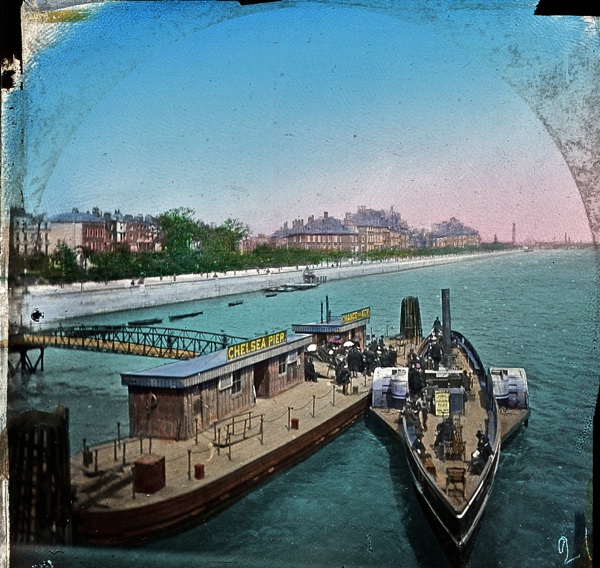
A trip from Chelsea Pier, c.1910.

Doggett’s Coat & Badge Race, c.1920.

Feeding pigeons outside St Paul’s, c.1910.

Building the Great Wheel, Earls Court, c.1910.
Glass slides copyright © Bishopsgate Institute
You may also like to take a look at
On May Day

Street Strolling Clowns by John Thomas Smith, 1816 (courtesy Bishopsgate Institute)

Sweeps on May Day in the City of London c. 1920 (courtesy Bishopsgate Institute)
On May Day, a traditional time of celebration in London when we look forward to the summer that lies ahead, I present this chapbook of The Seasons by W S Johnson from 1846 which was brought to my attention by Sian Rees.


Courtesy of McGill Library
You may also like to take a look at
Ron McCormick’s Spitalfields & Whitechapel
Today it is my pleasure to publish a selection of Ron McCormick’s fine photographs of Spitalfields and Whitechapel taken in the seventies when he lived in Princelet St

Carrying bicycles over Pedley St bridge

Street musician in Brick Lane market

Faces in the crowd, Commercial St

‘The boys’ pass time on the steps of the Great Synagogue, Fournier St

Costa cobblers, Hanbury St

Engineering works, Heneage St

Engineering works, Heneage St

Bottling girls in the Truman Brewery

Mother and toddler, Buxton St Holiday Club

Street scene, Whitechapel

Flower seller, Whitechapel

Shoe shop, Wentworth St

Mr & Mrs Ali with their children, Brick Lane

Bakery, Whitechapel

Leaving Spitalfields, Artillery Passage opens onto Middlesex St

Family playtime in streets off Whitechapel Rd

Cheshire St market

Girl and her grandmother, Great Eastern Buildings, Quaker St

Rooftop playground, Great Eastern Buildings, Quaker St

Roof of Great Eastern Buildings, Quaker St

Tenement buildings, Spitalfields

Street singer, Brick Lane market

Diamond merchants, Black Lion Yard

Woman with dogs in alley off Quaker St

Photographs copyright © Ron McCormick
You may also like to take a look at
At Eel Pie Island

Even though Twickenham is a suburb of London these days, it still retains the quality of a small riverside town. The kind of place where a crowd forms to watch a crow eating a bag of crisps – as I observed in the High St, before I crossed the bowed footbridge over to Eel Pie Island.
This tiny haven in the Thames proposes a further remove from the metropolis, a leafy dominion of artists’ cabins, rustic bungalows and old boatyards where, at the overgrown end of the only path, I came upon the entrance to Eel Pie Island Slipway. Here, where there are no roads, and enfolded on three sides by trees and tumbledown shacks, a hundred-year-old boatshed over-arches a hidden slipway attended by a crowded workshop filled with an accretion of old tools and maritime paraphernalia.
For the past thirty years, this magnificent old yard has been run by Ken Dwan, where twelve men work – shipwrights, platers, welders, marine engineers and marine electricians – on the slipway and in the workshop. “We have all the skills here, “ Ken informed me, “and the older ones are passing it onto the younger ones. Everybody learns on the job.” One of just four yards left on the Thames, Ken has his order book full for the next year, busy converting barges into houseboats, and maintaining and repairing those already in existence which, by law, have to be surveyed every five years.
Like his brother John Dwan – the Lighterman I spent a day with once – Ken has worked on the river his whole life, earning a living and becoming deeply engaged with the culture of the Thames. Ken makes no apology to describe himself as a riverman and, as I discovered, the currents of this great watercourse have taken him in some unexpected directions.
“I started as an apprentice Waterman & Lighterman at fifteen. When the Devlin Report came out in 1967, all Lightermen had to be fully employed by lighterage companies, and I joined F.T.Everard & Sons. You got your orders over the phone the night before, and they sent you to collect and deliver from any of the docks between Hammersmith and Gravesend. We used to drive and row barges of every conceivable cargo – lamp black, palm oil, molasses, wool, petrol, sugar – I even moved a church once!
The work moved East as the docks quietened down and companies closed. Because of the Devlin Report, we had a domino effect whereby, when one company shut, everybody would join the next but there wasn’t enough work and so they shut too. But, as freemen of the Thames, we Lightermen were able to work in civil engineering. I worked on the building of the Thames Flood Barrier, and a lot went into the construction of Canary Wharf and the redevelopment of the Pool of London.
After that, I worked on the passenger boats, and I decided to buy one with a partner and we formed Thames Cruises – doing trips from Westminster to Gravesend. We started by buying other people’s cast-offs and we needed to repair them, so then we bought this place and I came up here while my partner ran the passenger boats. They still run from Lambeth. I found that if you have the facility, a lot of people want repairs and now most of our work is for other people. We also do a small amount of boat building and we provide a service of scattering of ashes on the river for the Asian community.
I did a lot of rowing years ago, I went to two Olympics as a single sculler, in 1968 and 1972. I won my Doggett’s Coat & Barge and was made a Queen’s Waterman, becoming the Queen’s Bargemaster for three years. My job was to move the crown in the State Coach from Buckingham Palace to Westminster for the Opening of Parliament. It dates back to the time when the safest way to travel was by water. They do suggest that the London streets are safer now than years ago, but you may wish to question that. I was Master of the Watermen’s Company from 2007/8, and now both my sons have got their Doggett’s Coat & badge and work on the river too.
I loved working around the Pool of London years ago, and, sometimes after work, I used to walk through Billingsgate Market late at night. There’d be be fish and ice everywhere, the atmosphere in that place was incredible. When we were out of work, we could get a tanner there for pushing the barrows of fish up the hill. My favourite place in London then was Tower Hill in the early morning, the escapologist on the corner trying to get out of the bag, and the old coffee shops where you could get steak and kidney pudding. When the big old tomato boats moored on the West side of London Bridge, the bridge would be full of people watching what was being moved around – it didn’t matter what time of year, people lined the bridge because there was always something different being unloaded. All the cranes were still working then and the place was hive of industry. It was a privilege to be part of it. For a fifteen year old, the London Docks was an adventure playground.
It’s never been hard getting out of bed and going to work. I still love going on the river seven days a week. It was never a job. It was an absolute pleasure. It was a life.”
When Ken visited Eel Pie Island as a fifteen year old apprentice Lighterman, he did not know that one day he would come back as master of the boatyard here. Yet today, as custodian of the slipway, he is aware of the presence of his former self – indicating to me the hull of a lighter that he worked on when it carried cargo which now he is converting to a houseboat. His sequestered boatyard is one of the few unchanged places of industry on the Thames, where the business of repairing old vessels that no other boatyard will touch is pursued conscientiously, using the old trades – where all the knowledge, skills and expertise that Ken Dwan once learnt in the London Docks is kept alive.

Ken Dwan, Waterman & Lighterman


A nineteenth century Dutch barge and Thames lighter of a hundred years ago.


“This barge, I worked on it when it moved cargo and now we are converting it into a palace!”

Ken Dwan – the Queen’s Bargemaster – stands at the centre, surrounded by fellow Watermen.

Looking across to the mainland and Twickenham church.

You may also like to read about


