In Old Holborn
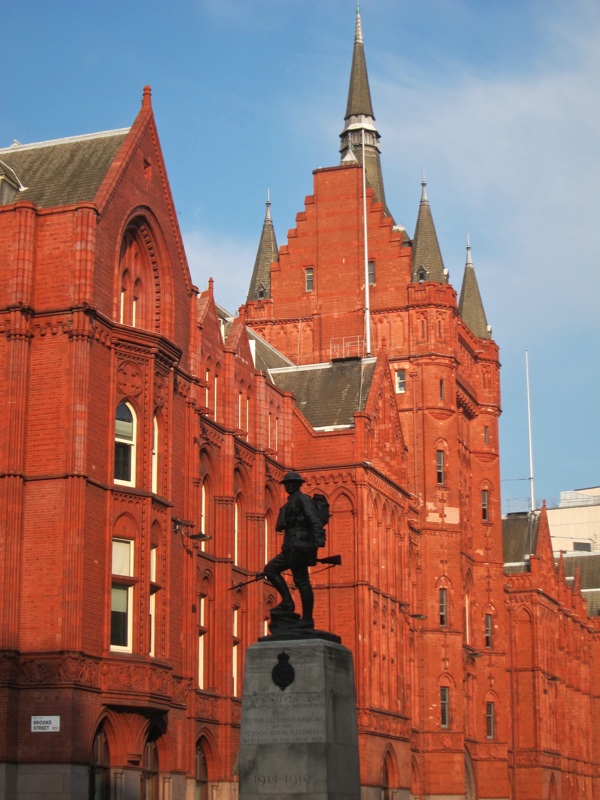
Holborn Bars
Even before I knew Holborn, I knew Old Holborn from the drawing of half-timbered houses upon the tobacco tins in which my father used to store his rusty nails. These days, I walk through Holborn once a week on my way between Spitalfields and the West End, and I always cast my eyes up in wonder at this familiar fragment of old London.
Yet, apart from Leather Lane and the International Magic Shop on Clerkenwell Rd, I rarely have reason to pause in Holborn. It is a mysterious, implacable district of offices, administrative headquarters and professional institutions that you might never visit, unless you have business with a lawyer, or seek a magic trick or a diamond ring. So I resolved to wander in Holborn with my camera and present you with some of the under-appreciated sights to be discovered there.
Crossing the bed of the Fleet River at Holborn Viaduct, I took a detour into Shoe Lane. A curious ravine of a street traversed by a bridge and overshadowed between tall edifices, where the cycle-taxis have their garage in the cavernous vaults receding deep into the brick wall. John Stow attributed the name of Holborn to the ‘Old Bourne’ or stream that ran through this narrow valley into the Fleet here and, even today, it is not hard to envisage Shoe Lane with a river flowing through.
Up above sits Christopher Wren’s St Andrew’s, Holborn, that was founded upon the bank of the Fleet and stood opposite the entrance to the Bishop of Ely’s London residence, latterly refashioned as Christopher Hatton’s mansion. A stone mitre upon the front of the Mitre Tavern in Hatton Garden, dated 1546, is the most visible reminder of the former medieval palace that existed here, of which the thirteenth century Church of St Etheldreda’s in Ely Place was formerly the chapel. It presents a modest frontage to the street, but you enter through a stone passage way and climb a staircase to discover an unexpectedly large church where richly-coloured stained glass glows in the liturgical gloom.
Outside in Ely Place, inebriate lawyers in well-cut suits knocked upon a wooden door in a blank wall at the end of the street and brayed in delight to be admitted by this secret entrance to Bleeding Heart Yard, where they might discreetly pass the afternoon in further indulgence. Barely a hundred yards away across Hatton Garden where wistful loners eyed engagement rings, Leather Lane Market was winding down. The line at Boom Burger was petering out and the shoe seller was resting his feet, while the cheap dresses and imported fancy goods were packed away for another day.
Just across the road, both Staple Inn and Gray’s Inn offer a respite from the clamour of Holborn, with magnificent tranquil squares and well-kept gardens. But the casual visitor may not relax within these precincts and, when the Gray’s Inn Garden shuts at two-thirty precisely, you are reminded that your presence is that of an interloper, at the gracious discretion of the residents of these grand old buildings.
Beyond lies Red Lion Sq, laid out in 1684 by the notorious Nicholas Barbon who, at the same time, was putting up cheap speculative housing in Spitalfields and outpaced the rapacious developers of our own day by commencing construction in disregard of any restriction. Quiet benches and a tea stall in this tree-lined yet amiably scruffy square offer an ideal place to contemplate the afternoon’s stroll.
Then you join the crowds milling outside Holborn tube station, which is situated at the centre of a such a chaotic series of junctions, it prompted Virginia Woolf to suggest that only the condition of marriage has more turnings than are to be found in Holborn.

The One Tun in Saffron Hill. reputed to be the origin of the Three Tuns in ‘Oliver Twist’
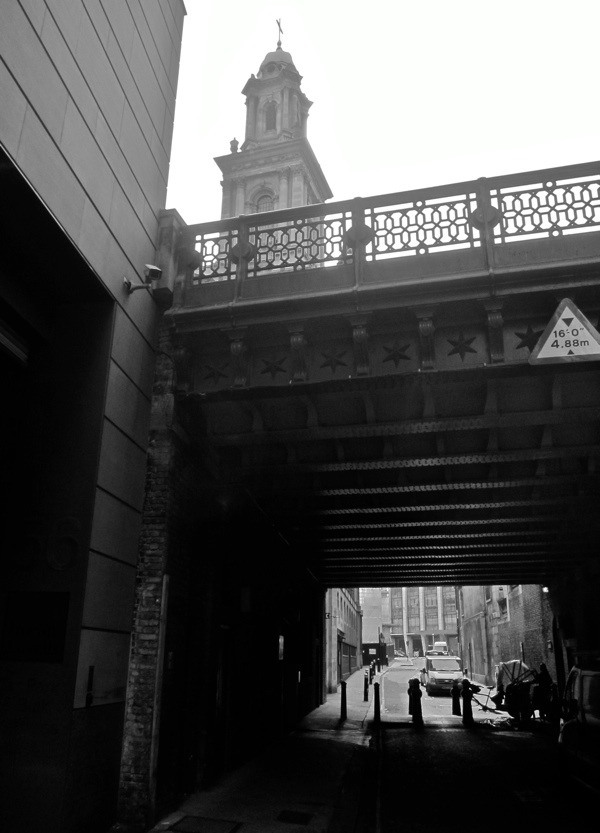
In Shoe Lane

St Andrew Holborn seen from Shoe Lane

On Holborn Viaduct

Christopher Wren’s St Andrew Holborn

In St Etheldreda’s, Ely Place

Staircase at St Etheldreda’s

The Mitre, Hatton Garden

Charity School of 1696 In Hatton Garden by Christopher Wren

Choosing a ring in Hatton Garden

In Leather Lane

Seeking sustenance in Leather Lane
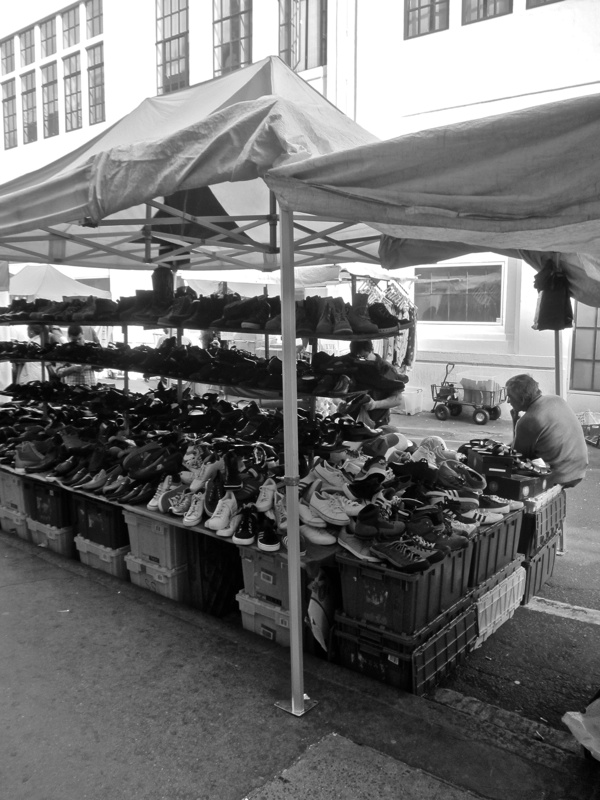
Shoe Seller, Leather Lane

Barber in Lamb’s Conduit Passage

Staple Inn, 1900


In Staple Inn

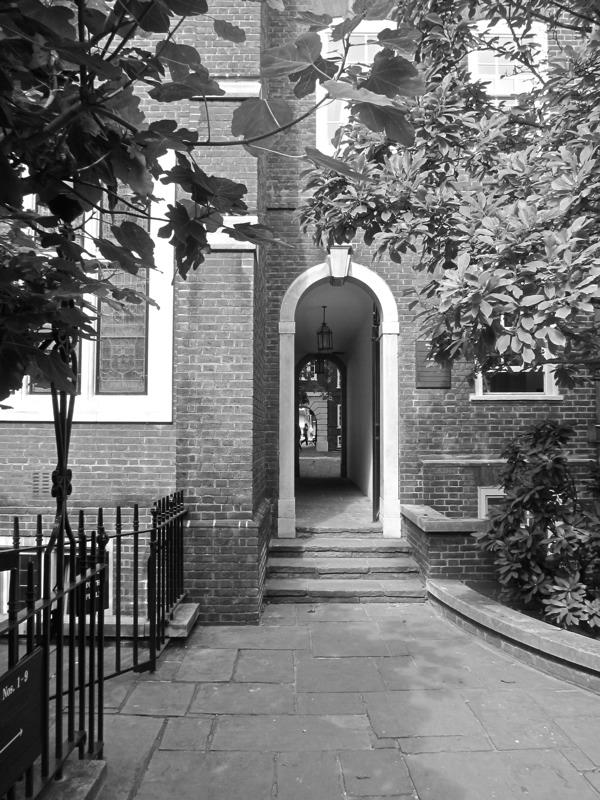
In Staple Inn

In Gray’s Inn

In Gray’s Inn Gardens
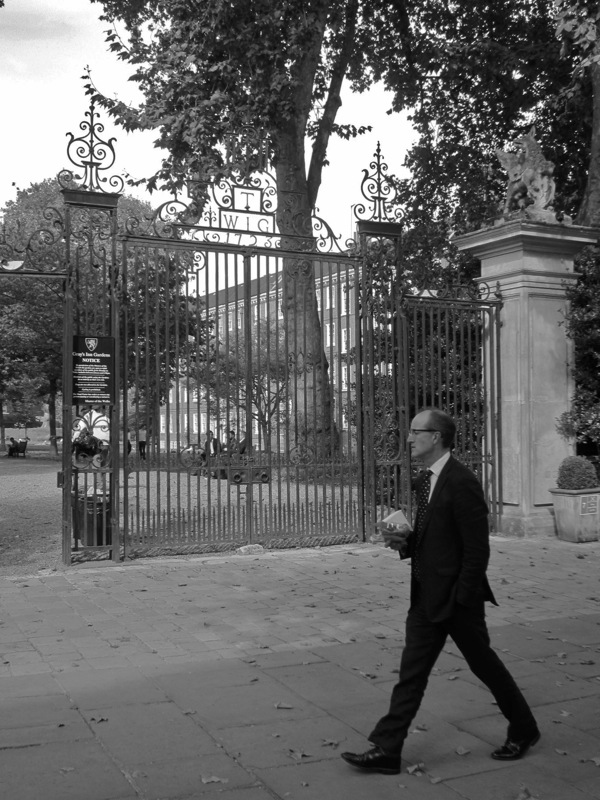


In Gray’s Inn

Chaos at Holborn Station

Rush hour at Holborn Station

Fusiliers memorial in High Holborn
You may also like to take a look at
Jock McFadyen, Artist
Jock McFadyen will be displaying paintings at his studio from 18th March – 14th May, each Saturday and Sunday from 11am to 4pm at 4 Helmsley Place, E8 3SB
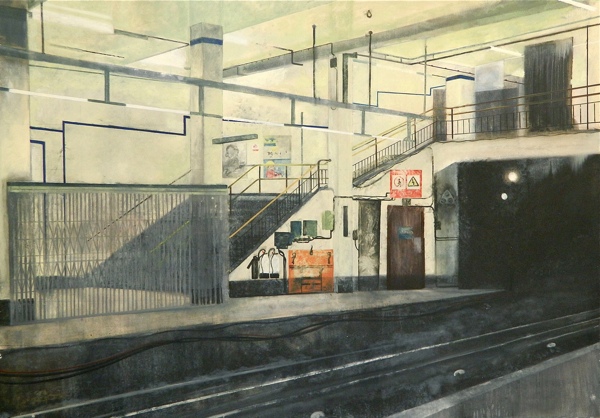
Aldgate East by Jock McFadyen
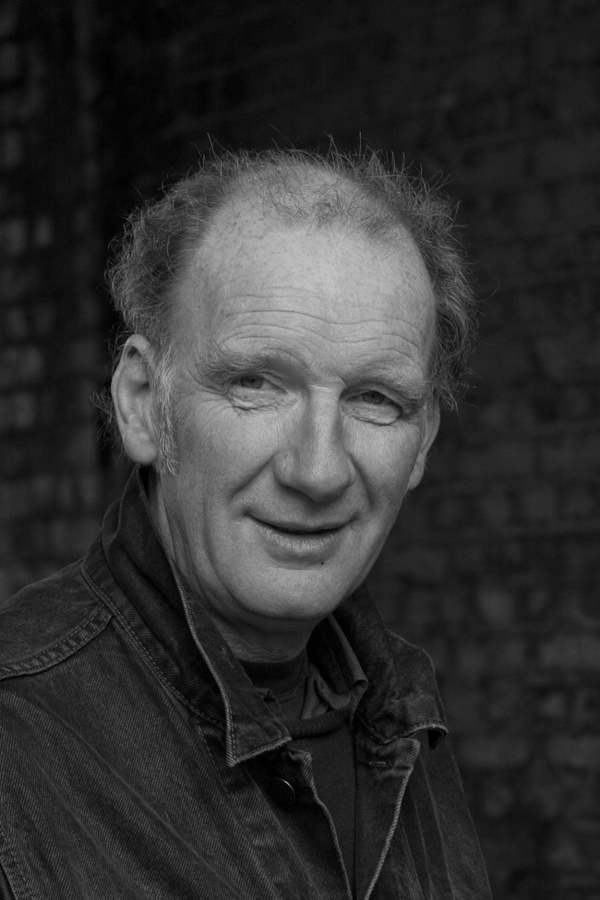
Hidden behind an old terrace facing London Fields is a back street with a scrapyard and a car repair garage, and a row of anonymous industrial units where painter Jock McFadyen has his studio. You enter through a narrow alley round the back to discover Jock in his lair, a scrawny Scotsman with freckles, tufts of ginger hair, and beady eyes that look right through you. Yet such is the modesty of his demeanour, he acted more like the caretaker than the owner – concentrating on the coffee and biscuits, and leaving me to gasp at his vast canvasses of landscapes on a scale uncommon in our age.
The works of man appear insubstantial, either dwarfed by the scale of the landscape or partly obscured by meteorological effects in Jock’s paintings. With plain titles such as “Dagenham,” “Looking West,” “Pink Flats,” and “Popular Enclosure,” he evokes the terrain where East London unravels into Essex beneath apocalyptic northern skies, encompassed by an horizon that extends beyond your field of vision when you stand in front of these pictures.
Originating from Paisley, Jock has lived and worked in the East End since 1978, with studios in Butler’s Wharf, Bow and the Truman Brewery before arriving in London Fields more than twenty years ago. Although he has painted a whole series of epic landscapes of the East End, Jock remains ambivalent about its impact upon his work. “It’s difficult to say how much a place affects you because my real influences are other painters like Lowry and Sickert,” he admitted to me with a shrug, “You’re never just painting what’s in front of your nose, you’re aware of the history of painting.”
“When I was a student at Chelsea in the seventies, the previous generation were the pop artists and my work was quite stark and self-referential.” he confessed with a chuckle, breaking into a shy grin, “But when I became Artist in Residence at the National Gallery in 1981, I realised I couldn’t spend my life just making art about art, so I started painting what I saw in the street – What could be less fashionable?”
“Then in 1991, I got commissioned to design a set for the Royal Ballet. They thought, ‘It’s urban despair, let’s get Jock McFadyen!'” he continued, sipping his coffee with relish, “There were no figures in my design, because the dancers were the figures. And that’s when I realised I had been a landscape painter all along – I’d been painting people in places.”
So there we left our conversation – but before I departed his studio, I paused to admire a huge canvas of magnificent old rotting warehouses on the River Lea. It occurred to me that Jock came from Glasgow – a decayed port city with a vibrant working class culture – and felt at home in the East End, a location with a similar identity. I saw Jock looking at me and I realised he knew what I was thinking. “If you are a landscape painter you can only paint one place at a time,” he said, anticipating my words “So the question is ‘Are you an East End painter or are you just a landscape painter that happens to live here?'”

Jock McFadyen in London Fields
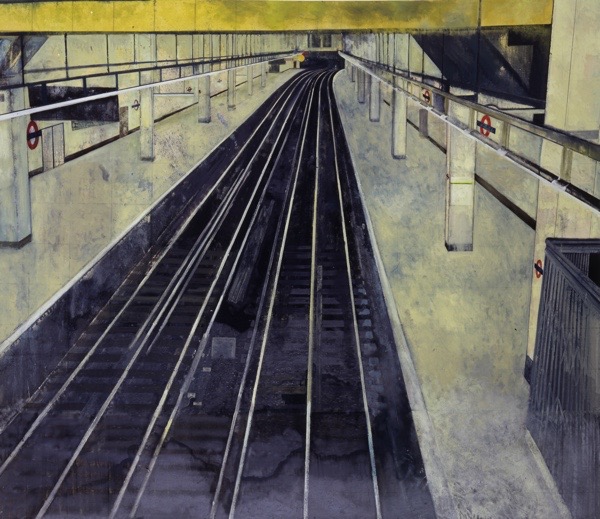
Aldgate East
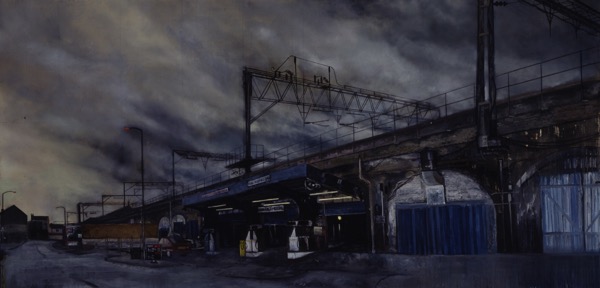
Three Colts Lane
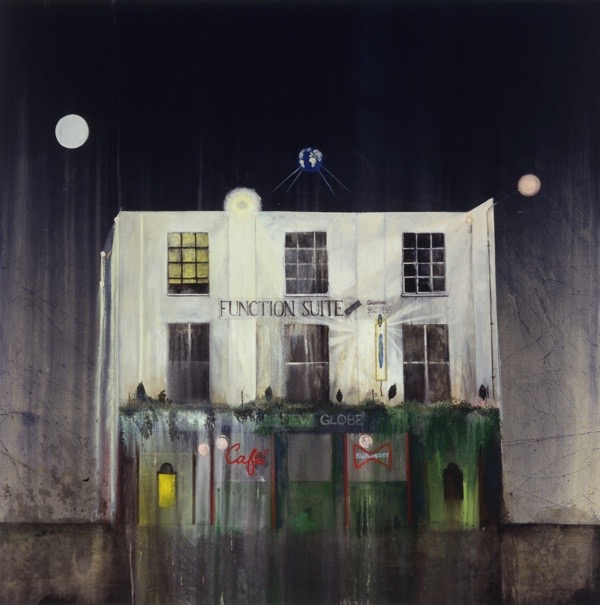
The New Globe
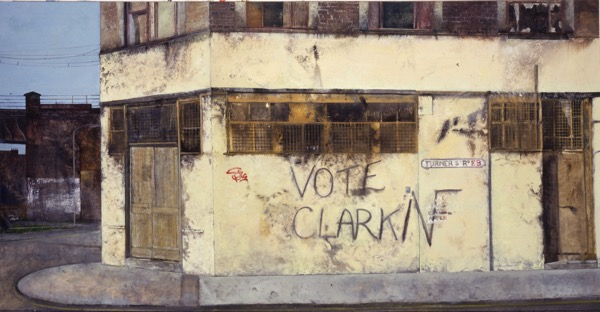
Turner’s Rd
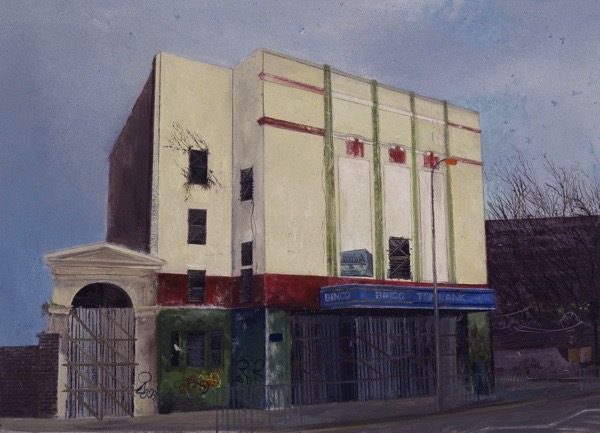
Bingo Hall, Mare St
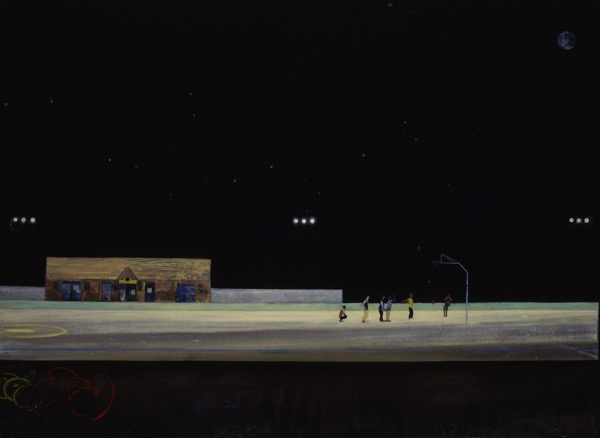
Bethnal Green Garden
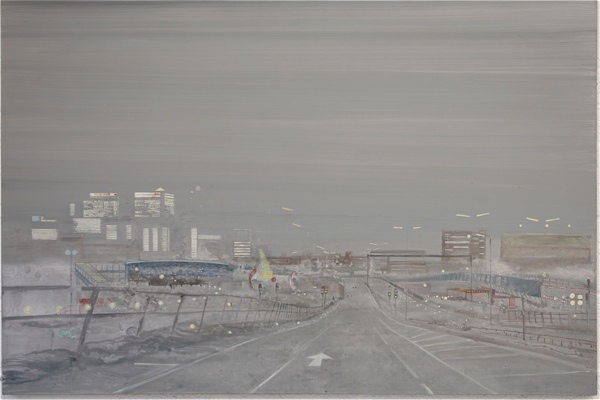
Looking West

Bud

From Beckton Alp

Goodfellas

Showcase Cinemas

Tate Moss

Pink Flats

Jock & Horseshoe Jake in front of Popular Enclosure

Dagenham
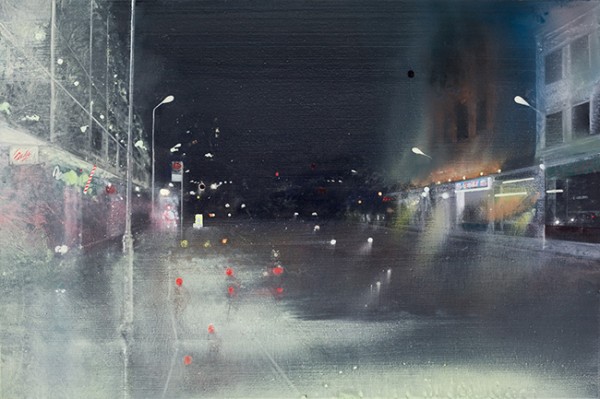
Roman Rd
Jock McFadyen
Paintings copyright © Jock McFadyen
Portraits copyright © Lucinda Douglas Menzies
Click here to order a copy of EAST END VERNACULAR
David Power, Showman

David Power lives in a comfortable Peabody flat round the back of the London Coliseum and, with his raffish charm, flowing snowy locks and stylish lambswool sweater, he is completely at home among the performers of theatre land. Yet, although David may have travelled only a short distance to the West End from his upbringing in the East End, it has been an eventful and circuitous journey to reach this point of arrival.
Blessed with a superlative talent, both as a pianist and as a composer, David interrupted our conversation with swathes of melody at the keyboard – original compositions of assurance and complexity – and these musical interludes offered a sublime counterpoint to the sardonic catalogue of his life’s vicissitudes. Settled happily now with his third wife, David organises charity concerts which permit him to exercise his musical skills and offer a lively social life too. At last, winning the appreciation he always sought, David has discovered the fulfilment of his talent.
“I’ve done a lot of things in my time. All my family were boxers. In those days you had thirty or forty fights a week before you could make a living. It was a different world. Them days we had some good fights but they were hungry then. They punched the fuck out of each other but they were all friends too.
Me, I love boxing but I was a prodigy at the piano at the age of five. My mother, Lily Power, she couldn’t afford no piano lessons for me because we were poor. People have no idea how hard it was in the thirties and forties. I was born in Hounslow and my mother moved us back to Spitalfields where she was from.
My mum paid five shillings a week rent at 98 Commercial St but she wouldn’t let me answer the door when the rent collector came round. Today you couldn’t buy it for two million. Wilkes St was called the knocking shop because the brass went round there for the top class girls. They said, “Can we help you out, any way you like?” Itchy Park, next to the church, we called that Fuck Park – you could get it in there for sixpence. It was a wonderful, wonderful world.
Then I was evacuated to Worcester but I ran away about nine times. Each time, the police picked me up when I got to Paddington Station and put me on the train back again, I was nine years old. It was very funny.
They gave my mother an old pub in Worcester and she took in twenty armaments workers. There was no water, it was outside in the scullery. She charged one pound fifty a week for bed and breakfast and I used to get up at five-thirty to do the fires each morning in 1940. The most wonderful thing was when they brought gas into the house and we had a gas stove, and I didn’t have to worry about making up the fire each morning and heating the water for everyone for bath night on Friday. I got in a lot of trouble at school because I was Jewish and they used to say, “Show us your horns!” and that’s how I got into fighting.
I started work in Spitalfields Market when I was fourteen, I worked with a Mr Berenski selling nuts – peanuts and walnuts. The place was piled high with nuts! I had to stack them up with a ladder. I remember once the sack split and the nuts went everywhere and he chased me around the market. But Harry Pace, my cousin, he was a middleweight, he protected me.
I got a job in The Golden Heart playing the piano at weekends, earning one pound for two sessions. An old guy asked me to play, “When I leave the world behind,” and I thought, “He ain’t got long to go.” I earned three pounds, seventeen shillings and tuppence but, when my father discovered, he hit me round the ear and said, “You’ve been thieving!” Then my mother explained what I had been doing, and he took the money and gave me two bob.
After the war, my mother moved to Westcliff on Sea and that’s when she could afford two and sixpence for piano lessons for me, but by then I was much more interested in sport. As a child, I could play any music that I heard on the radio but, when I had my first lesson at ten years old, I thought crochets and quavers were sweets. There was a big Jewish community in Westcliff and I went to Southend Youth Club and started boxing there until I was called up for the army. I played football for Southend, we won the cup and I scored two goals. In the army, I sent my mum one pound a week home, but I was supposed to have been a concert pianist at eighteen. Fortunately, my Colonel liked music and I was in the NAAFI playing the piano and he asked me to play for the officers. They shipped me out to Hong Kong and Singapore and I played twice a month in the Raffles Hotel on Sundays and for the Prime Minister of Hong Kong.
When I came out the army, I was supported by Harriet Cohen, a concert pianist. I told her I was a ragged man but she wrote to the principal of the Guildhall School of Music. The professor told me to play flat, so I lay on the floor. I said, “You asked me to play flat, you fucking nitwit.” Then I went for an audition at the Windmill Theatre but they only offered me eight pounds a week for playing fourteen shows, so I jacked it in and did the Knowledge and became a cab driver, and got married in 1960. Then I decided to go into the markets and I worked in Covent Garden for twelve months as a porter, until my wife’s dad and I went into hotels – The Balmoral in Torquay and Hotel 21 in Brighton, but in the recession of the nineties I went bankrupt. We couldn’t compete with the deals offered by the big chains where businessmen used to bring their dolly birds at weekends.
Then I went on the road selling and I was earning three or four hundred pounds a week, especially in Wales. They didn’t know what a carpet was there. I once bought ten thousand dog basket covers for five pounds and sold them all at four for a pound as cushion covers in Pitsea Market. And that’s when I went into Crimplene, and then china, and then ties. Those were great days. Eventually, I went back in the taxi, worked like a slave, had a heart attack and died. Half of my heart is dead. I’ve been in and out of hospital with the old ticker ever since, so I decided to give something back by holding concerts for University College London Hospital. I do it all. I know talent when I see it and we have shows every month.
I never played the piano for twenty years, until ten years ago I went back to it – I wrote a piece of music when my wife died. I always wanted to be a pianist because music is something I get wrapped up in. A lot of people never believed I played the piano because I was so ragged, I had a ragged upbringing. If you come from the background that I came from, you’ve got keep putting money on the table. To be dedicated to music, you to have to be rich or a fool. I’m a born showman, that’s what they tell me, “David, you’re a showman.””

David (on the left) enjoys a picnic with his mother Lily and brothers and sisters in Itchy Park, Spitalfields in the nineteen thirties

David as a young boxer in the nineteen fifties

Concert Pianist Harriet Cohen encouraged David to become a professional pianist.

David Power, Showman
Pubs Of Wonderful London
In these cold grey days at the end of winter, I get a powerful urge to seek refuge in a cosy corner of an old pub and settle down for the rest of the afternoon. There are plenty of attractive options to choose from in this selection from the popular magazine Wonderful London edited by St John Adcock and produced by The Fleetway House in the nineteen-twenties.

The Old Axe in Three Nuns Court off Aldermanbury. It was once much larger and folk journeying to Chester, Liverpool and the North used to gather here for the stage coach.

The Doves, Upper Mall, Chiswick.

The Crown & Sceptre, Greenwich – once a popular resort for boating parties from London, of merry silk-clad gallants and lovely ladies who in the summer evenings came down the river between fields of fragrant hay and wide desolate marshes to breathe the country air at Greenwich.

At the Flask, Highgate, labourers from the surrounding farms still drink the good ale, as their forerunners did a century ago.

Elephant & Castle – The public house was once a coaching inn but it is so enlarged as to become unrecognisable.

The Running Footman, off Berkeley Sq, is named after that servant whose duty it was to run before the crawling old family coach, help it out of ruts, warn toll-keepers and clear the way generally. He wore a livery and carried a cane. The last to employ a running footman is said to have been ‘Old Q,’ the Duke of Queensberry who died in 1810.

The Grenadier in Wilton Mews, where coachmen drink no more but, at any moment – it would seem – an ostler with a striped waistcoat and straw in mouth might kick open the door and walk out the place.

The Spaniards in Hampstead dates from the seventeenth century and here the Gordon Rioters gathered in the seventeen-eighties, crying “No Popery!”

The Bull’s Head at Strand on the Green is an old tavern probably built in the sixteenth century. There is a tradition that Oliver Cromwell, while campaigning in the neighbourhood, held a council of war here.

Old Dr Butler’s Head, established in Mason’s Avenue in 1616. The great Dr Butler invented a special beer and established a number of taverns for selling it, but this is the last to bear his name.

The grill room of the Cock, overlooking Fleet St near Chancery Lane. It opened in 1888 with fittings from the original tavern on the site of the branch of the Bank of England opposite. Pepys wrote on April 23rd 1668, “To the Cock Alehouse and drank and ate a lobster and sang…”

The Two Brewers at Perry Hill between Catford Bridge and Lower Sydenham – an old hedge tavern built three hundred years ago, the sign shows two brewer’s men sitting under a tree.

The Old Bell Tavern in St Bride’s Churchyard, put up while Wren was rebuilding St Bride’s which he completed in 1680. There is a fine staircase of unpolished oak.

Coach & Horses, Notting Hill Gate. This was once a well-known old coaching inn, but it still carries on the tradition with the motor coaches.

The Anchor at Bankside. With its shuttered window and projecting upper storey, it enhances its riverside setting with a sense of history.

The George on Borough High St – one of the oldest roads in Britain, for there was a bridge hereabouts when Roman Legionaries and merchants with long lines of pack mules took the Great High Road to Dover.

The Mitre Tavern, between Hatton Garden and Ely Place. It bears a stone mitre carved on the front with the date 1546. Ely Place still has its own Watchman who closes the gates a ten o’clock and cries the hours through the night.

The George & Vulture is in a court off Cornhill that is celebrated as the place where coffee was first introduced to Britain in 1652 by a Turkish merchant, who returned from Smyrna with a Ragusan boy who made coffee for him every morning.

The Bird in Hand, in Conduit between Long Acre and Floral St, formerly a street of coach-makers but now of motorcar salesmen.

The Old Watling is the oldest house in the ward of Cordwainer, standing as it did when rebuilt after the Fire, in 1673.

The Ship Inn at Greenwich got its reputation from courtiers on their way to and from Greenwich Palace and in 1634 some of the Lancashire Witches were confined her, but now it is famous for its Whitebait dinners.

The Olde Cheshire Cheese – the Pudding Season here starts in October.
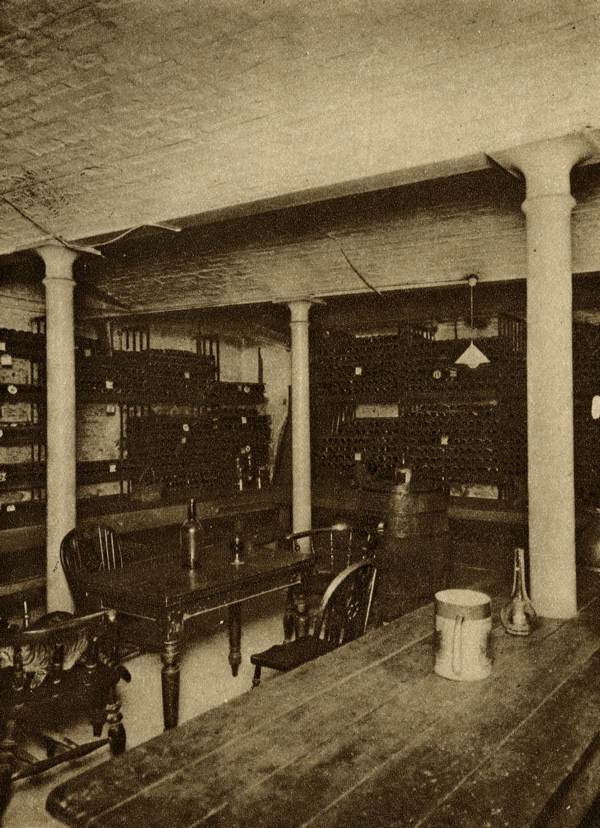
The Cellar Bar at the Olde Cheshire Cheese

The Chop Room at the Olde Cheshire Cheese

The Cellar Cat guards the vintage at the Old Cheshire Cheese. Almost under Fleet St is a well, now unused, but pure and always full from some unknown source. To raise the iron trap door which keeps the secret and to light a match and stoop down over this profound hole and watch the small light flickering uncertainly over the black water is to leave modern London and go back to history.
Images courtesy Bishopsgate Institute
You may like to take a look at
The Taverns of Long Forgotten London
Alex Pink’s East End Pubs Then & Now
The Gentle Author’s Next Pub Crawl
The Gentle Author’s Spitalfields Pub Crawl
The Gentle Author’s Dead Pubs Crawl
The Gentle Author’s Next Dead Pubs Crawl
In Search Of Flower & Dean St
Contributing Writer, Gillian Tindall, went in search of Flower & Dean St
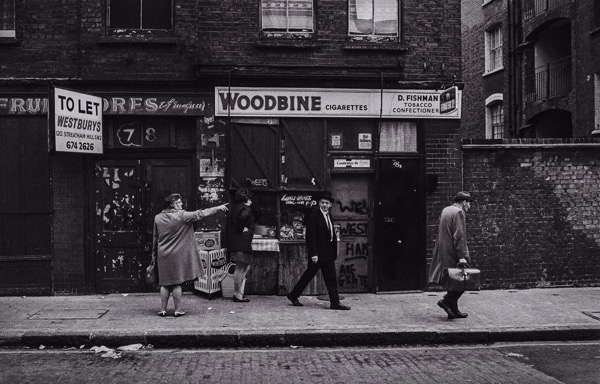
Fishman’s Tobacconist, Flower & Dean St, seventies, by Ron McCormick
It is a disappointing fact that some dwellings are built to be poor, you can find examples all over Britain. But in parts of London, once desirable streets had poverty imposed upon them. The streets of Spitalfields, whose early Georgian houses are now expensive and desirable, were from the Victorian period until well after the Second World War under this shadow. It is only thanks to the energies and determined actions of a few in the sixties and seventies that a number of these streets have survived, but many have not and one of these is Flower and Dean St.
In Tudor times, Spitalfields was actually fields beyond the City wall, though by the late Elizabethan days a sprinkle of individual wealthy gentleman’s houses began to dot the roadside up to Shoreditch and, by the reign of Charles I, there were more of them – typical ribbon development. This ceased during the Civil War but once peace was established, even before the Cromwells were seen off and Charles II was restored, builders got busy again in this desirable-almost-rural setting.
In 1655 two brothers called Fossan, one of whom was a goldsmith, acquired an odd-shaped chunk of land not far from an ancient, muddy track to brick fields, now Brick Lane. Much of the ground was used for tenter fields, where woollen cloth woven locally was hung up to dry. Already the City clothing industry was impinging on the rural land. The Fossans leased the land for ninety-nine years to two builders, John Flower and Gowan Dean. Such was the system under which most of Greater London was created over the next two hundred years. There they built Fossan St, whose name a generation later came to be misunderstood as ‘Fashion St,’ and gave their own surnames to the street just south of it.
Fashion St still exists with the handsome early eighteenth century Christ Church, Spitalfields, and its graveyard just to the north, but its present buildings are of a later date. The original Flower & Dean St is gone as if it had never been.
It must have been a pretty street and a respectable one for much of the next century, when it was mainly occupied by Huguenot silk-spinners. These were protestants who had come to England to find a more welcoming society than the Catholic France of Louis XIV. They arrived in far greater numbers in the 1680s when Louis tore up a legal agreement tolerating Protestantism and real persecution set in. Some arrived across the Channel in dangerously small boats, making their way into the Thames estuary and up the river by night. Nothing in the life of nations really changes.
These hard-working spinners and weavers flourished, and by the mid-eighteenth century many had established themselves in other businesses, entering prosperous British society. Those who remained began to do less well, imports of silk and cotton from India were damaging the home trade. By the middle of the century the houses in Flower & Dean St were being sub-divided into smaller lodgings. There were also questions about their stability, the brickies employer by Flower & Dean were said to have used inadequate mortar.
Fifty years later, the land east of Whitechapel was entirely built up with houses and these were extending further along the Mile End Rd. Within another generation, the hamlets set in countryside that was visible from the Tower of London would be turning inexorably into the great mass of the East End. To the prosperous residents of expanding West London, this might as well have been a foreign country.
In reality, of course, much of the East End was filled with decent hard-working people who themselves regarded such places as Flower & Dean St as dangerous slums. It was now where lodging houses offered a bed for a few pence a night and where, it was said, thieves felt at ease and prostitutes plied their trade, though it is unclear who would seek them out there.
Ford Maddox Brown, the painter, described it as ‘a haunt of vice… full of cut-throats’, and it was a place where policemen were said only to venture in pairs. But the street acquired a sudden and much more general fame when, in 1888, two women who lodged in there in different houses met their demise in the Whitechapel Murders. Enough was enough. With the not-entirely rational logic that has often been applied to places that get a bad reputation, it was decided the street should be pulled down.
Just to add to the drama, during demolition in 1892, two skulls and some bones were found in a box under the yard. More murder victims, it was at once assumed. In reality, the examination of the bones seems to have been cursory and it is likely these relics were from a field-burial hundreds of years earlier.
What rose in the place of Flower & Dean St was Rothschild Buildings, a massive tenement block bestowed on the large newly-arrived population of Jewish people from Eastern Europe. The bestowers were the Rothschild banking family, and it was a classic example of ‘four percent philanthropy’ – a charitable cause, yet one which nevertheless brought in a modest but steady income.
Moral views change and the improvements of one era attract the disapproval of later times. By the seventies, many of the descendants of the original Jewish occupants of the Rothschild Buildings were established in more salubrious northern suburbs and Bangladeshis arrived to take their place. The Buildings were steeped in soot and the lack of bathrooms in the flats was considered unacceptable. They were pulled down leaving only the grandiose brick archway. Today, the site is a dug-out games pitch at the end of the short stub of Lolesworth Close off Commercial St.
Just to the south is Flower & Dean Walk, a modern low-rise pedestrianised development, looking oddly out of place amidst the complex of old alleys and new tower blocks, with the raucous salesmanship of Petticoat Lane a few minutes away. I went for a stroll down there recently on a snowy day. There was a thin mist floating above the whiteness and it seemed as if the monstrously tall constructions that have transformed the City were dissolving into the sky, as if they were disappearing while the older, traditional buildings remained. Would that it were so!
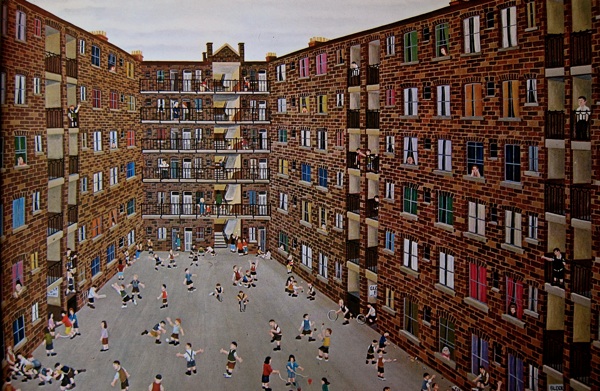
Rothschild Buildings by John Allin, seventies
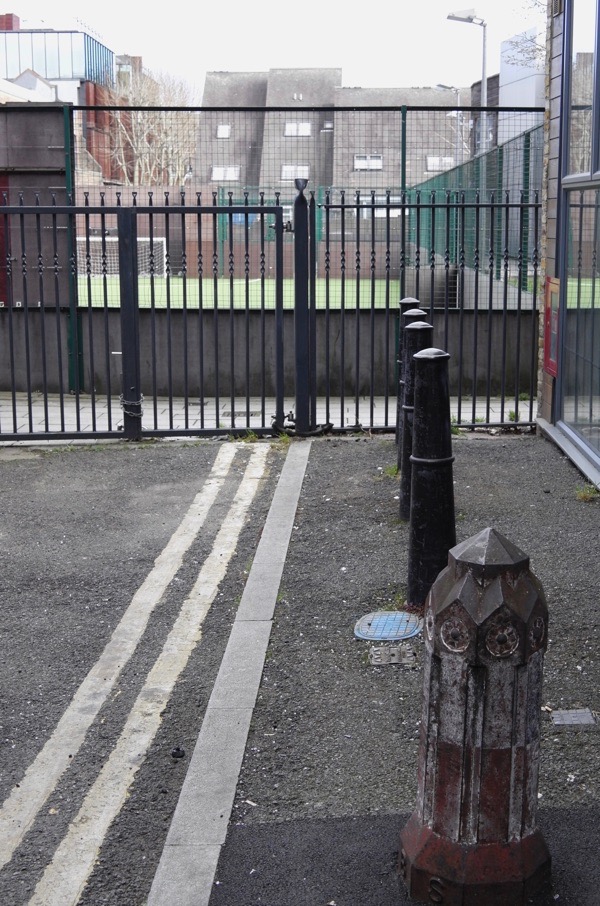
This bollard in Lolesworth Close is all that remains of Flower & Dean St
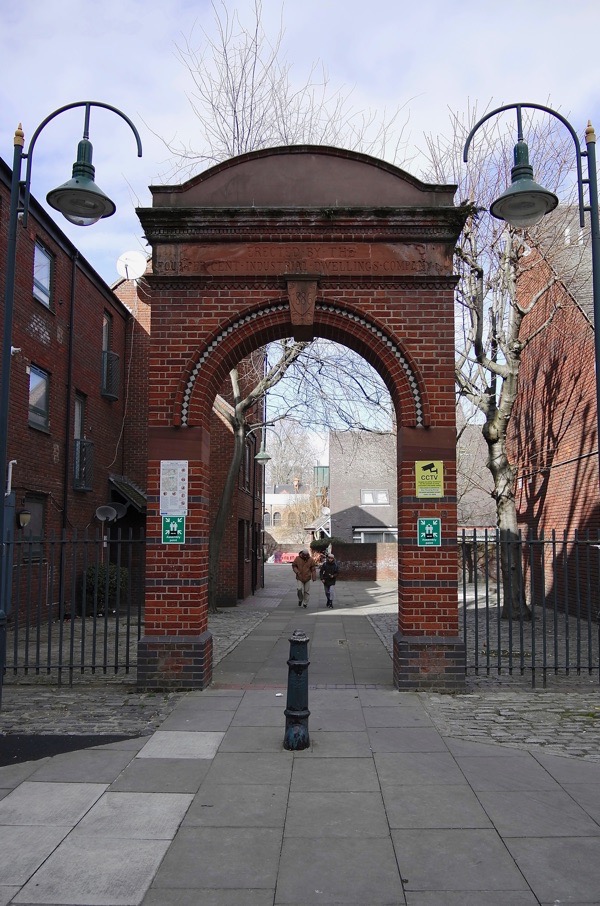
Entrance to the former Rothschild Buildings
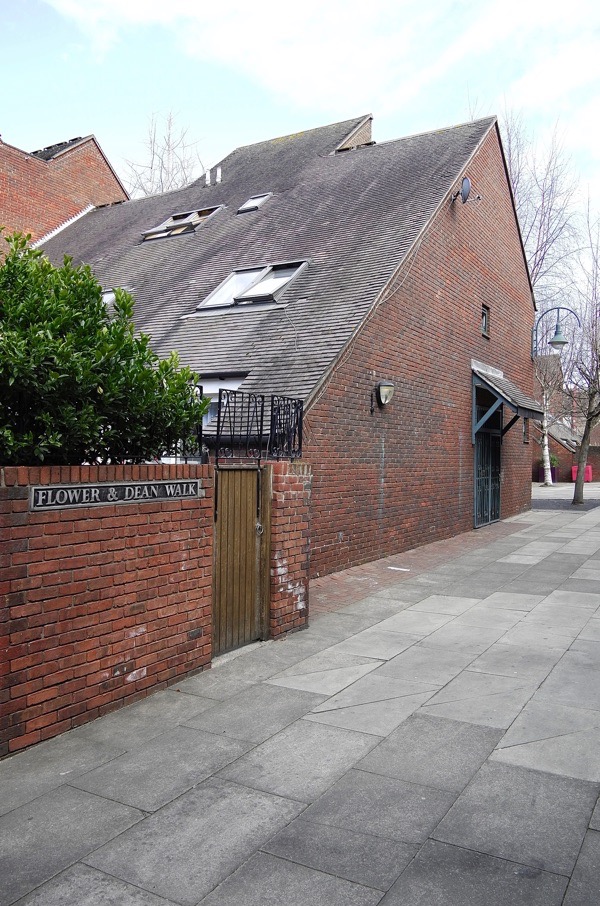
Flower & Dean Walk
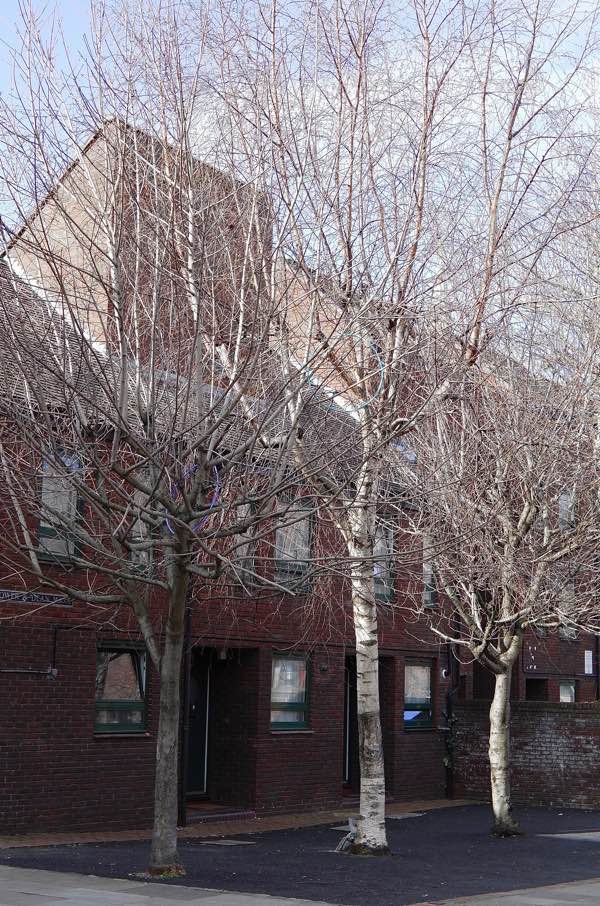
Flower & Dean Walk
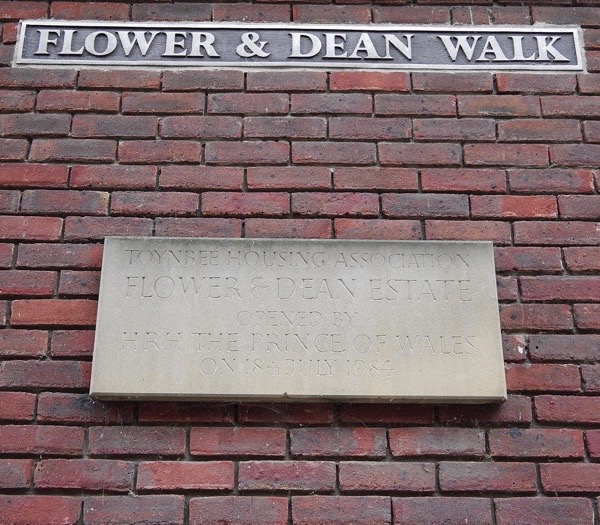
Flower & Dean Estate opened by HRH The Prince of Wales on 18th July 1984
Gillian Tindall’s The House by the Thames is available from Penguin
You may like to read these other stories by Gillian Tindall
Memories of Ship Tavern Passage
At Captain Cook’s House in Mile End
The Costume & Mantle Worker
I spent an afternoon in the Bishopsgate Institute archive studying copies of The Costume & Mantle Worker, a bilingual journal in English and Yiddish for members of the United Ladies Tailors Trade Union. In Spitalfields, we are still aware of the former textile trade and I was especially fascinated by these adverts, reproduced below, which set me on a quest to discover which of these premises are still standing.
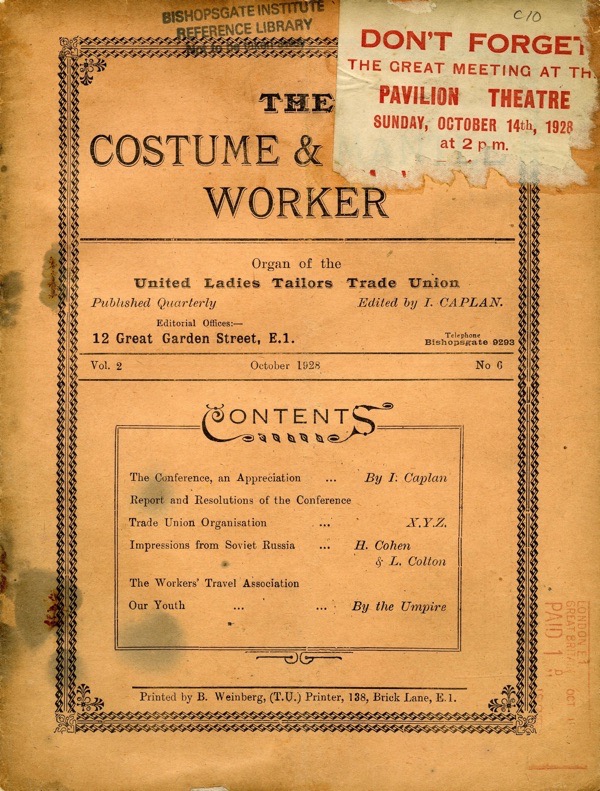
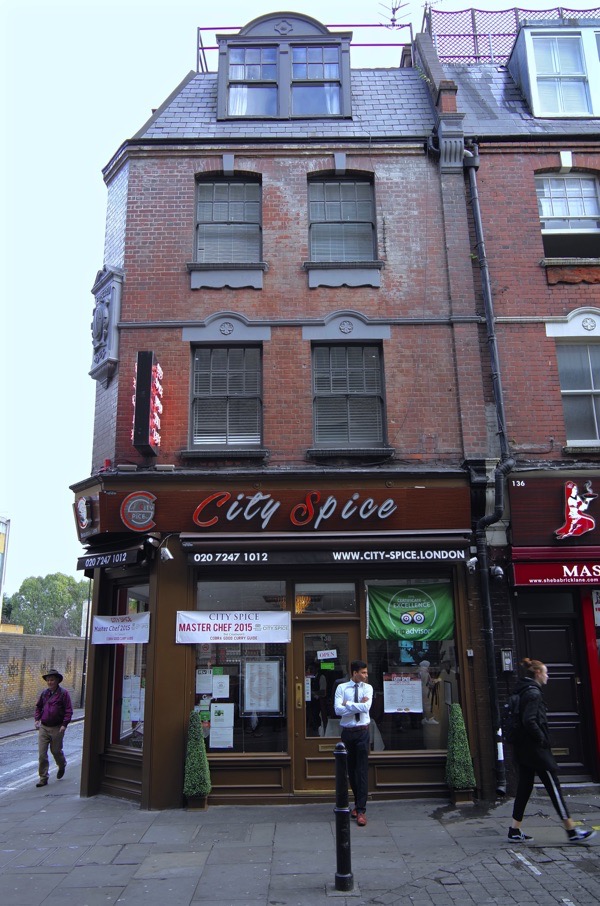
Formerly B. Weinberg, Printer, 138 Brick Lane
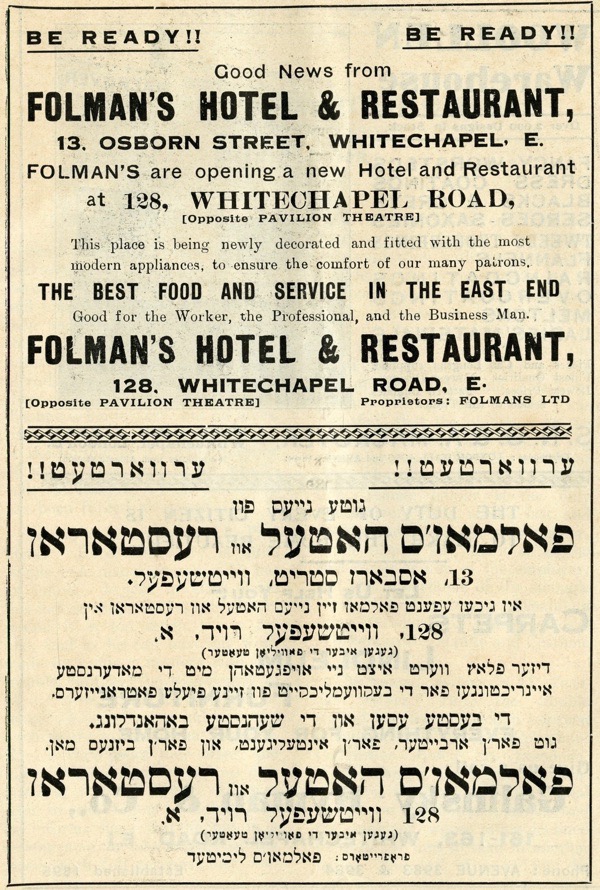
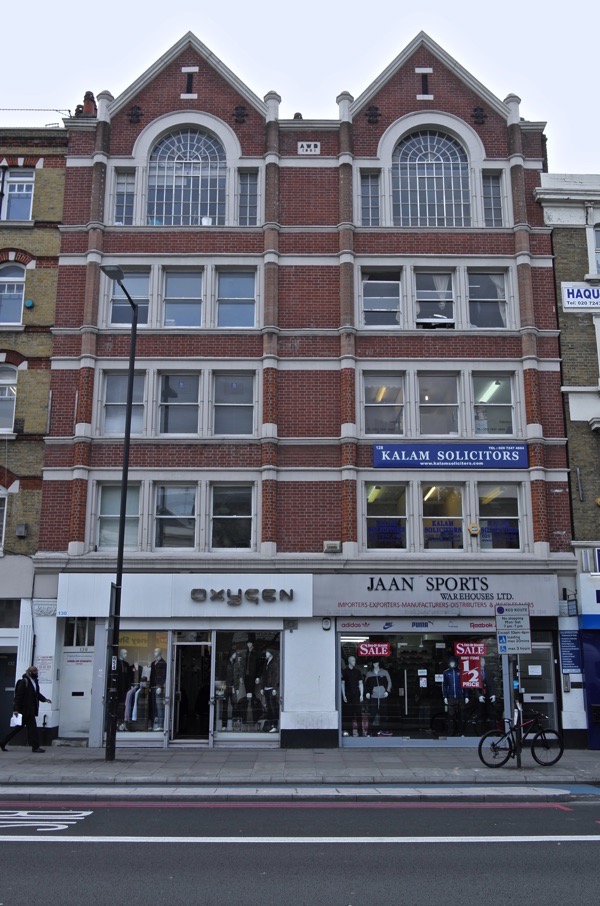
Formerly Folman’s Hotel & Restaurant, 128 Whitechapel Rd, Opposite Pavilion Theatre
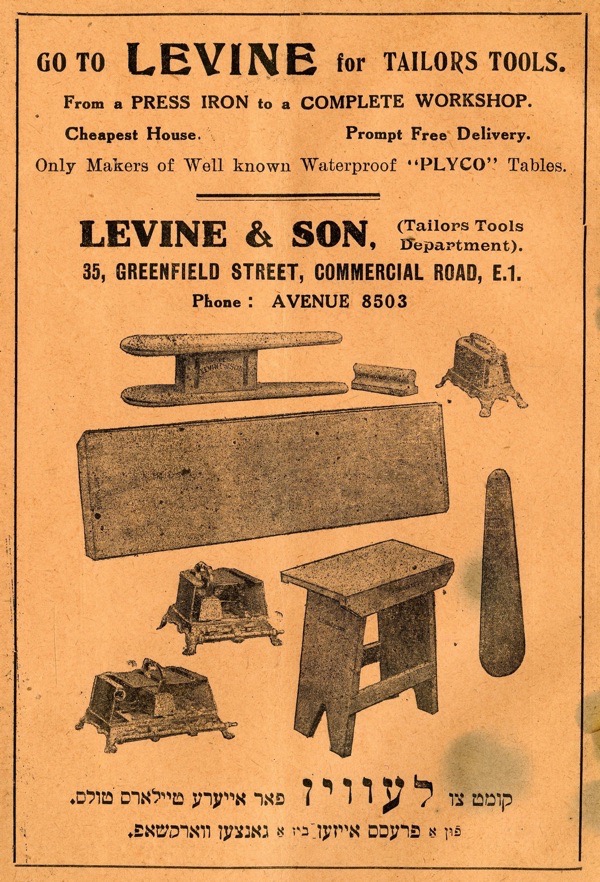

The Gentle Author’s tailors’ stool
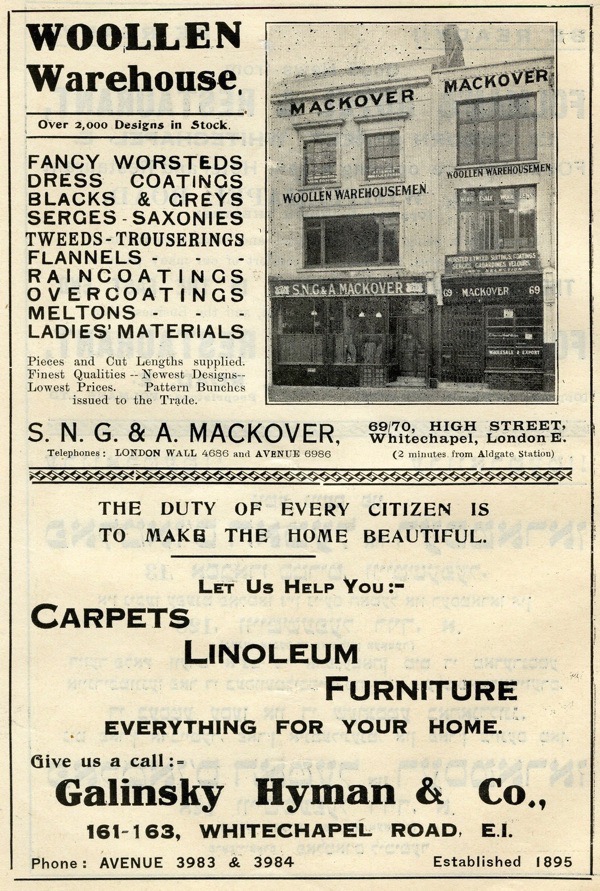
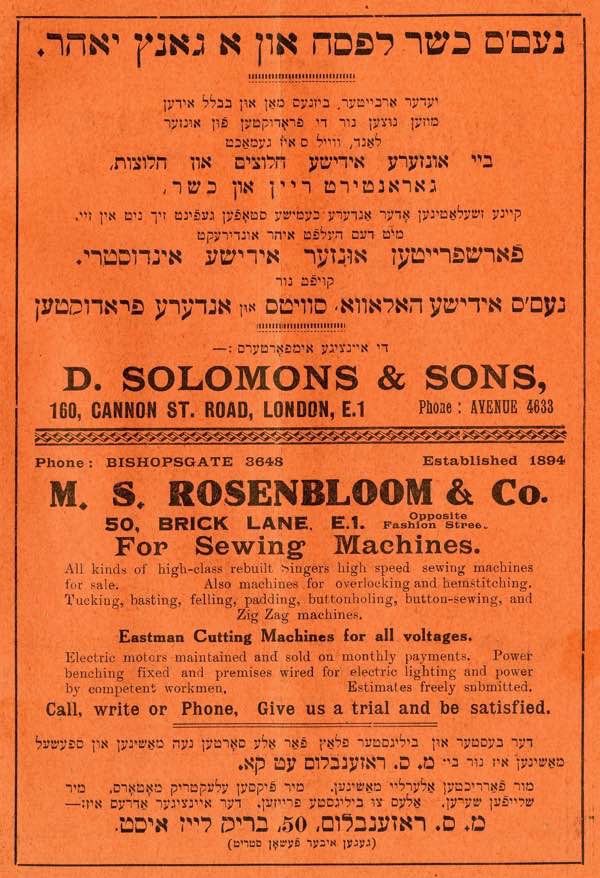
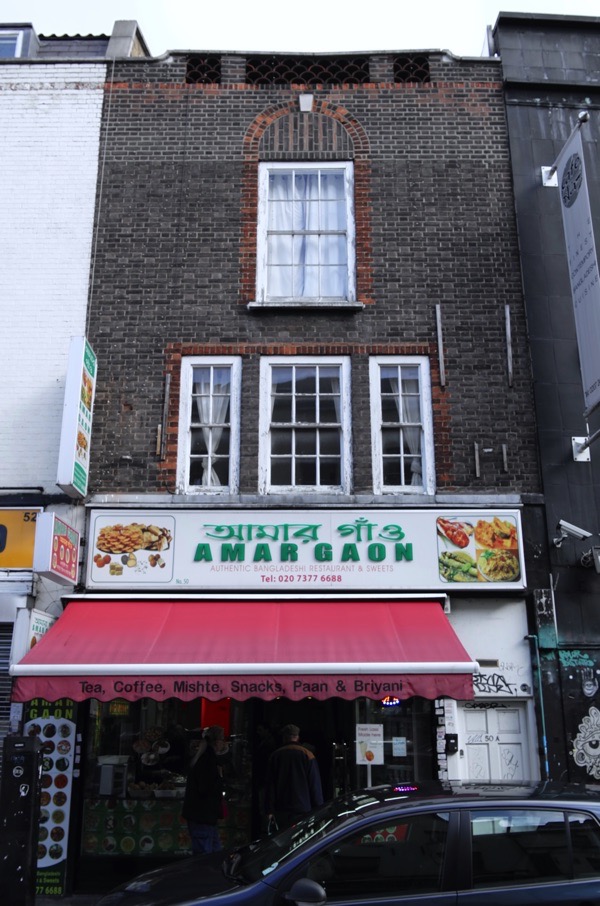
Formerly M. S. Rosenbloom & Co for sewing machines, 50 Brick Lane
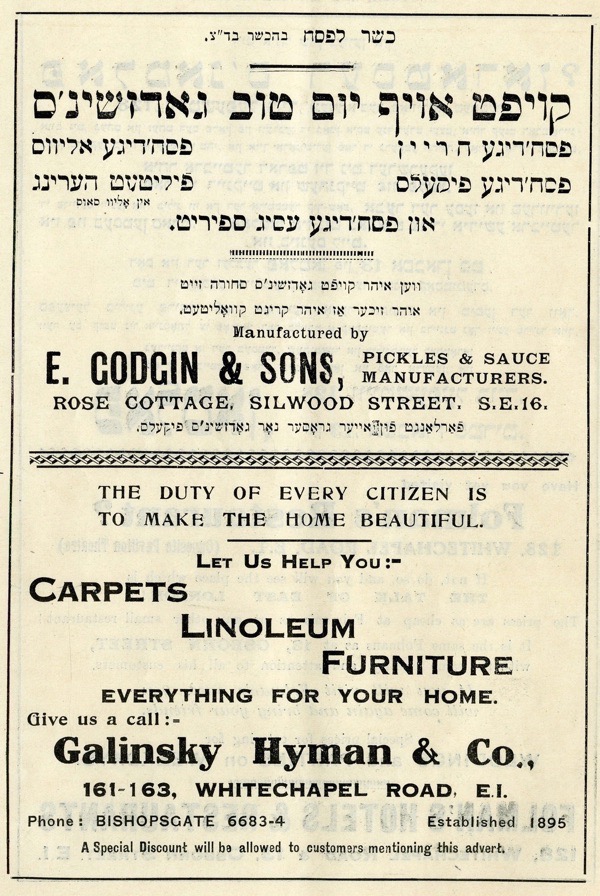
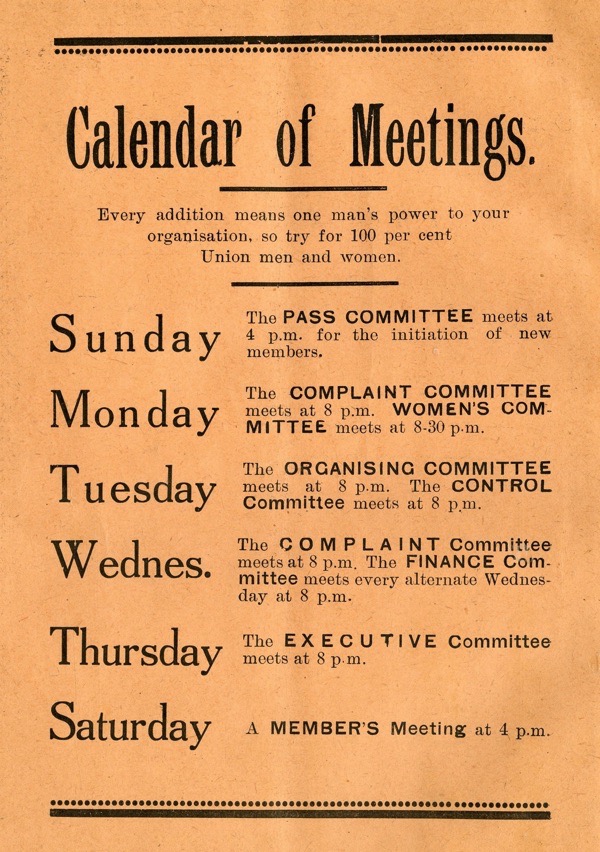
Pages of The Costume & Mantle Worker courtesy Bishopsgate Institute
You may also like to read about
James Mackinnon, Artist
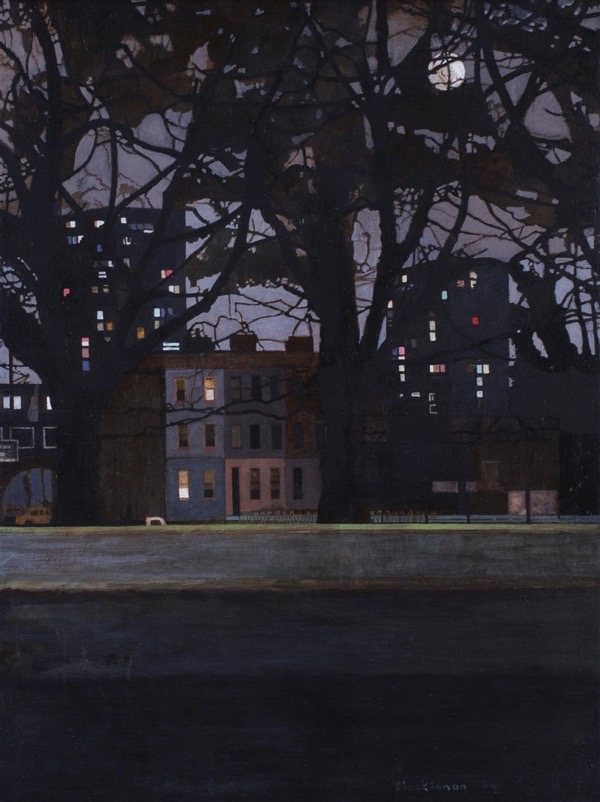
Twilight at London Fields, 2012
James Mackinnon’s streetscapes of the East End in general and London Fields in particular have captivated me for years. The seductive sense of atmosphere and magical sense of possibility in these pictures is matched by the breathtaking accomplishment of their painterly execution to powerful effect.
Remarkably, James is a third generation artist, with his uncle Blake and grandfather Hugh before him – which perhaps accounts for the classical nature of his technique even if his sensibility is undeniably contemporary.
We sat outside Christ Church, Spitalfields, one day and chatted about the enduring allure of the East End for artists. I was sorry learn that James had been forced to leave due to a combination of the rising rents and lack of recognition for his work.
Like several others I met while researching my book East End Vernacular, he is an artist who is genuinely deserving of appreciation by a much wider audience. It is very disappointing that the rewards for such a prodigiously talented painter as James Mackinnon are so little that he can no longer afford to be in the East End, and the East End is lesser for it.
“I grew up in South London in Lee Green and I used to go to the Isle of Dogs through the foot tunnel under the Thames and I was mystified by the area north of the river. Sometimes I would bunk off school with a sketchbook and go wandering there. It seemed a mysterious land, so I thought ‘What’s further up from the Isle of Dogs?’ I was a kid and I had been taken up to the West End, but I had never been to the East End and I sensed there was something extraordinary over that way.
I had always loved drawing and I got a scholarship in art to Dulwich College when I was eleven. The art department was wonderful and I got massive support, so I used be in the art block most of the time.
Later on, having left home and gone through college, there was a big recession and it was tough, all the students were scrabbling around for work, I had an epiphany. I was sat next to the Thames and I realised I just wanted to look at buildings and paint them. Since I was a child, buildings and their atmosphere, the feeling of buildings always had this resonance that I could not put my finger on.
As a kid, I was painting with poster paint and drawing with felt tips, and I was obsessed with the Post Office Tower. There was an art deco Odeon in Deptford that was derelict for years and it was demolished at the end of the eighties, and that had a huge effect on me. I sat in the back of my dad’s car and we drove past on the way up to London, and I would see this building and almost have a heart attack, I had such strong feelings about it. My God this thing is extraordinary, I am in love with it! It was falling to bits, it had pigeons sitting in the roof and it had wonderful art deco streamlining but it had this atmosphere, an elegance and a sadness. Even with the Post Office Tower, I felt it had this presence as though it were a person. That comes to the fore when you paint and you feel the place. You are not just concentrating on the architecture, it’s an emotional thing.
So with painting and drawing skills, I wanted to explore the landscape and often the hinterland. There is something compelling about going to a place you do not really know about – the mysterious world of places. The atmosphere of places is borne out of people and their residue, it’s about people living in a place.
By exploring, I was slowly drawn to where my heart was guiding me. In the early nineties, I moved to the East End because it was affordable and I had always wanted to explore there. And I was there until around 2013. I lived in Hackney and had a great time there, and made some great friends.
I was struggling as an artist, there was a lot of signing on the dole, but it was an act of faith, I knew it was what I had to do. I had always painted buildings.
I lived near London Fields and there is this little terrace of Georgian houses with a railway line and overhead electric wires, and there are some tower blocks in the distance, and you have all this grass. That was at the bottom of my road, it was such an interesting juxtaposition. A lot of East London landscapes have that, you might get a church sitting next to a railway line, next to tower block, next to the canal and a bit of old railing and some graffiti. That funny mixture. So I would just go and paint what I wanted. I painted what I was drawn to. For a long time, I was obsessed with Stratford. No-one had done anything to it at that time and I would go round the back streets and I roamed the hinterlands. I walked through to Plaistow and it is all part of a certain landscape that you find in the East End. To make a picture, you have got to find something that moves you and it can be something at the bottom of your road that resonates for you and makes the right composition for a painting. It’s hard to explain.
I had a go at having a studio but I was always a struggling artist so, when it came to rent day, it got tricky. It’s lovely having a studio but I could not afford it. I tried living in my studio for a bit to save money on the rent but the landlord found out and there was a cat and mouse game.
By the time I left, I think I had found myself. There is something in the painting that says it is me rather than anyone else and that has evolved from having done it for twenty years. I just about managed to survive. I realised I have got the tenacity and self belief. This is what I love. You find your path after a lot of struggle but it only comes by doing it. You realise that a great painting can come from something very ordinary, you can go for a walk and there might be something round the corner that knocks you out. There was a lot of that in the East End and I am still obsessed by it though it is changing hugely. Some of the landscapes have changed and some of the shops have gone. I miss Hackney in many ways but I do not miss struggling and rents going up. The area has changed.
So now I have moved to Hastings. I had a little boy and it became untenable to carry on living in the East End. I had no choice.”
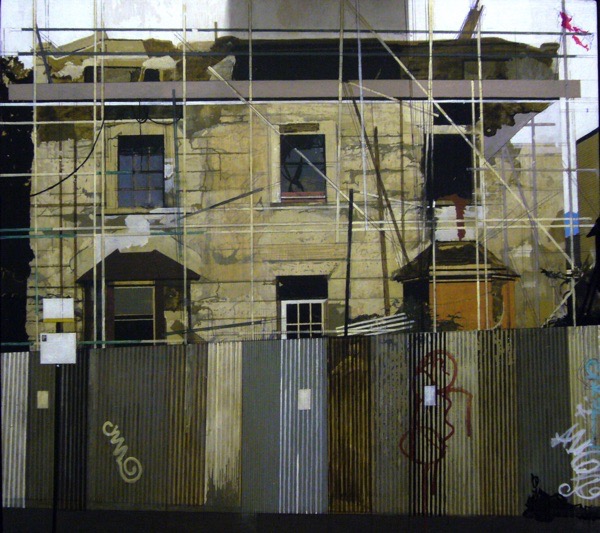
Homage to James Pryde, 2009 (The Mole Man’s House)
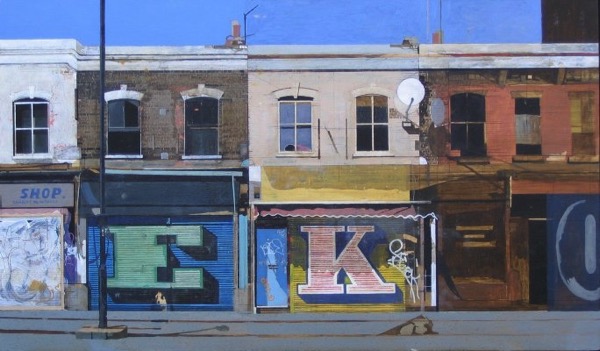
Broadway Market
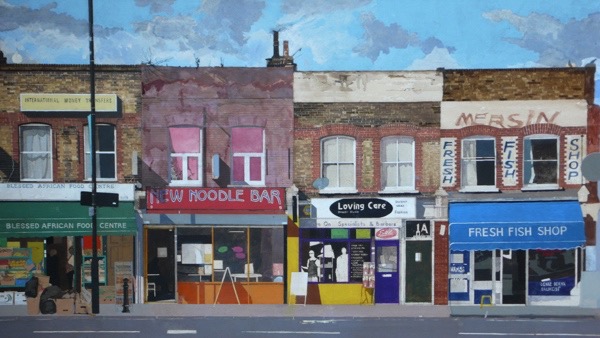
Shops in Morning Lane, 2014
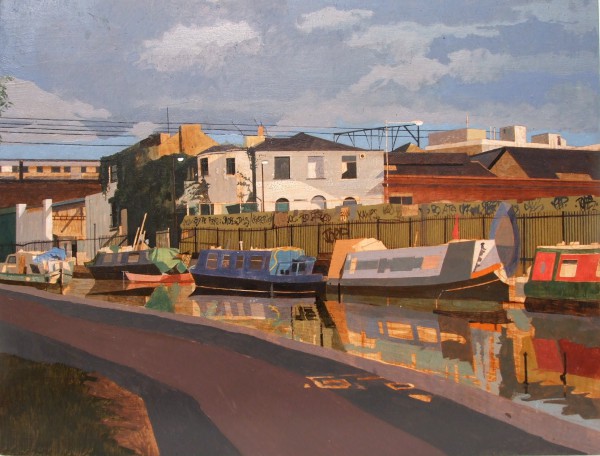
Hackney Canal near Mare St, 2012
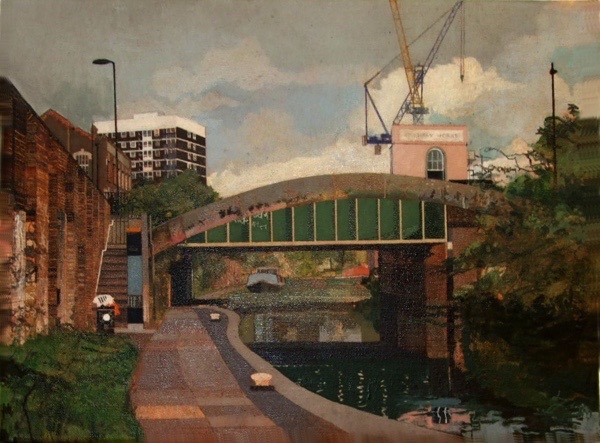
Canal, Rosemary Works 2014

Savoy Cafe, Hackney, 2012
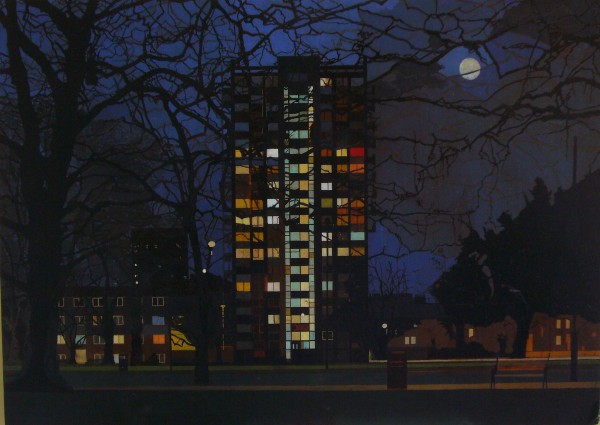
James Tower, London Fields, 2012
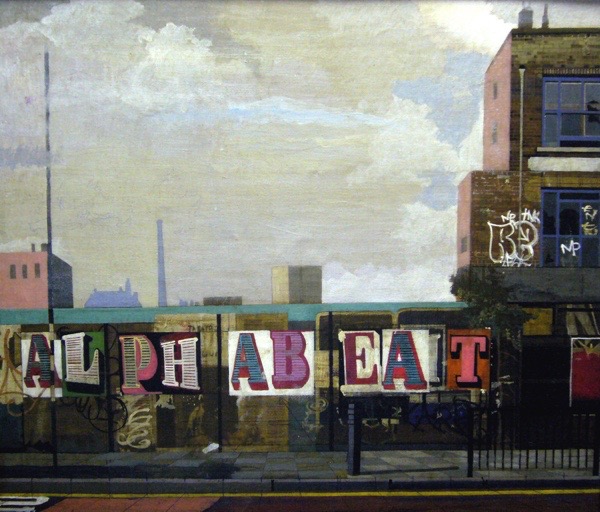
Alphabeat, 2007
Paintings copyright © James Mackinnon