
Eleanor Crow’s East End Cafes
JOIN ME FOR FOR A WALK THROUGH SPITALFIELDS THIS SATURDAY 11TH MARCH
CLICK HERE TO BOOK FOR SPRING & SUMMER TOURS
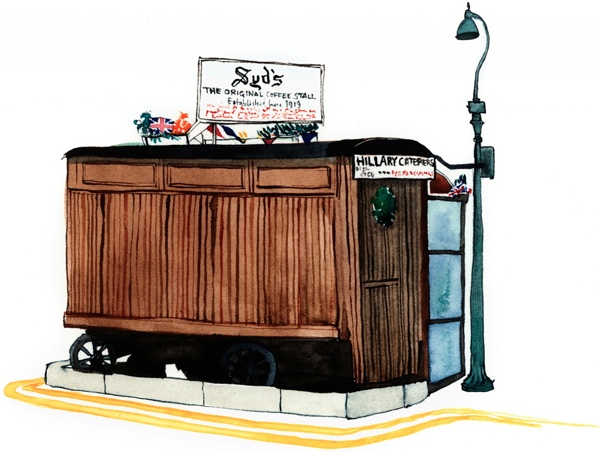
Syd’s Coffee Stall, Shoreditch High St
(Gone but not forgotten)
Illustrator Eleanor Crow made this set of watercolour portraits of cafes as a tribute to those cherished institutions which incarnate the essence of civility in the East End. “It’s because they’re individual concerns, often owned by families across generations who get to know all their customers,” admitted Eleanor, revealing the source of her devotion to cafe culture ,“I like the frontages because each is designed uniquely for that café with wonderful sign-writing or lettering and eye-catching colours. Some of these cafés have been here for a very long time and everyone in the area is familiar with them, and is very fond of them. They make the streets into a better place and are landmarks upon the landscape of the East End.”
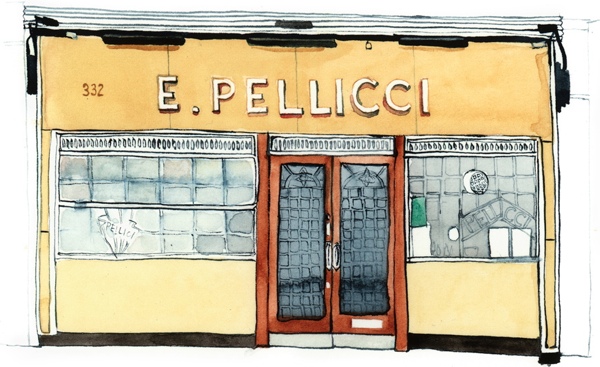
E. Pellicci, Bethnal Green Rd
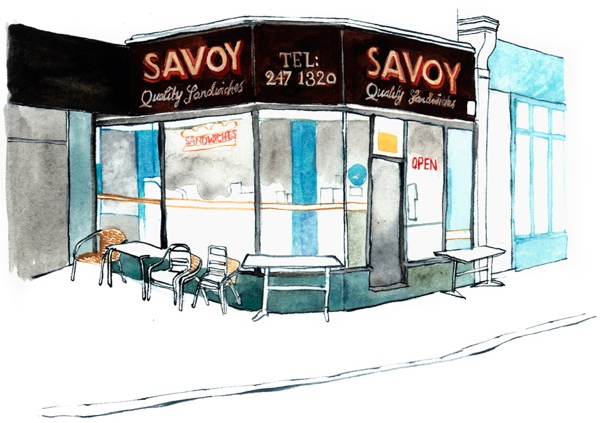
Savoy, Norton Folgate (Gone but not forgotten)
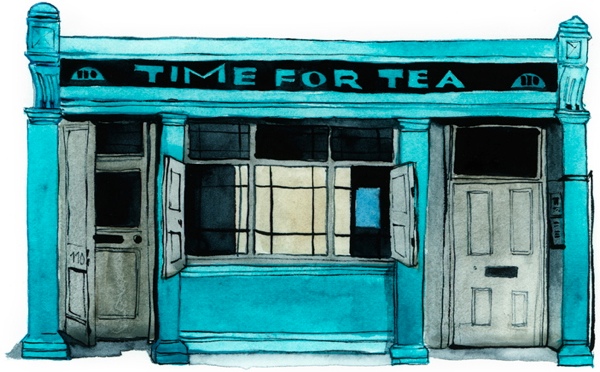
Time for Tea, Shoreditch High St (Gone but not forgotten)
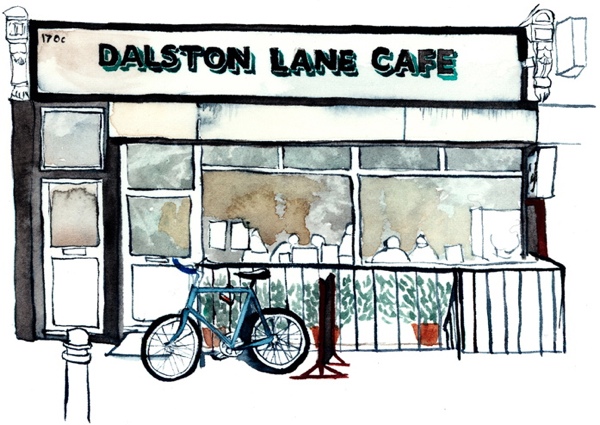
Dalston Lane Cafe
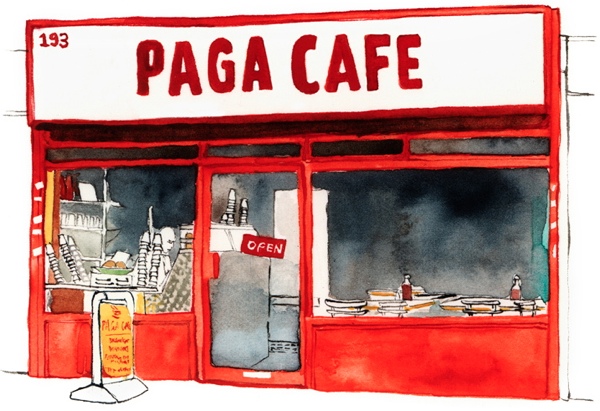
Paga Cafe, Lea Bridge Rd
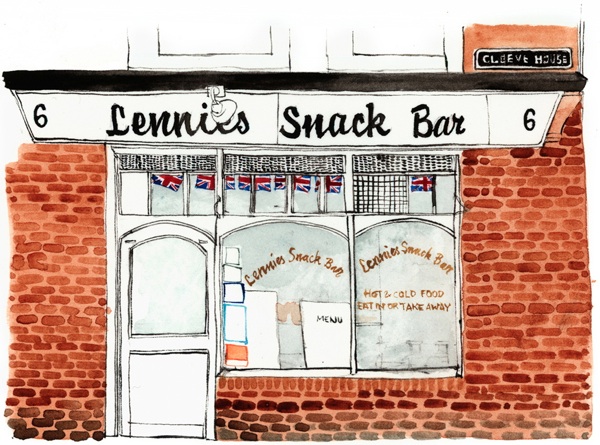
Lennies Snack Bar, Calvert Avenue (Gone but not forgotten)
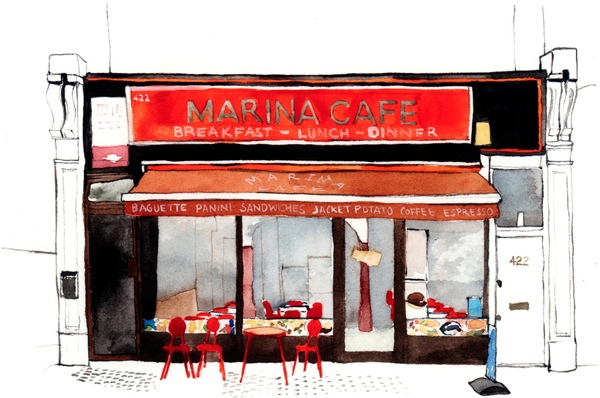
Marina Cafe, Mare St
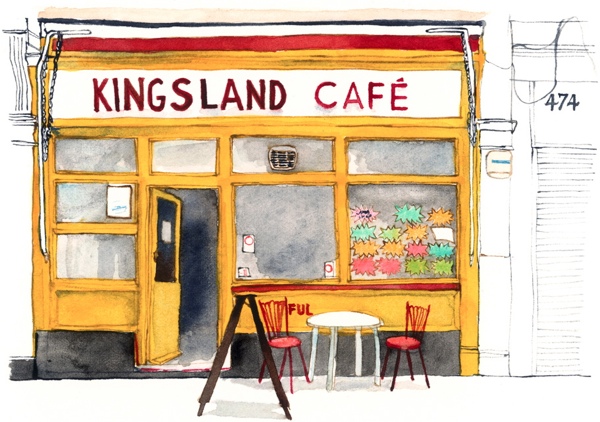
Kingsland Cafe, Kingsland Rd
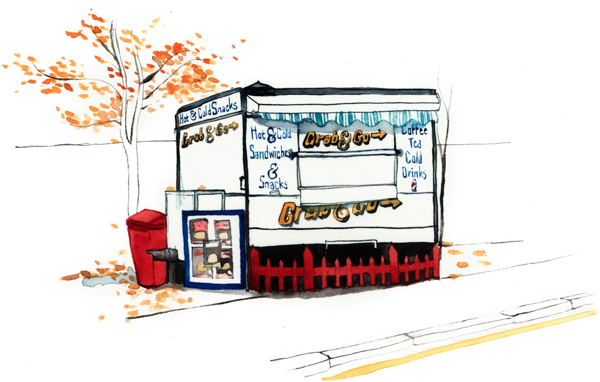
Grab & Go, Blackhorse Lane
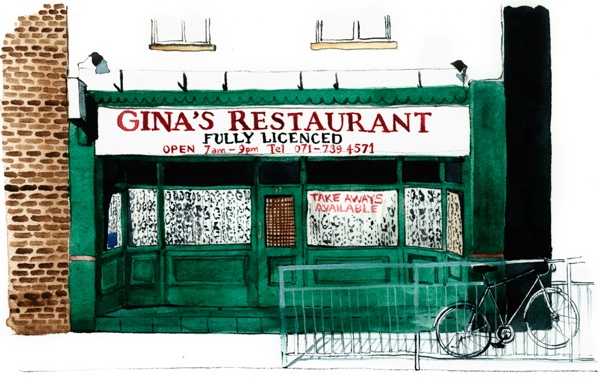
Gina’s Restaurant, Bethnal Green Rd (Gone but not forgotten)

Copper Grill, Eldon St

Billy Bunter’s Snack Bar, Mile End Rd (Gone but not forgotten)
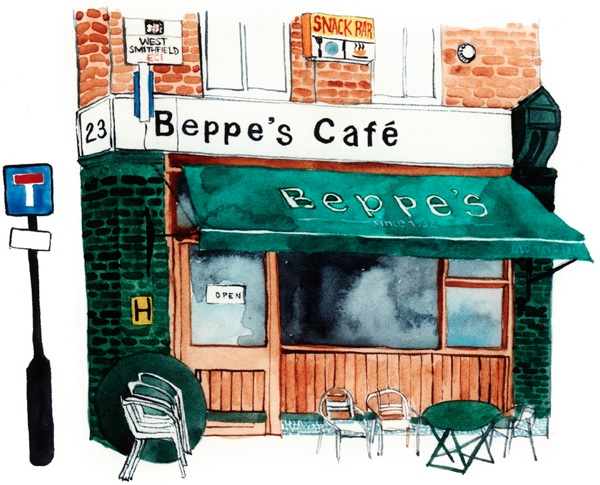
Beppe’s Cafe, West Smithfield
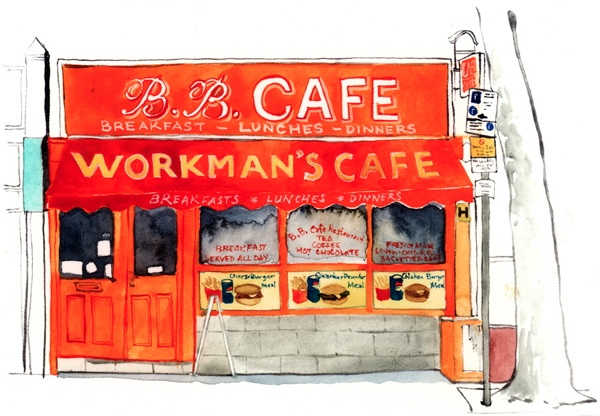
B.B. Cafe, Lea Bridge Rd

Savoy Cafe, Graham Rd

A.Gold, Brushfield St (Gone but not forgotten)
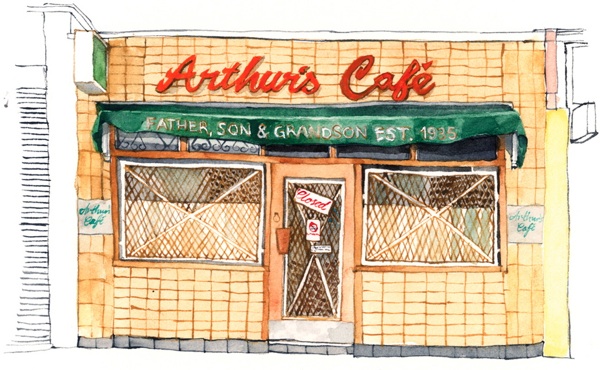
Arthur’s Cafe, Kingsland Rd (Gone but not forgotten)
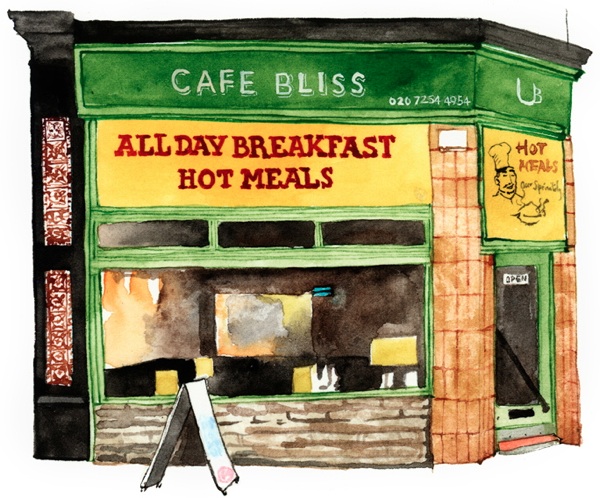
Cafe Bliss, Dalston Lane
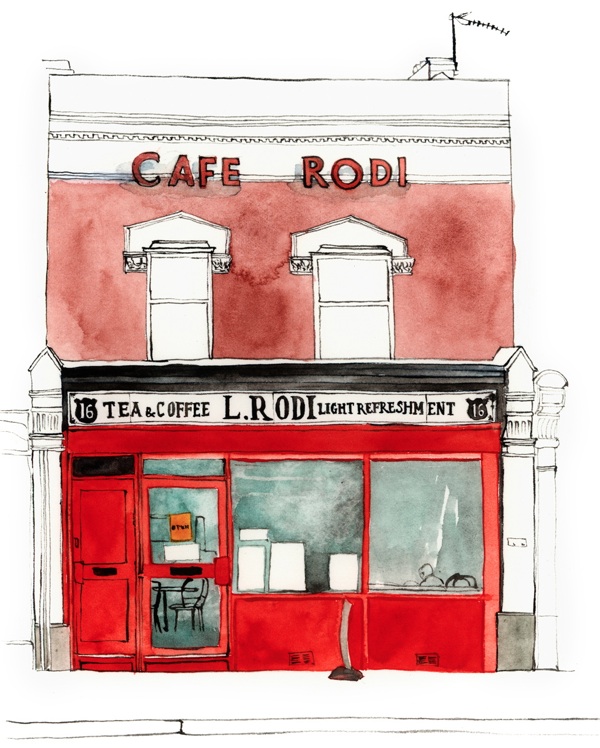
Cafe Rodi, Blackhorse Lane
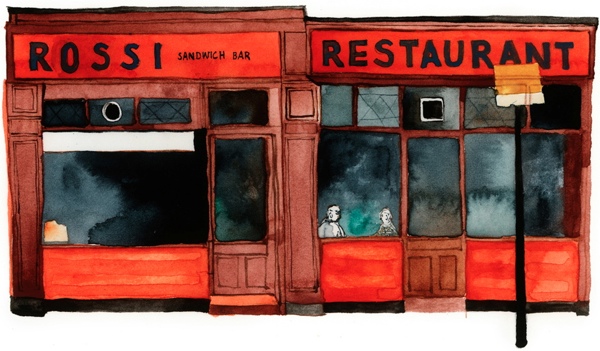 Rossi Restaurant, Hanbury St (Gone but not forgotten)

Eleanor Crow at E.Pellicci
Drawings copyright © Eleanor Crow
Portrait copyright © Colin O’Brien
You may also like to read
Dorothy Bishop, Artist & Teacher
DESPITE THE CHILL TODAY, I AM DELIGHTED TO REPORT THAT A BALMY 14 DEGREES IS FORECAST FOR MY WALK THROUGH SPITALFIELDS NEXT SATURDAY 11TH MARCH
CLICK HERE TO BOOK FOR SPRING & SUMMER TOURS
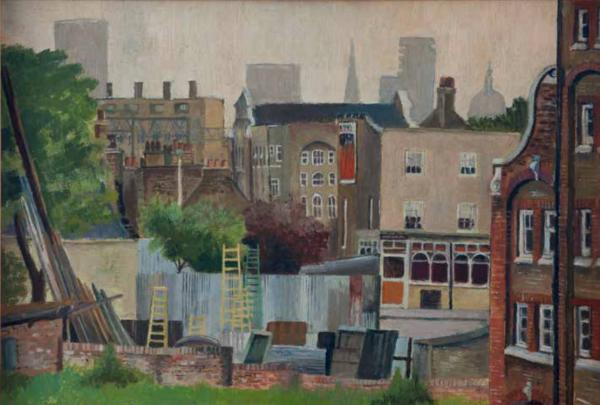
Looking towards the City of London from Morpeth School, 1961
This painting shows the view from the art room at the top of the school in Bethnal Green where Dorothy Bishop taught for twenty years. It was a formative experience that Dorothy treasured and this painting – which her friend Ruth Richardson kindly brought to my attention – is one of only a few pictures of hers that are known to exist. Although she painted throughout her life, she did not consider herself a professional artist.
Born in Brockley, Dorothy lived with her parents, her elder sister and younger brother for most of her life. After training as an Art teacher, she taught at a school in the north west of England for the duration of the war, returning south to live in Harefield, Uxbridge with her parents afterwards. In 1947, Dorothy took a job teaching evening classes Stewart Headlam Recreational Evening Institute in Morpeth St, an employment which was to occupy her until 1968. Recording her memory of these years, Dorothy wrote a diary of her impressions of the people and the place from which we include these excerpts.
“I was there for twenty-one years and it was one of the best things in my life. Now I am old and I must lead a quiet life, I would give much to be back at Stewart Headlam School. I really loved the cockney boys and girls, especially the wit and vitality of the boys. The whole atmosphere was full of life and rough kindness. I loved the wildness of the boys, once it had snowed and they made for me with snowballs and I saw their dark eyes dancing with joy, shining in the lamplight. They did enjoy things. The layabout boys tended to come to Art as in football training you had to do something, whereas in Art you could just sit and exercise your wit on the teacher and thus show off to your friends. The girls then were almost a different tribe and provided me often with members of the class who would work and were also friendly. They always supported me in any trouble with the boys and, on the whole, sex solidarity was more powerful than class solidarity.”
“The class was from 7:30pm to 9:30pm with a quarter of an hour’s break to go to the canteen for a cup of tea. The second half of the class was the most difficult as the boys would become restless, even to throw pencils. Sometimes I was utterly exhausted at the end and thought, ‘Why am I doing this?’ but then I thought, ‘Why should they drive me out?’ also I really loved them and there were some gentle quiet boys and girls who would talk to me. The next week they would be quite different and ask, ‘Did we upset you, Miss? We was only having a bit of a giggle.’”
“I was not approved of by the L.C.C. inspectors. Once they found my class copying Mickey Mouse and painting him in bright colours. I told them I could not change the taste of Bethnal Green for such things, but did not add – as I thought – that it would be impertinent to try to do so. In their report they said I was ‘defeatist’. I got a letter which said, ‘While your qualifications remain at their present level you are not suitable for employment by the L.C.C.” I was devastated. I was not terrific but I had had a full art training. As to drawing Mickey Mouse, the Pop Artists were doing this a few years later.”
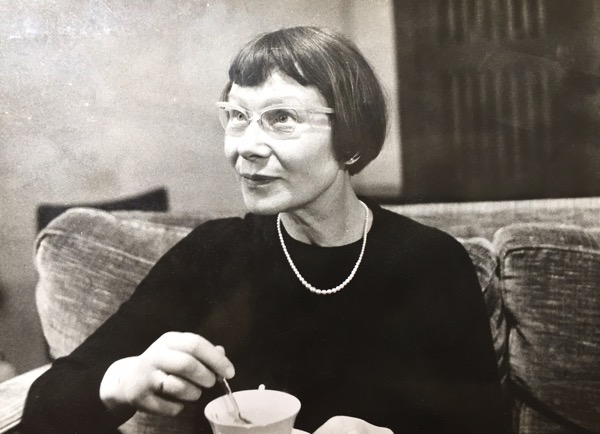
Dorothy Bishop (1913-2005)
Painting copyright © Estate of Dorothy Bishop
(With thanks to Esther North, Dorothy’s niece)
The Cabbies Shelters Of Old London
DESPITE THE CHILL TODAY, I AM DELIGHTED TO REPORT THAT A BALMY 14 DEGREES IS FORECAST FOR MY WALK THROUGH SPITALFIELDS NEXT SATURDAY 11TH MARCH
CLICK HERE TO BOOK FOR SPRING & SUMMER TOURS
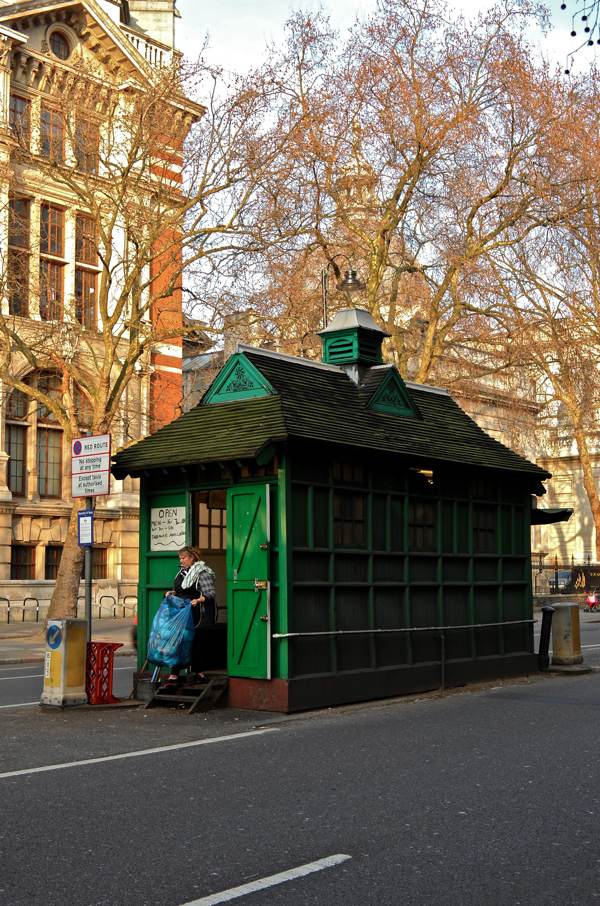
Thurloe Place, SW7
Created between 1875 and 1914, sixty of these structures were built by the Cabmen’s Shelter Fund established by the Earl of Shaftesbury to enable cabbies to get a meal without leaving their cabs unattended and were no larger than a horse and cart so they might stand upon the public highway.
Today, only thirteen remain but all are grade II listed and, on my strange pilgrimage around London, I found them welcoming homely refuges where a cup of tea can still be had for just 50p.
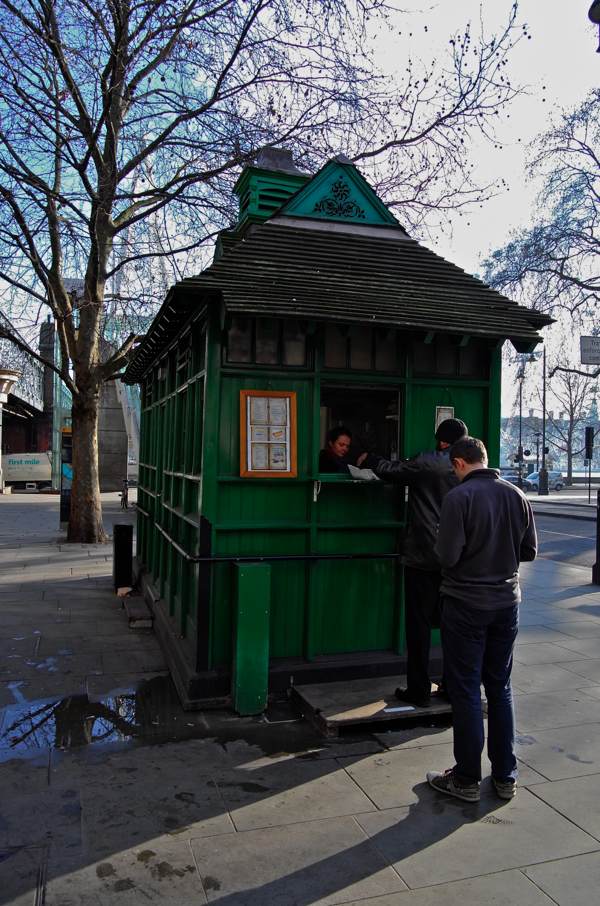
Embankment Place, Wc2
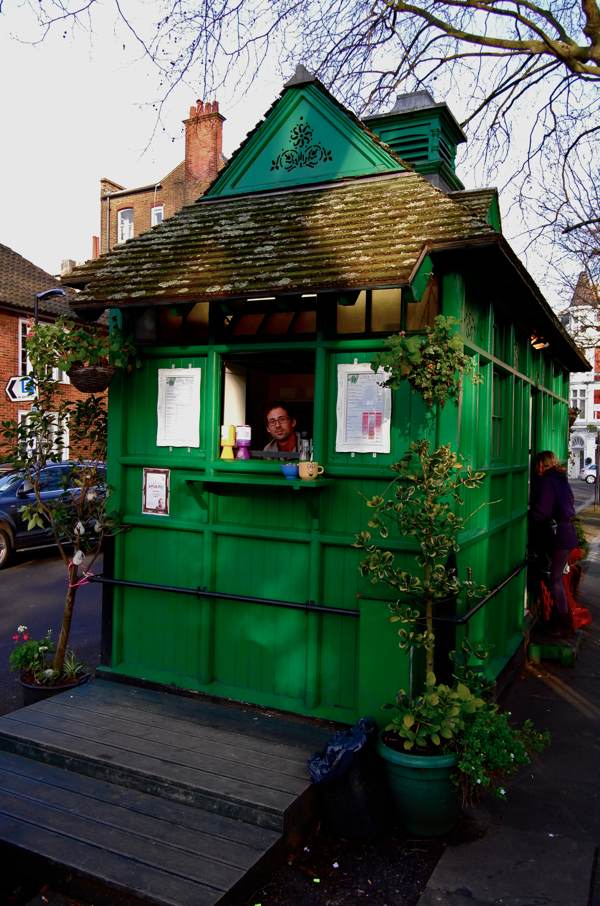
Wellington Place, NW8
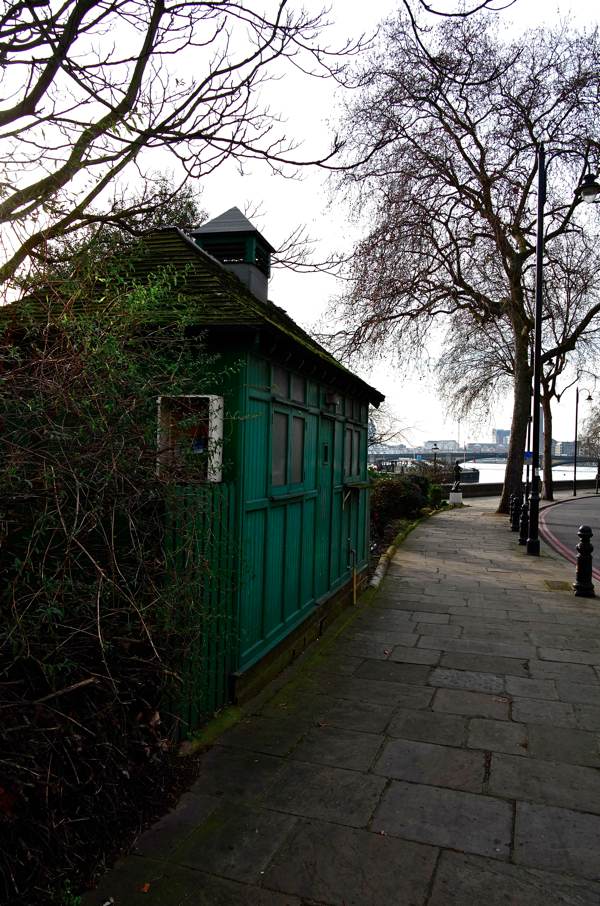
Chelsea Embankment, SW3
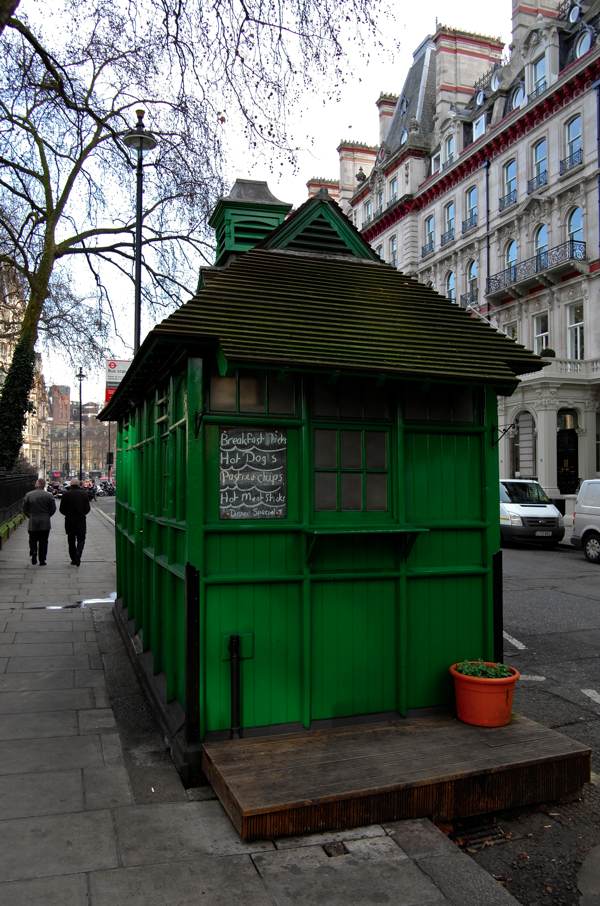
Grosvenor Gardens, SW1
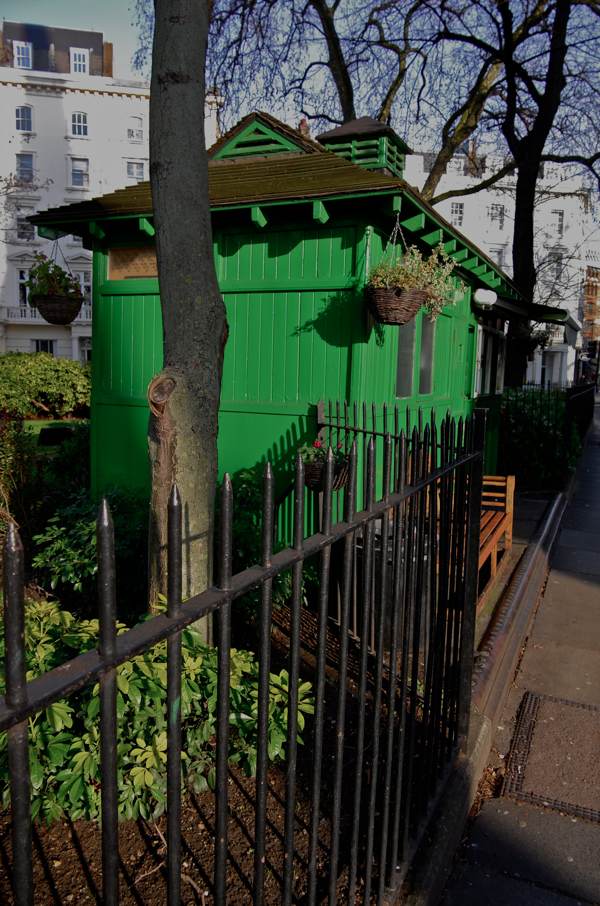
St Georges Sq, SW1
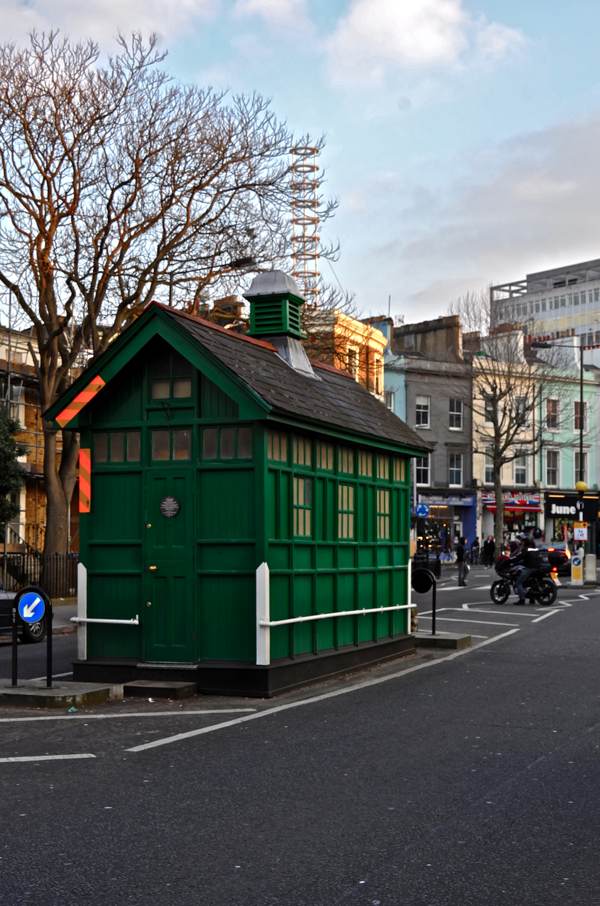
Kensington Park Rd, W11
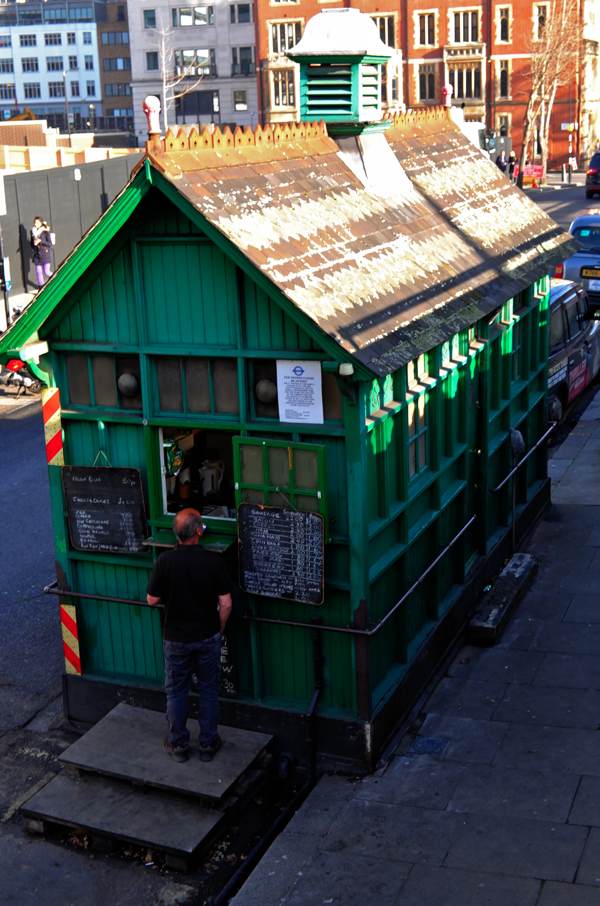
Temple Place, WC2
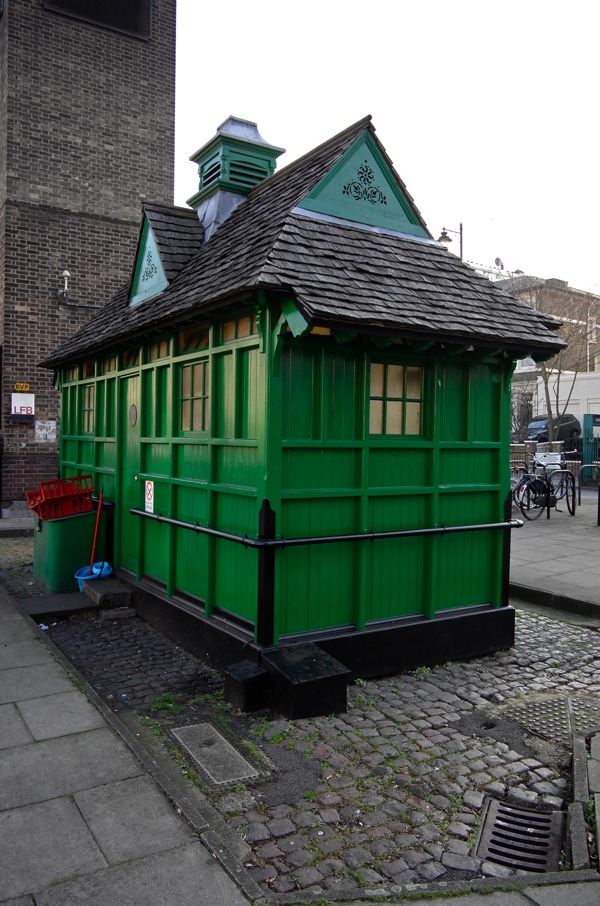
Warwick Ave, W9
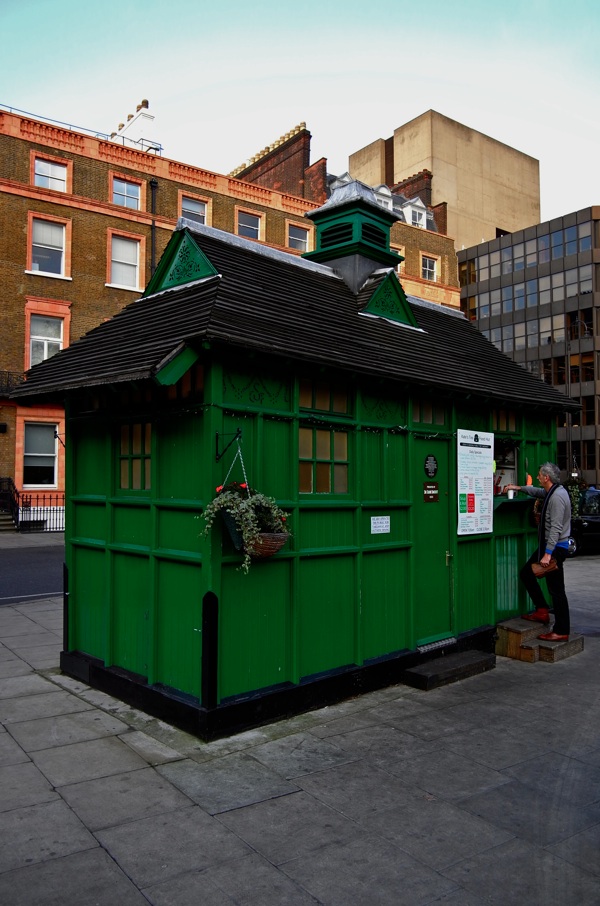
Russell Sq, WC1
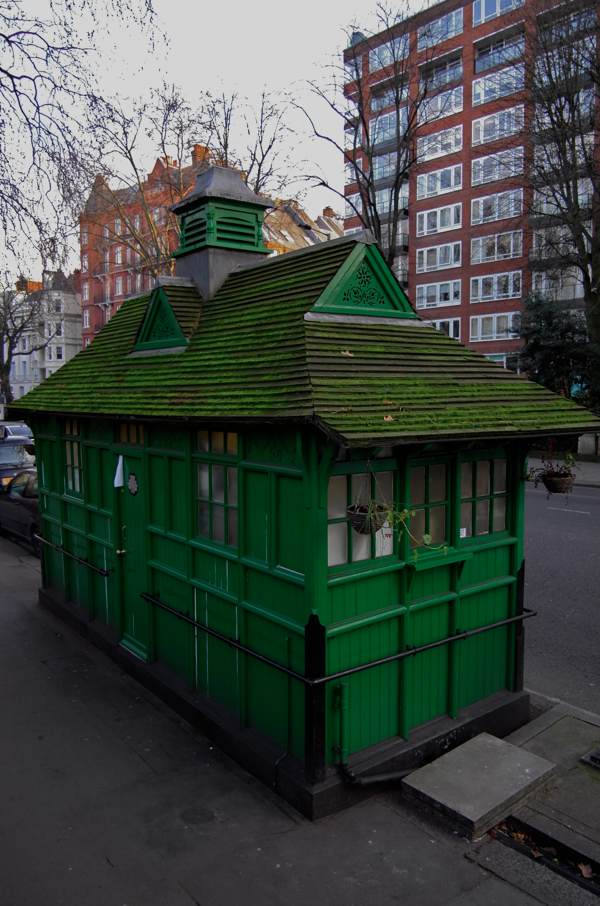
Kensington Rd, W8
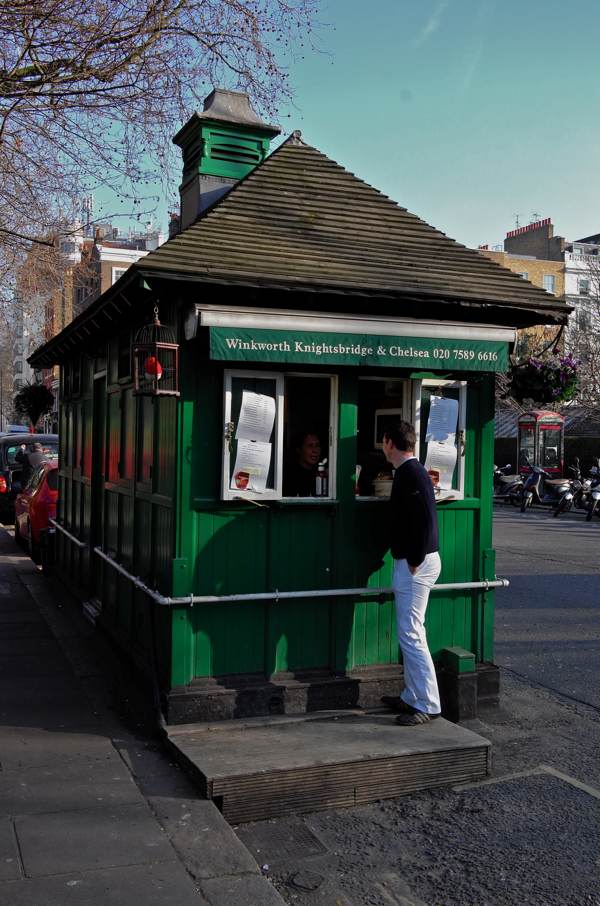
Pont St, SW1
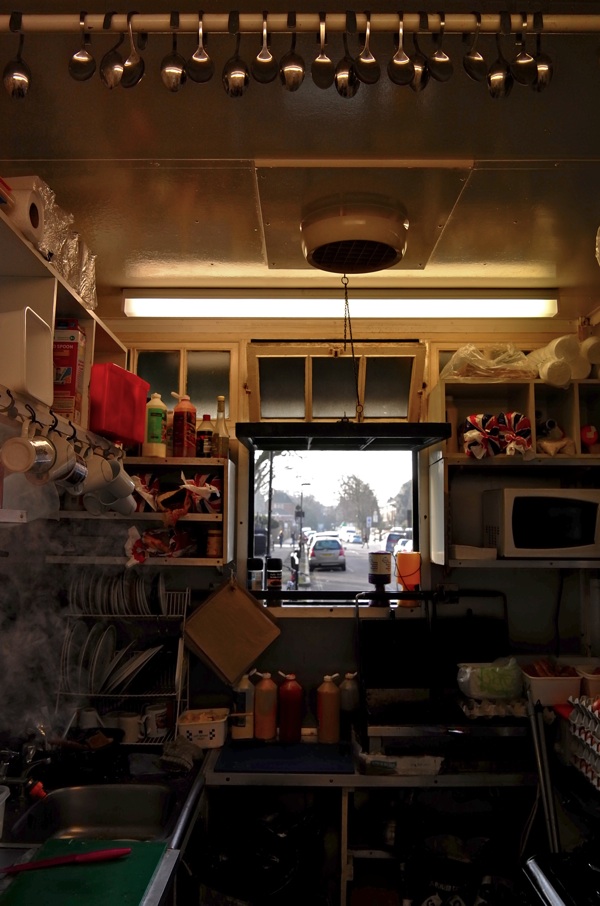
The shelter attendant at Wellington Place has spoon-bending powers
You may also like to read about
Gillian Tindall In Stepney, 1963
I AM DELIGHTED TO REPORT THAT A BALMY 14 DEGREES IS FORECAST FOR MY WALK THROUGH SPITALFIELDS NEXT SATURDAY 11TH MARCH
CLICK HERE TO BOOK FOR SPRING & SUMMER TOURS
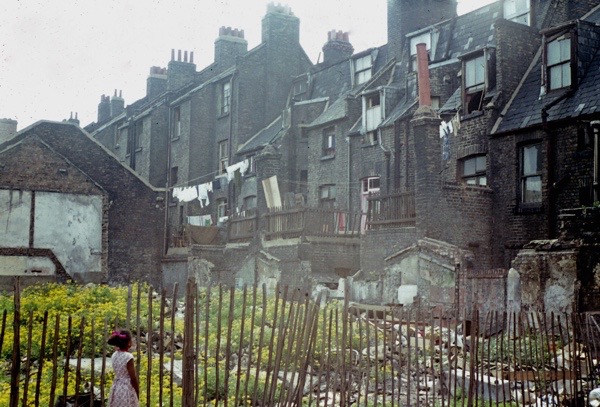
Old Montague St
Contributing writer Gillian Tindall’s memoir of her first visits to Stepney in 1963 is accompanied by photographs of the East End taken in that era by her husband Richard Lansdown.
The number of people who actually remember the Blitz that struck the East End between 1940 and 1944 is fast diminishing, yet everyone has heard of it. Today, it is generally assumed that the acres and acres of undistinguished post-war flats that are now the dominant architecture of much of the East End are the result of post-Blitz rebuilding. In fact, the truth is rather different
It was twenty years after the worst of the Blitz that I first got to know Whitechapel and Stepney, Tower Hamlets’ ancient heartlands. It was 1963, the summer after the coldest winter for a century and so long ago that I can almost see – separate from my present self – the girl that I was then. She wears a checked cotton dress she made herself on a sewing machine and her plait of hair is pinned up. She is walking rapidly round the area with a pack of index cards from the Stepney Old People’s Welfare Association in a small basket. In her flat sandals, she is exploring the East End for the first time.
In those days, a pungent scent of hops from Charringtons’ Anchor Brewery enveloped a stretch of the Mile End Rd, and sometimes a dray cart pulled by huge shire horses rolled sonorously past and turned in at the great gates. The jingling harness and the rhythmic clopping of heavy, whiskered hooves, were an assertion of a long tradition that in only a few years would become extinct, but the girl who was me did not know that. Nor could she guess that the small shops in Whitechapel with Jewish names over the doors, selling kosher meat or Fancy Trimmings or jellied eels, were in their final years too. You do not know much when you are young.
I was employed by the Welfare Association, on a casual basis, to find out how many of several thousand old ladies on their books, and a smaller number of old gentlemen, were still at their recorded addresses, and how well – or not – they were managing. Their children, I learnt from conversations with them, had usually moved to London’s northern suburbs, or to Dagenham or Basildon – or had been ‘relocated’ more recently under The Greater London Plan. The old people’s cards mostly showed birth-dates in the 1880s, some even in the 1870s. Some had been widowed ever since the War of 1914-18, and one or two were even old enough to have lost sons in that war. Often, when I was invited into their houses, the mantlepieces in their front rooms were dressed with the bobbled chenille runners of the Victorian age, with symmetric ornaments at each end – a décor almost extinct today but commemorated in the two china dogs that are the symbol of Spitalfields Life Books.
Some of them would try to detain me with sagas of ancient achievements or griefs, to which I listened with a guilty awareness that I had many more names to visit in the next two hours. Today, how much I would like to have these garrulous old people back, even for one afternoon! They spoke of happy times past, of ‘nice shops’ and good markets and celebrations for forgotten victories and jubilees, of synagogues and Baptist Sunday schools, a world of neighbourliness which they perceived as dispersed and lost. To prolong the chat they would offer me very strong tea, to which very sweet, tinned milk was automatically added. Then I would be taken to see the place in the cracked wall of the kitchen or the upstairs bedroom where “you can see the daylight through it, darlin’, can’t you?”, and the privy in the backyard with the perennially leaking roof – “It isn’t very nice, you see, ‘specially when it rains. My husband, he could have fixed that, but now I’m on me owney-oh…”
I would assure them that the Old People’s Welfare would try to do something about these things. It took me a while to discover the extent to which the forces of bureaucracy were preventing such simple, ad hoc improvements from being carried out. Not long before, Stepney Council had specifically refused a landlord permission to make good minor damage to three houses in White Horse Rd, near Stepney Green. ‘The carrying out of substantial works of repair to this old and obsolete type of property would seriously prejudice the Council planning proposals for the redevelopment for residential purposes of this part of Stepney and Poplar Reconstruction Area.’
These post-war plans were not dreamed up by individual Councils. The Greater London Plan was imposed by the London County Council (the fore-runner of the Greater London Council), but the local authorities had adopted its assumptions with blinkered enthusiasm. As early as 1946, warning local voices had been raised, especially about the way the envisaged Brave New Stepney of high-rise blocks set in ‘green spaces’ did not seem to allow any place for the small businesses that had long been the life-blood of the East End. The truth was that Labour thinking in those years had an aversion to small businesses. And so carried away were the Council by the prospect of reducing the borough’s population substantially by moving half of them out of London (a key element of the Plan) that the views of the inhabitants themselves counted for little. An early, enthusiastic description of the Plan in a popular illustrated magazine shocks the reader of today by its Stalinist disregard for the population’s own preferences:
‘A New East End for London… will create a new and better London, of town planning on scientific lines… [It] will make a clean sweep of two-thirds of Stepney and one-third of the neighbouring borough of Poplar… More than 1,960 acres will be transformed… 3 ½ miles long and 1 1/2 miles wide.’
I noticed that among all the old people I visited, whether in snug little houses that only need the roof mended and a bathroom added to the back or in multi-occupied, once-elegant terraces or in serviceable Victorian tenements, the refrain was “Oh, it’s all coming down round here, dear.” I could tell that though they were acquiescent about the change, believing it to be in some way inevitable, they felt hurt at a profound, inarticulate level by what was being done. It became clear to me that something terrible was happening, a social assault that went far beyond any rational response to the Blitz.
It was true that to the east of St Dunstan’s church, in the ancient heart of Stepney, the war had left a scene of devastation. The bombs arrived here in battalions, aiming at the gasholders and the docks, although the church itself was hardly touched. But why, over twenty years later, was the place still a wilderness reminiscent of Ypres just after World War I? On what must once have been a street corner, the remains of a shoe-shop stood, apparently untouched since it was set alight by an incendiary bomb in 1940. Burnt shoes still littered the dank interior of the shop, among other rain-sodden rubbish.
On the west side of the church, running towards Jubilee St, there was still whole grid of streets standing, solid, liveable homes, many of which seemed hardly touched by bomb-blast – indeed the London County Council’s own contemporary maps of bomb-damage show that to have been the case. But not long after I first walked those streets they had almost all been boarded up. Other streets were already being supplanted by long fences of corrugated iron, with just the occasional public house left isolated on a corner without anyone to go to it. Here, I was told, was where a ‘green space’ was arbitrarily planned. Yet it could have been sited to the east of the church without destroying a whole neighbourhood, reducing to worthlessness in the eyes of the dispossessed inhabitants what had been the fabric of their existence. All coming down – people’s memories, the meaning of their lives.
The Welfare Association’s annual report for that year had lots to report on gifts, fuel grants, outings, chiropody and meals-on-wheels but – perhaps diplomatically – on the subject of ‘relocation’ it had little to say.
Walking back up Stepney Green, an ancient curving route with trees and grass down the centre of it, a few runs of substantial old houses were still standing. I dreaded that, next time I came past, the iron screens would have taken over here too. In fact, this did not happen. Stepney Green itself was saved in the nick of time and rehabilitated. Unknown to me in that summer of 1963, a rebellious Conservation movement was beginning to grind into action. Post-war doctrines about the State knowing what was best for its citizens were at last being questioned, on the political Left as well as the Right. The ‘slum-clearing’ obsession, fixated on the need to destroy the architecture of the past in order to eradicate the poverty of that past, as if the streets themselves were somehow the source of urban ills, was at last perceived to be false. On the contrary, when whole districts were laid waste, crime and vandalism increased. By the seventies articles in illustrated magazines were not about a future of radiant towers but had titles such as ‘An Indictment of Bad Planning’. As the distinguished commentator Ian Nairn put it, the East End had not been destroyed so much by the War but had been ‘broken on the planners’ wheel’.
Today, it lives again in another form. The synagogues and Baptist chapels have been replaced by mosques, the Kosher butchers by Halal butchers. Whitechapel market is full of sarees and bright scarves. The Welfare Association is no longer in the same headquarters under the same name, but survives as Tower Hamlets Friends & Neighbours. We can at least be grateful for what has been saved – or re-born.
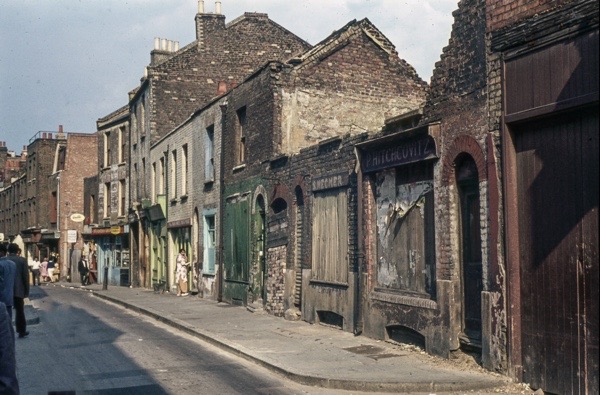
Old Montague St
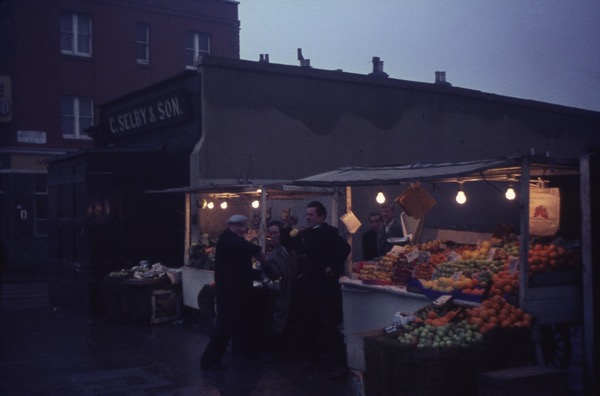
Fruit Stall in Bow

Jubilee St
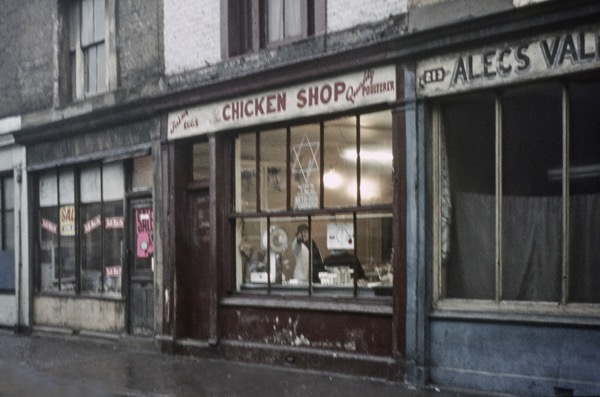
Jubilee St
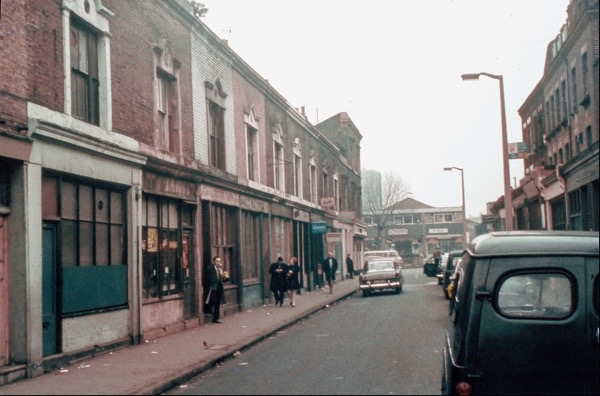
Jubilee St
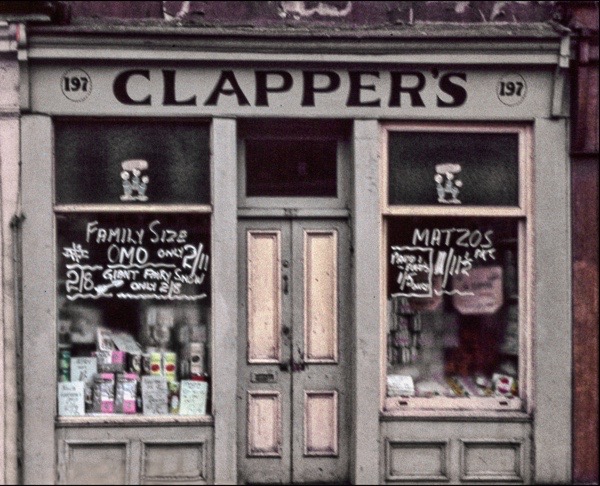
Jubilee St
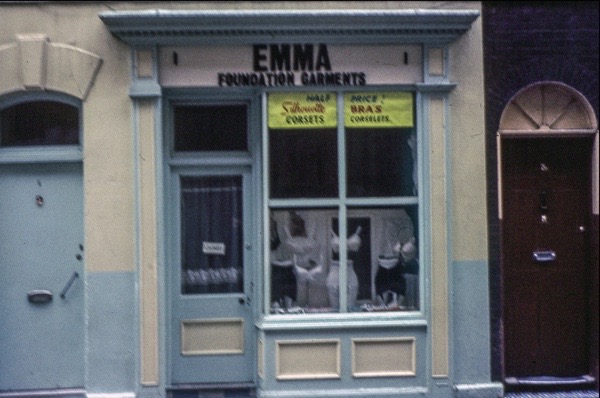
Off Mile End Rd
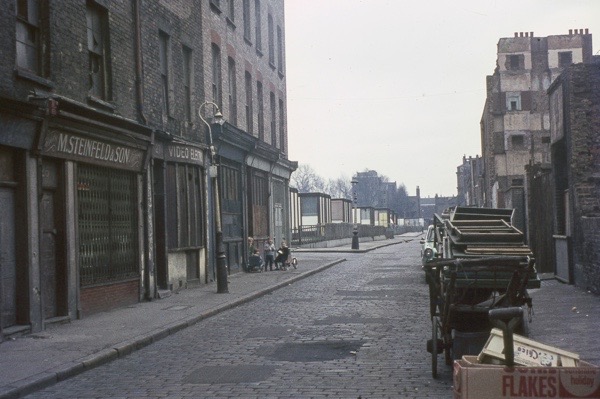
Buxton St
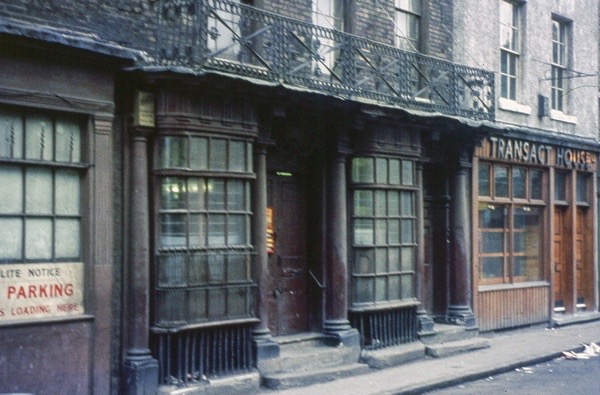
Artillery Lane
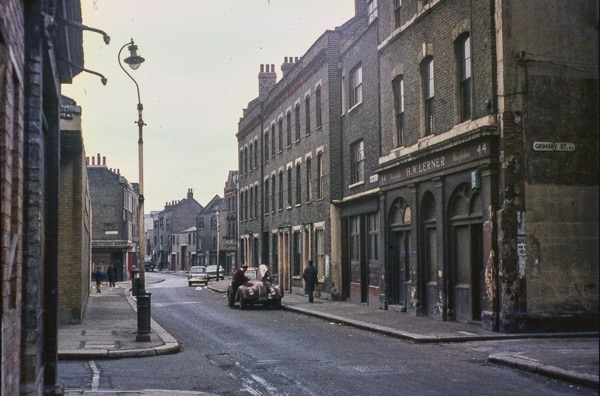
Cheshire St
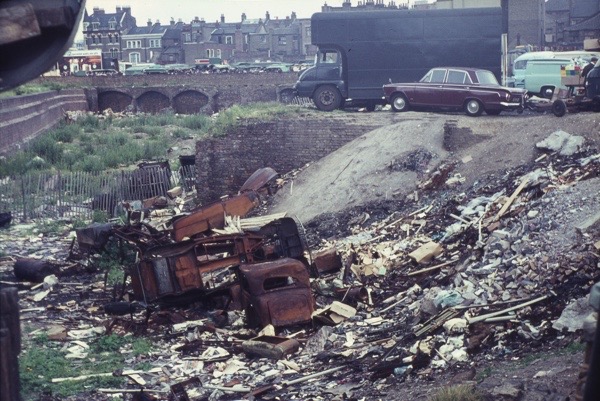
Bombsite at Club Row
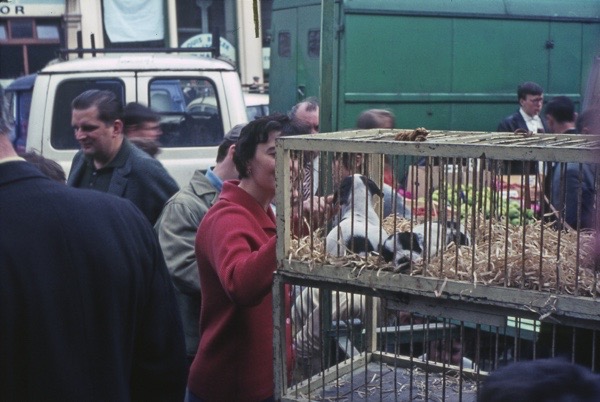
Club Row Animal Market
Photographs copyright © Richard Lansdown
You may also like to read these other stories by Gillian Tindall
Alf Morris, Survivor

The eightieth anniversary memorial service for the Bethnal Green Tube Shelter Disaster takes place today, Sunday 5th March at 2pm at the church of St John on Bethnal Green. At 3pm there will be a procession led by the Bishop of Stepney to lay wreaths at the memorial with a blessing.
More than ten years ago, I met with Alf Morris at Nico’s Cafe next to Bethnal Green Tube Station. Alf was one of the few remaining survivors of the Bethnal Green Tube Disaster, when one hundred and seventy-three people died in the single worst civilian calamity of World War II in Britain. No bombs fell, the casualties were the result of a series of tragic circumstances, when a crowd of three hundred people mistook the sound of anti-aircraft rockets for bombs dropping and stampeded into the narrow stairwell at the tube entrance, falling over each other in panic like helpless human dominos.
For over fifty years, Alf carried his story without even telling his wife or children, but in 2007, when he was approached by the people who wanted to create a memorial to this forgotten calamity, Alf broke his silence. The result was an extraordinary eye witness testimony which he dictated to me and it is my privilege to publish Alf’s compelling story here in his own words.
“On 3rd March 1943 at a quarter to eight, in our home at 106 Old Ford Rd, the radio went off, as it did every time there was an air raid. My father, Alfred George Morris, insisted that me and my aunt, Lilian Hall, go to the tube to shelter. As we crossed Victoria Park Sq, the air-raid siren sounded. In Bethnal Green Gardens, between the Toy Museum and St John’s Church, there was a radio controlled searchlight that came on. This meant the searchlight had found an aircraft, me and my aunt knew this from other nights. So we ran across Victoria Park Sq to reach Roman Rd (which was then called Green St), then across the road to the entrance to Bethnal Green Tube and started down the steps.
There was a wooden hoarding and a narrow entrance with just a twenty-five watt bulb, but we knew where we were going because we had been there many times and there were handrails at each side. Me and Lilian, we started walking down the centre of the staircase and everything was as normal. The air-raid had stopped. We continued on down and as we got halfway down, the rocket guns in Victoria Park fired at the aircraft above. There was a deafening noise as they flew over. At that time, two buses arrived at the number eight bus stop and they were full of people. Above the noise, somebody shouted ‘There’s bombs! There’s bombs! There’s bombs! They’re bombing us!’ And as they did everybody ran to the entrance.
The rush of people separated me and my aunt. I was pushed to the left and my aunt was pushed to the right. I was thirteen years old. As I was pushed downwards, I was carried down. I got to the third step from the bottom and I was pushed up against the rail with people falling from above. They fell on top of one another. They were all screaming for their mothers and fathers. I couldn’t see my aunt and I couldn’t move my legs because the people were all pushed up against them. I was calling for my aunt but she had her own problems, she was stuck too.
And then, on the landing at the bottom of the staircase, there was a lady air raid warden, her name was Mrs Chumbley. She could see me calling and crying. She put her arms across the people who were down and the first thing she did was grab my hair, and I screamed because the pain was tremendous, but she could not move me. So she reached further over the people and put her hands under my arms and pulled me out like I was a bag of rubbish, and I started to move and I came out.
When she pulled me, I must have stepped on several of the bodies, she pulled me over these people. Then she stood me on the landing, grabbed my collar and said, ‘You go downstairs and you say nothing of what has happened here.’ She had a very dominating voice. Then I walked away from her and descended the escalator, which was not working because the station was still under construction and when the war began they ceased working on it.
At the bottom of the escalator, there was a big steel door. They pulled the door open and as I went in they asked why I was crying but I said nothing. I walked down to my bunk, and I sat there and cried. Ten minutes later, my aunt came down. They pulled her out, and she had left her coat and shoes in the crush. Her stockings were torn, and she was black and blue down one side. We got some tea in the canteen and settled down but we were worried about my mum, who had gone to another shelter with my sister who was a babe in arms at the time.
Around nine thirty, three people came walking along the tunnel, a policeman, an air raid warden and a fireman who had climbed down the shaft at Carpenters Sq next to Bancroft Rd. You could hear their footsteps approaching and people were asking why they came through the tunnel. But no-one said anything because there were fifteen hundred people in the shelter and we didn’t want panic. It quietened down at ten thirty when we went to bed but I didn’t sleep much because I was so worried.
The next morning I came up around seven o’ clock and when I walked up the stairs there were piles of shoes and all the steps had been washed down. I got home at seven thirty but no-one knew how bad the tragedy was at this time. I was very pleased to see my mum and sister, my mum told me when she heard the guns she thought it was bombs so she ran into the shelter under the catholic church and when the all clear sounded at eight thirty in the evening she went home.
Just before I went to school, Lilian Trotter used to bring her seven year old daughter Vera round and Vera and me would go to school together. But that morning Lilian Trotter didn’t show. I waited till nine before I left for school. At school, there were so many children missing out of the class. The teachers asked, ‘Where are they?’ I said, ‘There’s been something happened at Bethnal Green Tube.’ When school finished at four, I went home but Lilian and Vera had still not arrived. Their uncle asked my dad where they were. They’d all heard rumours. You wasn’t allowed to talk about what happened.
My dad was very level-headed. I thought a lot of my dad. He said to my mother, ‘I’m going to look round the hospitals.’ He went to the Bethnal Green Hospital, then the Hackney Rd Children’s Hospital and the Marmaid Hospital. They was all laid in the different mortuaries. So then he realised there had been a terrible tragedy. He found Lilian and Vera. Vera could not be recognised she was so mutilated, her face was crushed. The way he recognised her was because he had taken a nail out of her shoe two weeks before the accident. She was unrecognisable. That went for most of the bodies that were pulled out from there. All those people I heard crying for their mothers and fathers, gradually getting less and less and no-one could help them. It was terrible.
When my father came home and told my mother Elizabeth, he sat on the kitchen steps and cried like a baby. That was the only time I ever saw my father break down. We accepted that Lil and Vera were dead, and then we carried on as best we could because we thought there might be another raid that night. When we went to line up for the shelter, newspaper reporters were asking us what happened but we were instructed to say nothing. This is how it was covered up.
And we went down into the shelter and gradually it got around that one hundred and seventy-three people had died, sixty-two of whom were children.”
As Alf dictated to me in Nico’s Cafe, one sentence at a time, I could see he was reliving the events and describing what he saw precisely. Paradoxically, since Alf never spoke of it for over fifty years, the story retained absolute clarity in his telling. He carried the experience itself and it had not become supplanted in his mind by a repeated narrative of the events.
I was touched to be there with him having our private conversation – learning of these big events that once happened so close at hand in Bethnal Green – amid the banal public clamour of the steamy cafe. I found it impossible not to warm to this open-hearted man still struggling with the experience. Time brought Alf no solace. He was the solitary guardian of his story, lucky to survive but deeply unlucky to become part of a tragedy he could never escape. Watching him bring the events into the present tense, as we sat with our faces just inches apart, I could see the thirteen year old boy of 1943 still present in Alf.
When he had unburdened his lonely secret, Alf revealed a warm human nature to me. Telling me how a newspaper feature brought him to meet Suzanne Lane, the granddaughter of his saviour – who knew nothing of her grandmother’s heroism until she learnt it from Alf – he remembered Mrs Chumbley, the air raid warden, with great respect and affection.
“She stood at the top of the escalator in a blue smock. She was a tall woman and she’d point at you and say ‘Stop running!’ or ‘Shut Up!’ and you’d do it. She scared everyone but when it came to this incident, she was a true godsend.”

Mrs Chumbley, heroine of the Bethnal Green Tube Disaster.

Lilian Trotter and her daughter Vera.

You may also like to read about
Yet Another Favourite Blog
I am delighted to publish this extract of a favourite post from GRAVE STORIES, Come with me into the graveyard, all human life is here, written by a graduate of my blog writing course. In this post, The Gravedigger visits a suburb of Liverpool in search of the origins of Eleanor Rigby.
We are now taking bookings for this spring’s course, HOW TO WRITE A BLOG THAT PEOPLE WILL WANT TO READ on 25th & 26th March. Come to Spitalfields and spend a weekend with me in an eighteenth century weaver’s house in Fournier St, enjoy delicious lunches and cakes baked to historic recipes by Townhouse and learn how to write your own blog.
IN SEARCH OF ELEANOR RIGBY
Before the Industrial Revolution and the opening of the great quarries in the nineteenth century, Woolton was a village outside Liverpool. Old terraces remain in the centre and isolated sandstone houses survive, stranded on islands in the middle of approach roads today. Now Woolton is a smart suburb with large, detached houses and thirties semi-detached, an abundance of coffee shops, bars, and restaurants, and the famous Woolton Picture House dating from 1926.
The parish church of St. Peter’s was built in 1886 using the same local sandstone as Liverpool Cathedral, one of the last customers before the quarries closed. The church has windows by Charles Kempe and William Morris, and its bell tower is the highest point in Liverpool. When I visited it was enjoying an open day with a profusion old documents, photographs, maps, and local history books on display.
But my objective was Eleanor Rigby, the dark, narrative song about loneliness which came out in 1966 on the Beatles’ Revolver album and on a 45rpm single with its hauntingly beautiful, pensive lyrics oddly paired with the chirpy Yellow Submarine. The origin of the name of the protagonist is disputed. Paul McCartney suggested that it was inspired by actress Eleanor Bron, who starred with the Beatles in the 1965 film Help, combined with the name of a store in Bristol, Rigby and Evans Ltd, which he had noticed during a visit to Jane Asher when she was performing at the Bristol Old Vic.
But in Woolton they see things differently, for it was here at the Woolton Village Fete in July 1957 that John met Paul. The day’s events included a procession, the crowning of the Rose Queen, a fancy dress parade, a display by Liverpool police dogs, and performances in the school grounds behind the church by John Lennon’s band, the Quarry Men. The latter took second billing, after the George Edwards Band, at the Grand Dance held in the church hall at 8pm with tickets priced at two shillings, and “refreshments at moderate prices.” In the hall they have marked the spots on the floor where a mutual friend introduced a sixteen-year-old John to a fifteen-year-old Paul and the latter auditioned to join the Quarry Men.
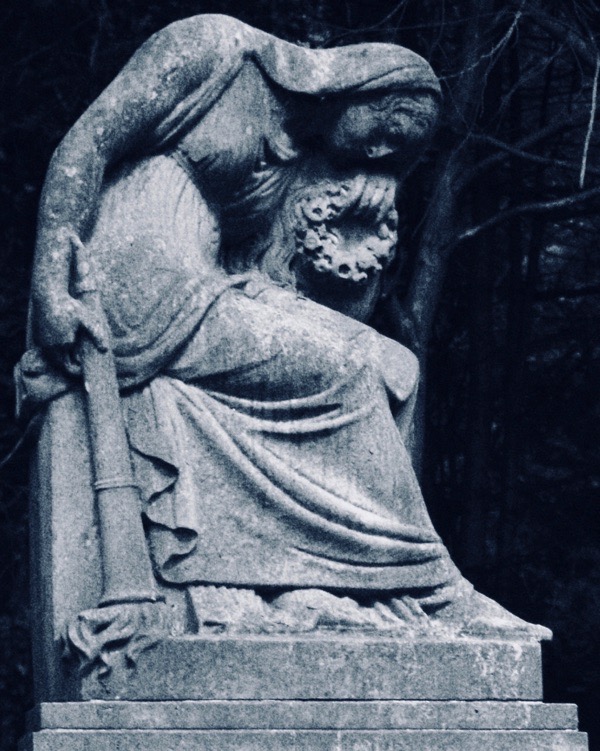
In St. Peter’s churchyard, across which the young John and Paul frequently took a short cut, a headstone bears the name Eleanor Rigby. McCartney said that he had no recollection of ever seeing the stone yet he admitted that he could have unconsciously borrowed the name.
I was predisposed to find the origins of Eleanor Rigby here. The wardens and parishioners extended the warm welcome at which Liverpudlians excel. In response to my quest, an enthusiastic volunteer explained where the grave was, urging me to look out for Father McKenzie’s prototype as well. He explained that if I went to the edge of the graveyard I could look upon the location of the stage where the Quarry Men performed in 1957. Then he drew my attention to the additional presences in the churchyard of George Toogood Smith, John’s uncle, and of Bob Paisley – the Liverpool football manager – he explained, noting my blank expression. Cheerfully he instructed me to come back if I failed to find any of these treasures, offering to abandon his post and conduct me thither personally. In many a larger cemetery I have wished for such assistance but here I left him surrounded by other eager visitors while I located Eleanor Rigby with ease.

‘Eleanor Rigby
Died in the church and was buried along with her name’
The original Eleanor Rigby worked in the City Hospital at Parkhill, married Thomas Woods in 1930, and died at only forty-four of a brain haemorrhage.
Only a few graves away was John McKenzie.
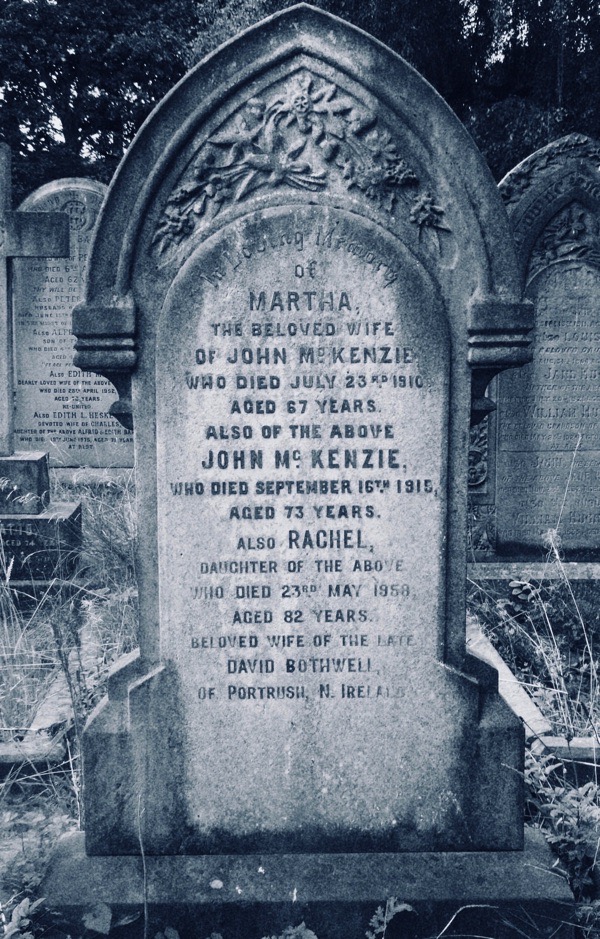
‘Father McKenzie
Wiping the dirt from his hands as he walks from the grave.
John McKenzie was only a short distance from Eleanor Rigby – come on, it’s obvious they were the inspiration for the song!
Following my friend’s directions, I also located George Toogood Smith and Bob Paisley.
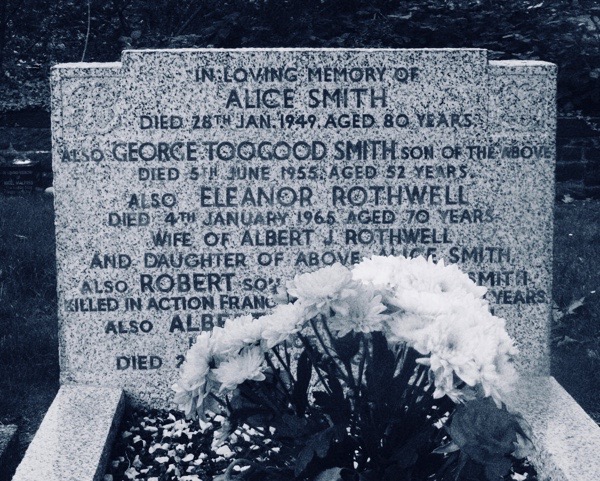
George Toogood Smith, John Lennon’s Uncle
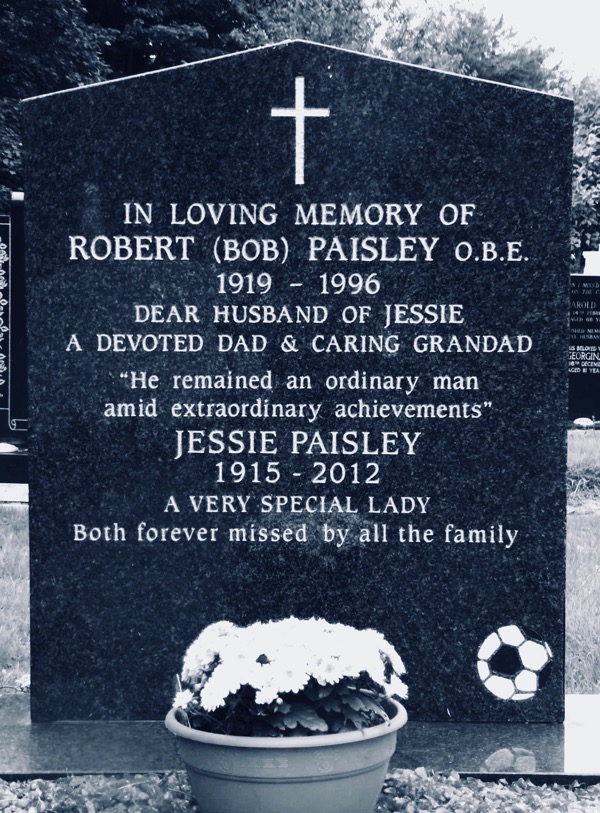
Bob Paisley, Liverpool Football Manager
I recommend an excursion to St. Peter’s in Liverpool to meet the warm, friendly congregation. If you are lucky, your visit may coincide with a performance in the church hall by the remaining Quarry Men. But most importantly pay your respects to the original Eleanor Rigby, most assuredly the muse – whatever Paul McCartney may say – for one of the greatest Beatles songs.
My First Year As A Tour Guide
THE GENTLE AUTHOR’S NEXT TOUR IS SATURDAY 11TH MARCH AND BOOKINGS ARE OPEN NOW FOR SPRING & SUMMER TOURS
CLICK HERE TO BOOK FOR SPRING & SUMMER TOURS
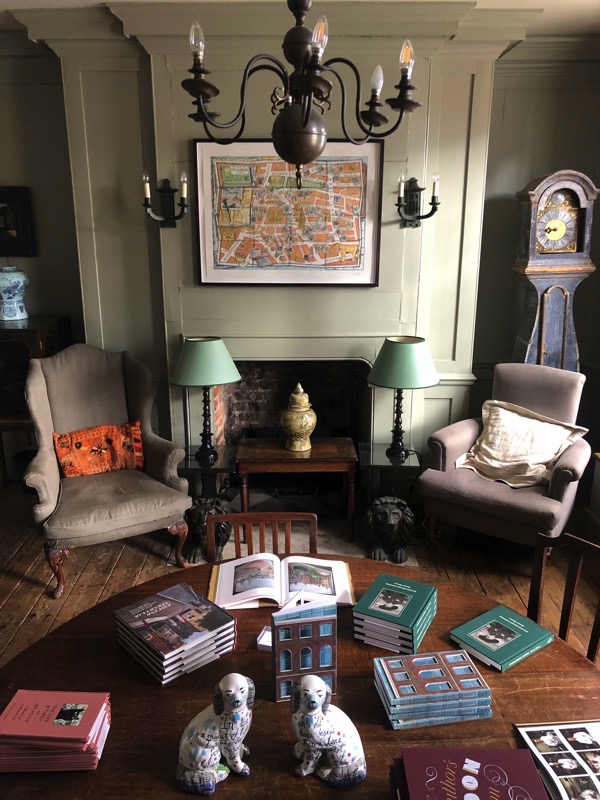
The drawing room at Townhouse awaits tour guests
As we commence a second season of tours, I think of how it began. It was a curious experience walking alone through the streets of Spitalfields with an imaginary party of guests, when I was planning the route of my walking tour a year ago. I had to decide where to stop and talk – out of the flow of people, in shadow during high summer and under cover when it rained. But during my first year it hardly rained, although I did find myself doing my tour in temperatures of thirty-five degrees in July and zero in December. On that particular wintry day, I carried a hot water bottle in a satchel which I passed around to my guests in turn.
The hardest part was to choose which stories to tell out of the thousands I have written, but equally there were considerations of contrast and variety, and how to ensure the route was sufficient, long enough but not too long. After walking a circular path that took me half an hour, I found this same route took two hours when you stop and tell tales. It gives me time to include stories of around a dozen people of Spitalfields, as well showing some old photographs, some paintings and playing a little music in situ.
Each Saturday in summer I am to be found at 2pm outside Christ Church, Spitalfields, in Commercial St, full of expectation as I await my guests. Overcoming my innate timidity, I approach people arriving and ask them if they have come for the tour and, thankfully, I have learnt to read the signs so that mostly they are not random strangers. I hand each guest one of Adam Dant’s maps of the tour when they arrive with the instruction to study it before we set out in case they get lost and I inform them that we shall be starting at 2pm precisely. By having the exact number of maps, I know when everyone has arrived.
Certain rituals have arisen, prior to each tour. Washing, then brushing my hair, before polishing my shoes and putting on my best suit. Then arranging the cups and saucers for post-walk refreshments, confirming the precise number of cakes with Harry the baker, checking I have my photographs in order, enough maps for each of the guests and the correct keys in my pocket.
When you set out for a tour through the streets of Spitalfields on a Saturday afternoon, you have no idea what you may encounter – from block parties with boom boxes to rampant hen parties, political demos and, once, a bride and groom emerging on cue with wedding guests assembled to throw confetti while bells pealed overhead. Yet I am pleased to confirm that we have always made it through, and while I may occasionally struggle to make myself heard over the biker parades and sirens heading down Commercial St, it appears my guests take such distractions in their stride, accepting it all as manifestations of the colourful street life of the East End.
I try to speak to my guests as individuals when I tell my stories and I have learnt to make eye contact with each one in turn. I had no problem overcoming my reserve until a British film star of trans-Atlantic fame came on my tour, acting low key and incognito. Then my natural modesty reasserted itself and I have to confess I struggled to make direct contact with those eyes that were so familiar from the big screen. Conversely, it was a joy when those who feature on my tour joined the tour in person, becoming the star attraction, and when those who feature on my tour popped up by chance in the street to greet me as if by some grand plan, much to the delight of my guests.
In those first months, sometimes I had to search to know what to say but as the summer wore on something magical happened. The words of the tour became like lyrics of a favourite song, so that when I opened my mouth to speak the first line, the entire story flew away with its own volition and momentum.
My favourite moment is at the conclusion of the tour, observing the expressions of anticipation and wonder when I open the door to a three hundred year old house and invite my guests to walk up to the first floor drawing room and make themselves at home. After the clamour of the street, it is a pleasure to come indoors to peace and quiet, and discover refreshments laid out with individual cakes baked freshly to a recipe of 1720. Once everyone is settled, I always ask who has East End roots and people regale us with the most wonderful stories. After our shared journey, a group of former strangers discover they can chat at ease together and a tea party ensues.
CLICK HERE TO READ WHAT GUESTS SAY ABOUT THE GENTLE AUTHOR’S TOUR
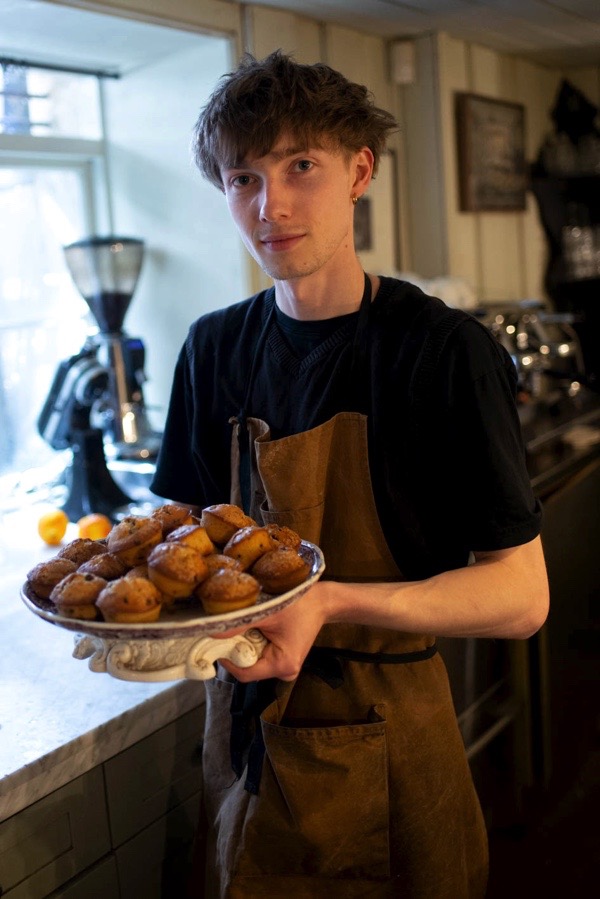
Harry Thomas with his cakes baked freshly to a recipe of 1720 for the tour
With grateful thanks to Townhouse for their support, providing the venue and catering for my tours












