
The Gentle Author’s Indoor Garden
As the temperatures plunge, I contemplate my indoor garden

‘No enemy but winter and rough weather…’ As You Like It
Every year at this low ebb of the season, I cultivate bulbs and winter-flowering plants in my collection of old pots from the market and arrange them upon the oak dresser, to observe their growth at close quarters and thereby gain solace and inspiration until the garden outside shows any convincing signs of new life.
Each morning, I drag myself from bed – coughing and wheezing from winter chills – and stumble to the dresser in my pyjamas like one in a holy order paying due reverence to an altar. When the grey gloom of morning feels unremitting, the musky scent of hyacinth or the delicate fragrance of the cyclamen is a tonic to my system, tangible evidence that the season of green leaves and abundant flowers will return. When plant life is scarce, my flowers in pots acquire a magical allure for me, an enchanted quality confirmed by the speed of their growth in the warmth of the house, and I delight to have this collection of diverse varieties in dishes to wonder at, as if each one were a unique specimen from an exotic land.
And once they have flowered, I place these plants in a cold corner of the house until I can replant them in the garden. As a consequence, my clumps of Hellebores and Snowdrops are expanding every year and thus I get to enjoy my plants at least twice over – at first on the dresser and in subsequent years growing in my garden.


Staffordshire figure of Orlando from As You Like It
William Whiffin, Photographer
William Whiffin (1878-1957) is one of the great unsung London photographers, which makes it a rare pleasure to present this gallery of his pictures from the collection of his granddaughter Hellen Martin. Born into a family of photographers in the East End, Whiffin made his living with studio portraits and commercial commissions, yet he strove to be recognised for his more artistic photography.

Lion Brewery and the Shot Tower, South Bank

The photographer’s son Sid Whiffin at Cooper’s Stairs, Old Queen St

Off Fetter Lane

The Pantheon, Oxford St

In Princes Sq, Stepney

Figureheads of fighting ships in Grosvenor Rd

At Covent Garden Market

Jewry Street, off Aldgate High St

Milwall & the Island Horse Omnibus, c.1910

St Catherine Coleman next to Fenchurch St Station

In Fleet St

In Buckfast St, Bethnal Green


At Borough Market


In Lombard St

Rotherhithe Watch House


Wapping Old Stairs

Junction of Cambridge Heath Rd & Hackney Rd


Ratcliff Stairs, Limehouse

Ratcliff Causeway, Limehouse

St Jude’s, Commercial St

Farthing Bundles at the Fern St Settlement, Bow

Houndsditch Rag Fair

At the Royal Exchange, City of London


Weavers’ House, Bethnal Green Rd

Off Pennington St, Wapping

Borough of Poplar Electricity Dept


Pruning in the hop gardens of Faversham

Photographs copyright © Estate of William Whiffin
Hellen Martin & I should be very grateful if readers can identify any of the uncaptioned photographs
You may also like to read about
Down Among The Meths Men

The work of Geoffrey Fletcher (1923–2004) is an inspiration to me, and today I am publishing these fascinating drawings he made in Spitalfields in the nineteen sixties accompanied by an excerpt from his 1967 book Down Among the Meths Men.
If you want to know who they are, the meths men of Skid Row, then I will introduce them as the alcoholic dependents of the East End. They are to be found primarily in an area of of a couple of square miles known as Skid Row. It is a Rotten Row and only beginning to attract the attention of the trend setters.
Skid Row was originally a place of fields. Bodies were tipped there in the plague, their remains turn up occasionally. The most architecturally interesting part of Skid Row are the streets built by the Huguenots, who settled there after the St Bartholomew massacre. A century and a half ago, the rest of the East End surrounded the Huguenot quarter and brought it low. Ultimately the area will be rebuilt. No plans have been made to preserve the houses of Queen Anne’s time, as far as I am informed. I should like to see the whole of Skid Row preserved intact, with its inhabitants, though I recognise this is not a conventional view.
It is necessary, therefore, to contemplate it before it disappears, street by street. Without a doubt, reformers will eventually overtake these suburbs of Hell. They will tear down the fine, rotten houses, build over the bombed site and cart off the wet rags, old mattresses, waste paper and vegetable refuse that makes the quarter so attractive. In that event, London will have lost one of its major advantages, for there is nothing to be gained from well swept streets and office blocks.
Stand in Artillery Lane, watch a meths man rubbing his itchy sores and then eye the stream of commuters pouring into Liverpool St Station intent on the suburbs. Now and again, a meths man will appear among them, a goblin in rags. In their haste for home and respectability, they have nothing to say to him. Nor he to them. He is the inarticulate voice crying from the wilderness of old bricks, bug-ridden rags, cinders and sickly grass. His bloated, alchohol-distorted face is something from an uneasy dream, he sways in front of you in tipsy despair, blurred, disgusting, shaking like an Autumn leaf, the apotheosis of the antihero, a Prophet without a message.
There is a curious camaraderie among the meths men, perhaps the only attractive quality a conventional observer would allow them. It is a ghostly solidarity, the fag end of what is called co-operation, citizenship, the team spirit or any other of those names used commonly to cover up the true nature of the forms of society.
When I got to the Synagogue, I found them on the steps, eight men and a woman. One of the school was in the cooler. A negro roadsweeper languished over his muck wagon at the corner and a few young prostitutes, on the job, hung about in Brick Lane. Brick Lane is marvellous, a melting pot of all the nationalities that grew from the loins of Adam, greasy, feverish Brick Lane, the Bond St for the people of the abyss. Fournier St was a perspective of houses, once the homes of silk merchants and Huguenot weavers, over-used and neglected till the very imposts of the carved doors had become faint and bent with dejection. From the over-tenanted houses, the signs of fruit merchants and Jewish tailors creaked in the wind. The rain had given way to the thin mist of a Winter day.
The Chicksand group sat in a row, staring at nothing. Absolutely nothing. It reminded me of the brass monkeys. I knew the woman. The Chicksand men called her Beth, referring to her native quarter of Bethnal Green. Beth showed signs of recognition, lifted up her weary red eye-lids and stretched out a hand for a fag. I distributed Woodbines. Meths women are heavy drinkers, and can get through three or four wine bottles full in a morning, but they tend to begin slowly and build up as the day wears on. Next to her was Liverpool Jack, an ex-merchant seaman whose nerves had gone West on the convoys, and a man called Pee. He had no other name, nor could any other have done him credit. He was the most abject of the meths men. He had made two or three attempts at suicide, and his last one nearly rang the bell. I thought, sometimes I overdo my relish for offbeat experiences.

In Itchy Park, beside Christ Church, Spitalfields

Meths woman, 1965

Meths men on the prowl in Artillery Passage, 1965

Meths people in Artillery Passage, 1966

Meths men gather round the fire outside the Spitalfields Market

Meths men waiting to move on the corner of Fournier St, 1965

The old meths site in Fieldgate St, Whitechapel

Spitalfields Market scavengers

Meths man asleep in Widegate St, 1965
You may also like to read
A Brief History Of Street Food Sellers
The ubiquitous ‘street food’ sellers of the modern capital have precedents dating back centuries, as Dr Charlie Taverner, author of Street Food: Hawkers and the History of London, explains.

‘Nice Fat Rabbit!’ by Luke Clennell, c.1812 (courtesy Bishopsgate Institute)
Between the sixteenth and early twentieth centuries, hawkers of food carried baskets, pushed wheelbarrows, and set up stalls right across the metropolis. All sorts of Londoners relished their mackerel, mussels, oranges, cherries, turnips, muffins, puddings, and pies. But street sellers were particularly important for those in neighbourhoods at the edge of the medieval city, such as the East End.
When I started my research on London’s hawkers, I scoured court reports and parish records for mentions of individuals who got by through hawking food. There were women like twenty-nine-year-old widow Mary Knapp, who in 1695 resided in Shadwell and explained her livelihood as ‘selling Fish and fruit & the like’. Or Joan Cornish, a milk vendor, who on 30th November 1721 was crossing the road on the way out to Hackney, with her yoke and pails across her shoulders, when she was trampled by a coach and horses. She died two days later.
There were men too, like oyster seller John Witchalls. In 1821, he rented a garret above a public house in St Leonard, Shoreditch. Witchalls cannot have been making much money because he shared the room with a shoemaker, a man found guilty of stealing his roommate’s coats, trousers, shirts, and other belongings, along with some cash. I found hundreds of examples of hawkers who spent their working lives in and around these busy, ever-changing districts.
In the nineteenth century, street sellers began to gather in regular haunts several days a week. While exploring the east side of the City, journalist George Augustus Sala chanced upon one of these street markets, describing ‘an apparently interminable line of “standings” and “pitches” consisting of trucks, barrows, baskets, and boards on tressels, laden with almost every imaginable kind of small merchandise’.
The air rung with the advertising cries of traders, their patter with customers, and the hum of conversation. After dark, flickering candles and naphtha lamps illuminated the whole performance. An 1893 survey by the London County Council identified 112 such markets citywide. The largest was Wentworth St, between Whitechapel and Spitalfields. In full flight, 335 stalls were pitched in rows parallel to the kerbs and down the middle of the highway, so all traffic was stopped. The market ran throughout the week but peaked on Friday afternoons and Sunday mornings, reflecting the Shabbat observance of the Jewish people who called the area home.
Why were hawkers so important to this part of the capital? It was partly to do with its position on the City’s immediate periphery. As London expanded rapidly from the late Tudor period, poor labourers and immigrants were drawn to tightly-packed houses with cheap rents beyond the City wall. Over the following centuries, these suburbs were surrounded by further sprawl, giving rise to some of the most awful inner-city slums. Their residents, working long hours for meagre wages and with little room to cook, relied on the small parcels of inexpensive food that hawkers provided around the clock.
Street selling was especially vital to the East End. In the mid-seventeenth century, the City of London had fifteen official food markets, the western suburbs had four but the east had none. The tens of thousands of residents of Hackney and Stepney had to walk miles to do their shopping. Though more markets were built after the Fire of 1666, this part of town remained badly provisioned. Street vendors made up much of the deficit.
Hawkers also lived on London’s margins in other ways. Until the twentieth century, when newly formed borough councils started handing out licences, the legal basis for street selling was shaky. Since the Middle Ages, all buying and selling in London was supposed to be limited to certain locations, either marketplaces such as Cheapside, Leadenhall and Billingsgate, or the shops of privileged retailers like fishmongers and butchers. Those who traded elsewhere, including hawkers roaming the streets, were breaking the law.
Major crackdowns were irregular. In 1612, the City of London aldermen tried to make all female street sellers pay sixpence for a badge and have their details listed in a register, yet it seems enforcement was half-hearted. An Act of Parliament in 1867 appeared to ban hawking altogether, but a public outcry allowed traders to keep operating as long as they stuck to a new set of rules laid down by the Metropolitan Police. However, hawkers were always at risk of prosecution. If they tended not to be harassed, arrested, or fined by officials for street selling alone, they were frequently accused of a variety of other offences: cheating customers, dealing rotten produce, corrupting the youth, and blocking the thoroughfare.
Popular culture cast them as people on the margin. The most famous chronicle of street folk is Henry Mayhew’s London Labour and the London Poor, first published in 1851. Mayhew encapsulated the hawking population in the character of the costermonger. Fiercely independent and resistant to authority, the coster wore a distinctive uniform of waistcoat and neckerchief, spoke a dialect, and was accompanied by his constant friend, a scruffy donkey, which sometimes was stabled in his owner’s rooms. Costermongers were depicted as a class or even a race apart, one of the ‘nomad tribes’ cut adrift from mainstream society.
Mayhew was drawing on and developing an older tradition, the Cries of London. From the late Elizabethan era, this genre, encompassing visual prints, courtly music, and ballads, captured the sights and sounds of the streets. Artists and composers conjured a cast of stereotypes, like the vulgar, hard-drinking fishwife, the naïve, rustic milkmaid, and the seductive oyster girl whose basket of shellfish concealed her true occupation, selling sex.
But the Cries also suggest a different side to the story. The genre was eventually adopted by the new media of children’s books and photography and remained popular into recent history, as The Gentle Author has charted. Londoners continued to be fascinated by street sellers who took centre stage in how they imagined their metropolis. At the same time, the majority of people knew full well that the hawkers who inspired those prints and songs provided them with food they could not find anywhere else.
Yet the location of the margin is a matter of perspective. In 1888, James Briggs, a clerk representing the owner of Spitalfields Market, gave evidence to a Royal Commission investigating the food trades across Britain. Established in the seventeenth century in response to London’s eastward growth, the Market became a wholesale hub for hawkers stocking up with fruit and vegetables. In fact, street sellers had become so crucial to business and to feeding the wider community that the owner even allowed them to drive their barrows directly into the midst of the trading floor.
As Briggs explained, ‘I have seen costermongers who have come from all parts, east and west and north and south to this place to buy, because it is known to be a place where not so much articles of luxury come, but articles which are the prime necessities of life.’ Like most Londoners, Briggs was confident of where the heart of his city really lay.

Costermonger by Marcellus Laroon, 1687 (courtesy Bishopsgate Institute)

‘Strawberries, Scarlet Strawberries’ by Francis Wheatley, 1793 (courtesy Bishopsgate Institute)

Hot spiced gingerbread! by William Craig Marshall, 1804 (courtesy Bishopsgate Institute)

The Flying Pie Man by John Thomas Smith, 1816 (courtesy Bishopsgate Institute)

Ice cream seller by John Thompson, 1876 (courtesy Bishopsgate Institute)
You may also like to read about
Ron McCormick At Southend
In these melancholy January days of rain and chills, let us recall the happy days of high summer and day trips to Southend as evoked by Ron McCormick’s photographs of half a century ago, selected from the current exhibition at Beecroft Gallery. Two Views of Southend by Josef Koudelka & Ron McCormick runs until 19th February, admission free.

“The Beano, Bank Holiday and Southend Carnival, a crate of beer in the back of the coach and ‘kiss me quick’ to the sound of the Salvation Army band. Southend is the East Londoner’s Riviera. My pictures are about the people who come for the day and are out to enjoy themselves whatever. A laugh, booze up, let yourself go, dip in the sea and the race to catch the coach home.
I enjoyed being with them.”
Ron McCormick

Beach scene

Salvation Army Band, Marine Parade

Test of strength at the Kursaal Amusement Park

Outside The Ship Pub, Marine Parade

On the Promenade, Marine Parade

Sea cruise, Marine Parade

Outside The Ship Pub, Marine Parade

Seafood stall

Beach tents

Deck chair shrimp break, Marine Parade

Outside the Borough Hotel

One-armed bandits

Seafront at Marine Parade

Slot machines, the Happidrome Arcade

Slot machines

The Shrubbery, Royal Terrace

Visitors near the pier, Marine Parade

Standing room only, Kursaal Palace Bingo Hall

Elim Pentecostal preacher at Marine Parade
Photographs copyright © Ron McCormick
You may also like to take a look at
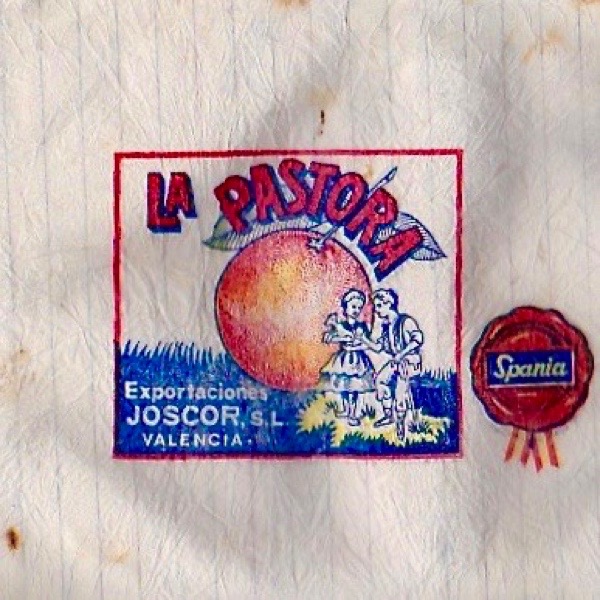
Keren McConnell’s Orange Wrappers
This is the season for oranges and lemons, so I was more than delighted when Keren McConnell kindly sent me her glorious fruit wrapper collection from the seventies to share with you. If any other readers have ephemera collections, please get in touch.

“I started collecting fruit papers when I was six years old, possibly inspired by a holiday in Spain in 1971. Most of the papers stuck in my small scrapbook were picked up while shopping for groceries with my mother at the local greengrocers in Blackheath. I think they reminded me of that holiday with their bright and graphic imagery.
I was drawn to the designs and texture and feel of the crinkly tissue paper. I also collected carrier bags and paper bags for their graphics, but this collection did not survive all our house moves.
Who knows? This book of fruit papers may have even informed my career. I became a print and graphics designer for fashion brands and retailers, sometimes using this scrapbook as reference material to inspire a T-shirt design.
As a child, particular favourites were the designs depicting animals, beautiful ladies and the smiling face on the Sicilian lemon is particularly appealing. I have no idea why the Tower of London was on a fruit paper from Spain. Perhaps the designer thought London was an exotic place, just as I had found Spain so exotic? Some of the designs seem to have been inspired by sport, such as horse racing and Formula One.
Are children today inclined to make collections like this? Mine was born out of boredom, particularly on wet Sundays when the days felt so long.”
Keren McConnell







You may also like to take a look at
Charles Dickens’ Inkwell

Five Christmases ago, I received the most extraordinary present I ever expect to receive. It is Charles Dickens’ inkwell.
In the week before Christmas, I paid a seasonal visit to photographer & collector Libby Hall in Clapton and, as we sat there beside a table groaning with festive treats, she handed me a parcel with the words, ‘I thought you should have this.’ It is a phrase often used when gifts are presented but it was only when I unwrapped it that I discovered the true meaning of her words. What better gift could there be for a writer than an inkwell that once belonged to Charles Dickens?
It is a small travelling inkwell which screws shut and that a writer might easily carry in a pocket or bag, as Dickens did with this one when he visited America in 1842 and left it behind. Barely larger than a pocket watch, it is a modest utilitarian item comprising a square glass bottle and a hinged brass top with a screw fixture to hold it shut. What distinguishes this specimen are the initials engraved on the lid in tentative gothic capitals, C.D.
Libby told me that it was a gift from her friend Cinda in New York whose father had been given it in 1949/50 by a Dr Rhodebeck. All Cinda can remember is that the Rhodebecks were a long-established family in Manhattan who lived in Park Avenue near 86th St. She understood they had been custodians of the inkwell since the eighteen-forties.
Charles Dickens’ first visit to America, which he described in his American Notes, proved a great source of disappointment to the young writer. Although his books were bestsellers and he received universal adulation, there was no law of copyright and he earned no income whatsoever from his sales there. He arrived with an idealistic view of America, imagining a democratic, progressive society without the handicap of decayed old-world aristocracy. What he discovered was the brutal reality of slavery, inhuman prisons and rampant gangsterism.
It was also the first time that Dickens encountered the full wattage of his own celebrity, forced to flee through the streets of Manhattan with crowds of over-enthusiastic fans in pursuit. Yet he rose to the occasion by acquiring an ostentatious wardrobe of new outfits, even if he was spooked by the fanaticism of those who wanted to steal the fluff from his coat as souvenirs.
This raises the question whether Dickens mislaid the inkwell or whether it was appropriated? A chip on the top left corner of the bottle suggests it might have been dropped and then discarded. The wing-nut which secures the lid is missing too and the brass top has come adrift, perhaps indicating that the inkwell was damaged and was no longer considered of use? At this time in his career, Dickens used black iron gall ink which is a corrosive, explaining why the metal top came off the bottle.
Seeking further information about the inkwell, I took it along to the Charles Dickens Museum in Doughty St where curator Louisa Price agreed to take a look and she confirmed that it is an inkwell of the correct period. We searched the Collected Letters and back numbers of the Dickensian to no avail for any mentions of a lost inkwell in America or the Rhodebeck family. Then Louisa brought out a selection of engraved personal items belonging to Dickens from this era for comparison and we could see that he preferred his initials in gothic capitals over the roman or cursive alternatives that would have been available.
The most persuasive evidence was an inkwell from Dickens writing box which once sat upon his desk. Less utilitarian than the travelling version, this example nevertheless had an almost identical bottle in size and design, and although the large brass screw top was more elaborate, including his symbol of the lion recumbent, the gothic capitals were similar to those on the travelling inkwell.
Louisa Price concluded that the inkwell feels right and there is no evidence to suggest it is not authentic, but it would be helpful to uncover evidence linking Charles Dickens and the Rhodebeck family. So this is where I need your help, dear readers. I know that many of you are researchers and some of you are in America. Can anyone tell me more about the Rhodebecks or find any literary connections which might link them to Charles Dickens and establish the provenance of the inkwell?
UPDATE
With thanks to Linda Grandfield & Theresa Musgrove for locating Dr Rhodebeck
Dr. Edmund Jean Rhodebeck, b. 1894 had an office at 1040 Park Ave (near 86th St) and a residential address nearby at 1361 Madison Ave. He was a collector of literary materials, including a copy of The Works of William D’Avenant with Herman Melville marginalia. He also wrote an article about Kateri Takakwitha, a Mohawk woman considered for sainthood, for a 1963 newsletter. His father was Frederick, born in the 1860s and his grandfather was a Peter Rhodebeck, born c. 1830 who worked as a saloon keeper on Broadway c 1880, but in New York directories for 1867 and 1868 is listed as a ‘driver’ at 124 West First Avenue and then West 49th St.
Can anyone tell us more about Dr Rhodebeck and his literary collection?

Dr Edmund Rhodebeck, former owner of the inkwell

Charles Dickens’ inkwell sits upon my desk

Comparative photograph showing an inkwell from Dickens’ writing box in the collection of the Dickens House Museum on the left and the travelling inkwell on the right. Note similarity of the glass bottles and the gothic capitals. (Writing box inkwell reproduced courtesy of Charles Dickens Museum)

Charles Dicken in 1838 (Reproduced courtesy of National Portrait Gallery)

Dickens’ calling card as a young man (Reproduced courtesy of Dan Calinescu)
You may also like to read about
Charles Dickens in Spitalfields


