
James Boswell’s East End

Click here to book your tour tickets for this Saturday and beyond

A few years ago, I visited a leafy North London suburb to meet Ruth Boswell – an elegant woman with an appealing sense of levity – and we sat in her beautiful garden surrounded by raspberries and lilies, while she told me about her visits to the East End with her late husband James Boswell who died in 1971. She pulled pictures off the wall and books off the shelf to show me his drawings, and then we went round to visit his daughter Sal who lives in the next street and she pulled more works out of her wardrobe for me to see. And when I left with two books of drawings by James Boswell under my arm as a gift, I realised it had been an unforgettable introduction to an artist who deserves to be better remembered.
From the vast range of work that James Boswell undertook, I have selected these lively drawings of the East End done over a thirty year period between the nineteen thirties and the fifties.There is a relaxed intimate quality to these – delighting in the human detail – which invites your empathy with the inhabitants of the street, who seem so completely at home it is as if the people and cityscape are merged into one. Yet, “He didn’t draw them on the spot,” Ruth revealed as I pored over the line drawings trying to identify the locations, “he worked on them when he got back to his studio. He had a photographic memory, although he always carried a little black notebook and he’d just make few scribbles in there for reference.”
“He was in the Communist Party, that’s what took him to the East End originally,” she continued, “And he liked the liveliness, the life and the look of the streets, and and it inspired him.” In fact, James Boswell joined the Communist Party in 1932 after graduating from the Royal College of Art and his lifelong involvement with socialism informed his art, from drawing anti-German cartoons in style of George Grosz during the nineteen thirties to designing the posters for the successful Labour Party campaign of 1964.
During World War II, James Boswell served as a radiographer yet he continued to make innumerable humane and compassionate drawings throughout postings to Scotland and Iraq – and his work was acquired by the War Artists’ Committee even though his Communism prevented him from becoming an official war artist. After the war, as an ex-Communist, Boswell became art editor of Lilliput influencing younger artists such as Ronald Searle and Paul Hogarth – and he was described by critic William Feaver in 1978 as “one of the finest English graphic artists of this century.”
Ruth met James in the nineteen-sixties and he introduced her to the East End. “We spent quite a bit of time going to Blooms in Whitechapel in the sixties. We went regularly to visit the Whitechapel when Robert Rauschenberg and the new Americans were being shown, and then we went for a walk afterwards,” she recalled fondly, “James had been going for years, and I was trying to make my way as a journalist and was looking at the housing, so we just wandered around together. It was a treat to go the East End for a day.”
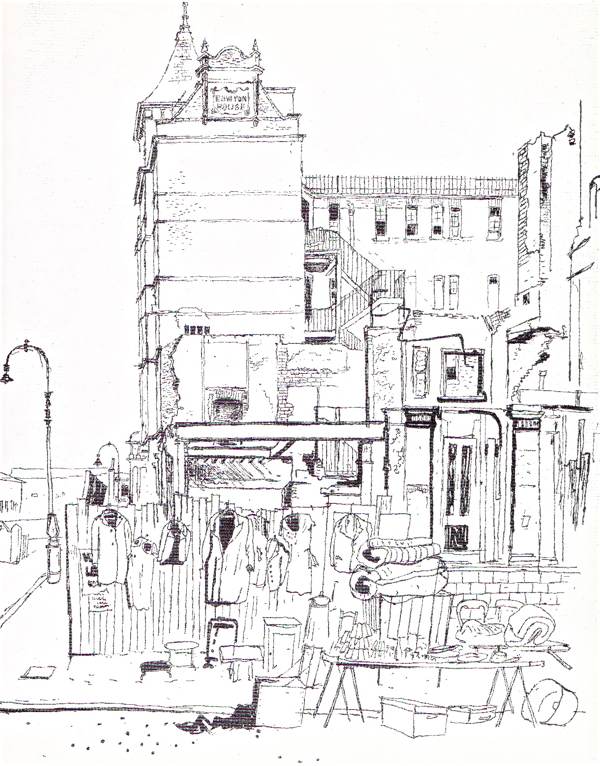
Rowton House

Old Montague St, Whitechapel

Gravel Lane, Wapping

Brushfield St, Spitalfields


Wentworth St, Spitalfields


Brick Lane


Fashion St, illustration by James Boswell from “A Kid for Two Farthings” by Wolf Mankowitz, 1953.

Russian Vapour Baths in Brick Lane from “A Kid for Two Farthings.”

James Boswell (1905-1971)


Leather Lane Market, 1937
Images copyright © Estate of James Boswell
You might also like to take a look at
In the footsteps of Geoffrey Fletcher
The Spitalfields Nobody Knows (Part One)
The Spitalfields Nobody Knows (Part Two)
Adverts From The Jewish East End
Click here to book your tour tickets for this Saturday and beyond
Stefan Dickers, Archivist at Bishopsgate Institute showed me these adverts he found in an almanac from 1925 that originally came from Sandys Row Synagogue, evoking a lost East End world of Kosher Viands, Lodzer Cakes and Keating’s Powder.


Images courtesy Bishopsgate Institute
You might also like to take a look at
Adverts from Stepney Borough Guide
The Night I Kissed Joan Littlewood
Click here to book your tour tickets for this Saturday and beyond

This is what happens when you try to carry a ladder the wrong way down a narrow alley, as Roy Kinnear is discovering in this frame from Joan Littlewood’s film Sparrows Can’t Sing.
You can see through the arch to Cowley Gardens in Stepney as it was in 1962. This is where Fred (Roy Kinnear’s character) lived with his mother in the film and here his brother Charlie (James Booth) turned up after two years at sea to ask the whereabouts of his wife Maggie (Barbara Windsor), finding that the old terrace in which he lived with Maggie had been demolished in his absence.
The drama revolves around Charlie’s discovery that Maggie has moved into a new tower block with a new man, and his attempts to woo her back. Perhaps there are too many improvised scenes, yet the film has a rare quality – you feel all the characters have lives beyond the confines of the drama, and there is such spirit and genuine humour in all the performances that it communicates the emotional vitality of the society it portrays with great persuasion. In supporting roles, there is Harry H. Corbett, Yootha Joyce, Brian Murphy and several other superb actors who came to dominate television comedy for the next twenty years. Filmed on location around the East End, many locals take turns as extras, including the Krays – Barbara was dating Reggie at the time – who can be seen standing among the customers in the climactic bar room scenes.
My favourite moment in the film is when Charlie searches for Maggie in an old house at the bottom of Cannon St Rd. On the ground floor in an empty room sits an Indian at prayer with his little son, on the first floor some Afro-Caribbeans welcome Charlie into their party and on the top floor Italians are celebrating too. Dan Jones, who lives round the corner in Cable St, told me that this was actually Joan Littlewood’s house where she and Stephen Lewis wrote the screenplay.
I once met Joan Littlewood at an authors’ party hosted by her publisher. She was a frail old lady then but I recognised her immediately by her rakish cap. She was sitting alone in a corner, being ignored by everyone, and looking a little lost. I pointed her out discreetly to a couple of fellow writers but, too awestruck by her reputation, they would not dare approach. Yet I loved her for her work and could not see her neglected, so I walked over and asked if I could kiss her. She consented graciously and, once I had explained why I wanted to kiss her – out of respect and gratitude for her inspirational work – I waved my pals over. We enjoyed a lively conversation but all I remember is that as we said our goodbyes, she took my hand in hers and said ‘I knew you’d be here.’ Although she did not know me or my writing, I understood what she meant and I shall always remember the night I kissed Joan Littlewood.
Watching Sparrows Can’t Sing again recently, I decided to go in search of Cowley Gardens only to discover that it is gone. The street plan has been altered so that where it stood there is not even a road anymore. Just as James Booth’s character returned from sea to find his nineteenth century terrace gone, the twentieth century tower where Barbara Windsor’s character shacked up with the taxi driver has itself also gone, demolished in 1999. Thus, the whole cycle of social and architectural change recorded in this film has been erased.
I hope you can understand why I personally identify with Roy Kinnear and his ladder problem, it is because I too want to go through this same arch and I am also frustrated in my desire – since nowadays there is a solid wall filling the void and preventing me from ever entering. The arch is to be found beneath the Docklands Light Railway between Sutton St and Lukin St. Behind this brick wall, which has been constructed between the past and the present, Barbara Windsor and all the residents of Cowley Gardens are waiting. Now only the magic of cinema can take me there.

At R. Russell, Brushmakers
Click here to book your tour tickets for this Saturday and beyond
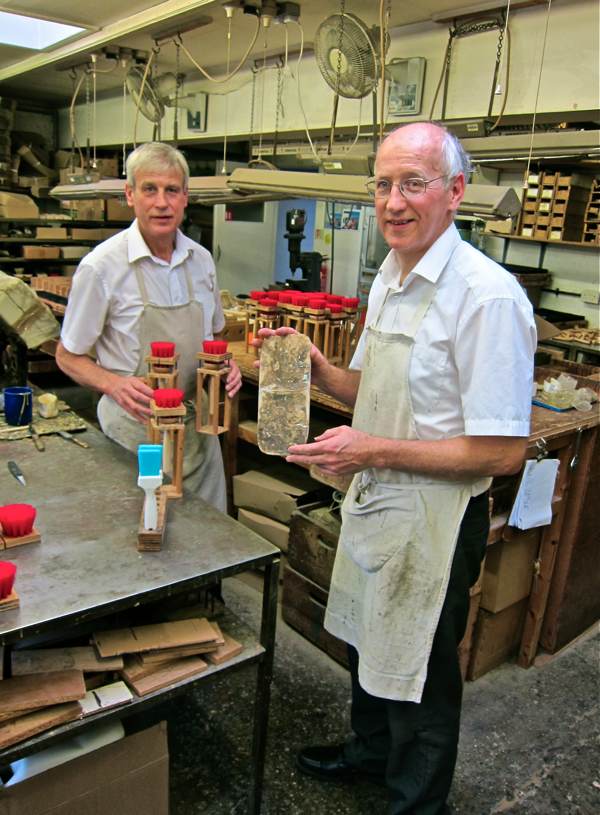
Robert & Alan Russell, sixth generation brush makers
Take the Metropolitan Line from Liverpool St St Station all the the way to Buckinghamshire and after a ten minute walk through the small market town of Chesham you will arrive at the tiny factory of R.Russell– Brush Makers since 1840 – secreted in a hidden yard. Here you will find brothers Robert & Alan Russell, sixth generation brush makers, working alongside their eight employees making beautiful brushes by hand, the last of their kind in a town once devoted to the trade. Surrounded by beech woods, Chesham had a woodenware industry since the sixteenth century and brush manufacture began two hundred years ago as a means to utilise the offcuts from the making of wooden shovels for use in brewing.
The workshop at R.Russell is on the first floor looking down onto a garden with a tall pollarded tree and an old camellia in flower. Two large battered worktables fill the centre of the room where batches of brushes are lined up in different stages of manufacture. There are stacks of brushes with garish plastic bristles and racks of sweeping brushes with natural brown bristles. Over by the window is Alan’s work bench, overlooking the garden. And it was here that I joined him as he placed the bristles into the former to make a broom, speaking as he worked with breathtaking dexterity, occasionally pausing for thought and gazing out onto the garden below, yet without ceasing from his task.
“My father was Robert, his father was Stanley, before him was Robert, his father was George and then there was Charles. The origins are lost in the mists of time, but we know that in 1840 Charles Russell had a pub by the name of The Plough in Chesham, and he used to make a few brushes at the back of the pub and sold them to the customers. His son George was the first member of the family down in the records as a brush maker.
I’ve been making brushes since I was sixteen and I’ve been here forty years, After you’ve been doing it as long as I’ve been doing it, it’s quite relaxing. I’d much rather be making brushes than sat behind a desk doing office work, your mind goes off wherever you please.
My grandparents lived in the house at the front and the factory was a shed in their back garden. I came down here with my father at the age of six and he showed me how to make brushes. I used to make brushes with the waste off the floor, because the bristles were too valuable to spoil, but if you can make a proper brush with the waste then you really know how to make a brush! By the time I left school, I had a good training in brush making because I worked here every holiday and after school. My father never pushed me or my brother into it, but it was a natural progression because we got on well with Dad. I was made a partner at eighteen and my brother who’s older than me was already a partner.
When I started, we produced mainly paper-hanging brushes and dusting brushes for painters. We sold them to the kings of the market – the paintbrush makers – and they sold them to decorators. But they are all finished now the paintbrushes are made in China, so we lost our trade. We have gone back to how we were before, we make specialist brushes to order. It’s a niche market because there’s so few of us left. We are a handmade specialist brush maker. We are flexible and we have a lot of experience and we can turn our hands to anything. We made a brush for the National Trust recently, based on an original in a sixteenth century painting. It’s much more interesting although we are not making the money we used to make. We peaked just before the turn of the century, when the Chinese started selling their paint brushes here, and we’ve managed our decline since then. But I feel more confident now than for a long time. People are looking for something different and business is looking up. Meanwhile prices are rising in China and the quality is not always there, and people are prepared to pay for a better brush and they’re the people we’re supplying.
I don’t want to do anything else, as long as I can make enough to live on by doing this. I can’t imagine working for someone else, even though we work long hours here. My wife will tell you, I’d rather be here than spend a day at home decorating. I’m a brush maker. On my father’s grave we put “brush maker” not “brush manufacturer” because that’s what he was, a skilled man.”
Next door, in the office where the brothers prefer to spend the minimum amount of time, Robert, the elder brother, showed me the photographs of his forebears who worked here in the same trade before him. He confided that he and his brother never take a holiday at the same time and while one is away they speak on the phone every day.
Both brothers wore identical white short sleeve shirts with black trousers and white aprons, which were – I realised – the uniform of the brush maker, not so different from their predecessors photographed in the 1930s. After six generations, this pair have become as absorbed as anyone could be in this most unusual of occupations, a life devoted to brushes. And I could not resist asking Alan which brush he would be, if he were a brush, because I knew he would have a ready answer.
At once he came back with this reply -“If I was a brush, I’d be a Badger Softener because it’s something that’s looked after. It does something very special. It’s for marbling, to create the soft texture beneath the veins. It just softens the edges. It doesn’t do much, but you can’t do anything without it. It’s the sort of brush you’d buy once in a lifetime.”

Alan Russell tucks the bristles into the former – “I’d much rather be making brushes than sat behind a desk doing office work, your mind goes off wherever you please.”

Chess Vale Bowling Club, Chesham c.1910 – Old Bob Russell sits second from right in middle row with the watch chain while his son Stanley reclines in front.

Alan Russell uses his “flapper” to level off the bristles.

Robert & Alan’s grandfather Stanley Russell in the 1920s.

Ann Brett brushes out loose bristles. –“It’s nice to see something with the “Made in England” label on it.”

Robert & Alan’s great-grandfather Old Bob Russell in the 1930s.

Alan Russell checks the bristles are in alignment.

Bob & Stan Russell & a fellow brush maker in the 1930s.

Robert & Alan Russell – “people are prepared to pay for a better brush and they’re the people we’re supplying…”

The factory in the 1960s.

My souvenir, a beautiful handmade brush from R.Russell.
R.Russell brushes are available from Labour & Wait in Redchurch St
You may also like to read about
The Return Of Vicky Moses
Click here to book your tour tickets for next Saturday and beyond

Vicky outside the former Providence Row Shelter where she stayed as a ten-year-old in 1958
When Vicky Moses returned to Spitalfields for the first time in over fifty years while house-hunting she had the strange experience of encountering her younger self at the Providence Row Shelter in Crispin St, where she had once stayed as child. Then Vicky moved into a flat nearby in the Petticoat Tower and revealed that it is no accident that after all these years she chose to make her permanent home in Spitalfields.“The place feels comfortable to me,” she confirmed when I met her in Crispin St outside the former Providence Row Shelter.
“During the winter of 1958, my mother took myself, aged ten, with my sister and brother aged six and four, and a six-month-old baby, to London to get away from my violent father. Arriving at Victoria Station with just the housekeeping money, Mum had no option but to seek help. She went first to what is now The Passage, a charitable hostel in Carlisle Place in Victoria, but there was no help there for a family such as ours. Eventually – having walked right across London looking for somewhere to stay – by that evening we arrived at the doors of Providence Row in Spitalfields where we were given beds and this became our temporary home.
As a ten-year-old, I was able to take it all in and remember it well, even now. It was such a contrast to our suburban life, but we were safe and secure and with our mother, our rock.
My memories of Providence Row are these – From the street you went up steps to the door, and inside was a long large room with a huge wooden table running through the middle, and, on either side, along the walls, were wooden benches. Women and children were separated from the men who were downstairs.
Each night, before going to bed, we were given a mug of cocoa and a thick slice of bread and butter. We all went to bed about the same time. The dormitory had beds arranged, hospital-style, around the walls, facing into the room, and a double row ran down the centre. We were in the women’s dormitory, my sister and I sharing a single bed, Mum sleeping with my brother with the baby in-between. In the bed next to ours, an old woman slept fully clothed, muttering and snoring which I found most disturbing.
In the mornings, we went down for breakfast – a mug of tea and another thick slice of bread and butter. Then we had to go out as the refuge was closed during the day, so there was nothing to do but walk the streets.
Mum took this opportunity to show us the sights of London that were within walking distance. She showed us Billingsgate Fish Market and we went to St Paul’s, to Petticoat Lane Market where the crockery seller enthralled me with his banter and where I first tasted hot chestnuts, and to Fleet St and the Tower of London and Tower Bridge. I remember waiting and then eventually seeing the Bridge open and close for a ship to pass through.
There were the bomb sites too, fascinating places for a child. I read ‘An Episode of Sparrows’ by Rumer Godden when I was twelve and I saw the film version ‘Innocent Sinners’. It was all familiar to me because I knew the location, I’d lived there. ‘A Kid for Two Farthings’ was another film I saw not long after our stay – I must watch it again to relive those days, to see it again through my child’s eyes.
The days were very long and we had to be fed, which meant food on park benches. And it was cold. But eventually 5pm would come round and we could return to the refuge.
We should have been at school, of course, and my eleven-plus exam was approaching. I’d been learning long division of pounds, shillings and pence, so Mum taught me this at the shelter in the evenings. I knelt at the bench with a piece of paper on which Mum had written some sums and next to me were her spare coins to help me. The other residents must have thought this odd, but Mum was not to be deterred, the eleven-plus was important and preparation continued regardless of circumstances.
Next to us on the bench, sat another mother with her two daughters, the only other family I can remember. One daughter was my age, and the other was younger. I played with the older girl and we became friends, even though there was nowhere for us to go and play or even talk, other than by sitting beside each other on the bench.
The other residents came from an existence very different to mine. They were poor, desperate people from a Dickensian world – people whose problems were not solved by the new welfare state, but I didn’t feel threatened, and the nuns and lay staff were kind, and our Mum was our star.
When the time came for us to leave – we were moving on to stay with my uncle – I remember a nun came to the door to see us off. I can see her standing at the top of the steps. Mum needed to pop back inside to say goodbye to someone, and asked me to hold onto the pram and watch the others. She put her purse under the pram cover and went inside. Five minutes later she reappeared and went for her purse. It had gone. Someone had seen her go and distracted me from my task.
Those were strange days but ones I will never forget and, in many ways, I’m glad I had this experience though I wish the circumstances that led us there had been different.”
Vicky passed her eleven-plus exam in 1959.

Vicky (far right holding the baby) with her brothers and sisters in the spring of 1959, six months after their stay in the Providence Row Shelter.

The dormitory – Vicky’s mother and her two youngest children slept in the bed in the foreground, while Vicky and her sister shared the next bed in the front of the picture.

Sister Fidelma outside Providence Row’s Gun St entrance, pictured in Catholic Life, 1976.
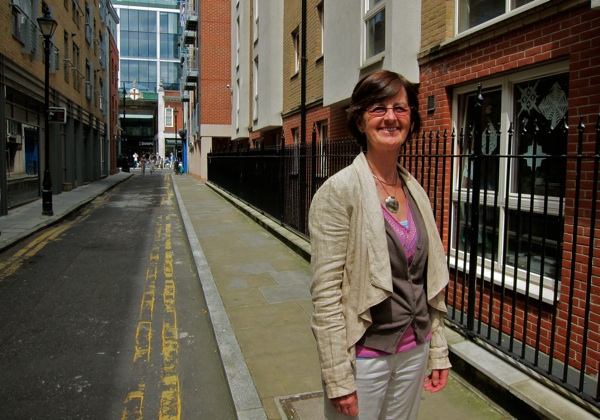
Vicky stands in Gun St where Sister Fidelma once stood.

The shelter seen from the corner of Crispin St and Whites Row, a century ago.

Vicky is now a resident of Spitalfields and the shelter has been converted as student accommodation.


Extracts from a pamphlet produced by Providence Row in 1960.
Click here to read about the continuing work of Providence Row in Spitalfields.
You may also like to read about
Click here to book your tour tickets for next Saturday and beyond

Pedro da Costa Felgueiras will tell you that he is a lacquer and paint specialist, or japanner – but I think he is an alchemist. In his secret workshop in a Hoxton backstreet, Pedro has so many old glass jars filled with mysterious coloured substances, all immaculately arranged, and such a diverse array of brushes, that you know everything has its purpose and its method. Yet even as Pedro begins to explain, you realise that he is party to an arcane universe of knowledge which defies the limits of any interview.
Pedro showed me Cochineal, the lush red pigment made from crushed beetles – very expensive at present due to floods in Asia. Pedro showed me Shellac, which is created by the Kerria lacca beetle as a coating to protect its eggs and, once harvested, is melted down and stretched out in huge transparent sheets like caramel – and is commonly used to make chocolate bars shiny. Pedro showed me Caput Mortuum, a subdued purple first produced by grinding up Egyptian mummies – Whistler was so horrified when he discovered the origin that he buried the paintings in which he used this pigment in his back garden. Pedro showed me his broad Japanese lacquer brush, of the kind made from the hair of pearl divers, selected as the finest and densest fibre. Pedro showed me his fine Japanese lacquer brush made from the tail of a rat, as he delighted to explain, once he had put it in his mouth to wet it.
“I find it very difficult to get excited about new paints,” he confided to me in his hushed yet melodious Portuguese accent, as the epilogue to this catalogue of wonders, “modern colours are brighter, but they will not last, they will flake away in twenty-five years.”
“Sometimes I feel I was born a hundred years after my time.” Pedro mused, “My earliest memories are of Sunday church, and of the gold and coloured marble, which I found quite overwhelming. But everybody else wanted new things – because they were surrounded by old things, they wanted plastic.” Growing up in Queluz just outside Lisbon, it was the Baroque palace covered in statues that cast its spell upon Pedro and when he discovered the statues had been made in Whitechapel, then he knew he had found his spiritual home. “I don’t know why I ended up here,” he admitted, “I had the desire to do something with my life and I would not have been able to do that if I stayed in Portugal.”
“When I first came to Spitalfields I used to walk around and look at the old houses, and now I have ended up working in many of them.” he continued, thinking back, “In London, I was fascinated by the junk markets and I bought things, and I wanted to restore them – it all came from that.” Pedro undertook a B Sc in restoration and was inspired by the work of Margaret Balardi who inducted him into the elaborate culture of japanning. “The first thing she taught me was how to wash my brush,” Pedro recalled with a grin.
“In the eighteenth century when they imported lacquer ware from the East, they started imitating it and used European techniques to do it. At first, they imported the ingredients from Japan but they couldn’t do it here and people died of it because it is poisonous,” Pedro explained, adding that he studied lacquer work in Japan and can do both Eastern and European styles. “I keep everything clean and I don’t touch it,” he assured me.
In the centre of the workshop was a fine eighteenth century lacquered case for a grandfather clock that had been cut down for a cottage when it went out of fashion in the nineteenth century. Pedro was painting the newly-made base and top, using the same paints as the original and adding decoration from an old pattern book. To reveal the finish, he wiped a damp swab across the old japanning and it instantly glowed with its true colour, as it will do again when he applies a new coat of shellac to unify the old and the new.
Using old manuals, Pedro taught himself to mix pigments and blend them with a medium, and now his talent and expertise are in demand at the highest level to work with architects and designers, creating paint that is unique for each commission. In the eighteenth century, every house had a book which recorded the paint colours used in the property and Pedro brought some of these out to show me that he makes for his customers today, with samples of the colours that he contrived to suit. There is a tangible magic to these natural pigments which possess a presence, a depth, a subtlety, and a texture all their own.
“I remember when it was a hobby and now it has become a job.” said Pedro, gazing in satisfaction around his intricately organised workshop,“You have to be diligent without cutting corners. It’s all about time. You grind the pigment by hand and it takes hours. It’s hard work. You can’t expect to paint a room in a week. It takes three days for the paint to dry and it will change colour over time – it’s alive really!”


Pedro paints a lacquer table to a design by Marianna Kennedy.

You may also like to read about
Pamela Cilia, Bottling Girl

Click here to book your tour tickets for next Saturday and beyond

Pamela Cilia
The reputation of the Truman’s bottling girls has passed into legend in Spitalfields. In the course of my interviews, so many people have regaled me with tales of this heroic tribe of independent spirited females who wore dungarees and clogs which thundered upon the cobbles as made their way through the narrow streets en masse, that I have been seeking an interview with one of these glamorous and elusive creatures for years.
Consequently, I was more than happy to make a trip to Rainham to pay a call upon Pamela Cilia, who proved to be a fine specimen of a bottling girl, full of vitality, sharp intelligence and strong opinions to this day. Illuminated by sparkling charisma and filling with joyous emotion as she recounted her story, Pamela was no disappointment.
“I loved it, I loved it, really loved it. But when my husband discovered I was going to work at Truman’s, he said, ‘I don’t want you working in that *******.’ He called it a certain place. Yet he already worked there, so I said to him, ‘If you give the place such a bad name, why are you working there?’ My first job was at Charrington’s in Mile End Rd until that closed down, then I worked for Watney Mann’s for seven years in Sidney St before they sold it to Truman’s, and that’s how we all ended up in Truman’s.
In the bottling plant, you had the filler, then you had the discharger and the labelling. The boxes came down and we filled them up. If a vacancy appeared on a machine, they did it by seniority – I think there were about seven machines. They had one ‘Galloping Major’ that done pints and quarts, and all the others were little bottles. They also had the canning machine. I was mainly on the canning machine.
We never had all this ‘safety,’ like now. We never wore glasses, we never had earpieces, so it was really dangerous, especially when the bottles went ‘bang’– especially when you had one in your hand and it exploded. You’d be getting them out of the pasteuriser, then all of a sudden ‘bang, bang bang, bang!’ because they hit against one another and they were hot from the pasteuriser.
I was forty-four and my children were all at school. In those days we lived in two rooms. Two pound a week, that’s what we paid. And my friend Doris used to take the kids to school and she used to bring them home. I clocked in at half past seven and finished at five.
When we got paid on Thursday’s, we used to go over to the Clifton – Thursday was curry day. My friend Adele said ‘I’ll take you to an Indian restaurant.’ At first, she took me to a restaurant near Middlesex Street, near the old toilets. ‘I’ll take you there for a curry,’ she offered, so I said ‘All right’ but when we ate there, I told her, ‘Oh, I don’t like that, Adele.’ The food was too hot.
The following Thursday we went to the Clifton, and on the tables were peppers. Terry, the engineer – big bloke – he said ‘Pam …’ He was going out Adele and had a row with her, they weren’t talking. He said, ‘Pam, it’s no good asking her for a roll …’ So I offered, ‘All right, I’ll get one for you.’ He said, ‘I want cheese and tomato.’ I got him two cheese and tomato rolls, but I took a pepper and took the pips out and put them in with the tomato pips. Then I gave them to him and went home afterwards, because I knew what he would do. I was a bit of a joker. I didn’t worry about anything. Nobody got me down.
My sister was different. She was a worrier. I mean, I went there one day and she was crying her eyeballs out. And they all said to me. ‘Pam, Betty’s crying,’ and I said, ‘What are you crying for?’ So she told me that Yvonne, or whatever her name was, said, ‘We can’t go home in her car if we smoke.’ I said ‘Listen, you don’t need her car. You got a pair of legs. Walk on them. Or get a cab home. Don’t let them get you down.’ Well, all the girls in there, they said ‘Pam, how brave you are, you don’t care.’
I met my partner at Truman’s. He was a student of nineteen and I was forty-eight, they used to take students on at Truman’s at busy times. One day, I was out with Adele and she said,‘Pam, I’m not coming to dinner with you today’ and I went ‘You’re not? Why’s that?’ She said to me ‘A student has asked me to have a drink with him at dinner time.’ I replied, ‘Oh, I see, we’ll see about that’. I went straight over to Bernie and asked, ‘Excuse me, can I speak to you?’ And he said ‘Yes’ and I said ‘Are you taking my friend, Adele, for a drink at dinnertime?’ He said, ‘Yes’ and I said, ‘I don’t think so.’ He said, ‘What?’ and I said again‘I don’t think so.’ He said, ‘Why’s that?’ and I said, ‘If you take her then you’ve got to take me too.’ He went, ‘Oh, alright then, you can come too,’ and I said, ‘Never mind about alright, I’m coming…’
Later, Adele met a student too. Bernie was only nineteen when I met him and I’ve been with him for thirty-eight years. I’ve got four children from my first marriage. My youngest one is sixty-one now. I got one at sixty-one, one at sixty-two, one at sixty-three and the eldest one’s three years older, she’s sixty-six. So I’ve not done bad, bringing up four kids in two rooms. I may be eighty-three but I’m still as lively as if I was twenty-one.
I was brought up in Malta because my father was Maltese. We used to come back and forth, he was a seaman. In the end, he gave up the sea because he had malaria and he was in Addenbrooke’s hospital in Cambridge, where they told him that he could get better treatment in London – so we all moved back to where my mother came from.
There were a lot of Maltese people in the East End then, but they had a very bad name. My husband was Maltese. He was a good husband but he used to hate me talking to bad girls and I’d ask him, ‘Why?’ In Stepney, you’d see the prostitutes, you had them all living in them houses next the hospital where they had furnished rooms. If they saw you with your kids, you don’t say to your child, ‘Don’t talk to her, she’s no good, she’s a so-and-so.’ That’s not me. For me, she’s a human being. Her life is her life. What happened was he said ‘Look Pam, say there’s a crowd of Maltese in Whitechapel’ – which there used to be years ago, they all gathered near the station. He said, ‘You’re not gonna talk to them. I’m being straightforward with you.’ He didn’t want me to get categorised like that or be labelled.
He didn’t want me to work at the bottling plant either, but I done it anyway. See, I’m stubborn. You had every creed, every race. I mean I’m gonna be fair because I have to, I got to swear. When I went in in the morning, I’d say ‘Good Morning, Sweary Mary,’ and she’d say to me ‘F*** off, you Maltese bastard!’
‘You Irish, you Welsh, you Scotch, you Black, you White’ – she’d have a name for every one of one of them. We had Lil, we used to call her ‘Barley-Wine Lil’ because, as soon as she came in, she’d grab a plastic cup. We’d all be thinking she was drinking tea – but she wasn’t! This was seven o’clock in the morning and she was drinking barley wine!
It was very, very good experience for me. I mean, if anything happens to me, I’ve had a good life. I loved the atmosphere, the fighting, and the swearing. And to me, they were straightforward people. Because they’d row with you today and speak to you tomorrow. They didn’t hold it against you. See, I’m a type of person can’t hold rows with people, I just want to be friends, you know.
Once, Me & Adele went down Brick Lane to the market and Sweary Mary was in front of us. We were in our welly boots and our overalls. They had these big stalls down Wentworth Street on a Friday or a Thursday, and we saw Mary – well I tell you what, I’ve never run from nobody. I said to Adele, ‘Look, Sweary Mary’s in front.’ Adele shouts out ‘Sweary Mary!’ Oh, she just turned round and shouted at us ‘F*** off, you Truman’s whores.’ Oh, did we laugh. I mean, it’s not nice really, but that was us. We couldn’t do it today. When you got home you were a different person because you were in your family.
If someone phoned me up and said ‘Pam, there is a permanent vacancy at Truman’s, would you do it?’ The answer’d be, ‘Yes.’ I’d probably go with one leg. You had your ups and downs but there was no violence and – the beer! It was nobody’s business.
Terry, the bloke I gave the peppers to, he was a comedian. It was so hot in the bottling plant that all we had on was our cross-over aprons and our bras and pants. I had a high chair, and I had to grab these cans and pull them forward. One day, he came behind my chair and – this is all because of the pepper in the cheese and tomato roll – I knew he’d get me back, but he didn’t get me straight away. He took my chair and tipped it upside down over a container for old cardboard boxes. He shook me, picking me up and throwing me off my chair into the big container. I couldn’t get out, my friends had to pass me wooden boxes so I could make steps to get out. Well you know, it was dangerous.
Yes, we had a bad name. Like I told you, my husband didn’t want me to go there because of the bad name. But it doesn’t mean to say you’re all the same. Yes, I had a laugh and joke, I’m not saying I didn’t. As I said, that bloke Terry got hold of me, he turned me upside down, my boobs went over my shoulders, and I didn’t think nothing of it. But my husband – to this day – he never knew. I didn’t see harm in it. But no, it was good, I loved it. Honest, I loved it. If it hadn’t closed down, I would still be there. I would probably be the sweeper-up!
My husband died after I left Truman’s but I had already met Bernie, and the marriage was already on the rocks. I left him in the end. I always said, ‘Once my children grow up, I’m off.’ And when my children got married, the last one, I was off. And that is how I met Bernie.
At first, they all thought that he was a policeman and I knew that thieving was going on, pinching beer. So he came in one morning and he had navy trousers on, and Adele said to me, ‘Pam, there’s a policeman in here.’ So I said, ‘What do you mean, a policeman?’ I went to him ‘Oi, are you a policeman?’ and he said, ‘No.’ Of course, when we saw him in the morning, we used to shout, ‘Morning, Officer!’ But it’s true, his father was a police sergeant at Chequers and he grew up there. We always said he was a bit of a snob.
I’m eighty-three and Bernie’ll be fifty-eight this year. We just hit it off, age didn’t make any difference. We clicked from that day we met. And he is good as gold. It was fate. I say to myself, ‘It’s fate you meeting Bernie, he wanted a bottling girl.’ He’s been in a lot of places, Bernie. He met Harold Wilson and – who’s that other prime minister? But that’s another story…”

Pamela Cilia at home in Rainham – ” I’m eighty-three and still as lively as if I was twenty-one.”


Labels courtesy Stephen Killick
Transcript by Jennifer Winkler
You may also like to read these other Truman’s stories
First Brew at the New Truman’s Brewery
Tony Jack, Chauffeur at Truman’s Brewery


