
The Bold Defiance

Click here to book your spring walk through Spitalfields
Click here to book your walk through the City of London
Rupert Cole tells how he uncovered the story of John Doyle and John Valloine, protagonists of the ‘Bold Defiance,’ who advocated for the rights of journeymen weavers in the eighteenth century and were executed in Bethnal Green for their endeavours.

‘Excavate the dust under your floor, the future needs our story to be found’ – this is the message I received from Doyle and Valloine this morning. I now have my arm between two joists under the floorboards. My hand is submerged deep in some ancient filthy grey dust. I cannot see anything in the darkness, the excavation is done by feel. As I fumble along the lath and plaster, every so often I come across a loose object. I can usually tell if it is just another wood shaving or something more significant that I need to bring up for further inspection. Today’s find is only a button and a piece of lead gas pipe. I will have another rummage tomorrow.
I am in the Dolphin, a former public house at 85 Redchurch St. I moved here twenty-seven years ago. It had been an Irish pub, its Irish connection dating back to when Irish and Huguenot silk weavers lived and worked around Spitalfields and Bethnal Green. In 1996, the pub was closed down and sold by the Truman Brewery after the company went into receivership.
When I first moved in, the interior still had the remains of a rotten, beer-soaked seventies chipboard bar and a disintegrating, sticky fag-burnt fitted carpet. With my friends, we set about a clear-up which revealed that some parts of the building were eighteenth-century.
Our first discovery was situated at the back of the yard. Concealed under a mass of asphalt roofing was a little single-storey brick building that had been converted for use as the pub’s toilet. We were curious as to why such a small building had two chimney flues and why in the attic there was a large timber trough with two connected chutes. So we asked Greater London Industrial Archaeology Society to visit. Between us, we deduced the building was an eighteenth-century brewhouse. The trough was probably where barley was kept and lowered via the chutes into a masher, and heated using one of the two flues. The other flue was likely for toasting hops or heating a fermentation vessel.
Nearly every day brought discoveries at the Dolphin. Under stone slabs in the yard, we found broken pottery, oyster shells, and clay pipes – one was decorated with dolphins. In the cellar, were bricked-up vaults which ran under the pavement that had not seen the light of day for a century or more. We found gin and port bottles buried under the cellar floor. And upstairs, there was a seemingly endless trove of objects, playing cards, buttons, and little folded paper pouches of tobacco in the dust under the floorboards. Hidden in one corner was an eighteenth-century glass bottle with liquid remnants at the bottom. When I removed the cork, it still had a faint scent. I think it was laudanum.
I started researching the building’s history which led me to a file held at the London Metropolitan Archives that had not yet been digitised. It was difficult to decipher the handwriting. The file contained the ‘Middlesex Sessions’ trial documents detailing a raid by thirty troops on ‘the Dolphin Alehouse’ on the night of Saturday 30th September 1769, in which four people were killed – Adam McCoy, Thomas Cartwright, Adam Haselden, and James Briggs. The documents included statements by surgeons, soldiers, the pub’s landlord, lodgers, and silk weavers. They described a horrific battle scene, a pistol shot fired through a head, a body found at the foot of the stairs, another in the taproom with his jaw blown apart, blunderbusses and cutlasses, and weavers fleeing out of windows and over roofs.
The location of this Dolphin Alehouse was described as the corner of Turville St and New Cock Lane (today the short stretch of Redchurch St between Club Row and Swanfield St).
Before long, I found the link between this raid and a group of revolutionary journeyman silk weavers who called themselves the ‘Bold Defiance,’ led by an Irishman John Doyle, and a Huguenot, John Valloine. Their headquarters was the club room on the first floor of the Dolphin Alehouse.
There are history books that explain the Bold Defiance, the context and complexity of all the silk-weaving industrial disputes, and what follows here is my summary.
The master silk weavers’ introduction of mechanised looms and the breaking down of established piece-work rates in the late eighteenth century severely impacted journeyman weavers’ pay. As a matter of survival, the Bold Defiance organised resistance. This was similar to the Luddite movement forty years later and it was a sort of proto-trade union, except they extorted subscriptions directly from employers not workers. They set a levy per loom and then sent demands to the master weavers, ‘You are desired to send the full donation of all your looms to the Dolphin in Cock Lane.’ If they refused to pay, then the Bold Defiance would cut their precious silks or sabotage their looms.
Lewis Chauvet, one of Spitalfield’s major silk manufacturers, refused to pay the levy and seventy or more of his looms were destroyed. As a consequence, Chauvet offered £500 reward for the capture of the Bold Defiance ringleaders, Doyle and Valloine. The raid on the Dolphin was based on a tip-off and they were tried at the Old Bailey on the 18th October 1769. Despite pleading their innocence, the pair were convicted on spurious evidence and sentenced to death.
With the endorsement of King George III, they were hung outside the Salmon & Ball in Bethnal Green, in the heart of the weavers’ neighbourhood rather than at Tyburn Tree. The intention was to intimidate the weavers from attempting any more rebellions, ‘to strike Terror into the Rioters.’ Yet thousands of weavers rioted as a consequence of these and scores of other ‘state-endorsed-executions.’ The rebellions continued until 1773 when the Spitalfields Act of Parliament legislated for a process of wage regulation through arbitration between the government, the master weavers, and the journeyman weavers. This was an important step towards the inception of trade unions, which to a considerable degree can be attributed to the influence of the Bold Defiance. It also marked the demise of the local artisan hand-loom weaver and the beginning of industrial capitalism.
I was excited to realise I was living in the former headquarters of the Bold Defiance. Details in the building suddenly seemed even more curious. Was the round hole in the cracked pane of glass left by one of the pistol shots during the raid? Was the chunk of torn wood, the result of where a musket ball had struck it when the soldiers fired into the cellar? Was the curious cut-out panel in the door on the first-floor club room, the hatch where the master weavers’ contributions were handed to the Bold Defiance? Perhaps Doyle had drunk from that very same bottle of laudanum? Could Valloine have smoked from that dolphin-decorated clay pipe? They surely had both drunk ale from the brewhouse.
My conversations with Doyle and Valloine continue. I would like to believe their voices are geologically recorded as ‘word fossils’ in the Dolphin walls and that one day acoustic phonon-archaeology will permit us to ‘playback’ their conversations. But, until then, I shall make do with imagining their words.
‘Dear Rupert, We are pleased you found us! Continue dust-larking under your floors, there is more to discover. Memories of the past are imaginings for the future. We shall send you instructions on how to start a ‘cash-back’ revolution soon. Thank you for telling our story. Yours, the Bold Defiance, Doyle and Valloine.’

The Dolphin in the early twentieth century

The Dolphin sign

Door to headquarters of the Bold Defiance

Staircase leading to the headquarters of the Bold Defiance

The former brewhouse to the rear of the Dolphin

Objects discovered by the author under the floorbooards at the Dolphin

The fragment of clay pipe with dolphins

The author’s museum of Bold Defiance artefacts


Jackson’s Oxford Journal, Saturday October 7th 1769


Bath & Bristol Chronicle, 14th December 1769

Location of the Dolphin marked on John Roque’s map

Click on this image to enlarge
‘The Weavers in an Uproar or a Quartern Loaf cheap at Twelve Pence’ – satire on the industrial unrest in the silk-weaving trade in the 1760s (courtesy British Museum)
Rupert Cole will be hosting a series of Bold Defiance re-enactment art events in collaboration with the House of Annetta this summer and a small museum of artefacts found at the Bold Defiance headquarters opens at the Dolphin soon. This article is an extract from a pamphlet to be published later this year which will include other stories from the Dolphin Alehouse. Thanks to historian Peter Guillery.
A Visit To Great Tom At St Paul’s
Click here to book your spring walk through Spitalfields
Click here to book your walk through the City of London

Click to hear the sound of Great Tom
Like bats, bells lead secluded lives hibernating in dark towers high above cathedrals and churches. Thus it was that I set out to climb to the top of the south west tower of St Paul’s Cathedral to visit Great Tom, cast by Richard Phelps at the Whitechapel Bell Foundry in 1716.
At 11,474lbs, Great Tom is significantly smaller than Great Paul, its neighbour in the tower at 37,483lbs, yet Great Paul has been silent for many years making Great Tom the largest working bell at St Paul’s and, after Big Ben (30,339lbs), London’s second largest working bell.
To reach Great Tom, I had first to climb the stone staircase beneath the dome of St Paul’s and then walk along inside the roof of the nave. Here, vast brick hemispheres protrude as the reverse of the shallow domes below, creating a strange effect – like a floor of a multi-storey car park for flying saucers. At the west end, a narrow door leads onto the parapet above the front of the cathedral and you descend from the roof of the nave to arrive at the entrance to the south west tower, where a conveniently placed shed serves as a store for spare clock hands.
Inside the stone tower is a hefty wooden structure that supports the clock and the bells above. Here I climbed a metal staircase to take a peek at Great Paul, a sleek grey beast deep in slumber since the mechanism broke years ago. From here, another stone staircase ascends to the open rotunda where expansive views across the city induce stomach-churning awe. I stepped onto a metal bridge within the tower, spying Great Paul below, and raised my eyes to discern the dark outline of Great Tom above me. It was a curious perspective peering up into the darkness of the interior of the ancient bell, since it was also a gaze into time.
When an old bell is recast, any inscriptions are copied onto the new one and an ancient bell like Great Tom may carry a collection of texts which reveal an elaborate history extending back through many centuries. The story of Great Tom begins in Westminster where, from the thirteenth century in the time of Henry III, the large bell in the clocktower of Westminster Palace was known as ‘Great Tom’ or ‘Westminster Tom.’
Great Tom bears an inscription that reads, ‘Tercius aptavit me rex Edwardque vocavit Sancti decore Edwardi signantur ut horae,’ which translates as ‘King Edward III made and named me so that by the grace of St Edward the hours may be marked.’ This inscription is confirmed by John Stowe writing in 1598, ‘He (Edward III) also built to the use of this chapel (though out of the palace court), some distance west, in the little Sanctuary, a strong clochard of stone and timber, covered with lead, and placed therein three great bells, since usually rung at coronations, triumphs, funerals of princes and their obits.’
With the arrival of mechanical clocks, the bell tower in Westminster became redundant and, when it was pulled down in 1698, Great Tom was sold to St Paul’s Cathedral for £385 17s. 6d. Unfortunately, while it was being transported the bell fell off the cart at Temple Bar and cracked. So it was cast by Philip Wightman, adding the inscription ‘MADE BY PHILIP WIGHTMAN 1708. BROUGHT FROM THE RVINES OF WESTMINSTER.’
Yet this recasting was unsatisfactory and the next year Great Tom was cast again by Richard Phelps at the Whitechapel Bell Foundry. This was also unsuccessful and, seven years later, it was was cast yet again by Richard Phelps at Whitechapel, adding the inscription ‘RICHARD PHELPS MADE ME 1716’ and arriving at the fine tone we hear today.
As well as chiming the hours at St Paul’s, Great Tom is also sounded upon the death of royalty and prominent members of the clergy, tolling last for the death of the Queen Mother in 2002. For the sake of my eardrums, I timed my visit to Great Tom between the hours. Once I had climbed down again safely to the ground, I walked around the west front of the cathedral just in time to hear Great Tom strike noontide. Its deep sonorous reverberation contains echoes of all the bells that Great Tom once was, striking the hours and marking out time in London through eight centuries.


Above the nave


Looking west with St Brides in the distance

Spare clock hands

Looking east along the roof of the cathedral

Up to the clock room

The bell frame for Great Paul in the clock room

Great Paul

Looking up to Great Paul

Looking across to the north west tower from the clock room


Looking along Cannon St from the rotunda


Looking south to the river

Looking across to the north west tower

Looking down on Great Paul

Looking up into the bell frame

Looking up to catch a glimpse of Great Tom, St Paul’s largest working bell

Great Tom cast by Richard Phelps in Whitechapel in 1716, engraved in 1776 (Courtesy of The Ancient Society of College Youths)

Great Tom strikes noon at St Paul’s Cathedral
Remembering Helen Taylor-Thompson
Click here to book your spring walk through Spitalfields
Click here to book your walk through the City of London
On International Women’s Day, we remember the inspirational Helen Taylor-Thompson (1924-2020) who co-founded Europe’s first AIDS hospice at the Mildmay Hospital in Shoreditch.

Helen Taylor-Thompson
What would you do if your local hospital was cut? Would you shrug your shoulders? Would you sign a petition? Would you go on a march?
Helen Taylor-Thompson did something more effective than any of these things, she took over the hospital and reopened it herself. Yet it was not such a radical act as you might assume, since the story of the Mildmay Hospital in the East End is that of a succession of strong women driven by a passion to care for the sick and the outcast, ever since the eighteen-sixties when it was established to minister to those in Shoreditch suffering from the cholera epidemic.
Catherine Pennefeather recruited eleven women to work with her and opened the first mission hospital in a warehouse in Cabbage Court in the Old Nichol in 1866, as a memorial to her husband, the Irish evangelist William Pennefeather. Working among people living in the most deprived conditions, Catherine insisted upon a personal approach that respected the dignity of everyone that came into her care, however degraded they might have become by their circumstances. In 1890, a foundation stone was laid for a purpose-built hospital which opened in 1892 and the Mildmay Hospital served the people of the East End continuously until it was shut by Margaret Thatcher’s government in 1982.
Demonstrating heroic independence of spirit, Helen Taylor-Thompson refused to let the noble history and tradition of care that the Mildmay represented be broken. She reopened it in 1985 and three years later in 1988 – when Mildmay inaugurated Europe’s first dedicated HIV clinic – the prescience of her action in saving the hospital became fully apparent.
At the clinic, it was Helen who delivered the circumstance in which Princess Diana came to the Mildmay and kissed a patient who was dying of AIDS upon the cheek – a powerful gesture that reverberates in the collective memory to this day and which contributed to overcoming the ignorance and prejudice which surrounded the disease at that time. It was an event that occurred within a climate in which staff of the Mildmay were shunned in the neighbourhood and even refused haircuts at local barbers out of misplaced fear of infection.
A pioneer by nature, Helen Taylor-Thompson was a descendant of the missionary Dr David Livingston and the daughter of the Chairman of the African Inland Mission. At eighteen, she was recruited into the Special Operations Executive during World War II, working in the First Aid Nursing Yeomanry (FANY), and her wish to be parachuted into occupied France to work with the Resistance was only frustrated when, as she was under twenty-one, parental consent was required but secrecy forbade her asking. Yet her experience in Special Operations became an invaluable asset when she faced her biggest challenge in Shoreditch. “I’ve had quite a life haven’t I?” she confessed to me in bemusement, looking back.
A quarter of a century after it reopened, the Mildmay Hospital built a brand new hospital for itself and Helen Taylor-Thompson remained undiminished in her fervour to be of service to humanity, applying herself to an ambitious educational project Thare Machi, designed to prevent HIV infection among people in the poorest countries. But, when I met her, I managed to persuade her to reveal the untold story of her involvement with the Mildmay Hospital and it proved to be an inspirational tale.
“The Mildmay was a little general hospital, much loved, with just a few wards and an A&E department. In the seventies, the District Health Authority had tried closing it but they were frightened to do so because it had such a good reputation. Other small hospitals were closing locally and many people felt the Mildmay had had its day, yet I believed it was still valuable because it was a Mission hospital and it worked with the most vulnerable people. I was chairman of the Hospital Advisory Council which I had formed to support the Mildmay and, when I saw that it was next in line to close, I got the community behind me to fight and we marched to Trafalgar Sq, and I clambered up among the lions and pleaded for the Mildmay not to close. It was fun but it didn’t do any good. They said, ‘It’s got to close,’ and it did. So then, a whole lot of people said, ‘We must go out in Glory,’ but I didn’t. I said, ‘We will fight for it and get it back.’
I had only one or two people who agreed with me, but a solicitor said, ‘Legally they can’t close it without giving the Mission the option of taking it back.’ So I went to the MP Peter Shore and said, ‘I want you to work with me to get it back.’ Then I wrote a letter to Kenneth Clarke to ask if I could have it back, and I knew it would have to be on a lease and seven years was too short and I didn’t think they’d give me twenty-one years, so I requested ‘a long lease.’ And two months later, I got a letter back offering it to me on a peppercorn lease for ninety-nine years – with strings attached.
As a Christian, I put this down to prayer. I was at the top of the stairs and I thought, ‘I can’t do this on my own,’ and the phone rang at the foot of the stairs. The caller said, ‘You don’t know who I am but I am the father of one of the nurses and I wondered if you’d like some help.’ He was working for the GLC and he could use the photocopier after hours. I employed an accountant to do a feasibility study and the plan was that we were going to work with young people who had suffered chronic injuries in accidents and people with Multiple Sclerosis, because they weren’t being taken care of.
But the District Health Authority didn’t want us to reopen the hospital, they wanted to sell it and get the money. We were examined and they told me we were incapable of doing it. If we hadn’t made a go of it after a year, they were going to take it away from me. I still had to find the money, so I sold the Mildmay Convalescent Home for half a million and I discovered there was a thing called ‘free money’ – the money which the hospital had in 1948 when it was taken over by the NHS. It had been put into a trust to be used for the hospital. I had no idea how much there was but I said, ‘You’ve got to give me that money.’ – it was £365,000! So we just had enough for eighteen months. The hospital had been closed for three years and vandals had got in, so I said to the NHS, ‘You’ve got put it right for us.’ I realised that we needed to get in six months before the contract was signed, so that we could sign the contract and admit the first patient on the same day. Elizabeth Willcocks, the previous matron who was in retirement, agreed to come back for two years and we reopened.
Thirteen months later, we were asked if we would take some AIDS patients. At that time, they were treated like lepers. So I went to the Matron and the Medical Director, and they both said, ‘The Mildmay has always looked after the people that nobody else wants to look after.’ We had the top floor which had formerly been the children’s ward and we didn’t know what to do with it, so I took the proposal to the board and I said, ‘I want a unanimous answer,’ and they said, ‘Let’s get on with it!’
Then we had big trouble – bricks thrown through the windows and a lot of Christians saying we shouldn’t be doing it and homosexual groups saying, ‘Boycott them, they’re Bible Bashers!’ We decided, ‘We’ll take no notice, we’ll open up and we’ll show love and great care.’ In October 1988, we opened the first hospice in Europe dedicated to treating people with AIDS. We had so many, we turned the whole hospital of thirty-six beds over to them. We had found our purpose, and the government were good and supported us with money.
The press used to be on the roof of the building opposite with telephoto lenses because we had some quite well-known people as patients. You’d think it was a sad place because people were dying, but it was happy because the patients were so well looked after and the doctors made sure they suffered no pain. Princess Diana came regularly and there was a patient called Martin who was dying and had lost touch with his family for eleven years. I said to him, ‘Would you like to give her the bouquet?’ The BBC were there and he gave Diana the bouquet, and they filmed her as she kissed him. Within twenty minutes, his mother rang and wanted to come to see him, and the whole family were reunited and shortly afterwards he died.
The Chairman of the District Health Authority, who had interrogated me, came to see me privately and he said, ‘I wish I hadn’t voted against you reopening the Mildmay.’ I said, ‘I’m very glad you did because it put more pressure on me to make the hospital independent, without that maybe I’d never have been able to get it back?'”

The first Mildmay Mission operated from a warehouse in Cabbage Court in the Old Nichol in 1866.
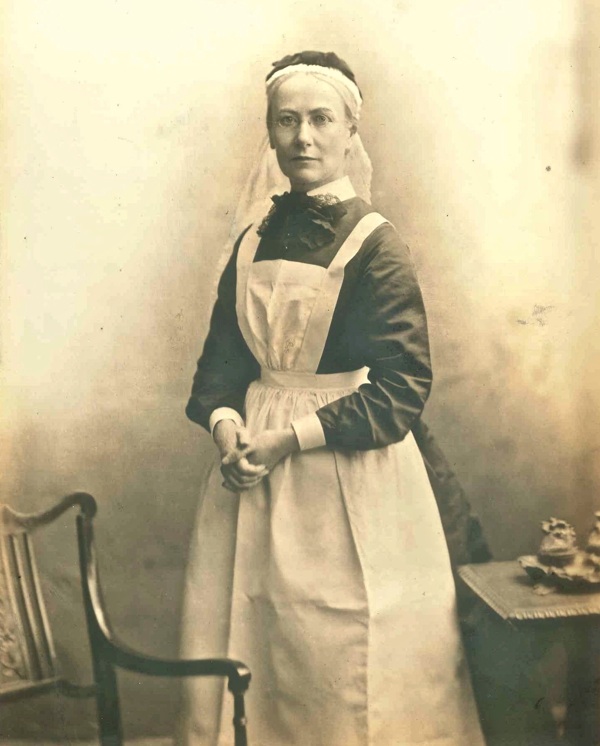
Emily Goodwin, the first matron at the new Mildmay Hospital, 1892


Sister Louise Blakeney, First Theatre Sister, 1909.


Miss Mulliner & Dr Gauld in the hospital pharmacy, 1909.

Matron and sisters in the nineteen twenties.


In the hospital kitchens.

The Mildmay Hospital with extra wards in Nissen huts during World War II.

Mildmay staff in 1966.

Detail, showing the Milmay cat.

Miss Stockton, Elizabeth Willcocks (Matron), Sister Edwin and Dr Buxton at the Mildmay in 1964.
Portrait of Helen Taylor-Thompson copyright © Patricia Niven
Crowden & Keeves’ Hardware
Click here to book your spring walk through Spitalfields
Click here to book your walk through the City of London
Richard Ince proprietor of James Ince & Sons, Britain’s oldest umbrella manufacturers, showed me this catalogue published by Crowden & Keeves in 1930 which had been knocking around his factory for as long as he could remember. Operating from premises in Calvert Avenue and Boundary St, they were one of the last great hardware suppliers in the East End, yet the quality of their products was such that their letterboxes and door knockers may still be recognised in use around the neighbourhood today.


The umbrellas were supplied to Crowden & Keeves by James Ince & Sons


You may like to read about these favourite hardware shops
At The Jewish Soup Kitchen
Click here to book your spring walk through Spitalfields
Click here to book your walk through the City of London

Originally established in 1854 in Leman St, the Jewish Soup Kitchen opened in Brune St in 1902 and, even though it closed in 1992, the building in Spitalfields still proclaims its purpose to the world in bold ceramic lettering across the fascia. These days few remember when it was supplying groceries to fifteen hundred people weekly, which makes Photographer Stuart Freedman’s pictures especially interesting as a glimpse of one of the last vestiges of the Jewish East End.
“After I finished studying Politics at university, I decided I wanted to be a photographer but I didn’t know how to do it,” Stuart recalled, contemplating these pictures taken in 1990 at the very beginning of his career. “Although I was brought up in Dalston, my father had grown up in Stepney in the thirties and, invariably, when we used to go walking together we always ended up in Petticoat Lane, which seemed to have a talismanic quality for him. So I think I was following in his footsteps.”
“I used to wander with my camera and, one day, I was just walking around taking pictures, when I moseyed in to the Soup Kitchen and said ‘Can I take photographs?’ and they said, ‘Yes.’ “I didn’t realise what I was doing because now they seem to be the only pictures of this place in existence. You could smell that area then – the smell of damp in old men’s coats and the poverty.”
For the past twenty-five years Stuart Freedman has worked internationally as a photojournalist, yet he was surprised to come upon new soup kitchens recently while on assignment in the north of England. “The poverty is back,” he revealed to me in regret,“which makes these pictures relevant all over again.”

Groceries awaiting collection

A volunteer offers a second hand coat to an old lady

An old woman collects her grocery allowance

A volunteer distributes donated groceries

View from behind the hatch

A couple await their food parcel

An ex-boxer arrives to collect his weekly rations

An old boxer’s portrait, taken while waiting to collect his groceries

An elderly man leaves the soup kitchen with his supplies
Photographs copyright © Stuart Freedman
You can read more about the Soup Kitchen here
You may also like to take a look at
My Spring Shirt
Click here to book your spring walk

I pulled this shirt out of my cupboard this week in advance of the arrival of spring. If you look closely, you will see the collar is wearing through but this does not diminish my affection for this favoured garment that I have worn for years now, bringing it out just for these few months at the end of winter. Although most of the clothes I own are of undecorated design, there is a gentle lyrical quality about this pattern that appeals to me.
When I wear this shirt with a dark jacket, the colours really sing and I feel am doing my bit in participating in the seasonal change. This contrast of formal clothing with a sprigged shirt can express dignified restraint while at the same time revealing an attachment to flowers, plants, gardens and nature – a contrast that I recognise in my own personality.
I love the conceit of having violets on my shirt when those in my garden are in flower and I enjoy the subtle tones of all the flowers portrayed, remaining as recognisable species while artfully stylised to make a pattern. The evocation of the natural world in this simple design touches a chord for me and, as with so many things that trigger an emotional response, I discovered that my passion for these floral patterns from Liberty goes back a long way.
When I came across the familiar photograph of my mother Valerie as a child, which you can see below, I did a double-take when I recognised the pattern on the dress. It was a Liberty print, very similar to my spring shirt which I hold in such affection. In that moment, I recalled that my grandmother Katherine bought fabric at Liberty in London and had it made up into dresses for my mother in the nineteen-thirties. This was a gesture which made such an unforgettable impression on my mother that for her whole life she carried her delight in these cotton dresses, which were so magical to her as a little girl in Somerset. Floral prints fed her innocent imagination, nurtured by ‘Songs of the Flower Fairies’ and performing as one of Titania’s attendants in a school play.
A generation later, I grew up with the received emotion of this memory – a story my mother told me when I was a child. I thought I had forgotten, but I realised it was through an unconscious recollection of the photograph of my mother in the Liberty dress that I was attracted to this flowery shirt, without understanding the origin of my desire at the time.
The story was confirmed when my Uncle Richard moved out of the old house where he and my mother grew up and, in my grandmother’s dressing table, I found a small leather pocket diary from the thirties recording her London trip with the entry, “Stayed at Claridge’s. Ordered carpet and sideboard at Harvey Nichols and bought materials at Liberty.” My grandmother was the daughter of a diminished aristocratic family who married my grandfather Leslie, a bank manager, and adopted an autocratic manner to ameliorate her loss of status. Consequently, my mother, with admirable resourcefulness, ran away from home at nineteen to escape my bossy grandmother and married my father Peter, who was a professional footballer – an act of social rebellion that my grandmother never forgave.
Nevertheless, the taste I acquired for these old-fashioned designs reflects the fondness my mother carried for that special moment in her childhood which she never forgot, when my grandmother showed maternal kindness to her little daughter in the gift of flowery cotton dresses. An act which came to represent everything about my grandmother that my mother could embrace with unqualified affection, and she encouraged me to remember the best of people too, a prerogative I claim in this instance as the sole living representative of these characters.
Today, I wear my shirt as the sympathetic illustration of a narrative which extends over three generations, culminating in my own existence upon this earth, and as I button my spring shirt, before walking out to celebrate sunshine and a new beginning, I am reminded that I alone carry these emotional stories now, clothing me in the humble affections of my forebears.

The Gentle Author’s mother ‘Valerie’ in the nineteen-thirties

Liberty of London
So Long, Bernard Kops
Poet, playwright and novelist, Bernard Kops, died on 25th February aged ninety-seven years.

Bernard Kops (1926-2024)
“It’s amazing I have lived so long, after all the drugs that I have taken in my life!” declared Bernard Kops with a certain genial alacrity when I visited him and his wife of seventy years, Erica, in Finchley. Yet once he told me his stories of growing up in Stepney Green in the nineteen thirties, I understood how those experiences might instill a keen will to live which perhaps, in part at least, accounted for his glorious longevity.
Bernard’s father left Rotterdam with his family in 1902, hoping to get to New York, but when he bought his ticket it only took him as far as London. The ticket office in Amsterdam explained that he could collect the second part of his ticket to New York from Mr Smith on arrival in London, but when he arrived in the Port of London and asked for Mr Smith everyone laughed at him. And thus it was that Bernard’s father’s dream of America was supplanted by the East End. Later, the relatives in Amsterdam implored Bernard’s father to return with his family prior to the outbreak of World War II, believing that Holland would remain neutral and Bernard remembered his father weeping because he could not afford the tickets to return. Yet those relatives were all killed by the Nazis and Bernard’s father’s impecunious situation was the salvation of his immediate family.
Such was the equivocal nature of Bernard Kops’ inheritance and, looking back from his perspective as the father of four children, six grandchildren and two great-grandchildren, it coloured all experience with a certain sentiment, cherishing the fleeting brilliance of life.
“I couldn’t have done anything without Erica,” he assured me, prefacing our conversation, when I visited him in the Victorian apartment block in Finchley where he lived for the last sixty years, moving there from Soho in the days when it was an enclave of writers and artists. Walking down the long passage in his modest basement flat, I found him in a peaceful room looking out onto the garden where we chatted beneath the poster for “The Hamlet of Stepney Green.” Bernard’s first play launched him as one of the new wave of young playwrights from the East End, alongside Arnold Wesker and Harold Pinter, that came to define British theatre in the post-war era. “There were actors who couldn’t fathom what we were doing, but we brought the streets into the theatre,” Bernard explained, “I still think of myself as a street person, I come from a verbal culture where everybody was always talking all the time.”
Recalling his childhood, he said, “Everyone was starving in those days before the war. And when my sister Phoebe came home and she had got a job, we were all overjoyed. But then she came back from the sweatshop and said the boss has been feeling her up. ‘She’s not going back,’ said my mother. ‘We need the money,’ said my father. Because we were so poor, every day was a battle. My whole life was a drama.”
“I was different from my brothers and sisters, and I don’t know why,” Bernard confessed, still bemused by his literary talent, “My mother recognised it, she used to say, ‘He’s the one that’s going to take me to Torquay one day.’ That was her measure of success.” One of Bernard’s earliest memories was of hiding under the table to eavesdrop on the adults and his mother asking, “Where’s my Bernie?” which was the cue for him to jump out and delight her.
As a child, Bernard knew that it was not safe for him to stray up the Cambridge Heath Rd towards Bethnal Green because that was where the fascist blackshirts were. Yet on the day that war was declared, when Bernard’s mother gave him sixpence to seek his own amusement, he took a bus through the danger zone up to the West End where – at eleven years old – he discovered a vision of whole other world that he realised his mother had never seen. Then, walking down Brick Lane one day just after the war, a young man stopped Bernard and asked what he was mumbling under his breath and Bernard admitted he was speaking poetry. Realising that Bernard had never read any poetry, he gave Bernard a slim volume of Rupert Brooke published by Faber and Faber. “So I read Grantchester and I thought it was fantastic,” Bernard recalled fondly, “I went to the library and asked, ‘Have you got any more Faber and Faber books like this?’ The library gave me freedom.”
In common with generations of writers and artists from the East End, Bernard Kops educated himself using the collection at the former Whitechapel Library next to the Whitechapel Gallery. From here, Bernard took classes in drama at Toynbee Hall which focused upon improvisation – inventing plays – and it gave him the technique to launch himself as playwright. This was the move that eventually led him to live in Soho, enjoying the company of his literary peers, and he recalled returning from there to Hanbury St to visit Colin McInnes while he was writing Absolute Beginners, in which Bernard appears in a barely fictionalised form as “Mannie Katz.”
In summation,“I’m a poet basically,” he announced to me with a diffident smile.
All this time, Erica had been sitting across the room from us, encouraging Bernard by making small appreciative noises and completing the odd stray sentence in a story she has heard innumerable times. In a prolific career including plays, screenplays, poems, novels and autobiography, life did not run entirely smoothly for Bernard who succumbed to drug addiction and depression, yet overcame both afflictions with Erica’s support to reach a state of benign equanimity. “I said to her, the moment I met her, that I was going to marry her, and she thought I was absolutely mad,” Bernard confided, raising his voice and catching Erica’s eye provocatively. “And I haven’t changed my mind,” confirmed Erica with a nod from the other side of the room, folding her hands affectionately.

Whitechapel Library, Aldgate East

Bernard & Erica
For You
May 2012

Bernard Kops
Portraits copyright © Lucinda Douglas-Menzies
You may also like to read about Bernard Kops’ close friend


