
Last Days At W.F. Arber & Co
CLICK HERE TO BOOK YOUR TICKETS
Last week I learnt belatedly that my friend Gary Arber – the legendary printer of the Roman Rd – died three years ago. Here is my account of my last visit to his print works before it closed forever.
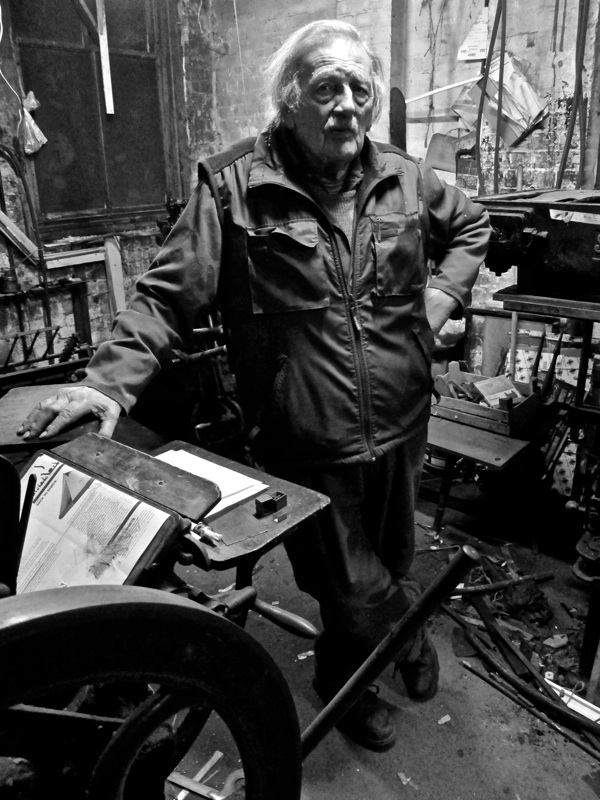
Gary Arber
Four years passed since I first walked eastward through the freshly fallen snow across Weavers’ Fields on my way to visit Gary Arber, third generation incumbent of W.F. Arber & Co Ltd, the printing works in the Roman Rd opened by Gary’s grandfather Walter Francis Arber in 1897. Captivated by this apparent time capsule of a shop where little had changed in over a century, I was tempted to believe that it would always be there, yet I also knew it could not continue for ever.
“In October, I couldn’t find enough money from my takings to pay my business rates,” Gary admitted to me then, “and that’s when I decided it was time to call it a day.” As the last in the family business, Gary had been pleasing himself for years. After three generations, the metal type was all worn out and so Gary let the machines run down, taking on less and less printing. Then he put the building up for sale and set a date that coincided with when his insurance ran out, as his date to vacate the premises.
Bearing the responsibility of being the custodian of the contents, a major question for Gary was to find a home for his collection of six printing presses which are of historic significance. He has gave them to the Cat’s Eye Press in Happisburgh, Norfolk, who agreed to restore them all to working order and put them to use again. Since he made his decision, Gary had been at work clearing up the sea of boxes and detritus that had accumulated to conceal the machines and I took advantage of this brief moment to see the presses in their glory before the process of taking them apart and transferring them to Norfolk commences later that week.
“It’s good to see them again after thirty years,” declared Gary, as he led me down the narrow staircase to the small basement print workshop where the six gleaming beasts were newly revealed from beneath the litter. In the far corner was the Wharfdale of 1900 that has not moved since it was installed brand new and, at the foot of the stairs, sat the Golding, also installed in 1900. The Wharfdale was a heavy rectangular machine that famously was used to print the Suffragettes’ posters while the more nimble Golding was employed to print their handbills. At WF Arber & Co Ltd it had not been forgotten that Gary’s grandmother Emily would not permit his grandfather to charge Mrs Pankhurst for this work.
The Heidelberg of 1939 was the last press still in full working order and Gary informed me that since World War II broke out after it was delivered, his father (also Walter Francis) had to pay the British Government for the cost of it, although he never discovered if the money was passed on to the Germans afterwards. Next to it, stood the eccentrically-shaped Lagonda of 1946 which we were informed by its future owner was believed to be the last working example in existence.
In between these two pairs, sat the big boys – two large post-war presses, a Mercedes Glockner of 1952 and Supermatic of 1950. Gazing around at these monstrous machines, sprouting pipes and spindles and knobs, Gary could recall them all working. In his mind, he could hear the fierce din and see those long-gone printers – Fred Carter, Alfie Watts, Stan Barton & Harry Harris among others – who worked there and wrote their names in pencil underneath the staircase. Sometime in the mid-fifties, alongside their names and dates, Gary wrote his name too, but instead of the date he wrote “all the time” – a statement amply confirmed by his continued presence more than half a century later.
Yet Gary never set out to be a printer. He set out to fly Lincoln Bombers, only sacrificing his life as a pilot after his father’s premature death, in order to take over the family print works. “I bought myself out in 1954, but I would be dead by now if I had stayed on, retired and grown fat like all the rest,” he confided to me, rationalising his loss, “I’m the only one surviving of my crew and I can still lift a hundredweight.”
“I remember when I first came here to visit the toy shop upstairs as a child but I didn’t get a toy except for my birthday and at Christmas,” Gary informed me, <“My grandfather always had his bowler hat on. He had two, his work bowler and his best bowler. He was a very strict and moral man, he raised money for hospitals and he was a governor of hospitals.”
We all missed WF Arber & Co Ltd, but it was far better that Gary chose to dispose of the business as it suited him, and wrapped it up to his satisfaction, than being forced into it by external circumstances. After all those years, Gary Arber could rest in the knowledge that he had fulfilled his obligation in a way that paid due respect to both the Walter Francis Arbers that preceded him.
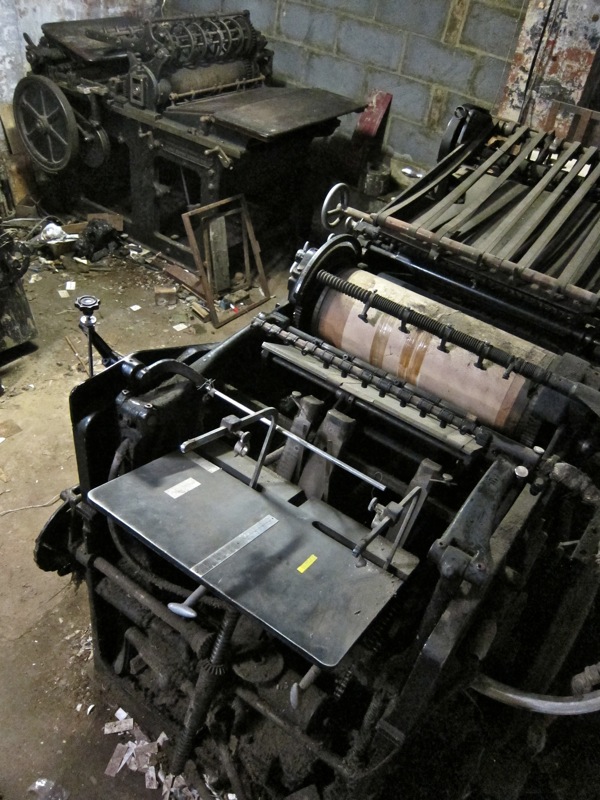
The Wharfdale & The Glockner
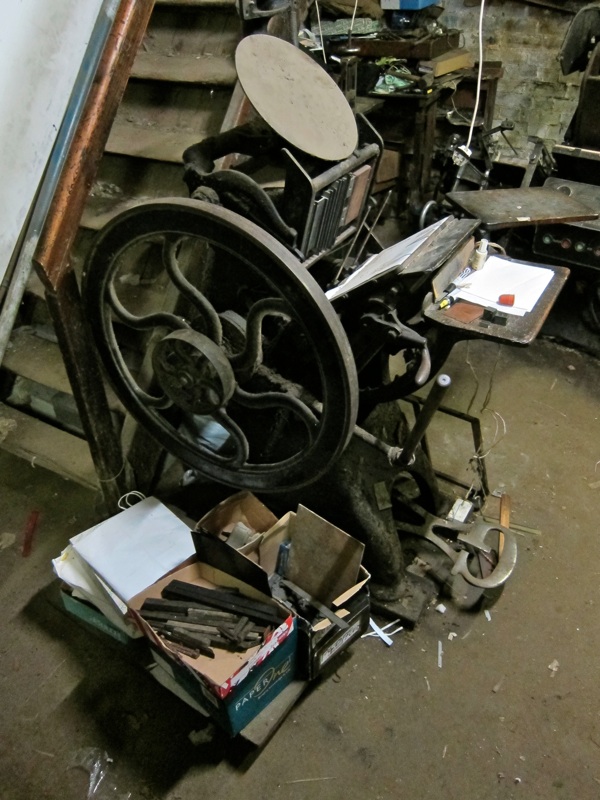
The 1900 Golding that printed the Suffragettes’ handbills
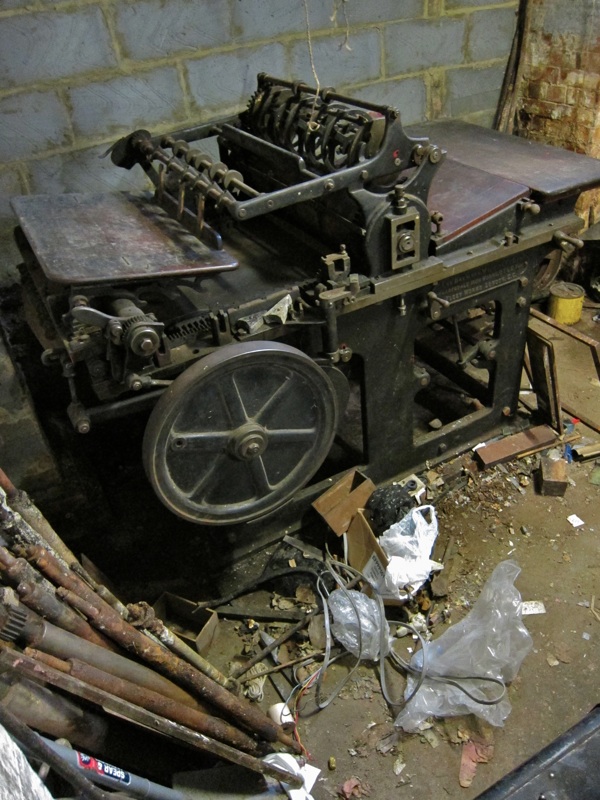
The 1900 Wharfdale that printed the Suffragettes’ posters
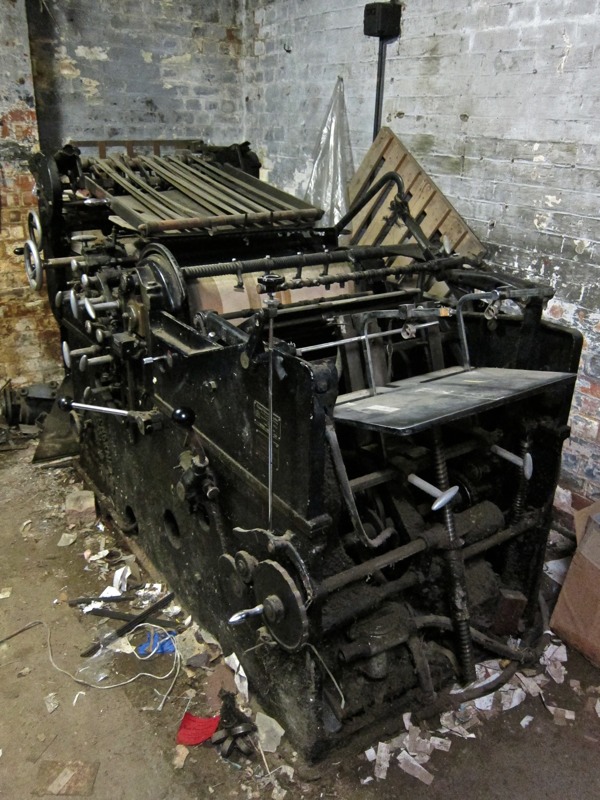
The 1952 Mercedes Glockner
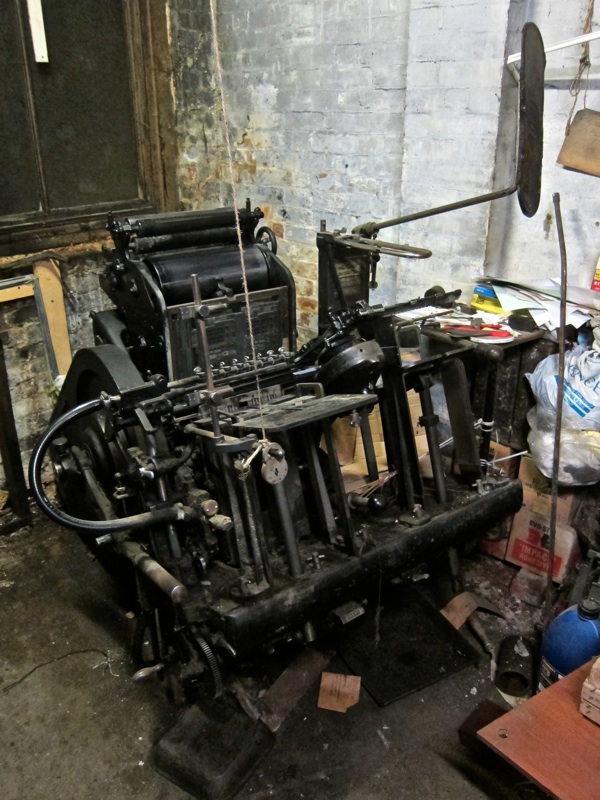
Gary was printing with this 1939 Heidelberg last week
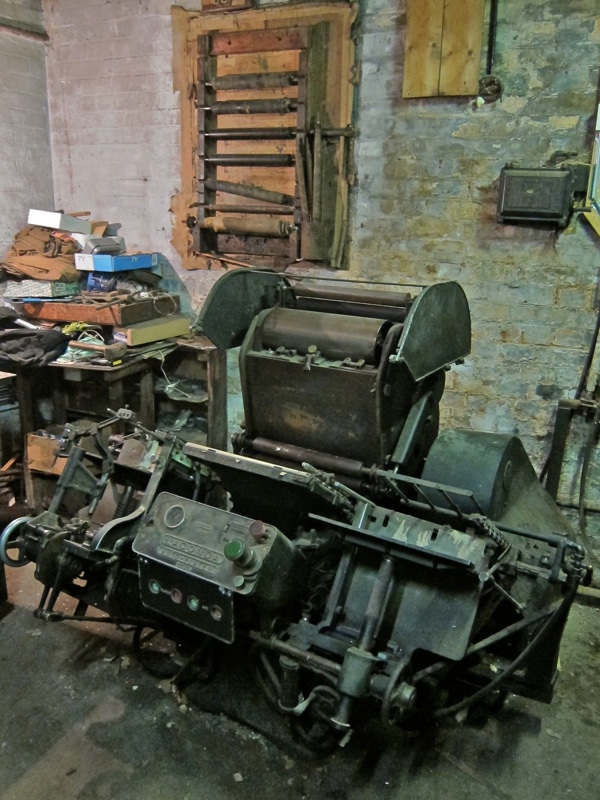
The last known working Lagonda in the world, 1946
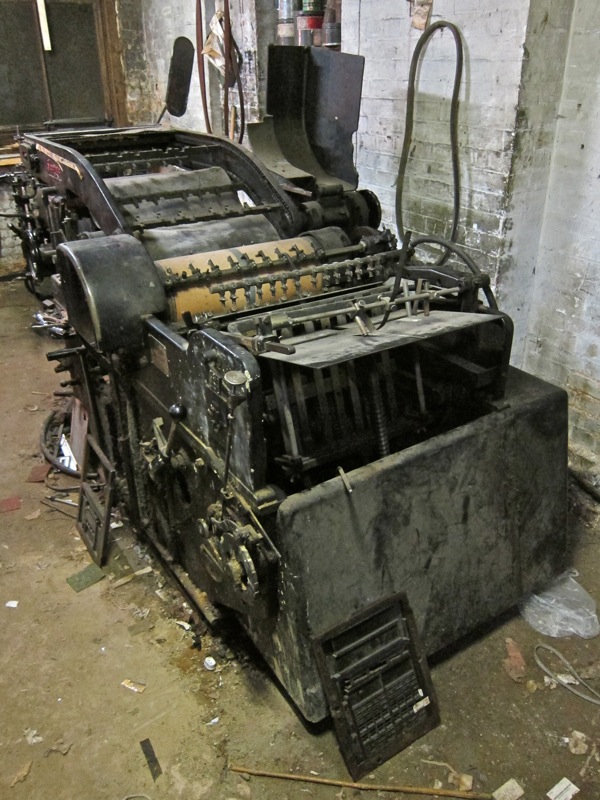
The 1950 Supermatic
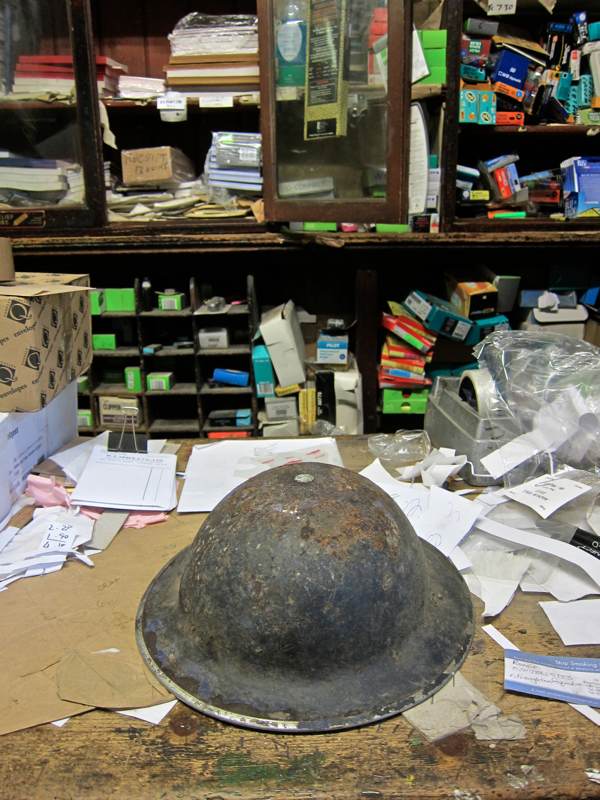
Gary found his Uncle Albert’s helmet under one of the machines while clearing up. Albert was killed while in the fire service during World War II.
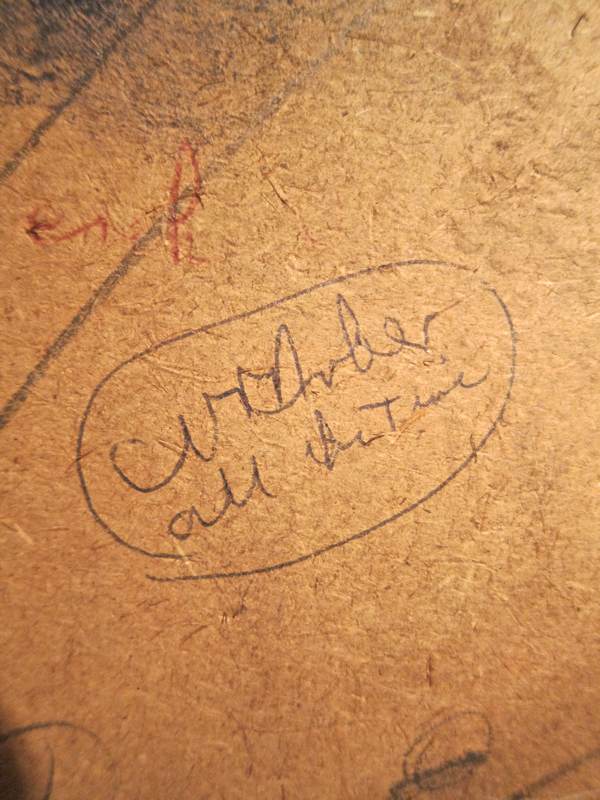
The printers wrote their names and dates in the fifties but Gary wrote “[here] all the time”
You may also like to read











“Last known working Lagonda” —- Silly me! I was expecting to see a smart car among the presses!
I am sad to hear that Gary is no longer with us. I wonder why he signed his name as CV Arber rather than Gary as he clearly did not like his given names, Clarence Victor Francis.
I am pleased to hear that the wonderful and historically important printing machines have gone to a good home. The premises would have made a great museum.
I have fond memories of the toy shop in the 1950s.
Gary certainly made a powerful mark on history. Good to know that his legacy lives on and that those astounding machines are still working.
In answer to Sue M. Gary’s birth name was Clarence, as she notes, but he and his wife hated it. It was after he was married that, at his wife’s suggestion, he asked to be called Gary. I must admit, it suited him better.
What history right there in these pictures! I t would be well worth a second article to go up to the
presses new home and see them all cleaned up with newer photos! Hint-hint.
another gloriously informative blog, on histories disappearing before our eyes. Thanks GA