
Benjamin Pollock, a penny plain, tuppence coloured

Yesterday as the first snowflakes of the winter spiraled out of a pale sky, I walked up through Spitalfields towards Hoxton following in the footsteps of Robert Louis Stevenson who came here to 73 Hoxton St in 1884 to visit Benjamin Pollock’s Toy Theatre Shop. “If you love art, folly or the bright eyes of children speed to Pollock’s” he wrote in his essay “A penny plain, tuppence coloured” – referring to the prices of the printed sheets in their hand-coloured and plain versions.
Stevenson was an only child who played with toy theatres to amuse himself in the frequent absences from school due to sickness, when he was growing up in Edinburgh. I too was an only child who was enchanted by the magic of toy theatres, especially at Christmas and it was the creation of these dramas that led to my first career, as a playwright. So you will understand why it was of interest to me to find 73 Hoxton St. Although Pollock’s Toy Theatres survived at this address into the twentieth century, I knew the shop was gone but I wanted to find the site.
Hoxton St has even numbers on the east side and odd numbers on the west. Walking past the Job Centre and Hackney College, I quickly found numbers 74 and 76, but to my disappointment I saw a recent housing development on the other side of the street without any numbers. I crossed the road to read a metal plate there which, contrary to my expectation, explained this was the site where the letter was read discovering the Gunpowder Plot. By now, the snow was falling fast, so I decided that I should be satisfied with this discovery and turned back towards Spitalfields. But then, as I passed Hoxton Post Office, I saw another round metal plate on the corner of Fanshaw St marking the site of Benjamin Pollock’s shop.

Even when Stevenson came here, he knew that Benjamin Pollock’s shop was the portal to an earlier world, because the theatres of his childhood that he purchased in a shop on Leith Walk in Edinburgh were produced by Skelt’s Juvenile Drama and the names on the printing plates were altered with successive owners, “This national monument, after changing its name to Park’s, Webb’s, Reddington’s and last of all to Pollock’s, has now become, for the most part, a memory”, he wrote.
Coincidentally, it was Mr W.Webb’s great granddaughter, the legendary publisher Kaye Webb (who edited, Lilliput in the forties, Picture Post in the fifties and Puffin Books in the sixties and seventies), who first took me seriously as a writer and was the first to publish my works. She lived in a flat overlooking the canal at Maida Vale and when I came to London to stay with her there, she showed me one of Webb’s theatres that had been coloured and made up by Ronald Searle to whom she had been married. She regretted the name Pollock had erased that of her grandfather but I was fascinated that the knack for creating popular culture had been passed on down the generations.
John Reddington opened his shop in 1851 and ran it until his daughter Eliza married Benjamin Pollock in 1873 and they took over the shop, continuing until Benjamin Pollock died in 1937, by which time toy theatres had become an anachronism and the business was in terminal decline. Yet such was the celebrity that Stevenson had brought, Benjamin Pollock received the unique accolade for a Hoxton shopkeeper of an obituary in the Times. His daughters Selina and Louise sold out in 1944 and shortly after the building was destroyed by an enemy bomb. It was Marguerite Fawdry who salvaged the remnants, including the printing plates, and opened Pollock’s Toy Museum in 1956 as a trust. The plates you see here today were kindly provided by Alan Powers, the modern-day saviour of Pollock’s Toy Theatres.
I cannot quite put my finger on what still draws me to the romance of these old theatres, even Stevenson admitted “The purchase and the first half hour at home, that was the summit.” As a child, I think the making of them was the greater part of the pleasure, cutting out the figures and glueing it all together. “I cannot deny the joy that attended the illumination, nor can I quite forget that child, who forgoing pleasure, stoops to tuppence coloured.” Stevenson wrote.
As I walked back down Shoreditch High St in the whirling blizzard, I began to envy Stevenson’s escape to the South Sea Islands, but until the wanderlust seizes me, I am happy to be here in Spitalfields writing to you every day. In the meantime, we share our passion for toy theatres. I love the evocation of the heroic nineteenth century theatre that they provide and I am still entranced by the beautiful vista they offer to an imaginative world rich in the poetry of infinite dramatic potential.
There is still time for you to order one for Christmas from www.pollocksmuseum.co.uk where you can also book to attend a performance of JACK & THE BEANSTALK on 10th January at the Art Workers Guild in Queens Sq.

James Brown, illustrator & printmaker
 This fascinating linocut by James Brown caught my eye at the Mangle Sale on Saturday, so on Monday I walked over from Spitalfields to Hackney Wick, where James has his studio, to find out more.
It is curious that proverbs come in contradictory pairs. “A stitch in time saves nine” versus “Don’t cross your bridges till you come to them” or “You’re never to old to learn” versus “You can’t teach an old dog new tricks.” I do not know whether this demonstrates the futility of generic advice or whether instead it actually reveals something essential about the contradictory nature of human emotion.
At first, James Brown’s linocut drew my attention with its beautiful rich texture and the energetic abstract quality of his lettering but, on closer inspection, I realised he had found the ideal visual device to unlock the sardonic humour of these daft platitudes. James came over to speak to me as I was deciphering the letters and turned the print upside down with a flourish, because either way up makes equal sense. In fact, he sells them framed with two hooks so you can turn them round on the wall according to your whim.
To me, the phrase “Absence makes the heart grow fonder” evokes the sentiment of the nineteenth century while “Out of sight out of mind” speaks of a hardboiled twentieth century cynicism, and the different typefaces reflect this disparity eloquently – James has perfect pitch when it comes to rendering the tone of language in visual terms. However, what I like most of all is that both phrases become one design, because it is the true nature of emotions to be mixed. You could believe both phrases at the same time, you would be confused but you would be human.
By contrast, James struck me as an appealingly modest and well-balanced individual, when he welcomed me to his beautiful light studio on the second floor of an old warehouse in the tiny quarter of industrial buildings sandwiched between Victoria Park and the Lee Valley Olympic Site. After ten years working as a textile designer, coming up continuously with designs for patterns, followed by a stint at a fashion label, he quit to reinvent himself as an illustrator and moved in to share this studio with his brother. He began by making screenprints to sell at his son’s school Arts & Crafts fair and the immediate positive response to his witty attractive designs was such that he never looked back.
As well as making his own prints and selling them, James has been receiving commissions from some prestigious clients including Priscilla Carluccio’s FEW & FAR. He was feeling particularly triumphant the day I visited because he had just received his first order for a large number of his prints from Liberty of London and we shook hands in celebration of the moment. It was a bold step that James took, striking out on his own mid-career, so it was inspiring to meet him now when everything is beginning to take off.
James has decided that his “Absence makes the heart grow fonder” print is to become the first of a series based on pairs of proverbs. “It is nice to know what I am going to do to start next year”, he declares in excited anticipation. I cannot wait either because I can imagine a whole line of them on the wall up a long staircase and everyday you could swap them round and drive everyone crazy with the visible barometer of your moods. More seriously, I am especially impressed by the way James has mastered the humble yet stubborn technique of the linocut with such panache. “People remember linocutting from school but they don’t understand how it can be so precise“, he explains before adding enigmatically“but I have ways…”
Then James pointed out a particularly dynamic linocut with flamboyant letters that read THIS IS WHERE THE MAGIC HAPPENS! confiding that this is his biggest seller, and revealing that he never tires of overhearing couples whispering to each other “Let’s get one and put it in the bedroom.” Once, he overheard a young girl say to her mother, “Let’s get one and put in the kitchen,” and then the mother’s heartfelt response, “There’s no magic there.” Beyond bedrooms and kitchens, copies of this print now also adorn the offices of a mindreader and a magician, James tells me proudly. I was pleased to see one on the wall of his own studio too, because this truly is where the magic happens.
Keep a lookout for James’ new work at Elphick’s in Columbia Rd or visit his website www.generalpattern.net to buy online.

The Romance of Old Whitechapel

During summer, I like to walk down from Spitalfields through Whitechapel to the river each week and see what is going on down there. On one of these walks, about eighteen months ago, I took a detour down Turner St at the back of the Royal London Hospital where I came upon an old terrace that was being rebuilt directly behind Will Alsop’s new Blizard Building. The houses drew my attention because something unusual was going on there – the materials being used in the renovations were historically appropriate and even the door fixtures were second-hand, so that rather than creating uniformity there was a subtle variance among all the houses of the modest terrace. There was a rare sensibility at work and I was fascinated. For the next year, each time I walked down to the river, I took the same detour and observed the progress of these buildings, pressing my nose against the window on occasion to observe the work inside.
As I stood on the corner of Turner St and Varden St and looked back, on the very first day I found this terrace, admiring the attics with pantile roofs and the clapperboard extensions newly added to the early nineteenth century buildings – I had a strange experience of deja vu. It was as if I had seen this view before, but yet the evidence of my eyes was clear, the work was newly done and incomplete in places. I knew that clapperboard houses were in the majority in the East End in the nineteenth century but none have survived to the present day. I kept going back to Turner St in order to unravel this puzzle in my mind.
Then, a couple of weeks ago, I met Tim Whittaker, Director of the Spitalfields Trust – while I was visiting Dennis Severs’ house. I asked him about the Turner St houses, and he revealed that he was in charge of these renovations himself and the clapperboard extensions were based on an old photo of houses in Wellclose Square – a photo reproduced in a book I had read in the spring of 2008. Now I knew exactly where I had seen this view before and the mystery was solved. He generously agreed to take me on a tour of the houses and even introduced to the householder against whose window I had pressed my nose, who fortunately did not recognise me.
The Spitalfields Trust began in the nineteen seventies to save the old houses in Spitalfields but nowadays they are casting their gaze further afield. These houses in Whitechapel built between 1809-15 had been derelict and uninhabited for more than fifteen years when they caught the eye of Tim Whittaker, who lives nearby in an old house in New Rd that he has been restoring himself for years. At the time, the Turner St houses belonged to the London Development Agency who had scheduled them for demolition to build a new innovation centre on the site. But Tim successfully proposed an alternative site for the innovation centre nearby on New Rd, opening the way to the Trust acting as an estate agent selling the houses to people who appreciated the quality of the buildings and who agreed to repair them well under the guidance of the Trust.
Thanks to a happy accident when an English Heritage listing offer was scared out of one of the derelict properties by a pigeon, the buildings were never listed. This allowed the possibility of adding the bathroom extensions and of raising the roofs to create an attic floor for each house. However, Tim, in supervising the project, has been rigorous in adopting an historically accurate vernacular aesthetic, which is how he came to base the design of the extensions upon an old photograph of houses long-gone in nearby Wellclose Sq. But his approach goes further than that, because the renovations have been undertaken using a cunning mixture of salvage and new materials, one of the houses even contains old bannisters given to the Trust from a house that had been demolished in Wellclose Sq.
Coming from a family of architects, with grandparents and a mother and a father who were all architects, Tim Whittaker describes himself wryly as “not an architect,” although his background and many years working for the National Trust as a surveyor, before he joined the Spitalfields Trust, more than qualify him for the role of supervising architect that he has undertaken for this inspirational renovation. I think Tim’s declaration means that he chooses to reject the role of architect because his work is about responding to the innate nature of these old buildings and resisting anything that might be an imposition upon their distinctive quality. There is something very exciting now about this elegant block of modest nineteenth century terraces holding its own beside Will Alsop’s strikingly modern construction next door, both benefit from the comparison.
These small houses were built at the beginning of the nineteenth century for lower middle class families – a surgeon, a sea captain, a plumber, a shopkeeper and a Chelsea pensioner among others – only one had a live-in maid. A hundred years later, this was an exclusively Jewish neighbourhood and another hundred years on the houses would have been lost forever, if it had not been for the Spitalfields Trust. I particularly like the austere (ungentrified) modesty of these buildings that speak eloquently of the lives of the ordinary working people who have lived here for two centuries. Too often these buildings that do not draw attention to themselves are the ones that get torn down. Tim’s ambition was to maintain and enhance the spirit of the neighbourhood, “I wanted to give Whitechapel back a bit of the romance it had lost”, he says, and he has succeeded splendidly.

Columbia Road Market 16
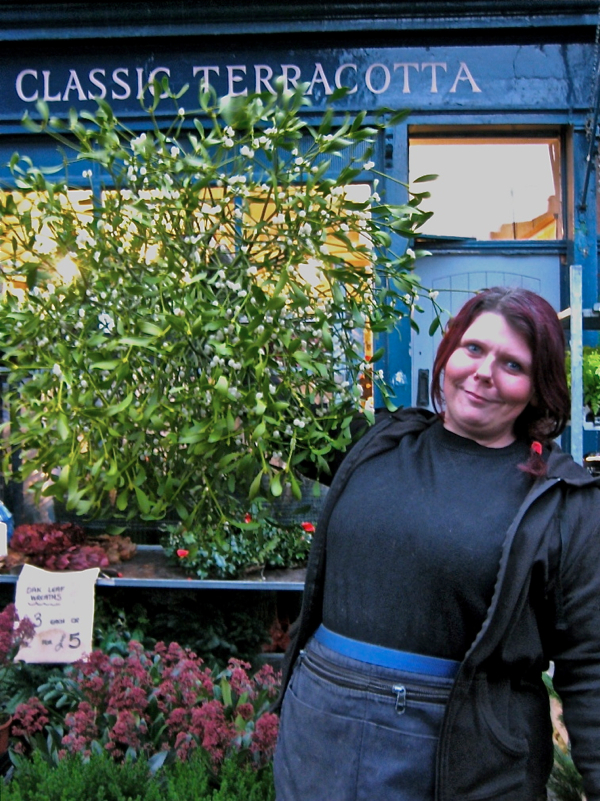
Again this week, the market was crowded before eight in the morning and the drama had intensified, not just because it was another week closer to Christmas and the rain had finally stopped, but because the mistletoe arrived. Immediately, I spotted a gruff old gentleman sidling up to the young ladies who ran the next stall, brandishing a sprig and declaring “I know a trick with mistletoe!”
After due deliberation, I bought this bough for £10 from Denise Kirstenson, the Eliza Doolittle of Columbia Rd, whose fine soprano voice rings out throughout the market each week. Some readers may wonder why I chose to buy such a huge bough of of mistletoe. The answer is simple, I like to encourage lots of kissing in my house at Christmas.
Mick Taylor, Sartorialist of Brick Lane

When I took my photograph of Mr Sammy Minzly outside the Beigel Bakery yesterday, I was delighted to see Mick Taylor sidle into the left of the picture. For months I had been hoping for the privilege of a conversation with this debonair gentleman whose striking outfits I have admired innumerable times as I have passed through Brick Lane and this was the ideal opportunity.
He explained to me the origins of his relationship with style.“When I was young in the nineteen sixties, I was blond and good looking – I was young and I didn’t know what I had, I made a few pounds and enjoyed life. When I had some money I went to Albert’s in Whitechapel and got suits, shirts and shoes – everything had class.” But Mick recognises that fashion moves ever onward, “I slung a lot of it,” he admitted, “Nowadays everyone’s dressing down. It’s a different scene.”
That day, in an unusually subdued outfit, compared to his colourful summery ones, Mick paired up a vintage sheepskin hat with a slim blue denim overcoat which followed the lean silhouette of his trim physique and had a warm fleece lining and trim to match the hat. He continued the denim of the coat with a pair of blue jeans turned up at the cuffs, and completed the look with a pair of tan leather boots that he said reminded him of those Steve McQueen wore in “The Cincinnati Kid.” Then Mick astounded me with his next action. Confiding that he treasures a memory of going on a special date with a Jewish girl to the ABC Whitechapel, now the Genesis Cinema, to see “The Cincinnati Kid” when it first came out – he took a mouth organ from his pocket and, by way of illustration, casually played the theme tune which he recalled from that day in 1965. I was overwhelmed by the charisma of the man who is Brick Lane’s top style icon.
“What you wear, and how you wear it, is the most important thing” he declared to me. And, in confirmation of this absolute belief, Mick revealed that he bought his coat for three pounds in the market and found both the jeans and boots that make up his outfit on the street. Through all his many changing outfits of the year, Mick is living proof that style is not about money, it is entirely about ingenuity and imagination. In this particular outfit, I admired his choice of the restricted palette of blue denim and soft browns that complemented his natural colouring – the denim emphasising his piercing blue eyes and the brown fleece picking up the blond hairs in his beard to create a distinctively mellow look.
Although he lives in Whitechapel, for over fifty years Mick has been hanging around at the top of Brick Lane, becoming a connoisseur of – and star player in – the street life that he loves so much. You will find him there between the Beigel Bakery and Brick Lane Coffee most days until around three when he returns home to Whitechapel. I think I noticed Mick at first, not because of his clothes but because of his stance, since Mick stands in Brick Lane as if he owns it, which in a sense he does. With Mick, as with all true icons, it is not ultimately about the clothes, it is about the attitude. Blessed with a natural dignity, Mick has got soul too. Over all this time, he has been observing street fashion with a critical and perceptive eye, long before the Hoxton boys arrived in their skinny jeans and ironic hats. He has seen it all pass by down Brick Lane.
Mick says, “I am Cockney boy born in Hackney within the sound of Bow bells”. Speaking of the old East End, Mick Taylor told me he had seen the gangs, fights, murders and stabbings in the street. “You don’t see it no more, it’s better now without a doubt. No more gangs, no more violence”, he concluded with a thoughtful smile.
Mr Sammy's beigel shop in Brick Lane

The man in the blue v-neck sweater is Sammy Minzly, known affectionately in the neighbourhood as Mr Sammy. He is the presiding spirit of the most famous beigel bakery in the land, situated (as if you needed to be told) at the top of Brick Lane. Any visitor to London only has to ask a cab driver to take them to “the beigel shop” and they will find themselves delivered here to 159 Brick Lane, where the bakery is open twenty-four hours a day, seven days a week – and everyone is welcome.
If you go out for a big night and only have a few coins left, what can you do? If you go out on a hot date and get dumped in the rain, what can you do? If all your shoes have got holes and your feet are soaking, what can you do? If you are hung over in the morning and you have not even been to bed yet, what can you do? The answer to all these questions is the same. You know you can go to Mr Sammy’s shop and get a beigel for 20p and guarantee that you will feel better at once.
This establishment is a place of unceasing drama where, at any time of the day and night, there is a constant stream of all kinds of people lining up to create an egalitarian mix that I shall probably not come across anywhere else this side of the pearly gates. Here in Brick Lane they are lining up for beigels to satisfy their appetite and restore their spirits. Stepping in from the cold into the warm vaporous atmosphere, you find yourself one among the expectant congregation shuffling forward towards the counter where two large-hearted ladies are distributing consolation in the form of beigels with different fillings. The question now is, of which denomination are you? Salt beef? Smoked salmon and cream cheese? Egg? Or maybe you are of a puritanical disposition and like your beigel plain?
As you advance along the snaking line, you come round to view the spectacle of the open kitchen where the bakers are at work and the salty bittersweet fragrance of dough fills your lungs. I interrupted Mr Sammy here, just as he had finished shelling a hundred eggs, and we stood among the impressive steel machines for mixing up the dough to have a quick chat as the other bakers continued their work. While we were talking he began cutting beigel-sized pieces off a vast pile of dough. There is an inescapable sense of imperative here because as soon as one batch of beigels go on sale in the shop, another is going into the oven, and so it goes on for eternity. Mr Sammy makes sure there are always enough fresh beigels and no-one is ever disappointed.
A dignified unassuming man with the eyes of a poet, Mr Sammy has been working here since 1976 and is one of the three joint proprietors of the shop with the two Cohen brothers, who took over from the Liebermans fifty-five years ago. All three are bakers and it is their conscientious approach and years of experience that account for the quality of the beigels here, that are unsurpassed on this side of the Atlantic Ocean. Mr Sammy is usually around in the shop, though technically he only works two all-night shifts, Wednesday and Saturday.
“We use the old system, boiling the beigels, before we bake them” explains Mr Sammy pointing to a vat of cloudy hot water. It is this slower process that creates the distinctive chewiness though few bakers do it anymore because they want to create their beigels fast. Mr Sammy uses a recipe that his forefathers brought from Poland, but it is not simply a case of following the recipe, “it is how you work the recipe and how you treat the dough” qualifies Mr Sammy, revealing his professional baker’s sensibility.
When I ask him how he finds the work, he halts and casts his eyes proudly around the crowds in the shop waiting for beigels, “It’s like a club for me, I see all kinds of nationalities here. It’s the hot spot!” he declares. Then, as an example, he tells me how the Japanese love his smoked salmon and cream cheese beigels, and he follows this with the disclosure that the beigel shop is also a celebrity haunt – running his mind through the long roll call of glitterati that have eaten his beigels, he chooses Henry Winkler, the Fonz, as his personal favourite.
A hundred years ago, this was the Jewish neighbourhood and now the beigel shop is the only vestige of that entire world. But every beigel baked here today by Mr Sammy serves as a living reminder of the journey that so many thousands took from Poland (and all of Eastern Europe) to Brick Lane, and from here over successive generations out into the wider world.

Gavin Cornwell, A Haircut At The Morgue

If you go down to the morgue today you are sure of a big surprise, because now you can get a haircut there from Gavin Cornwell.
My last haircut was done on the morning before I wrote my first daily post to you, more than a hundred days ago in August. Over recent weeks, I have taken to wearing my sheepskin hat, not just because of the cold weather but to conceal the straggly mop underneath. So last week, I pointed my nose northwards and walked from Spitalfields up the Kingsland Rd to Stoke Newington to visit Gavin the hairdresser who lives in a morgue.
At end of a quiet street of well-kept nineteenth century terraces is an unassuming building that you could walk past without noticing, if you did not know. It has a large chocolate-brown rolling door with signs that say GARAGE IN USE 24 HOURS and more stridently VEHICLES OBSTRUCTING THIS GARAGE WILL BE REPORTED TO THE POLICE AND MAY BE TOWED AWAY. You might assume this is merely a garage but in fact this is the morgue where you can get a haircut.
For over ten years now, Gavin has been trimming my hair regularly. I first met him when I worked in Clerkenwell. I used to rent a tiny office at the top of an old building in Clerkenwell Close where I went every day to write. One summer’s day, as I was walking down Exmouth Market to buy my lunch, I noticed a bowl of water set upon the pavement for dogs. The next thing I saw was the head of a string mop making its way towards the dish for a drink, like some strange Dougal dog. Like a marionette, it was moving by means of a line attached to a stick and at the other end was a skinny guy almost apoplectic with laughter. This was Gavin.
Exmouth Market was enjoying a moment then as the most fashionable street around. As Carnaby St was to the nineteen sixties, Exmouth Market was to London in the mid-nineties, and it was a few charismatic individuals like Gavin (who had a salon there at the time) that brought this about. Before I met him, getting my hair done was an experience comparable to visiting the dentist or the bank manager, but having my hair cut by Gavin has been one of unrivalled hilarity. Each time I sit down in his chair, an hour of carefree good-humoured banter passes quickly and at the end I discover my hair has been cut.
But I have not yet disclosed the reason I keep coming back to him. The first time he cut my hair something extraordinary happened, as I walked away down the street, someone said to me “Nice haircut!”. It had never happened before in my life. At that time, I was working a lot in New York and there complete strangers came up to me all the time to compliment the haircut and ask who did it. It was ridiculous but it was wonderful too.
Please understand that these are modest haircuts, not show-off hairdos, though I guess he could do that too if you asked. What I particularly like is that when Gavin cuts my hair, it never looks like it has just been cut, there are no harsh edges to give the game way. Best of all, the cuts get better as they grow out, so there is none of that “just walked out of the salon” phenomenon that looks like a wreck two weeks later.
When he cut my hair last week, I tried to discover why he is so good. He explained to me that he does what he calls “classic” haircuts that he learnt at the Vidal Sassoon School of Hair Dressing where he trained after he ran away from Kent to London as lad. As a rising star there, he was responsible for cutting the hair of celebrities like Kim Wilde and Dale Winton in the West End salon. I think it was a relief for him to move East and do haircuts for indie types like Adam Cornish and Louis Theroux.
Gavin’s approach is to respond to the quality, texture and form of your hair, and he cuts it to enhance the natural growth. I regret to disappoint you with the news that he does not do highlights, colouring or perms, he works with what you have. He cuts both women’s and men’s hair, and while for women the styles are diverse, for men his inspirations are Steve McQueen and Jean Paul Belmondo.
As for the morgue, there is nothing there you would recognise from “Six Feet Under”, it is now a happy family home where it is my delight to go and get my hair cut in peace and quiet with no fuss. If you ask him nicely, I am sure Gavin could be persuaded to cut your hair too and you can discover the magic for yourself. He can be reached on 07984 636678 or gavincornwell@blueyonder.co.uk













