Rochelle Cole, Poulterer

It never crossed my mind that being a poulterer might be a glamorous profession until I met Rochelle Cole at Liverpool St Chickens in Leyden St. When Rochelle bounced into her shop from the rain outside (wearing wellingtons and a flat cap at a jaunty angle), she appeared through the chain link curtain to greet me with a confident smile. Taking me in with a single glance of her huge eyes, as she pulled the cap from her head allowing her dark flowing locks to fall in a cascade around her shoulders, I was completely mesmerised. Rochelle has presence, she is the top bird at Liverpool St Chickens and a fourth generation poulterer too.
I was grateful for the excuse to walk over and explore the web of little streets where the Petticoat Lane Market happens on Sunday. This is the hidden, more utilitarian side of Spitalfields where I commonly go to admire the African shops with their colourful displays of Batik fabrics, when I am taking a shortcut down towards London Bridge. My instinct is that these streets are among the oldest parts of Spitalfields but they do not declare their history readily in the way that the silk merchants’ houses do on the other side of the market.
I was fascinated to learn that it was Rochelle’s great-grandmother Janie Cohen who established the poulterer’s around 1890. An exceptional undertaking for a woman at that time, an exceptional undertaking for any woman that had six children at any time. On her death in 1920, the business passed to her two sons Isaac and Sydney who adopted the name Cole. They passed it to Rochelle’s father Joe Cole and, after Joe died, Rochelle took sole responsibility two years ago. Coles have always bought their bags from Gardners, the paper bag sellers in Spitalfields and Paul Gardner remembers Joe Cole paying with banknotes stained in chicken blood with feathers attached.
As a child, Rochelle often came to the shop with her dad Joe, “My memory of coming to the East End is sleeping all the way in the car and when we arrived I’d wake to ‘cock-a-doodle-do!’ The shop was like a farm, you’d be surrounded by chickens and it stank to high heaven! When I was a little girl, I used to come in and stroke a chicken and then my dad would pick it up and slaughter it in front of me. Once I was eight or nine, he’d say ‘You go and get one’ and then I held the chicken for him to kill it. In our house we only ate chicken, it was – eat chicken or starve. After that I went vegetarian for seven years.” Considering Rochelle’s emotional disclosure, I began to wonder how it was she had come to embrace her profession in the way she has now.
In the 1890s, Cohens was one of many kosher butchers among a plethora of Jewish food stores in the heart of the East End ghetto. Those original customers bought the hard chicken (Cohen’s/Cole’s speciality) to make chicken soup. As the Jewish people moved out, Muslims arrived to buy halal chicken, often taking the chickens alive to bless them at home. Today, Rochelle has many African customers who prefer the hard chickens she sells that are the basis of their cuisine. Rochelle told me the African clientele love chickens’ feet, “‘Can we have extra feet for the children?’ they ask.” she said. It is curious how this humblest of chicken, the boiler, bred primarily to lay eggs, has been adopted by different cultures in the same location through different times. A trick of fate that has ensured the survival of Coles’ poulterers when all the other Jewish food stores that once defined these particular streets have long gone.
“They couldn’t wait to leave,” said Rochelle, commenting on the exodus of people who wanted to escape the poverty and struggle that the place characterised for them. Indeed, Rochelle’s mother never wanted to come from the family home in North London to visit and, two years after Joe’s death, she consented to the sale of the original premises (at the junction of Cobb St and Leyden St) fifty yards down the road from the current shop. This was the catalyst for Rochelle’s change of heart. “I said, ‘You cannot close this business.’ I was the only one who was passionate. I couldn’t let the family business die. We had customers who been coming for forty or fifty years. My father had a horrible time when the animal rights protestors came on the scene. We had death threats! It contributed to his early death at sixty-one.” And so, like the loving daughter that she is, Rochelle started up the business again in these new premises driven by her mission to keep alive her family’s enterprise for another generation. Rochelle recognised that if her great-grandmother, Janie, could it in 1890 with six children, she could do it now.
“It was a big struggle to get the new shop up and running”, Rochelle declared, getting emotional again describing an experience her great-grandmother would recognise. Only this time Rochelle’s emotion was triumphant because all the loyal customers followed her to her shiny yellow shop where she sells fresh chicken six days a week (closed Saturdays and Yom Kippur). Now Rochelle is positively glowing with pride at the thriving poulterer’s business and her only regret is that she has no old photos to tell the story – just the painting you see below. But after our conversation, I had the feeling that I had encountered in Rochelle the living spirit of Janie, that bold woman who started out on her own in 1890.
Gary Arber, printer
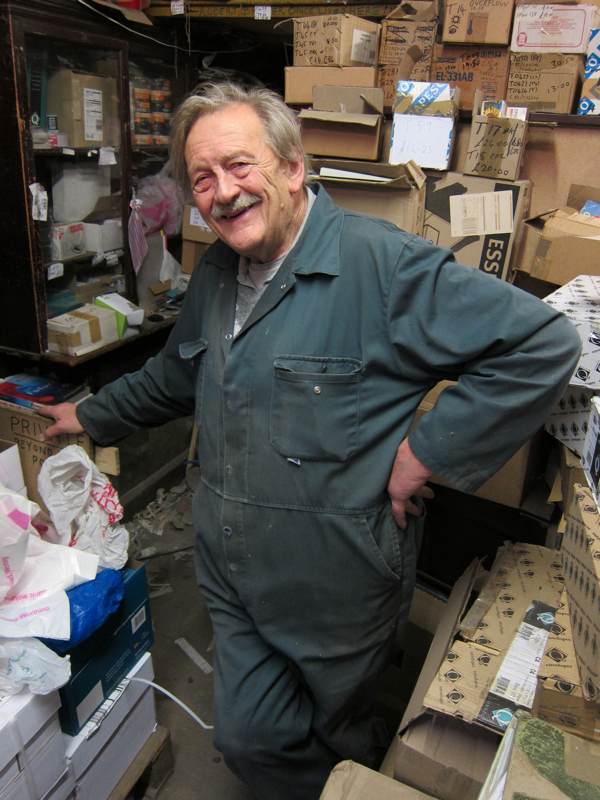
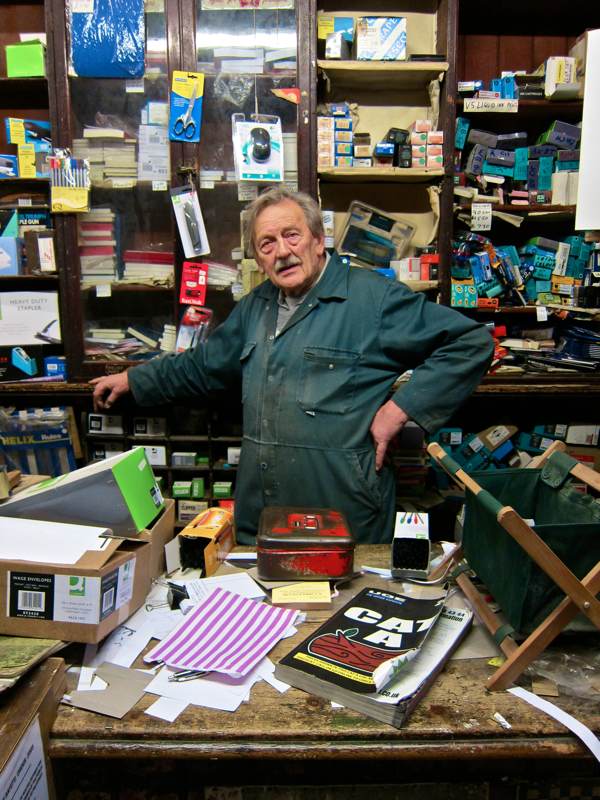
On Monday morning, I set out early from Spitalfields, crossing the freshly fallen snow in Weavers’ Fields, and walking due East until I came to the premises of Arber & Co Ltd at 459 Roman Rd. Once I rang the bell, Gary Arber appeared from the warren of boxes inside, explaining that he did not have much time because he had to do his accounts. So, without delay, I took the photo above and Gary told to me that his grandfather Walter Francis Arber first opened the shop in 1897, as a printer and stationer that also sold toys. The business was continued by Gary’s father who was also called Walter Francis Arber and it is this name that remains on the stationery today.
“I’m here under duress because I’m an airman,” said Gary, explaining that he took over the business, sacrificing his career as a pilot flying Lincoln Bombers when his father died, because his mother relied upon the income of the printing works. “I left the beautiful Air Force forever in 1954,” he revealed wistfully. It is not hard to envisage Gary as a handsome flying ace, he has that charismatically nonchalant professionalism. You can see it in the picture above, Gary retains the Air Force moustache over half a century later, so you only have to imagine a flight suit in place of the overall to complete the picture. There is no doubt Gary saw life before he swapped the flight suit for an overall and vanished into the print shop. He was there at Christmas Island in 1946 to witness one of the first nuclear tests (see it here), though thankfully Gary was not one of those pilots who flew through the dust cloud to collect samples. “We were guests of the day, watching from a boat, we had bits of dark glass and they told us to shut our eyes when the countdown reached two and open our eyes to look through the glass when it reached minus five – but you saw it through your eyelids. Then you felt the shock, the turbulence and the heat. It was great fun.” Mercifully, Gary appears to have suffered no ill-effects, still running the shop today at seventy-eight, driving daily from his home in Romford.
These days, Gary’s shop has become something of a magnet for artists who love his old-school letterpress printing but, as a sole operator, Gary now only undertakes these jobs “under pressure.” “The quality is rubbish,” he says, grabbing a pad of taxi receipts and turning one over to reveal the impress of the type, embossed into the paper – the only way he can get a clear print from the worn type now. “It should be smooth, like a baby’s bottom,” he sighs, running a single finger across the reverse of the page before tossing it back onto the pile. I was concerned upon Gary’s behalf until he disarmed me, “I don’t make any money, I’m just pottering about and enjoying myself!” he confided gleefully. Owning his premises, Gary enjoys complete security and the freedom to carry on in his own sweet way.
I heard a rumour that the Suffragettes’ handbills were printed here and Gary confirms this. “My grandmother, Emily Arber, was a friend of Mrs Pankhurst and she wouldn’t let my grandfather charge for the printing. A ferocious woman, she ruled everyone – the women, my grandmother and aunt, ran the toys’ side of the business.” And although the toys side was wrapped up long ago when Gary’s aunt (also called Emily) died, the signs remain. Lift your eyes above the suspended fluorescents and you discover there are beautifully coloured posters produced by toy manufacturers pasted to the ceiling. “If I removed those the roof would probably collapse!” quipped Gary with a grin. Then, indicating the glass-fronted cases that were used to display dolls, “All the shopfittings are a hundred years old, nothing’s been touched.” he said proudly, and pointed to an enigmatic line with scruffy ends of string hanging down, each carrying more dust than you would have thought possible, “Those bits of string had board games hanging from them once.”
Moving a stack of boxes to one side, Gary uncovered some printing samples for customers to select their preferred options. What a selection! There was a ration card from a butcher round the corner, a dance ticket for December 30th 1939 at Wilmot St School, Bethnal Green, and one for an ATS Social with the helpful text “You will be informed in the event of an air raid,” just in case you get seduced by Glenn Miller and do not hear the siren. There is a crazy humour about these things being here. I turned to confront an advert for a Chopper bicycle portraying a winsome lady with big hair, exhorting me to “Be a trendy shopper.” I turned back to Gary, “This is a shop not a museum,” he said sternly. You could have fooled me.
Aware that I was keeping Gary from his chores, I was on the brink of taking my leave, when Gary confessed that he was no longer in the mood for doing accounts. Instead he took me down to the cellar where six printers worked once. “This is where it used to happen,” he announced with bathos, as we descended the wooden staircase into a subterranean space where six oily black beasts of printing presses crouched, artfully camouflaged beneath a morass of waste paper, old boxes and packets with the occasional antique tin toy, left over from stock, to complete the mix. Here was a printing shop from a century ago, an untidy time capsule – where the twentieth century passed through like a furious whirlwind, demanding printing for the Suffragettes and printing for the Government through two World Wars, and whisking Gary away to Christmas Island to witness a nuclear explosion. And this what was what was left. I was completely overawed at the spectacle, as Gary began removing boxes to reveal more of the machines, enthusiastically explaining their different qualities, capabilities and operating systems. He pointed out the two that were used for the Suffragettes’ handbills and I stood in a moment of silent reverence to register the historical significance of these old hulks, a Wharfdale and a Golding Jobber.
Gary made a beeline for the Heidelberg, the only one that still works, and began tinkering with the type that he used to print the taxi receipt I saw earlier. This was the heart of it all. I joined him and, standing together in the quiet, we both became absorbed by the magic of the press. Gary was explaining the technical names for the parts of the printer’s pie, when an unexpected wave of emotion overcame me there in this gloomy cellar, on a cold morning in February, up to my ankles in rubbish surrounded by historic printing presses. “Will you print something for me?” I blurted out, and although he claimed he only did this “under pressure,” Gary kindly consented to my heartfelt request at once.
I need some correspondence cards and I am honoured that Gary will print them for me (in Perpetua, my favourite typeface) as a momento of his wonderful printing shop. Once we agreed on the nature of the job, another customer arrived. So I said my goodbyes, secure in the knowledge that I now have reason to go back and continue our conversation, once the proofs are ready.
I doubt very much that Gary did his accounts that day, but Gary is a sociable man with a generous spirit (even if he strikes an unconvincingly gruff posture occasionally) and if you choose to pay a visit yourself, then it is highly possible that you will learn (as I did) about the Roman sarcophagus that was discovered in the Roman Rd, or the woman who was the inspiration for the character of Eliza Doolittle in Pygmalion, or Gary’s adventures on steam trains in India, or when Gary was invited to the National Physics Laboratory in the fifties see an early computer, as big as four houses, that could play chess.
One word of caution,“Printers are either highly religious or wicked,” says Gary, adding “- and I don’t go to church!” with melodramatic irony. So if you decide to go round, be sure to pay Gary due respect by buying something, even if it is only a modest thing. Bear in mind, as you purchase your box of paperclips, that Gary is there under duress – he would rather be flying Lincoln Bombers – and then, once this subterfuge is achieved, it is appropriate to widen the nature of discourse.


This picture shows the garden at the rear of Arber’s printing works in the Roman Rd photographed in 1930. I was going to photograph the same view today but, once I saw it for myself, I decided that you would rather not know.
Dickens in Spitalfields 2, the silk warehouse

You may recall reading in last week’s opening installment of Charles Dickens’ feature “Spitalfields” published in his weekly journal “Household Words” on 5th April 1851, how he and his sub-editor W.H.Wills climbed the stair to enter a silk warehouse in Spital Sq. As soon as they had introduced themselves to the manager, another character entered the scene…
Somebody mounts the stairs, and enters the apartment with the deliberate air of a man who has nothing whatever to do, but to walk about in a beautifully brushed hat, a nicely fitting coat admirably buttoned, symmetrical boots, and a stock of amazing satin; to crush his gloves tightly between his hands, and to call on his friends, to ask them – as this gentleman asks our friend (the manager) – how he is getting on; and whether he has been down “yonder” lately (a jerk eastward of the glossy hat); and, if he hasn’t whether he means to go down next Sunday, because if he does, he (the visitor) means to go too, and will take him down in his “trap”. He then, in a parenthetical, post-scriptum sort of way, alludes to a certain “assorted Glaces, ” and indicates the pile of silks he means by the merest motion of his ring finger.
“The figure is – ? “ says he.
“Two and seven,” replies the vendor; “How many pieces shall I put aside?”
“Well- fifty. By the bye, have you heard?” – Mr Broadelle (our friend) has not heard, and the visitor proceeds to announce, from impeachably authority, that the match between Mr Crumpley of Howell’s, and Miss Lammy of Swan’s, is to come off at last: in fact, next Thursday. Cordial “good bye;” graceful elevation of the polished hat to myself; and the departure of, as Mr Broadelle informs us, one of his best customers.
“Customer?”
“Yes? You heard? He has just bought fifty pieces of silk of various or ‘assorted’ colours.”
“At two shillings and seven-pence per yard?”
“Just so. And there are eighty four yards in a piece.”
Our organs of calculation are instantly wound up, and set a-going. The result brought out when these phrenological works have run down, is, that this short, easy jaunty gossip began and ended in a transaction involving a sum of five hundred and forty-two pounds ten shillings. No haggling about the price; no puffing of quality, on one side, or deprecation of it on the other. The silks are not even looked at.
How is this?
“Our trade,” says our friend, in explanation, ” has been reduced to a system that enables us to transact business with the fewest possible words, and in the easiest possible way. The gentleman who has just left, is Messrs. Treacy and McIntyre’s silk-buyer. In like manner, the different branches of large houses are placed under the control of similar buyers. At the end of every half-year, an account is taken of the stewardship of each of these heads of department. If the Buyer have narrowly watched the public taste, and fed it successfully, – if he have been vigilant in getting early possession of the most attractive patterns, or in the pouncing on cheap markets, by taking advantage, for instance, of the embarrassments of a ‘shaky’ manufacturer or a French revolution ( for he scours the country at home and abroad in all directions), and if his department come out at the six-monthly settlement with marked profit – his salary is possibly raised. Should this success be repeated, he is usually taken into the firm as a partner.”
“But no judgement was exercised in the bargain just made. The Buyer did not even look at your goods.”
“That is the result of previous study and experience. It is the art that conceals art. He need not examine the goods. He has learnt the characteristics of our dyes to a shade, and the qualities of our fabrics to a thread.”
“Then, as to price. I suppose your friend is lounging about in other Spitalfields warehouses at this moment. Perhaps by this time he has run his firm into debt for a few thousand pounds more?”
“Very likely.”
“Well; suppose a neighbour of yours were to offer him the same sort of silks as those he has just chosen here, for less money, could he not – as no writing has passed between you – be off his bargain with you?”
” Too late. The thing is done, and cannot be undone,” answers Mr Broadelle, made a little serious by the bare notion of such a breach of faith. “Our bargain is as tight as if it had been written on parchment and attested by a dozen witnesses. His very existence as a Buyer, and mine as Manufacturer, depend upon this scrupulous performance of the contract. I shall send in the silks this afternoon. And I feel as certain of a check for the cash, at our periodical settlement, as I do of death and quarter-day.”
It is difficult to reconcile the immense amount of capital which flows through such a house as this – the rich stores of satin, velvets, lutestrings, brocades, damasks, and other silk textures, which Mr Broadelle brings to light from the quaint cupboards and drawers – with the poignant and often-repeated cry of poverty that proceeds from this quarter.
What says Mr Broadelle to it? He says this :
“Although most masters make this locality their head-quarters, and employ the neighbouring weavers, yet they nearly all have factories in the provinces: chiefly in Lancashire. The Spitalfields weaver of plain silks and velvets, therefore, keeps up a hopeless contest against machinery and cheap labour, and struggles against overwhelming odds. Will you step round and see a family engaged in this desperate encounter?”
“Is there a remedy?” we ask, as we go out together…
Let us conclude this installment with Dickens’ understated appeal to the reader’s political sympathy, knowing that next time we shall be able to accompany Dickens as he sets out ,with Mr Broadelle as his guide through the streets of Spitalfields, to learn at first hand of the living conditions of the weavers who manufactured these luxurious fabrics for the rich the enjoy. In the meantime, please do not try to trace the silk warehouse in question through the archives, because “broad ell” is a measure of cloth, Dickens invented this moniker, Mr Broadelle, for the manager of the business in his article.

Sarah Ainslie, photographer

When I met Sarah Ainslie at The Pride of Spitalfields last week, she told me she had some photographs of the market in Brick Lane that she had taken in the nineteen eighties. So two days later, my curiosity led me round to her studio in Ezra St, where she produced a box of large prints to show me. As she spread them out on the table, I was rapt by her pictures and we spent an enjoyable, absorbing hour shuffling them around to create this photo feature for you of Brick Lane in 1987-8.
This was exactly the time I first visited Spitalfields with Joshua Compston and Sarah’s pictures allowed me to recognise how fundamentally the texture of the market has altered in the intervening years. Here you see more old people than you do today and a smaller variety of people, with barely any of the fashionable young people who descend upon Brick Lane every Sunday these days. In 1987, Brick Lane was not the place to be seen that it is now.
The market portrayed here was a more insular, less structured affair with many stalls merely consisting of piles on the ground – a surreal environment in which stallholders commonly dumped what was unsold and people enjoyed scrabbled through the rubbish, seeking anything of value. Sarah told me she was fascinated by the chaos and energy of the market, and the sense of people bringing their lives out onto the street when they displayed their personal possessions for sale.
Sarah’s pictures convey a wonderfully immediate panoramic sense of the life and atmosphere of the market, but a closer inspection reveals more. Like all good photography, her photos get more interesting the longer you look. Spot the man with plastic elephant nose standing on the corner of Cheshire St, spot the lady with the bag on her head in the rain, spot the pair of disembodied legs reclining on a bench, spot the reflection of the man with the bad false teeth caught in the circular mirror. These eye-catching fractures in the surface of reality lead us to scrutinise these pictures, searching for the significance in this compelling spectacle of humanity and all the wonderful arbitrary old junk we trash, we trade and we treasure all over again in an endless cycle.
It is my great pleasure to welcome Sarah Ainslie as a contributing photographer to Spitalfields Life, Sarah will be accompanying me on some of my interviews in future and you can look forward to seeing more of her distinguished photography alongside stories here in these pages over coming months. The Spitalfields Life header for the month of February is a detail of another photograph by Sarah from this same set of pictures.


Columbia Road Market 21

As I walked up and down the market this morning in the pale sunlight, weaving my way between the trolleys of plants where the stallholders were still setting up in the sub-zero temperatures, I came upon these Irises. I recalled that Joan Rose told me, when I met her recently, that the original planting of the flower beds around the bandstand in Arnold Circus was entirely Irises in honour of the Huguenot people, some of whose descendants, including Joan herself, lived there. Apparently, blue was the colour of the Huguenot cross, composed of a four-petalled Iris, a symbol created in 1688. In Joan’s childhood, there was a gardener who took care of the gardens of St Leonard’s church, that were outstanding for their quality of cultivation. He also tended the Irises at Arnold Circus which Joan told me were sublime when they were all in bloom and the entire park turned blue.
The life of Mr Pussy

Every night, Mr Pussy sleeps at my feet just like those dogs you see curled up at the feet of effigies on medieval tombs. There is a sheepskin, strategically placed across the corner of the bed and this is his rightful place. Sometimes, when I roll over in the night, my feet meet the reassuring resistance of a solid lump and I know it is Mr Pussy. At first light, he wakes, climbs down and then strolls along to the head of the bed, full of the joy of morning, and miaows in my face. Commonly, I open my eyes to confront him eyeballing me and then I turn my back on him, rolling over to sleep further because this may be five in the morning. Mr Pussy is full of optimisim and delight at the new day and cannot understand my reluctance.
Mr Pussy’s disappointed response will be to scratch half-heartedly for a little upon the side of the bed to encourage me to rise. Once this avenue is exhausted, he leaps in one bound onto the oak chest of draws, where I place my watch and rings at night. The thunderous plonk as Mr Pussy lands upon the chest of drawers always stirs me from my slumbers because I know what comes next. A little tinkling, a little scraping and a little scratching, as Mr Pussy manoeuvres my possessions to the edge of the chest of drawers in preparation for knocking them onto the floor. As I lie there in a half-slumber, I am trying to remember if I left my phone on the chest of drawers or not. So I roll over in bed, sitting up, and our eyes meet as Mr Pussy looks down at me accusingly, because he expects better than this sleepy-headed disinterest. Mr Pussy wants me to get up. “Pussy!” I yell in a melodramatically over-reactive tone, throwing back the covers as if I am about to rise. Mr Pussy jumps down and runs from the room, eager to be the first into the bathroom – but I am too smart for him, I pull back the covers and return to sleep. It works every time.
I know what Mr Pussy wants, because sometimes I play along if the fancy takes me. Mr Pussy wants me to rise when he does, so he can follow me into the bathroom to lick the pools of water in the shower, then return to the bedroom to observe me dressing. Once this is complete, he runs to the head of the stairs and pauses, preparing for the moment of triumph when we run downstairs together to embrace the glorious day. If Mr Pussy’s desired scenario does not to take place then he skulks off out of the house in frustration, as happened the other morning when I woke to a frenzied screaming in the back yard. Mr Pussy was halfway up a tall willow with his hackles up, snarling, eyes popping and generally letting rip like a wild predatory beast. At the top of the tree was a young brown cat clinging onto mere twigs. Mr Pussy had pursued this poor creature that had invaded his territory until it had nowhere left to run, just like those fearsome pirates of old who made their adversaries walk the plank.
There is no doubt Mr Pussy has his dark side. The pet shop owner who sold him to me in Mile End years ago told me that he had been rescued as part of a litter from an East End street. I took the cat, who was the size of my hand then, to Devon on the train that night. My notion was that a kitten would be a consolation to my mother, who was recently bereaved, but he caused havoc, running around the house screaming and smashing things. Even the neighbours complained, asking her to keep her cat quiet. Although, at first, he was not quite the joy I had anticipated, I told myself that a cat problem was preferable to a bereavement problem. It was an exorcism, and sure enough, over his first year, he settled down under her placid influence.
I knew my mother wanted a female cat and when I entered the shop, one kitten ran up to me. I realised, in a moment of mutual recognition, that this was the one. The owner assured me this was a female. My mother named the kitten Rosemary and it was only after a year, when we sent the cat to be neutered, that the plain facts were revealed. I broke the news to my mother, “Pussy is a boy.” Immediately she responded,“That’s why he is so bossy!” with characteristic insight. This was when he first acquired the name Mr Pussy, indicative of his early gender confusion. He was never Rosemary again, except very occasionally when we chose to tease him and Mr Pussy responded with filthy looks that could make Silvio Berlusconi look clean.
Now, years later, my mother is gone and Mr Pussy has made Spitalfields his home. When I leant out of the window last week to confront Mr Pussy in the tree here, I only had to yell “Pussy!” and a transformation came upon him. The wild beast vanished to be replaced by my domestic cat once more. Mr Pussy came running back into the house and we performed the morning ritual just as he likes it. I respect Mr Pussy for being his own creature and as long as we can maintain the pretence of a pet and owner relationship, I am prepared to accept his animal instinct that is wild at heart.

Harvey Cabaniss, Verde & Co

If you go round to Verde & Co, the delicatessen at 40 Brushfield St on any given Friday morning at ten, you will discover Harvey Cabaniss, the head chef and proprietor, serving the eminent Edith Randall, his most favoured and loyal customer who gets special service. “You mustn’t tell everyone about the special service” said Edith, regal in her velvet hat, when I stumbled upon the Friday ritual last week, “otherwise I’ll have rivals and that will be no good at all.” Fortunately, I know I can rely upon my readers’ discretion to maintain this best kept secret in Spitalfields – of the special service at Verde & Co – because I have no doubt it could also be arranged for you too, if you ask Harvey nicely and avoid ten on Friday mornings.
What is the nature of the “special service” that has kept Edith Randall coming back, walking in all weathers from her home in the Barbican to buy her weekly supplies here every Friday at ten, since Verdes opened a few years ago? Emerging with the immaculate brio and theatrical timing of a stage conjurer, in one step Harvey appeared from the kitchen and held up a rabbit in triumph, the only difference being this rabbit was skinned and ready for the pot. Overawed at the prospect of this delicious leporine specimen, Edith clasped her hands in delight, but this was merely the overture to the performance. Harvey vanished into the kitchen again and returned with a sirloin steak, then an ox tail, delivering up a fresh box of John Dorys as his grand finale. It was an embarrassment of edible riches and with each option I could feel the rising excitement as Edith Randall rubbed her hands together in hungry anticipation of the culinary treats that the coming week held for her.
Very soon, Harvey had the pieces of meat and fish lined up neatly on the counter in boxes, supplemented by some salad, mince pies and quiches from the Sally Clarke’s famous bakery in Kensington Church St. For Edith Randall, next week’s menu was taken care of. “I’ll weigh the empty box first this week,” said Harvey catching Edith’s eye with a knowing grin. “Harvey always weighs the empty box first so he knows how much a box weighs,” said Edith inexplicably, “Sometimes, I get home and it puzzles me why there is a box with nothing in it, until I realise it is the empty box!” Clearly, this is one of those rare private jokes that can run and run, accumulating greater humorous import with further repetitions.
I think we have established that Edith Randall is a female of descriminating tastes but what I have not revealed is that she is Canadian, not that these things are mutually exclusive, though it is Edith’s prerogative to disagree. “I came here from Canada in 1951 to escape from the lack of culture, I had to get out and I just simply loved it, because I had a desire to be in Europe. Even though, in 1951 everyone was going the other way and it was pretty grim here with rationing, bomb sites and flowers growing on the ruins around St Paul’s.” A graduate of the University of Canada with a passion for European literature, Edith Randall never looked back, she is at the opera almost nightly and scrupulous in keeping up with the latest exhibitions. “I killed the Turner yesterday,” Edith declared in a throwaway that is distinctly North American in its laconic irony.
It is no surprise that Edith and Harvey have become soulmates in a formal, highly respectful, mutually amused kind of way, because Harvey too is a refugee from the former colonies. Coming here and washing the dishes for Fergus Henderson at his first restaurant “The French House Dining Rooms”, Harvey quickly graduated to be a chef, working with Fergus for six years before becoming head chef for the top notch catering operation run by the Caprice group. The surprising part of Harvey’s story is that he is of Huguenot origin, his ancestor Henri Cabiniss passed through here from France in 1695 before leaving for North Carolina. After three centuries, Harvey feels he has come home now.
When Jeanette Winterson bought the building in Brushfield St and renovated it, she wanted to lease the shop to a grocer and Harvey took it on. Retaining all the charm of the quaint old premises, enhanced with a fine display of antique china, Staffordshire figures, toy theatres and nineteenth century clocks, Harvey has stocked it to the roof with his favourite foods.“The best things you can buy in London,” he terms it simply. Sometimes, I have noticed that oranges are the only fruit on sale here and I always wondered if this was a subtle joke at the landlady’s expense, but I was too shy to ask.
Just like the planets in the heavens, Harvey is in a constant state of motion. Even as I took the photo above, I was aware that he was poised, about to run off to the next task. A tall man with agile grace and a powerful physical presence, who lifts his head up to look you in the eye, I should not have been surprised if, like Nijinsky, Harvey was capable of spectacular leaps, though maybe this would not be especially practical or entirely advisable in such a tiny shop crammed with pots of jam stacked up and valuable antiques.