Hullabaloo at the Thrift Store

One Saturday morning recently, I was walking down Brick Lane when I saw a long line of hundreds of excited young people that stretched the entire length of Sclater St. When the Thrift Store decided to post an invitation to their jumble sale on facebook, they never dreamed that over two and a half thousand people would arrive, many coming from as far away as Oxfordshire and Cambridgeshire. At opening time there was already a queue of four hundred people waiting outside but during the morning it grew and grew, until the line reached all the way round the corner into Brick Lane. You have to admit it was a good deal, for £10 you could fill a small bag with as many clothes as you pleased or for £20 you could fill a big bag.
There are so many reasons to love thrifting but I had no idea the culture of secondhand was this huge – until I saw the line of enthusiasts in Sclater St, all dressed in their diverse individual styles created from vintage. Spitalfields is now the capital of this culture and thousands of eager people come every weekend from all over, to trawl through the different thrift stores side by side on Brick Lane, Cheshire St and Sclater St. Taking the occasional break for coffee or lunch, and meeting up with friends along the way, it is a pleasant day’s occupation. I see them parade back to Liverpool St clutching their bags triumphantly at the end of the afternoon.
Quite simply, vintage clothes have brought the fun and creativity back to fashion because they are cheap and every item is unique. With tantalising ambiguity, these clothes manage to be both democratic and exclusive simultaneously, permitting everyone to create a distinctive look, expressive of their personal identity, that no-one else has or can have. And the alterations that are often required invite the purchaser to restyle the garments, using second-hand to become fashion-forward. Another attraction is that old clothes often display higher quality workmanship and are manufactured from better fabric than many new clothes.
I love the poetry of old clothes that carry their history, of design, of manufacture, of the previous owner, and of other times and other worlds. There is a fascinating dynamic present when a younger generation take on the garments of a previous generation, subtling adjusting them to the suit the requirements and expectations of contemporary life. We wear them differently. In their form and structure, these clothes connect the wearer to the social custom of the past while revealing how the world has changed too.
For those politically aware fashionistas, wearing secondhand clothes is an ethical statement in itself, and one of the best kinds of recycling, providing the easiest path to the moral high ground that I know. Because you are conserving the resources that would be used to make new clothes and also dissociating yourself from the exploitative labour practices of the High St stores. Imagine, all this integrity that can be acquired just by purchasing some old rag!
Each month, the East End Thrift Store holds a lively shopping party with a free bar at their vast warehouse in Whitechapel. Once I heard about it, I realised this was an opportunity too good to be missed. So last week, photographer Sarah Ainslie and I went along to investigate. We hoped to photograph some extravagant wild flowers to show you, but instead of a bunch of secondhand roses, we discovered these raging beauties…

Poppy is thinking about whether to buy this silver hat for £10.

Duke knows how to look good in primary coloured sweaters.

This is Nimi and Tina, showing off the snazzy red dress she discovered for £15.

This is Jen, triumphant with the classic shirtdress she found for £30.

This is Rafal who knows instinctively how to carry off a cape.
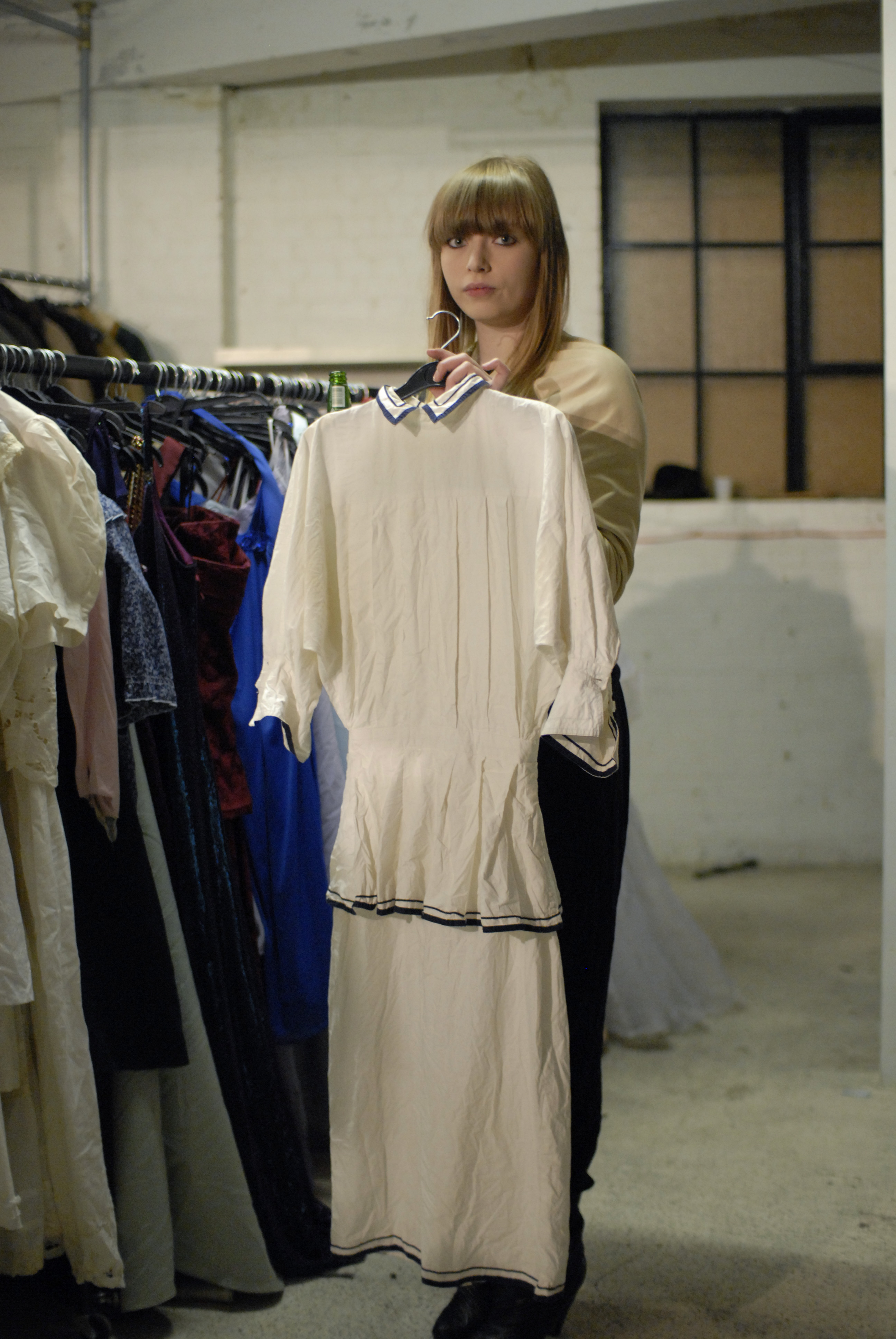
This is Nina delighted with the nautical-themed shiftdress she will wear all summer long.

This is Paula and Ainara who are going to share this jacket.

This is Robson, an artist and curator, looking for an outfit for the opening of his show on Thursday.

Emma is deliberating between a red dress and this one in deep turquoise for £30.

Max has just moved to London from Weymouth and is considering investing in a leather jacket, maybe.
All pictures copyright © Sarah Ainslie
Nina Bawden, novelist

In recent years, a recurring highlight in my existence has been the opportunity to walk from Spitalfields through Hoxton and along the canal path up to Islington to enjoy a light lunch with the sublimely elegant novelist Nina Bawden, who lives in an old terrace backing onto the canal and whom I consider it a great honour to count as my friend. I first met Nina when I took my copy of “Carrie’s War” along to a bookshop and queued up with all the hundreds of other children to have it signed by the famous author. She appeared to my child’s eyes as the incarnation of adult grace and authoritative literary intellect, and it is an opinion that I have had no reason to qualify, except to say that my estimation of Nina has grown as I have come to know her.
Years after that book signing, Kaye Webb, Nina’s editor who had encouraged my own nascent efforts at writing, rang me up at six-thirty one evening to say she had just remembered Nina and her husband Austen Kark were coming to dinner that very night and she had nothing to give them. At this time Kaye was over eighty and housebound, so I sprinted through the supermarket to arrive breathless at Kaye’s flat beside the canal in Little Venice by seven-thirty – and when Nina and Austen arrived at eight, dinner was in the oven.
They were an impressive couple, Austen (who was Head of the BBC World Service) handsome in a well-tailored suit and Nina, a classically beautiful woman, stylish in a Jean Muir dress. I regret that I cannot recall more of the evening, but I was working so hard to conceal my anxiety over the hasty cuisine that I was completely overawed. Naturally, in such sympathetic company, it all passed off smoothly and I only revealed the whole truth to Nina last year when Valerie Grove was writing her biography of Kaye Webb, “So Much to Tell,” to be published by Penguin in May.
Given the background to our friendship, it has been my great delight to get to know Nina a little better since we became “neighbours” on this side of London and I was thrilled when she consented to my writing this pen portrait, celebrating the occasion of her recent nomination for the Lost Booker Prize of 1971 for her novel “The Birds on the Trees” which has just been republished by Virago. When a journalist from The Times rang Nina to ask what “The Birds on the Trees” was about, Nina pulled a copy from her shelves, where it had sat since 1971, crowded among all her other works in her peaceful study at the back of the house overlooking the garden, and read it to find out. “You do learn as you go on,” admitted Nina to me, “so I expected bad bits but I wasn’t displeased as I expected.” Adding rhetorically, “Who was it who said,’We write novels so we have something to read when we are old?'”
Born in East London in 1925, Nina was evacuated during the blitz and then became amongst the first of her post-war generation to go up to Oxford. At Somerville College, she had the temerity to attempt to persuade fellow undergraduate Margaret Thatcher (Margaret Roberts as she was then) to join the Labour Party, that enshrined the spirit of egalitarianism which defined those years. Even then, young Margaret displayed the hard-nosed pragmatism that was her trademark, declaring that she joined the Conservatives because they were less fashionable and consequently, with less competition, she would have a better chance of making it into parliament.
The catalogue of Nina’s literary achievement, which stretches from the early fifties into the new century, consists of over forty novels, twenty-three for adults and nineteen for children. A canon that is almost unparalleled among her contemporaries and that, in its phenomenal social range and variety, can be read as an account of the transformation brought about by the idealistic post-war culture of the Welfare State, and of its short-comings too.
Nina met Austen, the love of her life, by chance on the top of a bus in 1953 when they were both in their twenties and married to other people. They both divorced to remarry, finding happiness together in a marriage that lasted until Austen’s death in 2002. At first,they created a family home in Chertsey, moving in 1979 to Nina’s current home in Islington, when it was still an unfashionable place to live. Although her terrace is now considered rather grand (Boris Johnson lives a stone’s throw away), Nina told me she understood they were originally built for the servants and mistresses of those who lived on the better side of Islington.
Nina is someone who instinctively knows how to live, and through her persistent application to the art of writing novels and in her family life with Austen and their children, she won great happiness and fulfillment. I know this because I sense it in her bright spirit and powerfully magnanimity, but equally I know that her life has been touched with grief and tragedy in ways that give her innate warmth and generosity an exceptional poignancy. When Nina reread “The Birds on the Trees”, she discovered it had been inspired by the suicide of her son Nicky, “When bad things happen, you absorb them into yourself and make use of them in novels.” she said soberly, “In the case of Austen, I had a fight with the railways.”
On 1oth May 2002, Nina and Austen boarded a train at Kings Cross to got to Cambridge for a friend’s birthday party. They never arrived. The train derailed at over one hundred miles an hour and Nina’s carriage detached itself, rolling perpendicular to the direction of travel and entering Potters Bar station to straddle the platforms horizontally. Austen was killed instantly and Nina was cut from the wreckage at the point of death, with every bone in her body broken. In total, seven people died and seventy were injured that day.
After multiple surgeries and, defying the predictions of her doctors, Nina stood up again through sheer willpower, walked again and returned to live in the home that she had shared with Austen. In grief at the loss of Austen and no longer with his emotional support, Nina found herself exposed in a brutally politicised new world, “I suppose I am lucky to have lived so long believing that most men are for the most part honourable. And lucky to have taken a profession in which owning up and telling the truth is rarely a financial disadvantage” she wrote. Nothing in her experience prepared her for the corporate executives of the privatised rail companies who refused to admit liability or even apologise in case their share price went down. It was apparent at once that the crash was caused by poorly maintained points as the maintenance company had cut corners to increase profitability at the expense of safety, but they denied it to the end.
Refused legal aid by a government who for their own reasons deemed the case of the survivors seeking to establish liability as “not in the public interest”, it was only when Nina stepped forward to lead the fight herself, setting out to take the rail companies to the High Court personally, that they finally admitted liability. If Nina had lost her case, she risked forfeiting her home to pay legal costs. But after losing so much, inspired by her love for Austen, Nina was determined to see it through and, in doing so, she won compensation for all the survivors.
You can read Nina’s own account of this experience in “Dear Austen”, a series of letters that she wrote to her dead husband to explain what happened. “When we bought tickets for this railway journey we had expected a safe arrival, not an earthquake smashing lives into pieces,” wrote Nina to Austen,“I dislike the word ‘victim’. I dislike being told that I ‘lost’ my husband – as if I had idly abandoned you by the side of the railway track like a pair of unwanted old shoes. You were killed. I didn’t lose you. And I am not a victim, I am an angry survivor.”
Sometimes extraordinary events can reveal extraordinary qualities in human beings and Nina Bawden has proved herself to be an extraordinary woman, remarkable not only as a top class novelist, but also as a woman with moral courage who risked everything to stand up for justice. It is one thing to write as a humanitarian but is another to fight for your beliefs when you are at your most vulnerable – this was the moment when Nina transformed from writer to protagonist, and became a heroine in the process. Nina may not look like an obvious heroine because she is so fragile and retiring, but her strength is on the inside.
Whenever I visit Nina, my sanity is restored. I walk home to Spitalfields along the canal and the world feels a richer place as I carry the aura of her gentle presence with me. Concluding our conversation in the study last week, before we went downstairs to enjoy our lunch, Nina smiled radiantly and said, ” I’ve decided to get on with my novel…” in a line that sounded like a defiant challenge to the universe.

Hugo Glendinning, photographer

This is the unforgettable moment when the rock chicks of the Speed Angels (the world’s first trans-sexual pop group) took Spitalfields by storm, caught on film by photographer Hugo Glendinning who lived at 27 Fournier St when he took this picture. For nearly twenty-five years, Henry Barlow, the owner of this magnificent eighteenth century house, let it out to a lucky group of young actors and artists at rents they could afford, until it was sold this year. When Hugo arrived in 1989, he was just three years into his career but by the time he moved out in 2002, after more than a decade of ceaselessly inventive and stylish photography, he had achieved a reputation as one of the most distinguished and prolific photographers in the sphere of theatre and dance.
All the photographs shown here were taken by Hugo using 27 Fournier St as his location. And the location fees for these shoots covered the electricity and gas bills for years – even though it is a large old house and expensive to heat. So in return for accepting the occasional invasion by trans-sexual rock chicks and other extravagant glamorous personalities, the residents of 27 Fournier St were able to remain warm all winter. Speaking as someone who collects broken pallets in the street to chop up for firewood, this sounds like a very good deal to me.
Each of these superlative pictures were commissions for major publications, work that Hugo undertook in addition to his performing arts photography. When I met with Hugo in his studio last week, we thought it would be amusing to show you these photographs because collectively they tell a different story from their original intention. Many people have speculated about the stories that this sedate old house could tell but I do not think anyone ever imagined the scenarios pictured here.
Even though these photo shoots were undertaken years apart, I cannot resist imagining them all happening simultaneously, as some kind of phantasmagoric party at 27 Fournier St. They propose a bizarre game of consequences in which the Speed Angels encounter Patrick Stewart, better known as Jean-Luc Picard, the Captain of the Star Ship Enterprise, in a time-warp in which Amelia Fox is dressed up for a costume drama (looking as if she might be one of the original residents from the early eighteenth century), while the high-flying Fuel Design team cavort in the back garden, and maverick dancer and choreographer Nigel Charnock takes a bath to promote AIDS awareness.
Hugo’s innovative panoramic photography takes a step further in permitting the architecture of 27 Fournier St to become an integral part of the drama, metamorphosing into a theatrical landscape heaving with surreal possibilities. In fact, digital manipulation permitted Hugo to twist and reconfigure the house to become as labyrinthine as the Topkapi Palace. These panoramas present a compositional challenge to a photographer that is closer to narrative painting than to conventional photography. Although in Hugo’s case, he was placing figures within his own personal domestic space, which may account, in part, for the graceful accomplishment of these notable examples of the genre. You might like to click on each of the panoramas below to enlarge them so you can examine all the nooks and crannies of the old house in detail.
The first panorama is an elegant group portrait of a whole generation of young women artists photographed in the ground floor living room at 27 Fournier St in 1997. You will recognise Tracey Emin, who is a neighbour in Fournier St, perched on top of the television set, but how many others can you identify? The next eight panoramas were the result of Hugo’s collaboration with Forced Entertainment Theatre Company, entitled “Frozen Palaces” and shot in the house over a single weekend as a very early Quick Time Virtual Reality project. Conceived by Forced Entertainment as “a landscape of interlocking dreams, these images allowed the viewer to explore, view or investigate – in an experience akin to wandering, or trying out versions of the truth and of making playful connections.” I am fascinated by these enigmatic melodramas, an unlikely combination of eighteenth century architecture and the technology of virtual reality, as a means to unlock the dream life of the old house. Finally, you can see one of Hugo’s witty “Chill in tonight” series of panoramic advertisements that he shot for Guinness. Once they were posted around the East End, Hugo ran out with his camera to photograph his own pictures on billboards and enjoy the secret irony of these private interiors visible in the public arena. The one pictured here shows Hugo’s living room in 27 Fournier St on display in Old St.
Scattered across different publications at different times, no-one would ever have made the connection that unifies these diverse photographs but, seen together, this set of pictures illustrates just how inspiring a single charismatic architectural space can be, for a photographer with such an exceptionally fertile imagination as Hugo Glendinning.


All photographs copyright © Hugo Glendinning
I am grateful to Hugo Glendinning for permitting me to use a detail of a photograph he took of the Market Cafe in Fournier St on the day it closed down, as the header for the month of March. In this picture, the passersby are reading the notice announcing the closure. I look forward to showing you more of the pictures Hugo took during his time in Spitalfields at a later date.
Columbia Road Market 24

I woke in the night several times to the sound of rain falling and, sure enough, I found myself walking up the road to the market in the wet early this morning. The market was the emptiest I ever saw it, with just the stallholders huddling under their canopies clutching cups of hot tea after a long night, loading their vans, travelling and setting up in the pouring rain. I was admiring all the additional herbs on sale this week, when I saw the herb women shivering and congratulated them on their courage in making it here. “We’ve got no choice, this is our living,” they replied brightly, “Let’s hope we get some brave customers today!”
Certainly, the prices were as ridiculous as the weather, with cut flowers at four bunches for a fiver. Anyone that braves the rain today can buy armfuls of flowers for just a few pounds. I bought four pots of tiny lustrous Aconites (Eranthis hyemalis) for £5 and replanted them in this bowl to place on my old dresser, continuing the display of plant life that I have maintained through the Winter while I await the Spring flowers in my garden.
Gary Arber’s Collection

I returned to Gary Arber’s printing shop in the Roman Rd to collect the correspondence cards he has printed for me in the Perpetua typeface that I like so much. On this visit, Gary graciously permitted me the opportunity to take more photographs, recording the extravagant poetry of the old printing works and toy shop opened by his grandfather, W.F. Arber, in 1897 and of which he is the last custodian.
Gary is an extraordinarily talented man, not just an ex-flying ace, but also a skilled technician who has maintained the printing presses for the last half century and done all the typography in the printing works too, including drawing illustrations for print jobs. This is in addition to doing all his own plumbing and wiring here and at home, always undertaking car repairs himself, and leaving time over to be an expert wildlife photographer and RSPB conservation warden at weekends. It is refreshing to meet a man with so many varied accomplishments, it gives Gary a certain confidence. And he demonstrates an appealing modesty too when, for example, he shows you the sash window he is in the process of renovating. As you are probably aware, a sash window is a complex piece of joinery but Gary had already disassembled one, replaced the rotten timber and reinstalled it, when he showed me the next one he was going to tackle.
Once upon a time, six printers worked here in the printing shop, alongside compositors, trimmers, shop assistants and managers but now there is just Gary knocking around on four floors of the works doing a little printing, playing patience on his computer and repairing the sash windows when he feels like it. Alone, like Prospero on his island, surrounded by his secret kingdom, Gary does as he pleases – when not interrupted by a string of admiring young visitors who come to wonder and in hope that Gary will tell more of his beguiling tales. I count myself among this group of devotees who appreciate Gary Arber for his dignified flippant philosophising as a palliative to the earnest literalism of modern life.
As anyone who has visited the shop will already know, the strings above the counter once suspended a fine display of box toys. This was more than generation ago. I love the way that Gary has carried on working here without ever tidying up. Our culture is puritanical where it comes to order and organisation. We are taught to believe there is innate moral value in tidiness, but it is an entirely spurious notion. I have often wondered what it would be like if you never changed anything, never threw anything away and never cleared up. Gary’s printing works conscientiously illustrates the result of such an independent-spirited approach. Almost everything from the last century of business remains and the textures of human activity are vivid. You might assume that the past is gone, vanished like the wind, but in Gary’s world time is manifest in the layers and layers of things used by all those who were once here. Gary accepts that his existence is contingent too, confiding to me that, in spite of multiple leaks, he will not be shelling out for the new roof that is required because he would rather leave that for the next owner who comes along. A sentiment that is touching in its unsentimental realism.
In the meantime, Gary is the custodian who alone knows the stories, who alone knows how everything works, who can pick up anything and tell you what it is and why it is there. For example, Gary pointed out the Alto Lagonda printing press, one of six in the basement (you can see it pictured below piled with boxes), the machine that printed the handbills for the Suffragettes. It is accompanied by a Wharfedale, a Heidelberg, a Supermatic, a Golding Jobber and a Mercedes Glockner, all from the early twentieth century except the Supermatic. I photographed Gary beside this and he described the machine as “new” because it was manufactured in the nineteen fifties. Only the Heidelberg is in use at present. This is the one that printed my cards, and when Gary set it in motion for me, it whirred into life with all the easy grace of a vast sea-beast twirling in deep water.
Gary’s grandparents, Walter and Emily, lived on the floors above the shop but, once they died, Gary’s father, also Walter, turned their first floor living room into a compositor’s room (the “comp room”as Gary terms it) and the rest of the living space became storage for the print works. The golden nineteen thirties wallpaper and chocolate colour scheme make an attractive background to the tall cabinets of trays of type and compositors’ desks set on either side of a compositors’ stone. A Healthy and Safety Inspector, with a bureaucratic mania worthy of Peter Sellers, once insisted that the walls must be whitewashed because people have to work in white rooms, apparently. However, Gary stood his ground like a true Englishman and the thirties wallpaper remains today in all its shabby glory.
Most of the type here is worn out with use and we walked upon a layer of thousands of tiny pieces of dusty grey metal type spilled onto the floor of the comp room, undulating like the surface of the moon and crunching beneath our feet. Gary delighted to snatch a case of type from the cabinet and show me the V and J compartments in the bottom right corner – apart from the rest of the letters because they were added to the alphabet later, after the design of printers’ cases had been standardised, centuries ago. This case was all capital letters.“This is the upper case”, announced Gary gleefully before putting it back and pulling out the one beneath with a flourish, “And this is the lower case!” In an instant, I understood the origin of the terminology I have used all my life to distinguish what in school were referred to as” the big letters and the small letters.” I shall never forget that as long as I live. Neither shall I ever forget my visits to this unique printing shop and now, every time I use my correspondence cards (that he printed for me so kindly at the price they were thirty years ago) I will always think affectionately of Gary there in the eternal magic kingdom that is W. F. Arber & Co Ltd.


Dickens in Spitalfields 5, the young artist

In previous installments of Charles Dickens’ article “Spitalfields,” that he published in his weekly journal “Household Words” on 5th April 1851, we accompanied Dickens and his sub-editor W.H.Wills to a silk warehouse, a Ragged School and a weaver’s loft, with Mr Broadelle, manager of the silk warehouse as our guide. Having witnessed the wealth of the silk merchants and the poverty of the weavers, in this final part, with strange prescience, and striking a deliberately upbeat note, Dickens concluded his visit to Spitalfields by paying a visit to the studio of an ambitious young artist…
Spitalfields, however, has its bright side. As yet machinery has not been invented to turn artist, or to guide the shuttle through the intricate niceties of the Jacquard loom, so as to execute designs. Figured and brocaded silks must still be done by hands, and those hands must be skillful.
We knock at the door of a cheerful little house, extremely clean. We are introduced into a little parlour, where a young artist sits at work with crayons and watercolours. He is a student of the School of Design. He is at work on a new pattern for a table-cover. He has learnt to paint in oil. He has painted the portraits of his sisters – and of some one who I suspect is not a sister, but who may be a nearer one yet and a dearer one, and they decorate the room. He has painted groups of flowers. He shows us one that was in last year’s Exhibition at the Royal Academy, he shows us another that he means to finish in good time to send to the next Exhibition. He does these things over and above his regular work. He doesn’t mind work – he gets up early. There are cheap casts prettily arranged around the room, and it has a little collection of chapbooks of a good sort in it. The intrinsic worth of every simple article of furniture or embellishment is enhanced by a hundred-fold ( as it always may be) by neatness and order.
Is father at home? Yes, and will be glad to see the visitors. Pray walk up!
The young artist shows us the way up to the top of the house, apologising cheerfully for the ladder-staircase by which we mount at last. In a bright clean room, as pure as soap and water, and scrubbing, and fresh air, can make it, we find a sister whose portrait is down stairs – we are able to claim her instantly for the original, to the general satisfaction. We find also, father, who is at his Jacquard loom, making a pretty pattern of cravat, in blue upon a black ground. He is a cordial, sensible, intelligent a man as any one would wish to know. He has a reason for everything he says, and everything he does. He is learned in sanitary matters among other necessary knowledge, and says the first thing you have to do, is, to make your place wholesome, or you can’t expect to work heartily. Wholesome it is as his own pleasant face and the pleasant faces of his children well brought up. Industry, contentment, sense, and self-respect, are the hopeful characteristics of everything animate and inanimate in this little hose.
If the veritable summer light were shining, and the veritable summer air were rustling, in it, which the young artist had tried to get into the sketches of green glades from Epping Forest that hang near father’s loom, and can be seen by father whilst at work, it could not be more cheering to our hearts, oppressed by what we have left.
I meant to have had a talk with Mr Broadelle, respecting a cruel persistence in one inflexible principle which gave the New Poor Law a particular severity in its application to Spitalfields, a few years back, but which I hope may have been amended. Work in the stone-yard was the test of all able bodied applicants for relief. Now, the weaver’s hands are soft and delicate, must be so for his work. No matter. The weaver wanting relief, must work in the stone-yard with the rest. So, the Union blistered his hands before it relieved him, and incapacitated him from doing his work when he could get it.
But, let us leave Spitalfields with an agreeable impression, and be thankful that we can.
Dickens foresaw the end of Spitalfields as a location for mass-manufacturing while recognising the possibility for artists and designers who can create and sell their own personal work. A trend that is continued today by the young artists who show their work in all the tiny galleries here and the designers who sell their handiwork in the Upmarket and Backyard Market every Sunday. And just like Dickens’ young artist, many have day jobs to keep them going.
Dickens published his first issue of “Household Words” on 30th March 1850 with an editorial declaration that is an inspiration to me as I write to you each day, “We aspire to live in the Household affections and to be numbered among the Household thoughts of our readers. In this summer-dawn of time, the reader will be introduced to the world around us, the knowledge of many social wonders, good and evil, but he will be subjected to no mere utilitarian spirit, no iron binding of the mind to grim realities. For one thing is certain; society must tenderly cherish that light of Fancy which is inherent in the human breast; or woe betide the results.”
1851, the year of Dickens’ visit to Spitalfields, does not seems so long ago if you think that Paul Gardner‘s great-grandfather, James Gardner, began trading as Gardners Market Sundriesman in Commercial St in 1870, in the same building where Paul still sells paper bags today.
For threepence a week, Dickens’ readers received a twenty-four page copy of “Household Words” in the mail every Saturday morning, with features such as the article about Spitalfields you have just read, alongside installments of his latest fiction. In “Household Words”, Dickens won the editorial independence from publishers that he long desired and created an independent open medium of communication with his readers who quickly amounted to more than forty thousand a week. Dickens’ project is one we can recognise, because I think we all know how he would have used the internet to pursue the same ambitions today.
The artist’s box pictured above was kindly provided by Brian Oxley (featured in yesterday’s post) who is currently selling a collection of fine nineteenth century artist’s boxes, including this one, through his stall in the Spitalfields Antiques Market each Thursday.


Spitalfields Antiques Market 1
Today we commence an occasional series introducing the traders in the weekly Spitalfields antiques, vintage and collectors’ market, held every Thursday. This is quickly becoming London’s pre-eminent antiques market and I love the way the traders carefully lay out the items on display upon their stalls, providing an endless source of fascination for browsers. To me, every one is a work of art and for a long while I have been eager to record them all, so I am delighted to collaborate with photographer Jeremy Freedman (who is himself a trader in the market) to bring you these first portraits that initiate our project.

This is Dale Stephens who has been trading in the Spitalfields Market for a year. “It feeds my own collecting habit”, Dale confessed to me cheerfully, explaining that he is a trained cabinet maker and furniture designer, which makes him especially appreciative of the skill and technique that went into the manufacture of even the most run-of- the-mill artifacts in the past. As Dale was speaking, my eye fell upon some lovely old handmade bone rulers and I knew exactly what he meant.

This is Karen Beardsmore who has been trading in the Spitalfields Market for six months. “I used to manage a pub”, Karen explained recklessly,“but I gave it up to do the things I liked. I’m doing pottery courses and having a lazy year!” Karen can regularly be seen mudlarking at Wapping and sells exquisite old matchboxes full of seventeenth century china fragments from the Thames for just £4. In fact, everything on Karen’s stall fits into one suitcase which she drags along each week. It must be quite a large one.

This is Brian Oxley who has been collecting for forty-five years and is currently selling off some of his precious things to fund an extension to his home on Romney Marsh, creating an additional room with a view over the marsh for his wife who has MSA. An experienced painter and teacher of art, Brian restores and reframes old paintings, and is also selling a wonderful collection of fine nineteenth century artist’s paint boxes. You can learn more about Brian’s own paintings here and here. What a gentleman.

This is Jess Collins who trades in vintage clothing and accessories with her boyfriend Oliver Stannion. Surrounded by a mind-boggling array, dating from the nineteenth century up until the nineteen eighties, Jess rolled her eyes around in amusement as she revealed where it all came from, “We started collecting in Manchester at car boot sales but we got so much stuff we began selling it. Then Ollie moved to London and I followed. We’ve only been doing it for year but we’ve already got enough stock to last a lifetime!”