
Spitalfields Antiques Market 4

This elegant lady is Ali Wollen who gave up teaching twenty-one years ago when she went “a little loopy” and bought a place in a remote corner of Brittany where she is a peasant farmer for part of each year. As a consequence, everything on Ali’s colourful stall is French, and trading gives her the perfect excuse to hop across the channel and mow the grass and prune her trees, every time she requires more stock. Ali specialises in religious artifacts, lighting, hooks, kitchenware, ceramics and taxidermy including the rare albino cobra you see in the picture. “I do appreciate the social life of the market because it can be a bit solitary in France, where the nearest village is over a mile way.” revealed Ali with a shy grin.

This is Jo and Richard Waterhouse, proud father and daughter. It is Jo’s stall but, “He’s my encourager,” she explained, turning round to show the patch on her sweater than her father darned expertly for her. Jo began trading a few years ago in Totnes, where she supported herself through Dartington Hall by a stall in the Butterwalk Market. I was particularly attracted by Jo’s stock of unused vintage bicycle bells at just £3 each. Father and daughter had driven up for the day from Arlesey in Bedfordshire, “well known for its cement works, mental hospital and artificial limb factory”, apparently.

This is the adorable Beverley Barnett, a former jewellery designer who has diversified into collectables to get into the markets where she wanted to be and is now seen at Covent Garden, Portobello and Spitalfields, specialising in mid-twentieth century glass and ceramics. “I have been knocked back since my brother died but I have got things moving again.” Beverley confessed, opening her heart to me and sharing her enthusiasm, “I love the market, it’s tough and challenging but fun, and the best buzz of the day is when you are packing up and suddenly get a good sale at the end of the afternoon.” Be advised, if anyone is seeking a Scandanavian glass bowl for fruit salad this Summer, Beverley has several nice ones to choose from.

This is Catherine Martin, a passionate traveller, artist, and collector who is selling some of the extraordinary charismatic spoils of her exotic journeys, including beaded work from Cameroon, beaded skulls by the Huichol people and nineteen fifties wrestlers’ head moneyboxes from Mexico, German flour sacks, American money bags and false teeth from Morocco. This is only Catherine’s second week in Spitalfields Market but already her stall is drawing a lot of attention.“Anatomy is increasingly popular as people are becoming more interested in the mechanics of the body,” explained Catherine, with a lighthearted smile, raising an eyebrow and gesturing towards the famous collection of false teeth.
Photographs copyright © Jeremy Freedman
Vote for Nina Bawden!

I took this photograph of Nina Bawden’s copy of the first edition of her novel “The Birds on the Trees”, sitting on the green velvet armchair in her quiet study at the back of the old terrace where she lives next to the canal in Islington. Several weeks ago, I wrote a pen portrait of Nina Bawden to celebrate her nomination for The Lost Booker Prize of 1970 and now I am delighted to report that she has been shortlisted for the award, which will be decided by an online public vote closing at the end of this month.
The author of over forty novels for both adults and children including the classic children’s book “Carrie’s War,” Nina Bawden has been shortlisted for the Booker Prize in the past but has not won, yet. This week, circumstances conspired to make it imperative to read “The Birds on the Trees,” which has just been reprinted by Virago, and I was grateful for the excuse to stop everything, sit down in a quiet corner, open a copy and write you a report.
“She had always been the same, seen people as objects to be manipulated; her husband, her family, all grist to her mill in one way or another. That first book – oh, we were all disguised up to a point, she took the trouble to change our names, but it was a shameful thing, all those wicked lies set down for all to see! That young woman, having an affair with her husband’s best friend, all that hopping in and out of bed and no one knowing which child belonged to whom! And these were supposed to be good people, let me say, not cheats and liars! ‘All I can say is,’ I said to her, ‘I hope your children never read this book!'”
There is a vivid eloquence to Nina Bawden’s prose style. She writes such beautiful sentences and in “The Birds on the Trees,” they draw you in at once to the web of stories woven around her central narrative of a family accommodating to their wayward son Toby, who rejects their aspirations for him. Maggie and Charlie, a novelist and a journalist, are of the first generation after World War II who achieved professional success, exceeding their parents, and now are baffled to discover in the nineteen sixties that their teenage son does not share their ambitions and values. They cannot understand why he grows his hair long and does not want to go up to Oxford.
The crisis created by Toby’s expulsion from school for possessing drugs forms the substance of the novel but I do not think it is the subject. The narrative of the repercussions of his mild long-haired rebellion is consistently interrupted by interior monologues, revealing discord spanning three generations of the same family. In each case, we are party to the mind talking to itself. The characters recount their stories, both as a means to understand who they are and in order to persuade themselves of the veracity of their own point of view – attempting to make the elusive nature of their experience more concrete. As these stories accumulate, their emotional import grows and deepens, but I could not say who was living in the real world.
Yet there is a luminous beauty to this writing, that is full of acute personal detail, attempting to trace an intricate and diaphanous web of self-deceits and justifications. Nina observes the tragically comic self-consciousness of the liberal intellectual bourgeoisie with sympathy and humour, and without ever allowing herself to be wiser than her characters. The simple irony is that the one with the strongest grasp of reality, who uses words for their real value, is Toby, the boy being taken for psychoanalysis. It becomes apparent to the reader that Toby’s situation is some kind of judgement upon everyone else, and it does not permit you to read dispassionately. This is the question the book asks, and it is the same puzzle that obsesses the characters too.
I cannot detach the novel from the story of Nina’s own family and her son Niki who experienced mental illness and problems with drug addiction in adolescence, taking his own life in 1982 at the age of thirty-four, twelve years after “The Birds on the Trees” was published. The most extraordinary sequence in the book to me, is when Maggie’s best friend calls to break the news that Toby is a heroin addict. After the phone call, in one of the most emotionally naked pieces of prose writing I can recall, Maggie walks into the boy’s empty bedroom and sits alone with her grief. The real events give the book an unavoidable poignant quality, especially because the novel ends on a note of hope, when Toby prepares to run away.
“She said slowly, ‘Toby, what are we going to do?’
‘I don’t know,’ he said, and smiled with hardly any effort at all. ‘But I promise it’ll be better than this.”
“The Birds on the Trees,” brilliantly evokes the brittle reality of a class of nineteen sixties liberal intellectuals that feels as historically remote as Virginia Woolf’s or Marcel Proust’s world does today, but more than this, the novel stands as an enduring exploration of how we all create personal myths to bind ourselves to existence, and the tragicomedy of family life that ensues when the stories do not match up with each other.
If you read my portrait of Nina Bawden, then you will know that Nina is a both a friend and a personal inspiration to me. She became a heroine when she stood up to fight for compensation for the survivors of the Potters Bar rail crash of 2002 in which her husband Austen was killed and Nina herself was cut from the wreckage at the point of death.
I think that anyone who can endure the London blitz, write more than forty novels, survive a train crash at a hundred miles an hour, then take on the rail company and win, and still be in good form today at eighty-five deserves a prize. So I am asking you to vote for Nina Bawden to win The Lost Booker Prize by clicking here.

The lost world of the laundrettes

When I went into the chemist next door and asked the assistant if she knew when this coin wash opened, she laughed in my face. The launderette in Hoxton has been closed for years and the speed queen was dethroned long ago, I discovered. This enigmatic shutter painted by Ben Eine is now the portal to a lost world that will never open again. Let me explain, I was so impressed when I visited the Boundary Estate Community Launderette recently, that I invited photographer Sarah Ainslie to accompany me on a tour of the other neighbourhood launderettes in anticipation of savouring the delights on offer, but it proved to be an elusive and contradictory quest.
On the other side of Arnold Circus from the Community Launderette stands the former Boundary Estate Laundry as a reminder of the origins of this culture, when pools, bathhouses and laundries were established in the nineteenth century to improve the living conditions and hygiene of people who lived in the East End. Ironmongers Row Baths still functions as a majestic architectural temple to the benign qualities of water, providing an environment for relaxation, a medium for exercise and the means to get your clothes washed too. This is the last place where you can still take a bath or have a swim, and get your laundry done at the same time. We also visited the York Hall Baths which has a plate in the entrance announcing Baths & Laundry, but while the baths have been spruced up in recent years the laundry has been shut down. Sarah and I peered furtively through the whitewashed window in the Cambridge Heath Road at the ranks of gleaming machines that will never spin again.
Although the coin wash in Hoxton is gone, over in Hoxton St, we were relieved to find The Laundry Room open and welcoming with its cheerful daffodil-yellow livery. Here we were received by Eileen Long who has been running the place a few years and keeps it spotless. Having lived in Hoxton thirty-six years, Eileen is a proud advocate of the place and is passionate about local history, explaining that she once lived in the flat on the site of Benjamin Pollock’s Toy Theatre Shop. Eileen confided that, years ago, when a notorious East End gangster put his hand upon her head and offered protection from those who might abuse her on account of her height, she rejected the offer outright because she has always stood up for herself, winning respect in the neighbourhood that she enjoys today.
On a Spring morning, The Laundry Room is a pleasant place to spend a few hours, pass time or read a book and strike up a random conversations with whoever passes through, but I noticed it was open twenty-four hours and when I asked Eileen about night-time she rolled her eyes mysteriously. As we travelled East, I regret to report we encountered launderettes empty of customers with cracked panes, where a pervasive melancholy reigned and I could not but wonder how long these will last. Yet on each occasion we were welcomed by generous women who had found it within themselves to preside with kindness. I love launderettes for the spaces they provide where people can be comfortable together even as strangers, enjoying innocent camaraderie, and spending time outside the home in a relaxed place of social possibility.
At The Laundry Room over in Broadway Market, we were delighted to be greeted by Nency, a white-haired woman with gracious old-fashioned manners, who told me she was accustomed to regular visits from photographers. “They tell me it’s classic. I asked my daughter, ‘What is classic?’ and she said, ‘It’s when something cannot be improved upon.'” Nency declared with restrained irony. She showed me her private shrine on the reverse of the store-room door, that commemorates the love of her life, Mustapha, known as Jimmy, who came from Cyprus to steal her heart in 1950. Nency keeps these photographs here as a constant reminder, recording Nency and Mustapha as a happy young couple, Nency and Mustapha and their children, Nency and Mustapha as a senior couple, Mustapha as she last remembered him and Mustapha’s grave. All of the joy and heartache of life in five photographs on the back of a laundry door.
Over at Smarty Pants in Bethnal Green Rd it was another story. Owner, Mr Patel, with impressive initiative, has lived up to the name of his business by diversifying into dry cleaning, repairs and alterations to create a thriving trade. “These girls will tell you what kind of service I give them!” he announced with a glint in his eye and his customers within earshot. “Oh yes, he always offers us a cup of tea if we want it and always does our repairs on time,” confirmed Linda enthusiastically – as she tipped soap powder into her machine – just in case there could be any misunderstanding. Like the community minded residents of the Boundary Estate, Mr Patel has proved that there is a future for the evolved launderette, but I have hopes that those where Eileen, Nency and all those other fine matriarchs preside will be with us for many years to come because they still have devoted customers.
Nevertheless, I have spared you pictures of those that are closed and those that are open but always empty, because it seemed shameful to air the dirty laundry in public and I did not want to write an elegy for launderettes. You must not let me pine for the lost world of the launderettes, because they are the epilogue to a series of social changes, taking the East End from the unsanitary conditions that induced outbreaks of cholera, to become a place where today almost everyone has bathrooms and washing machines at home. It will suffice to know there is still one launderette somewhere, just in case my washing machine breaks or if I should need the spiritual consolation of human company one quiet morning.
I recommend the inspiring laundry stories at http://spinningstories.wordpress.com as further reading.

Eileen, manager of the The Laundry Room, Hoxton St with her daughter.


Nency’s shrine to Mustapha.

Maggie folds in the Wash & Spin & Dry in the Hackney Road.


A glimpse into the lost launderette in the Cambridge Heath Rd.


Mr Patel proprietor of Smarty Pants in Bethnal Green Rd.


Photographs copyright © Sarah Ainslie
Jones Dairy, Henry Jones & family
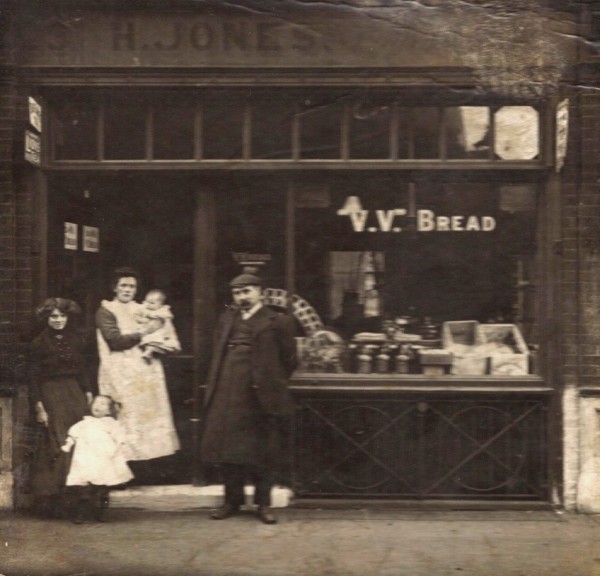
Henry Jones, with his wife Sarah and family, who came from Aberystwyth in 1877 to found Jones Dairy.

There are probably more Henrys in the Jones family than you will find in all of Shakespeare’s History plays. The enterprising gentleman pictured up above in the apron who founded the venerable dairy in Stoney Lane, off Middlesex St, was the first recorded Henry Jones in this particular branch. His proud grandson on the right of my portrait of this current incarnation of the Jones family business (now based around the corner in Middlesex St) is another Henry Jones and the grinning great-grandson standing behind him on the left is the most recent Henry Jones, a fourth generation dairyman, who is destined to carry the line onwards into the future with his sister Lucy. Henry senior with his wife Catherine (in the centre) and brother Trevor (on the left) are the current partners in Jones Bros, where Catherine and Henry’s children Henry and Lucy work today.
The first Henry Jones had eleven children, so it is not impossible there were other Henrys along the way but, as a consequence of all those siblings, the Jones family is not unlike Rabbit’s family in “The House at Pooh Corner,” with so many cousins and uncles and aunts that the margins of the clan blur into obscurity, which means we cannot ascertain for sure the exact number of Henrys. What is certain is that during the marathon that was the twentieth century, it was Henry Jones and his family dairy who stayed the course – through two World Wars and negotiating all the obstacles history threw in their path – running a relay over successive generations, and still delivering pints today after more than one hundred and thirty years when other Welsh dairies fell by the wayside. No-one else, it seems, could keep up with the Joneses. In Middlesex St alone there were once Morgans’ and Lewis’ Dairies, and at least two other Jones Dairies in Puma Court and Ezra St (no relation) have gone – not to mention Barker’s Dairy in Toynbee St where Isabelle Barker grew up and which is believed to have closed in World War II, Henry had never even heard of that one.
Out of all the Welsh family dairies in the East End, only Jones Bros exists today, which is a triumph for the family. What is the secret of their longevity and of those eleven children? Is this the source of the myth of the legendary virility of the milkman? Dare I say it, perhaps there really is something in the milk?Today, the resultant Jones dynasty comprises its own hereditary monarchy of dairymen and women. They are the kings and queens of dairy and, should you require confirmation of this, the current Henry Jones senior is also a freeman of the City of London and you will see Jones Bros marching in the Lord Mayor’s Parade this year.“I even think of myself as English now,” admitted Henry with startling candour.
It was my pleasure to meet Henry in his office up above the shop in Middlesex St where he runs the business and keeps the family photograph collection in a large album. Originally, the Joneses were dairy farmers who saw the opportunity to drive their cattle from Wales to supply fresh milk. It seems incredible now to even imagine the drovers bringing cattle from all over the country to London, but you only have to look around the streets of our capital to see the evidence of this in the form of the old stone cattle troughs that remain today on all the major roads.
When the first Henry Jones died in 1921, it was up to his wife Sarah to run the dairy with the help of her eleven children. A task that cannot have been easy, witnessed by the 1929 letter reproduced below from the clerk of the Public Health Department complaining about the behaviour of her young ones – a document that is a comic anachronism now but which must have caused heartache to Sarah. No wonder she chose to take a break from the arduous task of being a lone business woman and single parent to eleven children, by sitting on a milk churn to catch her breath while a photo was taken. Yet Sarah was a popular and magnanimous figure, who became an East End legend when two hundred people turned up at Euston Station to sing hymns, giving her an honourable send-off when she finally returned to Aberystwyth in her coffin.
Once Sarah died in 1937, the legacy was divided between all eleven children, but sons Eric and David bought out the business, becoming Jones Bros. It was Eric who married Nellie and fathered Henry and Trevor Jones, who were born on the premises and run the business today. But once World War II came, Eric and David were sent off to fight in India and Africa, and it was up to the Jones sisters Gladys, Bessie and Elsie to step in and do the milk rounds for the duration, which brought unexpected glamour to the dairy and became a national news story.
Then, forty years ago, Stoney Lane was demolished and a monolithic concrete housing development was built on the site, in which Jones Bros opened their new shop in Middlesex St. Henry and Trevor both joined the business at fifteen years old, once they left school. “When I started, we got up at four to do the milk round and then work in the shop, seven days a week. Sunday trading was very big then and we used to open until midnight on Saturdays too.” explained Henry. It was touching to hear Henry speak of Jones Bros because it was always personal, the business and the family are one and the same for him. In one moment, he spoke of how the transition from iron to lightweight plastic crates doubled the capacity of a milk float and, in another, of waking up in his mother’s bed at five years old to discover she had died.
In Henry and Trevor’s time as dairymen, both the trade and the nature of their lives have changed as residential deliveries diminished, dairy products became widely available at other shops than dairies and supermarkets sold cheap milk as a loss leader. In the eighties, the business could have folded but instead they expanded boldly, opening a warehouse in Stepney and widening operations to cover Canary Wharf, the City of London, the West End and South Bank too. Yet still there are obstacles, Henry remembers the IRA bombs at St Mary Axe and Bishopsgate, which took away his customers in a flash. Then last year, the dairy’s major supplier went bankrupt in the recession and Henry had to find a replacement overnight, only to discover that without a credit rating he would now have to pay weekly, creating a cash flow crisis that again might have brought the business down.
With all these crises safely in the past, Henry junior and his sister Lucy came in to join the family photo shoot and were excited to see their father had brought out the old photo album, envelopes of pictures and boxes of ancient round books. It became an impromptu party as we all crammed into the office, turning over these artifacts in shared fascination and choosing which ones to show you. Then we walked out together into the dazzling sunlight of a happy April morning to enjoy taking the photos that comprise the next chapter in the long-running family drama of Jones Dairies.

Sarah takes a moment’s rest from running the dairy and caring for her eleven children.

The notorious letter.

The famous tribute.

Eric with two of his fellow milkmen.

David and Eric Jones outside the dairy in Stoney Lane.

The glamorous Jones Sisters.

Nellie Jones with an assistant at the dairy counter, with young Henry sneaking into the photo too.

After World War II, Eric and David bought the premises next door and expanded.

Trevor Jones outside Jones Bros dairy

Henry Jones could not wait to get behind the wheel of a milk float.

The current partners, Trevor, Catherine and Henry Jones.

Henry and Lucy Jones, the next generation.

Columbia Road Market 30

It was a fine Spring morning and the market was alive early today with gardeners, like myself, gathering new plants as preparation for a day’s work in the domestic gardens of East London. Although I already have some in a variety of colours, I could not resist the blue of this Aquilegia for a mere £2. The compelling artificiality of their elaborate flowers, like some strange medieval bonnet, or pleated skirt, or even an eccentric semi-folded umbrella, contrast elegantly with their modest delicately shaped grey green leaves.
I was brought up to call them Columbine and we had them growing wild in every corner of our garden in Devon, and when my father died they took over his vegetable patch between the orchard and the flower garden to create their own shimmering display of colour each Spring. Then, years later, when I set out to walk the length of the Pyrenees from the Atlantic to the Mediterranean coast, I found Columbine growing wild to fill entire mountainsides with their blooms, in the Basque country. The wild variety were of the deepest blue, and that was what I recalled when I came upon this Columbine this morning.
This week, for the first time, plants that I bought last year in Columbia Rd have come into flower in my garden. I am especially proud of the Snake’s Head Lilies (Fritillaria Meleagris), that I grew from bulbs, because in the past I have failed to cultivate them. Also, the Bleeding Heart (Dicentra Spectabilis) which I bought for £3 is now a huge fleshy pale green plant hung with its flowers that vividly resemble hearts with tear drops emanating. I know these are considered unfashionable now, with a white variety replacing the pink, but if you can get past the overcooked nineteenth century allegorical quality, they are extraordinarily beautiful. Three commonplace yet bizarre flowers this week, each so intricate in their composition and design, each illustrating the endless ingenuity of nature.


Beatrice Ali, Salvation Army Hostel Dweller

“She was dancing in a tutu under my window, directing the traffic and shouting ‘Up the Common Market!” explained Clive Murphy with a wan smile, as he sat in the kitchen of his flat above the Aladin Curry House in Brick Lane last week, recalling how he met Beatrice Ali, the well known local personality and eccentric, pictured here by East End photographer Paul Trevor in the nineteen seventies.
Recording thirty hours of conversations with Beatrice telling her story, between May and October 1975, Clive edited her words to became “The Good Deeds of a Good Woman,” the first book he published in his “Ordinary Lives” oral history series in 1976. It is a fascinating account which explains the human story behind Beatrice’s famously idiosyncratic behaviour, restoring dignity to an individual who had been rendered marginal by her own misfortune and become the object of derision in her own community.
“Whenever I could find her, I asked her to come and see me to make a tape recording. We entered into a collaboration agreement, splitting the royalties fifty-fifty. She did it because she was burning with resentment at some people and she wanted to talk about how kind she was. I think she was very lonely and very glad to have someone to talk to.” Clive told me, describing the origin of the book.“She threw milk bottles at windows,” added Clive affectionately,” and when the book was published she used to shout at mine, ‘I know you’ve got a woman up there!’ She was as lively as a trivet. She was just perfect.”
“The Good Deeds of a Good Woman” is a candid account of a mixed-race marriage that ended badly when Basit, Beatrice’s husband of thirty years, left her in 1965, once their sons were grown up, selling their home in Spitalfields and returning to East Pakistan where he took a young wife. Yet in spite of the tragedy of her circumstance, Beatrice demonstrated an endearingly unsentimental wit and lack of self pity in the telling of her tale, in vigorous language that held my rapt attention, without a break, from cover to cover.
Returning one day to discover a padlock on her own front door, Beatrice slept on Liverpool St Station before moving into a Salvation Army Hostel. Censured by many English people for her inter-racial marriage, Beatrice found herself rejected by the Bangladeshi people too. Even her sons disowned her, and she sought to retain self-respect by undertaking good deeds, while struggling to support herself as best she could. In such straightened circumstances, every action of her existence became a brave gesture of defiance against the odds. Today, Beatrice’s story of her courageous daily battle for survival on the streets of Spitalfields is essential reading for anyone who wants to understand the evolving life of the East End.
“I sat nights in Liverpool St Station and after that I’d go into the toilet and have a wash and do my hair, then come back and have another sit down. Then I’d go and stand at the meths drinkers’ fire in Spitalfields Market till two men come round with soup and bread between twelve and quarter past. I’d have that and then have a walk around or stand at the coffee stall in Commercial Street, and then I’d go back to the station and buy a ticket and go and doze off in the Waiting Room. Policeman would come in and wake you up. ‘Have you got a ticket?’– and I’d show it. ‘Won’t be long. I’m going to work at five o’clock.’ ‘Oh! Sorry to worry you.'”
Once Beatrice was living in the Salvation Army Hostel, she could only return at night, filling her days with casual jobs and altruistic deeds to restore her reputation and self-esteem, as these two extracts illustrate.
“I’m a fool when I’ve got money. I’d give to anybody. About four months ago I was walking through Fieldgate St and in Fieldgate St there’s a butcher’s shop, and I saw an old man with two sticks and he’s looking at these lamb chops. ‘Oh they’re such lovely big meaty chops!’ He looked at me. ‘Oh Mum,’ he said, ‘I wouldn’t half love four chops! Two for me and two for my wife!‘ I had money. I went in. I said, ‘Four of them nice meaty chops, love!’ How much do you think they were? A pound! I said to the old man. ‘They’re only a pound, love.’ He said, ‘You’re not buying them for me, surely?!’ I said, ‘Yes’ and I bought him a tin of peas as well. Funny thing, I was lucky that day. If you help anybody, you’re often lucky. I went into the betting office and I won £10 on the horses.”
“Someone saw me with an old man, they said, ‘I wouldn’t do it. I wouldn’t have no interest if I went out with a man like that.’ I said, ‘What you would do and what I would do is two separate things. My heart is soft, if I thought anybody needed the money for food and I had it, I’d buy it for them. If I had two shillings and someone needed a shilling, I’d give it to them.’ This old man, bless him, he couldn’t thank me enough. He said, ‘You are so kind to me. I do appreciate this kindness.’ The morning after I put him in this armchair, I went round the Maltese shop near the nuns’ and got him a cup of tea and brought it to him – he’d been out all night sitting in this armchair. ‘Here you are, Dad. Here’s a cup of tea and a couple of cigarettes. And here you are, here’s ten pence.’ I said, ‘Are you all right, Dad?’ He said, ‘I’m all right. Don’t worry. But come back and see me again. I always look forward to you. You are so kind.'”
The year after she recorded her story, Beatrice got a flat in the Boundary Estate but was subsequently found there, two weeks after she died, by social workers who had neglected to visit. “The Good Deeds of a Good Woman” is an alarming tale of how a woman can fall through the surface of existence and never regain control of her life, but it is also remarkably testimony of moral courage and tenacity to survive and, thanks to Clive Murphy, we can remember Beatrice Ali today with the respect she deserves.

Hardback copies of “The Good Deeds of a Good Woman,” including a vinyl record of Beatrice Ali talking, are available at Labour and Wait.
In Geoffrey Fletcher's footsteps


Hidden away behind the Genesis Cinema and Wickham’s lopsided department store is Bellevue Place. To get there, you walk up a side street from the Mile End Rd where you discover a bright green door in an old wall hung with ivy. Push this door and enter another world just as writer and artist, Geoffrey Fletcher, did when he walked through the same doorway in 1964.
In The London Nobody Knows he wrote,“A green gate opening in the wall leads to a totally unexpectedly corner of London, one that may well disappear if Charrington’s, who own the property, ever decide to expand. Bellevue Place is well named. It is a cul-de-sac with a paved pathway leading to the far end, under a creeper-covered wall. The cottages are early nineteenth century, and have true cottage gardens fenced with wooden rails, pointed at the top. Here are unbelievably rural gardens, full of lilac, lupins and delphiniums – all a minute’s walk from the Mile End Road.”
Geoffrey would be gratified to see my picture and learn that Bellevue Place remains today, its cottage gardens still fenced with wooden rails, pointed at the top. The irony is that Charrington’s has gone and the large brewery complex, of which the creeper-covered wall once formed part of its perimeter, has been replaced by a housing estate. Geoffrey Fletcher’s project was to record the quaint old corners of London before they were destroyed in the name of progress, but the popularity of his work marked a change in public opinion towards the preservation of buildings. As a result, many of those he recorded in elegiac tones in “The London Nobody Knows” are preserved today as characterful landmarks of the London everybody knows.
Bellevue Place, unseen from the street and surrounded on four sides by high walls, is a magical place where it truly does feel as if time has stood still. The walls form a wind break, creating an atmosphere of warm still air in the gardens and, each of the half-dozen times I have been there, I have never seen any of the residents. There is an innate quiet in this corner. As I searched to find the exact spot where Geoffrey Fletcher did his drawing, framed by lush foliage all those years ago, I should not have been surprised if he had appeared through the green gate or, equally, if I had walked out of the gate to discover I was in London in 1964.
Over in Spitalfields, Geoffrey deliberated over what to draw because even then people were catching on to the London nobody knows. “One of the finest eighteenth-century shops in the whole of London is here, in Artillery Lane. However, as this is well-known, I have chosen to illustrate a curiousity instead – the Moorish bazar in Fashion Street, given an odd realism by the turbaned figures of Indians who have drifted into the area. It was once a Jews’ market, a place for the sale of cheap textiles, penny notebooks, and fifty-blade penknives. Buildings with a Turkish, or Moorish touch invariably appeal to me, by their utter disregard of architectural qualities. I have a liking for the tawdry, extravagant and eccentric.”
The eighteenth century shop in Artillery Lane (which James Mason stood outside in the film of The London Nobody Knows) is now the Raven Row gallery and the Moorish bazar, after being derelict for many years, has been reconstructed, preserving most of the facade, as an office building occupied by media businesses. The integration of the facade of the bazar into the new building means it is more corporate than tawdry today. This is no longer the place for penny notebooks and fifty-blade penknives, though if Geoffrey came back he would not have to look far in the surrounding streets to find them.
You have to ask yourself who the “Nobody” of ‘The London Nobody Knows” refers to, because all the places he describes have inhabitants. How could the population of the East End rank as nobody? Given that Geoffrey Fletcher was a Daily Telegraph columnist, I choose to assume that by “Nobody,” he means “Nobody who reads the Daily Telegraph.” The implied title being, “The London Nobody who reads the Daily Telegraph Knows.” If you can forgive me being so disingenuous, let me quote the following extract from his introduction of 1962 – which regrettably sounds comically antiquated now – as evidence of my assumption, and leave you to your own conclusions, “There are parts of London never penetrated, except by those who like myself, are driven on by the mania for exploration: Hoxton, Shoreditch, Stepney for instance, all of which are full of interest for the perceptive eye, the eye of the connoisseur of well-proportioned though seedy terraces, of enamel advertisements and cast-iron lavatories.”
Even if he was capable of being a curmudgeon, we owe Geoffrey Fletcher a debt of gratitude for recording his fond appreciation of once neglected aspects of our city so conscientiously and with such lyricism. In fact, I cannot deny a twinge of jealousy that I was not around to visit these places as he described them, though I am lucky enough to have Bellevue Place nearby whenever I need a glimpse of his London.
By 1989, Geoffrey had become aware that “The London Nobody Knows” was a relative concept, an horizon that retreated endlessly and, in acknowledgement of this, he added a new preface including the words, ” Tomorrow, scorning the London everybody knows, we may take the road, like Mr Pickwick, eager for character and flavour, expecting only the unexpected. We may search for bankrupt tandooris in the uplands of North London. We may even set out for the Seven Sisters Rd…”














