A Dress of Spitalfields Silk

In 1752, when Ann Fanshawe was twenty-eight years old, her father Crisp Gascoyne was appointed as Lord Mayor of London, and became the first incumbent to take residence in the newly built Mansion House. Since Margaret, her mother, had died back in 1740, it fell upon Ann to assume the role of Lady Mayoress and this spectacular dress of Spitalfields silk, which was purchased by the Museum of London from one of her descendants in 1983, is believed to have been made to be worn just once, upon the great occasion.
Born in 1724, Ann was the eldest daughter of Crisp Gascoyne of Bifrons House in Barking, marrying Thomas Fanshawe of Parsloes Manor in Dagenham at the age of twenty-one. In 1752, when she stepped out as Lady Mayoress, Ann had three children, John six years old, Susanna five years old and Ann four years old. Ten years later, Ann died at the birth of her fourth child Mary, in 1762. Parsloes Manor no longer exists but “The History of the Fanshawe family” by H.C. Fanshawe published in 1927 records this couplet engraved upon one of the windows there by Ann & Thomas.“Time ‘scapes our hand like water from a sieve, We come to die ere we come to live.”
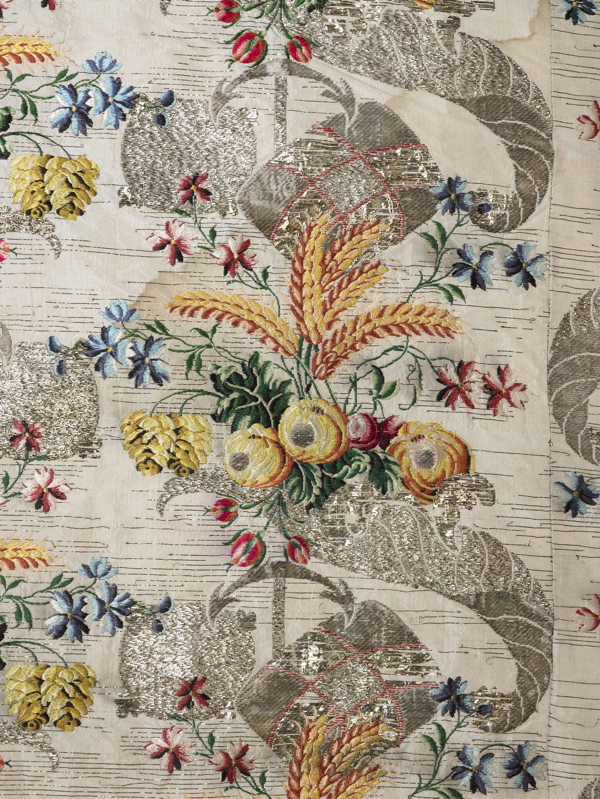
Becoming Lord Mayor of London was an auspicious moment for Ann’s father (who had been Master of the Brewer’s Company in 1746) and he saw his eldest daughter step out in a silk dress that was emblematic of his success. The design contains images of hops and barley interwoven with flowers spilling from silver cornucopia, alternating with anchors and merchants’ packs in silver, all upon a background of white silk threaded with silver. It was a dress designed to be seen by candlelight and the effect of all this silver thread upon white silk, in a dress trimmed with silver lace, upon his eldest daughter adorned with diamonds, was the physical embodiment of Gascoyne’s momentous achievement. To crown it all, H.C. Fanshawe describes a lost portrait of Ann, “which shows her to have been strikingly handsome.”
As the Covent Garden Journal of 3rd November 1752 reported: “The Appearance at Guildhall, on Thursday last, was very noble, particularly that of the Ladies, many of whom were extremely brilliant, a Circumstance which in too great a Measure lost its Effect, their being mixed with an uncommon Crowd of Company… The Ball about ten o’Clock was opened by Mrs. Fanshaw (as Lady Mayoress, who made a most splendid Figure) …”
As everyone in Spitalfields knows, the Huguenot weavers here excelled at creating silk, both in their technical finesse and elegance of design. Such was the skilful incorporation of the expensive silver and coloured threads in the cloth for Ann Fanshawe’s dress that they were only used where they were visible, with very little wasted upon the reverse. According to the American critic, Andrea Feeser, the dye used for the blue flowers was rare indigo from South Carolina, where Ann’s brother-in-law Charles Fanshawe was stationed as a Rear-Admiral and had access to the indigo dye.
When Natalie Rothenstein, the authoritative scholar of Spitalfields silk, wrote to the curator at the Museum of London in July 1983 about the dress, she authenticated the fabric as being of being of Spitalfields manufacture, but also could not resist declaring her distaste for the design.“I am sure that the dress is Spitalfields and indeed the floral style is just right for the date 1752-3. I am sure too, that the design is unique – created for one rich lady. The bales and anchors ought to refer to a merchant, while the ears of corn and horn of plenty reveal the prosperity he brought to the city as well as his family’s execrable taste.”
Commonly, silks were woven in lengths of cloth sufficient for several dresses, but in this instance the design was likely to have been made solely for this garment. A customer bought a design from a mercer and six months was the lead time for the weaving of the silk cloth, which could have been made up into a dress in little more than a week. Natalie Rothenstein describes the chain of transactions thus, “silk was generally imported by a silk merchant. It was then sold through a broker to a silkman who, in turn, supplied the master weaver with the qualities and quantities required. Either the silkman or the master weaver had it thrown and dyed. The master weaver would normally obtain an order from a mercer and instruct his foreman. The latter, based at the master weaver’s warehouse, would measure out the warp for the journeyman, who returned it when completed.” Ann would never have met the people who made her dress and they may never have seen her in it.
When the culmination of this process arrived, once the silk had been designed, the dress manufactured and the great day came, Ann had to get dressed. No underwear was worn, just a shift of fine linen, probably with some lace at the neck, then silk stockings and garters to hold them up. Next came her stays of whalebone, that we should call a corset, and then her hooped petticoat, also with whalebone and cross ties to maintain the oval shape of the dress and not allow it to become circular. At last, Ann could put on her dress, which came in three pieces, first the skirt, then the stomacher followed by the bodice. There were no hooks or buttons to hold it all together, so pins would be used and a few discreet stitches where necessary. Lace sleeve ruffles were added and a lappet upon her head. Finally, diamonds upon the stomacher and around Ann’s neck, plus shoes and a fan completed the outfit.
Now Ann was ready for her appearance, except her dress was two metres wide and she could not walk through a door without turning sideways. Getting in and out of a carriage must have been a performance too. Ann was fully aware that her dress was not designed for sitting down but fortunately she did not to expect to sit.
What can we surmise about Ann’s experience in this dress? I was surprised at the workmanlike manufacture of the garment which was sewn together quickly and presented no finish upon the inside. The quality and expense of the materials was what counted, the tailoring of the dress was not of consequence. Almost like a stage costume, it was a dress to create an effect.
Maybe Ann was the apple of her father’s eye and she was proud to become his angel that incarnated the supremacy of their family in the City of London, or maybe she felt she was tricked out like a tinsel fairy in a ridiculous dress with symbols of brewing woven into the fabric, tolerating it all the for sake of her dad? No doubt her husband Thomas Fanshawe was present at the occasion, but maybe her children, John, Sukey and Nancy (as she called them) stayed behind at Parsloes Manor and did not see their mother wearing the famous dress. Did Crisp Gascoyne, her father, get sentimental on the night, shedding a tear for his wife Margaret and wishing that she had lived to see the day?
We shall never know the truth of these speculations, but everyone wants to have their moment of glory – looking their best at a significant occasion in life – and I should like to think that, on the one day she wore it, this dress delivered that moment for Ann Fanshawe.
You can see Ann Fanshawe’s dress for yourself at the Museum of London




Roy Emmins, sculptor

At the furthest end of Cable St are the Cable St Studios where Roy Emmins has cloistered himself for more than ten years, working six days every week, alone in a tiny workshop. A former porter at the Royal London Hospital in Whitechapel, after more than thirty years service Roy took early retirement to devote himself to sculpture, and today his studio is crammed to the roof with innumerable creations that bear testimony to his prodigious talent and potent imagination.
When Roy opened the door to me, I could not believe my eyes. There were so many sculptures, it took my breath away. With more artifacts than a Pharoah’s tomb, I did not know where to look first. Roy stood and smiled indulgently at my reaction. Not many people make it here to the inner sanctum of Roy Emmin’s imagination. He is not a demonstrative man, and he has no big explanation – not expecting praise or inviting criticism either. In fact, he has no art world rhetoric at all, just a room packed with breathtaking sculpture.
First to catch my attention were large carvings hewn from tree trunks, some in bare wood, others painted in gaudy colours like sculptures in medieval cathedrals and sharing the same vigorous poetry, full of energetic life and acute observation of the natural world. Next, I saw elaborate painted constructions in papier-mache, scenes from the natural world, gulls on cliffs, fish in the ocean, monkeys in the jungle and more. All meticulously imagined, and in an aesthetic reminiscent of the dioramas of the Natural History Museum but with more soul. I stood with my eyes roving, absorbing the immense detail and noticing smaller individual sculptures in ceramic, bronze, and plaster, on shelves and in cubbyholes. Turning one hundred and eighty degrees, I faced a wall hung with table tops, each incised with relief sculptures. I sat on a chair to collect my thoughts and cast my eyes to the window sill where sat a menagerie of creatures, all contrived with exquisite modesty and consummate skill from tinfoil and chocolate wrappers.
The abiding impression was of teeming life. Every figure quick with it, as if they might all spring into animation at any moment, transforming the studio into an overcrowded Noah’s Ark, with Roy as an entirely convincing Mr Noah. Yet, in his work, Roy emulates the supreme creator, reconstructed Eden – fashioning all the beloved animals, imbuing them with life and movement, and creating jungles and forests and oceans – imparting a magical intensity to everything he touches. Like Stanley Spencer’s murals at Cookham, there is a sublime quality to Roy Emmin’s vision. Roy’s sculptures are totems, and his carved tree trunks resemble totem poles, with images that evoke the spirits of the natural world and nourish the human spirit too. Even Roy’s tinfoil stags possess an emotionalism – born of a tension between the heroic dignity of the creature he sculpts so eloquently and the humble material from which each figure is fashioned.
It is a paradox that Roy, an English visionary, exemplifies in his own personality – which is so appealingly lacking in ego yet tenacious of ambition in sculpture. Originally apprenticed as a graphic artist, he developed Wilson’s disease, which caused him to shake, yet spared him military service. After years attending the Royal London Hospital, a drug was founded to treat his affliction but by then, Roy admitted, he preferred the atmosphere of the hospital to the design studio because it was an environment where he always was meeting new people. Taking a job as a porter, Roy also attended evening classes at Sir John Cass School of Art in Whitechapel, pursuing painting, ceramics, life modelling, and wood-carving. Once these closed down in 1984, Roy joined a group of wood-carvers who met at the weekends in the garden studio of their ex-tutor Michael Leman in Greenford. When the hurricane came in 1987, they hired a crane to collect fallen trees – and one of these became Roy’s first tree trunk carving.
When he took retirement in 1995, Roy was permitted to retain his caretaker’s flat in Turner St at the rear of the hospital. After a stint at the Battlebridge Centre in King’s Cross, where he had free studio in return for one day a week building flats for homeless people, Roy came to the Cable St Studios and has been here ever since. Always working on several sculptures at once, Roy often returns to pieces, reworking them and adding ideas, which may go some way to explain the intensity of detail and richness of ideas apparent in all his sculpture.
Looking at Roy’s work, I wondered what influence it had on his psyche, wheeling patients around for thirty years at the hospital. The sense of wonder at the natural world is exuberantly apparent, but this is not the work of an innocent either. In a major sculpture that sits outside his door entitled “The Shadow of Man,” Roy dramatises the destructive instinct of mankind, yet it is not a simple didactic work because the agents of destruction are portrayed with humanity. Again, it brought me back to medieval carving which commonly subverts its own allegory, picturing villains with charisma, and there was a strange pathos when Roy placed his hand affectionately upon the head of a figure wielding a chainsaw, a contradictory force embodying both destruction and creation.
Roy inherited his love of people from a father who worked his whole life on the railway and ended up manager of the bar on Liverpool St Station, while Roy’s mother was skilled at assembling electrical parts, which she did at home, imparting an ability in intricate work to her son. Each of Roy’s three uncles, a master carpenter, plumber and builder were model makers and Roy’s brother makes models too, though, in contrast to Roy, he makes ships and cars, mechanical things. I am fascinated by the creative skills of working men expressed in areas of endeavour parallel to their working lives. Roy’s work exists in the tradition of the detailed handicrafts undertaken by sailors and prisoners, and the model railways of yesteryear, yet in its accomplishment and as a complete vision of the world, Roy’s work transcends these precedents. Roy is a unique talent and a true sculptor who grasps of the essence of his medium.
Showing me a wire and plasticine dancer, with a skirt made from the paper cases manufactured for buns, Roy explained that a figure must have three points of contact with the ground to stand upright. In this instance, the ballerina had one foot pointing forward and a back foot that met the ground at toe and heel. Roy placed the precarious figure on a surface and, just like his spindly tinfoil creatures, it stood with perfect balance.


The Baishakhi Mela in Spitalfields

The streets of Spitalfields were closed off from dawn yesterday and, in the cool of early morning, an expectant hush lay upon the neighbourhood. Then, in the distance, came the sound of drumming which grew and grew until around midday the Baishakhi Mela procession arrived, beneath a transparent blue sky, filling Brick Lane with a joyful chaos of colour and noise and life. The Mela, celebrating the Bengali New Year, is the largest Bengali festival held outside Bangladesh and, for one day, Spitalfields is transported to another continent.
From mid-morning, drummers, dancers, groups of children, and fantastic carnival animals gathered on the far side of Spitalfields Market, before lining up in Lamb St. Once everyone was assembled, the mayor took a photocall and cut a ribbon. Then they all set off past the Golden Heart and into Hanbury St before erupting onto Brick Lane where, among curry houses, Bangladeshi grocers and in the shadow of the mosque, the whole extravagant drama took on its full meaning. The narrow street and tall buildings intensified the din of drumming, whistles and horns, while spectators found themselves crowded together and swept along by the infectious sense of carnival that ruled Brick Lane. This annual moment, of the Baishakhi Mela procession passing through Brick Lane, manifests the jubilant apotheosis of Bangladeshi culture, both here in East London and for members of the Bangladeshi diaspora across Britain.
Meanwhile, I was nipping around, in and out the crowd, jumping onto street furniture and sprinting through the side streets to catch every detail of the parade. Standing upon a telephone junction box, I found myself eye-to-eye with those riding the magnificent elephant, and party to spectacular perspectives up and down Brick Lane, of the procession of dancers and drummers stretching in either direction, as far as I could see. The lyrical images passing before my eyes added up to a poem, with each carnival float and attendants attired in silk and tinsel, comprising a sequence of verses featuring an owl, butterflies, a giant waterlily, an elephant and a turtle. It evoked the imaginative universe of a dream, or a collection of Indian folk tales, or a set of miniature paintings, except it was here now – loud and brash – and in your face in Brick Lane!
I followed the procession as it turned into Old Montague St where the atmosphere changed as the crowds ebbed away. In the residential streets, people leaned out of the windows of their houses to wave, and homeless people woke from sleeping on the grass to witness an unlikely vision. From here, it was a short journey to arrive at Weavers’ Fields which held a funfair and a huge concert stage. The parade was merely the catalyst to ignite the festivities and, for the rest of the day, the streets, parks and curry houses of the East End were full with high-spirited revellers enjoying the blessing of the sunshine. Everyone had plenty to celebrate, because it was Bengali New Year and the day Summer arrived in Spitalfields too.


Columbia Road Market 36

To salute the arrival of Summer this week, I bought three of these exuberant Marguerite Daisies for £5 at Columbia Rd to plant in a flower pot on the wall in a sunny spot. You cannot have Summer without Daisies, and this particular variety have these fine long white petals that catch the sunlight, causing the flowers to glow like stars against the deep shades of my garden.
Another modest plant that I love is Calendula, that I was brought up to call Marigold. For £4, I bought eight of this yellow variety to fill two pots on my sill. Every flower is a like a child’s drawing of a sunburst and will remind me of sunlight even when the clouds come over. The Marigold’s tangy scent, and viscous fleshy flowers and leaves take me back to my childhood garden. You can be sure I will save all the seeds in a brown paper bag in my desk drawer to scatter next Spring.
Cultivated in England since medieval times for its medicinal properties, the humble Marigold is a stalwart of the cottage garden, and even if some reject it for its ubiquity and gaudy shades, it is so familiar to me that, like the Daisy, the season would be lacking without it. These pop flowers are my invocation to long happy Summer days.

13 Princelet Street, the Landmark Trust

This is a historic photo of rare event, Pat Lloyd and Katherine Haspineall sitting down. It does not happen very often because they are the busy housekeepers at 13 Princelet St, the eighteenth century house belonging to the Landmark Trust that is available to let for holidays and short stays. “We have a cup of tea, put the world to rights, make the beds, clean the place top to bottom, flick a duster around, do the wax polishing and sweep the garden,” explained Kathy, outlining their routine. “Kathy’s really easy to work with,” Pat declared to me with a significant nod. “So are you!” replied Kathy, with a retort to Pat that was almost instantaneous. “We jog along,” Pat informed me summarily, and they both nodded their heads simultaneously in consensus.
Pat continued, speaking for both of them, with Kathy interpolating enthusiastic gestures of endorsement when Pat became lyrical, “We’ve become quite possessive about the house. We get incensed if people break anything. It becomes more than a job, you get very attached to it. I think houses take on a sense of the people who have lived there – the walls seep up the personalities of the people. I often think of all those that have lived here and imagine the weavers up on the top floor, working with their babies asleep under the loom. We’re proud of the house and we like to make it look beautiful. It’s very good thing to do. People come and stay here and they love it.” As you will have gathered, Pat & Kathy cherish 13 Princelet St as their beloved charge.
Thanks to their conscientious labours, I can confirm that the fine old edifice looked immaculate, as I sneaked around to snap my pictures, nipping up and down stairs, slipping in and out of the majestic empty rooms. The colour scheme of soft blues and greens was illuminated by the sunlight of early Summer, and the gardens of Princelet St, visible from the staircase at the back of the house, were verdant with new growth. The house has a stillness, entirely in denial of the modern city outside. In fact, the place has such presence, that I almost hesitated before opening closed doors, unable quite to dismiss the possibility that there might be someone there. There was no-one yet, but fresh bed sheets and towels, sparkling bathrooms, polished floors, plumped cushions and an intriguing box of groceries in the hallway were ready to welcome the guests for a christening to be held in the house that weekend.
Princelet St was one of the first streets to be built on this side of Spitalfields, upon a piece of land known as Joyce’s garden. The site of number thirteen was leased to Edward Buckingham, a stone mason, on a sixty year lease in 1718/9. Remarkably, no-one expected or even intended these houses to last. He built the house as a speculative development and, by the seventeen forties, the names of the residents, L’Amy, Durade, Allard were recognizably French, reflecting the Huguenot population in Spitalfields at that time. Princelet St became one of the most prosperous on account of the silk industry and in confirmation of this, by the seventeen eighties, silk weavers were advertised in trade directories at this address.
In 1984, the house was bought by Peter Lerwill in a dilapidated state. He undertook a three-year restoration programme, done as conservatively as possible to preserve the original joinery. Then he lived in it for seventeen years before bequeathing it to the Landmark Trust, so that others could enjoy it as he had done. Today, 13 Princelet St is booked throughout the year with a steady flow of guests who enjoy the place for a quiet holiday or to hold weddings, host parties, stage romantic Valentine dinners or celebrate birthdays. And Pat & Katherine are always there before and after, to clean up and put everything in order for the next arrival.
Most people who stay at 13 Princelet St never meet Pat & Kathy, they are the invisible fairies that prepare the house. But if any of the guests get the opportunity to strike up a conversation as I did, they will discover that their discreet hosts are real women with proud East End connections. Pat told me that when she was first married she lived in two rooms with one shared outside sink down by St Catherine’s Dock. Now she lives just down the road in an eighteenth century terrace in Folgate St next to Dennis Severs’ House. “He used to invite to me to his Christmas parties before he started making money out of it,” she recalled with delicate irony. Pat worked in the Spitalfields Fruit & Vegetable Market years ago, and was landlady of both the Poet in Folgate St and the Commercial Tavern before she took early retirement. All her husband’s family worked in the docks for the last six generations, she told me plainly.
Then Kathy chipped in to reveal her father worked in the docks too, as a lighter man, and described him as “a bit of a rogue.” In the age of post-war austerity, he purloined a roll of blanket fabric, wrapping it round his body to get it out of the docks and arriving home dripping with sweat. Her mother made it up into three dressing gowns for the children, but what Kathy remembers was that the coarse cloth was scratchy. Then changing tone, she added with a grin, “When the nuts arrived in port for the chocolate factory, they had to hire security to get them out of the docks!”
Our conversation had acquired its own engaging momentum that led us away from the house and Pat & Kathy’s benign stewardship of it, which was the subject of the day, but our digressions simply confirmed how conducive the place is for contemplation of the multiple histories of the East End. I was charmed by the company of these generous-spirited women. By now the time was drawing on and the next guests were expected imminently, so like household spirits before dawn, it was time for us to make our departure. Kathy left first, then Pat made one last circuit of the house, pulled on her jacket in the hallway, and stood for a moment to absorb the quiet and breathe in the aroma of wax polish. Satisfied that her work was done, Pat turned and walked out the door. We said our goodbyes in the street as she locked up, and went our separate ways in opposite directions down Princelet St.


Mick Pedroli, Dennis Severs' House

The face at the window is Mick Pedroli, house manager at Dennis Severs’ House in Folgate St. In January 1995, when Dennis Severs invited Mick to leave his home town of Amsterdam and come and work here, Mick had never been to the East End of London. But he took a leap of faith and arrived on 3rd March to commence his new job and new life in London, and he has been here ever since.
“I slept in the Dickens room at first,” Mick recalled wryly, referring to a primitively furnished garret in the attic, “but then the roof started leaking, so I moved into the Leckaux room next to it and then that started leaking too. I worked preparing the house during the day and, as it was open to the public every evening, I either had to go out or help Dennis. It was a lonely place to be away from home, living in a dark cold old house – but it was all-consuming too.”
After just a week, Dennis departed for New York, leaving Mick to host the tours and bring order to the management of the house. “I improvised, because I had no idea what to say when visitors asked questions,” Mick confessed to me with the gallant self-deprecatory irony that is his forte, as we sat in the cool of the Victorian parlour surrounded by overstuffed upholstery and a surfeit of bric-a-brac, all enfolded by wallpaper crowded with oppressive roses.
Clearly, Mick’s improvisatory abilities are immense because he stayed the course, playing the role of peacemaker to the mercurial Dennis Severs in his last years and then steering the house forward after Dennis’ death from Aids in 1999, to the present day that sees more visitors through the door each year than ever before. Where once the cultural establishment dismissed Dennis Severs’ House for details of historical inaccuracy, now the tide has changed and it is appreciated for the quality of imagination at play. Today, the National Trust sends curators there to learn how to create atmosphere and evoke the lives of people who once inhabited a historic building.
This was Dennis Severs’ genius, and today Mick, with his colleague David Milne, upholds the endeavour, filling the house every day with spontaneous details, flowers, food and freshly rumpled bed sheets – as if the Jarvises, the family of eighteenth century residents that Dennis Severs invented, had just left a moment ago. So convincing is the evocation that Dennis once fell into a row with a guest who claimed to be descended from the imaginary family in question. It was a spat that met its conclusion when Dennis threw the woman out into Folgate St, and Mick had to apologise and give her money back.
The house is an innately dramatic space and, if you ask him, Mick has a lexicon of tales that he refers to as “the soap opera,” rolling his eyes at all the theatrics he has witnessed over the years. “The first time I had a row with Dennis, I went upstairs to bed and locked my door with a chair because I was scared he might come after me in the night,” admitted Mick – raising his eyebrows – in testament to the force of Severs’ personality, that remains capable of inspiring such loyalty, even in his absence. “They were the best of times. We used to sing together and dance around the house as were preparing for the visitors,” explained Mick with a weary smile, reeling off a list of Dennis Severs’ favourite disco hits, and searching around with his eyes to trace the images that linger in the shadows of these quiet rooms which still harbour the presence of their creator.
Once Dennis became sick, Mick found himself in a role that demanded greater involvement than he ever expected, “It was very difficult time when Dennis changed from being a vibrant person to a fragile ill man over six months. When he discovered his cancer was terminal, he lay down in the bedroom and I held his hand and cried. ‘I so envy you for your tears,’ he said. He was very pragmatic and accepted it. When he was in hospital for extended periods, I had to come in six or seven times a day to empty the buckets collecting the leaks. It was a really dark picture, Dennis’ body eaten away by cancer and the old house leaking.
I was with him when he passed away. He died on the twenty-seventh of December and on the third of January we were open to the public. Then he lay here in state in the dining room, in a coffin lined with red velvet and decorated with black ribbons, for friends to come say ‘goodbye’ before he was taken to Christ Church on the sixth of January. Two hundred people gathered in the street outside as the bells tolled a death knell and we all walked behind the hearse drawn by four black horses.”
The unspoken irony is that in setting out to evoke the life of the past, Dennis Severs created the magnificent scene upon which the drama of his own death would be played out. Today in Dennis Severs’ House, the living and the dead co-exist equally within the eternal present that the house proposes. Through tending the reality of the Jarvises, Mick and his fellow curators have become a parallel family, of those that worked alongside Dennis. Even though the story of Dennis and his circle may be less apparent to the visitor than the fictional Jarvises which the rooms are set up to describe, theirs is a story that deepens an appreciation of the house as an emotional space for the contemplation of the ephemeral poetry of existence.
“The kitchen is my favourite place,” revealed Mick, eyes gleaming with delight,” I think it is the most unpretentious room, soulful and warm, quiet and safe. It doubled as my sitting room when I lived here. On my first New Year’s Eve, we had a big party. Dennis had his A-list friends upstairs in the drawing-room while I had my party downstairs. We had our music and all these people were dancing in the kitchen. It was surreal.” Mick’s choice of room reflects his own egalitarian nature, as the ex-proprietor of a coffee bar in Amsterdam, and fifteen years later, Mick’s perseverance appears to have carried him through the experience that threatened to overtake his life.”Of course, there is a deep emotional involvement here for me,” he conceded with equanimity, before adding, “but it is a job. I have working hours now and I have a life. If I meet people who ask what I do, I say I do admin.” Let me admit I was not entirely persuaded.
Once you open up a dream space, as Dennis Severs did, it can take on a life of its own, drawing everyone into its vortex. He may be dead and lying in his grave, but his imaginative world still flourishes in Folgate St, just waiting to enchant the unwary visitor. When you arrive and Mick Pedroli greets you at the door with a polite invitation to hold silence, he is inducting you as a participant in the drama that Dennis Severs set in motion. There is only one thing to do, take a deep breath and step over the threshold.
Click on these links to read the stories of Isabelle Barker’s Hat and Simon Pettet’s Tiles at Dennis Severs’ House

Mick enjoys a quiet moment with Madge the house cat.

Spitalfields Antiques Market 9

This is Lisa Mackintosh & Rachel Parnoby, two artists who work together, making constructions of broken antique dolls, old photographs, stuffed animals, jewellery and skulls. Their playful nostalgic work is in big demand, especially by the Japanese, so, although their stall was depleted, Lisa & Rachel were jubilant. “We had this idea to take old photographs and put the faces onto dolls,” Rachel told me, outlining how she and Lisa use dolls to reveal the emotion behind the false facades of formal photographs, creating works of intriguing melancholy poetry. Two busy ladies, Lisa & Rachel travel all over Europe, seeking curios for their work, while also caring for the six children they have between them.

This proud silver-haired gentleman is Stuart who grew up in Exmouth Market. “My father was a market trader and I used to do Hoxton market when I was five. I’ve been here all my life and I paid cheap rent, but all of a sudden you’ve got to earn £400/500 a week to live here. I’m homeless now. I’d rather sleep in my van than pay £200 rent a week.” he confided to me, buzzing with defiant energy. “I like to come with a new pitch each week. I was brought up with markets. I’ve done other things and come back. It’s been there fifty years. I’ve got the gipsy blood in me.” declared Stuart, an aristocrat among traders, who drives around all week, discovering new things to sell in Spitalfields each Thursday.

This is Marie who deals in kitchenalia. “I used to buy it for myself but I got to point where I couldn’t keep on collecting, so I started selling it so I could keep on buying,” explained Marie, rationalising the compulsion she embraced when a back injury forced her to give up her teaching career.“Now my husband does all the carrying and I just sit here and take the money!” she admitted with a sly grin. Then, contemplating her beautiful blue enamel bread bin, Marie said, “It amuses me to look at something that’s been around sixty years and people can still use it, I hate this throwaway society where everything gets chucked out.” and she placed her hand upon the lid affectionately.

This is Stephen Ellis, of Hedgend near Winchester, who deals in china, lovingly displaying a Willow Pattern plate from 1806. “I’ve got a full Willow Pattern breakfast set from the eighteen nineties at home that I eat off every day,” he boasted with a smirk, showing me an example from the nineteen fifties and letting me draw my own comparison. “I’ve got a bit of an interest in china,” he admitted in proud understatement, as he cast his eyes upon all the stacks of dishes that he carts between Hedgend, Portobello, Covent Garden and Spitalfields for three days each week. Remarkably, Stephen is director of a centre for adults with learning difficulties on the other two days, which means he has got his plate full.
Photographs © Jeremy Freedman