
Robson Cezar, Saludos Amigos!

This exuberantly glamorous figure, alive with animation and ready to run, is the Brazilian artist and Spitalfields resident, Robson Cezar, whom I featured last year when he exhibited his bronze sculptures. Now he is staging “Saludos Amigos,” for one night only at the Hanbury Hall in Hanbury St this Thursday. In 1942, Walt Disney travelled to Rio to make “Saludos Amigos,” a pop portrait of Latin America, and in the same spirit, Robson has gathered together South American artists in London to create a new “Saludos Amigos,” curating an exhibition as a representation of some of the cultures that comprise the continent today.
The East End has a special significance for Robson Cezar because it was here in 1969, that Helio Oiticica, exiled by the military government of Brazil, staged his “Tropicalia” exhibition at the Whitechapel Gallery. This show introduced Tropicalia to the international art scene as the major Brazilian cultural movement of the twentieth century. Singers, Caetano Veloso and Gilberto Gil were also exiled, and the influx of Brazilians enriched the London scene of the nineteen sixties. Oiticica recreated a favela in the Whitechapel Gallery complete with a billiard table where local youths could come and play, though he found them to be a“tough bunch” – a quality which can only have added to the authenticity of the favela for visitors.
Helio Oiticica was photographed in Spitalfields in 1969, with a sheepskin coat slung across his shoulder, looking the picture of an exile in a foreign land of dereliction. “The swinging loneliness of the world,” he termed it. As a Brazilian, used to several showers every day, he was appalled by to discover that in England people bathed once a week, and turned down a room in Hackney without a shower because he would have to use the Hackney Baths. Yet in London, he and Caetano Veloso discovered the liberty to develop as artists that they were denied in their own country. They loved to travel around upon the top of London buses together and Caetano Veloso wrote a ballad of freedom that began, “Walking down Portobello Road to the sound of Reggae, I’m alive!”
Robson Cezar was born in a favela in 1967, where he grew up listening to the music of Tropicalia that incarnated the spirit of liberation which arose at this time. His story is quite different to that of Helio Oiticica, yet equally dramatic. Once Robson’s elder brother and sister crossed illegally into the USA, he managed to obtain a visa as an artist to show a picture in an exhibition in New York. With remarkable courage and presence of mind, he stayed on for eight years, earning a living as a painter and decorator, while taking part-time courses at The Art Students’ League where exile George Grosz had studied, over half a century earlier. Like any of the millions of illegal aliens there, Robson could have been deported without notice, if stopped by the police, yet, through hard work and tenacity, he managed to thrive until the events of 9/11 took away his income.
A chance meeting led to the opportunity of a personal sponsorship, and in 2002 Robson came to the UK where he spent five years in art education, culminating in a Sculpture Fellowship at Chelsea College of Art last year. Robson’s personal project is to create a new “Tropicalia” that explores his experience as an artist living outside his mother country. “Everything is a product of my journey to this place,” he says plainly, rolling his deep brown eyes in emphasis. Calling himself a sculptor, yet working in a variety of media, Robson makes vivid bronze sculptures in a classical style that Rodin would recognise, alongside all kinds of pictures and short films.
“I choose to see Tropicalia as a cultural salad where anything can be mixed,” explained Robson, turning contemplative and outlining his personal manifesto, “I have lived from the generation of Helio Oiticica and Caetano Veloso and I am the product of it. To understand that I am the inheritor of their works and ideas fills me with power and energy as an artist. It allows me to disregard the idea that I am an artist from the “margins” and enables me to place myself at the centre of my world. This is what allows me to think I can create my own interpretation of Tropicalia, here and now, because like Helio Oiticica, art is a means of survival for me.”
In “Saludos Amigos,” Robson is showing a selection of his intricate and witty bottlecap pictures, using caps collected by Sandra Esqulant of The Golden Heart in Commercial St. These beautiful works use thousands of bottlecaps to create mind-boggling trompe l’oeil effects that replicate something of the experience of drinking the contents of the bottles. With song titles or names as simple texts, the poverty of materials in these pictures is directly in contrast to the richness and intriguing sophistication of the effect, which can be affectionate, comic or disorienting by turns.
Of especial interest is the picture he created as a tribute to Sandra Esqulant, the beloved mother figure to all East End artists, exhibited here for the first time. Using bottlecaps from The Golden Heart, Robson made a sparkly golden heart with her name across it, expressing the affection of all those in Spitalfields, and presented to her as a gesture of consolation at the time her husband Dennis died last year.
Forty years on, Robson Cezar has discovered a different East End to the place that Helio Oiticica knew. Taking the opportunity of all the galleries here today, Robson stages several shows each year, famous for the diversity of art and free-flowing caipirinhas that turn the openings into high-spirited parties. And I am sure “Saludos Amigos” will be no exception tomorrow, because, after the long journey he made to get to this point, Robson Cezar has plenty to celebrate.


From the song “Splish Splash” by Roberto Carlos


Helio Oiticica, Spitalfields 1969

Robson Cezar, Spitalfields 2009

A tribute to Sandra Esqulant, landlady of The Golden Heart

Robson & Sandra
You may like to visit Robson’s website to follow his new work www.robsoncezar.com
Sheepshearing at Spitalfields City Farm

It is the season for the shearing of the sheep here in Spitalfields and Tom Davies came over from the Vauxhall farm yesterday to do the deed. When he described the act as “something like a dance,” I could not envisage what he meant, until Tom set to work, taking hold of a sheep and twisting and turning it, as he sheared the fleece away.
For the time it took to shear the sheep, man and beast became partners in a strange choreography. The control was all with the man, but the sheep had to withhold resistance to allow the shearer to do his business. Commencing with the sheep on its back, working in a state of intense concentration, Tom manoeuvred the creature, securing it between his legs and manipulating it with his left hand, while holding electric clippers in his right. It is an act of will as much as physical dominance, and once Tom flipped the sheep onto its back, the animal went into a swoon of passivity that permitted him to set to work – not entirely dissimilar to the day dream that humans enter into while at the hairdressers.
Strength and balance are required to hold the creature firmly in place and manipulate it with dexterity while shearing. Equally, control and finesse are necessary to achieve a close shave and not cut the sheep anywhere tender. And I am pleased to report that Tom demonstrated all these qualities, to the delight of the excited audience at the Spitalfields City Farm, where the annual sheepshearing is one of the highlights of the season.
No blood was shed and afterwards all the sheep emerged looking sleek yet alert, where before they looked fuzzy and vacant. Once they recovered from the shock of this ritualised public de-nuding, I have no doubt they felt much more comfortable in the Summer temperatures. “It went reasonably well,” declared Tom with nonchalant modesty, rubbing his hands on his shirt and wiping the perspiration from his tanned features, after receiving rapturous applause for his heroic endeavours from an enthusiastic crowd.
Meanwhile nearby, in the cool shade of an old barn away from the dusty heat of the shearing pen, the ladies of the London Guild of Weavers, Spinners & Dyers were at work. They were taking raw fleece and carding and spinning it to create yarn, and weaving and knitting the thread, thereby demonstrating the stages of the creation of woollen textiles, and telling a story that is as old as humanity.
Over on the other side of Spitalfields, we have Tenterground and Tenter St, as a reminder of the weaving of wool that once took place here, even before the silk weavers came. A tenter ground was the site where newly woven pieces of wet woollen cloth were stretched out after washing, onto wooden frames called tenters which held them taut so the fabric would dry flat and square.
Jenifer Midgeley had a table loom set up beside her friends from the Guild, Carole, Jean and Pat who were hard at work spinning wool, using wheels and spindles. There is a quality to these modest activities that encourages garrulous sociability, and I found the placid atmosphere of amicable conversation in the shady barn was a welcome respite to rowdy cheers of the sheepshearing in the scorching sunlight of the yard.
I watched Jenifer as she demonstrated her table loom, and I observed faces illuminated in amazement when she revealed the separation of the warp and the weft, inviting passersby to take a seat and pass the shuttle back and forth through the loom. In a moment, the mystery of the creation of cloth was manifest in its essential simplicity. For some children, the sight of women spinning and weaving was a novelty they had not seen before, outside books of fairy tales, and I saw many young ones captivated by the rare yet commonplace magic of these graceful senior ladies working at their wheels and looms.
Sheepshearing is traditionally a time of celebration and high jinks, and the city farm was overrun with delighted city families enjoying a rural retreat from the dusty urban streets beyond. With Tom shearing the fleece and the women of the Guild spinning wool and weaving cloth, it was an ideal diversion to fill a beautiful afternoon of early Summer in London.


More White Vans of Whitechapel

Ever since I wrote about the white vans of Whitechapel last year, I have been keeping an expectant eye on the market because you never know when the next masterpiece will appear. The market traders use these shabby vans as overnight storage and they do not travel far beyond Whitechapel. In fact, many sit upon deflated tyres and have not moved an inch since I wrote my first appraisal of this unlikely gallery of paintings six months ago.
With the keen eye of a collector, I am now photographing these colourful works whenever I discover new ones, to create an archive for your pleasure – and today I am publishing the fruits of my recent fieldwork.
Night and day, you see the parade of vans parked along the curb in the Whitechapel Rd, next to the pitches of the respective traders. By day, the images upon the vans are only visible to drivers and those on the Royal London Hospital side of the street, because the stalls obscure them from visitors to the market. But by night, the extraordinary gallery of ramshackle painted vans lined up becomes apparent to everyone. If you did not know, you might think that the travelling circus had come to town. You might expect them to burst open, and see cartoon characters, clowns and stilt walkers erupt upon Whitechapel.
A chance conversation yesterday with a fruit and vegetable seller revealed the origin of this flourishing phenomenon. Proud of his own livery, with two fine owls emblazoned upon his rear shutter, he me told the story. Many of the traders were frustrated by the proliferation of tags sprayed upon their vans but, when an artist asked for permission to paint upon a van, with visionary foresight, the trader in question consented – as long as the artist covered the entire van. He recognised the code of respect between street artists and taggers, so that once his vans was painted with an elaborate design, the taggers would not deface it. And for the most part, this etiquette has been upheld, encouraging more traders to offer their vans as canvasses to street artists.
Already, a proliferation of the painted vans has taken place – with several in Bethnal Green Market, and two sad vans in Sclater St Market, that were going nowhere, have been given the treatment too. The notion has spread beyond box vans now, with the first painted mini van spotted in Bethnal Green recently, and there is a lovely painted trailer in Whitechapel Market that is a tour de force.
There is a sensuous glory in colour that all these paintings share, along with an exuberant carnival energy that is especially winning when manifest in exultations to “Get Up!” and “Get Busy!” The significance of the imagery is an intriguing mystery to me – a curious amalgam of owls, clothes pegs and characters sprung from manga cartoons – but the boggling eyes and sparkling teeth rendered in such dramatic colour contrasts ensure these vans have a vibrant presence in the cityscape. And on the odd occasion when I have come upon them unexpectedly, parked in a dull side street, they have always caused my heart to leap in delight.
No longer in conflict, the traders, taggers and street artists have become artistic collaborators, through an imaginative solution that satisfies all and the result is a flowering of street art that brings wit, drama and romance to a scruffy old market. All presided over by the traders themselves, who have become unintentional patrons of art, the accidental Medicis of Whitechapel Market.


Columbia Road Market 37
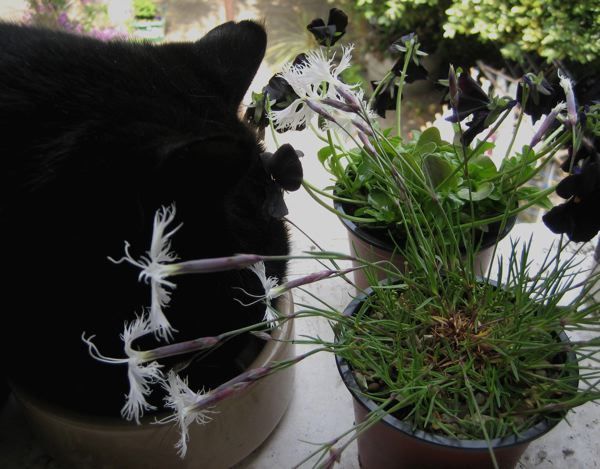
This week I accompanied my neighbour to the market early to buy plants for his garden and help him carry them back to Spitalfields, but although we were laden with Lupins, Poppies, Pelargoniums and Clematis, I could not resist buying something for myself. So I acquired these two Alpine curiosities for just £3,Dianthus (Squarrosus Nanus) and Viola (Molly Sanderson).
My garden is full of colourful flowers now, but I chose this monochrome combination of a tiny white Carnation and black Viola to place on my kitchen window sill next to Mr Pussy’s drinking dish, where I can admire them at close quarters each day. When the temperature rises, it suits my cat to sit here on the sill, enjoying the cool breeze through the old house and lapping up fresh water. The white Carnation makes a fine contrast with his black hair while the black Viola almost matches the sable tones of his silky coat.
Meanwhile in my garden, the Foxgloves I planted last Autumn create a fine parade up my path, while the Aquilegias I bought earlier this year have turned out to be an unusual double variety, of magnificently layered spiky petals in deep purple, violet and blue tones. Finally, one of several varieties of Astrantia, that I planted over the Winter, has come into bloom. It is a favourite plant in my garden, at this favoured time of the year, when all is fresh and green, with flowers opening and the promise of many more blooms to come throughout the long Summer ahead.

Aquilegia

Digitalis

Astrantia

Aquilegia
Adam Dant, Artist

This is Adam Dant standing in Boundary Passage, just off Shoreditch High St, with his hands placed protectively upon two Napoleonic cannons from the Battle of Trafalgar which are set into the pavement here to serve as bollards. Adam explained to me that each one has a cannon ball welded into the top and these trophies became the model when more bollards were required. Replicas were cast in different sizes and proportions, and today they are to be seen everywhere in London, yet among all the hundreds that line our city streets, these two are special because they are the real thing, though I wonder if anyone who walks through Boundary Passage today is aware that these are spoils of war.
Adam, who lives and works nearby in Club Row, specialises in the arcane and amazing, producing all kinds of ephemera, drawings and prints that exist somewhere between satires and celebrations. His subject is the diverse absurdity of culture and history. It is not Nonsense exactly, but Adam delights in serious craziness that pokes fun at our contemporary media by proposing charismatically strange alternative perspectives. He came here to this corner of Shoreditch fifteen years ago, wishing to be within proximity of printers, not just for practicalities’ sake but because he has great affection for the culture of small-time old-school printers, as he recalled fondly,“There were a lot in Redchurch St then, I used to get plates made at ‘Holywells’, they used to make bromides too. ‘Foremost Grinding’ next door used to sharpen the blades for guillotines and there was the ‘Old Nichol Press’ where I could typesetting done.”
Visiting Adam in his beautiful studio on two floors of a tiny old workshop in Club Row, I walked straight in off the street, passing through a battered cane blind, to discover a scruffy yet cosy little room with a fireplace at one end and a drawing board that filled the entire wall at the other. All conveniently illuminated by the morning sun through the wall of translucent glass that comprised the street frontage. In one corner was a narrow desk, beneath a steep staircase, and at the centre of the room, floored with boards at eccentric angles, sat a small couch with a low table piled with history and art books. As I sat down, I cast my eyes up at the appealingly garish painting on the ceiling, hand painted to look like wallpaper that looked like nineteenth century plasterwork.
I felt I met a kindred spirit in Adam Dant because for five years he published a daily newspaper under a pseudonym, “Donald Parsnips’ Daily Journal” in an edition of a hundred copies that he distributed free each day. “I was making lots of pamphlets and maps and handbills at the time, I think I was impressed by the history of the City of London, especially the birth of the press and the unfettered pamphleteering tradition. I got up at six each day and used the available time before I left for work to write it, so if I got up late it looked a bit scrappy. I printed them at Frank’s photocopy shop in the Bethnal Green Rd and I’d hand them out as I walked between here and Agnews in Bond St, where I worked at the time. This was before all the free newspapers. It was the strategy of the fine artist, confounding people with preposterousness.” Quickly, Donald Parsnips took on a life of his own as Adam was invited to recreate the project in Berlin, Paris, New York and Cairo – where he produced a special edition written by hand on papyrus leaves.
The purpose of my visit was to ask about Adam’s print “The New Street Cries of Spittelfields, shewing a small selection of the local trade and life with their respective cries, barks and toutage, for the benefit of the curious visitors.” He showed me the oldest print of “The Cries of London” dated 1660 recording the cries of the street hawkers of the city, apparently inspired by an earlier French version, and a set of playing cards of London cries from 1745, before he unfurled his print, based upon his own observation of contemporary life in Spitalfields. I realised what a gift this notion was for an artist because the street life of Spitalfields remains vivid today, even if the trades would be unrecognisable to our predecessors.
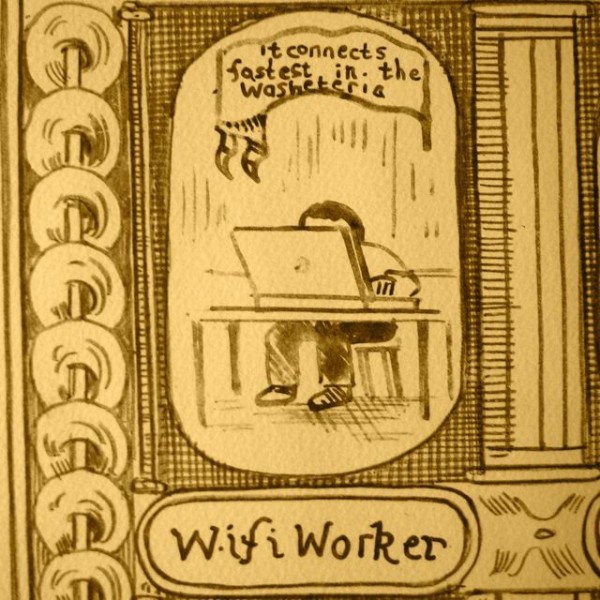
Here in Adam’s print you will find, The Wifi Worker, The Japanese Hairscruffer, The Pizza Leafleteer, The DVD Hawker, The Belly Piercer, The Hen-night Girl, The Phone Unlocker, The Internet Cafe Man, The Cause Braceleter, The Loft Mouse, The Night Trolleymen, The Wedding Videoer, The Late Postie, The Shirt Shredder and The Bendy Bussenger.
There is an undeniable romance to the illustrations of the street cries of old London whereas Adam’s print is inflected with a different spirit, that of his own gentle satire. He made the print in 2005, but now that we no longer see so many hen nights in Spitalfields and the bendy buses are being taken off the road, the world has already moved on. I have no doubt that it will be only a few more years before people look at Adam Dant’s print of “The New Street Cries of Spittelfields” with its border of bagels, and sigh for the lost days of DVD Hawkers and Wifi Workers.
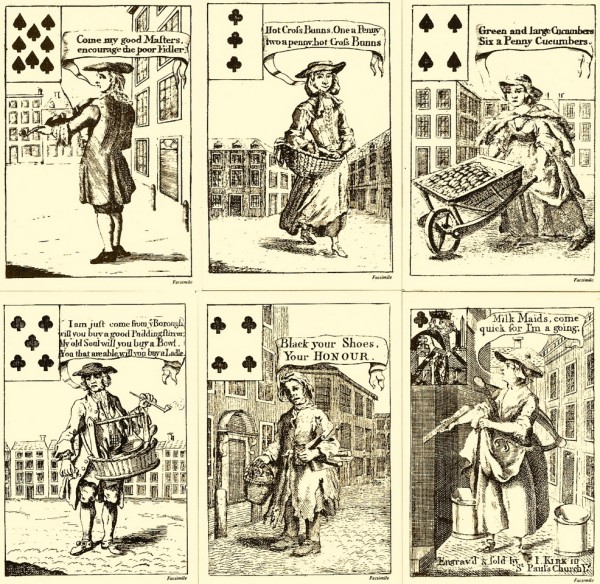
Cries of London 1754
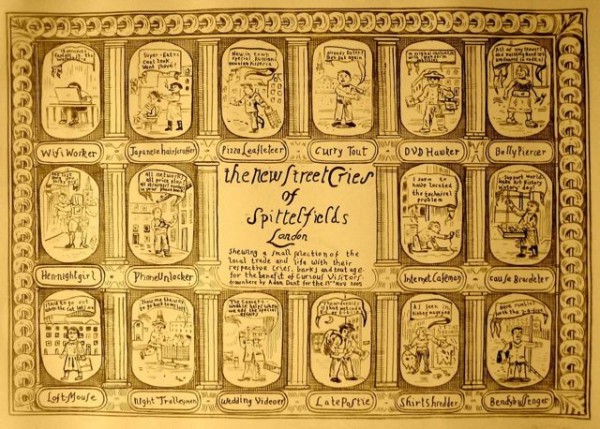
The New Street Cries of Spittelfields 2005



The Door To Shakespeare’s London

Ever since I wrote about the Shakespearian actors in Shoreditch, I have been wondering if there is anything left in the neighbourhood from Shakespeare’s time when his plays were performed here at “The Theatre” and “The Curtain Theatre” in Curtain Road at the end of the sixteenth century. The Norman church of St Leonard’s Shoreditch that Shakespeare knew was demolished in the early eighteenth century but I heard a story that a door from the church had been preserved, a door that Shakespeare could have walked through.
When I spoke to the Reverend Paul Turp, he confirmed that the new church had reused much of the material from the earlier building and that the paving of the portico included twelfth century stone. In fact, he believes that the current building was constructed using the floor of the Norman church as its foundation, and the tombs of the Shakespearian actors are buried down below, just waiting to be rediscovered. My enquiry became the premise for an exploration, and when I met the beguiling Rev Turp on the steps of the church, he handed over a flashlight, a single gesture that filled me immense anticipation.
Standing there on the porch in the afternoon sunlight, the Rev Turp began by conjuring a picture of the moment the Roman army arrived on the other side of the road to secure a source of fresh water. This was the wellspring of the River Wallbrook at the junction of Shoreditch High St and Old St. From a camp here at the crossroads, the Roman army controlled England and Wales. The road West led to Bath, the road North led to York, the road East to Colchester and the road South to Chichester. When I heard this I realised that Old St truly is an old street.
The Anglo-Saxon word “suer,” meaning stream, gave the neighbourhood its name “Shoreditch,” and it was this stream that undermined the old church, leading to its demolition. Even after the building of George Dance the Elder’s church in 1740, there were problems with flooding and the ground level was built up to counter this. Only the top three steps out of the ten at the front of the church are visible now, the rest are underground. Similarly, the lower crypt was filled to stabilise the structure, which is very frustrating for the Rev Turp because he believes that the floor of the lower crypt is the floor of the Norman church, where the tombs of the Shakespearian actors are. This is the floor that William Shakespeare walked upon, whenever he came for services, weddings of his fellow actors, or when his brother Edmond‘s son was buried here in 1607.
As I stood in the depths of the crypt with the Rev Turp, beneath a dusty brick vault, peering down to the mysterious lower vault that has been filled in, the physical space came to manifest the distance between us and Shakespeare’s world. The Rev Turp wants to excavate through the layers of rubble and human remains to reach it. “If I can find a stone with the name Burbage on it then I shall be satisfied” he confessed, referring to the joiner James Burbage who built the first theatre in Shoreditch and his son Richard who was the first actor to play Romeo, Hamlet and Richard III.
We were standing in the underworld of the imagination, it was packed with the dead, though just a fraction of the more than seventy-six thousand buried at this site. We peered deep into small family vaults on each side, where piles of coffins had collapsed upon each other, broken open over time, creating a mishmash of bones. Many coffins were discovered to have been filled with bricks, indicating the undertakers had sold off the bodies before burial – though fortunately the families of the dead were none the wiser. We gazed through a large central vault where, beneath a surface that resembled dunes, countless layers of coffins were stacked up yet broken in upon each other to create a morass of unknown depth. Under the porch, on a level with corners of lead coffins sticking out from the surface, we were literally walking upon the dead. The Rev Turp told me tests were done to check whether the remains of those that died of smallpox still presented any risk of infection today, and I was reassured to learn that although the virus was present, it was inert.
In the crypt, I was confronted with the great number of dead that exist between us and Shakespeare’s world, when I had just wanted to walk through a door and be there. So I asked the Rev Turp about the surviving door from the earlier church and, leading me back from the depths, he took me to the Clerk’s House facing Shoreditch High St, which has the door in question built into it. Maybe it was the experience of the crypt, but as I walked through the churchyard, wiping the sinister dust off my hands and relieved to be out in the air, I thought of lines from Romeo & Juliet (first performed at The Curtain Theatre). Mortally injured, Mercutio says of his wound, “tis not so deep as a well, nor so wide as a church-door; but ’tis enough, ’twill serve. Ask for me tomorrow, and you shall find me a grave man.”
Once I saw the old door, I was disappointed at first, though I tried to hide it from the Rev Turp. The door was tall and narrow, with panels that appeared eighteenth or nineteenth century in style, not the wide medieval church door I had envisaged. The Rev Turp explained it was from a side entrance, but I began to wonder. Not only were there two layers of railings between me and the door – which was locked – but even if I was able to walk through it, could I accept that this door that was around in Shakespeare’s time? Then something unexpected happened, by chance the resident of the Clerk’s House arrived home at that moment and, without thinking twice, I leant through the railings to ask if I could see the reverse of the door. He said “Yes. Come in.” So, leaving the Rev Turp standing, I ran out of the churchyard gate and into the gate of the Clerk’s House – and through the door.
At once, I could see from the back of the door that it was ancient, with primitive iron hinges, and acceptably medieval in its robust contruction. Then my host showed me old panelling, also incorporated into the building, at the top of the stairs, of proportion and construction that was of the renaissance or earlier. Now I was persuaded of the history of the door and, as I stood to take my picture, looking out from behind the portal to Shakespeare’s London, a black cat ran down the stairs and out of the door, turning to look back at me, as if in confirmation of my good luck at this discovery.

The Clerk’s House

The enigmatic doorway

Beneath Shoreditch Church.

Stacks of coffins collapsed upon each other and broken open.

Tudor stocks and whipping post in the entrance to Shoreditch Church. “Every church should have one!”says the Rev Turp.
Spitalfields Antiques Market 10

This is the charming Ellemay Simmons from Sutton, who becomes more interesting the more you speak with her. “My roof is choca’ with mannequins,” Ellemay admitted after we had been chatting for five minutes, bringing out her favourite piece from beneath the stall – where she kept it secreted from customers against the unfortunate possibility that anyone should buy it – revealing a fine mustachioed nineteen twenties marionette head she discovered in a Paris flea market. “I like bizarre heads,” Ellemay confided by way of explanation, showing me a Punch & Judy head by way of distraction, while she stowed the cherished head safely in its bag again. Only here off & on, Ellemay likes to keep her collection to herself.

This is Alan & Marion Young, pictured on Alan’s seventieth birthday. “I love people,” explained Alan who has been a dealer for over thirty years, “You meet so many people from every walk of life – from those who can only afford a small thing for fifty pence to those who will buy something for two thousand pounds. I’m retired but I still do it because I love it.” In passing, Alan mentioned that in 2005, he & Marion had saved enough to redecorate their home and shop in Deptford, but when the tsunami hit Sri Lanka they decided to use the money to fly to Colombo, hire vans, buy water and drive to the Tamil country to distribute it to sixty-five thousand people personally. I do hope someone made Alan a cake for his seventieth birthday.

This is Tom who works for Heather, a specialist in sixties and seventies clothing. “She loves her clothes, she’s lucky, she can wear anything and look good,” Tom explained, conjuring a sketch of the fabulously stylish Heather. “We’ve had Twiggy here, she’s let go of her sixties’ clothes but now she’s buying again, and Boy George used to buy things from us for his shows.” he revealed in a matter of fact tone, indicative of his professional detachment from the glamorous world he presides over, on behalf of Heather. I asked Tom if it was a problem not having a changing room, but he dismissed this notion robustly, “I’ve had ladies standing in just their knickers, they don’t care.” he declared.
Photographs copyright © Jeremy Freedman












