The Return of Aubrey Silkoff
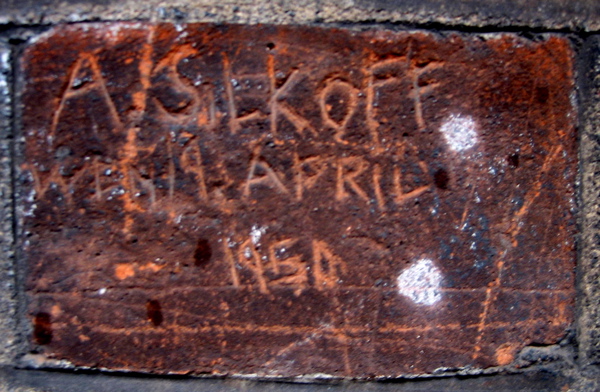
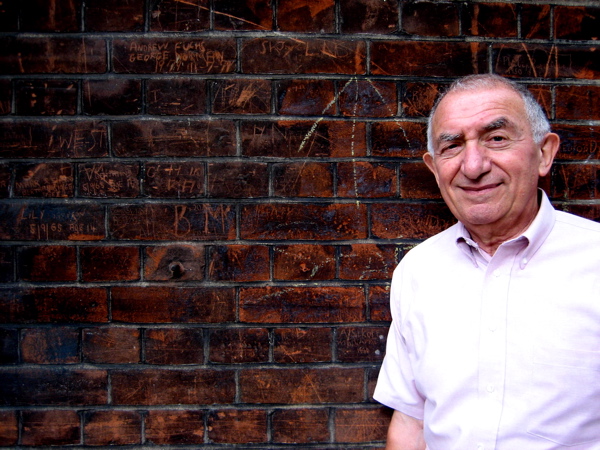
Today Aubrey Silkoff returned to Navarre St, Arnold Circus, to see the brick where he incised his name on the nineteenth of April 1950, when he was eleven years old – you can see it just to the left of his upper arm in the photo above. When I first spoke with Aubrey over the phone, he admitted that he had no memory of carving it, although he confirmed that he grew up here in Laleham Buildings on the Boundary Estate and Navarre St was where he played football as a child.
Fortunately for us, 1950 was also the year of the photo craze when Aubrey and his pals acquired cameras and were able develop their pictures at the Boys Club at Virginia Rd School. As a consequence, we have a photographic record to show us some of the children who wrote their names on the wall of Wargrave Buildings at that time. Capturing the spirit and energy of a fleeting moment, these pictures allow us to put faces to the names incised on the bricks, vividly evoking the childhood world of over half a century ago which produced graffiti of such unlikely longevity. Recalling Bert Hardy’s photographs of East End children on the street, what makes these exuberant images special is that they were taken by the children themselves.
As we walked down Navarre St together, I had the strange experience of introducing Aubrey to his long forgotten graffiti. “It was something to do while we talked,” said Aubrey, explaining that he and his pals used nails from the wooden scooters they constructed to roam as far as the bombsites in the City and around St Pauls. Yet although Aubrey recognised a few names when he saw them on the wall and even matched some up to the pictures, together we confronted the limit of his fragmentary memory after so many years.“I wonder what life held for them?” he said quietly, contemplating the names on the wall, as we stood in the empty street lined with parked cars, that once echoed to the noise and shouting of children playing.
“The streets were clear of vehicles, except maybe the odd coal wagon or a fruiterer with a horse and cart. There were few cars because no-one could afford one and, if someone bought one, they took all the kids for a ride in it as a novelty.” Aubrey told me, explaining how, as children, they had possession of the streets for their playground, using cans, or laying down jumpers or coats in the road, to create goalposts.
“We were a group of kids that used to know each other and spend all our time together in the streets because the flats were not conducive to living in. There was no space for us inside, so we used to be outside, swinging on the railings at the corner of Navarre St and Arnold Circus. We didn’t know anything about girls. The boys had nothing to do with girls. Half the kids were Jewish but there was no conscious decision to mix with your own kind, although I think we gravitated together because we considered ourselves outsiders. Many kids had lost their fathers in the war, and they had background problems.
You didn’t know that you don’t have much money, because it was just not to be found. I had new clothes once a year. I used to have a new suit at Passover. My mother took me down to a place off Brick Lane. There were schleppers everywhere on the street – touts for tailors. I remember going back for fittings, there wasn’t much ready-made clothing available then. I was ashamed of my parents because I was born late and I thought they were old. On the day of the V.E celebrations we came down into the yard with our food on plates and our chipped enamel cups, we didn’t have china. And when the people saw them, they asked in disapproval, ‘Can we replace them?’ That was embarrassing.
I took the eleven plus exam which decided whether I would go to Grammar School or Secondary Modern which was inferior. I don’t know what happened but I never passed or failed, I went to a Central School instead. At the end of term we were called onto the stage and divided up between which schools we were going to. I cried because I didn’t go to Grammar School. It was cruel because it split friendships up. ‘What are you doing today? We’re doing Latin and logarithmic equations,’ they said, and I felt a failure because I didn’t do any of those things.
Nothing has been easy for me, exams were always hard. But I was never at the bottom and never excelled either, I was always in the heap. I was fortunate that in those post-war years there were expanding opportunities open to me, giving me an education and a career – because I had no ambition, I never looked further than my nose. Though I knew I wanted to get out of the East End because I did not want to work in a tailoring sweatshop as my father and all his friends did. As a greeting they, always asked each other, “Are you working?” because the work was seasonal, and people were out of work for long periods of time.
In 1958 I moved out to a bedsitter in Stoke Newington on my own. I learnt to look out for myself and be wary of what people are trying to put over you, and as a consequence I’ve been known as a cynical person throughout my life. But I have no regrets about any of it today because it gave me a sense of looking at the glass as half empty. I never expected anything wonderful to happen and it has. I have progressed over the years and I feel very lucky indeed.
I was interested in classical music from a very early age. One day I went over to Sadler’s Wells Theatre and offered money to buy a ticket but the kiosk person said ‘You haven’t got enough’, so this couple behind me in the queue said, ‘Do you really want to see it?’ and they bought me a ticket. That was ‘La Boheme’ – I wish I could repay that couple today.”
Contemplating the photo of himself at eleven, a crucial moment in his childhood, Aubrey pointed out the spilt food on the “scruffy” jacket and interpreted his expression as “sardonic,” while I saw self-possession and humour in his youthful visage. “I’m thinking ‘Why am I here?'” he said, rolling his eyes with a droll grin.“Now I look at all these photographs and I wonder,’Did it actually happen?'” continued Aubrey, thinking out loud. Today, when he returned to Arnold Circus, he encountered the evidence that it did happen, because sixty years later, Aubrey found his name graven into the wall on Navarre St. Aubrey Silkoff, Wed 19th April 1950.
Read my first story about the Graffiti at Arnold Circus
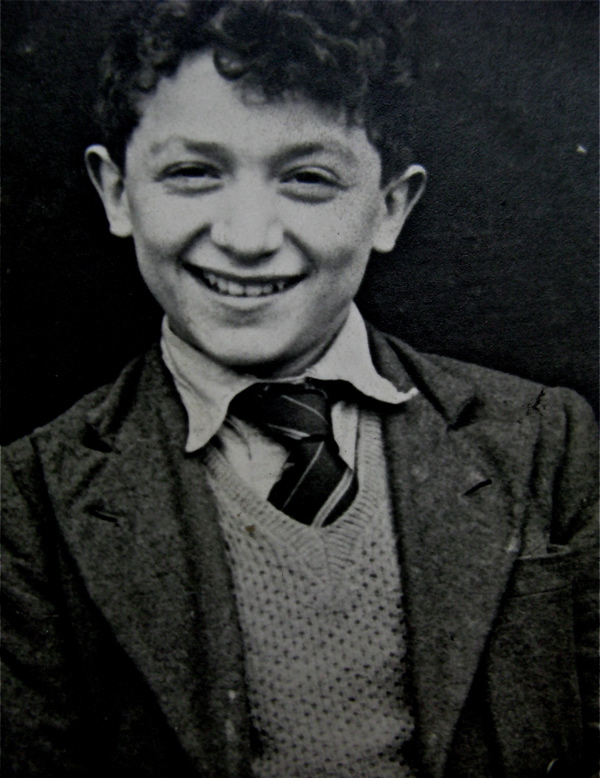
Aubrey Silkoff at the time he wrote his name on the wall of Wargrave Buildings.
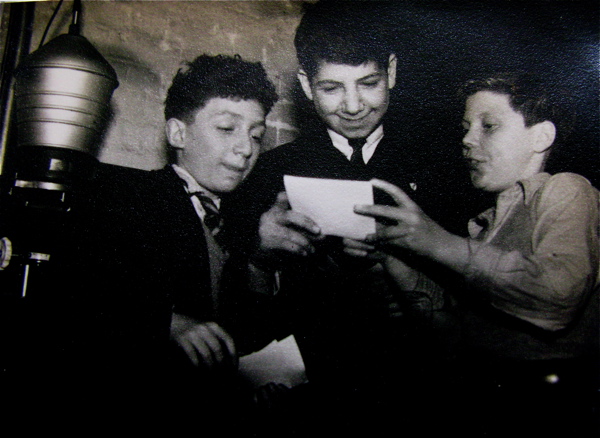
At the photographic club
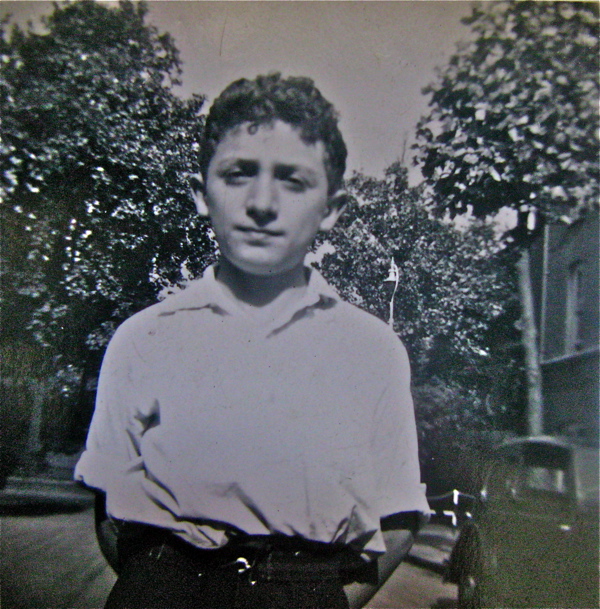
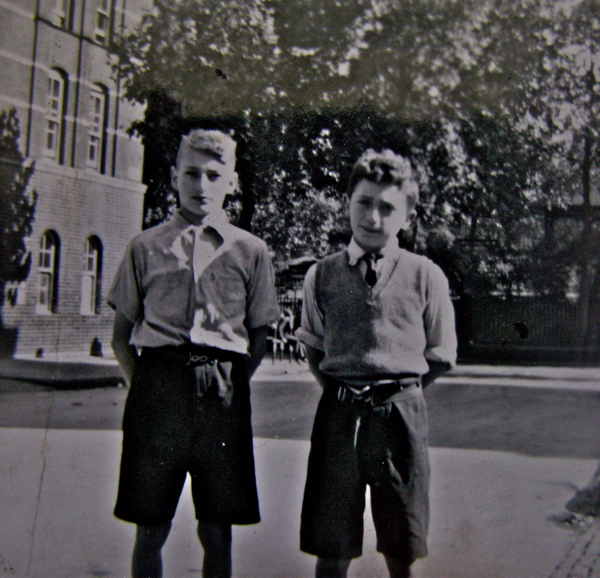
At Arnold Circus, with the bandstand visible in the background
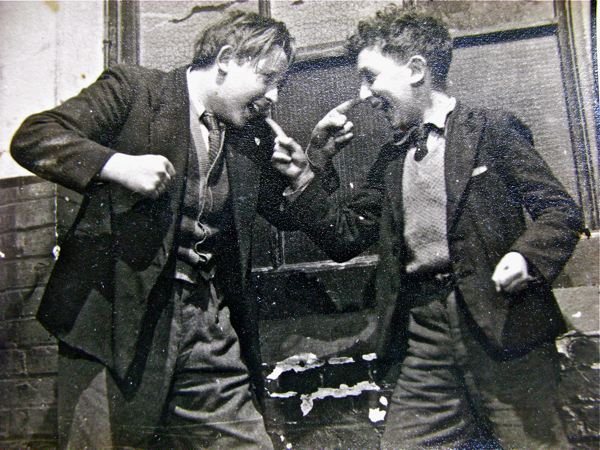
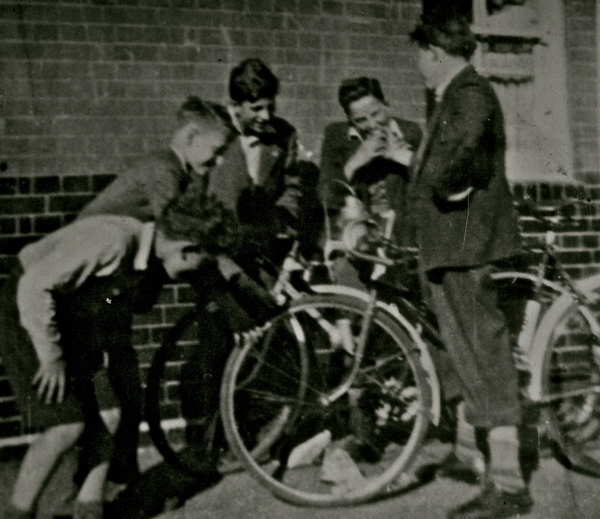
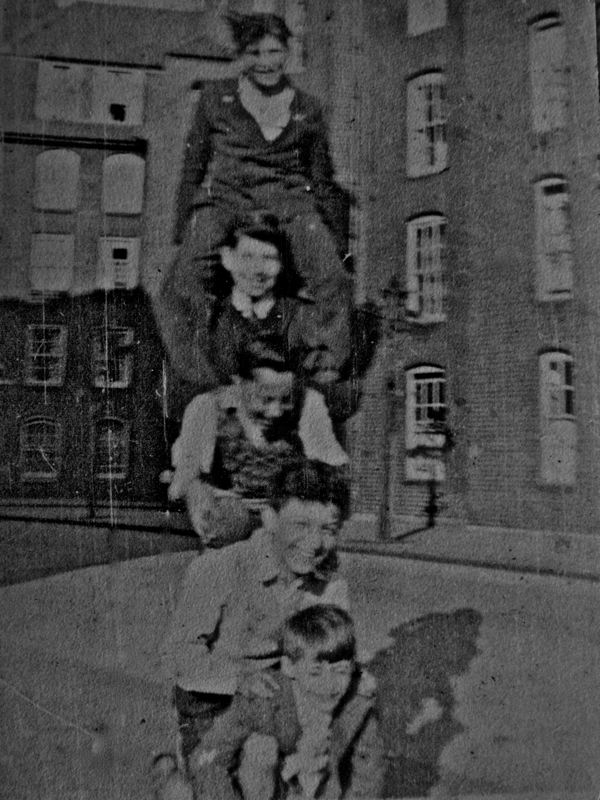
A stunt at the corner of Navarre St.
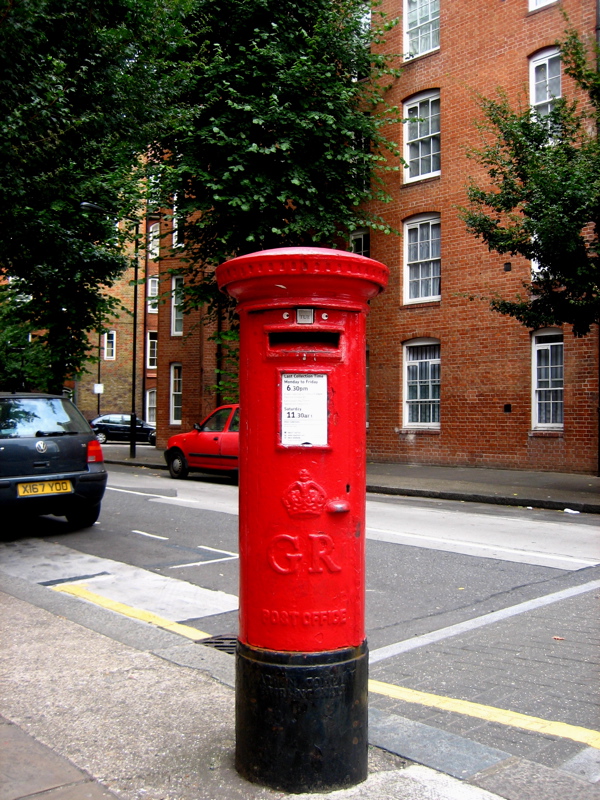
The trick revealed – this is the same pillarbox that Aubrey and his pals used in their photograph.
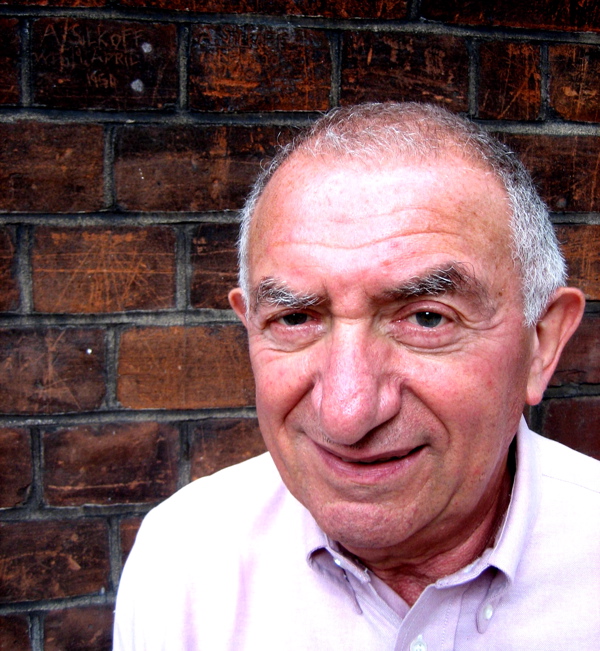
Aubrey Silkoff – with his brick in the top left corner.
Jim Howett, Designer
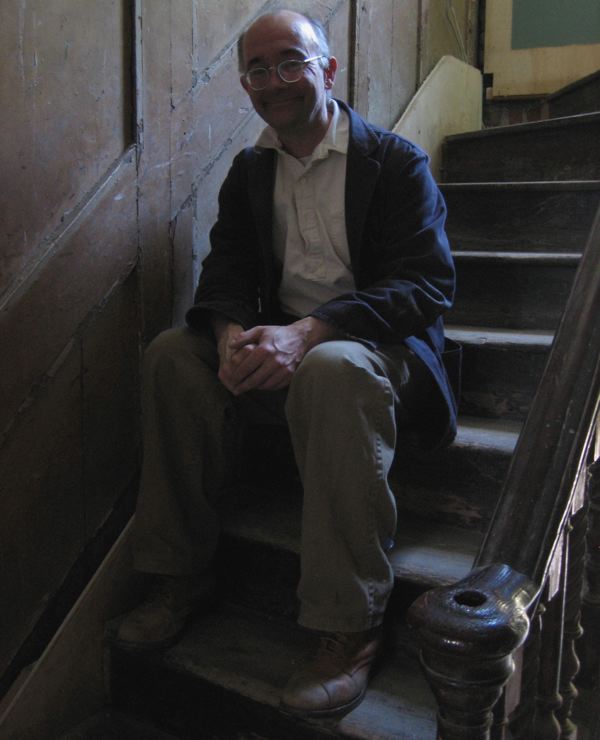
In my opinion, Jim Howett is the best dressed man in Spitalfields – pictured here with a characteristically shy smile – sitting on a seventeen twenties staircase in one of the houses in Fournier St he is currently restoring for the Spitalfields Trust. He looks entirely at home in this shabby yet elegantly proportioned old house, a specifically localised environment that over time has become his natural habitat and is now the place you are most likely to find him in East London.
For years, I admired Jim’s fine artisan clothing whenever I caught glimpses of him, always crossing Commercial St and disappearing through the market, or off down Folgate St preoccupied with some enigmatic intent. Then, last Winter we were introduced and I discovered that Jim sleeps each night in the attic at Dennis Severs’ House and crosses the market every day to work at 3 Fournier St with Marianna Kennedy, designing the furniture and lamps that are so distinctive and have become ubiquitous in the houses around Spitalfields. I also learnt Jim is responsible for a significant number of the most appealing shopfronts in the neighbourhood – though I should have guessed that the modest twill clothing he wears from head to toe and which suits him so snugly is made by Marie & Will at Old Town.
At first, I assumed Jim was Irish on account of his soft vowels and quietly spoken manner, almost whispering sometimes, even swallowing his words before he utters them, and thereby drawing your attention to listen, concentrating to gather both what is said and what is unspoken. Such is the nature of his mind that Jim will begin a sentence and then pursue a digression that leads to another and yet another – though such is the intelligence of the man, that when he leads you back to the resolution of the original thought, it acquires a more precise import on account of all the qualifications and counter arguments. Without a doubt, Jim is a consummate prose talker.
Jim’s origins lie in Ohio, in the foothills of the Appalachians, where he grew up in Salem. But Jim’s father worked in international development and in the nineteen sixties the family moved to the Congo and then his father was transferred Vietnam, with the family ending up in London in 1967. Jim studied at the Architectural Association under the tutelage of Dan Cruickshank, subsequently working for a few years in prehistoric archaeology, before deciding to study at the London College of Furniture,which was then in Commercial Rd.
Renting a room on Brick Lane, Jim dropped a card to his former tutor who wrote back to say he had just bought a house in Elder St full of broken furniture, so Jim set up a workbench in Dan’s basement to undertake the repairs. As a charismatic bachelor lacking domesticity and living in a romantically shambolic old house, Dan became a magnet for the attentions of women who always arrived bearing hampers of food – an occurrence of such regularity that as the attractive female benefactors walked through the door, Dan would simply yell down the cellar stairs, “Jim, dinner’s come!”
“Dennis Severs knocked upon the door one day, looking for Dan.” said Jim. “He said he’d just bought a house round the corner and wanted to do tours, and we thought he was crazy but we helped him set it up. I made the shutters, the partition with the arch in the dining room and I copied the fireplace from one in Princelet St.” he added, revealing the origin of his own involvement with 18 Folgate St, where today he is the sole resident. Before long, Jim was sharing a workshop with Marianna Kennedy and ceramicist Simon Pettet in Gibraltar Walk, sharing aspirations to create new work inspired by historical models and applying traditional craft skills. They found themselves at the centre of a community focussed around the restoration of the eighteenth century houses, dubbed “Neo-Georgians” by the media – a moment recorded today in the collection of magazines and photo features, illustrating the renaissance of Spitalfields, that Jim keeps in a box in his workshop.
Jim taught himself furniture making by copying a Hepplewhite chair – constructing four versions until he could get the proportion right – before he discovered that there was no market for them because dealers considered them too dangerously close to the originals as to approach fakes. Yet this irony, which was to hamper Jim’s early career as a furniture maker, served as a lesson in the significance of proportion in engaging with historical designs.
When Jim won a commission to design an armoire for Julie Christie, he thought he had found the path to success. “She gave me tip of half the value of my commission fee and I thought ‘This is as good as it gets’, but she remains the best client I ever had.” admitted Jim, wistfully recognising the severely limited market for custom-built new furniture in antique styles. “I used to make these pieces and have no money left over to buy coffee afterwards”, he declared with a shrug, even though today he has a client list that includes Bono, Paul Smith, Liv Tyler, Jeanette Winterson and Tilda Swinton – and has created an impressive range of bespoke tables, turned lamps and bronze mirrors produced in collaboration with Marianna Kennedy.
Instead, the renovation of Spitalfields gave Jim the opportunity to become one of those who has created the visual language of our streets, through his subtle approach to restoring the integrity of old shopfronts that have been damaged or altered. Perhaps the most famous are Verde & Co and A.Gold in Brushfield St, 1 & 3 Fournier St and Bedell Coram, Andrew Coram’s shop in Commercial St. In these and numerous other examples, through conscientious archival research, Jim has been responsible for retaining the quality of vernacular detail and proportion that makes this Spitalfields, rather than any other place. The beauty of Jim’s work is that these buildings now look as if they had always been like they are today.
Yet Jim is quick to emphasise that he is not an architect, explaining that his work requires both more detailed knowledge of traditional building techniques and less ego, resisting the urge to add personal embellishments. “The difference between me and architects, working on historic buildings is that I restrict myself to organising the space. I believe if a building has survived for two hundred years, it has survived because it has certain qualities. The reason, I don’t put my finger in the pie is because I can express myself in other things.”
While Jim spoke, he produced file after file of photographs, plans and maps, spreading them out upon the table in his workshop to create a huge collage of Spitalfields, whilst maintaining an extraordinary monologue of interwoven stories about the people, the place and the buildings. I was fascinated by Jim’s collection of maps, spanning the last five hundred years in Spitalfields and I realised that he carries in his mind a concrete picture of how the place has evolved. When I have seen him walking around, he is walking in awareness of all the incarnations of this small parish, the buildings that have come and gone through past centuries.
It fired my imagination when Jim took me into the cellar of 15 Fournier St, and pointed out the path across the yard belonging to the sixteenth century building that stood there before the eighteenth century house was built, telling me about the pieces of charred wood they found, because this was a site where debris was dumped after the Fire of London in 1666. Converted into a mission hall in the nineteenth century, this house is Jim’s current project, restoring it to its original ground-plan and recreating a lost eighteenth century staircase.
Simon Pettet portrayed Jim on one of his tiles as a fly on the wall, reflecting Jim’s omnipresence in Spitalfields. “I think if my father had not taken us to the Congo, I should still be there in Salem, Ohio,” confessed Jim with a weary smile, “because at heart I am a localist.” Jim showed me the missing finger on his left hand, sliced off while cutting a mitre from left to right, a mark that today he regards as the proud badge of his carpenter’s trade. In his work and through his modest personal presence, Jim has become an inextricable part of the identity of Spitalfields – after more than thirty years, I hope we may now describe him as a local.
Over coming weeks, I look forward to showing you a selection of Jim’s exemplary work, both his shopfronts and in the restoration of old buildings here in Spitalfields.
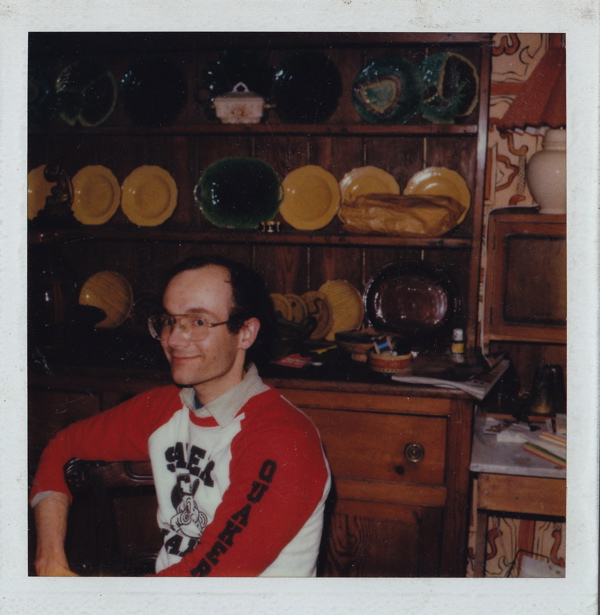
Jim at Jocasta Innes’ house in Heneage St, 1990
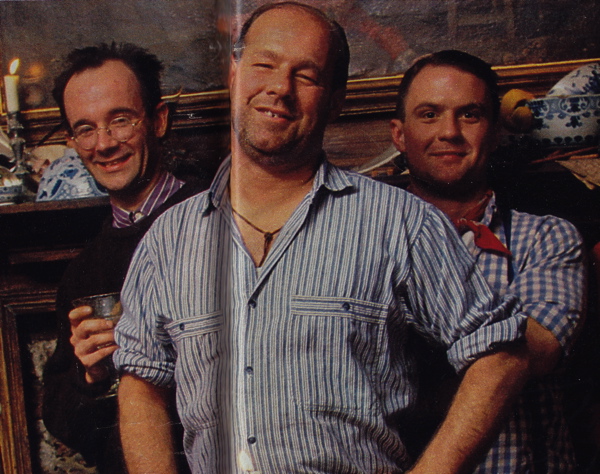
Jim with Dennis Severs and Simon Pettet, pictured in a magazine feature of 1991
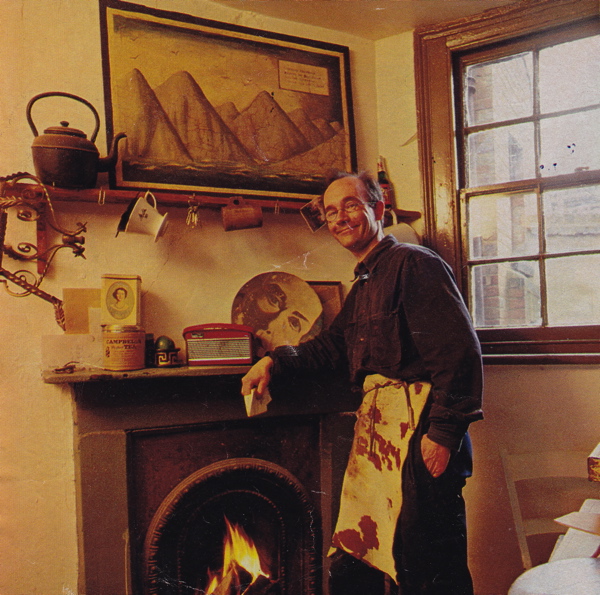
Jim modelling his calfskin apron, 1991
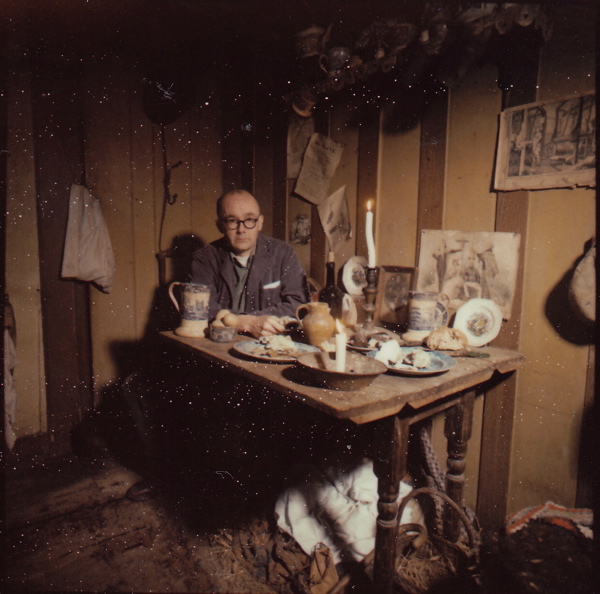
Jim pictured in the penurious weavers’ garret at Dennis Severs’ House that today is his bedroom.
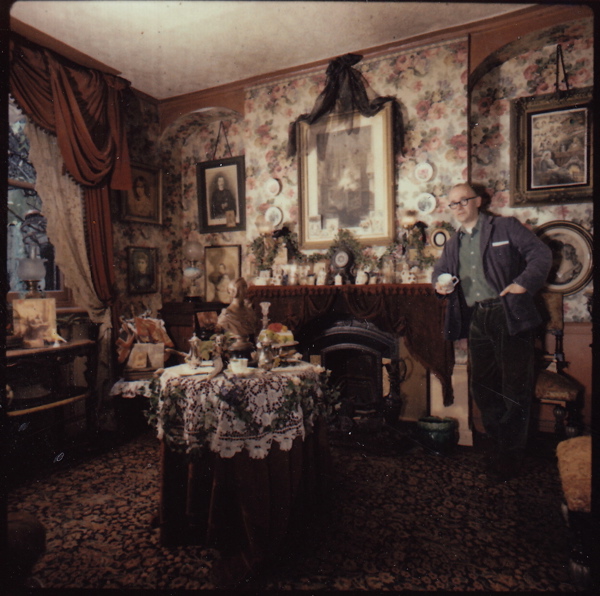
In the Victorian Parlour at Dennis Severs’ House.
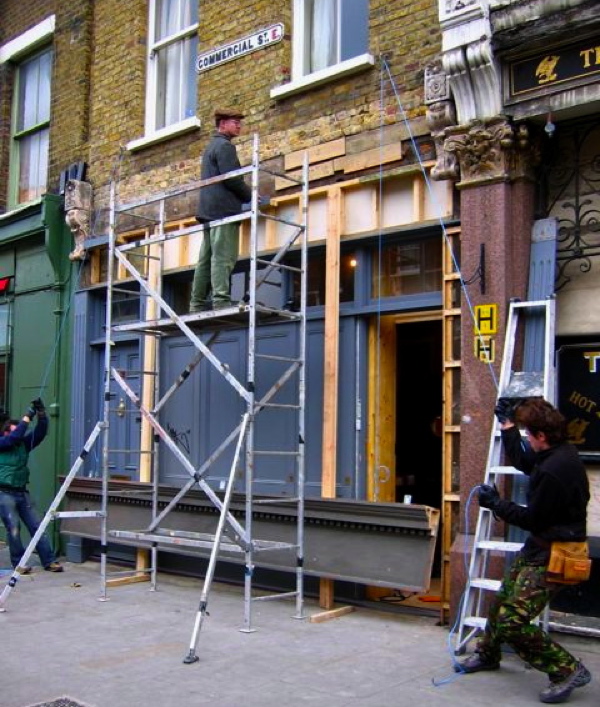
Hoisting up the new cornice at Bedell Coram in Commercial St.
Norman Phelps, Model Boat Club President
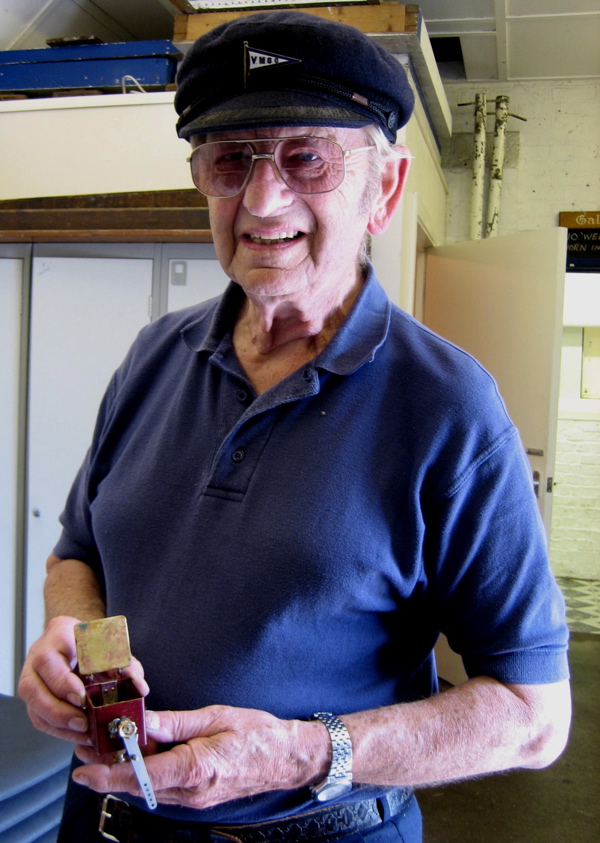
This is Norman Phelps, President of the Victoria Steam Boat Club, proudly displaying his ratchet lubricator that he made recently – just the latest example of an enthusiasm that began in 1935 when, at the age of five years, he fell into the boating lake in Victoria Park. It might have been a tragedy but instead it was the beginning of a lifetime’s involvement with model boats, and seventy-five years later, you can still find him at the lakeside on Sundays, giving the benefit of his experience to the junior members of the club.
Norman was understandably wary of speaking to me because the last time he gave an interview in 1951, he got taken for a ride by the News Chronicle. Although Norman spoke at length about the venerable club, all that got published was a souped-up account of how he courted his wife at the lake over the model boats. Seizing the opportunity to set the record straight, Norman generously sat down with me next to the boating lake last Sunday and spoke with lyrical ease.
“I was always known, not by my father’s name of Phelps, but as Watson – because my mother was famous as “Dolly Watson” on account of running the sweetshop in Rockmead Rd, where I grew up. I stayed in London all through the blitz and I saw the city burning and I saw this park blown apart, and our house was destroyed by a rocket in early 1945. Because of the bombing everyone knew everyone else. I saw neighbours dead on the pavement and I heard people crying out from beneath the wreckage of buildings where we could never dig them out. I saw the Home Guard practising with wooden rifles because we didn’t have real ones. It was crazy!
Funnily enough, I married a girl from Seweston Rd, on the other side of the park. I met her dancing at the Hackney Town Hall and because we were keen dancers and won prizes, we decided we would race model boats and see if we could win. We joined separately, but we did our courting through the club, and she won a lot of prizes and ruffled a few feathers. She’s been running boats her whole life and she still is at seventy-eight.
We got married in 1956, had our reception in the clubhouse and I was made secretary of the club at the same time. They gave us a presentation box of cutlery as a wedding present that we have today. In the early days, I supported my wife because she had such an enormous predilection to compete. She’s won so many prizes, we’ve got boxes full. If we turned up to compete, other people would say, ‘Let’s give up now!’ It was the art of straight-running. I did the designing, and she did the maintenance and cleaning. My wife was the talent, and I tended to stay in the background and be the club secretary and that was enough.
To be a great straight-runner you have to know a lot about the water and the wind, and the boat itself has to be considered too. The greatest talents in the world have competed here. So many people have gone now but I saw all the greatest exponents, like Stan Pillinger of Southampton, John Benson of Blackheath, Peter Lambert of St Albans, Jim King of Welwyn and Edgar Westbury, editor of Model Engineer. In this club we were lucky, we had pawnbrokers, jewellers, butchers, several tug skippers from the Thames – many of our members were skilled people. They didn’t have any money, so they built boats out of cocoa tins and orange boxes, producing some of the finest straight-running hulls in the club.”
Norman recognises that the flourishing of the boat club was in direct correlation with the heyday of skilled trades. He speaks passionately of the deference that existed between the members who all brought their different areas of experience and abilities to the boat club, and the culture of mutual respect that went with it, based never upon economic status but always upon skill. Tanned and lined from endless Summers on the lake, still with thick white hair and a scrawny energetic physique, he looks like a character drawn by Mervyn Peake. Possessing an eloquent tongue and a raucous laugh, Norman is engaging company too, with tender stories to tell of former members, especially his friend Bill, “even though he was a South London boy, we managed to see eye to eye.”
“So many have pegged out. I can’t get my head round it. I suppose I’m next for the chop.” he continued with a droll grimace, crossing his arms protectively. Yet Norman remains fiercely proud of the culture of the boat club and their marvellous vessels, honed to perfection over so many years. “This is still the home of straight-racing, we have the greatest talents here.” he said, indicating a pale young man in waders enjoying a quiet sandwich, who blushed readily as I was authoritatively informed he was the grandson of “a great talent”.”These skills are rare now. I spoke to the editor of Model World recently and he told me they have people ringing up because they can’t even put kits together today,” Norman declared in breathless amazement, before lowering his voice further and raising his brows to confide, “None of our members can give out their home addresses, because the boats have become too valuable and they don’t want to get turned over.”
“Who needs a computer?” asked Norman in derision, “I have a problem with the lubrication of my boat engine to solve.” But in spite of his disaffection, the contemporary world is affecting the boat club in ways that are not entirely disadvantageous, and even skills nurtured through computer games have their place here. “We have lowered the age limit for membership from twelve to ten, because nowadays ten-year olds are better with the radio controls than we are.” declared Norman proudly.
I can understand Norman’s ambivalence when he has lived through such big times, during which the Victoria Model Steamboat Club sailed on as a beacon of civility across troubled water. Its survival today as one of only two in existence (along with Blackheath), makes it all the more important as a reminder of the best of that other world, before the computer, when just a few people sat behind desks and most possessed a skilled trade that enabled them to earn their living and achieve self-respect too.
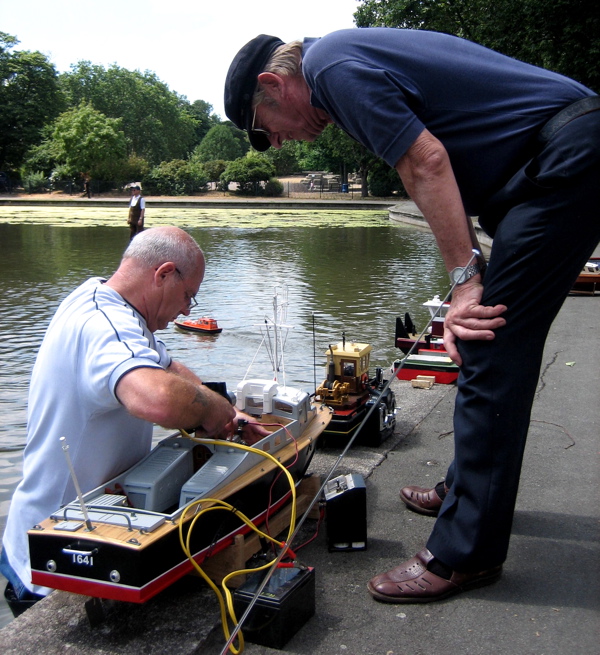
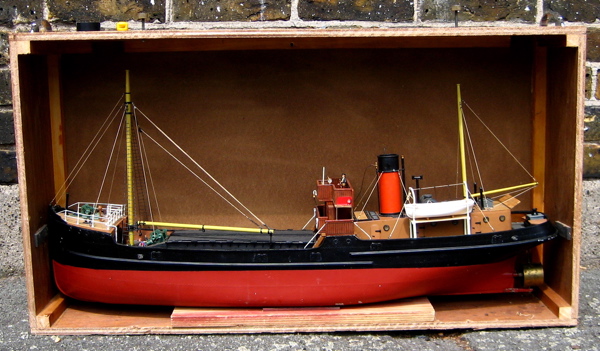
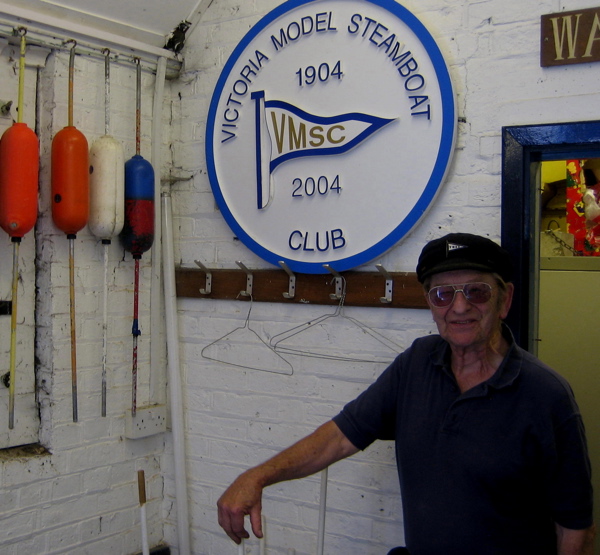
You also like to take a look at these other stories about the Victoria Model Steam Boat Club
Columbia Road Market 45
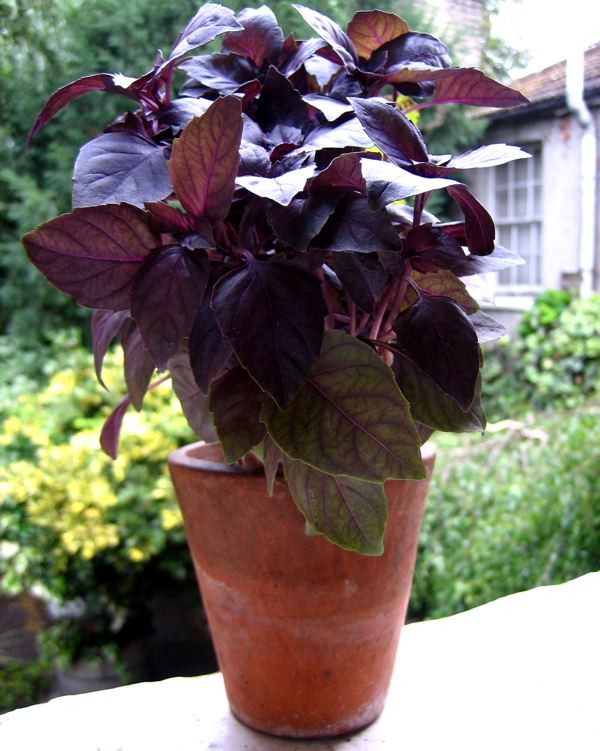
It was refreshing to walk through the early morning streets of Spitalfields in the gentle rain, which cleaned the air and the pavements, and brought out all the fragrances of the plants. I was the only customer at the market first thing and it was my privilege to have it to myself, with such breathtaking displays of colourful flowers solely for my pleasure at that time. There was a relaxed atmosphere, induced by the balmy temperatures and the arrival of the holiday season, which meant a few spaces in the market where traders had gone away, and also several sons and daughters helping out their parents on their stalls, getting inducted into the trade.
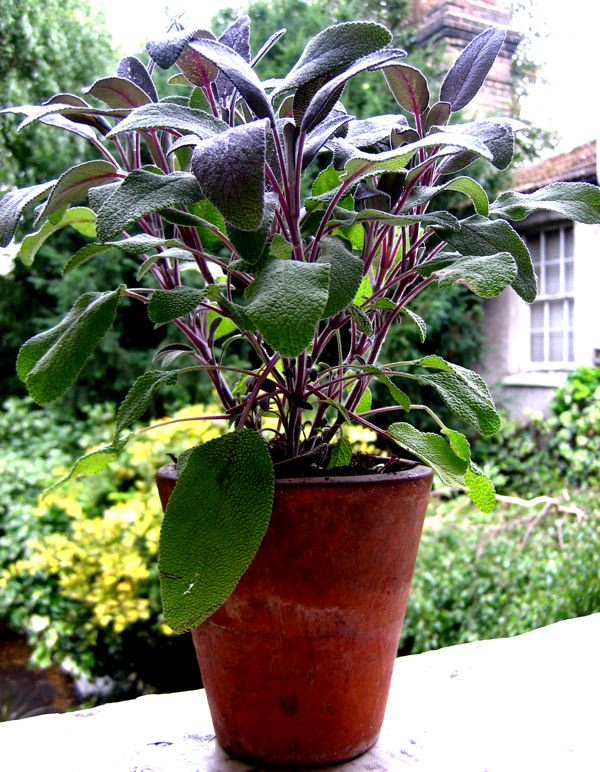
In spite of all the flowers, it was the fragrance of Sylvia’s herb stall at the corner of Ezra St that caught my attention with its delicate herbal scents released by the moisture. And upon a whim I bought these two purple herbs for just £3 the pair, a Purple Basil (Ocimum basilicum purpurascens) and a Purple Sage (Salvia officinalis purpurascens). Just brushing my finger over the leaves, sprinkled with soft rain, was sufficient to release their irresistible scents. The aesthetic of these purple herbs is exquisite, enough to convince me that they taste even more vivid than their green counterparts.
The Purple Basil will make a tasty and colourful addition to the green salads that are my staple diet at this season of the year, while I shall plant the Sage in a dry border next to a Heuchera and a Geranium with purple leaves, to add to a subtly contrasted purple patch that I am developing in a corner of my garden.
David Milne, Dennis Severs’ House
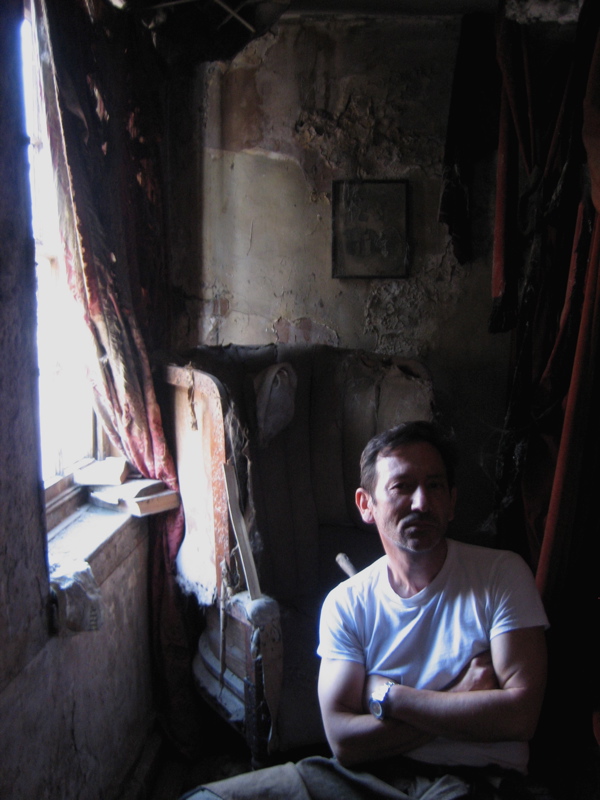
Once upon a time, David Milne used to arrange all the old things from his parents’ house in the attic of their home to create his own world of play. David is pictured here in the attic of Dennis Severs’ House in Folgate St where today, as curator of the house, it is his job to arrange things – both in the general sense of maintaining every aspect of the property and also in the specific sense of arranging all the myriad objects that fill these crowded rooms.
Yet the success of David’s arrangements renders his labour invisible, since when you come upon the artifacts occupying these rooms, everything appears to have occurred naturally in the course of the daily life of the fictional inhabitants. But very little is accidental in this house of mysteries, because everything has been arranged to tell a story, and making those arrangements is David’s tour de force and his life’s passion too.
“I think I have a good understanding of what the life of a servant must have been like, except I am the servant to an imaginary family,” David confided to me after years of cleaning and polishing. Widening his eyes significantly as he revealed his qualification, “though I am a very taxing master – because everything has to be right.” and underlining the statement with such a stern glance that I almost felt pity for him, suffering such an exacting scrupulous employer.
I recognised the glance from when David instructed me to hold silence upon my arrival at the house, when I came to visit during a public opening. It was a look of such gravity that it ensured silence reigned throughout the property, no-one dared utter a word in the face of such an authoritative visage. Yet this hauteur only serves to emphasise the unexpected radiance of his smile when you greet him off duty, because the evocation of fantasy at 18 Folgate St is a serious business and David understands his dignified responsibility to set a certain tone whilst at work. It is an onerous duty that magistrates, members of the clergy, footmen and the guards at Buckingham Palace will recognise, and one which David has perfected to an art.
David discovered 18 Folgate St in his early twenties when was exploring London by following the medieval street plan and he came upon Norton Folgate while walking up through Shoreditch. He peered through the lattice-work of the dining window and spied the baroque interior. “Spitalfields at that time was dark and faded, as if the eighteenth century inhabitants had simply locked their doors and gone, and because I had seen into one of the houses, my imagination created the stories in all the others.” he told me, recalling the moment with delight.
With characteristic rigor, David decided that he would never pay to visit the house, because he knew at once that his involvement had to be more than a tour. Fortuitously, years later, he was invited to a party in the East End and found himself back outside 18 Folgate St. As he explained to me, “I came into this house, walked up to the first floor where Dennis Severs was sitting in the Smoking Room holding court with his circle of friends, and I asked him, ‘Whose house is it?’ and he said, ‘It’s mine!’ And from that moment we were friends, speaking on the telephone every day until two weeks before his death. I never came to this house to strip it down, I never asked questions, I never asked ‘Why?’ I just accepted it as his beautiful creation.”
David lives in a tiny modern flat built upon the roof of a Victorian stucco mansion block in Earls Court, that he has furnished with seventeenth century furniture and lit entirely by candlelight – like a cabinet of curiosities – existing in a manner that is completely in tune with the ambience of Folgate St. “When you live with candlelight, you learn how to use it.” David told me, “You don’t arrange your candles evenly in the room and all at the same height, as people commonly do. You place them strategically. For example, in the kitchen here, there is a low candle on the table where the cook was studying a recipe book. I like to place things together in the manner of ‘still life’ and I love the light of seventeenth century paintings, you see it everywhere in this house.”
I realised how unusual it was for David to sit and talk, because his job consists primarily of housework, revealed by the long apron that is his professional uniform. All four storeys, staircases and rooms, are cleaned twice a week, the silver, brass and copper are polished every fortnight, floors and furniture are waxed annually, bed and table linen are laundered and starched regularly, and dusting is a continuous activity. Additionally, the food is prepared daily, with the master’s breakfast cooked every morning, and tea and coffee freshly brewed. It takes all day, while the house is closed, to prepare it to open for visitors, because even maintaining imaginary inhabitants in the patina to which they have become accustomed takes a lot of work.
As with Mick Pedroli, house manager, David Milne’s involvement in the house is personal, rooted in his friendship with Dennis Severs, which ultimately led to his lifelong commitment to the vision which the house manifests. “I used to come and stay regularly, and Dennis and I used to play together, cooking meals and taking photographs. I spent twelve Christmases in this house. When Dennis died, I decided to step up and take on the house because it needed people who understand it. Now I am waiting for the right person to walk through the door, one day, who can do my job.” said David, getting lost in thought, gazing fondly around the artfully dilapidated Dickensian attic where he stayed when he first came to visit for weekends at Dennis Severs’ extraordinary house so many years ago, “It’s a story that’s never-ending.”
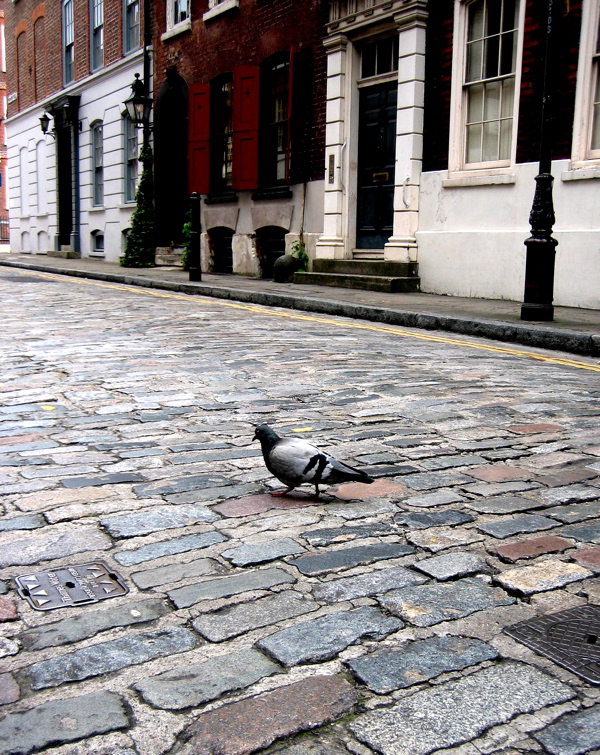
You may like to read my other stories about Dennis Severs’ house
Niki Cleovoulou, dress designer

Niki has always been a perfectionist, since she first learnt sewing and pattern cutting in Cyprus before coming to London at the age of thirteen in 1959. “I could never pass any faults. I don’t care about the money, I don’t care about the time, I don’t care about the trouble, so long as I can do something good for the customer, then I can be happy.” she declared with a grin of satisfaction, speaking of her work today as a designer and maker of haute couture gowns for special occasions – in plain words, a traditional dressmaker.
“I couldn’t go to school because of the war in Famagousta,” revealed Niki regretfully, giving the reason for her journey across Europe in her early teens, leaving the village of Styllous to live with her brothers in Neasden, who were students at that time.“Within three days they took me to the factory in the West End where my older sisters worked. I was a machinist, making skirts for ladies’ suits.” she told me. And so Nikki’s working life in London commenced, and the photograph above serves to illustrate this time eloquently, revealing Niki as a poised young woman of modest temperament, full of life and anticipation at the possibilities of existence.
In those days, Niki’s godfather Sophocles came regularly to the Spitalfields Market to buy fruit and vegetables, and he always got his hair cut by a young bachelor Kyriacos Cleovoulou at the salon in Puma Court. It was a chance meeting that was to decide the course of Niki’s life, because their respective families decided to put Niki and Kyriacos together. “They came over to see my family in Neasden. It was very difficult for us to go outside or even be alone,” admitted Niki, rolling her eyes with a blush and a shrug, “It was arranged, we got engaged within two or three weeks and married three months later.”
“We came to live here in Spitalfields in 1970, but the building had to be fixed up because it was in a poor state and we did the salon first. I remember the men with barrows of fruit and vegetables running around shouting at four in the morning, and people going to cafes for breakfast early. You could do your shopping at dawn. It was very friendly, like a family. My husband used to go and buy boxes of fruit, he knew everyone and they knew him because they all came here for haircuts! He used to open very early in those days.
A year after we were married, we went to Cyprus together for two months and when we came back he stopped cutting hair and worked with me in the factory, where I taught him how to sew trousers. But then the factory burned down, so my husband went back to hairdressing, ‘Hairdressers always have money in their pocket.’ he used to say, because he never had to wait until pay-day as other professions did. He set up a sink and all he needed was a comb and scissors to earn money.”
Although Niki held great affection for the sociable life and community that she encountered living in proximity to the market, she was less enthusiastic about the living conditions in the tiny rooms above the salon in Puma Court where she brought up her two young sons George and Panayiotis, while still doing sewing from home. “It was very difficult, there was no bathroom – so my husband fixed one up in the hallway and we had a kitchen at the back.” she confided, thankful that within five years they were able to buy a house in Palmer’s Green and Kyriacos could commute on the train to Liverpool St each day.
Throughout all these years, Niki earned money through her sewing and yet, as she confessed to me, she was secretly frustrated because she never got to design dresses as she had always wished, “I was doing my dress designs but only for the people that knew me. I thought, ‘If only, if only everyone knew what I could do, I could make a dress for the Queen’ – I had so much confidence in myself and my gift.” Niki never gave up her ambition and, even though she was qualified in pattern cutting in Cyprus, she achieved a City & Guilds’ Diploma that qualified her in this country too. Then, just ten years ago, working in partnership with her daughter Stavroulla (widely known as Renee) she created Nicolerenee, making bespoke wedding dresses and gowns for special occasions, working from the old family premises in Puma Court.
My conversation with Niki took place over a cup of tea in a quiet corner of Cleo’s Barber Shop, the salon where her husband Kyriacos began cutting hair in 1962 – where her godfather Sophocles came for a haircut in 1969 and discovered that Kyriacos the barber was an eligible bachelor. It is a location charged with powerfully emotional resonance for Niki and now, five years after Kyriacos’ death, their three children, Panayiotis, George and Stavroulla have reopened the barber shop, continuing the tradition for a second generation. When the time came for Niki’s portrait, we walked through to the premises next door, once derelict, now a showroom full of elegant silken gowns arrayed upon rails, all examples of Niki’s talent and expertise. Here Niki took out a favourite pink dress, full of proud memories, that she made for herself and wore frequently in the nineteen sixties, still in immaculate condition today.
This is a story that shows how external events can affect a life, sending Niki from Cyprus to London and from Neasden to Spitalfields, while equally illustrating the power of resolute self-belief to overcome obstacles. As Niki confirmed when she held up the dress in triumph, cast her eyes around the rails of dresses filling the tiny shop and said with a gleeful smile, “In the end all my wishes have come true, because I have the shop here today with my daughter, and I am a very happy person, especially when I can talk about my work!”

Niki on a visit to her childhood home in Styllous, Famagousta, Cyprus in 1966

Niki’s father George, 1966.

Kyriacos at the Acropolis, early sixties.

Niki and Kyriacos outside St Andrew’s Church, Kentish Town on their wedding day, 1969.

Kyriacos and Niki

Cleo’s Barber Shop in Puma Court, Spitalfields, nineteen eighties.

Kyriacos stringing beans in the yard at the back of the salon between haircuts, ten years ago.
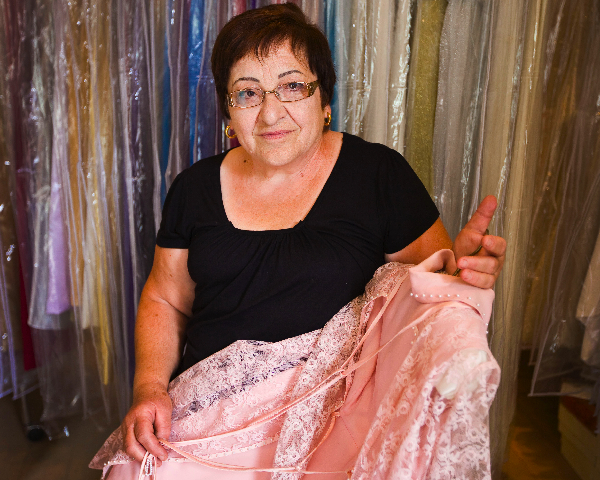
Niki Kleovoulou today.
Photograph copyright © Jeremy Freedman
You may like to read my earlier story about Cleo’s Barber Shop
Spitalfields Antiques Market 16

This is Hollie Reedy, a sassy young New Zealander who possesses an arresting knack with eyeliner and always dresses in black. “I have lots more stuff at home, but what you see is what I can carry in two black bags on the bus from the Kingsland Rd.” she enthused, while adopting a series of fashion plate postures with an endearing lack of self-consciousness. A restless nomadic spirit, Hollie confessed with an eager smile, “I used to have a shop in New Zealand, but I shut it to come here and brought the stock with me, and now I am ready to go back and start again in Auckland.” Catch this exotic migratory bird with the raven plumage before she flies off to another hemisphere.

This is my pal Bill, a dignified market stalwart who deals in coins, antique whistles, gramophone needle boxes, souvenir thimbles, magic lantern slides, trading tokens, small classical antiquities and prehistoric artifacts. “I sell quite a few things, but on a low margin because it’s more interesting to have a quick turnover.” he admitted to me, speaking frankly, “I’m here more for enjoyment really – quite a few friends I’ve made over the years. I was a shy person before, but it’s made me confident having a stall. I’ve become an optimistic person.” Bill travels from Walthamstow to Spitalfields each week with all his stock in a backpack and large suitcase – practical, economic and an incentive to sell as much as possible.

This is Barrie Reeve, a bold adventurer who scours Belgium and Holland, exploring the stranger margins of the trade – with eclectic finds such as the medical specimens and charts, chemistry jars, maps and artificial limbs you can see in the picture, which delight the bohemian tastes of his specialist customers here in Spitalfields. I especially liked the orrery on the top right with all the planets made of little wooden balls on wires turning round a tin disc, a primitive model of the grandest scheme of all. Surrounded by his marvellous discoveries, Barrie exudes a proprietory largesse, proud to share his appreciation with aficionados of the offbeat.

This is Richard Rags and his appealingly voluble son Cosmo Wise, both dressed head to toe in the clothing from the nineteen forties and earlier that is their shared passion. They cherish the extravagantly worn-out old togs your grandparents discarded, full of vibrant character and handmade details no modern garment can ever match. Cosmo really knows how to wear it and, with admirable enterprise, is now copying his most treasured finds in old fabric, to create exclusive pieces sold under his own label “De Rien.” “We are drowning in clothes, clothes dripping from the ceiling, even beds made of clothes.” he revealed with barely concealed delight, divulging the singular living conditions at their clothing warehouse in Hackney Wick.
photographs copyright © Jeremy Freedman