Who is Arnold Circus?

It is my pleasure to publish A Guide to Arthur Arnold, his Brother and his Circus by Naseem Khan of The Friends of Arnold Circus, written to celebrate the centenary of the bandstand on the Boundary Estate, Britain’s first social housing estate.
The newly renovated bandstand will be inaugurated tomorrow, Sunday 18th July, with a Sharing Picnic from 1pm, to which all are invited. Joan Rose will cutting a cake and I will be distributing a thousand copies of a free booklet containing stories from Spitalfields Life about Arnold Circus, so please come along and join the party.

Arthur Arnold didn’t look anything like this child’s version of the man behind Arnold Circus. But he did share qualities of energy and originality with the drawing. Robert Arthur Arnold was a resolute campaigner – a man who set great store by social justice and who spent much of his sixty-nine years working to improve the lives of the under-privileged in Victorian times. Arnold Circus is part of his legacy.
Looking at his track-record, you might not immediately think he was an innovator. His CV at first looks deceptively worthy – assistant commissioner under the Publlc Works Act (1863), author of a well-regarded pamphlet analysing schemes for the Thames Embankment, Liberal MP. But look a bit deeper and a man of persistent vision, a sturdy sense of commitment and a strong streak of independence of mind and unpredictability.
For this apparently solid Victorian public servant also produced two sensational novels, fought for married women’s rights at a time when they were legally subservient to their husbands, started and edited one of the first London evening newspapers, The Echo, and – when it was sold in 1877 – set off, with his wife, on a thousand-mile long trip, by horse and camel, the length and breadth of Persia.
So which is the real Arthur Arnold? Was it the pubic servant who concerned himself with decent sewers, good housing for the poor and land reform so that every farm worker could have the right to ‘three acres and a cow’? Or was it the independent-minded man who married the pioneering writer, Amelia Cole, and who in 1900 – at the height of the Empire – wrote how much he disliked the term ‘imperialist’ because ‘to me it is always suggestive of a waxed moustache’? And what did Arnold have to do with the circular gardens and bandstand at the heart of the then very new Boundary Estate?
The last one is the easiest question to answer. When the London County Council was formed in 1889 as the first all-London government, Arthur Arnold was elected as an alderman. In 1895, he became Chairman of the body and was involved in its pioneering ventures. Determined to be a progressive force, the LCC early on voted to demolish the notorious East London slums of The Old Nichol and replace them with the very first social housing estate, to be a model for good municipal government. Naming the gardens at the heart of the Boundary after Arnold was a graceful acknowledgment of his role.
It also has an element of irony, for Arnold had actually opposed the municipal housing policy since he argued that it would mean the eviction of all the most needy slum-dwellers. In this he was proved quite right. Only eleven finally became rehoused in the spanking new Boundary, as Sarah Wise’s eloquent study ‘The Blackest Streets’ documents. But for all that, it is a fitting legacy since Arnold had espoused so many of the causes that led to the development of social housing in Britain.
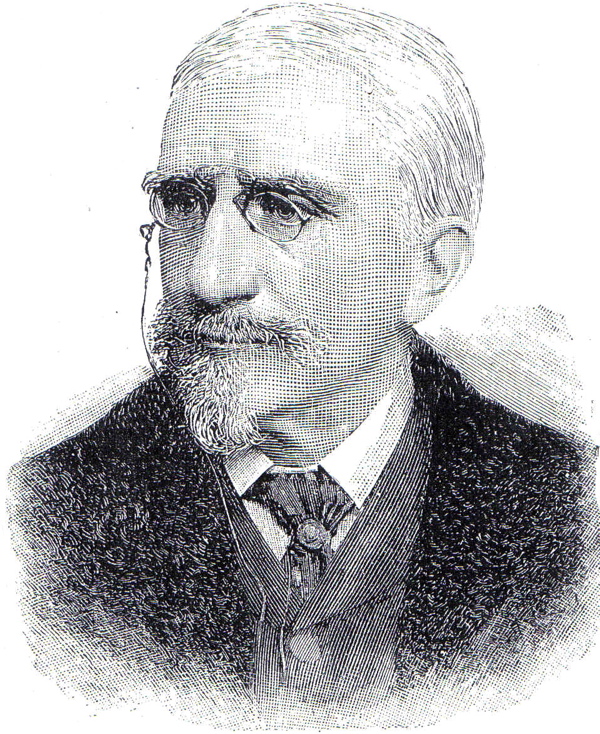 Arthur Arnold (1833-1902)
He himself had been born on May 28th 1833 to a respectable Kent family, and grew up with two brothers and three sisters in Gravesend. Unlike his older brother Edwin (born in 1832), he had no formal education since he was an ailing child. But he trained as a land agent and surveyor, moving naturally into the whole area of civic improvement that was so powerful a movement at that time.
From the start Arnold was a staunch radical. His paper, The Echo, campaigned for universal suffrage, for state ownership of the railways, Home Rule for Ireland and the disestablishment of the Church. Arnold himself had a gift for recognising young talent and hired and nurtured a number of writers who later became key journalists and editors themselves. With his wife, Amelia – daughter of the Governor of Sierra Leone – he was part of the anti-alcohol/temperance movement. When, after seven years, the paper was sold, he sought a seat in Parliament, and was finally successful in 1880 when he was elected MP for Salford.
His time in Parliament lasted five years. When he lost his seat, he turned his energies to London politics, to the new LCC and the road that led to Arnold Circus. Years of public service and a knighthood followed, with his last public engagement just a few weeks before his death of a heart attack on May 20th, 1902.
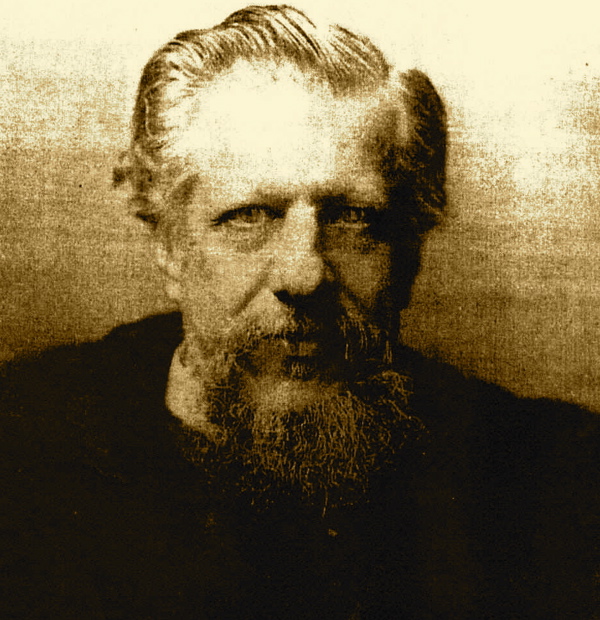
Edwin Arnold (1832-1904)
But influential as he was, it is nevertheless true that his older brother was more of a household name at the time. Edwin’s story is surprising too. Unlike Arthur, Edwin had been a brilliant scholar. From childhood up, he had won every prize going, and gone on to study at King’s College, London and then University College, Oxford, producing a poem that won the coveted Newdigate Prize.
For a short time, he taught English in Birmingham, but provincial schoolmastering was not his forte. A friend helped him gain the headship of the Deccan College in Poona/Pune and so in 1857 he set sail, with his wife and young son, for India, where he lived for four years. They were seminal years. Edwin was not an imperialist who kept himself secluded in the British enclave or cantonment. He learnt the local language, Marathi, as well as Sanskrit and Persian. He travelled, and engaged with local intellectuals: he mentored the poet Iqbal, who was a founding voice for the creation of Pakistan. And – most significantly – he made contact with Buddhism, which many years later was to lead to his fame.
But before that could occur, thirty years or so of journalism took place. Returning to England, he joined the Daily Telegraph, and was its Chief Editor for sixteen years, from 1873. It was a glorious time for the paper. It acquired such a dynamic and radical edge that the paper, that had been merely one of Fleet Street’s lesser dailies, was elevated to being the only rival to the previously unrivalled Times. Edwin Arnold himself was responsible for a number of bold commissions, amongst them sending Stanley to Africa to see if he could find the missing explorer, David Livingstone.
And then, in 1879, his life changed. He had been writing a long poem off and on, composing it, he said modestly ‘in my spare moments, being jotted down on anything that was available’. A life of the Buddha in blank verse and stretching to fifty thousand words, ‘The Light of Asia’ opened the eyes of the west to Buddhism and found its way into a huge amount of Victorian households, It was a runaway success. It went into sixty editions in Britain and even more in America where it was even dramatised on Broadway. It was turned into an opera with an Italian libretto too and performed in Paris in 1892, where George Bernard Shaw saw it and gave it a good review.
The book made him a rich man. It also earned him the Order of the White Elephant, awarded by a grateful King of Siam for ‘having made a European Buddhist speak beautifully in the most widespread language in the world.’ This award, interestingly, neatly matched his brother Arthur’s: for he had been awarded the Golden Cross of the Saviour by the King of Greece for his own sympathetic writings drawing on his travels in the Levant.
The two brothers – so alike in their vitality and determination – were born within a year of each other and died within two years of each other. Arthur and his wife, Amelia (a writer of feminist novels and eleven years his senior) had no children. Edwin on the other hand had three wives, with the first two dying before him. He married his final wife, a young Japanese woman of twenty, after meeting her in his travels through Japan.
In the year in which the Arnold Circus bandstand reaches one hundred years old, it is fitting to remember and mark not only Arthur, but also the brother to whom he was so close, for their idealism, staying power and open-minded curiosity. These are lasting values with lasting value.
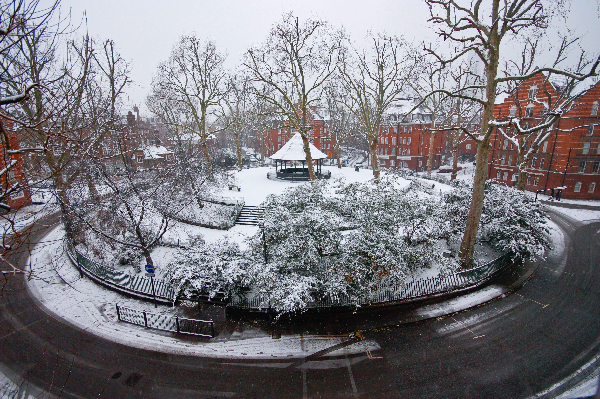
Article copyright © The Friends of Arnold Circus
Steven Berkoff at E.Pellicci

Steven Berkoff had a sausage and salad roll and I had a bacon sandwich, which we ate sitting at a table under the canopy outside E.Pellicci, while relishing the ceaseless parade of life along the Bethnal Green Rd. No-one noticed I was sitting there with one of the greatest Bond villains of all time, Orlov from “Octopussy,” although Maria Pellicci herself left the kitchen and came outside to welcome the honoured guest, who was friend of her late husband Nevio. While Steven’s reputation on stage and film is built upon energetic performances, we enjoyed a relaxed conversation illuminated just occasionally by flashes of Steven’s characteristic brilliance with language.
Meeting Steven, I was excited to be in the presence of one of the great actor-managers, in the line of Henry Irving and David Garrick. Like his predecessors, Steven knows what it means to lead a company of actors in the theatre and he has embraced the great Shakespearian roles fearlessly, and with matchless command of the stage. Yet in spite of the stature of his achievements, he is not grand at all. You are immediately aware that Steven possesses a natural authority, but it is a charismatic soulful presence, both contemplative and humorous, reflecting a vivid intellect. You know he is whirling a multitude of thoughts behind those gentle grey eyes.
Born in the East End, Steven was evacuated as a baby, returning after the war at ten years old to grow up in Anthony St, off Commercial St. “There was so much entertainment and sweetness in the Jewish working class East End that I knew. Every Sunday there’d be dancing, so you’d get to know girls and become civilized. There were a million things to do – swimming baths at Mile End, Goulston St, Victoria Park and Betts St, where I swam competitively, swimming sixty lengths every day at age eleven. I used to go to Myrdle St where there was a mixed club at the school where you could play ping-pong, and there was a man who sold sarsaparilla at tuppence a glass from a window at the top of Cannon St Row until ten o’clock at night. It tasted so good, I’d go there every other day for years. One day, this man was murdered and the police found a box of money under his bed – forty or sixty thousand pounds – he had been saving all the tuppences for forty years. They bricked up the window afterwards.
It was a ‘shtetl,’ in those streets, people leaned out to sell things from everywhere, old women sold tobacco from their windows. Hessel St was full of people shouting in Yiddish. There was a man I would pass everyday on my way to school, he said, ‘Here son, be a good boy, fetch me a can of tea and I’ll give you threepence.’ I did it each day and that was my first wages. In Whitechapel there was a stall where I started to do a little bit of work for The Pen King, a hooked nose gentile. He asked me to watch the stall while he went to Lyons Corner House next to the tube station for lunch. He trusted me and suddenly there I was running the stall. I learnt from him what theatre was, from the way he demonstrated the pens. I remember the snow in the East End in 1947 too, the worst Winter in living memory. It became like a fairy Winter Wonderland and all the broken buildings seemed like castles, covered in snow.”
When Steven described these years, the tone of his speech and the gestures he enacted for each of the people he recalled, as well as the different voices he adopted, all served to bring the whole vision alive in a moment. Blessed with a natural gift for rhetoric, Steven can unexpectedly compose long elegant sentences with big adjectives spontaneously and deliver them in the rich cadence of his actor’s voice. Always with him there is this sense of so much within, an endless source of stories and even more unspoken.
To fully appreciate his affection for this Anthony St world, you must understand that he grew up in modest conditions, specifically his family lived in “one room and a kitchen.” Yet, significantly, Steven describes the experience of being rehoused in better conditions in Manor House when he was thirteen as one of loss. These three formative years in a universe comprising a few streets South of Commercial St granted Steven a particularly humane vision of culture and society that has sustained him throughout his whole life. He learnt about the importance of trust (“trust is all you have,” he confided to me), the meaning of community and he saw the poetry in life too. My “rite of passage” he calls it today.
Steven has an instinct for spotting the phoney and pretentious, and he turns vituperative describing some new upmarket East End hostelries that, unaware of his status as an internationally known movie star, have given him the snobbish brush off, treating him as they would any other working class East Ender. “Whorehouses of mendacity” was the pertinent phrase that Steven conjured to describe them, yet he recounts these anecdotes not out of bitterness but an awareness of their exuberant absurdity. It reveals something that Steven is still vulnerable to slights, that he still identifies with people from his own background and is affronted on their behalf. He is not complacent. There is a certain magnanimity among the best actors and Steven has it in spades. He cancelled a biography because he thought it was too hagiographic. Maybe he recounted a few monologues of frustration for me so that I should not think he had lost his edge. Steven does not act the movie star, because he does not need it – because he knows something better. He is here in the East End, and he can always come along to E.Pellicci and greet Nevio Pellicci and Jukebox Jimmy and know that he is one among equals.
We parted and Steven strolled off down the Bethnal Green Rd, while I ran down to Cannon St Row to photograph the bricked up window where sarsaparilla was once sold. Imagining Steven walking around with a head full of poetry and soul full compassion, seeing flashes of the world that has gone, yet with which he retains an emotional connection, had led me to suggest he might play King Lear. But true to his astonishing vitality – looking many years younger than his age – Steven declared he wanted to play Othello and my heart missed a beat when from deep within him a booming voice spoke lines from the Moor of Venice. He is his own man and he is nobody’s fool, this is the force of nature that is Steven Berkoff.

The window in Cannon St Row where Steven delighted to buy sarsaparilla between 1947 and 1950.

All that remains of Anthony St where Steven grew up
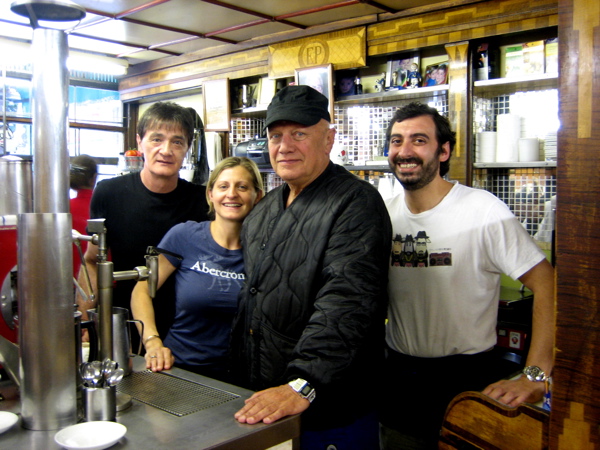
Salvatore, Anna, Steven and Nevio at Pelliccis.
Spitalfields Antiques Market 15
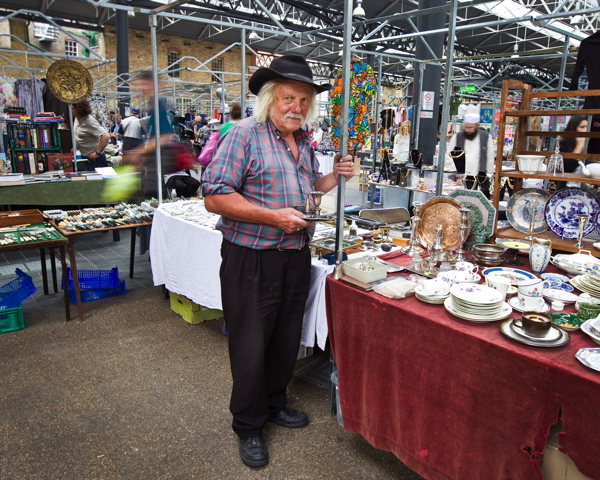
This is John the Hat, who has been dealing in silver plated cutlery and old Sheffield ware since being made redundant from his job as a bank manager in Covent Garden eighteen years ago. “It’s a living,” admitted John with a good-humoured shrug, while polishing his cherished stock of “shell & line” and “king’s pattern.” Reticent of his motives in choosing this speciality, John was eager to inform me with a proud grin that “the quality of silver plate from the nineteen thirties is far greater than you find today,” before justifying his status as a sole trader by declaring that, “a partnership is a leaky ship.” Yet in spite of his superficially irascible posture, I remain convinced of John’s irresistibly warm-hearted nature.
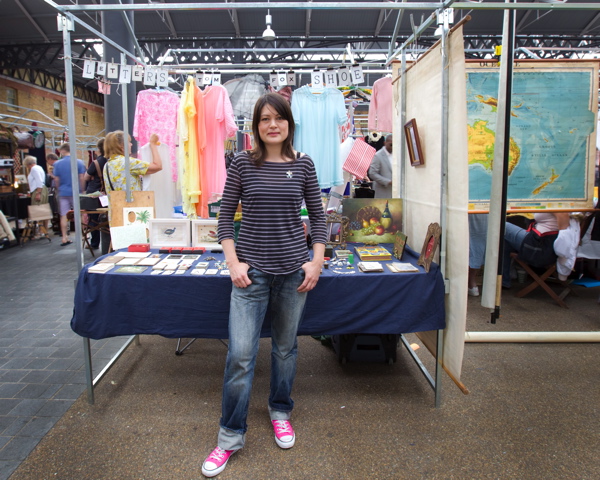
This is Jen Franklin, an artist whose serene exterior and immaculately arranged stall reveal nothing of her raging passion for ephemera. But given the opportunity, Jen was quick to declare her fervor. “I’ve always collected things obsessively, pieces of old paper that no-one wants, bits of old games, cards with letters printed on them, jigsaws with pieces missing, badly printed stuff, and really nicely printed stuff too. Also, I’m quite fond of animals and I collected over one hundred photos of people holding cats.” she confessed – surprising herself with her own emotion, her pale cheeks glowing with ardor and dark eyes glittering with delight.
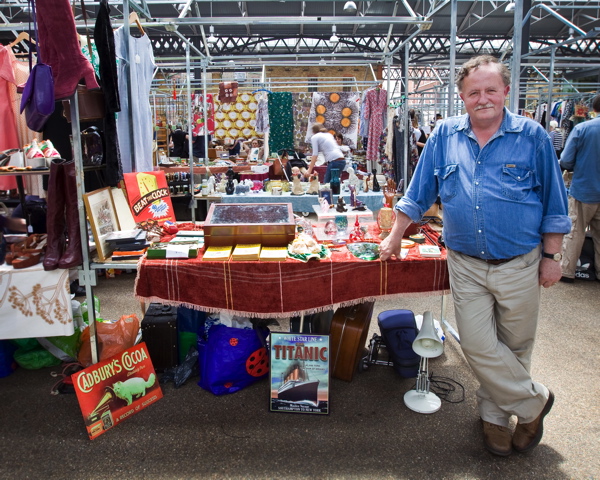
This is Ian Lawrence. “My dad died a couple of years ago. He was a collector, so I am selling off some of his stuff.” he told me with gentle candour. A gracious fellow who comes along regularly to enjoy the friendly atmosphere of the market, Ian helps out in a charity shop in Crouch End on other days. “I wanted to do letterpress printing but my grandfather said it was a dying trade,” explained Alan, who spent many years cutting stencils for a silkscreen printer in Enfield and now paints occasionally for his own pleasure. Distinguished by a modest dignity, Alan is one of the most charming gentlemen you could hope to meet in the market.
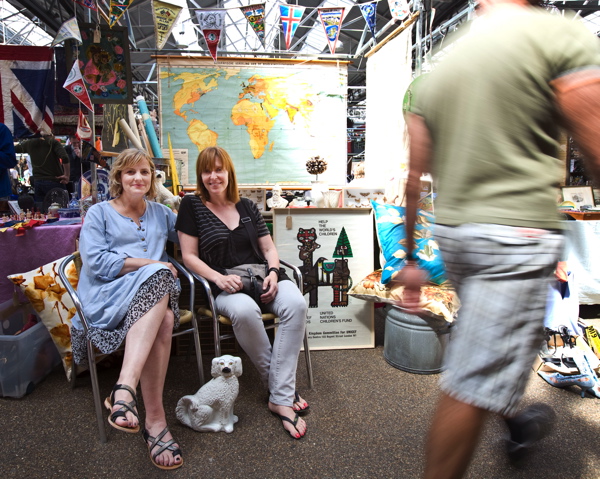
This is Julie Harris & Maxine Davis, a television production designer and set dresser who worked on the popular series “Teachers” for ten years, experiencing their first day as traders in the market. “We don’t know the protocol,” revealed Julie excitedly. “We bought all this stuff because we like it and now we don’t want to sell anything,” confided Maxine with a girlish smirk. While they may be the new kids in the playground now, these women are experienced professionals and I have no doubt we shall see them rise to the top of their class over coming weeks.
Photographs copyright © Jeremy Freedman
Agnese Sanvito, photographer

At the end of the lane in Ridley Rd Market in Dalston is a small square – of sea containers used as shops and hair salons, and corrugated iron shelters harbouring stalls – that fascinates photographer Agnese Sanvito. “It doesn’t look like London,” she explained to me, “I like it because it has its own character.” The new railway station opened nearby recently and across the line is a huge development of flats. When Agnese heard that a million pound redevelopment was promised for the market, she took her camera and set out to record the elusive character of life at this scruffy end of the market, which may be about to change for good. It was one of the first bright days in Spring and she took her pictures in the warm light of late afternoon.
This was in March. Just the month before, Agnese had quit her job to make a living full-time as a photographer. Six months later, Agnese can now look back on this time, secure in the knowledge that she had an assignment each week, sometimes several, and was one of the winners of the My East End Photography Competition, for the photograph of the butcher in Ridley Rd Market which she took that afternoon in March. Before Agnese returned to the South of Italy for a month to enjoy a Summer break with her family in her homeland, we met at Cafe Otto in Dalston and enjoyed a stroll around the market together.
“A new place is easier, because everything is seen freshly” revealed Agnese, referring to her travel assignments as a landscape photographer,“but I have passed through Ridley Rd Market lots of times and I wanted to capture its distinctive character. Photographing a place you know requires you to think more about what kind of pictures you take.” At first, Agnese took pictures of exotic fruit and colourful cakes but then she realised they could equally be photographed in other places. “I didn’t like it, because I’d seen it before,” she explained, shaking her long straight dark hair in self-criticism and revealing a rigorous searching photographic ambition to avoid the obvious.
The result of Agnese’ work is this modest set of six images focussed around the luminous picture of the butcher with a shopping trolley full of meat. There is nothing picturesque about these photographs – executed with a light touch – that record the utilitarian aspect of the market yet have subtleties which repay attention. The central photograph of the butcher is an image of naked capitalism, a frank realist picture of carcasses piled in a trolley by a small trader in a blood spattered coat. But in spite of the harshness of the image, the butcher is portrayed with empathy and the warm light – rendered on film rather than using digital photography – colours the shadows blue and even casts the red meat in a soft tone. In any portrait, there is a tension between exposing or sentimentalizing the subject, and this photograph is perfectly balanced, empathetic while also retaining a respectful distance. None of Agnese’ slyly disarming pictures tell you how to look at them – they are not demonstrative – like all good photographs, they invite you to search the image.
“I am interested in things that are in a process of change,” confided Agnese engimatically, so I asked her for an illustration and she came up with an unexpected example – underground toilets. Agnese is getting up at four in the morning to photograph public toilets in London that have been converted for other uses, and taking pictures of the exteriors when there is a magical dawn light and no-one on the streets. Next, Agnese showed me her photographs of the overgrown Murwillumbah railway line crossing Australia’s Byron Bay, lyrical empty landscapes with barely defined rails running through. It was when she explained to me that these were the lines that connected to Sydney and Brisbane serving the whaling industry, now closed down, that I became compelled. Agnese choses subjects that are contingent, inflecting all her pictures with an unspecified drama that the viewer must unravel.
Leaving the cafe and walking through the glorious chaos of the market as it was closing for the day, with piles of boxes everywhere, crates of fruit, bales of cloth, bowls of fish and piles of meat, all rich with pungent smells in the Summer heat, we arrived at the square at the end. Here were the African hair salons, named “God Willing” and “God First,” operating from sea containers. Here was the haberdashers, bewildering in its proliferation of buttons and ribbons and zips and threads. Here was the butcher with piles of goats’ feet on sale and here were the wire trolleys that they use to transport their meat, exactly as you see in Agnese’ photo. “I like this market, because it is their market,” commented Agnese, referring to the traders and their local customers, and recognising that there is a dignity in this working marketplace which serves a specific community day to day.
We parted at the edge of the market and Agnese promised to send me some of her pictures of underground toilets, once she has enough that she is satisfied with. I may have months to wait but I am already looking forward to it.


Photographs copyright © Agnese Sanvito
At Bow Cemetery
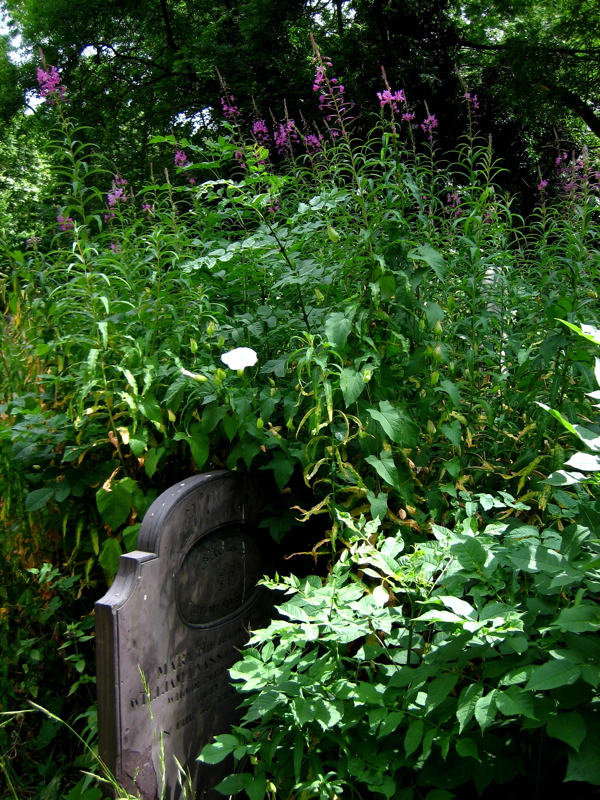
At least once each Summer, I direct my steps eastwards from Spitalfields along the Mile End Rd towards Bow Cemetery, one of the “Magnificent Seven” created by act of Parliament in 1832 as the growing population of London overcrowded the small parish churchyards. Extending to twenty-seven acres and planned on an industrial scale, “The City of London and Tower Hamlets Cemetery” as it was formally called, opened in 1841 and within the first half century alone around a quarter of a million were buried here.
Although it is the tombstones and monuments that present a striking display today, most of the occupants of this cemetery were residents of the East End whose families could not afford a funeral or a plot. They were buried in mass public graves containing as many as forty bodies of random souls interred together for eternity. By the end of the nineteenth century the site was already overgrown, though burials continued until it was closed in 1966.
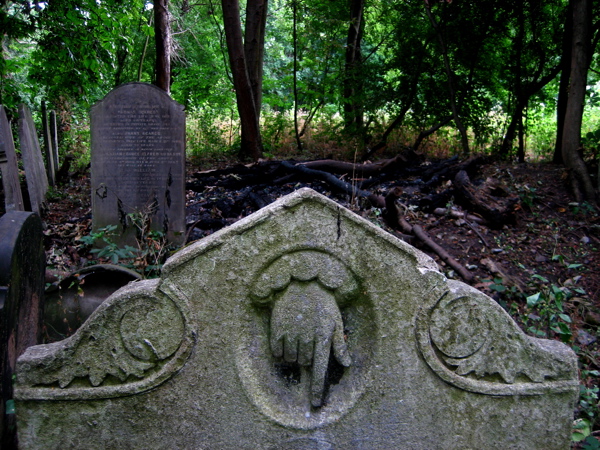
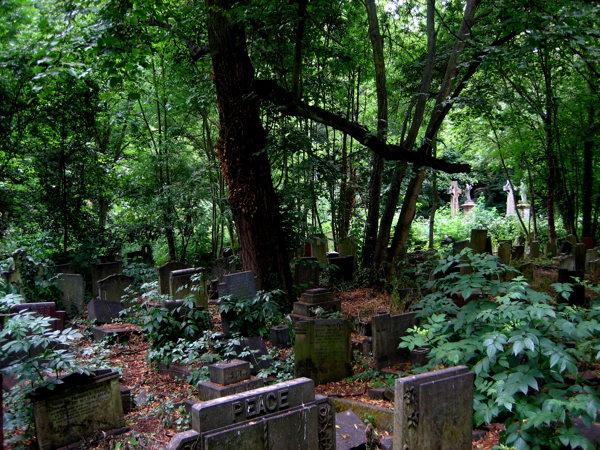
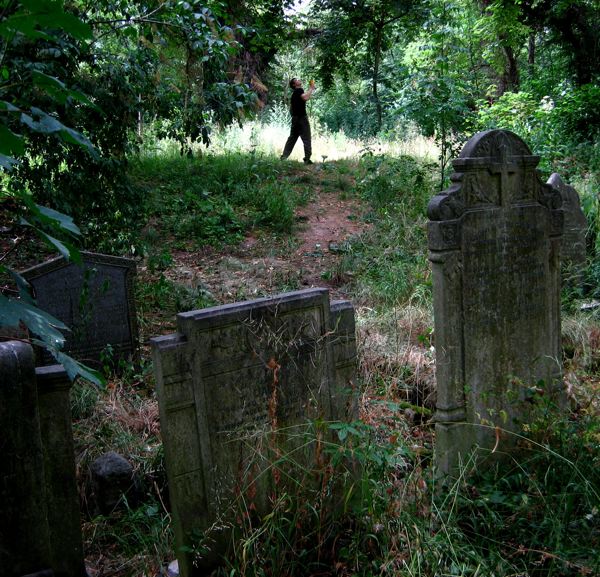
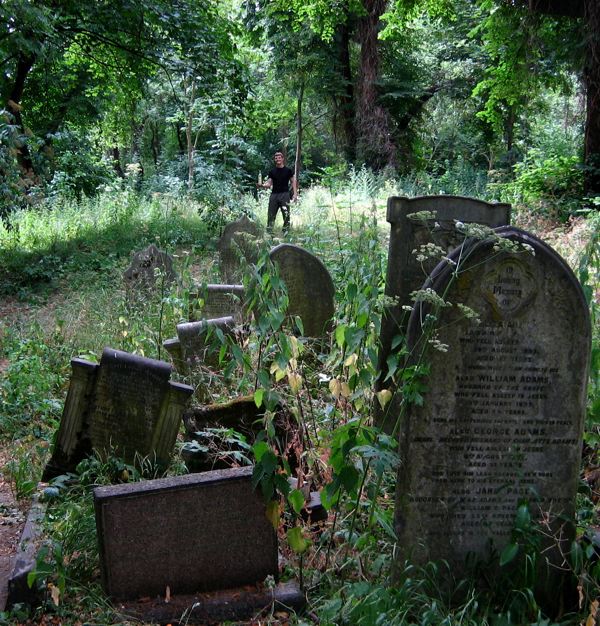
Where death once held dominion, nature has reclaimed the territory and a magnificent broadleaf forest has grown, bringing luxuriant growth that is alive with wildlife. Now the tombstones and monuments stand among leaf mould in deep woods, garlanded with ivy and surrounded by wildflowers. Tombstones and undergrowth make one of the most lyrical contrasts I can think of – there is a beautiful aesthetic manifest in the grim austerity of the stones ameliorated by vigorous plant life. But more than this, to see the symbols of death physically overwhelmed by extravagant new growth touches the human spirit. It is both humbling and uplifting at the same time. It is the triumph of life. Nature has returned and brought more than sixteen species of butterflies with her.
This is the emotive spectacle that leads me here, turning right at Mile End tube station and hurrying down Southern Grove, increasing my pace with rising expectation, until I walk through the cemetery gates and I am transported into the green world that awaits. At once, I turn right into Sanctuary Wood, stepping off the track to walk into a tall stand of ivy-clad sycamores, upon a carpet of leaves that is shaded by the forest canopy more than twenty metres overhead and illuminated by narrow shafts of sunlight descending. It is sublime. Come here to see the bluebells in Spring or the foxgloves in Summer. Come at any time of the year to find yourself in another landscape. Just like the forest in Richard Jefferies’ novel “After London,” the trees have regrown to remind us what this land was once like, long ago before our predecessors ever came here.
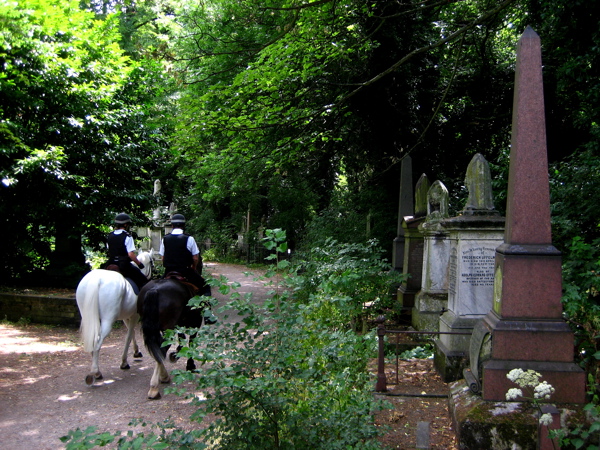
Over time, the tombstones have weathered and worn, and some have turned green, entirely harmonious with their overgrown environment, as if they sprouted and grew like toadstools. The natural stillness of the forest possesses greater resonance between cemetery walls and the deep green shadows of the woodland seem deeper too. There was almost no-one alive to be seen on the morning of my visit, apart from two police officers on horseback passing through, keeping the peace that is as deep as the grave.
Just as time mediates grief and grants us perspective, nature also encompasses the dead, enfolding them all, as it has done here in a green forest. These are the people who made East London, who laid the roads, built the houses and created the foundations of the city we inhabit. The countless thousands who were here before us, walking the streets we know, attending the same schools, even living in some of the same houses we live in today. The majority of those people are here now in Bow Cemetery. As you walk around, names catch your eye, Cornelius aged just two years, or Eliza or Louise or Emma, or Caleb who enjoyed a happy life, all over a hundred years ago. None ever dreamed a forest would grow over their head, where people would come to walk one day to discover their stones in a woodland glade. It is a vision of paradise above, fulfilled within the confines of the cemetery itself.
As I made my progress through the forest of tombstones, I heard a mysterious noise, a click-clack echoing through the trees. Then I came upon a clearing at the very heart of the cemetery and discovered the origin of the sound. It was a solitary juggler practicing his art among the graves, in a patch of sunlight. There is no purpose to juggling than that of delight, the attunement of human reflexes to create a joyful effect. It was a startling image to discover, and seeing it here in the deep woods – where so many fellow Londoners are buried – made my heart leap. Outside on the streets, a million people were going about their business while in the vast wooded cemetery there was just me, the numberless dead and the juggler.


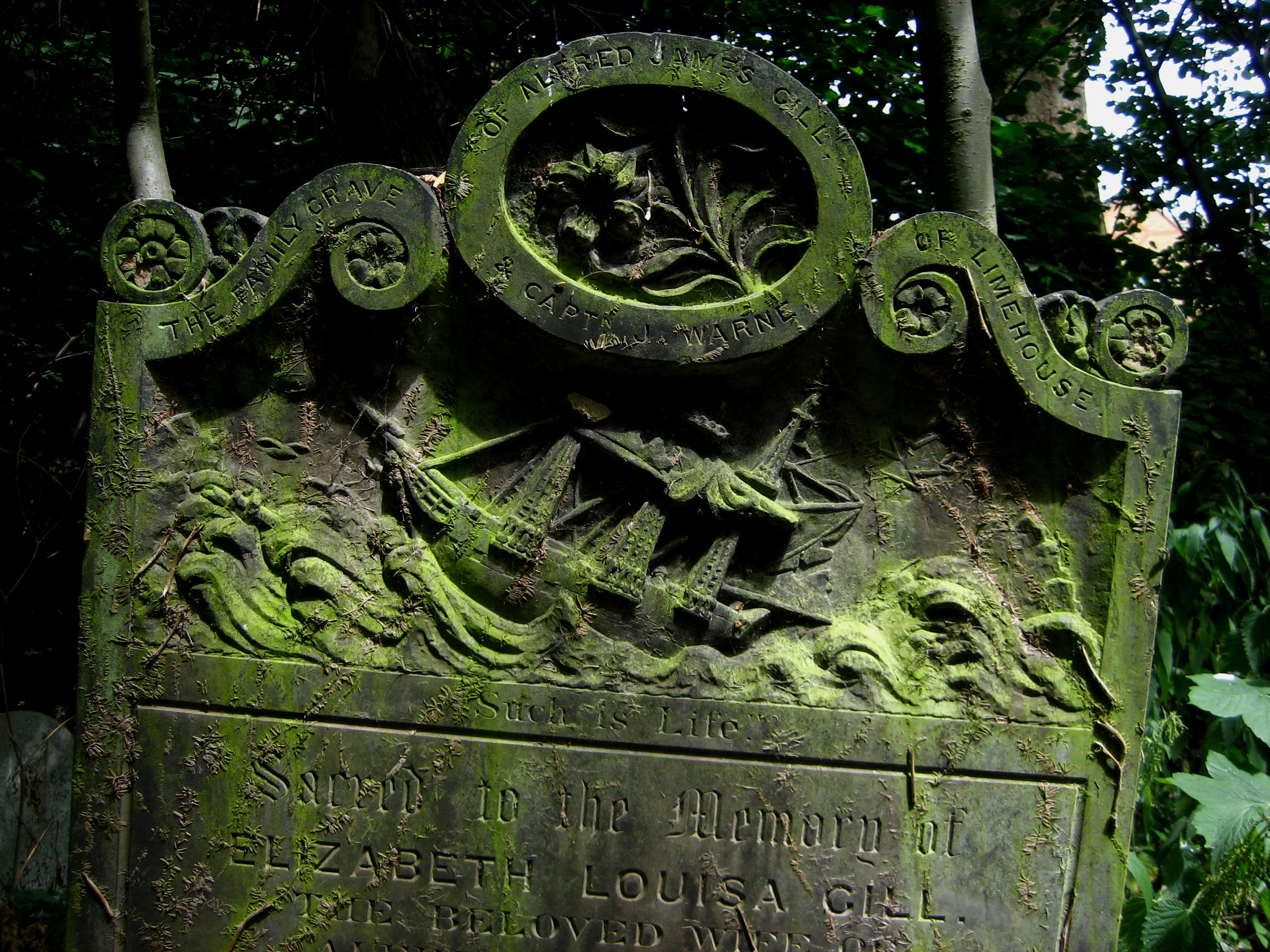
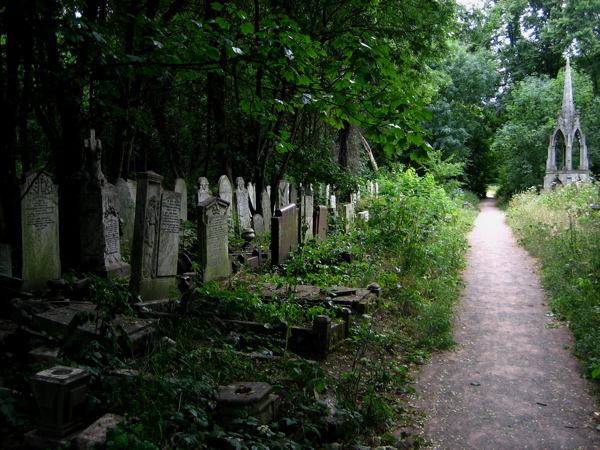
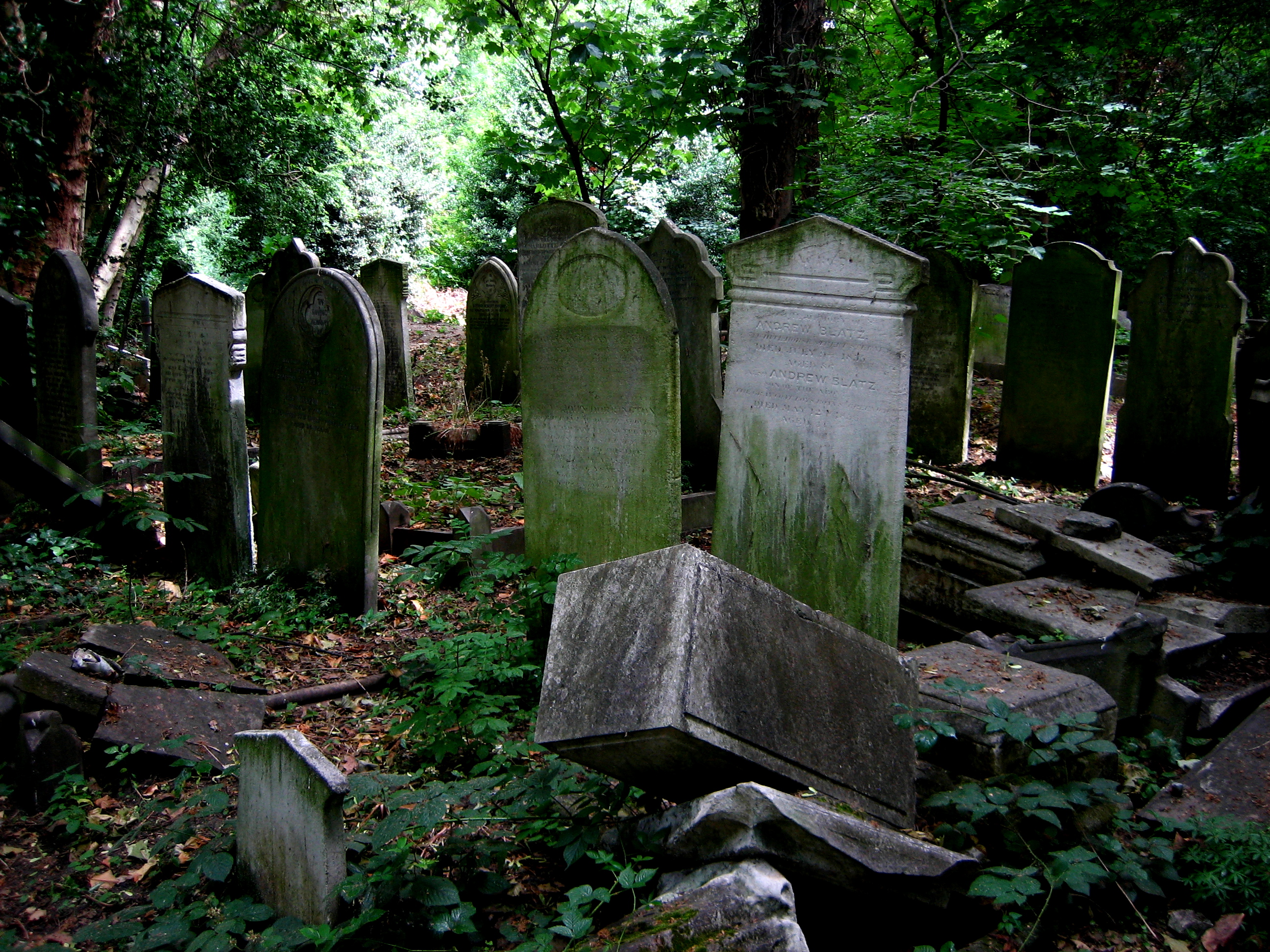
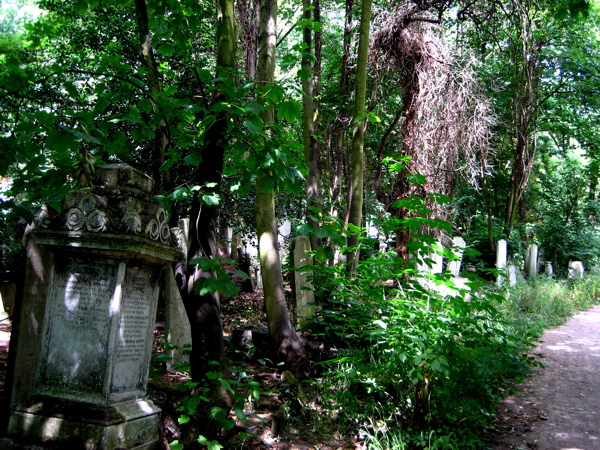
Find out more at www.towerhamletscemetery.org
The Tailors of Spitalfields
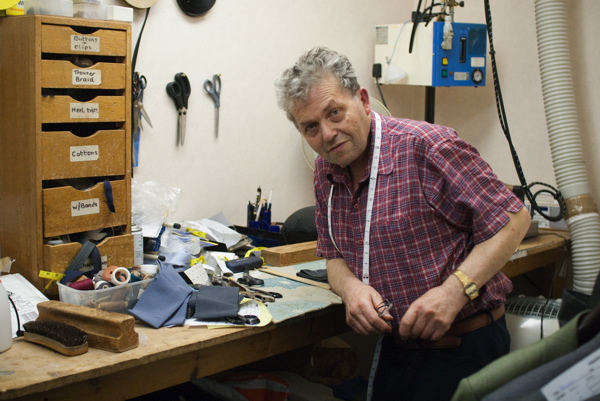
In 1956, when tailor Alan Shaw was twenty-one, as a young man starting out in the world, he opened up his own workshop in Whitechapel across the road from the Royal London Hospital. There were so many tailors workshops in the East End then that he had to search to find his own space, because everywhere he looked there were other tailors at work.
It is a very different picture today, and, when I set out to search for tailors in Spitalfields, I could only find a handful in the directory. Spitalfields Life contributing photographer Sarah Ainslie and I set to visit them in person to make a survey and see what we might find.
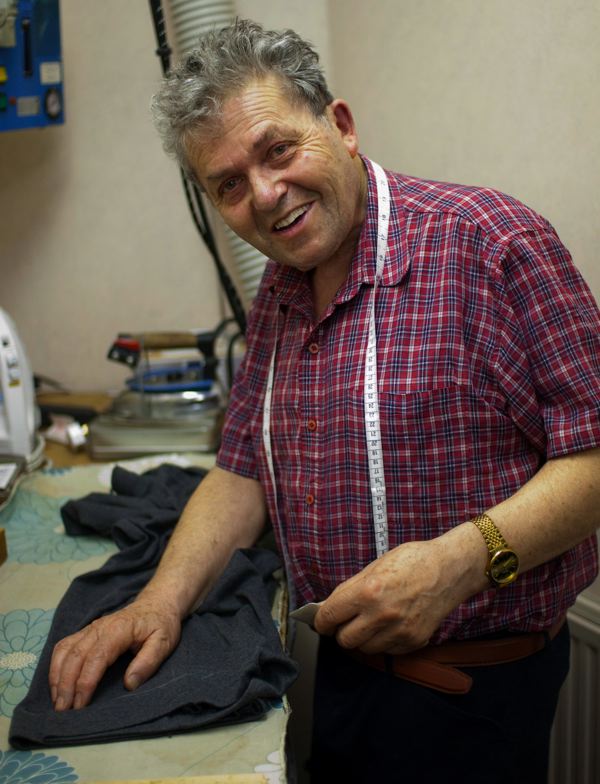
In a humid windowless room in Artillery Passage, we had the privilege to shake hands with Alan who now works for Norton & Townsend, doing their alterations at a bench in a narrow corner of a first floor storeroom. With a deferential nod to the sharp City types lingering outside, we made our way inside from Artillery Passage to stand upon the deep carpet of the showroom. We were told that all the tailoring is done off site, and these premises are simply where customers come to make orders and have their fittings. But brand manager Graham Hall intuited immediately who we would most like to meet, and we were grateful to be ushered up a back staircase and into Alan’s workroom. The circumstances could not be more modest in contrast to the affluence of the customers. Yet, although Alan no longer does tailoring any longer, he is every inch a tailor and, as the most senior practitioner in Spitalfields, we were eager to pay due reverence to this distinguished yet unassuming gentleman.
“It’s a good trade,” said Alan, speaking softly with an easy smile and quite surprised at our interest, “You can get a lot of satisfaction from putting a suit on someone and knowing it looks good. The whole business is in satisfying the customer. They bring back their friends and that’s how you built up contacts. I started at fifteen and my whole family were in the trade, my brother Norman had a big factory in Princelet St. When I was young I had loads of jobs but unfortunately all the little tailors have dropped away and there’s no workshops left in the East End any more. I’m seventy-five now and I only do a few days a week – but I continue because it’s part of my life.”
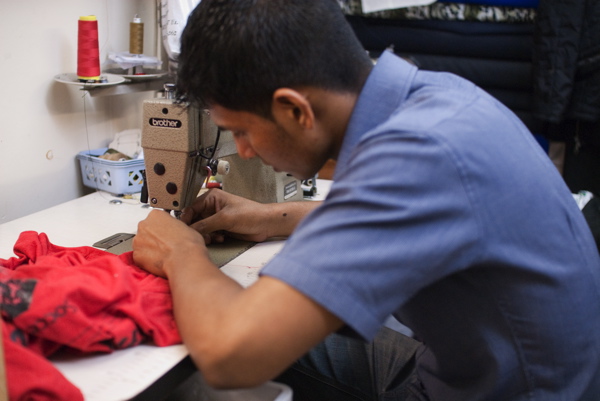
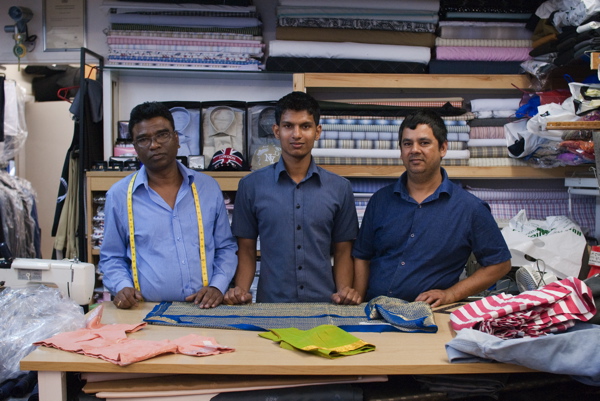
Alan would have been surprised to meet young Sharjahan, barely into his twenties, and working enthusiastically with colleagues Guffar and Lillur in the cramped backroom at Hussain Tailoring in Hanbury St – for a business that primarily serves the Bengali residents of Spitalfields, making suits, copies of customers’ clothes, and doing repairs and alterations too. With bolts of suiting arrayed on either side of the old wooden counter, wide enough to lay out a garment where Guffar was cutting a ladies’ tunic from richly woven green silk, this lively establishment is exactly how I imagine a tailor’s shop to be.
We were honoured by an invitation to visit the sweltering low-ceilinged workroom, where Sharjahan proudly showed us four sewing machine benches and three hemming machines around the walls, and the pressing bench in the middle of the workspace – another sewing machine and buttonholer were outside in the shop. As we spoke, he set about pressing a pair of worn stonewashed jeans, swiftly marking off the legs with chalk to tailor them for the owner. Meanwhile, two eminent white-haired gentlemen had arrived for a conversation in the front of the shop, revealing the premises as a social hub where local people constantly come and go, passing the time of day and making and collecting orders.
It could not have been in greater contrast to the cool of the cavernous office of Neil O’Brien tailors on the first floor of the former Fruit & Vegetable Exchange Building in Brushfield St. Agent Richard Elliott sat alone at his desk, in between visiting the offices of law firms, investment banks and private equity companies, where customers can order their suits without ever visiting his premises. A former sales manager for read-to-wear tailor Chester Barrie, Richard has worked for the last six years as an agent, visiting customers in offices, taking measurements and fitting suits. Welcoming us genially, in spite of our arrival unannounced and out of the blue, he snatched a fine linen jacket from a rail – hand-stitched in a unique style by a traditional family business in Puglia – as an example of the finesse of their Italian tailoring.
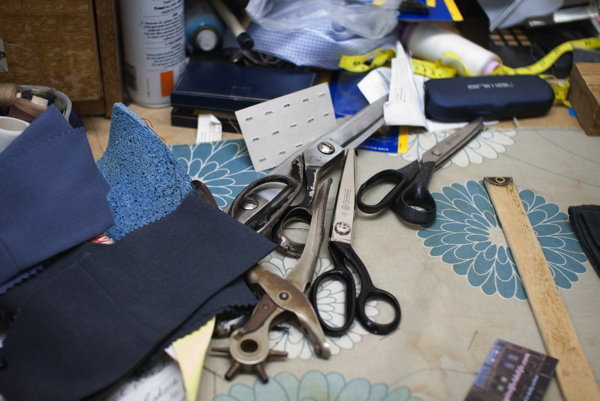
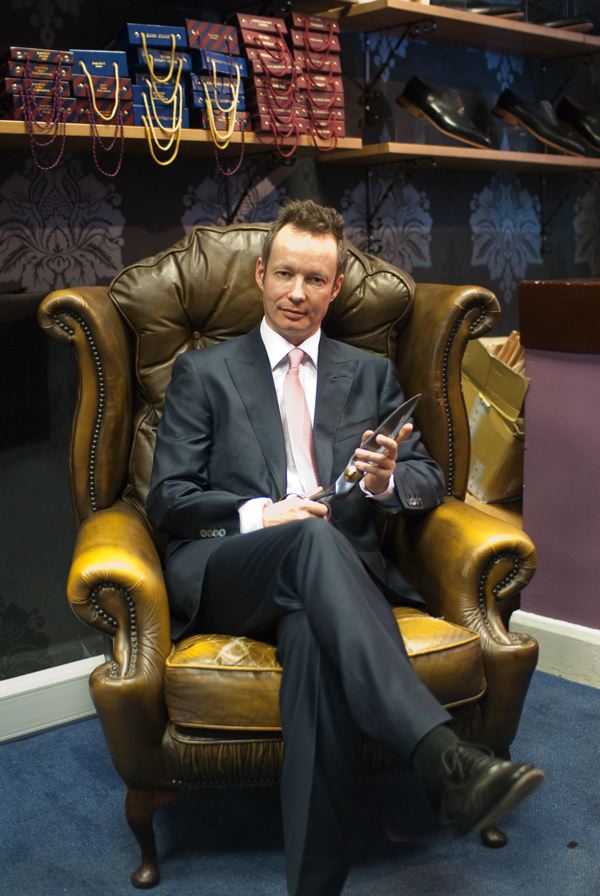
Our final stop was Max Hence, the tailor in Folgate St, now incorporated into Eveleigh & Read where executive Paul Read – natty in a glossy two piece with just one button at the front – was eager to show off his two hundred year old shears as an illustration of the traditional core values of the business that he started four years ago. Although all their garments are individually bespoke, Paul was keen to emphasise that they endeavour to suit every pocket, or – in other words – you can cut your coat to your cloth here. The biggest surprise here was to discover that, although some tailoring is done in Italy, Eveleigh & Read have a tailors’ workshop in Shoreditch. Excited, I thought we had found the object of our quest, if not in Spitalfields then nearby in Shoreditch, but Paul remained inscrutable, insisting that we could not visit it. Like the last rare specimen of an endangered species, the location of the tailoring workshop must remain a jealously protected trade secret.
In a single morning, we walked through the history of tailoring in Spitalfields, from the friendly neighbourhood tailor to the corporate agents speaking the paradoxical rhetoric of family businesses and British craftmanship. And memorably we encountered the king of Spitalfields tailors, Alan Shaw, a heroically soulful figure who carries the story of when the East End was full of tailors, just half a century ago.
Let me confess, I was more interested in the workrooms than the showrooms, which were calculated to flatter the customers’ tastes. However the economics of tailoring reconfigures the labour market, in the end it is about the rare human skill of working with cloth, creating outfits of subtle psychology that engineer modest transformations to show the wearer at their best, and this is what touches me.

Photographs copyright © Sarah Ainslie
Columbia Road Market 43

There was a party in my garden last night but, rather than face the debris, I got out of bed at dawn, headed out the door and walked up the road to the market instead, passing St Anne’s the Brazilian church where I could hear the young Brazilians, who had been up all night partying, still singing for joy.
For a mere £3.50 I bought a tray of sixteen assorted Cornflowers, sufficient to fill two pots to stand on an exposed sunny wall and give me a display of flowers in soft blues and delicious strawberry pinks for the rest of Summer. Almost nothing speaks of high Summer in England as vividly as the Cornflower that I think of scattered among wild Poppies in meadows of golden corn. I remember them from the “Cottage Garden Mixtures” of seeds that I used to buy for my childhood garden. This domesticated variety comes under the charming name of Batchelor’s Button and I love the subtle complexity of the snowflake patterns adopted by the flowers, each one presenting a different intricate delight, perfectly counterpointed by the grey-green foliage.