
The Closure Of Smithfield Market
In the week that the City of London voted to close Smithfield Market for good after more than 800 years of trading, I publish the work of photographer Orlando Gili who has been down at the market, documenting the last generation of butchers to work at this ancient site.

Greg Lawrence Junior and Greg Lawrence Junior Junior, Owners of G Lawrence Wholesale Meat
‘I arrived at Smithfield in the dead of night to photograph London’s renowned meat market which is set for permanent closure. The last pubs had long closed and it was a few hours before tube station shutters were wrenched open.
Walking towards the market, you are met by a wave of sound, beeps and wheels dragged over tarmac, bearing the weighty chunks of meat wrapped in plastic. Emitting at a different frequency is the grumble from a line of white lorries and vans, punctuated by shouts and low pitched chatter. Smithfield is very much alive and in full operational mode at this time. Within minutes of arriving, I am dressed in white overalls and deep inside the bowels of the market, photographing blood splattered butchers, and dodging lines of dead animals hanging from hooks.
Experiencing Smithfield at night is to uncover a secret parallel world that operates in the shadows while the rest of London sleeps. There is a sense of frenetic energy and unpredictability. Forklifts whizz past men in long jackets hunched over neatly stacked boxes, punching numbers into calculators and fielding phone calls. Inside the tall Victorian halls, behind large glass windows, carcasses are hacked into pieces at literally breakneck speed. It is a physical analogue space with a masculine atmosphere. There is a strong sense of camaraderie and familial spirit, many of the businesses are family run.
I returned on early mornings to develop a portrait series that celebrates the people behind the market. Night workers provide an under-appreciated role in modern cities. They risk significant damage to their health to meet the demands of the 24/7 city. According to a long-term US study of nurses, night shift workers are up to 11% more likely to die early compared to those who work day shifts.
The closure of Smithfield Market ends over 800 years of trading meat in Central London as part of a wider trend to sanitise inner cities with less palatable aspects of urban life kept out of sight.’
Orlando Gili

Mark, Chicken Salesman

Horatio, Driver

Moro, Butcher

Harry, Shopman

Simon, Salesman

Ian, Chicken Salesman

Greg, Beef Salesman and Sean, Cashier

Jonny, Butcher

Elijah, Salesman

Tony, Retired Boxer, Trader and Restaurant Distributor

Roger, Fork Lift Operator

Dave, Salesman

‘Pig Ear Tony’, Pig Meat Salesman

Charlie, Salesman

Aaron, Butcher, Marcus, Salesman and Mark, Shopman

Luca, Production

Adam, Butcher

Kye, Unloader

Pav, Butcher

Russel, Butcher

James, Sales Manager

Grant, Butcher
Photographs copyright © Orlando Gili
Dan Jones At Bethnal Green Library

Click to enlarge Dan Jones’ painting of St Paul’s School Wellclose Sq, 1977
Photographer Chris Kelly and I went along to join Dan Jones when he paid a visit to his splendid mural from 1977 of children and their rhymes in the playground of St Paul’s School, Wellclose Sq, which is installed at the Bethnal Green Children’s Library.
The Children’s Library is on your right as you enter the building and from the lobby you can see the huge colourful painting at the far end of a long room with windows facing onto the Green. Once I reached this point, I could already hear “The wheels on the bus go round and round…” sung by an enthusiastic chorus of toddlers and their mothers led by a librarian.
“In 1970, I was a youth worker and I ran a youth club in the hall on the right of the painting. I used to have two hundred kids dancing in there!” recalled Dan fondly, “And so most of the children in the school were known to me.” Living close by in Cable St, Dan, who began collecting rhymes in 1947, has followed the shifting currents of playground culture over all this time. “Some of these rhymes in the painting are still to be heard in the playground there,” he told me, “But others they don’t do anymore, or only sporadically.”
A local plasterer coated three boards with a fine coat of plaster to give a smooth finish for Dan to paint on and, inspired by Bruegel’s “Children’s Games,” Dan set to work upon the dining table in his front room, painting individual portraits of the children with their rhymes inscribed alongside. It took over a year’s work and Dan framed the life of the playground with the architecture of the school, including its weathervane in the shape of tall ship and Tower Bridge looming on the horizon – all portrayed beneath a distinctively occluded London sky. And now that most schools wear primary coloured shirts, it is fascinating to observe the wide variety of characterful clothing – reflecting the styles of the time – displayed by these children.
Astonishingly, the painting caused great controversy when it was first displayed, with the Daily Telegraph accusing Dan Jones of turning East End youth against the police force, because he included the rhyme – “There’s a cop, cop, copper on the corner, all dressed up in navy blue. If it wasn’t for the law, I would sock him on the jaw. And he wouldn’t be a copper any more, more, more…” A rhyme which Dan had simply recorded along with all the others in the playground.
At first, the mural graced the London’s Children’s Centre and for years it filled the narrow hallway of Dan’s house, but in the Children’s Library it fits perfectly as if it had been painted for this space. Dan’s picture hangs above the library corner, where children can play or sit on the floor and read books, casting a benign spell upon this favoured spot.
More than forty years have passed since Dan made his picture – the first of several on this subject and at this scale that he has done in subsequent years – yet it remains as fresh and immediate as the day he completed it in 1977.

Breuegel’s “Children’s Games,” 1560 – Dan’s inspiration.


Dan’s recent self-portrait

Dan Jones with his grandson Rumi
Photographs copyright © Chris Kelly
You may also like to take a look at
Chris Kelly & Dan Jones in the Playground
The Streets Of Old London

Piccadilly, c. 1900
In my mind, I live in old London as much as I live in the contemporary London of here and now. Maybe I have spent too much time looking at photographs of old London – such as these glass slides once used for magic lantern shows by the London & Middlesex Archaeological Society at the Bishopsgate Institute?
Old London exists to me through photography almost as vividly as if I had actual memory of a century ago. Consequently, when I walk through the streets of London today, I am especially aware of the locations that have changed little over this time. And, in my mind’s eye, these streets of old London are peopled by the inhabitants of the photographs.
Yet I am not haunted by the past, rather it is as if we Londoners in the insubstantial present are the fleeting spirits while – thanks to photography – those people of a century ago occupy these streets of old London eternally. The pictures have frozen their world forever and, walking in these same streets today, my experience can sometimes be akin to that of a visitor exploring the backlot of a film studio long after the actors have gone.
I recall my terror at the incomprehensible nature of London when I first visited the great metropolis from my small city in the provinces. But now I have lived here long enough to have lost that diabolic London I first encountered in which many of the great buildings were black, still coated with soot from the days of coal fires.
Reaching beyond my limited period of residence in the capital, these photographs of the streets of old London reveal a deeper perspective in time, setting my own experience in proportion and allowing me to feel part of the continuum of the ever-changing city.

Ludgate Hill, c. 1920

Holborn Viaduct, c. 1910

Trinity Almshouses, Mile End Rd, c. 1920
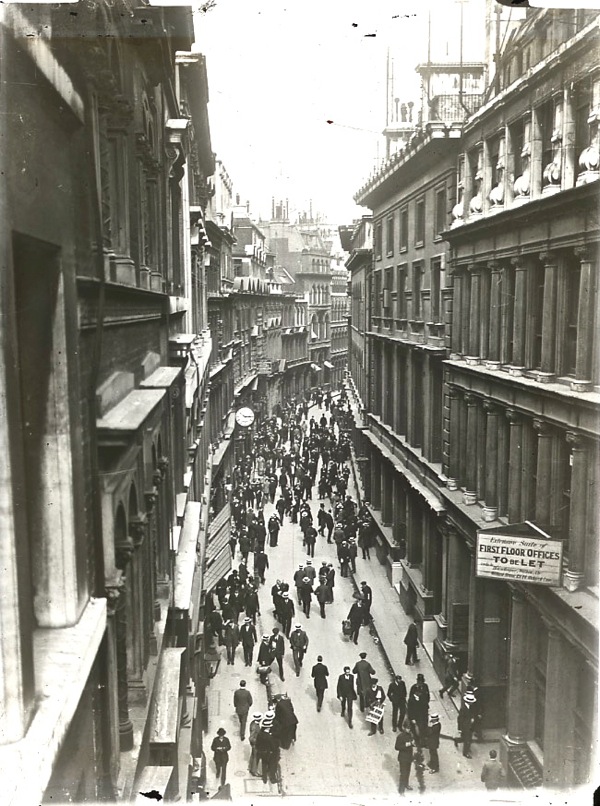
Throgmorton St, c. 1920

Highgate Forge, Highgate High St, 1900

Bangor St, Kensington, c. 1900

Ludgate Hill, c. 1910

Walls Ice Cream Vendor, c. 1920

Ludgate Hill, c. 1910

Strand Yard, Highgate, 1900
 Eyre St Hill, Little Italy, c. 1890

Muffin man, c. 1910

Seven Dials, c. 19o0

Fetter Lane, c. 1910

Piccadilly Circus, c. 1900

St Clement Danes, c. 1910
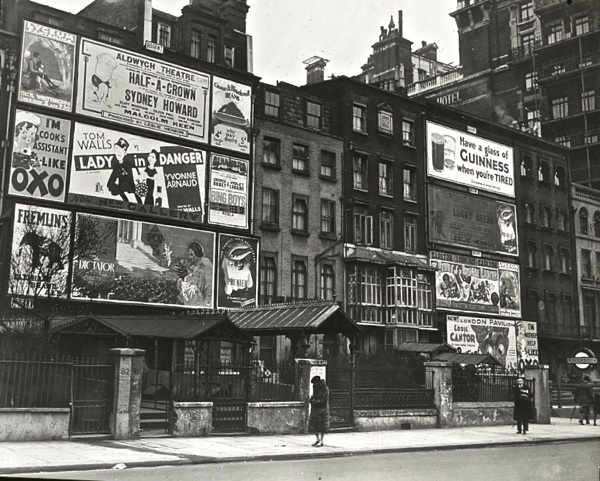
Hoardings in Knightsbridge, c. 1935

Wych St, c.1890

Dustcart, c. 1910

At the foot of the Monument, c. 1900
 Pageantmaster Court, Ludgate Hill, c. 1930

Holborn Circus, 1910

Cheapside, 1890

Cheapside ,1892

Cheapside with St Mary Le Bow, 1910

Regent St, 1900
Glass slides courtesy Bishopsgate Institute
You may also like to take a look at
The Forgotten Corners Of Old London

Who knows what you might find lurking in the forgotten corners of old London? Like this lonely old waxwork of Charles II who once adorned a side aisle of Westminster Abbey, peering out through a haze of graffiti engraved upon his pane by mischievous tourists with diamond rings.
As one with a pathological devotion to walking through London’s side-streets and byways, seeking to avoid the main roads wherever possible, these glass slides of the forgotten corners of London – used long ago by the London & Middlesex Archaeological Society for magic lantern shows at the Bishopsgate Institute – hold a special appeal for me. I have elaborate routes across the city which permit me to walk from one side to the other exclusively by way of the back streets and I discover all manner of delights neglected by those who solely inhabit the broad thoroughfares.
And so it is with many of these extraordinary pictures that show us the things which usually nobody bothers to photograph. There are a lot of glass slides of the exterior of Buckingham Palace in the collection but, personally, I am much more interested in the roof space above Richard III’s palace of Crosby Hall that once stood in Bishopsgate, and in the unlikely paraphernalia which accumulated in the crypt of the Carmelite Monastery or the Cow Shed at the Tower of London, a hundred years ago. These pictures satisfy my perverse curiosity to visit the spaces closed off to visitors at historic buildings, in preference to seeing the public rooms.
Within these forgotten corners, there are always further mysteries to be explored. I wonder who pitched a teepee in the undergrowth next to the moat at Fulham Palace in 1920. I wonder if that is a cannon or a chimney pot abandoned in the crypt at the Carmelite monastery. I wonder why that man had a bucket, a piece of string and a plank inside the dome of St Paul’s Cathedral. I wonder what those fat books were next to the stove in the Worshipful Company of Apothecaries’ shop. I wonder who was pulling that girl out of the photograph in Woolwich Gardens. I wonder who put that dish in the roof of Crosby Hall. I wonder why Charles II had no legs. The pictures set me wondering.
It is what we cannot know that endows these photographs with such poignancy. Like errant pieces from lost jigsaws, they inspire us to imagine the full picture that we shall never be party to.

Tiltyard Gate, Eltham Palace, c. 1930

Refuse collecting at London Zoo, c. 1910

Passage in Highgate, c. 1910

Westminster Dust Carts, c. 1910

The Jewel Tower, Westminster, 1921

Fifteenth century brickwork at Charterhouse Wash House, c1910

Middle Temple Lane, c. 1910

Carmelite monastery crypt, c. 1910

The Moat at Fulham Palace, c. 1920

Clifford’s Inn, c. 1910

Top of inner dome at St Paul’s Cathedral, c. 1920

Apothecaries’ Hall Quadrangle, c. 1920

Worshipful Company of Apothecaries’ Shop, c.1920

Unidentified destroyed building near St Paul’s, c. 1940

Merchant Taylors’ Hall, c. 1920

Crouch End Old Baptist Chapel, c. 1900

Woolwich Gardens, c. 1910

The roof of Crosby Hall, Richard III’s palace in Bishopsgate , c. 1910

Refreshment stall in St James’ Park, c. 1910

River Wandle at Wandsworth, c. 1920

Corridor at Battersea Rise House, c. 1900

Tram emerging from the Kingsway Tunnel, c. 1920

Between the interior and exterior domes at St Paul’s Cathedral, c. 1920

Fossilised tree trunk on Tooting Common, c. 1920

St Dunstan-in-the-East, 1911

Cow shed at the Queen’s House, Tower of London, c. 1910

Boundary marks for St Benet Gracechurch, St Andrew Hubbard and St Dionis Backchurch in Talbot Court, c. 1910

Lincoln’s Inn gateway seen from Old Hall, c. 1910

St Bride’s Fleet St, c. 1920
Glass slides courtesy Bishopsgate Institute
You may also like to take a look at
The Loneliness Of Old London

Lost in Old London – Rose Alley, Southwark, c. 1910
When I first came to live in London, I had few friends, no job and little money, but I somehow managed to rent a basement room in Portobello. For a year, I wandered the city on foot, exploring London without any bus fare. I think I never felt so alone as when I drifted aimlessly in the freezing fog in Hyde Park in 1983.
As I walked, I used to puzzle how I could ever find my life in London. Then I went back and sat in my tiny room for countless hours and struggled to write, without success.
Today, I am sometimes haunted by the spectre of my pitiful former self as I travel around London and, when examining the thousands of glass slides created by the London & Middlesex Archaeological Society for educational lectures at the Bishopsgate Institute a century ago, I am struck by the lone figures isolated in the cityscape.
The photographers may have included these solitary people to give a sense of human scale – but my response to these pictures is emotional, I cannot resist seeing them as a catalogue of the loneliness of old London.

Alone outside Shepherd’s Bush Empire, c. 1920

Alone at the Chelsea Hospital, c. 1910

Alone at the Natural History Museum, c. 1890

Alone at the Tower of London, c. 1910

Alone at Leg of Mutton Pond, Hampstead, c. 1910

Alone in the Great Hall at Chelsea Hospital, c. 1920

Alone outside St Lawrence Jewry, 1908

Alone in Bunhill Fields, c. 1910

Alone in Hyde Park, c. 1910

Alone at the Guildhall, c. 1910

Alone at Brooke House, Hackney, 1920

Alone on Hampstead Heath, c. 1910

Alone in Thames St, 1920

Alone at the Orangery, Kensington Palace, c. 1910

Alone in the Deans Yard at Westminster Abbey, c. 1910

Alone at Hampton Court, c. 1910

Alone at the Houses of Parliament with the statue of Richard I, c. 1910

Alone in the tiltyard at Eltham Palace, c. 1910

Alone in Cloth Fair, c. 1910

Alone at Marble Arch, c. 19o0

Alone at Southwark Cathedral, c. 1910

Alone outside Carpenters’ Hall, c. 1920

Alone outside Jackson Provisions’ shop, Clothfair, c. 1910

Alone outside Blewcoat School, Caxton St, c. 1910

Alone on the Victoria Embankment, c. 1910

Alone outside All Saints Chelsea, c. 1910

Alone at the Albert Hall, c. 1910
Glass slides courtesy Bishopsgate Institute
Take a look at
The Markets Of Old London

Clare Market c.1900
I never knew there was a picture of the legendary and long-vanished Clare Market – where Joseph Grimaldi was born – until I came upon this old glass slide among many thousands in the collection of the London & Middlesex Archaeological Society, housed at the Bishopsgate Institute. Scrutinising this picture, the market does not feel remote at all, as if I could take a stroll over there to Holborn in person as easily as I can browse the details of the photograph. Yet the Clare Market slum, as it became known, was swept away in 1905 to create the grand civic gestures of Kingsway and Aldwych.
Searching through this curious collection of glass slides, left-overs from the days of educational magic lantern shows – comprising many multiple shots of famous landmarks and grim old church interiors – I was able to piece together this set of evocative photographs portraying the markets of old London. Of those included here only Smithfield, London’s oldest wholesale market, continues trading from the same building, though Leather Lane, Hoxton Market and East St Market still operate as street markets, but Clare Market, Whitechapel Hay Market and the Caledonian Rd Market have gone forever. Meanwhile, Billingsgate, Covent Garden and Spitalfields Fruit & Vegetable Market have moved to new premises, and Leadenhall’s last butcher – once the stock-in-trade of all the shops in this former cathedral of poultry – closed last year.
Markets fascinate me as theatres of commercial and cultural endeavour in which a myriad strands of human activity meet. If you are seeking life, there is no better place to look than in a market. Wherever I travelled, I always visited the markets, the black-markets of Moscow in 1991, the junk markets of Beijing in 1999, the Chelsea Market in Manhattan, the central market in Havana, the street markets of Rio, the farmers’ markets of Transylvania and the flea market in Tblisi – where, memorably, I bought a sixteenth century silver Dutch sixpence and then absent-mindedly gave it away to a beggar by mistake ten minutes later. I often wonder if he cast the rare coin away in disgust.
Similarly in London, I cannot resist markets as places where society becomes public performance, each one with its own social code, language, and collective personality – depending upon the nature of the merchandise, the location, the time of day and the amount of money changing hands. Living in Spitalfields, the presence of the markets defines the quickening atmosphere through the week, from the Thursday antiques market to the Brick Lane traders, fly-pitchers and flower market in Bethnal Green every Sunday. I am always seduced by the sense of infinite possibility when I enter a market, which makes it a great delight to live surrounded by markets.
These old glass slides, many of a hundred years ago, capture the mass spectacle of purposeful activity that markets offer and the sense of self-respect of those – especially porters – for whom the market was their life, winning status within an elaborate hierarchy that had evolved over centuries. Nowadays, the term “marketplace” is sometimes reduced to mean mere economic transaction, but these photographs reveal that in London it has always meant so much more.

Billingsgate Market, c.1910
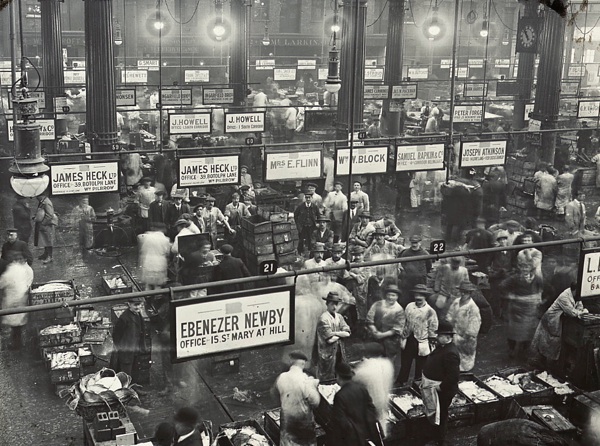
Billingsgate Market, c.1910

Whitechapel Hay Market c.1920 (looking towards Aldgate)

Whitechapel Hay Market, c.1920 (looking east towards Whitechapel)

Porters at Smithfield Market, c.1910

Caledonian Rd Market, c.1910

Book sale at Caledonian Rd Market, c.1910

Caledonian Rd Market, c.1910

Caledonian Rd Market, c.1910

Covent Garden Market, c.1920

Covent Garden Market, c.1910

Covent Garden, c.1910

Covent Garden Market, 1925

Covent Garden Market, Floral Hall, c.1910

Leadenhall Market, Christmas 1935

Leadenhall Market, c.1910

East St Market, c.1910

Leather Lane Market, 1936
 Hoxton Market, Shoreditch, 1910

Spitalfields Market, c.1930
Images courtesy Bishopsgate Institute
You may like to look at these old photographs of the Spitalfields Market by Mark Jackson & Huw Davies
Night at the Spitalfields Market
Other stories of Old London
The Nights Of Old London

The nights are drawing in fast and I can feel the velvet darkness falling upon London. As dusk gathers in the ancient churches and the dusty old museums in the late afternoon, the distinction between past and present becomes almost permeable at this time of year. Then, once the daylight fades and the streetlights flicker into life, I feel the desire to go walking out into the dark in search of the nights of old London.
Examining hundreds of glass plates – many more than a century old – once used by the London & Middlesex Archaeological Society for magic lantern shows at the Bishopsgate Institute, I am in thrall to these images of night long ago in London. They set my imagination racing with nocturnal visions of the gloom and the glamour of our city in darkness, where mist hangs in the air eternally, casting an aura round each lamp, where the full moon is always breaking through the clouds and where the recent downpour glistens upon every pavement – where old London has become an apparition that coalesced out of the fog.
Somewhere out there, they are loading the mail onto trains, and the presses are rolling in Fleet St, and the lorries are setting out with the early editions, and the barrows are rolling into Spitalfields and Covent Garden, and the Billingsgate porters are running helter-skelter down St Mary at Hill with crates of fish on their heads, and the horns are blaring along the river as Tower Bridge opens in the moonlight to admit another cargo vessel into the crowded pool of London. Meanwhile, across the empty city, Londoners slumber and dream while footsteps of lonely policemen on the beat echo in the dark deserted streets.


Glass slides courtesy Bishopsgate Institute
Read my other nocturnal stories


