The Milk Float that became a Carnival Float
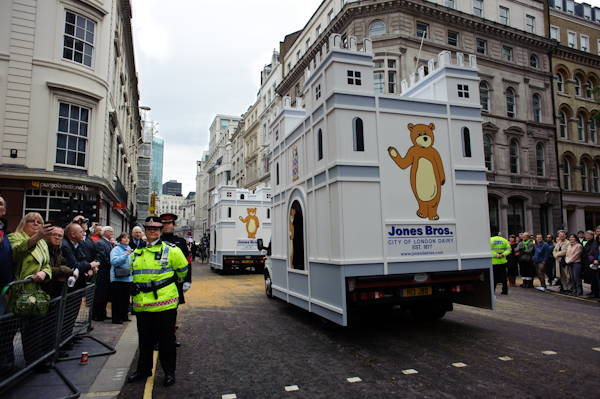
There was an air of mystery when Henry Jones, the third generation dairyman of Jones Brothers in Middlesex St, summoned me over to see him in the Summer. Closing the office door discreetly and looking me in the eye with a good-natured intensity, he revealed he had a story to tell me – but first I had to agree not to disclose it before the Lord Mayor’s Show. Once I had pledged my word, he proudly unrolled the blueprints upon his desk, confiding that Jones Brothers had accepted the honour of entering the Lord Mayor’s parade and had been placed at an impressive ninth position in the hierarchy of the running order, out of nearly one hundred and fifty entrants. The elaborate designs, which Henry showed me with such conspiratorial delight, were to transform a milk float into a model of one of the medieval gates of the City of London, complete with crenellated turrets.
In 1877, the first Henry Jones drove his herd from Abergavenny in Wales to Middlesex St and founded the dairy in Stoney Lane. Today his grandson Henry Jones presides over the longest established family business in Petticoat Lane, where his young son, the fourth Henry Jones, also works. This is a family with a long relationship with this particular web of streets at the boundary of the City of London. “I was born here,” Henry will tell you proudly, referring to the former dairy, which has since disappeared beneath the modernist concrete development where he now has his office.
So it was in the light of this family history that I came to appreciate Henry’s passionate enthusiasm for the parade, demonstrating that the language of pageantry is as vibrant as it ever was. The design of the gatehouse refers to the gate (or ‘Aldgate’) to the City of London that once stood here, where Geoffrey Chaucer once lived up above the gatehouse. Henry Jones – who is an independent councillor in this ward known as Portsoken – told me the name Portsoken is Norman French and refers to the ‘soke‘ (or district) outside the ‘port’ (or gate), once used by the knights of old for jousting. Consequently, he was employing a knight in armour to ride with a lance in front of his milk float, representing the ‘knightengild’ who were given land here for service to King Edgar. And the Portsoken Militia, the eighteenth century police force, reformed recently for ceremonial occasions would be marching alongside the milk float in their scarlet uniforms as guard of honour. Once Henry had conjured the beguiling image of how the float and entourage incarnated the history of Portsoken, he pointed out the Teddy Bears adorning the gatehouse, which were puzzling me. These were Henry’s whimsical gesture to his friend Mike Bear, the Alderman of Portsoken, who was due to become next Lord Mayor of London.
Henry’s conception was exactly in line with the original function of the parade when the burghers of the city used their floats to declare their status and demonstrate allegiance to the new Mayor. Eager to share his big secret, Henry was excited to inform me that he had already submitted his design to the Pageantmaster and won approval for its suitability. I promised to keep my lips sealed and he agreed to invite me over on the day before the Lord Mayor’s Show for a privileged glimpse of the grand design.
And so last week, I was ushered into the garage in Middlesex St where the float was being assembled behind closed doors. Men on ladders were attaching painted panels to the modest milk float and staging a metamorphosis worthy of the ugly duckling that became a swan. I shook hands with Stuart Stanley, veteran West End theatrical designer, who had been hired to fulfil Henry’s vision. As the gatehouse came swiftly together, Henry proudly explained that he and the other members of the Portsoken Ward Club, who were co-presenting the float, had been staging raffles and fundraising for four years to raise the money to realise this dream.
On the day of the parade, I greeted Henry outside the Guildhall. He was resplendent in his robes as a deputy Alderman and radiant with joy as he prepared to climb into the open coach to ride behind the Lord Mayor, while the rest of his family including his son, the fourth Henry Jones, drove the float. I never learnt what Mike Bear said when he first saw the bears upon the milk float transmogrified into a medieval gatehouse – on the glorious morning of his inauguration as the six hundred and eighty third Lord Mayor of London – but I am sure he cannot have been disappointed by this magnificent gesture which comprised a heartfelt tribute from Henry Jones, the third generation dairyman of Middlesex St.
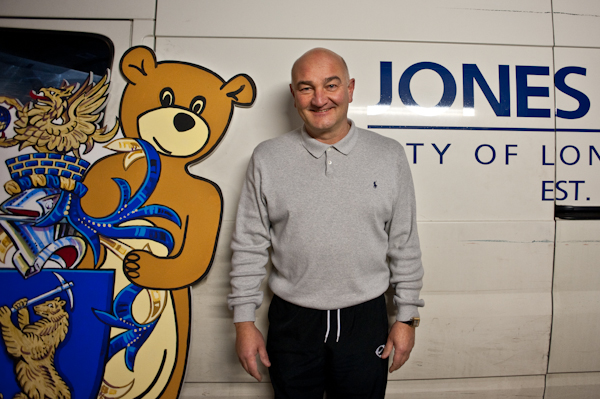
Henry Jones on the day before the parade.
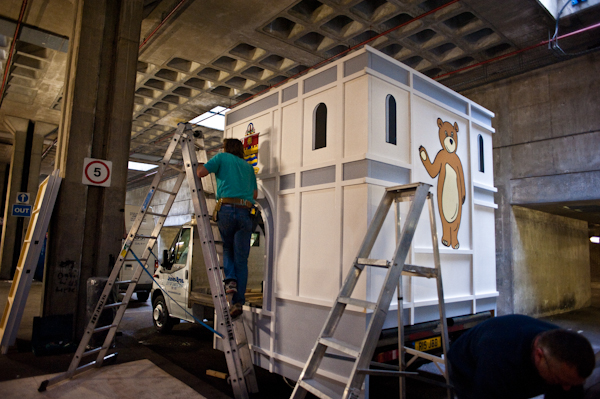
The milk float gets a makeover.
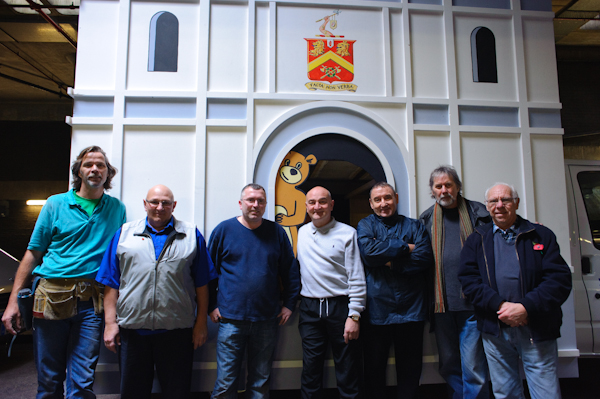
The team that transformed the milk float, Stuart Stanley the designer is on the far left.
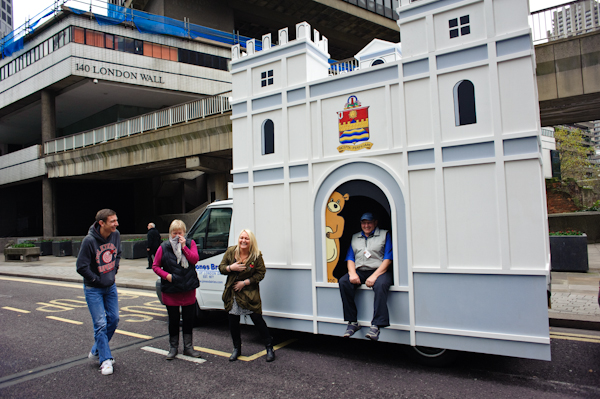
A moment of hilarity for the Jones family prior to setting off.
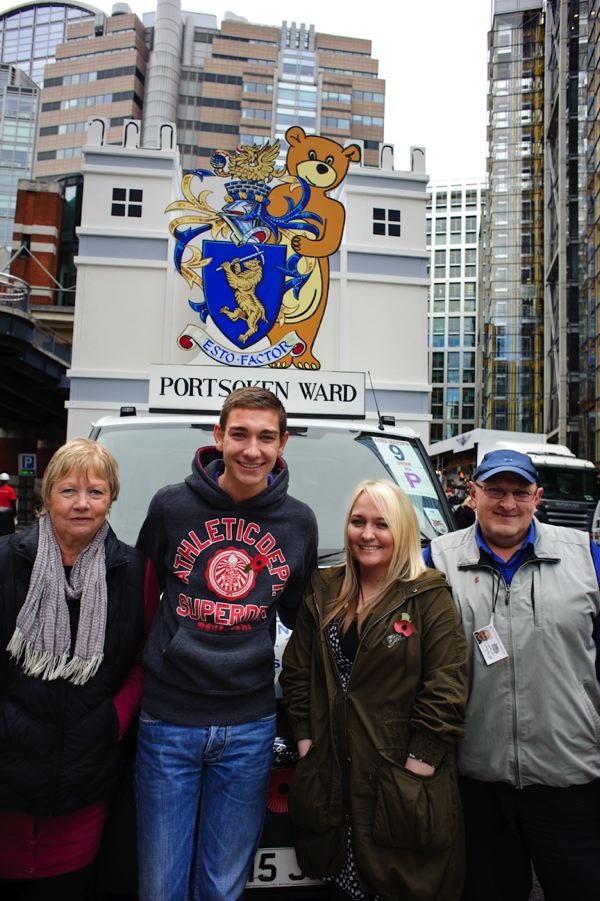
In the centre is the fourth Henry Jones with his sister Lucy, and flanking them Trevor Jones and his wife Hazel.
Photographs copyright © Ashley Jordan Gordon
At the Lord Mayor’s Show

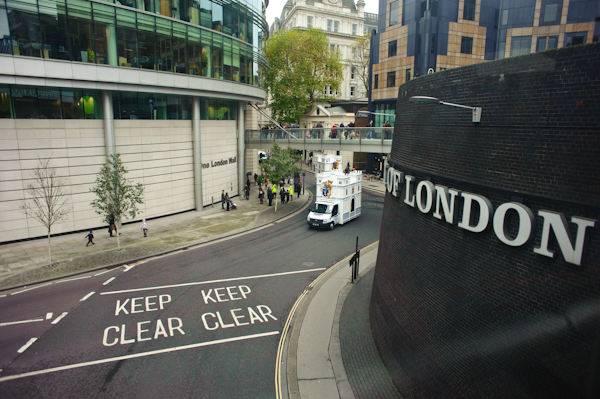
One of the highlights of November is the Lord Mayor’s Show, and each year I walk over to London Wall early in the morning where this extraordinarily multifarious parade gathers, to observe the elaborate preparations at close quarters, before it all moves off at eleven with the new Lord Mayor in his gleaming fairytale coach at its head. I cannot think of a more vibrant image of the diversity of human social endeavour – in all its paradoxes and contradictions – than this three mile long parade which takes over an hour to pass by. The City is closed off to traffic on the day and you walk through streets where a dreamlike hush presides to reach the assembly point where glorious chaos reigns as six thousand overexcited participants, both military and civilian, all take the opportunity to mingle and show off their gorgeous outfits.
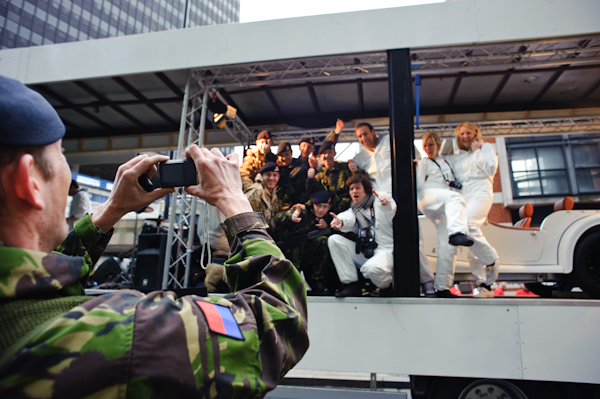
Ever since I saw her remarkable photograph Girl on the Kingsland Road, which was shown as part of Taylor Wessing Portrait Prize at the National Portrait Gallery, I have admired the work of Ashley Jordan Gordon and so it was my pleasure to invite her to join me at the parade on Saturday as Spitalfields Life’s newest contributing photographer. In the time before the parade moves off, a curious photo party takes place when everyone wants their photograph taken and Ashley did her best oblige as many as she could. There was a pervasive surrealism to this situation where all were in costume and it engendered a joyful camaraderie of equals in which the boundaries of normal life dissolved. I saw a platoon of soldiers dancing with a rock band, children climbing on a tank and, among so many braided uniforms, it was only upon second glance that I realised two were toy soldiers from Hamleys.
Meanwhile down at the Guildhall, in an atmosphere of high seriousness, the berobed dignitaries of the City of London were gathering, the Aldermen, the Sheriffs and the former Mayors. For these people the parade is one event in an entire weekend of formal dinners and arcane rituals that attend the inauguration of the next Lord Mayor of the City of London. And in the surrounding streets, their transport awaited as it has done each year since the event was transferred from the river after a drunken flower girl unseated the Lord Mayor in his barge in 1710. An array of immaculately preserved historic carriages were poised with magnificent horses and freshly shaved coachmen in uniforms to match – perfect in every detail as if they had just travelled through time to be here that morning.
I stood at the junction of Lothbury and Moorgate, at the rear of the Bank of England, to see the parade pass by. Even here the parade outnumbered those in the crowd, enforcing the sense that this was an event for the participants, not a performance for an audience but a moment of glory for those involved, in which our role was simply to be their witnesses. A costume implies an assumed identity, yet for many in the parade their clothes exemplified their roles, carrying a reality established over centuries. It took me a while to accommodate to this notion that I was not witnessing a reenactment of an historical event but the event itself. The outfits were not fancy dress they were real.
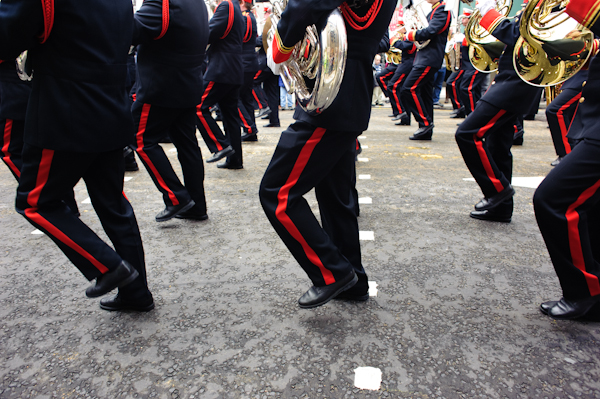
When a marching band in ceremonial uniform comes marching straight towards you, with a hundred musicians with playing simultaneously, looking sharp and displaying perfect focus, and the loud music echoes through the narrow streets, then the vivid intricacy of the spectacle is overwhelming. Here we were in the heart of the ancient City of London. Soldiers who returned from recent conflict were met with cheers, and respectful applause was forthcoming for the nurses and firemen too, public services that we all value, now facing cuts. Among all the carnival animals, the puppies on leads, the seven man bicycle and the veteran trucks, it was sobering to see a bomb disposal robot in the parade, rolling along with the innocence of a remote controlled toy.
From the playful to the grim, from the charitable to the corporate, from the raucous to the majestic, all the pageantry on display fused with an inescapable emotionalism into a wondrous vision of humanity. From the dignified seniors to the young crazy ones dancing on floats, and from those who take themselves alarmingly seriously to dumb clowns with painted faces, there were so many different proposals of what it means to be human.


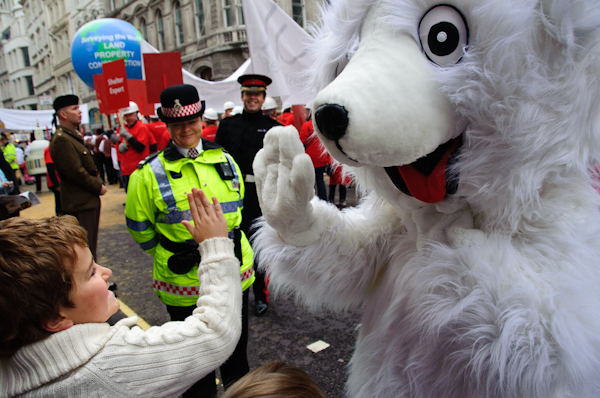
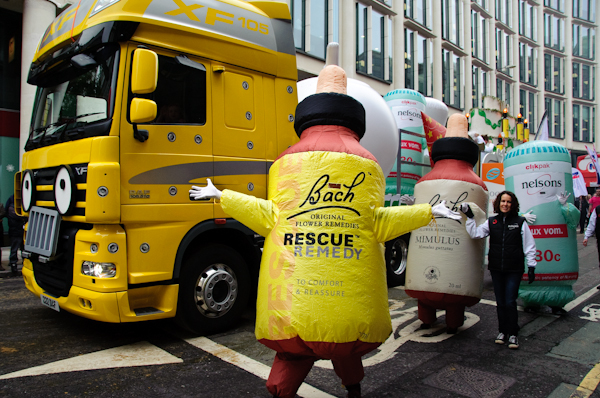
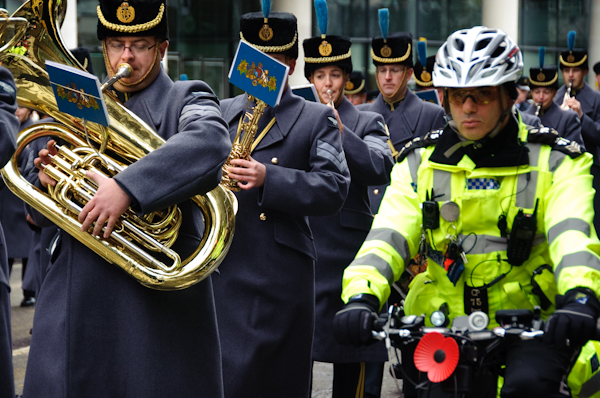


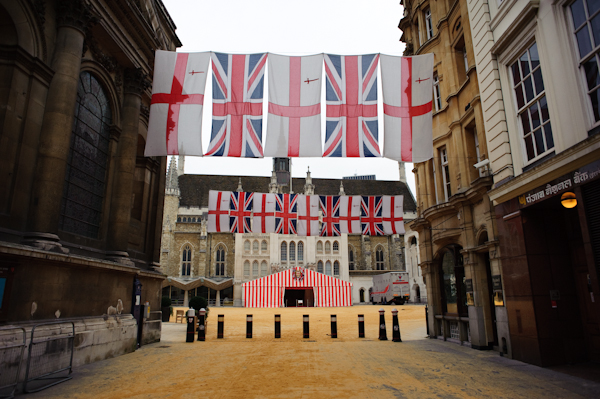
Photographs copyright © Ashley Jordan Gordon
Columbia Road Market 59

It was damp and misty and mild when I left Spitalfields early this morning to pay a call upon Stuart Crump, his daughter Alice, and Curly who works with them on their stall. A man of substance yet a relative newcomer to the market, Stuart has been in Columbia Rd for ten years and worked this pitch for the past two or three years. “My mum was a lecturer in floristry at the college in Southwark,” he explained proudly, “so when I left school in 1994, I opened a flower shop in Tottenham and then I had a place in the Edgware Rd, before I came here.” Stuart flies to Holland every Tuesday where he spends two days of each week buying plants for the coming Sunday at the huge auctions in the West Land. This week, Stuart has a fine selection of Orchids at competitive prices, and Chilli plants and Cyclamen are popular too.
At this point, Stuart’s enthusiastic daughter Alice bounced into the conversation to explain that she takes responsibility for rousing her father from his bed each Sunday at three-thirty in the morning, which caused Stuart to place his arm round her protectively as he rolled his eyes at the very thought of these reluctant awakenings. Alice takes great delight in the market, working here alongside her brother Charlie most weeks, and she is eager to follow her father into the family business, even though Stuart is dubious of the imminent changes coming to Columbia Rd. Stuart told me the stalls will be widened to twice the breadth and separated. “It won’t be good for the market, people like the hustle and bustle, and we haven’t got the stock to fill the width.” he confided with a shrug.
At the other end of the stall I had a chat with Curly. A celebrated character in the market, he has been employed on this pitch for the past twenty-five years – working for the previous owner Colin Roberts for twenty-three years. From Mondays to Fridays, Curly has a job at a tyre and bodyshop in Tottenham but, after a quarter of a century, his regular Sunday foray into market life has become the highlight of his week. “It’s something different, very sociable, you meet great characters and the stallholders are quite friendly,” he said, taking a bite from a hasty beigel, “It’s been like this as long as I’ve known it.”
Photograph copyright © Jeremy Freedman
Adam Dant’s Map of Shoreditch as New York
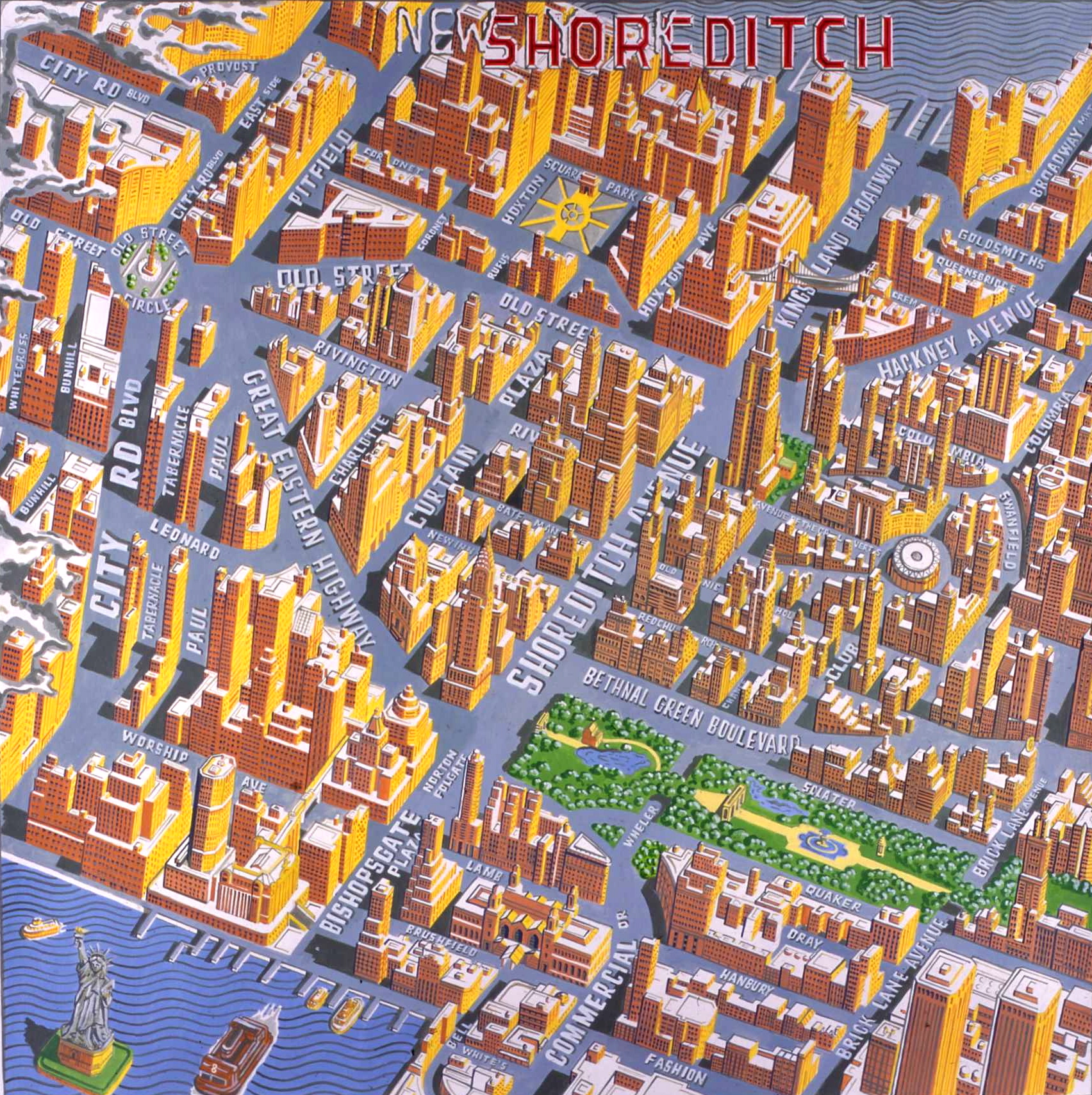
“People do say they like the New Yorky feel, here in Shoreditch,” admitted Adam Dant with a wily smile and a discernible twinkle in his eye, when I asked him how he came to draw this map of Shoreditch as New York. In this arresting vision, (A double click will enlarge the map to fill your screen) Old St roundabout is transformed into Old St Circle, Arnold Circus Park becomes Madison Square Gardens and Liverpool St Station becomes Grand Central Station. In this metamorphosis, the buildings and terminology are Americanised too, Brick Lane becomes Brick Lane Avenue, Bethnal Green Rd becomes Bethnal Green Boulevard and Quaker St becomes simply Quaker. Commissioned in 2003 by the Shoreditch Map Company, the original painting now hangs above the table football machine in Bar Kick in Shoreditch High St, where Adam and I went to have a look at it yesterday. Unsurprisingly, we were told it is the subject of a great deal of discussion in the bar.
When you come to think about it, the comparison becomes less far fetched than you might assume, because Broadway in New York is along the line of an ancient pathway followed by the Algonquin tribe, whereas in Shoreditch, Old St follows the route of a primeval trackway of the ancient Britons, and Canal St in New York follows the route of the former canal whereas Shoreditch takes its name from the “Suer” that was once ditched and is now piped off. Both places are renowned for their mix of artists and immigrant culture, and down in Brushfield St, on the site of the Spitalfields Market, Adam has drawn New York’s Ellis Island building in acknowledgement of the immigrants who have come to New York and Spitalfields, defining the nature of these locations today.
Looking around the neighbourhood, you quickly come upon further clues. We have Rivington St here just as they do, and Broadway Market and Columbia Rd too, chiming with New York. And the extension of the Great Eastern Railway up to Old St created a narrow triangular plot, occupied by a tall tapered building at the bottom of Great Eastern St which is reminiscent of the Flat Iron Building. Many people live in lofts in this vicinity today just as you might find in Soho or Tribeca and, of course, we have Shoreditch House whereas in New York they have Soho House, though I am reliably informed our rooftop pool deck is bigger than theirs.
In Adam’s vision, the Bishopsgate Goods Yard is transformed into a park, something many residents would like to see. Wheler St crosses the yard beneath a bridge just as 79th St crosses Central Park, while the elevated garden upon the former railway arches that Adam has drawn resembles the Highline Park in Chelsea – and a similar proposal has been made here, to transform the continuation of the Bishopsgate Arches over in Pedley St into a raised park. On Sundays, you will find the Chelsea fleamarket in the West Village, and here in Sclater St and Bethnal Green Rd. In Summer months, young people fill Hoxton Square, just as their transatlantic counterparts fill Washington Square.
The impetus behind Adam’s map was the Situationists, who would take a map of Paris to the Sahara Desert, exploring the strange poetry of transferring a map from one area and applying it to another. Inspired by the Situationist movement, Adam had previously done a project of Reading as Rome, in which he staged a casting call in Reading for “Reading Holiday,” a remake of the classic Audrey Hepburn, Gregory Peck movie, relocated to Reading – using a Lambretta and back projection of the streets of Reading. “I tried to take photos of Reading where it could pass for Rome,” Adam explained to me with a smirk, as we walked back from Bar Kick to his studio in Club Row, “It was bloody difficult.”
Then we were both stopped in our tracks by an image on a passing courier truck in Redchurch St, showing New York viewed through Tower Bridge grafted onto the Brooklyn Bridge. But was it Tower Bridge joining the Brooklyn Bridge across the East River with Manhattan in the background? Or was it London with the New York Financial District transferred to Shad Thames? Was it London as New York or New York as London? We stood and looked at each other in amazement…

The courier truck in Redchurch St, is this London or New York?
You may like to take a look at Adam Dant’s Map of the History of Shoreditch and his Map of Shoreditch as the Globe. Next time, Shoreditch in the Year 3000. Adam Dant’s current exhibition Bibliotheques & Brothels runs at the Adam Baumgold Gallery, East 66th St, New York City until November 27th.
In & Out the Eagle Tavern

I wish you would take me out to the theatre. On these dark nights when the rain beats at my window and the wind moans down my chimney, I dream of leaving the gloomy old house one evening and joining the excited crowds, out in their best clothes to witness the spectacular entertainments that London has to offer. The particular theatre I have in mind is The Grecian Theatre attached to the Eagle Tavern in Shepherdess Walk, City Road between Angel and Old St.
The place seems to have developed quite a reputation, as I read yesterday, “The Grecian Saloon is really a hot house or a black hole, for the number of human beings packed in there every night would induce a supposition there was no other place of entertainment in London. At least two thousand persons were left unable to procure admission.” This was written in 1839, demonstrating that the popular art of having a good time – still pursued vigorously in the many pubs and clubs here today – is a noble tradition which has always thrived in the East End, outside the walls of the City of London.
“Up and down the City Road, in and out the Eagle, that’s the way the money goes…” The Eagle public house in the rhyme still exists to this day, though barely anything remains of the elaborate entertainment complex which developed there during the nineteenth century – apart from a single scrapbook that I found in the archive of the Bishopsgate Institute. All the balloon ascents, the stick fights, the operas, the wrestling and the wild parties may be over, and the thrill rides closed long ago, but there is enough in this album to evoke the extravagant drama of it all and fire my imagination with thoughts of glamorous nights out on the town.
You only have to walk through Brick Lane and up to Shoreditch on a Saturday night, through the hen parties and gangs of suburban boys out on a bevy, jostling among the crowds of the intoxicated, the drugged and the merely overexcited, to get a glimpse of what it might have been like two hundred years ago. With as many as six thousand attending events at the Eagle Tavern, we can assume that lines must have formed just as we see today outside nightclubs.
On the site of the eighteenth century Shepherd & Shepherdess Pleasure Garden, the Grecian Saloon developed at the Eagle Tavern to provide all kinds of entertainments, from religious events to conjuring and equestrian performances. There is a tantalising poetry to the hints that survive of these bygone entertainments, because sentences like “We are glad to find that little Smith has recovered her hoarseness.” and “We have little to find fault with save that the maniac was allowed to perambulate the gardens without his keeper.” do set the imagination racing. There are many fine coloured playbills in the cherished album that I hope to show you in coming weeks, crammed with enigmatic promises of exotic thrills. Take a look at the plates below and wonder who exactly was the beautiful Giraffe Girl, or General Campbell, the smallest man in the world. Amongst so much hyperbole there is a disappointing modesty to learn that the central attractions are merely supported by the “artistes of acknowledged talent.”
Elaborate pavilions with all manner of special effects were constructed at the Grecian Saloon, which in turn became the Grecian Theatre in 1858 where Marie Lloyd made her stage debut, aged fifteen. Eventually the building was acquired in 1882 by General William Booth of the Salvation Army and the parties came to an end. Yet this site saw the transition from eighteenth century pleasure garden to nineteenth century music hall. And when you come to think of the many thousands of souls who experienced so much joy there over all those years, it does impart a certain sacred quality to this location, even if it is now mostly occupied by the Shoreditch Police Station.


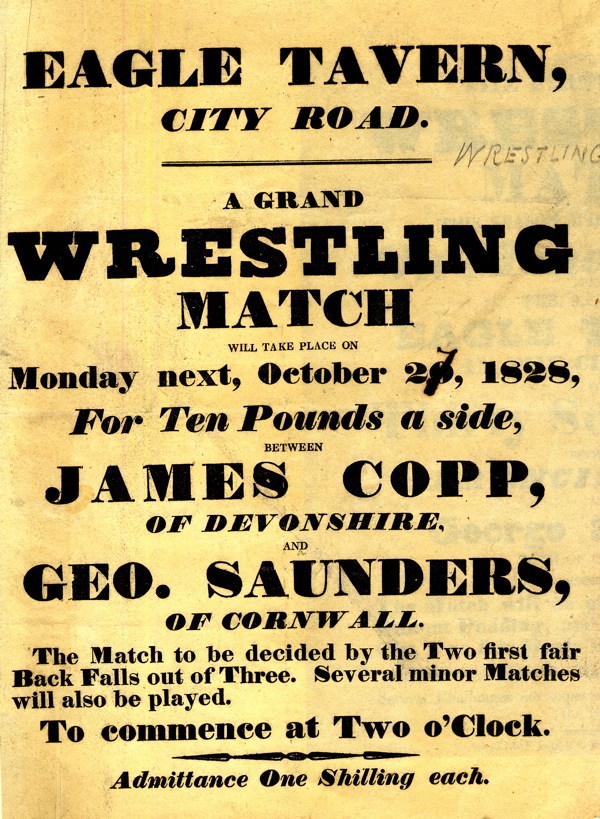


Watercolours of the New Grecian Theatre in 1899, built during the management of George Augustus Oliver Conquest in 1858 and later purchased by General William Booth of the Salvation Army.

All images copyright © Bishopsgate Institute
Peter Hardwicke, Signwriter

You may have seen Peter Hardwicke in Brushfield St over the last couple of weeks, busy up a ladder or crouched down on the pavement, painting new signwriting on the Market Coffee House which has opened an English Restaurant. “That’s not how you spell ‘restaurant’!” I called out cheekily to him, when I saw Peter standing with his brush poised, while balanced precariously upon two planks supported by tall trestles. Yet such was his professional mode of composure that he simply turned his head and, looking down, gave me a gracious smile of complicity – as if he had never heard that one before. While everyone has gone about their business recently in Spitalfields, Peter has painted his elegantly proportioned letters with placid concentration, apparently oblivious to the chaos surrounding him.
Directly across Crispin St stands The Gun, which is covered in signwriting that Peter did back in the nineteen eighties. Although I admired the flourish of his gold italic script emblazoned there, Peter is a little dubious of this early work because he is aware that tastes in signwriting have moved on. The trend now is for cleaner typography, whereas in the eighties they liked their fascias crowded with letters. I think we can allow Peter this singular distinction because he knows what he is talking about, since he has devoted all the years between doing these two premises on either side of Crispin St to painting the lettering on shops all over the East End.
Today, Peter may be the last sign writer in London who works entirely by eye – painting lettering freehand, and positioning and sizing it by eye too, rather using a computer. His innate sense of proportion and knack of placing the words upon the building derive from his practice of working directly onto the shopfront, rather than planning it on a computer and then simply transferring the design, a process that he dismisses as mere “painting by numbers.” And I cannot deny there is a certain heroic bravado to Peter’s work, which provided a popular spectator sport for the curious in Brushfield St last week, as we saw him consulting with the proprietor, then sketching out words in chalk before getting up there in front of everyone, and painting perfect nicely balanced letters, getting it right first time – and spelling ”restaurant” correctly too.
I managed to persuade Peter to climb down his ladder and join me for a cup of tea at Dino’s Cafe in Commercial St, where he took the opportunity to explain how he acquired and refined his talent for painting lettering with such grace.
“My father was involved in the restoration of historic vehicles, old trucks, and through him I learnt the basics of my craft. But then in 1984, at the age of sixteen, I went on to join a very established traditional signwriting company who did a lot of work on pubs for Courage, Whitebread, Watneys, Combe Reid and Truman’s. I had very good time there and fantastic workmates, apprentices like myself. The owner Ted Ambridge – an absolute genius – taught me everything I know, an complete master he was.
I was reasonably competent after three years and I was sent to signwrite my first pub, The Red Lion in Hoxton. I was a spotty faced teenager and the landlord told me to go home.He called Mr Ambridge and said, “I’ve got a young kid here who wants to do the signwriting on the pub.” And he said, “It’s alright, let him get on with it, it’ll be fine.” I done the job and it was very successful, but the point of the story was that although I done the signwriting on this pub, I couldn’t buy a drink there because I wasn’t old enough.
It’s one of those trades where the work is very therapeutic and satisfying, it’s almost like a hobby but you are being paid for it. I can be desperately ill and still do it. I think there’d have to be a hurricane for me not to do it. I’ve worked in all winds and weathers. I’ve worked in the snow. Signwriters are a bit like mountain goats.
When I started my freelance career, I worked in Central London in the high end of the trade doing gold leaf and glass work, the premium market – the cream of the signwriting trade. But what with the regeneration of East London and being from here, I actually prefer working here. It’s more interesting and I like to see my local area looking good. I get great pleasure walking along Columbia Rd, Cheshire St and through Spitalfields, knowing that I’ve had a hand in creating this environment. It’s almost tribal, here in the East End there is an optimistic flourish to the signwriting even if it is a bit rougher, whereas up in North London the lettering is more uptight, anxious and controlled. I can do any font from memory, though I have own house style, a pointed serif font signwriter’s Roman. We’ve all got it, I can look at any sign and tell you what signwriter done it. It’s just like a signature. You can see the link between the three of us who trained with Mr Ambridge, very classical.
I met a guy last week – he stopped in his van outside the Market Coffee House – in his late fifties. He said, “I used to do what you do.” “What happened?” I asked. He’d gone over to scanning signs onto plastic with a computer, and the last time he picked up a brush was five years ago. He got quite melancholy,“There’s no work now,” he said. “But there is,” I replied,“If I can do it, you can!””
Below you can see a proud selection of Peter’s work in the vicinity and you can view his archive here.


Peter Hardwicke at work in Brushfield St

Peter as an apprentice in 1984, aged sixteen, with one of his first pieces of work.
New photographs copyright © Jeremy Freedman
Lucinda Rogers’ East End
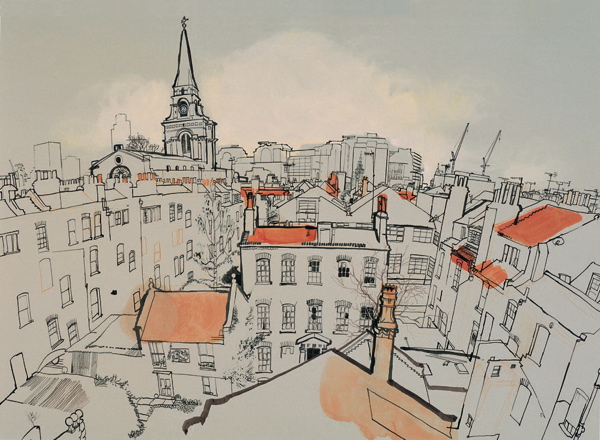
Even before I met her, I always admired this view looking West over Spitalfields by Lucinda Rogers that is framed on the wall of the Golden Heart in Commercial St. It is a large drawing executed in vigorous lines placed with superlative confidence, and filled with subtlety and fluent detail to reward the eye. The pale cloud on the horizon high above the City – illuminating the grey Northern light of a London sky – is a phenomenon that anyone in Spitalfields will recognise. What I especially like about this drawing is that there are so few lines, enough to summon the drawing into existence yet without any superfluous gesture. And although there is no pretence to photographic realism, the vivid spatial quality is such that when you gaze into the deep spaces of the composition it can feel almost vertiginous, especially if you have had a few drinks.
The next work of Lucinda’s to impinge upon my consciousness was her portrait of my friend Paul Gardner, the paper bag seller, which hangs up behind the counter in his shop in Commercial St, where his family have traded from the same building since it was built in 1870. Here you see Paul, in his world composed of paper products, at ease behind the counter in a characteristic pose of dreamy contemplation, ever expectant of the next customer to burst through the door demanding paper bags. The crowded symphonic detail of the bags and tags and signs in this masterful portrait manifest the contents of Paul’s extraordinary mind, possessing a natural facility to keep to track of all his stock, as well as working out all the prices, discounts for multiples and VAT percentages with ease.
I do not know what I expected when I met Lucinda Rogers for the first time, but I certainly was not prepared for her alluring poise, as she arrived looking chic in a tweed coat with dramatic long straight copper hair, pale skin and a huge ring with a rectangular stone – with an intensity of glamour as if she had stepped from a Jean Luc Godard movie. As we shook hands and I complimented her on her work, she flashed her hazel eyes with a generous smile, and I was momentarily disarmed to realise that she was looking at me with the same shrewd vision which she demonstrates in her elegant work. Once introductions were accomplished, we enjoyed several hours studying this remarkable set of drawings, which exist collectively today as a unique portrait of our neighbourhood as it was in the first decade of this new century.
They were created by Lucinda between 2003 and 2008, for an exhibition at the Prince’s Foundation Gallery in Shoreditch and then for a feature in an Italian design magazine, Case da Abitare, as she explained to me, “I was offered an exhibition, so I decided to make it of the East End – because I had only drawn New York up until then – with the focus on Spitalfields and especially on people working. So not really about the buildings, but about recording the things that go on inside the buildings and how they are changing. Not like a photograph, but more about a particular day, your feelings, and what you choose to leave out or leave in to make the picture. You are making something that’s less factual and more subjective.”
The first drawing Lucinda made was of the B2B building in Usborn St at the bottom of Brick Lane. “The reason I did this drawing was because of the numbers that are cut out of plywood and nailed to the wall to advertise the sound studio where the soundtracks for Bollywood films are recorded. The floor beneath is occupied by the rag trade, the Jewish Monumental Mason is next door, in between is the Italian Coffee Shop, while in the background the Gherkin is being built and in the foreground is an apple core.” she told me, enumerating the diverse elements in her picture that coalesce to define the elusive mutable culture of this location, where today an estate agent occupies the property.
The modest aesthetic of these drawings upon tinted paper with just a few touches of colour is dramatically in contrast to their bold compositions and scale. Lucinda’s work is closer to cinema than photography, because confronted with the physical presence of the works you cannot resist turning your head to scan the extent of these images.“I see the finished drawing in my mind,” Lucinda said to me plainly, revealing an imaginative confidence that permits her to work without preparatory drawings, defining the structure of these pictures with her first deftly-placed bold brushstrokes.
Each was completed in a single session on location in the street or in the workplace, contributing to the spontaneity that all these drawings share. The fragile lines that conjure these images out of ether give them tremendous energy and life, whilst also emphasising their diaphanous transient quality of vision. As Lucinda Rogers admitted to me with philosophical smile and a gentle shrug of perplexity, “Everything that I draw changes…”
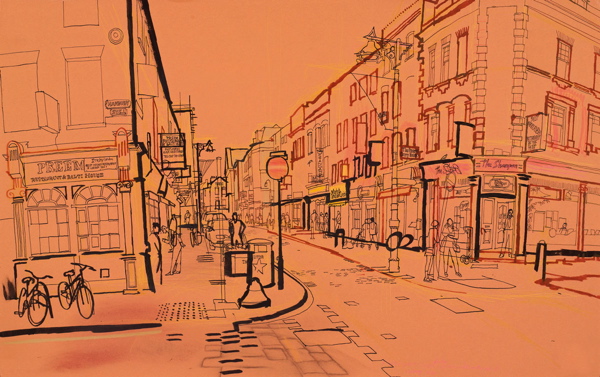
Brick Lane at the junction with Hanbury St.

At the rear of the Nicholls & Clarke building, Norton Folgate.
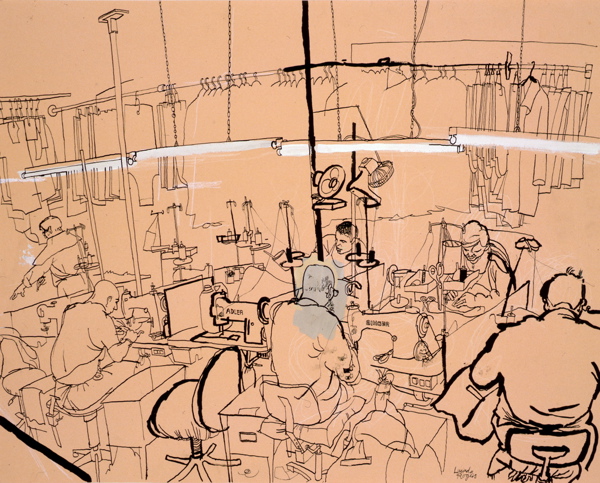
Leatherworkers at Hyfact Ltd, Links Yard, Spelman St.
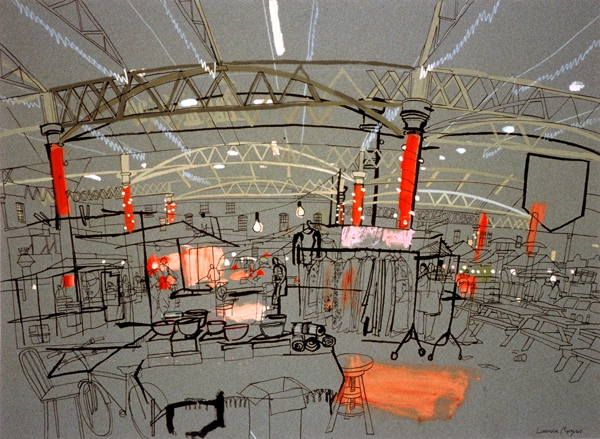
Sunday in the Spitalfields Market, Christmas
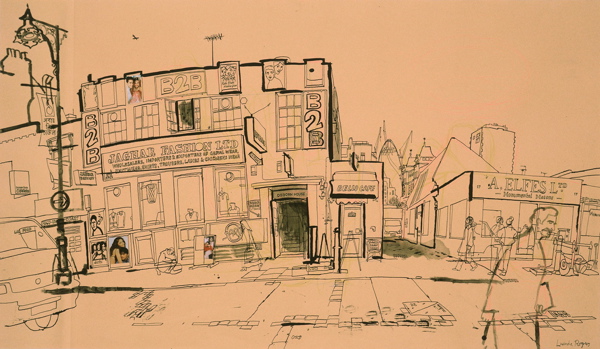
B2B Building, Osborn St.
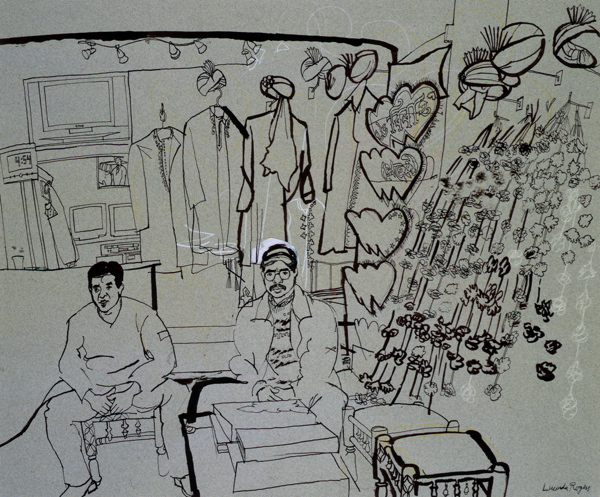
Sunrise wedding services, Hanbury St.
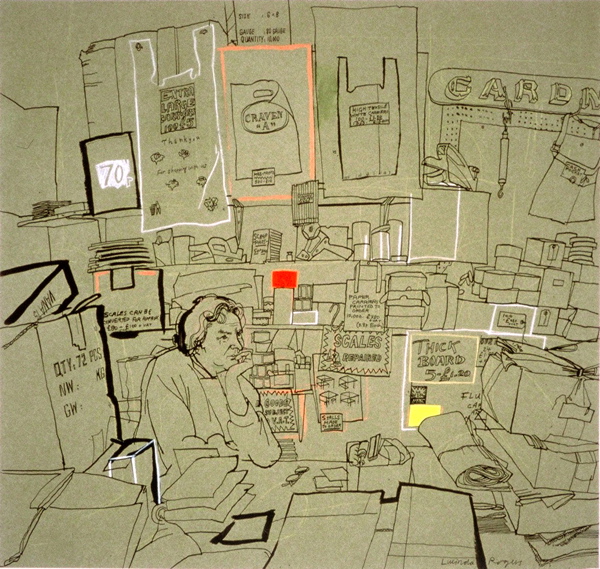
Paul Gardner, Gardners Market Sundriesmen, Commercial St.
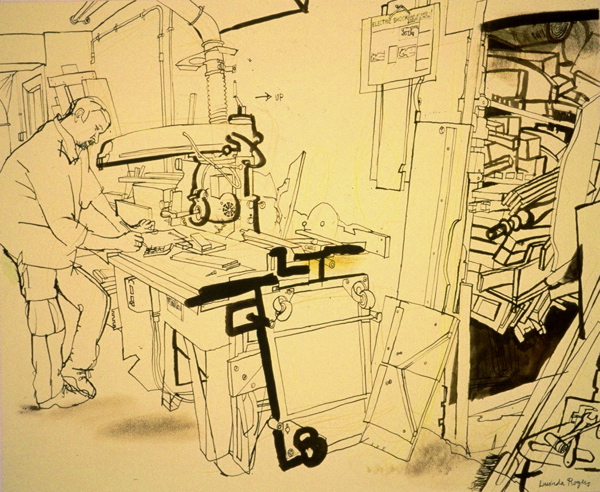
Phil at Crown & Leek joinery, Deal St.
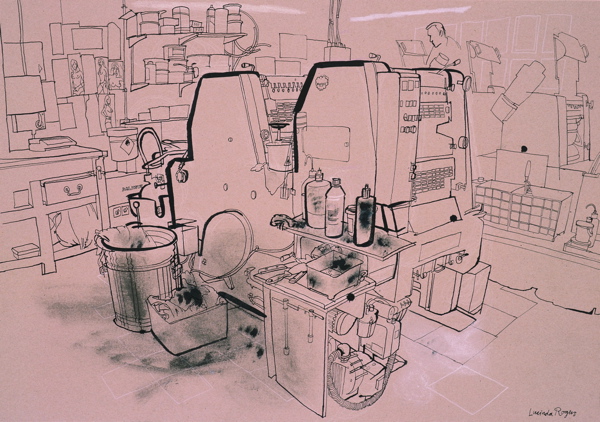
KTP Printing, Princelet St.
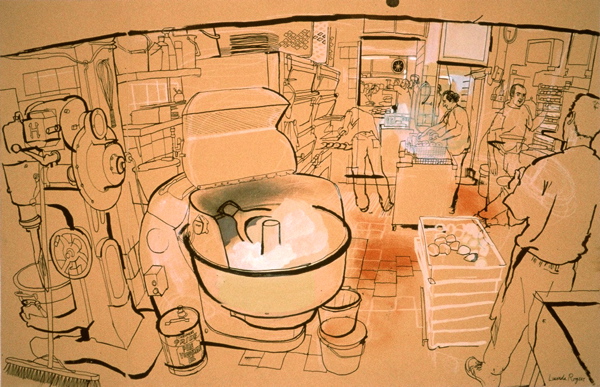
Night in the kitchen at the Beigel Bake, looking out towards Brick Lane.
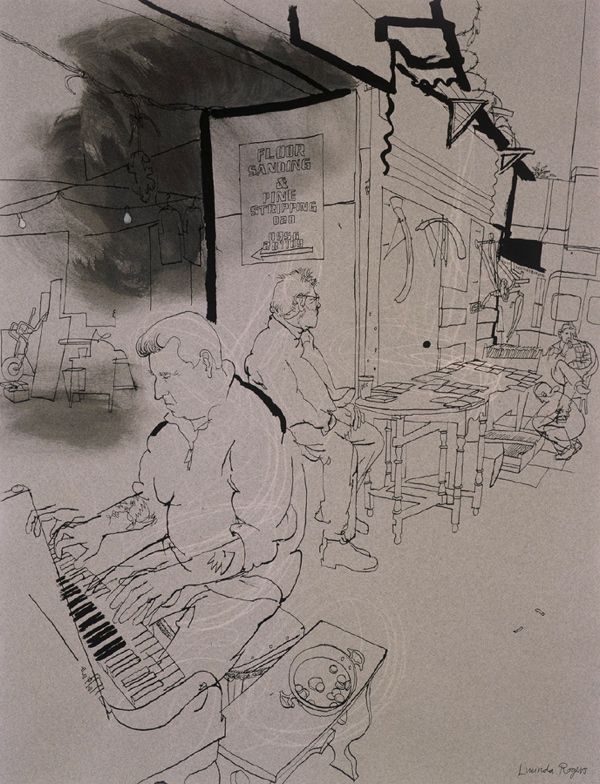
Big John Carter playing Boogie Woogie on Brick Lane.

Saffire furniture shop, Redchurch St.
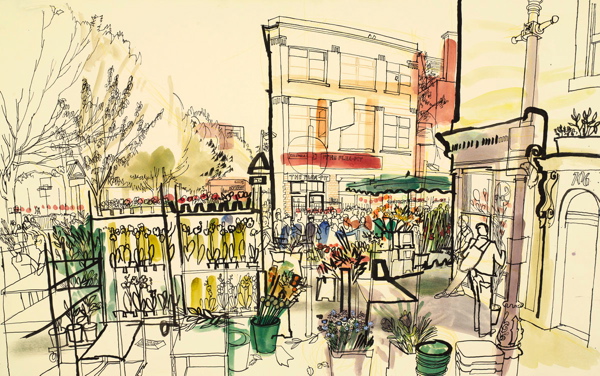
Columbia Road Flower Market.
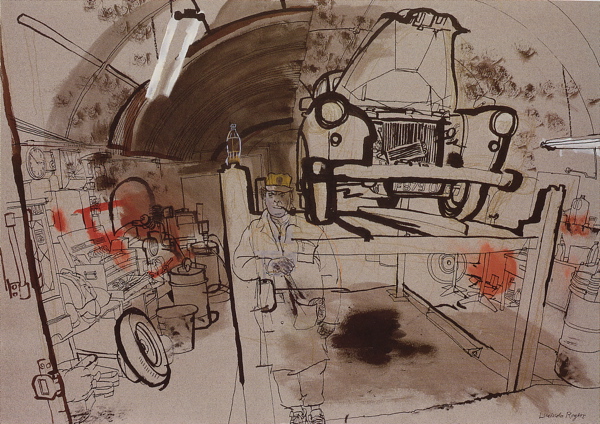
Eugene at North Eastern Motors, Three Colts Lane.

Junction of Middlesex St and Wentworth St, viewed from Petticoat Towers.
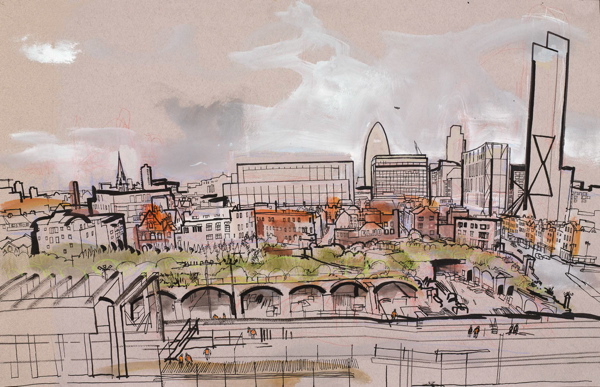
Bishopsgate Goods Yard with Spitalfields and the City beyond, viewed from pool deck at Shoreditch House.
Drawings copyright © Lucinda Rogers