
Mark Petty’s Multicoloured Coats
It has been so grey recently that I decided to visit my esteemed friend Mark Petty, the trendsetter, who I introduced you to last year. Mark is well known in Spitalfields and Bethnal Green for his primary coloured leather suits and, even in these dark days, can always be relied to upon to elevate our lives with the audacious use of colour in his personal wardrobe. In fact, when I met Mark in Cheshire St recently, he invited me round to see his series of multicoloured coats that he has designed, each adorned with motifs which tell a story, and, even though, based on Mark’s previous outfits my expectations were high, I can assure you that I was not disappointed.
“My mother used to say I have the creative touch. At work, I used to make the sausage rolls and meat pies that it was my job to bake – but then I made all the cakes and puddings too!” Mark told me proudly, confiding the innate creativity that he has directed to such spectacular effect recently.
Mark Petty’s multicoloured coats represent the latest fruits of the collaboration between Mark as pattern-cutter and Mr Singh of Batty Fashions in the Hackney Rd who sews them. As with many of the most creative partnerships it is not entirely without friction, yet the finished results successfully combine Mark’s flamboyant colour sense with Mr Singh’s attention to fit and finish – even if just occasionally Mark’s extravagant imagination is too much for Mr Singh’s conservative sensibilities, as with the case of the words “Bethnal Green” across the rear of the lilac shorts below, which Mark had to sew on himself.
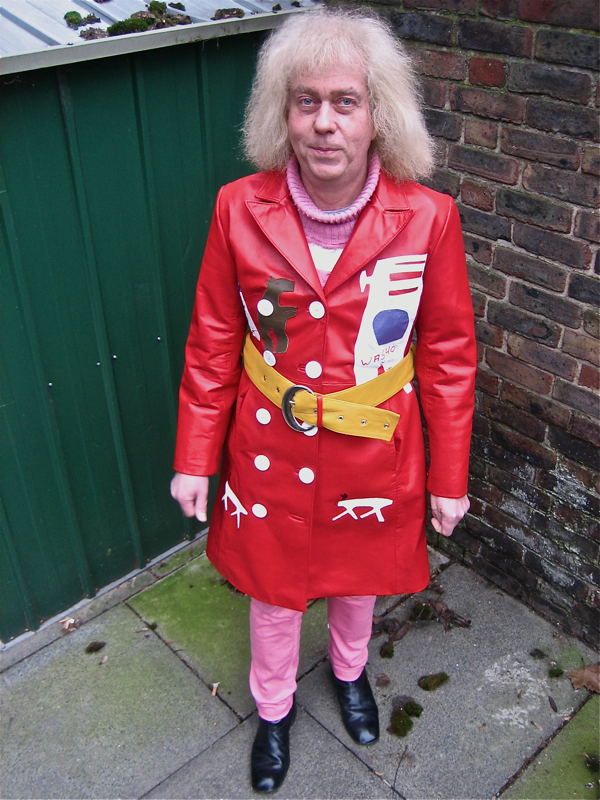
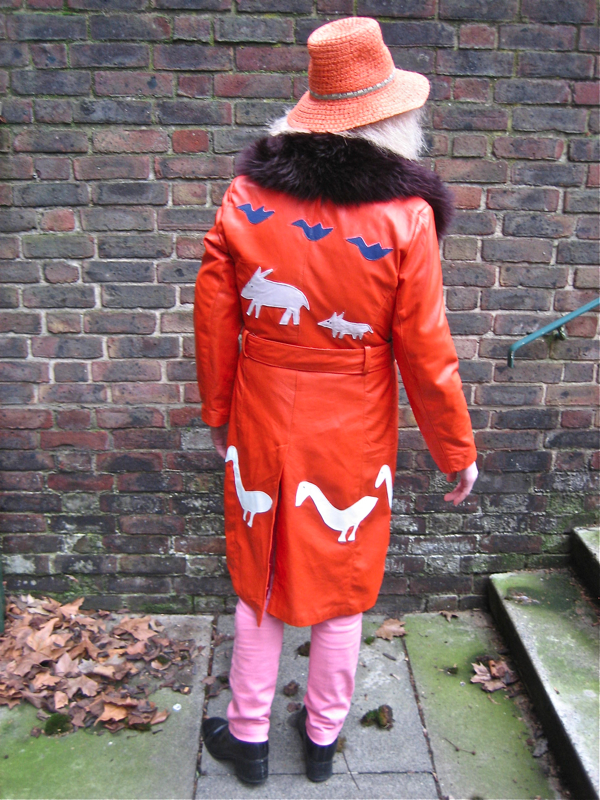
I am fascinated by the iconography of Mark’s coats, rendered so elegantly in Matisse-style cutouts, which in each case have vivid personal meaning for Mark. Of the first coat he designed, the tangerine number with the geese, Mark explained the origin of this imagery in his childhood. “When I was much younger, I lived with my mother and my uncle and aunt in this bungalow in the wilds of nowhere in Essex,” he explained, as if beginning a fairy tale, “and the only way to get out was through this horrible wood. I liked geese and when my mother went up to feed them, I fed them too. And she told me the story of this woman who used to drive her geese through East London.”
“I drew up the patterns of the geese and I said to Mr Singh, ‘We’re not going to have any disagreements, we’re going to do it my way!'” admitted Mark affectionately, recalling how it all began. You might wonder why anyone might choose such a breathtaking colour for a coat when most people prefer brown or black or blue, but in order to tell the story of these coats I think can reveal to you – without compromising Mark’s privacy – that his initial impulse was to draw the attention of a “significant other” that Mark cherished.
This intention is overt in the second coat which adopts the theme of railways and shows two steam trains in love, meeting under a light, with the text, “Come to me.” While the third coat, in Mark’s favourite colour of pink, manifests open-hearted emotionalism,with friendly animals that incarnate innocent affection and the unqualified declaration, “Can you handle it?” This gloriously exuberant design has bear motifs because Mark revealed that this was his term of endearment for his beloved, who never saw the coat because the relationship foundered – casting a sweet melancholic poetry upon the garment today.
The final coats in the sequence explore Mark’s feelings in the aftermath, beginning with a subdued blue coat illustrating the Ice Age, with images of extinct creatures, dodos and woolly mammoths on ice flows, labelled in Fahrenheit , an outdated form of measurement. This is followed by a vivid red coat with a Prehistoric theme, going further back in time. This garment is defiant in its emotionalism, with a pair of Brontosauruses in love and a picture of a bear dropping a mobile phone – as Mark’s beloved did when he saw the first coat – and a fond image of Mark’s washing machine that he keeps in his bedroom because it will not go through the kitchen door. In this coat, the relationship is memorialised and celebrated, as Mark takes ownership of his feelings and translates them into images that satisfy him.
“As a child, I had no toys except a Brontosaurus. We were a family that never stayed much in place, we came over from Ireland in the fourteen sixties. So I thought I’d include Brontosauruses to record who I am.” announced Mark, with a broad smile to reveal the culmination of his series, “My last coat will be a mythological theme, Welsh Dragons to commemorate people I once knew and people who have died and gone.”
Mark Petty understands the magic power of clothes – and his project to take his innermost feelings and put them on the outside, unashamedly, is one that expresses an extraordinary commitment to emotional truth. It demonstrates moral courage too, because while these coats are unapologetically outspoken, Mark possesses an undemonstrative personality. “I used to go out in fear because of the kids throwing bottles and calling me a ‘white tranny bitch,'” he confided to me with an absurd grimace, “you don’t expect it here in Bethnal Green that’s supposed to be so multicultural. But I go out anyway, because I am determined. You have to do these things. Because I believe if you use love, you show there is more to life than hatred”.

The first joyous coat emblazoned with the geese of Mark’s childhood.
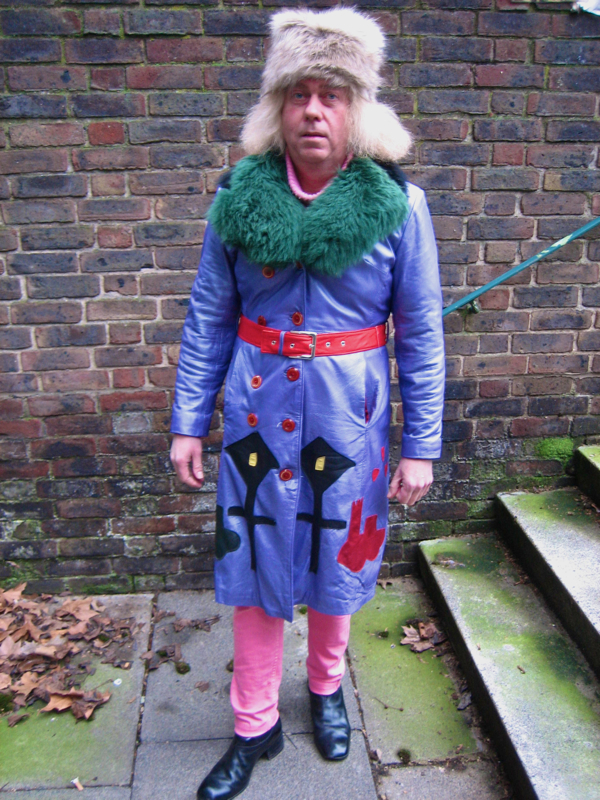
The railway themed coat, completed with a cossack hat.
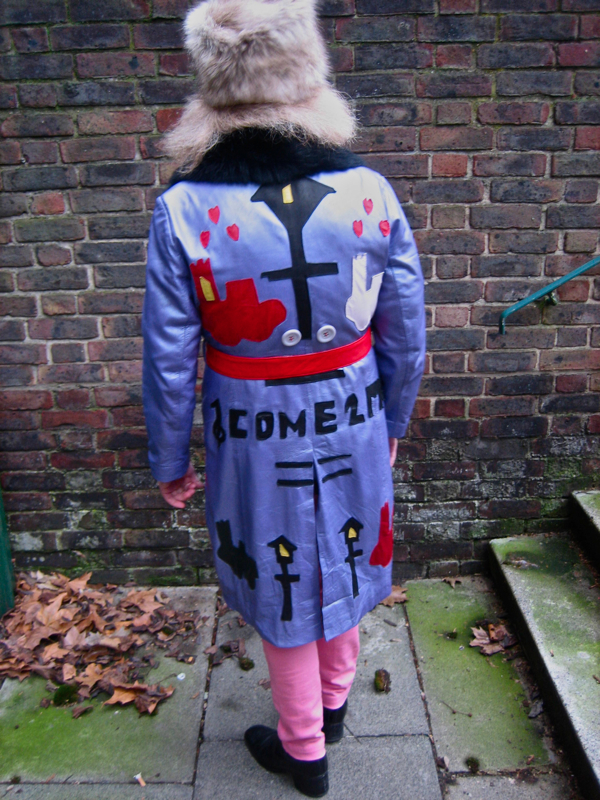
Two steam trains in love meet under a light.

Little bears in celebration of innocent affection.
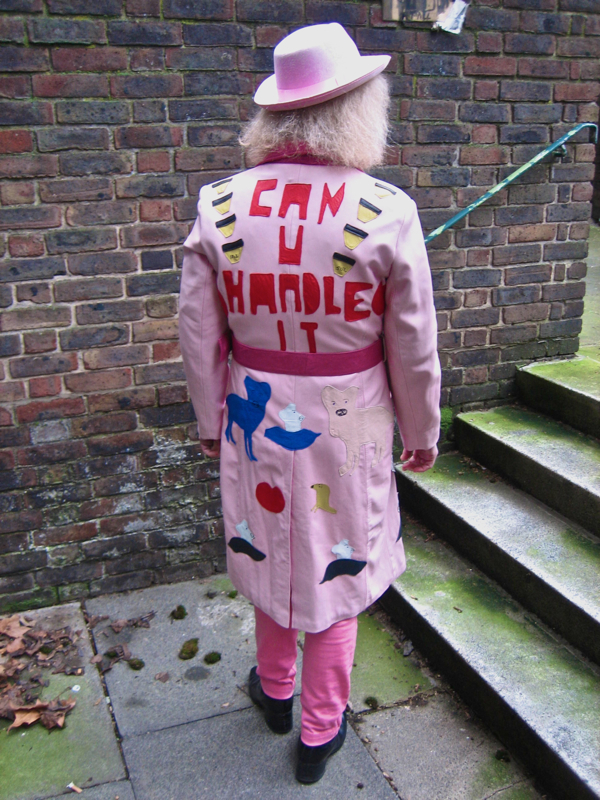
Can you handle it? – a declaration of unrequited love.
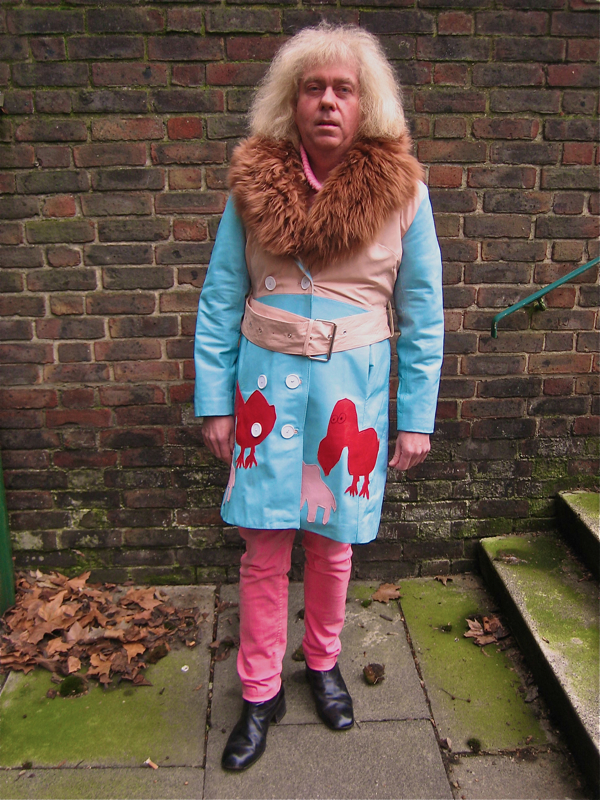
This Ice Age themed coat features dodos, woolly mammoths and creatures that are extinct.
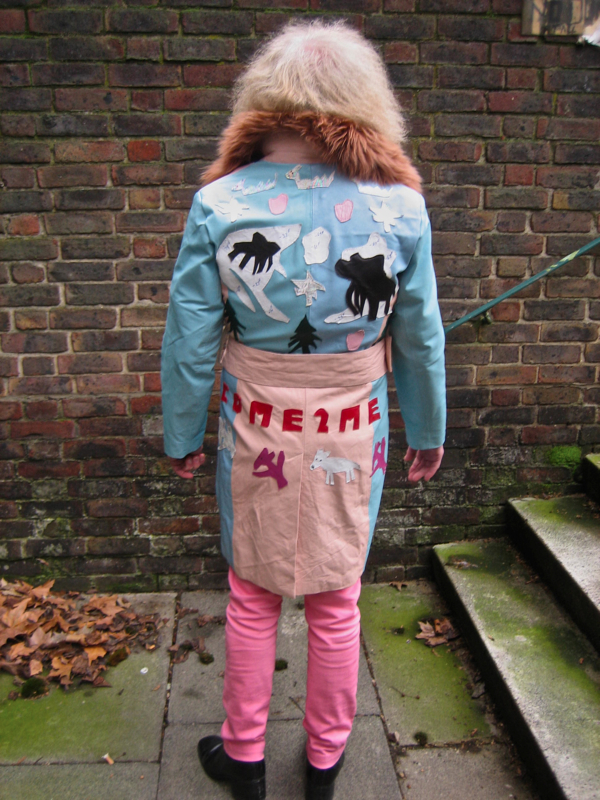
Woolly Mammoths separated by the Atlantic upon ice flows labelled with temperatures in Fahrenheit.
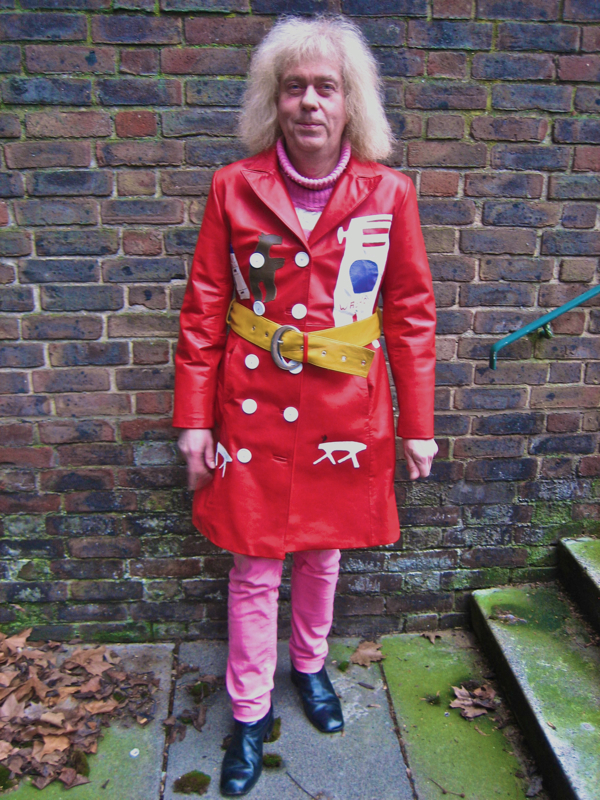
Motifs of bear with a mobile phone and a washing machine adorn this coat.
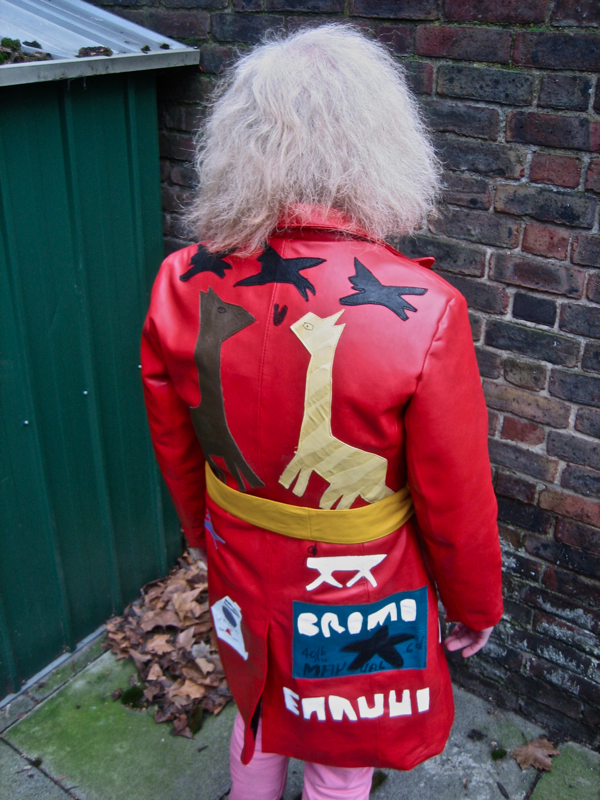
Brontosauruses in love, with Pterodactyls flying overhead.
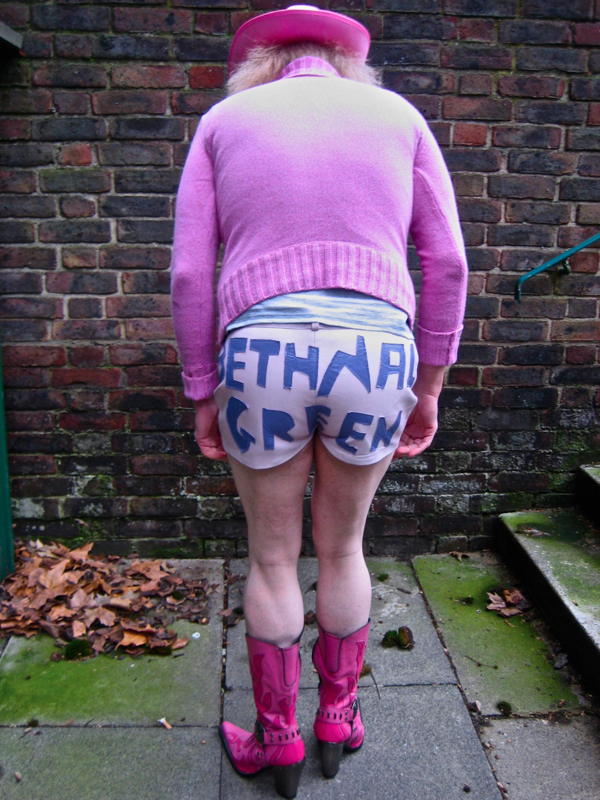

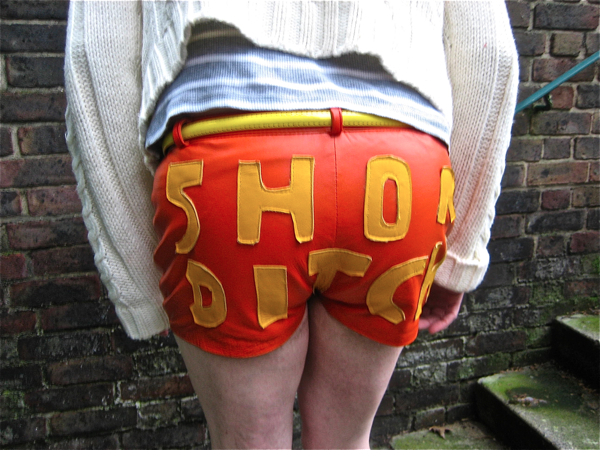
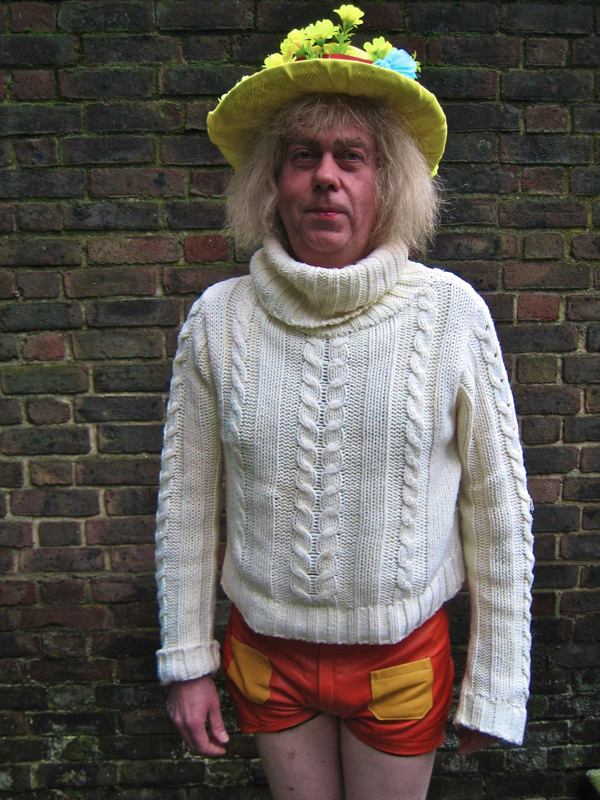
Mark’s new hat design, paired with his Shoreditch hot pants, proposes an optimistic look for Spring.
Read my first story about Mark Petty, Trendsetter
John Leighton’s London Cries
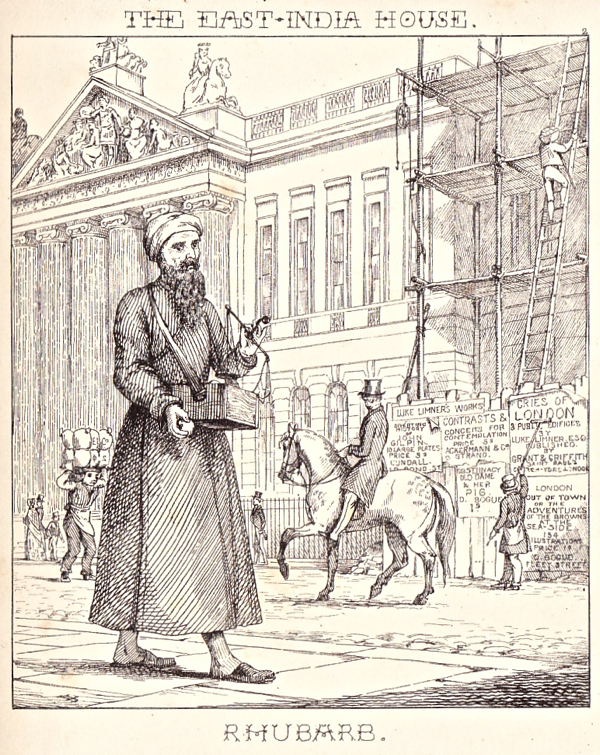
John Leighton’s “London Cries & Public Edifices” were published in 1851 under his playful pseudonym Luke Limner. Today Leighton is remembered primarily for his designs for book bindings but I have a fondness for his Cries because, while they may not have the grace of Francis Wheatley’s set from the seventeen nineties or the draughtsmanship of John Thomas Smith’s Vagabondiana from 1817, they share the same fascinating evocative poetry, recalling the long lost street life of London with sly humour.
This Turkish rhubarb seller in Leadenhall St is of great curiosity to me, especially as fresh rhubarb is sold by the Costard-Monger in another plate, but since Leighton refers to rhubarb in this context as a drug and it is being sold here in dried form, I can only conclude that this oriental gentleman is selling rhubarb as a laxative. I leave you to imagine what cry might be appropriate to such a tradesman, although I understand the phrase “Fine Turkey Rhubarb!” was sufficient to get the message across in 1851. In fact, John Leighton himself was not averse to a little hawking and if you look at the hoardings closely, you will see they advertise his other self-published works.
Francis Wheatley’s influence can be discerned in The Cherry Seller, The Milk Maid and The Bay Seller, elegant young women presenting themselves with poise to catch the attention of the viewer. But in the Match Seller a different sensibility is at work, the nature of the viewer is specified through the shadow of the lady and gentleman approaching the Bank of England, and the anxious expression upon the seller’s face points the irony of the poorest vendor standing in front of the symbol of the greatest riches.
Each of Leighton’s characters have unsentimental vivid life, as if they are all paying rapt attention – like the Cats’ & Dogs’ Meat Seller in Smithfield, surrounded by dogs and cats, and just waiting for some sentimental animal lover to come along with cash to feed the hungry. Some of these drawings appear to be portraits, because who would invent the one-legged chair mender, or the camp Costard-Monger or the crone selling watercress who seems to have walked out a fairy tale? The hunched posture of the Umbrella-Mender tells you everything about his profession, while Hot Potato Seller jumping to keep warm in the snow speaks of direct observation from life.
Finally, it is remarkable how many of the landmarks of 1851 still stand unchanged – in the City of London, where John Soane’s Bank of England, The Mansion House and the Royal Exchange face each other today as they did then, and further towards the centre, Charing Cross Station and Trafalgar Square are as we know them. At first, I though the sellers and the buildings looked as if they were from separate drawings that had been pasted together, until I realised that this disparity is the point – the edifices of wealth and the occupations of the poor.

The Tinker is swinging his fire-pot to make it burn, having placed his soldering iron in it, and is proceeding to some corner to repair the saucepan he carries.
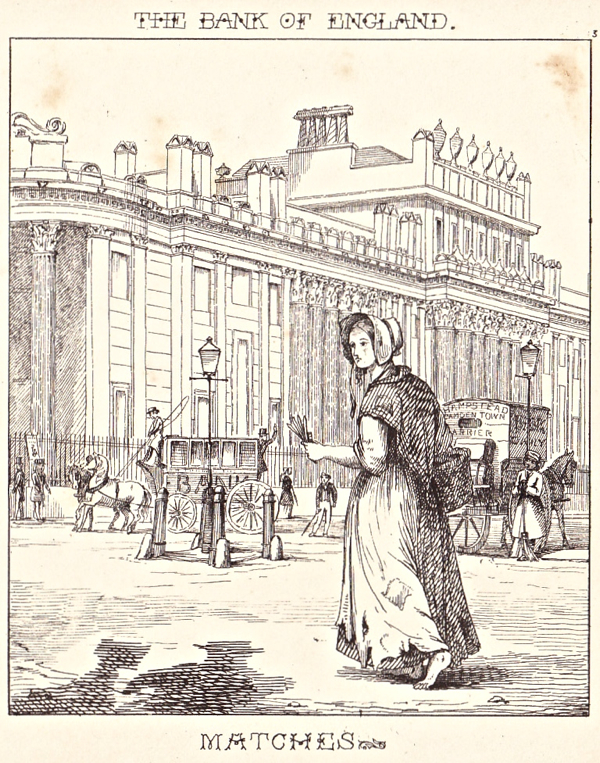
Of all the poor itinerants of London, the Matchsellers are the poorest and subsist as much as on donations as by the sale of their wares.
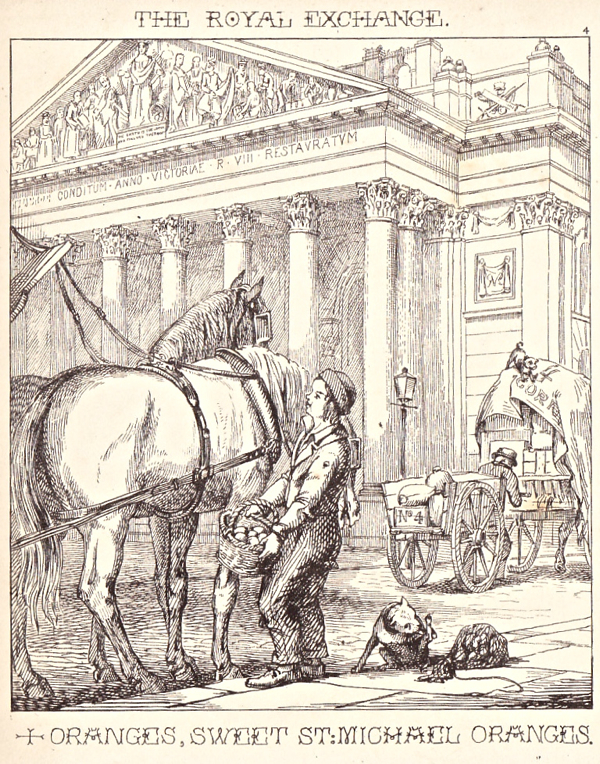
Here is a poor Irish boy endeavouring to dispose of his oranges to some passengers outside an omnibus.

These little prisons are principally manufactured by foreigners who have them of all sizes to suit the nature and habits of little captive melodists.

This artificer does not necessarily pay much rent for workshops, as he commences operations with his canes or rushes up the nearest court or gateway.

As the vendor approaches, the cats and dogs bound out at the well-known cry.
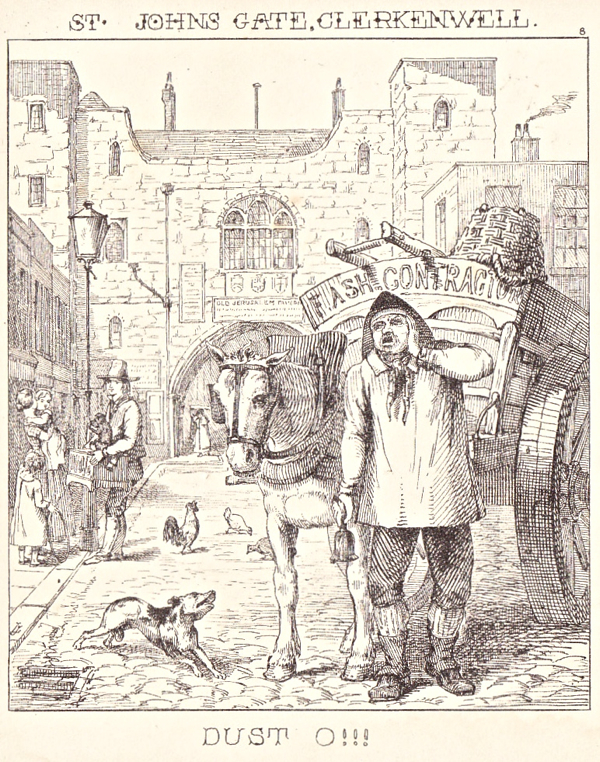
The costume of the Dustman bears a string resemblance to that of the Coalheaver, probably through their being connected with the same material, the one before it is burnt, the one after.
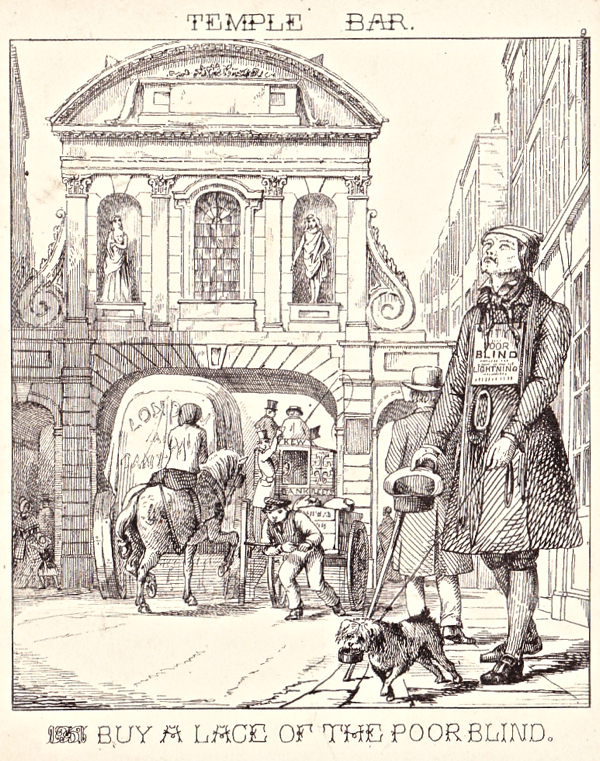
The blind must gain a livelihood as well as those who are blest with sight. He sells cabbage nets, kettle-holders, and laces, doubtless the work of his own hands in the evenings.
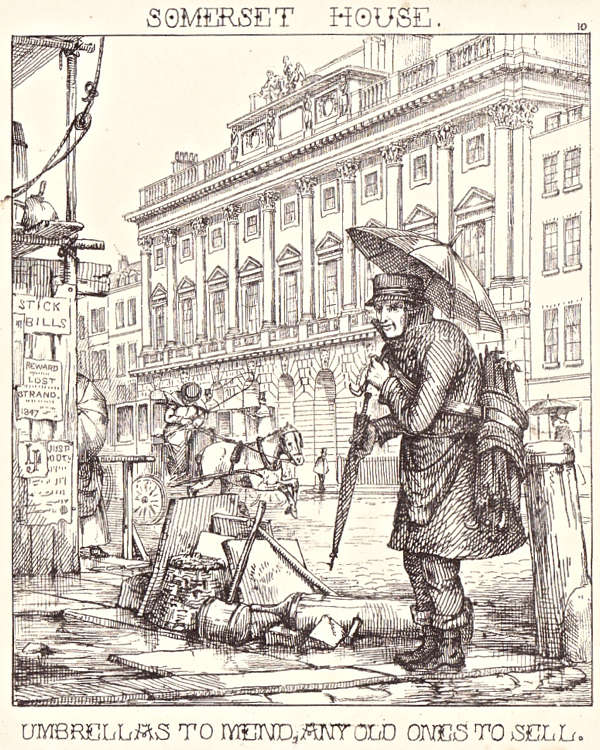
During the day, the Umbrella-mender goes his rounds, calling “Umbrellas to mend! Sixpence a piece for your broken umbrellas!” and then he returns home to patch and mend them, after which he hawks them for sale. Here he appears in his glory under the auspices of St Swithin.
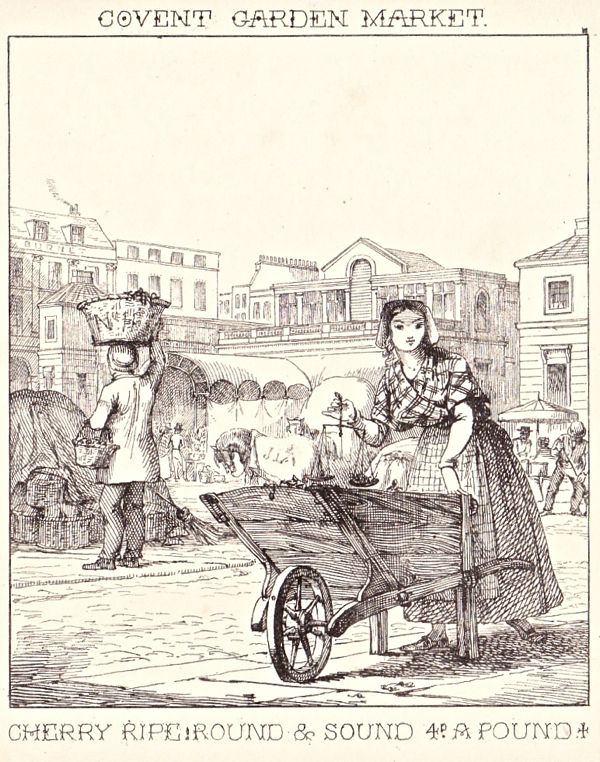
Of cherries, there are a great variety and most come from the county of Kent.

The Costard Monger is an itinerant vendor of garden produce, in the background is a seller of hearthstones in conversation with a Punch & Judy man.
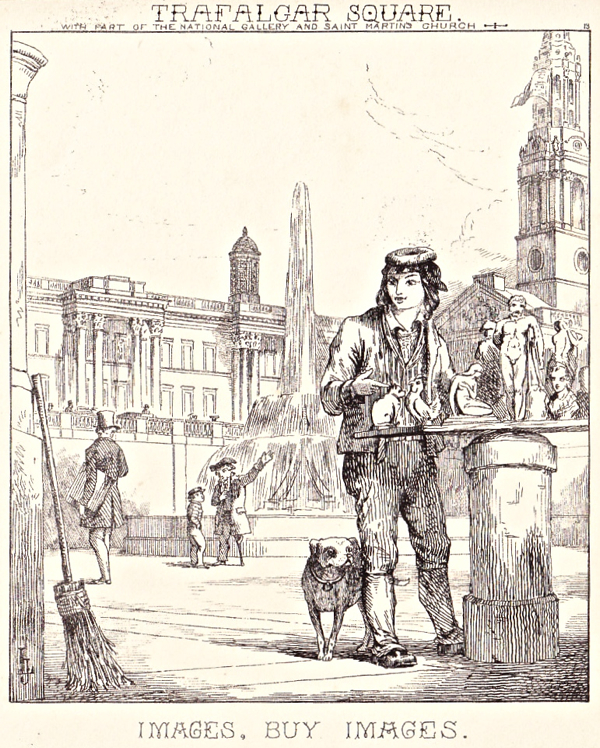
The dealers in these items are mostly Italians, our vendor has some high class items, the Farnese Hercules, Cupid & Psyche, and Chantrey’s bust of Sir Walter Scott.
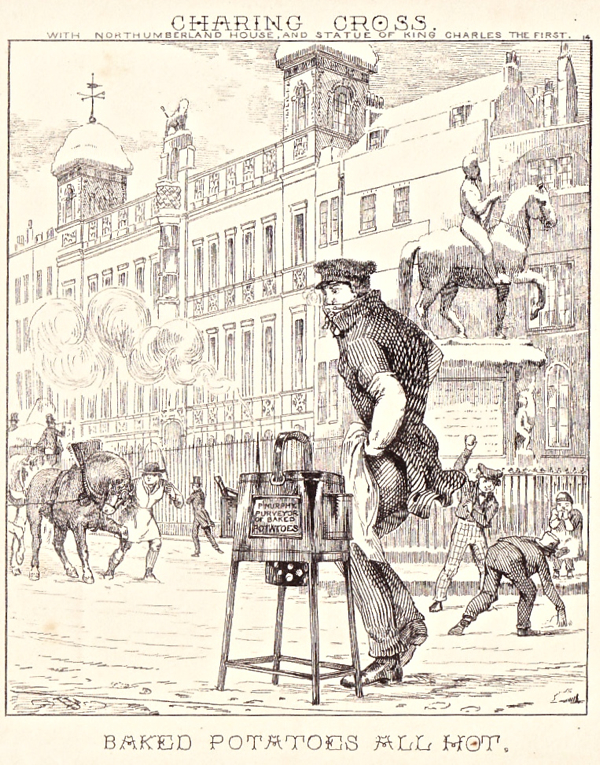
“How very cold it is!” The Potato-merchant jumps about to warm his feet.
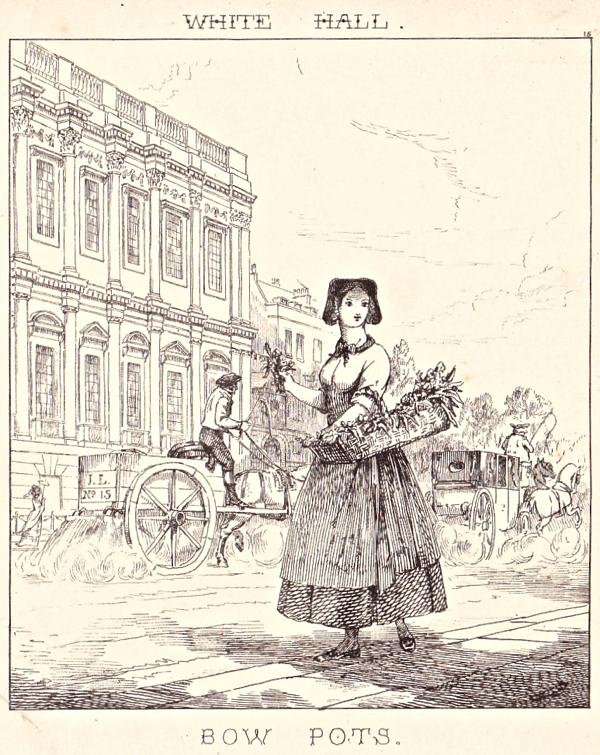
Bow Pots! (or Bay Pots!) two a penny!
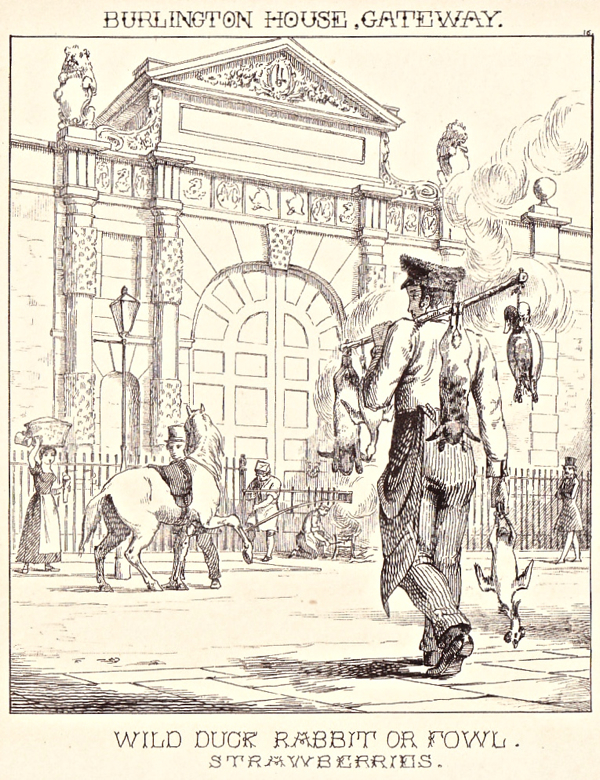
Wild ducks from the fens of Lincolnshire, Rabbits from Hampshire and Poultry from Norfolk.
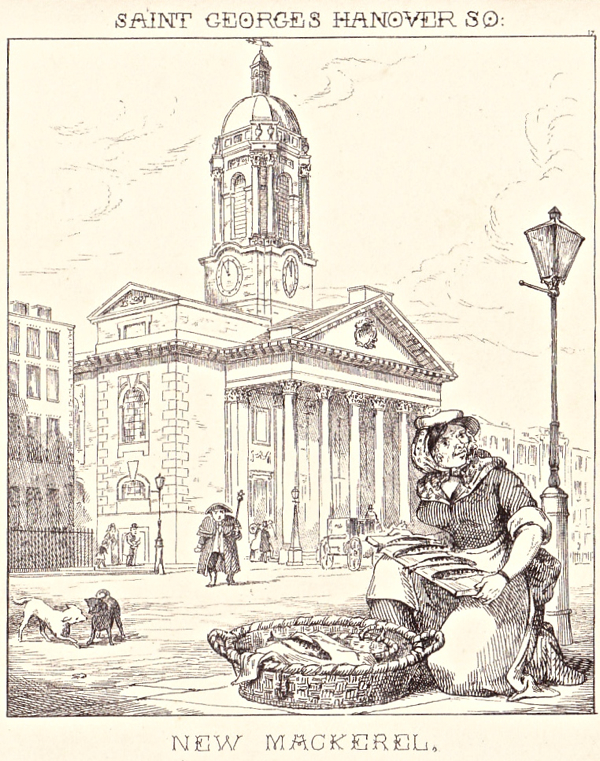
There is a law that permits of Mackerel being sold on Sundays, and here comes the beadle to warn off the Fish-woman.

The old clothesman and bonnet -box seller go their rounds.
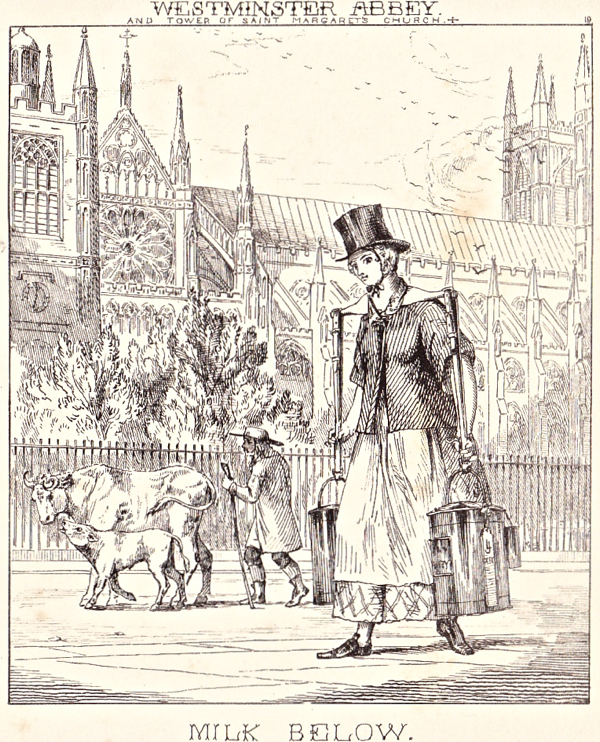
Of dealers in milk there are two classes – the one keeping cows, and the other purchasing it from dairymen in the outskirts and selling it on their own account.
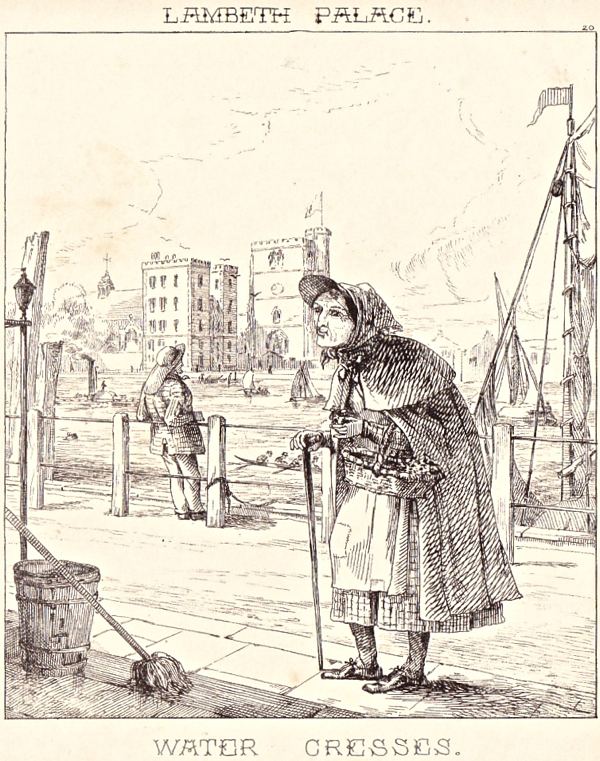
At half past eight, the step is mopped and Betty runs to get the penny for the poor old dame.
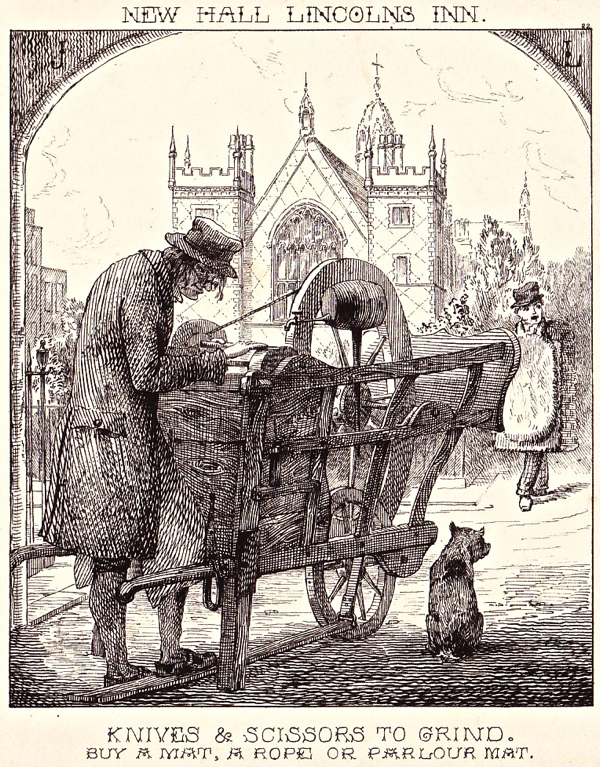
Knife Grinder at the entrance to Lincoln’s Inn Fields, with a seller of rush, rope and wool mats.
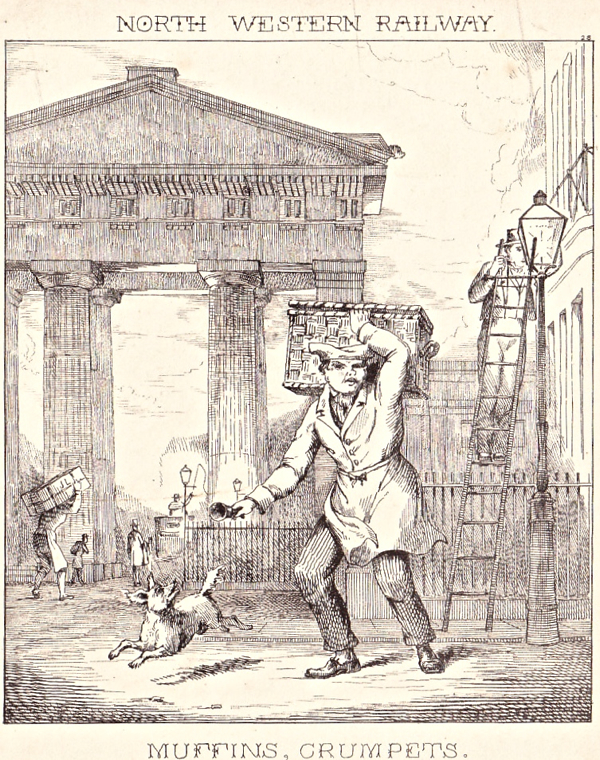
This is the evening cry in Winter.
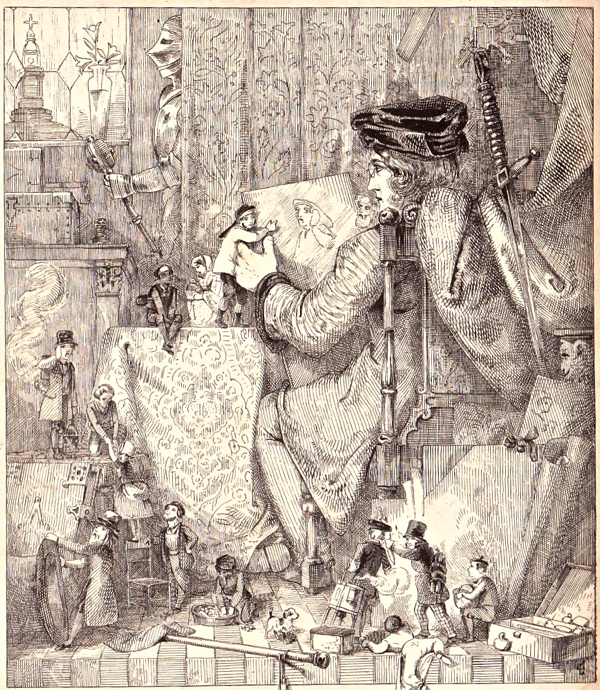
John Leighton and his cries of London.
You may like to take a look at
Francis Wheatley’s Cries of London
Spitalfields Market Portraits

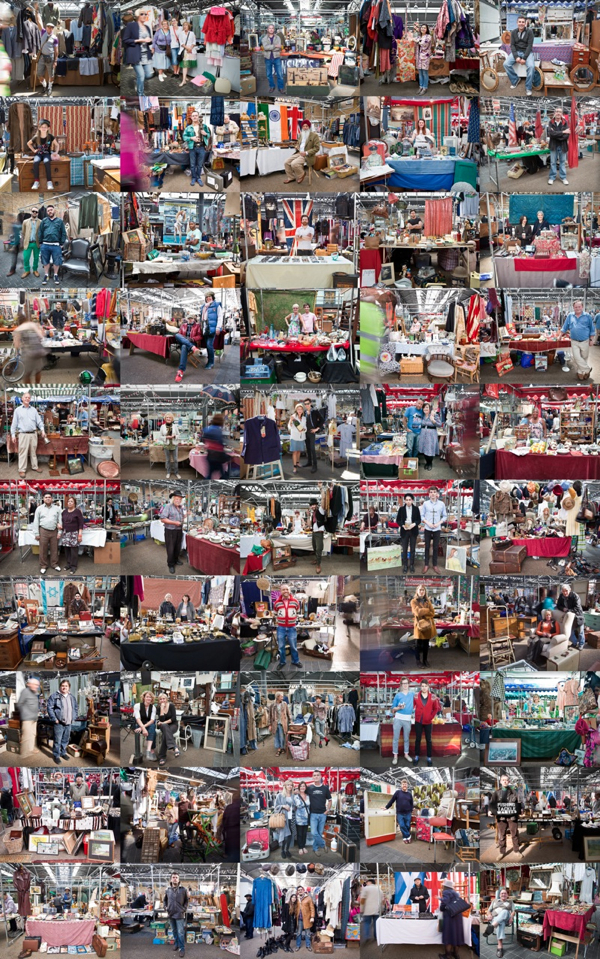
Throughout last year, I published a weekly series of more than eighty profiles, telling the stories of the traders in the Spitalfields Antiques Market accompanied with vibrant images by Spitalfields Life contributing photographer Jeremy Freedman, and the result is a distinguished body of portraiture, recording the diverse personalities who come together to create London’s pre-eminent weekly antiques market.
Fifty of these photographs will be shown three venues in Spitalfields from 10th February until 10th March, The Golden Heart in Commercial St, Agnes B in the Spitalfields Market and Rough Trade East in the Truman Brewery – as the first Spitalfields Life exhibition – produced with the gracious support of Nido, Spitalfields who have paid the costs of creating the show as a gesture of goodwill to the local community.
Jeremy Freedman’s ancestors came to Spitalfields from Holland in the eighteenth century, his great-great-great-great grandfather was one of the founders of Sandys Row Synagogue in 1854, and I am proud to present his debut exhibition as a celebration of Spitalfields today. Please come to join Sandra Esqulant and me for a drink to launch the exhibition on Thursday 10th February from 5pm at The Golden Heart. Meanwhile, I am taking this opportunity to look back at a few favourites from the series.
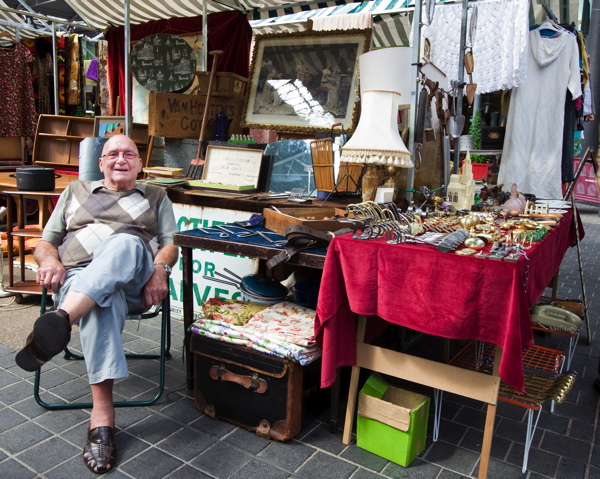
This is the celebrated George Cossington, an ex-steeplejack, now putting his feet up at ground level after thirty years above the roof tops.“I fell once but a corrugated iron roof saved my fall, that was in Beckton Gas Works,” he recalled in relief, grateful to be here today. “I’ve always loved old tools, but I thought,’If you sell ‘em, who’s going to buy ‘em?’ So I bought a polishing machine and I bring them back to life.”George told me, accounting for his gleaming stock of antique iron and brassware – including an especially covetable military issue pruning saw dated 1945, still in perfect condition. Just one of the myriad delights of utilitarian metalwork to be discovered at George’s stall. (Read the full story of George Cossington, Steeeplejack)

This is the gracious Sonoe Sugawara, seen here proudly holding an exquisite nineteenth century girl’s silk undergarment. Sonoe originally sold vintage English clothes from a stall in a Tokyo department store and now has a clever business going whereby she sells kimonos in London too, moving back and forth two or three times a year with a full suitcase in both directions. “My boyfriend’s great-grandparents were dealers before the war, collecting nineteenth and early twentieth century kimonos,” revealed Sonoe with a significant nod, accounting for the origins of her ravishingly beautiful stock of fine antique kimonos.

This is Sarah & Roy, a devoted couple from Dagenham. “I make the money while he’s the hard working one who carries the heavy boxes around,” admitted Sarah mischievously, slipping a protective arm around Roy. On the right hand side of the stall are Sarah’s vintage jewellery and clothes, while on the left are Roy’s childhood plastic toy soldiers, Action Men and Ladybird books. “I do feel sad parting with some because I remember playing with them,” Roy confessed to me with a sentimental smile – inspiring Sarah to wrap her arms around him and plant an emotional kiss, declaring,“Bless him, he loves it!”

This is Harvey Derriell, a lean and soulful Frenchman of discriminating tastes, and a connoisseur of tribal art from West Africa, with his prized collection of sculptures, textiles and beads, including my own personal favourite, chevron trading beads. “Fourteen years ago, I went to Mali, and I fell in love with the place and the people and I wanted to return. Now I go back four times a year.” revealed Harvey, brimming with delight. I was dismayed to learn that the Golonina bead market is closed but Harvey reassured me that beads are still to be found. “In Bamako, they ask ‘What do you want? Drugs, gold, diamonds, girls, boys or beads?’ “ he explained.

This is Linda Lewis who has been a dealer in kitchenalia, vintage china and glass for twenty years. With enviable stamina, she gets up at four thirty to drive here in all seasons from her home in North Essex. “My partner is a banker, so this is just part-time,” Linda whispered discreetly, adding “but now he’s been made redundant, maybe I’ll have to go back to doing it full-time.” Yet, demonstrating her appealingly buoyant nature, Linda qualified this by saying, “I love it, I wouldn’t do it otherwise, and because I like it so much, it doesn’t seem like work.”

This is my pal Bill, a dignified market stalwart who deals in coins, whistles, gramophone needles, souvenir thimbles, magic lantern slides, trading tokens, small classical antiquities and prehistoric artifacts. “I sell quite a few things, but on a low margin because it’s more interesting to have a quick turnover.” he admitted to me, speaking frankly, “I’m here more for enjoyment really – quite a few friends I’ve made over the years. I was a shy person before, but it’s made me confident having a stall. I’ve become an optimistic person.” Bill comes to Spitalfields each week with all his stock in a backpack and large suitcase – practical, economic and an incentive to sell as much as possible.

This charismatic chatty young Italian is Giovanni Grosso, who sells immaculately fine gloves, hand-made in the nineteen fifties by his father Alberto, the renowned glovemaker of Naples – a rare opportunity, since Alberto ceased glovemaking in the nineteen seventies. Giovanni himself is a talented sculptor who showed me some tiny cameos he has carved with astonishing skill into seashells. Currently serving an apprenticeship in stone carving with Raniero Sambuci, Giovanni explained to me that he came to London because “…in Naples, unless you compromise with the mafioso you leave!”

This is Lottie Muir & Amanda Bluglass who met through Soulmates seeking romance and discovered instead a shared passion for “Thames treasures and coastal coterie”. “I am a mudlarker and a letterpress fanatic,” explained Lottie, “so I collect Roman glass and Medieval pottery, which wash up against my flat in Rotherhithe, and arrange my discoveries in type cases.” Lottie’s finds are complimented by things selected by Amanda who is a sculptor, “All are chosen for shape or some kind of sculptural beauty,” she added with calm authority, in contrast to Lottie’s giddy excitement on this first day of their new venture.

This is the distinguished Mr Singh, expertly modelling a dress sword which belonged to the Lieutenant General to the Tower of London between 1880-90, a very fine example of its kind, that was once presented to Lord Chelmsford. “I must differentiate myself from the general public and I do it by an emphasis on quality,” explained Mr Singh modestly and, as I cast my eyes upon his impressive selection of antique silver cutlery, I found no reason to disagree. If you see Mr Singh, impeccably dressed English gentleman, and dealer in militaria and classy bric-a-brac, either here in Spitalfields or at St James, Piccadilly, be sure to pay your respects and wish him “Good day”.

This is Richard Rags and his appealingly voluble son Cosmo Wise, both dressed head to toe in the clothing from the nineteen forties and earlier that is their shared passion. They cherish the extravagantly worn-out old togs your grandparents discarded, full of vibrant character and handmade details no modern garment can ever match. Cosmo really knows how to wear it and, with admirable enterprise, is now copying his most treasured finds in old fabric, to create exclusive pieces sold under his own label “De Rien.” “We are drowning in clothes, clothes dripping from the ceiling, even beds made of clothes.” he revealed with barely concealed delight, divulging the singular living conditions at their clothing warehouse in Hackney Wick. (Read the full story of Richard & Cosmo wise, Rag Dealers.)

This is Molly & Ellen, who can be seen working together in the market every Monday, Thursday and Friday. Molly’s family have been swagmen in the East End for generations and Ellen played here in the fruit & vegetable market when she was child. “I was born in Whitechapel and this used to be our playground – only the porters could control us because they were the only ones we would listen to.” confided Ellen with a proud smirk. Molly & Ellen are two women of great spirit who speak for a resilient local community that has lived through all the changes. (Read the full story of Molly the Swagman.)

This noble man with the face of saint from a Romanesque cathedral is John Andrews, who deals in “vintage fishing tackle for the soul” and is the author of “For All Those Left Behind,” a memoir about his father and fishing. Learning that angling is a dying art, I was hooked by the melancholy poetry of John’s collection which speaks of the magnificent age of British fishing between the mid-nineteenth and mid-twentieth century. “I am addicted to buying and selling it, and I live in my own little world,” confessed John, which sounded so appealing to me that I accepted his invitation to join a fishing trip immediately. Corduroys by Old Town.
Photographs copyright © Jeremy Freedman
At International Magic
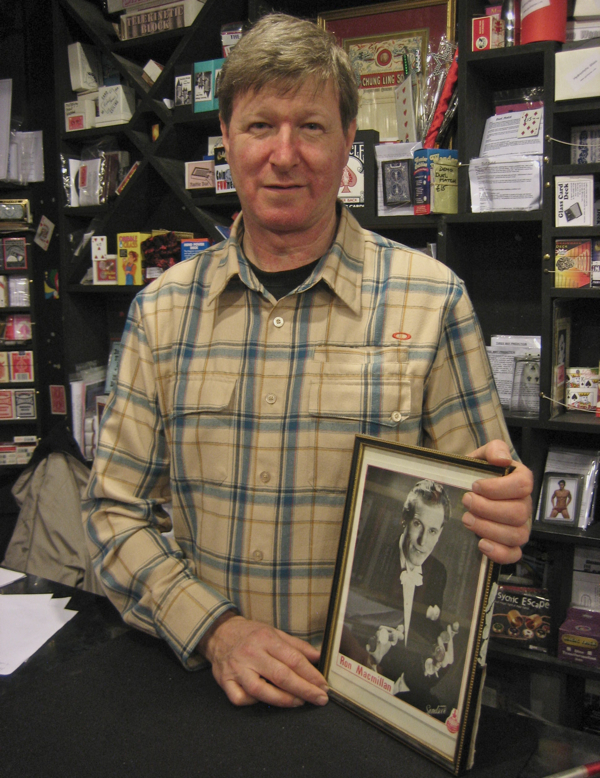
Anyone searching for prestidigitation in East London need look no further than International Magic in the Clerkenwell Rd, where Martin MacMillan presides today over the tiny shop opened by his father Ron Macmillan – a conjurer known as “The Man With The Golden Hands” – in 1961, exactly fifty years ago.
Just by pressing upon the old brass door catch and stepping into the red carpeted interior, where tricks both old and new line the walls and hang from the ceiling, you can sense magic in the air, as if you have entered in the vestibule of an old theatre – which in a sense you have because, at almost any time of the week, you will find a throng gathered around the counter, where Martin and his customers amuse themselves by performing conjuring tricks for each other. International Magic is recognised as the prime destination for professional and amateur magicians, where they all come and go, learn what is new, socialise, spar and compete in a friendly way, showing off and having fun, just between themselves.
You do not even need to buy anything, only arrive wide-eyed and open-hearted, bring your credulity and your innocence, and be sure to wish Martin, “Good Day!” and shake his hand, and know you will be assured of a genuine welcome and a breathtaking impromptu magic show. People always want to go behind the scenes in the theatre, they want to know what is the secret behind a magic trick, and behind International Magic lies an extraordinary story – it is a true romance.
Ron MacMillan was a French Polisher from Canning Town who was also a successful footballer, and in 1950 when he was admitted to outpatients, he caught the eye of Teresa, a young nurse from rural County Mayo who was new to London and the post-war world of bomb sites and food shortages. Teresa was fascinated by the handsome young man turning coins in his fingers with such eye-catching dexterity and they went on a date together. When Ron’s diagnosis was confirmed as TB, Teresa nursed him through the operation which involved the removal of a lung and some ribs. To give Ron something to concentrate upon, Teresa bought him a book, “It’s Easier Than You Think,” by Geoffrey Buckingham. And it saved his life, because Ron was fortunate enough to recover from TB, and discovering he was a natural at conjuring, he spent his recuperation practising magic tricks and amusing the other patients – thereby giving him his future career .
Unable to return to physical work, Ron managed to secure some employment in the docks where he entertained his fellow dockers and did magic shows on ships, – performing as “The Man With The Golden Hands” – quickly acquiring a reputation by winning competitions and playing in clubs. On one occasion, while performing in front of the Krays and Diana Dors, tossing pennies in the air and catching them behind his back, Ron dropped some into the front row where the twins were, but, understandably, although his act won approval from these hard-nosed types, he did not go to retrieve his coins. Ron’s tour-de-force was to produce sixteen billiard balls out of the air – more than any conjurer had done before or since – and while it was in greater part testimony to his extraordinary talent at legerdemain and, while I should not wish to give the game away, I think we may applaud him for making such ingenious use of the cavity in his chest that was the legacy of his illness.
Teresa and Ron married and had three children, and Ron enjoyed a successful stage career until the late fifties, when the touring became too much for him. So, in 1957, he opened International Magic in Saffron Hill, Clerkenwell, moving to the current site in 1961. “It’s the cheaper end of the West End,” explained Martin, “And this area has history of magic. There was a lot more around then, with Gamages’ magic department in Leather Lane and Elisdon’s in Holborn.”
“If you are born into it and grow up with magic, then you don’t know anything else, until you meet non-magicians,” Martin revealed to me in amused reminiscence,”When you tell them that you’re a magician and everyone you know is a magician, then you realise it is special. Before that, I thought everyone had a magician for a father. As early as I can remember, I was involved in magic. I can’t put a date to it because as I was learning to read and write, I was picking up magic tricks, and at fifteen I came to work here.” Martin claims that he never performs professionally but the truth is that he performs all day. Tall and with a generous smile, he is the perfect master of ceremonies here at the epicentre of the magic world, where you can come for all your magic needs, including lectures, weekly classes and tickets for the annual International Magic convention which celebrates it fortieth anniversary this year.
Let me admit to you that my grandfather was a conjurer in music hall, and it was a visit to International Magic that first brought me to Clerkenwell as a child. I cherish this shop for many reasons – because it has never been modernised, because you don’t need much money to buy a few tricks, because it displays the old tricks of dead conjurers alongside new tricks for sale, because everyone is treated as equal here, because it is all about celebrating the triumph of quick-wittedness and extraordinary talent, and because this is true culture handed down through generations solely for the authentic pleasure of idle entertainment.
Listen to Teresa MacMillan’s story of International Magic by clicking here.

Ron MacMillan, The Man With The Golden Hands
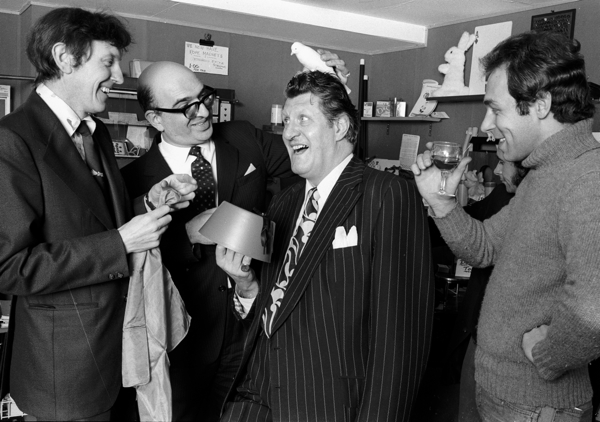


Ron Macmillan and Tommy Cooper with magicians Henk Meesters, Bobby Barnard and Graham Desmond skylarking at International Magic in the nineteen sixties.
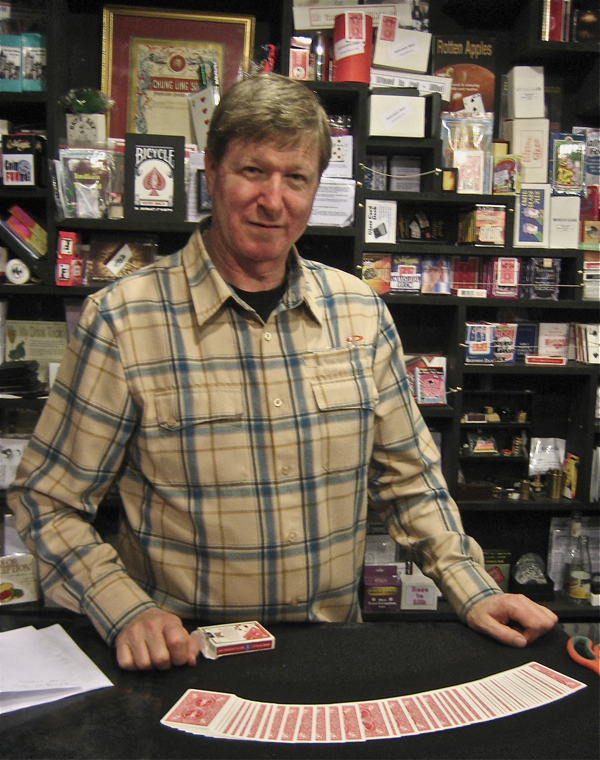
Martin MacMillan will demonstrate any trick you may wish to purchase.
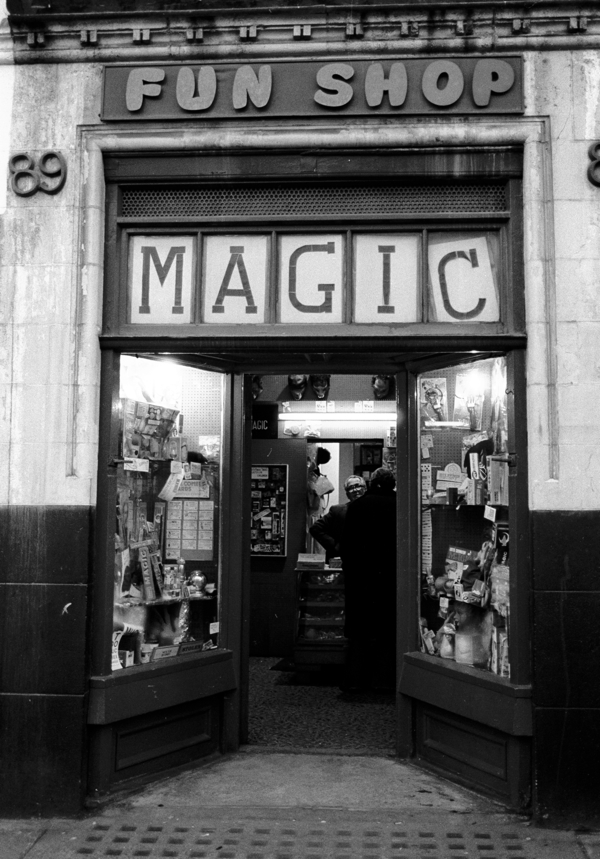
International Magic in the nineteen sixties.

Spitalfields Life will be reporting to you from the fortieth International Magic Convention in November.
Columbia Road Market 68
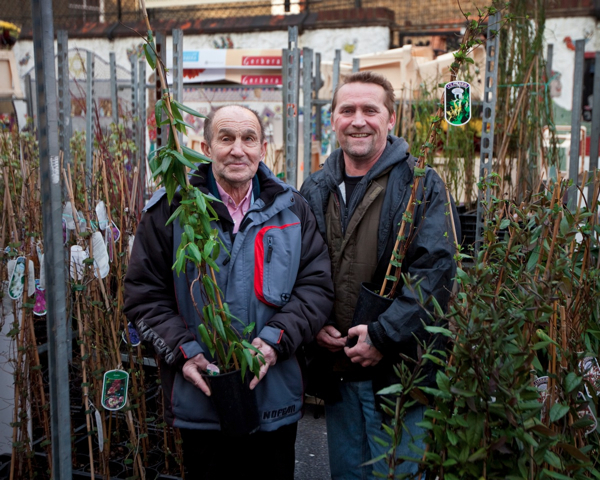
Lou & Billy Burridge
Alongside George Gladwell, the other trader who has been in Columbia Rd the longest is Louis Burridge – widely known as Lou – pictured here with his son William – widely known as Billy. He is celebrated as the preeminent supplier of climbers and creepers, clematis, honeysuckle, passionflowers and vines, that adorn the gardens of the East End. Yet, although Lou started trading in the late forties, I discovered that the story of the Burridges, the family who are regarded as Columbia Rd nobility, begins even further back in the last century.
“My father was here in 1922, he was plantseller with a horse and cart,” explained Lou, glancing over to the site where his father’s pitch was, when I drew him away from the market for a chat on the wall beside Ravencroft Park. “He had a lot of land at Cuckoo Lane, Edmonton. Before that, the family had fish shops in Portsmouth and in the Hackney Rd – a big family of fish dealers. My father was pretty well educated in botany, because my grandfather paid for him to learn, and quite a lot of his family moved into the plant business, but they’re nearly all dead now except me.”
Still limber and lean – clad in ski clothing as protection against the cold on a January morning – Lou is enthusiastic to talk of the market which has been his lifelong delight, as well as the source of livelihood for his family over four generations. “I’m retired really but I come down here every Sunday to see my boys, Billy who’s taken over my stall and Louis who sells cut flowers.” he revealed with quiet satisfaction, “I am one of the oldest now and it makes a day out for me. There’s very few of the originals left who were down here after the war. Just me, George, the Harnetts and Albert Dean on the corner (they were all Alberts, it was his grandfather who was here when I first arrived). I was the only one who sold plants, shrubs and that during the fifties and sixties, but in the eighties I specialised in climbers because you can’t do everything. It’s not an easy business to make a living at, the prices haven’t gone up in years.”
Today, Lou is the head of the extended Burridge clan, whose members you find trading along the length of Columbia Rd.“My five brothers gradually got into it and they all had stalls, and then you’ve got their sons, and their sons – so you’ve got all the family.” he declared in joyful tones, “We all get together for birthdays and that. I’m seventy, and I suppose there must have been a hundred people at my birthday party. We all get on pretty well. Some live in Hertfordshire, some in live in Rayleigh, some live in Southend.
We all come from Edmonton originally. There were eight of us children, five boys and three girls. There was not a lot of money, because my father lost it when he sold all his land before the war and then he became sick. He had bad arthritis, he was born in 1895 and only traded till 1955, but my mother worked here till she was eighty-nine. For years we had it hard but we were very close, and trade picked up in the nineteen sixties. To a certain extent, we have built up this market, the Burridges, the Harnetts and the Deans.”
“I’ve always loved market work. It’s a funny thing growing plants and selling them, because you get very interested in them, people who sell wholesale plants in supermarkets have no idea. – This is life.” he said, with a sprightly smile of pride, before springing up from the wall, eager to return to his pitch, because he could no longer resist the magnetism drawing him back to the site where his father started in 1922.
Approaching Columbia Rd from the West today, or at any time in the last sixty years, you would see the Harnett’s plant stall to your left and Albert Dean’s flower stall on your right, and then Lou Burridge’s stall, another pitch down from the Harnetts, also on the left. There you find Lou – slight of stature yet bright of spirit – presiding every week among a forest of cherished specimens of climbers that are as tall as he is, with the rare experience of a plantsman born and bred.

George Gladwell’s picture of Louis Burridge trading in the same spot in the early nineteen seventies.
Colour photograph copyright © Jeremy Freedman
Black & white photograph copyright © George Gladwell
The Dosshouses of Spitalfields

Queen Victoria’s bust presides over a pretty corner at Father Jay’s dosshouse in Shoreditch.
A hundred years ago, there was a periodical called “Living London – its work and its play, its humour and its pathos, its sights and its scenes.” Many years before familiar titles like “Life” and “Picture Post,” “Living London” was the first mass-market publication to use photography to show its readers aspects of society they had never seen before. Whilst studying the three volume compilation in the archive at the Bishopsgate Institute, I came across features about “London’s Drapers” and “London at Dead of Night,” that were not dissimilar in length and form to my own stories published here in Spitalfields Life.
Below you can read excerpts from T.W.Wilkinson’s feature which permits us a rare glimpse inside the dosshouse in Crispin St, that retains its doorbell and worn step to this day. The culture of the lodging house has been an essential part of the lives of thousands of itinerant casual workers in Spitalfields for centuries – porters, weavers, brewery workers and many others – most could not afford a room and simply rented a bed each night. They lived their lives in public, between the workplace, the public house and the dosshouse, often working each day to earn the night’s lodging. First there were the economic migrants from the English countryside, then the Irish, Asians in the twentieth century and currently Eastern Europeans who are destitute, without work, and filling the hostels of the East End. The history of Spitalfields cannot be told without these itinerant peoples, yet there is little evidence of their presence because they travelled light and left barely a trace behind.
“Wherever there are particularly mean streets in London, the signs of hotels for the poor hang high over the causeway. The dosshouses for men are the most numerous, and for a typical lodging house for men we cannot do better than go to that district of which Spitalfields Church is the centre. Dorset St, with its squalid air, its groups of dossers scattered over the pavement, as well as Flower & Dean St – of little better repute, and having the same characteristics in a minor degree – are almost under the shadow of that edifice.
And as to the time of our visit, let it be eight o’ clock in the evening.
Here we are, then. There is no need to knock, the door is open. At 4am, it swings back to let out the market porters and a whole posse of lodgers who carry under their arm the mark of their calling – a roll of newspapers, yesterday’s returns.
Through the ever-open door, along the passage, a sharp turn to the right and – phew! – this is the kitchen, the loafing place of the idle and the workshop of the industrious. Opposite as we enter, a huge fire glows and crackles, above, a serried line of tin teapots, battered and stained with long use, and above that again, the Rules of the House. In the corner beyond the fireplace a buxom female figure is eyeing the depleted collection of cracked crockery ranged on the shelves, her sleeves upturned to her massive biceps. She is the domestic ruler of about two hundred men, termed “the deputy.” This woman’s strong point is the celerity and dispatch she displays in carrying out certain very necessary operations connected with bed-making.
Distributed over the kitchen, three or four score men are having supper, and a grim, picturesque assemblage they make. Yonder a seedy, frock-coated failure, on whose black glossy curls Time’s hand has not yet been laid, is sopping some bits of bread – manifestly begged from the tea-shop – in a concoction made from halfpenny tea and sugar mixed, his eyes wandering now and again to a pair of kippers which a market porter tossed from a frying pan on to a plate a few minutes since. At his elbow, an old man with a snowy beard mouths a greasy ham bone like a decrepit dog. In front of the fire is another figure that arrests the roving eye. A pallid youth has his meal spread out before him on an evening newspaper, which is his tablecloth. It consists of tea, bread and margarine, and that delicacy of which the dosser never tires, the humble bloater. He conveys the food to his mouth with Nature’s forks. Artificial ones are not provided, nor is it customary to supply knives or spoons. Too portable – that is the explanation.
Next, the sleeping chambers. It is midnight. The door at the foot of the stairs is locked but at intervals the deputy opens it and takes from each lodger as he passes the numbered metal check given to him earlier in the evening as a voucher for fourpence. Here is the first room. No curtains or blinds to the window, no covering of any kind to the well-scrubbed floor, no pictures on the walls and number at the head of the bed corresponding to that of a room in a hotel. On going higher, and seeing room after room of exactly the same character as the first, you discover that most beds in the house are occupied. From the foot of one, a dark mass protrudes. A man has turned in without undressing – that is all. Look at the waistcoats peeping out from under pillows, or turn down the coverlets on that empty bed and read the legend stamped boldly on the lower sheet, “Stolen from -.” There is the clue. Many a man has woken to find his boots gone while he is asleep.
Now there is the last rush of feet on the stairs, the “last train” is coming up, the laggards who are loath to leave the kitchen have been turned out. Soon the whole house will be silent save the two cronies who have tarried overlong, and then there will be a howl from somebody they have wakened, and then, perhaps, a fight.
Yet a hurried survey of Father Jay’s Hospice in Shoreditch will modify the impression that this fourpenny hotel in Spitalfields has produced. Here we are in a different atmosphere. A light, well-appointed kitchen, cubicles above, some of them very tastefully decorated by their occupants, and, still higher, the ordinary rooms, split up to a certain extent by fixing wooden screens, one of which is covered with brackets, busts, looking-glasses, pictures and odds and ends innumerable, the property of the man whose bed is beneath. All in striking contrast to the bareness and gloom of the typical East End dosshouse.”
Readers who wish to learn more of this world might choose to read Jack London’s “The People of the Abyss” or George Orwell’s “Down and Out in London and Paris,” both of which are drawn in part from their author’s experiences in East End dosshouses.
The very identity of Spitalfields has been bound up with these shelters since the twelfth century when Walter Brune founded St Mary’s Hospital outside the walls of the City of London as a refuge for the needy. And today, continuing this honourable tradition, there remain several hostels in the neighbourhood that provide a haven for those with nowhere else to go.

This dosshouse on the corner of Crispin St and Raven Row still stands, and the lines here were a familiar site until it was replaced by Providence Row in Wentworth St in the nineteen nineties. Today this building contains student accommodation for the London School of Economics.
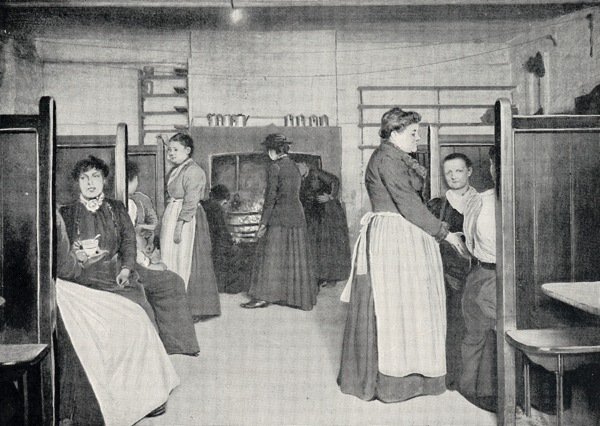
The kitchen in a single women’s lodging house in Spitalfields.

The kitchen of a common lodging house in Spitalfields.
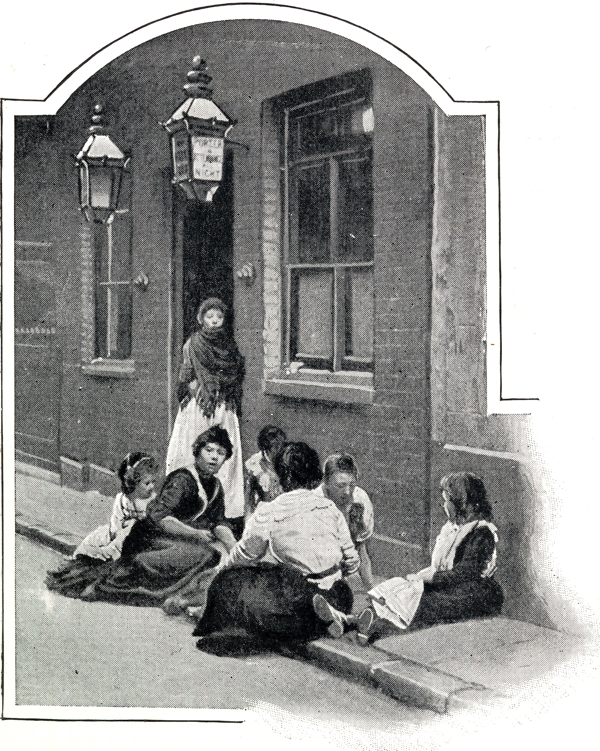
Outside a lodging house in Flower & Dean St, Spitalfields.
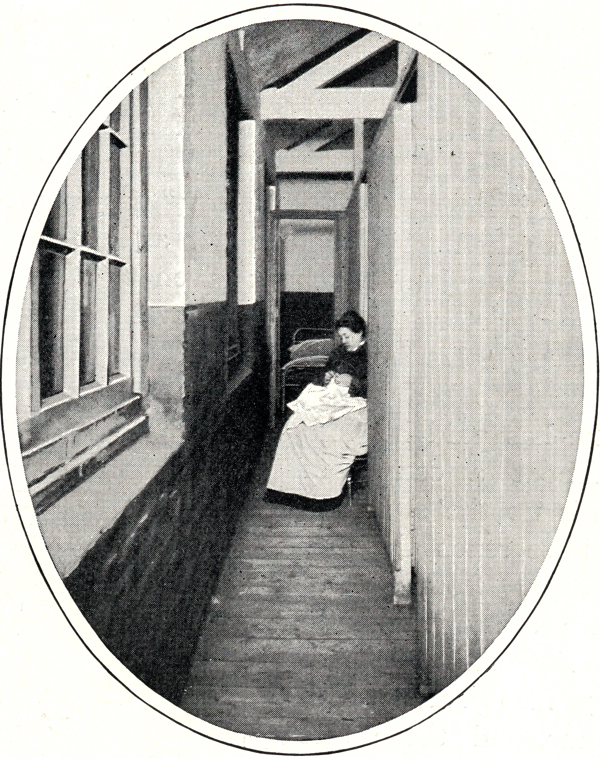
Cubicles in a couples’ house in Spitalfields.
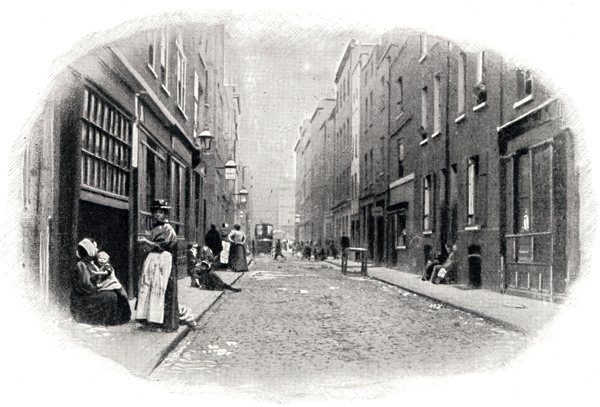
Scene in Dorset St, Spitalfields.
Images copyright © Bishopsgate Institute
You may also like to read
Clive Murphy’s account of Beatrice Ali, Salvation Army Hostel Dweller,
Stanley Rondeau at the V&A
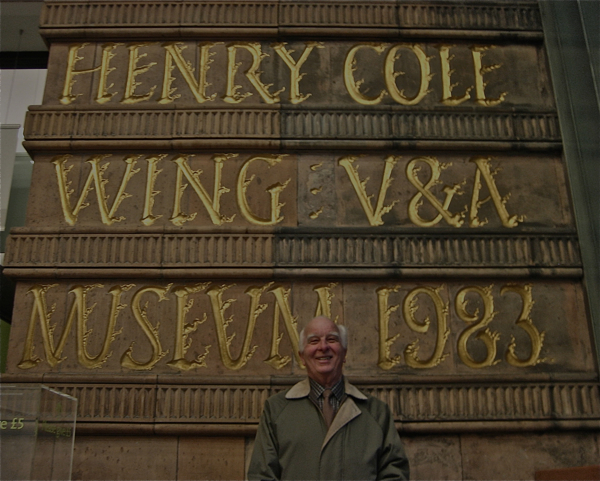
Last year, I introduced you to Stanley Rondeau whose great-great-great-great-great-great-grandfather Jean Rondeau was a Huguenot silk weaver who came to Spitalfields in 1685 as a refugee fleeing religious persecution in Paris. Jean’s son prospered in Spitalfields, becoming Sexton at Christ Church, having eleven children, building a new house at 4 Wilkes St and commissioning designs in the seventeen forties from the most famous of silk designers, Anna Maria Garthwaite, who lived almost next door, in the house on the corner with Princelet St.
Since Anna Maria Garthwaite’s designs were exceptionally prized both for their aesthetic appeal and their functional elegance as patterns for silk weaving, hundreds of her original paintings have survived to this day. So yesterday, Stanley & I went along to the Victoria & Albert Museum in Kensington to take a look at those done for Stanley’s ancestor Jean the Sexton, two hundred and seventy years ago. We negotiated our way through the labyrinths of the vast museum, teeming with school children, with a growing sense of anticipation because although Stanley has seen one of the designs reproduced in a book, he has never cast his eyes upon the originals. And up on the fourth floor, we entered a sanctuary of peace and quiet where curator Moira Thunder awaited us in a lofty room with a long table and large flat blue boxes containing the treasured designs that were the objects of our quest.
Moira – chic in contrasting tones of plum and navy blue, and with a pair of fuchsia lenses which hinted at a bohemian side – welcomed us with scholarly grace, and duly opened up the first box to reveal the first of Anna Maria Garthwaite’s designs. Drawn in the wide margin at the top of a large sheet containing an elaborate floral number, this design was the epitome of restraint with a repeated motif that resembled a bugle flower in subdued tones of purplish brown, labelled “Mr Rondeau, Feb 5 174 1/2,” and intended as a pattern to be woven into the body of a vellure used for men’s suiting.
Mr Rondeau of Feb 2011, instinctively drawn towards his own name revealed before him, leaned forward to touch the piece of paper – which caused Moira’s eyes to pop, though fortunately for all concerned the priceless design was protected by a layer of transparent conservator’s plastic. Once smiles of amelioration had been exchanged after this faux-pas, Stanley enjoyed a quiet moment of contemplation, gazing with his deep-set chestnut eyes from beneath his bushy white eyebrows upon the same piece of paper that his ancestor saw. I think Stanley would have preferred it if “Mr Rondeau” had been written beside the fancy design below, because he asked Moira whether the other design for Jean Rondeau in the collection was more colourful but, with an unexpectedly winsome smile, Moira refused to be drawn.
Yet while Stanley’s curiosity was understandably focussed upon those designs attributed to his ancestor, I was enraptured by the myriad pages of designs by Anna Maria Garthwaite, whose house I walk past every day. Kept from the daylight, the colours in these sketches remain as fresh as the day she painted them in Spitalfields three centuries ago. The accurate observation of both cultivated and wild flowers in these works suggests they were painted from specimens which permits me to surmise that she had access to a garden, and picked her wild flowers in the fields beyond Brick Lane. I especially admired the sparseness of these sprigged designs, drawing the eye to the lustrous quality of the silk, and Moira, who worked as assistant to Natalie Rothenstein – the ultimate authority on Spitalfields silk – pointed out that weavers rarely deviated from Garthwaite’s designs because they were conceived with such thorough understanding of the process.
And then, Moira opened the second box to reveal the second design by Anna Maria Garthwaite for Jean Rondeau, which Stanley had never seen before. Larger and more complex than the previous, although monochromatic, this was a pattern of pansy or violet flowers divided by scalloped borders into a repeated design of lozenges. Again drawn in the margin, at the top of a piece of paper above a multicoloured design, this has the name “Mr Rondeau” written in feint pencil beside it. It was a design for a damask, either for men’s suiting or a woman’s dress, which Moira suggested would be appropriate to be worn at the time of half-mourning. A degree of formalised grief that is unfamiliar to us, yet would have been the custom in a world where women bore many more babies in the knowledge that only those chosen few would survive beyond childhood.
Moira took the unveiling of this second design as the premise to outline the speciality of Master Silk Weaver Jean Rondeau, who appears to have built his fortune, and company of fifty seven employees, upon the production of cheaper silks for men, unlike his Spitalfields contemporary Captain Lekeux – for whom Anna Maria Garthwaite also designed – who specialised in the most expensive silks for women. In reponse to Moira’s erudition, Stanley began to talk about his ancestor and the events of the seventeen forties in Spitalfields with a familiarity and grasp of detail that made it sound as if he were talking about a recent decade. And as he spoke, with the unique wealth of knowledge that he has gathered over a lifetime of research, I could see Moira becoming drawn in to Stanley’s extraordinary testimony, revealing new information about this highly specialised milieu of textile production which is her particular interest. It was a true meeting of minds, and I stood by to observe the accumulation of mutual interest, as with growing delight Moira and Stanley exchanged anecdotes about their shared passion.
Recently, Stanley visited the Natural History Museum to hold the bones of his ancestor Jean the Sexton which were removed there from Christ Church for study, and by seeing the designs at the Victoria & Albert Museum that once passed before Jean’s eyes in Spitalfields, he had completed his quest. But there was a surprise in store, when Moira revealed that there were other textile designs from the nineteenth century commissioned by another Mr Rondeau who might be a descendant – but due to a forthcoming refit of the department Stanley would have to wait until 2012 to see them.
“It was a big day,” Stanley admitted to me afterwards, his eyes shining with emotion, as he began to absorb the reality of what he had seen. “I’ll wait a year, and then I’m going to come back,” he added with grin of determination. It was a cliffhanger, because who knows what extravagant designs of high-flown Victoriana Mr Rondeau of the nineteenth century might have commissioned, in contrast to the understatement of his eighteenth century predecessor? But whatever Stanley Rondeau discovers, I have no doubt that the gracious Moira Thunder will be waiting to greet him upon his return to the V&A.
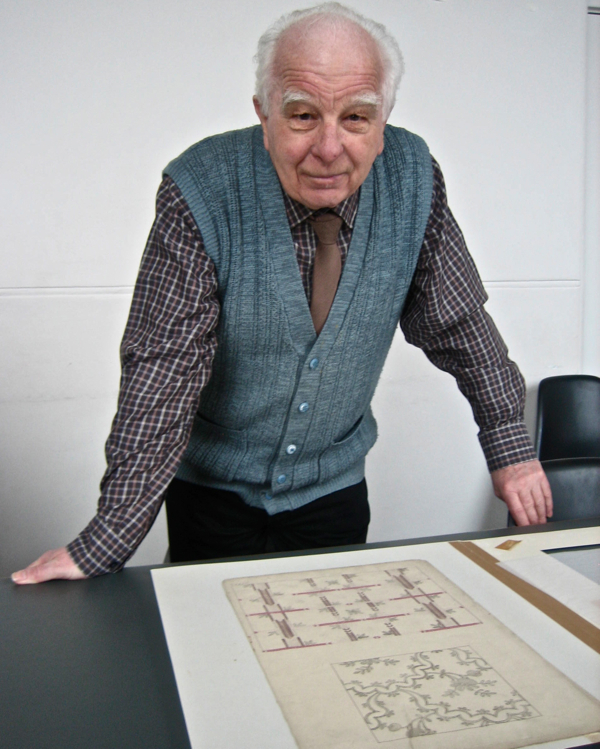
Stanley Rondeau sees the design commissioned by his ancestor in the seventeen forties for the first time.
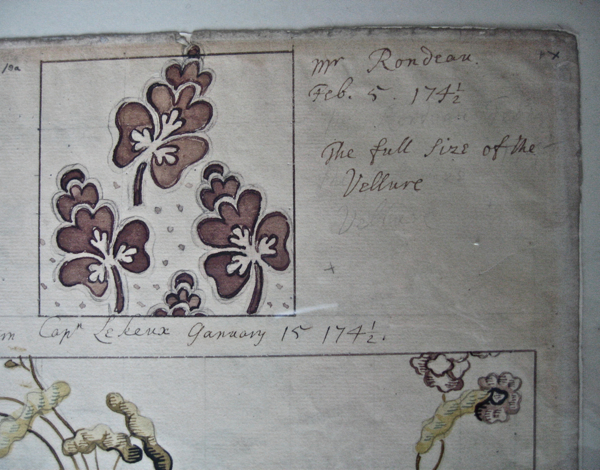
Design for a vellure for Jean Rondeau, by Anna Maria Garthwaite, Spitalfields, February 5th, 1741.
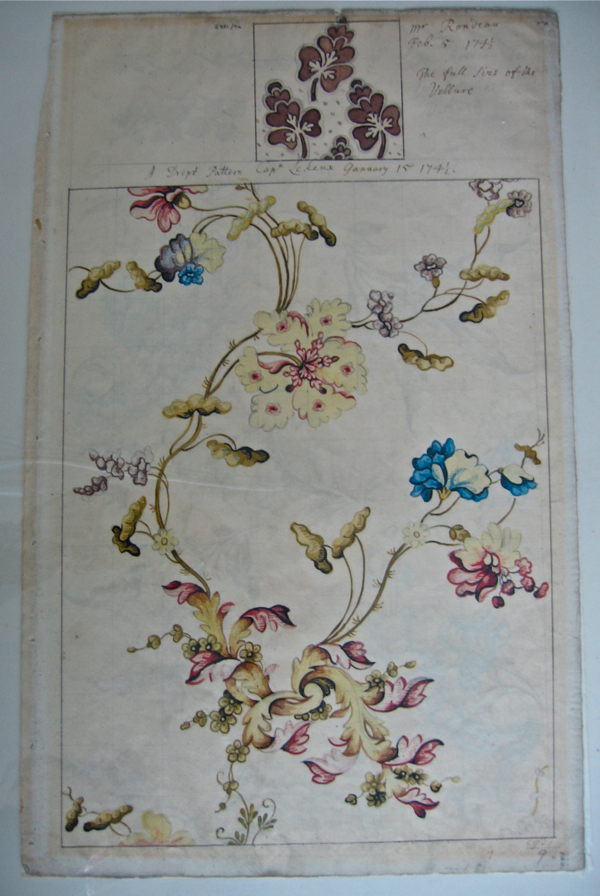
The full page with Jean Rondeau’s design at the top.
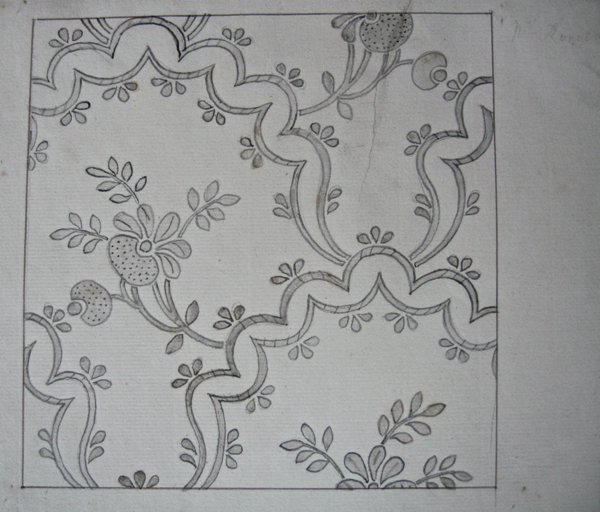
Design for a damask by Anna Maria Garthwaite for Jean Rondeau, possibly for half-mourning.
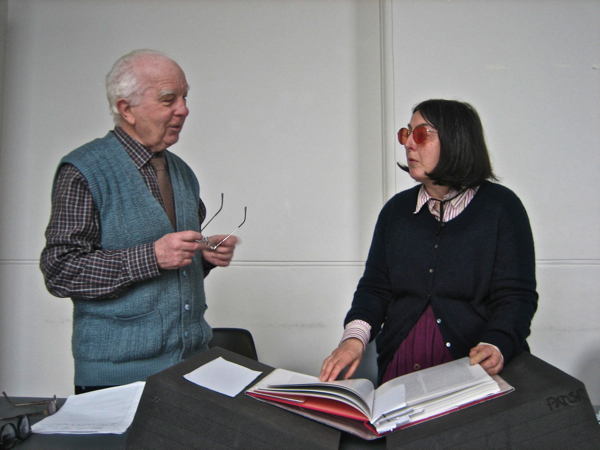
Stanley Rondeau chats with Moira Thunder, Curator, Designs, at the Victoria & Albert Museum, over a copy of Natalie Rothenstein’s definitive work “Silk Designs of the Eighteenth Century.”
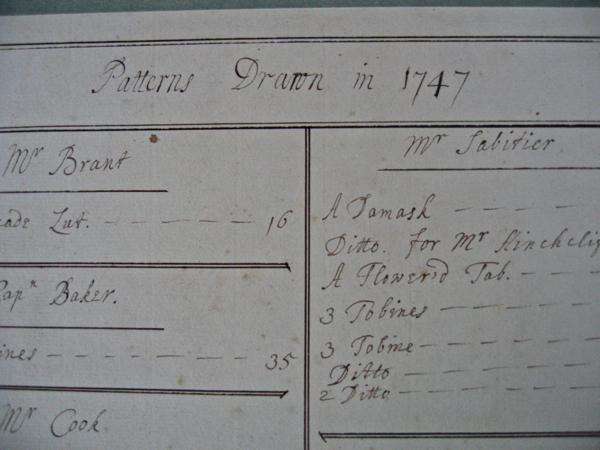
Anna Maria Garthwaite’s catalogue of designs.
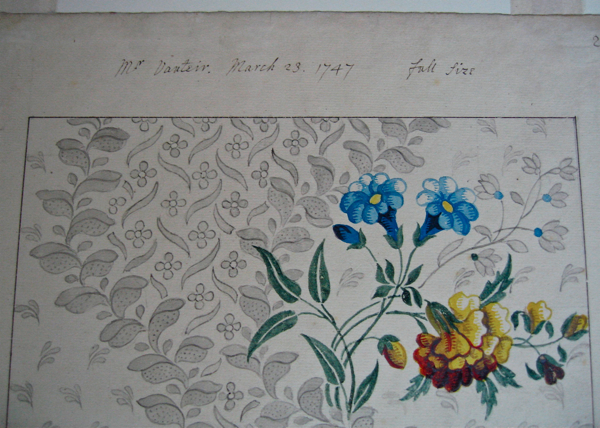
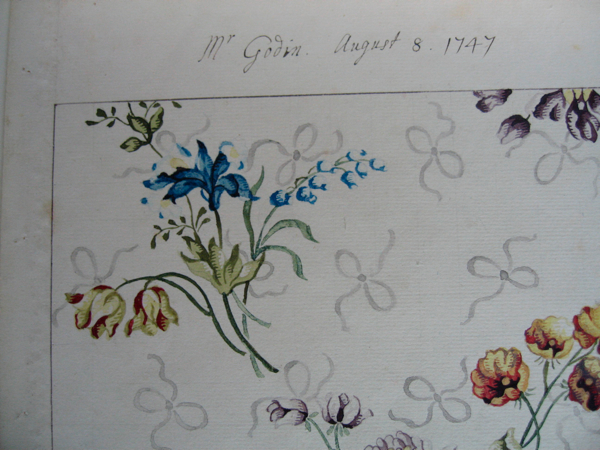
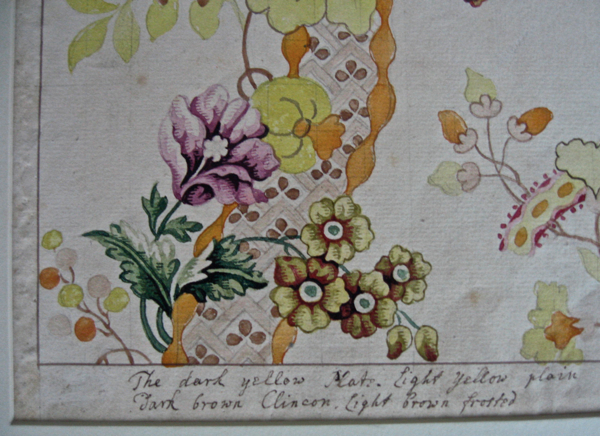
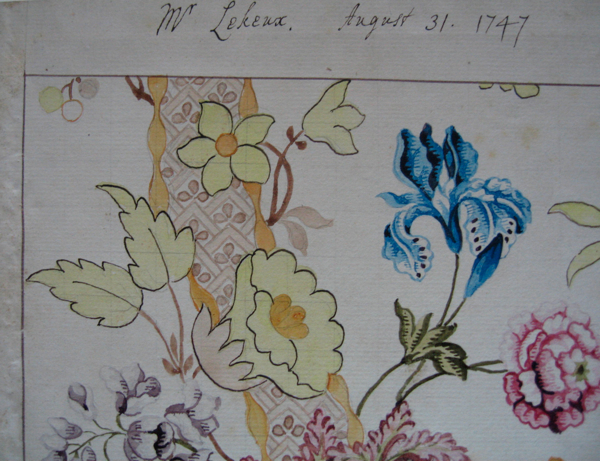
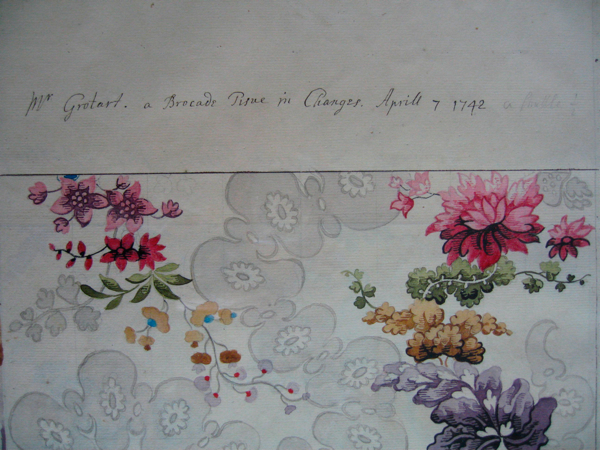
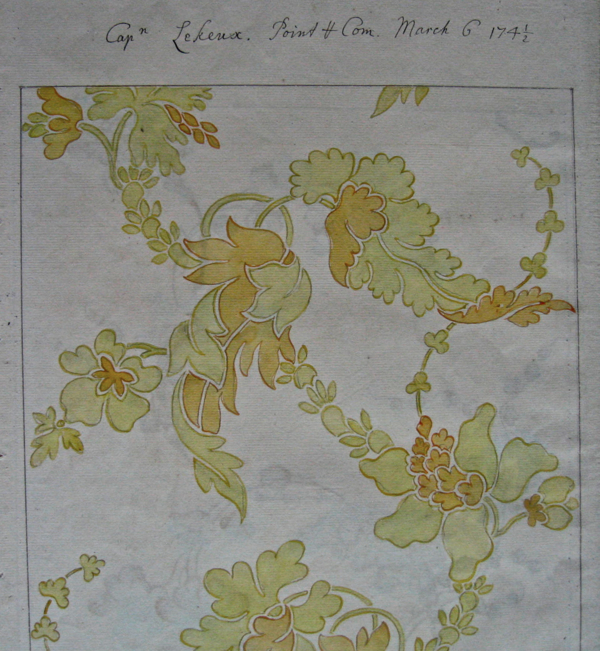
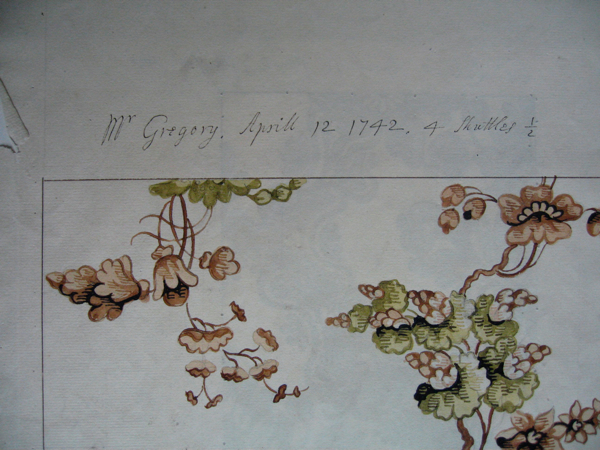
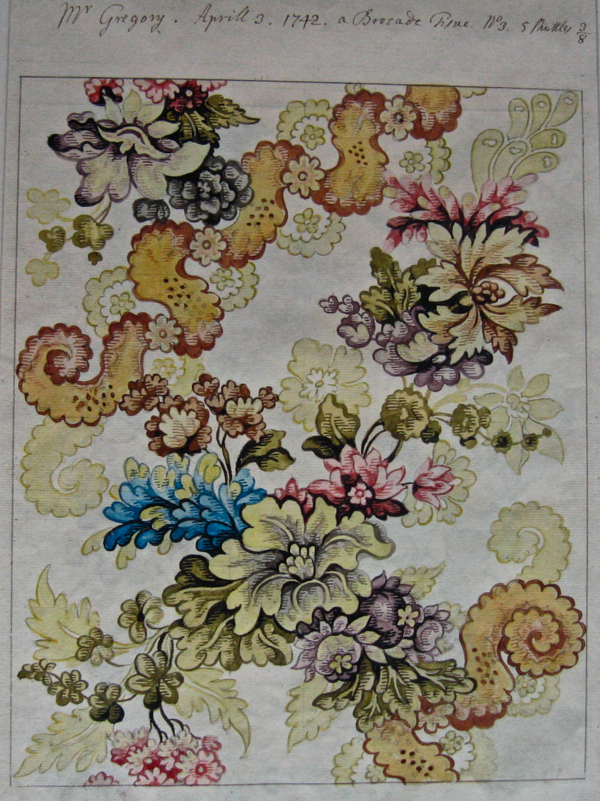
Designs by Anna Maria Garthwaite for Spitalfields silks from the seventeen forties in the collection of the Victoria & Albert Museum.
Textile design photographs by Jane Petrie
All images copyright © Victoria & Albert Museum
With grateful thanks to Moira Thunder of the Victoria & Albert Museum for making this possible.
You may also like to read about












