
Maurice Franklin, Wood Turner

If you were to rise before dawn on Christmas Eve, and walk down the empty Hackney Rd past the dark shopfronts in the early morning, you would very likely see a mysterious glow emanating from the workshop at the rear of number forty-five where spindles for staircases are made. If you were to stop and press your face against the glass, peering further into the depths of the gloom, you would see a shower of wood chips flying magically into the air, illuminated by a single light, and falling like snow into the shadowy interior of the workshop where wood turner Maurice Franklin, who was born upstairs above the shop in 1920, has been working at his lathe since 1933 when he began his apprenticeship.
In the days when Maurice started out, Shoreditch was the centre of the furniture industry and every premises there was devoted to the trade. But it has all gone long ago – except for Maurice who has carried on regardless, working at his lathe. Now at ninety-one years old, being in semi-retirement, Maurice comes in a few days each week, driving down from North Finchley in the early hours to work from four or five, until eight or nine in the morning, whenever he fancies exercising his remarkable talent at wood turning.
Make no mistake, Maurice is a virtuoso. When rooms at Windsor Castle burnt out a few years ago, the Queen asked Maurice to make a new set of spindles for her staircase and invited him to tea to thank him for it too. “Did you grow up in the East End?” she enquired politely, and when Maurice nodded in modest confirmation of this, she extended her sympathy to him. “That must have been hard?” she responded with a empathetic smile, although with characteristic frankness Maurice disagreed. “I had a loving family,” he told her plainly, “That’s all you need for a happy childhood, you don’t need palaces for that.”
Ofer Moses who runs The Spindle Shop – in the former premises of Franklin & Sons – usually leaves a list for Maurice detailing the work that is required and when he returns next morning, he finds the completed wood turning awaiting him, every piece perfectly achieved. But by then Maurice will already be gone, vanished like a shade of the night. So, in order to snatch a conversation with such an elusive character, a certain strategy was necessary which required Ofer’s collaboration. Early one frosty morning recently, he waited outside the shop in his car until I arrived, and then, once we had checked that there was a light glimmering inside the shop, he unlocked the door and we went in together to discover the source of the illumination. Sure enough, the wood chips were flying, accompanied by the purr of the motor that powered the lathe, and hunched over it was a figure in a blue jacket and black cap, liberally scattered with chips and sawdust. This was Maurice.
Unaware of our presence, he continued with his all-engaging task, and we stood mesmerised by the sight of the master at work, recognising that we were just in time to catch him as he finished off the last spindles to complete a pristine set. And then, as he placed the final spindle on the stack, Maurice looked up in surprise to see us standing there and a transformation came upon him, as with a twirl he removed his overall and cap, sending a shower of wood chips fluttering. The wood turner that we saw hunched over the lathe a moment before was no more and Maurice stood at his full height with his arms outstretched, assuming a relaxed posture with easy grace, as he greeted us with a placid smile.
“This firm was the wood turning champion of Britain in 1928,” announced Maurice with a swagger. “Samuel, my father, had been apprenticed in Romania and was in the Romanian army for two years before he came here at the beginning of the twentieth century, and then he served in the British Army in the 14/18 war before he opened this place in 1920. He had been taught by the village wood worker in Romania, they made everything from cradles to coffins. All the boys used to sleep on a shelf under the bench then.”
Maurice told me he was one of a family of twelve – six boys and six girls – and he indicated the mark in the floor where the staircase once ascended to the quarters where they all lived. “I started when I was thirteen, I’ve still got my indenture papers” he informed me conscientiously, just in case I wanted to check the veracity of his claim, “I took to it from the start. It’s creative and at the end of the day you see what you’ve made. I’m proud of everything I do or I wouldn’t do it.”
In spite of his remarkable age, Maurice’s childhood world remains vivid to him. “Here in Shoreditch, ninety per cent were Jewish and the ones that weren’t were Jewish in their own way. Over in Hoxton, they’d take your tie off you when you arrived and sell it back to you when you left – but now you couldn’t afford to go there. In 1925, you could buy a house in Boundary St for £200, or you could put down a pound deposit and pay the rest off at three shillings a week. I was born here in 1920 and I went to Rochelle School – They won’t remember me.”
The only time Maurice left his lathe was to go and fight in World War II, when although he was offered war work making stretcher poles, he chose instead to enlist for Special Operations. Afterwards, Franklin & Sons expanded through acquiring the first automatic lathe from America, and opening a factory in Hackney Wick to mass-produce table legs. “Eventually we closed it up because everyone was getting older, except me.” quipped Maurice with a tinge of melancholy, as the last of his generation now, carrying the stories of a world known directly only to a dwindling few.
Yet Maurice still enjoys a busy social calendar, giving frequent lectures about classical music – the other passion in his life. “I especially like Verdi, Puccini and Rossini,” he declared, twinkling with bright-eyed enthusiasm, because having made chairs for the Royal Opera House he is a frequent visitor there. “I like all music except Wagner. You’ll never hear me listening to Wagner, because he was Hitler’s favourite composer.” he added, changing tone and catching my eye to make a point. A comment which led me to enquire if Maurice had ever gone back to Romania in search of his roots. “I’ve got no family there, they were all wiped out in the war. My father brought his close relatives over, but those that stayed ended up in Auschwitz.” he confided to me, with a sombre grimace, “Now you know why I wanted to go to war.”
And then, after we had shared a contemplative silence, Maurice’s energy lifted again, pursuing a different thought, “I remember the great yo-yo craze of the nineteen thirties,” he said, his eyes meeting mine in excitement, “We worked twenty-four hours a day.”
“What’s the secret?” I asked Maurice, curious of his astonishing vitality, and causing him to break into a smile of wonderment at my question. “All you’ve got to do is keep on living, and then you can do it. It isn’t very difficult.” he said, spreading his arms demonstratively and shaking his head in disbelief at my obtuseness. “Are you happy?” I queried, provocative in my eagerness to seize this opportunity of learning something about being a nonagenarian. “I’ll tell you why I am happy.” said Maurice, with a grin of unqualified delight and raising one hand to count off his blessings, “I’ve got a wonderful family and wonderful children. I’ve been successful and I’ve got an appetite for life, and I’ve eaten every day and slept every night.” Maurice was on a roll now. “I was going to write a book once,” he continued, “but there’s no time in this life. By the time you know how to live, it’s over. This life is like a dress rehearsal, you just make it up as you go along. One life is not enough, everyone should live twice.”
There was only one obvious question left to ask Maurice Franklin, so I asked it, and his response was automatic and immediate, with absolute certainty. “Yes, I’d be a wood turner again.” he said.


“I wake up every day and I stretch out my arms and if I don’t feel any wood on either side, then I know I can get up.”


Maurice’s handiwork.

Ofer Moses, proprietor of the The Spindle Shop

Maurice’s service book from World War II.

Maurice as a young soldier, 1941


Maurice as a child in the nineteen twenties, in the pose he adopts leaning against his lathe today.

The figure on the left is Maurice’s father Samuel in the Romanian army in the eighteen nineties.

Samuel Franklin as proprietor of Franklin & Sons, Shoreditch.

Maurice Franklin
Photographs copyright © Patricia Niven
You may also like to read about Hugh Wedderburn, Master Woodcarver
Chapter 3. A Funeral at Christmas

There was grim silence in the middle of the day in Spitalfields on 23rd December 1910, when all activity ceased as the funeral of the three policemen shot dead in Houndsditch on 16th December made its way from Bishopsgate after the service at St Pauls Cathedral, travelling towards the City of London Cemetery in Ilford – as this contemporary newspaper report describes.
Most of the onlookers – including many aliens – stood cramped upon the pavements of Brushfield St for an hour and a half in passive expectation, and the procession moved slowly, as indeed was not only appropriate but necessary in a space so confined. When the hearses passed and the people saw the wreath-laden coffins, they seemed to recognise, in a very personal sense, the pathos and heroism of the lost lives. There was a pitying murmur.
At the end of Brushfield St and corner of Commercial St, which forms an angle of the Spitalfields Market, packing cases stood piled up in tiers and the market employees were clustered upon them. At this point also was to be heard the sombre tolling of the bell from Christ Church, Spitalfields, which directly faces Brushfield St. At noon, workrooms and factories in the neighbourhood released their hands for dinner. Men and girls hurried to the street and at every moment the throng increased. The crowds in Commercial St, where the pavement offered wide standing room, were truly enormous and the presence of so many thousands waiting so patiently was proof of popular feeling deeply stirred. The streets were full of mourners rather than sightseers.
Shopkeepers in the district showed their respect by putting up their mourning boards, or shutters, in the centre of their windows. As the hearses and carriages approached, blinds were drawn. Naturally, at this season of the year, many of the shop windows were gay with Christmas goods, and those seemed curiously out of place on this melancholy occasion.
Englishmen and foreigners mourned alike in Whitechapel. Men and women of foreign nationality gathered together in groups, waiting for the funeral to pass while talking in their native tongues. But they were not aliens of the type that committed the outrage of Saturday last. They appeared to be respectable hard-working people, peaceful and law abiding, and gave the impression they had come to this country to earn their living honestly. The fact is, many of them feel most keenly the stigma which is cast upon them, they resent being classed with criminals who have come to rob, and, with Englishmen, they feel indignation and abhorrence at the crime which has sacrificed those three splendid lives.
Meanwhile there had been significant developments in the case. On the day of the discovery of the corpse of George Gardstein and the arrest of Sarah Trassjonsky at 59 Grove St, Nicholas Tomacoff stepped from the crowd and knocked on the door, looking for a gentlemen by the name of “Fritz Svaars,” in whose room the body had been found. Aware of the £500 reward for information leading to the arrest of the members of the gang responsible for the murders in Houndsditch, he was naturally eager to assist the police, and they booked him into a hotel with all his expenses paid for the next five weeks.
Nicholas Tomacoff had been teaching Fritz Svaars to play the mandolin for the past three months and dropped by unexpectedly to visit him in his room the previous day – on the afternoon before the robbery – only to discover a group of friends with Svaars. Tomacoff was able to give police names and descriptions for the five men he had see there, including George Gardstein. And that very evening he led them personally to 141 Romford St, the residence of Osip Federoff, a locksmith, and 36 Havering St, where Peter Piatkow and Pavell Molachoff lived. All three were arrested, and then a policeman accompanied Tomacoff on a Christmas shopping spree in which he bought boots, a shirt, a collar and socks at the cost of fifteen shillings and sixpence. Subsequently he bought underpants, a vest, socks and a collar for eight shillings and fourpence, and later a hat and an overcoat for fourteen shillings and ninepence, amounting to a new wardrobe courtesy of the police.
Luba Milstein was dragged into Leman St Police Station by her brothers, who had escorted her all the way from Columbia Rd when they suspected her of involvement in the case, and she was placed under arrest. A woman came forward, who recognised the face of George Gardstein on the reward poster, to reveal that she had rented a room to him under the name of Mr Morin at 44 Gold St, and a police search of the room produced a cache of weapons. From the evidence that had come to light and the interviews with Sara Trassjonsky and the others who were now under arrest, the nature of endeavour by the gang of Latvian Anarchists was beginning to emerge, even if the precise nature of their inter-relationships remained unclear. They had rented the property in Exchange Buildings solely for the purpose of the robbery, which although of serious intent was an escapade of dubious practicality.
The Whitechapel police had little sleep for days as the tenacious Inspector Frederick Wensley combed all the lodging houses in the vicinity, where as many as seven hundred men slept each night, in his search for the other members of the gang. Committal proceedings were opened at the Guildhall Police Court on December 21st when the suspects in custody were brought before the court, but before proceedings commenced there was a new and unexpected twist.
During the holiday season, readers may rest assured that they will be kept informed of any advances in the development of this case as they occur.


Memorial cards sold by hawkers at the funeral procession.

The haul from 44 Gold St, described by the press as “the anarchists’ bomb factory.” Guns, ammunition and a small quantity of chemicals were discovered, which a police observer later revealed were “practically useless for the manufacture of explosives. There was no sign of a bomb and no indication that any attempt had been made to make one.”
Images copyright © Bishopsgate Institute
Myra Love, Maori Princess

“My mother was the Queen of Rarataonga, so I am a princess,” admitted Myra Love, with a gentle ambivalent grin, when I pressed her. Yet her ancestry on her father’s side is equally impressive, she is a Maori of the Te Ati Awa tribe of Petone, and her ancestors include two eighteenth century Scots from Selkirk – an explorer and an whaler – who married Maori princesses, Robert Park (brother of Mungo Park) and John Agar Love. “I always say my legs are Scottish,” Myra added with a smirk, claiming the European thread in her lineage with pride.
Today, Myra’s residence is a one bedroom flat in Bethnal Green – as far away as it is possible to be from her ancestral land – yet she still feels her responsibilities to her people, revealing a passionate sense of duty when she speaks of the politics of land. “I never learnt Maori because my grandmother said ‘English is the language of power, and you have to be fluent in English and get the land back’ – and we have. We formed corporations and we’re able to reclaim it today because the leases are coming up after a hundred years. There’s loads of land that we gave away for beads and blankets, and we’re getting it back.” Myra told me, swelling with magnificence and widening her eyes in skittish delight, adding, “Most of Wellington belongs to us now, and we got the railway station back last month.”
In this moment, I was afforded a glimpse of the woman who was born to be Queen of Rarataonga, because even though she does not choose to enact her public role, Myra’s abiding concern is the stewardship of the land on behalf of her people and her driving force is her desire to leave it in a better state. In another age, Myra might have led her tribe in battle, but today she fights at the High Court instead. “We are a warlike people!” Myra informed me proudly, accompanying the declaration with a winning smile. She knows that the success of her endeavour will define her legacy when she is long-gone, and in this sense, her concerns are parallel to medieval English royalty, seeking to unify the realm for generations to come.
“When I was a child, there was a feeling that we were second-class citizens.” continued Myra with a shrug, “If I was put down for being a Maori, my grandmother would say ‘Remember they’re walking on our land,’ and she owned quite a lot of land. My father was going to change how land was owned in our part of the country but he went to war and got killed instead. He was a leader of men. I was only five when he left. He went to Sandhurst and was the first Maori to command a battalion in World War II, but Maori leaders always fight alongside their men, and he was shot.
I was the youngest of three siblings so I didn’t count for very much until they died, and then I became very important because now I own a lot of land. I’m getting some of the land in New Zealand and some of the land in Rarataonga. And their siblings are fighting me for it and I am defending it in the High Court. I’m partitioning it out because I don’t want it for myself and I don’t want them to sell it, and I intend to stay as healthy as possible because they all want me to die.”
Stepping into Myra’s warm flat, painted in primary colours and crowded with paintings, plants, photographs, legal books, jewellery and musical equipment, I entered the court of a woman of culture. Not in the least high-faluting, she balances her serious intent with an attractive emotional generosity, which made it an honour to sit beside her as she opened her photo album. And Myra made it clear that she became the author of her own destiny, when she made the break at twenty-one and ran away – like Audrey Hepburn in “Roman Holiday” – to find a new life in the wider world.
“Once my grandmother died, the family disintegrated and I was moved out of the family house, so I decided to leave. Every Christmas we met together, but when she was gone there was a fight for the land, so because my family were all angry, I chose to go to America and become a jazz singer.
I sold a piece of my land to my uncle for £300 and bought a P&O ticket to San Francisco. You think everywhere’s going to be like New Zealand, so it was a bit of a shock when I got off the boat, because I was bit of a hokey girl. But it was exciting and, going through the Golden Gate Bridge, I thought, ‘My dreams are coming true.’ And some girls on the boat told me they knew Oscar Peterson, and they took me to the Black Hawk Club and there was Oscar Peterson. But I thought, ‘I’m going to New York,’ so I got on a train. It was 1958 and I had £100 left. I was an innocent abroad. In New York, I stayed on Bleecker St, just around the corner from Marlon Brando.
It was such a joy to visit places you’d only read about in books. At school I learnt Wordsworth’s ‘Westminster Bridge’ and when I came to London I had to go there at dawn. By then, I had only about £25 left, but money went a long way in those days.”
Myra told me it takes thirty years to learn to be a jazz singer, and she also filled those thirty years with getting married, having three children, and getting an Open University degree. “I got divorced because he wouldn’t let me go on singing,” she confided, spreading her hands philosophically, “When we broke up, I did a teacher training course and my first job was in the East End. I’ve always worked in underprivileged areas, and I’ve sent more kids to university than I’ve had hot dinners. These kids they know a little about a lot, and they’ve got the ability to latch onto something. They’re more than people who don’t live in the area know, because their struggle has been long. I’ve always believed that knowledge is power and that’s what I’ve tried to teach these kids.”
Recognising their situation equated with that of her own people, Myra discovered a sense of camaraderie with the people of the East End, which drew her to adopt the place as her home from home. And so it was that, Myra Love, the heroic Maori princess – devoted to fighting for the rights of her tribe – became a popular figure in the East End today, renowned for singing jazz at the Palm Tree in Bethnal Green. “I get my kicks from meetings with old East Enders,” she confessed enthusiastically, “They’re a tough breed. These people are just like me – they’re Maoris!”

This painting of 1858 by William Beetham shows the Maori Chiefs of Wellington with Dr Featherstone at the time of treaty of Waitanga which established peaceful colonial government in Aotearoa. On the left is Hon Tako Ngatata MLC and in the centre Honiana Te Puni Kokopu, from whom Myra is descended.

Taumata, Koro Koro Rd, Petone – “My grandmother had this house built in 1898, she picked this hill so she could see where she was born and where she would be buried. And I was born there November 8th, 1934, and I will be buried there too.”

Myra’s grandmother, Ripeka Love

Myra’s mother, Takau Upoko-o-nga Tinirau Makea Nui Ariki Love, Queen of Rarataonga.

Rangitira women of the Te Ati Awa tribe. At the centre is Lady Pomore, standing to her right Romahora, then Grandaunty Mata with Grandma Ripeka Love at the end of the row.
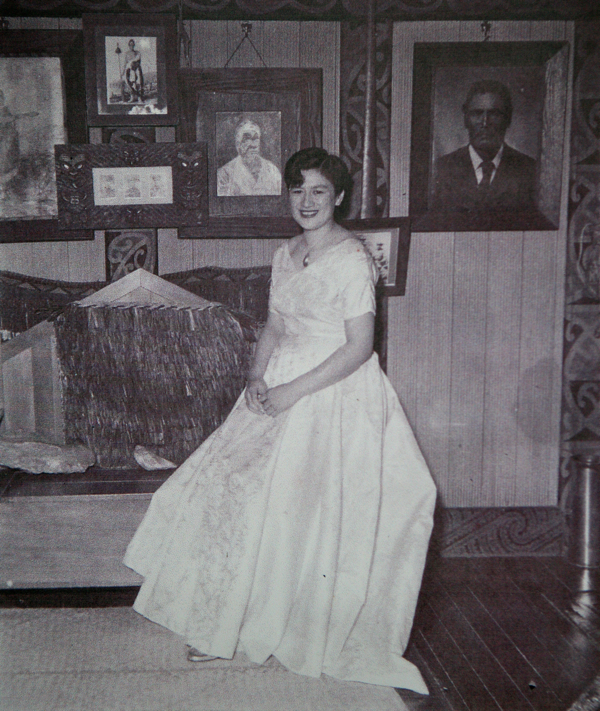
Myra Love in her debutante’s dress – “We are really very posh in the Maori way of thinking!”

Myra Love
Portraits copyright © Patricia Niven
Mr Pussy in Winter

It is Midwinter’s Day, and tonight – the longest night of the year – Mr Pussy will not stir from the chimney corner. Warmed by the fire of burning pallets, he has no need of whisky to bring him solace through the dark hours, instead he frazzles his brain in a heat-induced trance. Outside in the streets, Spitalfields lies under snow, the paths are coated in sheet ice and icicles hang from the gutters, but this spectacle holds no interest for Mr Pussy. Like the cavemen of ancient times, his sole fascination is with the mesmerising dance of flames in the grate. And as the season descends towards its nadir in the plunging temperatures of the frozen byways, at home Mr Pussy falls into his own warm darkness of stupefaction.
Mr Pussy is getting old. The world is no longer new to him and his curiosity is ameliorated now by his love of sleeping. Once he was a brat in jet black, now he is a gentleman in a chenille velvet suit, and tufts of white hairs increasingly fleck his glossy pelt. Toward the end of Summer, I noticed he was getting skinny, and then I discovered that his teeth have gone which meant he could no longer crunch the hard biscuits that were always his delight. Extraordinarily, he made little protest at his starvation diet, even as he lost weight through lack of food. Now I fill his dish with biscuits and top it up with water, so that he may satisfy his hunger by supping the resulting slush. And through this simple accommodation – plus a supplement of raw meat – his weight is restored to normal and he purrs in gratification while eating again.
Once Mr Pussy was a wild rover, ranging over the fields in Devon, disappearing for days on end and returning proudly with a dead rabbit in his mouth. Now he does not step beyond the end of the alley in Spitalfields and in these sub-zero temperatures only goes outside to do his necessary business. Sprinting up the stairs, and calling impatiently outside the door of the living room, he is ever eager to return to the fireside and warm his cold toes afterwards, sore from scraping at the frost in the vain attempt to dig a hole in the frozen earth. Like a visionary poet, Mr Pussy has acquired a vivid internal life to insulate himself against the rigours of the world and, in the absence of sunlight, the fire provides his imaginative refuge, engendering a sublime reverie of peace and physical ease.
Yet Mr Pussy still loves to fight. If he hears cats screeching in the yard, he will race from the house to join the fray unless I can shut the door first and prevent him. And even when he has been injured and comes back leaking blood from huge wounds, he appears quite unconcerned. Only two small notches in his ears exist as permanent evidence of this violent tendency, although today I regularly check his brow for tell-tale scratches and recently he has acquired some deep bloody furrows that have caused swelling around his eyes. But I cannot stop him going out, even though it is a matter of concern to me that – as he ages and his reflexes lessen – he might get blinded in a fight one day, losing one of his soulful golden eyes. Since he is blissfully unaware of this possibility, I must take consolation from his response when he could not eat, revealing that Mr Pussy has no expectations of life and consequently no fear of loss. His nature is to make his best accommodation to any exigency with grace.
And be assured, Mr Pussy can still leap up onto the kitchen counter in a single bound. He can still bring in a live mouse from the garden when he pleases and delightedly crunch its skull between his jaws on the bedroom floor. If I work late into the night, he will still cry and tug on the bed sheets to waken me in the early morning to see the falling snow. When the fancy seizes him, he can be as a sprightly as a kitten. Come the Spring, he will be running up trees again, even if now – in the darkest depth of Winter – he only wants to sleep by the fire.
Alone here in the old house in Spitalfields tonight, Mr Pussy is my sole companion, the perfect accomplice for a writer. When I take to my bed to keep warm while writing my stories, he is always there as the silent assistant, curled into a ball upon the sheepskin coverlet. As the years have gone by and Mr Pussy strays less from the house, I have grown accustomed to his constant presence. He has taught me that, rather than fear for his well-being, I need to embrace all the circumstances and seasons that life sends, just as he does.

You can read more about Mr Pussy here:
Laura Knight, Graphic Artist

“I bought them ten years ago for £10 in a secondhand shop in the Essex Rd,” revealed Laura Knight with a proud gleam in her eye, when I enquired the origin of this fine nineteenth century couple. “The colour and the style of them really appealed, they spoke to me,” she said, contemplating the cherished figures.
In retrospect, ten pounds was truly a bargain price for this Staffordshire group that has proved to be such a rich source of inspiration for Laura. “With Staffordshire Figures, there’s always two things going on,” she explained to me, articulating the dynamic that gives these modest designs their charisma, “there is the fineness of detail in the moulded form, in contrast to the application of the colour which – I suppose because it may have been done by children – has a childlike, almost crude quality.”
When Laura’s elegant prints of Staffordshire Figures drew my attention recently, capturing the spirit of these pieces with rare grace and economy of means, I recognised they were the assured work of a mature artist in control of her medium. So I became curious to discover the story behind them and I invited her over to find out.
As soon as Laura leapt off the bus outside Liverpool St in the snow, she cast her lively eyes around in wonder at the changes in Spitalfields, recalling humorously that once upon a time she often came to Brick Lane for a curry at the Nazrul and enjoyed watching the strippers over a drink at the Seven Stars in Brick Lane. “It used to be a nice place for cheap night out when I was a student at the Royal College of Art in 1978,” she admitted to me with a nostalgic grin. Laura’s grandparents were from Bethnal Green, “The talk was of boys’ clubs and boxing matches,” she remembered as we walked through the streets together, “It’s sad when you can’t have the conversations that you wish you’d had with them in the nineteen seventies when they were alive.”
There is an emotional resonance to Laura’s graphic work that draws you in, and in which pieces of china exist as personal fragments to evoke an entire culture. “They were on everybody’s mantlepiece and everybody’s dresser. They are a vivid background, deep in our memories of home. There wasn’t a kitchen without a piece of willow pattern or a mantlepiece without a piece of Staffordshire.” said Laura, speaking from the heart, “But because they’re so familiar they’ve become forgotten and no-one’s looking at them any more.”
After graduating from the Royal College, Laura enjoyed a successful career as an illustrator which led to teaching, which led to cutting back on her own work. And then when she quit teaching, she found herself starting all over again as illustrator. “I suppose if you really love something, you just want to keep doing it until you can make it your own,” was Laura’s self-effacing explanation of her predicament at this moment – also the moment when she remembered the Staffordshire couple that she bought in the Essex Rd. “I realised when I was drawing them that they were suitable for rubber stamps,” said Laura, revealing the discovery of her technique, whereby she gets her drawings made up into rubber stamps and then colours them herself, as a cottage industry, just like the ceramic painters of old. “I want to make my work into products that I can sell, rather than wait for people to commission me,” she continued, outlining her policy to achieve artistic independence, “I’ve started working with the London Printworks Trust who have given me a lot of support. They do small runs and they have printed my designs onto silk scarves.”
Knowledgeable and passionate about the history of English popular art, and with a distinctive mature style, Laura Knight is creating work that is irresistibly appealing. And it is my privilege and delight to introduce you to Laura and her joyous creations, because she has no outlets yet. In fact, Laura has just twelve of her beautiful silk scarves with handrolled edges that she sewed herself, and it is a condition of her support from the London Printworks Trust that she needs to sell these before they will print more. They cost £55 each and if you contact her to buy one, she will send it out to you at once.
It is the week before Christmas, need I say more?
Limited numbers of cards, silk scarves and cloth kit cushions are available direct from lauraknight@waitrose.com


Laura has made twelve of these fine silk scarves, hand rolling the edges of each one.

The Staffordshire couple bought for £10 in the Essex Rd ten years ago.


Laura designed this pair of cushions as a cloth kit to sew yourself.
Images copyright © Laura Knight
Columbia Road Market 64

Each year at Christmas, my parents would drive over to Chard in Somerset to visit my grandmother for lunch on Christmas Day, and this blue Spode bowl always sat upon the sideboard in the dining room with blue Hyacinths sprouting in it, as a promise of the New Year and the Spring to come. Subsequently my mother inherited the bowl and it sat upon the dresser in Exeter, but now that all my living relatives are gone, it is here with me in Spitalfields and it is my lone responsibility to uphold the tradition by planting Hyacinths each year. Last year, I filled it with bulbs from Columbia Rd Market which, in a unique precedent in the history of this bowl and to my surprise, turned out to be bright pink. Although my grandmother would certainly not have approved, it was an exuberant break from the conservatism of tradition. But this year, the seller who sold me these six bulbs for £5 assured me they were blue – of the variety called “Blue Pearl”- so I shall now live in keen expectation of the New Year to discover what appears in 2011.

The Hyacinths of 2010.

I awoke to this view from my bedroom window in Spitalfields yesterday.
Chapter 2. A Body in Grove St

After a tip-off, police discovered a body at 59 Grove St in Stepney. It was one of the gang who had staged the attempted robbery in Houndsditch on 16th December, and he had been shot accidentally by one of his fellows during their escape.
Dr Scanlon telephoned Arbour Sq Police Station with the news. He had been awoken at 3:30am by two women with their faces concealed by shawls and who could not speak English. He understood that “A man is very bad at 59 Grove St.” and followed them through the dark streets to the house where, lying in a blood-stained bed, he found a man with a bullet-wound to the chest. The dying man refused Dr Scanlon’s suggestion to transfer him to the Royal London Hospital, and so the doctor could only prescribe medication to ease the pain. When he asked what name to write upon the certificate, Dr Scanlon was told “George Gardstein.” Then one of the women returned with him to collect the medicine and he promised that he would visit later to check upon the casualty.
The report of Dr Scanlon’s call was passed to Inspector Frederick Porter Wensley – known as “the Weasel”- who had joined the force in 1887 at the time of the Whitechapel murders. Originally from Somerset, he had a reputation for ambition and was frustrated that he had been held back from promotion to the role of Detective, because it would mean a transfer when he had become too useful in Whitechapel.
Wensley arrived at Dr Scanlon’s surgey in the company of Detective Inspective Thompson of the City of London Police – acknowledging the importance of this unexpected break in the case. Dr Scanlon was instructed to pay a second call and then return to the surgery, both to avoid raising suspicions and to protect himself as informant. Yet inexplicably, when Dr Scanlon discovered the dead body of George Gardstein, he rang the Coroner at once and the news was leaked to the press. Then he returned to the surgery and informed Wensley and Thompson, who raced in anger to 59 Grove St with news reporters on their heels.
Mindful of what happened in Houndsditch and with characteristic pragmatism, Wensley pushed the obese landlady up the staircase ahead of him as a human shield against any bullet, but in the front bedroom he discovered only Gardstein’s wide-eyed corpse upon the bed and a small hunchbacked woman hastily burning papers in the grate in the small back room. Her name was Sara Trasjonsky and it was she who summoned Dr Scanlon.
A tweed cap full of bullets lay upon the bedside table, an overcoat with a bullethole in the back hung upon the bedstead and a loaded pistol was discovered concealed under the bloody mattress. A door key from Exchange Buildings was found in the dead man’s pocket and, in his pocket book, a membership card for a Latvian Anarchist Communist group, beside instructions for detonating bombs by electricity. Gardstein was carrying a fake passport in the name of “Schafshi Khan.”Letters were scattered around the room, mostly correspondence from a man named Fritz in the hard labour section of the Central Prison in Riga and, amongst other papers, there was also a statement of accounts for the Social Revolutionary Party in Baku. It was evident that a criminal gang of Eastern Europeans with political motives were on the loose in the East End, and the City of London Police offered a £500 reward for information leading to to their arrest. “Who are these Fiends in Human Shape?” was the headline in the Daily Mirror, and government policy towards immigrants and political refugees was questioned.
Now that George Gardstein could no longer object, his body was transferred to the Royal London Hospital, where a medical student told a journalist, “We’ve got him. There was very great competition and he’s as handsome as Adonis – a very beautiful corpse!”
You may be assured that further reports of any new developments will be forthcoming in the next week.

59 Grove St – the body was discovered in the upper room.

Grove St, looking North.

Today, Grove St is renamed Golding St and only a fragment remains. In this view, equating to the photograph above, the approximate site of 59 Grove St is now occupied by the garage in the centre right.

The memorial to the dead policemen unveiled in Cutler St, Houndsditch, last Thursday, on the day of the centenary.
Archive images copyright © Bishopsgate Institute


