
Stanley Rondeau at the V&A
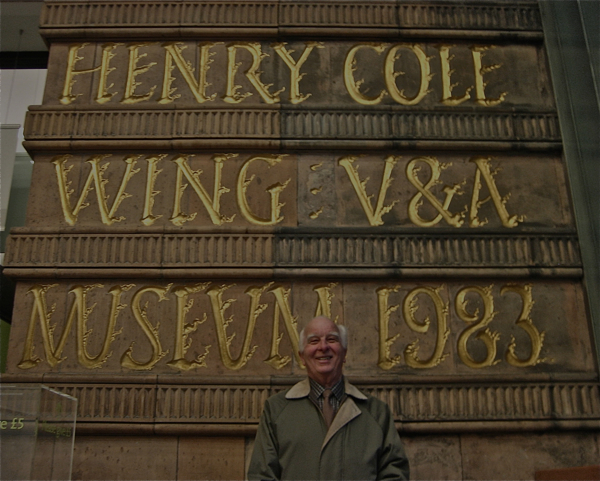
Last year, I introduced you to Stanley Rondeau whose great-great-great-great-great-great-grandfather Jean Rondeau was a Huguenot silk weaver who came to Spitalfields in 1685 as a refugee fleeing religious persecution in Paris. Jean’s son prospered in Spitalfields, becoming Sexton at Christ Church, having eleven children, building a new house at 4 Wilkes St and commissioning designs in the seventeen forties from the most famous of silk designers, Anna Maria Garthwaite, who lived almost next door, in the house on the corner with Princelet St.
Since Anna Maria Garthwaite’s designs were exceptionally prized both for their aesthetic appeal and their functional elegance as patterns for silk weaving, hundreds of her original paintings have survived to this day. So yesterday, Stanley & I went along to the Victoria & Albert Museum in Kensington to take a look at those done for Stanley’s ancestor Jean the Sexton, two hundred and seventy years ago. We negotiated our way through the labyrinths of the vast museum, teeming with school children, with a growing sense of anticipation because although Stanley has seen one of the designs reproduced in a book, he has never cast his eyes upon the originals. And up on the fourth floor, we entered a sanctuary of peace and quiet where curator Moira Thunder awaited us in a lofty room with a long table and large flat blue boxes containing the treasured designs that were the objects of our quest.
Moira – chic in contrasting tones of plum and navy blue, and with a pair of fuchsia lenses which hinted at a bohemian side – welcomed us with scholarly grace, and duly opened up the first box to reveal the first of Anna Maria Garthwaite’s designs. Drawn in the wide margin at the top of a large sheet containing an elaborate floral number, this design was the epitome of restraint with a repeated motif that resembled a bugle flower in subdued tones of purplish brown, labelled “Mr Rondeau, Feb 5 174 1/2,” and intended as a pattern to be woven into the body of a vellure used for men’s suiting.
Mr Rondeau of Feb 2011, instinctively drawn towards his own name revealed before him, leaned forward to touch the piece of paper – which caused Moira’s eyes to pop, though fortunately for all concerned the priceless design was protected by a layer of transparent conservator’s plastic. Once smiles of amelioration had been exchanged after this faux-pas, Stanley enjoyed a quiet moment of contemplation, gazing with his deep-set chestnut eyes from beneath his bushy white eyebrows upon the same piece of paper that his ancestor saw. I think Stanley would have preferred it if “Mr Rondeau” had been written beside the fancy design below, because he asked Moira whether the other design for Jean Rondeau in the collection was more colourful but, with an unexpectedly winsome smile, Moira refused to be drawn.
Yet while Stanley’s curiosity was understandably focussed upon those designs attributed to his ancestor, I was enraptured by the myriad pages of designs by Anna Maria Garthwaite, whose house I walk past every day. Kept from the daylight, the colours in these sketches remain as fresh as the day she painted them in Spitalfields three centuries ago. The accurate observation of both cultivated and wild flowers in these works suggests they were painted from specimens which permits me to surmise that she had access to a garden, and picked her wild flowers in the fields beyond Brick Lane. I especially admired the sparseness of these sprigged designs, drawing the eye to the lustrous quality of the silk, and Moira, who worked as assistant to Natalie Rothenstein – the ultimate authority on Spitalfields silk – pointed out that weavers rarely deviated from Garthwaite’s designs because they were conceived with such thorough understanding of the process.
And then, Moira opened the second box to reveal the second design by Anna Maria Garthwaite for Jean Rondeau, which Stanley had never seen before. Larger and more complex than the previous, although monochromatic, this was a pattern of pansy or violet flowers divided by scalloped borders into a repeated design of lozenges. Again drawn in the margin, at the top of a piece of paper above a multicoloured design, this has the name “Mr Rondeau” written in feint pencil beside it. It was a design for a damask, either for men’s suiting or a woman’s dress, which Moira suggested would be appropriate to be worn at the time of half-mourning. A degree of formalised grief that is unfamiliar to us, yet would have been the custom in a world where women bore many more babies in the knowledge that only those chosen few would survive beyond childhood.
Moira took the unveiling of this second design as the premise to outline the speciality of Master Silk Weaver Jean Rondeau, who appears to have built his fortune, and company of fifty seven employees, upon the production of cheaper silks for men, unlike his Spitalfields contemporary Captain Lekeux – for whom Anna Maria Garthwaite also designed – who specialised in the most expensive silks for women. In reponse to Moira’s erudition, Stanley began to talk about his ancestor and the events of the seventeen forties in Spitalfields with a familiarity and grasp of detail that made it sound as if he were talking about a recent decade. And as he spoke, with the unique wealth of knowledge that he has gathered over a lifetime of research, I could see Moira becoming drawn in to Stanley’s extraordinary testimony, revealing new information about this highly specialised milieu of textile production which is her particular interest. It was a true meeting of minds, and I stood by to observe the accumulation of mutual interest, as with growing delight Moira and Stanley exchanged anecdotes about their shared passion.
Recently, Stanley visited the Natural History Museum to hold the bones of his ancestor Jean the Sexton which were removed there from Christ Church for study, and by seeing the designs at the Victoria & Albert Museum that once passed before Jean’s eyes in Spitalfields, he had completed his quest. But there was a surprise in store, when Moira revealed that there were other textile designs from the nineteenth century commissioned by another Mr Rondeau who might be a descendant – but due to a forthcoming refit of the department Stanley would have to wait until 2012 to see them.
“It was a big day,” Stanley admitted to me afterwards, his eyes shining with emotion, as he began to absorb the reality of what he had seen. “I’ll wait a year, and then I’m going to come back,” he added with grin of determination. It was a cliffhanger, because who knows what extravagant designs of high-flown Victoriana Mr Rondeau of the nineteenth century might have commissioned, in contrast to the understatement of his eighteenth century predecessor? But whatever Stanley Rondeau discovers, I have no doubt that the gracious Moira Thunder will be waiting to greet him upon his return to the V&A.

Stanley Rondeau sees the design commissioned by his ancestor in the seventeen forties for the first time.

Design for a vellure for Jean Rondeau, by Anna Maria Garthwaite, Spitalfields, February 5th, 1741.

The full page with Jean Rondeau’s design at the top.

Design for a damask by Anna Maria Garthwaite for Jean Rondeau, possibly for half-mourning.
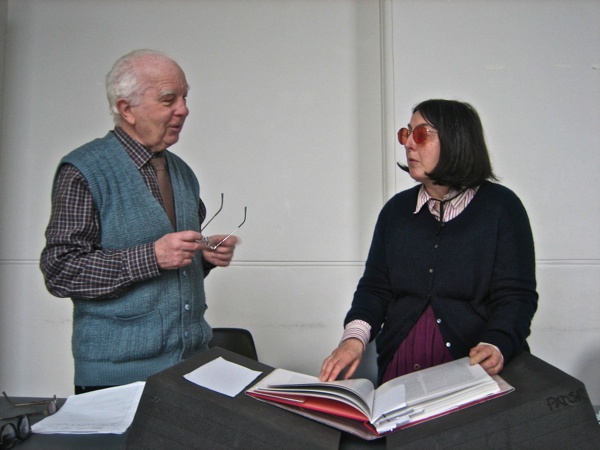
Stanley Rondeau chats with Moira Thunder, Curator, Designs, at the Victoria & Albert Museum, over a copy of Natalie Rothenstein’s definitive work “Silk Designs of the Eighteenth Century.”

Anna Maria Garthwaite’s catalogue of designs.


Designs by Anna Maria Garthwaite for Spitalfields silks from the seventeen forties in the collection of the Victoria & Albert Museum.
Textile design photographs by Jane Petrie
All images copyright © Victoria & Albert Museum
With grateful thanks to Moira Thunder of the Victoria & Albert Museum for making this possible.
You may also like to read about
Homer Sykes, Photographer

On Brick Lane in the nineteen seventies, on a damp January day like today, it would have been a toss-up between the Liver & Chips at 36p or the Fish & Chips at 27p for dinner, but either way I know that the Semolina Pudding at 6p would have finished it off nicely. Yet this dilemma will always remain hypothetical for me because I was not there, though thanks to the engaging vision of photographer Homer Sykes I am able to glimpse the lost world of the recent past in the East End. In Homer’s masterly picture, this cook will eternally be gazing down Brick Lane waiting for the next rush of customers, full of eagerness to clear every dish off the blackboard. With his strangely shaped hat and quaint apron, he is like a character from Breugel – and through Homer Sykes’ lense he is transfigured to become the ultimate custodian of the steamy cafe where hot dinners can never go cold.
“I was a middle class boy who came to London from Birmingham to do photography for fashion and advertising, and make money,” Homer admitted to me with self-depreciatory ambivalence, “And then I got interested in reportage. Everything in London was new to me, I’d had a sheltered background and I wanted to explore the contrasts between the haves and the have-nots.” But even before he came to study at the London College of Printing, Homer was photographing gypsy encampments in the centre of Birmingham and undertaking photographic road trips around America on greyhound buses.
For decades, Homer Sykes has enjoyed a lively and wide-ranging career as a photojournalist working for all the major publications and he has published a string of books including, “The English Season” and “Mysterious Britain,’ whilst also pursuing personal work, created in parallel to his public commissions. It was only in 2008, when scanning his collection of negatives, that Homer revisited the photographs he had taken in Spitalfields. “People are interested in what places were like thirty of thirty-five years ago,” he explained to me with a philosophical grin of delicate amusement, “But it doesn’t seem like thirty years ago to me, even though it was before an awful lot of people who look at my pictures were born.”
Homer heard that the Peabody Estates were to be demolished and, throughout his twenties, came to the East End whenever he had days free between assignments.” I used to walk around photographing stuff that was different and interesting and visually exciting.” he said, “The old lady in her flat at the top of Brick Lane, I would have spent an hour nattering with her to wait for the moment when she put her head in her hands.”
“These flats were being boarded up and people were moving out, and I remember thinking,’I’d better go and photograph this.'” he recalled, “I met this woman outside in the street and we got chatting and she invited me in. You have to talk to people and get their trust. What I like about this picture – she’s wearing a coloured housecoat – is the nice wall with the paper, the photographs and the kids’ paintings, and the teapot and milk bottle on the table. Her whole life is there and yet she’s being moved out.”
L.Elgrod, watchmakers, the last building standing in an alley off Whitechapel High St, incarnates the dogged persistence of the people here – while the details of clothes speak to us in voices that are no longer to be heard around Brick Lane, whether of the East European cook with his arcanely styled apron buttoned onto his coat, or of the black children so neatly dressed, in frocks with kneehigh socks, simply to play in the yard outside their Peabody flats. “Clothing tells you so much about who people are,” as Homer put it plainly.
These are unsentimental photographs, filled with human sympathy, yet there is also a classical aesthetic present which gives Homer Sykes’ pictures an enduring quality beyond their importance as social documentary, “All my work is considered, with a sense of formality.” confirmed Homer, “I am interested in composition – the content and composition must go hand in hand. It can’t be just a picture, an extra something is required.” In the selection published here, all are enlivened by unconventional compositions, like the picture of the Bengali sweatshop with an empty space at the centre, or of the woman holding up a mirror whilst trying on a wig in the market – only it is her friend’s face that is revealed to the camera.
“I’m just the kind of guy who needs to take pictures,” Homer Sykes admitted to me with a shrug, yet the serious and soulful body of work he has done belies such levity, even if it is characteristic of the spirit of the man.
You can see more of Homer Sykes’ East End photographs by clicking here


Photographs copyright © Homer Sykes
Wheatley’s Cries of London

Two Bunches a Penny, Primroses, Two Bunches a Penny!
Francis Wheatley exhibited his series of oil paintings entitled the “Cries of London” at the Royal Academy between 1792 and 1795. Two year earlier, the forty-one year old painter had been elected to the Academy in preference to the King’s nominee and, as a consequence, he never secured any further commissions for portraits from the aristocracy. Losing his income entirely, what should have been the crowning glory of his career was its unravelling – Wheatley was declared insolvent in 1793 and struggled to make a living until his death in 1801, when the Royal Academy paid his funeral expenses.
Yet in the midst of this turmoil, Wheatley created these sublime images of street sellers that – although seen at the time as of little consequence beside his aristocratic portraits – are now the works upon which his reputation rests. Born in Covent Garden in 1747, Wheatley was ideally qualified to portray these hawkers because he grew up amongst them and their cries, echoing in the streets around the market. You will recognise the old stone pillars of the market buildings that still stand today in a couple of these pictures, all of which could be located specifically in that vicinity. However, these pictures are far from social reportage as we understand it, and you may notice a certain similarity between many of the women portrayed in these pictures, for whom it is believed Mrs Wheatley – herself a painter and exhibitor at the Royal Academy – was the model. Look again, and you will also see that variants on the same ginger and white terrier occur throughout these paintings too.
In spite of the idealised quality of these pictures, I am drawn to these “Cries of London,” as a project that places working people at the centre of the picture, and represents them as individuals of stature and presence. The body language of subservience is only present when customers are in the frame, as you will see in the Knife Grinder and Cherry Seller below, whilst the lone Strawberry Seller, Match Seller and Primrose Seller all gaze out at us with assured status, as our equals. Taking this a stage further, the final three pictures, the Ballad Seller, the Gingerbread Seller and the Turnip Seller portray sellers and customers meeting eye to eye – dealing on a level – and with a discernible erotic charge in the air.
Although coming too late to save his career, Wheatley was well served by his engravers who created the prints which brought recognition for his “Cries of London,” as the most beautiful and most popular series of prints on this subject of all time, with editions still available into the early twentieth century. In fact, when I examined this set in the archive of the Bishopsgate Institute, I realised that many were familiar to me from chocolate boxes and biscuit tins, and once glimpsed in frames in the houses of elderly relatives and the seaside hotels of my childhood.
Luigi Schiavonetti, born in Bassano in 1765, engraved the first three plates, the Primrose Seller, the Milk Maids and the Orange Seller, with lush velvety stippled tones – a style that was maintained by the three subsequent engravers (Cardon, Vendramini and Gaugain), when Schiavonetti became too successful and expensive for such a modest project. The “Cries of London” were sold at seven shillings and sixpence for a plain set and sixteen shillings coloured, and the fact all thirteen were issued is itself a measure of their popularity.
It touches me to understand that Francis Wheatley chose to paint these “Cries of London” at the time he was losing grip of his life, struggling under the pressure of increasing debt, because they cannot have been an obvious commercial proposition. And I like to surmise that these graceful images celebrate the qualities of the ordinary working people, which Wheatley experienced first-hand, growing up in Covent Garden, and chose to witness in this subtly political set of pictures, existing in noble contrast to the portraits of aristocratic patrons who had shunned him when he was in need.
One cold Winter’s morning, tracing my way through the narrow alleys at the heart of the City of London recently, I came upon singing and it stopped me in my tracks. This was a recording of the “Cries of London,” installed there by a composer, and it was a welcome reminder of the beauty of these songs, exploiting the acoustics of the City to elegant and haunting effect. Already a year has passed since the newspaper sellers went, seemingly un-noticed, and now it lifts my spirits to hear the fruit seller in Sclater St Market each Sunday with his distinctive rhythmic cry, “Bananas, bananas, bananas,” – because in my mind this is the very last reverberation of that vast symphony of many thousands of voices echoing down the centuries and through the streets of London to our present day. The Cries of London.

Milk Below! – This is believed to be the origin of the more recent milkman’s cry, “Milko!”

Sweet China Oranges, Sweet China.

Do you want any matches?

New Mackerel, New Mackerel

Knives, Scissors & Razors to Grind.

Fresh Gathered Peas, Young Hastings.

Round & Sound, Five Pence a Pound, Duke Cherries.

Strawberrys, Scarlet Strawberrys.

Old Chairs to Mend.

A New Love Song, only Ha’pence a Piece.

Hot Spiced Gingerbread, Smoking Hot.

Turnips & Carrots, ho!

Francis Wheatley R.A. looks askance.
Images copyright © Bishopsgate Institute
You may like to take a look at
All Change at Shelf

I have a secret route to get to Shelf – I go past the farm, across the park, under the railway line, across the wasteland, under the sinister railway arch, over the graffitied footbridge, and then I turn left down Cheshire St to arrive excitedly at this oddball tangerine-coloured shop which only opens at weekends. It has been my place of constant pilgrimage for ten happy years of treats, where I could always guarantee to discover some new delight, but last week Katy Hackney & Jane Petrie invited me round to break the news that Shelf is leaving Spitalfields, because in future they will be open for business to the whole world, night and day at www.helpyourshelf.co.uk
When they first opened in Cheshire St, I did not have a place of my own to live and so, as consolation, I went to Shelf and bought an iron door knocker, vowing that one day I should have my own front door to go with it. Ten years later, this handsome door knocker, cast from a nineteenth century mould in a Belgian factory, greets me every day as I go in and out of my house. I always relied upon Shelf for serious nonsense, whenever I had urgent need of some nicely painted wooden rabbits at Easter or a candle powered merry-go-round, hand carved with deer from the Black Forest, at Christmas. There must be room in life for whimsy and joy, and Shelf is a toy shop for adults where you can rely upon finding a functional wooden radio or clockwork songbird that really sings.
I always wondered where on earth proprietors Katy Hackney & Jane Petrie got all this astonishing stuff, which you could find nowhere else – “Our elaborate hobby,” they term it modestly. It was a rare adventure to visit these two shrewd yet playful women from Dundee who maintain a constantly engaging double act, full of non-sequiturs and completing each others sentences. After several years, I enjoyed the privilege of viewing their most coveted finds, colourful old prints and toys which they stash safely in drawers in the basement for their own pleasure – just to make sure no customer could ever find them and buy them – and it became apparent then that Shelf was an endeavour based upon extraordinary personal enthusiasms.
At Shelf, in perverse yet welcome contrast to common practise, Katy & Jane have championed old designers, like Pravoslav Rada of Prague, eighty-seven years old, and Frerk Muller of Berlin, who is well into his sixties. It is the exclusive outlet in Britain for Pravoslava Rada’s bright-coloured ceramics which he has been making in an unchanging style since the nineteen sixties, and also the only place you can find the designs of Frerk Muller – an old beatnik who creates droll minimalist images of birds with moody expressions – printed onto mugs and towels.
Undefinable and unlike any other shop in London, Shelf has thrived on its own idiosyncrasy, even though Katy & Jane never set out out to be shopkeepers – a role which they are happy to relinquish to concentrate on designing their own things for Shelf. And I am especially excited to learn that now all the treasures from the cellar will go on sale. Naturally, I shall miss popping in for a chat and emerging with a bird whistle, but Katy & Jane are going to be back, setting up stalls at Christmas fairs and seasonal events. And in the meantime you can enjoy a Shelf bonanza at the shop, where everything is on sale at daft prices while stocks last. Be assured, this is not “Goodbye” to Shelf but simply “Au Revoir.”
Vist the Shelf blog The Other Side of the Shelf and Jane Petrie’s Costume Detail blog


Kellner figures, made by the same family since 1919

Paper mache animal head by Rachel Warren

Wooden merry-go-rounds from the Black Forest

Plaster letters rescued from the Californian desert, originally created to make titles for silent films.

Design by Frerk Muller, a beatnik from Berlin.


Ceramic by Pravoslav Rada of Prague

Stationery packs with tickets, boot polish tins and rare old paper bags from Paul Gardner’s basement.

Enamelled copper letters to make your own signs.

Ceramic by Pravoslav Rada

Paul Gardner visited Shelf to deliver the last paper bags on Friday.

John Moyr Smith’s Tiles

It was only after several of my interviewees asked me if I had been standing next to a bonfire recently, that I realised the smoky old fire in my house causes my clothes to reek like those of a hobo who sleeps next to the campfire each night. Even though everyone has been tactful, assuring me how enraptured they are by the whiff of wood smoke that accompanies me each time I walk in the door – to ameliorate this situation, I have decided to fit a stove in my fireplace before next Winter. Although kind friends now regularly leave pallets outside my house, collecting broken pallets from the streets of Spitalfields each week, dragging them home in the cold and chopping them up has become a burdensome chore. A stove will solve my smoke problem, give me more heat from less wood, spare me the coating of ashes that settles upon every surface in my living room – and now I can tile the fireplace.
My budget precludes delft tiles, and casting around for an alternative that suits my pocket I came across the work of John Moyr Smith, an artist and designer born in Glasgow in 1839, who worked in the Arts & Crafts tradition and designed graphic illustrated tiles for Minton in the eighteen seventies. I like their brownish hues which suit my quiet taste, but what attracts me most are their intricate scenes, like panels from a comic strip, telling stories from Shakespeare’s plays, the Bible, the Morte D’Arthur, the Arabian Nights and Aesop’s Fables. Although rare ones in pristine condition change hands for hundreds of pounds, there are enough around to buy more common examples in used condition for under ten pounds. So now I have set out to collect enough to fill my fireplace and here you can see the first eleven I have found, out of the sixty or so I will need in total.
The notion of a fireplace lined with stories to contemplate on cold Winter nights is one that appeals greatly, and although I originally imagined it would be exclusively Shakespeare – as a kind of shrine to the bard – I could not resist widening my collection to include scenes from the life of Jesus and Fairy Tales too. In place of the phantoms that are conjured gazing into the flames of my open grate, I shall have a gallery of dramatic fictions in the fireplace surrounding my stove, and just as all the stories I have ever read are interwoven in my mind, I cherish the notion of Hamlet and Jesus and Bluebeard side by side among the tiles. Reading the life of St Brendan, who paddled to America in a coracle, I came upon the story of an island he discovered which was revealed as whale when he lit a fire, and years later, reading the Arabian Nights, I came across the same adventure ascribed to Sinbad the Sailor, a correlation which confirms that all my tiles can be harmonious neighbours, their diverse cultural origins notwithstanding – because all the stories in the world must interconnect eventually.
I think John Moyr Smith could have had a very successful career as a comic book artist if he had lived a hundred years later, judging on his ability to visualise fictional characters convincingly and incarnate the dramatic moment in graphic form. On each of these tiles, almost like living tableaux or posed snapshots, there is a vibrant energy to his figures which suggests a use of models or, at very least, a fluent grasp of anatomy – because the postures and the resulting tension between the characters, always evokes the specific drama with dynamic precision.
Jesus’ powerful arm, extended to turn water into wine, possesses a force worthy of a superhero, while the shocked expressions of the witnesses are enough to confirm his miracle. A similar effect is employed in stilling the tempest, when the fishermen’s expressions of terror reveal the violence of the storm while Jesus stands impassive. Observe how, in the illustration to Othello, Desdemona and Othello’s gestures reflect and complement each other, placing her father who is dubious of their marriage in self-conscious isolation. In another example, notice Blubeard’s fist curled behind his back as a expression of his violent inner turmoil when confronting his young wife and the bloody keys that expose his darkest secret. My current favourite amongst the tiles I have so far is the scene from As You Like It – for the tenderness of expression as Celia leans over Rosalind languishing in distress at the loss of Orlando. It delights me to see how, in each case, John Moyr Smith found an effective image to reveal the sympathetic human truth expressed in a fictional moment.
As you will now understand, tiling this modest fireplace has become an epic undertaking in my imagination, and so – every few months during this year – I shall be showing you the new additions to my growing collection of Moyr Smith tiles as it accumulates. Then, next Christmas, you will see my ceramic gallery of storytelling complete, once it is installed to give me inspiration by reminding me of some favourite stories, when sitting with my cat beside the stove and whiling away the long dark nights of Winter in Spitalfields – in the days when my overcoat will no longer smell of wood smoke.

Jesus turns water into wine.

Bluebeard threatens to behead his wife when he discovers the bloodied keys.

Much Ado About Nothing – Dogberry confronts the villain Conrade in prison.

Hamlet – Laertes & Ophelia.

Othello – Brabantio is sceptical of his daughter Desdemona’s marriage to Othello.

Romeo & Juliet – Juliet & Nurse.

Henry IV Part I – Young Hal and Falstaff at the Boar’s Head in Cheapside.

The Merchant of Venice – Portia sees Bassanio turning pale upon reading Antonio’s letter.

Jesus stills the tempest.

As You Like It – Rosalind collapses upon being told of her beloved Orlando’s supposed death.

You may like to read about Simon Pettet’s Tiles at Dennis Severs’ House.
Columbia Road Market 67

This is George Gladwell selling his Busy Lizzies from the back of a van at Columbia Rd in the early seventies, drawing the attention of bystanders to the quality of his plants and captivating his audience with a bold dramatic gesture of presentation worthy of Hamlet holding up a skull.
Last week, I published George’s account of trading at the market since 1949 and this week it is my delight to show a prime selection from his personal collection of photographs, which have never been seen before. There is an appealing air of informality about the flower market as it is portrayed in these pictures. The metal trolleys that all the traders use today are barely in evidence, instead plants are sold from trestle tables or directly off the ground – pitched as auctions – while seedlings come straight from the greenhouse in wooden trays, and customers carry away their bare-rooted plants wrapped in newspaper. Consequently, the atmosphere is of a smaller local market than we know today, with less stalls and just a crowd of people from the neighbourhood. Whilst you can see the boarded-up furniture factories, that once defined Bethnal Green, and Ravenscroft Buildings, subsequently demolished to create Ravenscroft Park, both still in evidence in the background – I hope sharp-eyed readers may also recognise a few traders who continue working in Columbia Rd Market today.
During the week, I had the pleasure to visit George & his wife Margaret at their beautiful smallholding surrounded by trees, at the end of a lane in the Langdon Hills, and George searched through a lifetime’s photo collection to find these beautiful portraits that he took of his fellow traders at Columbia Rd one Summer long ago. Over the years, many thousands of images have been taken of Columbia Rd Flower Market, but George Gladwell’s relaxed photographs are special because they capture the random poetry and spontaneous drama of the market seen through the eyes of an insider.
Read George Gladwell’s account of trading since 1949 in Columbia Road Market 66

Albert Harnett

Colin Roberts


Albert Playle


Bert Shilling

Ernie Mokes

The magnificently named Carol Eden.


Fred Harnett, Senior

Herbie Burridge

George Burridge, Junior


Jim Burridge, Senior

Kenny Cramer

Lou Burridge

Robert Roper


Ray Frost

Robert Roper

George Burridge
Photographs copyright © George Gladwell
Dilruba Khanam, Photographer

This photograph by Dilruba Khanam of a Bengali bride in East London fascinates me with its unlikely combination of lyrical and urban realist elements. The bride in her luxuriant wedding clothes sitting beneath a tree might be an image from a classical miniature painting, if it were not for the satellite dish and the car – which place the picture precisely in the here and now. And when Dilruba told me her principal subjects were fashion and politics, it confirmed the source of the dynamic tension that enlivens this extraordinary image. Yet when Dilruba told me her story, I realised that as much as it reflects aesthetic choices, her remarkable sensibility is the outcome of her own struggle to wrestle freedom from the tyranny of circumstance.
Growing up in a high-ranking Muslim family in Bangladesh, Dilruba acquired a vivid knowledge of politics through personal experience. “The head of my family had supreme authority, and women were not even allowed to go out.” she admitted to me when I visited her in Mile End last week,“There was a separate conference room for the men where the newspapers were kept and females were not allowed to enter, but I would secretly go there and read them. I was the first female to break the rules, because I could not tolerate any injustice to women and I wanted to fight against it. As a young girl, I knew many politicians closely and I had seen their dirty politics and corruption, and I did not like it.”
At sixteen years old, Dilruba left home and went to live in the YWCA. “It was difficult for me to survive without family support,” she revealed in unsentimental reminiscence,“I was desperate to find a job, and I went from office to office asking. At that time, I had long hair and I was good looking, and I saw their dirty thinking about me, so I realised I had to protect myself. I cut my hair short and me and my best friend Javine – who was the first professional female magician in Bangladesh – we got training in judo, karate and shooting guns.” At first, Dilruba pursued athletics but it was photography that became her career. Once she had some training, Dilruba won freelance commissions from newspapers in Dhaka and became Bangladesh’s first professional female photographer, covering politics and fashion. One day, when Audrey Hepburn came to Bangladesh, Dilruba went along to take photographs of a star who herself once portrayed a certain youthful independence. But events took an ironic twist when the other photojournalists, who were all male, took pictures of Dilruba with her short hair and Western casual clothes, making her first prominent public appearance as a professional photographer – which ended upon the front pages of the national newspapers next day instead of Audrey Hepburn. An unexpected turn of events, but one – I like to think – that Audrey would have savoured with amusement.
Thus, Dilruba came to the attention of Rowshan Ershad, First Lady of Bangladesh and wife of President Ershad, who extended her personal support, appointing Dilruba as her official photographer upon all engagements for the next two years. And, almost like fairy tale, a whole new world of success opened up in which Dilruba was invited to Bollywood to photograph the stars, becoming accepted into the world of celebrities, singers, dancers, actors and models who took her as an equal and in many cases as a friend. Yet Dilruba could never forget the wider political picture, and when students at Dhaka University protesting against the ruling party were beaten up, she found that as a woman photographer she alone was able to get into the hospital to photograph their injuries.
Through her own courage and talent, Dilruba had achieved what no woman had done before in Bangladesh, forging a career as a photographer, but she realised that she could never be at peace there. Using the mobility that her professional status gave her she came to London. “First of all, I came to see the difference, and I found this is the place I want to live – because this is a free country.” she explained with a smile of quiet relief, ” I brought my camera with me and I started working with a Bengali newspaper here. Then I published my own glossy magazine ‘Elegant,’ and I stated my own modelling agency with a mixture of Asian and European models.”
“My family apologised to me,” she confided frankly, “when they realised I had done well and the newspapers wrote good things about me, but it was too late. I went through a lot of pain and hardship, and when I needed them most, I was all alone. So I can’t forgive and forget.”
Today, Dilruba Khanam is happy to live a relatively low-profile life in the East End, concentrating on the subjects of her photography rather than becoming a subject herself – but there is an intensity in her portraits of women, a detachment in her pictures of politicians, and a frequent use of passionate flaming reds, that – in different ways – all speak of the challenges she overcame on her journey to get here.

Dilruba as a teenage rebel in a Bangladeshi policeman’s hat.

Azra Javine, the first female magician in Bangladesh with Dilruba the first female photographer in Bangladesh, 1987.

Dilruba with her patron Rowshan Ershad, First Lady of Bangladesh

President Ershad of Bangladesh.

Dilruba with Audrey Hepburn in Bangladesh, 1989.

A famous dancer from Bangladesh.

Lata, TV Star

Nasrin Hussain Hema, choreographer.

Shabnoor, Film Star

Chatna, Model

Celebrating Boishakhi, 2000

A student of Dhaka University beaten with chains by the Jatiotabadi Chattra Dal (the student front of the Bangladeshi National Party), 1988.

Yet another bruised girl of Dhaka University, 1988.

John Major in Brick Lane, 1995.

George Galloway in Whitechapel, 2009.

Dilruba Khanam
Photographs copyright © Dilruba Khanam


