
Tom’s Van

Tom took me to see his van yesterday. “It’s packed up,” he explained. Adding with philosophical levity, “Nothing lasts forever,” as he led me through the busy streets with his dog Matty tugging eagerly at the leash all the way – and stopping occasionally to check bins for interesting stuff – until we arrived back in the safety of the tiny yard behind black corrugated iron gates, where he parks his van and sleeps in the shack at the rear. “He’s at home,” Tom declared, as he released Matty from his lead, once we were standing together in the quiet to survey the van overflowing with all the gear that Tom sells on Brick Lane each day.
“I got this van for next to nothing, three hundred quid – it’s worth four hundred quid for scrap – and it’s been a hell of a good van,” admitted Tom, praising the old blue van covered with slogans that is a familiar sight in Spitalfields – as if it were a thoroughbred he was reluctantly putting out to grass.“I’m clearing it out now.” he confided, raising a smile of anticipation, “It’s full of what I’ve picked up, stuff that’s been thrown away – it’s all worth money, especially if you’re a vendor. I’m finding things I didn’t know I had, old mobile phones in their boxes complete with their chargers – big ugly old ones.”
This is how Tom has created a sufficient life for himself and Matty, rescuing what others discard and selling it on Brick Lane to keep himself, and sleeping on an old couch in a windowless shed. While Matty climbed into the cabin of the van and curled up where he delights to snooze, Tom swung back a door to show me his own dwelling by the glimmering light of a bicycle lamp. A cell less that ten feet square of bare brick and concrete, piled with books and blackened pans, and with an old sofa partly concealed in an alcove. “How can you live like this?” I asked at once, unable to believe how anyone could exist in such frugal conditions through this last harsh Winter,”What about the cold?”
“It’s what I am used to.” announced Tom defiantly, eager to dispel my concern, “I enjoy the way I am, I don’t want to live like other people – it’s called survival. I got gas for cooking in bottles. I could have water and electricity, but I don’t need it.” Seeing that I was not convinced, Tom expanded his explanation to emphasise that this was his choice, “I’ve got my light, it only costs me batteries and I can bring in water. If you’ve got water, you’ve got rates. If you’ve got electricity you’ve got bills. But if you’ve got a torch, you buy batteries and if you run out of them, then you go without…” Seeing I was at a loss for words, Tom assumed a friendly smile and asserted his personal notion of liberty. “People get thrown out of their homes, and they’re making it so hard you haven’t got a chance – so the best chance you can have is to have nothing.” he said. When I thought of the anxious stream of brown envelopes that come through my letterbox, I could not deny that Tom had a point, but equally I do not know if I have the courage to cut loose as he has done.
So, amazed by Tom’s stamina and resilience, both physically and emotionally, I turned our conversation back to his van and the question of how he could replace it. “I’ve got cash.” he said, “It’s a recession – so they say – there should be lots of vans going cheap because of the parking fines. A friend of mine has a Jaguar and he parked it in a loading bay and they want to charge him thousands in fines or take it from him. There’s something wrong when you can take a man’s Jaguar from him.” And he shook his head in bemused disappointment.
Then, as he padlocked the yard to leave, unable to resist the magnetic pull drawing him back to Brick Lane where he spends all his waking hours, Tom added, “The owner was here, he said, ‘You’re alright, mate. Keep an eye on the place for me.'” With subtle grace, Tom had absolved me of any responsibility for him, but more than this I was impressed by the strength of his character and the austerity of his vision of life, which has come to define the nature of his existence, granting him the particular freedom that suits his temperament.
“Be lucky, adieu!” he wished me, as we shook hands outside the beigel shop, arriving back in Brick Lane at the centre of the world.
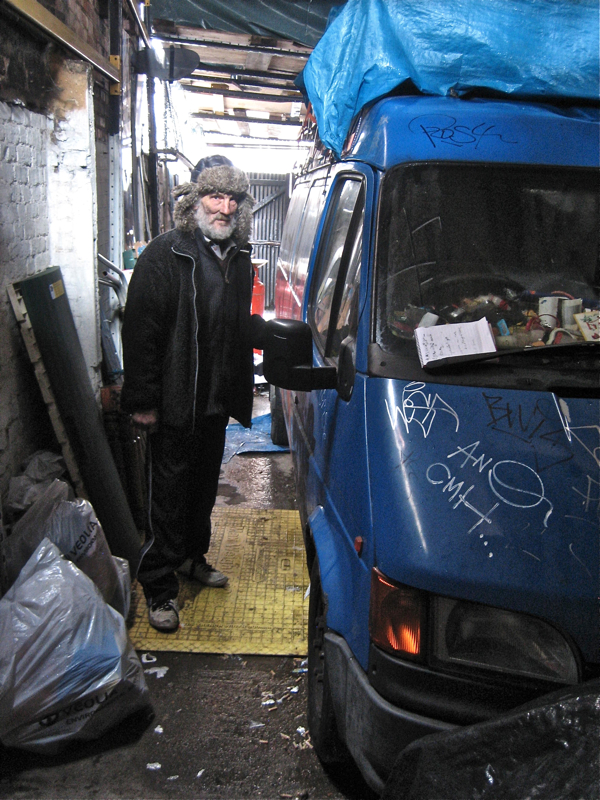
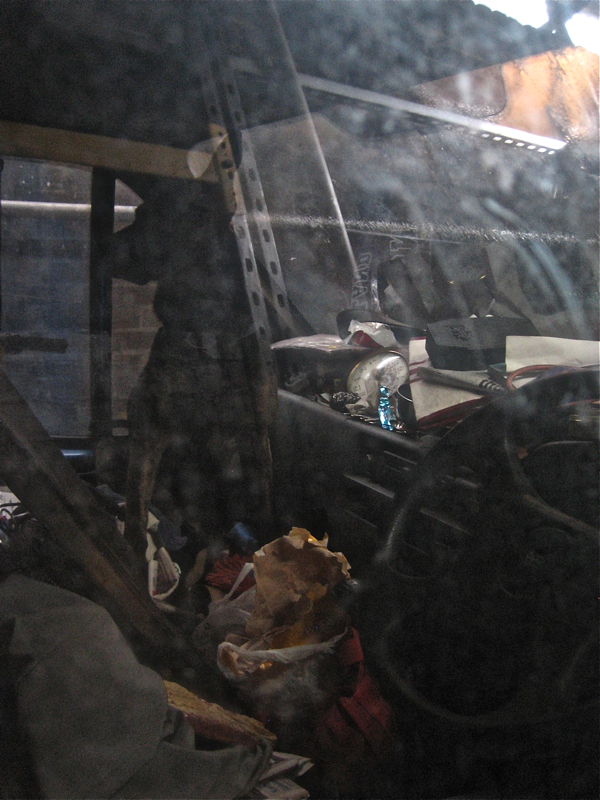
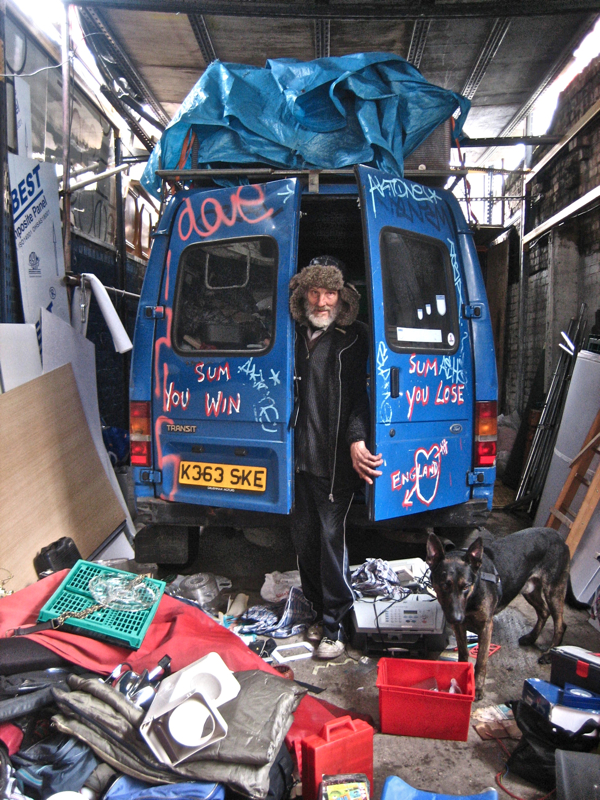
“The best chance you can have is to have nothing.”
Read my first interview with Tom
Favourite Pie & Mash Shops (Part One)

I have grown so skinny these past months at the end of Winter – chasing stories around Spitalfields – that I decided to undertake a tour of my favourite Pie & Mash Shops in the company of Spitalfields Life contributing photographer Sarah Ainslie, in order to explore all the delights on offer and put some meat on my bones into the bargain.
Pie & Mash Shops have a special place in my affections because they are unique to East London and inextricably bound up with the cultural and historical identity of this place – becoming destinations where people enjoy pilgrimages to seek sustenance for body and soul, by paying homage to the spirit of the old East End incarnated in these tiled, steamy temples dedicated to the worship of hot pies. Let me admit, it is a creed I can subscribe to wholeheartedly.
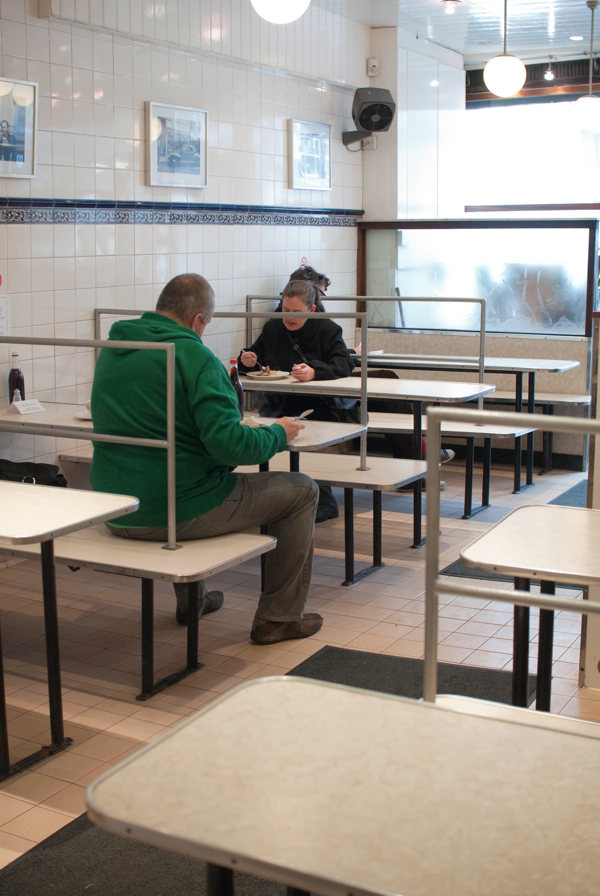
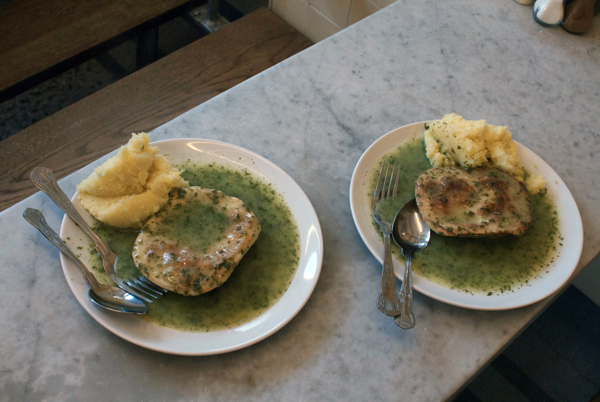
Taking our cue from that golden orb in the sky, Sarah & I decided to commence in the East and work our way West across the territory, beginning with G. Kelly, established since 1937 at 526 Roman Rd. Here we had the privilege to be welcomed by the lovely Sue Venning – resplendent in her white uniform – the proprietor who greets everyone universally with a brisk yet cheery “Yes, Love?” – commonly reciprocated by “Hello, Gorgeous.” It was a delight to walk into this sympathetic, clean and bright interior, adorned with daffodils and lined with marble and tiles, gleaming under the globe lamps.
“My Aunt Theresa on my father’s side married George Kelly who opened this in 1937,” explained Sue, introducing the intricate web of relations that connect this establishment to the two other Pie & Mash Shops by the name of Kelly, all independently run today by increasingly distant relatives as the generations pass by. “Samuel Robert Kelly opened up originally in Bethnal Green in 1915 – he had three sons, Samuel who took over in Bethnal Green, Joe who opened in Bonner St and George who came here to the Roman Rd. My father Bill (George Kelly’s brother-in-law) ran this with my mother Bea, until he died in 1969, and then I took over from her in 1990.” she outlined with a relaxed smile and a practised efficiency that left me reeling.
Arriving with the first customers of the day, I was fascinated to discover that my fellow diners were from Suffolk and Kent, and had gone out of their way to be there. In particular, the couple from East Anglia were up to visit their nan who lived nearby, and Sue confirmed that many of her customers were those who had once moved out of the East End, for whom a return visit to her Pie & Mash Shop was an opportunity to revisit a taste of home. Yet Sue retains a solid constituency in the Roman Rd. “People know each other here,” she confirmed fondly, “You know their orders when they come in, they don’t need to ask.”
We hit the rush at G. Kelly, 414 Bethnal Green Rd, (connected only genealogically to G. Kelly, Roman Rd) where Matt Kelly, proprietor for the last fifteen years, baker and third generation pie man, had his work cut out in the kitchen to meet the lunchtime demand for pie and mash and liquor at £2.65. Diners here eat off elegant cast iron tables beneath framed portraits of local boxing heroes of yesteryear and everyone is at home in one of this neighbourhood’s cosiest destinations.
At the head of the lunch queue was Mrs Julia Richards. “I’m going to be ninety-eight,” she bragged with a winsome grin, the picture of exuberance and vitality as she carried off her plate of pie and mash hungrily to her favourite corner table, pursued by her sprightly seventy-year-old daughter Patricia – both superlative living exemplars for the sustaining qualities of traditional East End meat pies. “I’ve been coming here over fifty years,” revealed Patricia proudly. “I’ve been coming here since before it opened!” teased Julia, her eyes shining with excitement as she cut into her steaming meat pie.“They used to have live eels outside in a bucket,” she continued, enraptured by memory, “And you could pick which one you wanted to eat.” We left them absorbed in their pies, the very epitome of human contentment, beneath a hand-lettered advertising placard, proclaiming “Kelly for Jelly.”
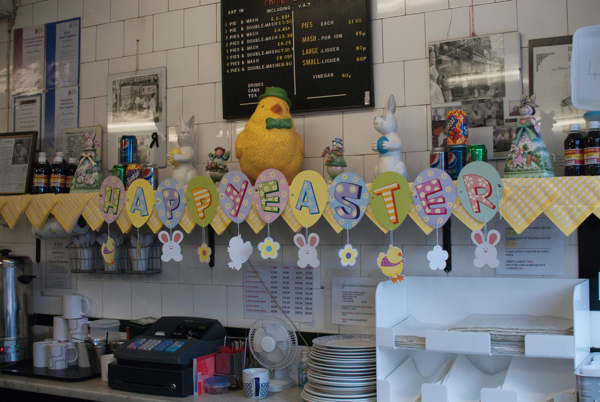
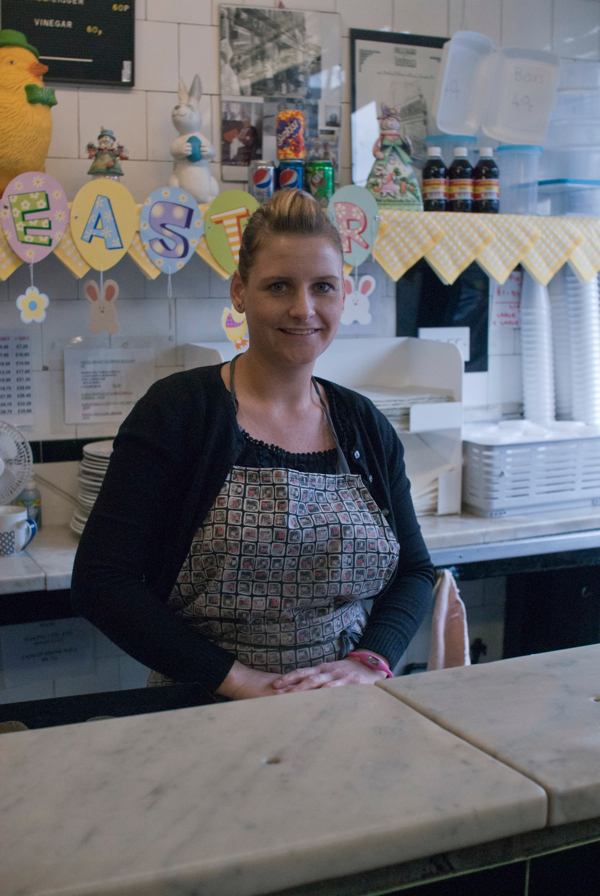
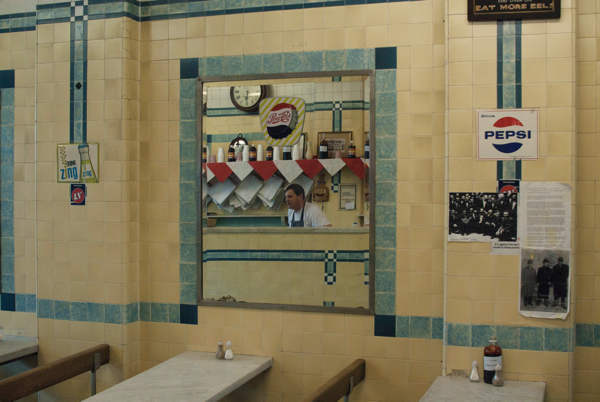
Up at F.Cooke in Broadway Market, once we had emptied our plates of some outstandingly delicious pies, Sarah & I enjoyed a quiet after-lunch cup of tea with the genial Robert Cooke – “Cooke by name cook by nature” – whose great-grandfather Robert Cooke opened a Pie & Mash Shop at the corner of Brick Lane and Sclater St in 1862. “My father taught me how to make pies and his father taught him. We haven’t changed the ingredients and they are made fresh every day,” explained Robert plainly, a fourth generation born-piemaker sitting proudly in his immaculately preserved cafe, that offers the rare chance to savour the food of more than century ago.
“My grandfather Robert opened this shop in 1900, then he left to open another in the Kingsland Rd, Dalston in 1910 and Aunty May ran this one until 1940, when they shut it after a doodlebug hit the canal bridge.” he recounted. “My mother Mary came over from Ireland in 1934 and worked with my grandfather in Dalston, alongside my father Robert and Uncle Fred. And after they got married in 1947, my grandfather said to my parents, ‘Here’s the keys, open it up,’ and they returned here to Broadway Market, where I was born in 1948.”
It was a tale as satisfying in its completeness as eating a pie, emphasising how this particular cuisine and these glorious shops are interwoven with the family histories of those who have run them and eaten at them for generations. Yet beyond the rich poetry of its cultural origin, this is good-value wholesome food for everyone, freshly cooked without additives, and meat pies, vegetable pies, fruit pies and jellied eels comprise a menu to suit all tastes. Reluctantly, after three Pie & Mash Shops in one day, Sarah & I were finished – but even as we succumbed to the somnolence induced by our intake of pies, we took consolation in dreamy thoughts of all those pleasures that await us in the other Pie & Mash Shops of the East End, yet to come.
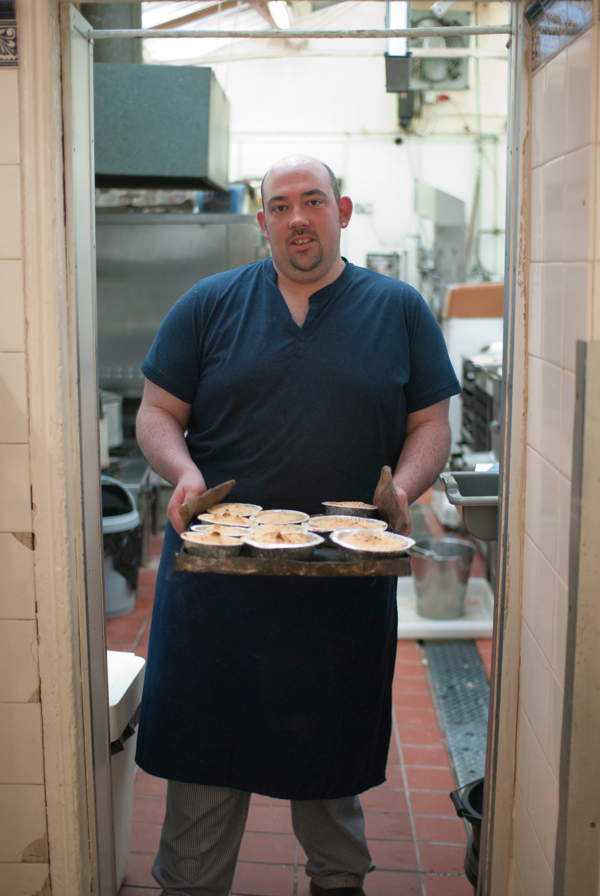
This is Dean Cecil who bakes the pies at G.Kelly in the Roman Rd.
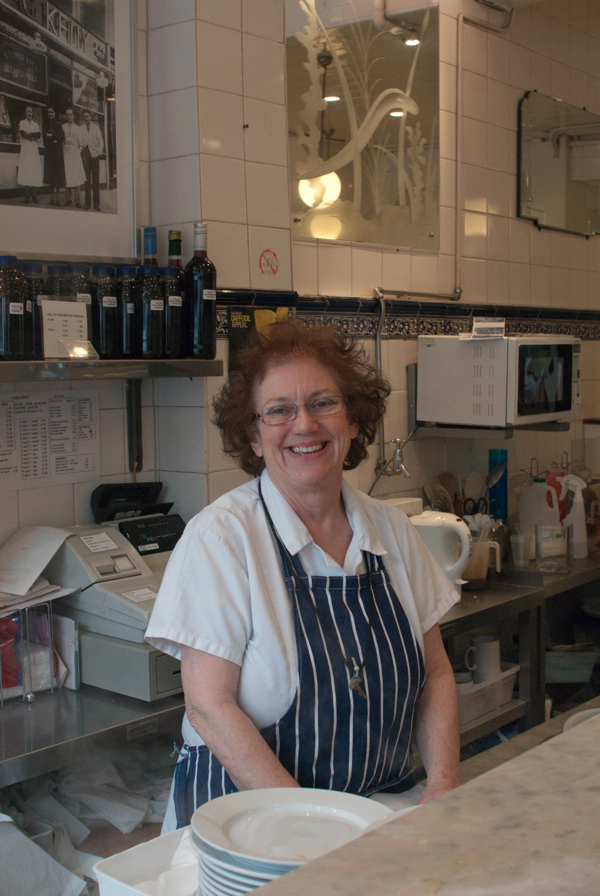
Sue Venning at G.Kelly, Roman Rd – her Aunt Theresa, who married George Kelly, is the woman in the dark coat, pictured in the black and white photo, standing outside the shop in 1937.
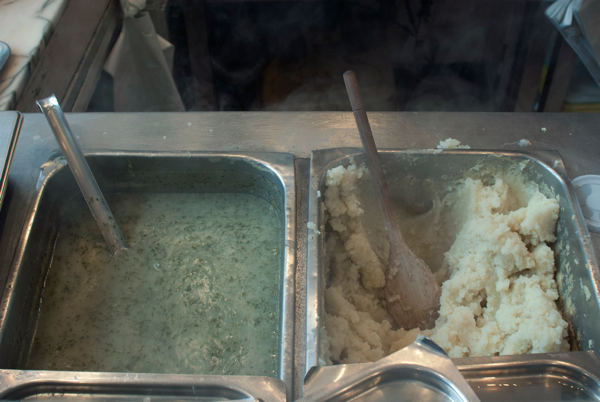
Liquor (Parsley sauce) and mash at G.Kelly
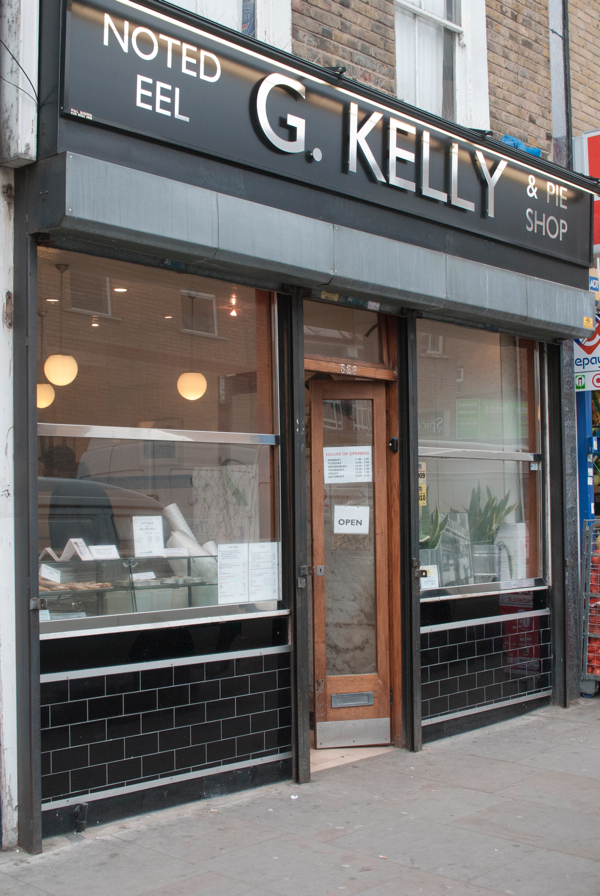
G.Kelly, 526 Roman Rd.
At G.Kelly, Bethnal Green


The prizefighters of yesteryear fondly remembered in the Pie & Mash Shop in Bethnal Green.
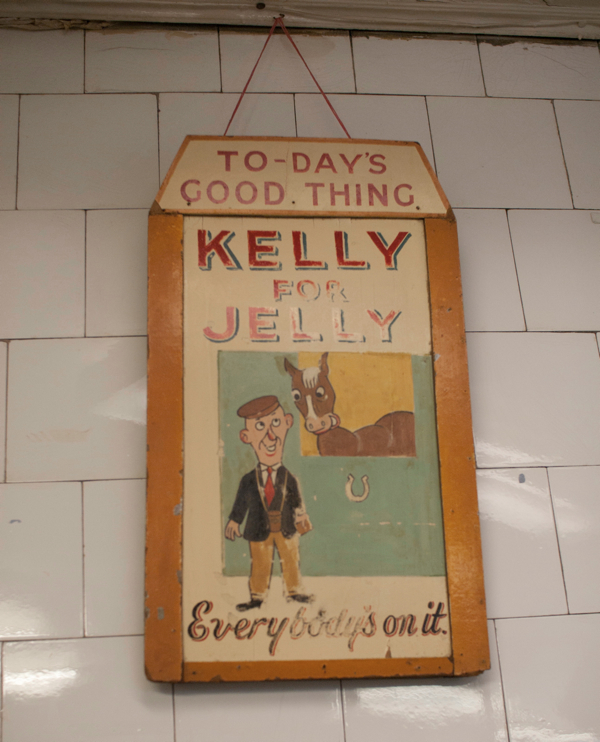

Julia Richards, nearly ninety-eight – “They used to have live eels outside and you could pick your own.”
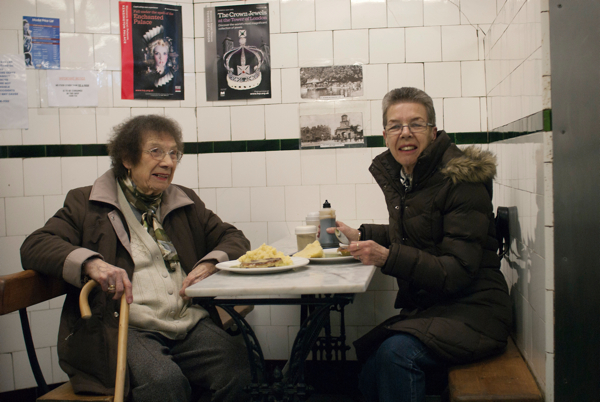
Regulars, Julia Richards and her sprightly daughter Patricia Wootton aged seventy, at the favoured corner table at G.Kelly, Bethnal Green.

G.Kelly, 414 Bethnal Green Rd

Jellied Eels at F.Cooke
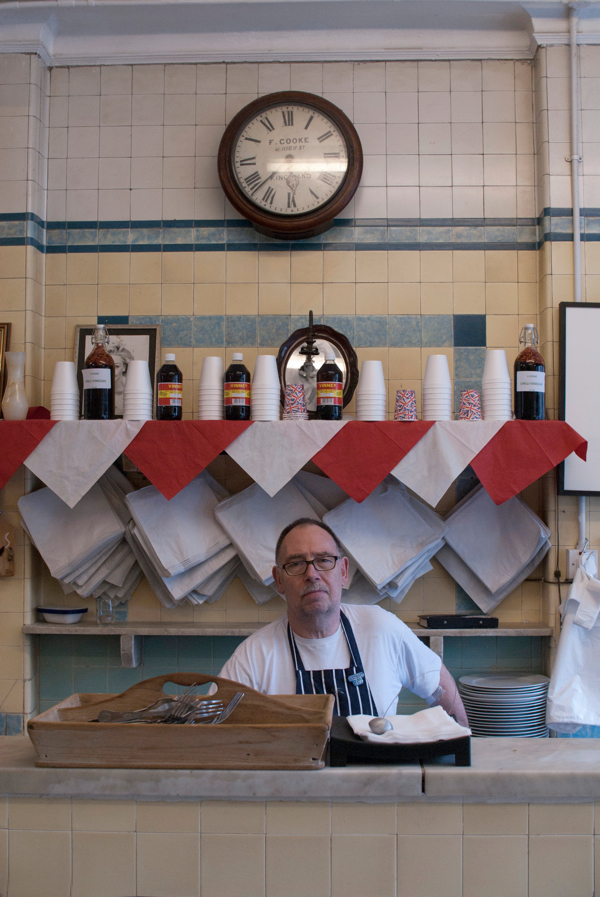
Robert Cooke under the clock commissioned by his grandfather Robert Cooke from a clockmaker in Hackney in 1911.
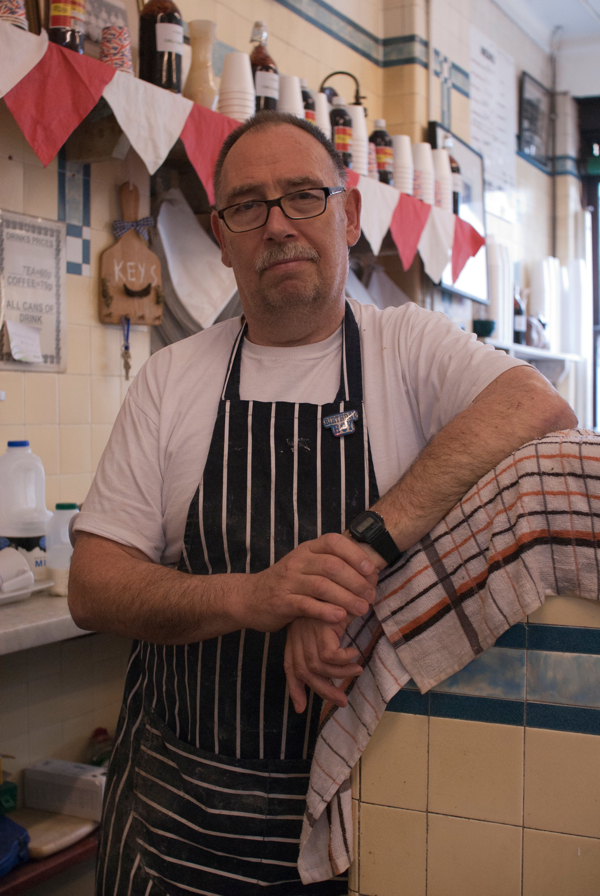
Robert Cooke, fourth generation pie-maker -“Cooke by name, cook by nature.”

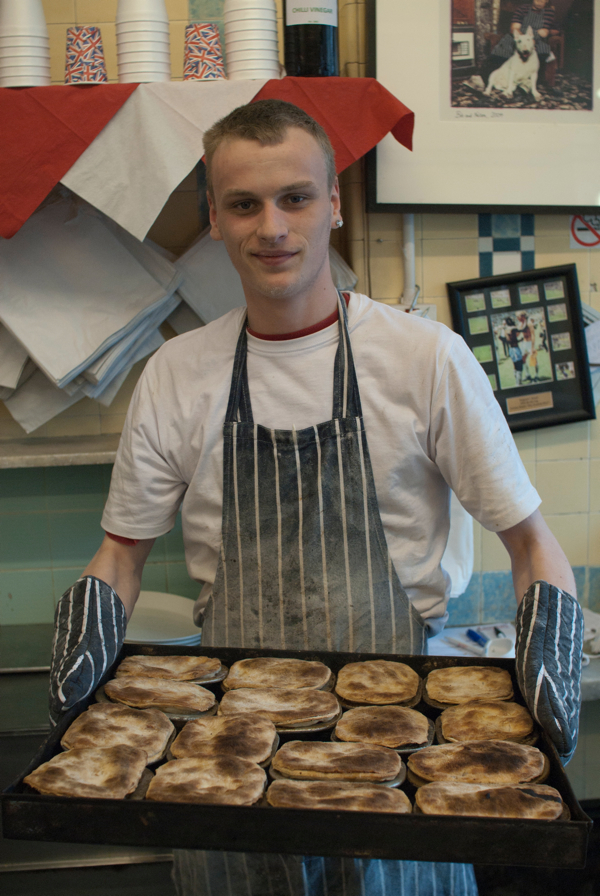
Pat with a tray of pies at Broadway Market
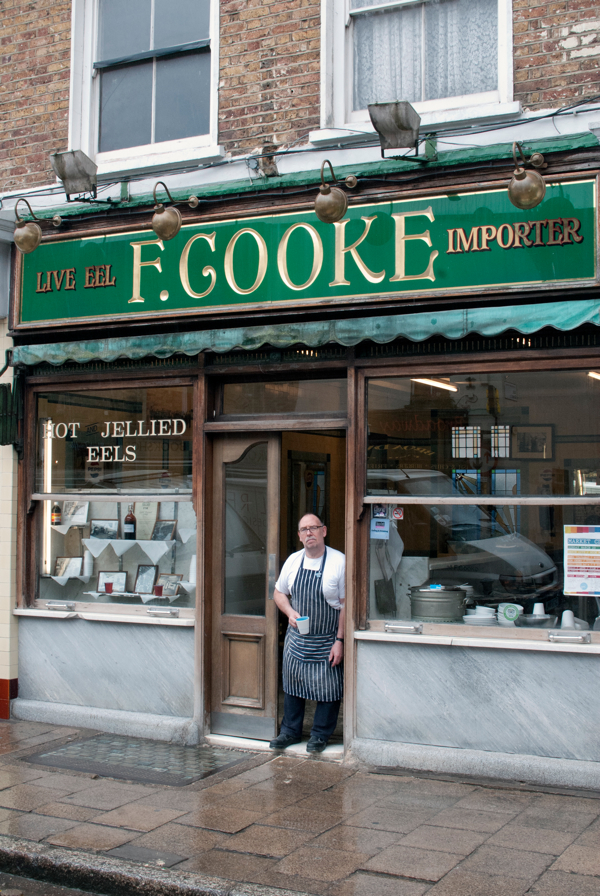
F.Cooke, 9 Broadway Market, since 1900.
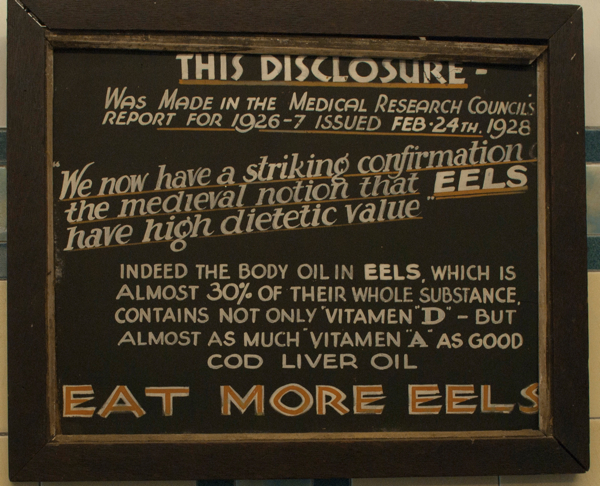
Photographs copyright © Sarah Ainslie
The Bread, Cake & Biscuit Walk

This biscuit was sent home in the mail during World War I
As you will know from my many stories about doughnuts, custard tarts, hot cross buns, mince pies, beigels and loaves of bread, I have a passion for all the good things that come from the bakery. So I decided to take advantage of the fine afternoon yesterday to take a walk through the City of London in search of some historic bakery products to feed my obsession, and thereby extend my appreciation of the poetry and significance of this sometimes undervalued area of human endeavour.
Leaving Spitalfields, I turned left and walked straight down Bishopsgate to the river, passing Pudding Lane where the Fire of London started at the King’s Bakery, reminding me that a bakery was instrumental in the very creation of the City we know today.
My destination was the noble church of St Magnus the Martyr, which boasts London’s stalest loaves of bread. Stored upon high shelves beyond the reach of vermin, beside the West door, these loaves were once placed here each Saturday for the sustenance of the poor and distributed after the service on Sunday morning. Although in the forgiving gloom of the porch it is not immediately apparent, these particular specimens have been there so many years they are now mere emblems of this bygone charitable endeavour. Surpassing any conceivable shelf life, these crusty bloomers are consumed by mould and covered with a thick layer of dust – indigestible in reality, they are metaphors of God’s bounty that would cause any shortsighted, light-fingered passing hobo to gag.
Close by in this appealingly shadowy incense-filled Wren church which was once upon the approach to London Bridge, are the tall black boards tabulating the donors who gave their legacies for bread throughout the centuries, commencing in 1674 with Owen Waller. If you are a connoisseur of the melancholy and the forgotten, this a good place to come on a mid-week afternoon to linger and admire the shrine of St Magnus with his fearsome horned helmet and fully rigged model sailing ship – once you have inspected the bread, of course.
I walked West along the river until I came to St Bride’s Church off Fleet St, as the next destination on my bakery products tour. Another Wren church, this possesses a tiered spire that became the inspiration for the universally familiar wedding cake design in the eighteenth century, after Fleet St baker William Rich created a three-tiered cake based upon the great architect’s design, for his daughter’s marriage. Dedicated today to printers and those who work in the former print trades, this is a church of manifold wonders including the pavement of Roman London in the crypt, an iron anti-resurrectionist coffin of 1820 – and most touching of all, an altar dedicated to journalists killed recently whilst pursuing their work in dangerous places around the globe.
From here, I walked up to St John’s Gate where a biscuit is preserved that was sent home from the trenches in World War I by Henry Charles Barefield. Surrounded by the priceless treasures of the Knights of St John magnificently displayed in the new museum, this old dry biscuit has become an object of universal fascination both for its longevity and its ability to survive the rigours of the mail. Even the Queen wanted to know why the owner had sent his biscuit home in the post, when she came to open the museum. But no-one knows for sure, and this enigma is the source of the power of this surreal biscuit.
Pamela Willis, curator of the collection, speculates it was a comment on the quality of the rations – “Our biscuits are so hard we can send them home in the mail!” Yet while I credit Pamela’s notion, I find the biscuit both humorous and defiant, and I have my own theory of a different nuance. In the midst of the carnage of the Somme, Henry Barefield was lost for words – so he sent a biscuit home in the mail to prove he was still alive and had not lost his sense of humour either.
We do not know if he sent it to his mother or his wife, but I think we can be assured that it was an emotional moment for Mrs Barefield when the biscuit came through her letterbox – to my mind, this an heroic biscuit, a triumphant symbol of the human spirit, that manifests the comfort of modest necessity in the face of the horror of war.
I had a memorable afternoon filled with thoughts of bread, cake and biscuits, and their potential meanings and histories which span all areas of human experience. And unsurprisingly, as I came back through Spitalfields, I found that my walk had left me more than a little hungry. After several hours contemplating baked goods, it was only natural that I should seek out a cake for my tea, and in St John Bread & Wine, to my delight, there was one fresh Eccles Cake left on the plate waiting for me to carry it away.
You can watch a film about a cake made to replicate the spire of St Bride’s Church by clicking here.
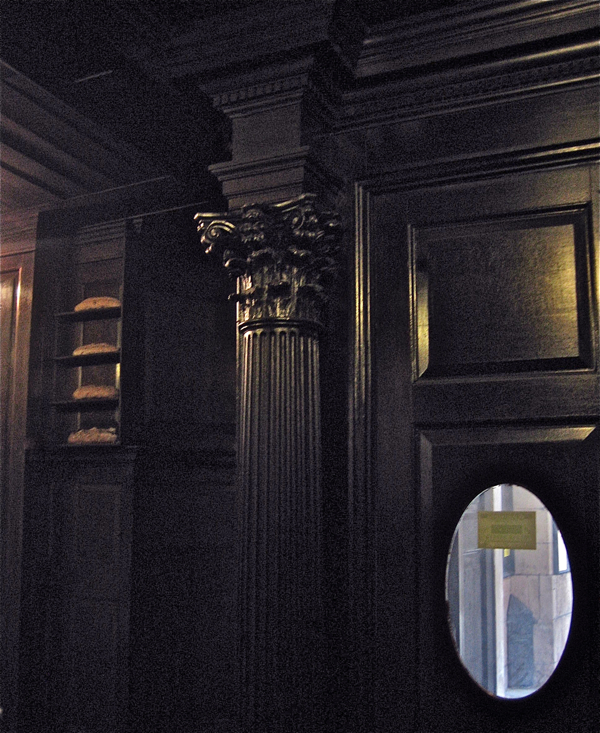
Loaves of bread at St Magnus the Martyr.
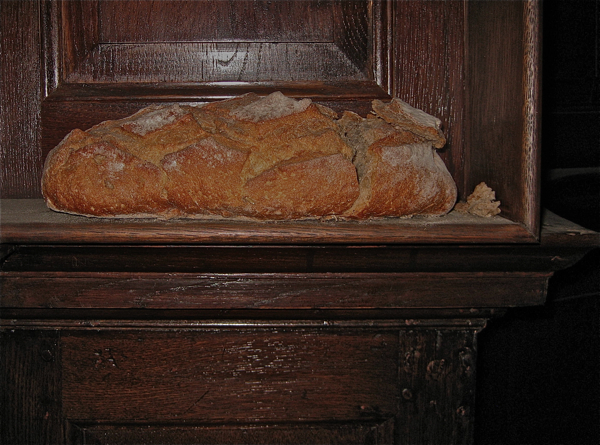
Is this London’s stalest loaf?
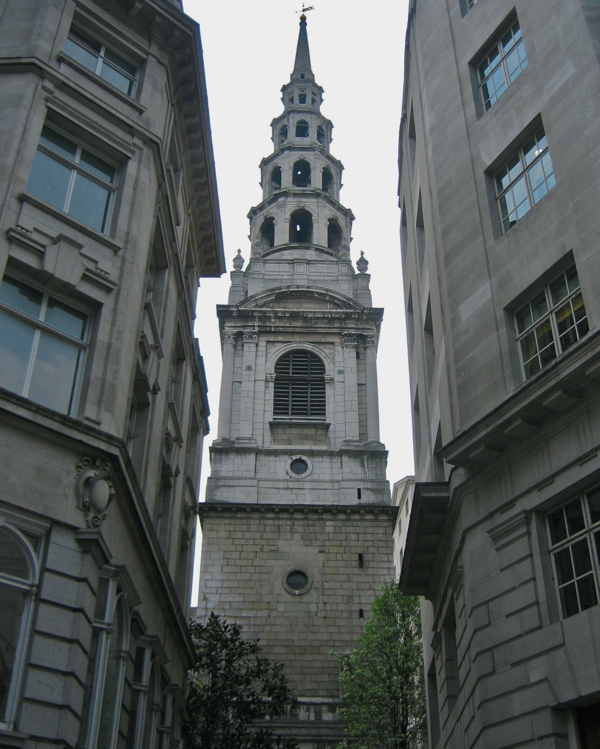
The spire of Wren’s church of St Bride’s which was the inspiration for the tiered design of the wedding cake first baked by Fleet St baker William Rich in the eighteenth century.
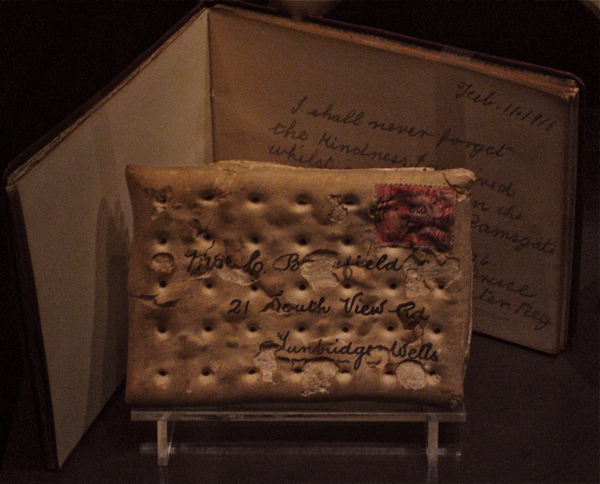
The biscuit in the museum in Clerkenwell.
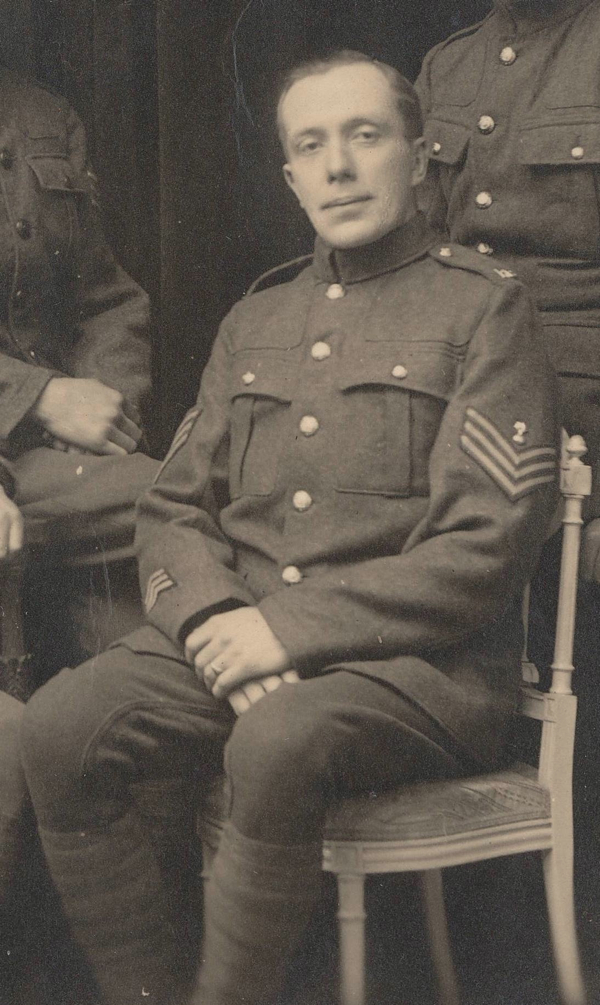
The inscrutable Henry Charles Barefield of Tunbridge Wells who sent his biscuit home in the mail during World War I.

The freshly baked Eccles Cake that I ate for my tea.
You may like to read these other bakery related stories
The Tart with the Heart of Custard
The First Mince Pies of the Season
Justin Piers Gallatly, Baker & Pastry Chef
Night in the Bakery at St John
Night in the Brick Lane Beigel Bakery
All Change at 15 & 17 Fournier St
Over the last year, I have enjoyed dropping in regularly to fifteen and seventeen Fournier St to visit Jim Howett and observe the progress of the mighty works that have been undertaken there by the Spitalfields Historic Buildings Trust to reinstate these two gracious houses built by joiner William Taylor in 1726 – which were carved up to become a Mission House for the conversion of Jews to Christianity in 1878.
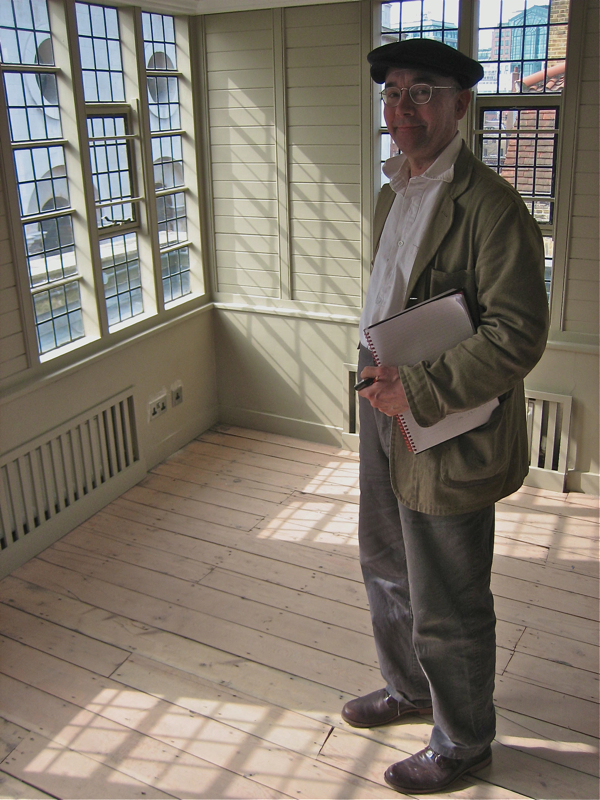
Jim and I always end up chatting in the attic room of number fifteen, lined with leaded casements, offering mind-boggling views to Nicholas Hawskmoor’s Christ Church, Spitalfields opposite, and where, over our heads, old notches in the beams reveal where the looms for silk weaving were once attached. Since the endeavour reaches completion this week, as foreman and architect, Jim was able to savour the moment up there in his light-filled eyrie above the rooftops, and look back upon a remarkable job achieved in partnership with Tim Whittaker, Director of the Spitalfields Trust.
“This is the last structural Georgian reconstruction that is going to happen in Spitalfields,” admitted Jim, with a tinge of disappointment in his softly spoken voice, because although these houses have posed an extraordinary exercise in deduction, it has been one that he has relished. With evangelic fervour, Christ’s Mission to the Jews tore the staircase out of the corner house, took out the walls on the ground floor to create a gospel hall and punched doorways between the two buildings to make them one – while subsequent factory usage and then a carve-up into flats in the nineteen eighties ravaged the buildings still further. “This reconstruction sets it back with a footprint as it was intended,” explained Jim, casting his eyes around the empty rooms in pleasure at the freshly sanded floors, new panelling, windows, shutters and doors made by joiner Aaron McGill. all connected by the tour-de-force of this entire project – the new staircase winding up through four storeys fitted by carpenter Pauol Cierny, constructed in the eighteenth century method, and to the design of William Taylor.
Entering the house this week was a rare engagement with time travel, to visit a newly constructed eighteenth century interior where the sawdust was still fresh and history waiting to happen. But when I first came here last Spring, Jim took me down into the cellar where excavations revealed remains of the dwelling that previously existed upon this site. Beneath the cellar floor was the ground level of a seventeenth century courtyard with a stone culvert that discharged water towards Lolesworth Field, gone centuries ago. Among the debris beneath the floor, Jim found quantities of charcoal confirming his belief that the land from here to Bethnal Green was back-filled with rubble from the Fire of London, raising the ground level by as much as two metres and burying a seventeenth century path below the cellar floor of an eighteenth century house. Ascending from the gaping muddy chasm of the cellar, the house was in disorder, doorways were being bricked up and holes cut in the floor. It was a composite of discordant spaces connected by eccentric arrangements that required you to walk into number seventeen to reach the top floors of number fifteen and go downstairs in number fifteen to reach the cellar of number seventeen – where the long-suffering residents endured living beneath a daily-accumulating layer of builder’s dust.
Yet I discovered a exhilarating transformation when I came back months later as the staircase was being fitted in number fifteen, spiralling up through the centre of the structure and restoring its spine. Unlike modern stairs in which the treads are supported on either side, the staircases of the eighteenth century were built one step on top of the next, supported by a central ascending beam – much more sturdy, as well as accommodating to the irregularities of an old building. When Jim first showed me his cherished staircase, it was not all there – you walked up and up, and then it ran out … But when I next returned, I was greeted with the triumphant news that the stairs had reached the roof and miraculously met the marks in the joists on the top floor where the original staircase had sat.
The sculptural quality of this fine staircase, adorned with spindles turned by Aaron McGill and barley sugar twists courtesy of Nichols Brother (established over a hundred years in the Hackney Rd), brings the building alive with dynamic energy. It takes you on a journey through differently proportioned spaces, all neatly panelled and flooded with light, to arrive at the lantern at the top. The layout of the rooms has been recreated and while there is a scrupulous attention to detail in all the work, idiosyncrasy is restrained – throwing emphasis upon the graceful flow of architectural space. Most importantly, the institutionalisation and its subsequent chaos is gone, humanity has been restored in the recovery of the sympathetic yet relatively modest domestic spaces which comprise this unusual corner house.
“I think we got the best out of all these people – there’s never been an argument, because everyone’s worked to their strengths” confided Jim quietly, almost speaking to himself in admitting his responsibility to his team. And realising that his own time to inhabit these houses, which have been his consuming passion since October 2009, is now at end, he added, “I’ll miss it.” Jim and I left the weavers’ attic glowing with sunlight and walked down through the empty panelled rooms, where the finishing touches were being made before everyone left.
Now the residents of number seventeen can finally hoover up the dust and the household spirits of number fifteen can experience a moment of peace, renewed and waiting, until the next wave of inhabitants arrive and time can begin all over again.
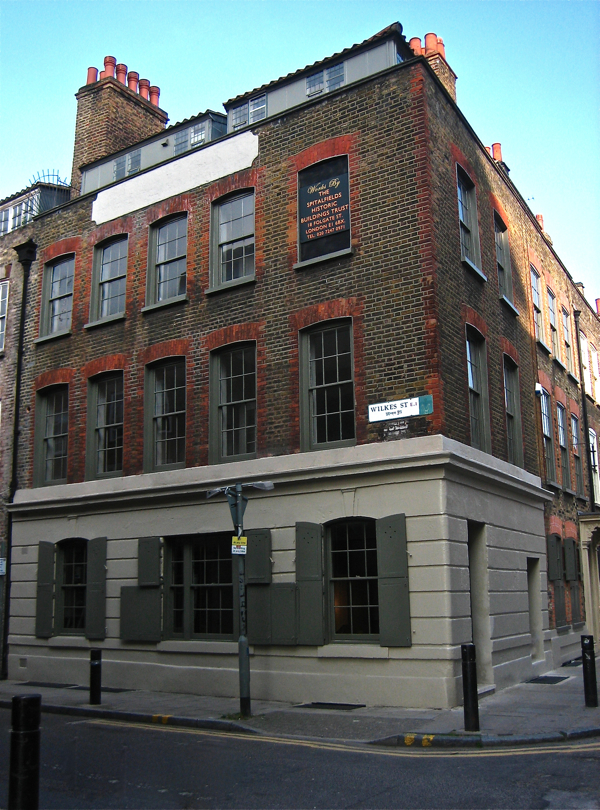
15 & 17 Fournier St restored.
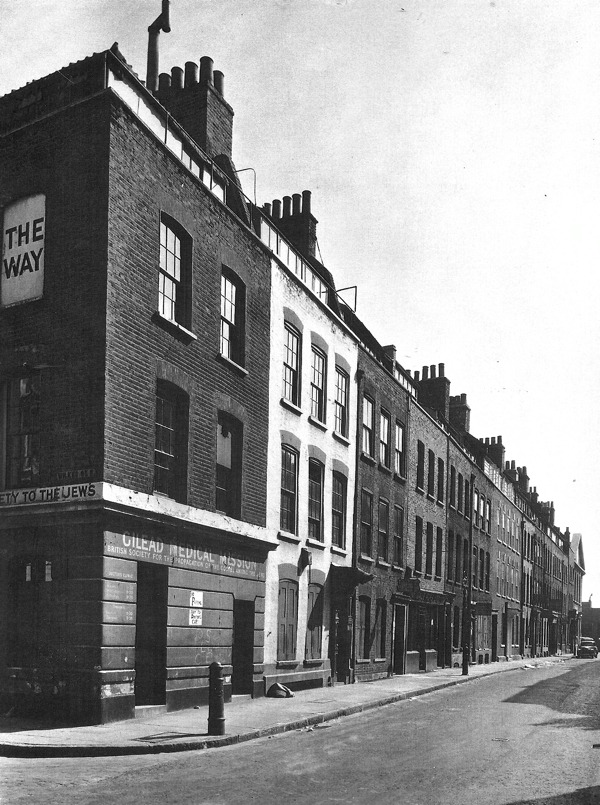
As the Mission of Christianity to the Jews until 1947.
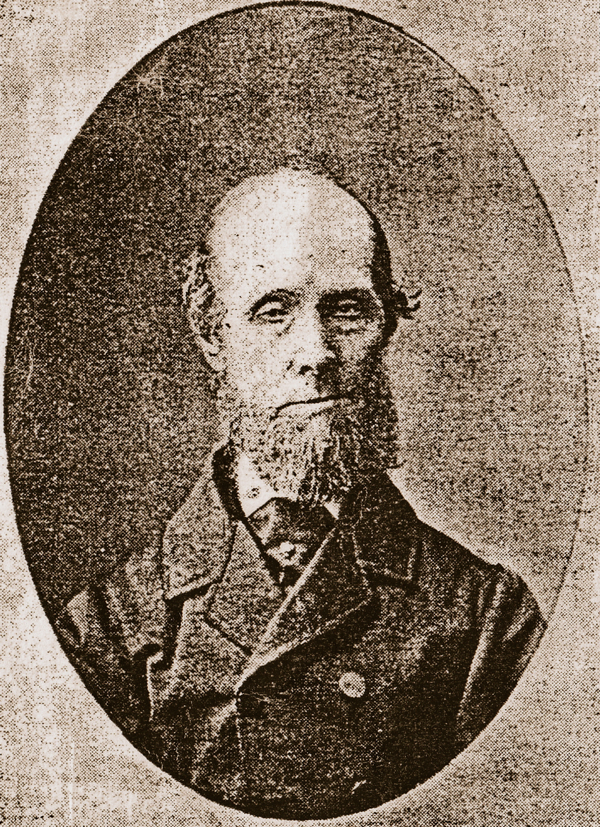
W.P. The Donor – he paid for the purchase of fifteen and seventeen to become a mission house in 1878.
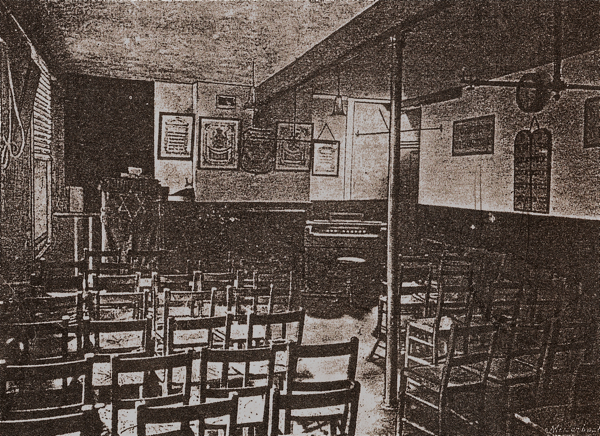
The interior of the mission hall occupying the ground floor of number fifteen.
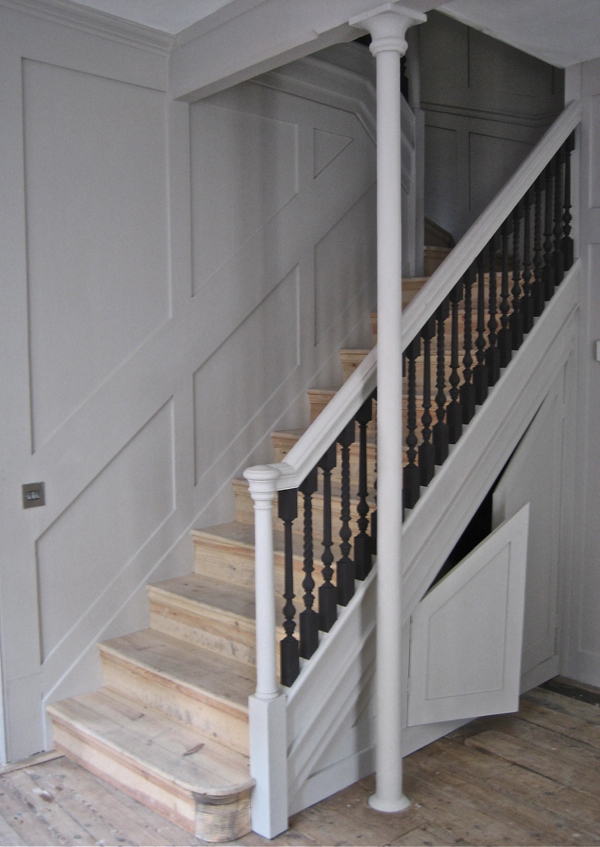
The new staircase at number fifteen constructed according to the method and design of William Taylor, the joiner who built these houses in 1726.
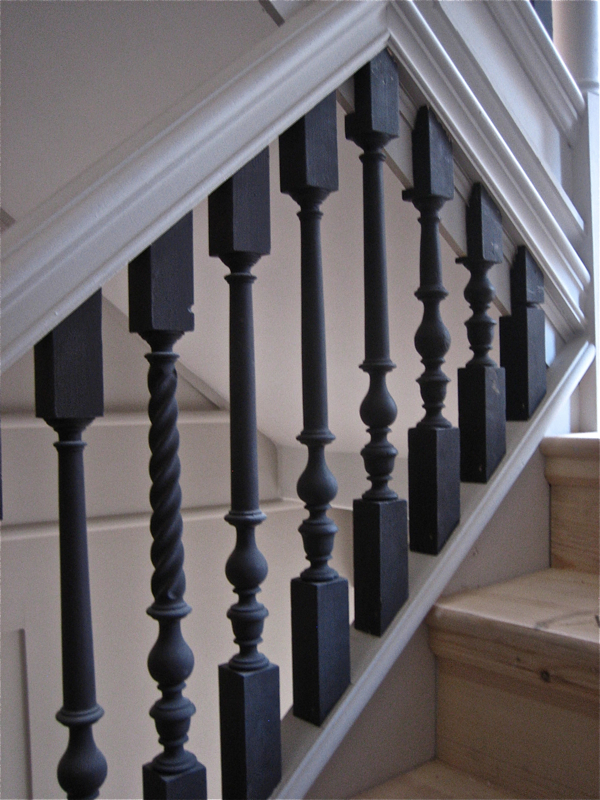
Detail of the spindles.
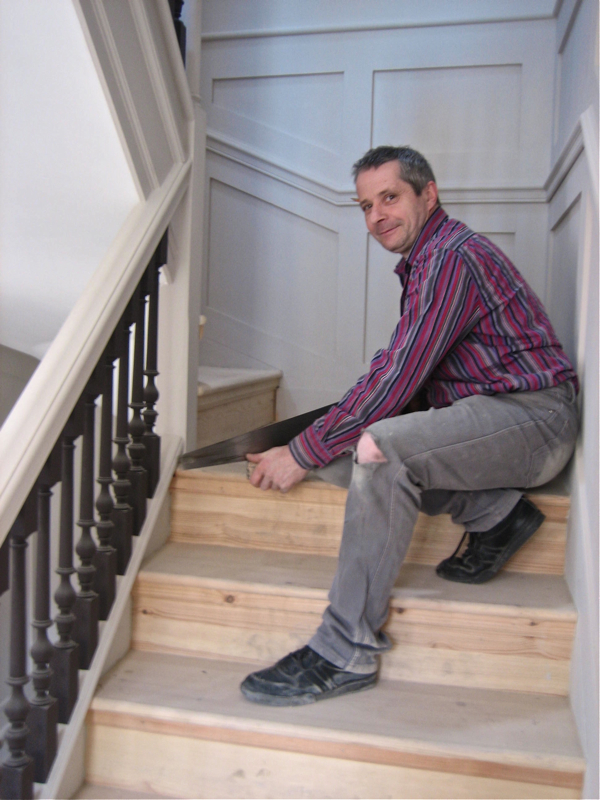
Pauol Cierny, from Slovakia, the Head Carpenter who built the staircase.
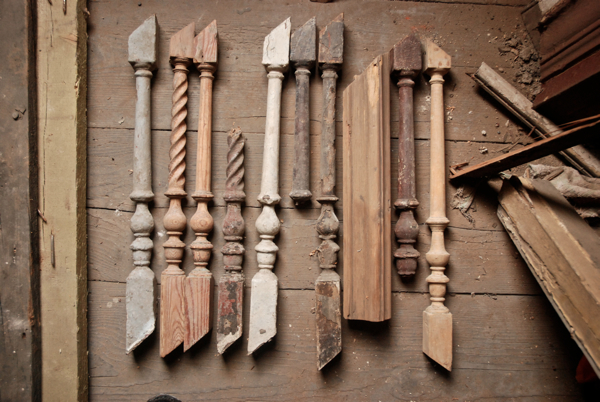
Surviving spindles from adjoining houses by William Taylor, used as patterns for creating new.

Aaron McGill, the Head Joiner, in his workshop where he made the windows, shutters and doors.
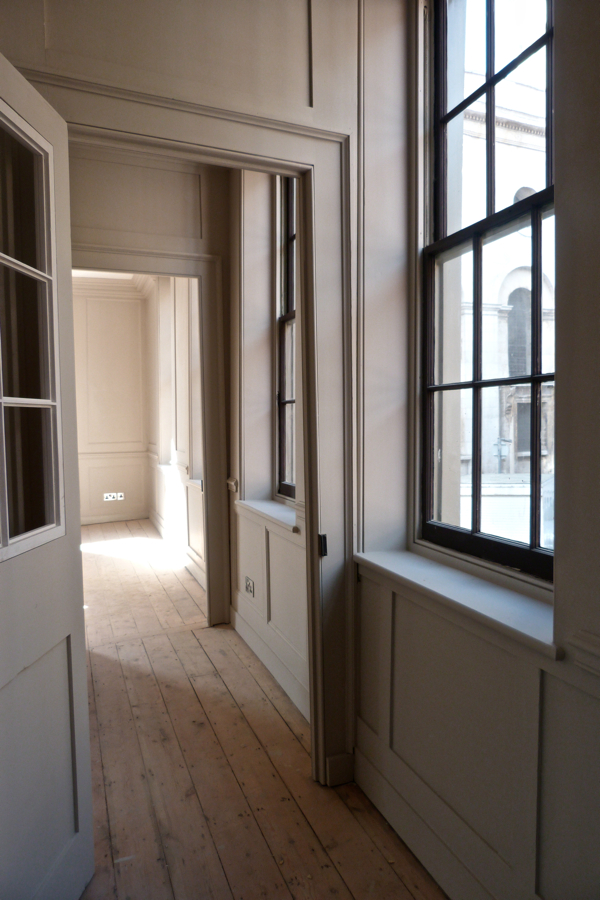
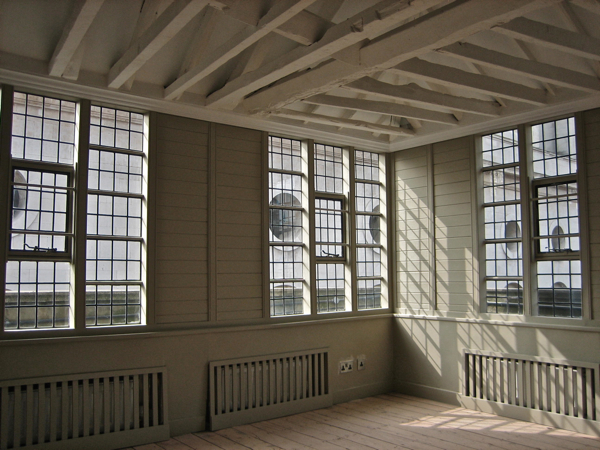
The Weavers’ loft overlooking Christ Church, Spitalfields. Notches in the beams indicate where looms were attached.
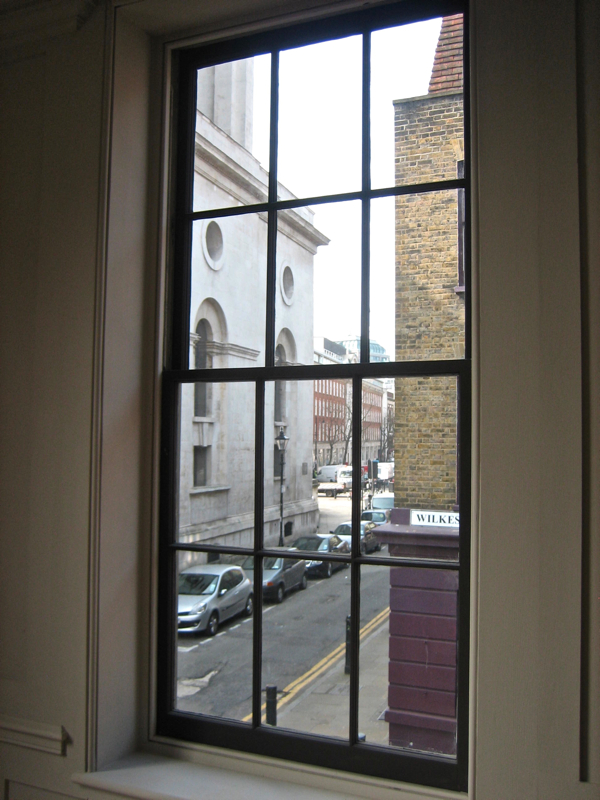

Petro Leanca, Carpenter from Moldova, who has worked on the house for the past six months, doing floorboards, doors and wall carpentry.
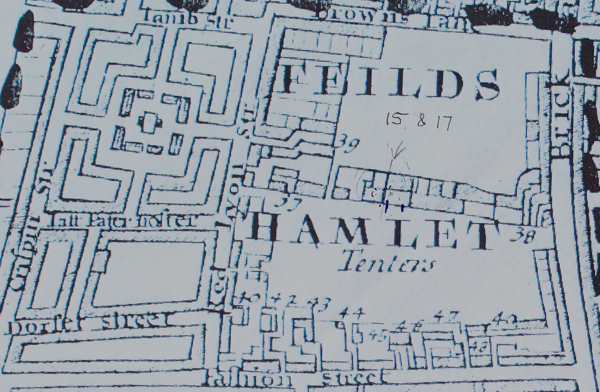
The previous property on the site is marked upon the Gascoigne map of Spitalfields from 1700 – above the “L” of hamlet.
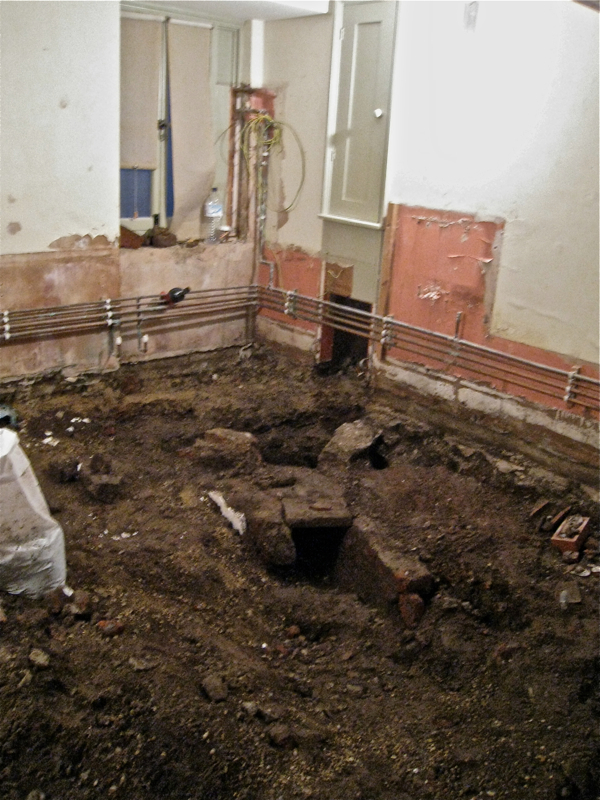
In the cellar of number fifteen, two metres below current ground level, the sixteenth century culvert in the yard of an earlier building.
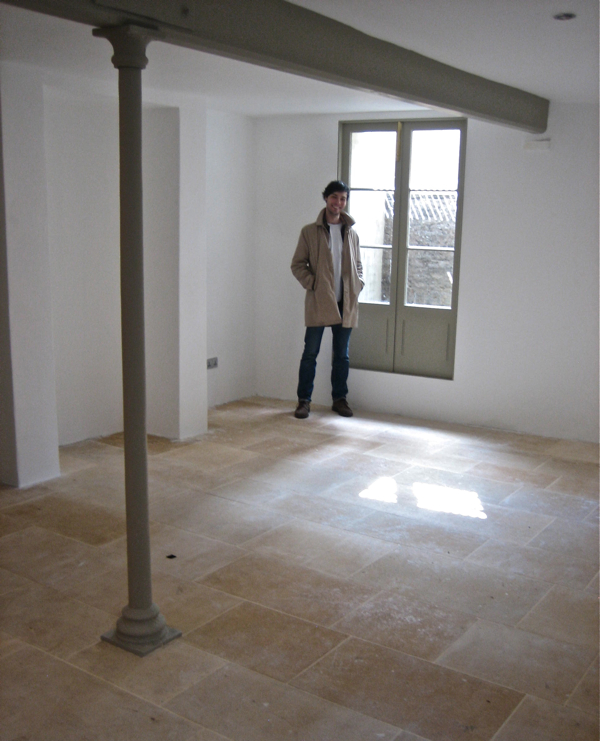
Rob Stroud in the finished basement where he and Hamish Lancaster spent most of the last year digging out the floor by several feet – “We’re well proud of this now.”
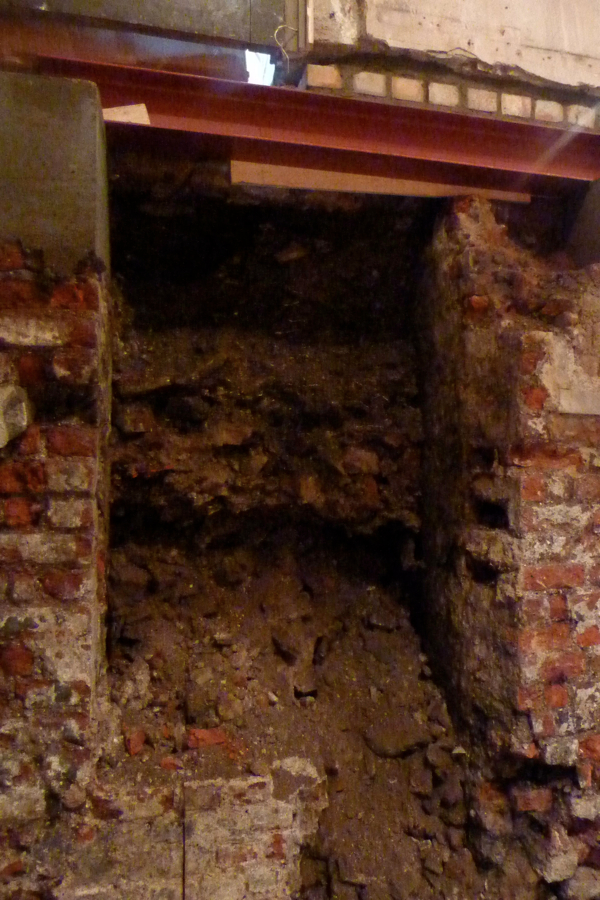
This is the light well in the picture up above – that Jim Howett discovered blocked with debris when he excavated to create a light well where one was necessary.
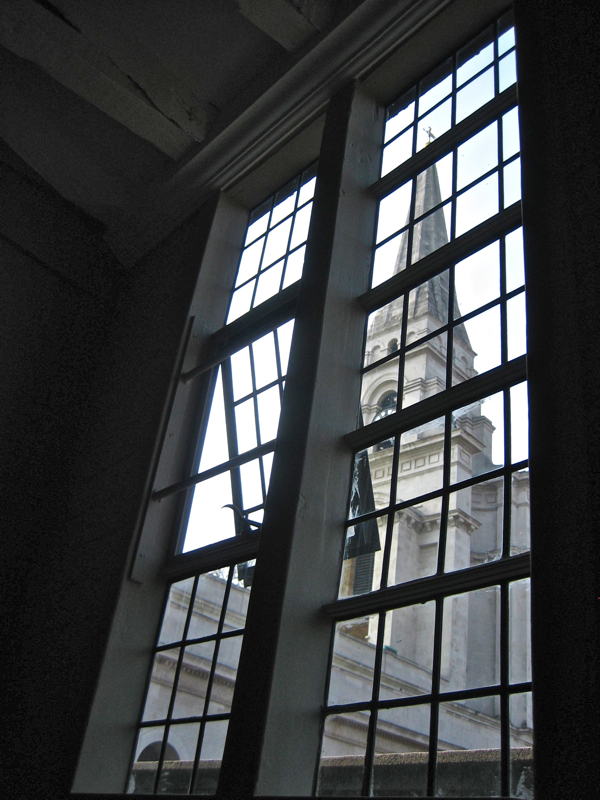
Looking up to Nicholas Hawksmoor’s spire, looming overhead.
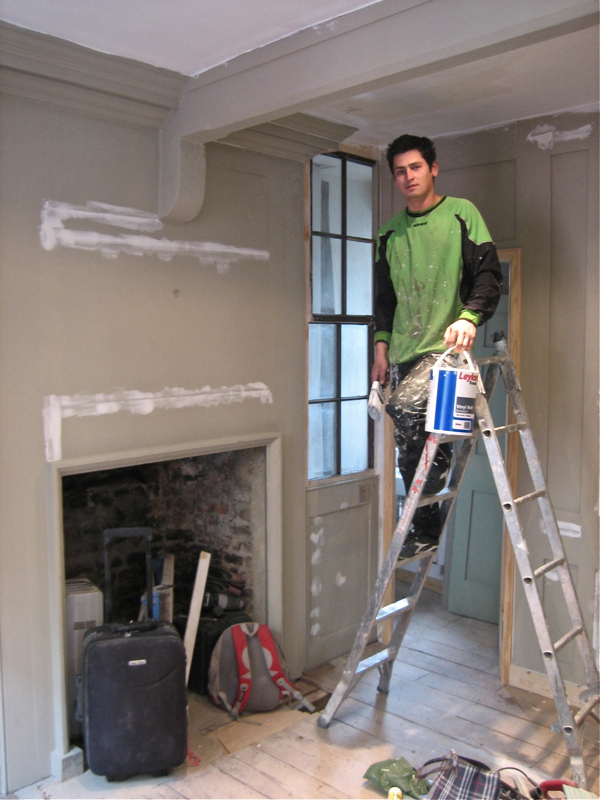
Painter, Daniel Costea, arrived from Timisoara, Romania three weeks ago.
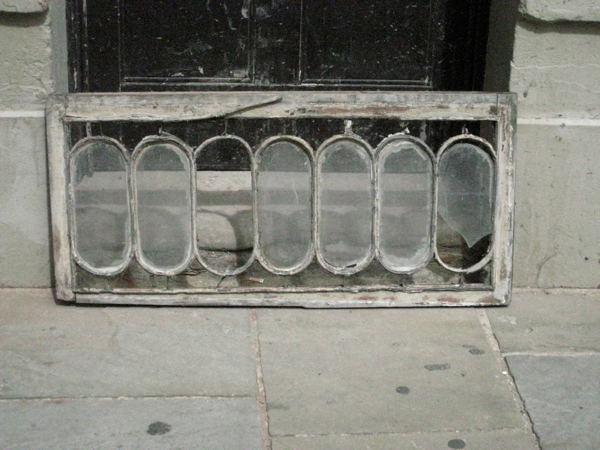
A fanlight discarded from another house in Fournier St.
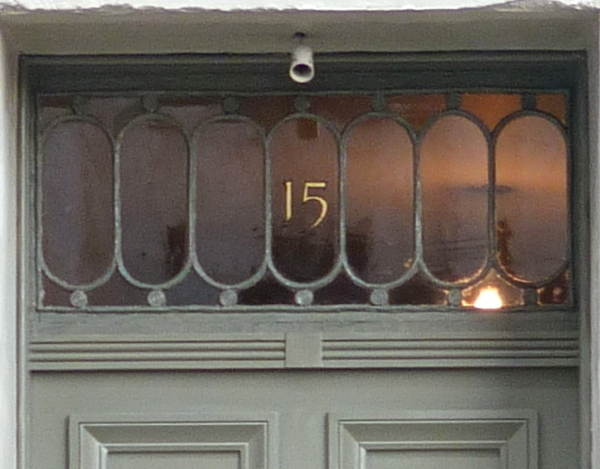
The fanlight installed.
You may also like to read about
John Thomson’s Street Life in London

In Brick Lane these days, almost everyone carries a camera to capture the street life, whether traders, buskers, street art or hipsters parading fancy outfits. At every corner in Spitalfields, people are snapping. Casual shutterbugs and professional photoshoots abound in a phantasmagoric frenzy of photographic activity.
It all began with photographer John Thomson in 1876 with his monthly magazine Street Life in London, publishing his pictures accompanied by pen portraits by Adolphe Smith as an early attempt to use photojournalism to record the lives of common people. I like to go into the Bishopsgate Institute and contemplate the set of Thomson’s lucid pictures preserved in the archive there – both as an antidote to the surfeit of contemporary imagery, and to grant me a perspective on how the street life of London and its photographic manifestation has changed in the intervening years.
For centuries, this subject had been the preserve of popular prints of the Cries of London and, in his photography, Thomson adopted compositions and content that had become familiar archetypes in this tradition – like the chairmender, the sweep and the strawberry seller. Yet although Thomson composed his photographs to create picturesque images, in many cases the subjects themselves take possession of the pictures through the quality of their human presence, aided by Adolphe Smith’s astute texts underlining the harsh social reality of their existence.
When I look at these vital pictures, I am always startled by the power of the gaze of those who look straight at the lens and connect with us directly, while there is a plangent sadness to those with eyes cast down in subservience, holding an internal focus and lost in time. The instant can be one of frozen enactment, like the billboard men above, demonstrating what they do for the camera, but more interesting to me are the equivocal moments, like the dealer in fancy ware, the porters at Covent Garden and the strawberry seller, where there is human exposure. There is an unresolved tension in these pictures and, even as the camera records a moment of hiatus, we know it is an interruption before a drama resumes – the lost life of more than one hundred and thirty years ago.
The paradoxical achievement of these early street photographs is they convey a sense that the city eludes the camera, because either we are witnessing a tableau that has been composed or there is simply too much activity to be crammed into the frame. As a consequence it is sometimes the “wild” elements beyond the control of the photographer which render these pictures so fascinating – the restless children and disinterested bystanders, among others.
I long to go beyond the bounds of these photographs, both in time and space. And reading Adolphe Smith’s pen portraits, I want to know all these people, because in their photographs they appear monumental in their dignified stillness – as if their phlegmatic attitudes manifest a strength of character and stoicism in the face of a life of hard work.
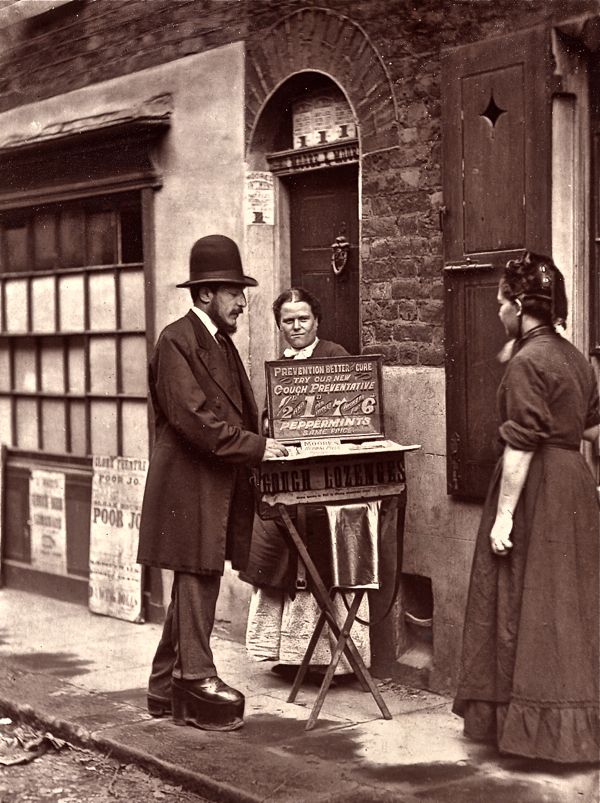
Street Doctor – “vendors of pills, potions and quack nostrums are not quite so numerous as they were in former days. The increasing number of free hospitals where the poor may consult qualified physicians have tended to sweep this class of street-folks from the thoroughfares of London.”
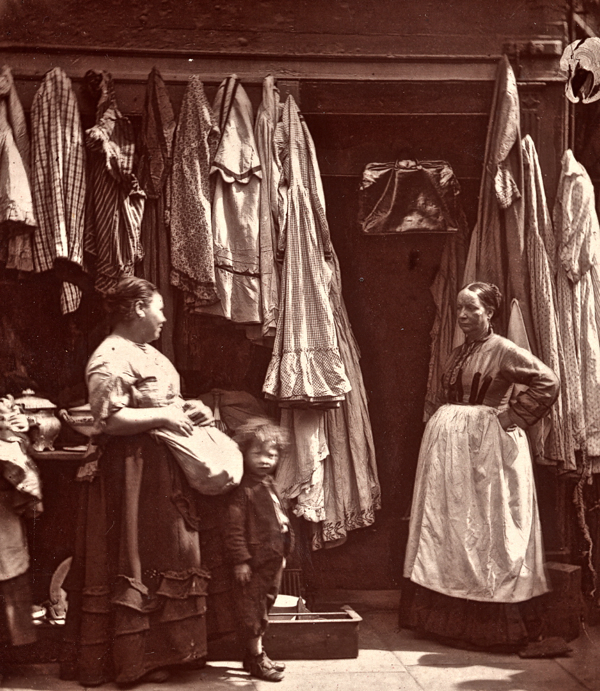
An Old Clothes Shop, St Giles – “As a rule, secondhand clothes shops are far from distinguished in their cleanliness, and are often the fruitful medium for the propagation of fever, smallpox &c.”
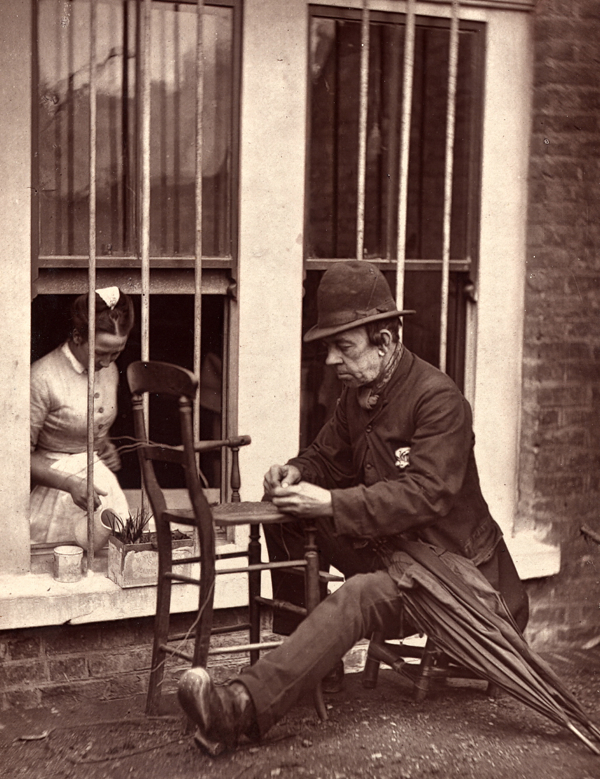
Caney the Clown – “thousands remember how he delighted them with his string of sausages at the yearly pantomime, but Caney has cut his last caper since his exertions to please at Stepney Fair caused the bursting of a varicose vein in his leg and, although his careworn face fails to reflect his natural joviality, the mending of chairs brings him constant employment.”
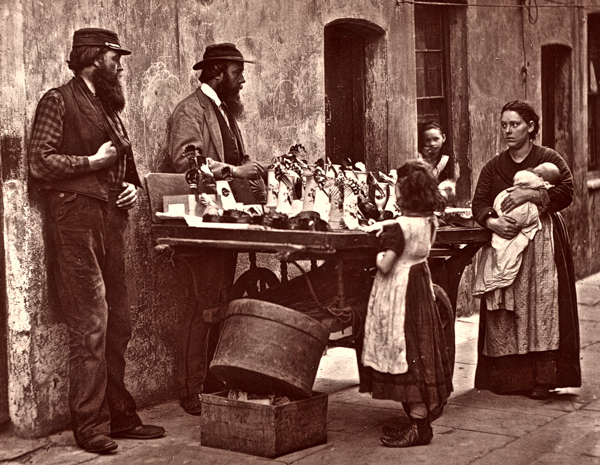
Dealer in Fancy Ware (termed swag selling) – “it’s not so much the imitation jewels the women are after, it’s the class of jewels that make the imitation lady.”
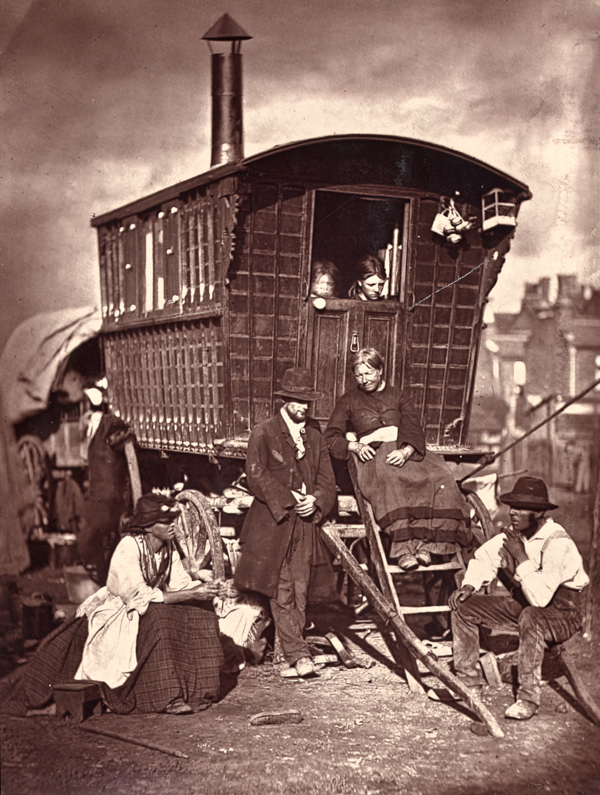
William Hampton of the London Nomades – “Why what do I want with education? Any chaps of my acquaintance that knows how to write and count proper ain’t much to be trusted into the bargain.”
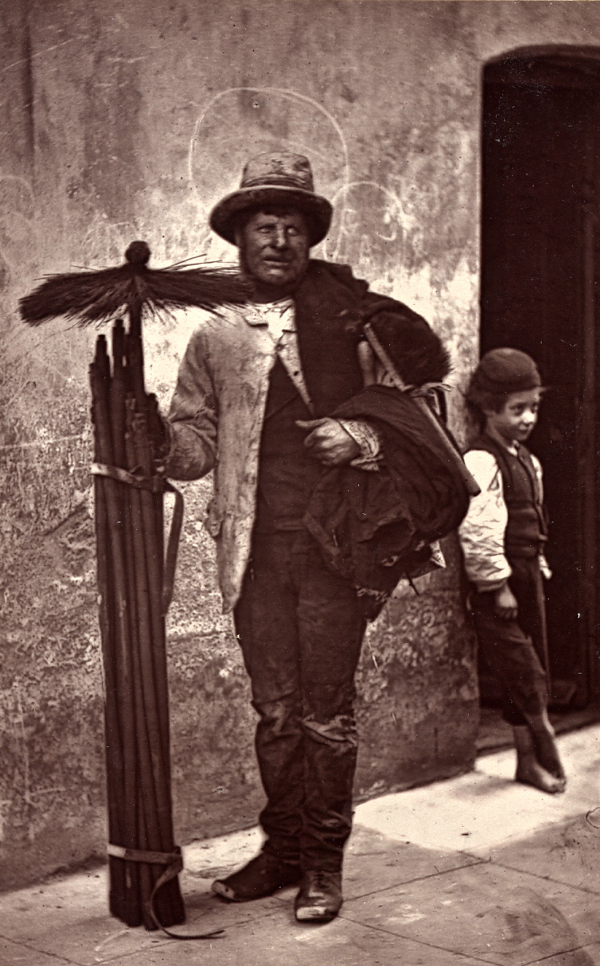
The Temperance Sweep – “to his newly acquired sobriety, monetary prosperity soon ensued and he is well known throughout the neighbourhood, where he advocates the cause of total abstinence..”
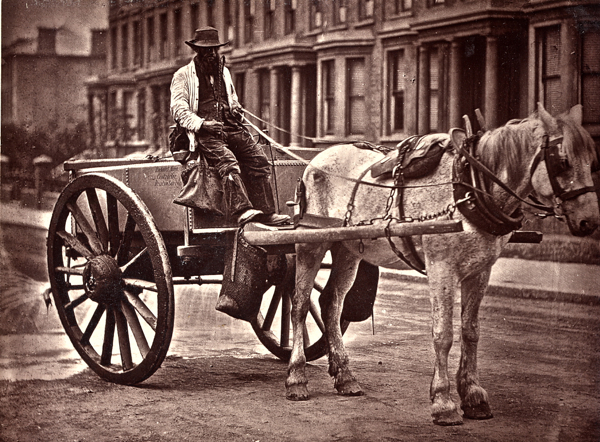
The Water Cart – “my mate, in the same employ, and me, pay a half-a-crown each for one room, washing and cooking. It costs me about twelve shillings a week for my living and the rest I must save, I have laid aside eight pounds this past twelve months.”
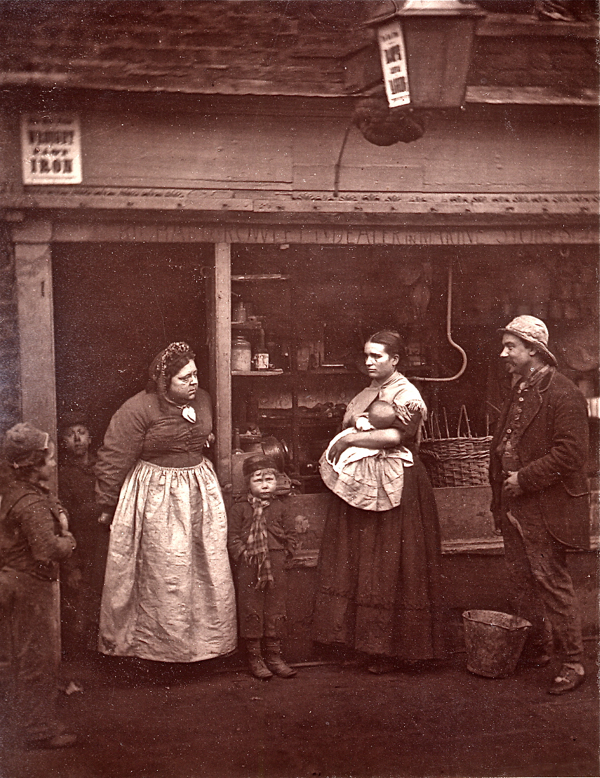
Survivors of Street Floods in Lambeth – “As for myself, I have never felt right since that awful night when, with my little girl, I sat above the water on my bed until the tide went down.”
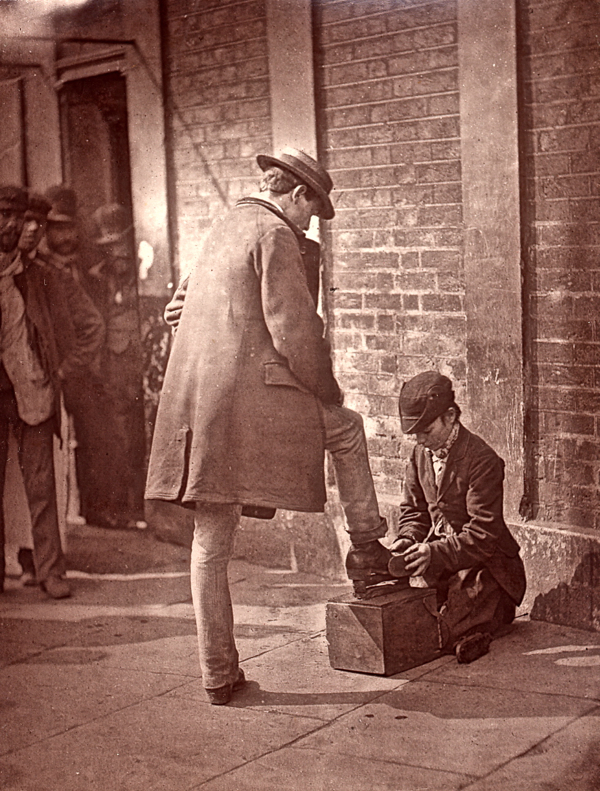
The Independent Bootblack – “the independent bootblack must always carry his box on his shoulders and only put it down when he has secured a customer.”
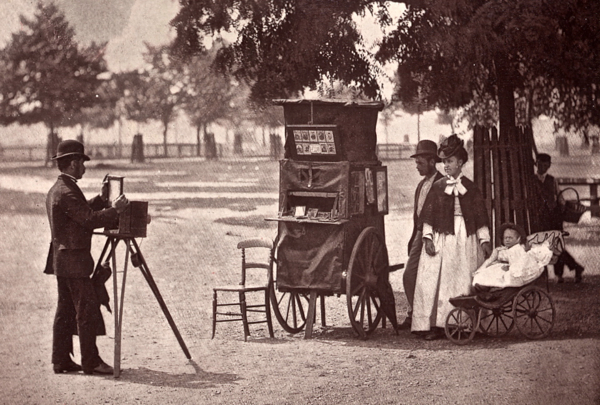
Itinerant Photographer on Clapham Common – “Many have been tradesmen or owned studios in town but after misfortunes in business or reckless dissipations are reduced to their present more humble avocation.”
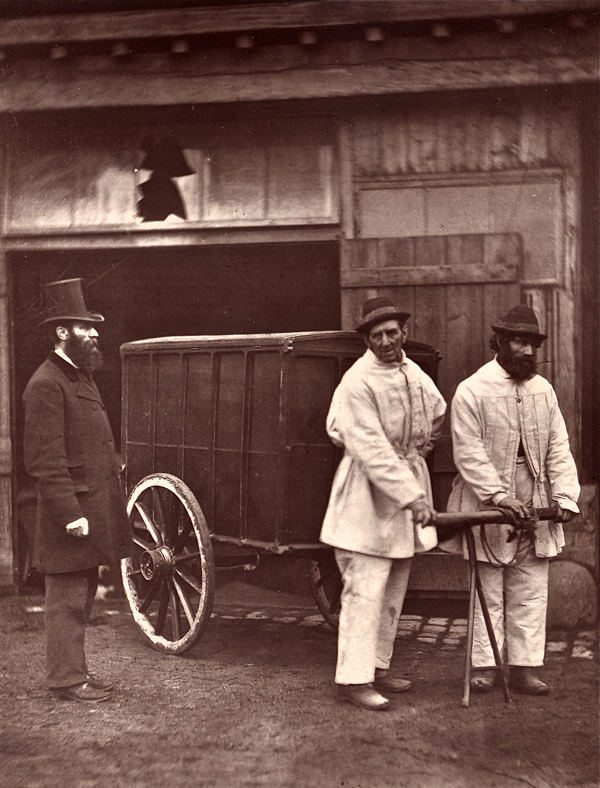
Public Disinfectors – “They receive sixpence an hour for disinfecting houses and removing contaminated clothing and furniture, and these are such busy times that they often work twelve hours a day.”

Flying Dustmen – “they obtained their cognomen from their habit of flying from from one district to another. When in danger of collison with an inspector of nuisances, they adroitly change the scene of their labours.”

Cheap Fish of St Giles – ” Little Mic-Mac Gosling, as the boy with the pitcher is familiarly called by all his extended circle of friends and acquaintances, is seventeen years old, though he only reaches to the height of three feet ten inches. His bare feet are not necessarily symptoms of poverty, for as a sailor during a long voyage to South Africa he learnt to dispense with boots while on deck.”

Strawberries, All Ripe! All Ripe! – “Strawberries ain’t like marbles that stand chuckin’ about. They won’t hardly bear to be looked at. When I’ve got to my last dozen baskets, they must be worked off for wot they will fetch. They gets soft and only wants mixin’ with sugar to make jam.”

The Wall-Workers (A system of cheap advertising whereby a wall is covered with an array of placards that are hung up in the morning and taken in at night) – Business, sir! Don’t talk to us of business! It’s going clean away from us.”

Cast-Iron Billy – “forty-three years on the road and more, and but for my rheumatics, I feel almost as hale and hearty as any man could wish .”

Labourers at Covent Garden Market – “it is in the early morning that they congregate in this spot, and they are soon scattered to all parts of the metropolis, laden with plants of every description.”

The London Boardmen – “If they walk on the pavement, the police indignantly throw them off into the gutter, where they become entangled in the wheels of carriages, and where cabs and omnibuses are ruthlessly driven against them.”

Workers on the Silent Highway – “their former prestige has disappeared, the silent highway they navigate is no longer the main thoroughfare of London life and commerce, the smooth pavements of the streets have successfully competed with the placid current of the Thames.”

Old Furniture Seller in Holborn – “As a rule, second-hand furniture men take a hard and uncharitable view of humanity. They are accustomed to the scenes of misery, and the drunkenness and vice, that has led up to the seizure of the furniture that becomes their stock.”

Mush-Fakers and Ginger-Beer Makers. – “the real mush-fakers are men who not only sell but mend umbrellas. By taking the good bits from one old “mushroom” and adding it to another, he is able to make, out of two broken and torn umbrellas, a tolerably stout and serviceable gingham.”

Italian Street Musicans -“there is an element of romance about the swarthy Italian youth to which the English poor cannot aspire.”

A Convicts’ Home – “it is to be regretted that the accompanying photograph does not include one of the released prisoners, but the publication of their portraits might have interfered with their chances of getting employment.”

The Street Locksmith – “there are several devoted to this business along the Whitechapel Rd, and each possesses a sufficient number of keys to open almost every lock in London.”

The Seller of Shellfish – “me and my missus are here at this corner with the barrow in all weathers, ‘specially the missus, as I takes odd jobs beating carpets, cleaning windows, and working round the public houses with my goods. So the old gal has most of the weather to herself.”

The “Crawlers” – “old women reduced by vice and poverty to that degree of wretchedness which destroys even the energy to beg.”
Images copyright © Bishopsgate Institute
Read the story of Hookey Alf of Whitechapel from Thomson’s Street Life in London
Brick Lane Market 4

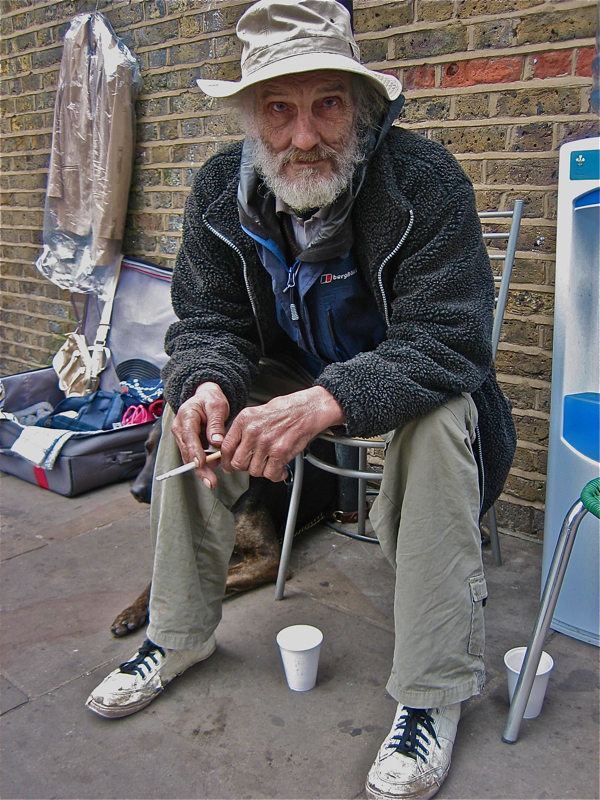
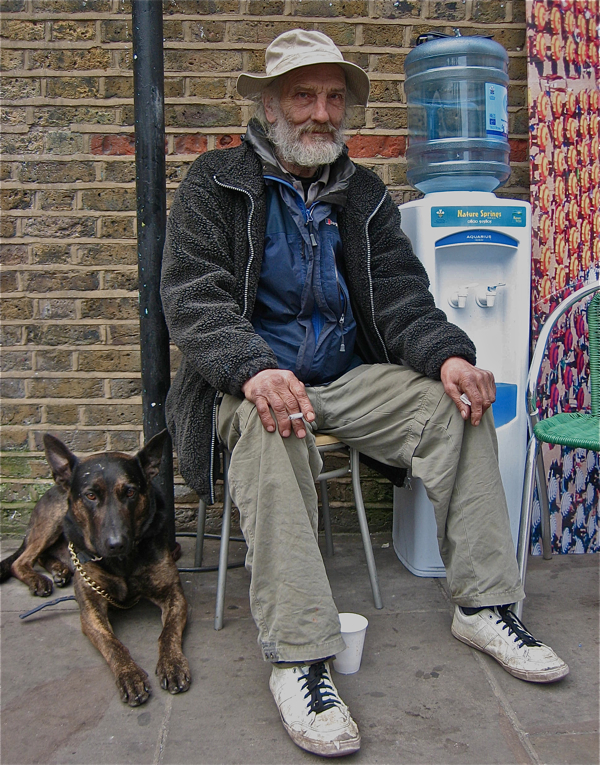
Let me admit, if I was to choose one person who incarnates the spirit of Brick Lane Market for me, it would be Tom – Tom the Sailor, as he is widely known – who you will find almost every day of the week with his faithful dog Matty, stalling out on the pavement with a few bits and pieces for sale. A distinguished gentleman of soulful character, yet with indefatigable humour and spirit, Thomas Frederick Hewson Finch has been around as long as anyone can remember, although few are aware of his origins or the extraordinary story of how he came to be here.
“In 1941, when the Germans were at war with England, that’s when I came along. My father wasn’t married to my mother. As far as I know, I was born in Goole in Yorkshire, but I don’t know for sure – no-one knows because it was 1941. I don’t think anybody cared about me, I was just a problem. I say my mother died when I was born but I don’t know, and I don’t want to know because I’ve had my life now, and I was slung in a home then which was natural. All I can remember is me lying on a floor and watching a rocking horse.
That home was St John’s in Ipswich, it’s not there any more. You went from baby to cots and then you went to beds, in other words you went through the stages. It was a big place. Loads of people like me needed somewhere to go. Why this place was picked was because there was Yanks all around. Although it may not be true, what I say is that my father was American. My mother went out with other people. She was part gypsy and she had to take care of herself, and naturally she would go with the Yanks who gave her cigarettes and stockings. Why would a woman want to go with Englishmen that were poor and had nothing?
When you sit there as an orphan and see other people being given presents, how do you imagine I felt? One child had an electric train set and I nicked it and buried it, but I when I went back to get it a year later it was rusty and no good. Why take somebody’s train set? It was how I thought. It was wrong, I know this now. I hid above a toilet for three days when they were looking for me, after they thought I had run away. As I got older, they slung me out because I was too unruly, and they put me in a stronger home. It was in East Grinstead, and the one who run it he was – now he would be locked up in prison – he was very hard. He used to love hitting me. He used the birch, he kept it in vinegar. He put you over a bench for six of the best. It was always me.
They sent me to a training ship for orphans on the River Medway – the Arethusa – where I reached Chief Petty Officer Boy. We slept in hammocks and you had to climb the one hundred and seventy foot masts everyday and slide down the lanyards. It was sailing ship from Harwich. From there, when you passed out you went to the Ganges in Suffolk where everyone went to go into the Royal Navy. They were training me in Morse code and typing, and I went on HMS Paladin. But I went deaf, on account of the cold weather in Iceland when I was drilling ice off a boat. I was invalided out with a pension of six shillings and ninepence a week which I sold for two hundred and fifty pounds, and with the money I bought a motorbike – a superflash.
I started working with woodworkers, Hollar Bros in Hull where I met my wife. I went in a cafe in Dagger Lane and the chap was doing no good and he asked me if I wanted the cafe for fifteen pounds a month, so I thought, “I’ll have that.” It turned out to be one hell of a place. All the bikers came down and it was packed out with motorcyclists from Brighton and all over England. I was open twenty-four hours and it was so busy you couldn’t park in the street. From there I ended up with seven nightclubs, and ten other cafes with casinos above them. I had dogs on the door, and I had one dressed as a fisherman because they knew me and I went to sea with them.
After that, I was twenty years on the run. I gave up everything when I left, me and my family, we just walked out. All the others ended up in the nick but they couldn’t catch me and I came down here to East End to get away. In other words, I was a bit of a villain. I’ve had a few premises round here, on Great Eastern St, Boundary St and two shops on Brick Lane, and in Cheshire St. I never paid for any of them. I used to have a partner, me and Terry – they called us “Tom & Jerry,” cat and mouse. Our first shop on the Hackney Rd, we sold the shop window just to get going. We used to sell nicked fireplaces, Victorian ranges and marble, you could get that stuff easy when there was no cameras. We sold them at giveaway prices, even the police came to buy from us. The shop was given to me by a Jew that was going to America, I was sitting in the Princess one day and he came in and threw the keys on the counter and said, “Take it, it’s yours!”
A camera crew came round once and asked me to show them how to sell a fireplace. We had one marked at fifteen pounds, so they filmed me and I asked “Thirty pounds” and they gave me the cash. Each time I asked more until it was seventy-five pounds. And when they said, “Can we have our money back ?” I said, “It’s your fireplace!” You can do anything in a market. Me and Terry closed up and went to the stripper pub on the corner. That’s how you sell a fireplace.
All my family are well off, they all made it. My little boy Andrew, he’s my son, he was always with me. He’s grown up now too, but I just carry on in my own stupid way. Why does a man do it? I can only do what I’ve always done, I know it better than anything. I’ve done it all my life. Old Tom’s still an orphan, it’s the way I was brought up.”
Larger than life yet of this life, Tom the Sailor is the most charismatic rogue you will meet, with his nautical tattoos, weatherbeaten features, white mutton chop whiskers and an endless supply of yarns to regale. He delights in ruses and fables. With the wisdom and modesty of one who has lived many lives, Tom recognises that the truth of experience is rarely simple, always ambiguous. And if, like me, you are of a similar cast of mind, then there is almost no better way to pass time and learn about the East End than hanging on Old Tom’s ear.

Brian Barrett, Foundry Foreman
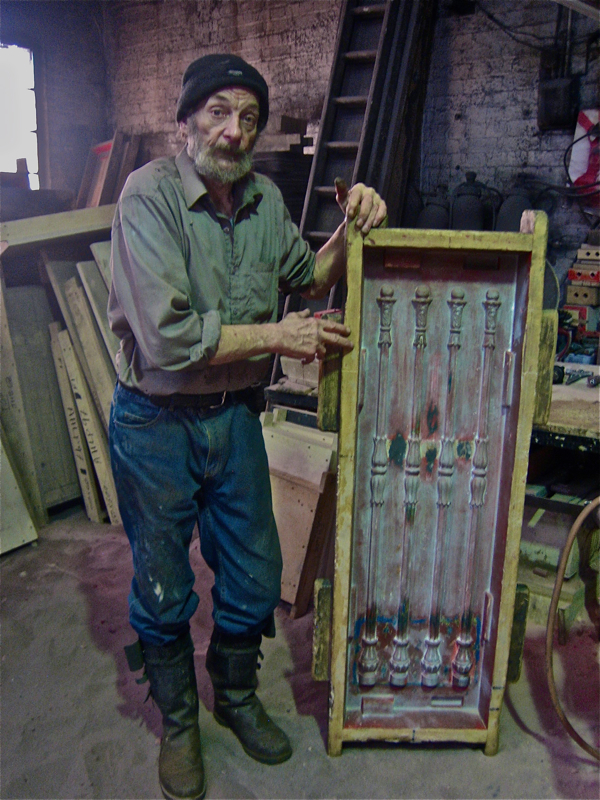
Brian Barrett was packing up alone in the foundry on Friday, when I dropped by to pay a visit at J.Hoyle & Son – although he seemed in no hurry to leave. “Looking forward to the weekend?” I queried, to permit him an exit line if he chose to take it. “I hate Fridays,” was Brian’s unexpectedly ambiguous response, “one day nearer to Monday, isn’t it?”
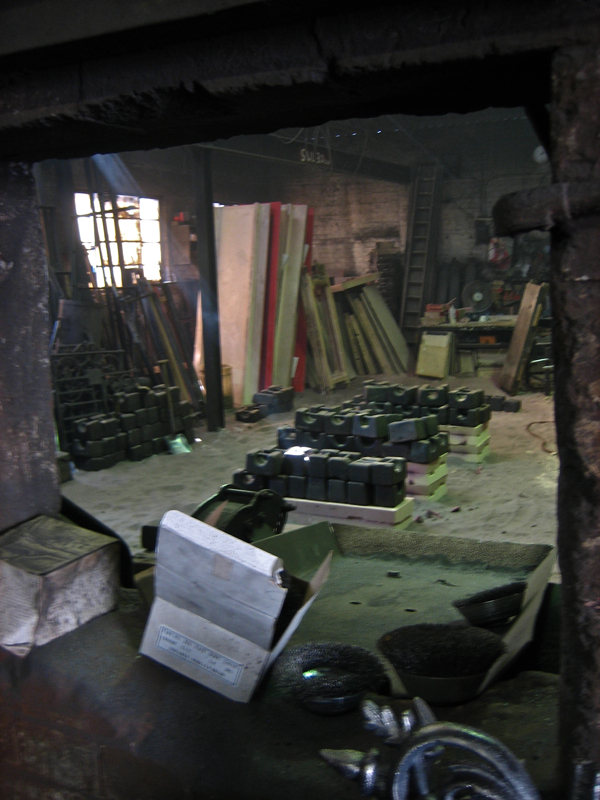
So there we were together, standing in the stillness of a shaft of sunlight upon the sandy floor of the old foundry, enjoying this brief moment of peace when the work was done and contemplating the achievement of the past week, manifest in the castings of iron stair rods laid out in front of us. Already my suspicion was that Brian was a little unconvincing in his reluctance to anticipate next week but as I did not wish cloud his satisfaction, I simply asked if he was finished for this week. “I shall come in on Saturday for a few hours,” he confirmed with a placid smile through his straggly beard, just to reassure me that his job was no ordeal.
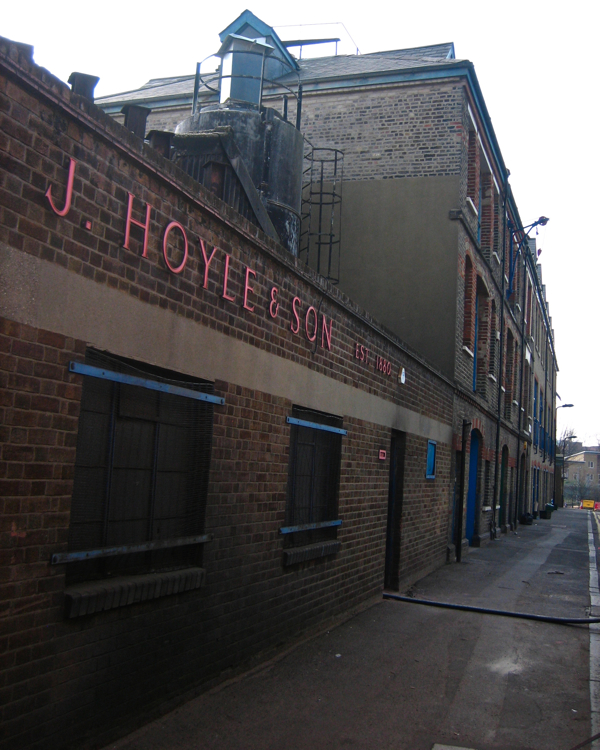
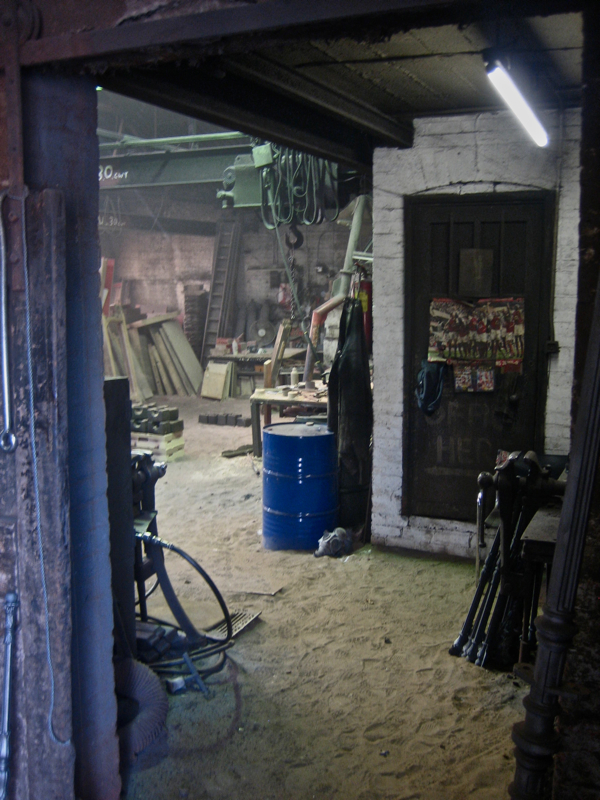
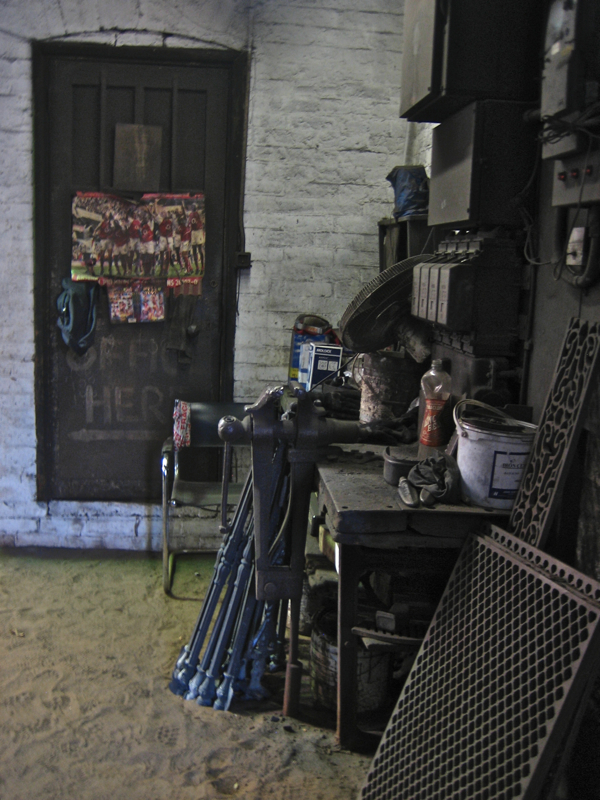
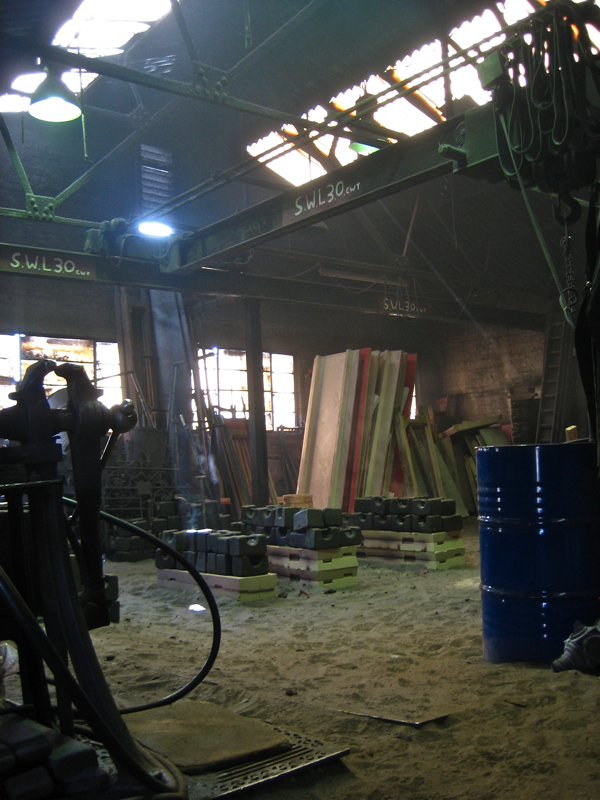
In this venerable brick building beside the canal glimmers the spirit of the Industrial Revolution and even earlier – because iron casting is one of the oldest technologies known to man – and at J.Hoyle & Son the essentials have not altered since they set up in 1880, as one of the many small foundries that operated in the East End at that time. Ironwork cast here at J.Hoyle & Son (the Beehive Foundry) can be seen upon The National Portrait Gallery, The British Museum, The Houses of Parliament, 10 Downing Street, The Bank of England, The Natural History Museum, and Smithfield Meat Market – as well as the lamp posts along the Chelsea Embankment.
On every occasion I have passed, I have caught a fleeting glimpse from the street into the hazy dim interior of this foundry, a place of dusty old equipment and raw creation, containing both the dark furnace of William Blake’s Jerusalem and the chiaroscuro familiar from the paintings of Joseph Wright of Derby. My father was apprenticed at a foundry at the age of twelve, yet I had never been inside a foundry and all this time I have carried a burning curiosity to get into one of these places. So it was a vivid and emotional moment for me when I stepped through the threshold in the twentieth century facade of J.Hoyle & Son into the vast darkness of the nineteenth century foundry beyond.
Everything was encrusted with black sand, settled like ash, as if I was in the proximity of a volcano, and there was an intense metallic smell – which I learnt was formaldehyde used to set the moulds – that filled the lungs. And after a lifetime of expectation, it was a privilege to be welcomed by Brian, the limber and sinewy custodian in his proud lair, to this environment that is so alien to the city street outside yet strangely reassuring to me.
Brian was born nearby on King Edward’s Rd, Hackney, in 1944, and he now lives in Well St just over the road from the foundry. “I’ve been at Hoyle & Son for sixteen years.” he revealed,“I started off as a labourer in another foundry at seventeen and progressed from there. I just fell into it – and I never considered doing anything else.” And then he qualified this expectation, in case it should appear too casual, adding, “You’ve got to be good though, you’ve either got the fingers for it or you haven’t.”
Today, Alan Hoyle runs the business founded by his grandfather John Hoyle and now Brian his foreman is training Ben Hoyle, twenty-one years old and the fourth generation in waiting, as a general apprentice in all areas of foundry practice. Hoyle & Son own an enormous pattern book that allows them to match almost any historic railing or piece of ironwork to replace it, receiving business from restoration projects nationwide and giving Brian with a continuous stream of intriguing project, both casting and repairs, to fill his days.
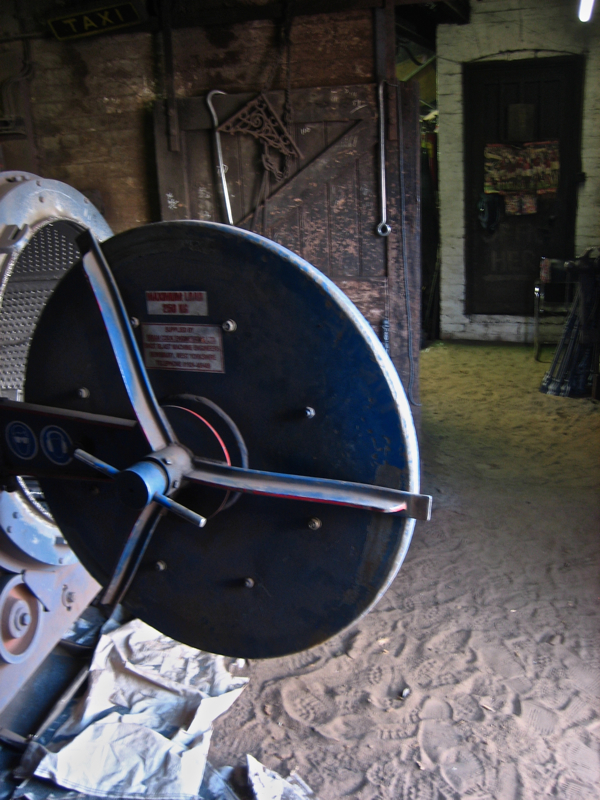
As the foreman with a team of seven, Brian runs holds the responsibility of running the furnace, taking the pig iron that you see piled up by the door and heating it to thirteen hundred degrees ready for pouring. “You make a lot of friends if you’re working the furnace in the Winter.” he quipped sagely, referring to the ever-open foundry doors that bring in the Spring breezes now but render the workplace less sympathetic in January. “Estuary Iron” is often used these days which contains graphite and is tougher and less brittle than conventional cast iron. Another modern intervention is the vast computerised sand pump, towering over the foundry, that can pump eight tonnes of sand an hour, mixed with resin to make the moulds for casting. “We used to work with damp black sand, but this combination allows us to get better detail,” explained Brian. Once the casts are cracked out of the moulds, they are put into the shop blaster – a bizarre variant upon a tumble dryer, that fires steel shot at the rotating pieces of iron to remove scraps and clean up the shape.
I was inspired to see this foundry work continuing in time-honoured fashion and know that no piece of railing or fence need ever be irreparable, thanks to the talents of Brian and the team at J.Hoyle & Son. “No-one likes getting their hands dirty, do they?” asked Brian rhetorically, displaying his grimy paws to me when I offered my hand to shake his. Yet although for generations white collar jobs have been widely perceived as superior to blue collar employment, and my father spoke of his apprenticeship in vaguely apologetic terms, it is obvious that there can be dignity and fulfilment in manual work – such as here at this foundry – requiring real skill and accomplishment.
Brian’s hands looked like my father’s hands, lined with ingrained dirt, which I remember from my childhood and that magically renewed after his retirement, as if he had worked at a desk his whole life. I am proud and a little envious that my father undertook an apprenticeship in a foundry, and I hope future generations will see the magic of these essential industries – appreciating the primal delight in getting your hands dirty.
Brian Barrett and I shook hands on it.
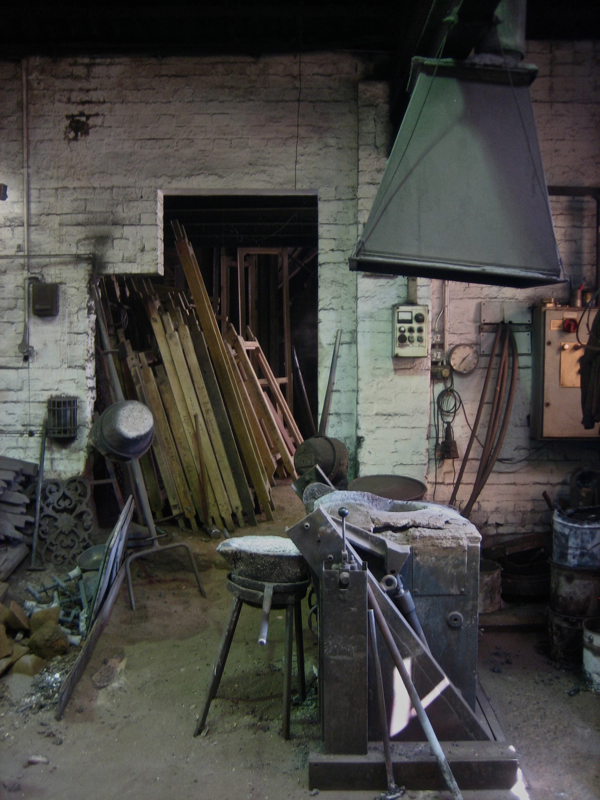
Brian’s furnace with the crucible for molten iron at the ready.
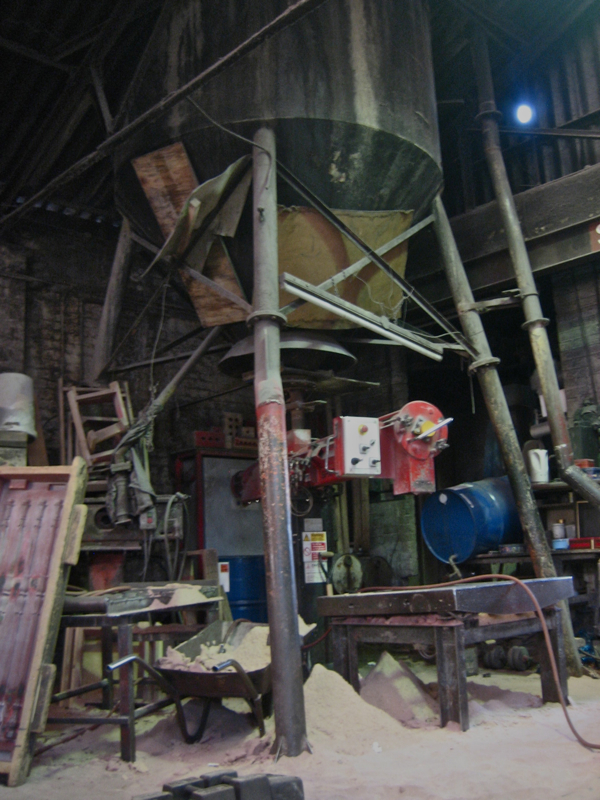
The computerised sand pump mixes beach sand with hardeners and resin to make moulds.
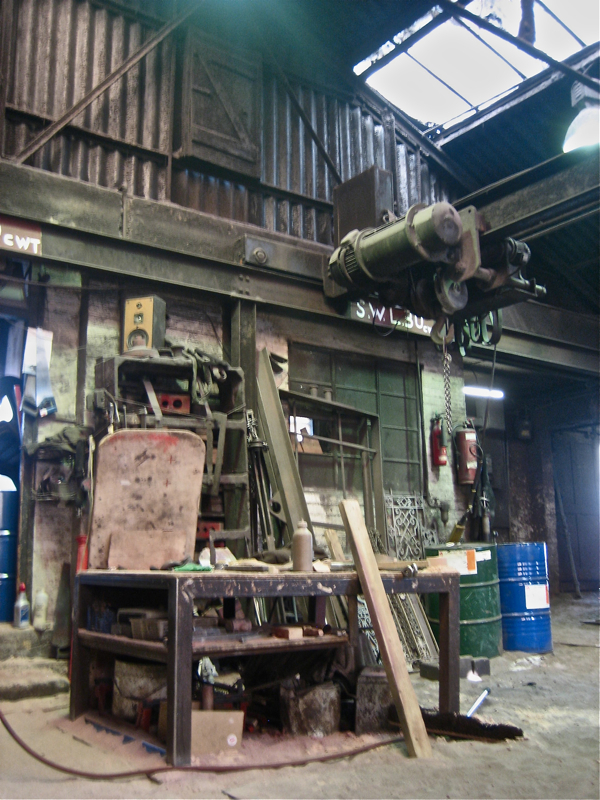
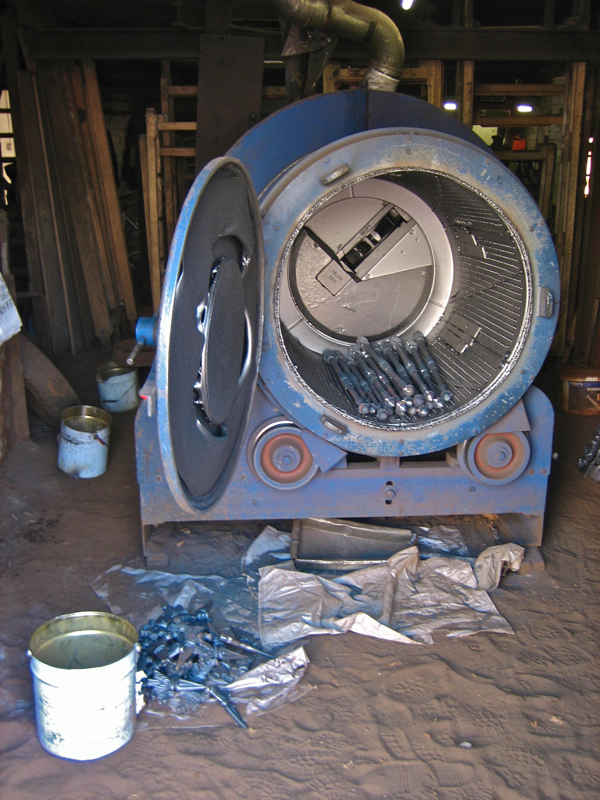
The shop blaster where new castings are tumbled amongst steel shot.
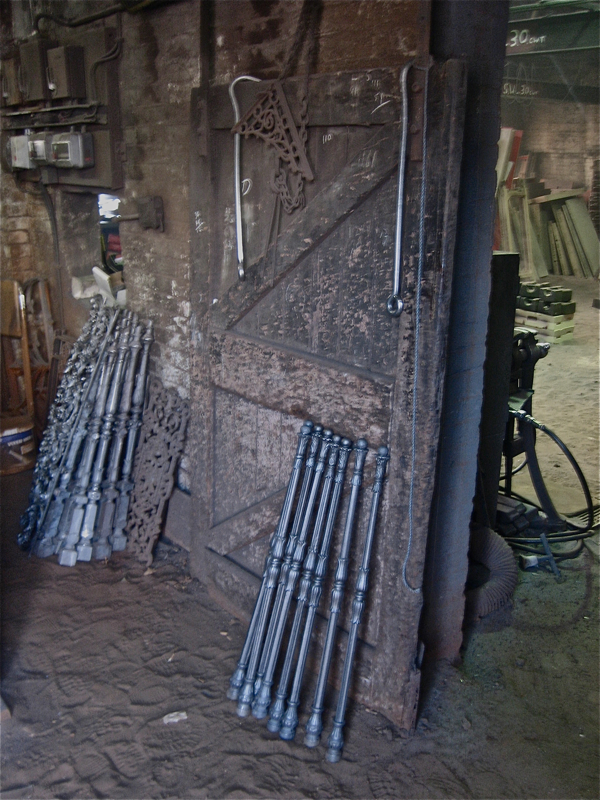
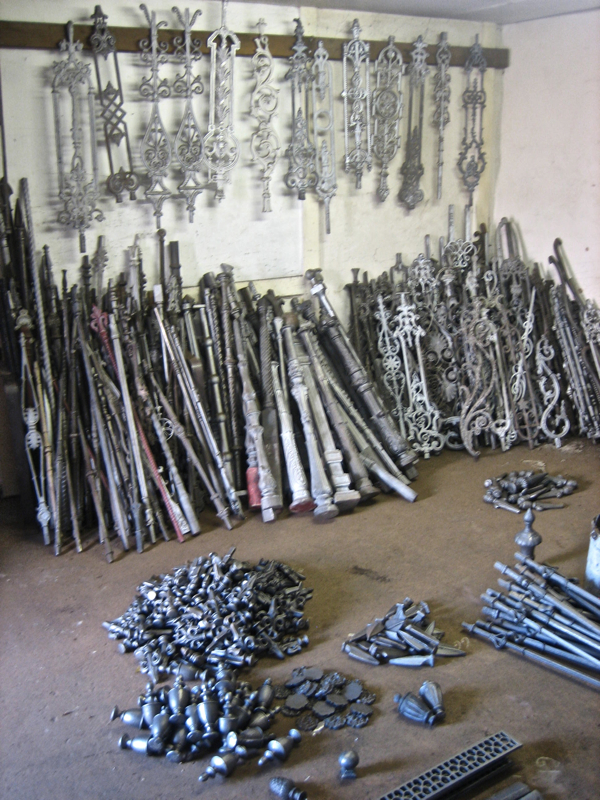
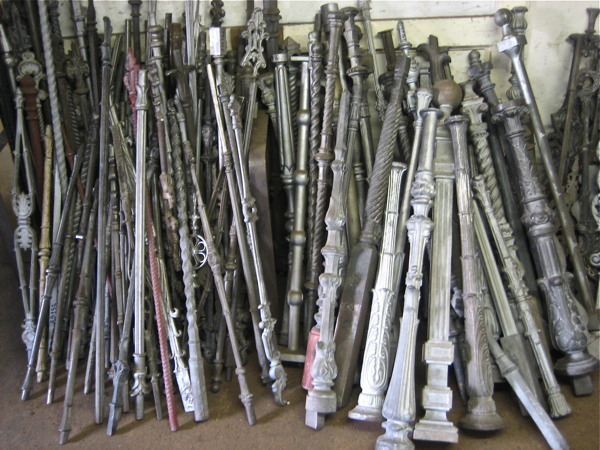
Options for spindles.
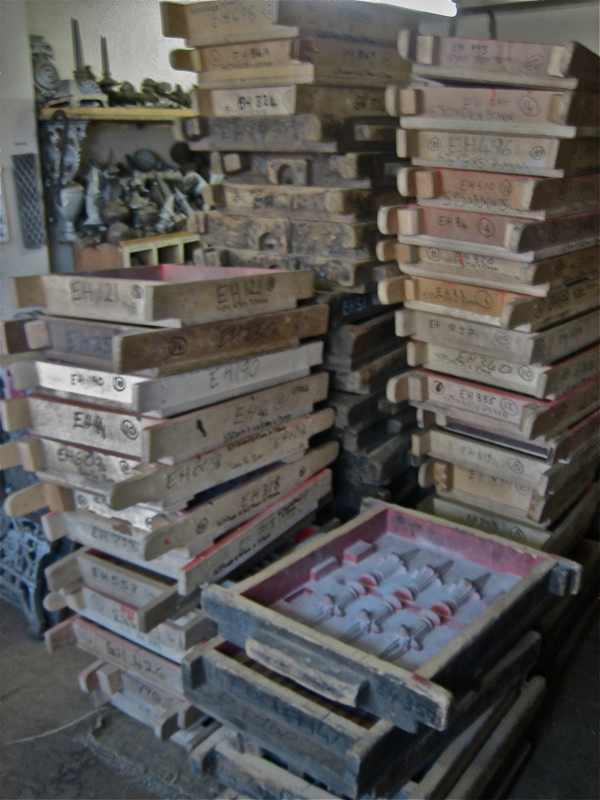
A fraction of the patterns in stock.
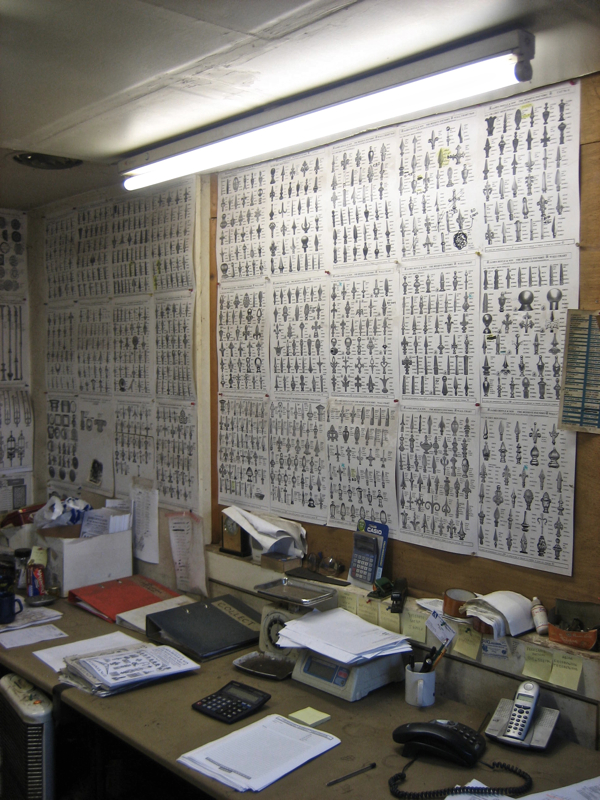
Pages of the pattern book adorn the office walls.
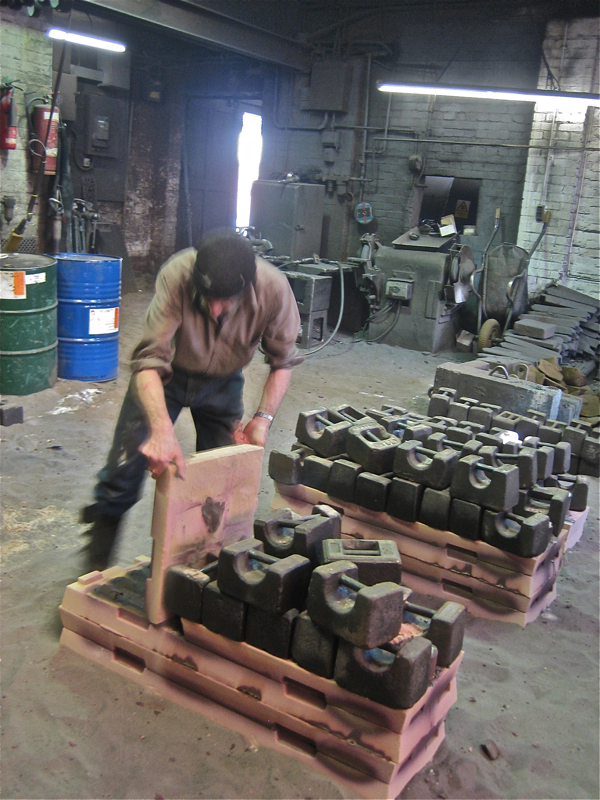
Brian opens a mould to take a look.
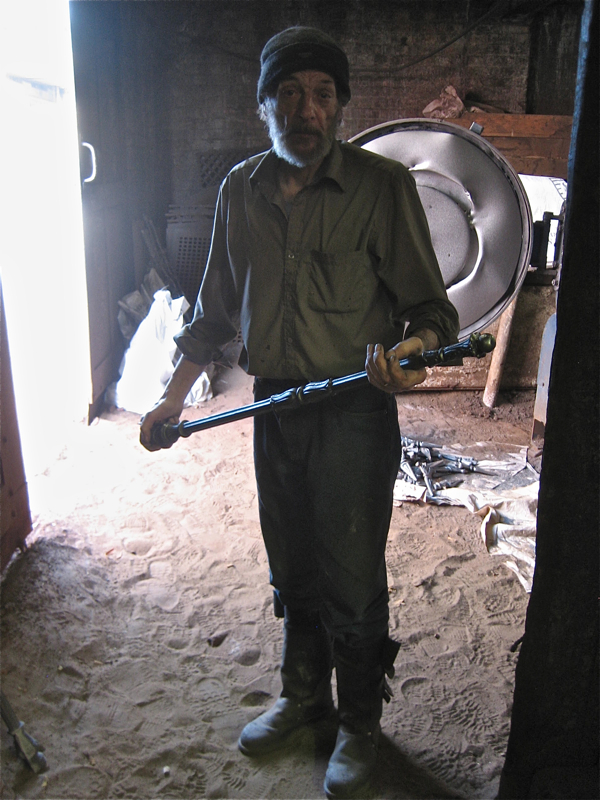
You may like to read about
The Roundels of Spitalfields cast at James Hoyle & Son












