
At Terry’s Tropicals
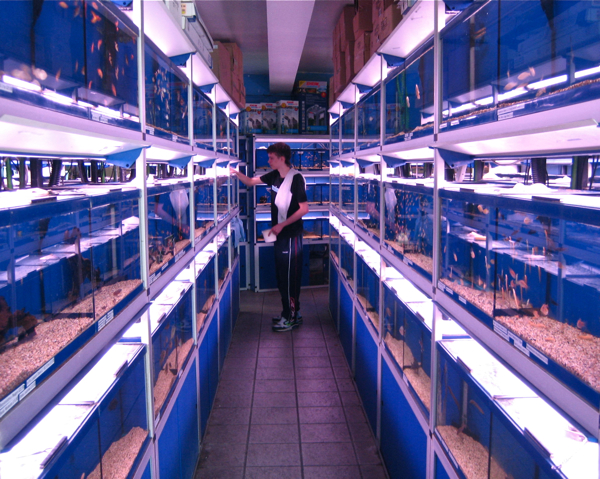
What better refuge from the hurly-burly of the Bethnal Green Rd, than to step into the sub-aquatic glow of Wholesale Tropicals (universally known as Terry’s Tropicals) and lose yourself in contemplation amongst the banks of illuminated fish tanks, as if you were taking a stroll upon the bed of a vast river in an exotic sunlit land? Here three generations of the Jones family work ceaselessly – Christmas not excepted – to maintain the population of up to ten thousand tropical freshwater fish that are their charge and their passion. Like those ethereal creatures which inhabit the depths, the family share a pallor evident of their lives tending fish in the gloom – where today, Jordan Jones, the youngest member pursues the never-ending feeding round that was begun by his grandfather Terry in 1961.
Once you have enjoyed a turn around the magnificent aquatic display, it is time to meet the two Terrys, the father and son that run the place, holding court at the front of the shop with Archie, who comes in each day (and has his own chair next to the tanks of aquarium plants), on all subjects tropical fish related. “We are known as the cheeky chappies of the fishkeeping world because of the banter that goes on,” bragged Terry the younger, revealing, “I’ve been here twenty-five years with the old bugger, since the day I left school at sixteen,” and proud to inform me that they used to have eighty tanks in the back garden when he was a child and won multiple awards for breeding South American catfish. “We specialised in getting all the different types,” he informed me enigmatically, “We searched high and low.” Adding helpfully, “We still sell the red-tailed catfish – the king of the Amazon – capable of growing to a metre long.”
You can learn a lot just by hanging on the words of these wily specialists gathered at the counter, like always wear a pair of rubber gloves when changing the water for your electric eel, like many of the fish here are extinct in the wild due to pollution, like Africans are the most aggressive of freshwater fish and require caves at the rear of their tanks to escape when fights break out, like how you must always put piranhas together in pairs of either sex to avoid a blood bath, and how the African Tiger fish is the most lethal, on account of its articulated jaw lined with sharp teeth and propensity to grow to five feet long. I was shown a six-inch specimen currently available for seventy-five pounds – it may look as benign as a stickleback, but its precisely serrated fangs are framed by an expression of primeval antagonism.
“Fishkeeping is more keeping the water than keeping the fish,” confided Terry the younger later, turning philosophical in the back office as he revealed a trick of the trade, “If you can keep the water just right, clean and the correct temperature and pH, they more or less keep themselves.” Yet I was not convinced of Terry’s dispassionate posturing, watching him chuckle affectionately as the Koi carp came to suck the food off his fingers. “Can you have a relationship with a fish?” I queried, “Do they respond to you?” Terry blinked at me as if to discreetly conceal his surprise at my under-estimate of the sweet nature of his beloved creatures. “They recognise you if you gesture through the glass to them,” he informed me and, as he spread his fingers, caressing the air beside a tank, a whole shoal of little fish swam up to meet his shadow playfully and passed by, turning away with a flick of their tails in unison.
Once upon a time, Terry Jones senior, a native of Bethnal Green, made a fish tank at school, gluing the pieces of glass together and using a slate for the base, heated with night-lights burning beneath. Years later, when he completed National Service, he started out breeding tropical fish with a pal from the Bethnal Green Working Men’s Angling Club. When he began, there were twenty-five fish shops in the East End and now fifty years later there are only two, but Terry persevered to create the phenomenon that is Wholesale Tropicals, drawing fish fanciers from as far as Fife. “Because we committed to something we do it properly, that’s why we work here seven days a week and all hours if necessary,” Terry junior assured me, as a loyal advocate of his father’s vision.
“I used to get home at eight each night, and then I’d be out in the shed with the seventy tanks I had there until midnight,” recalled Terry senior fondly, “- until the roof fell in, and I committed myself to building this extension ten years ago.” And he raised his eyes in pride at his creation, the serried rows of burbling tanks in aisles surrounding us. Standing there in one of the East End’s secret marvels – a temple devoted to the sublime wonders of the deep – beside the unassuming man who kept fifteen-inch piranhas for pets, the discreet genius behind the tropical fish shop that won every award going including the Practical Fishkeeping award for the Best Shop in the South of England, years running – I knew I was in the presence of a big fish.

Terry Jones who started the company in 1961.
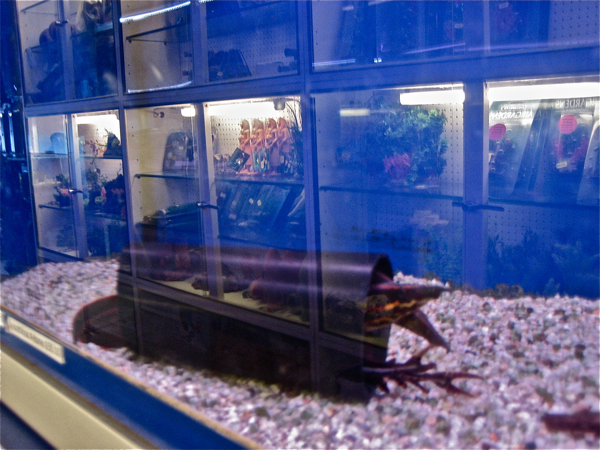
One of Bethnal Green’s most reclusive residents.
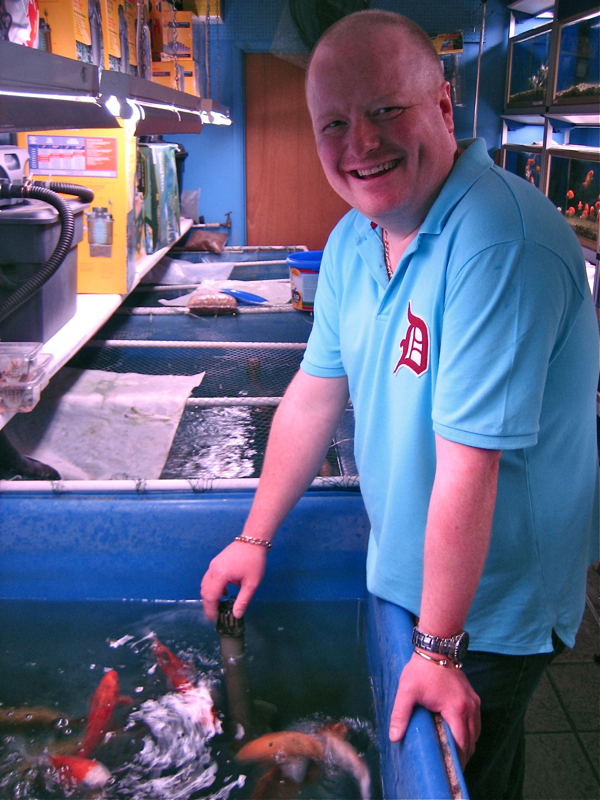
Terry Jones, junior, with his beloved Koi.
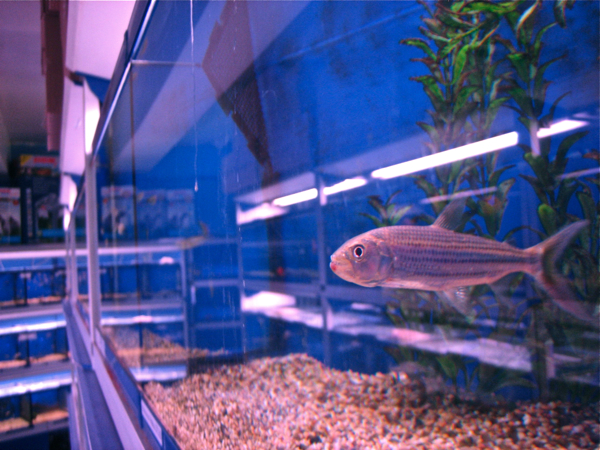
One of Bethnal Green’s most dangerous residents, the African Tiger fish.
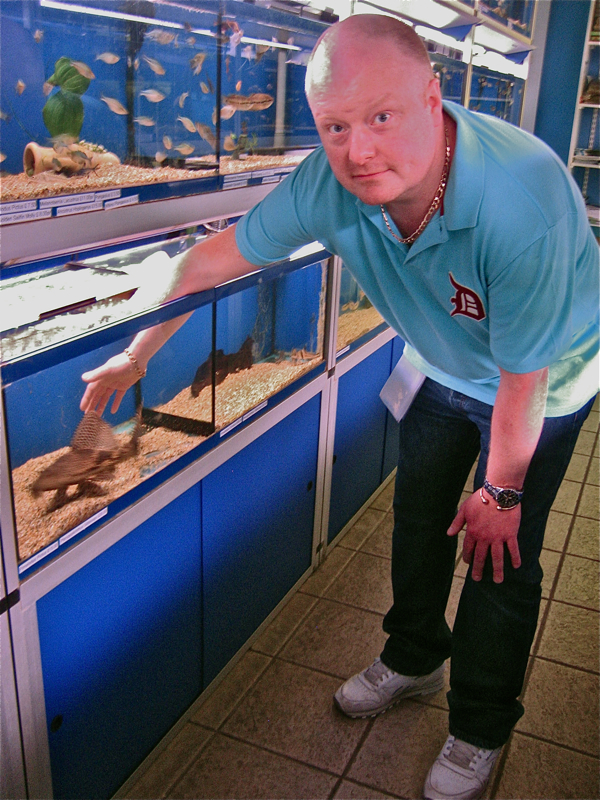
Terry caresses a cherished specimen of a South American catfish.
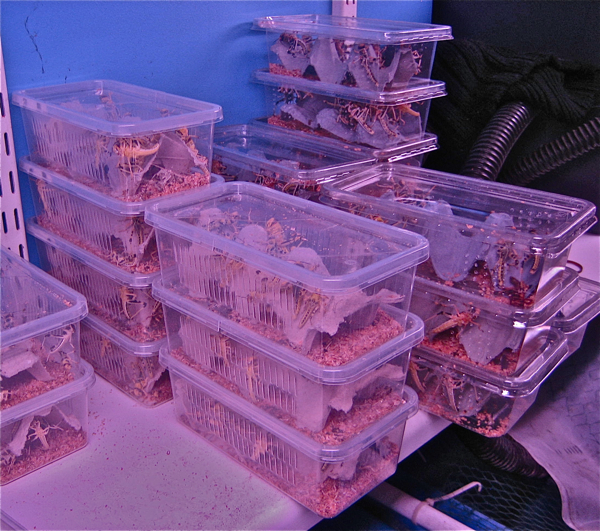
Live locusts for sale off the shelf for the lizard-fanciers of Bethnal Green.
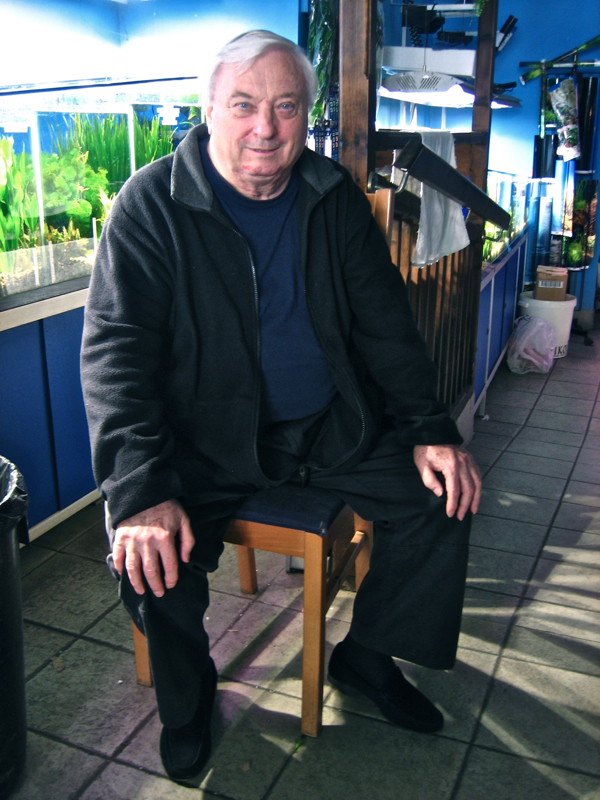
Archie, a regular customer, has a collection of three hundred goldfish, tropicals and toads at home.
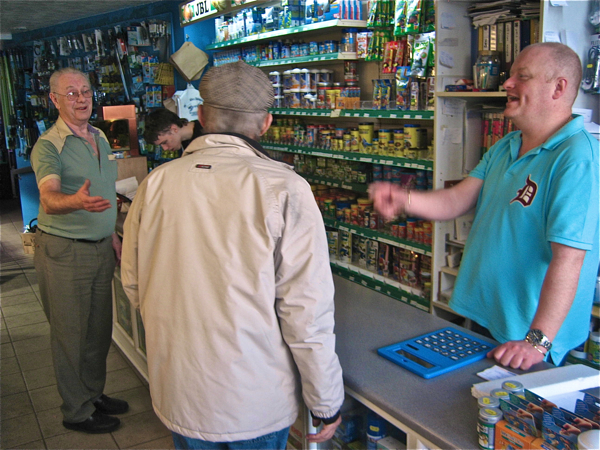
The two Terrys at work.
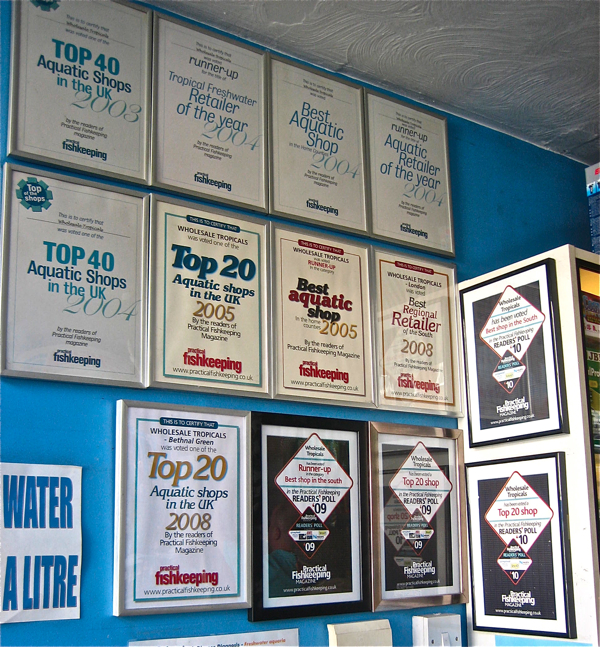
The wall of fame.
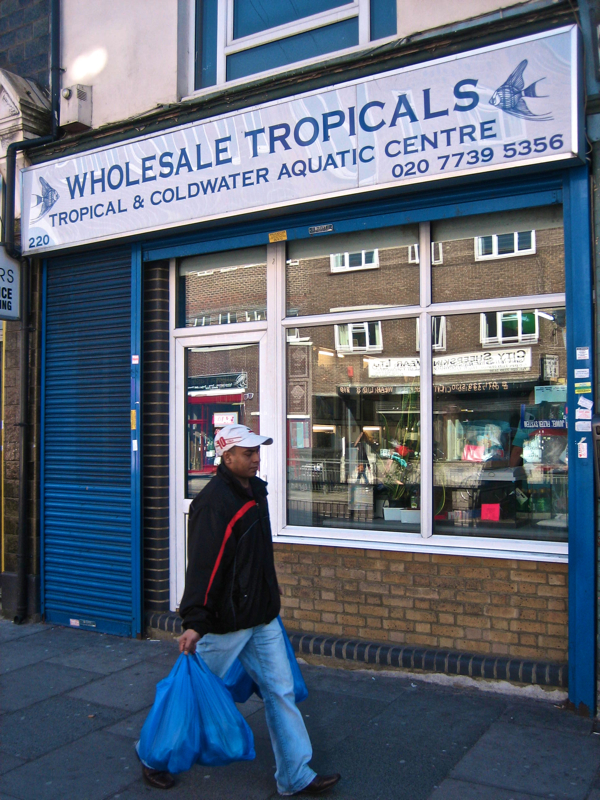
Shajeda Akhter, Playworker
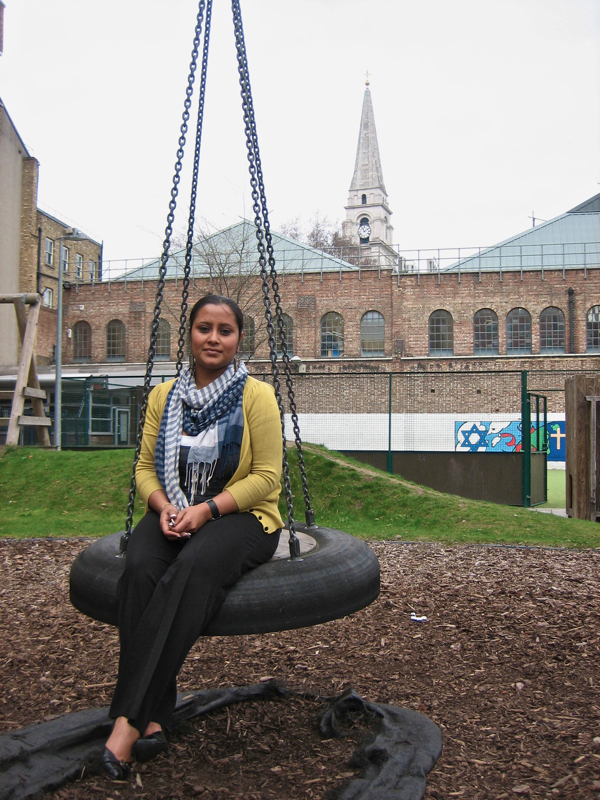
This poised young woman is Shajeda Akhter, a playworker at the Attlee Community Centre, in the shadow of Christ Church, Spitalfields. Although Shajeda may appear at peace now, she endured a long fight to win self possession as an independent woman and claim the freedom to make her own choices. Yet Shajeda’s struggle gave her both the motivation and the experience which enable her to support other young women facing similar pressures today – a responsibility that she has embraced with every particle of her being.
I came to this country in November 1995 after getting married to my husband Mujib. I was born and brought up in Debarai in Sylhet, Bangladesh – a lovely village with open fields where I was able to go out and play as a child. We were a very close family and everyone knew everyone, and I still take my kids back there. I came from a poor background and in my childhood I had freedom, but when I grew older I couldn’t go out to study as I wanted to do.
Ever since I was very young, I saw how my mother went through pain and I didn’t want to go through that. I asked her, “Why don’t you speak up?” and she said, “It’s the tradition.” So I said to my mother, “But if he leaves you, you have nothing.” I realised that you cannot guarantee that your husband will support you. Both parties must be able to earn some money and have the respect they need. The tradition comes second, it has to be me first!
My husband was my first cousin, born and brought up in London, and he went back on a holiday and met me and we fell in love, and he told his mum and dad that he wanted to marry me. And they didn’t approve, but he went ahead and married me anyway. My father also disapproved because he knew that I would have to come and live here – knowing that my husband’s side of the family would not accept me. I did not speak English and my husband could not read or write Bengali, but Mujib and I could understand each other, and he got Shiv Banerjee to compose his love letters to me.
We had a secret wedding with a few friends at night in the pouring rain. My husband’s family asked him to move out when they learnt about it. In London, we had to stay with Shiv until my husband bought a flat in Backchurch Lane in 1996. It was a struggle, I was very lonely without friends and family, but Shiv and his wife Selina adopted me as a daughter and slowly I began to make some friends. On my second day here, Shiv said, “I will arrange for you to learn English,” but I did not like the classes and I wanted to earn my own money. So, instead of language school, I worked as a volunteer at a Community Centre in Finsbury Park for a year and my English improved quickly.
Once my English was better, I searched for a job and got one in a jewellery factory in Kentish Town. But it was very difficult there and after six months I offered my services free to a travel agency, if they would pay my daily travel expenses. I did that for a year and a half before I was offered a paid job at an agency in Brick Lane. And I did that for another year until I became pregnant with my first child, working all through my pregnancy and planning to go back to work afterwards. I found myself very isolated at home, and I stayed in and cried until Selina came round and supported me taking me out for day trips.
I thought my husband’s parents would come when our baby was born but they never visited the hospital. They would not accept me because of my independence and, on the third day, my husband took our daughter to show them, but I have never been allowed to go into their house. They came to this country over forty years ago, and although I do not blame them for their beliefs, I wish I had their support.
My elder sister Majeda was due to give birth on the same day as me, in Bangladesh, but a week passed before I learnt she had died the day my daughter was born. Her inlaws did not seek medical attention because they did not want a doctor to examine her body – eventually my family took her to a hospital but then it was too late. Once I found out, a week later, I didn’t want to go back to work, I didn’t want to leave my daughter Shoma with anyone else.
When I became pregnant with my second child, I joined a mother and toddler group at the Attlee Community Centre on Brick Lane. Tanya the manager watched me and asked if I had any experience working with children. She told me to put my name down as a volunteer. Later, when my son Imon was two years old, she asked if she could put my name forward. I told her I had no experience but she said she would train me. She gave me responsibility and the keys to the building. Eventually she said, “We’ll pay you part time as a sessional worker,” but I wouldn’t leave my son, so she said, “Bring your children as long as you can take responsibility for them.” I became qualified and I have been here for the past nine years.
My work is about freedom, enabling young girls growing up to leave the house and be independent. I go and pick them up from their homes because they aren’t allowed to go out. I go and talk to the parents and persuade them to let their daughters go out, and they agree as long as I take them and bring them home. It was hard work at first, but slowly I have built it up from five girls in Backchurch Lane until now it is about fifteen or twenty girls.
It is very important they see life beyond family life because the normal route would be not going out, not becoming Westernised. A lot of girls may still wear head scarves but they have learnt to say, “no.” One young girl, she’s going to university and her parents want her to have education but there is also pressure, so I am giving her the power to make her own decision, because she must decide what is for her own good, for her own future – and I will support her in whatever she decides. A lot of young girls are under pressure but slowly we will come out of it, I give them my number and tell them to call me whenever they need support.
As I listened to Shajeda, speaking with balanced emotions and in professional fluent English, her moral courage became apparent – a woman caught between worlds, who has prevailed in the face of forces larger than herself through strength of character. With extraordinary independence of mind, she saw beyond the circumstances of her own upbringing and sought her own liberty. Neither complacent nor embittered, Shajeda Akhter has translated her own painful experiences into practical measures to help other women seek their own freedom, ensuring the individual steps that can bring about wider social change. It is a serious remit for one who goes by the deceptively light-weight job description of playworker.
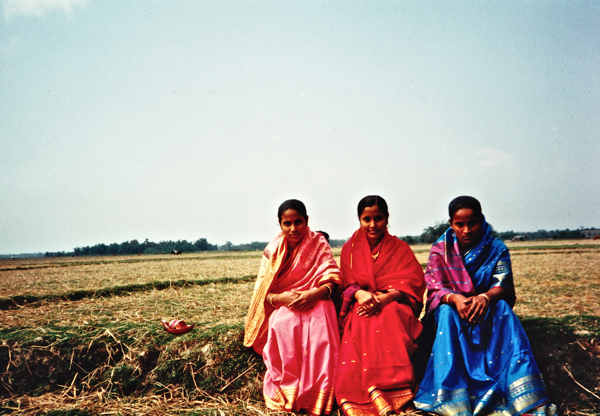
Three sisters in Debarai, Sylhet, Bangladesh in 1994, Majeda, Shajeda & Shafa.
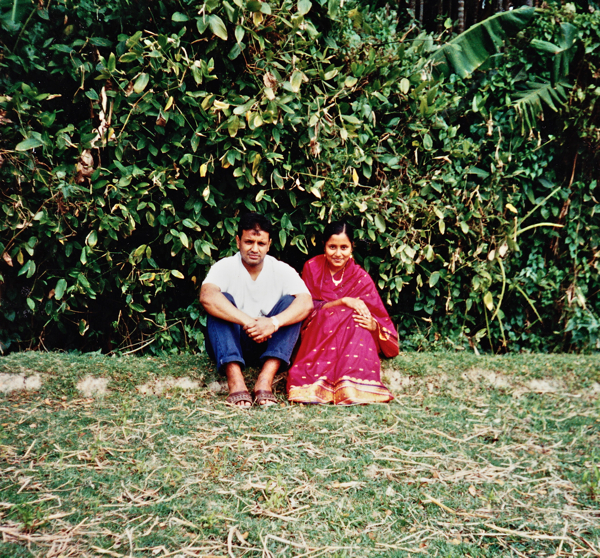
Shajeda & Mujib
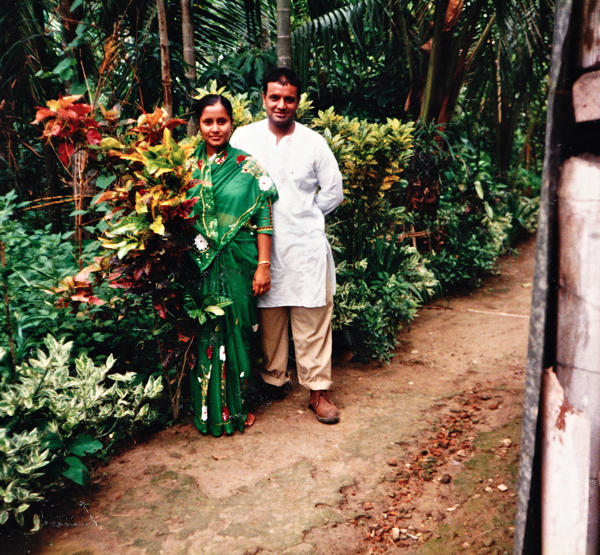
Shortly after the marriage in 1995.
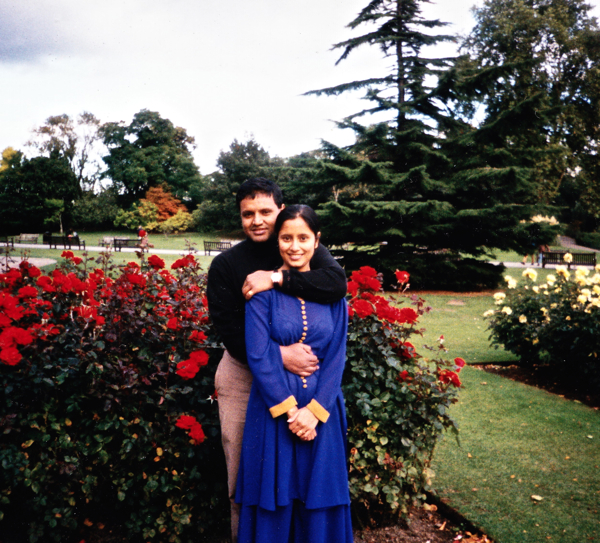
Together in Regent’s Park, Spring 1996.
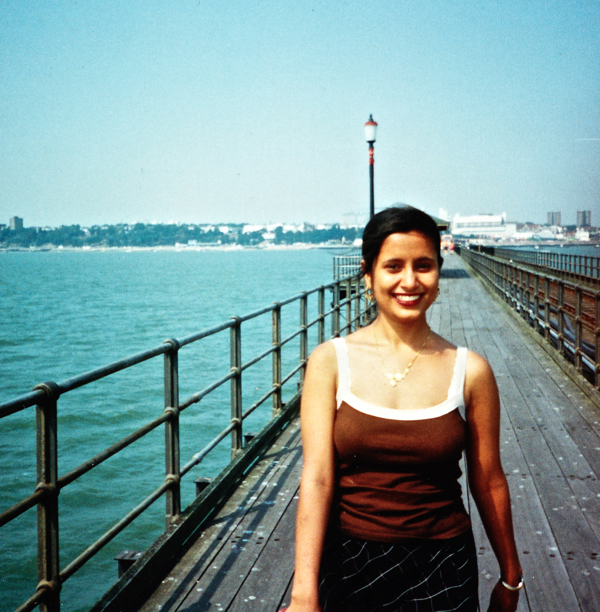
Shajeda at Southend, Summer 1996.
You may also like to read about
More of Rowlandson’s Lower Orders
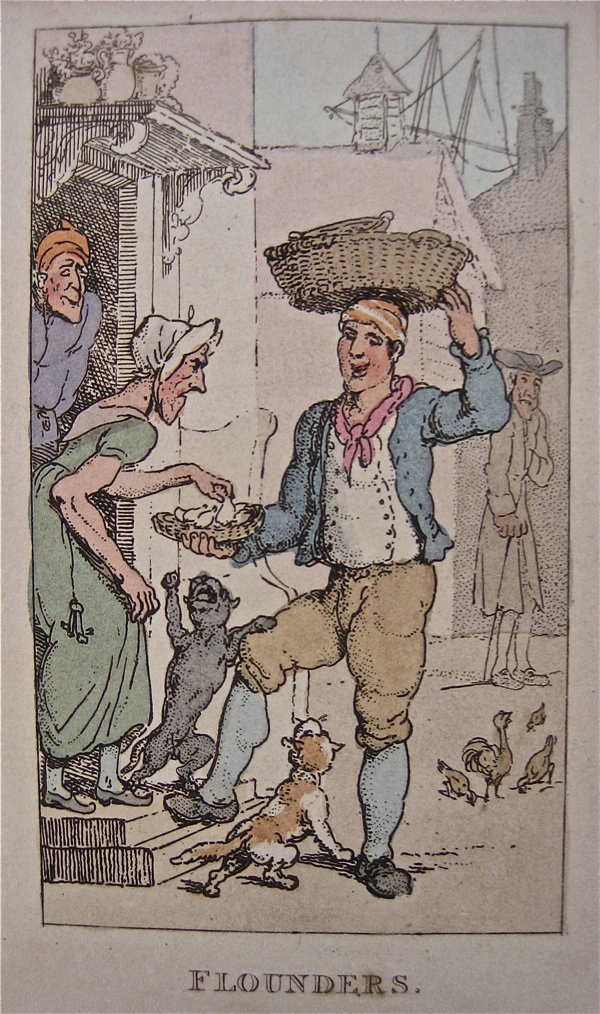
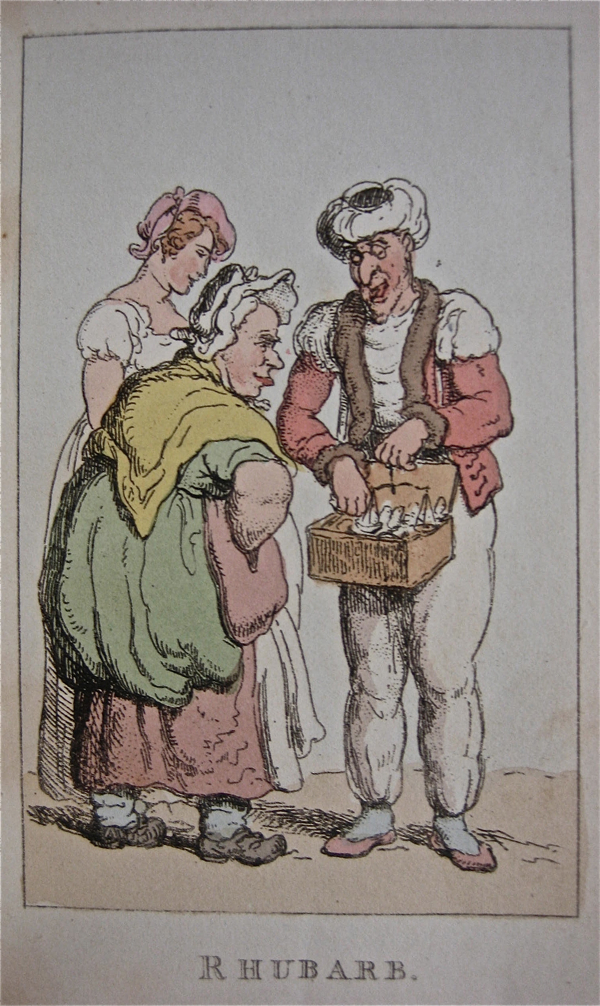
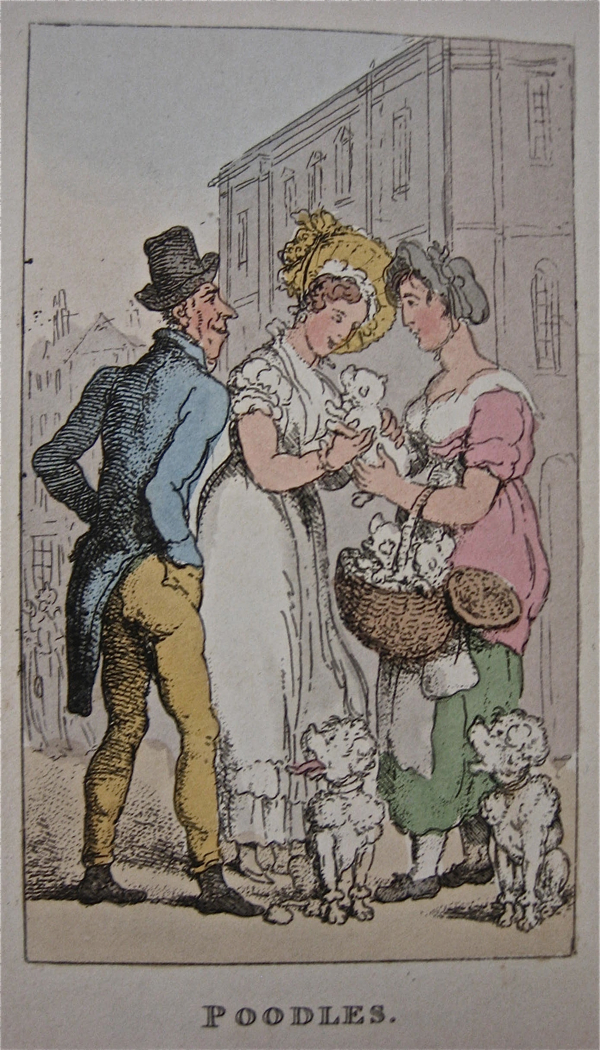
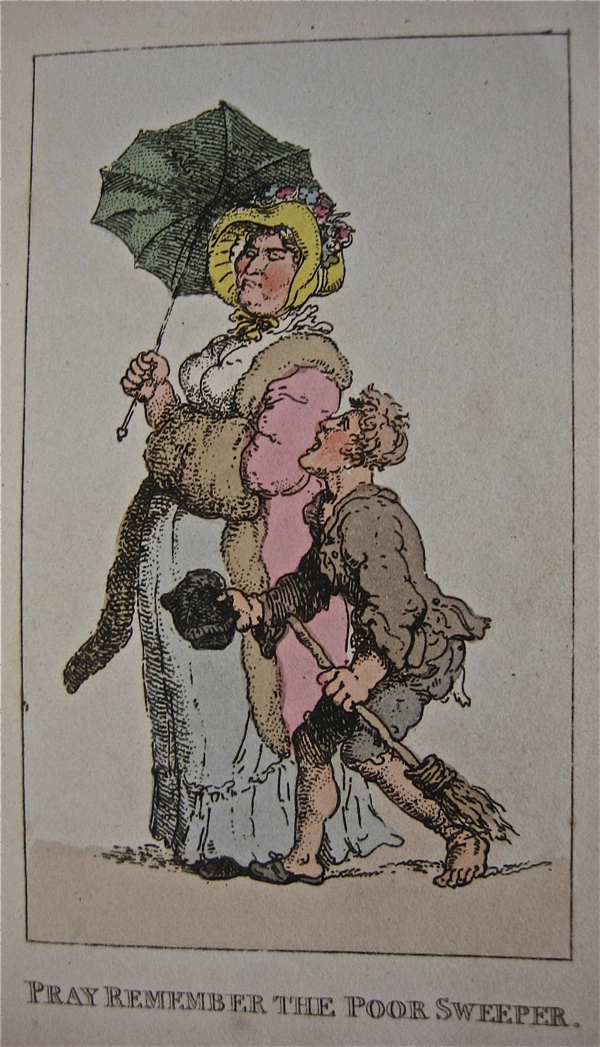
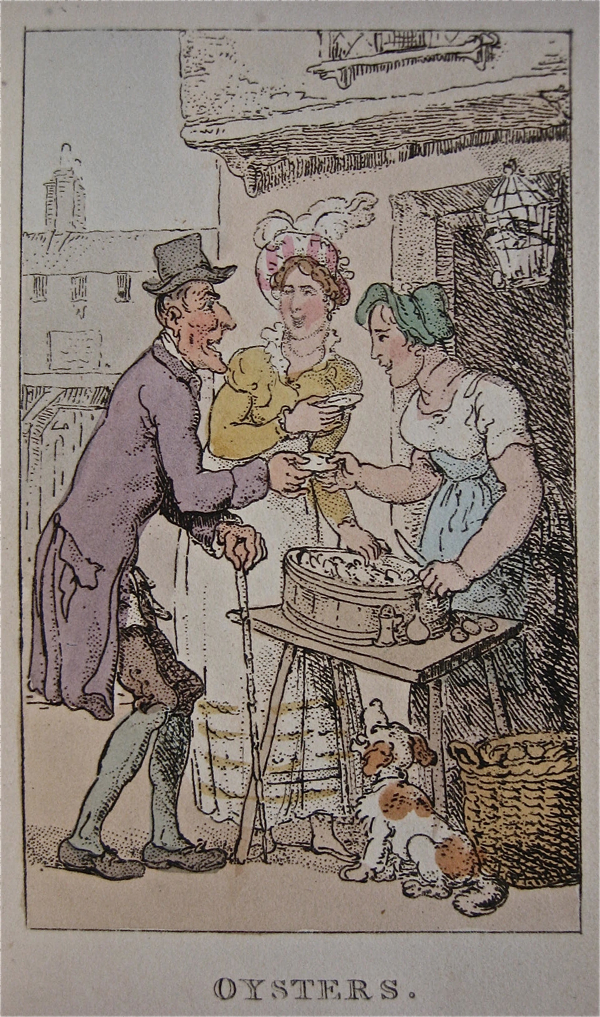
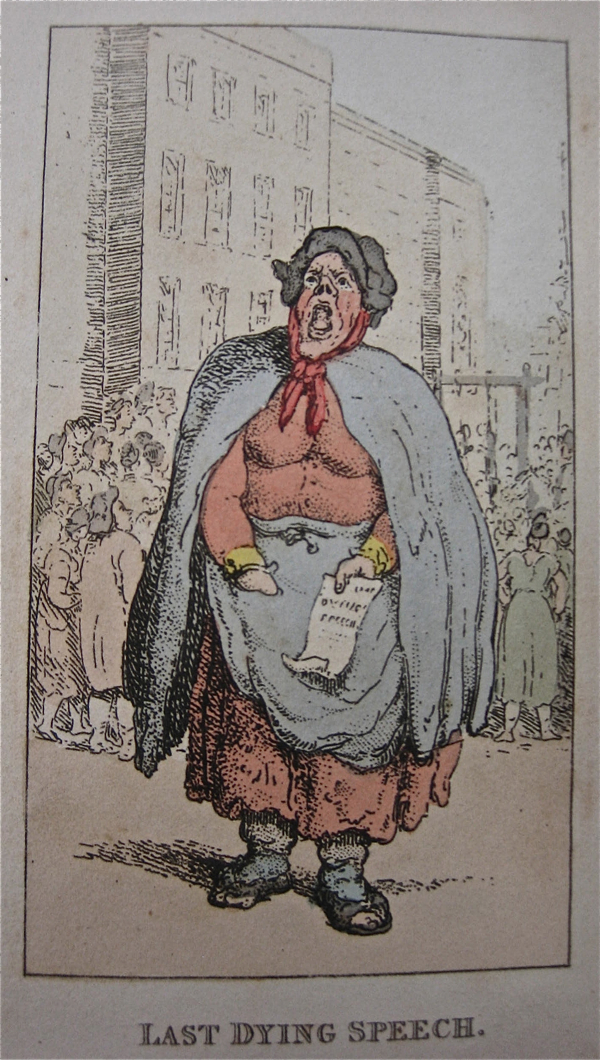
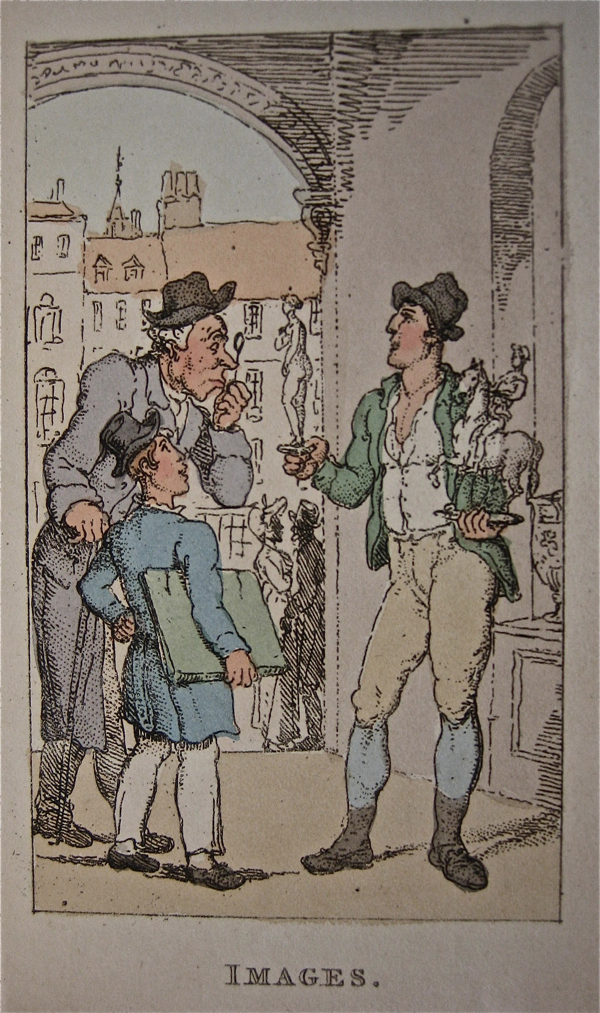
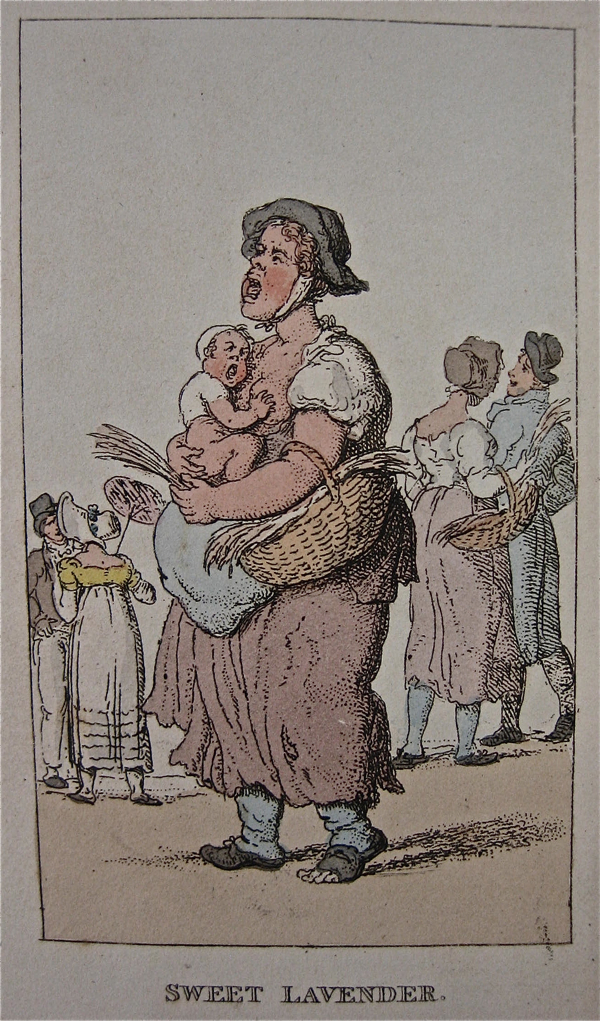
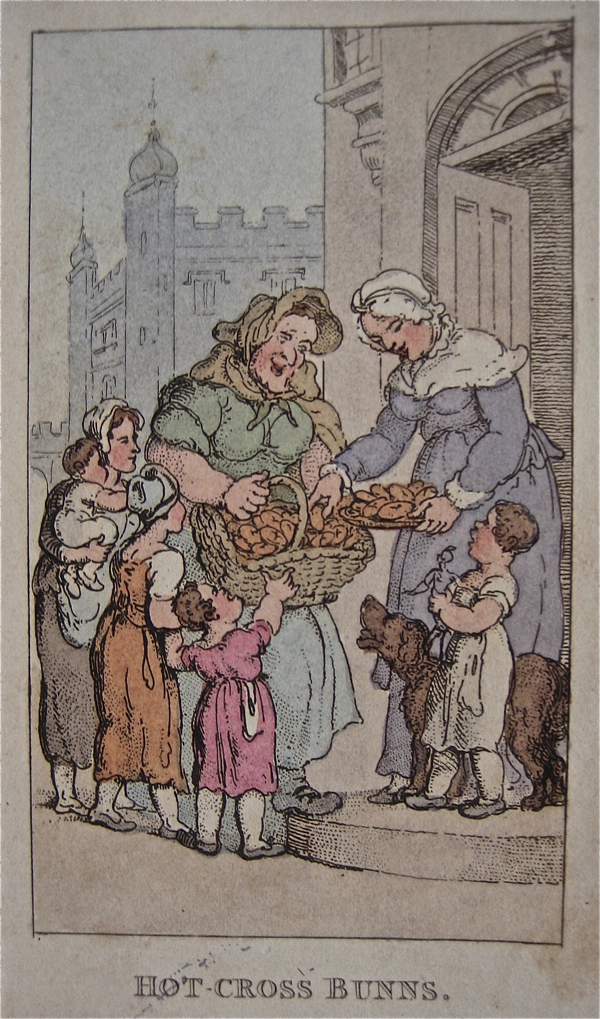
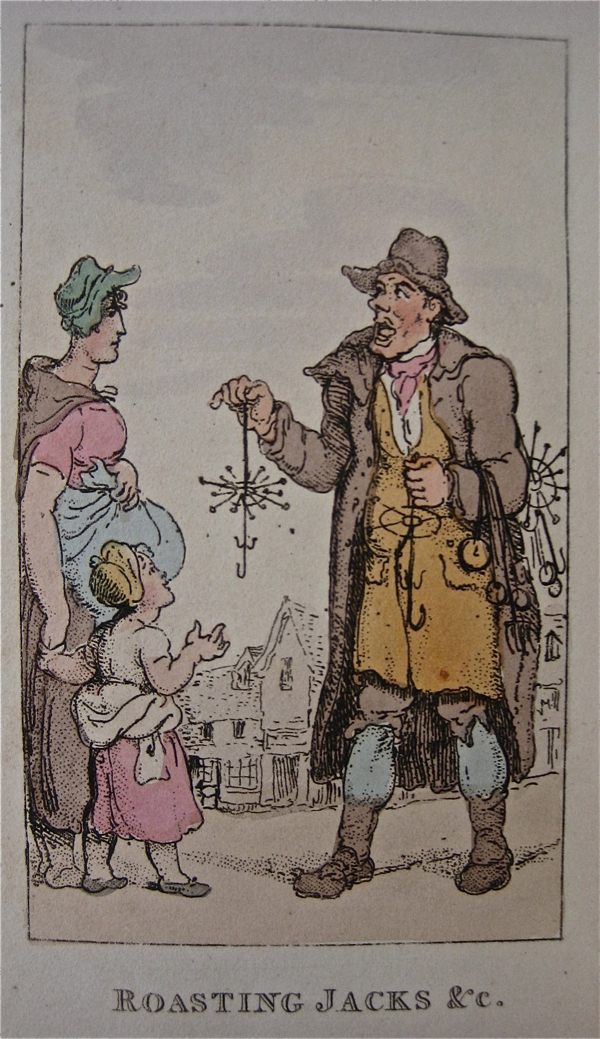
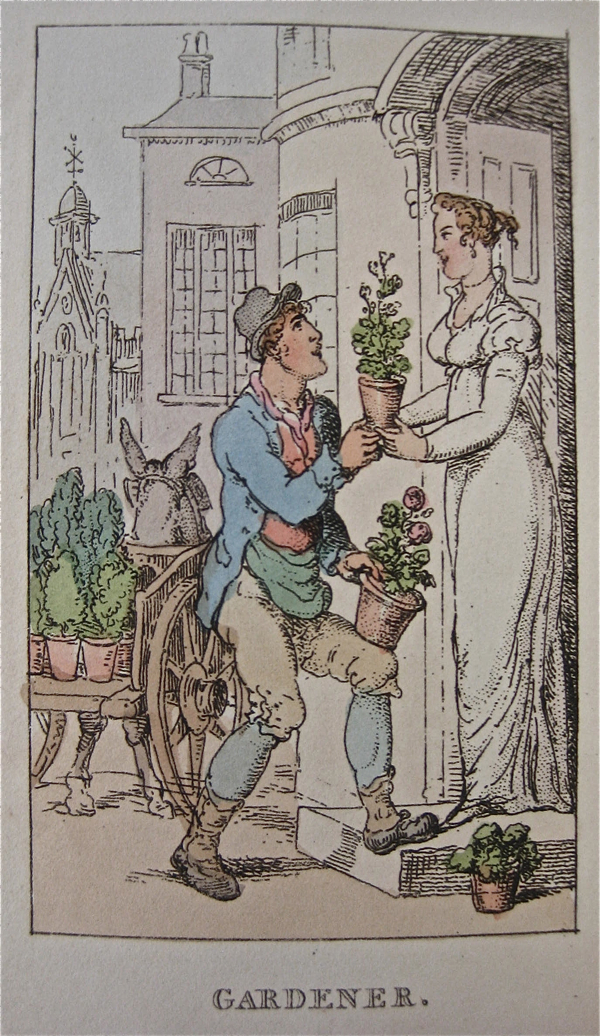
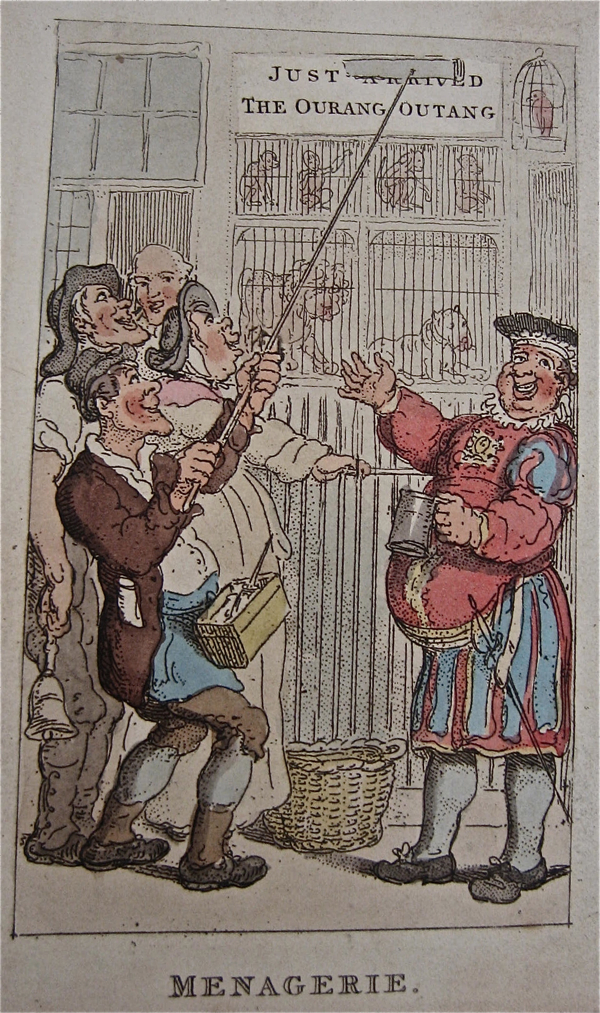
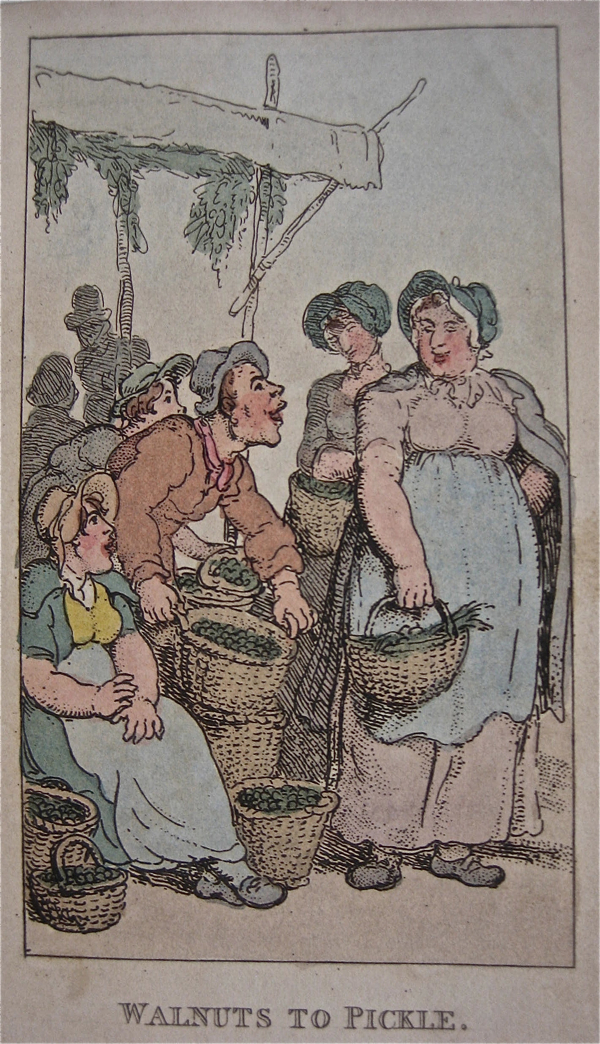
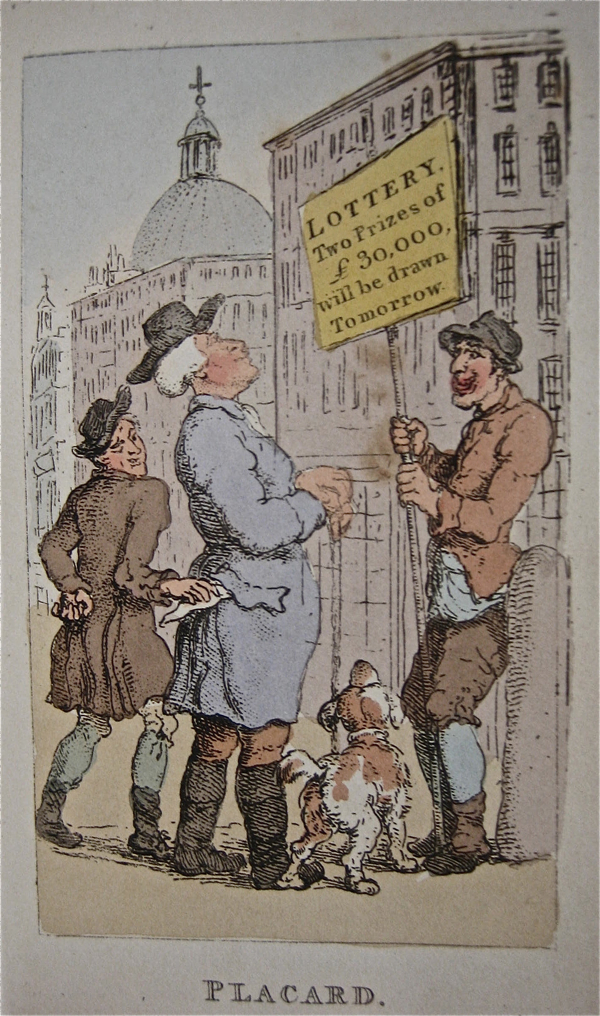
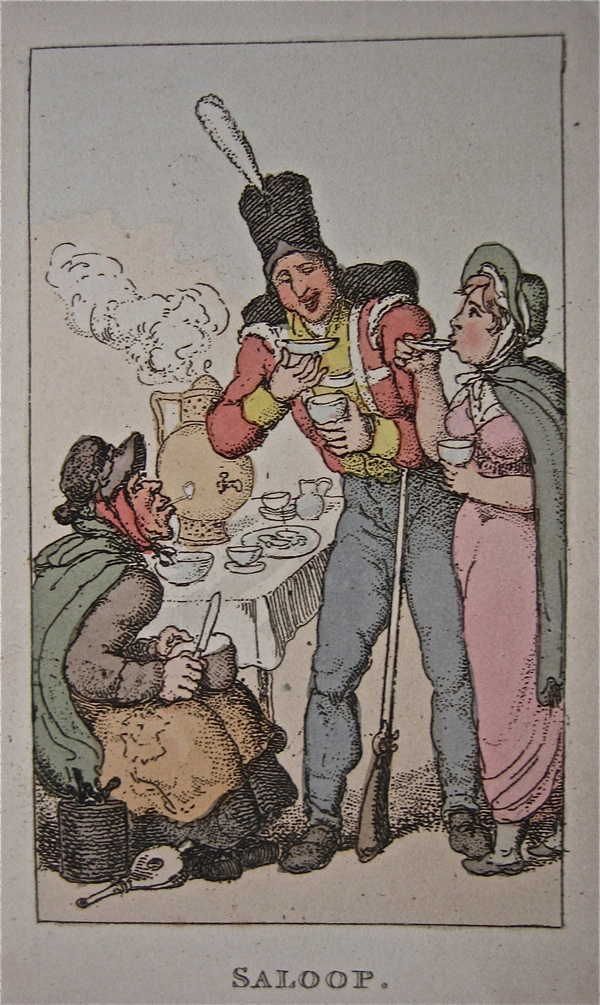
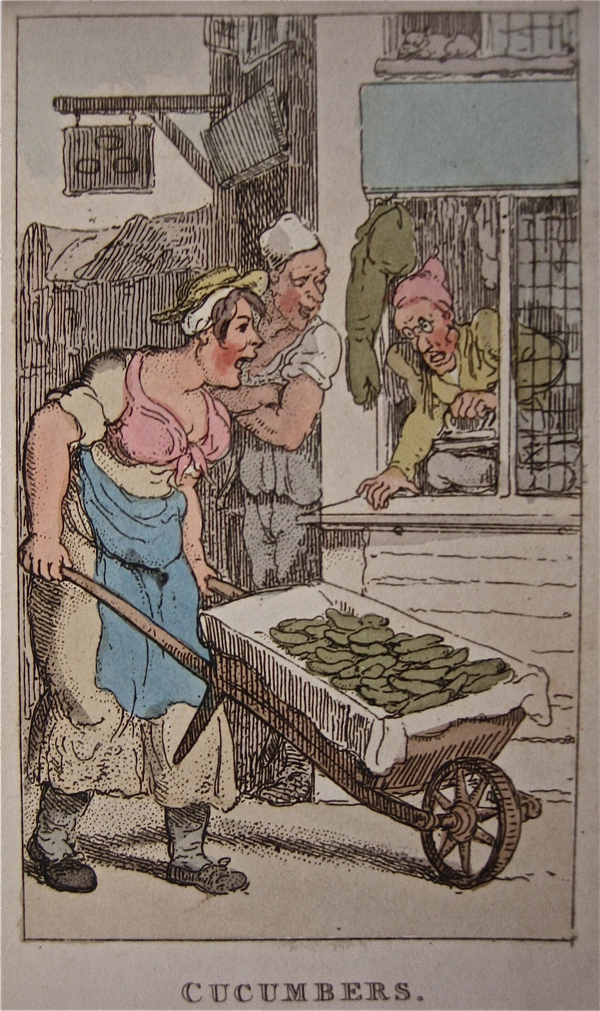
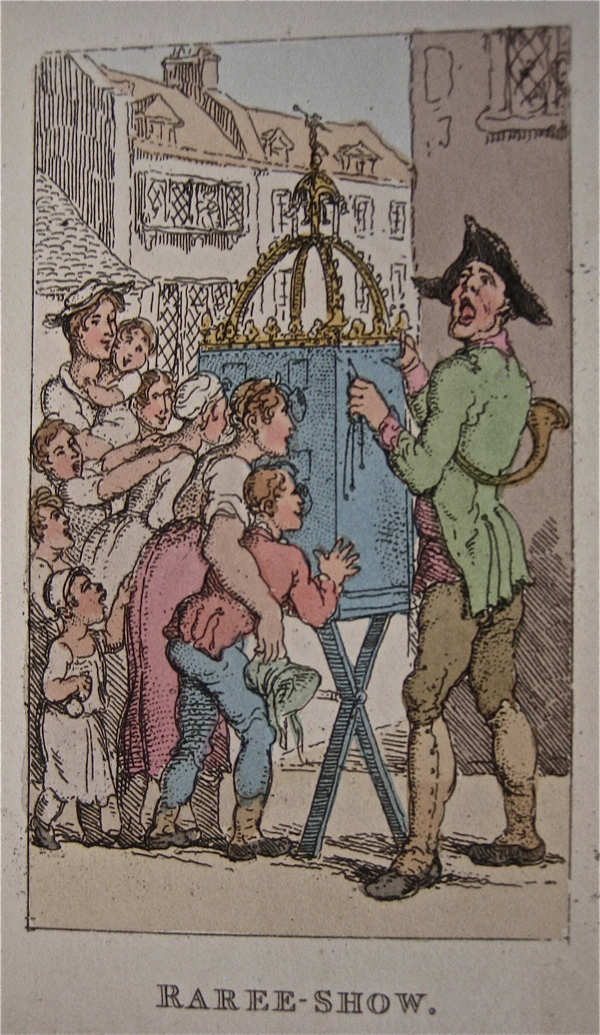
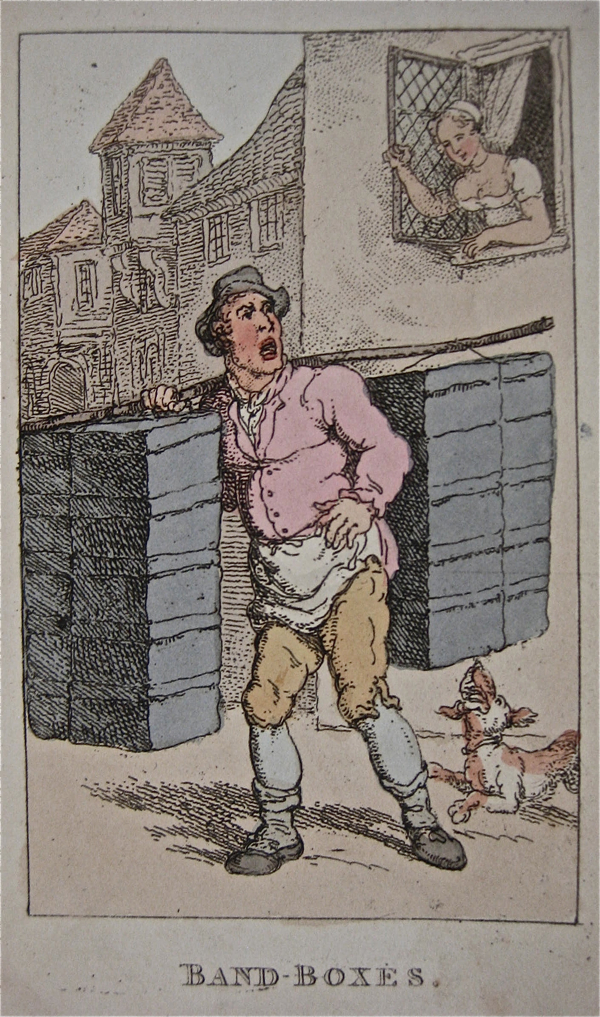
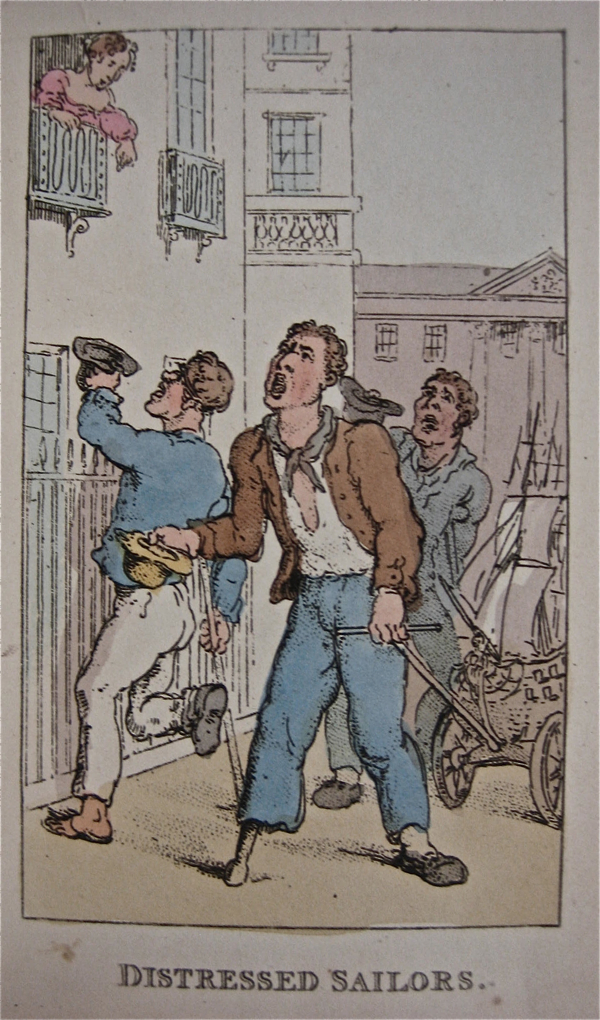
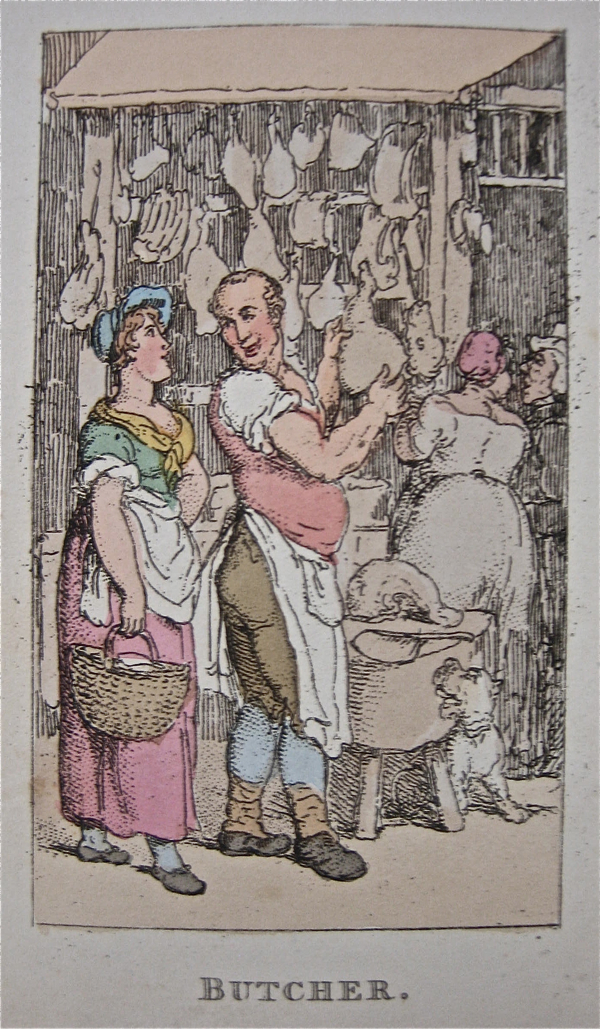
A few weeks ago I came across some examples of Thomas Rowlandson’s “Characteristic Series of the Lower Orders” from 1820, and those images compelled me to seek out more of these appealingly raucous pictures that, even though they were drawn almost two centuries ago, can still be equated with the street life of London today. As I go wandering through Spitalfields each weekend, weaving my way through the dense crowds of tourists, hustlers, hipsters, drunks, clubbers, traders, hawkers and cool cats, I am surrounded with an intense array of human dramas to match any of Rowlandson’s observations in these pictures.
Compared with many of the other sets of Cries of London that I have enjoyed recently, these are amongst the most unflattering images of humanity. In common with those photographs which catch people off guard, with red eye or gurning, Rowlandson’s pictures do no favours for their subjects, many of whom I recognise from their more aestheticised portrayals elsewhere – like Francis Wheatley’s portrayal of his wife as a graceful lavender seller. An image stylised to the sheen of a fashion plate that eventually became the illustration upon Yardley talcum powder tins in the twentieth century. Thomas Rowlandson’s lavender seller is no fashion model and she carries a screaming baby at her breast, an image that is never going to be reprinted on a biscuit tin yet speaks more eloquently of the human condition. In fact, many of the plates in his series were satires upon cliches of London street life familiar to the original viewers from other contemporary prints.
Yet there is a vibrant poetry to Thomas Rowlandson’s “Lower Orders,” transcending the Carry-On comedy stereotypes of fat ladies, nymphomaniacs, lewd codgers and young studs, because there is such wit and magnanimity in his vision that we cannot fail to to be assailed its exuberance. Unsentimental in the extreme, Rowlandson’s gaze is never dispassionate and frequently eroticised. Every bun, every walnut, every cucumber, every piece of meat, every bulge and curvaceous line of the masculine and feminine body is sexualised to a degree not seen again in English art until the postcards of Donald McGill.
These are such noisy pictures. Thomas Rowlandson is a rare artist in drawing so many of his subjects with their mouths open – not only are they garrulous, they are hungry and they are needy. They possess animalistic desire charged with human intelligence and they will not shut up. Who does not find the collective energy of humanity in London almost overwhelming sometimes – surging over London Bridge at 8:30am, crowding into Holborn station at 5pm, in Leicester Square on a Saturday night, and jostling in Brick Lane and Columbia Rd on a Sunday morning? The quality of Rowlandson’s talent is that he never alienates us from his subjects. Each of his pictures evokes an engaging story and, if we are honest, we recognise our own delights and desires manifest in his oddball Londoners of 1820. And you only have to stop in the crowd and gaze upon their successors around you in Brick Lane to discover comparable scenes today. We are these people.
Because Thomas Rowlandson had no illusions about his subjects, he had no disillusion or cynicism either – and that is why I find his drawings to be the most endearing portrayals of London street life that I know.
You may like to take a look at
Thomas Rowlandson’s Lower Orders
Marcellus Laroon’s Cries of London
More John Player’s Cries of London
William Nicholson’s London Types
Francis Wheatley’s Cries of London
My Quilt
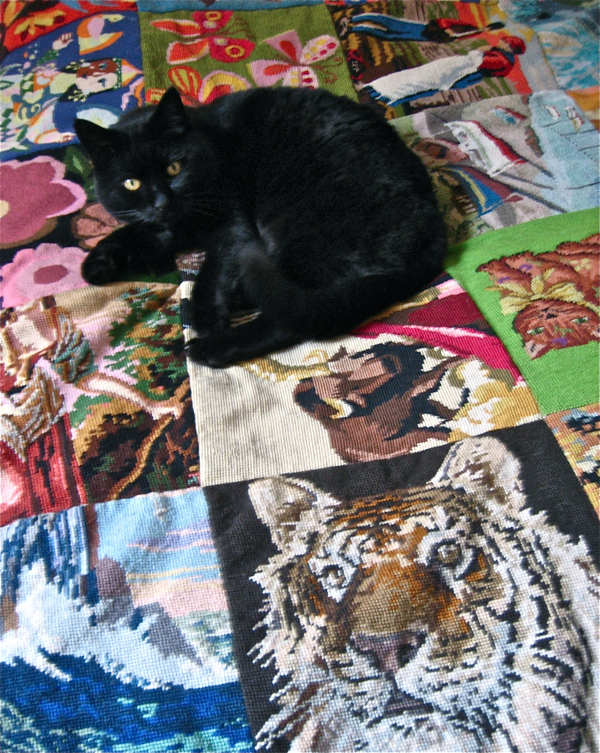
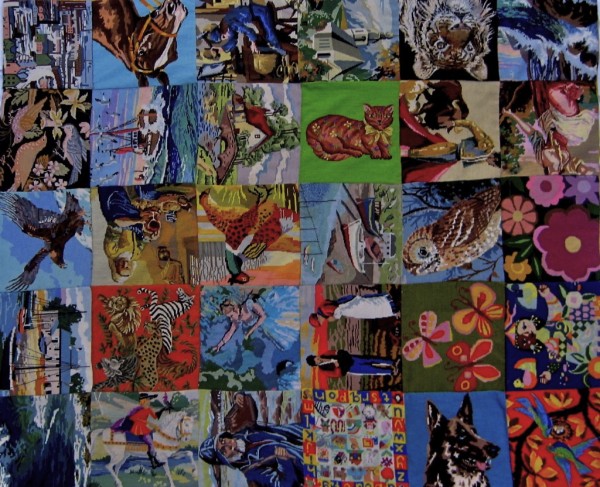
All the stories I have written this Winter (including these words you read now) were written beneath this quilt that I made a few years ago and which has special meaning for me. Once the snow began before Christmas, I retreated to my bed to work each day, abandoning my desk that had become piled with layers of paper and taking consolation in the warmth and comfort under my quilt, as the ideal snug location to devise my daily compositions. While the deep freeze overtook the city and snow whirled outside, I was happy there – in my secure private space, writing to you through the long dark nights in Spitalfields.
This is the only quilt I ever made and I make no claims for my ability as a stitcher which is functional rather than demonstrating any special skill. Once I made a shirt that I sewed by hand, copying the pattern from one I already had, and it took me a week, with innumerable unpicking and resewing as I took the pieces apart and reassembled them until I achieved something wearable. It was a beautiful way to spend a week, sitting cross-legged sewing on the floor and although I am proud of the shirt I made, I shall not attempt it again.
My quilt is significant because I made it to incarnate the memory of my mother, and as a means to manifest the warmth I drew from her, and illustrated with the lyrical imagery that I associate with her – something soft and rich in colour that I could enfold myself with, and something that would be present in my daily life to connect me to my childhood, when I existed solely within the tender cocoon of my parents’ affections. My sweetest memories are of being tucked up in bed as a child and of my parents climbing onto the bed to lie beside me for ten minutes until I drifted off.
For several years, after the death of my father, I nursed my mother as she succumbed to the dementia that paralysed her, took away her nature, her mind, her faculties and her eventually her life. It was an all-consuming task, both physically and emotionally, being a housewife, washing bed sheets constantly, cooking food, and feeding and tending to her as she declined slowly over months and years. And when it was over, at first I did not know what to do next.
One day, I saw a woollen tapestry at a market of a fisherman in a sou-wester. This sentimental image spoke to me, like a picture in a children’s book, and evoking Cornwall where my mother was born. It was made from a kit and entailed hours of skillful work yet was on sale for a couple of pounds, and so I bought it. At once, I realised that were lots of these tapestries around that no-one wanted and I was drawn to collect them. Many were in stilted designs and crude colours but it did not matter to me because I realised they look better the more you have, and it satisfied me to gather these unloved artifacts that had been created at the expense of so much labour and expertise, mostly – I suspected – by old women.
I have taught myself to be unsentimental about death itself, and I believe that human remains are merely the remains – of no greater meaning than toenails or hair clippings. After their demise, the quality of a person does not reside within the body – and so I chose to have no tombstone for my parents and I shall not return to their grave. Instead, through making a quilt, I found an active way to engage with my emotion at the loss of a parent and create something I can keep by me in fond remembrance for always.
I laid out the tapestries upon the floor and arranged them. I realised I needed many more and I discovered there were hundreds for sale online. And soon they began to arrive in the mail every day. And the more I searched, the more discriminating I became to find the most beautiful and those with pictures which I could arrange to create a visual poem of all the things my mother loved – even the work of her favourite artists, Vermeer, Millet, Degas and Lowry, as well as animals, especially birds, and flowers, and the fishing boats and seascapes of her childhood beside the Cornish coast.
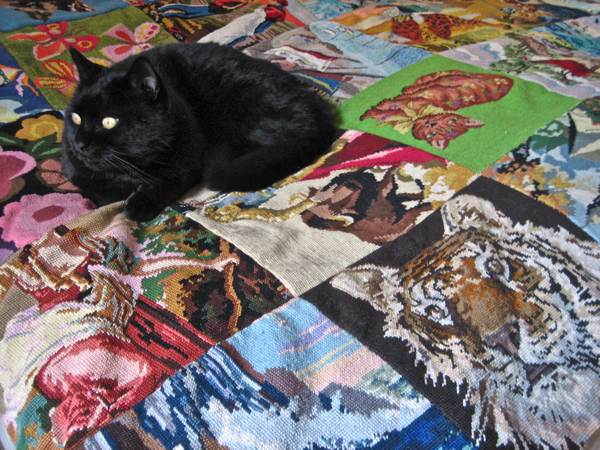
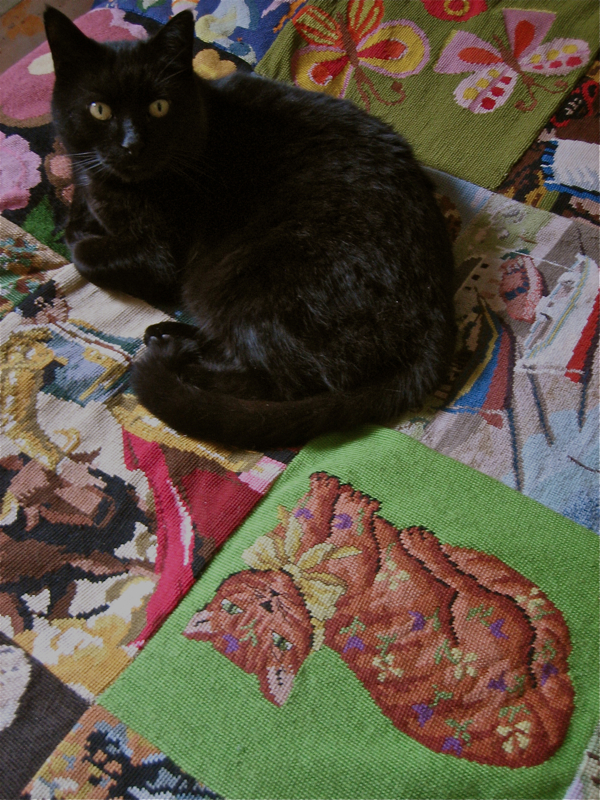
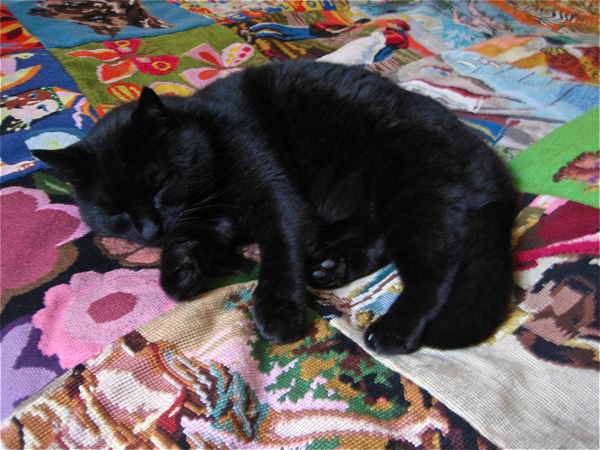
Over months, as the quilt came together, there with plenty of rejections and substitutions in the pursuit of my obsession to create the most beautiful arrangement possible. A room of the house was devoted to the quilt, where my cat Mr Pussy came to lie upon the fragments each day, to keep me company while I sat there alone for hours contemplating all the tapestries – shuffling them to discover new juxtapositions of picture and colour, as each new arrival in the mail engendered new possibilities.
The natural tones of the woollen dyes gave the quilt a rich luminous glow of colour and I was always aware of the hundreds of hours of work employed by those whose needlecraft was of a far greater quality than mine. After consideration, a soft lemon yellow velvet was sought out to line it, and a thin wadding was inserted to give it substance and warmth but not to be too heavy for a Summer night.
It took me a year to make the quilt. From the first night, it has delighted me and I have slept beneath it ever since. I love to wake to see its colours and the pictures that I know so well, and it means so much to know that I shall have my beautiful quilt of memories of my mother to keep me warm and safe for the rest of my life.
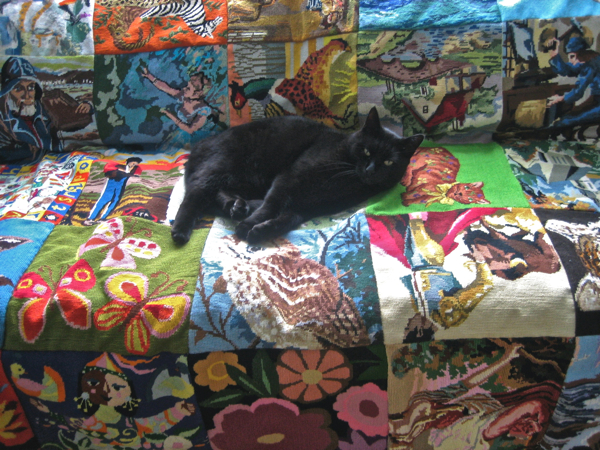
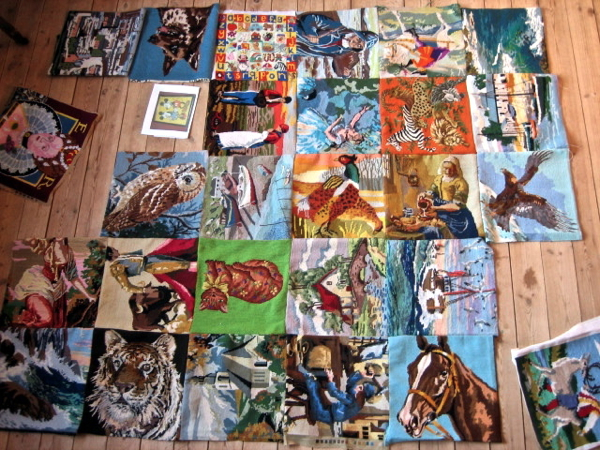
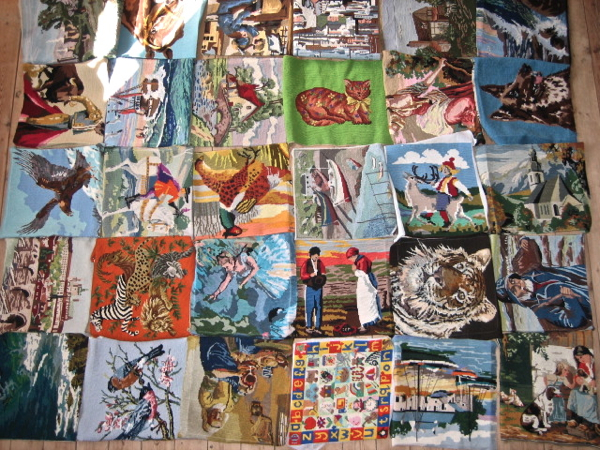
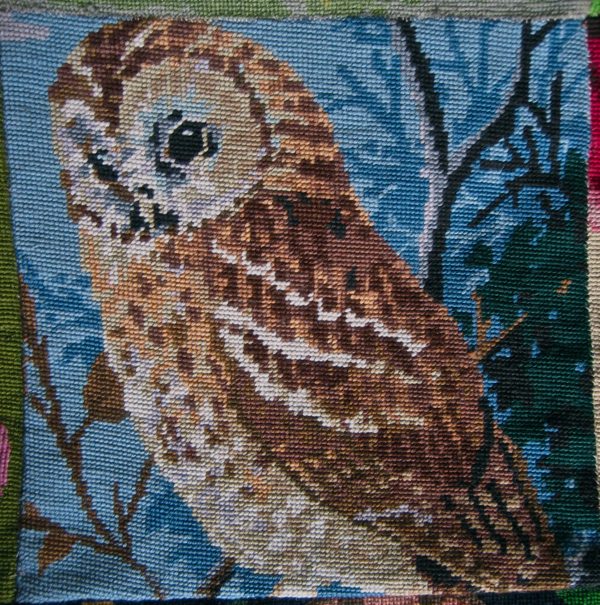
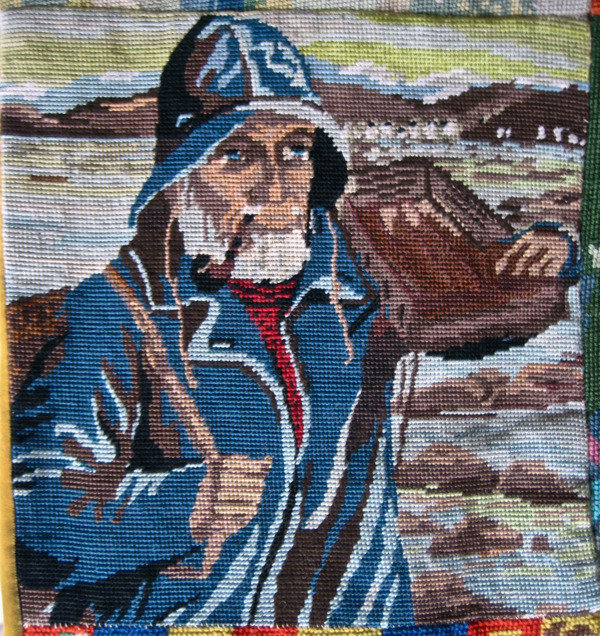
The first tapestry I bought.
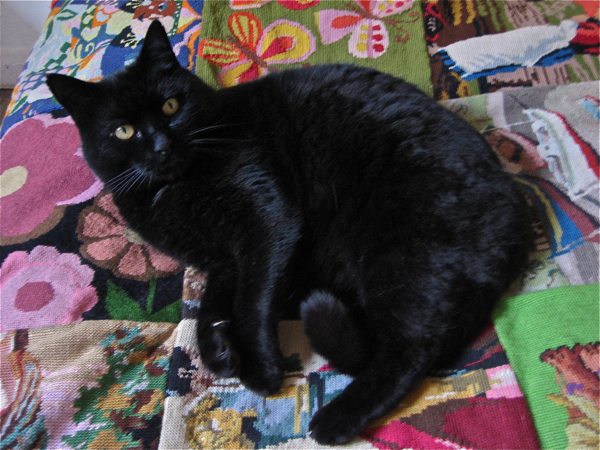
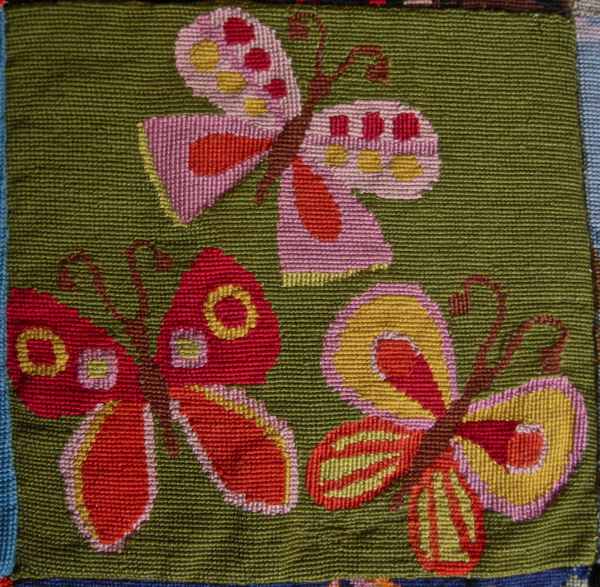
Seventies silk butterflies from Florida.
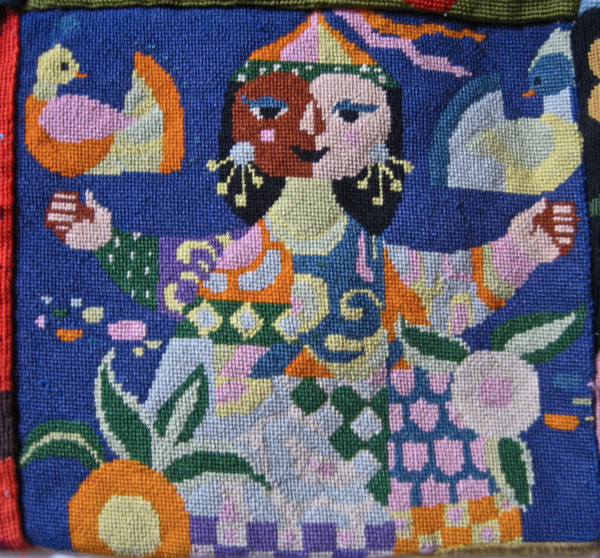
From Thailand.
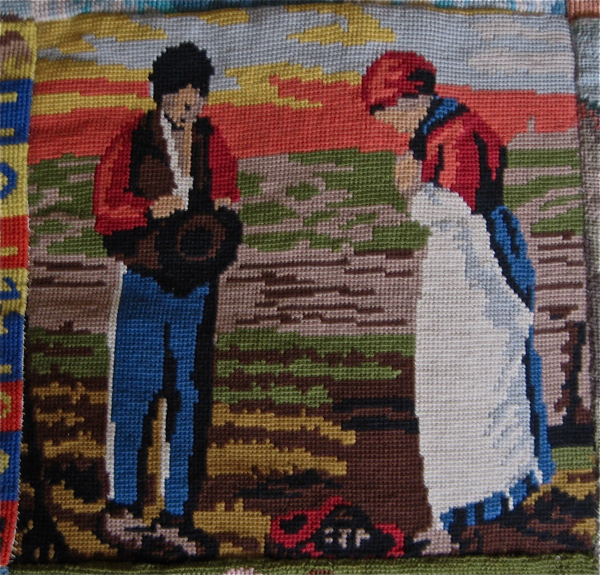
My grandmother had a print of Millet’s “The Angelus” in her dining room for more than sixty years.
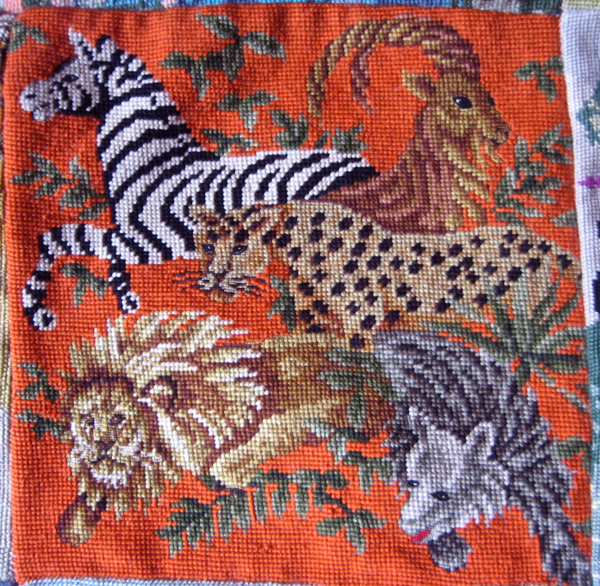
Note the tiny stitches giving detail to the lion’s head in this menagerie.
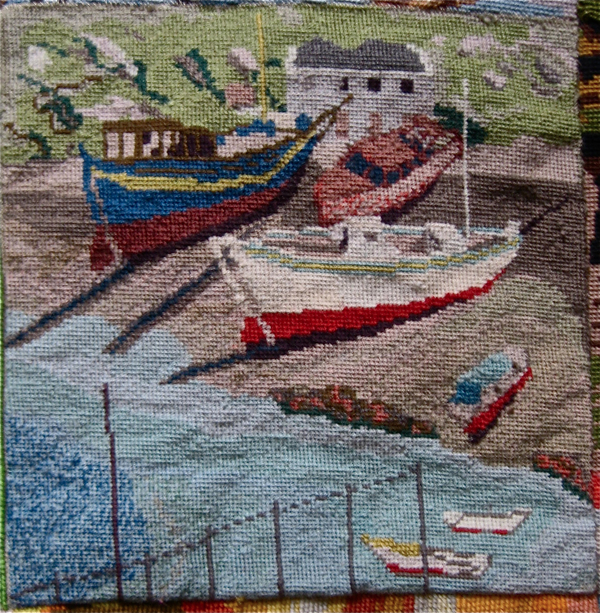
A unique tapestry from a painting of a Cornish fishing village.
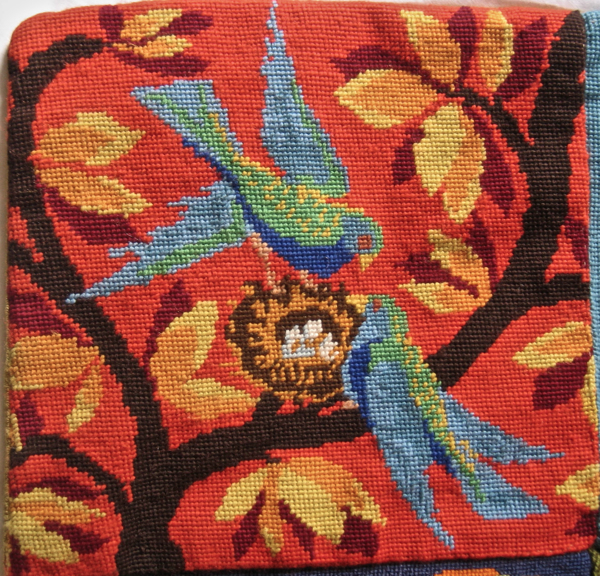
From the Czech Republic.
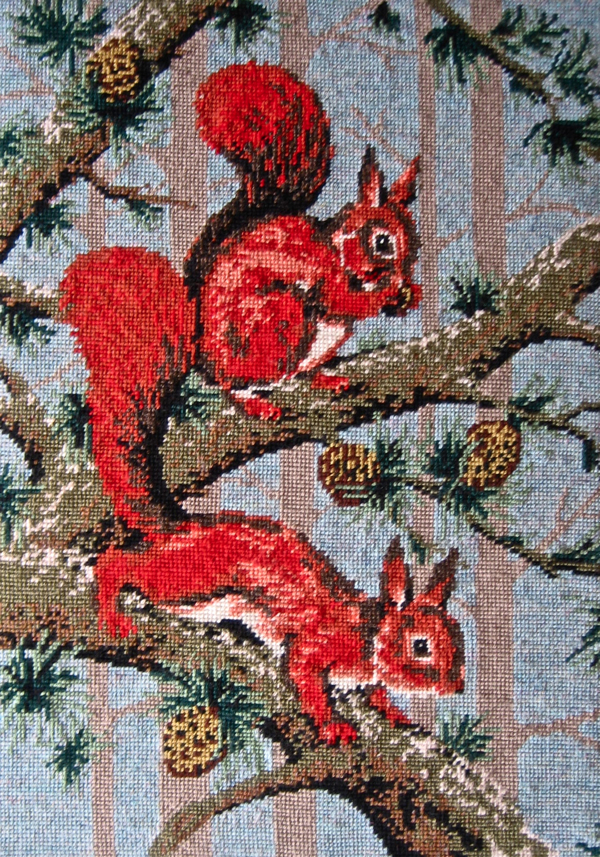
These squirrels never made it into the quilt.
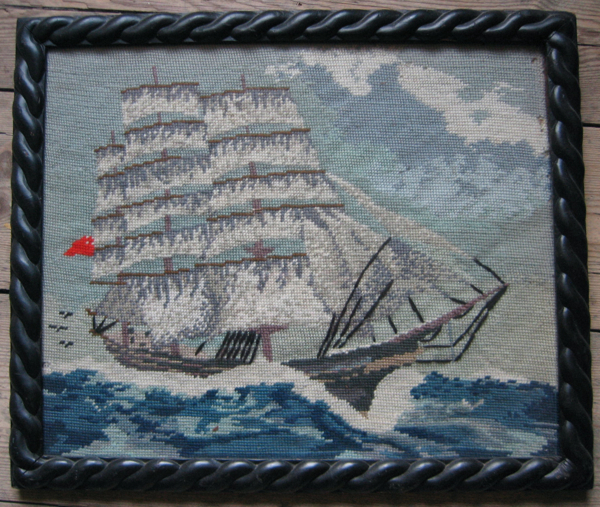
I could not take this wonderful seascape from its frame, it hangs on my wall today.
You may like to read about Mr Pussy in Winter
Columbia Road Market 70
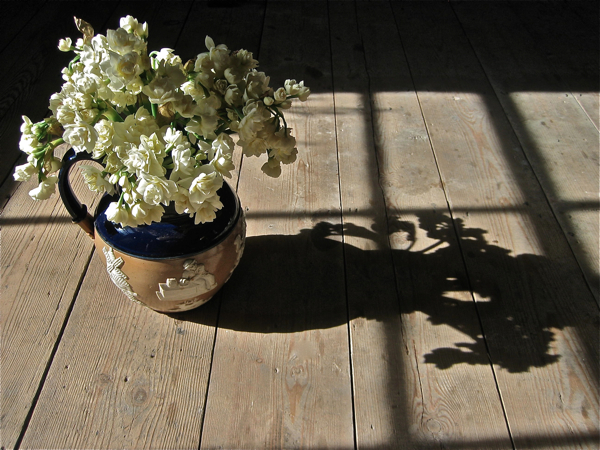
I bought these heavily scented Narcissi from Lisa Burridge at Columbia Rd, three bunches for just two pounds this week – possessing a pungent musky fragrance that fills my living room, and perfectly complementing the first flawless blue skies over the East End this weekend. They are just one of the many subtly different varieties of English Daffodils and Narcissi from Spalding Market that Lisa has on sale now, at the peak of the season for Spring flowers.
Waking early to sunlight, I am tempted to lie in bed watching the nesting birds coming and going from the bird house outside my bedroom window all morning, but it is a pleasure to rise when the sun offers such promise, and take a stroll up to Columbia Rd to visit Lisa Burridge at her stall and return with an armful of Spring flowers for the exchange of a few pounds. With her brightness of manner and sassy hoop earrings Lisa brings a touch of feminine glamour to the market, and it is always a pleasant diversion to stop by for a chat interspersed between the eager customers arriving to carry off flowers in delight. Lisa married into the Burridges – the family that over more than three generations have become such an integral part of the history of this market that they are considered the royalty of Columbia Rd.
“I started working here for my father-in-law Herbie Burridge when I was eighteen, twenty-four years ago,” Lisa confided to me proudly. “And my kids usually help out, only one’s got a driving lesson and the other has a throat infection,” she added with a philosophical smirk, explaining, “I take care of my family all week and work here on Sunday, and sometimes in the market at Waltham Abbey on Saturday.”
Lisa runs the cut flower stall on the one of the long-established Burridge family pitches for her husband Pete, while he manages the nursery in Hoddeston with his brother dealing in plants that are sold on another pitch. “It used to be forty stalls out of fifty-two here were Burridges once upon a time, Herbie told me,” commented Lisa in wonder. “More like twenty-one out of fifty-two,” qualified Pete with a good natured shrug, making a more conservative estimate as he arrived to join the conversation – though still quite an extraordinary proportion for one family in a market. “The old man liked to tell a tale,” admitted Lisa to me, flashing an indulgent smile, before she turned back to serve the next customer, reaching for yet another handful of the scented Spring flowers that surrounded her in a bower of pale yellow.
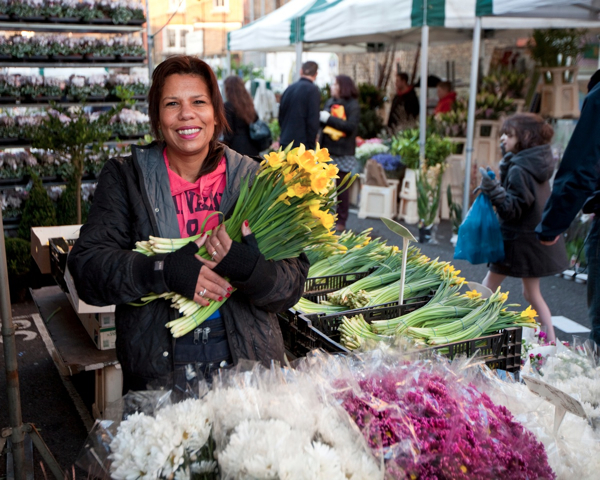
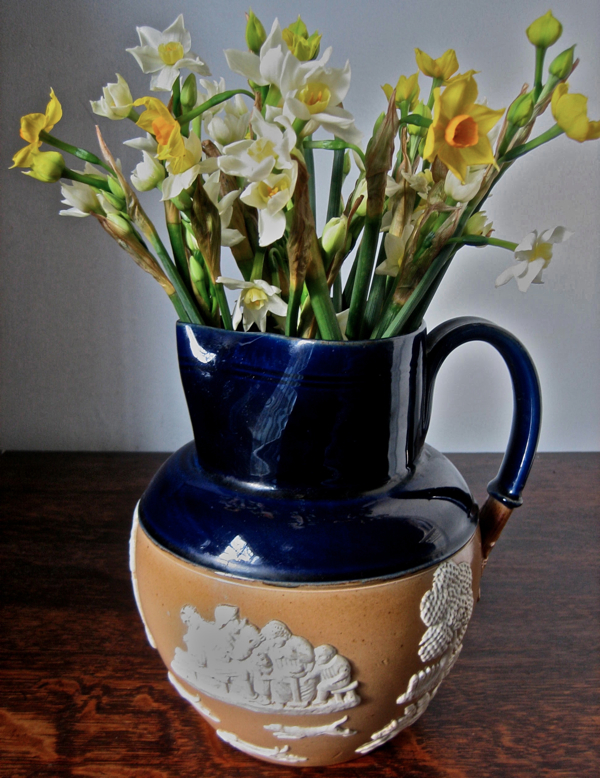
The Spring flowers of 2010 from Columbia Rd.
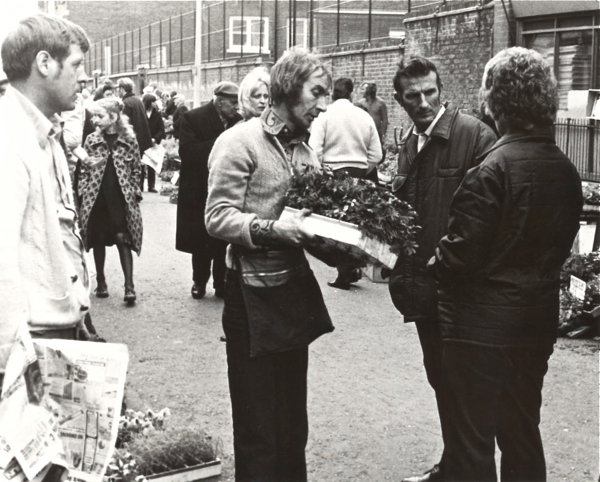
George Gladwell’s portrait of Herbie Burridge on the same pitch as Lisa, back in the nineteen seventies.
Portrait of Lisa Burridge copyright © Jeremy Freedman
You can learn more about the Burridges here
Josephine Ferguson (first husband Burridge)
Denise Kirstensen (née Burridge)
Leslie Norris of Bethnal Green

Leading this splendid parade advancing manfully down the Old Ford Rd is Leslie Norris, Warrant Officer of the London District Air Training Corps, at the head of the very first Bethnal Green Carnival in 1952 – and such was the joy that Leslie felt in being at the centre of his community, evident in this heroic image, that it remains undiminished even half a century later.
Growing up in the streets around Hackney Rd, Leslie earned the nickname “Ginger” and although now, at eighty-five, only a few fiery-red hairs in his eyebrows remain as clues to its origin, when I visited Leslie in his current home in Essex, he was eager to declare his enduring emotional loyalty to Bethnal Green. “Even though I live in Romford, I am an East Ender,” he confirmed to me absolutely with a proud grin.
Born at 26 Hassard St, Bethnal Green, to Florence, a French polisher and Albert, a seed merchant, Leslie grew up “with a whole family of aunts and uncles all within a mile of each other,” and the interweaving streets around Columbia Rd – where he attended school – were the centre of his world. “Friday evenings we’d do jobs for the Jewish women,” recalled Leslie, laughing in delight at how resourceful he and his pals were at the age of ten. “We’d get sixpence from Mrs Leibowitz, Mrs Brodsky and Mrs Bukowski because they weren’t allowed to work, and we would run errands, clear up and light the fires for them. And we used to go to the Spitalfields Market at closing time with a knife and ask for offcuts of fruit in a bag for our mums – and that would be our supply for the week.”
At first, when Leslie’s father took over his brother’s sawdust business, Leslie helped out by delivering the sawdust to the jewellers in Hatton Garden, but his first real job was as a “glue-boy” in a furniture factory in Columbia Rd. “At the age of fourteen, I once pushed a barrow with an oak dining table and four chairs all the way to St. Anne’s Rd in Tottenham – I know it was 7th September 1940, because afterwards I had to rush home and put on a suit for my brother’s wedding. And then that night, during a raid, three of my cousins were killed.” he recalled in sober contemplation. Next, Leslie went on to work in a saw mill in Ezra St – but the events of September 1940 meant that he had already determined to join up as soon as he was old enough and in 1943, after training, he became a wireless officer in the Royal Corps of Signals, serving in Burma.
Back home after the war, Leslie centred his existence around St. Hilda’s East on the Boundary Estate. “It was the place everyone met in those days. We’d go every night. We used to love to dance – even though we only had five records to dance to!” he enthused. Possessing the charisma of a natural leader, Leslie became both Chair of the Senior Club and Captain of the football team at twenty four, organising camping trips and days out – involving his contemporaries from the immediate neighbourhood who all became life-long friends. And the exuberant photographs vividly communicate the spirit of carefree Summer jaunts and youthful high jinks that presided, illustrating how St. Hilda’s performed a crucial social function, as Leslie confirmed with a gleam in his eye. “Twenty marriages came out of those years at the club,” he boasted, “including my own” – glancing quietly to a nearby photograph of Joyce Lucretia Graves who died in 2007, whom Leslie had known since she was seven and whom he married on the 29th March, 1952.
“Joyce was determined we should marry in St. Leonards, Shoreditch, but we were out of their parish and the Reverend, a guy by the name of Rutter, wouldn’t permit it.” admitted Leslie. Fortunately a priest that Leslie knew during the war stepped in and performed the ceremony “with bells and everything,” he informed me, triumphantly. And when thick snow made wedding photos impossible outside the church, Leslie and Joyce led the wedding party over to St Hilda’s East where they requisitioned the gymnasium for their pictures.
Many years later, Leslie discovered his great-great-great-grandfather John Norris had been married at St Leonards in 1786. And he and Joyce returned to the church, where Leslie’s ancestors had made their vows more than two centuries earlier. “We went back for our fiftieth wedding anniversary in 2002 and renewed our vows,” revealed Leslie, recalling the congregation of nearly two hundred people that came to greet him and Joyce as they arrived at the church. “It was beautiful to be back again,” he confided to me tenderly, before adding, “Some joker asked if I was wearing the same suit!”
In the fifty years that passed between these ceremonies at St Leonards, Leslie worked as a butcher at Smithfield, maintaining his ties with the area and becoming a Freeman of the City of London – even though he moved from Bethnal Green with Joyce and their two children, Ian and Colin, in 1968 to live among the green fields of Romford. Demonstrating his passionate sense of community, Leslie was President of the St John’s Ambulance, Mile End Division for thirty years, and became Vice President of the South West Essex Burma Star Association, so I was not surprised to learn that he was awarded the O.B.E. for his service to others.
“I still sing the school song to myself every night,” Leslie told me, revealing the depth of the connection he feels to Bethnal Green even now, and, quite unselfconsciously, he sang the opening verse, beginning, “Columbia, the name we treasure/ Thy name ever dear to me/ Thy memories will always bring me pleasure/ Through far away I may be…” just as he remembered hearing other soldiers sing it in the tents in the jungle when he was serving in Burma so many years ago.
And as I listened, Leslie Norris became “Ginger” Norris again and I understood the indelible impression that the vibrant life of this small patch of streets in Bethnal Green had in shaping his destiny.


Post-war celebrations in Cuff Place, where Leslie and Joyce lived for the first twenty years of their marriage – Joyce stands at the centre of the lower picture.

Leslie (on the left) with pals in Bethnal Green.

Leslie as captain of the St Hilda’s football team.

Leslie and Joyce on their first date, Southend, Easter 1949.

The first kiss.

On a Summer camping trip from St Hilda’s East.


Leslie and Joyce.

Leslie and the boys enjoyed getting into drag for a lark.

Joyce did the washing up in a field.

Leslie swept Joyce off her feet.

Leslie and Joyce on their wedding day after the marriage at St Leonard’s, Shoreditch, 29th March 1952, – photographed in the gymnasium at St Hilda’s due to heavy snowfall.

“We used to go every year to Ramsgate in the Summer, to the same house, for sixteen years”

Joyce sits among family on the beach at Ramsgate in the sixties.

A gathering at Leslie and Joyce’s in Romford in the seventies.

Joyce and friends enjoy a knees up.

Leslie and Joyce, 1973.

Leslie Norris of Bethnal Green.
Mud God’s Discoveries 3

For many people the Thames is a sacred river populated by diverse gods, as mudlark Steve Brooker has discovered from all the offerings that he finds deposited in the mud, representative of the religious beliefs amongst the immigrant cultures of contemporary London. “Ever since I started, I’ve found thousands of them,” Steve told me, suggesting that the sub-aquatic spiritual universe of the Thames must be a crowded place where immortals cohabit side by side. “Woolwich, Bermondsey and Rotherhithe are very big on Indian offerings,” added Steve helpfully, “whereas I find Chinese artifacts at Silvertown.”
Although Steve is not a religious person, these objects exert a powerful fascination upon him. When he is alone on the mud, scouring the water’s edge in the dawn mist and he discovers a religious offering, then Steve recognises a personal sense of awe in the human credulity which led to the deliberate placing of these offerings in the river with the expectation of a particular result.
Instead of fairies at the bottom of his garden, Mud God Steve presides over a large community of deities from the Thames, and amulets too – all artifacts contrived to evoke benign spirits. But when Steve finds Voodoo dolls impaled with needles or vials wrapped in paper with obscure texts including the word “Lucifer,” then he leaves these strange offerings where he finds them in the river. “I don’t believe it, but I do have a healthy respect for it,” he admitted Steve warily. Once he came within three feet of being hit by an effigy, when at low tide the owner threw it with considerable heft to reach the water, narrowly missing knocking Steve for six. “They are just for luck – but I could have been killed by an offering!” declared Steve in affront, widening his eyes at the absurdity of it.
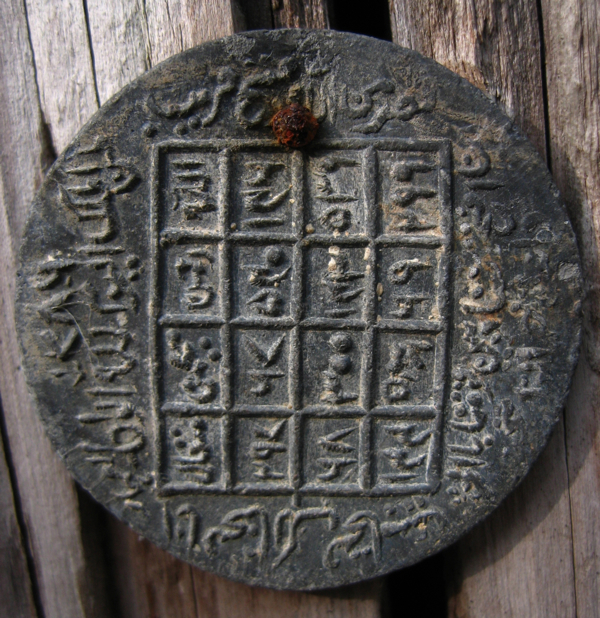
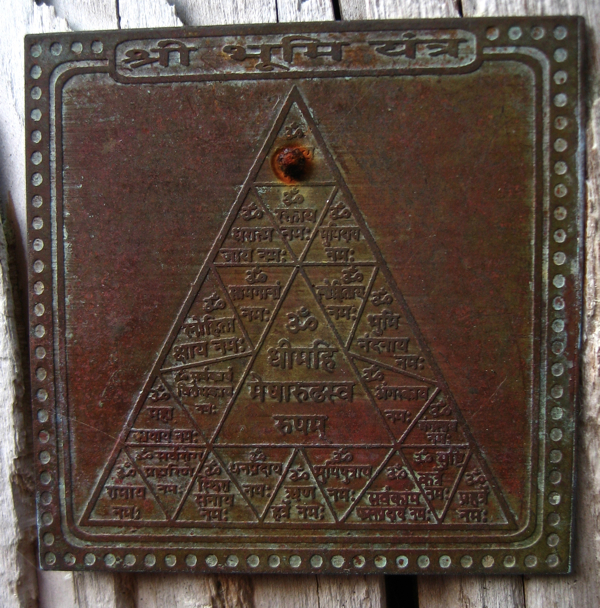
An invitation to examine some “Roman” pots at Woolwich led Steve on an especially muddy episode, which revealed hundreds of terracotta ghee pots (resembling Roman lamps) associated with the Indian festival of Diwali, when traditionally these lamps are set adrift upon the Ganges – the Thames in this instance standing in for the sacred river among London Hindus. Another common find are square metal plates incised with designs, these “yantras” are talismans to avert misfortune.
Most fascinating to Steve are the many modest silk bundles he finds upon the shore bound up carefully in red thread, containing offerings of seeds and sweet corn and coins. Also, sometimes wrapped up and tied in red thread are padlocks and glass vials containing fluid enfolded in texts written upon waxed paper, and the significance of the red thread especially perplexes him. “It means something to someone,” he mused.
“Always collect any coconut you see in the Thames,” Steve advised me – especially if it has been drilled and resealed, because these commonly contain offerings, which sometimes may be of value. Naturally, gold is the offering of greatest worth and Steve once found a lump of gold wrapped up in lead – lead and gold being two materials often combined in religious offerings – another source of enigma.
Many of the effigies in the river are cheap mass-produced objects, purely for the purpose of sacrifice, yet the human significance placed up these things gives them emotional value and meaning for Steve. Although occasionally, extraordinary sculpted items also turn up like the exquisite bronze head below which has its own presence and is believed to be of African origin.
There is a collective mystery to these objects that do not give up their secrets easily, and Steve feels obligated to provide a safe home for them all – in the private hope that one day they will speak to him. “I’d like to be a Buddhist,” he confessed to me, with the rogueishly appealing smile that is his signature,“but I think I’m too nasty!’
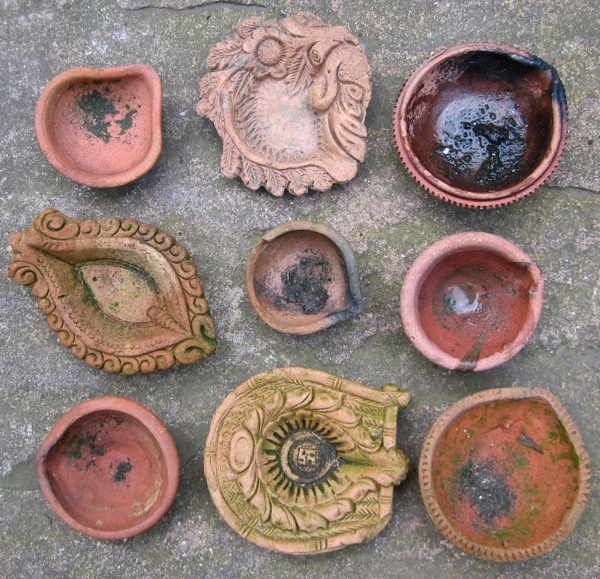
Clay lamps used by Hindus in the festival of Diwali – filled with ghee and set alight, they drift off across the water.

Yantras, a talismans to ward off evil.

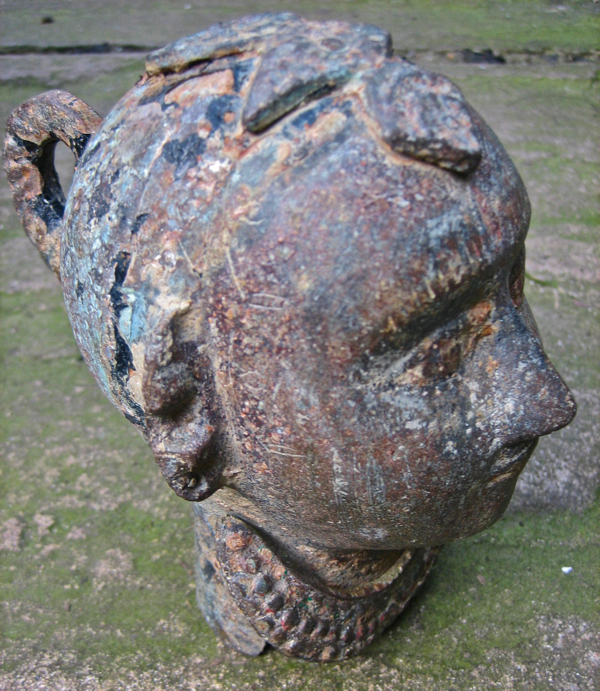
Fine bronze head believed to be of African origin.
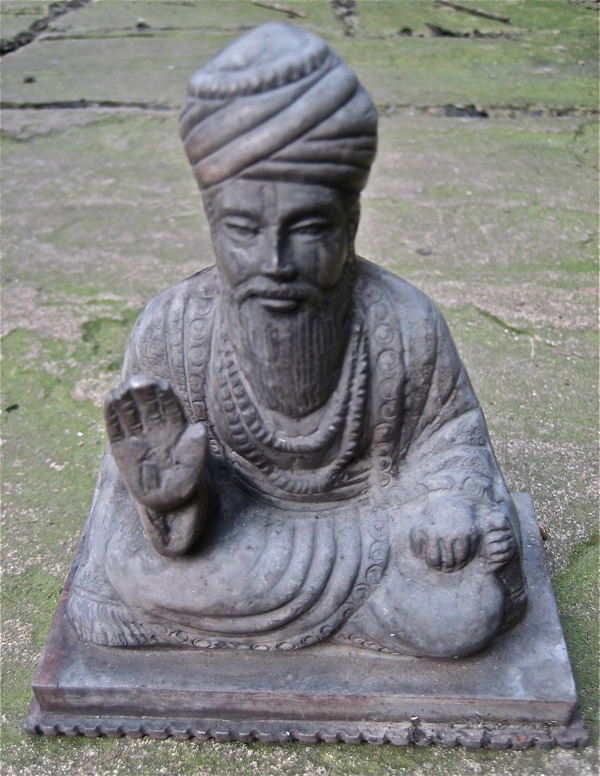
Steve Brooker’s series MUDMEN continues on History and you can find out more from his website www.thamesandfield.co.uk
You may like to catch up with












