A Wedding Dress of Spitalfields Silk

At Kensington Palace is preserved a modest white satin dress of Spitalfields silk of one hundred and seventy years old, made for a tiny woman with a miniscule waist, barely five feet tall and just twenty years of age. Lain upon the table in the former dining room of Princess Margaret and sequestered from natural light behind closed curtains, it has a delicacy that is almost ethereal, as if it were a gown left behind by a sylph or a passing fairy – but in fact this was the dress that Queen Victoria wore when she wed Prince Albert on 10th February 1840.
Just four months earlier, Victoria had set eyes upon her grown-up cousin for the first time only yards from where I had come to view her dress. And as I was led through the echoing passages at the Palace – where Spitalfields Life was granted special access to see this garment sewn of cloth woven in Spitalfields – I came into a fine stair hall known as the Stone Steps at the core of the building. Victoria was born in a room at the top of these steps, which as a child she was not permitted to climb or descend without another holding her hand, such were the stifling restrictions known as the Kensington System imposed upon the young queen by her mother. Although Victoria had been crowned at eighteen, until she married she could not move out to live independently at Buckingham Palace.
Yet upon these steps on 10th October 1839, Victoria was aroused by a vision of such rapture that it changed her life –“At half past seven I went to the top of the staircase and received my two dear cousins Ernest and Albert, – whom I found grown and changed and embellished. It was with some emotion that I beheld Albert who is beautiful…. so excessively handsome, such beautiful blue eyes, an exquisite nose, and such a pretty mouth with delicate mustachios and slight but very slight whiskers, a beautiful figure, broad in the shoulders and a fine waist.” This was the man who would father her twelve children, and five days after their meeting she proposed to him.
When Victoria chose the dress to marry Albert, she broke from the lavish precedent of George IV’s eldest daughter Princess Charlotte who had married in a heavy dress of silk net embroidered with silver. Victoria might have been expected to wear red velvet robes trimmed with ermine and a gown of ostentatious wealth for her marriage, but instead she chose to wear a simple white satin dress that was within the aspiration of any woman of means – a decision that reflected her wish not to emphasise the difference in status between herself and her groom.
The dress was made in two pieces, a skirt and bodice sewn of the finest gauge of ivory silk satin woven in Spitalfields. The simple bell-like skirt was supported by layers of petticoats and Victoria wore a corset of whalebone beneath the bodice. White Honiton lace ruffles adorned her sleeves, with a band of lace at her neckline, while a lace overskirt and train of lace completed the dress. The graceful simplicity of Victora’s youthful conception broke with tradition, expressive of her confident independent spirit, yet it initiated the custom for the white wedding dresses that we know today.
Although plainest among the wedding dresses in the royal collection, Victoria’s is the most radical in its assertion of the wearer’s personality, expressive of her personal desire not to outshine Albert, while equally, in her selection of Spitalfields silk and Honiton lace, celebrating the accomplishment of the native textile industry. A gesture of consummate diplomacy when there were those who might criticise her choice of a foreign husband. But beyond these declared intentions, through its lack of decoration, Victoria’s dress has a human quality as a piece of clothing, emphasised here in the place where she lived, and where one day she walked out of the door forever to commence her new life with Albert.
“10th February 1840, Got up at a quarter to nine, Mamma came and brought me a nosegay of orange flowers. Wrote my journal, had my hair dressed and the wreath of orange flowers put on. Saw Albert for the last time alone, as my bridegroom. Dressed. I wore a white satin gown with a very deep flounce of Honiton lace, imitation of old. I wore my Turkish diamond necklace and earrings and Albert’s beautiful sapphire brooch…”
Once she arrived at Buckingham Palace after her marriage – Victoria wrote – “I went and sat on the sofa in my dressing-room with Albert, and we talked together there from ten minutes to two till twenty minutes past two.” Only this silk gown and its creases were witness to that intimate half hour when Albert and Victoria were first alone together as husband and wife. But we know she carried the affectionate memories of the day, because Victoria continued to wear the train of Honiton lace from the wedding dress for the rest of her life and, even after Albert’s death, as an old lady in black, she wrapped herself in the white lace that enshrined her tenderest emotions.
Standing alone in the small dining room of the apartment in Kensington Palace, I cast my eyes upon the one hundred and seventy year old gown gleaming upon the table for one last time. This dress of Spitalfields silk was an instrument of liberation for Victoria, to leave the restrictions of her childhood and her past, to enter the arms of the man she loved, and to walk out in the wide world of potential that lay before her.


Marriage of Victoria and Albert by George Hayter, 1840
Top: Queen Victoria in her Wedding Dress by Franz Winterhalter, 1840
With grateful thanks to Joanna Marshner, Senior Curator, Kensington Royal Palace.
You may also like to read about Ann Fanshawe’s Dress of Spitalfields Silk.
Anthony Eyton, Artist
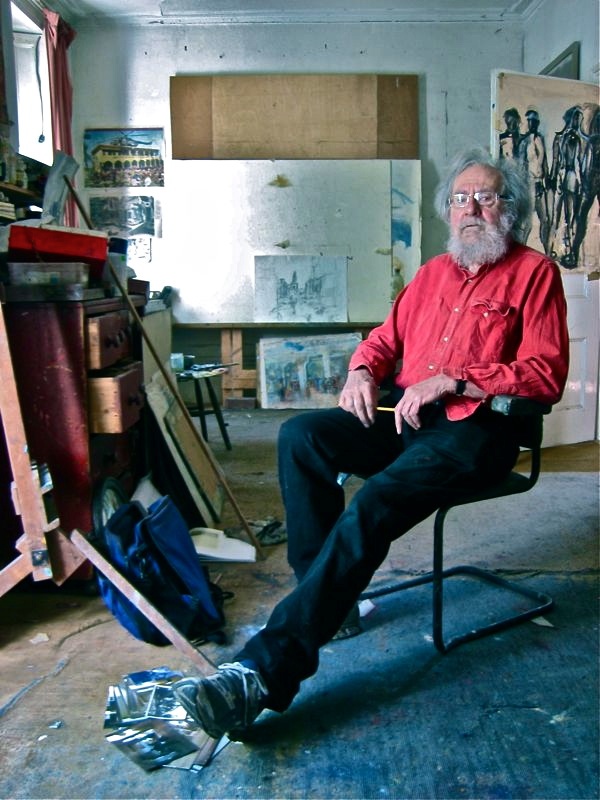
I took the 133 bus from Liverpool St Station, travelling down South of the river to visit the eighty-eight year old painter Anthony Eyton at the elegant terrace in the Brixton Rd where has lived since 1960 – apart from a creative sojourn in Spitalfields, where he kept a studio from 1968 until 1982. It was the 133 bus that stops outside his house which brought Anthony to Spitalfields, and at first he took it every day to get to his studio. But then later, he forsook home comforts to live a bohemian existence in his garret in Hanbury St and the result was an inspired collection of paintings which exist today as testament to the particular vision Anthony found in Spitalfields.
A tall man with of mane of wiry white hair and gentle curious eyes, possessing a benign manner and natural lightness of tone, Anthony still carries a buoyant energy and enthusiasm for painting. I found him working to finish a new picture for submission to the Royal Academy before five o’clock that afternoon. Yet once I arrived off the 133, he took little persuasion to lay aside his preoccupation of the moment and talk to me about that significant destination at the other end of the bus route.
“That biggest strangest world, that whirlpool at Spitalfields, and all the several colours of the sweatshops, and the other colours of the degradation and of the beautiful antique houses derelict – I think the quality of colour was what struck me most.” replied Anthony almost in a whisper, when I asked him what drew him to Spitalfields, before he launched into a spontaneous flowing monologue evoking the imaginative universe that he found so magnetically appealing.
“From Brick Lane to Wilkes St and in between was special because it’s a kind of sanctuary.” he continued, “And looking down Wilkes St, Piero della Francesca would have liked it because it has a kind of perfection. The people going about their business are perfectly in size to the buildings. You see people carrying ladders and City girls and Jack the Ripper tours, and actors in costume outside that house in Princelet St where they make those period films, and they are all in proportion. And the market was still in use then which gave it a rough quality before the City came spilling over and building its new buildings. Always a Mecca on a Sunday. I used to think they were all coming for a religious ceremony, but it’s pure commerce, and it’s still there and it’s so large. It’s very strange to me that people give up Sunday to do that… – It’s a very vibrant area , and when Christ Church opens up for singing, the theatre of it is wonderful.”
Many years before he took a studio in Spitalfields, Anthony came to the Whitechapel Gallery to visit the memorial exhibition for Mark Gertler in 1949, another artist who also once had a studio in an old house in one of the streets leading off the market place. “Synagogues, warehouses, and Hawksmoor’s huge Christ Church, locked but standing out mightily in Commercial St, tramps eating by the gravestones in the damp church yard. “Touch” was the word that recurred,” wrote Anthony in his diary at that time, revealing the early fascination that was eventually to lead him back, to rent a loft in an eighteenth century house in Wilkes St and then subsequently to a weavers’ attic round the corner in Hanbury St where the paintings you see below were painted.
Each of these modest spaces were built as workplaces with lines of casements on either side to permit maximum light, required for weaving. Affording vertiginous views down into the quiet haven of yards between the streets where daylight bounces and reflects among high walls, these unique circumstances create the unmistakable quality of light that both infuses and characterises Anthony Eyton’s pictures which he painted in his years there. But while the light articulates the visual vocabulary of these paintings, in their subtle tones drawn from the buildings, they record elusive moments of change within a mutable space, whether the instant when a model warms herself at the fire or workmen swarm onto the roof, or simply the pregnant moment incarnated by so many open windows beneath an English sky.
Anthony’s youngest daughter, Sarah, remembers coming to visit her father as a child. “It was a bit like camping, visiting daddy’s studio,” she recalled fondly, “There were no amenities and you had to go all the way downstairs, past the door of the man below who always left a rotten fish outside, to visit the privy in the yard that was full of spiders which were so large they had faces. But it was exciting, an adventure, and I used to love drawing and doing sketches on scraps of paper that I found in his studio.”
For a few years in the midst of his long career, Spitalfields gave Anthony Eyton a refuge where he could find peace and a place packed with visual stimuli – and then two years ago, a quarter of a century after he left, Anthony returned. Frances Milat who was born and lived in the house in Hanbury St came back from Australia to stage a reunion of all the tenants from long ago. It was the catalyst for a set of circumstances which led to an invitation to show the works in Spitalfields that he painted here so long ago, and that in turn prompted Anthony to revisit and do new drawings in these narrow streets which, over all this time, have become inextricable with his identity as an artist.
You can see Anthony Eyton’s paintings at 11 Spitalfields in Princelet St from 5th – 28th May.
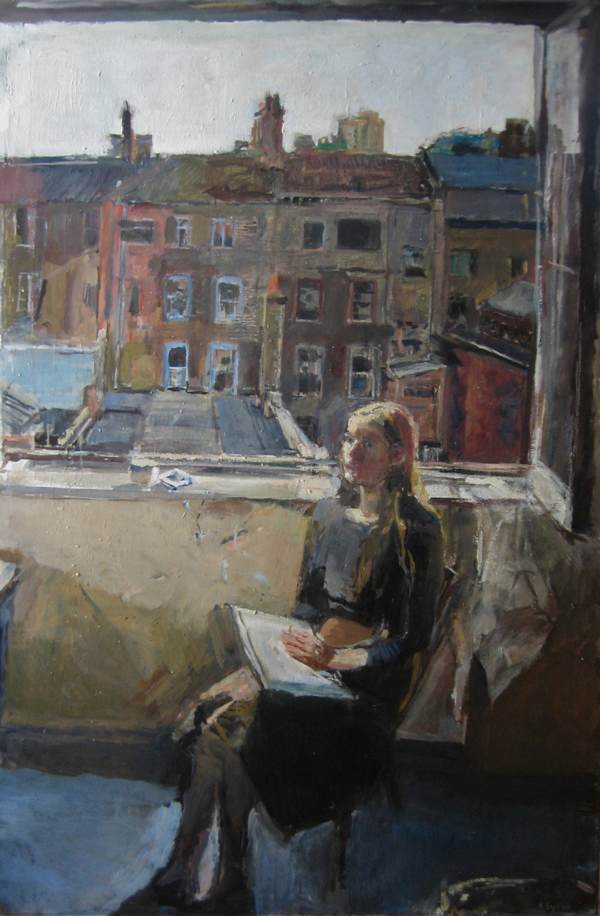
Christine, 1976/8. – “She was very keen that the cigarette smoke and grotty ashtray should be in the picture to bring me down to earth.”
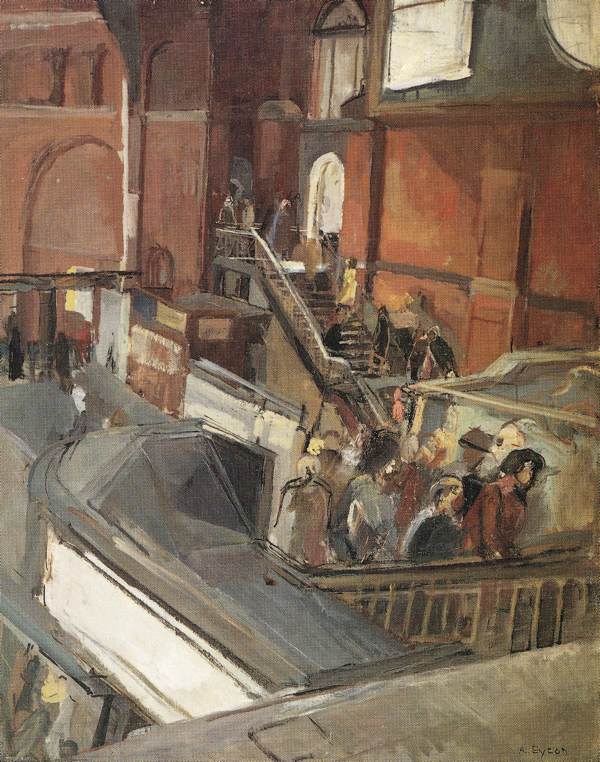
Liverpool St Station, mid-seventies.
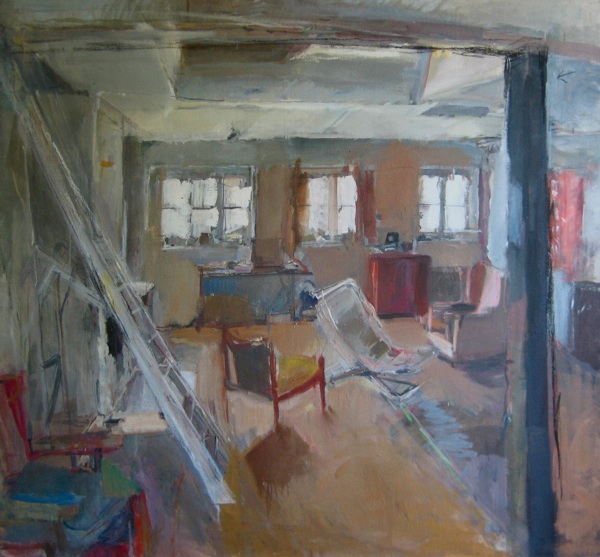
Studio interior, 1977.
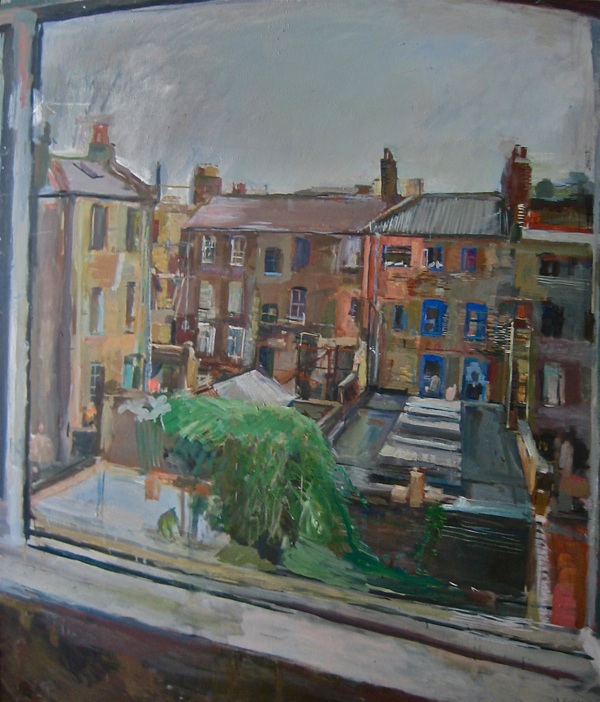
Back of Princelet St, 1980

Girl by the fire, 1978.
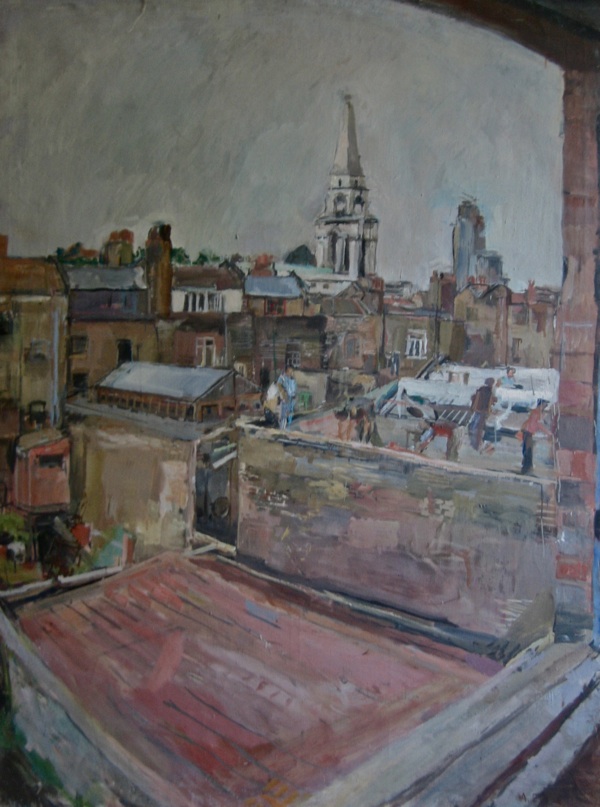
Workers on the roof, 1980
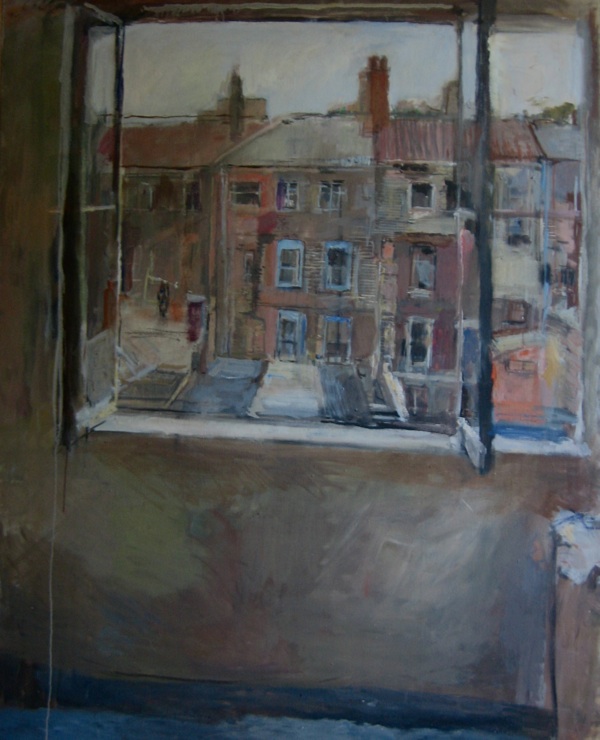
Open window, Spitalfields, 1976.
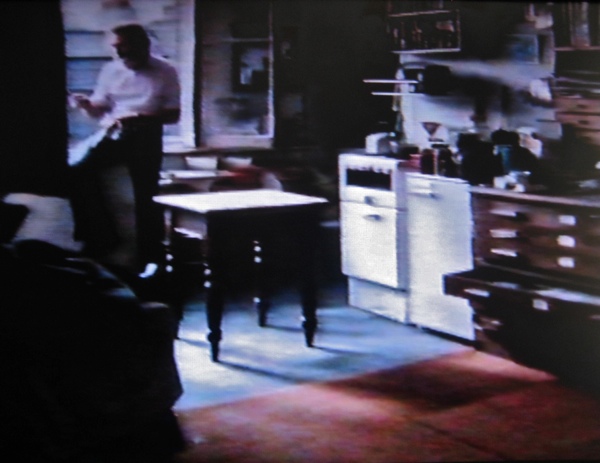
Anthony Eyton working in his Hanbury St studio, a still from a television documentary of 1980.

Wilkes St, 2011
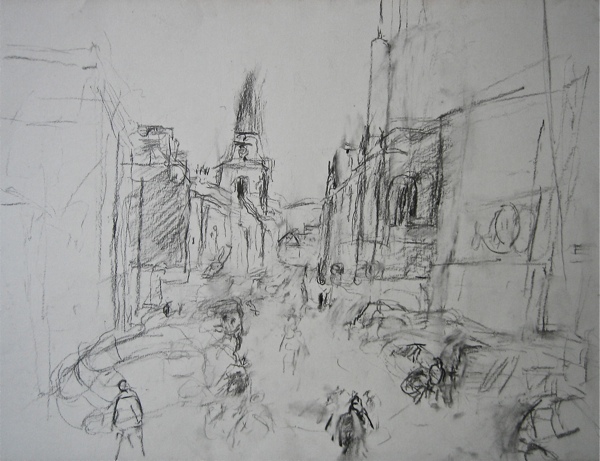
Fournier St from Banglatown, 2011
Pictures copyright © Anthony Eyton
Watch a film of Anthony Eyton in his extraordinary garden here.
The Return of Mick Taylor

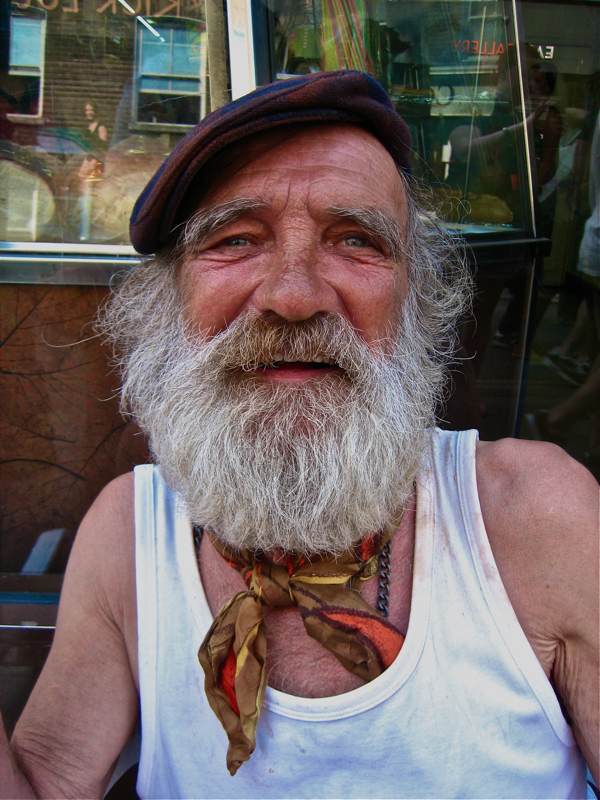
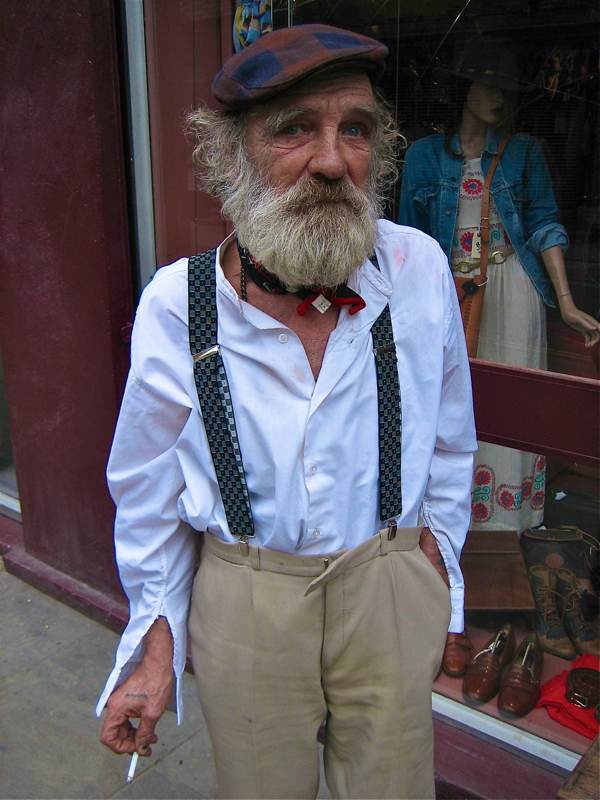
It was at the end of 2009 that I first interviewed Mick Taylor, the Sartorialist of Brick Lane, who was then regularly to be seen standing outside the Beigel Bakery, and gained popular renown for his stylish personal dress sense. When we spoke, Mick confided that he had been unwell and so, although I was disappointed, I was not surprised that I did not see him in Brick Lane at all throughout the long harsh Winter that ensued.
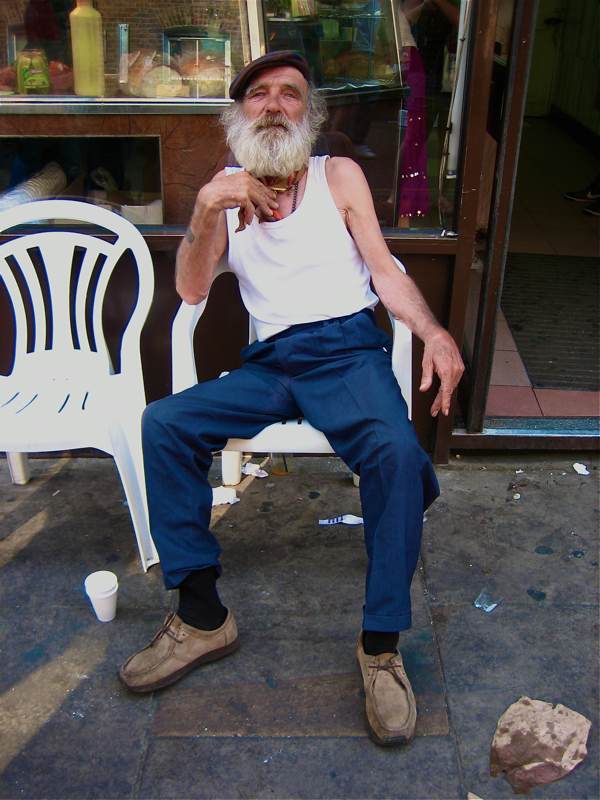
But he did not return the next year, and as the months passed I no longer expected to see him any more, although there were reports that he had been spotted around Whitechapel where he lives, so I carried hope that he might return to Brick Lane one day. And then this Spring, out of the blue, I encountered Mick sitting on a stoop near the Beigel Bakery, looking debonair in his big sheepskin hat and flashing a smile, just as he always used to and I was overjoyed to greet him and know that he has returned to the location that is his spiritual home.
On Easter Sunday we sat and drank tea together on Brick Lane, enjoying the warmth of the afternoon and watching the passing show, while Mick spoke about his life’s journey that brought him there.
“If you come down here to Brick Lane somebody always helps you out with a sandwich or something. Sometimes I come here without a penny in my pocket but I get a cup of tea. All it takes is to ask nicely and people will help you out. People want to sell things and I tell them where they can sell it. Knowing how to make a shilling, that’s what it’s all about and I’ve sold anything you care to mention over the years here.
I was a war child, I had no father but I had a mother. On 9th November 1945, I was born in my grandmother’s bed in Maclaren St, Hackney. My mother couldn’t afford to keep me so my grandmother and grandfather, Florence and George Taylor brought me up. I never had anything new, only secondhand things, but they brought me up well. My grandfather was a lovely man, he never hit me. He only had one eye, he was blinded in World War I, and he worked on the barges on the River Lee. My grandmother used to pawn his suit every Monday, buy veg on Tuesday, and get it back again on Thursday when he got paid, so he could wear it at the weekend. She taught me how to cook, and I still cook dinner every Sunday.
One day, when I worked for Truman’s, I got up at seven thirty in the morning and my grandmother had a heart attack and died in front of me. I went to work but I couldn’t work because my mind was falling to bits. So I told the foreman, and then I went wandering all over the place for four days until the police picked me up and took me to Hackney Hospital and, while I was under observation, I cut my wrists. I wanted to die because my grandmother was dead.
The woman in the next bed there was Frances Shea, Reggie Kray’s wife, she had mental problems. It sent her a little crazy being married to one of the Krays, but she was a lovely girl. I dressed up smart for her. Sixteen weeks we were together, she needed a bit of company and I took care of her. Then, when they sent her home, she died at once of an overdose but I don’t believe it. I loved her, and she cured me of the loss of my grandmother.
After that, I worked for the council and I did various jobs, I started my life all over again. I’ve been married a couple of times. I’ve lived my life, I’ve enjoyed it, I’ve had some good times. I’ve two sons but I don’t know where they are. Me and their mother divorced and I’ve never seen them again.
I never had much money but I’ve always made myself smart with a few quid and a suit and shirt – buying the right clothes, the right colour, the right cut. I used to go to Albert’s in Whitechapel and pay seventy five pounds for a pair of shoes, a suit, and a shirt. For my birthday, when I was seven years old, I came down with my grandmother to buy Italian shoes in Cheshire St for two pounds, two shillings and sixpence – pointed black shoes with Cuban heels. I already knew what I wanted at seven years old – you’re born with it, your style.”
Sporting his cap at a calculated angle, dressed in his petrol blue slacks, with a singlet, silk scarf and chain, Mick was in his element that day, and even as we spoke, passersby interrupted to request photographs with him. Like so many others, Mick has found a sympathetic community on Brick Lane, where he can present himself as he pleases and be celebrated for who he is too. Neither cynical nor sentimental about his past, Mick is able to inhabit the present with equanimity. Once we had finished our cups of tea, the shadows were lengthening, the stalls were packing up and the market crowds were thinning out, so I asked Mick what his plans were for the rest of Easter Sunday, and he rubbed his hands in hungry anticipation with a gleam of joy in his intense blue eyes.
“I’m going to buy a bit of lamb at the corner shop and boil it up with some potatoes and carrots and a few seasonal things. That’s Cockney food – a bit of boiled veg and a bit of a joint and if you’ve got money left, something sweet like a Spotted Dick. I learnt to make it when I worked in a pie shop when I was a child. Whatever pies was left, I always took them home with me.“Give it to the family,” they used to say. That’s the Cockney way of life.”


A Night at the Café de Paris
The unexpected concurrence of the prolonged spell of fine weather with a string of celebrations and festivals has gripped London with such a pervasive atmosphere of high day and holiday, that Spitalfields Life contributing photographer Sarah Ainslie and I decided it was time for one of our rare trips up West – to see if we could experience for ourselves some of the glamor and tinsel of the sophisticated metropolitan nightlife that is on offer.
Our destination was the legendary Café de Paris, built as an exact replica of the ballroom on the Titanic and opened by impresario Harry Foster in 1924. This was the glittering nightspot where Louise Brooks introduced the Charleston to London, where Noel Coward and Marlene Dietrich partied, where Orson Welles waltzed with Vivien Leigh, and where Cole Porter played many of his songs for the first time. Generations of Londoners celebrated here, the top place to see and be seen in the capital, and it stayed open throughout World War II until a pair of fifty pound bombs fell through the roof and exploded on the dance floor.
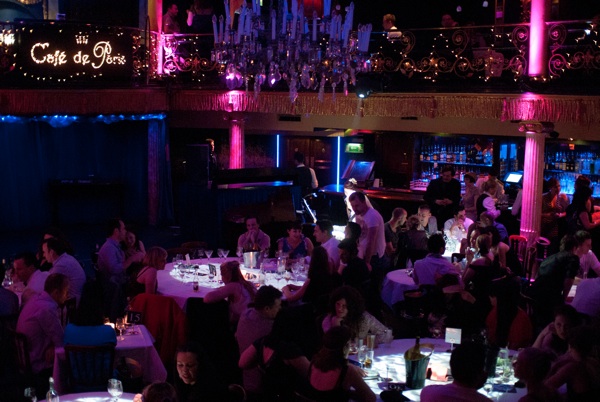
Yet in spite of everything, the Café de Paris is still here and it is just what a night club should be – with a pair of sweeping staircases leading down to an oval floor, surrounded by old gilt plasterwork and pillars with acanthus capitals supporting twirly gilded iron balconies, furnished with pink plush-velvet sofas, adorned with fringed rosy lanterns upon sconces, and topped off by a scarlet ruched-satin ceiling with a glistening crystal chandelier at the centre.
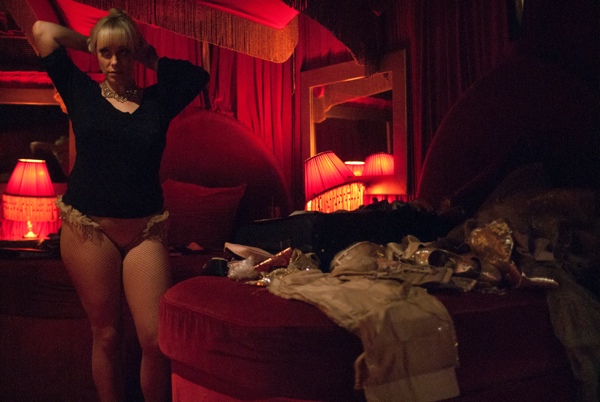
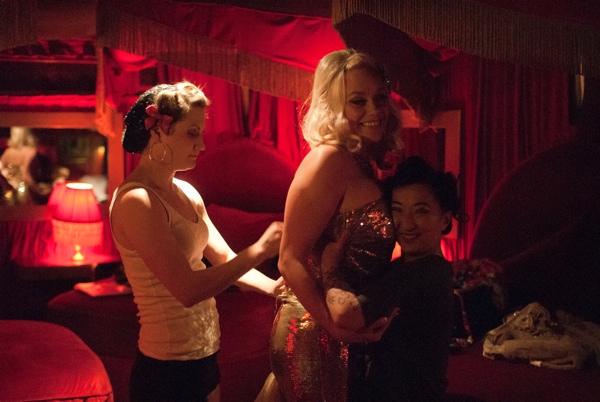
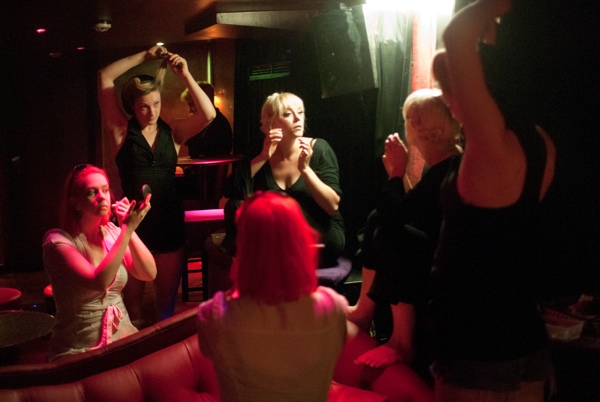
Promoter Tom Gravett has dedicated himself to rekindling the glory days of the Café de Paris as a cabaret venue with La Rêve each Friday night, and he certainly knows how to wear a double breasted suit to advantage too. Sporting a Clarke Gable moustache and floppy hair parted in the style of Errol Flynn, and flaunting an orchid in his buttonhole, he whirled us upon a breathless tour of the club and through into the dressing rooms upholstered in louche red velvet, where his performers – blithely unaware of our presence – were practising, preening and primping upon day beds in various stages of undress.
It was time to make our way to the centre of the floor where, beneath a haze of gold, pink and blue lights, candles glowed upon our table. Once we had taken our seats, Dusty Limits, a skinny birdlike young man with spidery limbs, fluent repartee and calculated insouciance, took the stage as master of ceremonies to promise us “an extraordinary cavalcade of cabaret genius.” Meanwhile, Tom retreated discreetly halfway up one of the sweeping stairs, a key position to scrutinise the progress of the evening. And all those in the balcony craned forward in excitement, their faces bathed in the reflected glow from the stage.
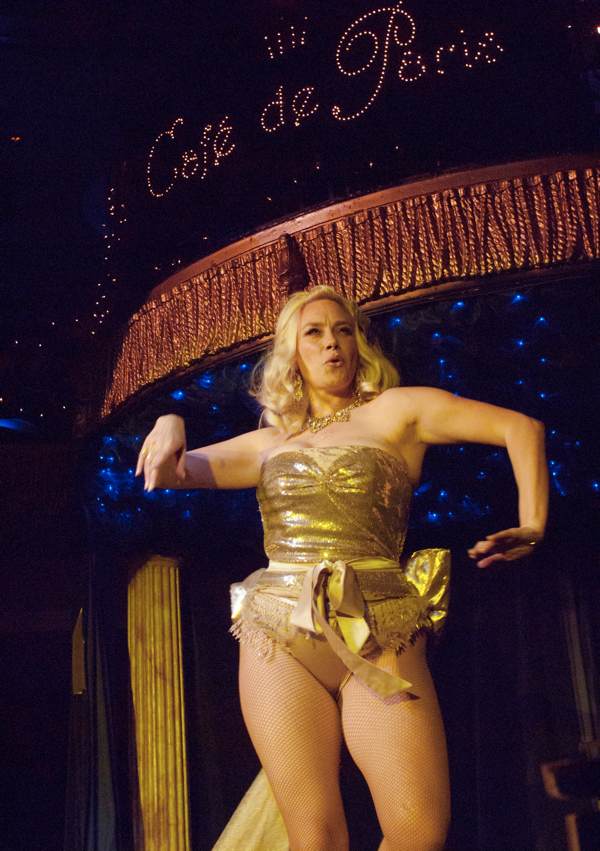
Opening act in the cabaret burlesque were the Bees Knees, an upbeat Charleston duo who did a bizarre quick change from Matelots to Russian peasants in folk costume while dancing all the time, followed by Miss Trinity Vogue in a red fedora who performed “Let’s have another drink!” accompanying herself on the ukulele, then the curvaceous blond Cherry Shakewell who lived up to her name with a neat trick spinning gold tassels from her appendages. Yet the undoubted early highlight of the show was Pippa the Ripper, rotating multiple hula hoops in opposite directions simultaneously from her gyrating legs, arms and torso. An act of excruciating complexity performed with a carefree expression of uninhibited delight, as if merely to say, “Look at me!” – when we were already slack-jawed in amazement at such an elegant spectacle.
East End favourite, Fancy Chance, winner of London’s Next Top Tranny Contest at the Bethnal Green Working Men’s Social Club last year, burst into the club in a wedding dress – with the irresistible wayward intensity that is her forte – tearing off her bridal gown to reveal a sassy feathery number and then discarding this too, she let her waist-length hair flow free and cavorted like a siren in her fringed scanties, chuckling with elation at her teasing charade.
All these acts shared a wit and ingenuity that included the audience in the joke, and the charismatic intimacy of this soulful old nightclub encouraged a natural sense of complicity. There was a pleasing spontaneity about the show yet the individual turns were slick, and seeing such diverse talents live at close quarters imparted a frisson of excitement you might not experience elsewhere – especially true of the final act of the evening, Brett Vista, an aerialist who performed in a hoop suspended over our heads.
As if unaware of anyone watching, this lithe young man drew himself up into the roof and hung suspended there, twisting and stretching his body into extraordinary contortions with grace and ease, constantly moving and turning in slow rhythm like one lost in a dream. The mesmeric quality of his movement held us all spellbound. He incarnated the magic of the place like a spirit conjured out of air, and, as he revolved in a shimmering aura of light above the audience at the Café de Paris, silent in wonder, the vibrant poetry of this extraordinary venue was alive for me.
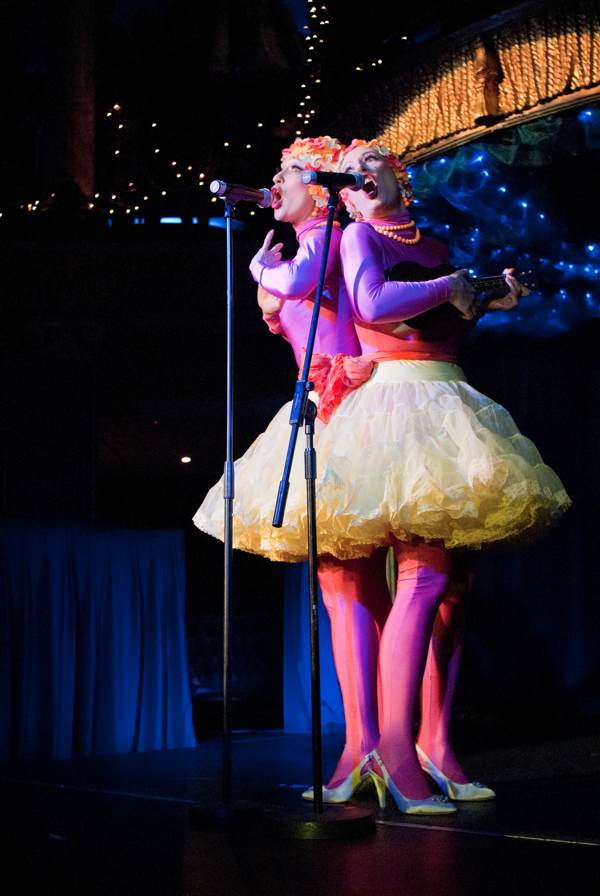
The Janus Sisters.
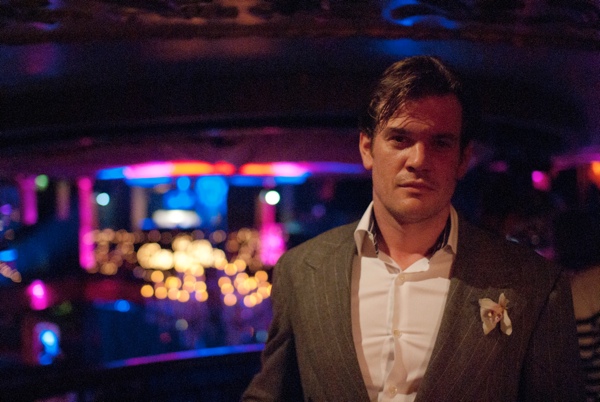
Tom Gravett, promoter of La Rêve.
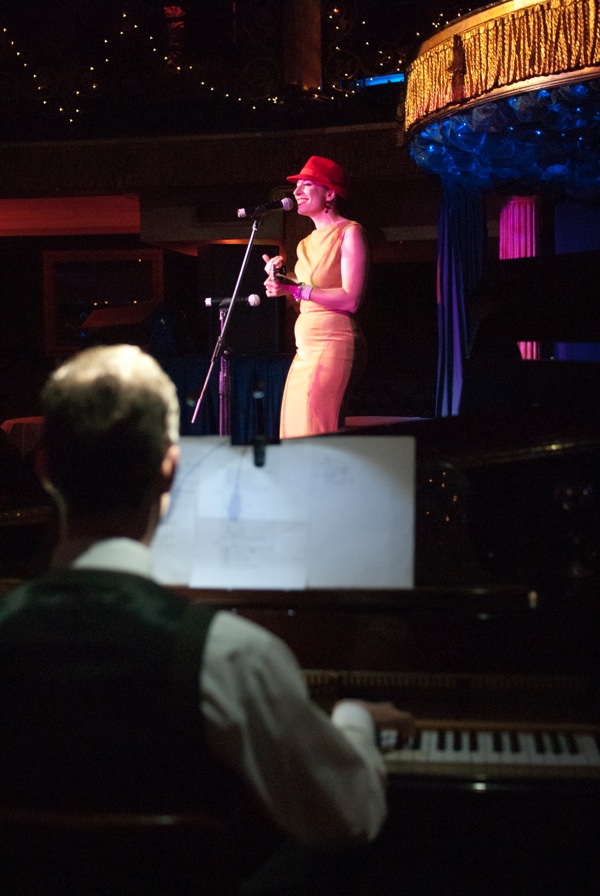
Tricity Vogue, with Michael Roulston at the piano.
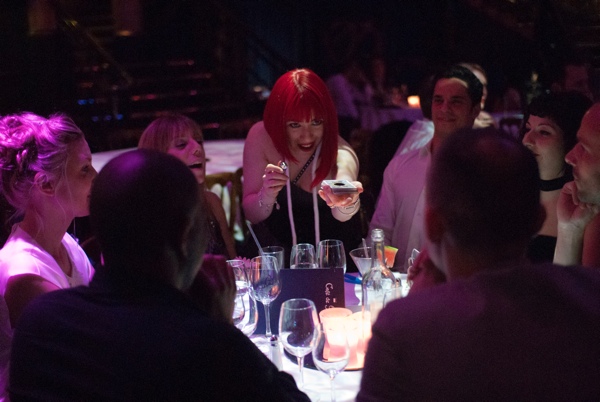
Louise London, prestidigitation at your table.
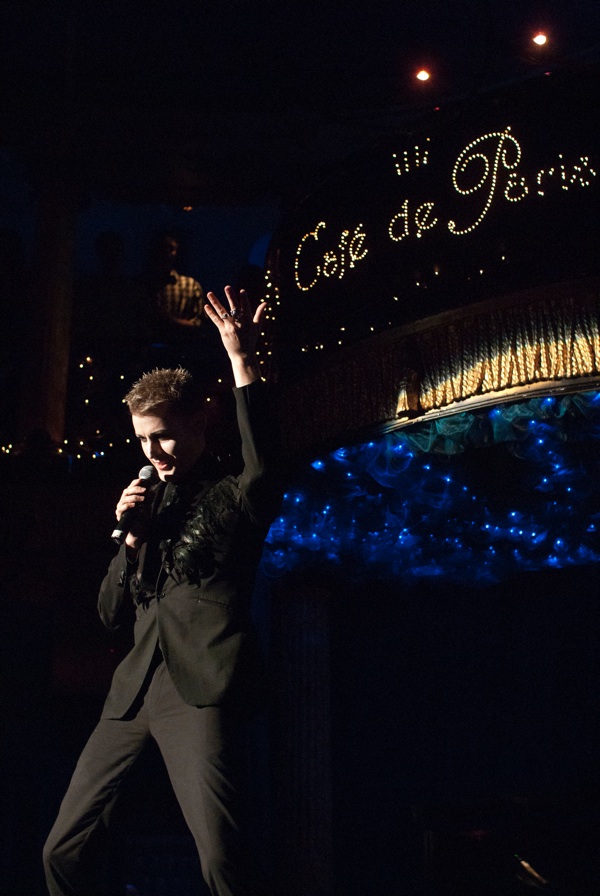
Dusty Limits, master of ceremonies.
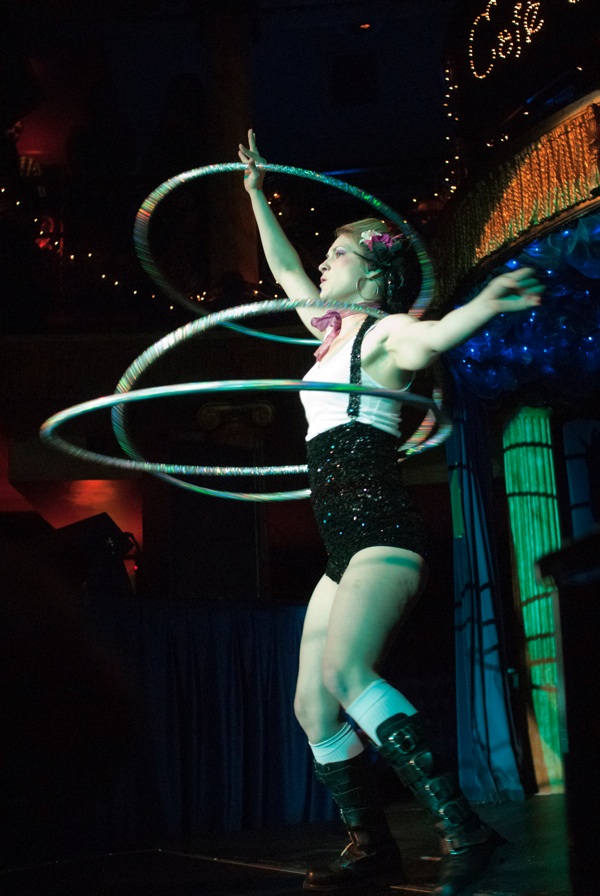
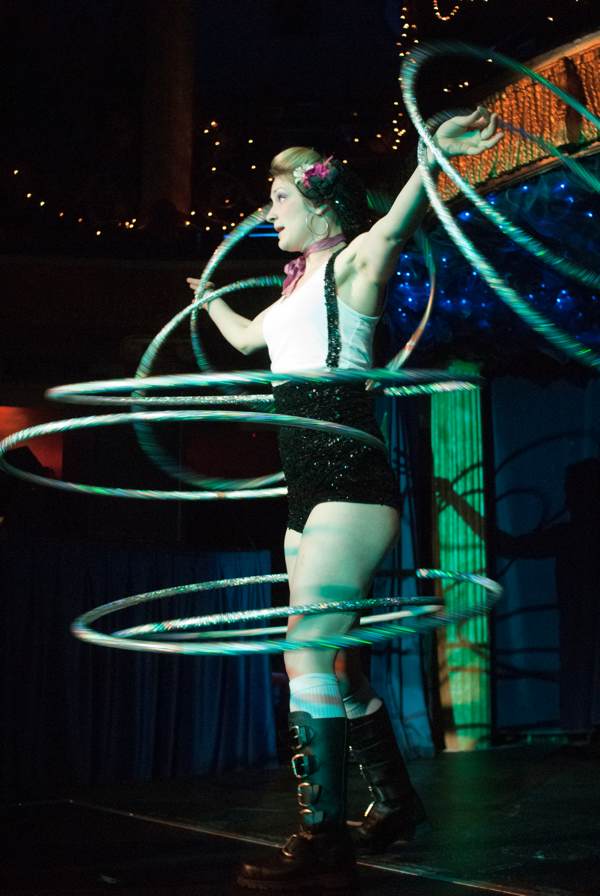
Pippa the Ripper, hula hoop artist.
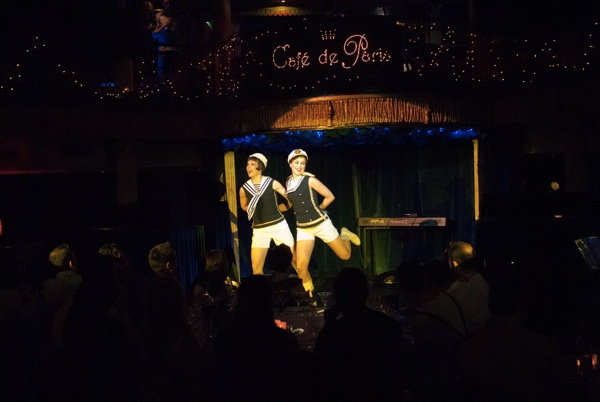
The Bees Knees, Charleston duo.
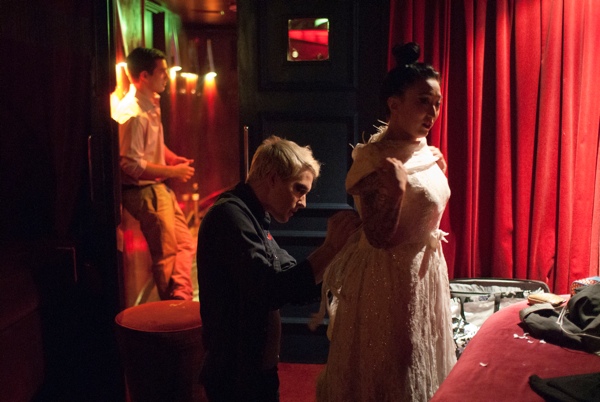
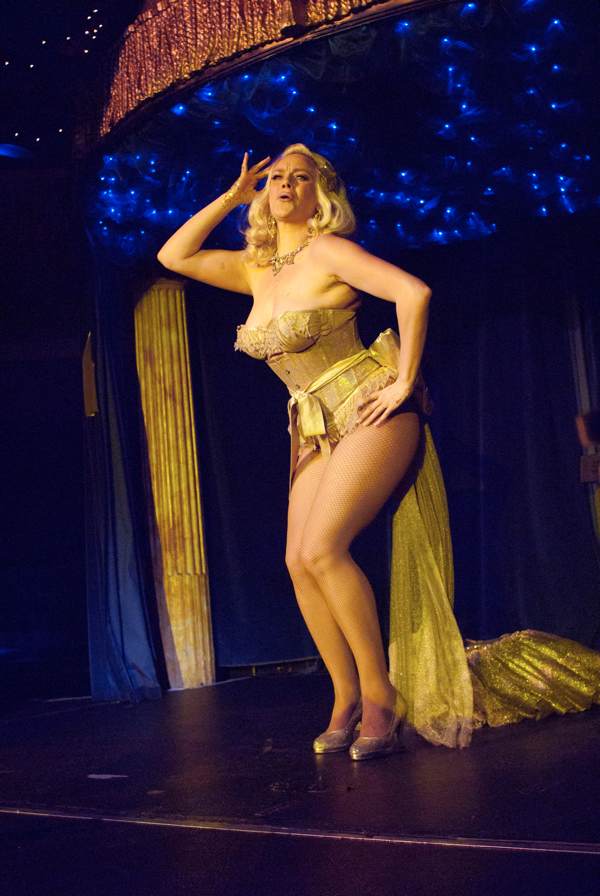
Cherry Shakewell, blonde burlesque bombshell.
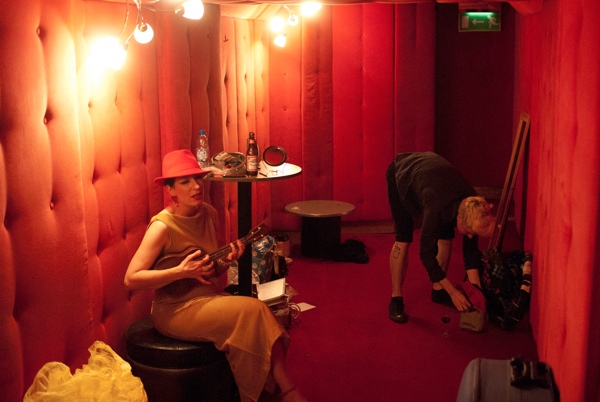
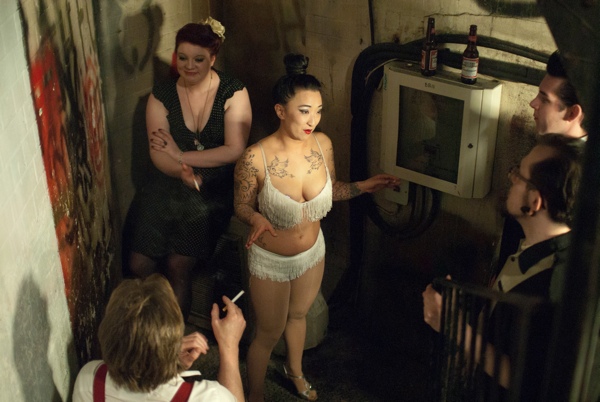
Cigarette break on the fire escape.
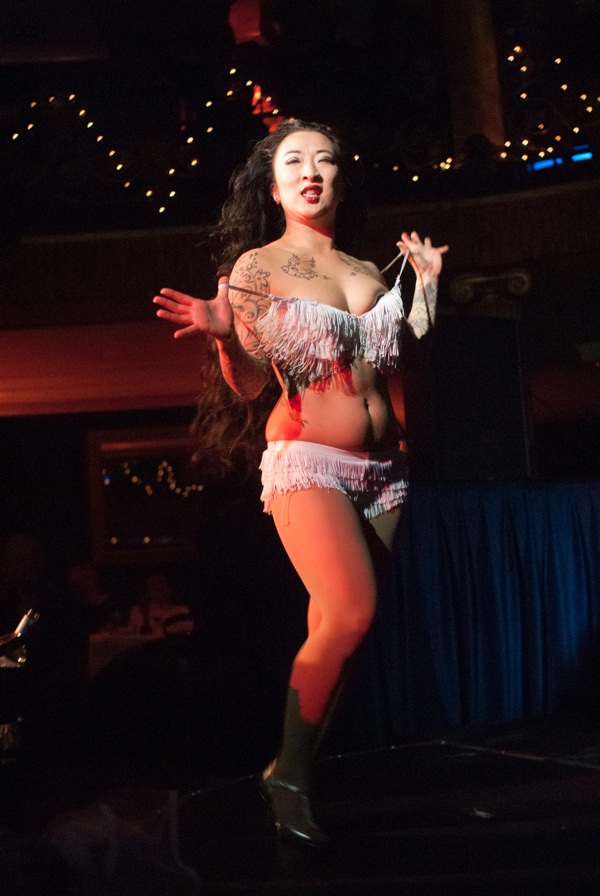
Fancy Chance.
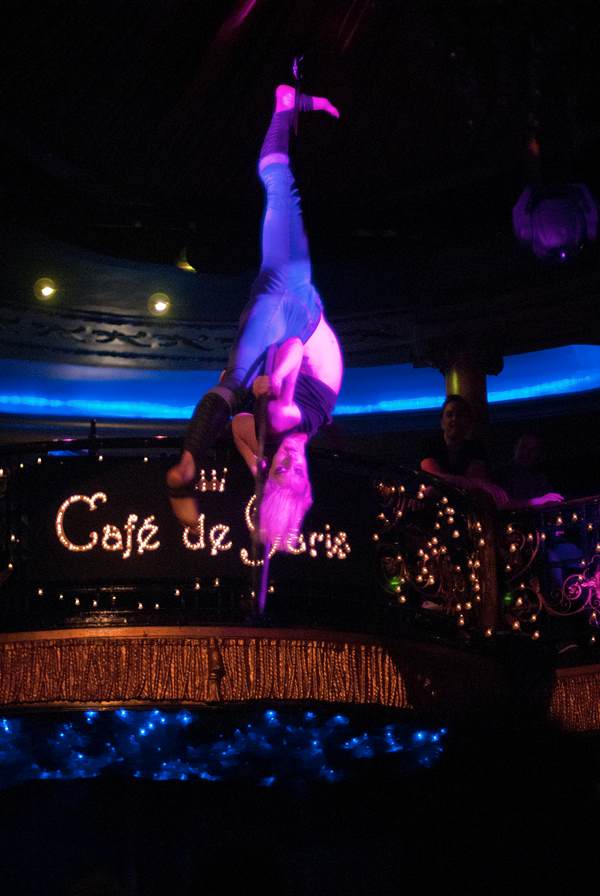
Brett Vista, aerialist.
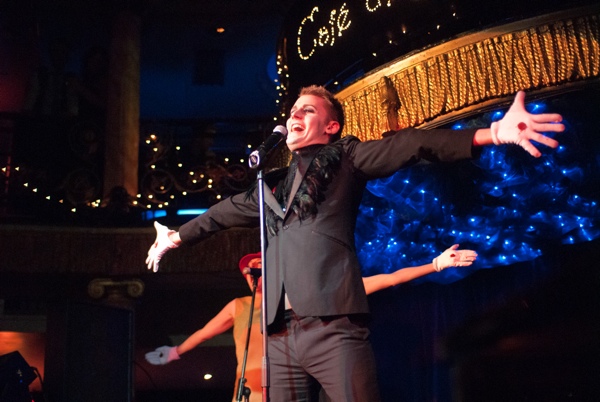
“an extraordinary cavalcade of cabaret genius.”
Photographs copyright © Sarah Ainslie
The Spitalfields Nobody Knows
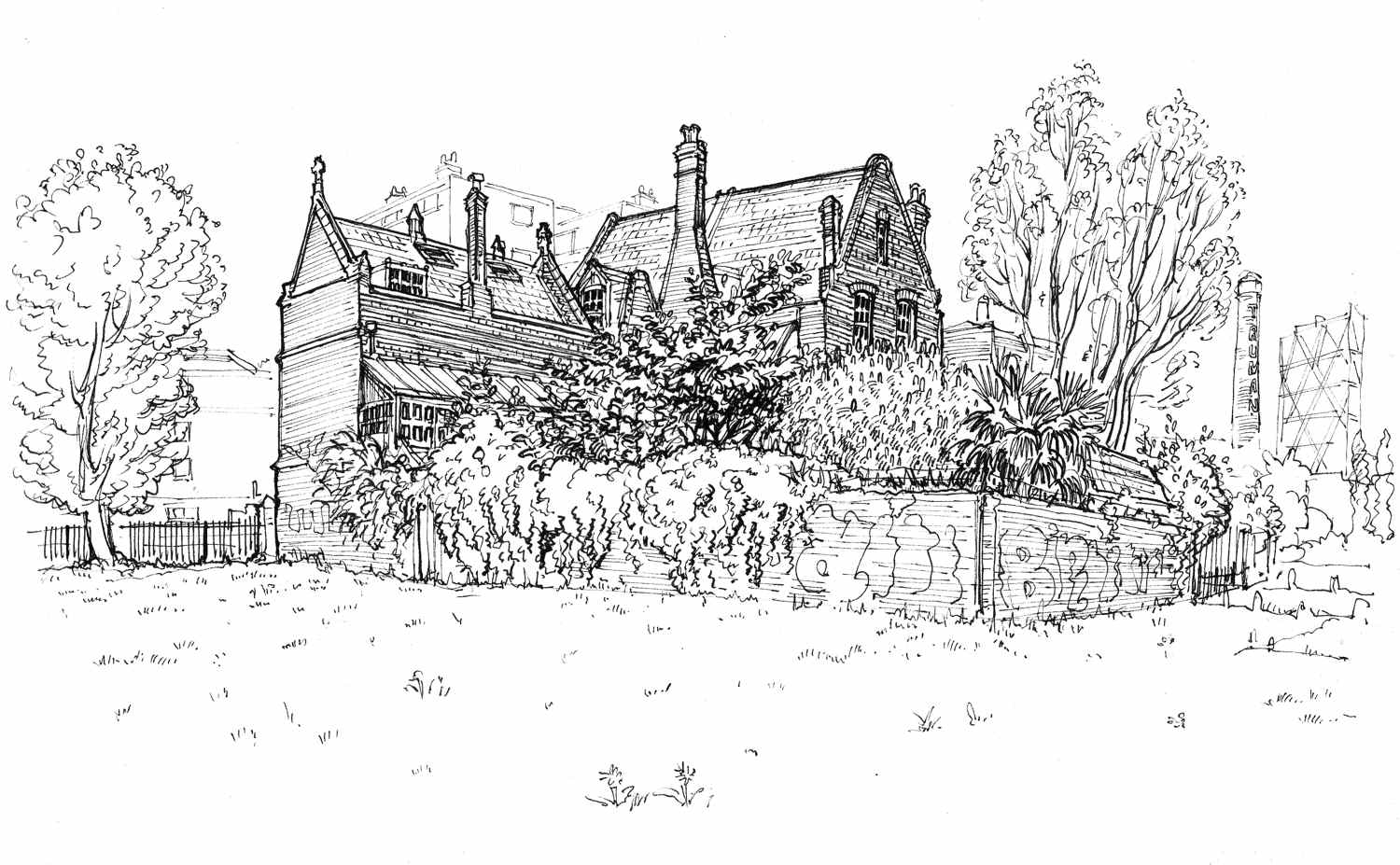 On Easter Monday, it is my pleasure to commence a new series in collaboration with Joanna Moore – conceived in homage to Geoffrey Fletcher and “The London Nobody Knows,” we shall be introducing you to lesser-known corners of Spitalfields and telling you their stories, each one illustrated with drawings by Joanna. (You can click on these pictures to enlarge them if you wish.)
The Old St Patrick’s School in Buxton St, dating from the eighteen sixties, stands upon the grass of Allen Gardens beside the Georgian vicarage of the former All Saints church – the last survivors of the nineteenth century streets that once stood here, long before the park was laid out. Enfolded by its lofty garden wall, containing huge exotic shrubs and dripping with climbing plants, this finely proportioned cluster of buildings rises with tall attenuated chimneys, like some mysterious castle of romance. St Patrick’s School is a tantalising enigma to those who walk through here regularly and have heard tales of the secret tropical garden which is rumoured to exist behind these implacable walls.
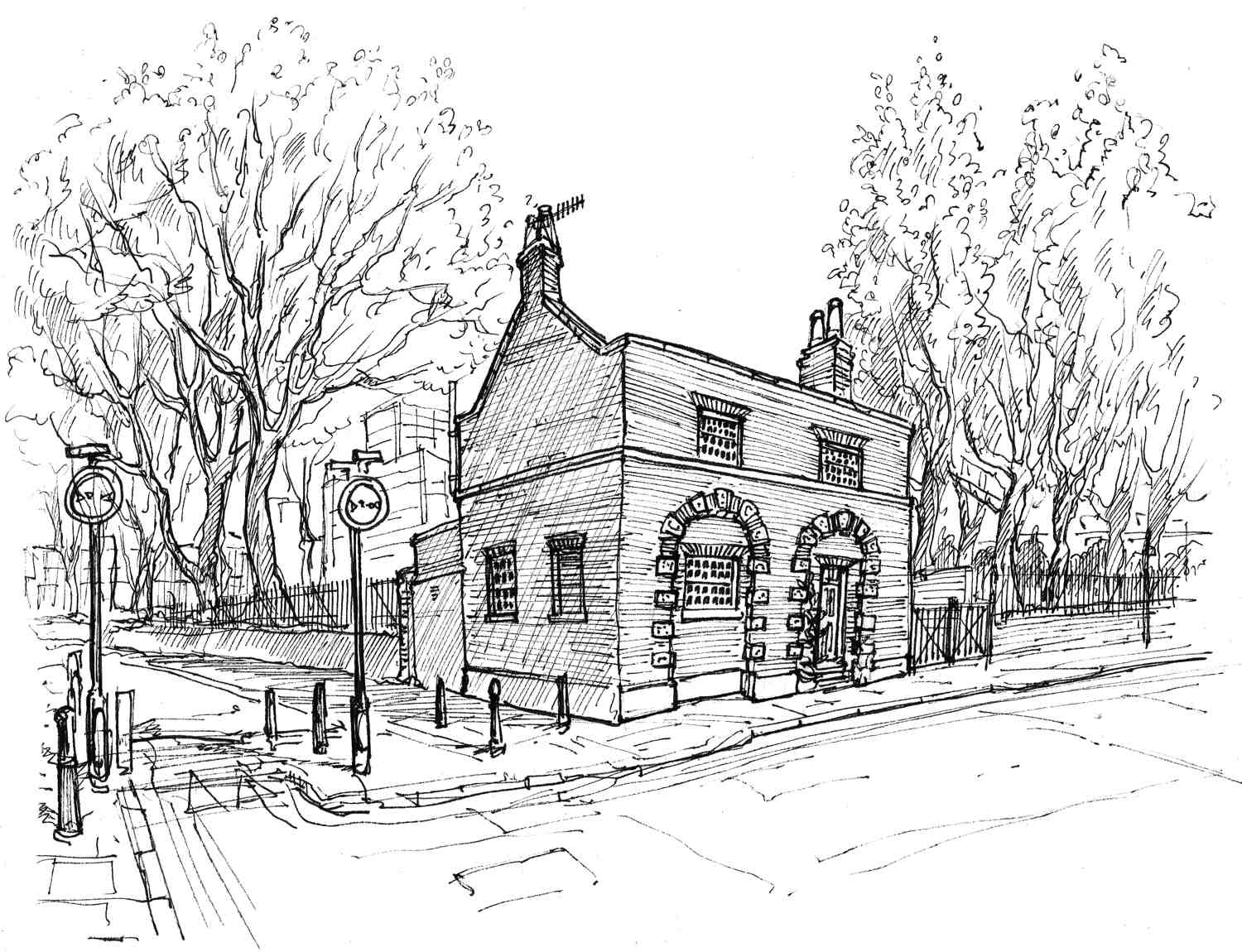
The Watchhouse on the corner of St Matthew’s Churchyard in Wood St was built in 1754 and, with the growing trade in human corpses for dissection, in 1792 it was necessary to appoint a watchman who was paid ten shillings and sixpence a week to be on permanent guard against resurrectionists. A reward of two guineas was granted for the apprehension of any body-snatchers and the watchman was provided with a blunderbuss and permission to fire from an upper window, once a rattle had been sounded three times. The churchwarden who lives there today told me that, according to the terms of his lease, he still holds this right – and the blunderbuss and rattle are stored in the house to this day. The small structure at the rear originally housed the parish fire engine, in the days when it was just a narrow cart. In 1965, the Watchhouse gained notoriety of another kind when fascist leader Oswald Mosley stood upon the step to give his last open air public speech.
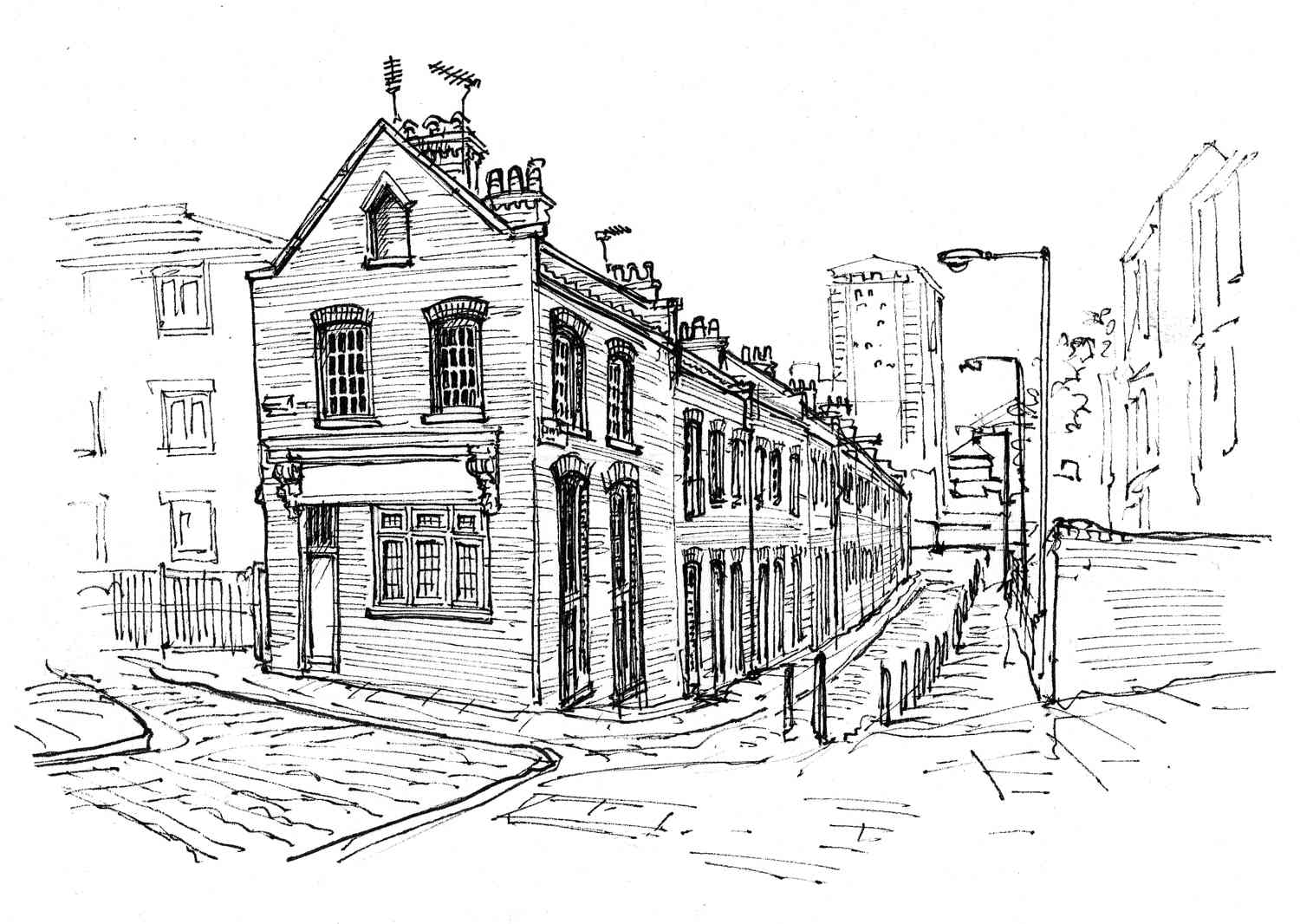
Gibraltar Walk off the Bethnal Green Rd is a handsome terrace of red brick nineteenth century artisans’ workshops that once served the furniture trade when it was the primary industry in this area. Of modest construction, yet designed with careful proportions, the terrace curls subtly along Gibraltar Walk, turning a corner and extending the length of Padbury Court, to create one long “L” shaped structure. These appealing back streets still retain their cobbles and there are even a couple of signs left from the days of furniture factories, but, most encouragingly, the majority of these premises are still in use today as workshops for small industries, keeping the place alive.
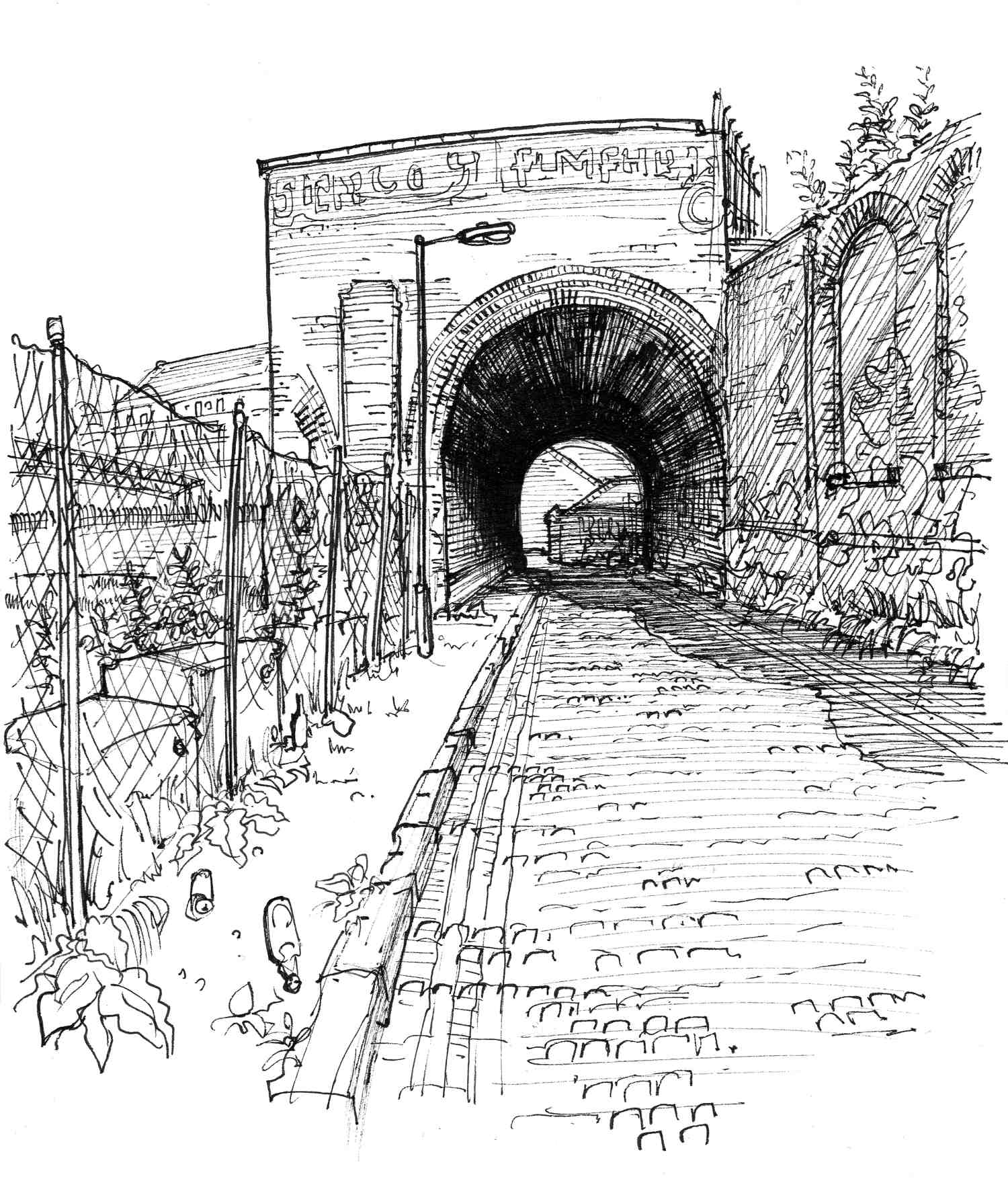
In Emanuel Litvinoff’s memoir, “Journey Through a Small Planet” describing his childhood in Cheshire St in the nineteen twenties, he recalls the feared Pedley St Arches where, “Couples grappled against the dripping walls and tramps lay around parcelled in old newspaper. The evil of the place was in its gloom, its putrid stench, in the industrial grime of half a century with which it was impregnated.” And today, with a gut-wrenching reek of urine, graced by a profusion of graffiti and scattered with piles of burnt rubbish, the place retains its authentic insalubrious atmosphere – a rare quality now, that is in demand by the numerous street fashion photo shoots, crime dramas and pop videos which regularly use this location. There is a scheme to turn the Great Eastern Railway Viaduct into a raised park – like the High Line in New York – but in the meantime wildlife flourishes peaceably upon these graceful decaying structures dating from the earliest days of the railway, constructed between 1836 and 1840 to bring the Eastern Counties Line from Romford to the terminus at Shoreditch High St.
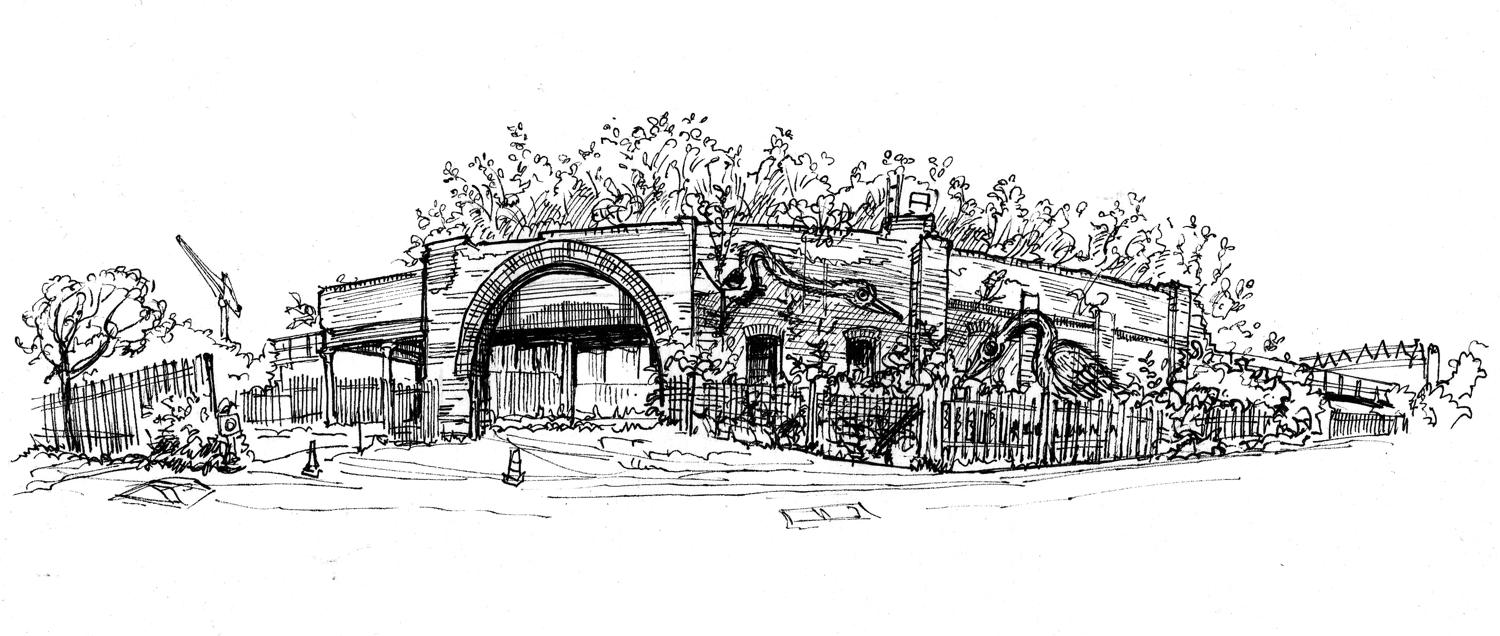
Drawings copyright © Joanna Moore
More of “The Spitalfields Nobody Knows” next week, but in the meantime you may like to read further about Joanna Moore
In the Roof of St Paul’s Cathedral

On the right of this photograph, taken in the roof of St Paul’s Cathedral, is the concave wall of the outer dome and curving away to the left is the convex wall of the painted inner dome that sits inside it, just like an enormous boiled egg beneath a cosy. It is a strange configuration which means the lower dome does not have the bear the weight of the dome roof, and which creates extraordinary incidental spaces that never cease to fascinate me whenever I return to scale this majestic cathedral.
Once I am through the main door, passing all the visitors standing and gazing at the vaulted cathedral ceiling far overhead, I go straight to the entrance to the roof. This was where I came the very first time I was ever permitted to visit London on my own as a child, and I have returned consistently through all the intervening years without disappointment.
Leaving the nave and ascending the stairs, you enter a different St Paul’s – no longer the monumental space dedicated to public worship but a warren of staircases and narrow passages that enable people to run like rats within the walls and emerge again to peer down at their world askance. If you are lucky, your initial burst of enthusiasm will carry you clattering up the wide spiral stairs to the height of the nave roof. At the head of these, formal elegance ceases as you turn left into a crooked passage and right, up a steep, tapering staircase which is only as wide as your shoulders, and where you must lean forward when the ceiling lowers to child height, before – without warning and quite unexpectedly – you step out into the cavernous void of the Whispering Gallery.
This was where I was transfixed by vertigo on my first visit. Sitting perched upon the tenuous balcony that circumscribes the dome with my back to the wall, the emptiness was overwhelming and the expectation of imminent collapse tangible. To this day it remains the most intense spatial experience that I know. I see the space contained by the great dome overhead and the aisles stretching below in four directions and it sets my head reeling, and I cannot avoid envisaging the dome spinning out of kilter and collapsing in an apocalypse. I can feel the magnetism to leap into the nothingness as if it were a great pool. Even the paintings upon the dome fill me with dread that the figures will fall from their precarious height. And each time I come there I must sit, while whispers fly around me, and make peace with these feelings before I can leave.
Sobered by the initial climb and awed by the Whispering Gallery, visitors usually take a moment to relax and scrutinise the views from the Stone Gallery that runs around the base of the exterior dome. Here I sat with my father while he recovered himself, when he came to visit me once when I first moved to London. As we discussed the idle spectacle of the view, I became aware for the first time that he was failing and growing old, and was quietly ashamed of my thoughtlessness in bringing him, when I knew it would be a point of honour for him not to admit to any struggle.
From here you climb into the interior of the domed roof – laced with iron staircases, spiralling and twisting around the central brick cone, like a giant pie funnel, that supports the lantern at the very top. Every wall tilts or curves or arches in a different direction and there is no longer any sense of height, you could equally be underground. Let me confide, on this recent visit, to my surprise and for the first time, this was where I experienced disorientation. I found myself in a space without a horizontal floor and barely any vertical services, hundreds of feet in the air, sandwiched between the roof dome with the sky above and the interior dome beneath – promoting morbid thoughts of smashing through this inner dome to fall like one of the figures from the paintings on the other side of the wall.
Yet as before, none of these grim fantasies were realised and I came safely to the Golden Gallery at the very top of the cathedral, two hundred and eighty feet above the ground. There is a spyhole in the floor there – God’s eye view – that allowed me to look right down through both domes to the floor below where the crowds crept like ants. And then, with the great dome beneath me, I could gaze out upon the city from a point of security, and free of vertigo.
When I climbed back down to ground level, I looked up to the dome from underneath and saw the speck of light from the spyhole and knew that to whoever was gazing at that moment I was now one of the ants. In medieval cathedrals, the focus of the architecture was upon the altar but at St Paul’s it is directly under the dome, where anyone can stand and be at the centre of things. The scale and ingenuity of St Paul’s are both an awe-inducing human achievement and one that makes people feel small too – a suitable irony in a great cathedral designed by a man named after the smallest bird, Wren.
I shall continue to return and climb up to the dome as long as I am able, because my trips to the roof at St Paul’s offer contradictory experiences that unlock me from the day to day. It is a reliable adventure which always delights, surpassing my recollections and revealing new wonders, because the vast scale and intricate configuration of this astounding edifice defy the capacity of the human mind to hold it in memory.

At the foot of the stair.
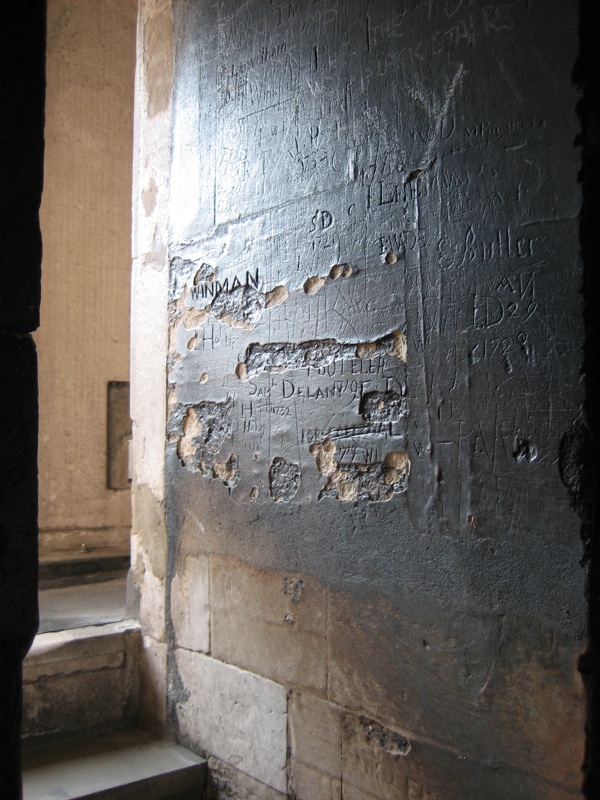
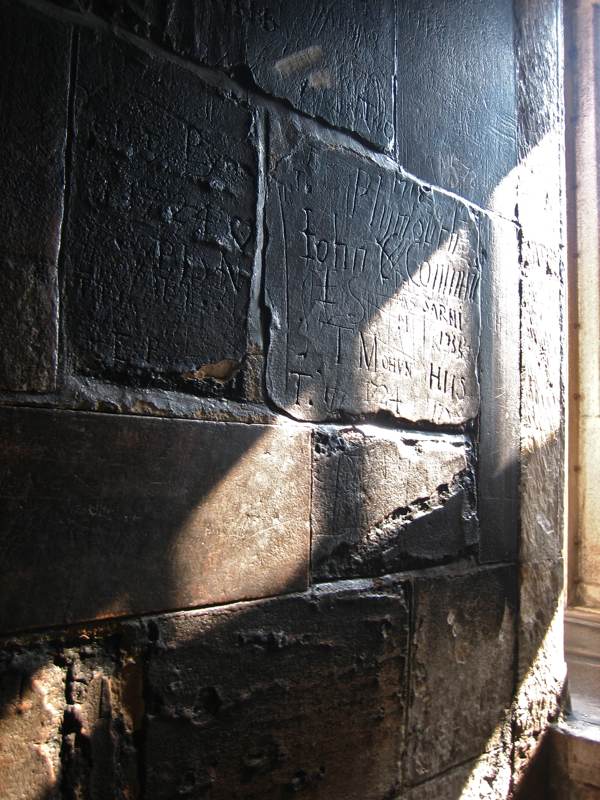
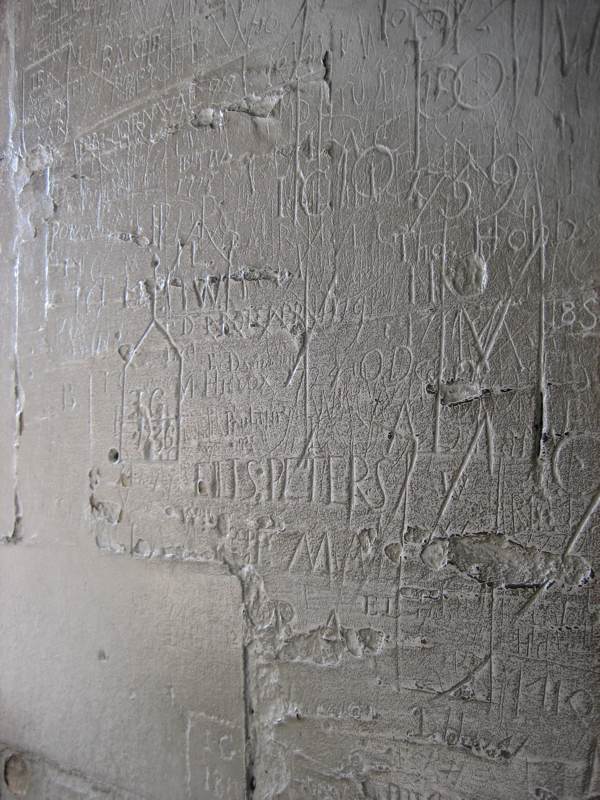
Graffiti at the entrance to the Stone Gallery.

On the Stone Gallery, at the base of the dome.

Iron staircases spiral in the hidden space between the inner and the outer domes of the cathedral.

Looking through from the top of the lantern down to the floor two hundred and seventy feet below.
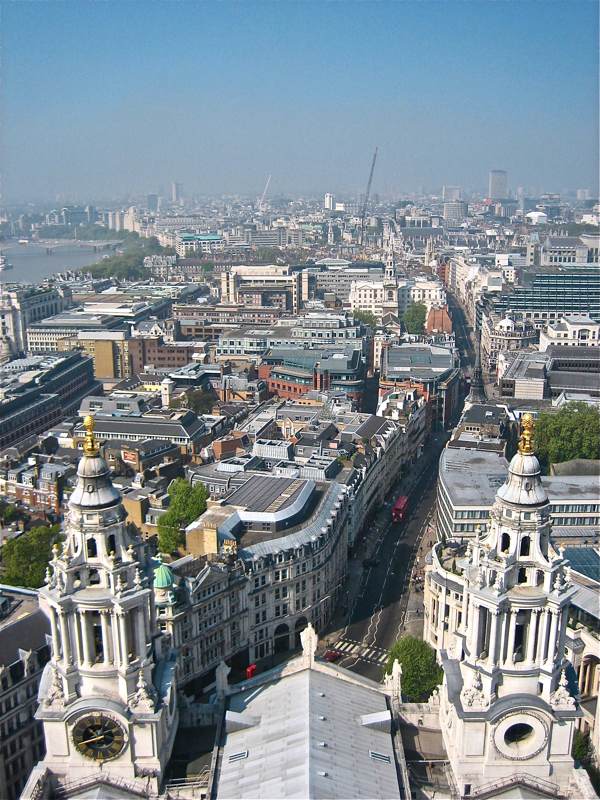
Looking West from the Golden Gallery, down the Strand.
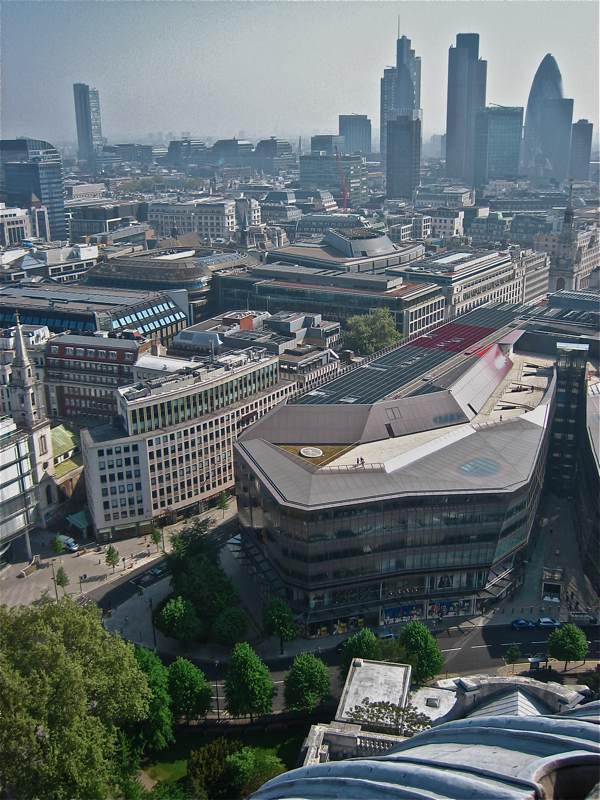
Looking East, Christ Church, Spitalfields can be seen top centre.


Looking from the floor to the dome and the lantern above.
The Widow’s Buns at Bow
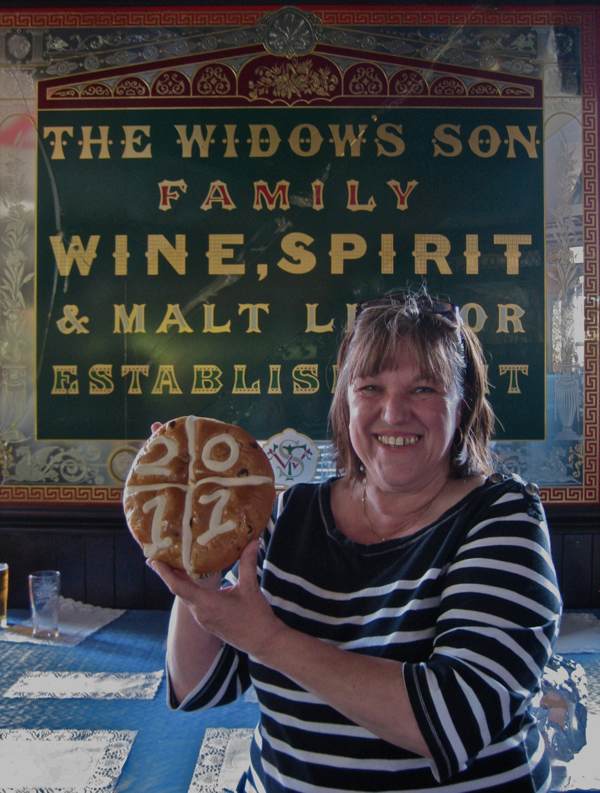
Baked by Mr Bunn’s Bakery in Chadwell Heath
On Good Friday, what could be more appropriate to the equivocal nature of the day than an event which involves both celebration of Hot Cross Buns and the remembrance of the departed in a single custom – such is the ceremony of the Widow’s Buns at Bow.
A net of Hot Cross Buns hangs above the bar at The Widow’s Son in Bromley by Bow, and each year a sailor comes to add another bun to the collection. And this year I was there to witness it for myself, though – before you make any assumption based on your knowledge of my passion for buns – I must clarify that no Hot Cross Buns are eaten in the ceremony, they are purely for symbolic purposes. Left to dry out and gather dust and hang in the net for eternity, London’s oldest buns exist as metaphors to represent the passing years and talismans to bring good luck but, more than this, they tell a story.
The Widow’s Son was built in 1848 upon the former site of an old widow’s cottage, so the tale goes. When her only son left to be a sailor, she promised to bake him a Hot Cross Bun and keep it for his return. But although he drowned at sea, the widow refused to give up hope, preserving the bun upon his return and making a fresh one each year to add to the collection. This annual tradition has been continued in the pub as a remembrance of the widow and her son, and of the bond between all those on land and sea, with sailors of the Royal Navy coming to place the bun in the net every year.
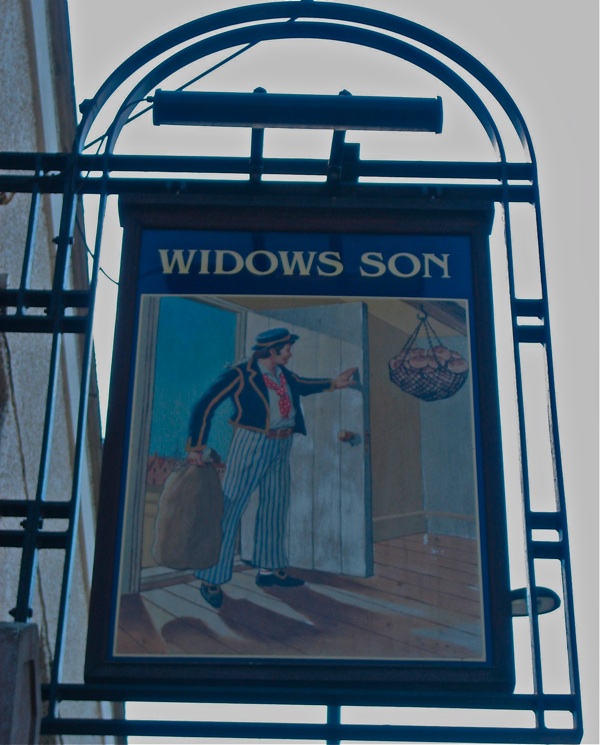
Behind this custom lies the belief that Hot Cross Buns baked on Good Friday will never decay, reflected in the tradition of nailing a Hot Cross Bun to the wall so that the cross may bring good luck to the household – though what appeals to me about the story of the widow is the notion of baking as an act of faith, incarnating a mother’s hope that her son lives. I interpret the widow’s persistence in making the bun each year as a beautiful gesture, not of self-deception but of longing for wish-fulfilment, manifesting her love for her son. So I especially like the clever image upon the inn sign outside the Widow’s Son, illustrating an apocryphal scene in the story when the son returns from the sea many years later to discover a huge net of buns hanging behind the door, demonstrating that his mother always expected him back.
When I arrived at the Widow’s Son, I had the good fortune to meet Frederick Beckett who first came here for the ceremony in 1958 when his brother Alan placed the Hot Cross Bun in the net, and he had the treasured photo in his hand to show me. Frederick moved out from Bow to Dagenham fifteen years ago, but he still comes back each year to visit the Widow’s Son, one of many in this community and further afield who delight to converge here on Good Friday for old times’ sake. Already, there was a tangible sense of anticipation, with spirits uplifted by the sunshine and the flags hung outside, ready to celebrate St George next day.
The landlady proudly showed me the handsome fresh 2011 Hot Cross Bun, baked by Mr Bunn of Mr Bunn’s Bakery in Chadwell Heath who always makes the special bun each year -” fabulous buns!” declared Kathy, almost succumbing to a swoon, as he she held up her newest sweetest darling that would shortly join its fellows in the net over the bar. There were many more ancient buns, she explained, until a fire destroyed most of them fifteen years ago, and those burnt ones in the net today are merely those few which were salvaged by the firemen from the wreckage of the pub. Remarkably, having opened their hearts to the emotional poetry of Hot Cross Buns, at the Widow’s Son they even cherish those cinders which the rest of the world would consign to a bin.
The effect of the beer and the unseasonal warm temperatures upon a pub full of sailors and thirsty locals rapidly induced a pervasive atmosphere of collective euphoria, heightened by a soundtrack of pounding rock, and, in the thick of it, I was delighted to meet my old pal Lenny Hamilton, the jewel thief. “I’m not here for the buns, I’m here for the bums!” he confided to me with a sip of his Corvoisier and lemonade, making a lewd gesture and breaking in to a wide grin of salacious enjoyment as various Bow belles, in off-the-shoulder dresses, with flowing locks and wearing festive corsages, came over enthusiastically to shower this legendary rascal with kisses.
I stood beside Lenny as three o’ clock approached, enjoying the high-spirited gathering as the sailors came together in front of the bar. The landlord handed over the Hot Cross Bun to widespread applause and the sailors lifted up their smallest recruit. Then, with a mighty cheer from the crowd and multiple camera flashes, the recruit placed the bun in the net. Once this heroic task was accomplished, and the landlady had removed the tinfoil covers from the dishes of food laid out upon the billiard table, all the elements were in place for a knees-up to last the rest of the day. As they like to say in Bromley by Bow, it was “Another year, another Good Friday, another bun.”
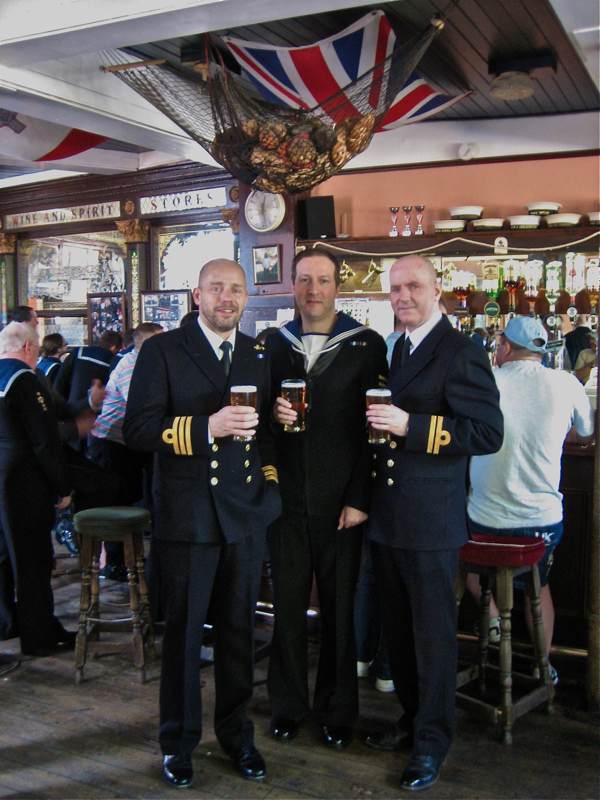
Peter Gracey, Nick Edelshain and Roddy Urquhart raise a pint to the Widow’s Buns.
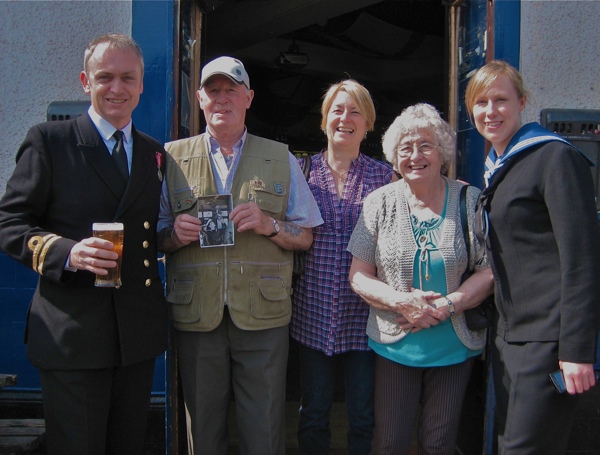
Tony Scott and Debbie Willis of HMS President with Frederick Beckett holding the photograph of his brother placing the bun in the net in 1958.
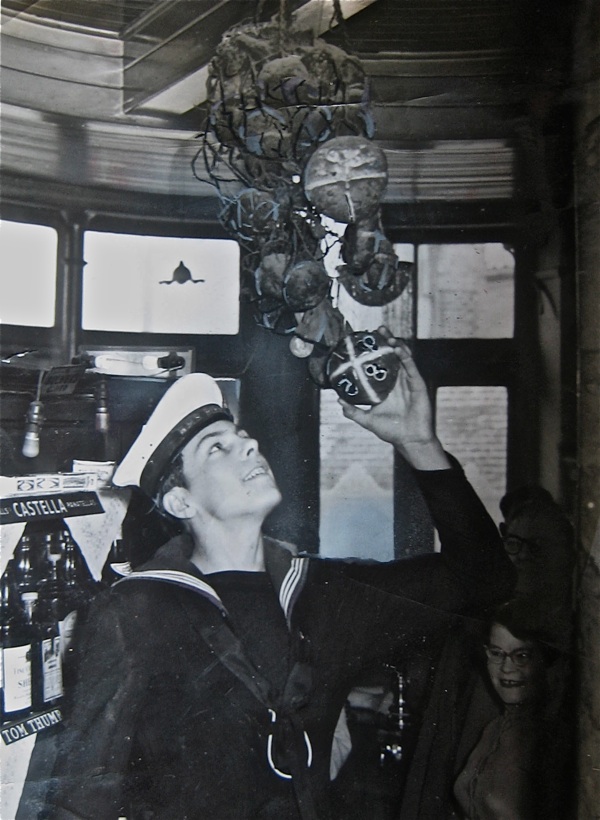
Alan Beckett places the bun on Good Friday, 4th April 1958.
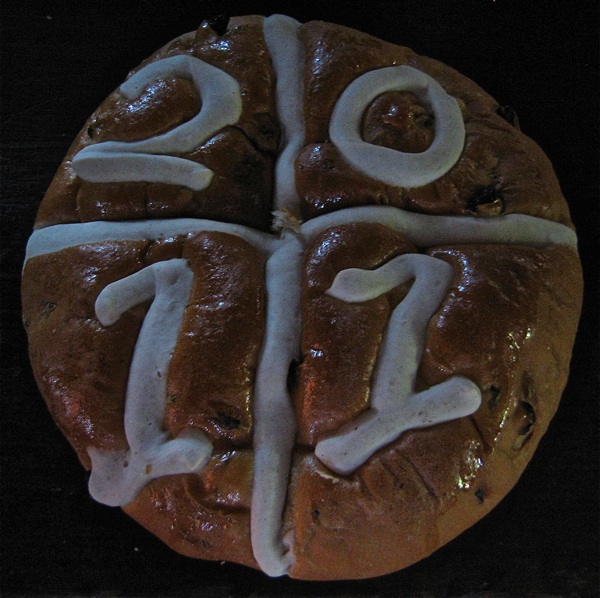
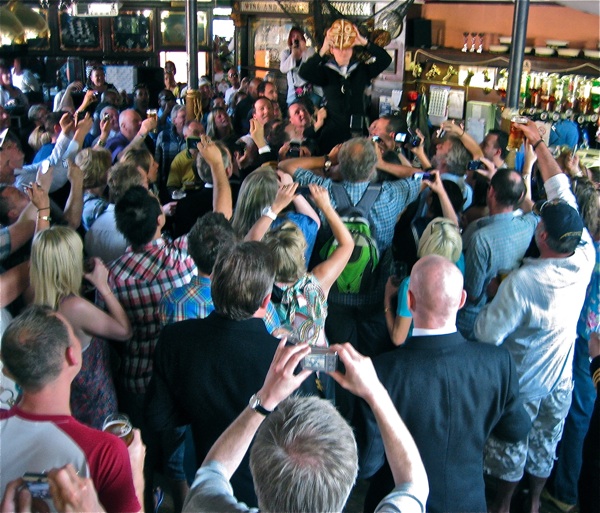
3 pm, Good Friday, 22nd April 2011.
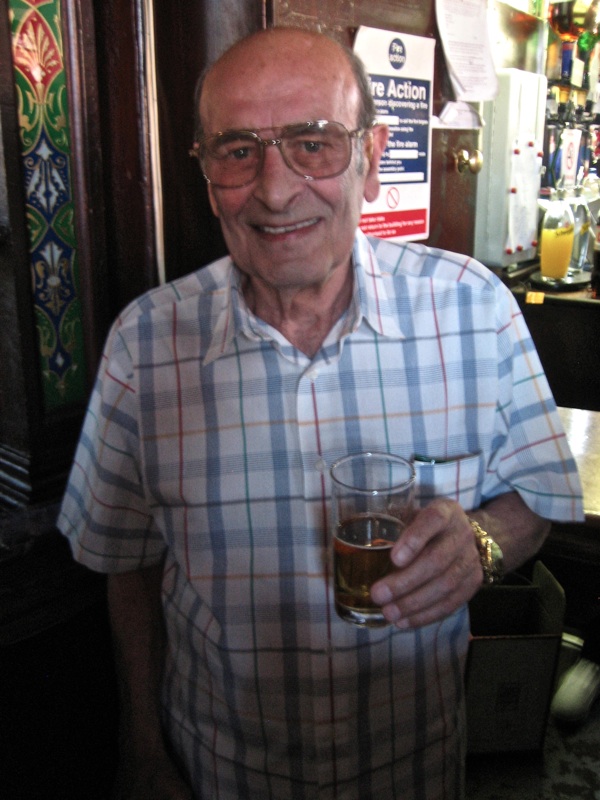
The Widow’s Son is the local for my pal Lenny Hamilton, the jewel thief.
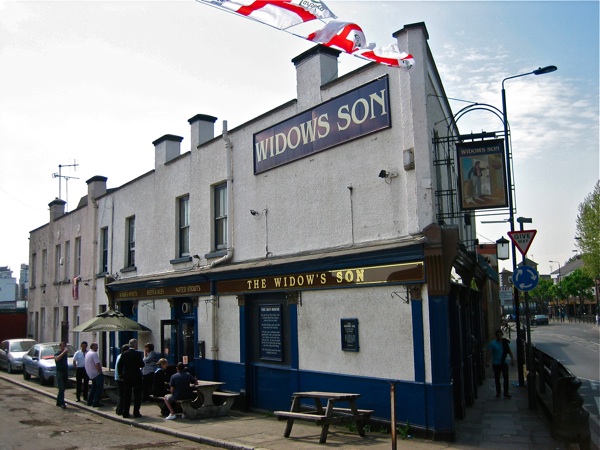
A Widow’s Son of Bromley by Bow
by Harold Adshead
A widow had an only son, The sea was his concern, His parting wish an Easter Bun Be kept for his return. But when it came to Eastertide No sailor came her way To claim the bun she set aside Against the happy day. They say the ship was lost at sea, The son came home no more But still with humble piety The widow kept her store. So year by year a humble bun Was charm against despair, A loving task that once began Became her livelong care. The Widow’s Son is now an inn That stands upon the site And signifies its origin Each year by Easter rite The buns hang up for all to see, A blackened mass above, A truly strange epitome Of patient mother love.
You may also like to read about