At William Gee Ltd, Haberdashers

Speaking as a lifelong connoisseur of quality haberdashery, let me say that if you are in need of a button or a reel of thread, there is no finer place to go than William Gee Ltd at 520 Kingsland Rd. For the haberdashery lover, even the windows at William Gee set the pulse racing with their ingenious displays of words contrived from zips – yet it was my privilege recently to explore behind the scenes at this glamorous theatre of smallwares, trimmings, threads, buttons and zippers, visiting the mysterious warren of storerooms at the rear of the shop, where I met the self-respecting guardians of this beloved Dalston institution that styles itself as “trimmings for all trades.”
My guide was Jeffrey Graham, maestro of the proud company boasting London’s largest selection of zip fasteners. He led me up an old brown lino-covered staircase between walls panelled in wood-effect formica to the locked, dusty upper room lined with happy photos of works’ outings and jamborees of long ago. Here Jeffrey brought the title deed to the property dating from the sixteenth century when this was Henry VIII’s land – Henry was the king that the Kingsland Rd refers to – and he had stables here for hunting when there was still forest, recalled today only in the name of Forest Rd. Then, once we had established this greater chronological perspective, Jeffrey brought out the tiny sepia photograph of William Goldstein that illustrates where the haberdashery business began.
“William Goldstein started in 1906 with two pounds in the kitty selling buttons and trimmings, and he changed the company name to William Gee. This was across the road where Albert’s Cafe is now, but after several years he needed larger premises and moved into the current building. He had two sons, Alfred & Sidney, and I knew both of them. Alfred died in 1970 and Sidney worked until he was eighty-five, and died four or five years ago. They grew the business and made it one of the largest of its type in the country, at a time when there was a large textile industry in the East End – which was full of clothing factories until a few years ago.
In the middle of the last century, there were more than eighty people working here. I remember coming in as a child and there were twelve ladies who all had their own button-making machines for covering buttons and they’d all be sitting there jabbering away making buttons, and some had machines at home and even carried on making them there too. When I was twelve or fourteen, I did a holiday job helping out and going out on deliveries with the drivers, so I saw a lot of the places we delivered to. My impression was that everything was bustling, everyone was busy, no-one had any patience and everyone knew everyone.
My father, David Graham, had a similar business at 77 Commercial St. He served all the factories in the little streets around Spitalfields and my grandfather had a haberdashery shop before him, on Brick Lane, M.Courts – it was still there in name until very recently. In the early sixties, the two businesses merged and my father became managing director of William Gee and we were supplying manufacturing companies that made uniforms and corporatewear, brideswear companies, hospitals, sportswear companies, hatters in Luton, – anyone really.We were doing a wholesale business in bulk that was very competitive.
The heyday was in the sixties through into the eighties, before manufacturers began to have their clothes made by cheaper labour in Eastern Europe, North Africa, or the Far East where much of the clothing is made today. It closed many factories and suppliers, they could not compete. It was no accident that people talk about “sweatshops,” because there wasn’t legislation to control how they should be organised then, but after legislation was enforced employers could not compete with overseas competitors.
It became a thing that you were delivering to shippers rather than factories, and then the types of customers became smaller and more varied – from engineers and printers, to film and theatre companies like the Royal Shakespeare Company and the Royal Opera, and lots of designers including, Gareth Pugh, Alexander McQueen Matthew Williamson, Vivienne Westwood, Caroline Charles and Old Town. What has come instead is a cottage industry, where individual designers are setting up and making a business out of it, and one of the largest sources of sales in recent years have been the colleges for fashion, textiles and art departments. But there are so many of them now that I wonder what will all the students do afterwards?”
Leaving this question to resolve itself we set out to visit the departments. First the button department which fills the shop next door, where buttonmaker, Janet Vanderpeer, presides over neat shelves stacked with rare ancient buttons from companies that closed years ago. Here I found her secreted behind a curtain in a cosy den, placidly making fabric-covered buttons at a press. Did she like it? A nod to the affirmative. How long had she been doing it? “A good while.” And without missing a beat she kept the buttons coming.
From here, we passed behind the shop to the three storey warehouse where the comprehensive supply of zip fasteners are kept and tended by their own designated keeper “You might think a zip is just zip,” said Jeffrey, rolling his eyes and gesturing to the lines of shelves. Then we stepped out into Forest Close whence the works’ coach parties departed in the nineteen fifties and crossed the road to the large warehouse where Janet’s brother David Vanderpeer, despatch manager, who joined the company thirty years ago at the age of sixteen, inhabits his own cosy den complete with microwave and ceramic leopard.
All fourteen staff at William Gee today have been there at least ten years and there is a sense of quiet mutual understanding which enables everything to run smoothly. Jeffrey told me a man will come in to say that his grandmother sent him here to buy buttons as a child and then ten minutes later another senior gentleman will come in to say the same thing. Yet in this appealingly utilitarian shop, that appears sublimely unaffected by any modern intervention, whoever comes through the door to stand between the two long counters is met with respect and patience. Even the old lady who did a high kick to place her ankle on the counter, when I was there, in order to display the kind of elastic she required was met with unblinking courtesy. And when Jeffrey Graham informed me authoratively, “The styles of clothing may have changed but the basic components are the same whatever the fashion.” I could hardly disagree.

William Goldstein’s haberdashery shop in 1906, that became William Gee.

A leaving party for Ivy Brandon in the seventies, with David Graham on the far right and Sidney Gee on the far left.

Sidney Gee & David Graham celebrate the seventy-fifth anniversary in 1981

The warehouse round the corner in Forest Rd.

Princess Diana in a coat with lining supplied by William Gee, 1986.


Jeffrey Graham, Managing Director of William Gee.

Janet Vanderpeer, Buttonmaker.

David Vanderpeer, Despatch Manager.


Stephen Selby, Antiquarian

Stephen Selby lives in a wonderfully rambling flat above Broadway Market which – as he will be sure to inform you – was once an ancient trackway continuing down through Columbia Rd and cutting a swathe across the grid of more recent East End streets. And where it crosses the Hackney Rd – he will add – was the Nag’s Head, a coaching inn that was the haunt of Dick Turpin, the notorious highwayman. Thus, from the moment you begin a conversation with Stephen, you are swept up into his beguiling vision of London that romances the familiar city to become an undiscovered landscape of myth and legend. And some of the stories he has to tell – especially of the founding of London as New Troy by Aeneas’ grandson Brutus three thousand years ago – are quite mind-boggling.
Chain-smoking, sporting snazzy red braces, surrounded by old maps, classical texts, pale brocade sofas, bottles of malt whisky and half-eaten packets of cream crackers, sits the debonair and courteous Stephen Selby – who worked in advertising in New York in the sixties and today is Chairman of the Broadway Market Traders’ Association – who recently unravelled the story of the Hackney hoard – and who now devotes himself to reading the ancient historians in their original Latin and Greek as part of his ongoing investigation into the lost prehistory of London. “I was looking for prehistoric London, so I looked up ‘Prehistoric London’ as a matter of course and I came across Elizabeth Gordon’s 1914 book ‘Prehistoric London, Its Mounds & Circles’,” admitted Stephen, and such is his passion for what this book has to say that he would only give me an interview once I had read it.
“What amazed me was the wide picture of our prehistory that exists and has been around for centuries, yet for the last three hundred and fifty years much of these legends were eradicated,” he told me, with emphatic enthusiasm, showing me – as illustration – a map of London dated 1582 with the inscription, “This ancient and famous City of London was founded by Brutus the Trojan.” Stephen is disappointed that since the foundation of the Royal Society, modern historians set themselves apart from legend and myth though an insistence upon verifiable fact, thereby denying the possibility that legend might contain a version of historical truth which has its own validity. Yet to Stephen’s delight, Elizabeth Gordon worked in the opposite direction, making sense of legend as history and it has inspired him to continue her work a century later.
Geoffrey of Monmouth, writing in the twelfth century, created the most widely read account of how, after the Greeks burnt Troy, Brutus rounded up dispossessed Trojans and led them to Britain – the country to which he gave his name – where he founded London as New Troy upon a marshy river valley which resembled Troy. Stephen has been seeking surviving evidence of Brutus and his dynasty that might confirm the veracity of the story. His first discovery was the etymology of Watling St which he believes derives from the Latin “Vates” meaning priest (as in “Vatican”), and his second discovery was that, like Troy, the ancient landscape of London was once scattered with mounds, erased by the modern city yet recorded upon old maps. Holywell Mound (at the junction of Curtain Rd and Great Eastern St) and Whitechapel Mound (upon the current site of the Royal London Hospital) were two in the East End, both of enigmatic origin and both removed in the eighteenth century.
According to Elizabeth Gordon, four mounds in London were of special significance to King Brutus -“Upon the two natural eminences of the Llandin and the Penton, the eyes of Brutus must have rested when he made the choice of his capital, while the two smaller artificial mounds of the White Mound and Tothill may have been erected by the Trojan King as trade increased under his rule.” Llandin (from which London took its name) that we know as Parliament Hill, was the centre of political activity, Penton (at Pentonville) was the centre of worship and observation of the stars, the White Mound (where the Tower of London now stands) was the place of royal burial and Tothill (located at Westminster) was a religious sanctuary. Elizabeth Gordon also tells us that Brutus’ descendant Molmutius laid out the roads, a task completed by his son Bellinus (who gave his name to Billingsgate Market) – especially fascinating to Stephen, eager to suggest that the straight roads usually credited to the Romans might be of greater age, and the mounds could have been instrumental in laying out their courses.
Stephen delights to draw upon old maps, extending straight trackways and linking the mysterious mounds to create a web of connecting coloured lines that hint at a greater scheme without revealing its significance, teasing and fascinating him equally. “The mystery of history,” as he terms it, his eyes misting just a little in captivated amusement as he takes a contemplative puff upon yet another of his Pall Mall cigarettes.
Down below, hipsters were perched like crows in a line sipping coffees in Broadway Market, whilst secluded up above in his Georgian green study Stephen Selby, the antiquarian and classical scholar, was reading Herodotus in Greek, consulting his Homeric dictionary and dreaming of an epic ancient world, as on a page of his old schoolboy atlas he traced the line that the Scythians travelled in their exodus from China across Asia to settle in Scotland – a journey evidenced, he assured me, by the tartan clad mummies of Urumchi in Xinjiang.

What is the significance of the Spitalfields Triangle? A perfect equilateral triangle links the sites of the former Whitechapel Mount and Holywell Mount, and St Mary Woolnoth in the City of London, shown here on John Roque’s map of 1746. (Click to enlarge)

Mount Terrace in Whitechapel is the only visible evidence today of the ancient mound that once stood here before the Royal London Hospital was built in the eighteenth century.
At the Geffrye Almhouses
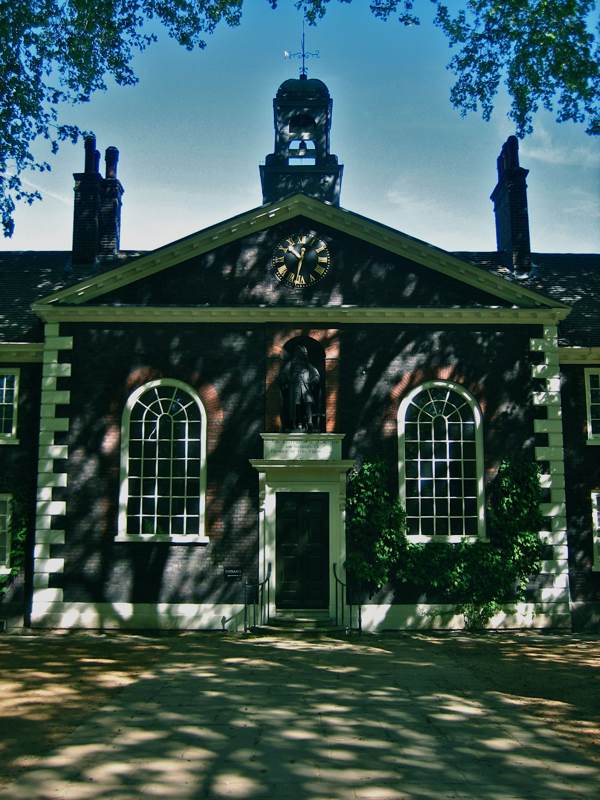
Visiting the Mariners’ almhouses at Trinity Green in Whitechapel last week filled me with curiousity to discover more of the former life of these places, and so I sought out the Geffrye almhouses in Shoreditch which are now the Geffrye Museum, where a couple of dwellings have been restored as they were once inhabited. After three centuries, the bewigged statue of Sir Robert Geffrye – the enterprising Cornishman who came to London at the age of sixteen, enjoyed a prosperous career as an ironmonger and was declared Lord Mayor of London in 1685 – still presides with a satisfied smile upon this fine terrace built in 1714 at his bequest by the Ironmongers’ Company to provide homes for “poor people of good character over the age of fifty-six.”
At that time, much of the land North of Old St was given over to nurseries and market gardens, punctuated by clay pits and kilns for tile making. Quieter and healthier than the City of London, it was the ideal location for almshouses, with the Drapers Company and the Frameknitters company also building to the North and South of the Geffrye site. Built by carpenter Robert Burford, the fourteen Geffrye almhouses were constructed of good quality materials, “of oake or good yellow firr,” and “good plain tyles with heart of oak lathes,” while windows were glazed with “the best Castle (Newcastle) glass,” and each door had “a stoute lock, key and bolt and latch and good hinges.” The buildings were lacking in ostentation, with minimal ornamentation upon the interior where each dwelling consisted of a single unfurnished room of thirteen by fifteen feet.
And for two hundred years, the Geffrye almhouses served their noble purpose until the rowdy city began to impinge upon the delicate sensibility of the elderly residents and, in 1908, the almshouse matron, Annie Young, complained that “All kinds of objectionable rubbish were thrown over the wall…rows between men and women were constantly to be seen…and the children who ran about the yards seemed scarcely to be human.” In 1912, the Ironmongers Company transferred their worthy pensioners to the more isolated and peaceful location of Mottingham in Kent and sold the almshouses to the London County Council who converted them into a museum of furniture, reflecting the location of Shoreditch as the centre of the furniture industry then.
Yet one dwelling remained unaltered with its staircase and internal woodwork intact, in use as the museum warden’s house until 1996, and this has now been restored with one room as it might have been in 1780 and another as it might have been in 1880. Stepping in through the double doors from the yard shaded by great trees, you find yourself in a staircase that once led to four residences on two storeys. On the ground floor you enter the austere eighteenth century room, bare boards, lead-grey painted walls, a few unframed prints, a small dining table, a stick-back chair set by the brick range and a stump bed in the corner. Although this single room – with a tiny closet for preparing food – might have been occupied by a couple, it does not seem cramped and is comparable to, or even larger than, rooms I have visited in care homes for old people today.
A list of residents from the seventeen eighties reveals that most were small tradesmen from London who enjoyed modest success in their working lives, and many were able to continue some form of piecework to supplement their small pensions. They were obligated to keep their rooms clean, to be in before the gates locked at night, to refrain from blasphemy or keeping poultry on the front lawn, and adultery and lewdness were both punishable by expulsion, yet the evidence of the records shows that the apparent strict regulations appear to have been followed leniently. No-one was expelled.
One flight of stairs above, you enter a room of the eighteen eighties and the immediate difference is that there are more things, more furniture and more trinkets. The brick range is replaced by a cast iron grate while a brass bedstead gleams in the corner – and two brackets above the fireplace carry the innovation of gaslight. In 1898, Henry Barrett the gatekeeper recorded an incident with matron’s new gas oven, “I met with an Axedon today. There Exploded in the matron’s House the Gas. I Filled the Gas oven in the stove & I opened the Door & it exploded in my face, Burned my Face & Hair & Whiskers & Burned off my Eye Lashes. It was God’s Good Providence my Eyes was not Hurt.” Looking from the window out into the tiny courtyard where once fifty people resided in these almshouse, I could only wonder at the drama occasioned by the exploding oven in such an isolated community – where few people left except feet first and some were simply transferred direct to the ironmongers’ cemetery conveniently placed within the grounds at the end of the terrace.
But in spite of the exploding ovens and rowdy neighbours, census records reveal that the Geffrye pensioners lived far beyond average life expectancy at the time – in this shangri la on the Kinsgland Rd – as Henry Barrett recorded in his journal,“Miss Daniel Died after seven years Bedrid, I think near a hundred years old.” Even today, with the steady flow of visitors and school parties to the Geffrye Museum, there is an enduring air of peace in this place that is instantly restored once the crowds have passed through the yard, and inside the almhouses you feel it pervasively, in these quiet rooms where people have sat out time.

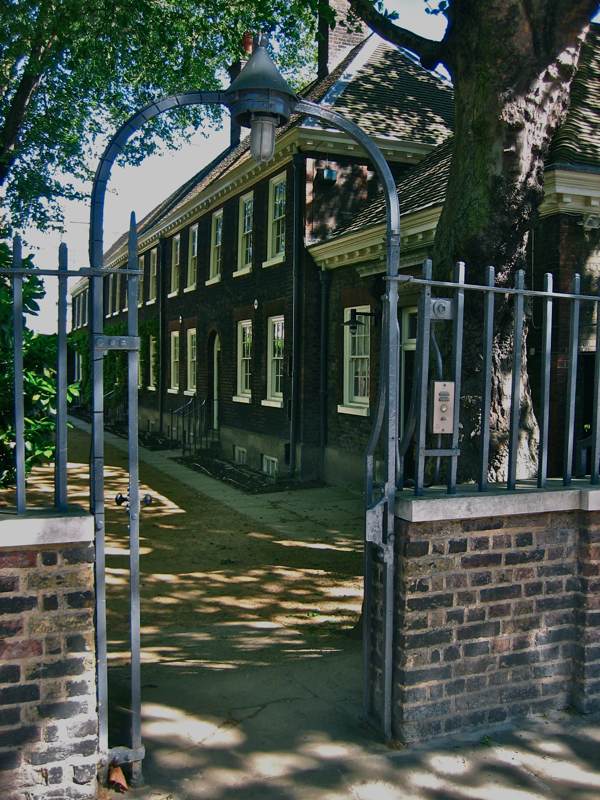

The ironmongers’ graveyard in a quiet corner of the grounds.

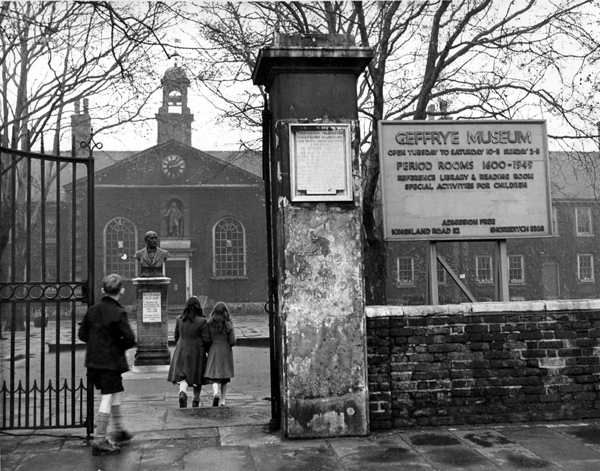
The courtyard in 1948, photograph by L. Taylor
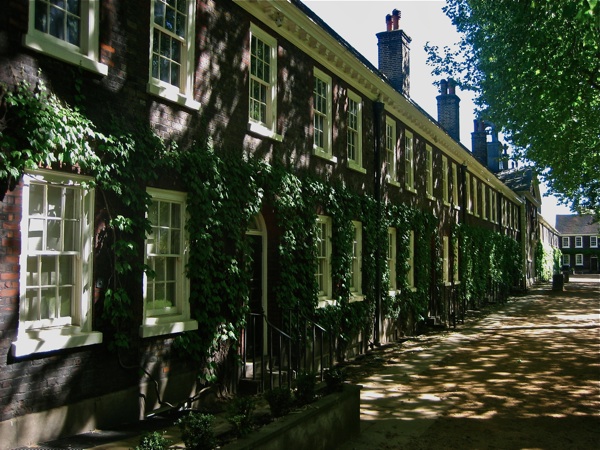

Schoolchildren visit the museum in 1961.
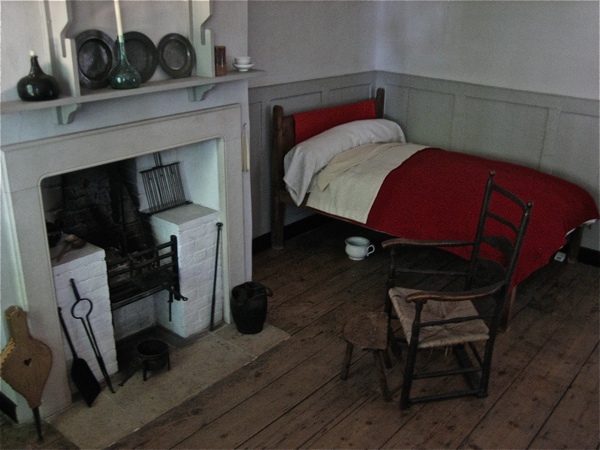
A room furnished as it might have been in 1780.

A room furnished as it might have been in 1880.
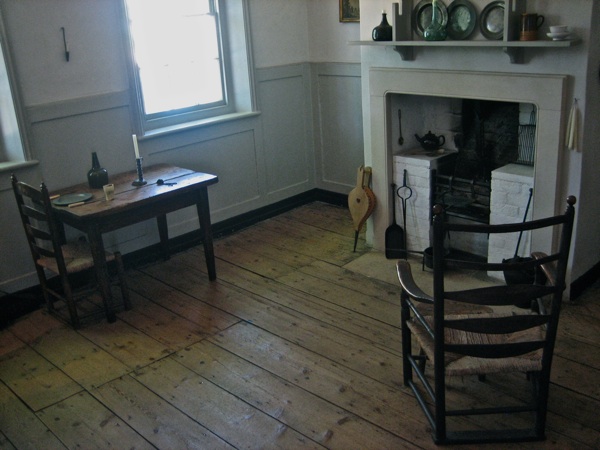
1780.
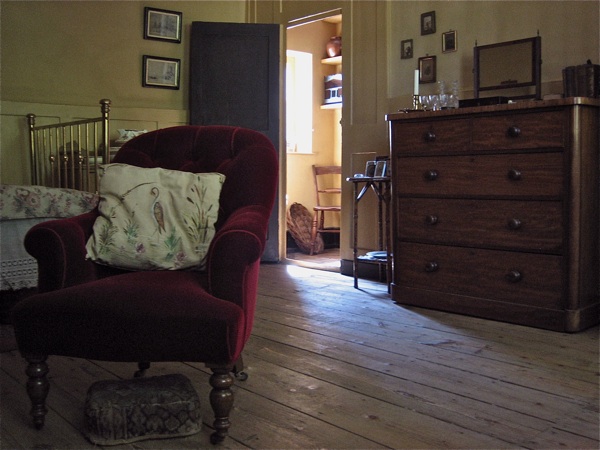
1880.
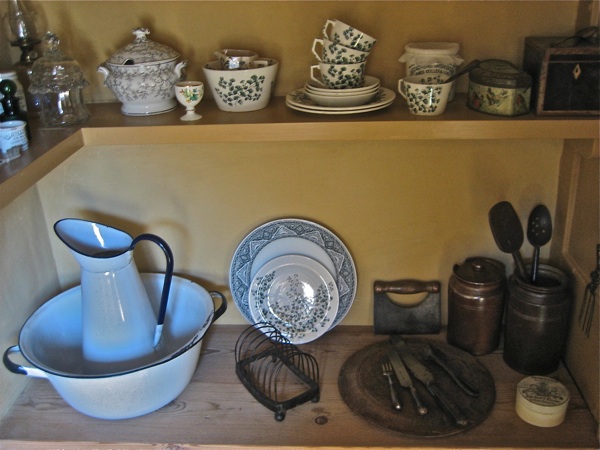
The crockery cupboard of 1880.

Geffrye pensioners enjoy the sun in 1903 – amused by their pet monkey on a stand.
Archive images copyright © Geffrye Museum
The Dogs of Spitalfields
Spitalfields Life contributing photographer Sarah Ainslie and writer Andrew McCaldon have been getting up early to join the dogs of Spitalfields and their owners frolicking in Allen Gardens, Weavers’ Fields and Haggerston Park on these recent fine Spring mornings. Although they have no dogs of their own, both Sarah and Andrew grew up around dogs and delighted in the opportunity to make these crafty portraits, as a happy excuse to join the local canine crew.
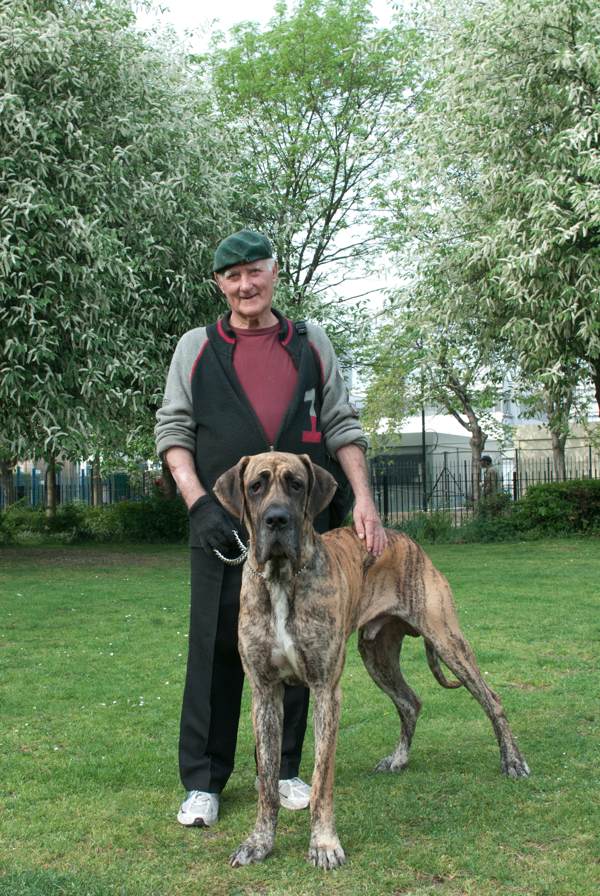
Tiger (Great Dane) & Paul Clarke
“To me, he’s always “Tig” – that’s how he knows it’s me.
I was dumped, as a baby, on the steps of St. John’s at the bottom of Bethnal Green Road. A woman found me and I was put in the orphanage round the corner. I ended up in the Royal Marines – for twenty-four years, three days and two hours – until 1973, then I went walkabout for few years. Now I look after the nuns at St. Saviour’s.
I trained Tig myself. He’s got to earn his money and the City police borrow him a lot. If he’s looking for you, you better hit the deck quick. He doesn’t bark, he just gets you down on the floor and then he waits for me.
When he’s good, great. When he misbehaves, I’m the guvnor.
The nuns like him because he’s emotional company and when they know he’s about they call for him. They all want him in their room and they get jealous if he spends too much time with one of them.
Tig’s so placid. If a person is placid, the dog will be the same. And I am mellow now too – after twenty-four years of killing you mellow a bit.”
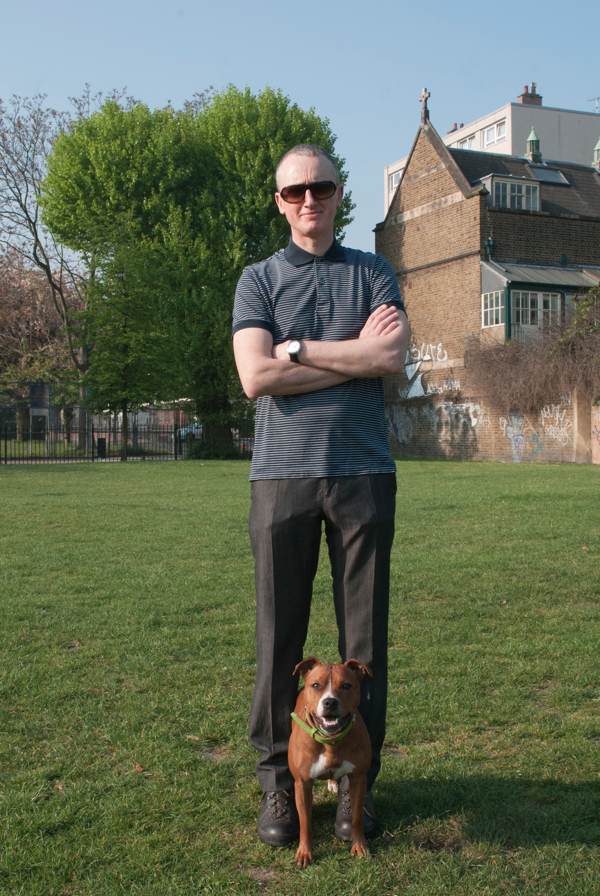
May (Staffordshire Bull Terrier) & Michael Landy
“When I have a hangover and have to get up at seven am in the morning to walk her, I ask myself “Why did I do this?”
I hadn’t had a dog since I was child and, being an artist, it’s not the easiest thing looking after one. She’s a pain in the bum at my studio – every time I look up she’s staring at me. But she’s learnt not to walk on my drawings.
She’s a big chewer, likes destroying anything. I think we’ve both got the same destructive personality!
At my age it’s nice to get back into parks. I was born in Graham Rd in Hackney, I spent a lot of time in parks as a kid, you know.They were places for illicit goings on, you used to get chased, thrown out by the wardens. Now I’m a middle aged man, I’m responsible – for May – and I’m back in parks.”

Shadow (Alaskan Malamute) & Michela Cucchi
“When I first saw him he followed me everywhere, always by my bum, and it’s like the song says – “Me and My Shadow.”
I didn’t want a normal dog, I wanted something I could learn from. These are really the first ever dogs, he’s very primitive, a domesticated wolf effectively. He’ll eat a whole chicken over three days.
He’s very protective of me, wants to be at my fruit and veg stall all day, hates going home. People see me differently, before it was always “You’re the lady on the stall,” now it’s “You’re the lady with the dog.”
When my Mum died and she was at home with us, he knew what was going on, he wouldn’t leave me. After she went, I just walked and walked and walked – with Shadow.
He was my sanity.”
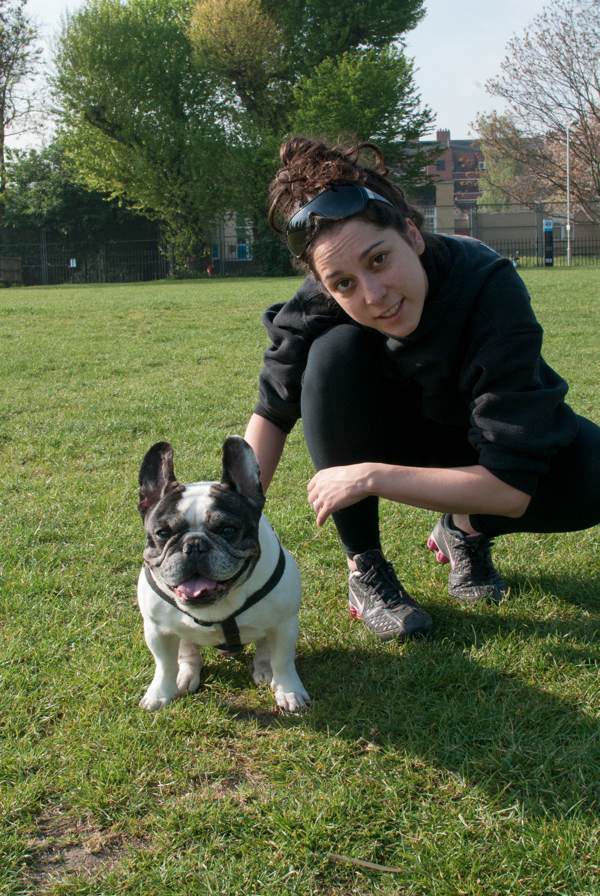
Homer (French Bulldog) & Caroline Johnson
“I didn’t think I’d care for something so much – now I’m totally controlled by this tiny little furball!
Homer preceded me. I’m not his first mother but I like to think I’m his best mother.
He was born in Texas but my husband raised him in New York. Homer had lots of friends there in the East Village, although he didn’t like the fourth floor walk up. When we both moved to London, it was four months before he could join us. We used to have him put on the phone and listen to him breathing.
Now we come to Allen Gardens every day, Homer needs to see his friends, we have to wait until he’s got a playmate. He’s not been fixed so he’s a bit of a pervert!
He’s twelve now, he’s an old man, could probably do with a bit of botox on his face. But he’s a happy dog and as they say, “Happiness keeps you young,” right?”
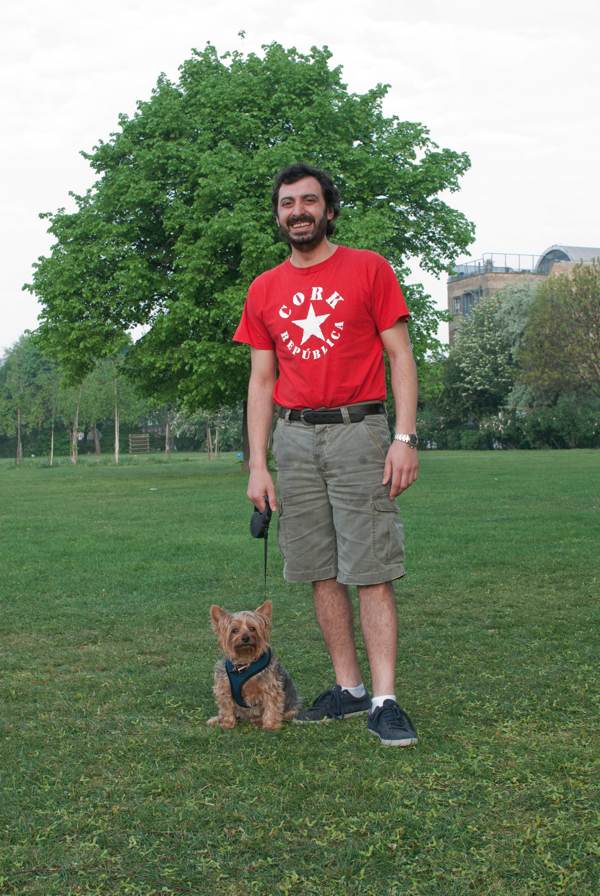
Charlie Pellicci (Yorkshire Terrier) & Nevio Pellicci
“He’s just been to the dog parlour on Columbia Rd for his summer haircut.
We used to have a guard dog at the cafe, about twenty years ago, an Alsatian called “Sparky,” because we’d been broken into and everyone got worried. But I was too young to appreciate him then.
I chose to get Charlie but he’s become the family’s dog now. Since Dad’s not been there, Mum’s become more attached to him – you know, we’ve started to have child “right of access” issues.
He eats very well! He has all the usual biscuits and steak pie, nice little bits of grilled chicken, seafood, he loves seafood. Only one thing he won’t eat – lettuce. He’ll lick the dressing off but won’t touch the leaves.
It is a good name for him. He looks like a real Charlie.”
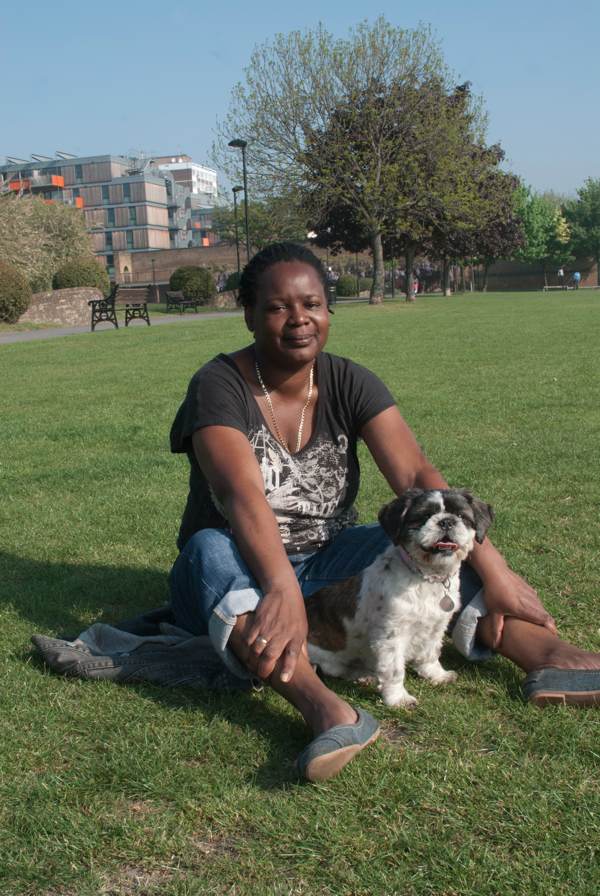
Maya (Shih Tzu) & Lorraine Carter
“Oh, it was hard getting up every morning to walk her in the snow, but she loved it. Instead of her ball I threw her snowballs.
Life is different for dogs around here now. My Granddad had a dog, an Alsatian, that used to go on the round with the milkman in the morning and the evening. In Homerton we had a mongrel, he could have a free run, he’d just come back home when he was ready. You’ve got to watch out for them more now, and Maya’s so gentle, I’d be worried she’d be taken from me.
But I wouldn’t live anywhere else. This area’s got “oomph,” I can breathe more here. And getting Maya was the right thing to do.
She’s a joy, an absolute joy.”
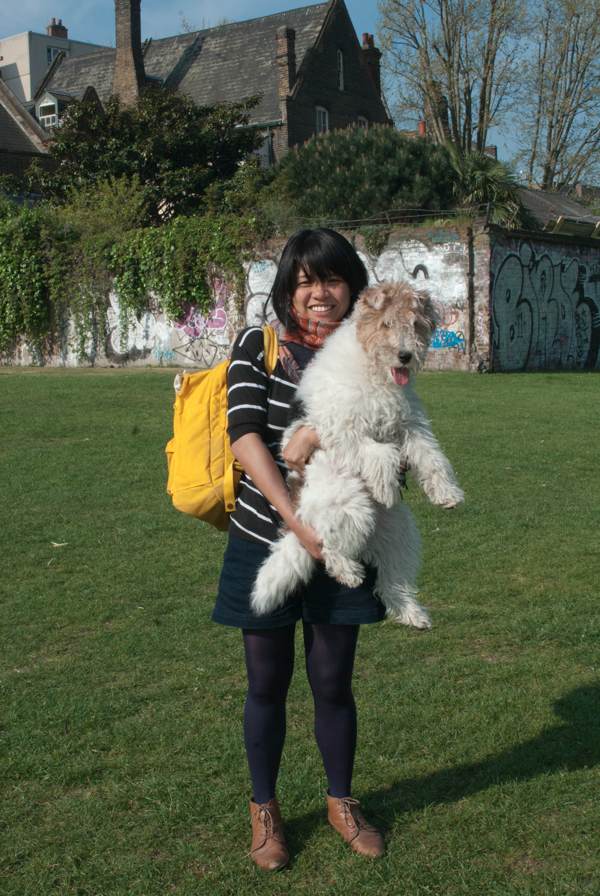
Stevie (Wire Fox Terrier) & George Wu
“He’s Tintin’s dog! I always liked Snowy more than Tintin, always wanted Snowy. And he is Snowy, but just not as clever as Snowy.
I got a sofa and came home to find he’d eaten one of the wooden arm rests.
It’s like having a kid. I’m a graphic designer, Stevie comes to work with me every day. He sits in a basket on the back of my bicycle and looks out. He’s ten kilos, it’s a nightmare.
He’s used to being carried, I have to carry him all the time at house parties or private views round here, or on the tube.
Stevie’s with me all the time – wherever I go, he goes.”
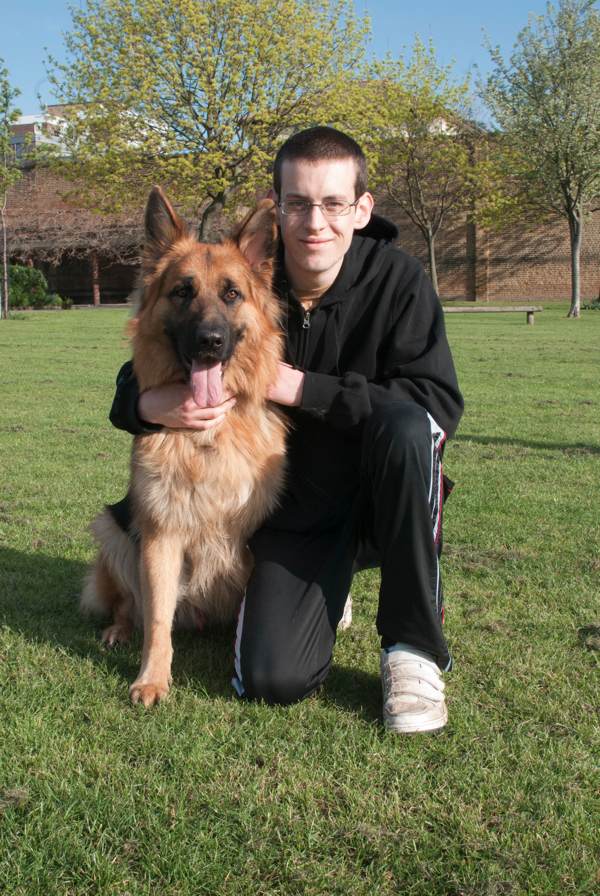
Cassius (German Shepherd) & Tony Morris
“Cass’s grandfather won Crufts in 2007 and 2008. I’m planning to enter him into shows too. We’ve been to the Shoreditch Dog Show and won some money. But Cass could win Crufts – I really want to enter him, he’s got winning genes in his body!
I’ve had him since he was eight weeks old. I walk him for two hours every morning. He’s learning to be calm around people and dogs, which is how you win championships.
I grew up on Goldsmiths Row. My dream is to move to St. Albans, because I’ve seen a lot of trouble around here. I’m not scared of anything though. I’m doing a diploma in English, I want to do a course in locksmithery and I’d like to be a gym instructor too.
And I’ll always have dogs.”
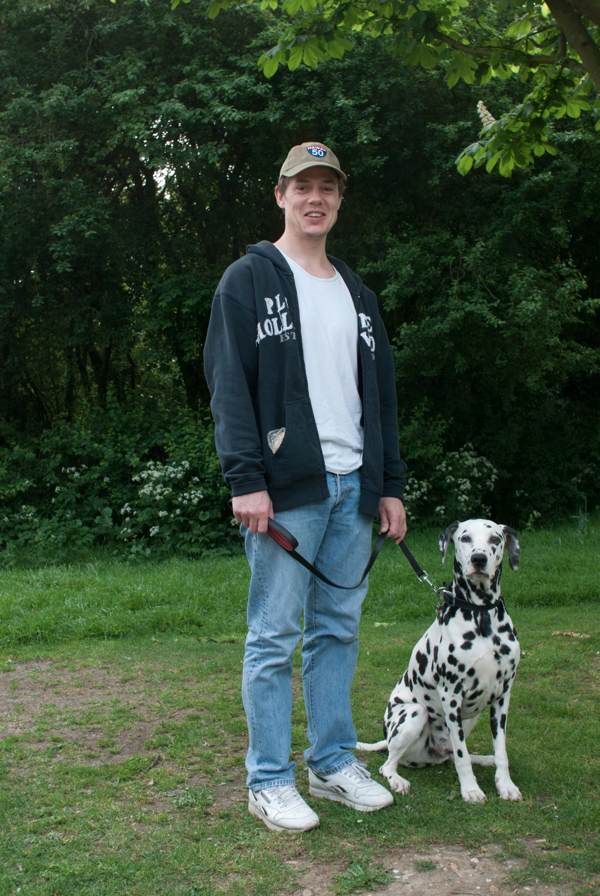
Forest (Dalmatian) & Joe Pritchett
“A bloke left him on my ex’s doorstep. Her house was like Dr. Doolittle’s. I said I’d take him home for one night and it’s been three and a half years.
He’s “Forest” because he’s a runner, bred to run alongside the carriages and Forest Gump was a runner too. And, well, I’m Nottingham Forest fan.
I had trouble, I found it hard to get on my feet, but now I feel like I’m a do-er. Having to be out three times a day for him, it helps with my motivation, it helps with everything.
I’ve never had to look after anything in my life but now I’ve got Forest.”
Photographs © Sarah Ainslie
The Spitalfields Nobody Knows (Part Two)

Nestling at the base of Nicholas Hawksmoor’s monumental spire for Christ Church, Spitalfields, is the tiny private roof garden on the top of 3 Fournier St, where what was once planted as a camomile lawn has grown to become a wildflower meadow with pink campions, oxe-eye daisies and sorrel abounding. The pitched roofs on three sides entirely conceal this verdant arbor from the street and create a favoured climate where freesias, carnations, honeysuckle, wallflowers, foxgloves, wild strawberries and lettuces flourish, surrounded by espalier fruit trees and rambling roses, all unknown to those who tread the dusty pavements of Commercial St far below. Built in 1754 by Peter Le Keux, a silkweaver, this elegant old house follows the same Tuscan Order of architecture that was Hawksmoor’s guiding principle, and as you ascend the staircase endlessly winding up to the roof garden, you come upon subtle intricate details, like banisters with square capitals, that match those across the road at the church.

The Worrall House of 1720 is the quintessence of the Spitalfields nobody knows – built in a secret courtyard between Fournier St and Princelet St by Samuel Worrall, the builder responsible for many of the surrounding houses, it can only be approached through a narrow passage behind a heavily-encrusted door. When you step through this door, into the dark cobbled alley lined with ancient planks covered with paint and tar that has not been renewed in over a century, you feel – more than anywhere in Spitalfields – that you have stepped back in time. Here Samuel Worrall built a handsomely proportioned yet modest house for himself in his own builders’ yard. Just one room deep with a pedimented door and stone balls atop the gateposts, it resembles a perfect lifesize dolls’ house. Facing East and constructed of a single layer of bricks, it only receives sunlight in the morning and is not a warm building in Winter, yet there is an irresistible grace and mystery about this shadowy house of enchantment, presiding silently upon a quiet courtyard that is outside time.
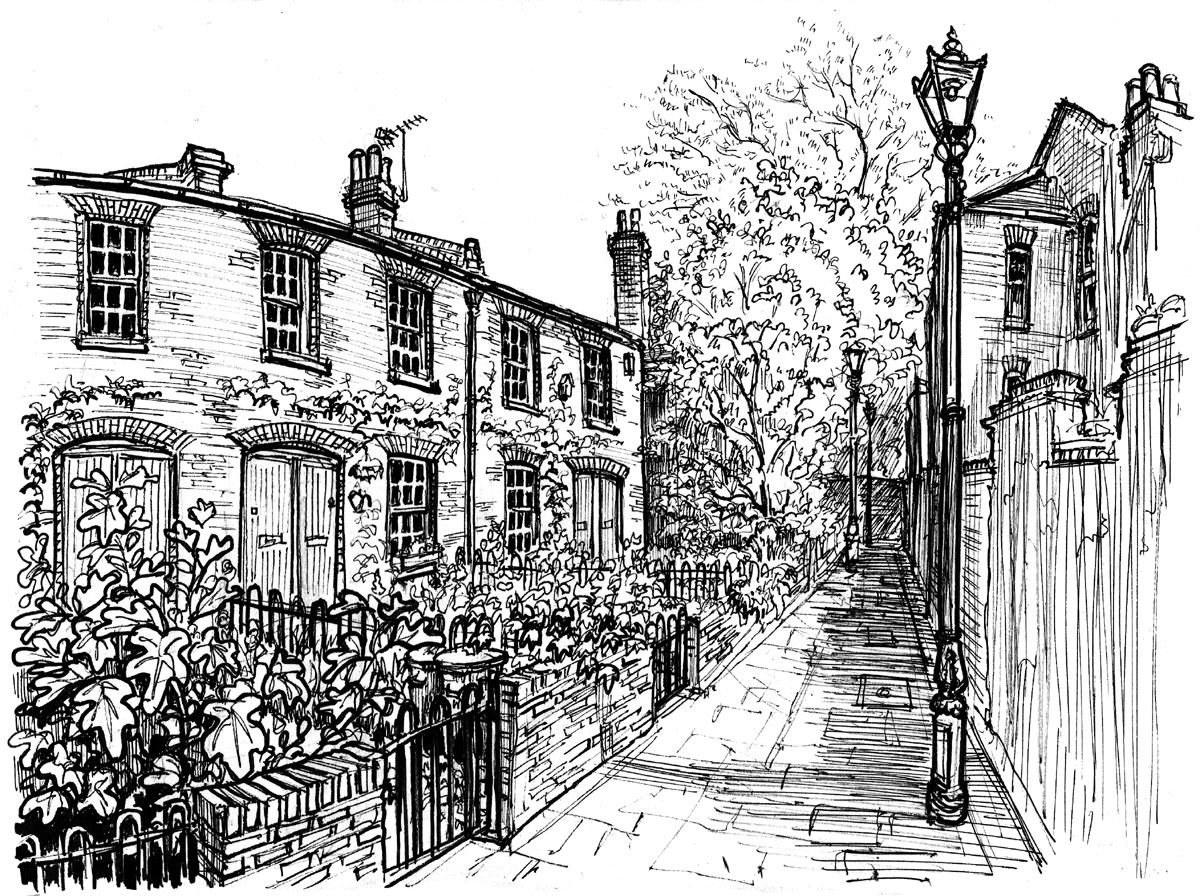
Joanna Moore’s drawing of Victoria Cottages in Deal St was done upon the spot where Geoffrey Fletcher, author of “The London Nobody Knows,”sat and drew the same view in May 1977, when this terrace was threatened by bulldozers. Built in 1855 by the Metropolitan Association for Dwellings for Housing the Industrious Poor, after the design of Prince Albert’s Model Cottages for the Great Exhibition of 1851, these are one of the earliest examples of two storey cottage apartments. Scheduled for demolition in a slum clearance scheme, they were saved in 1978 through the intervention of Peter Shore who was both local MP and Environment Minister. If Geoffrey Fletcher came back today he would be delighted to step through the old iron gate and discover well-tended cottage gardens where the fragrance of flowers hangs in the air. Pairs of neat white front doors lead either to the ground or first floor dwellings, which, although designed as the minimum in the nineteenth century, appear generous and sympathetic by contemporary standards. To the rear is a peaceful flagged courtyard where residents hang their laundry, tend the shared garden and hold wild annual parties that are the talk of Spitalfields.

Drawings copyright © Joanna Moore
You may also like to read
Brick Lane Market 8
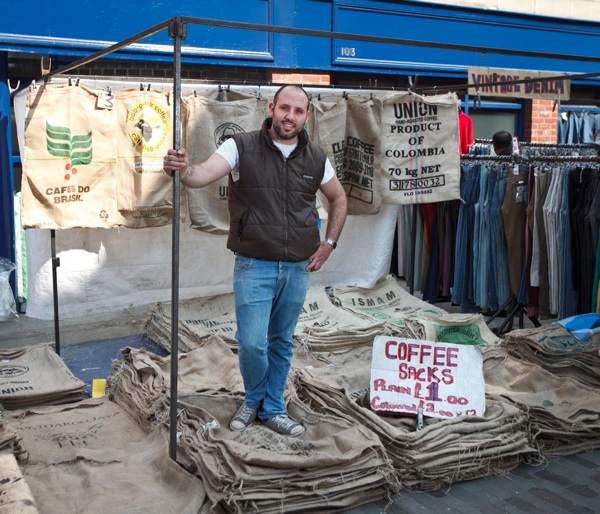
This is Paul Macatoni, the sack seller, with his fine display of printed hessian coffee bags from Africa, Asia and South America, that he has been selling on Sclater St for the past six months. “They’re popular, I’m in a niche market,” he admitted with glee, “People use them as decoration, storage, or to re-upholster furniture, to make cushions, beanbags and one lady even made a handbag out of one.” The amassing of so many sacks draws attention to their aesthetic qualities, attracting curious crowds to admire their typographic decoration and exotic trade marks, ensuring a brisk trade for Paul. The rest of the week he runs a call centre in Chigwell, but on Sundays Paul is big in sacks.

This is John Calcutt who has been trading on Brick Lane each Sunday since 1974. “I’m from Hoxton and I used to come down here when I was a little boy, and the stall next to me sold performing fleas.” he recalled affectionately, casting his eyes up and down the market, “It was absolutely packed by eight in the morning, they used to ring a bell at one o’clock then and you had to stop.” Now semi-retired, yet still energetic and limber, John comes from Dagenham to sell rugs here and in Deptford, three days a week.“I don’t like getting up early in the morning but I still come because I’ve got a mortgage to pay,” he confided as he began to fold up his wares, turning morose in his weariness. “I’m just hanging on,” he confessed to me in a whisper, “I don’t even break even but I don’t mind coming, as long as I don’t lose too much money.” It was an admission that revealed John’s depth of sentiment for Brick Lane. But then John remembered that he is close to paying off his mortgage, the result of thirty-seven years hard work here in the market, and brightened visibly, “Another three months, and I’ll be free in July!” he declared, triumphant.
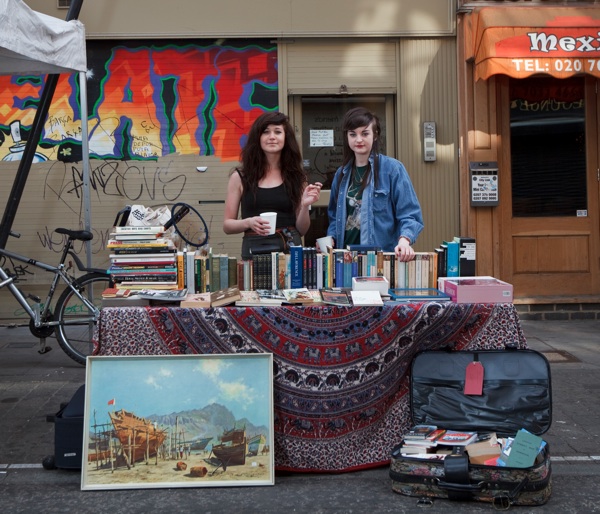
This is Laura & Milly, two skinny art students from London Metropolitan University who have been trading here on Brick Lane for seven weeks, selling books and bric-a-brac from a folding table.“It’s been tough, we’re not going to lie – but today’s been really good,” revealed Milly, sharing an emotional grin of achievement with Laura.“This is our food money for the week, we’ll go food shopping tonight before we get the bus back to Stratford.” she added in excited anticipation of a feast, revealing how essential the stall is to their survival during their studies. The pair fell into market life almost by accident. “We got pissed one night and thought, ‘We’ll give it a go!'” confessed Laura with a blush, making light of the origin of this brave endeavour that has made such a difference to their quality of life –“and now we’re both addicted, because it’s too much fun.”

This is the amiable Frank Ganeda – dealer in minerals – who was born in Eastern Europe, raised in Canada, and after ten years here now admits, “It’s hard to remember the original reasons why I came.” Fascinated by the legends and the touch of all his multi-coloured rocks and crystals that glint and gleam in the sunlight, Frank has found his ideal occupation in life – permitting him to go travelling to warm places each Winter and buy stones, which he can then sell in London each Summer, the high season for sales of minerals. “One of the fascinating parts of this job is picking what to bring to Brick Lane, I can spend hours deciding,” he disclosed, his pupils sparkling with the intensity of his polished stones. And whichever you pick, Frank will regale you with his eloquent patter, outlining their propitious influences, and sometimes rattling them together in his cupped hands and holding them up to your ear, saying, “Let me show you how they sing together.”
Photographs copyright © Jeremy Freedman
The Hackney Hoard
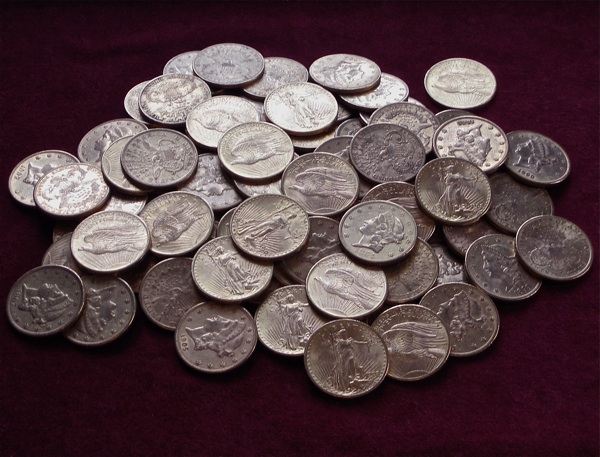
The tale of the Hackney hoard is an unlikely adventure that is also a true story – one which begins with a simple hole in the lawn and expands to become a epic international drama of Nazi gold, spanning generations and traversing the globe.
One day, Terry Castle, along with a volunteer and two of the residents at the centre in Bethune Rd, Hackney, where he was employed as a disability support worker, decided to dig a frog pond. “It was my idea,” explained Terry, who characterises himself as a psycho-geographer, “I’m big into amphibian preservation.”
“I got my team together, and we were three weeks into the digging. I was in my office – but I had to keep an eye on them because three people digging in a hole can be at risk of accidents – when the volunteer, who’s a local girl, looks up and says, ‘There’s something here, Terry.’ At this point we were about two and a half feet down. I saw a glass jar sticking out at a forty five-degree angle with its top pointing down. The metal seal had deteriorated to nothing. I thought, ‘This is unusual,’ because there was a lot of rubble at the site from when it had been bombed.
I remembered I had a builder’s trowel in the tool cupboard, so I excavated around the jar for about fifteen minutes. By complete coincidence, two weeks earlier, I had been working eight hours a day on the excavations at Syon Park, so I knew what to do. I studied archaeology at Birkbeck College, although my speciality was prehistory.
We hauled the jar up onto the grass and it weighed considerably more that it should weigh, it was whole and quite large. Thoughts go through your mind. What’s in this glass jar? Weights from a scales, somebody’s pebble collection, or something more sinister? I stuck in my hand and pulled out a roll of paper and put it in the palm of my hand, it was greaseproof paper. A second later, I pulled the paper apart and I saw a roll of gold coins, with the statue of Liberty marching out of the front coin in high relief.
If there was a moment which was special that was it. ‘My God, I think we’ve found treasure!’ I said. Then I took it up to the office and and slapped it on the table and said, ‘We’ve found gold.’ I wrapped it up in plastic and put in the safe and called the Museum of London. They came along from the Museum early evening. But I do remember thinking, ‘Shall I take just one, or shall I take a whole roll?'”
Yet Terry did not take a single coin of the eighty double-headed eagle American gold dollars – much to his regret, because neither he nor the others who found them ever received any recompense for their honesty. “I think something’s extremely fishy,” he claims, “We never got a cup of tea or coffee or a biscuit, but we got three years of stress and I’ve lost my respect for the law. I was known as ‘Mr Bling’ in Hackney, which is very hard when you’re not ‘Mr Bling.'”
Once the discovery of the Hackney hoard became the headline of the Hackney Gazette in October last year, it piqued the curiosity of local historian Stephen Selby who applied his sleuthing skills to remarkable effect in unravelling the tale behind the burial of the trove. In the Times’ archive Stephen found a report of a previous find of eighty-two “double eagles” at the same address in 1952 when the current building was constructed. These were awarded by the coroner to Martin Sulzbacher, a resident of the bombed house that once stood upon the site. Sulzbacher was a German Jew who had fled persecution from Nazi Germany in the late thirties and bought a double fronted suburban villa in Hackney. In 1940, when Martin Sulzbacher’s brother Fritz found the family was on an SS hit list in the event of an invasion of Britain, he took the gold coins from the safe deposit box in the City of London and buried them in the garden in Woolworths Killner jars.
Minted in the United States between 1854 and 1913, these coins were part of the hundred million dollar American loan paid to Germany for post-war reconstruction in 1924, money that Hitler eventually appropriated for his own purposes. No-one knows how Martin Sulzbacher acquired them or transported them into Britain, yet it seems the gold brought him no luck. After escaping the Nazis, he was interned by the British government as an enemy alien refugee, and sent to Canada on the Arandora Star which was torpedoed and sunk. Miraculously rescued after hours in the water, he was then sent to Australia on the Dunera, before being brought back to the Isle of Man where his wife and children were also interned.
As if this was not enough, when he was released, Martin Sulzbacher went to the deposit box and found his gold was gone. Meanwhile Fritz had informed a friend that no-one else need know of the location of the buried gold because all five members of his family knew it, but then the house took a direct hit on 24th September 1940 and they were all killed. Poor Martin Sulzbacher waited until the first discovery in 1952 for the return of eighty-two of his coins and, since he died in 1981, it befell to his son Max to come from Jerusalem to collect this recent hoard which was awarded to him by the coroner at St Pancras Coroner’s Court on 18th April. It seems the story ends there and Stephen Selby says graciously, “My greatest satisfaction is to have repatriated Max with his parent’s memory.”
Meanwhile Terry Castle lost his job, partly as a consequence of the discovery, and he has still to plumb the deeper significance of it all – “As a psycho-geographer I do think it’s very strange that we found gold when we digging a frog pond.” – yet he consoles himself with this small comfort – “I’m a free man, freer than I’d be if I had the treasure.”
Archaeologists have now excavated the site to ensure that no further gold coins remain.

Terry Castle, the psycho-geographer who discovered the gold while digging a frog pond.

Stephen Selby, the local historian who unravelled the story of the gold.