
Columbia Road Market 70

I bought these heavily scented Narcissi from Lisa Burridge at Columbia Rd, three bunches for just two pounds this week – possessing a pungent musky fragrance that fills my living room, and perfectly complementing the first flawless blue skies over the East End this weekend. They are just one of the many subtly different varieties of English Daffodils and Narcissi from Spalding Market that Lisa has on sale now, at the peak of the season for Spring flowers.
Waking early to sunlight, I am tempted to lie in bed watching the nesting birds coming and going from the bird house outside my bedroom window all morning, but it is a pleasure to rise when the sun offers such promise, and take a stroll up to Columbia Rd to visit Lisa Burridge at her stall and return with an armful of Spring flowers for the exchange of a few pounds. With her brightness of manner and sassy hoop earrings Lisa brings a touch of feminine glamour to the market, and it is always a pleasant diversion to stop by for a chat interspersed between the eager customers arriving to carry off flowers in delight. Lisa married into the Burridges – the family that over more than three generations have become such an integral part of the history of this market that they are considered the royalty of Columbia Rd.
“I started working here for my father-in-law Herbie Burridge when I was eighteen, twenty-four years ago,” Lisa confided to me proudly. “And my kids usually help out, only one’s got a driving lesson and the other has a throat infection,” she added with a philosophical smirk, explaining, “I take care of my family all week and work here on Sunday, and sometimes in the market at Waltham Abbey on Saturday.”
Lisa runs the cut flower stall on the one of the long-established Burridge family pitches for her husband Pete, while he manages the nursery in Hoddeston with his brother dealing in plants that are sold on another pitch. “It used to be forty stalls out of fifty-two here were Burridges once upon a time, Herbie told me,” commented Lisa in wonder. “More like twenty-one out of fifty-two,” qualified Pete with a good natured shrug, making a more conservative estimate as he arrived to join the conversation – though still quite an extraordinary proportion for one family in a market. “The old man liked to tell a tale,” admitted Lisa to me, flashing an indulgent smile, before she turned back to serve the next customer, reaching for yet another handful of the scented Spring flowers that surrounded her in a bower of pale yellow.


The Spring flowers of 2010 from Columbia Rd.

George Gladwell’s portrait of Herbie Burridge on the same pitch as Lisa, back in the nineteen seventies.
Portrait of Lisa Burridge copyright © Jeremy Freedman
You can learn more about the Burridges here
Josephine Ferguson (first husband Burridge)
Denise Kirstensen (née Burridge)
Leslie Norris of Bethnal Green

Leading this splendid parade advancing manfully down the Old Ford Rd is Leslie Norris, Warrant Officer of the London District Air Training Corps, at the head of the very first Bethnal Green Carnival in 1952 – and such was the joy that Leslie felt in being at the centre of his community, evident in this heroic image, that it remains undiminished even half a century later.
Growing up in the streets around Hackney Rd, Leslie earned the nickname “Ginger” and although now, at eighty-five, only a few fiery-red hairs in his eyebrows remain as clues to its origin, when I visited Leslie in his current home in Essex, he was eager to declare his enduring emotional loyalty to Bethnal Green. “Even though I live in Romford, I am an East Ender,” he confirmed to me absolutely with a proud grin.
Born at 26 Hassard St, Bethnal Green, to Florence, a French polisher and Albert, a seed merchant, Leslie grew up “with a whole family of aunts and uncles all within a mile of each other,” and the interweaving streets around Columbia Rd – where he attended school – were the centre of his world. “Friday evenings we’d do jobs for the Jewish women,” recalled Leslie, laughing in delight at how resourceful he and his pals were at the age of ten. “We’d get sixpence from Mrs Leibowitz, Mrs Brodsky and Mrs Bukowski because they weren’t allowed to work, and we would run errands, clear up and light the fires for them. And we used to go to the Spitalfields Market at closing time with a knife and ask for offcuts of fruit in a bag for our mums – and that would be our supply for the week.”
At first, when Leslie’s father took over his brother’s sawdust business, Leslie helped out by delivering the sawdust to the jewellers in Hatton Garden, but his first real job was as a “glue-boy” in a furniture factory in Columbia Rd. “At the age of fourteen, I once pushed a barrow with an oak dining table and four chairs all the way to St. Anne’s Rd in Tottenham – I know it was 7th September 1940, because afterwards I had to rush home and put on a suit for my brother’s wedding. And then that night, during a raid, three of my cousins were killed.” he recalled in sober contemplation. Next, Leslie went on to work in a saw mill in Ezra St – but the events of September 1940 meant that he had already determined to join up as soon as he was old enough and in 1943, after training, he became a wireless officer in the Royal Corps of Signals, serving in Burma.
Back home after the war, Leslie centred his existence around St. Hilda’s East on the Boundary Estate. “It was the place everyone met in those days. We’d go every night. We used to love to dance – even though we only had five records to dance to!” he enthused. Possessing the charisma of a natural leader, Leslie became both Chair of the Senior Club and Captain of the football team at twenty four, organising camping trips and days out – involving his contemporaries from the immediate neighbourhood who all became life-long friends. And the exuberant photographs vividly communicate the spirit of carefree Summer jaunts and youthful high jinks that presided, illustrating how St. Hilda’s performed a crucial social function, as Leslie confirmed with a gleam in his eye. “Twenty marriages came out of those years at the club,” he boasted, “including my own” – glancing quietly to a nearby photograph of Joyce Lucretia Graves who died in 2007, whom Leslie had known since she was seven and whom he married on the 29th March, 1952.
“Joyce was determined we should marry in St. Leonards, Shoreditch, but we were out of their parish and the Reverend, a guy by the name of Rutter, wouldn’t permit it.” admitted Leslie. Fortunately a priest that Leslie knew during the war stepped in and performed the ceremony “with bells and everything,” he informed me, triumphantly. And when thick snow made wedding photos impossible outside the church, Leslie and Joyce led the wedding party over to St Hilda’s East where they requisitioned the gymnasium for their pictures.
Many years later, Leslie discovered his great-great-great-grandfather John Norris had been married at St Leonards in 1786. And he and Joyce returned to the church, where Leslie’s ancestors had made their vows more than two centuries earlier. “We went back for our fiftieth wedding anniversary in 2002 and renewed our vows,” revealed Leslie, recalling the congregation of nearly two hundred people that came to greet him and Joyce as they arrived at the church. “It was beautiful to be back again,” he confided to me tenderly, before adding, “Some joker asked if I was wearing the same suit!”
In the fifty years that passed between these ceremonies at St Leonards, Leslie worked as a butcher at Smithfield, maintaining his ties with the area and becoming a Freeman of the City of London – even though he moved from Bethnal Green with Joyce and their two children, Ian and Colin, in 1968 to live among the green fields of Romford. Demonstrating his passionate sense of community, Leslie was President of the St John’s Ambulance, Mile End Division for thirty years, and became Vice President of the South West Essex Burma Star Association, so I was not surprised to learn that he was awarded the O.B.E. for his service to others.
“I still sing the school song to myself every night,” Leslie told me, revealing the depth of the connection he feels to Bethnal Green even now, and, quite unselfconsciously, he sang the opening verse, beginning, “Columbia, the name we treasure/ Thy name ever dear to me/ Thy memories will always bring me pleasure/ Through far away I may be…” just as he remembered hearing other soldiers sing it in the tents in the jungle when he was serving in Burma so many years ago.
And as I listened, Leslie Norris became “Ginger” Norris again and I understood the indelible impression that the vibrant life of this small patch of streets in Bethnal Green had in shaping his destiny.


Post-war celebrations in Cuff Place, where Leslie and Joyce lived for the first twenty years of their marriage – Joyce stands at the centre of the lower picture.

Leslie (on the left) with pals in Bethnal Green.

Leslie as captain of the St Hilda’s football team.

Leslie and Joyce on their first date, Southend, Easter 1949.

The first kiss.

On a Summer camping trip from St Hilda’s East.


Leslie and Joyce.

Leslie and the boys enjoyed getting into drag for a lark.

Joyce did the washing up in a field.

Leslie swept Joyce off her feet.

Leslie and Joyce on their wedding day after the marriage at St Leonard’s, Shoreditch, 29th March 1952, – photographed in the gymnasium at St Hilda’s due to heavy snowfall.

“We used to go every year to Ramsgate in the Summer, to the same house, for sixteen years”

Joyce sits among family on the beach at Ramsgate in the sixties.

A gathering at Leslie and Joyce’s in Romford in the seventies.

Joyce and friends enjoy a knees up.

Leslie and Joyce, 1973.

Leslie Norris of Bethnal Green.
Mud God’s Discoveries 3

For many people the Thames is a sacred river populated by diverse gods, as mudlark Steve Brooker has discovered from all the offerings that he finds deposited in the mud, representative of the religious beliefs amongst the immigrant cultures of contemporary London. “Ever since I started, I’ve found thousands of them,” Steve told me, suggesting that the sub-aquatic spiritual universe of the Thames must be a crowded place where immortals cohabit side by side. “Woolwich, Bermondsey and Rotherhithe are very big on Indian offerings,” added Steve helpfully, “whereas I find Chinese artifacts at Silvertown.”
Although Steve is not a religious person, these objects exert a powerful fascination upon him. When he is alone on the mud, scouring the water’s edge in the dawn mist and he discovers a religious offering, then Steve recognises a personal sense of awe in the human credulity which led to the deliberate placing of these offerings in the river with the expectation of a particular result.
Instead of fairies at the bottom of his garden, Mud God Steve presides over a large community of deities from the Thames, and amulets too – all artifacts contrived to evoke benign spirits. But when Steve finds Voodoo dolls impaled with needles or vials wrapped in paper with obscure texts including the word “Lucifer,” then he leaves these strange offerings where he finds them in the river. “I don’t believe it, but I do have a healthy respect for it,” he admitted Steve warily. Once he came within three feet of being hit by an effigy, when at low tide the owner threw it with considerable heft to reach the water, narrowly missing knocking Steve for six. “They are just for luck – but I could have been killed by an offering!” declared Steve in affront, widening his eyes at the absurdity of it.
An invitation to examine some “Roman” pots at Woolwich led Steve on an especially muddy episode, which revealed hundreds of terracotta ghee pots (resembling Roman lamps) associated with the Indian festival of Diwali, when traditionally these lamps are set adrift upon the Ganges – the Thames in this instance standing in for the sacred river among London Hindus. Another common find are square metal plates incised with designs, these “yantras” are talismans to avert misfortune.
Most fascinating to Steve are the many modest silk bundles he finds upon the shore bound up carefully in red thread, containing offerings of seeds and sweet corn and coins. Also, sometimes wrapped up and tied in red thread are padlocks and glass vials containing fluid enfolded in texts written upon waxed paper, and the significance of the red thread especially perplexes him. “It means something to someone,” he mused.
“Always collect any coconut you see in the Thames,” Steve advised me – especially if it has been drilled and resealed, because these commonly contain offerings, which sometimes may be of value. Naturally, gold is the offering of greatest worth and Steve once found a lump of gold wrapped up in lead – lead and gold being two materials often combined in religious offerings – another source of enigma.
Many of the effigies in the river are cheap mass-produced objects, purely for the purpose of sacrifice, yet the human significance placed up these things gives them emotional value and meaning for Steve. Although occasionally, extraordinary sculpted items also turn up like the exquisite bronze head below which has its own presence and is believed to be of African origin.
There is a collective mystery to these objects that do not give up their secrets easily, and Steve feels obligated to provide a safe home for them all – in the private hope that one day they will speak to him. “I’d like to be a Buddhist,” he confessed to me, with the rogueishly appealing smile that is his signature,“but I think I’m too nasty!’

Clay lamps used by Hindus in the festival of Diwali – filled with ghee and set alight, they drift off across the water.

Yantras, a talismans to ward off evil.


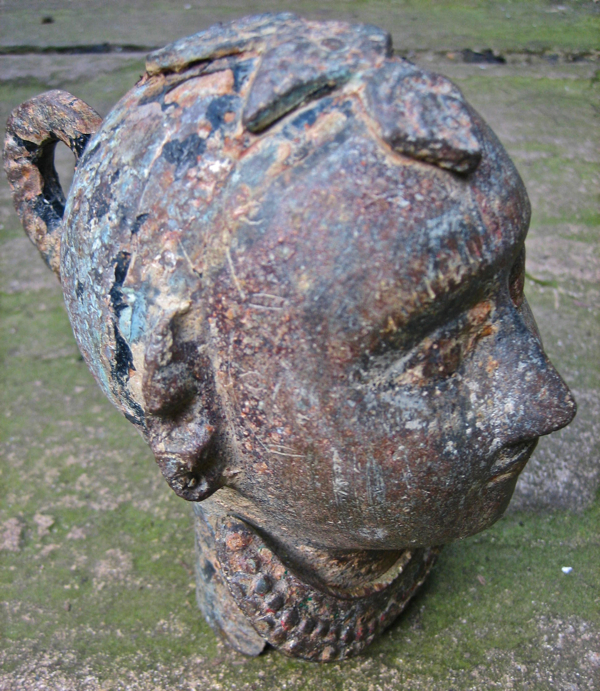
Fine bronze head believed to be of African origin.

Steve Brooker’s series MUDMEN continues on History and you can find out more from his website www.thamesandfield.co.uk
You may like to catch up with
Pellicci’s Collection

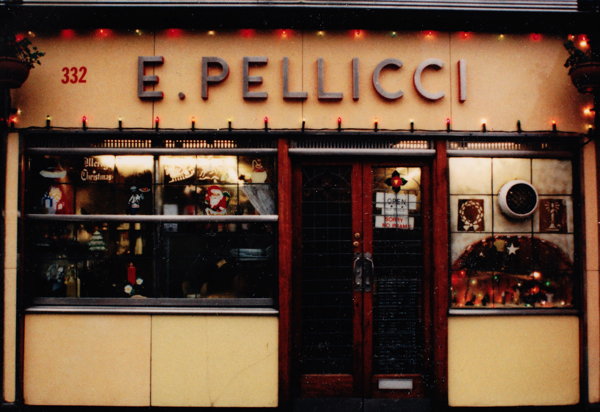
This is Lucinda Rogers‘ drawing of E.Pellicci in the Bethnal Green Rd, London’s most celebrated family-run cafe, into the third generation now and in business for over a century – and continuing to welcome East Enders who have been coming for generations to sit in the cosy marquetry-lined interior and enjoy the honest, keenly-priced meals prepared every day from fresh ingredients.
E.Pellicci is a marvel. It is so beautiful it is listed, the food is always exemplary and I every time I come here I leave heartened to have met someone new.
I found Lucinda Rogers’ drawing on the wall in one of the small upper rooms that now serves as an informal museum of the history of the cafe, curated by Maria Pellicci’s nephew – Toni, a bright-eyed Neapolitan, who has been working here since he left school in Lucca in Tuscany and came to London in 1970. He led me up the narrow staircase, opened the door of the low-ceilinged room and with a single shy gesture of his arm indicated the family museum. Toni has lined the walls with press cuttings, photographs and all kinds of memorabilia, which tell the story of the ascendancy of Pellicci’s, attended by a few statues of saints to give the pleasing aura of a shrine to this cherished collection.
Primo Pellici began working in the cafe in 1900 and it was here in these two rooms that his wife Elide brought up his seven children single-handedly, whilst running the cafe below to keep the family after her husband’s death in 1931. Elide is the E.Pellicci whose initial is still emblazoned in chrome upon the primrose-hued vitroglass fascia and her portrait remains, she and her husband counterbalance each other eternally on either side of the serving hatch in the cafe. In 1921, Nevio senior was born in the front room here. He ran the cafe until his death in 2008, superceded as head of the family business today by his wife Maria who possesses a natural authority and charisma that makes her a worthy successor to Elide.
As I sat alone in the quiet of the room, leafing through the albums, surrounded by the walls of press coverage, Maria came upstairs from the kitchen to join me. She pointed out the flat roof at the rear where her former husband Nevio played as a child. “He was very happy here,” she assured me with a tender smile, standing silently and casting her eyes between the two empty rooms – sensing the emotional presence of the crowded family life that once filled in this space that is now a modest store room and an office. Maria and Nevio brought up their children in a terraced house around the corner in Derbyshire St, and these days Toni goes round each morning early to pick her up from there, before they start work around six at the cafe she runs with her son Nevio and daughter Anna.
Pellicci’s collection tells a very particular history of the twentieth century and beyond – of immigration, of wars, of coronations and gangsters too. But, more than this, it is a history of wonderful meals, a history of very hard work, a history of great family pride, and a history of happiness and love.

Primo Pellicci still presides upon the cafe where he started work in 1900.

Primo’s children, Nevio and Mary Pellicci, 1930.

Pellicci’s wartime licence issued to Elide Pellicci in 1939 by the Ministry of Food.

Pellicci’s paper bag issued to celebrate the Coronation of Elizabeth II in 1953 – note the phone number, Bishopsgate 1542.

Mary and Maria Pellicci, Trafalgar Sq, 1963.


Nevio junior, aged seven, skylarking outside the house in Derbyshire St with pals Claudio and Alfie.

Nevio senior and Toni, 1980.

Pellicci’s customers in 1980.

Nevio senior, 1980.

Nevio and Toni.


Christmas card from Charlie Kray, 1980.

Nevio junior and Nevio senior.

George Flay’s portrait of Nevio Junior, 2006. See more at www.artofflay.com

George Flay’s montage of the world of Pellicci’s.

Nevio Senior, 2005


Salvatore Zaccaria, known as Toni, keeper of Pellicci’s collection.
You may also enjoy reading
Leila’s Shop Report

Every Monday night, Leila McAlister goes to New Covent Garden Market in Nine Elms in to buy fruit and vegetables, and when I arrived at her shop on Tuesday morning, she had just finished packing up the weekly vegetable boxes that she delivers to her customers in the neighbourhood. The whole place was filled with enough spellbinding fragrances and astounding vivid colours of fresh Spring produce to lift the spirits of the saddest March day.
“At the end of Winter when you feel you are living in a black and white film, you need to eat lots of oranges!” declared Leila authoritatively, with a delighted smile – standing in her blue twill jacket amongst the stacks of boxes of oranges from Sicily that were just a fraction of her exciting night’s haul which she had driven back to Arnold Circus in the dawn.
As an adult in the thrall of a passion for fresh vegetables, Leila’s Shop gives me a comparable thrill to that I once received as a child entering a sweet shop, I really want to eat everything – from the humble varieties of English potatoes to the exotic delicacies from the Mediterranean. Fortunately, Leila has a liberal policy of allowing her customers to taste anything that can be consumed raw. You do not have to drop a heavy hint, you simply have to ask, “What’s this?” in a leading tone and usually a leaf or a slice will be forthcoming.
Among the crates of citrus from Italy were unwaxed leafy lemons and Moro, Tarocco and Sanguinello blood oranges. And in response to my query about the respective varieties, Leila seized the opportunity immediately to slice up a couple with a sharp knife to reveal the juicy ruby-red flesh, and we were able to savour the relative qualities of the Sanguinello and the Moro – the Sanguinello possessing a deep, almost pomegranate flavour with a strong citrus kick, while the Moro orange was a lighter, more scented fruit. We stood in silence for a moment of contemplative pleasure, with our mouths full of orange, as momentarily the spirit of the Mediterranean made its presence felt in Shoreditch.
Also from Italy, Leila has the most spectacular radicchios I ever saw – Castello Franco, a pale yellow rose-shaped plant and Tardivo, a purple bud-shaped plant – both available now in very limited supplies for a short season, through the markets of Verona. It is difficult to imagine a more delicious Spring salad leaf than these and I love to eat them with a simple dressing of lemon juice and olive oil, but Leila told me that the Italians, for whom bitter leaves are a national passion, like to grill them. These varieties are highly regionalised, and by law Tardivo can only be grown in the region around Traviso. “It’s a serious business in Italy,” confirmed Leila, casting her eyes affectionately upon her astonishing display of crisp yellow and purple leaves that cause her customers to gasp in wonder, and which I have seen nowhere else in London.
Wild English garlic is in season now and Leila buys bags of their smooth green leaves from traders at the market who have been out foraging to make some extra cash. She was quite surprised when I admitted that I like to put these pungently flavoured leaves raw into my ham sandwiches, because she prefers to braise them and add them to pasta or risotto, recounting their success as an unexpected addition in Bechamel sauce to liven up cauliflower cheese.
From nibbling these sharp green leaves, we moved on to thin peppery slices of French black radish, a vegetable grown with such loving care to the regular size and shape of salami. “With a lemon dressing, capers and chopped parsley, it would be heaven,” speculated Leila, her eyes glazing over in a day dream. Next we tried Jerusalem artichokes raw, at Olha’s suggestion, who informed us that they were known as “underground pears” in her native Ukraine, and surprisingly they do possess an attractive chestnut flavour. Since it was time for admissions, Leila revealed they were called “fartychokes” in her family – “We used to die laughing waiting for the farting to begin!” she confessed, rolling her eyes in happy reminiscence, and she confirmed that artichoke soup will be on the menu at Leila’s Cafe this weekend.
Yet we had only begun to explore the range of what is at its best this week. I must leave it to you to go along and try the forced rhubarb, the purple sprouting, the leeks, the fennel, the cabbages, the creamy avocados from Malaga and all the other goodies that are available now, as Spring moves inexorably North through Europe from the Mediterranean, encouraging new life in the fields, and bringing us the first crops of the year.
I used to have an eighty-four year old friend with whom I stayed in her apartment on the Upper West Side for many years, whenever I visited Manhattan. “If only they would invent something new to eat!” she used to lament endlessly in a humorous tone, as one of the trials of her advanced years. I wish I could have taken her to Leila’s Shop, because she would have discovered plenty of delicious things to inspire her appetite, not “new” at all – but simply Leila’s pick of the very best that is in season.
Leila’s weekly vegetable boxes are available for delivery throughout Shoreditch, Dalston, London Fields, Bethnal Green, Spitalfields and Whitechapel.

Sanguinello – blood oranges from Sicily.

Grape hyacinths.

Market day at Leila’s Shop.

Cabbages.

Forced Rhubarb.

Black French Radishes.

The bandstand at Arnold Circus.

Sicilian lemons.

Leeks.


Fennel.

Garlic.

Jerusalem Artichokes.

Corner table at Leila’s Cafe

English Daffodils.

Sage, Rosemary and Thyme.

Spring sunlight at Leila’s Cafe.

Castello Franco and Tardivo, radicchio from Northern Italy.

Green Irises
Paintings copyright © Olha Pryymak
You like to read about
Bryan Edwards, Pawnbroker

This dapper gentleman in the elegantly understated suit and tie, with the immaculately combed silver hair and naturally distinguished features is Bryan Edwards, who in 1985 acquired Attenborough Jewellers in the Bethnal Green Rd – the largest East End Pawnbroker, established in 1892. You might assume Attenborough’s was the last vestige of a former world of poverty – even a relic of another time – but you would be completely wrong because pawnbroking is a growth industry that is booming in the current financial climate, with each recession providing further opportunity for growth.
Whereas once the pawnbroker served only the poor, now members of all social groups find their way into Bryan’s modern pawnshop with its smart leather couch and air of being an upmarket bureau de change. “We’ve had a lot of people from the City in here,” confided Bryan proudly to me as I enjoyed a tour of his splendid facilities, without any trace of the dinginess that is associated with old-school pawnbroking in the popular imagination.
“Just after the war, there were only a hundred and forty pawnbrokers left in this country,” revealed Bryan – a former President and member of the Council of the National Pawnbrokers’ Association for twenty-seven years – widening his eyes in concern at the thought of those dark days. “We operated under a lot of financial restrictions until 1985 when the Consumer Credit Act of 1974 became law, and that gave us more scope. And now there are over twelve hundred pawnbrokers nationwide,” he continued, with a modest grin of satisfaction at the collective tenacity and prudence of those fellow members of his own industry who have proved themselves survivors through the thick and thin of the post-war years. “We’ve seen some changes!” he declared with the understated swagger of an old trouper.
“In 1985, the limit on lending went from fifty pounds to fifteen thousand in twenty-four hours,” he recalled, his eyes gleaming in retrospective delight, “And when the recession of the nineteen nineties kicked in, that was when it really began to grow and expand. We had people who couldn’t pay their mortgages and City executives coming in.” Adding for effect, “We kept calling up the bank and asking them to send over more money!” he said, to convey the sense of carnival at this glorious moment in the history of pawnbroking.
Bryan’s father started the family business as a jeweller in King’s Cross in 1944 and ran it until an unexpected illness in 1958. “In three years, I had to take over and run the business. I was thrown in at the deep end.” Bryan explained to me, introducing the account of his entire lifetime in the profession in which he has proved such an outstanding success. Counterbalancing Bryan’s modern pawnshop entered by the door on the right hand side of Attenborough’s, is the traditional jeweller’s entered through by the door on the left hand side. Approximately fifteen per cent of the items brought in through the right hand door as security for loans get sold through the left hand door when their owners default on their debt, Bryan told me. The average loan is between five and and fifteen thousand pounds, with jewellery as the most common form of security and approximately five months as the average pledge, I learnt.
“Some people are just not capable of managing their finances. They don’t budget and they overspend.” Bryan admitted reluctantly with a frown of disappointment, as if he felt personally let down. “But we do everything we can not to foreclose because it’s not in our interest to sell a customer’s goods since we lose a customer. Because we are a family business, we always help out if people are in difficulties and we bend over backwards to help those who are in real need.” he said, clasping his hands in concern and speaking more like an altruist than a businessman. His bold confidence reflecting the fact that the banking crisis and consequent dearth of credit and loans has been good news for the pawnbroking industry, enabling Bryan to expand his operations further – manifest in his sleek refitted pawn shop. “Our role is where the banks didn’t help. It’s like instant coffee, it’s instant money!” he enthused with a chuckle, spontaneously coining a slogan in his eagerness to give money away to people.
Bryan led me up an old staircase through a sequence of small matchboarded rooms to arrive at the office up above the shop, with a magnificent nineteenth century fireplace, shuttered sash windows and views up and down the Bethnal Green Rd. Here Bryan gave me his account of himself while his daughter sorted through filing, occasionally interjecting, “Just between ourselves” and “Don’t tell anyone this but…” into his monologue, much to her disapproval. I found it remarkable that he had retained such a trusting nature after more than half a century as a pawnbroker.
“I went to Las Vegas to a pawnbroker’s convention but I didn’t put a penny on anything, not even a fruit machine.” boasted Bryan Edwards, the model of abstention, giving unquestionably the most original excuse for a trip to Las Vegas I ever heard, yet revealing his humanity by confessing with reckless playfulness – leaning forward and whispering to me so that his daughter would not hear – “Just between ourselves, I did gamble once on a horse in the Grand National because it was called ‘Pawnbroker,’ and it lost!”


Brick Lane Market 3

This is John and his father Alf in the charismatic old shed they have just opened up beside the railway bridge in Brick Lane. Two stalwarts who have spent their working lives buying and selling all manner of commodities in the East End – Alf entered local lore when he bought a lion cub off a ship in the docks forty years ago and sold it at Club Row animal market, while his son John has always traded around Brick Lane.
“I used to to have the biggest railway arch here, then I was in Cheshire St and once I had the biggest yard in Bacon St.” he boasted, explaining that for the past six years he has lived in the tiny caravan nestled snugly at the rear of his shed. When you enter the tall red wooden doors leading off Brick Lane into the huge shack with a multiplicity of stalls and a tea stand, you enter John’s world where he sells “all and everything, from a-z.”
“Is this bric-a-brac or junk?” I ventured, casting my eyes around the ramshackle mixture filling the cavernous space, where Tom the weather-beatened and tanned sailor lurked in the shadows at the rear with his big black dog. Raising his brows at the impudence of my question, “It’s shabby chic!” John declared, twisting his stubbly features into the leery smirk of a showman – “’Shabby chic’ was invented in Brick Lane.”
“I used to come up here with my dad and it was like a day out. If you wanted something you could get it for pennies. This place is what Brick Lane was like twenty years ago,” he continued, introducing his personal view of the changing currents of the market. “Saturday is better for us than Sunday now,” he said,“People come to all the vintage clothes shops but I don’t know how they make any money. I reckon that’s why they call them ‘pop-up shops’ because they pop up and then pop off.”
Over a cuppa from the tea stall, I settled down to enjoy Alf’s lyrical stories of the old East End, of Spratt’s dog food, Twining’s Tea, Percy Dalton’s peanuts, and of the former magnificence of Wellclose Square and when Wilton’s Music Hall was a rag store, and of his poor old pet fox, and Quackers, his pet duck, that followed him around the streets. “I think it’s a more violent world now,” he confided in a whisper, “beyond Vallance Rd is a dangerous place with gangs and drug wars. I won’t go there.”
When John’s two sons arrived from school in their smart green uniforms, I asked them if they planned to continue trading here on Brick Lane but they both shook their heads in unison. “I want them to be traders in the stockmarket,” said John, accompanied by nods of enthusiasm from his boys, “I take them for walks around the Docklands and tell them which companies to work for.”
“You want them to be bankers?” I queried. “I want them to make money,” he confirmed, “A lot of successful people have come out of Brick Lane, Alan Sugar started round the corner and the old man used to sell records to Richard Branson.” And then, turning to his father, their eyes met in a moment of shared realisation. “Where did we go wrong?” he asked, raising his hands with a grimace of bewilderment.


Photographs copyright © Jeremy Freedman


