
Emanuel Litvinoff, Writer (1915-2011)
In June, it was my privilege to meet Emanuel Litvinoff, who died peacefully in his sleep last Saturday. As a tribute, I am republishing my piece today – the last interview with one of the major writers to come out of the East End. Read “Journey Through a Small Planet,” and you will always think of Emanuel Litvinoff whenever you walk down Cheshire St.

At ninety-six years old, Emanuel Litvinoff is taking it easy now, enjoying long afternoons of contemplation, gazing out from the tall windows of his tiny flat in a Georgian terrace in Mecklenburgh Square, Bloomsbury, to the tall plane trees where woodpeckers and crows are to be seen. Yet still he thinks back to the two tenements off Cheshire St where he grew up in the nineteen twenties.
In 1913, Emanuel’s mother and father fled Odessa to escape the pogroms in which thousands of Jews were killed – they travelled steerage and hoped to get to New York but they never made it beyond Spitalfields where Emanuel was born in 1915. When the First World War broke out, Emanuel’s father returned to Russia and never returned, which left Emanuel’s mother to bring up her family alone by taking in sewing. These were the circumstances in which Emanuel grew up, within the confines of his East End Jewish ghetto – “the small planet” as he termed it in his writing – and his beautiful account is full of feeling, remarkable for its emotional candour and lack of sentimentality, tracing the kindness and the cruelties of existence in a series of clear-eye episodes from life of the young writer.
Although Emanuel won a scholarship to study the trade of his choice upon leaving school, he discovered that every one he selected was closed off to him as a Jew, and so he struggled, taking a series of menial jobs through the depression of the nineteen thirties and ended up working in the fur trade, nailing wet fur to boards. “It was tough,” admitted Emanuel. “I was often so hungry that I would hallucinate. We fought every day for our lives.” He remembers queueing for food in Whitechapel, applying to the Jewish Board of Guardians for a pair of boots and sleeping rough. Yet Emanuel was a born writer and in 1942 a slim volume of sombre poems was published, and when, on his first wife, Cherry Marshall’s, encouragement, he submitted a short story to an Evening Standard competition, he won a car. In the post-war literary world, Emanuel counted Dylan Thomas among the fans of his work as his writing took flight in the creation of articles, poems, novels and plays. And, with a strong moral sense enforced by his own experience, Emanuel wrote a poem that challenged T.S. Eliot over the antisemitism expressed in his early work, and even Eliot had to admit, “It’s a good poem.”
All this I knew before I went to visit Emanuel Litvinoff, but when I walked into his room, lined with books and illuminated by floor-to-ceiling windows, where he lives with his second wife Mary McClory, I was touched by the modest presence of the man. Recently Camden Council have withdrawn the support for Emanuel which had been recommended by doctors at University College Hospital after Emanuel received treatment there, leaving Mary to take care of her husband without any assistance. Emanuel’s response is sanguine. “It seems the same as 1931 all over again,” he said, shaking his head in disappointment, “This is a depression caused by financiers and bankers, but it’s the poorest who are paying for it.”
Mary and Emanuel have been together for twenty-seven years and have a twenty-five year old son, Aaron. Now Mary has given up her job as a teacher to care for Emanuel full-time and while he sits perched in his chair wedged between bookshelves, she has created three elaborate balcony gardens for him to look out upon, growing rocket, beetroot, sweetpeas, nasturtiums and California poppies from seed and even potatoes in a pot. A sense of peace borne of mutual trust presides over this couple here in this quiet flat, looking down upon the old square. Mary brought out some original editions of Emanuel’s books which she had been looking at to compile a collection of his poetry and Emanuel was eager to examine these treasured copies, holding the pages right up to his nose and scanning the lines of verse as if for the first time, yet travelling a half-remembered journey in his mind.
Although frail, Emanuel certainly retains his charm and, when he stands, his physical presence, natural authority and stature become apparent too.“After a lapse of time, the past becomes a mythical country,” he wrote in 2008. A sentiment that has specific meaning for Emanuel Litivinoff as one who has travelled such an odyssey, over almost a century, and for whom the distant past of his childhood can be recalled only in fragments now – yet thanks to his extraordinary literary talent, it is a story and a world that exists forever in the pages of his masterpiece of autobiography, “Journey Through a Small Planet.”

Emanuel at his flat in Mecklenburgh Square, June 2011.

Emanuel revisits Brick Lane, 1972.

Emanuel standing on the Pedley St bridge off Cheshire St in 1972.

Emanuel with his brothers Abe and Pinny on 18th December, 1940.

Emanuel is the second from the right in the second row of this picture of class one at Wood Close School in the nineteen twenties.

The earliest photograph of Emanuel with his two brothers.

Emanuel Litvinoff (1915-2011)
New portraits copyright © Lucinda Douglas-Menzies
Find out more at www.emanuel-litvinoff.com
John Moyr Smith’s Tiles 4
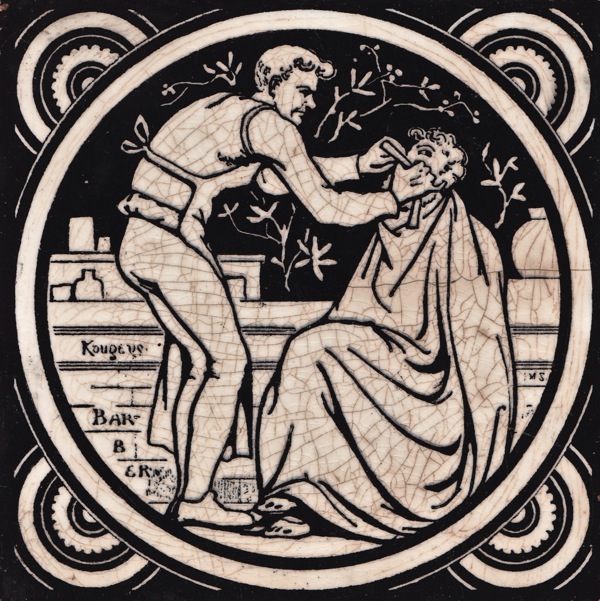
The Barber
At the very beginning of this year, I began to collect John Moyr Smith’s tiles from the eighteen eighties. Captivated by the elegant lyricism of his designs and working with a meagre budget, it has taken nine months to acquire the forty-five tiles I require to line my fireplace, in advance of installing an iron stove to keep me warm during the coming Winter. Where possible, I have bought chipped, cracked, broken or stained tiles – some even rescued from the bottom of the ocean – and, as a result, I now have a spectacular collection. In mint condition, some of these tiles would change hands for hundreds of pounds, yet many of my specimens only cost a few pounds each.
The selection published here illustrates the eclectic range of subjects which inspired John Moyr Smith, all portrayed with wit and vitality. It is a curious mix of the epic and the everyday that reflects my own sense of the volatile nature of existence. There is a barber, a painter, a potter and a tanner from Moyr Smith’s series of artisans, offering a vernacular counterpoint to his apocalyptic Biblical visions of Christ walking on the water, the the wise men arriving from the East, Jacob’s dream at Bethel, the fall of Sodom & Gomorrah and the slaying of Abel – with Tennyson’s Vivien seducing Merlin and Shakespeare’s Lear grieving for the loss of Cordelia, just to skew the phantasmagoric mirage in other strange directions.
Now that I have forty-five of these dramatic vignettes in ceramic form – each one a story, each one a world – I am going to have an interesting time working out the placement of them, like an outrageous coterie of bohemians in a crowded boarding house. But first, preparations are necessary before the tiles can be installed . When my house underwent renovation in the ninety seventies, the hearth was removed and a disproportionate modern fire surround fitted. Jim Howett has already been to take a look at the hole in the wall where I tore out the large fire surround, and he plans to reinstate the hearth for me with a plain marble hearthstone and a modest wooden surround of the scale and proportion which suit the period of the house. Our intention is that, once it is complete, the new fireplace will look as if it was always there.
Once the fireplace is finished, the interior can be lined with five rows of five of my Moyr Smith tiles at the back and five rows of two on either side. Finally, once the cracked and broken specimens are secured safely in place, the iron stove can be fitted. Jim & I hope to complete this before the end of the year, so that you can see the finished result before Christmas. Then I can settle down to write my stories on dark Winter nights, warmed by the glimmering stove in my fireplace lined with a glorious miscellany of stories.
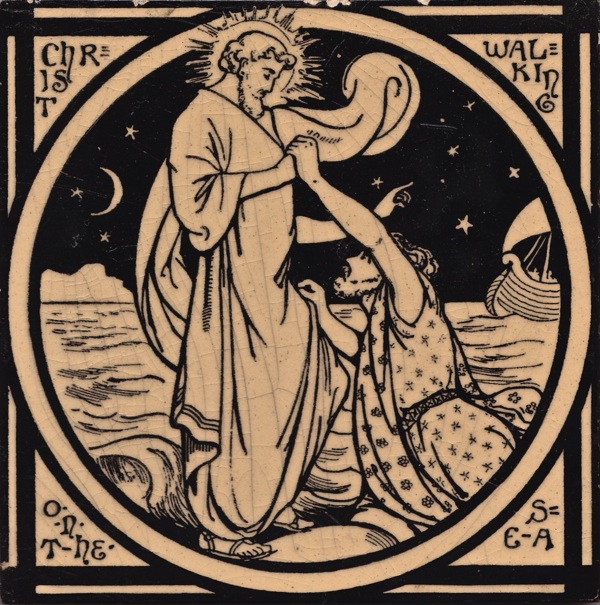
Christ walking on the sea.
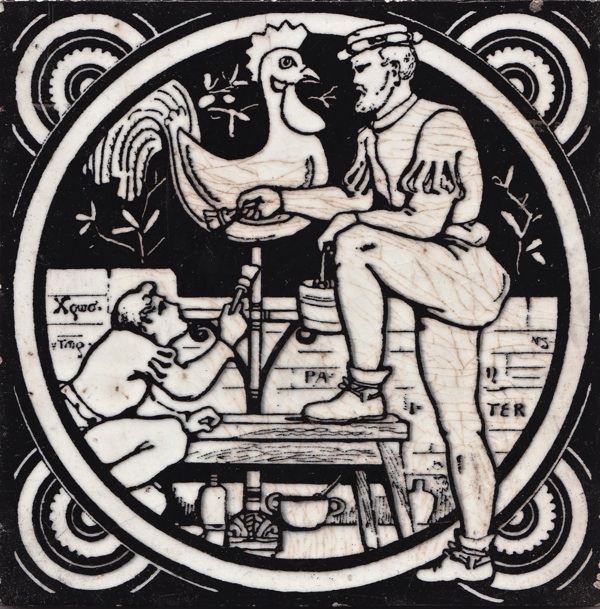
The Painter
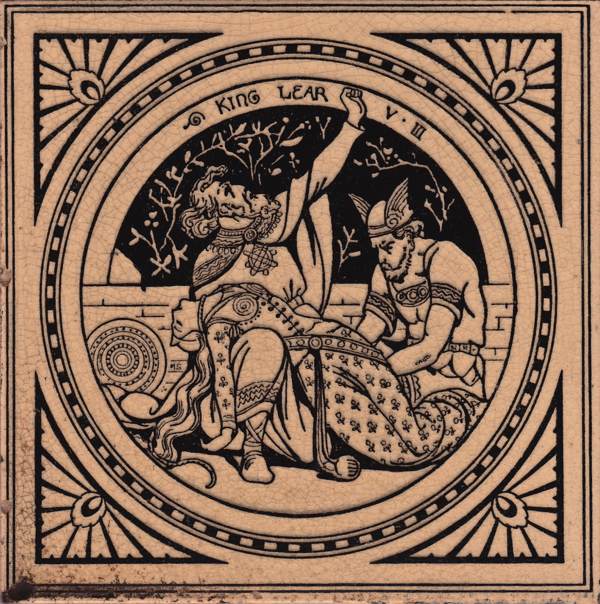
King Lear, V, III. A plague upon you, murderers, traitors all! Lear laments the death of Cordelia.
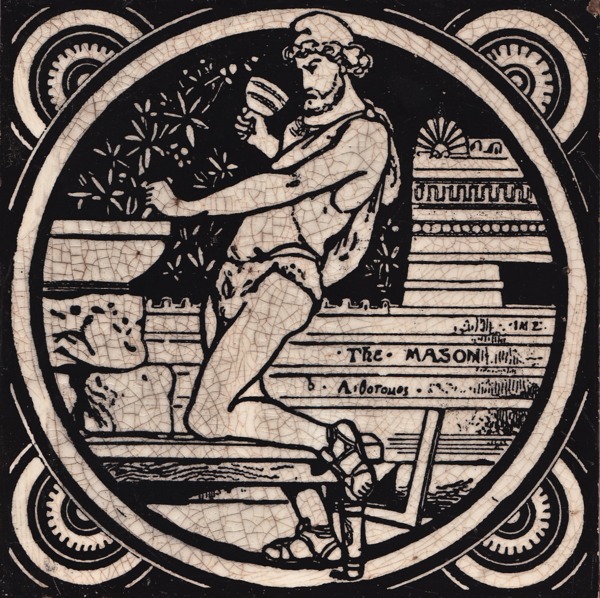
The Mason.
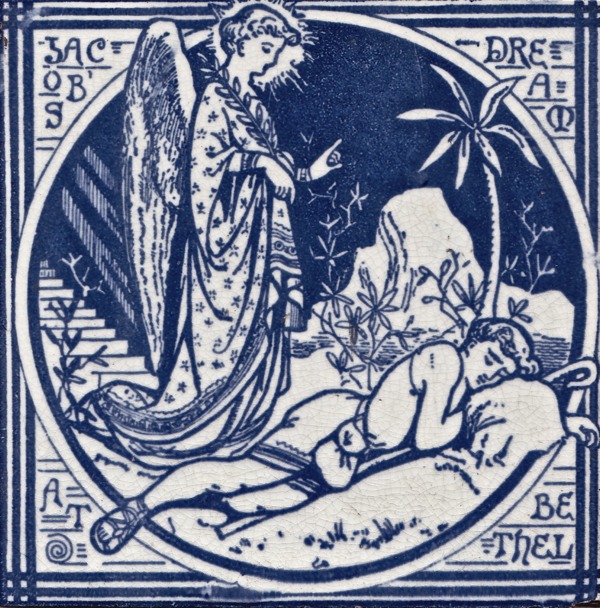
Jacob’s dream at Bethel.
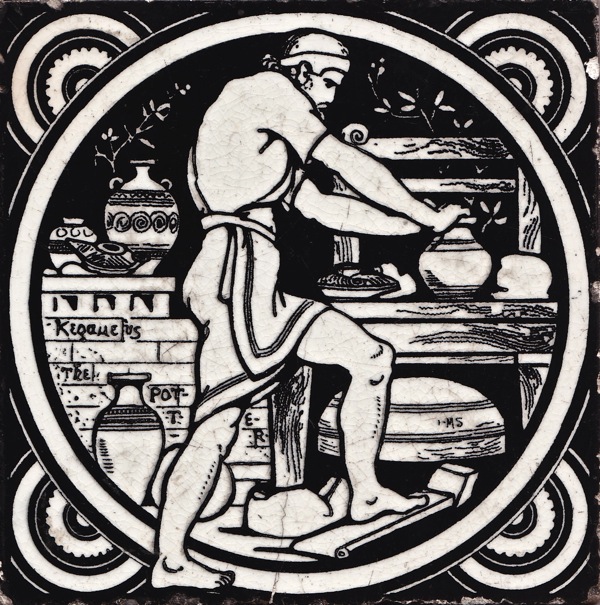
The Potter.
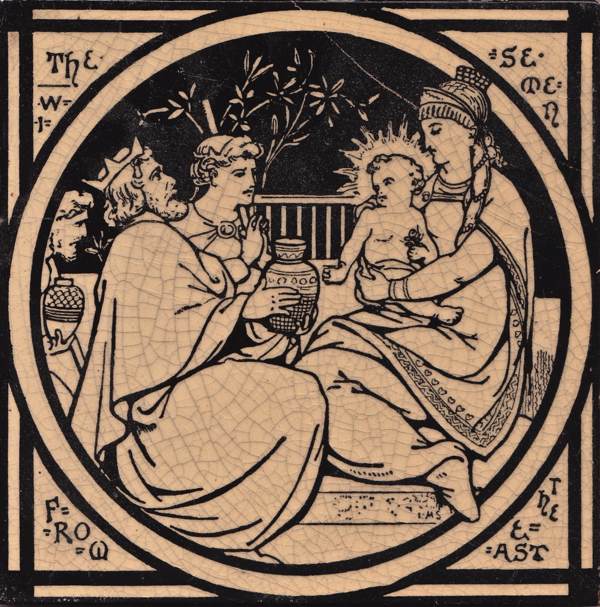
The Wise Men from the East.

Sodom & Gomorrah destroyed by fire.
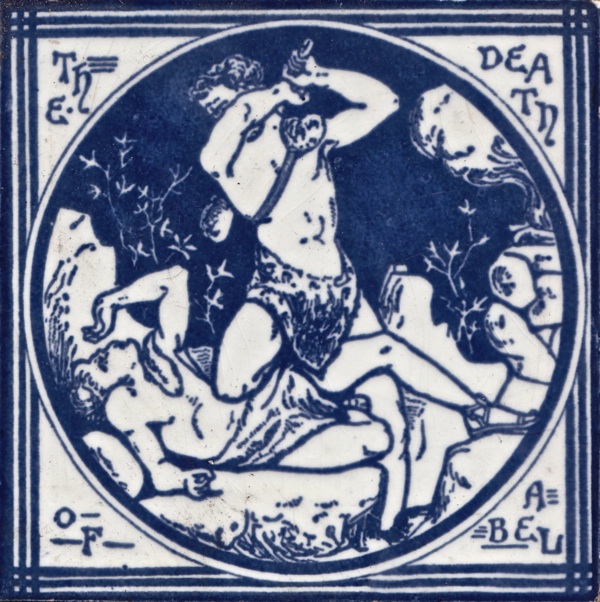
The death of Abel.
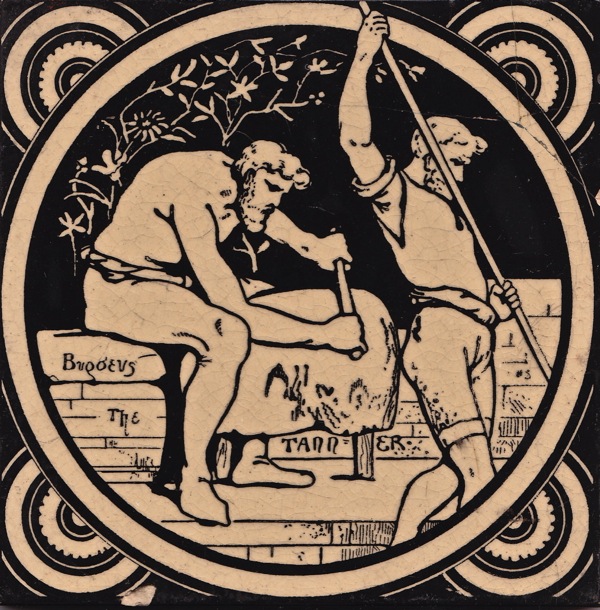
A Tanner.

Vivien from Tennyson’s “Idylls of the King.” Having seduced Merlin, the duplicitous Vivien imprisons him in a hollow tree with a charm.
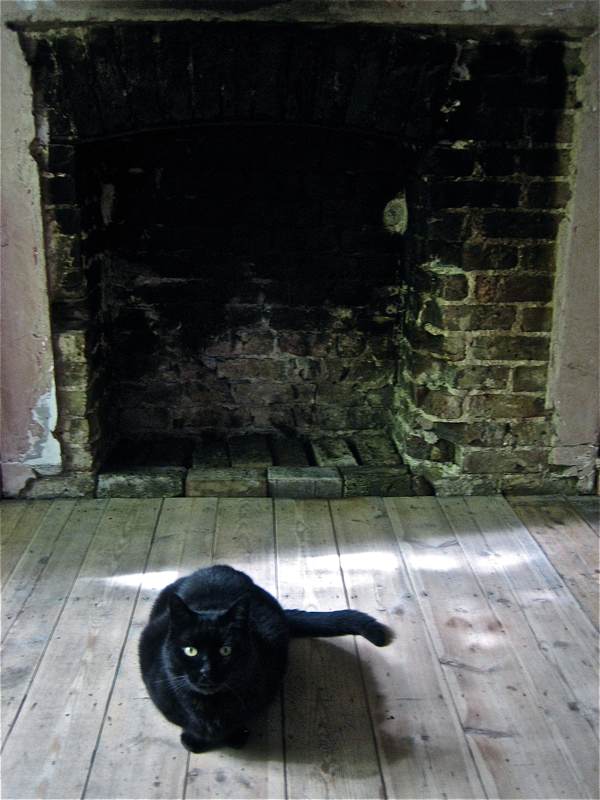
Sensing we are now in Autumn, Mr Pussy waits for the hearth to come to life, with tiles and a new stove.
You may also like to read about
Dennis Anthony’s Petticoat Lane
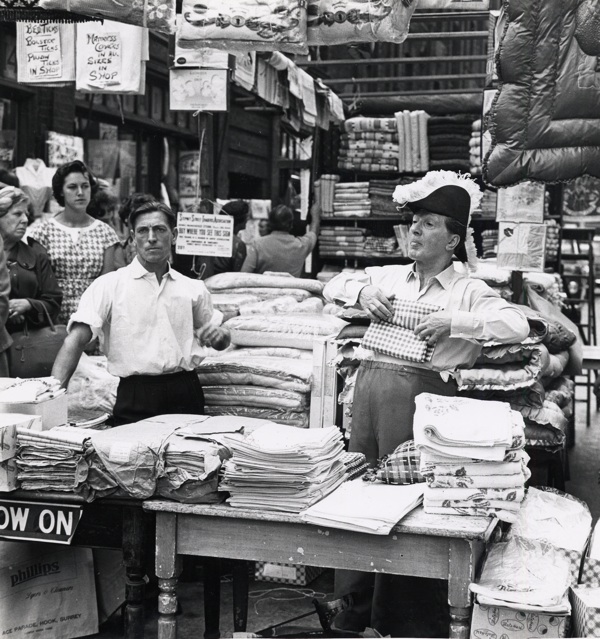
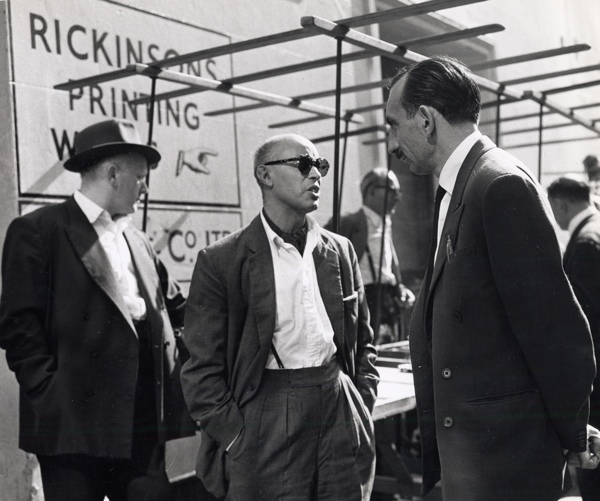
If you are looking to spruce up your linen cupboard with some fresh bolster cases or if it is time to replace those tired tea towels and soiled doilies, then these two lovely gentlemen are here to help. They have some super feather eiderdowns and quality blanket sets to keep you snug and cosy on frosty nights, and it is all going for a song.
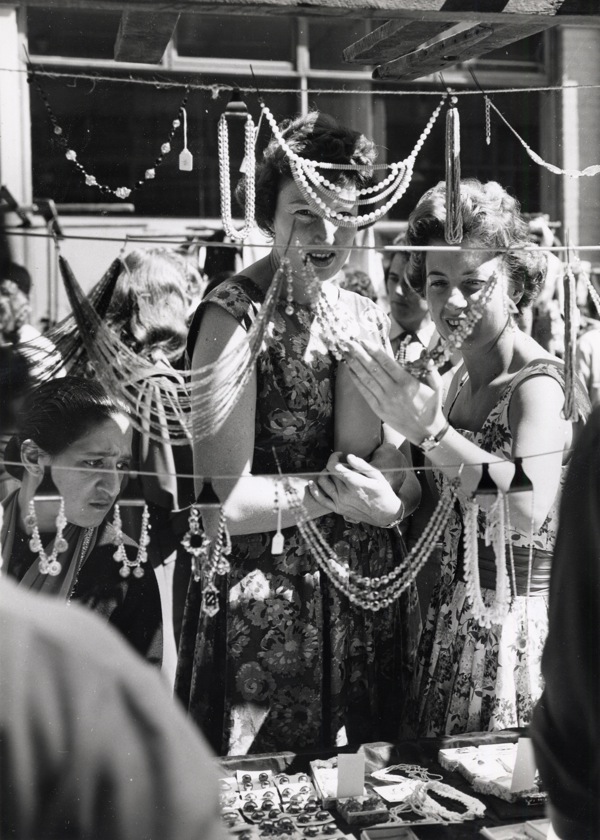
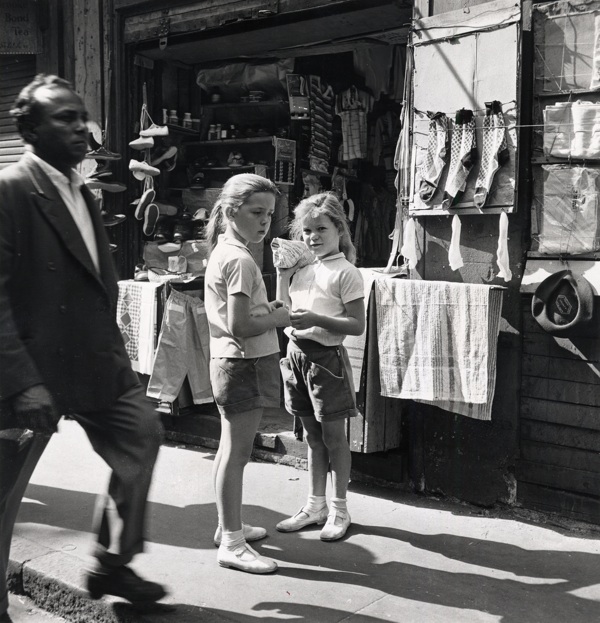
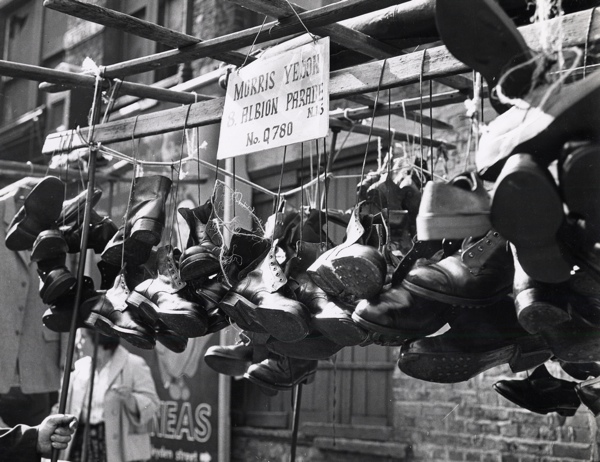
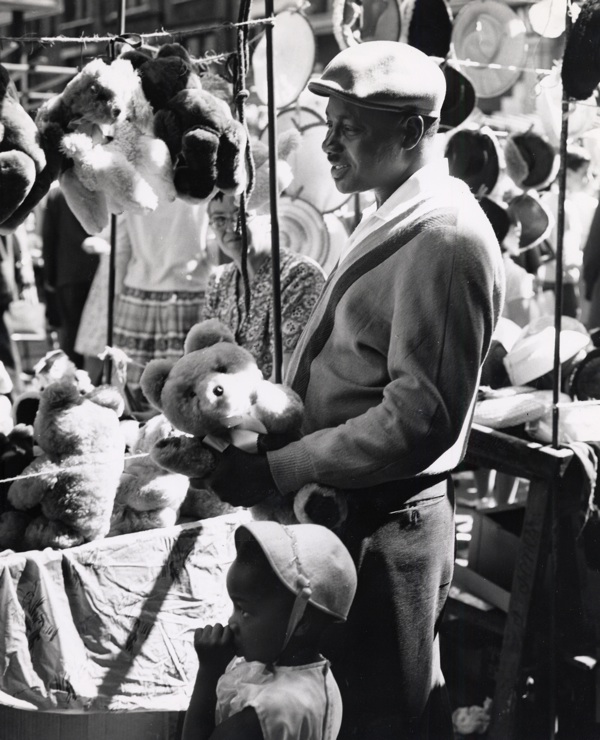
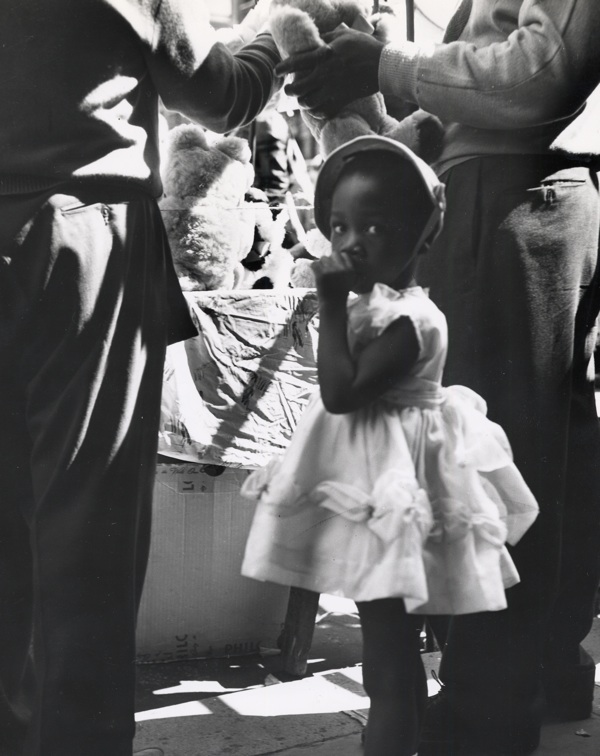
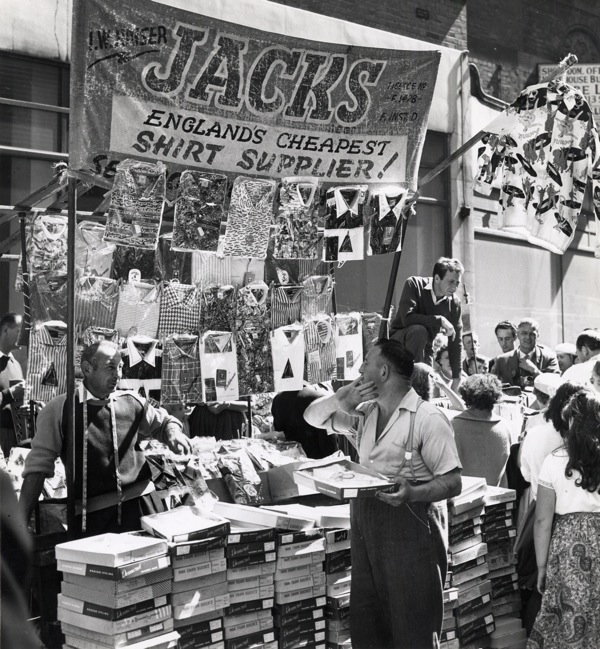
One Summer Sunday in the nineteen fifties, Dennis Anthony took his camera down Petticoat Lane to capture the heroes of the epic drama of market life – all wearing their Sunday best, properly turned out, and even a little swanky. There is plenty of flash tailoring and some gorgeous florals to be admired in his elegant photographs, composed with dramatic play of light and shade, in compositions which appear simultaneously spontaneous and immaculately composed. Each of these pictures captures a dramatic moment – selling or buying or deliberating – yet they also reward second and third glances to scrutinise the bystanders and all the wonderful detail of knick-knacks gone long ago.
When the West End shops shut on Sundays, Petticoat Lane was the only place to go shopping and hordes of Londoners headed East, pouring through Middlesex St and the surrounding streets that comprised its seven “tributaries,” hungry for bargains and mad for novelty. How do I know this? Because it was the highlight of my parents’ honeymoon, when they visited around the same time as Dennis Henry, and I grew up hearing tales of the mythic Petticoat Lane market.
I wish I could buy a pair of those hob-nailed boots and that beret hung up beside the two sisters in shorts, looking askance. But more even than these, I want the shirt with images of records and Lonnie Donegan and his skiffle group, hung up on Jack’s stall in the final photograph. Satisfied with my purchases, I should go round to Necchi’s Cafe on the corner of Exchange Buildings and join those distinguished gentlemen for refreshment. Maybe, if I sat there long enough, I might even glimpse my young parents come past, newly wed and excited to be in London for the first time?
I am grateful to the enigmatic Dennis Anthony for taking me to Petticoat Lane in its heyday. I should like to congratulate him on his superlative photography, only I do not know who he is. Stefan Dickers, the archivist at the Bishopsgate Institute, bought the prints you see here on ebay recently and although they are labelled Dennis Anthony upon the reverse, we can find nothing more about the mysterious photographer. So if anyone can help us with information or if anyone knows where there are further pictures by Dennis Anthony – Stefan & I would be delighted to learn more.



You might also like to see
Laurie Allen of Petticoat Lane
The Wax Sellers of Wentworth St
Down Among The Meths Men

The work of Geoffrey Fletcher (1923–2004) is an inspiration to me, and today I am publishing these fascinating drawings he made in Spitalfields in the nineteen sixties accompanied by an excerpt from his 1967 book Down Among the Meths Men. For anyone seeking an introduction to Geoffrey Fletcher’s writing, I recommend The London Nobody Knows which has just been republished with a new introduction by Dan Cruickshank.
If you want to know who they are, the meths men of Skid Row, then I will introduce them as the alcoholic dependents of the East End. They are to be found primarily in an area of of a couple of square miles known as Skid Row. It is a Rotten Row and only beginning to attract the attention of the trend setters.
Skid Row was originally a place of fields. Bodies were tipped there in the plague, their remains turn up occasionally. The most architecturally interesting part of Skid Row are the streets built by the Huguenots, who settled there after the St Bartholomew massacre. A century and a half ago, the rest of the East End surrounded the Huguenot quarter and brought it low. Ultimately the area will be rebuilt. No plans have been made to preserve the houses of Queen Anne’s time, as far as I am informed. I should like to see the whole of Skid Row preserved intact, with its inhabitants, though I recognise this is not a conventional view.
It is necessary, therefore, to contemplate it before it disappears, street by street. Without a doubt, reformers will eventually overtake these suburbs of Hell. They will tear down the fine, rotten houses, build over the bombed site and cart off the wet rags, old mattresses, waste paper and vegetable refuse that makes the quarter so attractive. In that event, London will have lost one of its major advantages, for there is nothing to be gained from well swept streets and office blocks.
Stand in Artillery Lane, watch a meths man rubbing his itchy sores and then eye the stream of commuters pouring into Liverpool St Station intent on the suburbs. Now and again, a meths man will appear among them, a goblin in rags. In their haste for home and respectability, they have nothing to say to him. Nor he to them. He is the inarticulate voice crying from the wilderness of old bricks, bug-ridden rags, cinders and sickly grass. His bloated, alchohol-distorted face is something from an uneasy dream, he sways in front of you in tipsy despair, blurred, disgusting, shaking like an Autumn leaf, the apotheosis of the antihero, a Prophet without a message.
There is a curious camaraderie among the meths men, perhaps the only attractive quality a conventional observer would allow them. It is a ghostly solidarity, the fag end of what is called co-operation, citizenship, the team spirit or any other of those names used commonly to cover up the true nature of the forms of society.
When I got to the Synagogue, I found them on the steps, eight men and a woman. One of the school was in the cooler. A negro roadsweeper languished over his muck wagon at the corner and a few young prostitutes, on the job, hung about in Brick Lane. Brick Lane is marvellous, a melting pot of all the nationalities that grew from the loins of Adam, greasy, feverish Brick Lane, the Bond St for the people of the abyss. Fournier St was a perspective of houses, once the homes of silk merchants and Huguenot weavers, over-used and neglected till the very imposts of the carved doors had become faint and bent with dejection. From the over-tenanted houses, the signs of fruit merchants and Jewish tailors creaked in the wind. The rain had given way to the thin mist of a Winter day.
The Chicksand group sat in a row, staring at nothing. Absolutely nothing. It reminded me of the brass monkeys. I knew the woman. The Chicksand men called her Beth, referring to her native quarter of Bethnal Green. Beth showed signs of recognition, lifted up her weary red eye-lids and stretched out a hand for a fag. I distributed Woodbines. Meths women are heavy drinkers, and can get through three or four wine bottles full in a morning, but they tend to begin slowly and build up as the day wears on. Next to her was Liverpool Jack, an ex-merchant seaman whose nerves had gone West on the convoys, and a man called Pee. He had no other name, nor could any other have done him credit. He was the most abject of the meths men. He had made two or three attempts at suicide, and his last one nearly rang the bell. I thought, sometimes I overdo my relish for offbeat experiences.

In Itchy Park, beside Christ Church, Spitalfields.

Meths woman, 1965.

Meths men on the prowl in Artillery Passage, 1965.

Meths people in Artillery Passage, 1966.

Meths men gather round the fire outside the Spitalfields Market.
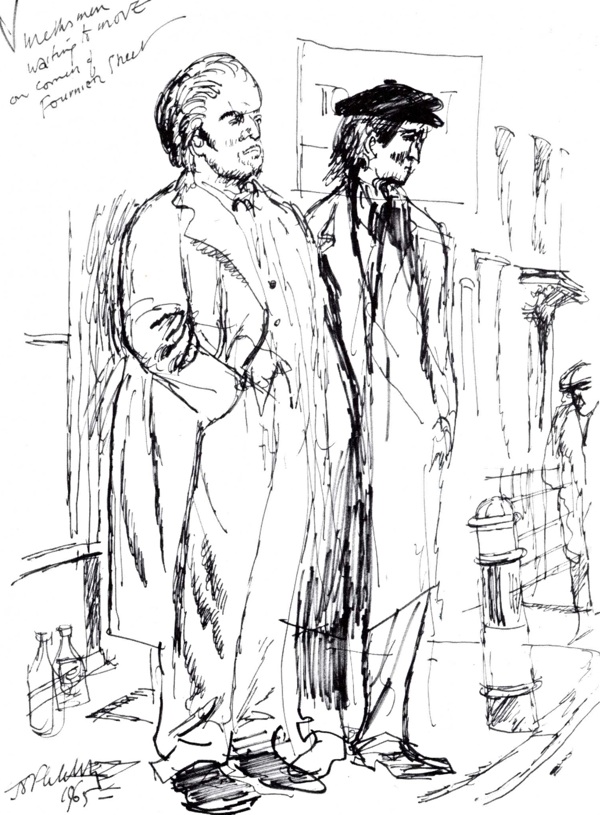
Meths men waiting to move on the corner of Fournier St, 1965.

The old meths site in Fieldgate St, Whitechapel.

Spitalfields Market scavengers.

Meths man asleep in Widegate St, 1965.
You may also like to read
At Gina’s Restaurant
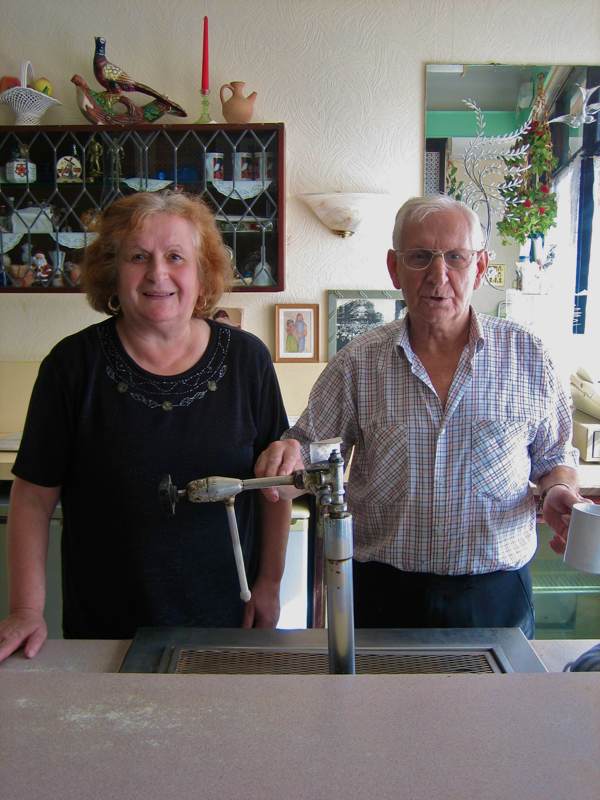
If you are looking for a Sunday roast in the East End, then you can do no better than to go along to Gina’s Restaurant at 17 Bethnal Green Rd where today Gina & Philip Christou open just one day a week out of loyalty to their longstanding customers, many of whom have been coming since Gina & Philip first opened in Brick Lane in 1961.
“We used to open every day,” Philip explained to me with startling frankness, “but what’s the point in killing yourself when you only have a few years left?”
Looking back over half a century, Gina confessed that she cried when she first saw the Hungarian Restaurant in Brick Lane, with three filthy rooms above it, that Philip bought. “I said ‘Jesus Christ! What I have we got here? I can’t live in this,'” she shrieked, growing visibly emotional at the mere recollection of moving with her one-month-old son into a flat with no bathroom and a rat infested toilet in the yard. Gina’s father had paid for her to train for six months as a hairdresser in Regent St and Philip had set out to buy her a salon, but he could not afford one and bought the lease on a restaurant instead. “I was going to buy her a hairdressing salon but it didn’t work out,” Philip admitted to me with a shrug, “so I said, “I’ll buy a cafe, I know how to cook, how to serve customers, how to do the shopping, and my wife can be a waitress!”
“I bought it from a Hungarian Jew and people used to come in and ask ‘Are you kosher?’ So I said, ‘Yes, I am kosher,’ And I used to offer them ‘kosher’ bacon sandwiches.” continued Philip with a twinkle in his eye. “My father told him he wasn’t good enough, when he asked if he could marry me,” interrupted Gina, raising a hand and turning sentimental as she recalled how they met when she joined her father for lunch at the Kennington restaurant where Philip was a waiter – adding, “but afterwards, he said, ‘As long as it’s alright with her.'”
“When we moved in, I went to Gostins, the timber merchants across the road and said, ‘Excuse me, I’m looking for old wallpaper books that you’re going to give away. I ‘ve got no money but I need wallpaper.'” Philip told me, amazed at his own resourcefulness “I papered the cafe with all the different coloured squares of wallpaper and painted the woodwork with some old blue paint my brother gave me. We opened up the cafe and we made a few bob, five pounds on the first day. It was good.”
“We had no furniture,” Gina announced with a gleeful smile, “My parents moved in, so I cleaned up a room for them and gave them our bed. The baby slept with them and we slept on the floor. ” When Gina & Philip came to Brick Lane in 1961 it was a Jewish neighbourhood with a few Indians, but by 1975 when they left it was mostly Bengali people. “We all used to help each other,” Gina explained, “Mrs Sagar across the road was an Indian lady married to a Jewish gentleman. When she learnt I had to sleep on the floor, she said, ‘I’ve got a bed, I’ll give it to you’ and later she gave me a wardrobe too.'”
Gina & Philip found themselves at the centre of a self-supporting community. “I couldn’t afford a van, so the chicken shop across the road leant me their bicycle to go to Smithfield Market each morning to buy chops, steak and sausages, and I used to be back by six thirty to open at seven every day.” Philip remembered fondly, amazed at his former vitality.
“Every Christmas, I used to open only for the old people and give them lunch,” Gina confessed to me, almost in a whisper, as if she did not want the word to get round, “I did it for years because I felt sorry for them. And I remember it was two shillings and sixpence to stay at the Salvation Army Hostel, and they charged a penny for hot water for their hot water bottles on top, so I told the hostellers to bring their bottles round to me and I gave them hot water for free.”
Yet in these unpromising circumstances, Gina & Philip’s Hungarian Restaurant became a unlikely commercial success when some long-distance lorry drivers, who parked their trucks at Aldgate, discovered it as they walked up Brick Lane on their way to the Well & Bucket public house. “One day these men came in and asked for a ‘Mixed Grill.'” Gina said, recalling the auspicious moment that changed her life, “So I went into the kitchen and said, ‘We’ve got new customers and they want a “Mixed Grill.” He made up a big plate of meat, and they ate it all and said, ‘Thankyou very much, we’ll see you again.’ The next day there was six, and ten the day after. In a month’s time, we had a multitude and a queue outside. I became famous for lorry drivers!”
On the basis of their new-found income, Gina & Philip were able to buy a house in Haringey, permitting extra space for their growing family of four children – exceedingly fortunate, because in 1972 the council served a compulsory purchase order on the restaurant to demolish it. “I cried when we had to leave!” declared Gina with a helpless smile, confessing the lachrymose parentheses to her sojourn in Brick Lane.
“I didn’t want to buy a cafe again, so I went to work at Blooms restaurant in Whitechapel,” said Philip. “And I wanted to be a machinist, but I couldn’t do it – I was always crying!” said Gina, eagerly carrying the narrative forward, “They asked me, ‘Why are you crying?’ I said, it’s not a restaurant, there’s no people in it.’ I missed all the people, they were so friendly.”
Gina & Philip borrowed money from the bank to buy the cafe they run today in the Bethnal Green Rd and all the regulars from Brick Lane and the long-distance lorry drivers followed them – especially as they now offered bed and breakfast above the cafe too. When they arrived, the Sunday animal market was still in full swing, filling the surrounding streets, selling birds and all kinds of creatures – “We bought a goat and called it Billy, but the neighbours complained about it eating their cabbages and we had to give it back,” Gina told me, as an aside. They originally opened up as G’N’T’S, changing it to “The Steakhouse” on a whim, only to discover this attracted a crowd that was too posh, which led to the current, ultimate incarnation as Gina’s Restaurant.
“I’ve got one old boy, he comes every week from Croydon. He’ll always have sausage, chips and beans – and eight to ten coffees.” Gina told me in affectionate reminiscence, “I’m a very soft woman, I talk to him and I feel good. I’m happy to listen to him because he lives by himself and has no-one to talk to but me.”
Sundays at Gina’s Restaurant are a long-standing ritual in this corner of the East End, the focus of a particular world and one of the last places you can get a good cup of tea for 80p. Gina told me that many of the fly-pitchers who trade on the pavement outside – constantly hassled by council officials – are pensioners who have lived their whole lives in the neighbourhood and come to sell a few of their possessions simply to afford a Sunday lunch. Gina & Philip open every weekend to offer a safe haven to these people, and to anyone else that wants an honest roast dinner.

Gina’s favourite teapot.
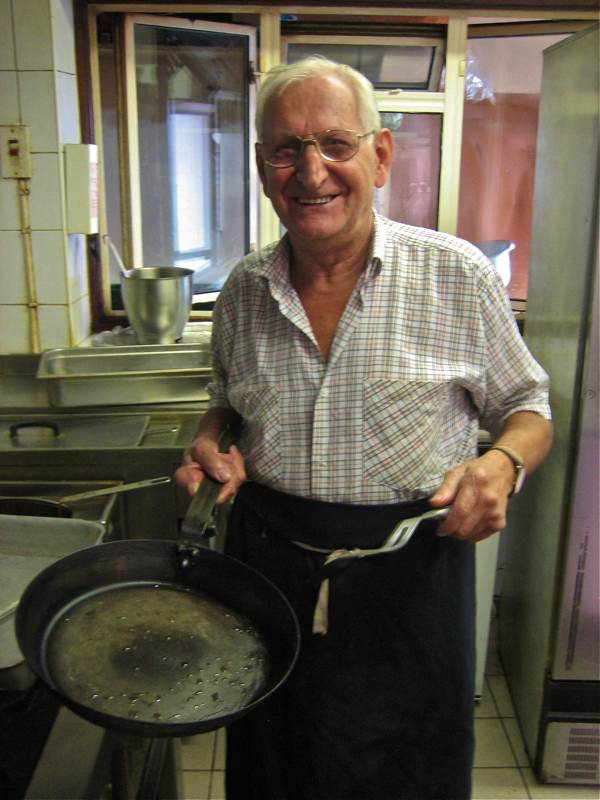
Philip’s preferred frying pan.
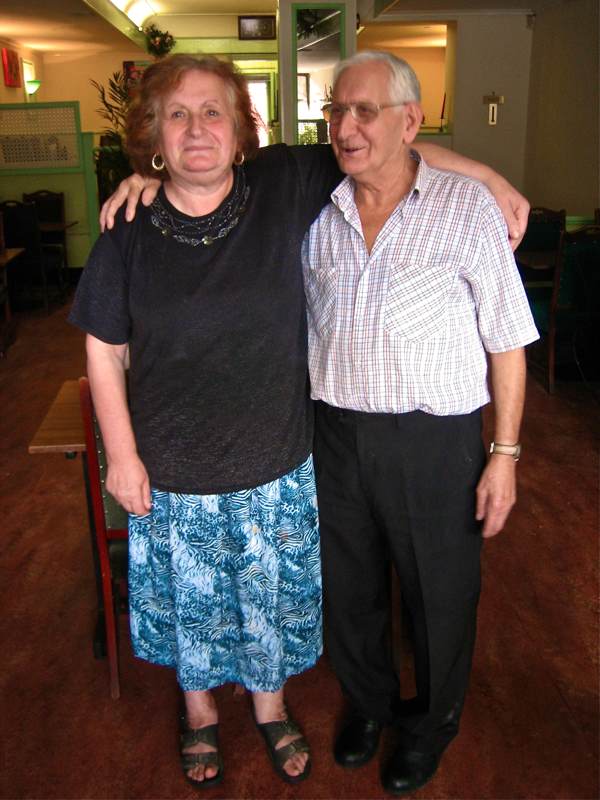
Gina & Philip Christou
You may also like to read about
Spitalfields Antiques Market 27
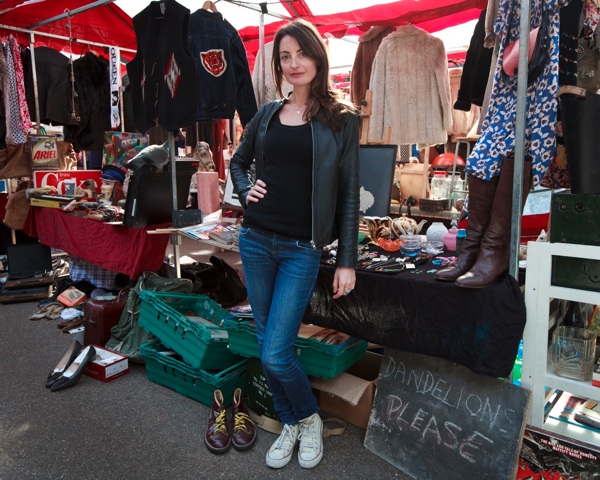
This is the stylish Lula Camus who came to London from France seventeen years ago and stayed. “I think there is a certain freedom of expression here that you don’t get in my country,” she admitted to me with an enigmatic smile, while reclining nonchalantly in front of a sign that read “Dandelions Please.” Years ago, Lula worked in the Savonerie in the Spitalfields Market before the rebuilding and now she has returned. “I decided to give it a go in the Antiques Market and this is my second week, but I’m still deciding whether to make it a full time job.” she confessed, rolling her dark eyes in equivocation and looking at me questioningly. I have my fingers crossed for Lula’s return.
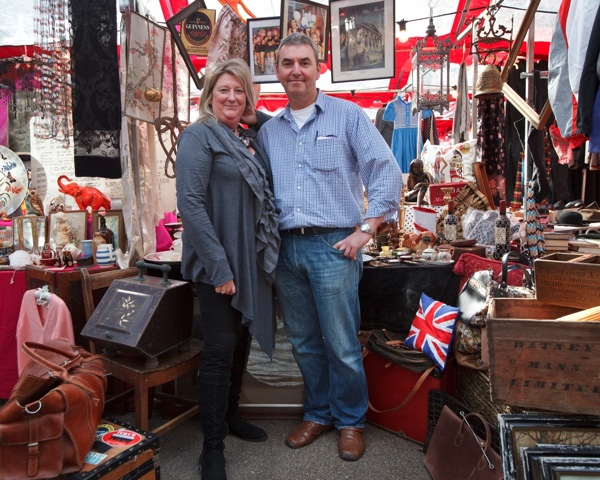
This is Hazel & Keith Townsend, a couple who both travel for a living as flight attendants. They flit in and out of the Spitalfields Market like migratory birds, selling the excess of unusual artefacts they collect in their globetrotting. “We get up at four thirty to come up from Sussex,” Hazel informed me while Keith ferried boxes from the car. “He does all the fetching and carrying, and helps me a lot,” she added in whisper, once he was out of earshot. “It’s all very new and there’s a novelty element but it’s still good fun.” announced Keith enthusiastically when he returned, “sometimes, we buy new things but the collection is going down.” And they exchanged a private smile of happy contentment. I wish Hazel & Keith safe flights.
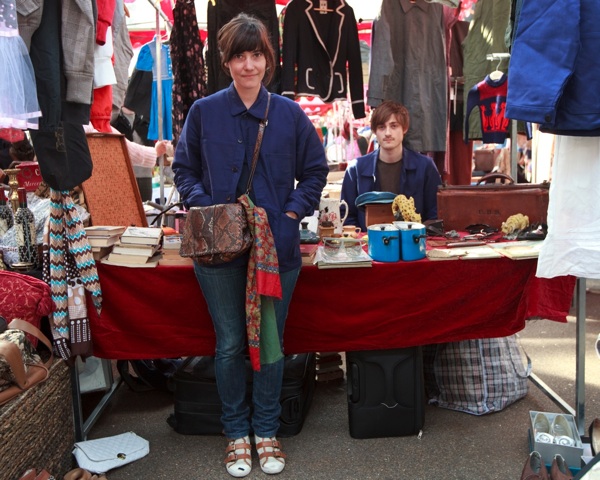
This is the charming Charlotte Marionneau & her handsome helper Sam. Charlotte came to London from Paris sixteen years ago and met her fellow ex-patriot Lula Camus for the first time on the day this photo was taken. “People are doers here,” she informed me with a respectful nod, “whereas in France, they just talk about it.” Charlotte began trading in Portobello fifteen years ago and started here in Spitalfields last year, selling an eclectic mix. A musician by profession, Charlotte has just completed her second album Theodorus Rex with her band Le Volume Courbe and, when not on the market, she works at Lucky 7, the record shop in Stoke Newington. So, for Charlotte, life is either music or markets. I hope the album is a big success.
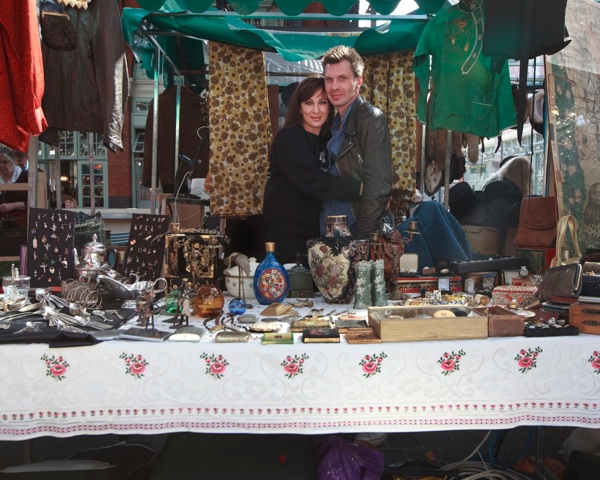
This is Jany Thomas & Marcin Cybukski enjoying a cuddle. “I grew up in markets, my mum traded at the stables in Camden and under the bridge in Portobello,” explained Jany, “I started last year, because I am an artist and I wanted to work for myself.” In fact, Jany & Marcin’s romance blossomed on the market and now they are engaged to be married. “I’ve always had a passion for antiques,” Marcin revealed, gesturing to the magnificent display upon the table,”and this is happened when we got together.” Next month, both commence a Fine Art Degree at the University of Middlesex and they plan to marry afterwards. I wish Jany & Marcin happiness in their marriage.
Photographs copyright @ Jeremy Freedman
Sue Bristow, The White Horse
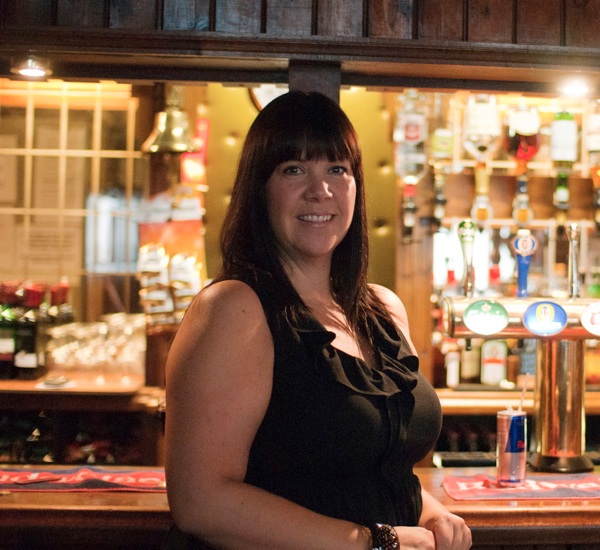
Many in Spitalfields enjoy spending time at The White Horse on the corner of Redchurch St and Shoreditch High St. Even on a midweek afternoon, when the pavements are empty, you can rely upon stepping inside the barroom and finding an enthusiastic crowd. It is an expectedly democratic place in which City workers and constructions workers rub shoulders, all mesmerised by the astounding balletics of the pole dancers at this celebrated East End strip pub where – unusually for such an establishment – women are welcome too.
No-one is more at home in The White House than Sue Bristow who has lived above the premises since 1978 and grew up there. With a life that would be envy of her customers, Sue is the presiding goddess in a little black dress, constantly surrounded by attendant Aphrodites in skimpy exotic outfits. Even as I chatted with Sue at the bar, glamorous creatures were flitting around catching her eye with a wink and nod, as they brandished their pint pots which the customers take such delight in filling with pound coins – merely for the opportunity of being in the same room with these nubile lovelies who cavort for the pleasure of their silent admirers.
With its blank facade and windows shielded from the street, this public house might appear mysterious to anyone who has never been through the door but, as Sue spoke, I realised there was nothing to hide beyond that certain discretion which is the strippers’ prerogative.
My dad, John Bristow, and his family are from Chicksand St. He and my uncles all worked in the Spitalfields Market together, and my nan, Glenys Bristow, ran a cafe in Commercial St opposite the market until they was bombed out in the war. She lives in Bethnal Green now and when we take her around Spitalfields she points out where everything used to be.
In 1978, we moved here to The White Horse. My mum and dad got the place and I was brought up above the pub. My dad was a lorry driver and my mum was a secretary, and they had to learn how to run a pub as they went along. When we first started, we had dancers here only on Thursday and Friday evenings, and Sunday lunchtimes. You had Robinsons that sold electric pumps across the road then, the betting shop on the corner, and there were a lot of banks, Lloyds, Barclays and Nat West, and the Post Office. But gradually all the people went away and even the banks shut. This was in the first recession and, although I was really young, I remember they were rough times – but we somehow managed to stay open throughout.
I started working here before I should of. In my school holidays I used to do the cleaning and the tills. Now I have a daughter of my own who’s fourteen, she always asking if she can work behind the bar and at Christmas she helps the girls to cash up all their pound coins from their pint pots. When I was eighteen, I was put in my own pub – The Crown, overlooking Victoria Park. I was one of the youngest licensees in the country. It was very hard work, your whole life is the pub. I did two and a half years at The Crown.
I don’t think I’ve ever left home completely. This pub is like my front room. It’s my home, isn’t it? I’ve been brought up in it, I’ve lived and breathed it. My dad retired eight years ago to Murcia near Alicante in Spain but Pauline, my mum, she didn’t want to go to Spain or leave the pub. She is very much the backbone here, and now she and I run it together. She takes care of the pub side, makes sure it’s open in the morning, does the tills, orders the beer, checks in the cellar and does the bookwork. She’s very meticulous, she doesn’t miss a thing. I do the girls, they check in with with me every morning when they begin their shifts. I do the booking sheets – we plan six weeks in advance. We find girls through word of mouth and we have a lot coming in to audition, but I only need the best of performers. I’ve been watching the dancers since I was fourteen, so I know who’s a good dancer.
The girls get to keep all their pounds in the pot here, we don’t take commission like some pubs do. I like to take care of the girls – to give them a safe and clean environment, and nice changing rooms. I get on with the girls very well and quite a few of them are my friends, and the girls all get on well together too. There are only five on each shift and they each do five performances. When we opened Blush – the table dancing venue upstairs – we had a meeting and let all the girls speak, in order to work out the fairest way to run it. I always oversee the girls personally, and I want it to be relaxed and not a competitive atmosphere.
People who have never been inside a strip pub sometimes presume that the men are in control but the opposite is true – the woman on stage has the most power, she has all the men under her control. Many of the girls say they enjoy that it’s run by women here. We only employ men to do the security. On Saturday night, we had a group of youngsters in and I decided they were not going to stay. I went over to them and said, “Right lads, this is my pub and I’ve told the staff that you’re not going to be served. You’ve got to leave. When you’re more mature, you’re more than welcome to come back.” And a few of them apologised. Not everyone knows how to talk to people, but if you make a little joke and they laugh. then you can get them on your side. It’s something you learn.
The doormen say, “If it kicks off, it’s not the customers you have to look out for, it’s Sue!”
This last comment was accompanied by a self-deprecatory laugh and roll of the eyes from Sue, before our conversation was concluded by the return of her daughter from school, exchanging greetings with the girls, all smiles and eager to tell her mother of her day. Glowing with maternal pride, Sue introduced me, demonstrating the enviable ease which permits her to inhabit the role of strip pub manager and mother simultaneously.

Sue Bristow – “I’ve been watching the dancers since I was fourteen, so I know who’s a good dancer.”
Photographs copyright © Sarah Ainslie
You may also like to read about The Strippers of Shoreditch












