Henry Chapman, Jack Of All Trades
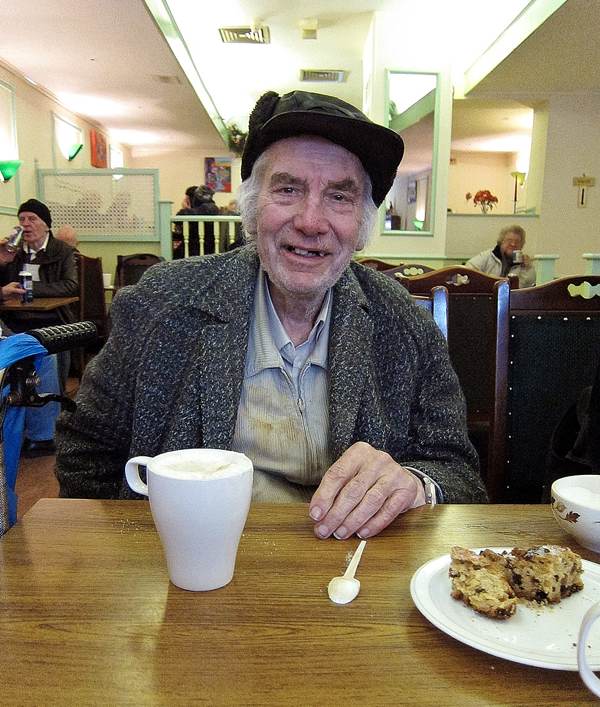
Harry has been coming to the Sunday market for more than seventy-five years
For as long as Gina Christianou can remember – certainly as long ago as the days of the animal market in Club Row – Henry Chapman, known universally as Harry, has been coming to her restaurant in the Bethnal Green Rd each Sunday, ordering sausage, egg and chips, and drinking seven cups of coffee, one after the other, to sustain him while enjoying the busy social life of this celebrated Spitalfields meeting point. After all this time, at eighty-three years old, Harry has become a fixture – so that now, as long as he is there occupying his central position at the front of Gina’s Restaurant on Sunday, you can know that all is well with the world.
With his bright-eyed charm and extravagantly bushy eyebrows, Harry is a popular character and his table is always full with those eager to share his company, yet few even know where Harry comes from each Sunday. So last week, Spitalfields Life Contributing Photographer Colin O’Brien and I waited at the next table until there was a gap in the flow and, once introductions had been exchanged, we were delighted to accept Harry’s gracious invitation to join him while he enjoyed his fifth cup of coffee of the morning. “I never drink it anywhere else,” he explained to me with a complicit smile, revealing that these seven cups at Gina’s comprise his entire caffeine intake for the week – just in case I might assume he were an immoderate character.
These days, Harry always wears his carpet slippers for comfort’s sake and has a walking frame, yet he still hops on the bus and comes all the way from Battersea each week to Spitalfields, just as he has done regularly for more than seventy-five years.
“It’s a kind of habit, I was only a boy when I used to come here from Battersea with my father. They sold cats and dogs here then, you could buy a goat – even foxes and eagles. I always get here about half past eight and I might leave at two or three o’clock, it depends on how I feel. I shall go home and get something to eat and watch television and go to bed.
On Monday morning, I collect my pension and then I go to a cafe in Peckham to see my friends and decide where we are going to go on Thursday. Every Thursday, I go out with a couple of mates and we take a trip by bus. Last week, I went to Dartford and Gravesend – I don’t like Dartford very much, I was there in the fever hospital for four months when I was a child, though I can’t remember it because it’s such a long time ago. We always meet outside the betting shop before we set out.
On Tuesday and Wednesday, I go to the cafe where I live. It’s on the street and it’s tiny, you couldn’t hardly call it a cafe because they only sell cakes, beans on toast, eggs on toast, no dinners. I don’t cook for myself. I don’t even make tea at home, I only keep it in case a visitor wants a cup, I drink orange juice. I’ve lived in my council flat in Battersea for the past twenty-seven years and I have a cat called Jake, he’s twelve years old.
My wife was Irish and she liked to drink but I don’t drink because I used to suffer with very bad migraines – floating lights, sickness and diarrhoea. I was paralysed for a while, then I wore glasses for six years and I recovered, but my wife left me and took the children with her. After I got divorced, I was in lodgings and met Mr Cornish, and he asked me to go and live with him, and I worked for him organising charity events. He used to take me all over the West End to get Sandeman’s port, silk ties at Liberty and perfume at Penhaligons, and I went to all the theatres to collect tickets for the shows and the Harlem Globetrotters, and I met the Prince & Princess of Bengal and Melissa Martin and Sheila Hancock and Leslie Crowther. Sometimes, he sent me to Marks & Spencer to get cakes for nothing and we’d have a raffle. But he was an old man and after three years he died, and that’s when I went to live with an elderly lady, as her lodger, until she died too. Then I went to live with my brother until I had to go into hospital to have an operation to put a plastic valve in my heart, and after that I got the flat I have now. That was in 1985 and now it’s leaking, so they are talking about keyhole surgery.
When I was a boy, I used to go and take care of the horses in Battersea Park. After I left school, I set out to be a carpenter but I couldn’t get an apprenticeship so I went to work in a papermill, from there I got a job in a steelworks and then I worked in a corn chandler, then a couple of years in the navy, then eighteen years in the gas works at Wandsworth as coke plant operator, followed by fifteen years at the council maintaining the streets, changing light-bulbs in street lights, laying pavement slabs and street sweeping until I had to retire. I needed the heart operation, so I took early retirement and I haven’t worked since – I suppose you could say I am a Jack of all trades.
I regret that I don’t see my children, they know where I live but they haven’t been to see me for twenty years. I don’t have any other relatives, just my half-brother and sister, and they’re probably dead now because they’re older than me. I might get a Christmas invitation, otherwise I’ll spend it by myself. It doesn’t matter if I’m on my own because it doesn’t worry me, I’ll have Jake. I’m not unhappy, I live on my own and do as I please. I journey on with life. I’ll be here next week, if nothing happens to me.”
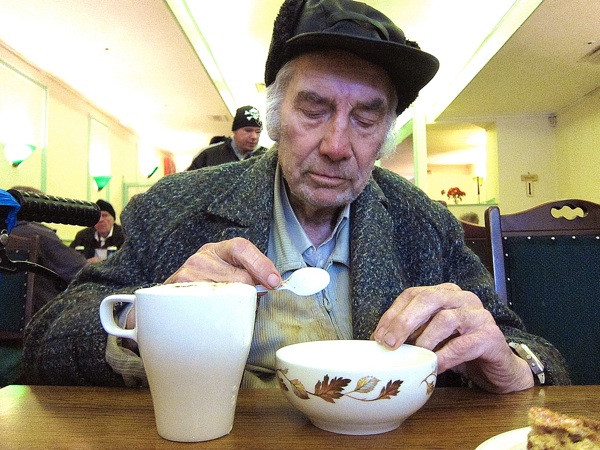
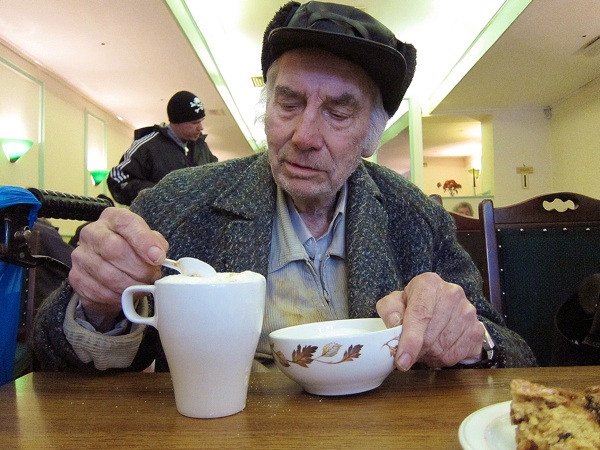
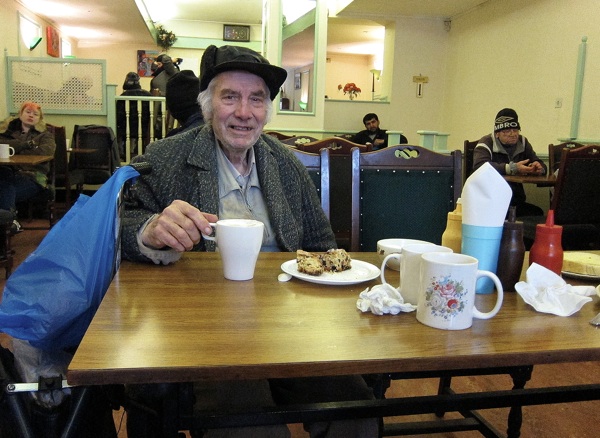
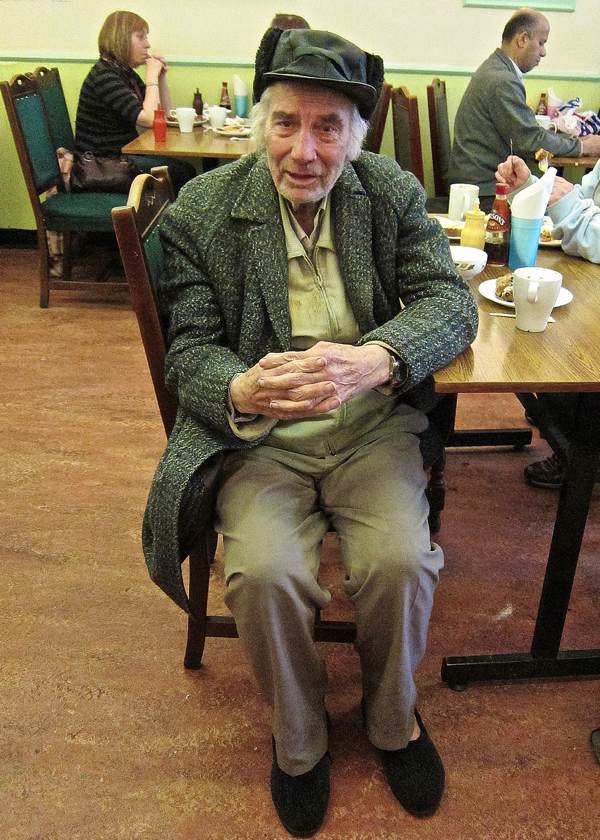


Henry Chapman, Jack of all trades.
Photographs copyright © Colin O’Brien
You also like to read about
Chapter 2. Horrid Murder

The River Thames Police Office occupies the same site today on the Thames beside Wapping New Stairs as it did in 1811. Once news of the murders on the Ratcliffe Highway reached here in the early hours of December 8th, Police Officer Charles Horton who was on duty at the time, ran up Old Gravel Lane (now Wapping Lane) and forced his way through the crowd that had gathered outside the draper’s shop. He searched the house systematically and, apart from the mysterious chisel on the counter, he found five pounds in Timothy Marr’s pocket, small change in the till and £152 in cash in a drawer in the bedroom – confirming this was no simple robbery.
In the bedroom, he also found the murder weapon, a maul or heavy iron mallet such as a ship’s carpenter would use. It was covered in wet blood with human hair sticking to it. At least two distinct pairs of footprints were discerned at the rear door, containing traces of blood and sawdust – the carpenters had been at work in the shop that day. A neighbour confirmed a rumbling in the house as “about ten or twelve men” were heard to rush out.
Primary responsibility for fighting crime in the parish of St George’s-in-the-East lay with the churchwardens who advertised a £50 reward for information, including the origin of the maul. The Metropolitan Police was only established in 1829 – in 1811 there was no police force at all as we would understand it and, as news of the mystery spread through newspaper reports, a disquiet grew so that people no longer felt the government was capable of keeping then safe in their own homes. Indicative of government concern at the national implications of the case, the Home Secretary offered a reward of £100.
Meanwhile a constant stream of sightseers passed through the Marr’s house, viewing the bodies laid out on their beds, and some left coins in a dish because Mr Marr had only left sufficient capital for his creditors to be paid nineteen shillings in the pound. The bill for the renovation of the shop was yet to settled.
Three days after the crime, on 10th December 1811, when the inquest was held at the Jolly Sailor public house just across the Highway from Marr’s shop, a vast crowd gathered outside rendering the wide Ratcliffe Highway impassable. Walter Salter, the surgeon who had examined the bodies, Margaret Jewell the servant, John Murray the neighbour and George Olney the watchman all told their stories. The jury gave a verdict of wilful murder.
For two centuries the Ratcliffe Highway had an evil reputation. Wapping was the place of execution for pirates, hanged on the Thames riverbank at low water mark until three tides had flowed over them. Slums spread across the marshy ground between the Highway and the Thames, creating the twisted street plan of Wapping that exists today. This unsavoury neighbourhood grew up around the docks to service the needs of sailors and relieve them as completely as possible of their returning pay. Now it seemed that these murders had confirmed everyone’s prejudices, superstitions and fears of the Highway – sometimes referred to as the Devil’s Highway.
Whoever was responsible for these terrible crimes was still abroad walking the streets.
Expect further reports over coming days as new developments in this case occur.

River Police Headquarters, Wapping New Stairs
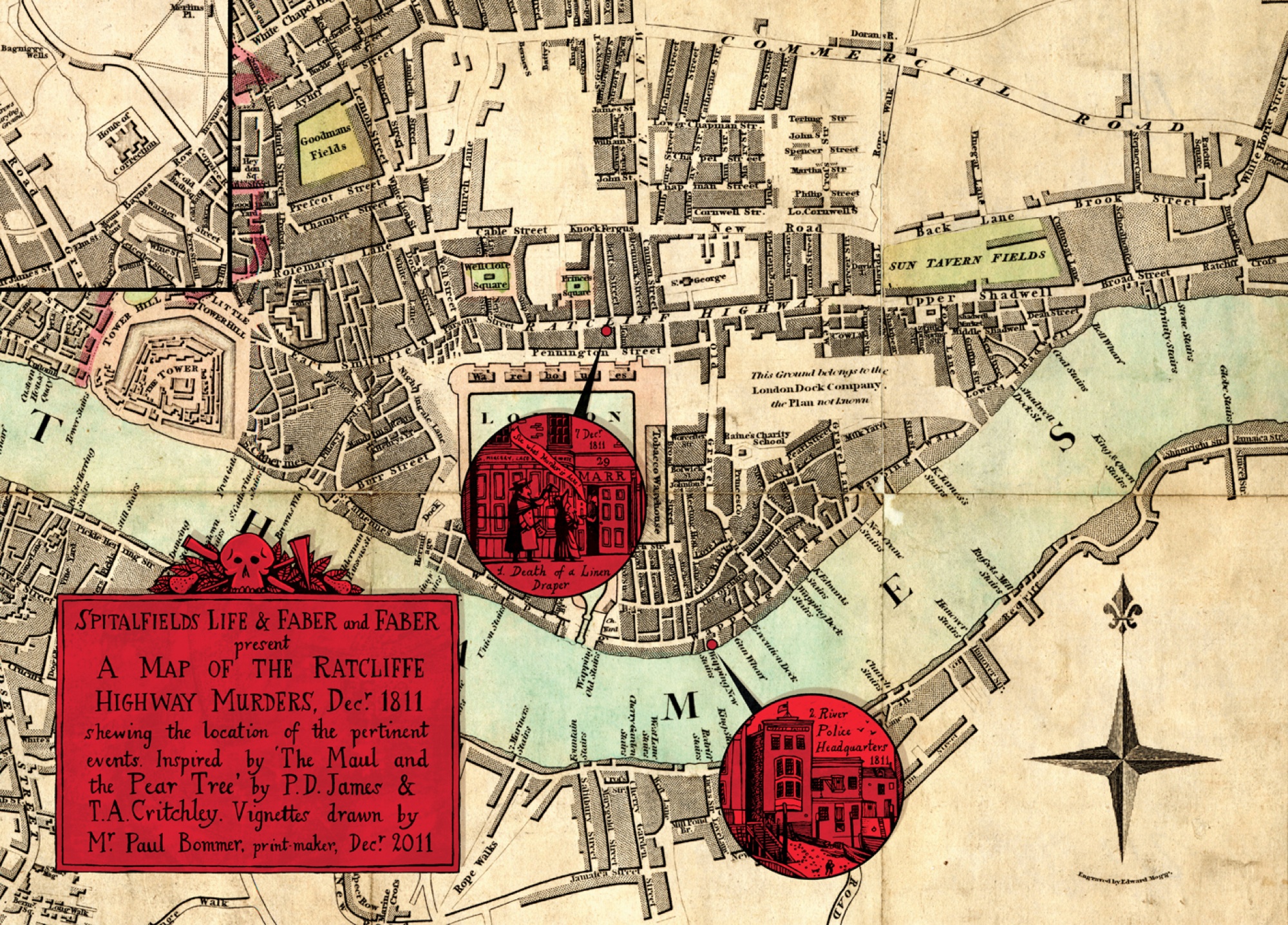
Click on Paul Bommer’s map of the Ratcliffe Highway Murders to explore further
The Maul & The Pear Tree – P.D. James’ breathtaking account of the Ratcliffe Highway Murders, inspired me to walk from Spitalfields down to Wapping to seek out the locations of these momentous events. Commemorating the bicentenary of the murders this Christmas, I am delighted to collaborate with Faber & Faber, reporting over coming weeks on these crimes on the exact anniversaries of their occurrence.
The Map of the Ratcliffe Highway Murders – In collaboration with Faber & Faber, Spitalfields Life has commissioned a map from Paul Bommer which will update throughout December as the events occur. Once you have clicked to enlarge it, you can download it as a screensaver or print it out as a guide to set out through the streets of Wapping.
Ratcliffe Highway Murder Walk – Spitalfields Life will be hosting a dusk walk on Wednesday 28th December at 3pm from St Georges in the East, visiting the crime scenes and telling the bone-chilling story of Britain’s first murder sensation. The walk will take approximately an hour and a half, and conclude at the historic riverside pub The Prospect of Whitby. Booking is essential and numbers are limited, so please email spitalfieldslife@gmail.com to sign up. Tickets are £10.
Thanks to the Bishopsgate Institute and Tower Hamlets Local History Archive for their assistance with my research.
You may like to read the first installment of this serial which runs throughout December
10th December, Old Father Christmas

Please welcome Old Father Christmas, also known in times past, as Grandfather Christmas, Old Christmas or even simply Old Winter.
Nowadays, with the global domination of American commercial culture, this fellow, Britain’s Father Christmas and Santa Claus, an import from the US, have become virtually synonymous and almost indistinguishable. But let me tell you – gentle readers – that once upon a time they were quite distinct from each other.
As you will all know, Santa Claus is a Anglicised corruption of “Sinterklaas,” the Dutch for St Nicholas, brought over to the States by immigrants from the Low Countries in the seventeenth century (when New York was called Nieuw Amsterdam). There he fused with the British Father Christmas and became Santa, losing his bishop’s robes on the way. The Victorian poem “A Visit From St Nick,” by Clement Clarke Moore, did much then to embellish this character and, in 1931, the Coca Cola company gave him their red and white livery which he wears to this day.
Old Father Christmas, on the other hand, is a much more ancient figure. Pagan in origin and an embodiment of arcane Mid-Winter revelries, he is made up, in part, of the Norse god Odin and the Roman gods Jupiter (Jove) and Saturn ( whose great feast, Saturnalia, was at this time). He is no gift-bearer (Christmas presents almost never featured in Yuletide celebrations before the Victorian period) but was instead the personification of festive cheer, feasting, warmth and merriment – so very welcome in the bitter, bleak, icy Winter months. He has a longer beard that his American counterpart and wears long gowns and a hooded robe, often fur-trimmed ( and almost never red!) – as opposed to Santa’s soft-drink-branding tie-in tunic and pants suit. He is big, and he is merrie – he is, in essence, the Ghost of Christmas Present, as portrayed by Dicken’s in “A Christmas Carol.” As for transport, he has many ways of getting about. Sometimes he would arrive on a white horse, bells a-jingling, sometimes a white donkey, or, as here, a white goat! In parts of the country, the tradition was that he came out from the North a-stride a great white goose!
During the Commonwealth in the sixteen fifties, the Puritans banned celebration of Christmas, deeming it an orgy of pagan idolatry (they were not, I suspect, far off). One of the earliest surviving images of Father Christmas is a subversive pamphlet published in 1653. Old Winter approaches a border or city wall where a soldier on guard says, “Keep out, you come not here,” to which the old man (here sporting long robes and a very fetching broad-brimmed felt or fur hat) counters, “O Sir, I bring good cheere.” Behind him stands a country peasant who says, “Old Christmas Welcome, do not fear.”
Ladies, Gentlemen, I hope and trust that you will all make Old Christmas very welcome in your hearts and homes, because the world would not suffer any from a little more merriment and good cheer!
Illustration copyright © Paul Bommer
The Whitechapel Nobody Knows (Part One)

I am delighted to resume my series of The East End Nobody Knows in collaboration with Spitalfields Life Contributing Artist Joanna Moore, by visiting Trinity Green Almshouses off the Mile End Rd. You only have to step through the emerald green gates to discover that this place has kept its age-old repose. Designed Sir William Ogbourne in 1695, as almshouses for retired and invalid mariners upon ground given Captain Henry Mudd of Ratcliffe, the conception was of fourteen cottages around a central chapel. Yet even though a bomb destroyed the rear half of this courtyard in 1943, the ship-shape sense of order is miraculously still intact. Look out for Basil, the old ginger tom who takes the role of master & commander now all the seafaring folk have departed.

Sculptor Roy Emmins lives in a tiny flat built upon the roof of a nineteen forties residential block at the rear of the Royal London Hospital, where he has created a wonderful sculpture garden to exhibit his works among plants and flowers. With a natural sensitivity to the anatomy of animals, Roy’s work is in a magical realist vein, evoking an entire of menagerie of creatures in stone, bronze, wood, paper mache and even tin foil. Six days a week, Roy walks from his flat in Whitechapel to his studio at the far end of Cable St where he has been working alone secretly for the past ten years, creating a vast body of superlative works, and up here in his sculpture garden among the chimney pots of Whitechapel, Roy’s sculpture exists in its own enchanted universe, known only to the lucky few.

These modest terraces in Walden St and Turner St – dating from 1809-15 – were derelict for fifteen years and would have been demolished if it had not been for the intiative of Tim Whittaker, Director of the Spitalfields Trust. He recognised the dignity of these self-effacing structures, built for the lower middle classes, their early residents included a surgeon, a sea captain, a plumber, a shopkeeper and a Chelsea pensioner. Completed two years ago, this award-winning restoration employs weatherboarded extensions in an historically appropriate vernacular aesthetic to win extra space and uses salvaged materials to subtle effect in preserving the shabby poetry of these old houses. As Tim put it to me, “I wanted to give Whitechapel back a bit of the romance it had lost.”

From Roy Emmins’ roof you can look down upon St Augustine with St Philip’s Church in Newark St, a soaring example of mid-nineteenth century red brick gothic that today houses the Royal London Hospital’s Library and Museum. If you walk into the ground floor you will encounter the sepulcral hush of medical students cramming for exams, while down in the crypt is the medical museum – open to the general public – where you can discover attractions as various as the Elephant Man’s hat, collections of gallstones preserved in specimen cases as if they were gulls’ eggs, Victorian autopsy sets and George Washington’s dentures.
Illustration copyright © Joanna Moore
You may also like to take a look at
The Spitalfields Nobody Knows (Part One)
The Spitalfields Nobody Knows (Part Two)

Be sure to seek out Joanna Moore (left) and her friends Helena Maratheftis (AKA Thefty) and Nhatt Nichols (AKA Nhattattack) at their stall in the Upmarket, Old Truman Brewery, Brick Lane on Sunday where they will be selling their London-themed prints and Christmas cards.
9th December, Babushka

Babushka is a traditional figure in Russian folklore who distributes presents to children around Christmas-time. Her name literally means “Grandmother” (which makes you wonder what Kate Bush was singing about!) The legend is she declined to go with the Wise Men, when they stopped at her house for food and rest en route to Bethlehem, to see the baby Jesus – because of the cold weather, and because she had housework and baking to do.
However, after the Magi left, she regretted not going and set off to catch up, filling her basket with presents and pastries. She never did catch up or find the baby Jesus, and it is said she wonders the earth ’til this day, visiting each house at Christmas and leaving toys and treats for good children. The morals of this story? Don’t put off ’til to-morrow what you can do today and a clean house, it’s not all that important!
I have an old book entitled North Russian Architecture, with a slip-case, a faux wood cover and hundreds of photographs of log-cabins and shingled, onion-domed shrines and chapels. They provided my reference for the buildings behind her.
Illustration copyright © Paul Bommer
8th December, The Spider & The Cave

When I was a child, my father, who is Polish, would tell me a traditional tale that he himself had been told when he was a boy.
According to legend, the Three Kings stopped at Herod’s palace in Jerusalem on their way to Bethlehem looking for the new-born king that the Star had prophesied. Herod, of course, knew nothing about this new-born king but was unsettled by the news. And, in the days following the Magi’s departure, the perceived threat to his sovereignty grew and grew until at last, in a fit of rage, he ordered his men to kill all new-born male children across the land .
Getting wind of this from the Three Kings, the Holy Family fled Bethlehem in Judea for Egypt and, at one point – as Herod’s men approached – they took refuge in a cave. There a spider, sensing who was hiding in his cave, quickly wove an intricate web across the entrance and Herod’s men, seeing the web, assumed that the cave had been unoccupied for some time and passed on without entering.
There is no mention of this story in the Bible but there is, I believe, a reference to it in the Quran. Tradition holds that the cave in question lies today on the outskirts of Cairo.
The moral of the story? Don’t kill spiders and look out for small miracles.
Illustration copyright © Paul Bommer
Simon Costin’s Dickens Diorama

Just recently, I took the 42 bus from Liverpool St Station down to Camberwell to visit Simon Costin where he was working on the top floor of an old scenery warehouse, recreating the nineteenth century city out of cardboard boxes for the new exhibition Dickens & London which opens tomorrow at the Museum of London. It sounded such a hare-brained scheme – a zany childhood fantasy writ large – that I could not resist going over to take a look, and I was not disappointed because I was confronted with a creditable terrace of tottering cardboard towers, even as I walked in the door.
Simon and his team of four were busily cutting up cardboard boxes, sticking storeys and roofs together, slicing out panels for windows and doors, and attaching tiles and bricks individually. Scattered around were books of old photographs that served as references, yet this was no literal architectural recreation but rather a dreamlike impression of the monstrous shambolic city which Dickens knew and that we all visit through his novels. As each edifice was completed, Simon proudly carried it across the room and added it to the quickly-growing warren of structures he was assembling, shuffling and swapping his property portfolio critically, like a whimsical land magnate.
Just as Charles Dickens’ London was a location of mystery, an unknowable labyrinth of human life, so Simon Costin has brought his own story to the cardboard diorama through referencing the work of his great-great-grandfather, William Pettit Griffith, a forgotten architect. Only the almshouses in the Balls Pond Rd survive today out of Griffith’s work built in London in the nineteenth century, though he was also the architect who fought to save St John’s Gate in Clerkenwell and conceived its renovated form that we know today.
In family lore, William Pettit Griffith was a shadowy figure who died in obscure poverty but Simon discovered a direct relationship with his long-gone forbear through an unlikely encounter with a stranger who revealed herself to have second sight. Two elderly women approached Simon in the tearoom at the Royal Academy. One explained that the other was blind yet blessed with a psychic gift and she saw a guardian angel at Simon’s shoulder. The figure she described was a Victorian gentleman with unusual hair that curled on both sides of his head, just as William Pettit Griffith’s hair does in the only portrait, which you see below.
This uncanny experience led Simon to research his enigmatic ancestor and he found they had lived in close proximity – as if they followed each other around London, one hundred and fifty years apart. Simon once squatted in a flat at 67 Guildford St and Griffith had lived at 117. Then, Simon moved to a flat that turned out to be around the corner from Griffith’s practice in Bermondsey. Next, Simon had a studio on Wharf Rd in Islington, close to Eagle Wharf Rd where Griffith had lived, and now Simon lives five minutes from the almhouses, the last Griffith building standing.
Dickens’ novels are full of long-lost relatives reunited through chance. A phenomenon that both confirms the dislocation of people in the teeming city, yet reveals the underlying connections which are usually hidden. Simon’s discoveries have brought him into a personal relationship with the nineteenth century city, and he has envisaged his nocturnal diorama of London as a place of wonder, of horror and awe.
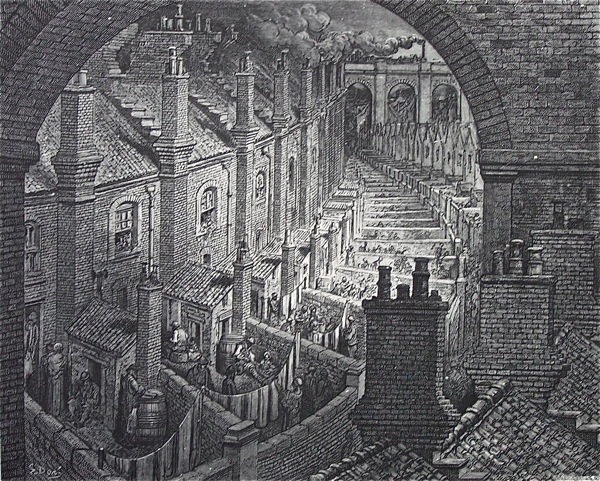
Gustave Dore’s London
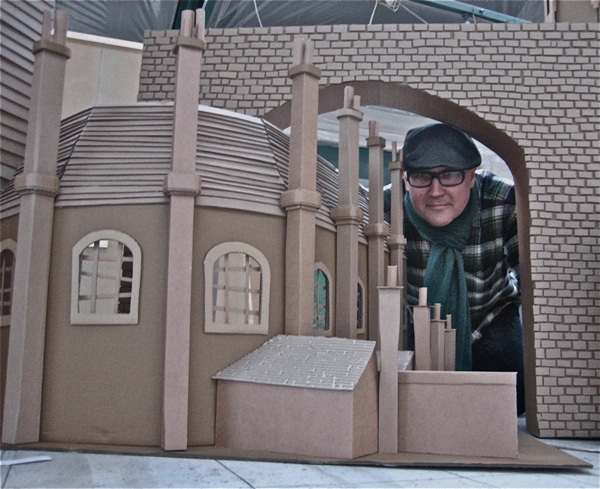
Simon Costin’s London.
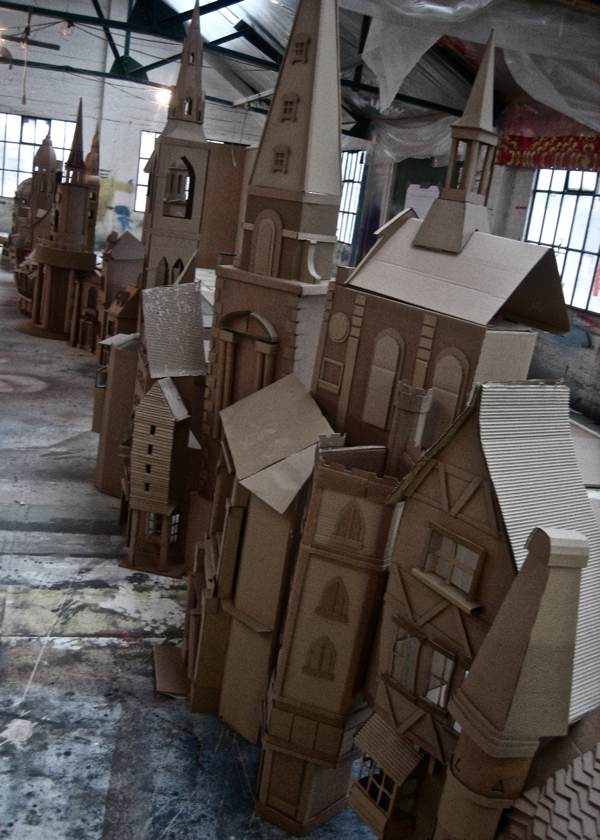
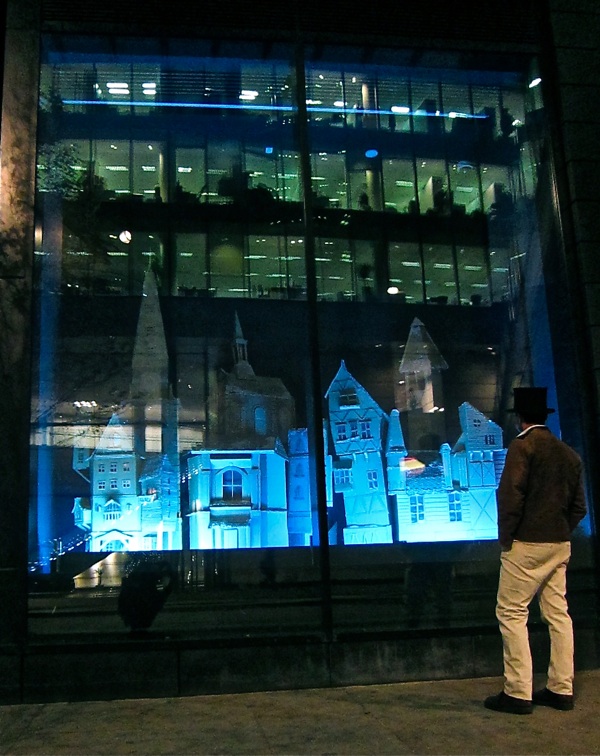
Part of the diorama at the Museum of London, seen from London Wall.

Simon Costin, great-great-grandson of William Pettit Griffith
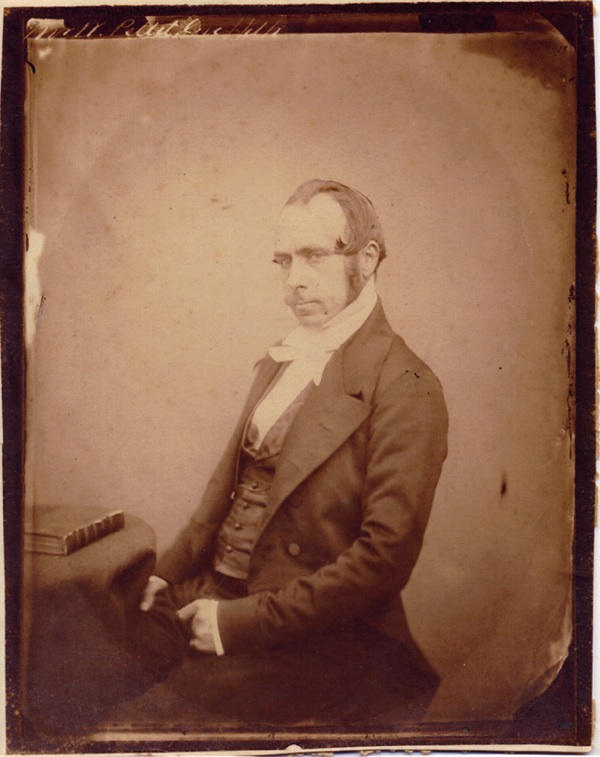
William Pettit Griffith, Simon Costin’s great-great-grandfather.
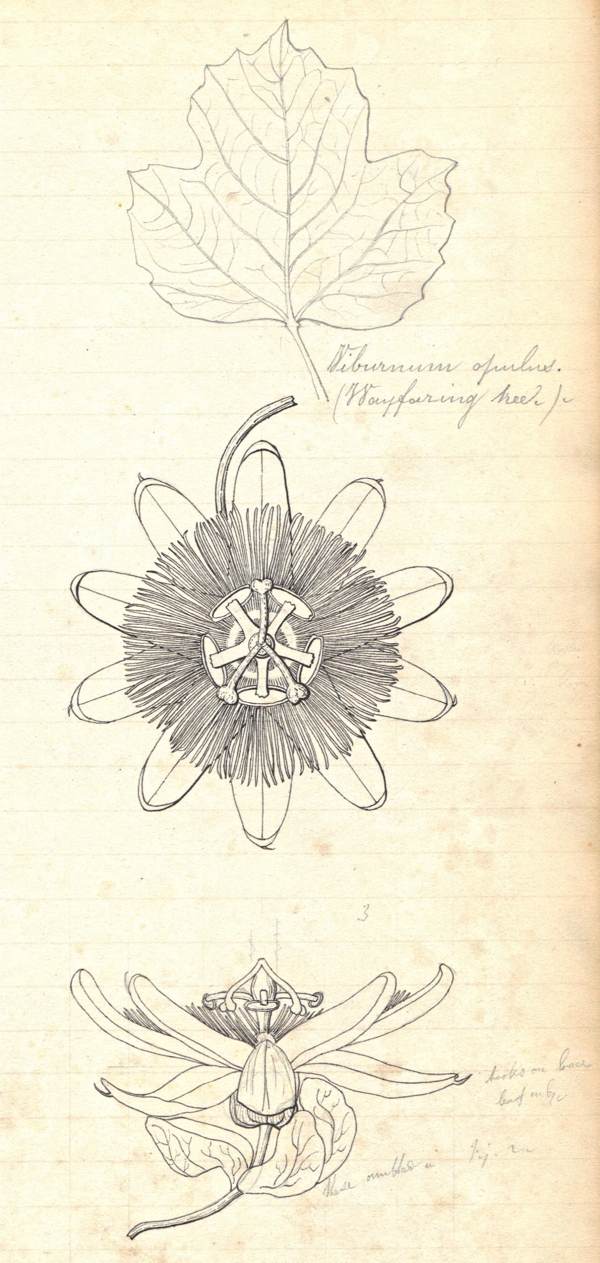
From the notebook of William Pettit Griffith
Simon Costin was assisted in creating his diorama by Jenna Rossi-Camus, Rachel Champion, Russell Harris and Yasemen Hussein.
You may also like to read about