
James Brown at Gardners Market Sundriesmen

This is illustrator & printmaker, James Brown, presenting Paul Gardner, the fourth generation paper bag seller, with a copy of the beautiful print he has created to celebrate this beloved and historic Spitalfields institution, Gardners Market Sundriesmen. When a one hundred and forty year old business advertises for the first time, something special is required and – working in collaboration with Paul – James has contrived a paper bag printed in gold and emblazoned with symbols of all the different items to be purchased at Gardners.
“Knowing about Paul and his story through Spitalfields Life, I thought it would be great to produce a design that he could use as a promotional flyer and that I could also make into a nice limited edition print too,” explained James shyly, standing in front of Paul and aware of the huge departure this first piece of advertising represents for Gardners.
Through supplying the bags, in this area traditionally occupied with small shops and markets, Gardners is naturally the epicentre. Yet with new people coming to set up stalls and open shops all the time, James’ beautiful postcards of his print constitute an ideal introduction to this uniquely appealing shop that will sell you as few bags as you need. In coming days, James & I will be distributing the cards in shops and markets on Paul’s behalf, but you can pick up some yourself direct from Gardners Market Sundriesmen and take the opportunity to admire the limited edition print, if you happen to be passing through Commercial St.
“Paul has so many stories to tell, my visits to Gardners were always lengthy and lively.” confided James, savouring the year it has take to develop his design. “It’s been great to get to know Paul and I really hope the flyer works for him, he is a lovely guy and offers a level of service that cannot be surpassed by any of the online bag and sundries suppliers.”
When I first met James Brown a couple of years ago, he had just quit a ten year career as a textile designer and struck out anew as an illustrator and printmaker, sharing a studio with his brother in Hackney Wick. Since then, I have been delighted to see his bravura designs turning up all over the place. “It’s snowballed really,” he admitted with a private smile of satisfaction, “And now I am making a living at it – exactly what I wanted to do and it’s brilliant!”
 James’ screenprint celebrating Gardners Market Sundriesmen, Spitalfields’ oldest family business.


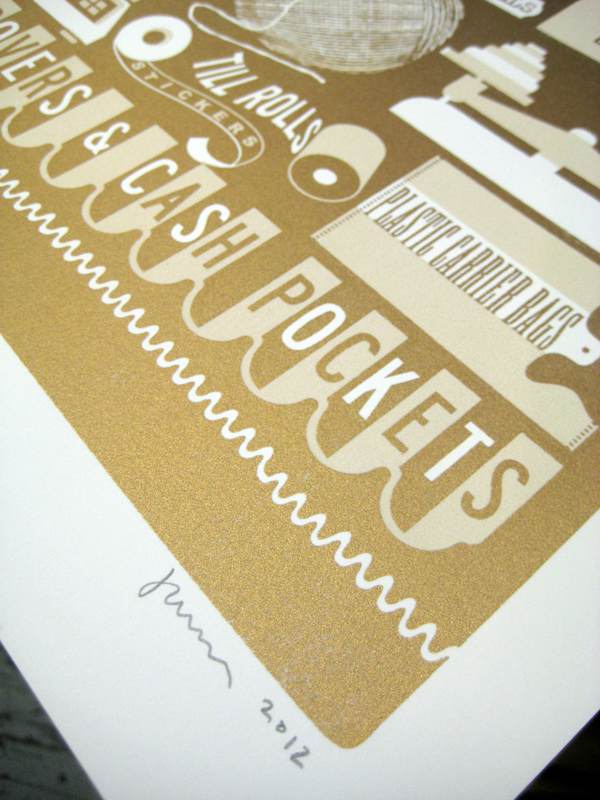
James Brown’s Gardners Market Sundriesmen print is available from Paul Gardner at 149 Commercial St, online from www.generalpattern.net and from Elphick’s Shop on Columbia Rd.
You may also like to read about
Last Orders At The Birdcage

This photograph records the historic Sunday night when popular landlady Teresa Farnham called “Last Orders!” at The Birdcage on Columbia Rd after twenty-one years behind the bar, heralding the end of an era in this corner of Bethnal Green. I slipped over to have a quiet drink with Teresa as the light began to fade on her final day at the pub. Outside the melancholy streets were coated in slush that began to freeze as dusk gathered, yet inside the cosy barroom at The Birdcage, a lively crowd was happily cheering in enjoyment at the constant thrills delivered by the big match on a widescreen TV. To use Teresa’s phrase, “It was chock-a-block!”
Even before we began our conversation, Teresa was keen to emphasise that regulars need not be entirely dismayed, because the new publican takes over this week and a smooth handover is promised. Continuity is of paramount importance for a public house established in 1760, and with a name that reflects the popular custom of keeping caged birds which was introduced to the East End by the Huguenots in the seventeenth century. The current building, constructed in the nineteenth century, still gleams with the handsome bottle-green Doulton ceramic tiles to be seen on many establishments in the vicinity, revealing that it was once a Truman’s pub. Although the ornate architectural flourish on the top may have been destroyed and the windows blown in during World War II, landlords Mr & Mrs Joel – who managed The Birdcage from 1922 until 1955 – kept the pub open thoughout, sleeping in the cellar between shifts of firewatching.
And thanks to the joint stewardship of Teresa and John Farnham, The Birdcage has continued to hold its own in Columbia Rd in recent years. Standing at the junction of several roads, it is a mighty block that defines the Western extremity of the flower market and stands sentinel beside the curved line of Columbia Rd which cuts through the grid of the surrounding streets, revealing itself as a trackway of an earlier date.
“I have been at The Birdcage for twenty-one years but I have lived here in the turning for fifty-two years. That’s how I met John. We both grew up in this turning, Wellington Road. I lived in the flats and he lived in the houses.
When we were little, we moved out from the East End to Basildon but my mum couldn’t settle there and so we moved back again to Bethnal Green. It was because my nan lived in Vallance Rd and my mum liked to go and see her every day. I went round after school and my mum always picked me up from there. My dad used to sell stuff down Brick Lane on a Sunday. He auctioned crockery. He threw it up in the air and caught it. I used to be in front of the stall taking the money. I was twelve when I first started, I’ve always worked with people and I was brought up to be polite and know my manners.
Because we only lived across the way, this was our local and I used to come here to the off licence to buy cigarettes for my mum, but I never used to come inside that much because I had two children and John’s not a drinker. The previous owners were Bob & Jean, he used to work in the Truman Brewery. They wanted to retire and they thought John & I would make good landlords. They asked us to take over, even though we had never run a pub in our lives. I was a housewife and John was a builder – but my husband, although he’s not academic, he’s clever in his own way.
To run a pub, people have got to like you, and we were very lucky that Bob & Jean were friends, so they helped us out at first. All you really have to know is how to clean the pipes for the beer and keep the cellar spotless. We’re very particular about that, it shows in the beer if you don’t do it. I change the barrels, I do everything but I don’t do the pipes for the beer. Only John does that. No-one else could do it good enough. He’s a perfectionist. He’s like that with everything, he’s always been that way. We’re very fussy about the general upkeep of the pub, and we have nice staff. My girls have been with me nineteen years, my sister and my sister-in-law and my two very good friends – we couldn’t have done it without them. The pub is only a building, but it’s the staff and clientele that make the pub.
Me & John are working landlords. Some landlords like to sit at the end of the bar, but we came in behind the counter and we’ve done that full-on for for twenty-one years. I like to talk to everybody. I often don’t finish before five in the morning and I am up again at nine. When we first came here, it was really busy with the bands but then that stopped and business went down, but we’ve brought it back bigger than before. Because the pub is always so busy, I haven’t had a day off in eight years. I don’t know what I am going to do now, I’m going to get up everyday and take it as it comes. I’ve got wardrobes to clear out.
I live next door. I’ve lived in this turning since I was sixteen. I’ve lived in the flats and I’ve lived in the houses, all in the same turning. There’s a strong sense of community here, we know everyone that comes to the pub. I shall miss it. I shall miss the people most. I love to see all the young ones singing and dancing. When I see that, I know it’s been well worth it. John & I, we’d like to thank everybody that’s supported us – and we’d like to say, please continue to support The Birdcage.”

Teresa & John Farnham, landlords at The Birdcage in Columbia Rd for twenty-one years.

“We both grew up in this turning, Wellington Road. I lived in the flats and John lived in the houses.”

“Some landlords like to sit at the end of the bar, but we came in behind the counter and we’ve done that full-on for for twenty-one years.”

The Birdcage as it was originally built before the flourish on the top got blown off in World War II.
Portraits copyright © Sarah Ainslie
Archive image courtesy of Truman’s Beer
You may also like to read about
Charles Dickens at Park Cottage
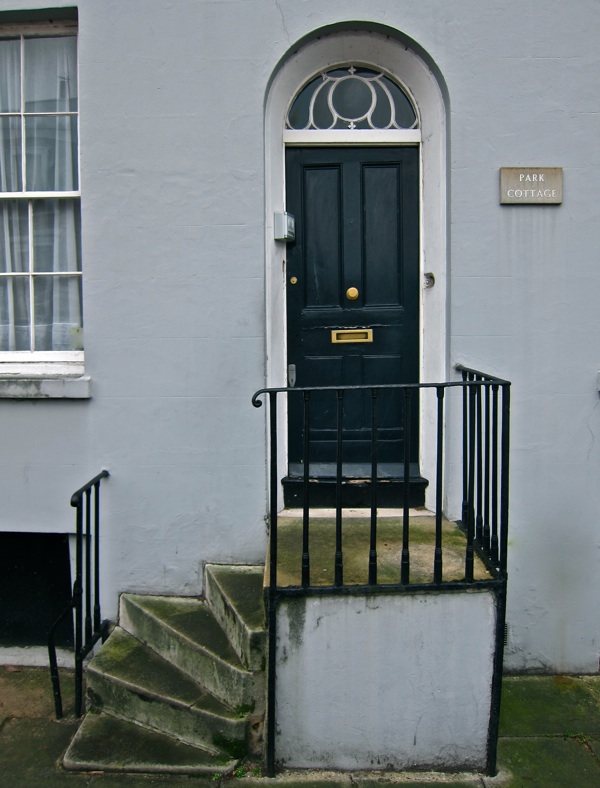
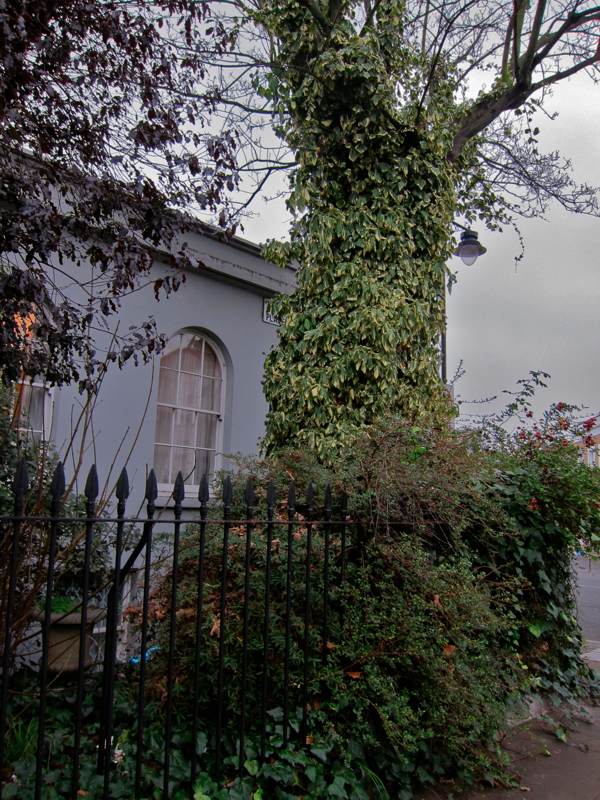
This is the front door where Charles Dickens walked in
Two birthdays will be remembered at Park Cottage in Canonbury on this day, one is of Joan Atkins the current owner – whose age discretion prevents me disclosing – and the other is Charles Dickens whose two hundredth birthday is celebrated today. Yet the connection extends further than the shared birthday, as Joan revealed to me when she kindly invited me round for tea recently.
Joan’s parents’ background was in the theatre, encouraging her curiosity to learn about her nineteenth century predecessors at Park Cottage, the Ternans – a theatrical family of mother and three daughters who attracted the interest of Charles Dickens. He came here in 1857 to pay visits upon the youngest daughter Ellen Ternan, after she and her sisters had acted with great success in two performances that he organised of Wilkie Collins’ play “The Frozen Deep” in Manchester. And it was Dickens’ growing fascination with the eighteen year old Nelly – as she was commonly known – that led to a meeting over tea in the living room at Park Cottage which signalled a turning point in his personal life and the separation in the following year from Catherine, his wife and mother of his ten children.
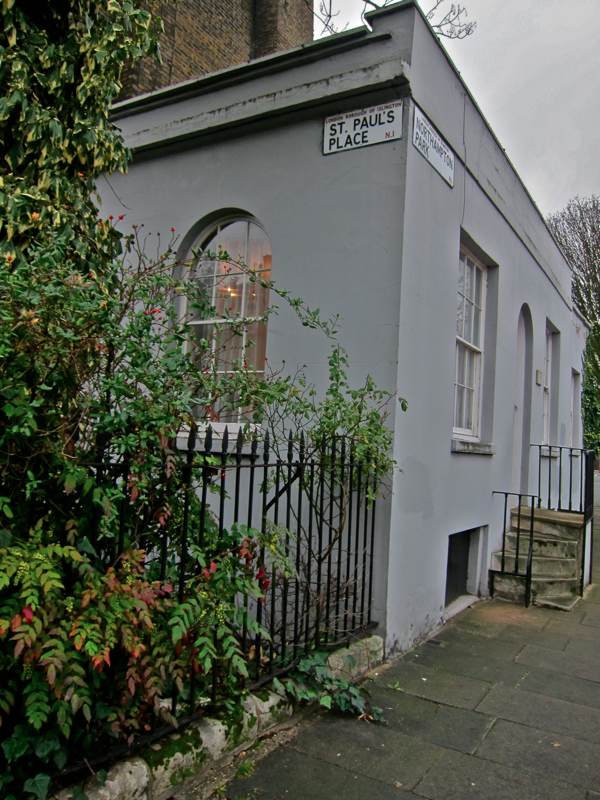
Coming upon Park Cottage at the corner of Northumberland Park, you might assume that this plain single storey edifice was merely an extension stuck onto the end of the 1835 terrace in St Paul’s Place, but in fact it is a 1790s dwelling that once stood alone here, built as the estate cottage when the surrounding fields were turned over as a plant nursery by Robert Barr. Climbing the worn stone steps to walk through the narrow front door with its decorative fanlight – suggesting an aspiration to greater things – you enter the raised ground floor of the cottage built originally as four rooms – two up, two down – that was extended shortly after construction to make six. These spaces are divided by wooden-panelled partitions in the familiar eighteenth century pattern, creating rooms of a generous height and proportion upon the ground floor with attractive fireplaces and large shuttered windows, while below in the semi-basement, where the flagged kitchen remained until the 1970s, the rooms are more modest and receive less daylight. It would have been a crowded house for the four Ternans and their servant to occupy.
The Ternans came to live here in the spring of 1855 while the mother and two elder sister were performing at the Princess Theatre. Mrs Ternan, the widow of Thomas Ternan the tragedian, struggled to maintain her family and protect the reputation of her daughters in the capricious world of show business. She was conscientious at first to ensure propriety in the relationship between the famous novelist and her youngest daughter. Though whether this supervision was due to moral concern or the better to manipulate Dickens obsession with her daughter to their advantage is open to question. Dickens’ nineteen year marriage to Catherine had already turned sour and he sentimentalised the virginal Nelly Ternan, confessing, “I do not suppose there ever was a man so seized and rendered by one Spirit.”
Years later, Dickens third daughter Kitty recalled the tense domestic atmosphere at this time – “This affair brought out all that was worst and all that was weakest in him. He did not care a damn what happened to any of us. Nothing could surpass the misery and unhappiness of our home.” Yet Dickens stubbornly protested his innocence in the face of Catherine’s accusations and sought to humiliate her for maligning Nelly, the idealised object of his infatuation. Kitty’s version of events is reported thus, “Entering the room, she found her mother seated at the dressing table in the act of putting on her bonnet, with tears rolling down her cheeks. Inquiring the cause of her distress, Mrs Dickens – between her sobs – replied,“Your father has asked me to go and see Ellen Ternan.” “You shall not go!” exclaimed Kitty angrily stamping her foot. But she went.”
Who can only imagine what conversation might have passed over the tea table in the course of such a bizarre encounter in the narrow room at Park Cottage with two arched windows giving onto St Paul’s Place? We shall never know if civility was preserved or if feathers flew. Did Catherine attend out of subservience to her husband or did she wish to confront the reality of his obsession? There is a story that Dickens ordered a bracelet for Nelly from a jeweller who sent it to Catherine by mistake, delivering the arbitrary event which brought the situation to crisis.
It was the end of Dickens marriage. “If you dislike me so much it might be better if we were to separate,” Catherine wrote to him. Afterwards, he made a financial settlement upon Nelly and, insisting that the crowded dwelling at Park Cottage was unwholesome, he established the mother and her daughters in a more central and better appointed dwelling on Berners St. In just eighteen months, the precarious existence of the Ternans had been transformed to one of stability and wealth. On her twenty-first birthday, Nelly became the owner of a house in Ampthill Sq, Mornington Crescent. And later, Dickens arranged an extended sojourn in France for her and visited regularly, leading the the suggestion that she was pregnant with his child
For the most part unchanged inside, Park Cottage retains the appealing rural quality of a workaday eighteenth century cottage where the nursery workers once came to collect their wages in the kitchen. If we cannot ever know exactly what happened when Dickens courted Nelly in these shadowy rooms, what we understand of the circumstances that led him to her, and of the outcome, permit us to speculate. At forty-five years old, Dickens sought renewal, describing Nelly in terms that exalt her as a totem of the life he craved – “There is not on earth a more virtuous and spotless creature than this young lady.”
We may be assured that Joan Atkins, the current inhabitant of Park Cottage, celebrates her birthday with a relaxed tea party attended by her loving family. And at today’s gathering, Joan’s shared birthday with the greatest of British nineteenth century novelists will be the only point of comparison with that mythic tea party which once took place in her house one hundred and fifty years ago.
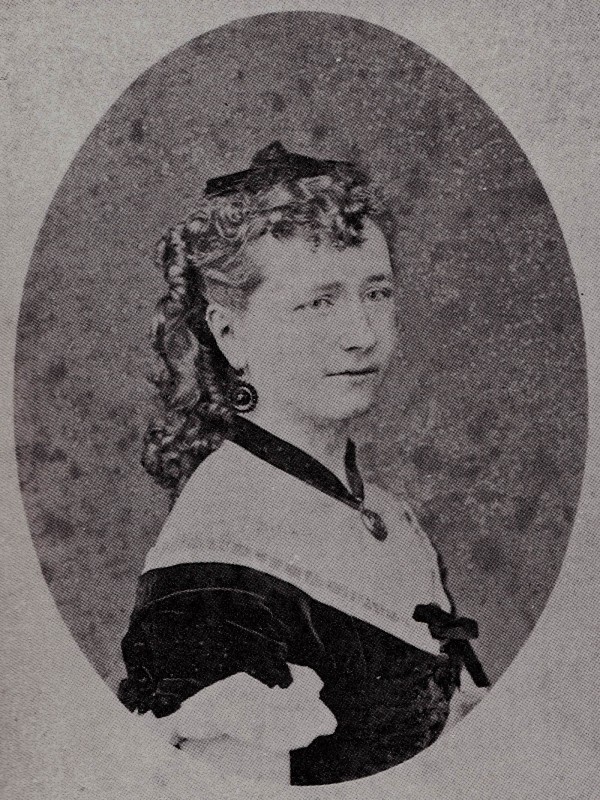
Ellen (Nelly) Ternan in 1858.
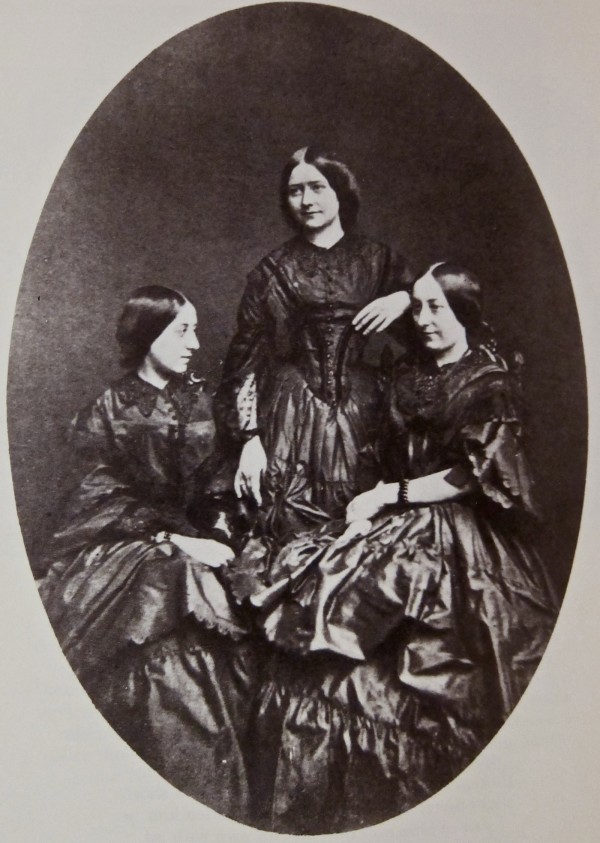
Maria, Ellen and Fanny Ternan.

The parlour at Park Cottage where Ellen Ternan once entertained Charles Dickens and his wife.
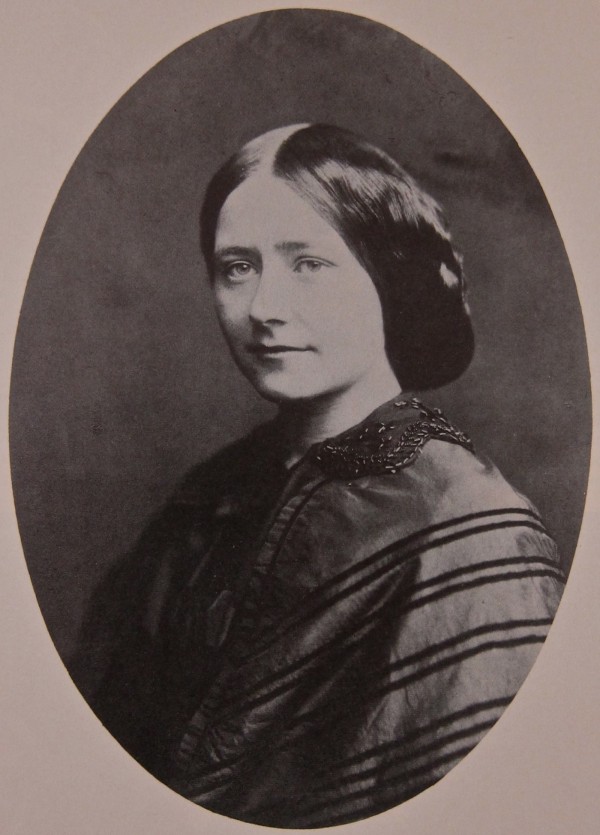
Ellen Ternan – Dickens described her as his “magic circle of one.”
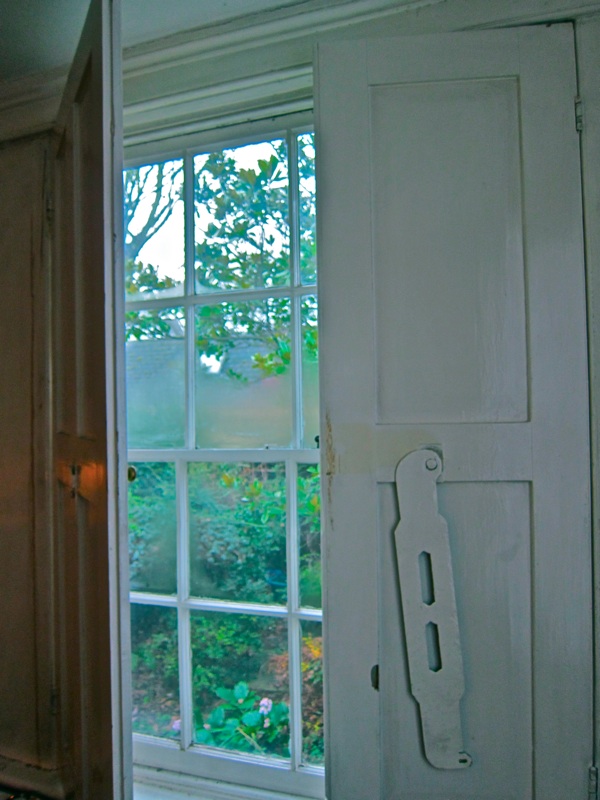
Looking out towards the walled garden.

Charles Dickens by William Powell Frith 1859.
You may also like to read about
Charles Dickens In Spitalfields
Charles Dickens in Spitalfields 2 – The Silk Warehouse
Charles Dickens in Spitalfields 3 – In the Streets
Charles Dickens in Spitalfields 4 – The Silk Weavers
Snowfall at Bow Cemetery

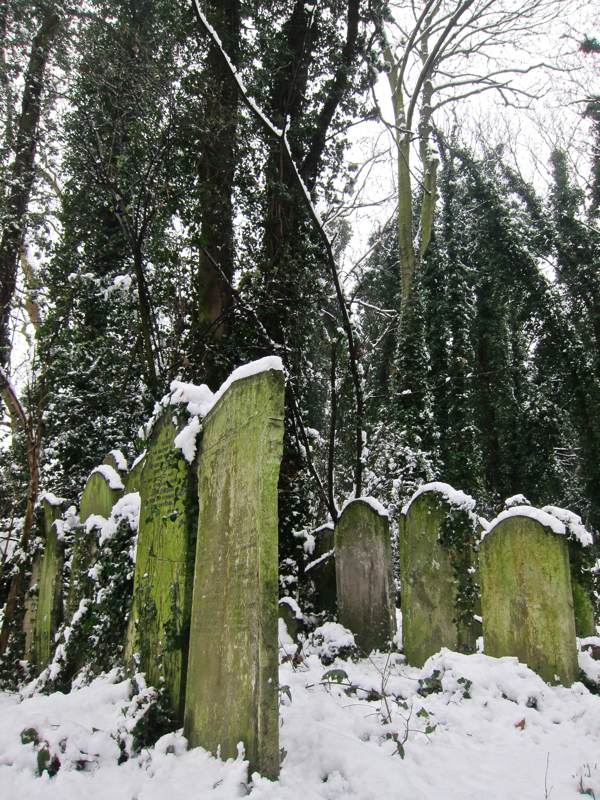
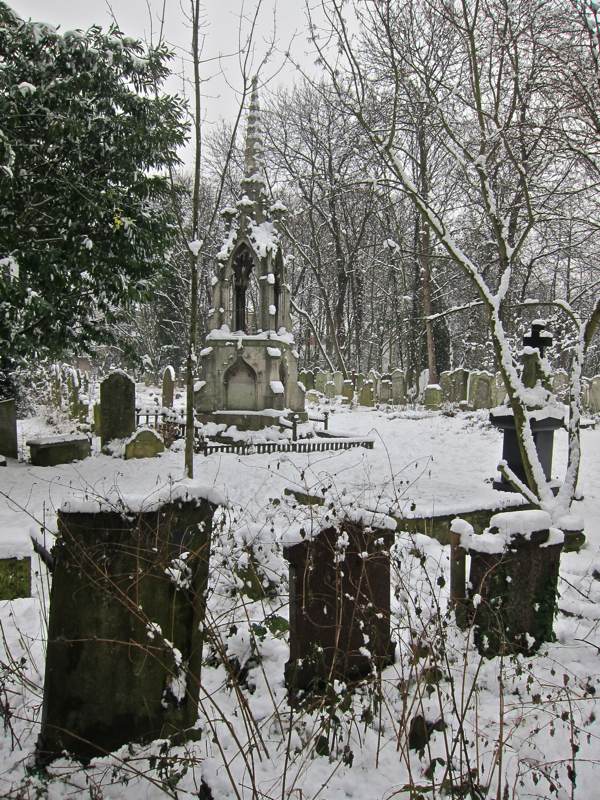
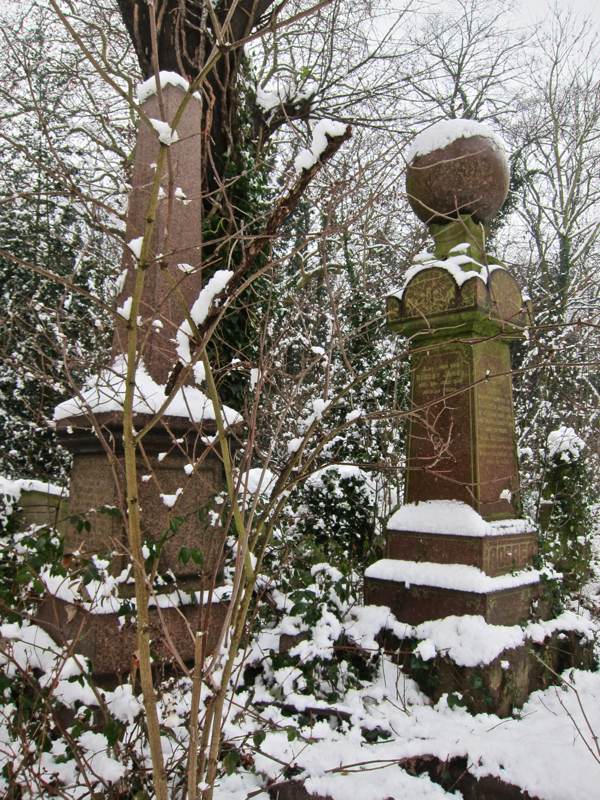
On Saturday night, a hush was cast upon the East End as the first snowfall of winter came down. Many cancelled their plans for going out, consequently the traffic thinned and the pavements emptied as the falling snow took possession of the territory. Awaking to silence on Sunday morning and looking from my bedroom window, the dark boughs of the great yew tree in the back yard were weighed down with a heavy covering of white – a bucolic wintry vision filling my gaze, as if the house had been transported in the night and I had woken high in the mountains.
Even as I opened my eyes, I knew I wanted to go to Bow Cemetery where I paid a visit to admire the precocious spring bulbs last February. That year, the snow had begun before Christmas and the spring came early, whereas this year the winter has been mild until the temperatures took a dip in mid-January, making up for lost time. So, as I have been awaiting the opportunity to see this magnificent graveyard in the snow all winter, the fulfilment of my wish compensated for the indisposition of slush filling the streets.
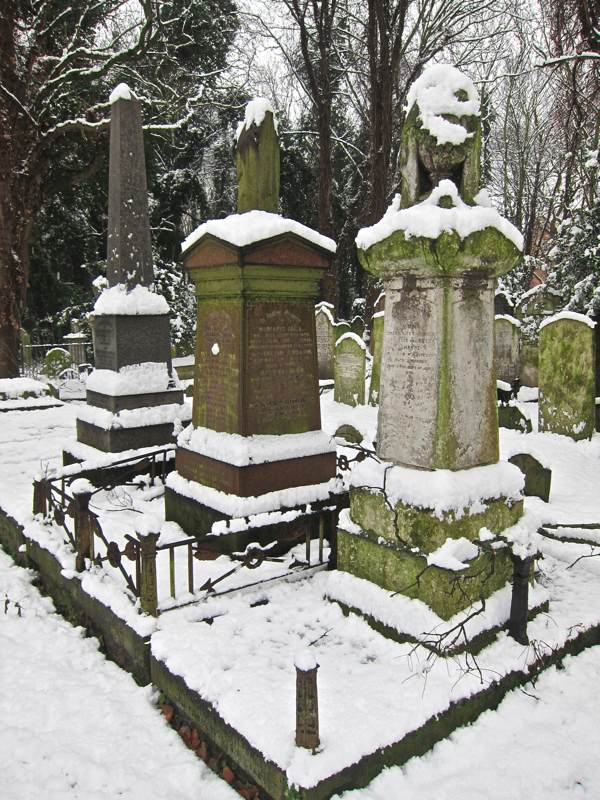
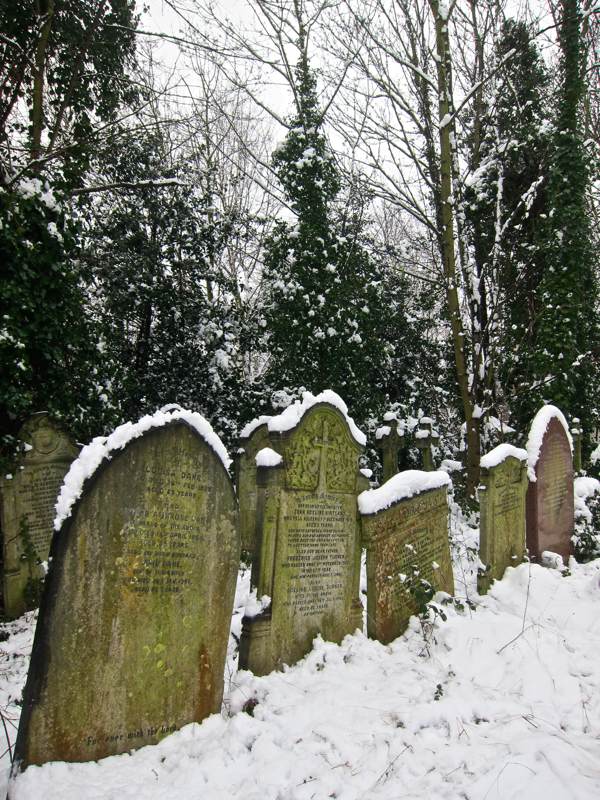
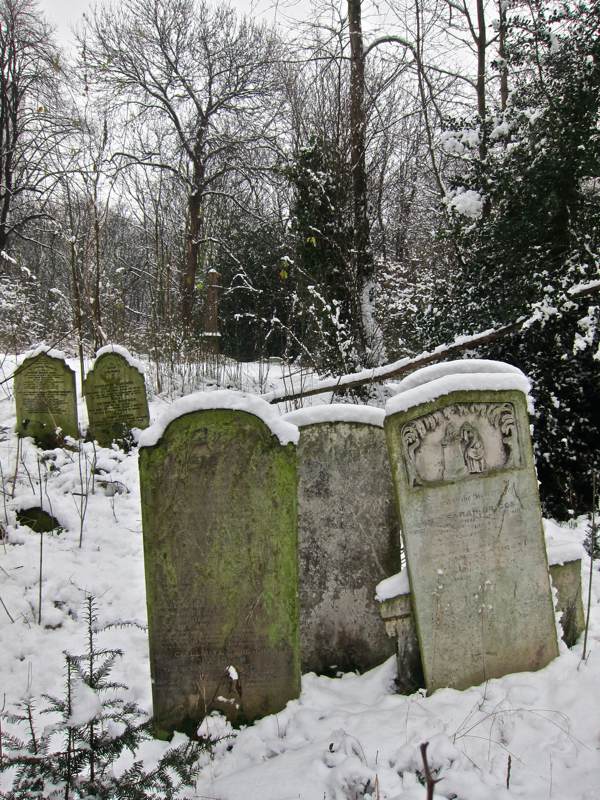
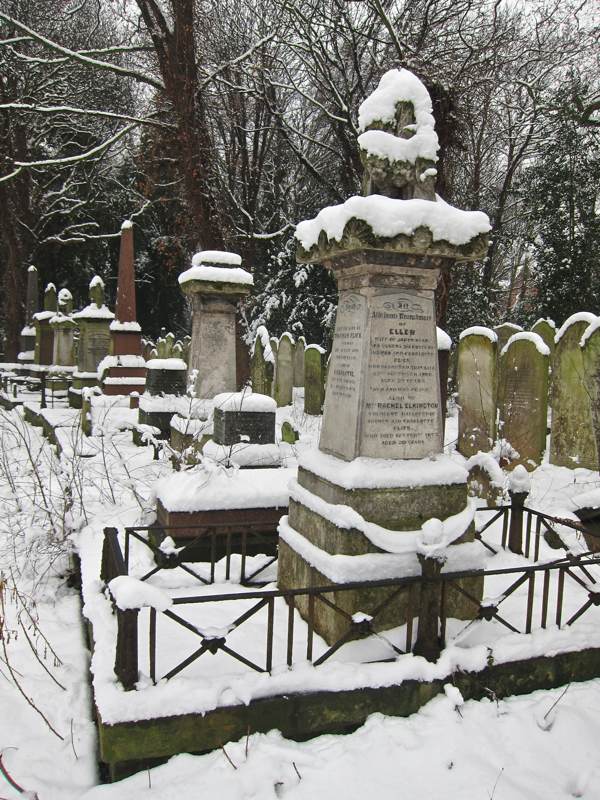
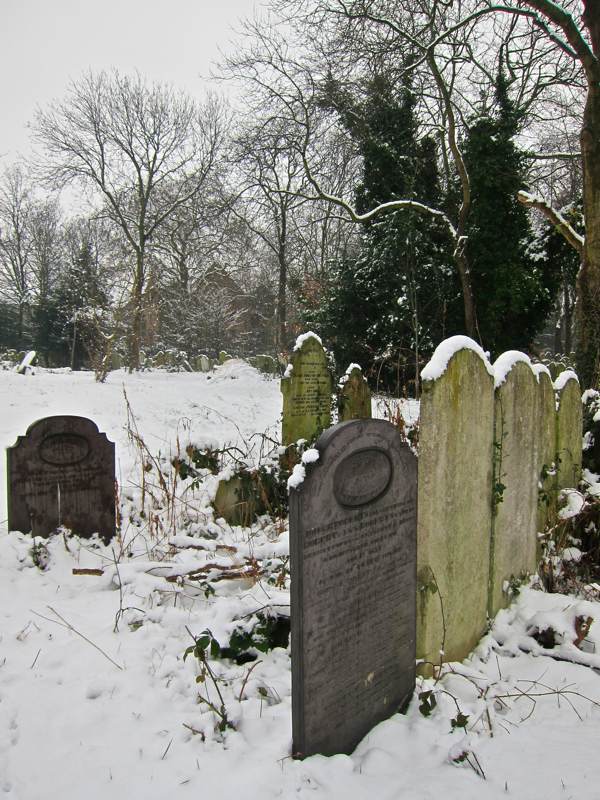
The appealing irony of Bow Cemetery is that this vast garden of death has become the largest preserve of wildlife in East London. Created once the small parish churchyards filled up, it is where those numberless thousands who made the East End in the nineteenth century are buried. On the Western side of the cemetery, near the main entrance, are fancy tombs and grand monuments but, as you walk East, they diminish and become more uniformly modest until, at the remotest extremity, there are only tiny stones. At first, I thought these were for children when, in fact, they were simply the cheapest option. Yet even these represent an aggrandisement, beyond the majority of those who were buried here in unmarked communal graves.
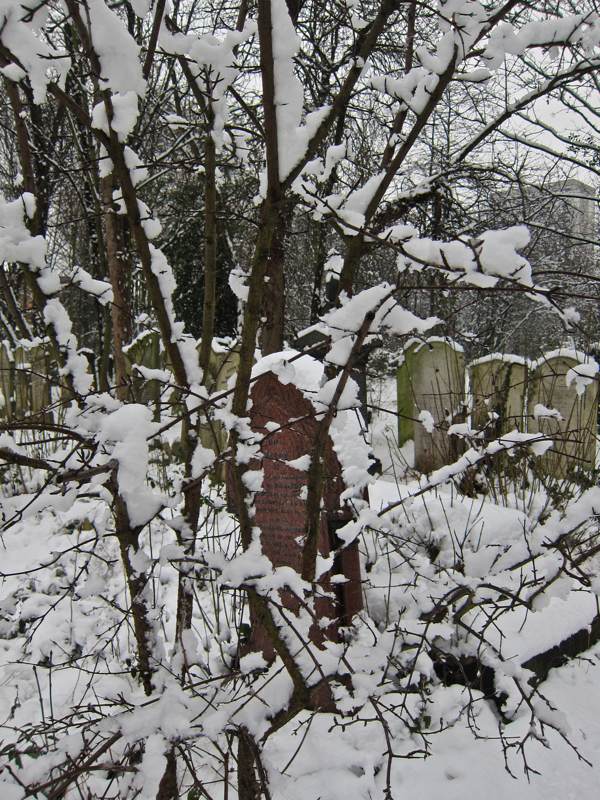
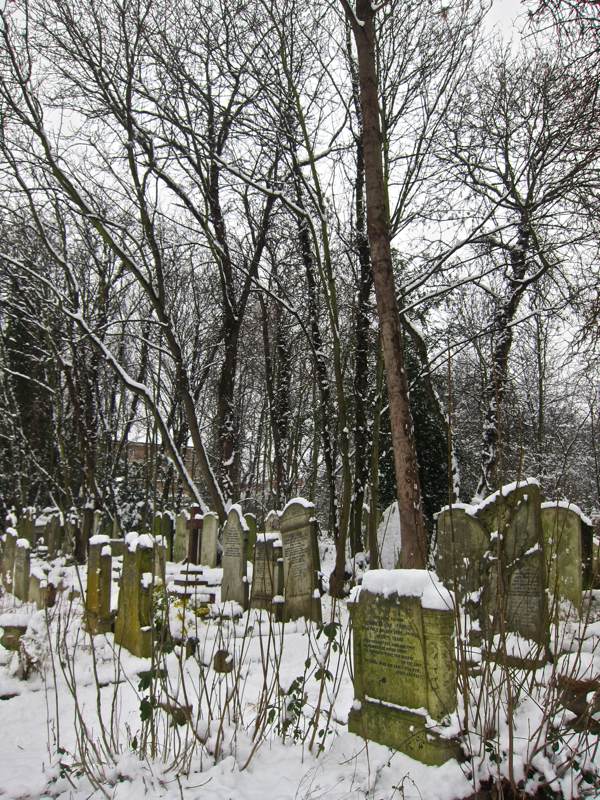
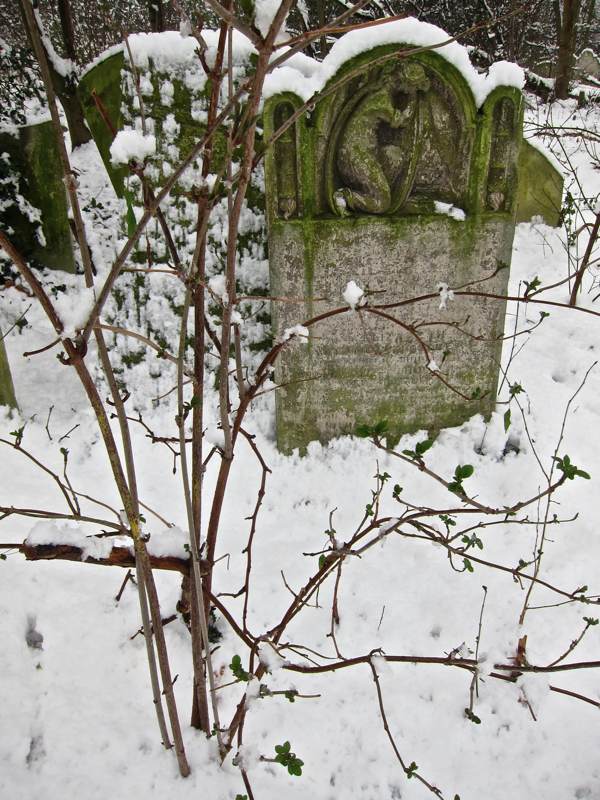
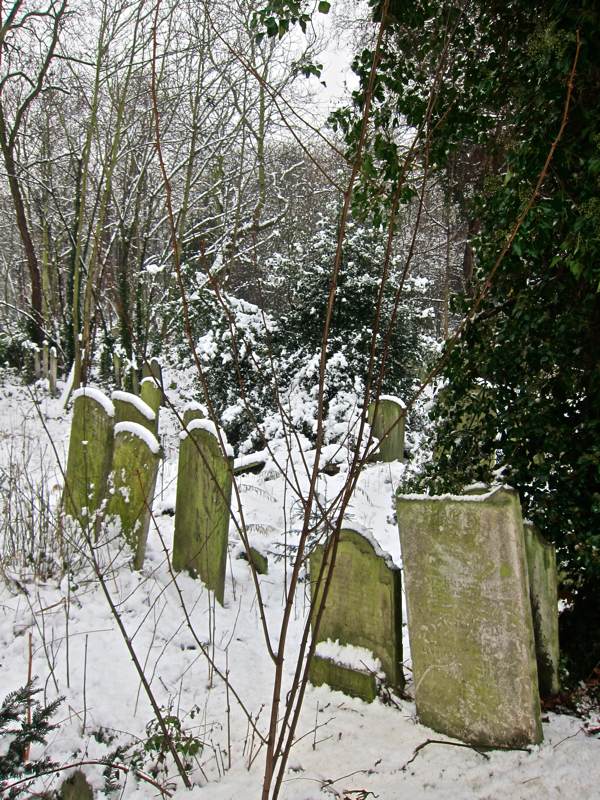
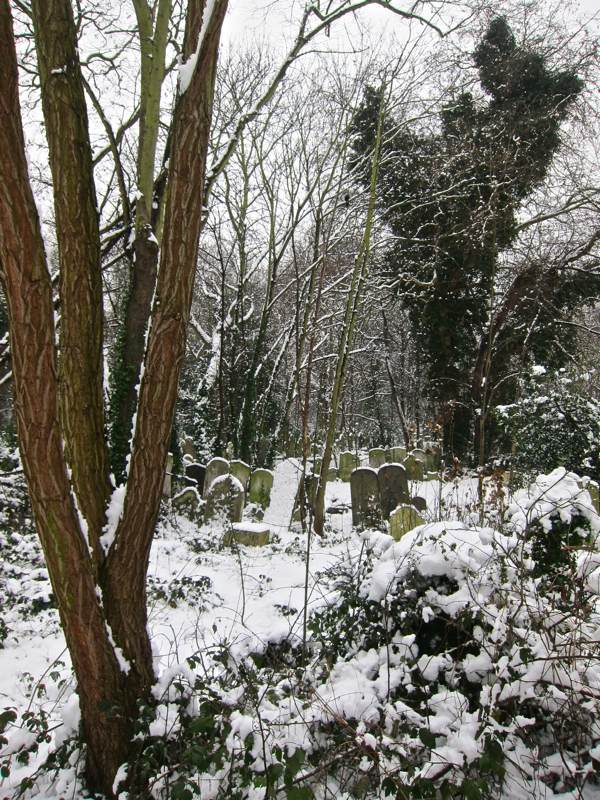
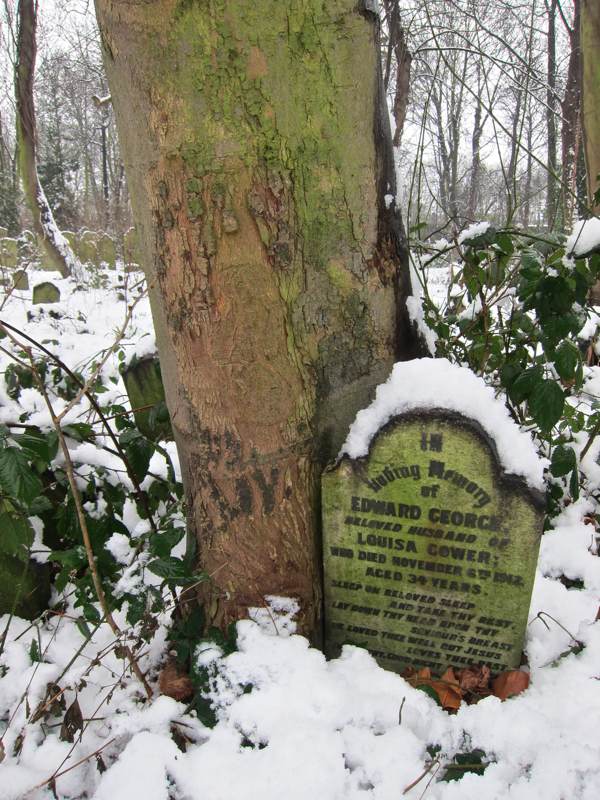
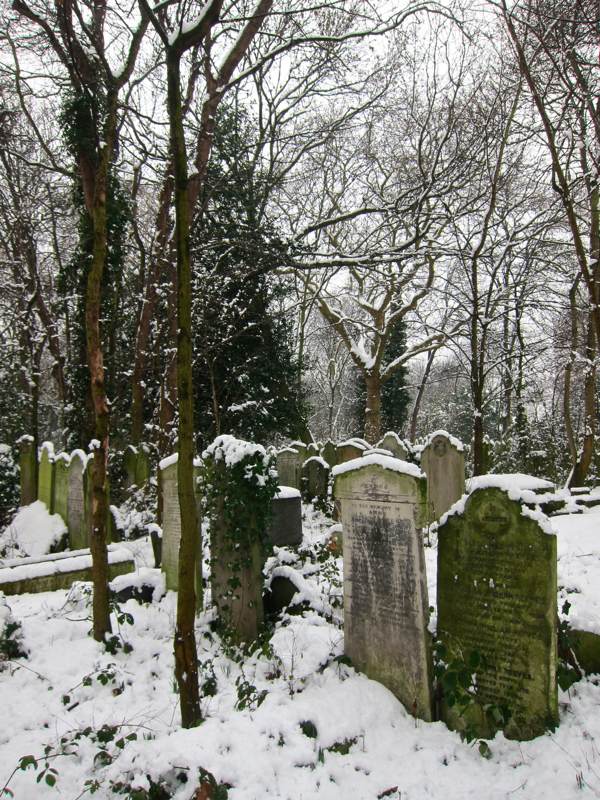
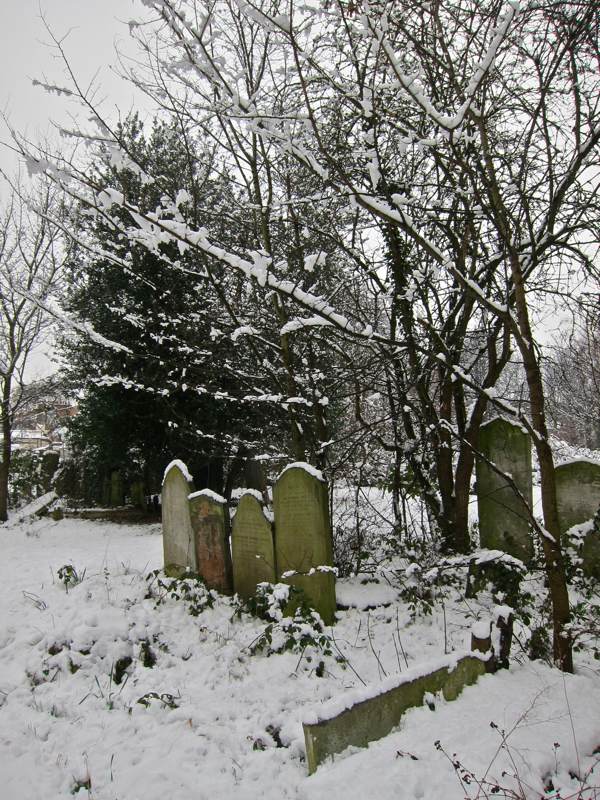
My spirits lifted to leave the icy mess of the streets and enter the quiet of the cemetery where since 1966, a forest has been permitted to grow. A freezing mist hung beneath the high woodland canopy, and the covering of white served to emphasise the rich green and golden lichen hues of the stones, and subtle brown tones of the tree trunks ascending from among the graves. As on my previous visits, there were few visitors here and I quickly lost myself in the network of narrow paths, letting the trees surround me in the areas where no human footprint had yet been made.
Crows called to each other and woodpeckers hammered away high in the tree tops, their sounds echoing in the still air. Thrushes searched for grubs under leaves in the rare patches of uncovered earth beneath stands of holly, and a young fox came by – standing out as a vivid rusty brown against the pale snow – slinking along self-conscious of his exposure. The spring bulbs that I saw last year in flower at this time were evidenced only by sparse green spears, protruding from snow criss-crossed by animal and bird tracks.
It was a very different place from the lush undergrowth of high summer when I first visited and another place again from the crocus-spangled garden of spring, yet I always discover peace and solitude here – a rare commodity in the East End – and, even in this bleakest season, there was life.







You may also like to read about
Find out more at www.towerhamletscemetery.org
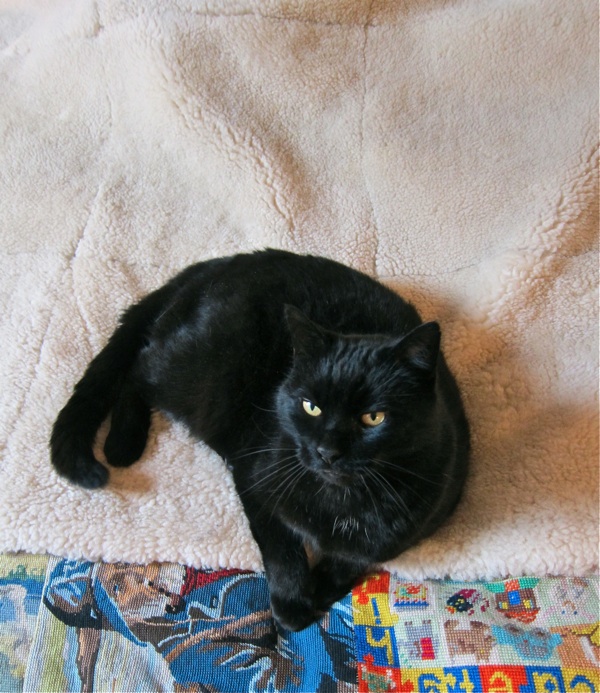
Apart from his necessary business, Mr Pussy did not stir from the house during the snow.
Joseph Grimaldi, Clown
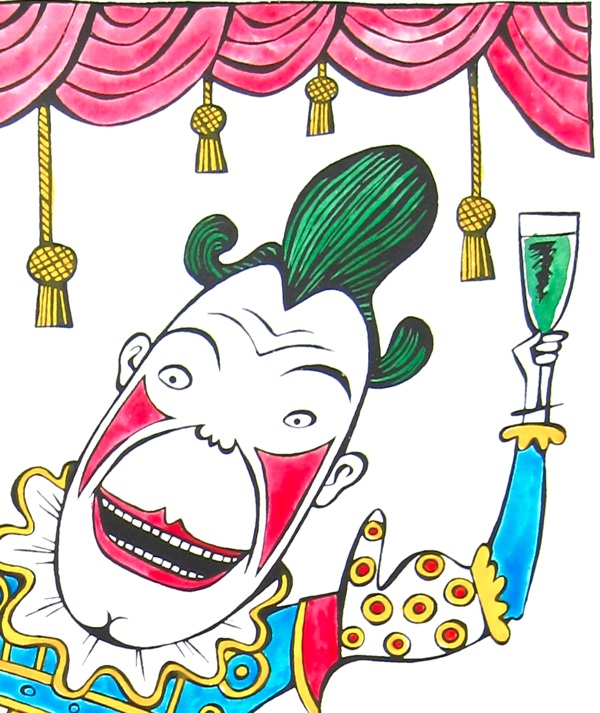
Today – the first Sunday in February – is when the clowns gather for the annual church service in Dalston to remember Joseph Grimaldi, and I am delighted to launch this new print by Spitalfields Life Contributing Artist Paul Bommer, created to celebrate the father of British clowning.
“Joey” was born in 1778 in Clare Market, a slum in Holborn composed of Elizabethan shambles which survived the Fire of London, to Guiseppe – known as “Iron Legs” – an Italian pantomime artist and Rebecca a dancer, both performers at Drury Lane. The story is told that he was literally catapulted to fame when he fell into the pit while performing as a monkey at Sadler’s Wells, aged three. Grimaldi’s father died when he was nine but by then Joey was already making a living on the stage. With star quality, a natural gift for physical comedy, ceaseless inventiveness and an obsessive propensity for work, Grimaldi enjoyed the constant adulation of his audiences even if his personal fortunes where rarely stable. When his first wife Maria, daughter of the owner of Sadlers’ Wells Theatre, died in childbirth less than two years after their marriage, he sought consolation through immersion in his creative world. Developing the role of Clown, the country buffoon from the Commedia dell’Arte, he created the notion of comedy derived from audience participation, excelled in political impersonations and invented the pantomime dame too.
Growing up in Holborn and Clerkenwell, Joey was fascinated by the street life of the city and his most famous song “Hot Codlings,” premiered in “Mother Goose” in 1806, dramatises the character of a hawker selling baked apples.
Joey invited his audience to complete the last line, inviting a dialogue in which the knowing spectators would subvert the performance by calling out “Gin,” cueing him to adopt a tone of soulful disappointment, declaring “Oh for shame!” in complicit response.
In the end, Joey’s success led to his self-destruction through a relentless performance schedule, often playing two theatres on the same night and enacting demanding physical stunts. By the age of forty-eight, he was unable to continue, and his departure from the stage and farewell to his adoring audience must rank as one of the most emotional in British theatre history. Held in the affections of all circus folk today, Joseph Grimaldi’s reputation remains current in the popular imagination as the inventor of the archetype of the white faced clown that is universally recognised.
In 1820, at seven years old, Charles Dickens saw Grimaldi perform in pantomime in London and, at twenty-five years old in 1838, he rewrote Grimaldi’s Memoirs from a manuscript discovered posthumously, fitting the job into the three month gap between completing Pickwick Papers and starting Nicholas Nickleby. George Cruickshank, who lived in Amwell St round the corner from Sadlers’ Wells, drew the lively pictures, captioned below with excerpts from the text by “Boz.”
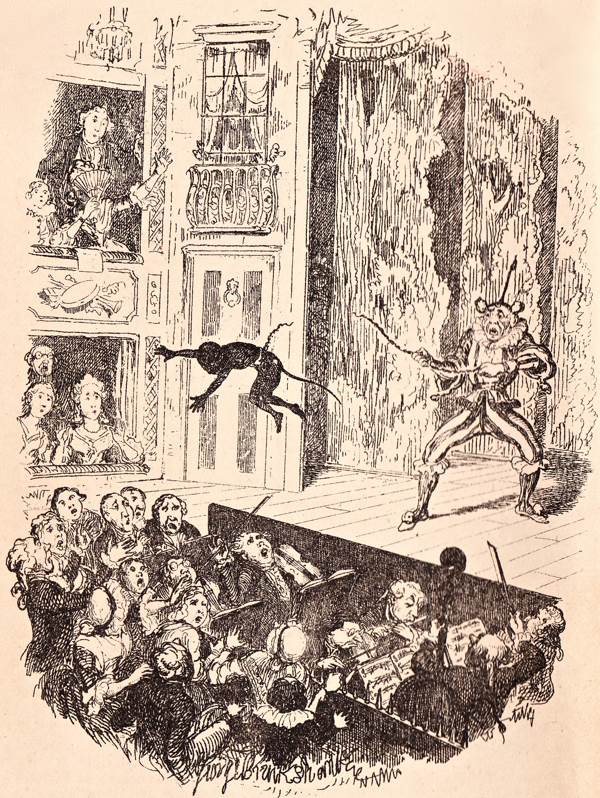
Joe’s debut into the pit at Sadlers’ Wells in 1782, aged three – “He played the monkey and had to accompany the clown (his father) throughout the piece. In one of the scenes, his father used to lead him on by a chain attached to his waist, and with this chain he would swing him round and round, at arm’s length, with the utmost velocity. One evening, when this feat was in the act of performance, the chain broke, and he was hurled a considerable distance into the pit, fortunately without sustaining the slightest injury – for he was flung into the arms of an old gentleman who was sitting gazing at the stage with intense interest.”
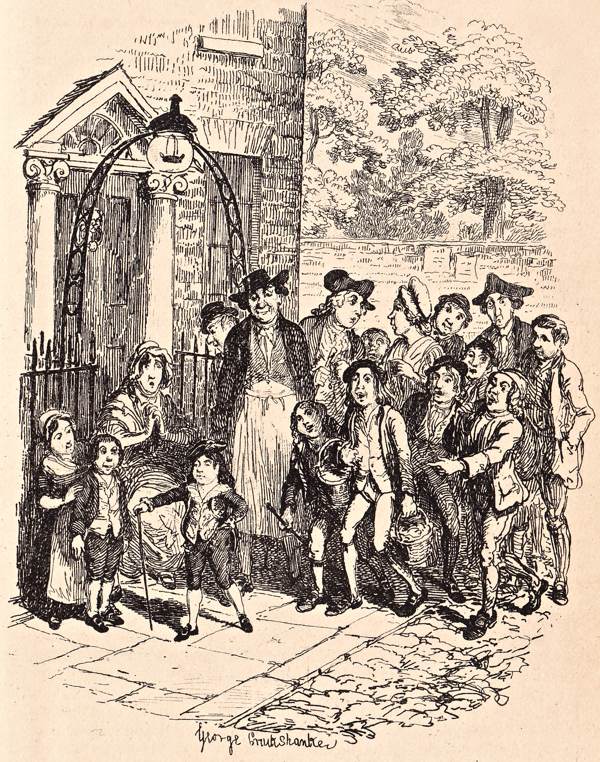
Master Joey going to visit his godpapa. “He used to be allowed as a mark of high and special favour, to spend every alternate Sunday at the house of his mother’s father, a carcass butcher doing a prodigious business, besides which he kept the Bloomsbury slaughter-house. With this grandfather, Joey was a great favourite, and as he was very much indulged and petted when he went to see him, he used to look forward to every visit with great anxiety. After great deliberation and much consultation with the tailors, the “little clown” was attired in the following style – he wore a green coated embroidered with as many flowers as his father had put in the garden at Lambeth, he had a laced shirt, cravat and ruffles, a cocked-hat upon his head, a small watch set with diamonds – theatrical we suppose – in his fob, and a little cane in his hand which he switched to and fro as clowns do now.”
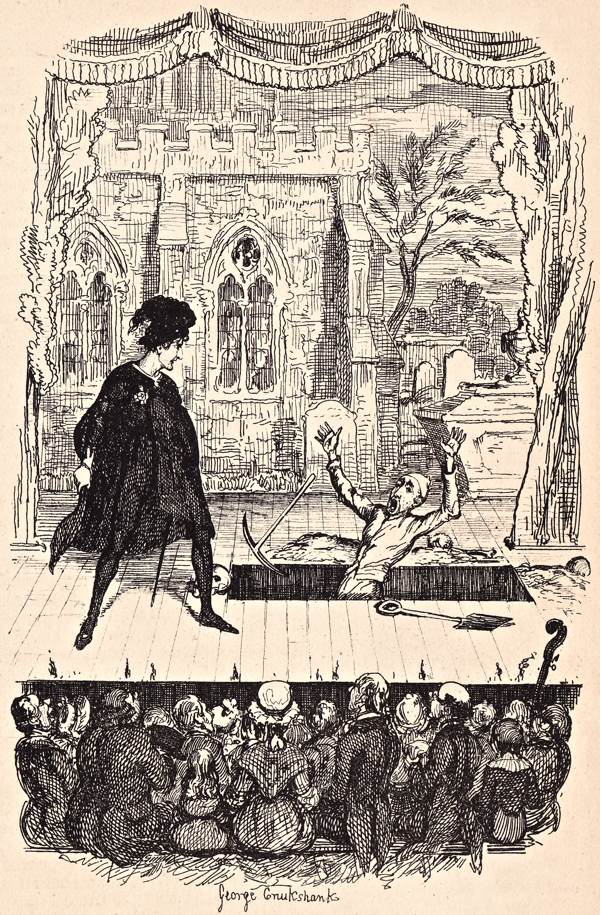
A Startling Effect – John Kemble as Hamlet and Joseph Grimaldi as the Grave Digger.
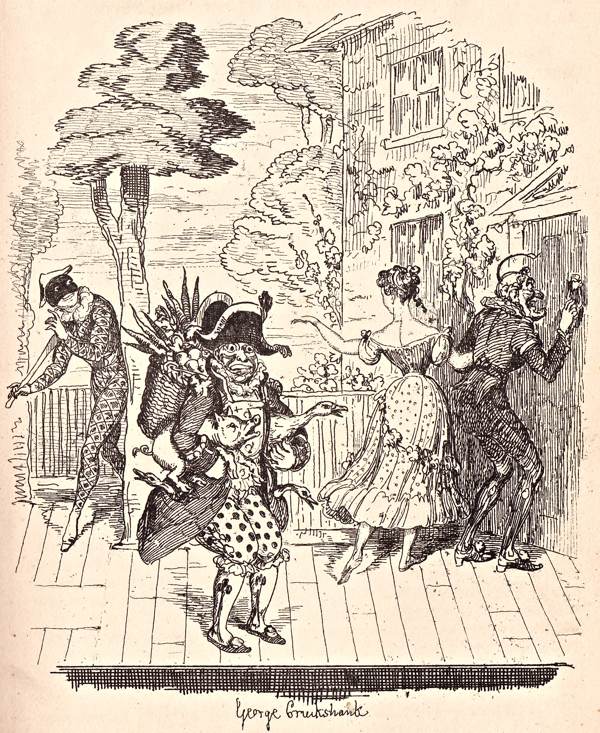
Live properties – “He dressed himself in an old livery coat with immense pockets and a huge cocked hat, both were – of course – over his clown’s costume. At his back, he carried a basket laden with carrots and turnips, stuffing a duck into each pocket, leaving their heads hanging out, and carried a pig under one arm and a goose under the other.”

Appearing in public – “During the month he had to play “Clown” at both Sadlers’ Wells and Covent Garden Theatres, not having time to change his dress and indeed no reason for doing so if he had, in consequence of his playing the same part at both houses, he was accustomed to have a coach waiting, into which he threw himself the moment he had finished at Sadler’s Wells, and was straightaway carried to Covent Garden to begin again.”
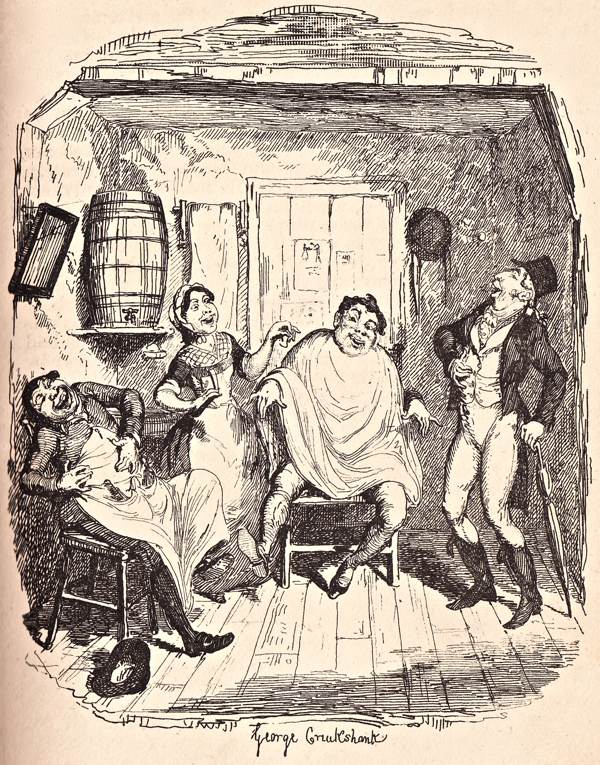
The Barber’s shop – “Grimaldi sat himself down in a chair and the girl commenced the task in very businesslike manner. Grimaldi feeling an irresistible tendency to laugh at the oddity of the operation, but smothered by the dint of great efforts while the girl was shaving his chin. At length, when she got his upper lip, and took his nose between her fingers with a piece of brown paper, he could stand it no longer, but burst into a tremendous roar of laughter, which the girl no sooner saw than she dropped the razor. Just at this moment in came the barber, who, seeing three people in convulsions of mirth, one of them with a soapy face and a gigantic mouth making the most extravagant faces, threw his hat to the ground and laughed louder than any of them.”
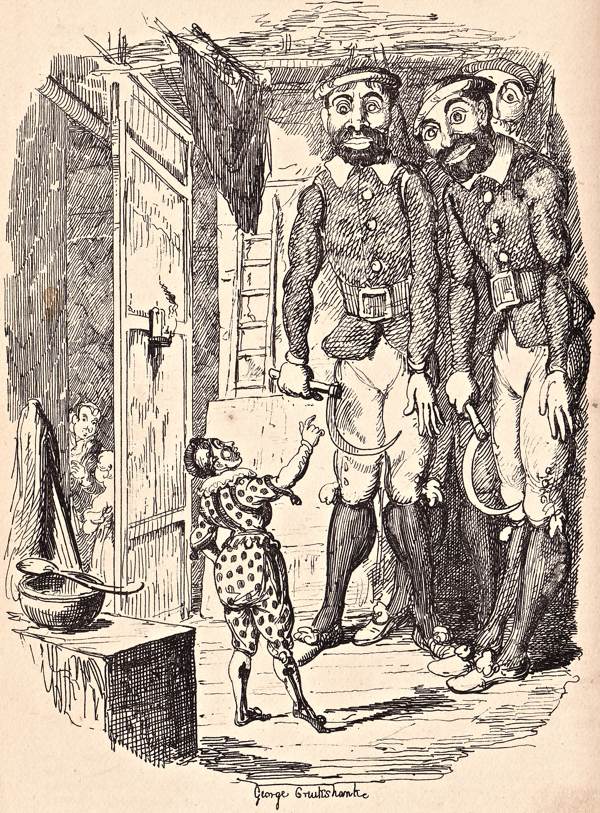
Grimaldi’s kindness to the Giants. – “When “Harlequin Gulliver” was in preparation they were at a loss where to put the Brobdignagians, these figures were so cumbersome and so much in the way that the men who sustained the parts were obliged to be dressed and put away in an obscure corner before the curtain was raised. Grimaldi pitied the poor fellows so much that after the first night’s performance, he thought right to ask whether they could endure so much labour for the future. “We have agreed to do it every night,” said the spokesman of the party, “if your honour will only promise to do one thing for us, and that is just to let us have a leetle noggin of whisky.” This moderate request was readily complied with, and the giants behaved themselves exceedingly well, and never got drunk.”
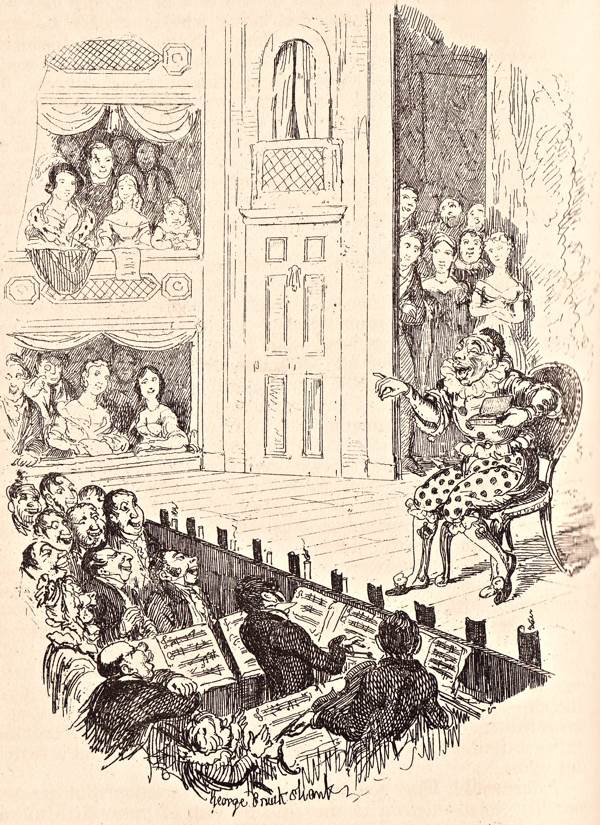
The last song – “In the last place, Grimaldi acted one scene, but being wholly unable to stand went through it seated on a chair. Even in this distressing condition, he retained enough of his old humour to succeed in calling down repeated shouts of merriment and laughter. ‘Ladies & Gentlemen, in putting off the clown’s garment, allow me to drop also the clown’s taciturnity, and address you in a few parting sentences. I entered in this course of life, and I leave it prematurely. Eight and forty years only have passed over my head. Like vaulting ambition, I have overleapped myself and pay the penalty in an advanced old age. If I now have any aptitude for tumbling, it is through bodily infirmity, for I am now worse on my feet than I used to be on my head. It is four years since I jumped my last jump, filched my last oyster, boiled my last sausage and set in for retirement.'”
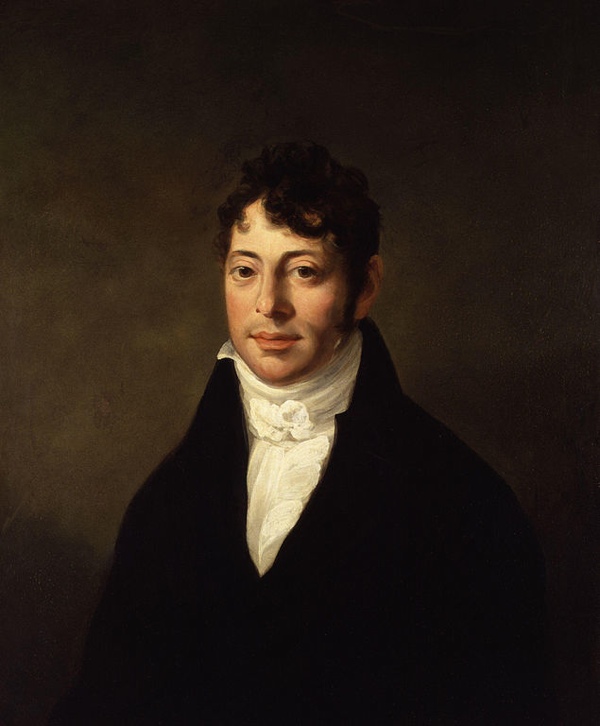
Portrait of Joseph Grimaldi by John Cawes, 1807.
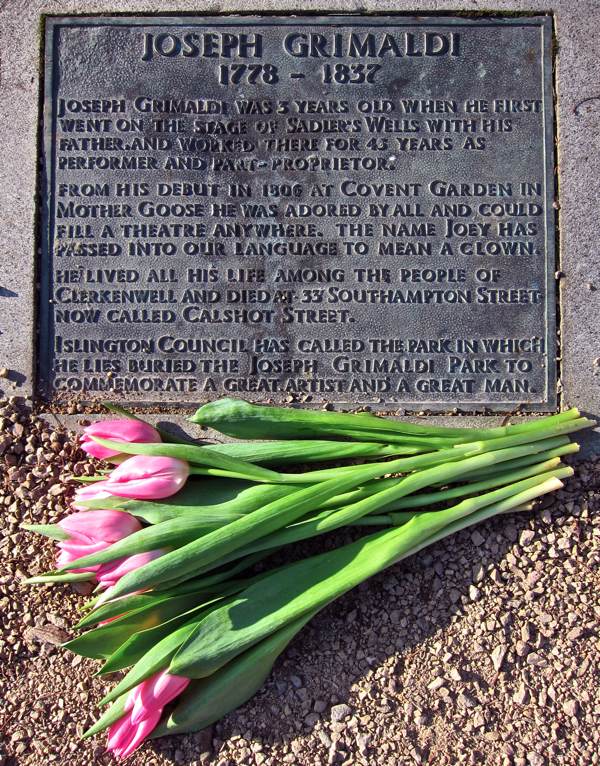
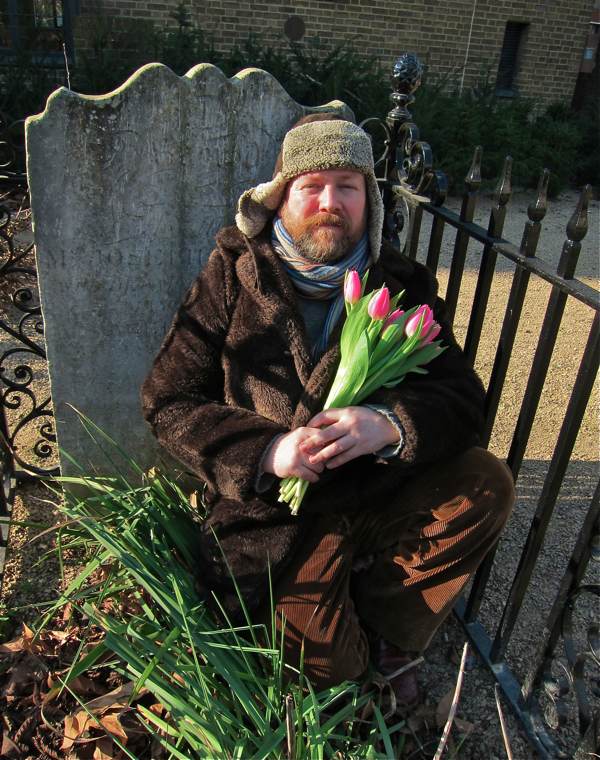
Artist Paul Bommer shivers in the February chill at Joseph Grimaldi’s grave in Pentonville.
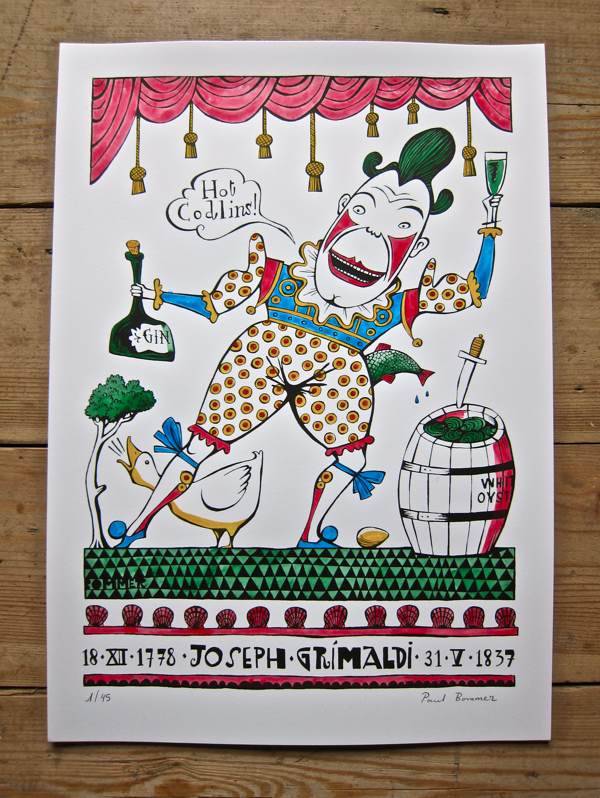
Copies of Paul Bommer’s Joseph Grimaldi print are available from the Spitalfields Life Online Shop.
You may also like to read about
At the 65th Annual Grimaldi Service
and these other stories about Paul Bommer’s work
The London Borough of Jam

Lillie O’Brien & I were at Covent Garden Market before dawn yesterday to get the pick of the crop of forced rhubarb. It is the only English fruit that is in season now and we bought it straight off the truck that had driven down overnight from the famous Yorkshire Triangle, where a frost pocket sweetens the rhubarb naturally and, after four generations, the Oldroyd family still grow rhubarb by candlelight in the time-honoured method. Once upon a time there was a Rhubarb Express to deliver trainloads of rhubarb to the hordes of eager Londoners craving rhubarb, but yesterday there was just Lillie & me seeking rhubarb while the city slept.
After four years as pastry chef at St John Bread & Wine in Commercial St, Lillie O’Brien struck out on her own last year to create the London Borough of Jam, a one-woman operation making small batches of the highest quality preserves from the freshest seasonal ingredients.
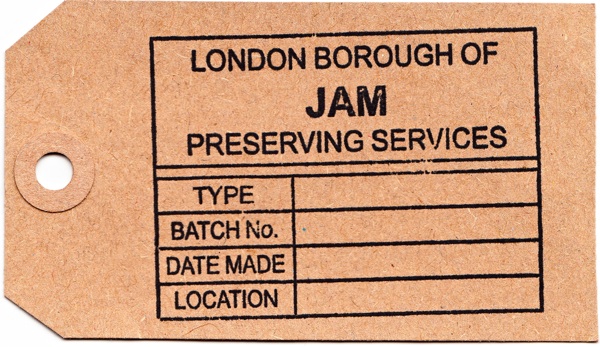
Seeking a name for her endeavour in the Hackney Local History Library, the label in the book identifying it as the property of the London Borough of Hackney caught Lillie’s eye and the witty identity for her new project was born. Through the autumn, Lillie filled the cellar of her house with jars of delicious jams made of the fruits of the harvest, only to have her entire stock bought out at shops and markets by greedy East Enders hungry for jam last Christmas, creating an imperative to feed the demand. Towards this end, our mission yesterday was to buy the best rhubarb, drive back to Lillie’s tiny kitchen in Clapton and make it into jam ready for sale this weekend. At five thirty, we were driving down to Covent Garden and by ten thirty we had jam, it was a highly satisfactory achievement for so early on a February morning.
At the market, we were greeted by Paul & Terry of Lenards wholesalers. By then, the night’s trading was already over but it was the ideal opportunity for a rhubarb hunt and Paul & Terry were the expert guides to lead us to the best options available. As we walked through the aisles, every fruit you might desire was on display, freighted in from each corner of the globe, yet in spite of the pristine appearance, the raspberries were bitter, the strawberries were watery and the cherries were brown at the centre. A discovery that confirmed our resolution to buy the fruit that was in season. The one diversion from our rhubarb quest was for blood oranges from Sicily, and as I stood in the sub-zero temperature of the market, I was transported to Southern climes by the intense sweetness of the ruby-red flesh of this gleaming golden fruit. Lily took a box to make some marmalade.
We found fat rhubarb and thin rhubarb, long rhubarb and short rhubarb. Some that was past its best and some that looked rather pale. Apparently, chefs like fat rhubarb to create chunks in their crumble, but Lillie prefers a smooth texture to her jam and when she opened a box of skinny rhubarb – blushing almost coral in its redness – her eyes widened in excitement and I knew we were in business.
In a state of raging anticipation, we carried our crates of gleaming rhubarb into Lillie’s tiny kitchen and Lillie shrieked with excitement at the ice-cold water as she washed the stalks in the sink. We paused briefly to admire the aesthetics of the curly dappled flowers before we beheaded them mercilessly and Lillie chopped one kilo of rhubarb into small pieces, while Chester her cheeky British Blue cat rubbed at her ankles.
Since the age of twelve, Lillie worked at a part-time job at a food store called Tartine in her home town of Melbourne, where she grew up under the influence of her mother’s cookery. “When I was a child, my mother made crab apple jelly but when you are little, you don’t like it – so she had a cupboard to herself with a year’s supply.” Lillie recalled with a sentimental grin. On leaving school, Lillie did a three year cooking apprenticeship and then five years as a chef at the celebrated Cicciolina mediterranean bistro before deciding to come travelling around Europe for six months. A tour that was cut short when a pal walked into St John Bread & Wine to ask if there were any jobs, was told a pastry chef was required and gave Lillie’s name. “I went in for a trial and stayed for four years,” admitted Lillie, “which I have to say went very quickly. I made the jam and preserves while I was there. But then I decided wanted to be part of the market here at Chatsworth Rd and I found that working at St John by day and making jam all night was quite tough. So it was time to move on from cheffing – from four years of rolling puff pastry that has given me enlarged muscles in my neck and from whisking eggs that has caused one arm to grow larger than the other! But I do miss it though…”
Lillie talked as she worked, weighing up the rhubarb and then transferring it to her beautiful copper jam pan. Copper is the best conductor of heat which means that the fruit will cook evenly, avoiding any overcooking that might compromise the flavour. This is why Lillie cooks her jam in small batches because larger amounts take longer to cook and the fruit does not cook consistently. Adding jam sugar and then the juice of a lemon, Lillie kept stirring as the liquid evaporated and the rhubarb reduced to an even texture. Meanwhile, she heated the jam jars and boiled the lids, both to sterilise them and to ensure that her hot jam had a hot jars to go into into, so there was no risk of the glass breaking.
Lillie constantly checked the consistency of the jam, its viscosity revealed by how it dripped from the spoon. Then she added the finely chopped stem ginger and the jam was almost ready. “I’m so happy, I’m beside myself with the colour! This is going to be the most beautiful rhubarb jam I ever made.” she declared in unmitigated delight, as she poured it from the pan through her jam funnel, making just four jars. This painstaking technique required Lillie to spend the rest of the day working through her twelve kilogrammes of rhubarb, yet ensured the unmediated fruitiness that characterises her jam.
An essential trip to Gardners Market Sundriesmen was required to purchase more labels for this new batch of jam before Paul Gardner left for the weekend, which meant that Paul was the lucky recipient of the first pot of jam. Then Lillie returned to her kitchen for a long day’s jam-making before writing the labels that evening, and all so the rhubarb & ginger jam can be on sale this weekend.
A lush deep pink jam with a vivid flavour that is more rhubarb than even rhubarb, a perfectly spreadable texture and a subtle piquancy of ginger – this is what I shall be having on my toast at breakfast this morning, thanks to the London Borough of Jam.

Washing the rhubarb.

Weighing the rhubarb.

The rhubarb in Lillie’s new jam pan.

Adding the jam sugar.

Testing the consistency.

Rhubarb & Ginger Jam by the London Borough of Jam.

Paul Gardner of Gardners Market Sundriesmen gets the first pot of rhubarb & ginger jam.
You can buy jams and preserves by London Borough of Jam at Leila’s Shop, E5 Bakery and from Lillie’s fortnightly stall in Chatsworth Rd Market on alternate Sundays. She will be there this Sunday with pots of her rhubarb & ginger jam.
You may also like to read about
Night in the Bakery at St John
The Gentle Author Speaks
This interview, conducted and edited by Tim Rich, was first published last year in Random Spectacular, a limited edition magazine with a circulation of seven hundred and fifty, and I am republishing the piece today so that those who were unable to obtain a copy may read it here. The print which was commissioned to accompany the interview was created by Justin Knopp of Typoretum.

I wanted to find out more about the writer whose words transport me each day, whose stories take me through previously unseen doorways in my own neighbourhood in the East End. But that also required a promise from me – that I wouldn’t reveal the identity of The Gentle Author. I feared that this guarding of the person behind the pen might go hand in hand with a reticence to talk. What I encountered was something else entirely. Here are some of the words we exchanged over a pot of tea in East London.
Tim Rich – Your promise to readers includes a picture of a sundial on Fournier Street that features the words ‘Umbra Sumus’ – “We are shadows.” Reading your writing for the first time, I had the immediate feeling that you were either pursuing or escaping something.
The Gentle Author – Well, there’s a wonderful notion that Kierkegaard described – that being a writer is like being in the continual state of running through a burning house, trying to decide what to rescue. I do feel that sensation a lot of the time. Also, that people’s stories go unrecorded is a matter of grief to me. I think that arose after the death of my parents. I grew up in Devon around old people, and I used to knock on their doors and ask to spend a day with them. I suppose I have a vertiginous sense of all the stories in the world, and accompanying that is a sense of the loss of all the stories. So I have a compulsion to collect as many as I can, for as long as I can.
Tim Rich – Your stories became longer after a couple of months of the blog, and that coincided with you writing more pen portraits.
The Gentle Author – I have a personal sense of responsibility to people that I’ve met to do them justice. The idea of trying to sum someone up in a thousand words is terrifying. That was why the stories got longer and longer. The other thing that happened in the first year – unexpectedly – was that a lot of readers came along. It gave me a different responsibility, to not disappoint the reader. You want to give them something wonderful. So I became more ambitious.
Tim Rich – That is a terrific counterblast to the common, pessimistic notion that people don’t read much any more, and that writing for the Web should always be short. You show that the Web can be a place for a longer and more personal form of writing.
The Gentle Author – I respect the discipline of writing, that a piece should be well structured and a story well told. But I also aspire to write in an unmediated way, and to not withhold an emotionalism if that’s how I react to a subject. I am also attracted to use vocabulary in a way that it is not used in journalism, but is perhaps more common in fiction. I chose to be this voice speaking from the darkness, because I want to be in private with the reader. I want the reader to understand that the writer’s intention is benign, and that we can trust each other. And I hope the readers create their own sense of who they are listening to and take ownership of what they read. In this sense, the Gentle Author is a conceit to bring readers closer to the subject, and I want the subject to be the people I’m writing about, not me.
Tim Rich – Do you have to get into the character of the Gentle Author when you write?
The Gentle Author – Graham Greene said that reading Charles Dickens was like listening to the mind talking to itself. It is the internal voice that I aspire to in my writing – what I hear inside my mind.
Tim Rich – Tell me a little more about the ‘hare-brained’ task you have set for yourself.
The Gentle Author – I wanted readers to know they could rely on something new every day. And I felt that if I created this cage for myself, then I could have no escape. I have written more than 800,000 words in the last two years, so it has worked to that degree. It’s a miracle. I spend most of the day running around the streets after people and doing interviews. In the evening, I sit down to supper, and then I write. The golden rule is that I can’t go to sleep until it’s done. People sometimes think that I knock off six stories in advance and press a button each day, but it isn’t like that at all. I may write interviews up a few days later, but it appeals to me that the Gentle Author has no choice but to write a story every day. I’m aware that it’s an excessive way to live but my experience has taught me that life is excessive.
Tim Rich – Your interviewees tell you remarkable things about their lives. How do you earn their trust?
The Gentle Author – You have to be open-hearted and honest, and you hope people see that it is just you, and that there’s no ulterior motive – and that no one’s paying you to do it. That you are doing it for love. People are wisely suspicious of writers, so I commonly send someone a piece I have already written and they can see what the outcome of being interviewed will be like.
Tim Rich – You write about the tension between tradition and change, such as the spiraling rents that have threatened to push out merchants like Paul Gardner.
The Gentle Author – It’s very difficult to trace what’s a right or wrong way for change to happen, but it’s vital that good things don’t get destroyed. For me, Paul Gardner, the Market Sundriesman, incarnates the essence of Spitalfields. Unless you have gone and shaken hands with Paul Gardner you can’t really say you have been to Spitalfields. His shop is where all the small traders in East London go to get their bags. What happened in Paul’s case was that, after my story, the landlords relented in their original demand for an excessive rent increase and showed themselves to be enlightened, recognising he is a special case. I hope people appreciate that the things which make this place distinctive are worth holding on to. One of the lessons revealed by the crash in the City was that the short-term profit motive is destructive and people need to take a longer-term view.
Tim Rich – You seem to revel in those lively nights out with the Bunny Girls and the trannies and the boys’ club reunions, but how do you feel about Spitalfields on a Saturday night – the drinkers and clubbers?
The Gentle Author – I think it’s a beautiful phenomenon. I often go out and walk the streets just to see the crowds on a Saturday night. Nothing has changed much there. In the 1860s The Eagle Tavern on the City Road was getting 12,000 people turning up a night and there were complaints about the crowds then. I think the young people who dress up and come to show off their outfits on Brick Lane embody a wonderful flowering of culture. So many people compete for ownership of this place, but the truth is that it belongs to everybody and nobody. There is a magic in Spitalfields, but if you love the area you must also be generous to others who love it too.
Tim Rich – Will there be enough space in your life to do other types of writing, as well as your daily report?
The Gentle Author – Dickens wrote six or seven stories a week for Household Words, but he also wrote the novels of Dickens as well. My background is in fiction, and originally I envisaged that there would be a chapter of a novel by me on the first of the month through the year. That has been sidelined, but as I get more confident and more in control of what I’m doing it could resurface. I’m attracted to the idea that the Gentle Author might have fictional adventures.
Tim Rich – What about visits to other places far from Spitalfields?
The Gentle Author – I am a favoured person in that I have had so many experiences and lived so many lifetimes in my life already. I remember, I went to Los Angeles for the Millennium and I was with a friend in a car on New Year’s Eve, and we turned left onto the freeway into oncoming traffic. She said, “We’re going to die.” And I said, “I don’t mind because I’ve done so much in my life, but what about your son?” There are lots of places I would like to go back to – Beijing, Cuba – but what I do now forces me to live in the day. My mind is so crowded I don’t have much space to think about anything else.
Tim Rich – You said something curious in a story on Dennis Severs’ house, which was, “Much as I love a good chat, I have many times wished that I never had to speak again.”
The Gentle Author – I think talking is hard. We take people’s words to be the expression of who they are. But I have always felt, with me, that was a contradiction because I didn’t feel that in speech I could represent who I was. That was why I began to write, because by writing down I could wrestle with words and become more truthful to who I am. So yes, I think it would be wonderful if I could get through the rest of my life without talking. I once lived on an island in the Outer Hebrides. I was the only inhabitant and I had to row forty-five minutes to the shore to get my mail. I would not see people for months on end and I did so much writing then. Your internal monologue becomes much more apparent when all the interference of external conversations is gone. Walking is very important in that respect too. I long for the release of the mind.
Tim Rich – So, writing is a release from the deluge of thoughts in your head.
The Gentle Author – Yes. For me, the act of writing is writing it down. There are no drafts. Writing is the act of recording an internal monologue. Coming back to the notion of the mind talking to itself – for me writing is the outcome of an unquiet mind, I suppose.
Tim Rich – How has Spitalfields Life changed your life?
The Gentle Author – I walk down the street and sometimes people lean out of windows to wave and come out and shake my hand. It is a beautiful thing, yet for that to happen in the middle of this huge city is bizarre. Generally, I don’t understand why people don’t talk to each other more. I think this is a political construct, this situation where we are all alienated from one another. A book that was important to me as a student was Raymond Williams’ Culture and Society. I think one of the outcomes of mass distribution through the printing press in the nineteenth and twentieth centuries was that it made everybody strangers to each other. We see all those people out there as ‘the masses’. It’s rubbish. It’s a lie. The hope of the internet is that it allows everyone to talk to each other again, and not be strangers.
Tim Rich lives in Bethnal Green and writes at www.66000milesperhour.com
A few copies of Justin Knopp’s print are still available from the Spitalfields Life online shop.












