
Alice Pattullo, Illustrator & Printmaker

Alice Pattullo only moved to London at the beginning of this year, coming – like so many other young artists before her – to make her way in the world. And, last week, I visited Alice in the room in the shared house in Leyton which serves both as her studio and her living space, where she works seven days a week creating a prolific output of lively and distinctive graphics.
“I had a plan,” Alice explained, her eyes lighting up in excitement, “One, find a house to live in. Two, do what I wanted to do.” Fortunately, a monthly commission from Coast magazine and regular work for English Folk Song & Dance Society publications covers Alice’s rent and gives her the basis upon which to create her own personal work, alongside a steady flow of other illustration jobs. “I can’t really stop,” she admitted to me, “you are working on one thing and it always leads to another thing. There is no distinction between my life and work. It could be really hard to motivate yourself in this situation but, because there’s so many things I want to do, that keeps me going.”
Originally from Newcastle, Alice graduated from Brighton College of Art in 2010 with a first class degree and an enthusiastic no-nonsense attitude. Her small room is lined with a colourful array of the work of twentieth century illustrators she admires and that she has found in markets and sales. Her desk is piled with her sketchbooks which she fills with designs and motifs that she scans into her computer where she reassembles and manipulates them into finished compositions. Impressively, Alice seems equally comfortable with the act of drawing as with digital creation.
I first became aware of Alice’s illustrations when I saw the beautiful print she had created inspired by my story about Steve Brooker, the mudlark, and the confidence and witty ingenuity of her style was immediately apparent. “All my work for the past few years has been about superstitions, folklore, traditions and customs.” Alice told me, “and since being in London I’ve been doing more stuff to do with being here.” Alice showed me two richly coloured prints that she has made as the beginning of a projected series illustrating all the livery companies of the City of London. “It’s about the celebration of a craft,” Alice declared, choosing the Worshipful Company of Glovemakers and the Worshipful Company of Basketmakers to start, as companies that are still involved in their respective trades. “It’s quite a good way to make a little money, and you’re not waiting for someone to give you a job,” she outlined, speaking modestly of these handsome prints that she produces in small editions at low prices to keep them moving.
There is a spirited quality to all of Alice’s work that I find irresistibly appealing. And I admire the way she has adopted her own subject matter and created her own momentum, thereby attracting commissions to keep herself going. Alice has no regrets about moving to London.“It’s been a good decision, I’ve already got so much more work,” she confirmed for me, breaking into a delighted smile.
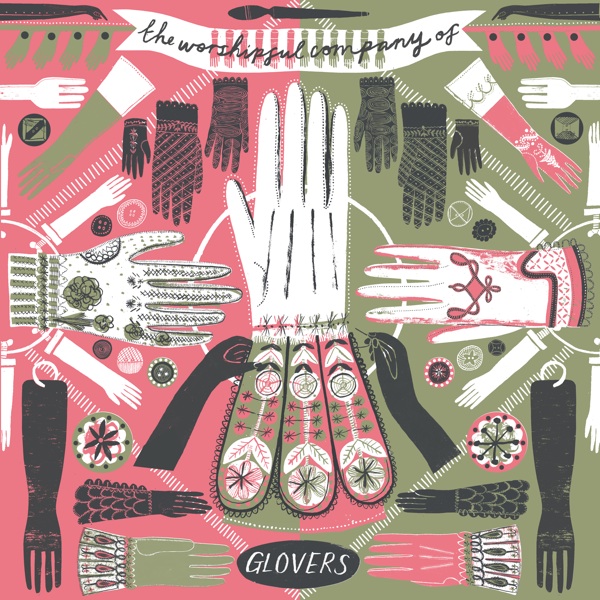
The Worshipful Company of Glovers
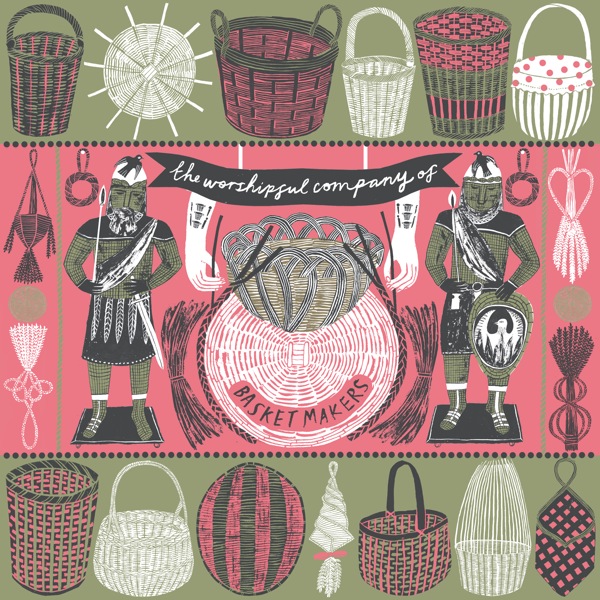
The Worshipful Company of Basketmakers (with the figures of the giants Gog & Magog)
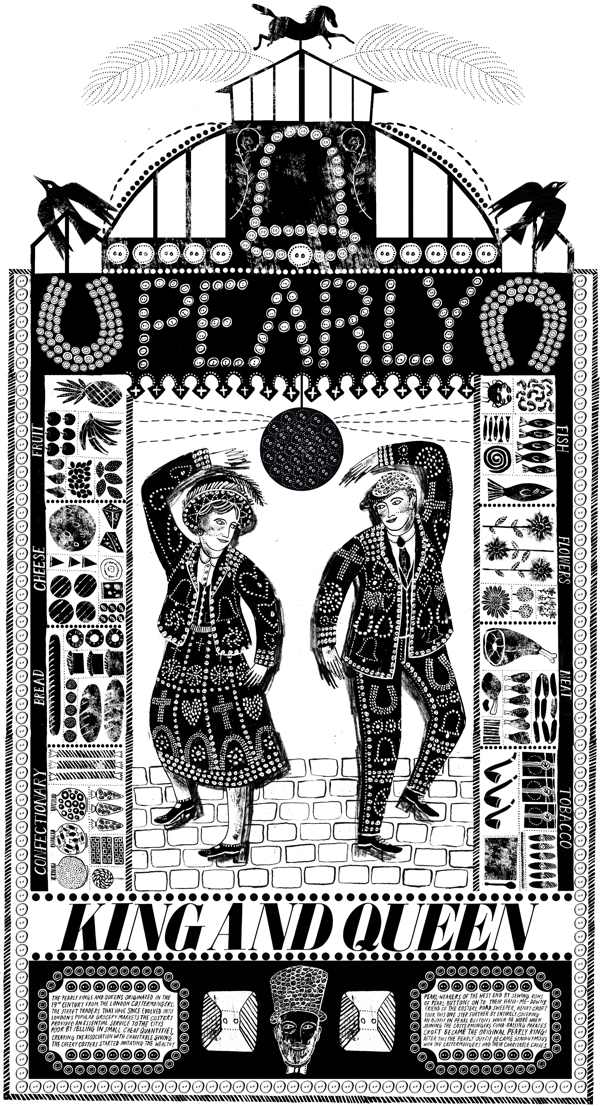
Pearly King & Queen
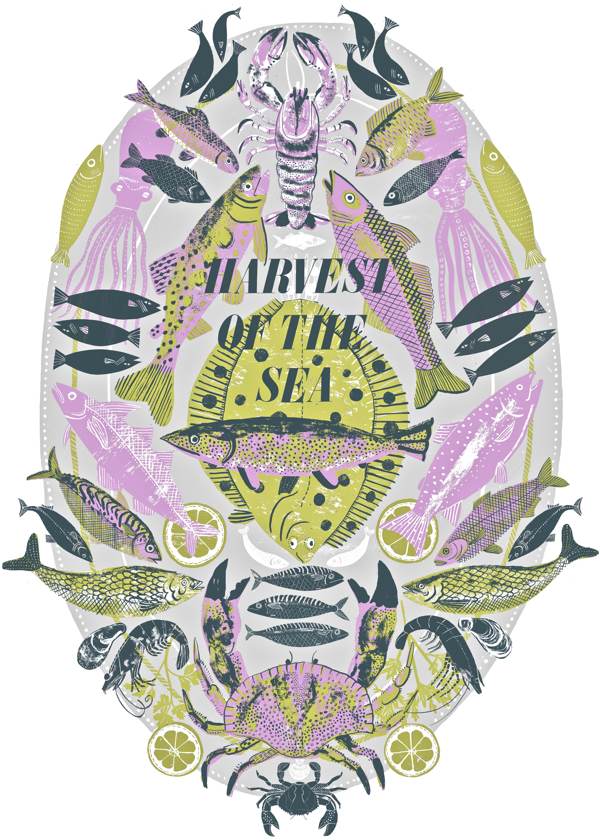
The Harvest Festival of the Sea
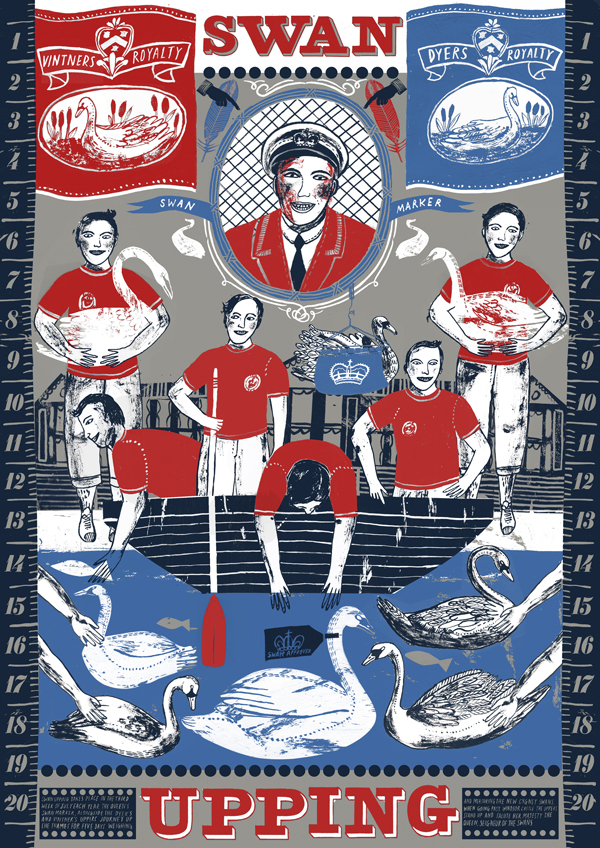
Swan Upping commissioned by the Shopfloor Project
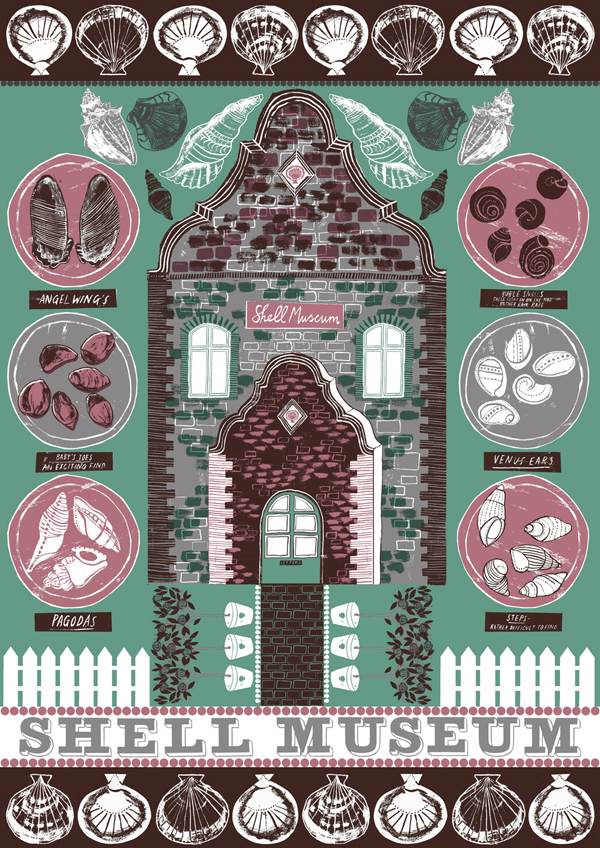
Glandford Shell Museum

Cats at Brighton Museum
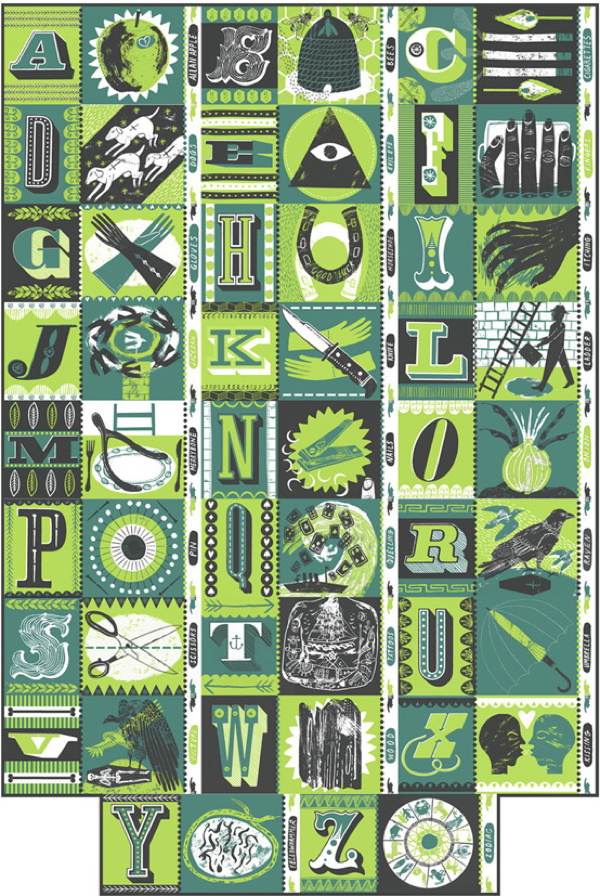
Alphabet of Superstitions
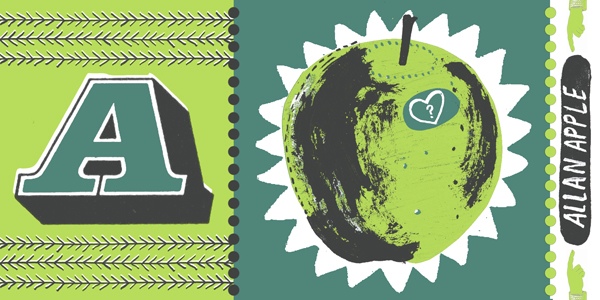
A IS FOR ALLAN APPLE. If a girl sleeps with an Allan apple under her pillow over Halloween she will dream of her future husband. If you eat one on Halloween you will be very fortunate in the year to come.
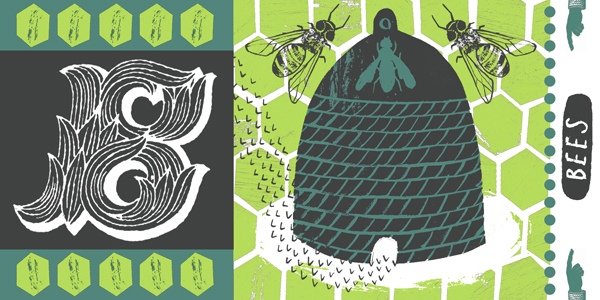
B IS FOR BEES. Bees are seen as sacred as they were thought to be divine messengers and foretellers of the future.You should never kill a bee, and you should always tell the bees of any change in circumstance in the home otherwise they will pine and die, or fly away – a grave misfortune.
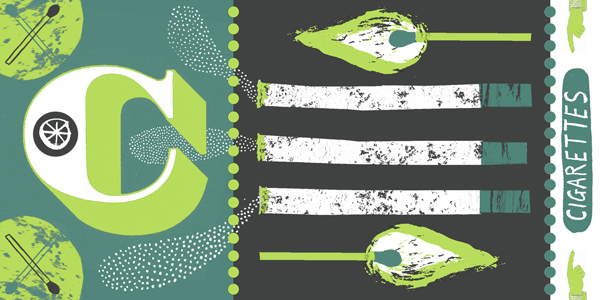
C IS FOR CIGARETTE. You should never light three cigarettes from a single match otherwise misfortune will fall upon he who holds the third.
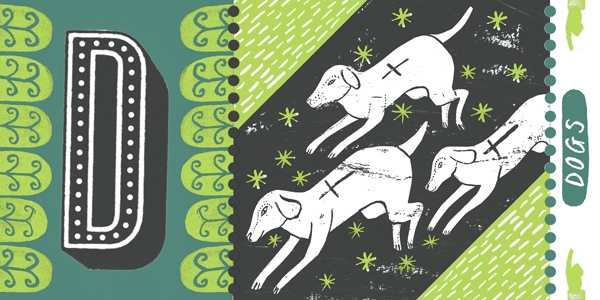
D IS FOR DOGS. Gabriel’s hounds are a pack of spectral dogs that haunt the skies.Anyone who hears or sees the hounds is doomed to s premature death.

E IS FOR EVIL EYE .He who bears the evil eye can bring illness and misfortune to humans and animals alike and can even destroy inanimate objects simply by looking at them.
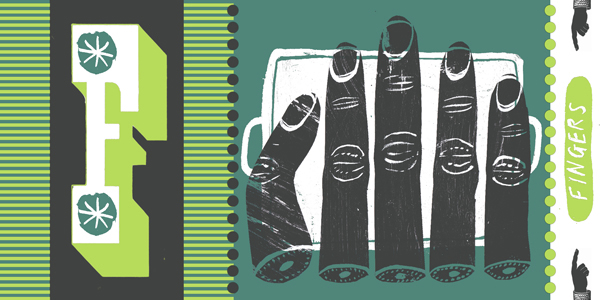
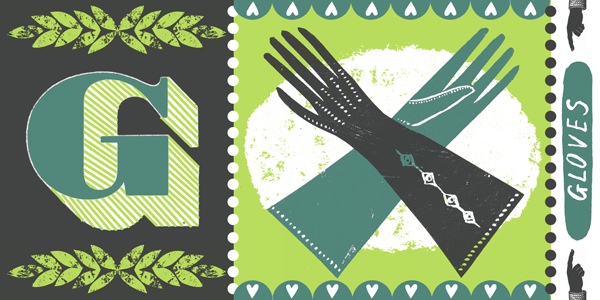
G IS FOR GLOVES. If you drop your gloves you should always allow someone else to pick them up for you otherwise bad luck will follow.And if they are returned to you then you can expect a pleasant surprise.
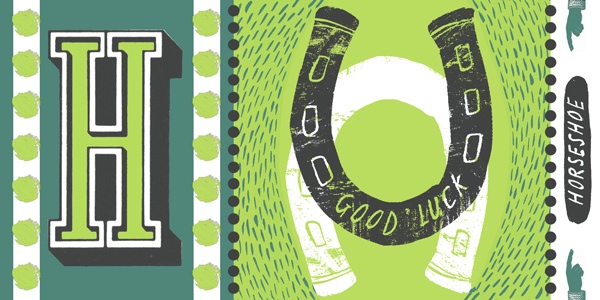
H IS FOR HORSE SHOE. The common horseshoe is the best known lucky amulet. However it will only bring you it’s lucky properties if it is hung with it’s prongs pointing up. If the point down all the good luck will fall out.

I IS FOR ITCHING. Having an unexplained sensation in the body, for example an itch is suggested to have a significance depending on where it is.An itch in your: Right ear =Your mother is thinking of you. Left ear =Your lover is thinking of you. Eyes = A pleasant surprise if it is your right, a disappointment if it is your left. Cheeks = Someone is talking about you. Hands = Your right means you will be getting money soon, your left means you will be losing some. Nose = You will be kissed, cursed, vexed or shake hands with a fool!
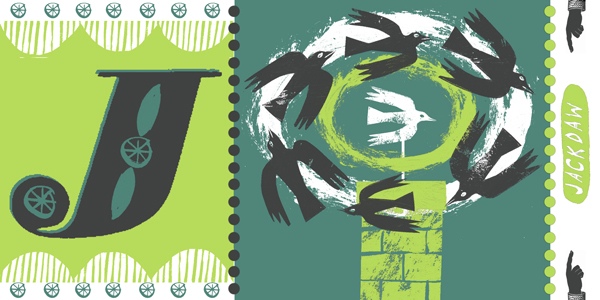
J IS FOR JACKDAW. Rain is foretold if you see jackdaws fluttering round the top of a building and it is an omen of death if one should fly down the chimney.
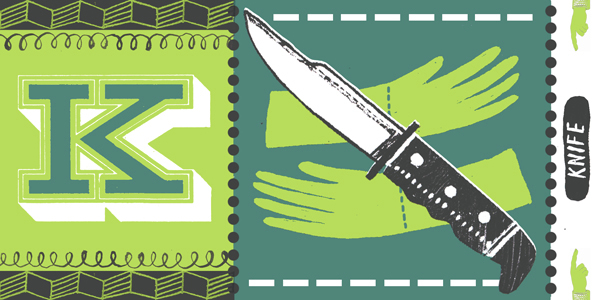
K IS FOR KNIFE. To give a knife as a present will ‘cut’ the friendship.This can be counteracted though if the receiver gives something back in return – as though ‘buying’ the knife.

L IS FOR LADDER. A well known superstition is that it is unlucky to walk under a ladder but the bad fortune comes as the shape the ladder makes from leaning against a wall is the triangle of the Holy Trinity and walking through it suggests a sympathy for the Devil!
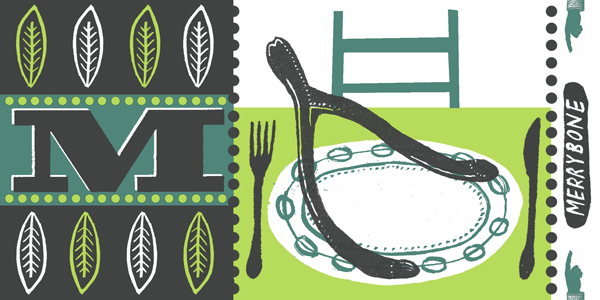
M IS FOR MERRYBONE. If two people hold each end of the forked bone found between the breast and neck of a fowl and break it while forming a secret wish, he who gets the larger half can be assured his wish will come true.

N IS FOR NAILS. Cutting your nails at sea will provoke a storm. If a young unmarried woman cuts the nails on her right hand she will rule her husband.A child’s nails should never be cut or he will become ‘light fingered’ but can be nibbled off by his mother.
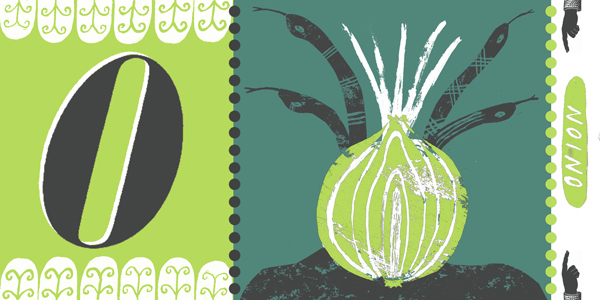
O IS FOR ONION. Snakes have an aversion to onions so to protect against their attacks it is wise to carry a raw onion in the hand.

P IS FOR PINS. See a pin and pick it up all day long you will have good luck.
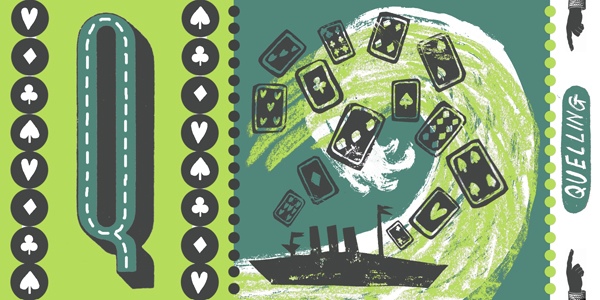
Q IS FOR QUELLING. To quell the waves in a storm it is suggested that you throw a pack of playing cards directly into the waves.

R IS FOR RAVEN. To see one raven is lucky, tis’ true, but it’s certain misfortune to light upon two and meeting with three is the Devil.
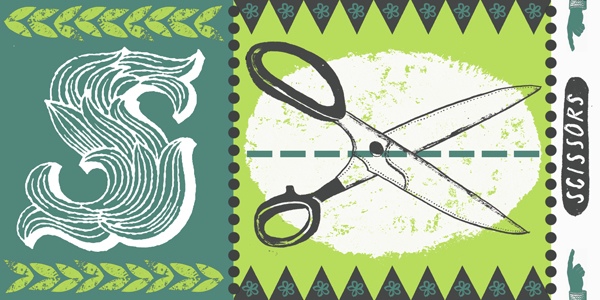
S IS FOR SCISSORS. Like giving a knife as a present, scissors too will cut the friendship.To drop a pair of scissors is thought to be unlucky and if they fall with the points facing downwards there will be a death shortly in the house.
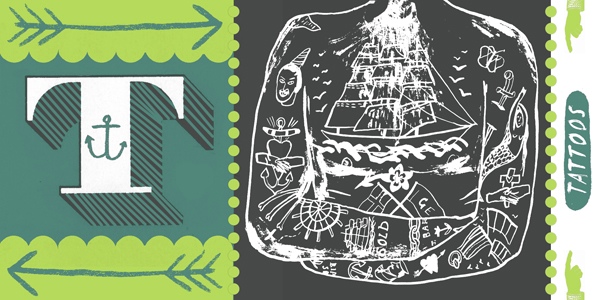
T IS FOR TATTOOS. A sailor without tattoos is like a ship without grog. Not seaworthy.

U IS FOR UMBRELLA. You shouldn’t open an umbrella indoors otherwise it will bring misfortune to the whole household.
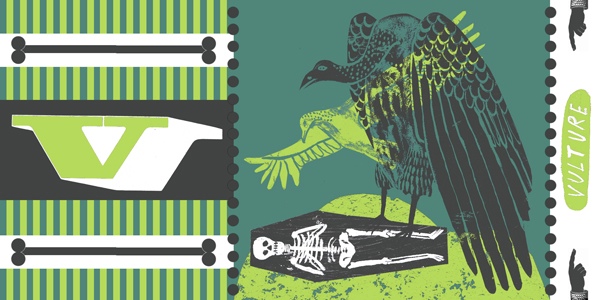
V IS FOR VULTURE. Vultures are birds of ill omen as it thought the can predict death and have an unsettling diet of corpses.
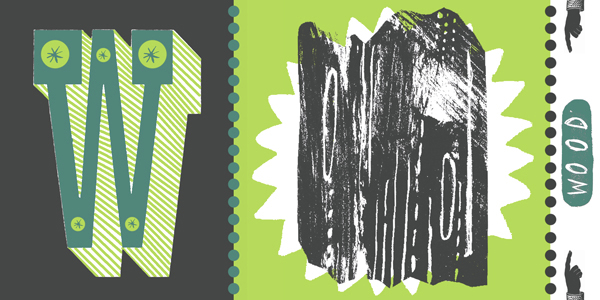
W IS FOR WOOD. Touching wood is thought to be an action that will help counteract the threat of evil. It is usually done when someone is thought to have tempted fate.
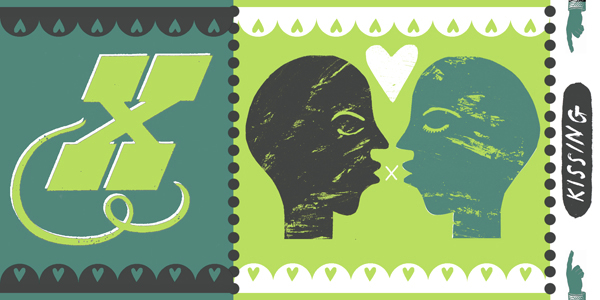
X IS KISSING. An unexpected kiss from a tall dark stranger is certain to be followed by a proposal of marriage. But beware! Kissing a man with a moustache should not be lightly undertaken – if a hair attaches to your lips you will never get married!
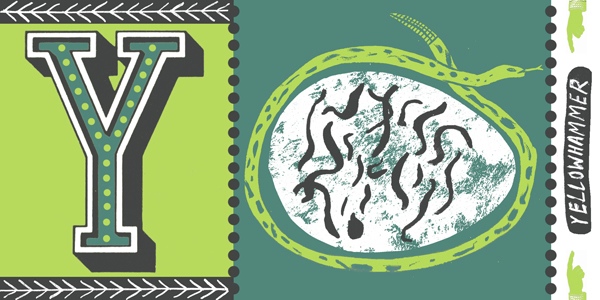
Y IS FOR YELLOW HAMMER. The yellowhammer is considered an ill omened bird as it is egg is covered in serpent like marks associating it with the Devil.
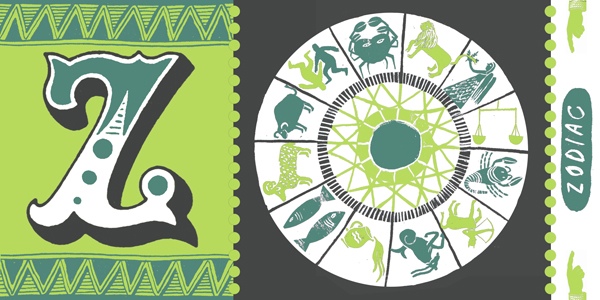
Z IS FOR ZODIAC. Each ‘house’ in the zodiac has it’s own unique character and people born within the dates are supposed to share similar traits.

Alice Pattullo in her room in Leyton.
Illustrations copyright © Alice Pattullo
Visit www.alicepattullo.com to discover a list of stockists of Alice’s prints.
You may also like to read about
This Was My Landscape

My Backyard, E.13 (1961) by John Claridge
“My bedroom and darkroom. What more could you want? Somewhere to get your head down. Somewhere to get your print down.”
When William Wordsworth was growing up, he had an overwhelming epiphany of the power of the landscape while out in a boat upon Grasmere beneath a starry sky, and photographer John Claridge had an equally influential experience at a similar age – in a very different kind of environment – while out on a night’s ratting expedition at a piggery next to the London Docks. “There was the glow of the lights of the dock, but all around us were vast expanses of darkness,” he told me in his excitement at recalling the wonder of the East End during his childhood in the nineteen fifties, in the days before the halogen glow which obscures the stars today.
“It was a different kind of landscape – without fields – but it was a landscape I loved, the landscape I grew up with,” John confessed, remembering the acres of bombsites and craters, wasteland and allotments that he once knew, and which he recorded in this vibrant set of pictures published today for the first time. “When I was fifteen, I was interested in motorbikes, girls and photography, though I couldn’t say in what order,” he admitted to me with a laugh.
There is a certain cast of occluded light shared by many of these photographs that is partly the result of the London smog of that era, partly mist off the river and partly the light of the early morning when John delighted to explore the East End. “I’m still an early riser, from the days of getting up at five to do my paper round.” he explained, “I’d have breakfast with my dad and listen to his stories – that was my education – then I’d cycle around in the dawn delivering papers before school each morning. You always expected something to happen, but you had to let it happen – that was part of the excitement of seeing something that you weren’t expecting to see, and then you wanted to share it.”
In the post-war East End, prior to redevelopment, the open spaces created a landscape of possibility where nature thrived, where anyone could have an allotment, and where John liked to go scrambling on his motorbike. It was a landscape that offered emotional freedom and creative space to John, who as a fan of Dan Dare and Flash Gordon, was off on his own imaginative journey.
Then, at seventeen, John had his first exhibition of photographs and Dennis Bailey, Art Director of Town Magazine, declared “They have shades of Walker Evans and Bill Brandt.”
“I didn’t even know who they were,” John revealed to me with a shrug. Yet John’s talent took the young photographer on a journey far from his native landscape, giving him a career filled with globe-trotting assignments. Today these early pictures record a place that no longer exists except as a personal landscape of memory. They show how the first landscape that met John’s eyes became the landscape upon which his vision as a photographer was shaped. And it is an epic landscape.

East End Blossom, E.1 (1960). “Blossom on a bomb site.”
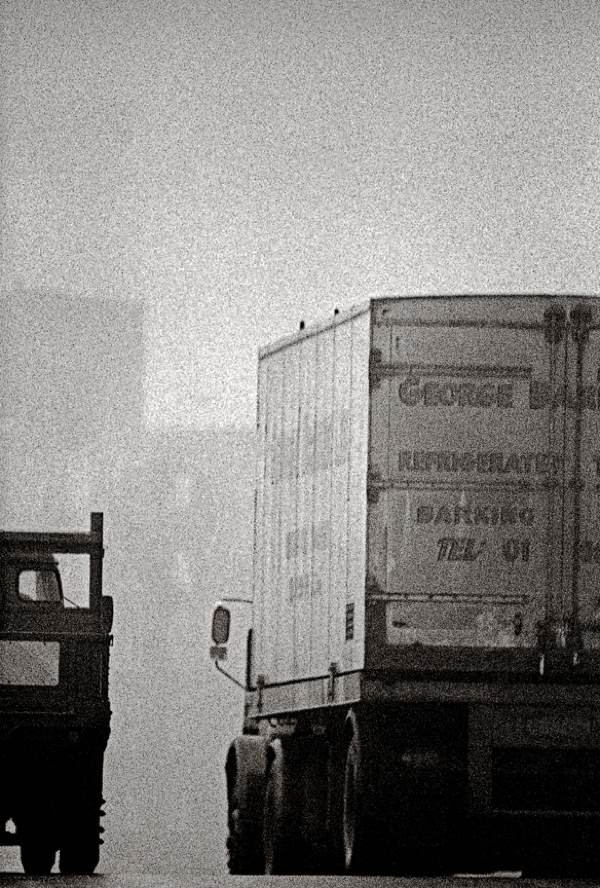
Canning Town Bridge in the Fog, E.16 (1965). “Shot from my motorbike (Triton) – stopped, of course.”

Sewer Bank Rd, E.13 (1964). “My house was just over the fence to the right.”

Ford & Vauxhall, E.15 (1960). “Turner Prize?”

Clearing a Bomb Site, E.13 (1961). “The next street to where I lived.”

Iron Bridge, E.16 (1964). “An iron bridge across the railway line, not far from the docks.”
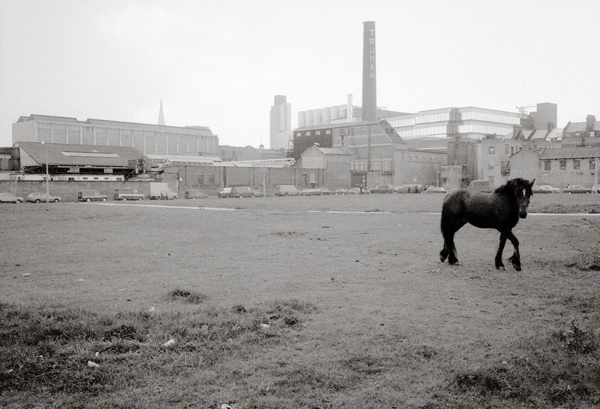
The East End Horse, Allen Gardens, Spitalfields (1972). “The horse takes a break from the harness of a dray cart.”

Smoke, E.16 (1963). “Winter’s morning looking towards Canning Town. I used to take my old scrambler motorbike and ride the bomb craters there.”

Vicky Park, E.3 (1962). “Where I used to take the occasional girlfriend.”

Canal, E.3 (1968). “Early morning, grey day but full of expectation.”

After the Rain, E.16 (1982). “That beautiful smell after everything’s had a good wash.”

Scrap Yard, E.16 (1982). “Sometimes it got muddy.”

The Path, E.7 (1960). “Neglected cemetery, always so quiet.”

Allotments, E.6 (1963). ” This area always had a strange presence, a symbiosis between industrial and natural.”
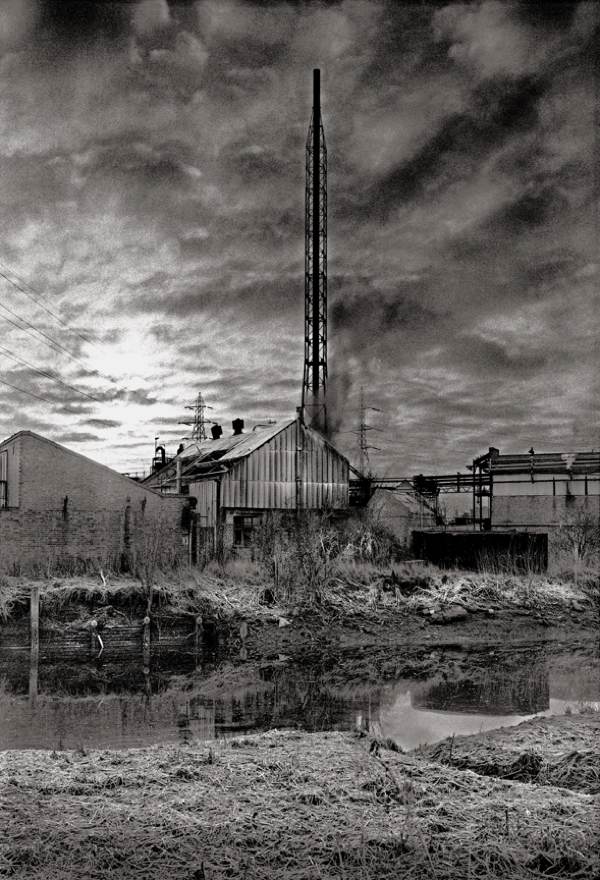
The Small Creek, E.3 (1987). Daybreak.
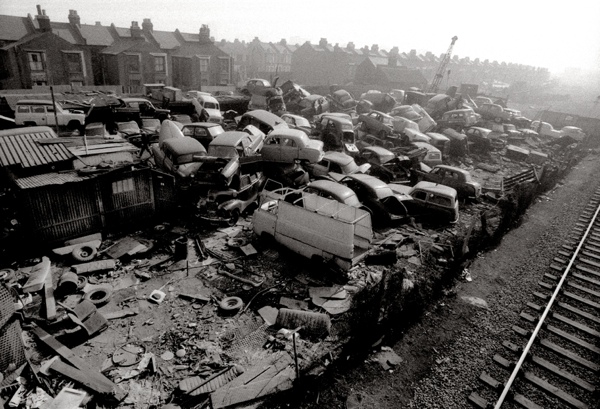
Along the Track, E.16 (1973). “Shot from a parapet, early morning above the rail-track. I wanted a bit of height.”
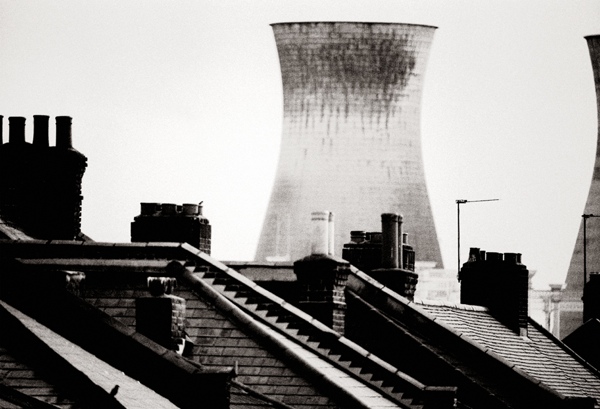
Rooftops, E.3 (1982). “There was always a great man-made sculpture around, not to every one’s taste but I liked it.”
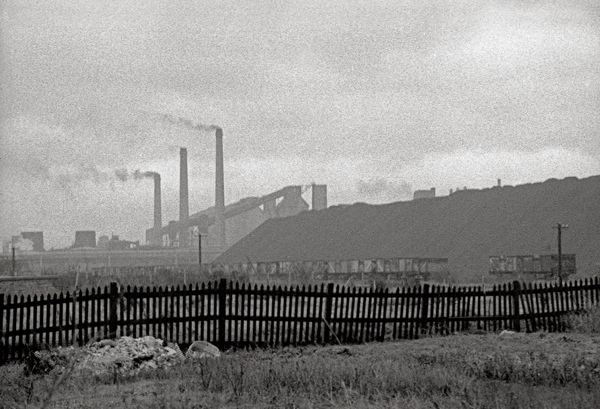
Slag Heaps, E.6 (1963). “This area seemed to always have a greyness that sat in the sky.”

Spillers, E.16 (1987). ” I loved these buildings, it was like walking into an early sci-fi movie.”
Photographs copyright © John Claridge
You may also like to take a look at
Along the Thames with John Claridge
Bernard Kops, Writer

“It’s amazing I have lived so long, after all the drugs that I have taken in my life!” declared Bernard Kops with a certain genial alacrity – speaking now as a sprightly eighty-six year old – when I visited him and his wife of fifty-eight years, Erica, in Finchley last week. Yet once he told me his stories of growing up in Stepney Green in the nineteen thirties, I understood how those experiences might instill a keen will to live which could, in part at least, account for his glorious longevity.
Bernard’s father left Rotterdam with his family in 1902, hoping to get to New York, but when he bought his ticket it only took him as far as London. The ticket office in Amsterdam explained that he could collect the second part of his ticket to New York from Mr Smith on arrival in London, but when he arrived in the Port of London and asked for Mr Smith everyone laughed at him. And thus it was that Bernard’s father’s dream of America was supplanted by the East End. Later, the relatives in Amsterdam implored Bernard’s father to return with his family prior to the outbreak of World War II, believing that Holland would remain neutral and Bernard remembers his father weeping because he could not afford the tickets to return. Yet those relatives were all killed by the Nazis and Bernard’s father’s impecunious situation was the salvation of his immediate family.
Such is the equivocal nature of Bernard Kops’ inheritance and, even now, looking back from his current perspective as the father of four children, six grandchildren and two great-grandchildren, it colours all experience with a certain sentiment, cherishing the fleeting brilliance of life.
“I couldn’t have done anything without Erica,” he assured me last week, prefacing our conversation, when I visited him in the Victorian apartment block in Finchley where he has lived for the last half century, moving there from Soho in the days when it was an enclave of writers and artists. Walking down the long passage in his modest basement flat, I found him in a peaceful room looking out onto the garden where we chatted beneath the poster for “The Hamlet of Stepney Green.” Bernard’s first play launched him as one of the new wave of young playwrights from the East End, alongside Arnold Wesker and Harold Pinter, that came to define British theatre in the post-war era. “There were actors who couldn’t fathom what we were doing, but we brought the streets into the theatre,” Bernard explained, “I still think of myself as a street person, I come from a verbal culture where everybody was always talking all the time.”
Recalling his childhood, he said, “Everyone was starving in those days before the war. And when my sister Phoebe came home and she had got a job, we were all overjoyed. But then she came back from the sweatshop and said the boss has been feeling her up. ‘She’s not going back,’ said my mother. ‘We need the money,’ said my father. Because we were so poor, every day was a battle. My whole life was a drama.”
“I was different from my brothers and sisters, and I don’t know why,” Bernard confessed, still bemused by his literary talent, “My mother recognised it, she used to say, ‘He’s the one that’s going to take me to Torquay one day.’ That was her measure of success.” One of Bernard’s earliest memories is of hiding under the table to eavesdrop on the adults and his mother asking, “Where’s my Bernie?” which was the cue for him to jump out and delight her.
As a child, Bernard knew that it was not safe for him to stray up the Cambridge Heath Rd towards Bethnal Green because that was where the fascist blackshirts were. Yet on the day that war was declared, when Bernard’s mother gave him sixpence to seek his own amusement, he took a bus through the danger zone up to the West End where – at eleven years old – he discovered a vision of whole other world that he realised his mother had never seen. Then, walking down Brick Lane one day just after the war, a young man stopped Bernard and asked what he was mumbling under his breath and Bernard admitted he was speaking poetry. Realising that Bernard had never read any poetry, he gave Bernard a slim volume of Rupert Brooke published by Faber and Faber. “So I read Grantchester and I thought it was fantastic,” Bernard recalled fondly, “I went to the library and asked, ‘Have you got any more Faber and Faber books like this?’ The library gave me freedom.”
In common with generations of writers and artists from the East End, Bernard Kops educating himself using the collection at the former Whitechapel Library next to the Whitechapel Gallery. From here, Bernard took classes in drama at Toynbee Hall which focused upon improvisation – inventing plays – and it gave him the technique to launch himself as playwright. This was a move that eventually led him to live in Soho, enjoying the company of his literary peers, and he recalls returning from there to Hanbury St to visit Colin McInnes while he was writing Absolute Beginners, in which Bernard appears in a barely fictionalised form as “Mannie Katz.”
In summation,“I’m a poet basically,” he announced to me with a diffident smile.
All this time, Erica had been sitting across the room from us, encouraging Bernard by making small appreciative noises and completing the odd stray sentence in a story she has heard innumerable times. In a prolific career including plays, screenplays, poems, novels and autobiography, life has not run entirely smoothly for Bernard who succumbed to drug addiction and depression, yet overcame both afflictions with Erica’s support to reach his current state of benign equanimity. “I said to her, the moment I met her, that I was going to marry her, and she thought I was absolutely mad,” Bernard confided, raising his voice and catching Erica’s eye provocatively. “And I haven’t changed my mind,” confirmed Erica with a nod from the other side of the room, folding her hands affectionately.

Whitechapel Library, Aldgate East

Bernard & Erica
For You
May 2012
(This is the first publication of a new poem)

Bernard Kops
Portraits copyright © Lucinda Douglas-Menzies
You may also like to read about Bernard Kops’ close friend
A Pearly Remembrance
When novelist Sarah Winman, author of When God Was a Rabbit, interviewed the Pearly Kings & Queens for Spitalfields Life last month, they extended the honour of an invitation to their memorial service for Larry Barnes, the former Pearly King of Thornton Heath. Naturally, this was an opportunity not to be missed and Sarah went along with Spitalfields Life Contributing Photographer Patricia Niven to send this report from the Pearly Kingdom.
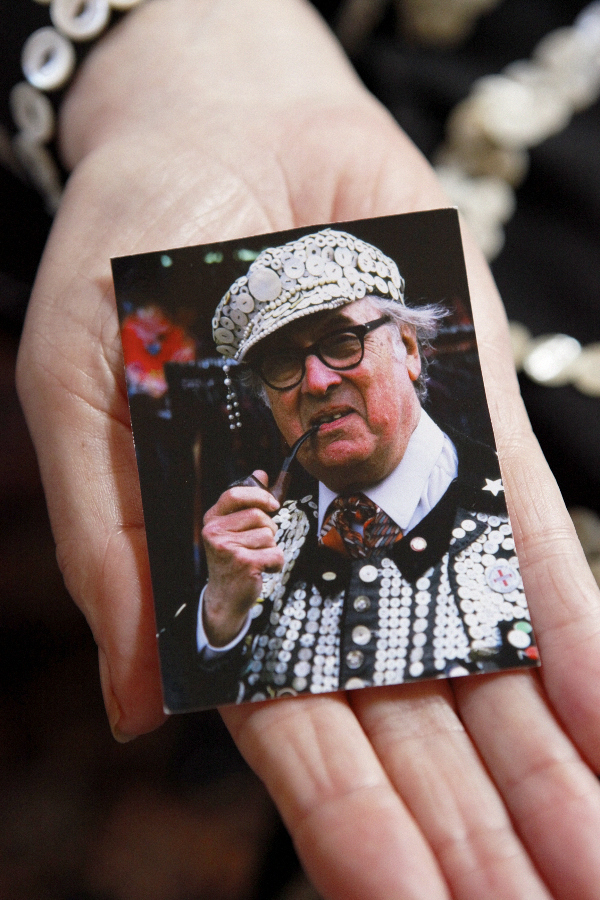
Larry Barnes, it seems, could do most things – including conjuring up a rare sunny day for his Memorial Service, in a month that so far had delivered only rain and gloom. He was born at a time dominated by Variety & Music Hall acts, taken along by his father who proudly declared to his son that he would one day be able to say that he had seen the great Gus Elen perform. For he had. And little did the young Larry Barnes know how that moment would stay with him, influence him, inspire him, until the day he too stepped onto the stage, “The Viceroy of Versatility” – singer, magician, paper tearer, balloon sculptor, escapologist, Pearly King of Thornton Heath. Larry Barnes did it all.
And on the 16th May, his birthday, they came from near and far. Family and friends, magicians, actors, entertainers, associates from the Players Theatre and of course the Pearly Kings & Queens all called by the bells of St Paul’s Covent Garden, to remember one of their own, to give thanks for a life that had given so much pleasure, so much love. His was a celebration of life in song. There was sadness, moments to reflect, naturally – but there was also music, applause even, and a sing-along: “Old Father Thames,” “London Pride,” “If it wasn’t for the Houses in Between,” “Pennies from Heaven,” “Lambeth Walk.” And of course, “Maybe it’s because I’m a Londoner?” Because that’s what we all were that day, what we all became, in a moment of rare togetherness.
Five abreast they were, walking from the church to the pub. Across their backs: Finsbury, Welwyn Garden City, Islington, Highgate, Redbridge, Upton Park, Upminster, Crystal Palace, Bow Bells, Newham, Norbury: An unusual gathering of so many Pearly Kings 7 Queens, tourists and passersby drawing breath and delight, cameras pointing at the glorious shimmering sight that is forever London. “How many buttons on your suit, Harry?” I ask the Pearly King of Bow Bells & Blackfriars. “Seven thousand,” Harry says, “My suit was made for the Golden Jubilee. I don’t wear it often. I wore it for the Queen, I’m wearing it for Larry.”
And on we walked.
I am putting together a composite, like a beachcomber I suppose, collecting fragments of china in the hope of piecing together a vase, a plate – a life – something beautiful, something tangible. For I never met Larry Barnes.

“I drank pints, Larry drank red wine,” said George Davison, the Pearly King of Newham. “I did shows with Larry, and always at the end he used to hand me his prop bag because he needed his hands free for his pipe and cane. Funny thing is, I’m always looking around for his bag.”

“I’d be walking along talking to him,” said Pat Jolly, Pearly King of Crystal Palace, “and I’d turn to him and realise he wasn’t there. He was twenty yards away, entertaining kids. He left such an impression on people. His photo’s always in my wallet. He’s up there with the great Pearly Kings.”

“He was like a brother,” said Arthur Rackley, Pearly King of Upminster. “He’d always do his best whatever it was. Sometimes he’d start an event not knowing anyone in the room, by the end he knew everyone.”

“He was a generous teacher,” said Lola McDowell, Pearly Queen of Norbury. “He thought enough of me to give me encouragement and ideas. He asked me to do a double act with him and it was an honour. He brought me into the Pearly family.”
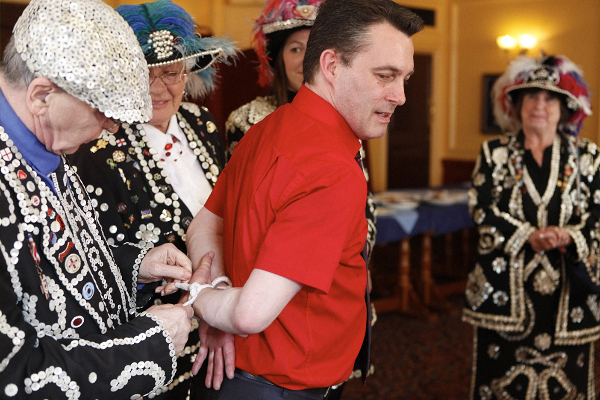
“He was a modern day PT Barnum!” declared a voice from behind. “I’m Dean Nicholas and I’m a magician. I do magic for the Crystal Palace family. I met Larry when I was ten years old and he taught me every week,” and, with that introduction, Dean immediately demonstrated the first routine Larry taught him – coins jumping from hand to hand. I was transfixed.
We all hope to leave a legacy, something unique that will live on in others, a marker of our time spent here, and hopefully of time spent well. As I watched Dean perform another one of Larry’s tricks – The Houdini Six Second Escape – and, as my eyes became those of a child again, it struck me that the gift Larry Barnes gave to the world was quite possibly the gift of wonder.
In those theatres and schools, in hospitals and care homes, he gave momentary respite from responsibility, illness and worry. When even the most tired of eyes could become young again, in unquestioning belief in the unexplained and the world of magic – a world where torn newspapers become ladders, houses and flowers, where balloons can be sculpted into dogs and hats, a world where a coin in one hand becomes four in another, and a world where a pack of cards and an order ‘to pick one’ holds the fervent anticipation of a Christmas morning.
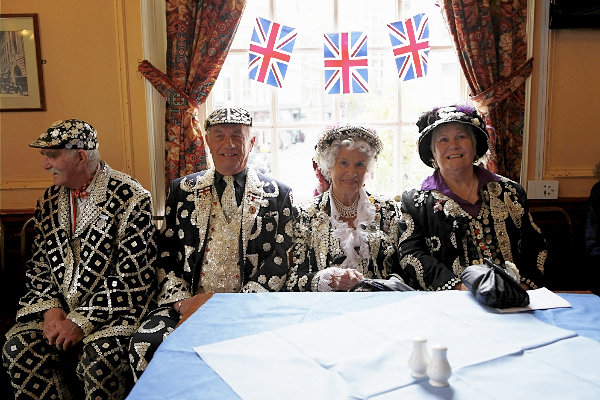
Peggy Scott, Pearly Queen of Highgate (at right) –“He knew how to make you laugh and listened to your problems.”
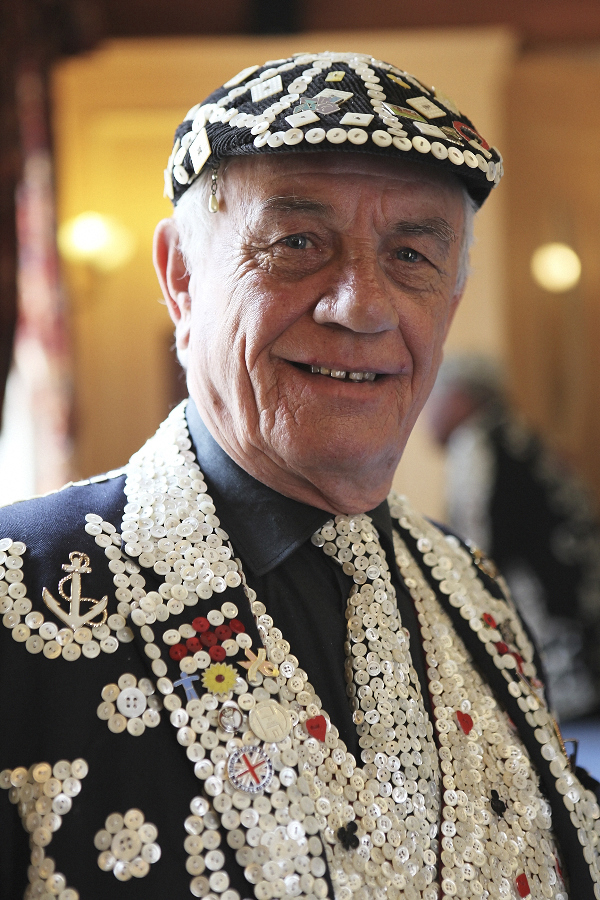
John Scott, Pearly King of Highgate – “A perfect gentleman.”
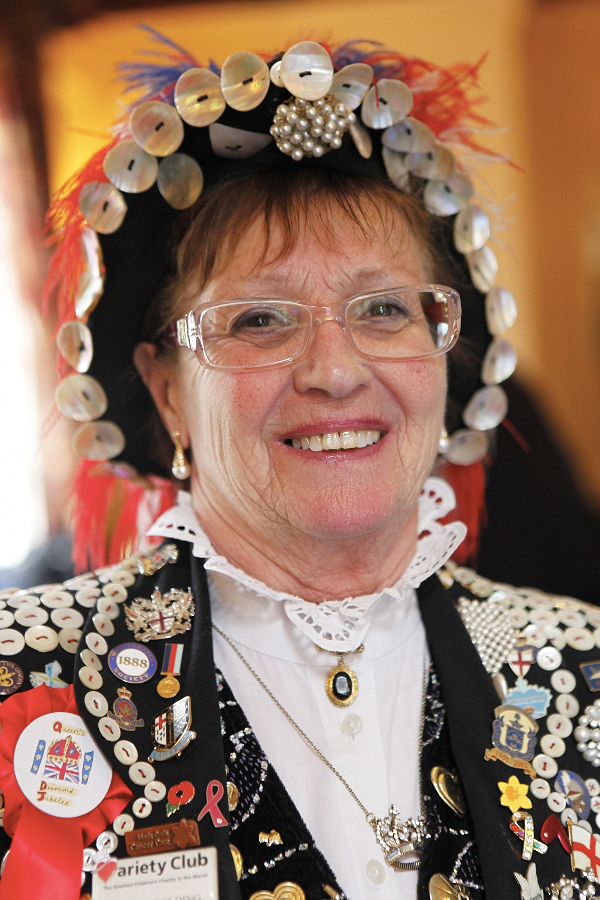
Doreen Golding, Pearly Queen of Bow Bells and Old Kent Rd – “Marvellous entertainer. Part of an old tradition that we’ll never see again.”
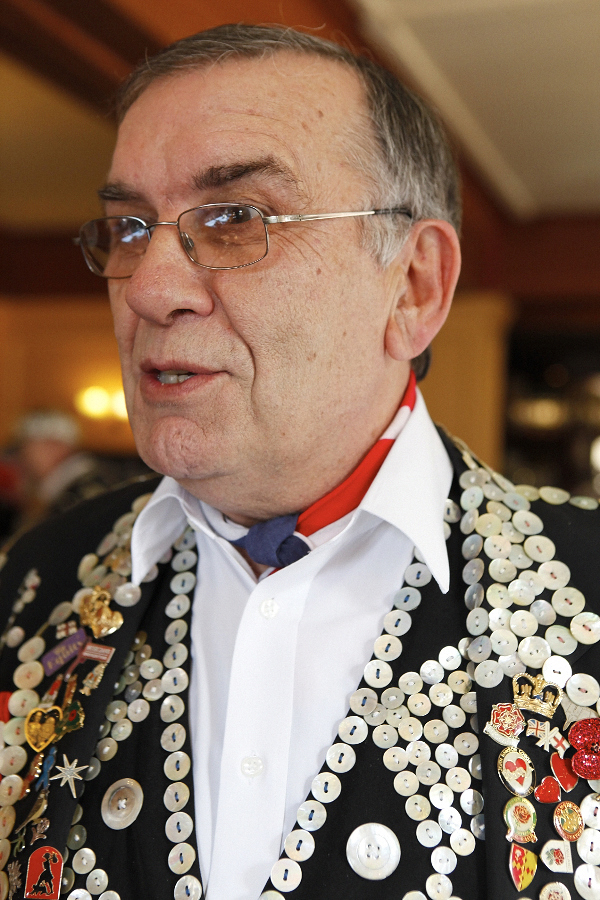
John Walters, Pearly King of Finsbury – “Such a lovely man, Larry was.”

Nicola Marshall, Pearly Queen of Welwyn Garden City – “Nice bloke.”
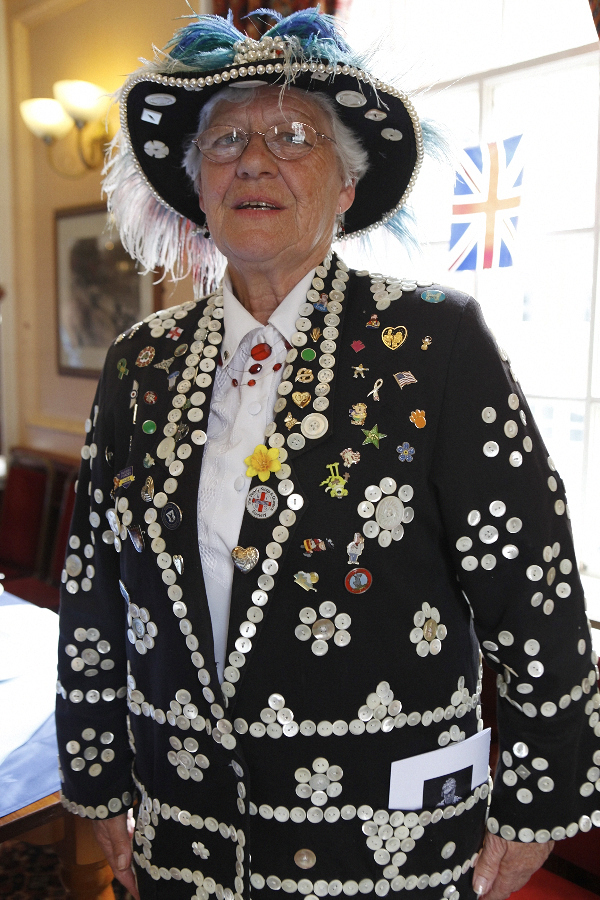
Angela Davison, Pearly Queen of Newham – “Oh, he was a wonderful friend. I just miss him so much.”

Carole Jolly, Pearly Queen of Crystal Palace.
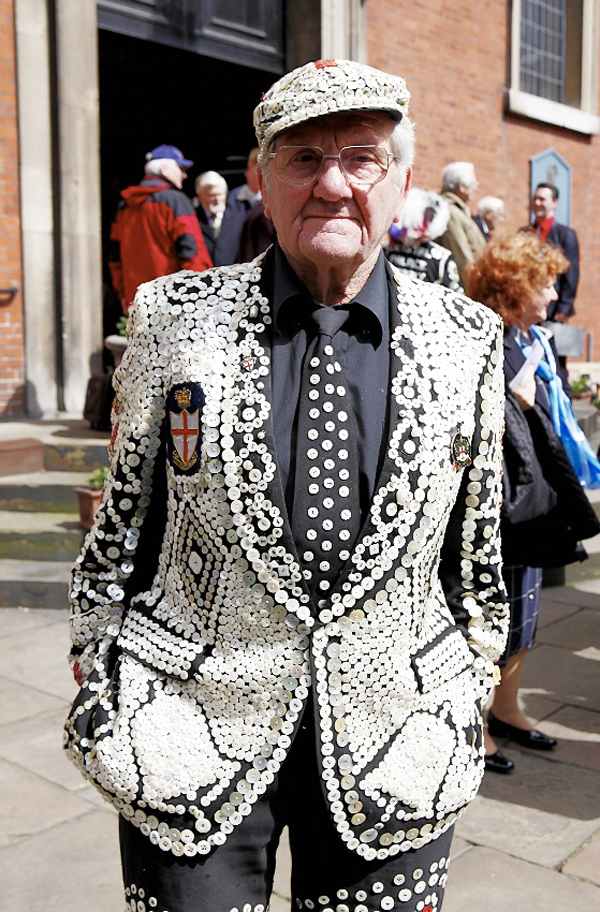
Henry Mayhead, Pearly King of Bow Bells.


Phyllis Broadbent, Pearly Queen of Islington –“I loved Larry. He was so loyal to The Pearlies. Such a great Music Hall act.”
Photographs copyright © Patricia Niven
Learn more about the Pearlies at www.pearlysociety.co.uk
You may also like to read
Marketa Luskacova’s Brick Lane
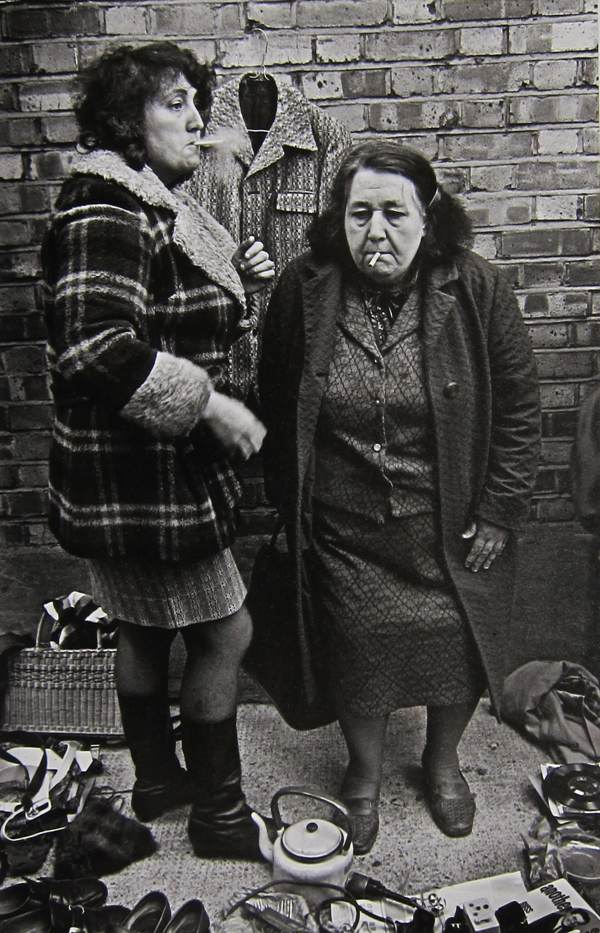
Two women with a cigarette, Cheshire St 1977.
When photographer Markéta Luskačová came from Prague in the mid-seventies, it became her great delight to visit the markets in London since they were forbidden under Communist rule in her own country. It was Brick Lane market in particular that took Markéta’s fancy, both as a subject for photography and a source of cheap produce. In fact, such was the enduring nature of her fascination and need, Markéta continued coming to Spitalfields to take photographs and get her weekly supply of fruit and vegetables for over thirty years.
As a young photographer in Czechoslovakia, Markéta went out to visit remote villages which were so poor that the collectivisation imposed elsewhere by the Communists was not viable, and she recorded a way of life barely changed for centuries in breathtakingly beautiful pictures, first exhibited in Prague in 1971 and later shown at the Victoria & Albert Museum in 1983. By chance, Markéta’s photographs were seen in Prague by Colin Osman, editor of Creative Camera, who was on a visit from London to attend the opera and he published them in his magazine, drawing international recognition for the quality of her vision.
In London, Markéta showed her work to Norman Hall, the renowned picture editor of The Times but when she told him she wanted to photograph markets, he dismissed it as “a subject for beginners” yet she set out undiscouraged.
“I went to Brick Lane and I never left. I fell in love with it.” she admitted to me, “Most of all, I photograph things I like and I was lucky enough that somebody saw my work and supported my photography for a little while.”
A year later, Markéta took her photographs of Brick Lane to Norman Hall and, looking at them, he declared, “This may be a subject for a beginner, but it is not a beginner that took these photographs.”
“I was poor,” recalled Markéta, “so I needed to do my shopping there as it was the cheapest place to buy things. I could identify with the people in Brick Lane because they were immigrants and they were in need of cheap goods. Once I had done my shopping, I would leave my bag with a stallholder while I took my photographs.”
In 1991, Markéta had a one woman show at the Whitechapel Gallery of her photographs of Spitalfields, establishing her reputation as a major photographic talent in this country. Those pictures – of which a selection are published here today – were the result of a two-year residency in which she selected from and printed her pictures taken between 1975 and 1990. Yet it is less widely known that these represent only a portion of those Markéta has taken in Brick Lane as result of her long-term relationship with the market which now extends over thirty years.
In particular, Markéta recorded the last days of the ancient market in birds and animals that existed in Sclater St and Club Row until it was closed down in 1990 as a result of protests by animal rights activists. Markéta shared a natural sympathy with the dealers, observing their affection for their charges, unlike the hard-line protestors, one of whom pushed her in front of a car.
Famously, Markéta photographed the sale of a lion cub in Brick Lane. She remembers that it was first offered at £150 and then the price diminished to £100 and finally £75, over successive weeks, as the cub grew and became less cuddly and more threatening. Eventually, the seller came back one Sunday without the lion but clasping a tray of watches that he had swapped the creature for. In Brick Lane, Markéta found her primary subject as a photographer, offering an entire society in realistic detail and a mythological universe of infinite variety.
“I don’t go to Brick Lane regularly anymore, sometimes six months passes between one visit and another” Markéta confided to me,“I photographed what I saw there and what I thought it was good to record, be it a face or a smile, an animal or a shoe. I believe in the evidential quality of photography, and I know that unless things are done in a visually interesting way they are not remembered.”
A woman with a gentle manner and a piercing gaze, Markéta Luskačová’s magnificent photographs reflect her own personality. They are simultaneously generous in their humanity yet unsentimental in revealing the nature of people. More than twenty years after her last show in the East End it is my delight to show a selection of her Brick Lane pictures here today.

Lion cub and dog, Club Row Market 1977.
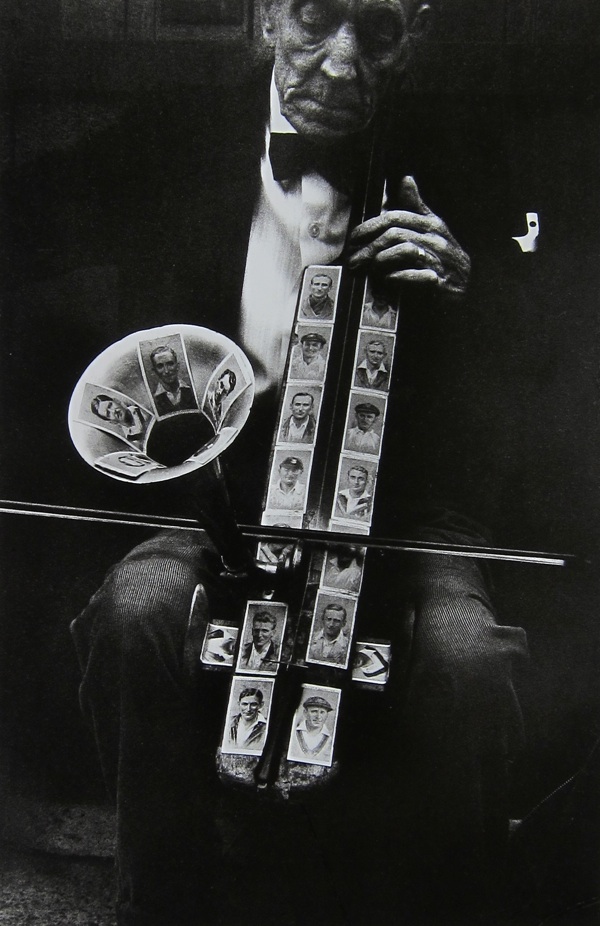
Street musician, Cheshire St 1977.
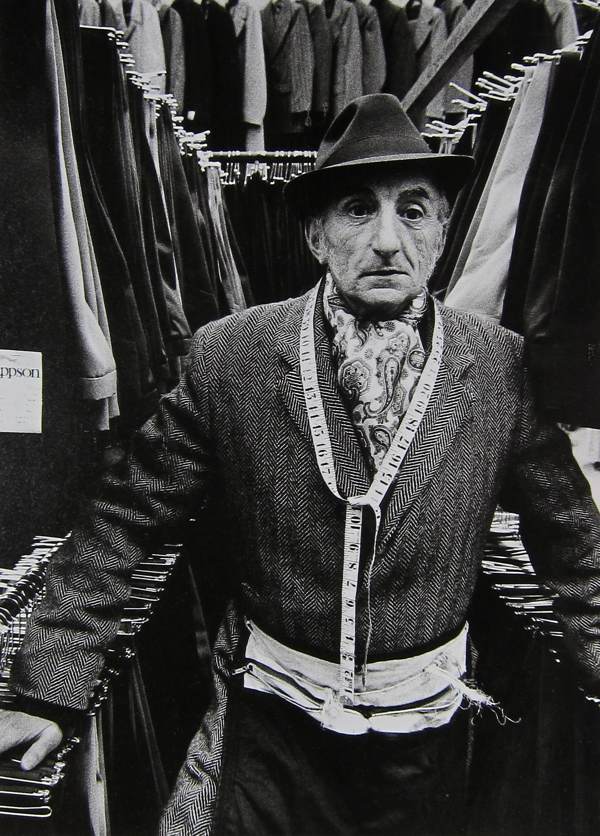
Man selling trousers, Petticoat Lane 1974.
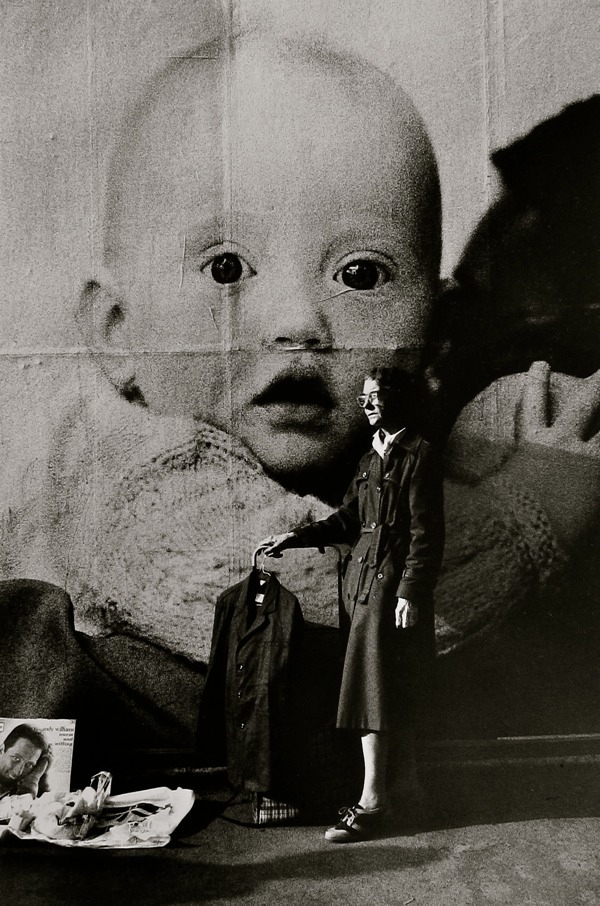
Woman in front of a poster, Bethnal Green Rd 1990.

Woman in the Bird in the Cage pub, Bethnal Green Rd 1976.

Man with a clock, off Cheshire St 1989.
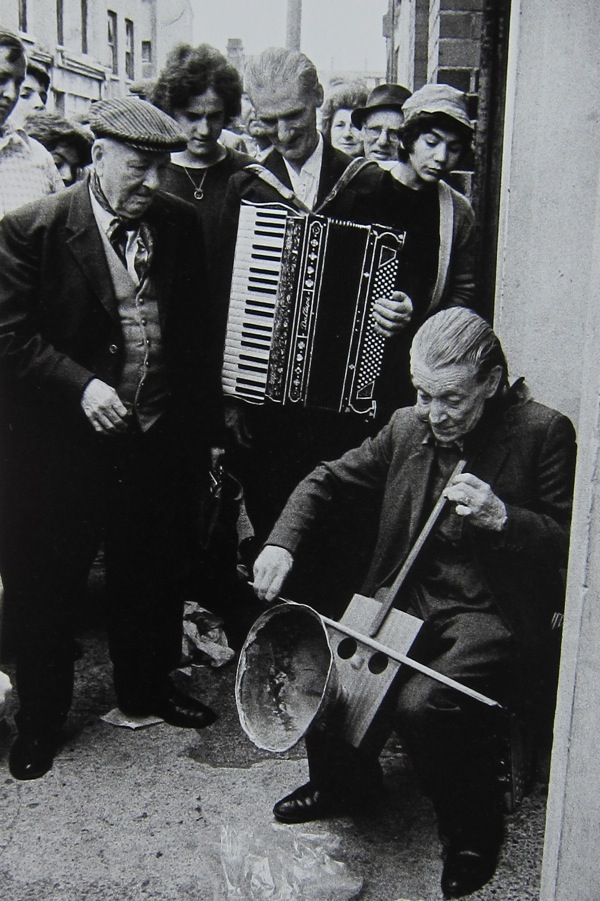
Street musician, Cheshire St 1979.
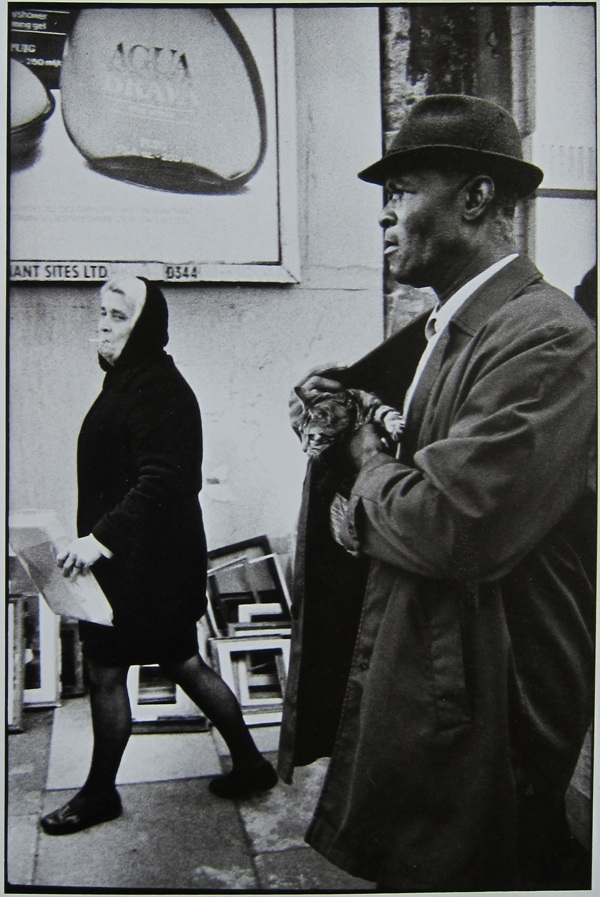
Man with kitten, 1977.

Girls from Canon Barnett Primary School in the train on their way back from the seaside, 1988.
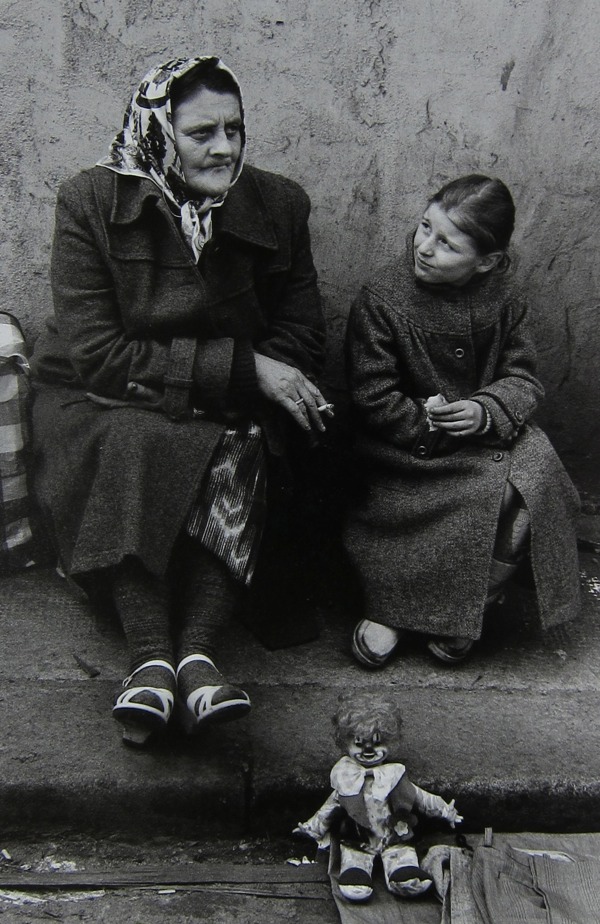
Woman and child, Sclater St 1976.

Old man and children with donkey, Sclater St 1980.
Photographs copyright © Markéta Luskačová
More Trade Cards of Old London
After recently publishing a selection of trade cards that might have been found by rummaging in a drawer in the eighteenth century, it is my pleasure to show this further selection discovered by searching down the back of a hypothetical sofa and under a hypothetical bed. Especially noteworthy are the cards for Lacroix’s and Peter De la Fontaine which are the early work of William Hogarth.
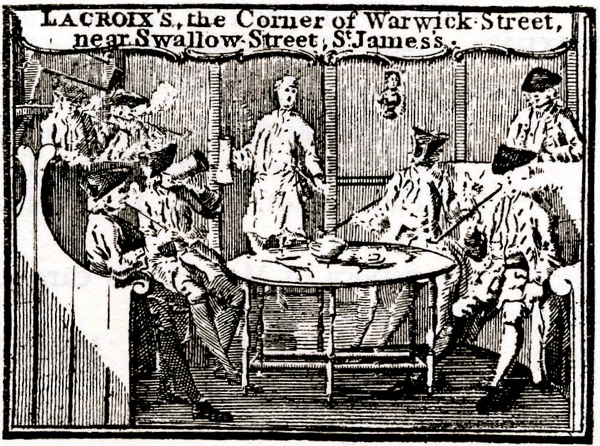
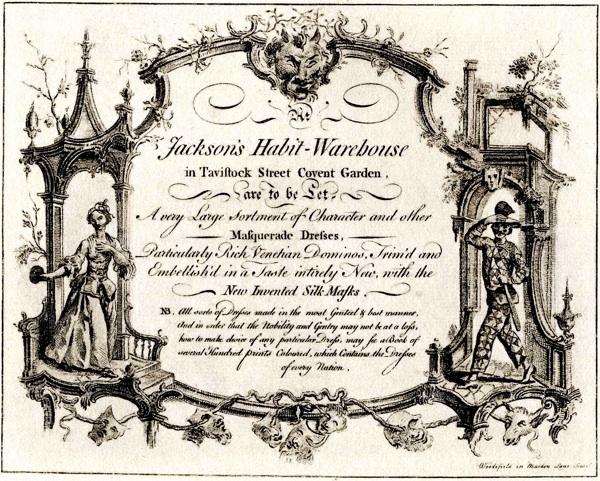
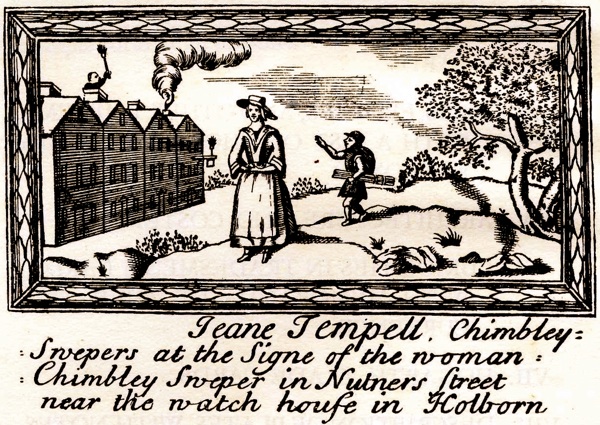
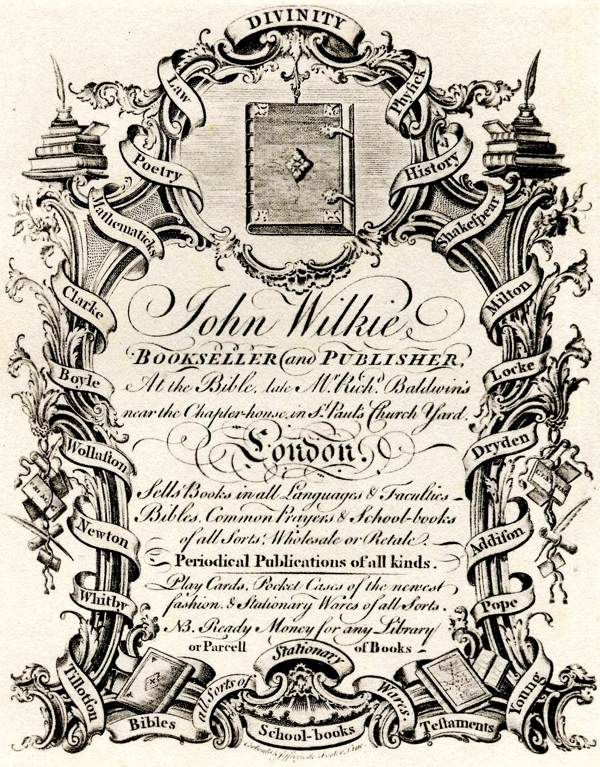
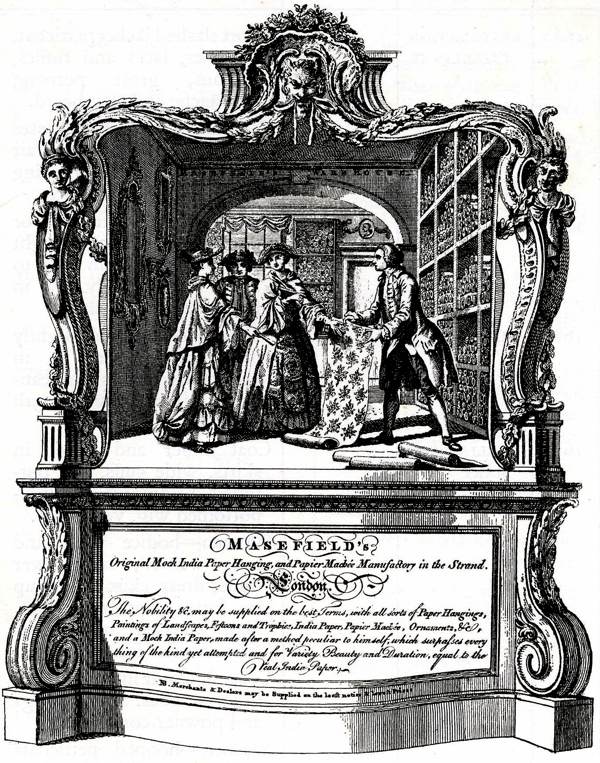
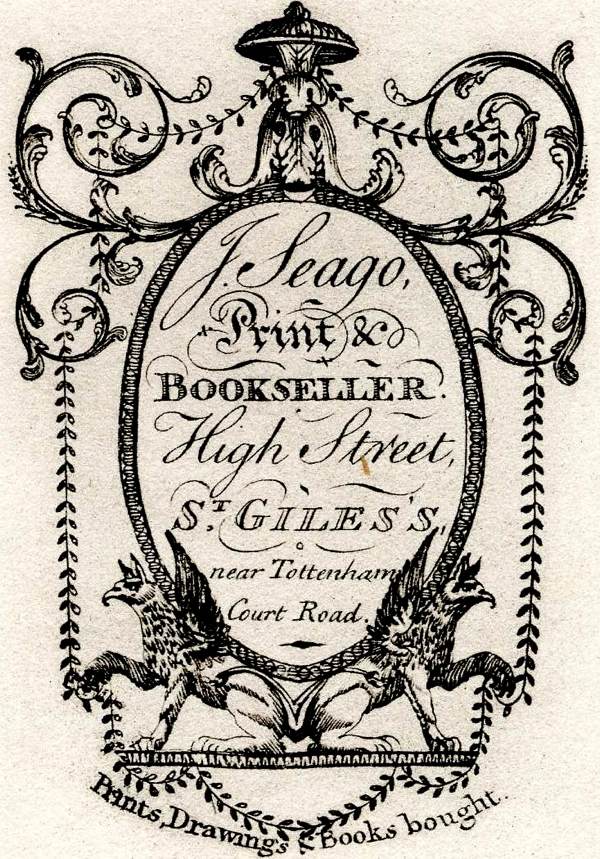
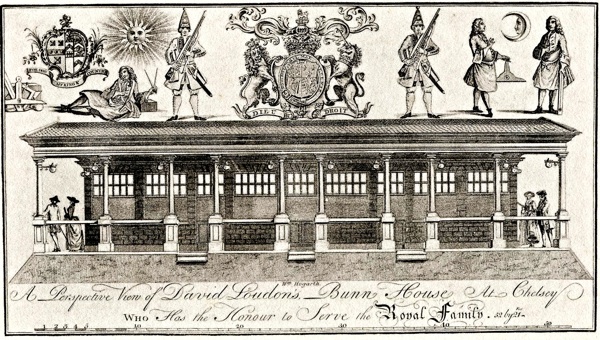
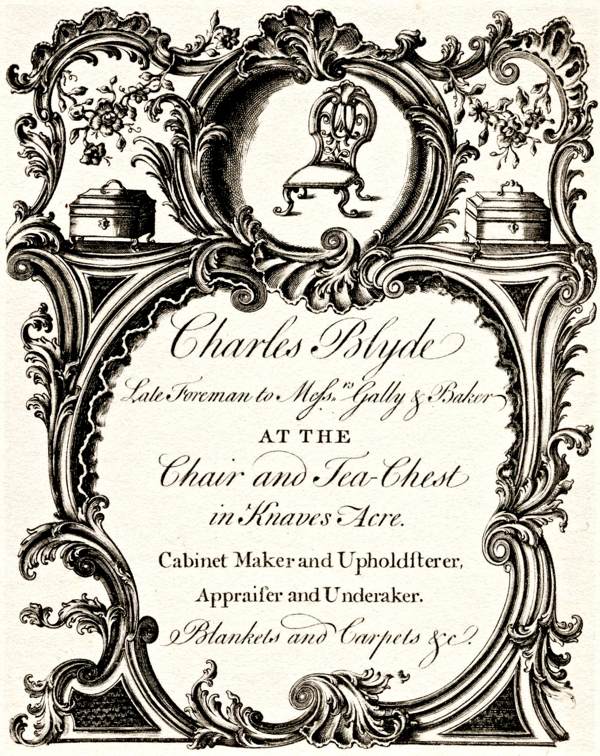
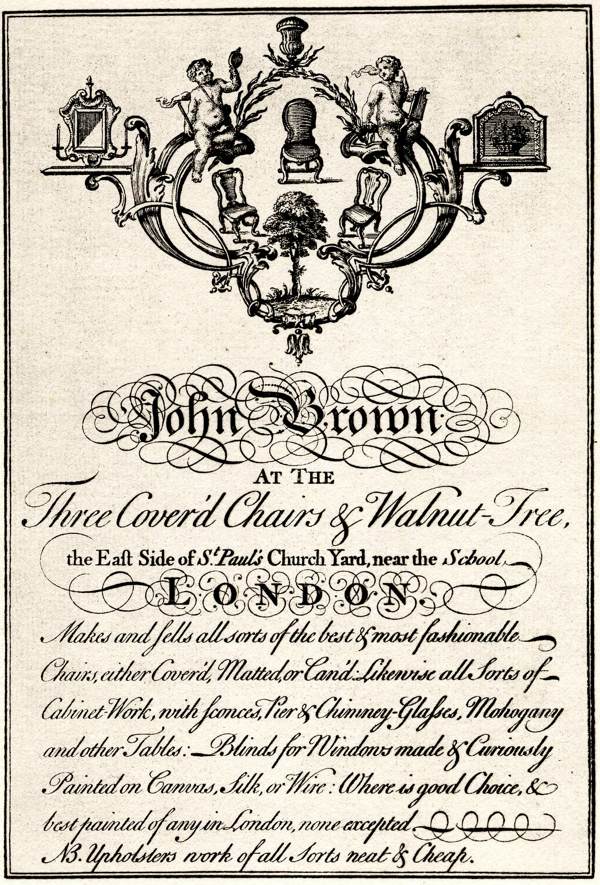
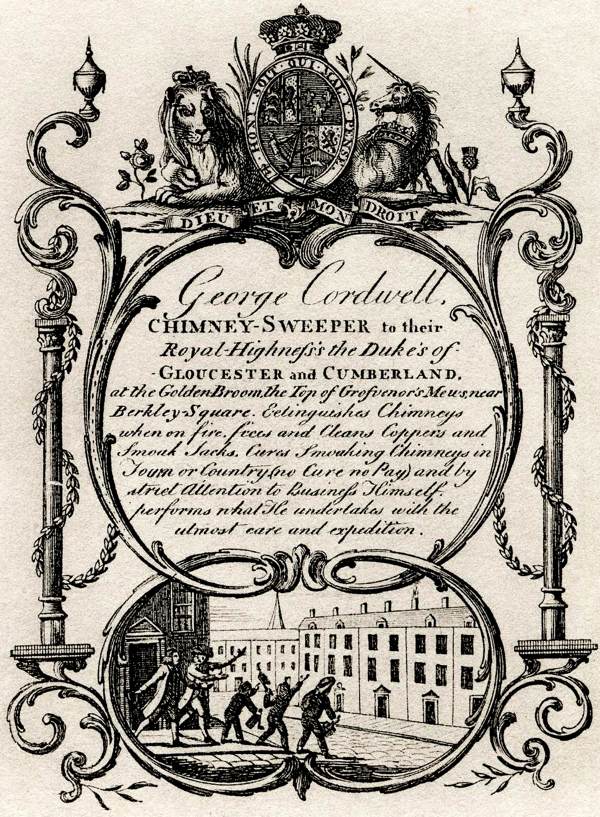
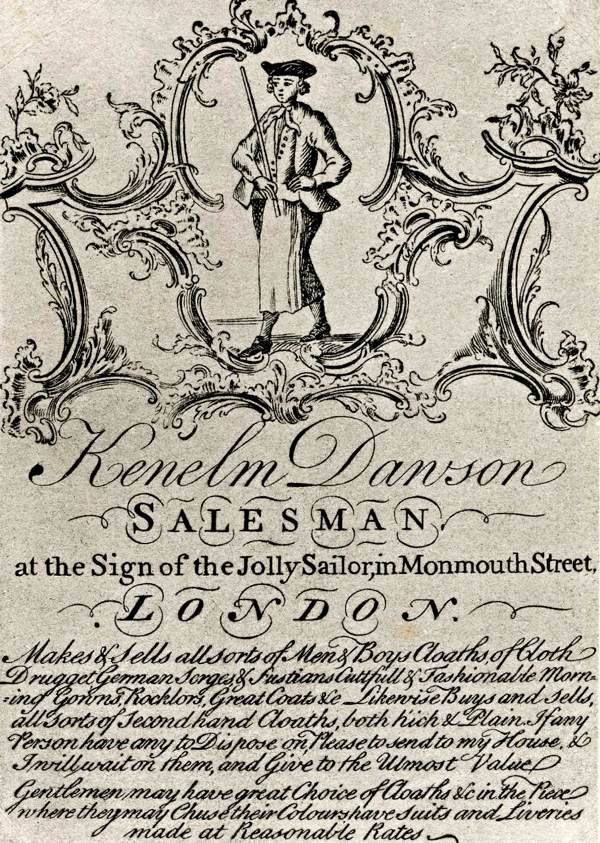
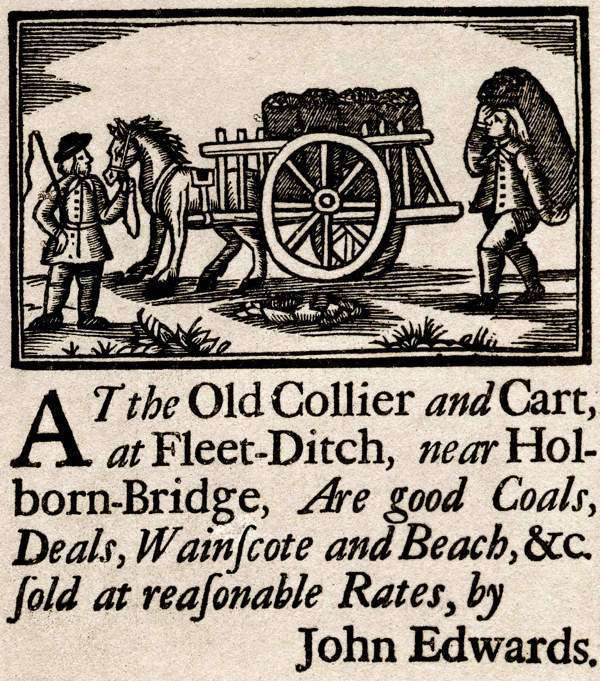
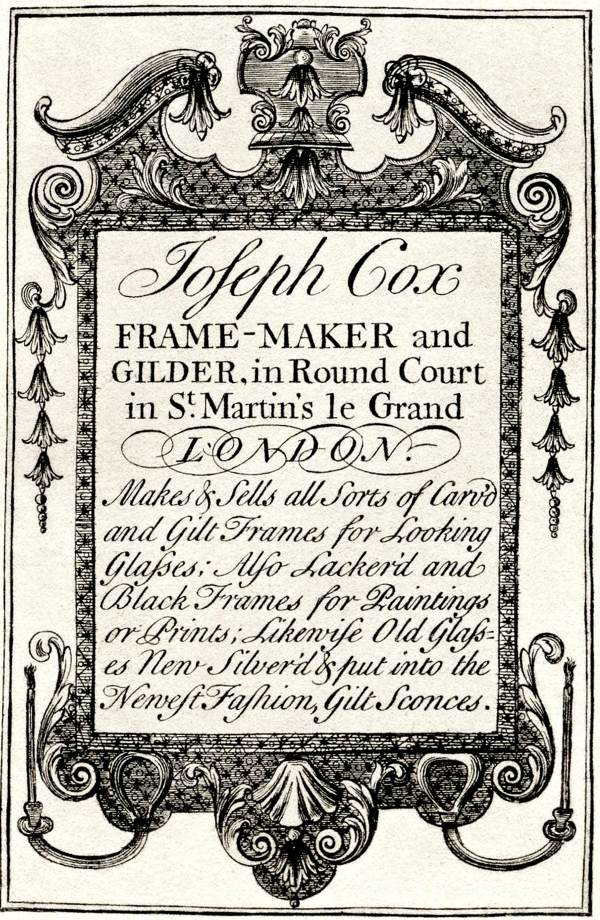
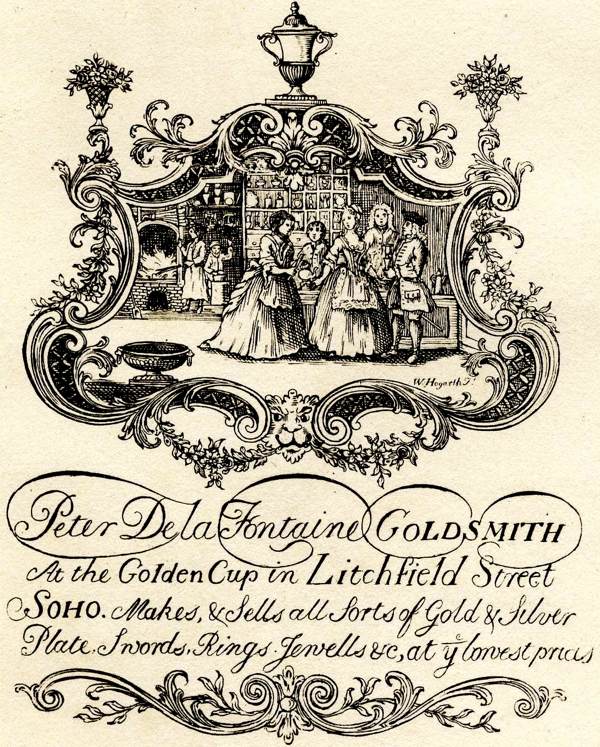
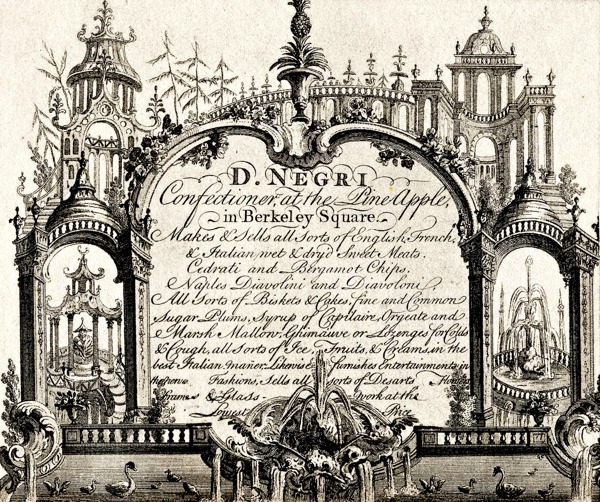
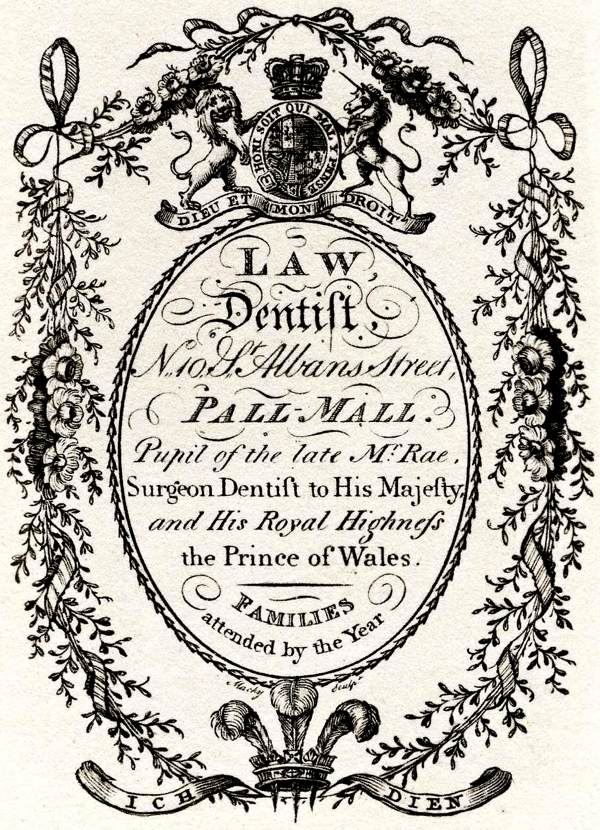
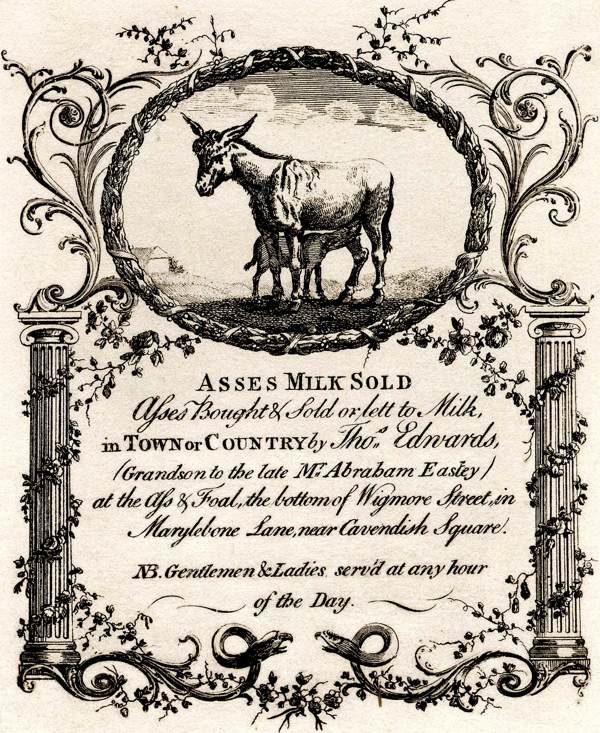
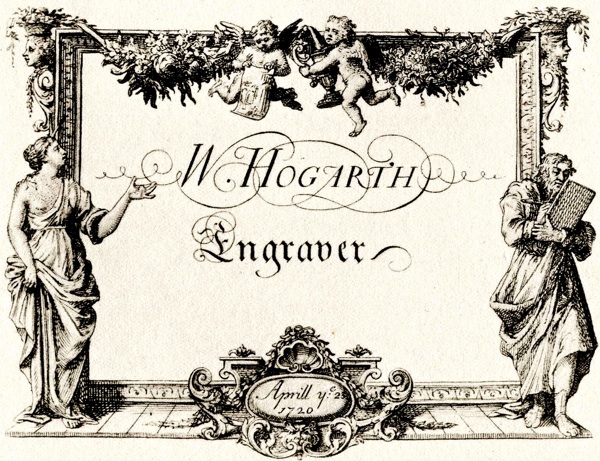
Images courtesy Bishopsgate Institute
You may like to see my original selection
Mick Taylor Models for Labour and Wait

Mick checks his costermongers’ knot
As one of those unfortunates that sniffles through eight months of the year, I regularly used to humiliate myself by pulling out ragged scraps of toilet paper from my pocket to wipe away the dewdrop at the end of my nose. Then I discovered the large brightly coloured handerfchiefs sold at old-school tobacconists, one in the Charing Cross Rd and the other in High Holborn, and the problem was taken care of – until both shut recently. Fortunately, Labour and Wait in Redchurch St have stepped in to fill the gap with a magnificent range in twelve different colours and subtle variants of spots and stripes – known variously as handerchiefs, neckerchiefs and bandanas according to their usage.
Rich in cultural associations, red spotted handkerchiefs have traditionally been worn by cowboys, gypsies and farmhands, also by Cary Grant in ‘To Catch a Thief,’ Peter Rabbit and Pigling Bland, customers in San Francisco leather bars, and even wrapped up as Dick Whittington’s bundle. In the East End, Mick Taylor, the man known as the Sartorialist of Brick Lane, who has been sitting outside the Beigel Bakery for the last half century – off and on – is the most visible proponent, and whatever his outfit he is always to be seen with a jaunty coloured neckerchief.
So I was delighted when Simon Watkins of Labour and Wait told me he had invited Mick Taylor to model their complete range of neckerchiefs, because Mick knows how to wear them better than anyone. Mick remembers his grandfather putting one on each morning before going to work and each of his uncles, Frank, Jim and Alf wore them everyday while collecting dustbins in the East End.
Tying a neckerchief is second nature for Mick. Folding the neckerchief in half diagonally at first, he then folded it a further three times with a triangular ‘tail’ left over, before wrapped it round his neck with the ‘tail’ at the rear of his collar. Once the points are crossed over, he explained, it is a question of tying the stook loosely in what is known as the costermongers’ knot. Mick revealed that the secret to getting a good knot is to start with uneven ends, giving you a satisfyingly symmetrical knot once it is tied.
“This brings back memories for me, ” Mick revealed as he straightened his neckerchief, ” – of London Fields on a Saturday night, going out in a mohair suit from Myers in the Hackney Rd.” Because, although he chose to model the neckerchiefs with a look that approximates to a costermongers’ outfit, Mick was keen to emphasise that they can equally be worn to add swagger to a suit. Mick selected red, blue and yellow as his favourites. “Flash colours,” he terms them, “they all look good with a white shirt.”
So look out for Mick and his new neckerchiefs, bringing a splash of brightness to Brick Lane and celebrating the arrival of the sunshine. With twelve colours to choose from, there is a neckerchief to suit every taste at Labour and Wait, and – now that Mick has shown the way – this could turn out to be the fashion trend of the summer in the East End.

Classic red

Black

Brown

Green
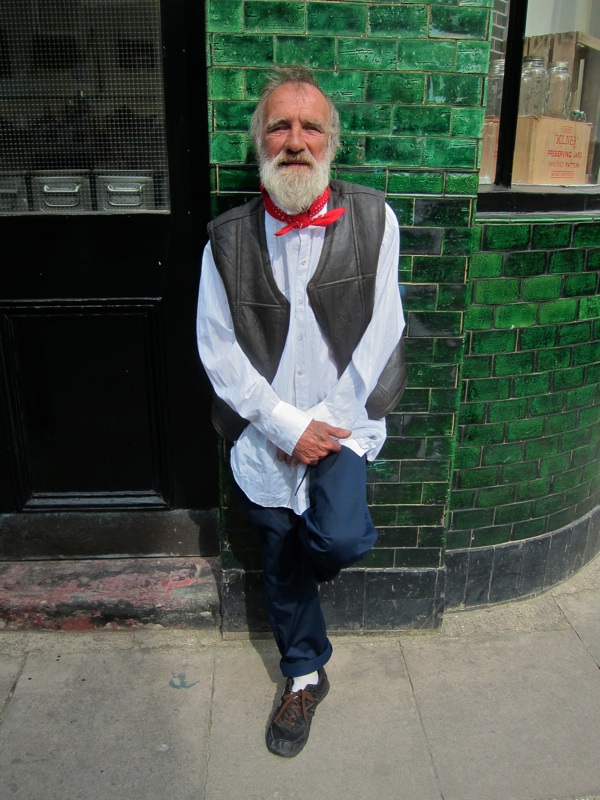
Bright red

Blue

Light Blue

Yellow

Dark Blue

First, fold your neckerchief in half diagonally.

Second, fold it three times, leaving a tail that will sit under your collar at the back.

Thirdly, cross the points with one end longer than the other before you tie the costermonger’s knot.


Neckerchiefs in twelve different colours available from Labour and Wait.
You may also like to read about












