
A Bus Stop in Bethnal Green
Amanda Jones took these photographs of the bus stop across the window from her flat. “I enjoy observing people and, when you do, London is a paradise…” she admitted to me, “so I take a picture of my view every day while having breakfast, or just as I am about to leave for work, with my coat on, the bag and the lunch box in my hands, and in a rush because I had nearly forgotten.”
Once she had accumulated a series of these photographs, Amanda decided to publish them and the result is The Bus Stop – a daily blog which traces the compelling drama of life at the kerbside. “I really like living in the East End because you feel part of it, just as if you were in a small town,” she explained, “and doing this project has helped me to realise this, because there are so many people who crop at the bus stop in my pictures on more than one day!”
How many recurring characters can you can spot among these favourite photographs from Amanda’s growing archive?

Thursday July 19th, 9:06

Monday July 16th, 9:06

Saturday July 7th, 11:49

Friday July 6th, 9:16

Saturday June 30th, 11:49

Tuesday June 26th, 8:09

Saturday June 23rd, 11:40

Wednesday June 30th, 9:17

Monday June 18th, 8:47

Saturday June 16th, 10:02

Friday June 15th, 9:00

Saturday June 10th, 12:07

Friday June 8th, 9:00

Jubilee Bank Holiday Tuesday June 5th, 11:54

Bank Holiday Monday June 4th, 12:28

Saturday June 2nd, 11:46

Wednesday May 30th, 8:55

Tuesday May 29th, 8:02

Saturday May 19th, 11:10

Friday May 11th, 8:54

Wednesday May 2nd, 8:19

Monday April 30th, 8:03

Sunday April 29th, 12:58

Thursday April 26th, 9:00

Tuesday April 17th, 6:31

Wednesday April 11th, 9:07

Wednesday March 26th, 9:00

Monday March 19th, 8:23
Photographs copyright © Amanda Jones
Follow The Bus Stop daily to keep in touch with the latest installment of the drama at the kerbside.
You may also like to take a look at
On The Rounds With The Olympic Milkman

Kevin Read
If delivering milk ever became an Olympic sport then Kevin Read, the Spitalfields milkman, would undoubtedly win a gold medal for Britain. Kevin does his entire round on the run – carrying three bottles in each hand effortlessly as he pounds up and down staircases, leaping in and out of his van – displaying astonishing stamina in his six hour circuit each night, stretching from the East End to the West End.
“I like to think of myself as the Olympic Milkman,” Kevin admitted yesterday morning when he picked me up in Spitalfields at three, “I been delivering to the site for more than six years now, since before they put the fence up.” It was a clear summer’s night and, as we drove through Whitechapel, crowds were leaving prayer at the mosque and a few vans were making deliveries, but once we passed these, the streets were empty. “We feared there would be road chaos, pavement chaos, train chaos – you name it – but in reality it’s been fairly quiet,” Kevin assured me. We barrelled east in his diesel milk float along the deserted Mile End Rd, between the empty bus lane and the empty Olympic lane, skirting the Olympic site with its tall red sculpture that looks like a meccano kit where someone lost the instructions and the empty Olympic Stadium in which images of the flame burned through the night on huge screens.
Our first call was to deliver a pallet-load of breakfast cereal to Bovis, the contractors who built the athletes’ village. The wind echoed like a strange ghostly choir as we ascended the lift of an empty tower block on top of the shopping centre opposite the site to make our delivery. From here we could see the futuristic buildings of the Olympics gleaming in floodlights beneath the golden moon in a deep blue sky. Next we drove over to deliver milk to the Olympic transport department, through a dark maze of temporary access roads, encountering numerous security checks and crossing empty parking lots, in a secret hinterland of the site used as a service entrance.
Since the Olympics were announced, this has been first port of call for Kevin every night, delivering enough milk to make the tea for everyone that worked to conjure this intricate landscape, currently home to the world’s sporting heroes.“On every sign, while this was under construction, they had the phrase, ‘You are part of it,'” Kevin told me proudly, “It was good because every cleaner, every road sweeper, every electrician and labourer saw that, and we all felt it too.”
Two years have passed since I first joined Kevin in his cabin and he revealed his quest to rebuild the lost milk rounds of the East End. And the good news Kevin has to impart now is that he has acquired many more customers over the intervening time and his round has grown significantly. “It’s definitely a trend,” he confirmed, speaking of the return to the delivery of glass bottles of fresh milk direct to the doorstep, “but you’ve got to break people’s habits and, in a city where 20% of the population moves every year, you have be continuously canvassing just to keep up.”
By now we were into the round proper, navigating at speed through narrow streets of housing, scattering this year’s fox cubs that take possession of the byways at this hour, as Kevin spiralled around in his float, making all his calls and moving steadily westwards while the dawn came up around us. “A year ago there were gangs roaming the streets, I got lumps of wood thrown at my van,” he confided to me, recalling last August’s riots, “but I just went off to do other parts of my round and came back later to make my deliveries, I wasn’t going to let them stop me.”
“People don’t understand this is a service industry, not a food industry,” Kevin continued evangelically, philosophising about the subject of milk delivery as he scrabbled through his notes to check which customers were on holiday, and warning me gently not to slam the van door because people sleep with their windows open at this season, “I try to give the service I’d like myself.”
We coasted along Cable St in the pink sunrise, turning onto the Highway and taking a circuitous route, avoiding Olympic traffic restrictions, to arrive at a cluster of nineteenth century blocks in which Eileen, one of Kevin’s most senior customers, resides. Eileen lives in the flat where she was born with her five siblings, all now between the ages of seventy-one and eighty-three, and she still shares it with two of them. When a bomb destroyed the next building during the blitz killing almost fifty people, Eileen and her young brothers were only children, yet they pulled people from the rubble and an empty space exists to this day between the blocks. I sat and contemplated it as Kevin ran upstairs with Eileen’s pints of milk yesterday.
It was six forty, and Kevin had a series of calls to make within the Central London Congestion Zone before the charge for entry began at seven o’clock. Passing the Tower of London, we crossed quickly through the Barbican to Charterhouse next to the old Smithfield Market to make a delivery and then hastened north to the streets behind St Luke’s Old St, where Kevin also delivers to the office of shoe designer Christian Louboutin. At last, we reached the Old St roundabout which marks the boundary of the Congestion Zone with just three minutes to spare, and were on our way to deliver the milk to Crossrail, London’s next grand project after the Olympics.
Kevin took it all in his stride but I had been sweating as the minutes ticked away before seven and was relieved as we headed back down Great Eastern St towards Spitalfields. Kevin is a consummate professional, experienced and indomitable. He travelled fifty-file miles yesterday, as he does every night throughout the year, after just five hours sleep, to deliver the milk to the East End, old and new. This is the heroic work of the Olympic milkman that no-one sees, bringing us essential supplies for a new day.


By Broadway Market.

In Bancroft Rd.

In Stepney.

Sunrise over the Bethnal Green Rd.

In Shoreditch.

In Shadwell.


In Cable St.

In Stepney Green.

“Look, a lot of people trust me!”

A quick cuppa on the go.


Delivering milk to the farm.


If you want Kevin Read to deliver milk or yoghurt or eggs or fresh bread or even dogfood to you, contact him directly by calling 07940095775 or email kevinthemilkman@yahoo.co.uk
You may also enjoy
Victorian Tradesmen Scraps
As my collection of the Cries of London has grown, I have widened the scope of the endeavour to include images of all tradesmen and these die-cut Victorian scraps are my latest discovery.
Enlarged here to several times their actual size, the detail and characterisation of these figures is revealed splendidly. Printed by rich-hued colour lithography, glossy and embossed, these appealing images celebrate the essential tradesmen and shopkeepers that were once commonplace but now are scarce.
In the course of my interviews, I have spoken with hundreds of shopkeepers and stallholders – and it is apparent that most only make just enough money to live, yet are primarily motivated by the satisfaction they get from their chosen trade and the appreciation of regular customers.
Here in the East End, these are the family businesses and independent traders who have created the identity of the place and carry the life of our streets. Consequently, I delight in these portraits of their predecessors, the tradesmen of the nineteenth century – rendered as giants by these monumental enlargements.


You may also like to take a look at these other sets of the Cries of London
Geoffrey Fletcher’s Pavement Pounders
William Craig Marshall’s Itinerant Traders
H.W.Petherick’s London Characters
John Thomson’s Street Life in London
Aunt Busy Bee’s New London Cries
Marcellus Laroon’s Cries of London
More John Player’s Cries of London
William Nicholson’s London Types
Francis Wheatley’s Cries of London
John Thomas Smith’s Vagabondiana of 1817
John Thomas Smith’s Vagabondiana II
John Thomas Smith’s Vagabondiana III
Thomas Rowlandson’s Lower Orders
At The Two Puddings

Shirley & Eddie Johnson on their first day behind the bar in 1962
Through four decades, from 1962 until 2000, Eddie Johnson was landlord of the celebrated Two Puddings in Stratford, becoming London’s longest serving licensee in the process and witnessing a transformation in the East End. When Eddie took it on, the Two Puddings was the most notorious pub in the area, known locally as the Butcher’s Shop on account of the amount of blood spilt. Yet he established the Puddings as a prime destination, opening Britain’s first disco and presenting a distinguished roll call of musicians including The Who – though the pub never quite shook off its violent notoriety.
“I’ve had a lot of blows,” Eddie confided to me with a crooked grin, his eyes glinting enigmatically. Even at eighty, Eddie retains a powerful and charismatic demeanour – very tall, still limber and tanned with thick white hair. Of the old East End, yet confident to carry himself in any company, Eddie admitted to me he was the first from his side of town to make it into Peter Langan’s Brasserie in Stratton St, mixing with a very different clientele from that in Stratford Broadway. It was indicative of the possibility of class mobility at the time, and there were plenty from the West End who were persuaded to take the trip east and experience the vibrant culture on offer at the Puddings.
“I came from the Old Ford Rd and I suppose you’d refer to it as a slum by today’s standards, but I never thought that because I had a happy childhood, even if we had an outside toilet and went to the bath house each week. The public library was heaven to me, all polished wood and brass, and I got a great love of schoolboys’ adventure stories which made me wish I could go to public school though, of course, I’d have hated it if I did. After I got married and had a son and then another, I had a number of dead end jobs. When I came out of the army, I became involved with a rough crowd. I worked with my brother Kenny organising dances. I was a bit of a hooligan and I got stabbed in a dance hall. But then I found a job as a Tally-clerk in the docks and became involved with the Blue Union – the skilled workers and stevedores. I was the Tally-clerk on Jack Dash’s strike committee. I loved it down there and, though I didn’t make a lot of money, I didn’t care because I loved the freedom. We could more or less do what we wanted.
The licensee of the Two Puddings got in trouble with the police, so Kenny and I bought the lease because we were frightened of losing the dance hall. Since my brother couldn’t hold the licence owing to an earlier court case, I had to take it. Now I didn’t fancy managing a pub and I had been to the Old Bailey for GBH, so I had to be upfront with the police in Stratford but they were horrible. They said,‘We’ve seen you driving around in a flash car,’ and I said, ‘I’l tell you where you can stick your licence!’ But this butcher, Eddie Downes, a huge fat man with a completely bald head who looked like a cartoon butcher, he told me not to worry. He had a reputation as a grass and he was always boasting about his connections to the police. ‘You’ll still get your meat from me?’ he asked, and three months later we were granted a licence.
We moved into the Puddings and after the opening night, I said, ‘I can’t stand this,’ and then I stayed forty years. I used to come downstairs on a Friday night and look around hoping there weren’t going to be any fights and I’d get all tensed up, but after a few light ales I’d be happy as a sandboy. The place would be packed and we’d be serving beer in wet glasses – it was fairly clean and people didn’t mind. We sold four hundred dozen light ales in a week, nowadays a pub is lucky to sell two dozen. We worked six nights a week plus a fortnight holiday a year and, on Wednesdays, my wife and I used to go up to the West End for a night out – but after forty years, it was tough.
At the end of the sixties, they knocked down a lot of buildings and did a redevelopment in Stratford. We lost all our local trade and the immigrants that came to live there didn’t have a culture of drinking, but we still had our music crowd. It was ear-splitting music really and we were the first pub to have UV. We called the club the Devil’s Kitchen and got a licence till two in the morning, and it was ever so popular. People came from far and wide.”
At the end of the last century, changes in the law required breweries to sell off many of their pubs and the Two Puddings changed hands, resulting in a controversy over discounts offered to publicans and a court case that saw Eddie Johnson thrown out of his job. Today, he lives peacefully in Suffolk and has organised his stories into an eloquent memoir. It is the outcome of lifetime’s fascination with literature that began with a passion for schoolboy adventures and led Eddie to read the great novelists during his hours of employment in the London Docks. His first story was printed in The Tally-Clerk at that time, and in recent years Eddie famously wrote frequent letters to The Independent. But now he has realised his ambition to become a writer with the publication of “Tales from the Two Puddings,” and I recommend it to you.
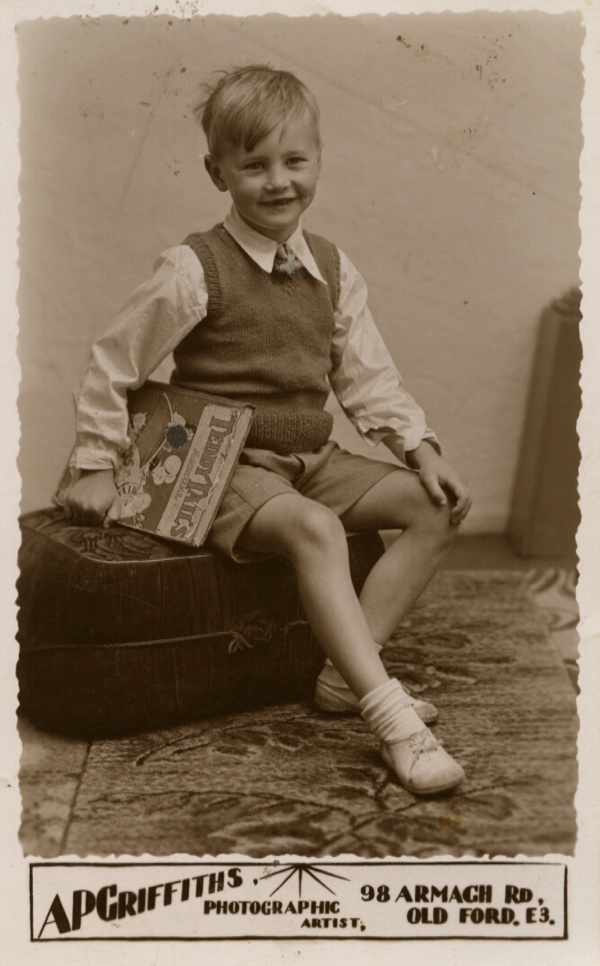
Eddie aged nine, 1941.

Eddie when he worked in the docks.


Early Saturday morning and preparing to open. Eddie behind the bar and George the potman to his right.

Old George the potman.


Shirley Johnson with Rose Doughty, the famous wise-cracking barmaid.


Eddie’s sister Doreen (second left) and friends heading upstairs to the Devil’s Kitchen, above the Puddings (photograph by Alf Shead)

Eddie and his brother Kenny with their beloved Uncle John in the Puddings.

Saturday night in the Puddings.

Joe and Sue, Eddie’s father-in-law and mother-in-law, enjoying a Saturday night in the Puddings.

Eddie Johnson
Copies of Eddie Johnson’s lively memoir TALES FROM THE TWO PUDDINGS are available from www.51statepress.co.uk
You may also like to read about
Mr Pussy In The Dog Days

The sagacious Mr Pussy
There is an exceptional hush upon the East End, with Ramadan and the Olympics conspiring to empty the streets of locals and tourists alike. The clouds hang heavy and the atmosphere is quiet, and my cat Mr Pussy divides his time between dozing on the bed and dozing under a bush. The pace of the city is stilled and Mr Pussy finds the climate conducive to resting.
Mr Pussy observes me with doleful eyes as I go about my daily tasks, too gracious to be overtly critical, yet he hopes that I might one day learn to appreciate the virtue of sitting peacefully for extended periods of time without other occupation, as he does. To this end, Mr Pussy waits patiently until a suitable opportunity when I am settled at my work before he approaches me. Arriving silently like a ghost, Mr Pussy reaches out a soft paw to stroke my forearm gently while I am writing, as a discreet gesture of companionship, drawing my attention without interrupting my activity.
Settling at my side and savouring the tranquillity of the hour, a purr of contentment emanates from him. And if my concentration should wander from my page, searching for a word or casting around to seek the direction of my thought, then I chance upon his hypnotic golden eyes, meeting my gaze with their fathomless depth and opalescent gleam. He has my attention. He has an infinite capacity for staring. He knows I am a neophyte and he is an expert at it. He knows I cannot resist succumbing to his superior mesmeric powers. He has me spellbound and I share his stillness. The house is empty and we are alone. We look at each other eye to eye, without blinking, to see who flinches first.
Almost imperceptibly, Mr Pussy begins to lower his lids and I do the same. I follow along, as his supplicant. Our eyelids move in sync and we are nodding off to sleep, it seems. I might enter the feline realm, if I did not open my lids again momentarily – only to discover that his eyes are open too. It is a moment of mutual recognition. Mr Pussy was testing the quality of my will, exploring my susceptibility to mental control. Mr Pussy observes me. Mr Pussy is implacable, yet he wants me to follow his example. Mr Pussy knows how to be. Mr Pussy keeps himself. Mr Pussy seeks to be calm. Mr Pussy is always present in the moment. Mr Pussy is sufficient.
Equally, Mr Pussy is curious of me and the intriguing nature of my existence that revolves around things other than eating and sleeping. I am the object of his scrutiny, Mr Pussy is studying me. Mr Pussy is an anthropologist, living among those who are subject of his fascination. Mr Pussy’s research methods are unconventional, he thinks he may gain knowledge by osmosis if he sleeps close to me or he may imbibe understanding by lapping up my bathwater.
Not always an entirely conscientious student, Mr Pussy likes to contemplate his findings at length. Mr Pussy likes to sleep on it, and he is a grand master in the art of somnolence. Mr Pussy knows how to behave in these dog days.

You may also like to read
A Few Pints With John Claridge

THE DRINK, E14 1964
Photographer John Claridge claims he is not a drinker, but I was not entirely convinced once I saw this magnificent set of beer-soaked pictures that he lined up on the bar, exploring aspects of the culture of drinking and pubs in the East End – pictures published here for the first time. “I used to go along with my mum and dad, and sit outside with a cream soda and an arrowroot biscuit,” John assured me, recalling his first childhood trips to the pub,“…but they might let you have a drop of brown ale.”
Within living memory, the East End was filled with breweries and there were pubs on almost every corner. These beloved palaces of intoxication were vibrant centres for community life, tiled on the outside and panelled on the inside, and offering plentiful opportunities for refreshment and socialising. Consequently, the brewing industry thrived here for centuries, inspiring extremes of joy and grief among its customers. While Thomas Buxton of Truman, Hanbury & Buxton in Spitalfields used the proceeds of brewing to become a prime mover in the abolition of slavery, conversely William Booth was motivated by the evils of alcohol to form the Salvation Army in Whitechapel to further the cause of temperance.
“When I was fifteen, we’d go around the back and the largest one in the group would go up to the bar and get the beers,” John remembered fondly, “We used to go out every weekend, Friday, Saturday and Sunday. We’d all have our suits on and go down to the Puddings or the Beggars, the Deuragon, the Punchbowl, the Aberdeen, the Iron Bridge Tavern or the Bridge House.” Looking at these pictures makes me wish I had been there too.
Yet the culture of drinking thrives in the East End today, with hordes of young people coming every weekend from far and wide to pack the bars of Brick Lane and Shoreditch, in one non-stop extended party that lasts from Friday evening until Sunday night, and stretches from the former Truman Brewery up as far as Dalston.
Thanks to John’s sobriety, we can enjoy a photographic pub crawl through the alcoholic haze of the East End in the last century – when the entertainment was homegrown, the customers were local, smoking and dogs were permitted, and all ages mixed together for a night out. Cheers, everybody!

A SMOKE, E1 1982. – “There was a relaxed atmosphere where you could walk in and talk to anybody.”

THE CONVERSATION, E1 1982. – “Who is he speaking to?”

DARTBOARD, E17 1982. -“I used to be a darts player, just average not particularly good.”

SINGING, E1 1962. -“She’d just come out of the pub…”

THE MEETING, E14, 1982. -“You don’t know what’s going on. There’s a big flash car parked there. Are they doing a piece of business?”

SLEEP, E1 1976. – “They used to club together and get a bottle of VP wine from the off-licence, and mix it with methylated spirits.”

BEERS, E1 1964. – “This is Dickensian. You wonder who’s going to step from that door. Is it the beginning of a story?”

ROUND THE BACK, E3 1963.

DOG, E1 1963. -“Just sitting there while his master went to get another pint of beer.”

EX-ALCHOHOLIC, E1 1982. – “He lived in Booth House and seemed very content that he had pulled himself out of it.”

LIVE MUSIC, E16 1982. -“It was a cold winter’s day and raining, but I had to get this picture. Live music and dancing in a vast expanse of nothing?”

THE BEEHIVE, E14 1964. – “She never stopped giggling and laughing.”
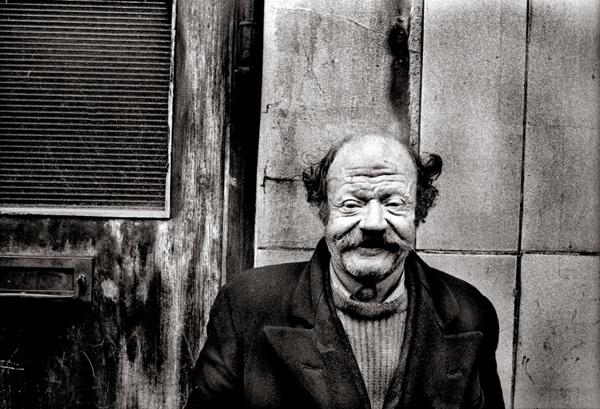
THE SMILE, E2 1962. -“He said, ‘Would you like me to smile?’ He was probably not long for this world, but he was very happy.”

IN THE BAR, E14 1964. -“I’d just got engaged to my first wife and she was one of my ex-mother-in-law’s friends. Full of life!”

THROUGH THE GLASS, E1 1982. -“I think the guy was standing at the cigarette machine.”

THE CALL, E16 1982. -“Terry Lawless’ boxing gym was above this pub. It looks as if everything is collapsing and cracking, and the shadows look like blood pouring from above.”

WHITE SWAN, E14 1982

LIGHT ALE, 1976 -“Four cans of light ale and he was completely out of it.”

CLOSED DOWN, Brick Lane 1982.
Photographs copyright © John Claridge
You may also like to take a look at
Along the Thames with John Claridge
At the Salvation Army with John Claridge
A Few Diversions by John Claridge
Signs, Posters, Typography & Graphics
Jimmy Cuba Returns To Leather Lane

Jimmy Cuba
Readers may have been wondering what became of Jimmy Cuba, the legendary music dealer of Spitalfields, who quit in 2010 after a decade in which his Latin beats became the signature soundtrack of the market. More than a year later, Jimmy has popped up again in Leather Lane Market, where he started out thirty years ago and where I came upon his melodious tunes drifting through the crowd last week, when Spitalfields Life Contributing Photographer Colin O’Brien and I walked over to welcome him back. We heard the music before we saw him, and – there he was – looking rejuvenated and relaxed, bopping around behind his stall in the sunshine, still wearing his trademark leather hat and still displaying his famous comic notices.
In fact, to those that know him , it was no surprise that Jimmy had returned to market life, since he began working on a fruit and veg stall in Romford Market as a child, even before he started in Leather Lane selling his record collection to pay his rent all those years ago, long before he ever came to Spitalfields. It was obvious that this existence would prove irresistible to Jimmy, as he admitted to me when I joined him behind the stall.
“I had a year and a half off, I went to stay with my sister in San Francisco for six months, travelled around the USA and visited Jamaica for a month. Then my sister and her family were going to Spain for the winter and I went with them, yet even then I knew I was coming back because I missed the market too much. My original intention had been to return and do something else, but I realised this is where I belong really, I love it. I love being here every day and talking about music. I may hate the winter and the early mornings, and my ankles are killing me, but I love being out on the street. And people love my stall, it looks interesting. You watch, when people walk past they start dancing. This stall is my life. I’ve got a passion for music and I’m here to educate people. I’ve got a lot of customers that still know me and they’re all turning up, and they’re happy to see me back. I love being out on the street and now I’m back in the street. It’s in my blood.”
Returning to trade in Leather Lane, Jimmy is surrounded by old pals – like Danny Quane known as “Danny the Sock,” who has the next stall, and Harry Burns, who has been in this market longer than anyone else. Danny was brought up in Brick Lane and his dad traded on Cheshire St. He has spent the last thirty years selling men’s socks and pants on Leather Lane, picking up the yiddish words used as traders’ slang in the market, such as “gimel” for three and “bice” for two. Harry Burns grew up in Hatton Garden during the war as one of a family of twelve children and recalls sleeping in bunks in the vaults beneath Smithfield Market as the bombs fell in the London blitz. Fired from his first job, making Italian ice cream, for eating too much of what he produced, Harry moved onto a spaghetti factory before he agreed to help out on a stall in Leather Lane, and stayed on for the rest of his life. “I’ve never lived more than a mile from here,” he confessed to me with a proud smile, “and I wouldn’t live anywhere else.” A dapper gent in a Homburg and brogues, Harry Burns is the grand old man of Leather Lane.
The market serves the office workers of Holborn and only operates over lunchtime. By three-thirty, Jimmy finished packing up and I joined him as, waving goodbye to Danny, he wheeled his trolley of records up towards the Clerkenwell Rd. We entered a former tramshed in the Grays Inn Rd where Jimmy stores his stock in the warehouse of his friend Zep who runs Stern Records, stacked to the ceiling with Reggae CDs that he exports to the United States. From here we walked through Lambs Conduit St, where Jimmy once had a record shop, stopping in to greet some of the long-term shopkeepers that Jimmy knows from the old days.
Opposite the hospital in Great Ormond St, Jimmy took me down to his subterranean lock-up where he stores his stock from thirty years of trading, along with a few surprises. “I’m clearing out a bank in Mayfair tomorrow,” he joked, then – before I jumped to the wrong conclusion – explaining he was buying up furniture and fittings that he would store here and sell online, along with an exclusive range of Kung Fu Panda phone chargers that he got for a song.
It was a warm afternoon and thirsty work lugging boxes of records around, so we were relieved to arrive at last at Jimmy’s flat next to Russell Sq and have a cup of tea. We sat in his living room in peace. With one wall lined with his music collection and a window looking out onto a Nash terrace, Jimmy has found his ideal home – within walking distance of the market.


Danny the Sock, dealer in men’s socks and pants for thirty years.

Jimmy with Harry Burns.

Harry Burns – “I’ve never lived more than a mile from here and I wouldn’t live anywhere else.”


Photographs copyright © Colin O’Brien
You may also like to read about
Colin O’Brien’s exhibition of photography Commonplace is open at Christ Church Spitalfields this weekend and runs until August 26th. Open Tuesdays, Saturdays & Sundays 1-6pm.


