
Kallistratus Wraith, Pirate Goth Magician & Corsetier

“I love not being like everybody else.”
In spite of what you might assume, Kallistratus Wraith, Pirate Goth Magician & Corsetier, was given his name at birth. “My parents were quite eccentric, they christened my elder brother and sister Arachnid and Grendel, so as soon as they were old enough they went to a lawyer and changed their names to July and John – but I like my name, I think it suits me,” Kallistratus admitted. “It means dweller from the deep, that’s why I have this,” he added, pointing to the octopus tattooed on his brow by means of explanation.
You may have seen Kallistratus – widely known as Kato – and his wife Pip in the streets of Spitalfields over the past year, looking strangely at home in their fearsome goth outfits among the old buildings, as if the entire neighbour had been constructed as some extravagant steampunk fantasy and they were creatures that had emanated from its deepest recesses. “She’s a rockabilly goth whereas I am more a piratey goth,” Kato informed me helpfully, exercising his lilting Herefordshire accent, and opening my eyes to the precise distinctions of gothdom.
“Pip and I met at a goth club, filled with goths gathered together. We already had our goth styles and we were both types that we both liked. So that was part of the attraction and we were more or less married twenty minutes after we met. At the time, Pip was living in a shared house with friends that she didn’t like and I was living in a house on my own, so we went down to get her things that night and she moved in with me and that was eighteen years ago.
We came here when our friend opened her goth shop, we worked for her before when she had a shop in Camden. It was ten years ago we met Sam, Pip worked for her at first but then she had an accident and broke her leg so I went in to help her out in the shop and the customers seemed to like it. I am a magician, I do magic acts and stage shows but when I am not doing that I am the corsetier in the shop, I measure the ladies for their corsets and fit them for their corsets. I love to seeing women in corsets and I’ve always been interested in Victorian styles.
Even when I was a little kid, I used to have long black painted fingernails at school and long black dyed hair. My dad was a magician and he collected old props and we used to have a skeleton in the front room. This was in Herefordshire. He died when I was ten and after that I wanted to do magic for him, to carry it along. I went to stay with my step-father who was my father’s best friend who was also a magician and lived in the Hollywood Hills in Los Angeles for many years.
I love not being like everybody else. Most of our friends are “different” though we do have some friends who dress quite ordinary. I don’t dress to make a statement, I wear what I want to wear and I’m not interested in what people think. You do get people calling abuse at you from cars sometimes but it’s just part and parcel, I ignore it. Nobody ever says it to your face. They see people like me and they think we are devil-worshippers and baby murderers, but if anyone comes to speak to us we are always friendly.”
Kato invited me to visit his tiny purple flat in Whitechapel that he shares with Pip. Stepping into the half-light of the living room, where sunlight filtered through closed curtains I could distinguish three sinister figures lurking in the gloom, life-size animatronic figures of familiar villains from horror movies. Yet Kato stood between these hell-raisers and extended his arms affectionately to introduce them to me as his cherished companions. Elsewhere in the room, horror babies nestled upon a rocking chair, a disembodied head lay upon the table and a skeleton presided over all, just as it did in Kato’s childhood home.
Kato told me that he used to perform magic at London fetish clubs but they have tailed off with the recession and he is looking forward to returning to the Holllywood Hills where the culture of goth horror magic remains vibrant. Kato delights in these transgressive areas of culture where the collective unconscious becomes tangible and, for him, the past is not something over and done but a continuum in which we can participate through our daily actions.
Entirely comfortable with dark areas of human experience that fill many with dread, Kato retains an upbeat courteous manner and is an engaging advocate for the seductions of fantasy. The ideal corsetier.

Kallistratus at home in Whitechapel with his animatronic moving horror figures.

A cosy corner of the living room.

Kallistratus Wraith, Pirate Goth Magician & Corsetier.
You may also like to read about
East End Desire Paths

In Weavers’ Fields
Who can resist the appeal of the path worn solely by footsteps? I was never convinced by John Bunyan’s pilgrim who believed salvation lay in sticking exclusively to the straight path – detours and byways always held greater attraction for me. My experience of life has been that there is more to be discovered by stepping from the tarmac and meandering off down the dusty track, and so I delight in the possibility of liberation offered by these paths which appear year after year, in complete disregard to those official routes laid out by the parks department.
It is commonly believed that the French philosopher Gaston Bachelard invented the notion of “desire paths” (lignes de désir) to describe these pathways eroded by footfall in his book “The Poetics of Space,” in 1958, although, just like the mysterious provenance of these paths themselves, this origin is questioned by others. What is certain is that the green spaces of the East End are scored with them at this time of year. Sometimes, it is because people would rather cut a corner than walk around a right angle, at other times it is because walkers lack patience with elegantly contrived curved paths when they would prefer to walk in a straight line and occasionally it is because there is simply no other path leading where they want to go.
Resisting any suggestion that these paths are by their nature subversive to authority or indicative of moral decline, I prefer to appreciate them as evidence of human accommodation, coming into existence where the given paths fail and the multitude of walkers reveal the footpath which best takes them where they need to go. Yet landscape architects and the parks department refuse to be cowed by the collective authority of those who vote with their feet and, from time to time, little fences appear in a vain attempt to redirect pedestrians back on the straight and narrow.
I find a beauty in these desire paths which are expressions of collective will and serve as indicators of the memory of repeated human actions inscribed upon the landscape. They recur like an annual ritual, reiterated over and over like a popular rhyme, and asserting ownership of the space by those who walk across it every day. It would be an indication of the loss of independent thought if desire paths were no longer created and everyone chose to conform to the allotted pathways instead.
You only have to look at a map of the East End to see that former desire paths have been incorporated into the modern road network. The curved line of Broadway Market joins up with Columbia Rd cutting a swathe through the grid of streets, along an ancient drover’s track herding the cattle from London Fields down towards Smithfield Market, and the aptly named Fieldgate St indicates the beginning of what was once a footpath over the fields down to St Dunstan’s when it was the parish church for the whole of Tower Hamlets.
Each desire path tells a story, whether of those who cut a corner hurrying for the tube through Museum Gardens or of those who walk parallel to the tarmac for fear of being hit by cyclists in London Fields or of the strange compromise enacted in Whitechapel Waste where an attempt has been made to incorporate desire paths into the landscape design. I am told that in Denmark landscape architects and planners go out after newly-fallen snow to trace the routes of pedestrians as an indicator of where the paths should be. Yet I do not believe that desire paths are a problem which can be solved because desire paths are not a problem, they are a heartening reminder of the irreducible nature of the human spirit that can never be contained and will always be wandering.

The parting of the ways in Museum Gardens.

The allure of the path through the trees.

In Bethnal Green, hungry for literature, residents cut across the rose bed to get to the library.

A cheeky little short cut.

An inviting avenue of plane trees in Weavers’ Fields.

A detour in Florida St.

A byway in Bethnal Green.

Legitimised by mowing in Allen Gardens, Spitalfields.

A pointless intervention in Shadwell.

Which path would you choose?

Over the hills and faraway in Stepney.

The triumph of common sense in Stepney Green.

Half-hearted appropriation by landscape architects on Whitechapel Waste.

A mystery in London Fields.

A dog-eared corner in Stepney.

The beginning of something in Bethnal Green.
Daniele Lamarche’s East End

Cheshire St Doorway – “He once ran after me into the beigel shop and urged me to follow him. I had no idea what he wanted, but he led me back to my car on Bethnal Green Rd to show me that I’d left my keys in the door – he was desperately worried I would lose them. It made me chuckle after that when passers-by clutched their shoulder-bags firmly and crossed the street at the sight of him.”
Photographer Daniele Lamarche came to stay in a flat in Wentworth St for two weeks in 1981 and ended up staying on for years. Working as an international news scriptwriter for Independent Television News in Leadenhall St, Daniele first visited Brick Lane when the Indian correspondent brought her here for lunch and she was capitivated. “As you crossed Middlesex St, coming from the City of London, all the windows were smashed and things were desolate.” she recalled, yet for Daniele it was the beginning of a fascination explored through photography which continues until the present day. “I found it interesting that a lot of people would not come and visit me in East London,” she confided to me, “Because it was the first place I found in London with a sense of wonder, a sense of poetry.”
In 1982, Daniele began taking photographs in Brick Lane. It was a time of racial discord in the East End and, working for the GLC Race & Housing Action Team, Daniele employed her photography to record injuries inflicted upon victims of racial assault, the racist graffiti and the damage that was enacted upon the homes of immigrants, the broken windows and the burnt-out flats. “People actually spat at me and shouted at me in the street,” she confessed. Undeterred, Daniele became part of the Bengali community and was called upon to photograph poor living conditions as residents campaigned for better housing – with the outcome that she was also invited to record more joyful occasions too, weddings and community events.
A Californian of French/American ancestry who grew up in Argentina and was taught to ride by a Gaucho, Daniele found herself in her element working at the Spitalfields City Farm for several years where she kept dray horses and rode around the East End in a cart. An experience which afforded the unlikely observation that the lettered fascias on shops and street signs are placed high because they were originally designed to be at eye-level for those sitting in horse-drawn vehicles. Becoming embedded in Spitalfields, Daniele photographed many of the demonstrations and conflicts between Anti-Fascist and Racist groups that happened in Brick Lane, taking pictures for local and national newspapers, as well as building up a body of personal work which traces her intimate relationship with the people here, reflecting the trust and acceptance she won from those whom she met.

George, Nora & the Pigeon Cage – “East Enders who once cared for the ravens at the Tower of London, they soon took to raising racing pigeons for club meetings and competitions.”

Bethnal Green Pensioner – “A delicately-faced woman answered the door when I knocked and talked to me at length about her life, her dreams and her memories…”

Elections – “A group of Bengali women vote in 1992 – when the BNP stood in Tower Hamlets – many for the first time, following a drive made by groups including ‘Women Unite Against Racism.’ This was formed when local women found themselves to be three or four in meetings of over a hundred men and decided that, rather than be patronized as token females, they preferred to reach out to empower and support those women who might not otherwise vote.”

Eva wins the prize – “Eva came from Germany in the fifties, and grew plants and made soups out of what others might consider weeds – nettles, spinach, beet root tops – as well as sewing and embroidering all manners of pillows and textile pieces, from hop-pillows to aid sleep at night to tablecloths in the Richelieu style – and she was always game to show her wares of jams, sewing and plants at local events.”

French waiter in the docklands.

John & John – “This is John Lee, formerly of Spitalfields City Farm, now an organic dairy and pig co-operative farmer in Normandy, and ‘John’ who would often pop in to visit from Brick Lane Market and use the toilet.”

Immigration – “This refers to the moment when individuals of Asian origin in East Africa were told their colonial British passports would be no longer valid after a certain date – thus causing many to come to Britain to establish their rights to nationality, and as a result, many families camped out at the airport waiting to be met.”

Toy Museum Lascars – “a set of nineteenth century figures which represent seamen from a range of ethnicities and cultures who would have once been seen in the docklands.”

Lam at Fire – “Lam who worked for the GLC’s Race and Housing Action Team visits a family of Vietnamese heritage in 1984 in the Isle of Dogs after they were petrol bombed the night before and only saved because the granny awoke and saw smoke. Lam lived as a refugee in Hong Kong, and then in England where he was housed at first in a small village which greeted him with a gift of dog faeces through the letter box. ‘Is it the same in the USA?’ he asked me.”

Minicab – “A traditional minicab sign hovers over a resident whose front door, back door and side doors touched three different boroughs, causing him havoc and much correspondence with council tax officers.”
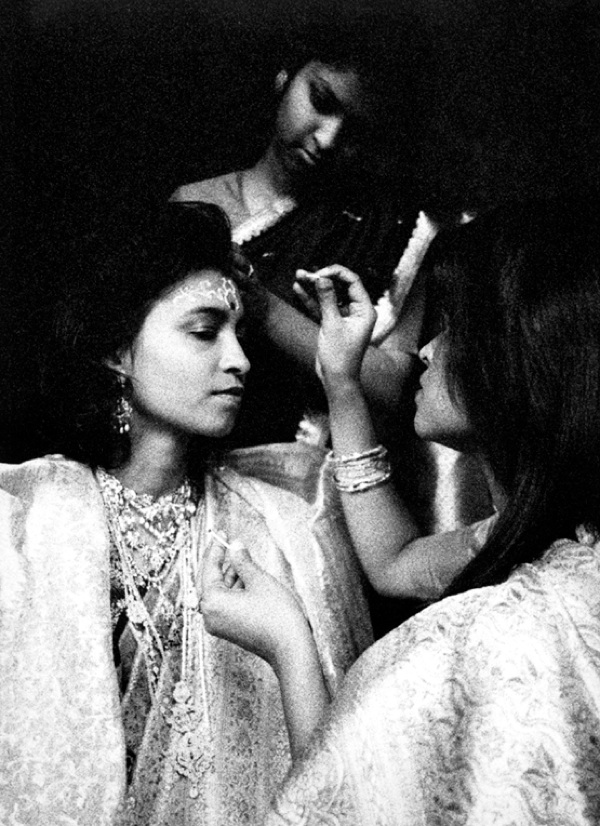
“Noore’s sister-in-law and friends help with wedding preparations, and a spot of toothpaste for intricate designs on her forehead.”

Paula, Woodcarver in her studio.

“Peter’s trades ranged from wheeling an old cart around as a rag & bone man to performing Punch & Judy puppet shows at children’s parties. Furniture and objects of interest flowed through his flat, and overflowed into the courtyard when a boat, which he’d sit in for evening cocktails, wouldn’t fit through the front door….”

Salmon Lane Horses – “A girl and her mother wait for the farrier after returning from school. Stables with horses for work and leisure dotted the streets and yards until developers picked off the remainder of the wasteland and yards where the animals were housed.”

Somali Girl – “This shows one of a group of children playing in a courtyard off Cable St where homes backed onto one another, enabling children to play within sight and ear-reach of parents indoors.”

Vietnamese Baby – “A voluntary sector advocate visits a Vietnamese family to check on their newborn’s progress. Over five hundred Vietnamese children of Chinese origin attended Saturday supplementary school classes at St Paul’s Way School in the eighties and nineties, most from Limehouse and the Isle of Dogs. Many had been housed across Britain but chose to leave the isolation of village homes, offered in a Home Office policy of dispersement, preferring the security of living in the metropolis – sometimes with thirteen family members in two rooms – thereby linking with community networks leading to jobs, further training and more fulfilling lives.”

Members of the Vietnamese Friendship Society.

Lathe, Whitechapel Bell Foundry – “Photographed in the eighties when the Bell Foundry was more a local point of interest, before it grew internationally famous.”

Brick Lane at Night – ” At a time when women were rarely seen on Brick Lane, I was once asked where my ‘friend’ was. I said the person I usually shopped with must be out and about – to which the questioner kindly patted my hand and whispered ‘they always come back…’ Some time passed before it dawned on me that many of the white women accompanying Asian men on the street were ‘working women’….”

Market Cafe Farewell – “Market traders, artists and local characters, ranging from Patrick who directed traffic from the Blackwall Tunnel and Tower Bridge to Commercial St- regardless of whether it flowed without his assistance – all squeezed into this one-room-cafe which opened in the early hours of each morning. Then it vanished one day with only a farewell note left to confirm where it had been.”
Photographs copyright © Daniele Lamarche
Cries Of London Scraps
It is my pleasure to publish these modest Victorian die-cut scraps which are the latest acquisition in my ever-growing collection of the Cries of London. The Costermonger scrap has the name “W. Straker, Ludgate Hill” rubber-stamped on the reverse and – sure enough – by pulling the London Trade Directory for 1880 off the shelf, I found William Straker, Silver & Copperplate Engraver, Printer, Die Sinker, Wholesale Stationer & Stamp Cutter, 49/63 Ludgate Hill. These mass-produced images appeal to me with their vigorous life, portraying their subjects with their mouths wide open enthusiastically crying their wares – all leading players in the drama of street life in nineteenth century London.

Newspaper seller (The Star was published in London from 1788-1960)

Sandwich-board man (Dan Leno started his career in Babes in the Wood at Drury Lane in 1888)

Milkman

Sweep

Watercress seller

Crossing sweeper

Shoe-shine

Buttonhole seller

Costermonger

You can read my feature about William Marshall Craig’s prints of the Cries of London in the September issue of World of Interiors on the newstands now.
You may also like to take a look at these other sets of the Cries of London
Geoffrey Fletcher’s Pavement Pounders
William Craig Marshall’s Itinerant Traders
H.W.Petherick’s London Characters
John Thomson’s Street Life in London
Aunt Busy Bee’s New London Cries
Marcellus Laroon’s Cries of London
More John Player’s Cries of London
William Nicholson’s London Types
Francis Wheatley’s Cries of London
John Thomas Smith’s Vagabondiana of 1817
John Thomas Smith’s Vagabondiana II
John Thomas Smith’s Vagabondiana III
Thomas Rowlandson’s Lower Orders
More of Thomas Rowlandson’s Lower Orders
Libby Hall, Collector Of Dog Photography

Libby Hall
Between 1966 and 2006, Libby Hall collected old photographs of dogs, amassing many thousands to assemble what is possibly the largest number of canine pictures ever gathered by any single person. Libby began collecting casually when the photographs were of negligible value, but by the end she had published four books and been priced out of the market. Yet through her actions Libby rescued an entire canon of photography from the scrap heap, seeing the poetry and sophistication in images that were previously dismissed as merely sentimental. And today, we are the beneficiaries of her visionary endeavour.
A joyful iconoclast by nature who has recently had, “Stop! Do not resuscitate, living will extant,” tattooed on her chest – Libby Hall is a born and bred New Yorker originating from the Upper East Side of Manhattan, who moved into her house in Clapton in 1967 with her husband the newspaper cartoonist, Tony Hall, and has stayed ever since.
Contrary to our expectations and in spite of the multiple signs in a plethora of languages warning us to beware of the dog, Spitalfields Life Contributing Photographer Martin Usborne and I found Libby without any canine company when we paid her a visit recently. “I’ve never lived without a dog before,” she confessed, revealing that her beloved dog Pembury had died just a few weeks previously on the couch in the front room, “there is a stillness and the place does seem incredibly quiet.”
We spent an enjoyable summer’s afternoon with Libby in the cool of her old house, studying the pages of proofs of dog photographs that line the walls, while she regaled us with the story of how it all began.
“My husband Tony and I used to go to Kingsland Waste, where we had a friend who did house clearances, and in those days they sold old photo albums and threw away the pictures. So I used to rescue them and I began sorting out the dogs – because I always liked dogs – and it became a collection. Then I started collecting properly, looking for them at car boot sales and auctions. And eventually a publisher offered me an advance of two thousand pounds for a book of them, which was fantastic, and when each of my books was published I just used the royalties to buy more and more photographs. I had a network of dealers looking out for things for me and they would send me pictures on approval. They were nineteenth century mostly and I only collected up until 1940, because I didn’t want to invade anyone’s privacy. Noboby was interested until my first book was published in 2000, and afterwards people said I had shot myself in the foot because everybody started collecting them and they became very expensive, but by then I had between five and six thousand photographs of dogs.
Dogs have always been powerfully important to me, I’ve lived with dogs since the beginning of my days. There’s a photo of my father holding me as baby in one arm and a dog in the other – dog’s faces were imprinted upon my consciousness as early as humans, and I’ve always lived with dogs until six weeks ago when my dog Pembury died. For the last month, friends have been ringing my bell and there’s only silence because he doesn’t come and I open the door to find them in tears. It was an intense relationship because it was just the two of us, Pembury and me, and as he got older he depended on me greatly. So it is good to have my freedom now but only for a little while. At one point, we had three dogs and four cats in this house. We even had a dog and a cat that used to sleep together, during the day they’d do all the usual challenging and chasing but at night they’d curl up in a basket.
When I was eleven, I wanted a dog of my own desperately, I’d been campaigning for five years and I wanted a cocker spaniel. My father contacted a dog rescue shelter in Chester, Connecticut, and they said they had one. But as we walked past the chain link fence, there was a dog barking and we were told that it was going to be put down the next morning. Of course, we took that dog, even though he wasn’t a cocker spaniel. We wondered if they always told people this, but Chester and I were inseparable ever after.”
With touching generosity of spirit, Libby confided to me that her greatest delight is to share her collection of pictures. “What matters to me is others seeing them, I never made any money from my books because I spent it all on buying more photographs.” she said.
These photographs grow ever more compelling upon contemplation because there is always a tension between the dog and the human in each picture. The presence of the animal can unlock the emotional quality of an image of people who might otherwise appear withheld, and the evocation of such intimacy in pictures of the long dead, who are mostly un-named, carries a soulful poetry that is all its own. Bridging the gap of time in a way that photographs solely of humans do not, Libby’s extraordinary collection constitutes an extended mediation upon mortality and the fragility of tender emotions.
“I put my heart and soul into it, and it was very hard giving up collecting, but my fourth book was the ultimate book, and it coincided with the realisation that my husband Tony was dying, so I realised that it was the end of a period of my life.” Libby concluded with a melancholy smile, sitting upon the couch where Pembury expired and casting her eyes thoughtfully around the pictures of dogs lining the walls. I asked Libby how she felt now that her collection is housed elsewhere. “I’ve got the books,” she reminded me, placing her hand upon them protectively, “I have no visual memory at all, so I keep going back to look at them.”
Libby Hall plans to get a new dog in the autumn.


The two stripes on this soldier’s sleeve meant he had been wounded twice and was probably on leave recovering from the second wound when this photograph was taken.


HRH the Princess of Wales with her favourite dogs on board the royal yacht Osborne.

John Brown 1871. The dogs are Corran, Dacho, Rochie and Sharp, who was Queen Victoria’s favourite.


George Alexander, Actor/Manager, with his wife Florence.

This photograph of Mick came with the collar he is wearing.

Queen Victoria and Sharp (pictured above with John Brown) at Balmoral in 1867.


Ellen Terry.


Charles Dickens with his devoted dog Turk.


Libby’s recently deceased dog Pembury wearing the vest that was essential in his last days.

Libby on the couch where Pembury died six weeks ago.

One of Libby’s six dog dolls’ houses. – “I think dolls’ houses with dolls are rather scary but dolls’ houses with dogs are ok.”

Libby Hall – “I put my heart and soul into it.”
[youtube VYXUJvTQ9IM nolink]
[youtube dxQ4OJG4kr8 nolink]
Portraits of Libby Hall copyright © Martin Usborne
Dog photographs copyright © The Libby Hall Collection at the Bishopsgate Institute

Updated in December 2012 – Libby Hall with her new dog Pip.
Libby Hall selected these favourite dog photographs from her books – Prince and Others, Prince and Other Dogs II, Postcard Dogs, Postcard Cats and These Were Our Dogs, all published by Bloomsbury.
You may also like to take a look at
The Dogs of Spitalfields in Spring
The Dogs of Spitalfields in Winter
A Nation Of Shopkeepers by John Claridge

Ross Bakeries, Quaker St, 1966
I am grateful to John Claridge for his prescience in taking these photographs, published here for the first time, because if I could travel back to the East End of half a century ago this is exactly what I should like to see – the local shops and the faces of the shopkeepers.
“I used to go to the shops with my mum every Saturday morning, and she’d meet people she knew and they’d be chatting for maybe an hour, so I’d go off and meet other kids and we’d be playing on a bombsite – it was a strange education!” John told me, neatly illustrating how these small shops were integral to the fabric of society in his childhood.“People had a pride in what they were selling or what they were doing” he recalled,“You’d go into these places and they’d all smell different. They all had their distinct character, it was wonderful.”
Although generations of the family were dockers, John’s father warned him that the London Docks were in terminal decline and he sought a career elsewhere. Consequently, even as a youth, John realised that a whole way of life was going to be swept away in the changes which were coming to the East End. And this foresight inspired John to photograph the familiar culture of small shops and shopkeepers that he held in such affection. “Even then I had the feeling that things were going to be overrun, without regard to what those in that society wanted.” he confirmed to me with regret.
As the remaining small shopkeepers now join together to form the East End Trades Guild to fight for their survival, in the face of escalating rents and the incursion of chain stores, John Claridge’s poignant images are a salient reminder of the venerable tradition of local shops here that we cannot afford to lose.

Shop in Spitalfields, 1964.

C & K Grocers, Spitalfields, 1982 – “From the floor to the roof, the shop was stocked full of everything you could imagine.”

Cobbler, Spitalfields, 1969.

Flo’s Stores, Spitalfields, 1962 – “All the shops were individual then. Somebody painted the typography themselves here and it’s brilliant.”

Fruit & Veg, Bethnal Green 1961 – “I’d been to a party and it was five o’clock in the morning, but she was open.”

W.Wernick, Spitalfields, 1962.

Fishmonger, Spitalfields, 1965.

Corner Shop, Spitalfields, 1961 – “The kid’s just got his stuff for his mum and he’s walking back.”

At W.Wernick Poulterers, Spitalfields, 1962 – “She’s got her hat, her cup of tea and her flask. There was no refrigeration but it was chilly.”

Fiorella Shoes, E2, 1966 – “There’s only four pairs of shoes in the window. How could they measure shoes to fit, when they couldn’t even fit the words in the window? The man next door said to me, ‘Would you like me to step back out of the picture?’ I said, ‘No, I’d really like you to be in the picture.”

Bertha, Spitalfields, 1982 – “Everything is closing down but you can still have a wedding! She’s been jilted at the altar and she’s just waiting now.”

Bakers, Spitalfields, 1959 – “There’s only three buns and a cake in the window.”

Jacques Wolff, E13 1960 – “His name was probably Jack Fox and he changed it to Jacques Wolff.”

Waltons, E13 1960 – “They just sold cheap shoes, but you could get a nice Italian pair knocked off from the docks at a good price.”

Churchman’s, Spitalfields, 1968 – “Anything you wanted from cigarettes to headache pills.”

White, Spitalfields 1967 – “I saw these three kids and photographed them, it was only afterwards I saw the name White.”

The Door, E2 1960.

The Window, E16 1982 – “Just a little dress shop, selling bits and pieces. The clothes could have been from almost any era.”

Victor, E14 1968 – “There’s no cars on the road, the place was empty, but there was a flower shop on the corner and it was always full of flowers.”
Photographs copyright © John Claridge
You may also like to take a look at
Along the Thames with John Claridge
At the Salvation Army with John Claridge
A Few Diversions by John Claridge
Signs, Posters, Typography & Graphics
Views from a Dinghy by John Claridge
In City Churchyards

In the churchyard of St Dunstan’s in the East, Idol Lane
If ever I should require a peaceful walk on a Sunday afternoon when the crowds are thronging in Brick Lane and Columbia Rd, then I simply wander over to the City of London where the streets are empty at weekends and the many secret green enclaves of the churches are likely to be at my sole disposal. For centuries the City was densely populated, yet the numberless dead in the ancient churchyards are almost the only residents these days.
Christopher Wren rebuilt most of the City churches after the Great Fire upon the irregularly shaped medieval churchyards and it proved the ideal challenge to develop his eloquent vocabulary of classical architecture. Remarkably, there are a couple of churches still standing which predate the Fire while a lot of Wren’s churches were destroyed in the Blitz, but for all those that are intact, there are many of which only the tower or an elegant ruin survives to grace the churchyard. And there are also yards where nothing remains of the church, save a few lone tombstones attesting to the centuries of human activity in that place. Many of these sites offer charismatic spaces for horticulture, rendered all the more appealing in contrast to the sterile architectural landscape of the modern City that surrounds them.
I often visit St Olave’s in Mincing Lane, a rare survivor of the Fire, and when you step down from the street, it as if you have entered a country church. Samuel Pepys lived across the road in Seething Lane and was a member of the congregation here, referring to it as “our own church.” He is buried in a vault beneath the communion table and there is a spectacular gate from 1658, topped off with skulls, which he walked through to enter the secluded yard. Charles Dickens also loved this place, describing it as “my best beloved churchyard”
“It is a small small churchyard, with a ferocious, strong, spiked iron gate, like a jail. This gate is ornamented with skulls and cross-bones, larger than the life, wrought in stone … the skulls grin aloft horribly, thrust through and through with iron spears. Hence, there is attraction of repulsion for me … and, having often contemplated it in the daylight and the dark, I once felt drawn towards it in a thunderstorm at midnight.” he wrote in “The Uncommercial Traveller.”
A particular favourite of mine is the churchyard of St Dunstan’s in the East in Idol Lane. The ruins of a Wren church have been overgrown with wisteria and creepers to create a garden of magnificent romance, where almost no-one goes. You can sit here within the nave surrounded by high walls on all sides, punctuated with soaring Gothic lancet windows hung with leafy vines which filter the sunlight in place of the stained glass that once was there.
Undertaking a circuit of the City, I always include the churchyard of St Mary Aldermanbury in Love Lane with its intricate knot garden and bust of William Shakespeare, commemorating John Hemminge and Henry Condell who published the First Folio and are buried there. The yard of the bombed Christchurch Greyfriars in Newgate St is another essential port of call for me, to admire the dense border planting that occupies the space where once the congregation sat within the shell of Wren’s finely proportioned architecture. In each case, the introduction of plants to fill the space and countermand the absence in the ruins of these former churches – where the parishioners have gone long ago – has created lush gardens of rich poetry.
There are so many churchyards in the City of London that there are always new discoveries to be made by the casual visitor, however many times you return. And anyone can enjoy the privilege of solitude in these special places, you only have to have the curiosity and desire to seek them out for yourself.

In the yard of St Michael, Cornhill.

In the yard of St Dunstan’s in the East, Idol Lane.

At St Dunstan’s in the East, leafy vines filter the sunlight in place of stained glass.


In the yard of St Olave’s, Mincing Lane.

This is the gate that Samuel Pepys walked through to enter St Olave’s and of which Charles Dickens wrote in The Uncommercial Traveller – “having often contemplated it in the daylight and the dark, I once felt drawn towards it in a thunderstorm at midnight.”

Dickens described this as ““my best beloved churchyard.”


In the yard of St Michael Paternoster Royal, College St.


In the yard of St Lawrence Jewry-next-Guildhall, Gresham St.

In the yard of St Mary Aldermanbury, Love Lane, this bust of William Shakespeare commemorates John Hemminge and Henry Condell who published the First Folio and are buried here.


In the yard of London City Presbyterian Church, Aldersgate St.


In the yard of Christchurch Greyfriars, Newgate St, the dense border planting occupies the space where once the congregation sat within the shell of Wren’s finely proportioned architecture.

In the yard of the Guildhall Church of St Benet, White Lion Hill.


In St Paul’s Churchyard.
You may also like to read about


