
The Nights Of Old London

The nights are drawing in and I can feel the velvet darkness falling upon London. As dusk gathers in the ancient churches and the dusty old museums in the late afternoon, the distinction between past and present becomes almost permeable at this time of year. Then, once the daylight fades and the streetlights flicker into life, I feel the desire to go walking out into the dark in search of the nights of old London.
Examining hundreds of glass plates – many more than a century old – once used by the London & Middlesex Archaeological Society for magic lantern shows at the Bishopsgate Institute, I am in thrall to these images of night long ago in London. They set my imagination racing with nocturnal visions of the gloom and the glamour of our city in darkness, where mist hangs in the air eternally, casting an aura round each lamp, where the full moon is always breaking through the clouds and where the recent downpour glistens upon every pavement – where old London has become an apparition that coalesced out of the fog.
Somewhere out there, they are loading the mail onto trains, and the presses are rolling in Fleet St, and the lorries are setting out with the early editions, and the barrows are rolling into Spitalfields and Covent Garden, and the Billingsgate porters are running helter-skelter down St Mary at Hill with crates of fish on their heads, and the horns are blaring along the river as Tower Bridge opens in the moonlight to admit another cargo vessel into the crowded pool of London. Meanwhile, across the empty city, Londoners slumber and dream while footsteps of lonely policemen on the beat echo in the dark deserted streets.

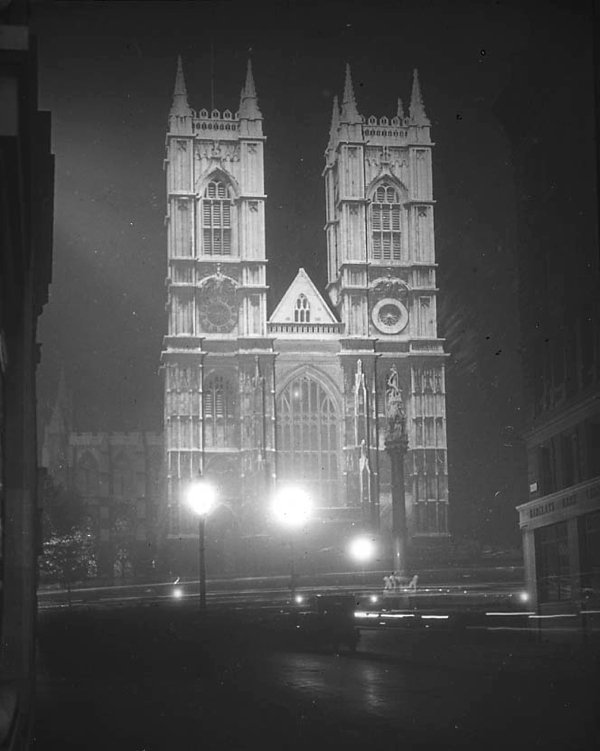


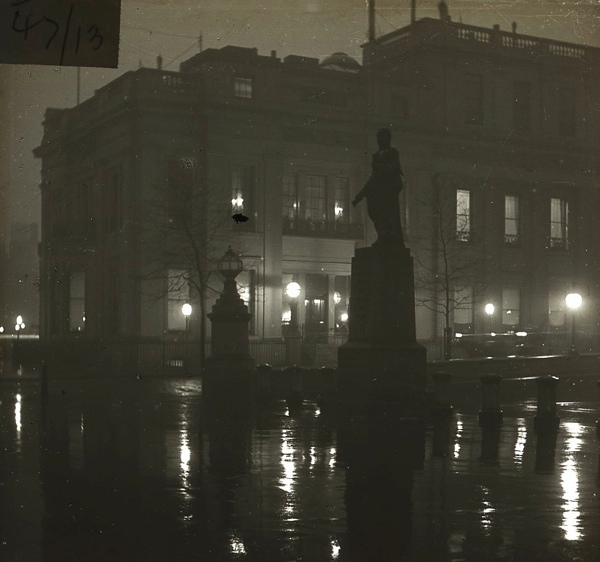


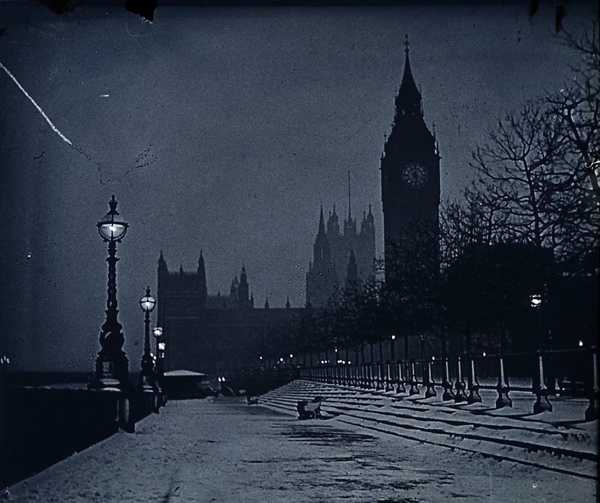


Glass slides copyright © Bishopsgate Institute
Read my other nocturnal stories
On Christmas Night in the City
On the Rounds With the Spitalfields Milkman
Other stories of Old London
Roy Emmins’ Sculptures
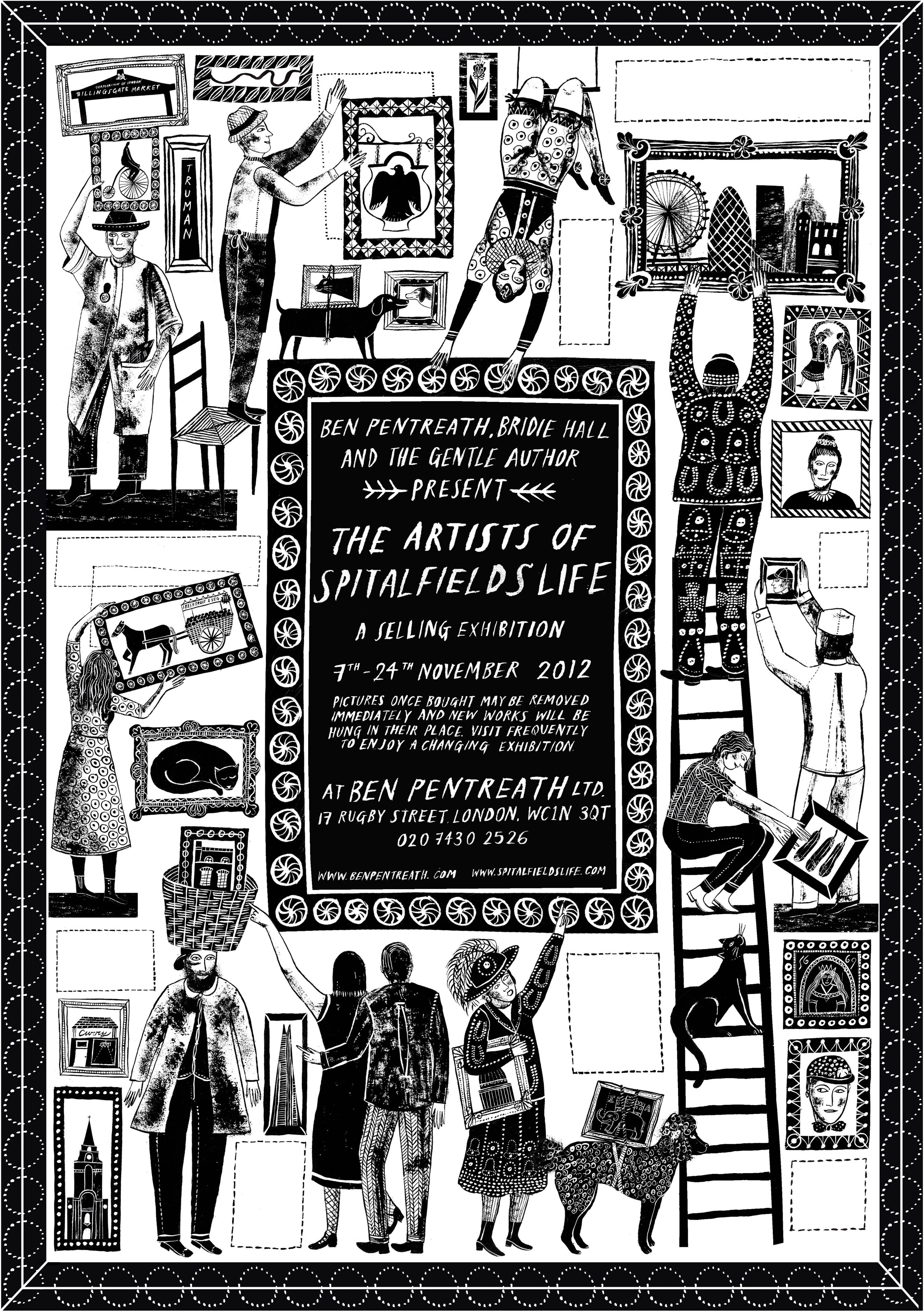
Click to enlarge this poster designed by Alice Pattullo
It is my delight to announce THE ARTISTS OF SPITALFIELDS LIFE, an exhibition curated by yours truly, opening at BEN PENTREATH in Bloomsbury one month today.
Please join me for the private view on the evening of WEDNESDAY 7th NOVEMBER to celebrate the work of artists who will be familiar from these pages – Paul Bommer, James Brown, Robson Cezar, Alfred Daniels, Adam Dant, Anthony Eyton, Marc Gooderham, Sebastian Harding, Marianna Kennedy, Laura Knight, Justin Knopp working as Typoretum, Joanna Moore, Alice Pattullo, Lucinda Rogers & Rob Ryan.
The centrepiece of the show will be a display of the work of Roy Emmins the Whitechapel sculptor, whose work has rarely been seen. And today I am publishing this preview of Roy’s magical menagerie alongside the pen portrait I wrote when I first met him two years ago.
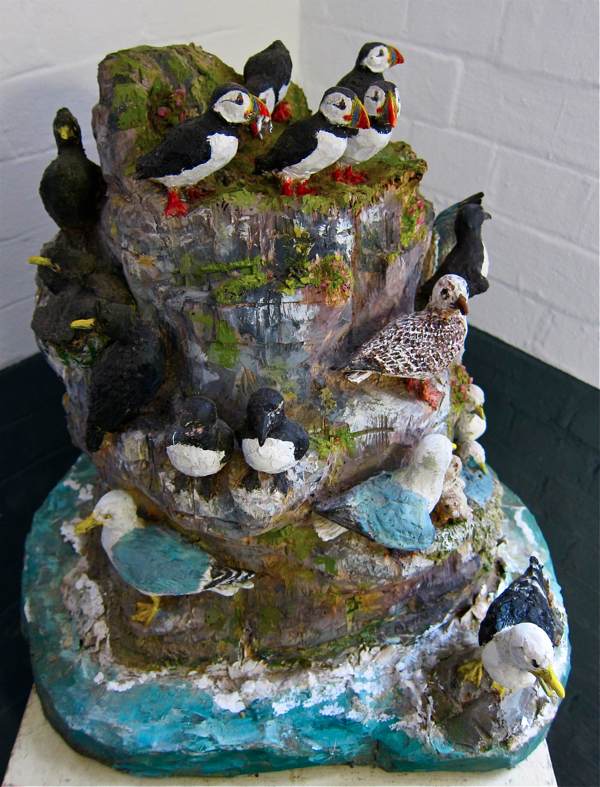
Sea birds – painted wood and milliput
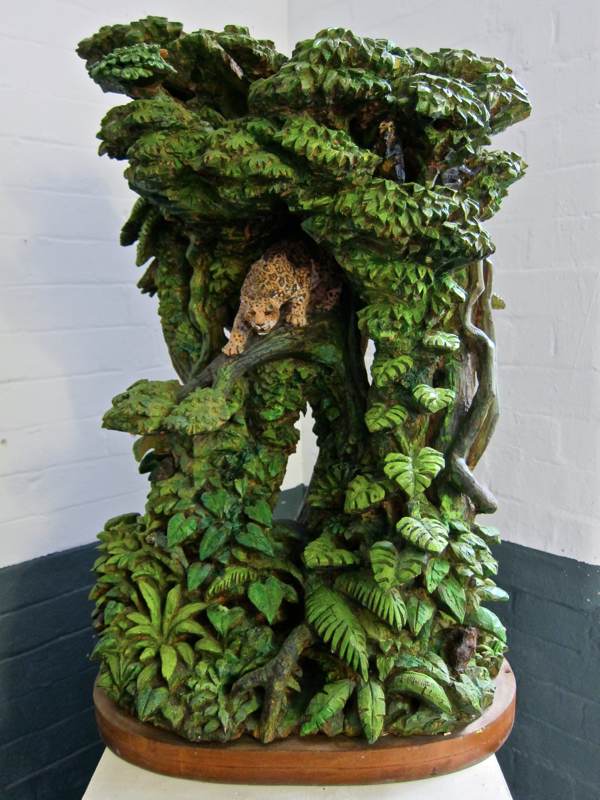
Rain Forest – painted wood enhanced with milliput
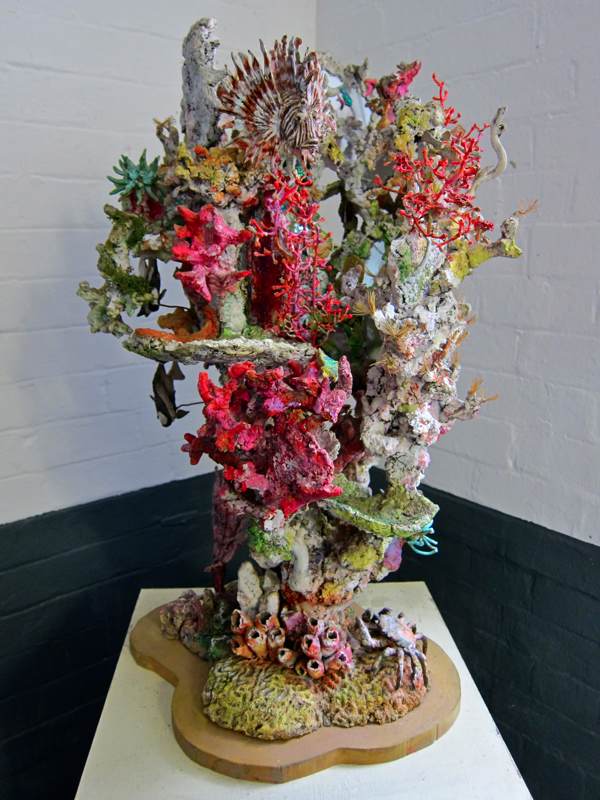
Coral Reef – paper maché and milliput
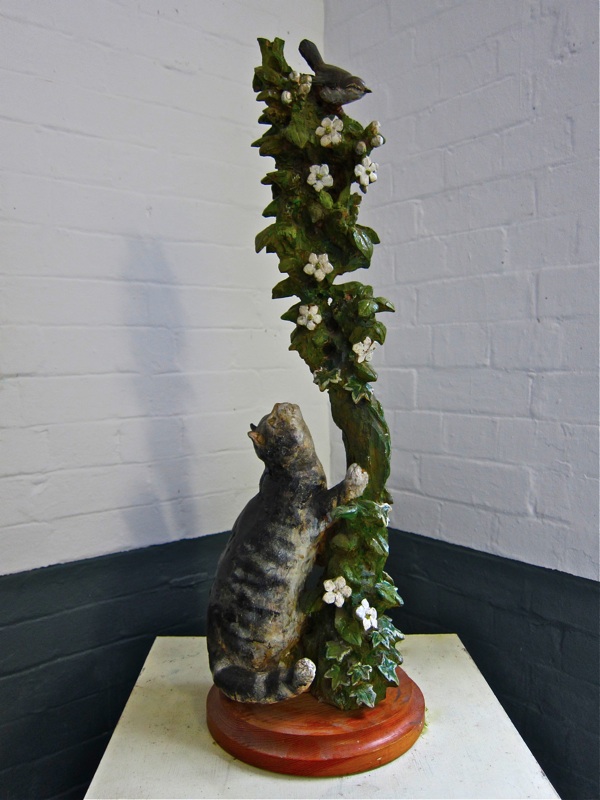
I spy breakfast – painted wood
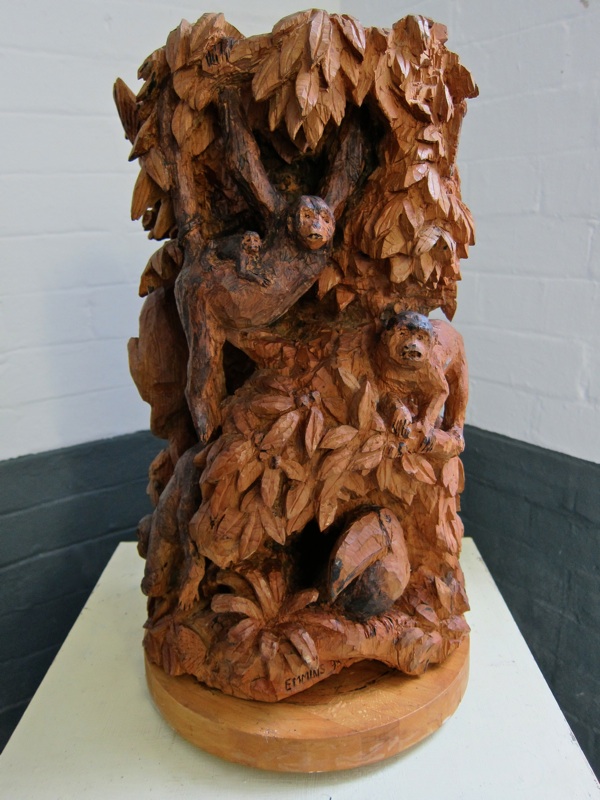
Arable Life – Cedar wood
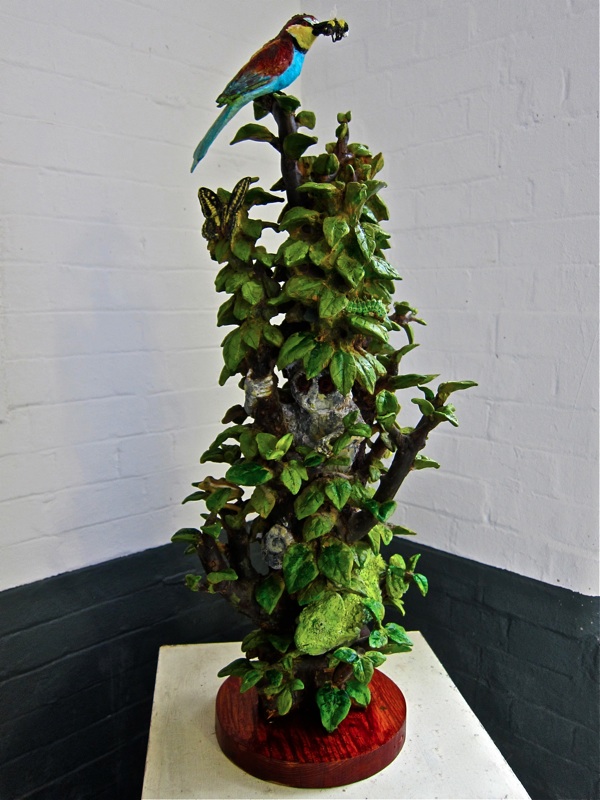
Bush Life – painted wood and milliput
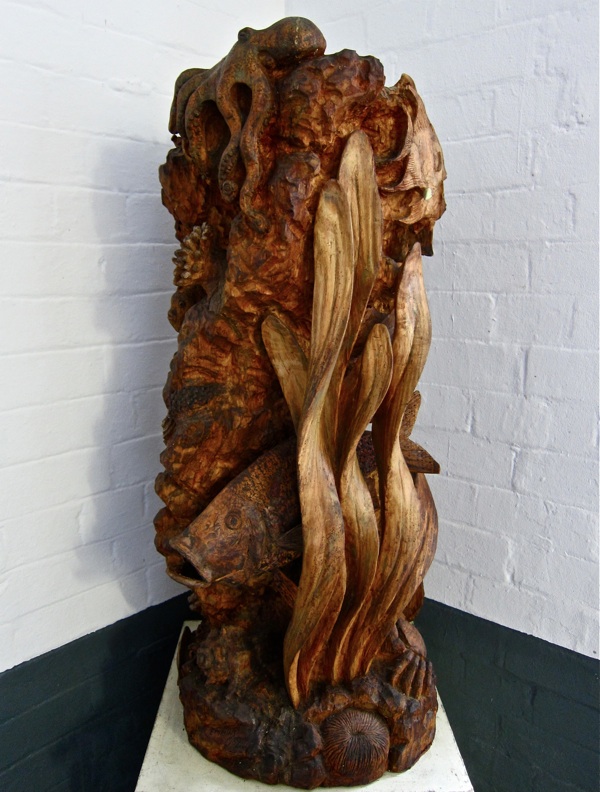
Coral Reef – ashwood
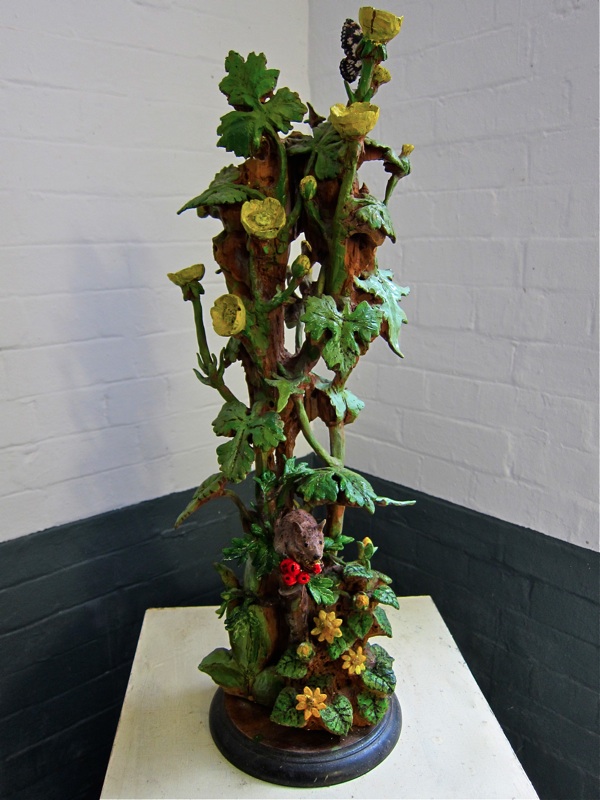
Wood Mouse & Butterfly – painted wood with milliput
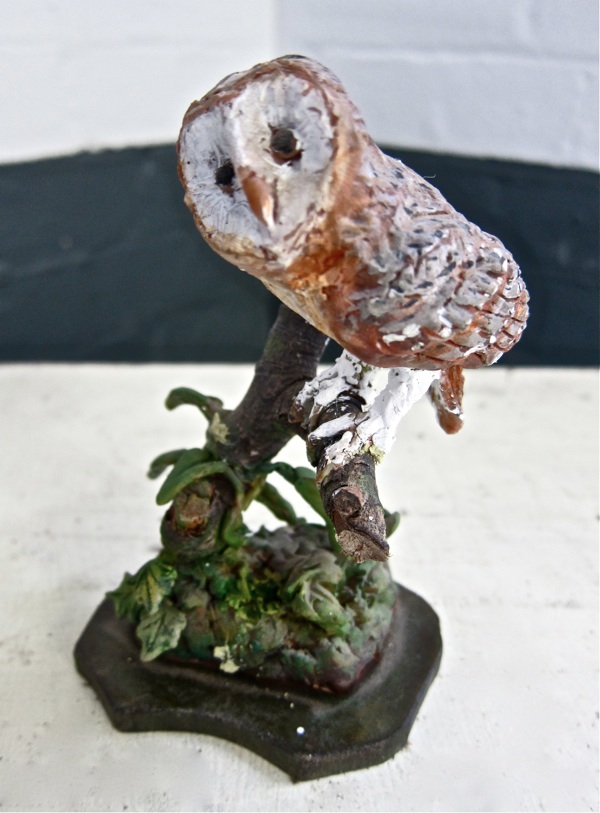
Owl – branch and painted milliput
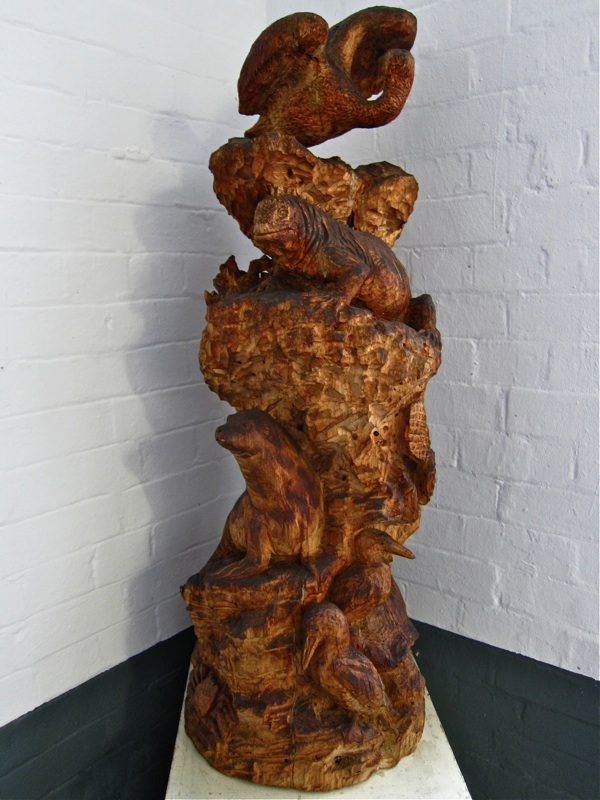
Galapagos – limewood
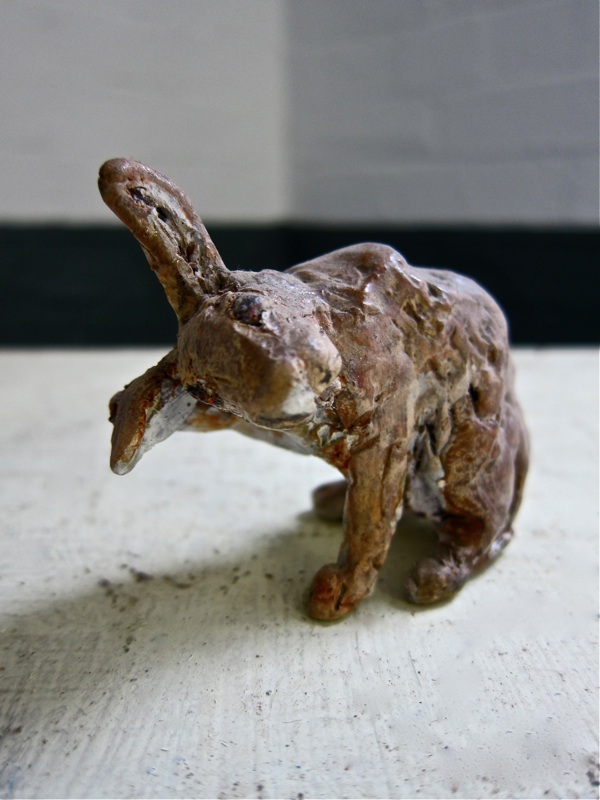
Hare – painted milliput
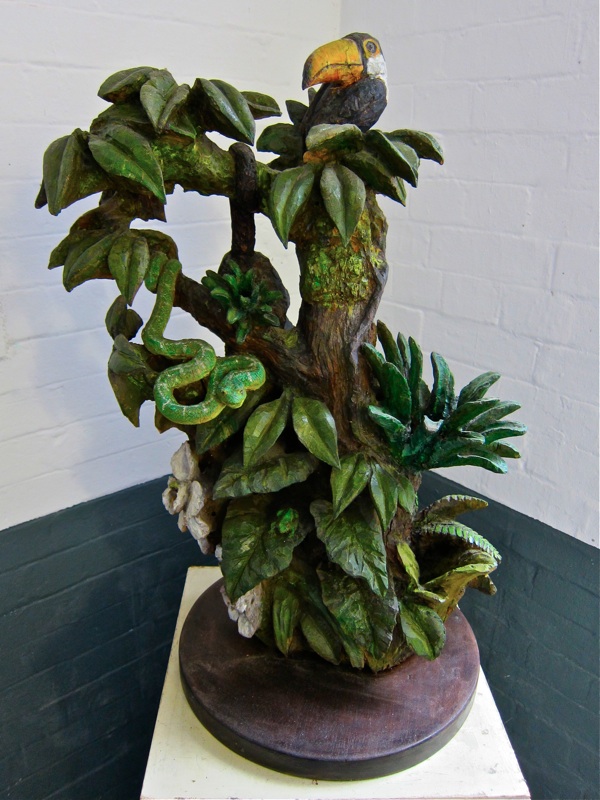
Jungle – painted Zeldovia wood
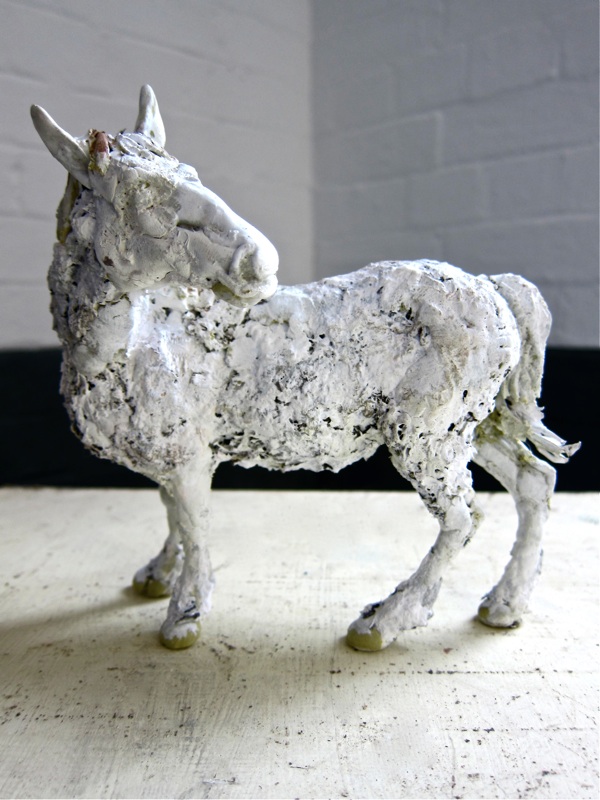
White Horse – paper maché
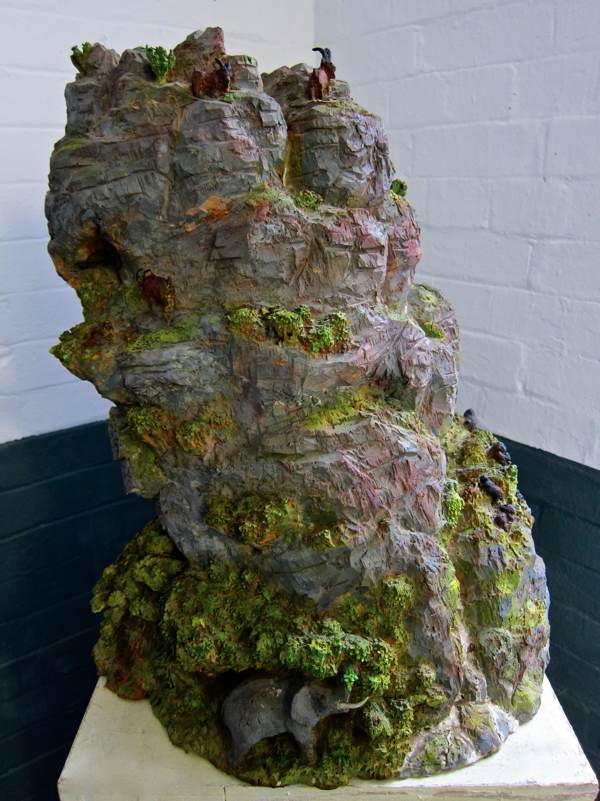
African Mountain – painted wood and milliput
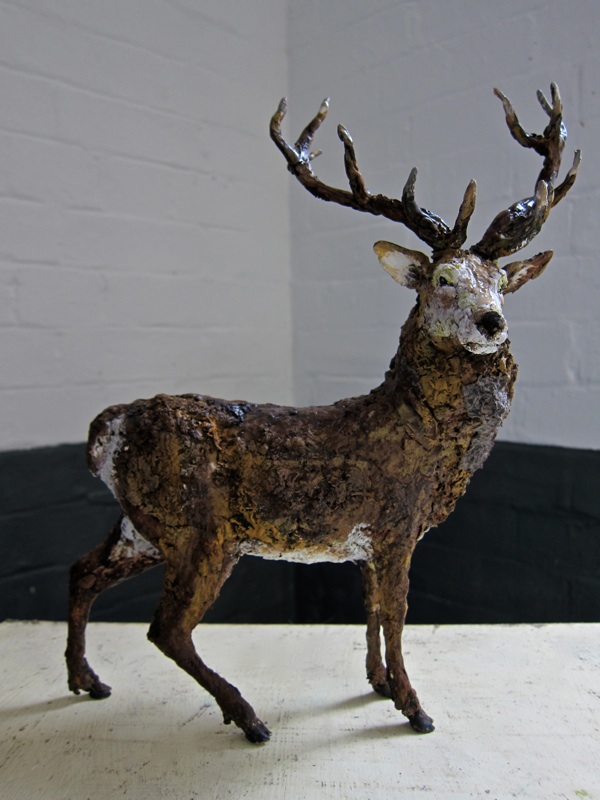
Stag – paper maché
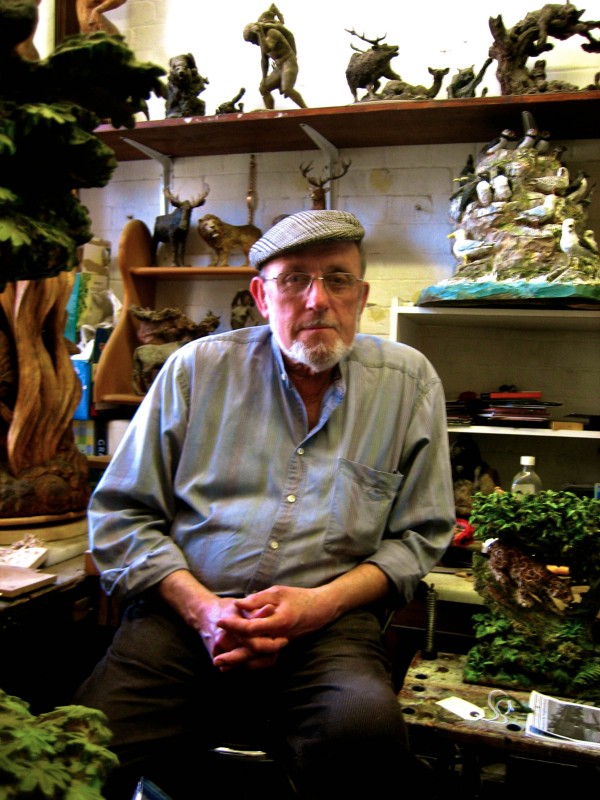
At the furthest end of Cable St are the Cable St Studios where Roy Emmins has cloistered himself for more than ten years, working six days every week, alone in a tiny workshop. A former porter at the Royal London Hospital in Whitechapel, after more than thirty years service Roy took early retirement to devote himself to sculpture, and today his studio is crammed to the roof with innumerable creations that bear testimony to his prodigious talent and potent imagination.
When Roy opened the door to me, I could not believe my eyes. There were so many sculptures, it took my breath away. With more artifacts than a Pharoah’s tomb, I did not know where to look first. Roy stood and smiled indulgently at my reaction. Not many people make it here to the inner sanctum of Roy Emmin’s imagination. He is not a demonstrative man, and he has no big explanation – not expecting praise or inviting criticism either. In fact, he has no art world rhetoric at all, just a room packed with breathtaking sculptures.
First to catch my attention were large carvings hewn from tree trunks, some in bare wood, others painted in gaudy colours like sculptures in medieval cathedrals and sharing the same vigorous poetry, full of energetic life and acute observation of the natural world. Next, I saw elaborate painted constructions in papier-mache, scenes from the natural world, gulls on cliffs, fish in the ocean, monkeys in the jungle and more – all meticulously imagined, and in an aesthetic reminiscent of the dioramas of the Natural History Museum but with more soul. I stood with my eyes roving, absorbing the immense detail and noticing smaller individual sculptures in ceramic, bronze, and plaster, on shelves and in cubbyholes. Turning one hundred and eighty degrees, I faced a wall hung with table tops, each incised with relief sculptures. I sat on a chair to collect my thoughts and cast my eyes to the window sill where sat a menagerie of creatures, all contrived with exquisite modesty and consummate skill from tinfoil and chocolate wrappers.
The abiding impression was of teeming life – every figure quick with it, as if they might all spring into animation at any moment, transforming the studio into an overcrowded Noah’s Ark, with Roy as an entirely convincing Mr Noah. Yet, in his work, Roy emulates the supreme creator, reconstructed Eden – fashioning all the beloved animals, imbuing them with life and movement, and creating jungles and forests and oceans – imparting a magical intensity to everything he touches. There is a sublime quality to Roy Emmin’s vision. Roy’s sculptures are totems, and his carved tree trunks resemble totem poles, with images that evoke the spirits of the natural world. Even Roy’s tinfoil stags possess an emotionalism – born of a tension between the heroic dignity of the creature he sculpts so eloquently and the humble material from which each figure is fashioned.
It is a paradox that Roy, an English visionary, exemplifies in his own personality, which is so appealingly lacking in ego yet tenacious of ambition in sculpture. Originally apprenticed as a graphic artist, he developed Wilson’s disease, which caused him to shake, yet spared him military service. After years attending the Royal London Hospital, a drug was founded to treat his affliction but by then, Roy admitted, he preferred the atmosphere of the hospital to the design studio because it was an environment where he always was meeting new people. Taking a job as a porter, Roy also attended evening classes at Sir John Cass School of Art in Whitechapel, pursuing painting, ceramics, life modelling, and wood-carving. Once these closed down in 1984, Roy joined a group of wood-carvers who met at the weekends in the garden studio of their ex-tutor, Michael Leman, in Greenford. When the hurricane came in 1987, they hired a crane to collect fallen trees – and one of these became Roy’s first tree trunk carving.
When he took retirement in 1995, Roy was permitted to retain his caretaker’s flat in Turner St at the rear of the hospital. After a stint at the Battlebridge Centre in King’s Cross, where he had A free studio in return for one day a week building flats for homeless people, Roy came to the Cable St Studios and has been here ever since. Always working on several sculptures at once, Roy often returns to pieces, reworking them and adding ideas, which may go some way to explain the intensity of detail and richness of ideas apparent in all his sculpture.
Looking at Roy’s work, I wondered what influence it had on his psyche, wheeling patients around for thirty years at the hospital. The sense of wonder at the natural world is exuberantly apparent, but this is not the work of an innocent either. In a major sculpture that sits outside his door entitled “The Shadow of Man,” Roy dramatises the destructive instinct of mankind, yet it is not a simple didactic work because the agents of destruction are portrayed with humanity. Again, it brought me back to medieval carving which commonly subverts its own allegory, picturing villains with charisma, and there was a strange pathos when Roy placed his hand affectionately upon the head of a figure wielding a chainsaw, a contradictory force embodying both destruction and creation.
Roy inherited his love of people from a father who worked his whole life on the railway and ended up manager of the bar on Liverpool St Station, while Roy’s mother was skilled at assembling electrical parts, which she did at home, imparting an ability in intricate work to her son. Each of Roy’s three uncles, a master carpenter, plumber and builder were model makers and Roy’s brother makes models too, though, in contrast to Roy, he makes ships and cars, mechanical things.
I am fascinated by the creative skills of working men expressed in areas of endeavour parallel to their working lives. Roy’s work exists in the tradition of the detailed handicrafts undertaken by sailors and prisoners, and the model railways of yesteryear, yet in its accomplishment and as a complete vision of the world, it transcends these precedents. Roy is a unique talent and a true sculptor who grasps of the essence of his medium.
Showing me a wire and plasticine dancer, with a skirt made from the paper cases manufactured for buns, Roy explained that a figure must have three points of contact with the ground to stand upright. In this instance, the ballerina had one foot pointing forward and a back foot that met the ground at toe and heel. Roy placed the precarious figure on a surface and, just like his spindly tinfoil creatures, it stood with perfect balance.
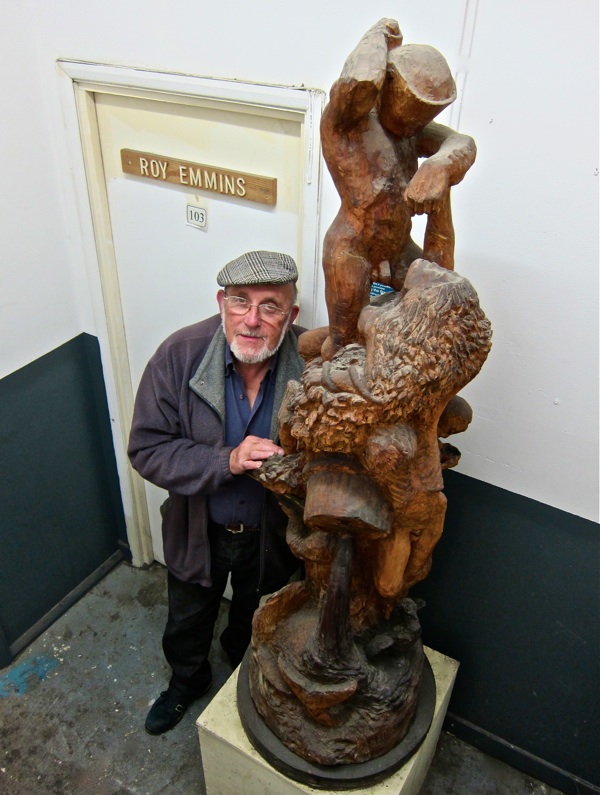
Roy Emmins with his sculpture ‘The Shadow of Man.’
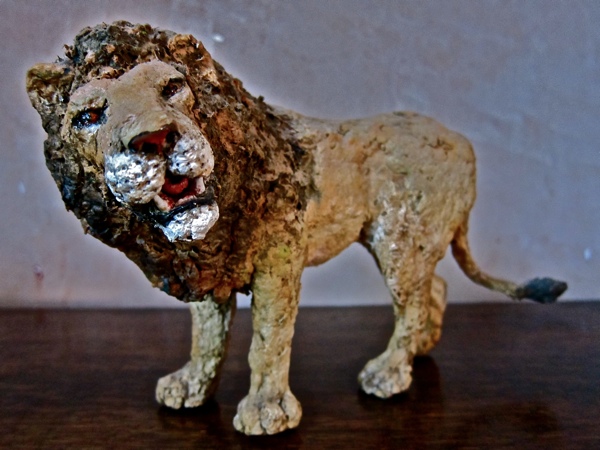
Roy’s paper maché lion sits upon my desk in Spitalfields.
A Winter Coat

The old buttons of my new inky-black soft corduroy coat
I realised that I can count the number of winter coats I have had in my life upon the fingers of my hands. And I remember most as signifying different stages in my life – including, the first blue woollen coat my mother bought for me, the school duffel coat, the expensive gabardine I left on the train, the corduroy coat my father paid for when I went to college, the secondhand tweed coat that I got to go to Moscow, the pea-coat I found at the car boot sale and the only new coat I ever bought for myself, a grey worsted overcoat, five years ago. Unfortunately, the grey overcoat does not have much warmth in it and I wear a thick sweater or sheepskin waistcoat underneath in a vain attempt to keep warm. But the outcome of these layers is that I cannot close the coat, thus defeating my original intent.
So I was grateful when Richard & Cosmo Wise invited me to pick a winter coat from the vast stock of glorious old clothes that they have sourced from rural France and Japan, some dating back to the eighteen eighties, and I walked over to their warehouse in Hackney Wick yesterday to make a selection. Yet the array of interesting clothing and pieces of rare fabric woven long ago is so diverting when you arrive at their den that the possibilities can be quite overwhelming.
Cosmo was working with a seamstress, sewing on buttons and putting the finishing touches to his collection of new clothes. Inspired by the pieces that he collects and the traditional methods of their manufacture, Cosmo has begun creating new designs executed in old or rare fabrics. And the textiles in this collection included fishermen’s mosquito nets impregnated with an insect-repellent dye that Cosmo found in Japan, mud silk that he found in Beijing, and also a transparent metallic textile used to line aircraft wings – just to bring a touch of modernity.
That afternoon, Cosmo was off to show his collection to a few buyers from selected shops at John Singer Sargent’s former studio in west London, but first he generously took me down to the stock room to choose a coat. At first Cosmo showed me one of his own designs manufactured from that attractive loose weave net that Japanese fishermen use to repel insects, but he did warn me that it would be high maintenance to repair and possibly of little warmth and, reluctantly, in spite of its swagger, this had to be laid to one side. Looking for warmth, I tried a huge blue wool coat with an astrakhan collar. “It’s heavy,” warned Cosmo, and I almost crumpled to the ground as I pulled it on, realising at once that I did not have the figure for it or wish to look like an old-school East End gangster. Next up, was a sheepskin coat that was snug but suggested that I was off on a polar expedition – I might go back and borrow this one when the blizzard hits.
Recognising that something shorter would be ideal, especially as I walk around so much, I tried a short brown woollen double-breasted jacket that was the first credible possibility and then a braided Prussian officer’s jacket which was beyond the realm of plausibility for an undemonstrative dresser such as myself.
At last, I pulled on a French hunting jacket in a wonderfully faded inky-black soft velvet cord from the mid-twentieth-century which felt it belonged to me. With a woollen lining of blue stripe, natty lapels and buttons emblazoned with horses, this comfortable worn old jacket became my new winter coat – thanks to Richard & Cosmo Wise.

A seamstress works ceaselessly, repairing old clothes and making up Cosmo’s designs.

A handsome new coat made to Cosmo’s design from Japanese mosquito-repellent fabric – but perhaps lacking warmth and a little too “Fagin” for me?

Fine blue woollen overcoat with astrakhan collar, cosy but made for someone with more figure than myself and perhaps a little too “East End Gangster” ?

Attractive and snug sheepskin coat, but perhaps too “polar explorer” for me?

Attractive short woollen double-breasted coat from Canada – a near miss.

A Prussian Officer’s Jacket with magnificent braiding – if only I had the personality it carry it off in Brick Lane.

At Richard & Cosmo’s warehouse.

Richard & Cosmo Wise can be found in the Spitalfields Market on Thursdays and at Portobello Market under the Westway on Fridays.
Read my other stories about Richard & Cosmo Wise
Richard & Cosmo Wise, Rag Dealers
Graffiti in Elder St
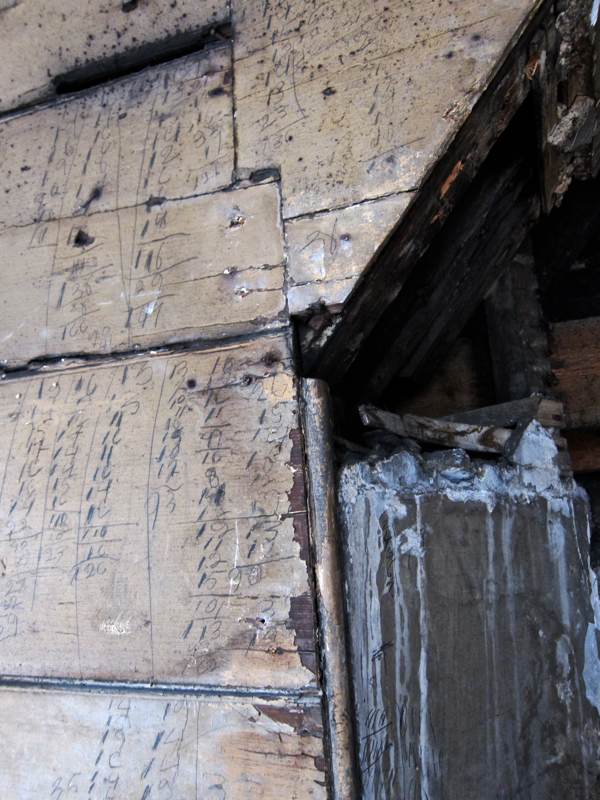
This graffiti was uncovered recently in the garret on top of an eighteenth century house on the corner of Elder St. In an irregular room that has the atmosphere of a cabin in a twisted old ship, with windows on two sides admitting maximum light for weaving or tailoring, walls slant upwards under the eaves to converge at the ridge, lined with old match-boarding once painted in white paint, now yellowed and peeling. When the place was converted for offices in the last century, plasterboard was put up to cover – and consequently protect – the old match-boarding which dates from the time this space was used for manufacture.
On my first visit, half the plasterboard still remained creating a dramatic contrast between the bland surface of the former office wall and the rich multi-layered texture of the match-board behind that carried the human presence in its wear and, most importantly, in its graffiti. There was a time when such evidence of previous occupants would be conscientiously removed but I am glad to report that the new owner of this house was delighted to discover these marks, evidencing those who came before, and invited me inside to photograph them.
Columns of numbers, scribbled hastily in pencil, record calculations that are sometimes in eights – but whether these refer to piecework or hours of labour, I could not tell. To the left in a different script, a reference to “11” wide lining” appears to be a calculation of the amount of fabric needed to line a coat. Beneath these is a French phrase in chalk which begins “N’est ce pas” followed by a word I did not recognise, but whether this indicates the presence of a French speaker or merely a French lesson, we shall never know. It does seem that a child took the same piece of chalk to draw a zig zag along the wall, which might suggest that the phrase might be part of a lesson.
There are two signatures – A.M.B. 3/8/93 and LITTA SHERMAN with illegible numbers beneath. Since these walls have been covered for decades we can assume that A.M.B. was here in August 1893, which leads me to surmise this graffiti originates from a late-nineteenth century garret clothing workshop, inhabited by a family. Children scrawling on the walls lower down and the parents tallying their work higher up. The only identity we have is Litta Sherman, a characterful name which carries its own personality, and was likely Jewish.
This graffiti feels familiar. You might see a similar form today where numbers are written around a phone at a taxi rank, or where a tally is kept on a factory or warehouse wall. There is an intimacy in such fragile pencil marks and an emotionalism in these columns of overworked digits scaling up towards the ceiling, witnessing endless labour. They speak of the time when Spitalfields was entirely given over to textile manufacturing and workers strived long hours in cramped workshops, suffering at the caprices of a volatile industry. Now, these poignant scribbles are the only evidence of those who are long gone, and they speak to me – and make me wish I could find out who Litta Sherman was.
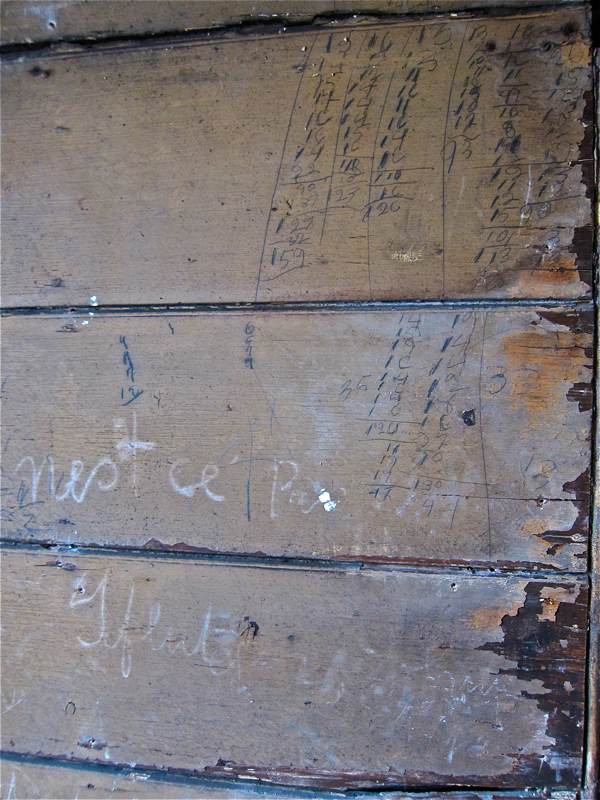
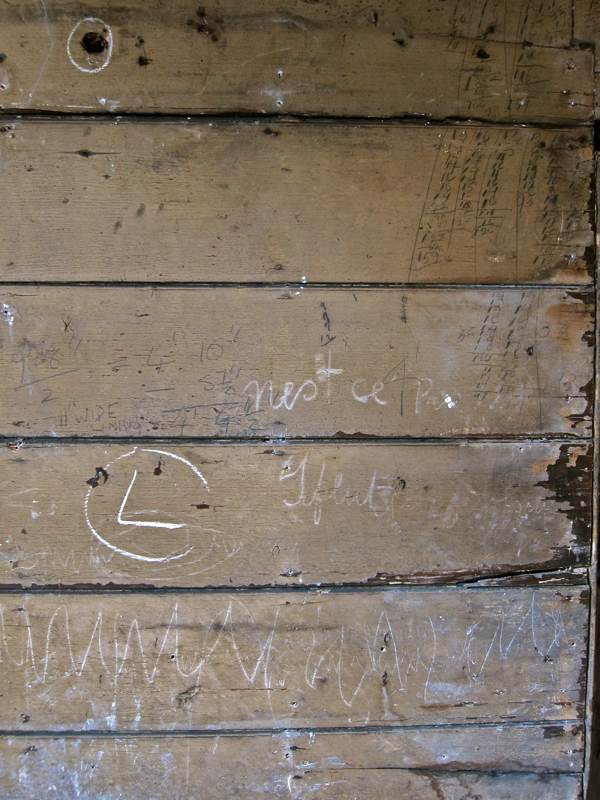
A long time ago, a child took a piece of chalk and drew a zig-zag line.
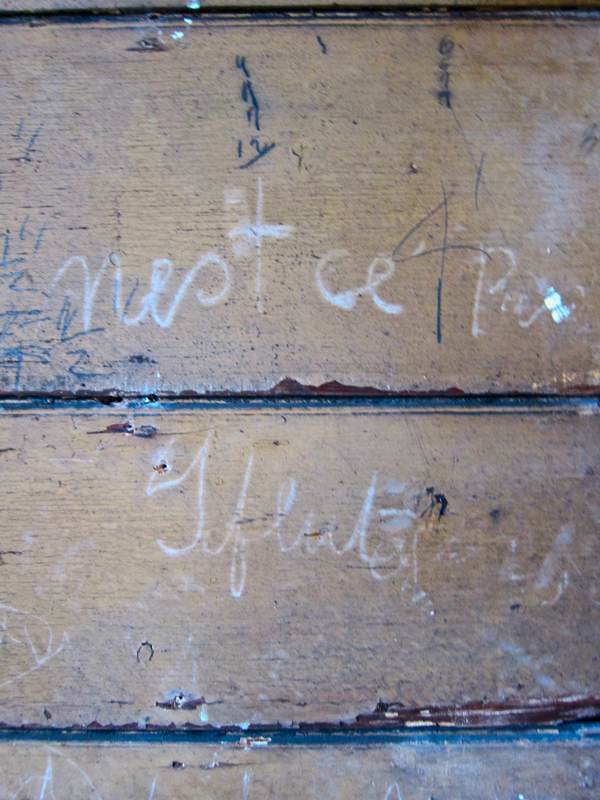
N’est ce pas …?
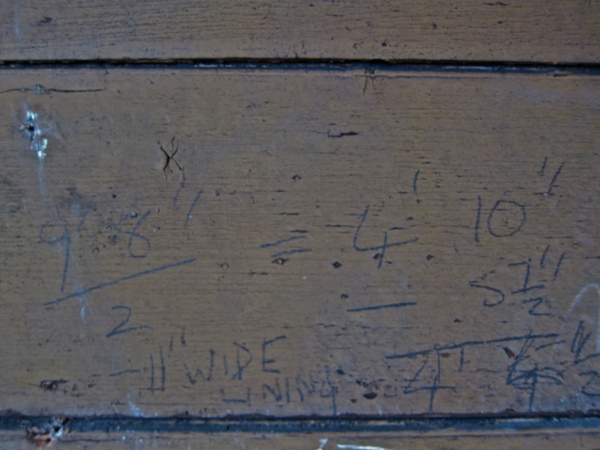
Does “11” wide lining” refer to the cloth for a coat?
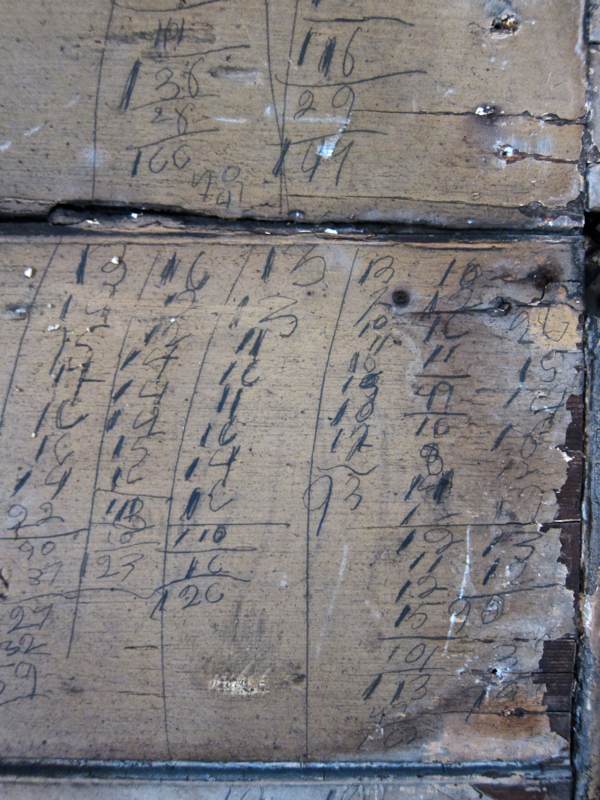
Do these calculations refer to piecework, or hours worked, or something else?
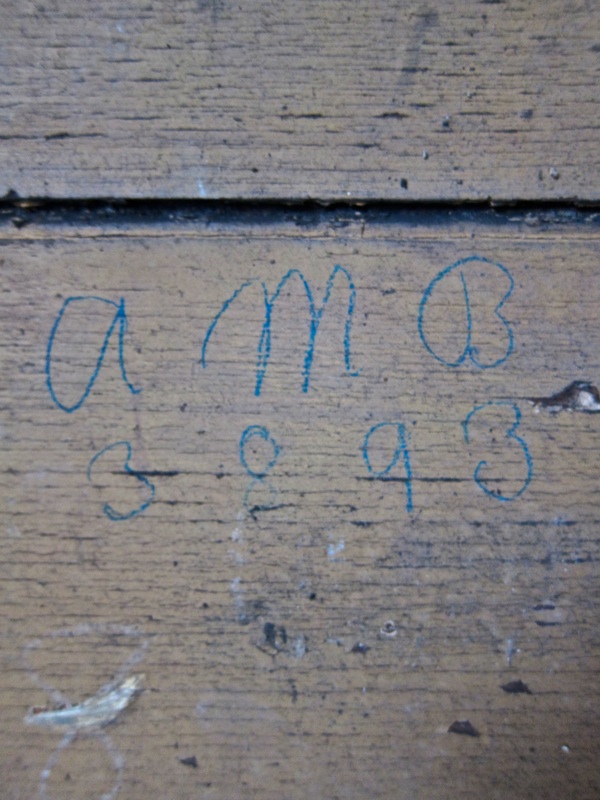
A.M.B. 3rd August 1893?
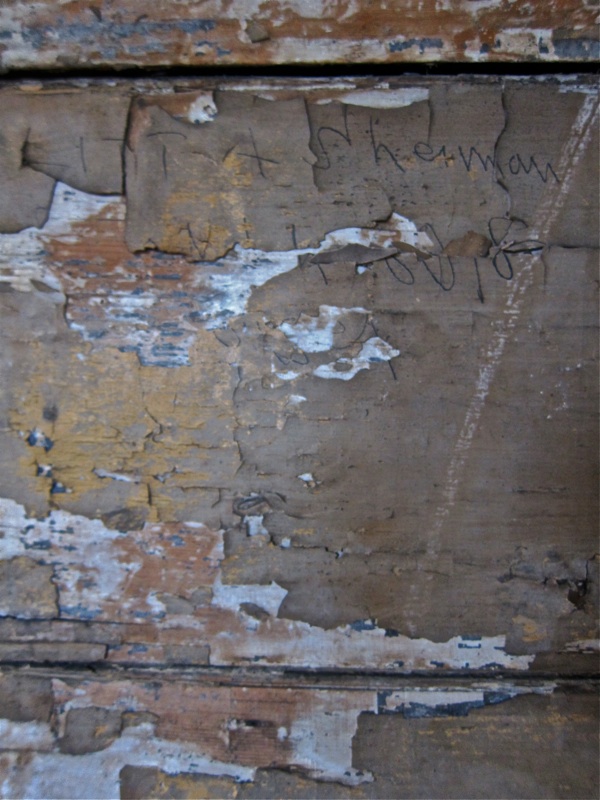
Who was Litta Sherman? Tantalisingly, the numbers beneath have been partly erased.
You may also like to read about
David Garrick at Goodman’s Fields Theatre
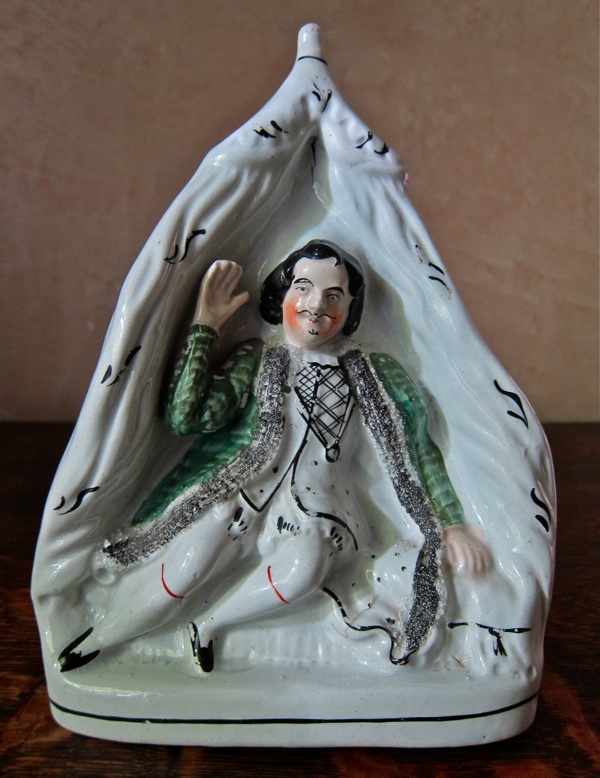
“Have mercy, Heaven” – David Garrick as Richard III
This modest Staffordshire figure of c.1840 upon my dresser illustrates a pivotal moment in British theatre, when David Garrick made his debut aged twenty-four as Richard III at Goodman’s Fields Theatre in Aldgate on Monday 19th October 1741. Based upon William Hogarth’s painting, it shows Garrick in the momentous scene on the night before the battle of Bosworth Field when those Richard has killed appear to him in a dream foretelling his death and defeat next day.
The equivocal nature of the image fascinates me, simultaneously incarnating the startling ascendancy of David Garrick, a new force in the British theatre who was to end up enshrined in Westminster Abbey, and the sudden descent of Richard III, a spent force in British monarchy who – if we are to credit the recent discovery – ended up buried in a car park in Leicester. You can interpret the gesture of Garrick’s right hand as attention seeking, inviting you to “Look at my acting” or, equally, it can be Richard’s defensive move, snatching at the air with fingers stretched out in horror. It is, perhaps, both at once. Yet my interest is in Garrick and how he became an overnight sensation, introducing a more naturalistic acting style to the London stage and leading the Shakespearean revival in the eighteenth century. And it all started here in the East End, just a mile south of Shakespeare’s first theatre up the road in Shoreditch.
Garrick’s family were Huguenots. His grandparents fled to London in 1685 and David was born in 1717 as the third of five children while his father Captain Garrick was travelling the country with a recruiting party. Suitably enough, at the age of eleven, David played the part of Kite in George Farquhar’s The Recruiting Officer. Then, in 1737, since there was no money to pay for university, David and his literary classmate Samuel Johnson left their school in Lichfield to walk to London and seek their fortunes. But the sudden death of Captain Garrick within a month delivered an unexpected legacy that permitted David to set up a wine business in the Strand with his brother Peter.
In that same year, the Licensing Act closed all the playhouses in London except Drury Lane and Covent Garden, yet the management of the unlicenced Goodman’s Fields Theatre managed to get a dispensation to present concerts. Far enough east to avoid the eye of the Lord Chamberlain, they bent the rules with posters declaring concerts – even if the performances they advertised were actually plays. Thus Richard III is advertised as a “A concert of vocal and instrumental music” at “the late theatre in Goodman’s Fields.” David Garrick’s name as the leading actor is not given, he is merely referred to as “A GENTLEMAN (Who never appeared on any stage)” – a common practice at this theatre.
Next day, the London Post & General Advertiser reported that Garrick’s “Reception was most extraordinary and the greatest that was ever known upon such an occasion.” And he wrote to his brother Peter immediately, quitting the wine business,“Last night, I play’d Richard ye Third, to ye Surprize of Every Body & as I shall make near £300 p Annum by It & as it is really what I doat upon I am resolv’d to pursue it.”
Garrick continued playing Richard throughout his career, essaying the role as many as ninety times, and this account written years later for The Gentlemen’s Magazine may give us some notion of his performance. “His soliloquy in the tent scene discovered the inward man. Everything he described was almost reality, the spectator thought he heard the hum of either army from camp to camp. When he started from his dream, he was a spectacle of horror. He called out in a manly tone, ‘Give me another horse.’ He paused, and, with a countenance of dismay, advanced, crying out in a tone of distress, ‘Bind up my wounds,’ and then falling on his knees, said in a most piteous voice, ‘Have mercy, Heaven.’ In all this, the audience saw the exact imitation of nature.”
By 27th November 1741, Garrick’s performance had turned into a phenomenon which all of London had to see, as The London Daily Post described, “Last night there was a great number of Persons of Quality and Distinction at the Theatre in Goodman’s Fields to see the Play of Richard the Third who express’d the highest Satisfaction at the whole Performance, several hundred Persons were obliged to return for want of room, the house being full soon after Five o’Clock.”
Yet the success that Garrick brought to the Goodman’s Fields drew attention to the unlicensed theatre – forcing its closure within six months by the authorities, encouraged by the managements of Drury Lane and Covent Garden who were losing custom to their East End rival. Meanwhile, Garrick considered his options and, after a triumphant summer season in Dublin, he walked onto the stage of Drury Lane as an actor for the first time on October 5th 1742 and he had found his spiritual home.
The myth of Garrick as the gentleman who stepped onto the stage, drawn magnetically by his powerful talent and declared a genius of theatre upon his first appearance, concealed a more complicated truth. In fact, Garrick had taken his first professional speaking role on the stage that summer in Ipswich, appearing under the name Lyddall. His own play, Lethe or Aesop in the Shades, had been produced at Drury Lane the year before. And, having played Harlequin in an amateur performance in the room above St John’s Gate in Clerkenwell, he took over at Goodman’s Fields Theatre one night when the actor performing the role became sick. So Richard III was far from Garrick’s first time in front of an audience, although it was the moment he chose to declare his talent, and it is likely that he made significant preparation.
Whenever I look at my Staffordshire figure of Garrick, whether he appears to be waving joyfully or reaching out in despair at the universe is an unfailing indicator of my state of mind. Ironically, Garrick’s monument in Westminster Abbey follows a similar design with a tent rising to a central apex, surrounding an effigy of the great actor making his final curtain call, yet here the proud gesture is entirely unambiguous, he’s saying “Look at me!”
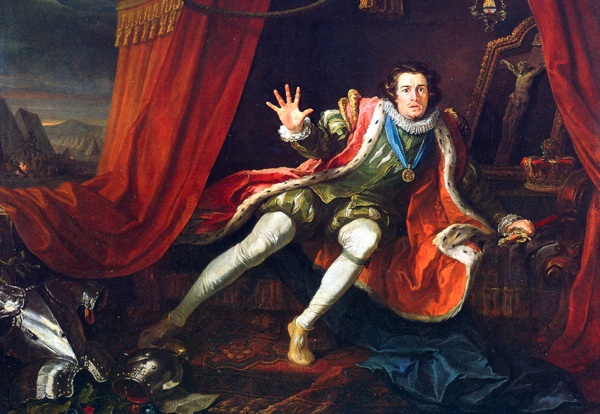
William Hogarth’s painting of David Garrick as Richard III, 1745.
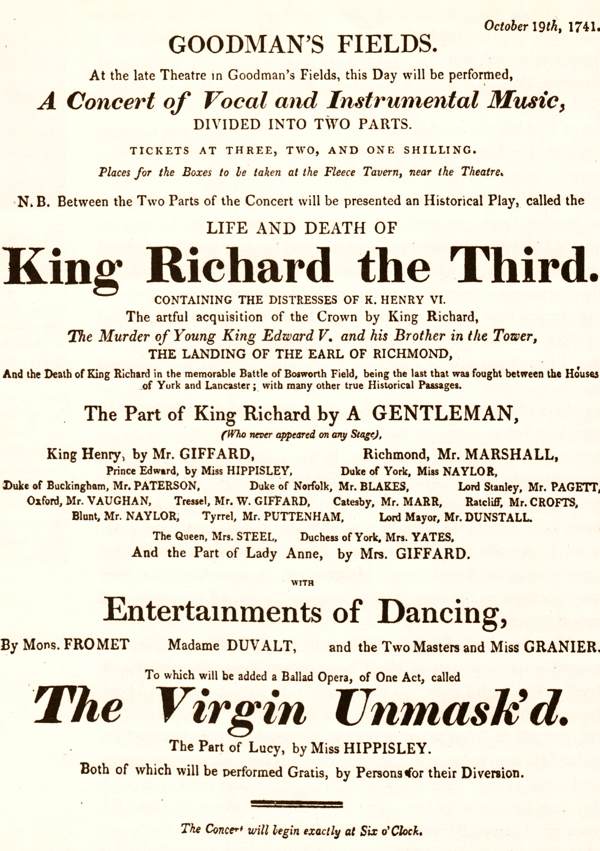
The playbill for David Garrick’s debut at Goodman’s Fields Theatre.
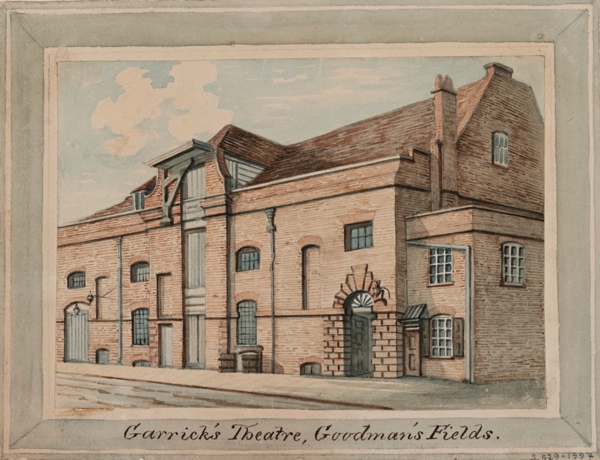
The Goodman’s Fields Theatre, Ayliffe St.
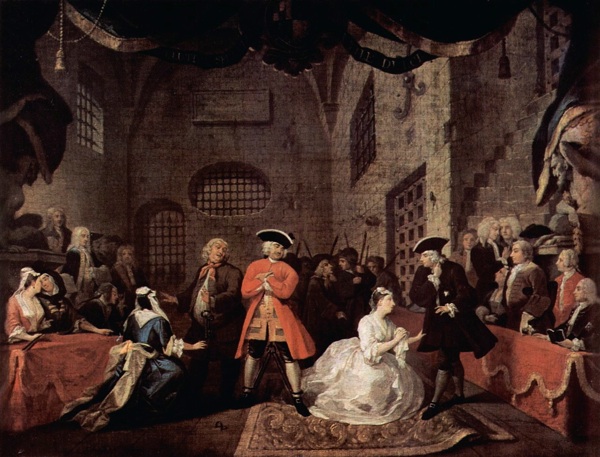
William Hogarth’s painting of The Beggar’s Opera by John Gay, performed as the closing production at Goodman’s Fields Theatre on May 27th 1742.
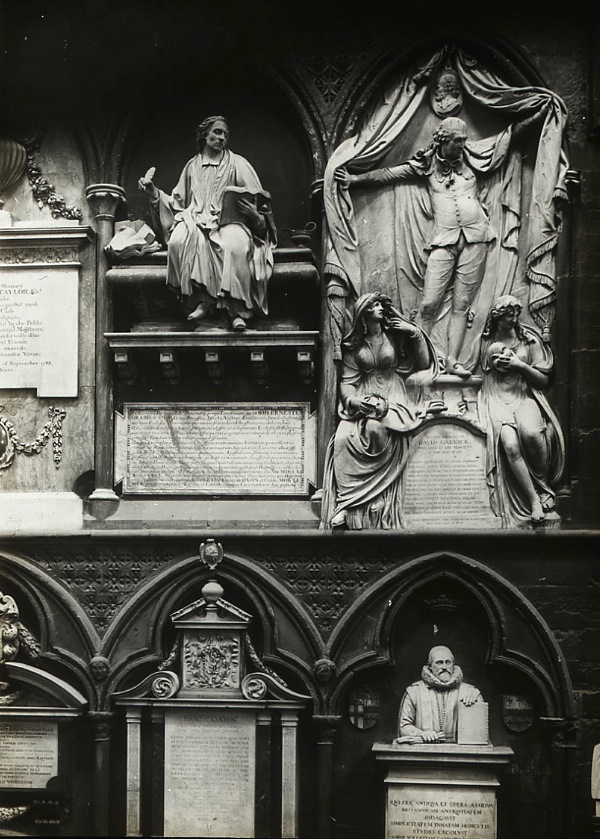
David Garrick’s monument in Westminster Abbey is to be seen on the top right of this glass slide.
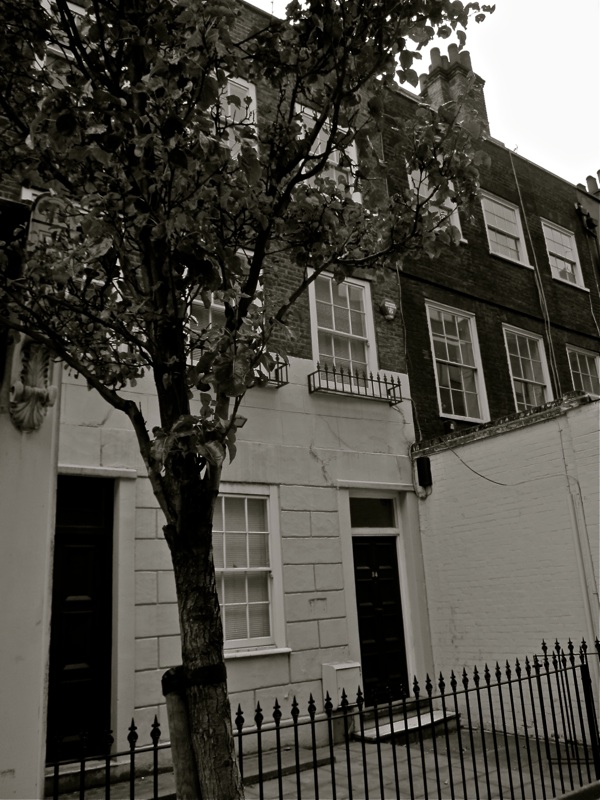
An eighteenth century terrace in Alie St, formerly know as Ayliffe St.
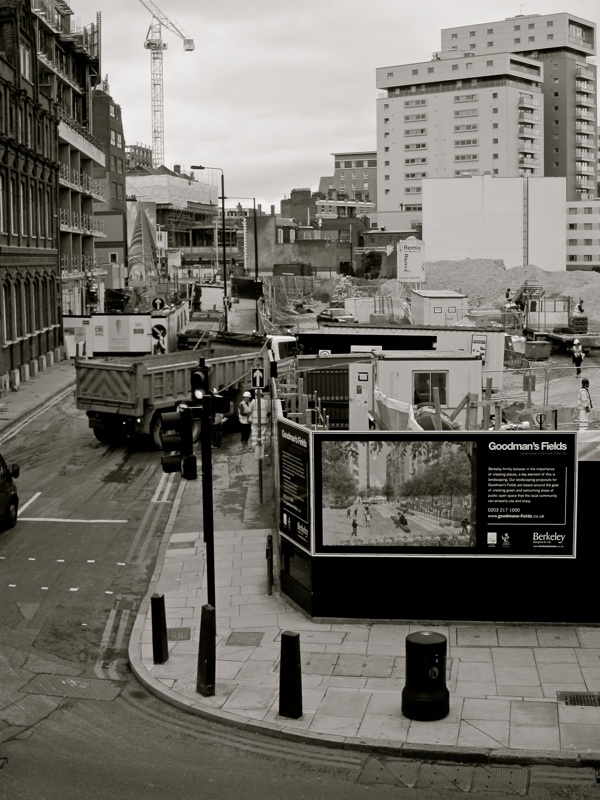
Goodman’s Fields today.
Watercolour of Goodman’s Fields Theatre copyright © Victoria & Albert Museum
Glass slide of Garrick’s monument copyright © Bishopsgate Institute
You may also like to read about
Fire At Crescent Trading
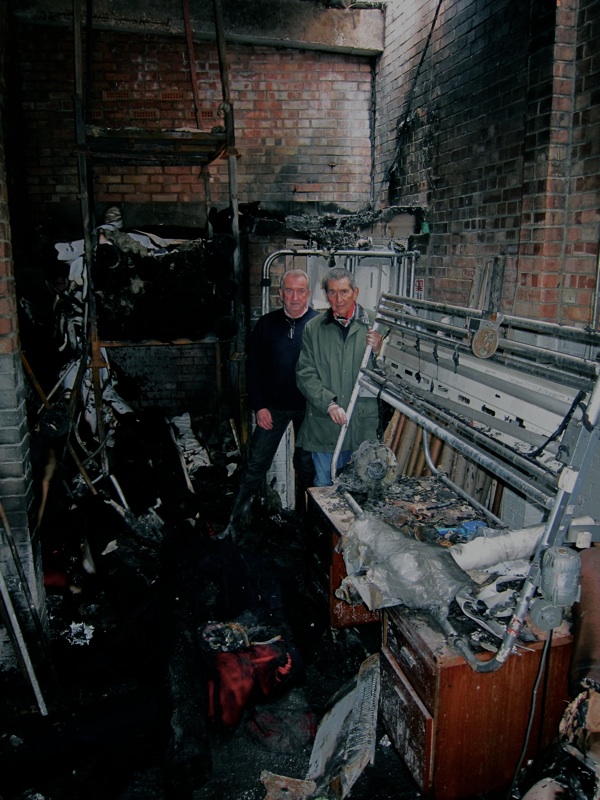
Philip Pittack & Martin White, cloth merchants – “We’re destroyed here!”
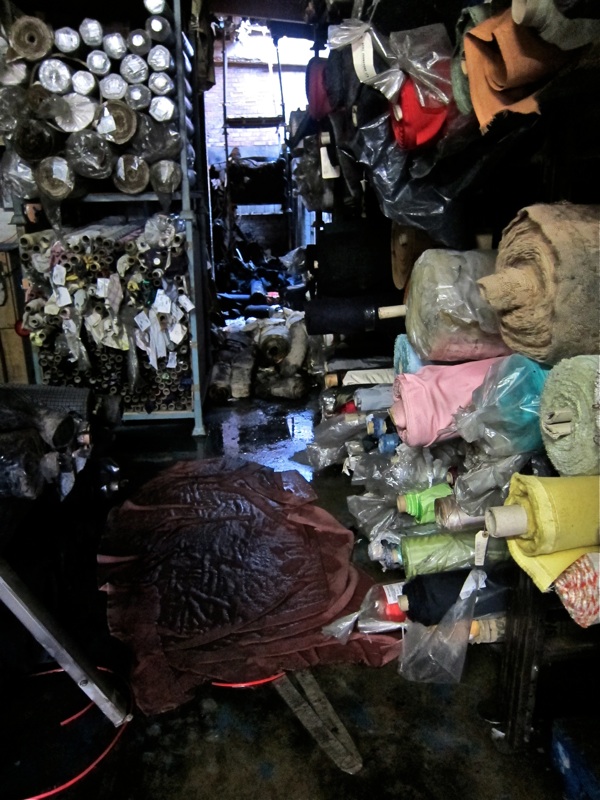
“A lifetime’s work has gone up in smoke” declared Philip Pittack, standing in the ruin of the Quaker St premises where he operated Spitalfields’ last cloth warehouse with his partner Martin White, until the recent conflagration. Just two years ago, Philip & Martin were forced to move their business, Crescent Trading, from the old stable across the road and they set themselves up again in their new premises with all their cherished fabrics neatly arranged in metal racks stretching up to the ceiling. Celebrated equally for their ceaseless repartee and their extraordinary bargains, this new calamity is a cruel blow for these two popular gentlemen who, between them, possess over one hundred and twenty years of experience in the trade.
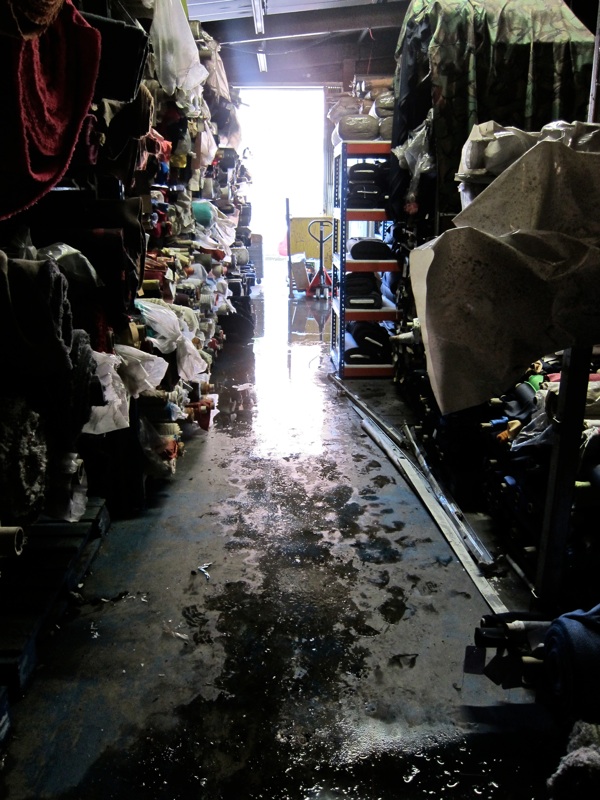
When I received Philip’s emotional phone message, I went round next morning to discover the warehouse flooded and a hole in the roof at the rear where the fire started. Just the night before, Philip recalled – savouring the tender memory – he and Martin had been celebrating at the Mansion House in the City of London, where designs by a student they sponsored were the centrepiece of an evening promoting British wool. Yet next morning, Philip woke to news of a different sort.
“I got a call at 7:45 from the manager of City Electrical next door to say there had been a fire. ‘You’d better get down here,’ he said.” Philip told me, taking a seat in his office in spite of the pool of water covering the floor,“Obviously, I was in shock but I got dressed, jumped in the car and flew down here. Coming along Grey Eagle St, I saw the back door hanging off and smoke billowing out and I felt sick. The manager of City Electrical said, ‘You’ve had a big, big, fire.’ and I said, ‘I don’t want to go in,’ but he guided me through the entrance that had been cut in the door by the firemen and I fell to my knees. I couldn’t speak for an hour, I was so shocked. He gave me a glass of water but I couldn’t drink it I was shaking so much. Then Martin arrived and we just sat and looked at the devastation.”
Even in such circumstances, Philip & Martin managed to retain their dignity and their dapper appearances – Philip in a fine Guernsey sweater, and Martin swathed in a silk scarf and with his monocle swinging. “It took four of us all day to get the water out and we ruined our ordinary shoes, so Martin went over to Blackmans in Cheshire St but they had sold out of Wellingtons and he came back in these designer boots.” continued Philip, with Martin leaning on the doorpost modelling the fancy footwear in question, “Fortunately, by the time I got there the delivery of Wellington boots had arrived.”
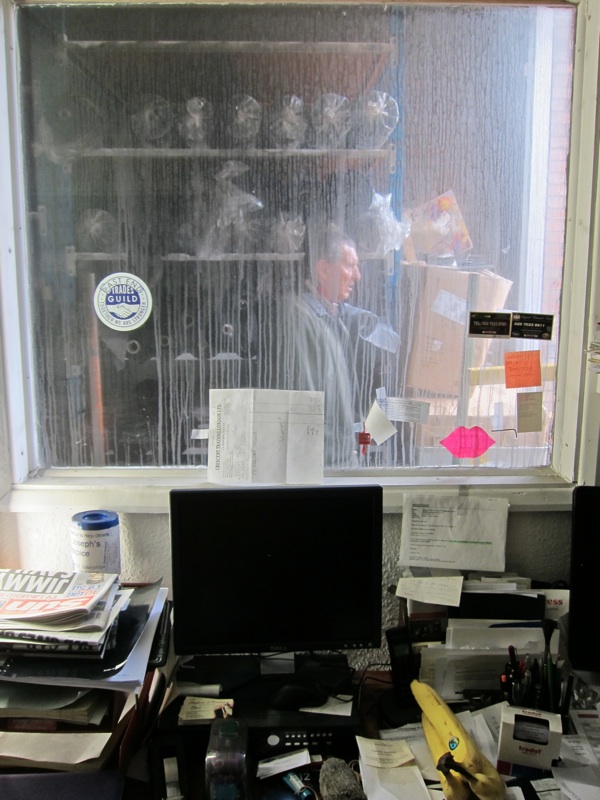
An electric fire appears to be the cause of the fire which, mercifully, was restricted to the corner of the warehouse, although heat caused the roof to buckle and smoke filled the whole building, permeating the precious rolls of fine suitings and silks. “We’ve had customers coming in and they’ve gone out crying, saying, ‘What are we going to do now?'” Philip confessed to me, wringing his hands in contemplation of the question. This is the beauty of Crescent Trading. There is a joyous rapport that exists between Philip & Martin and the fashion students and young designers who come to discover fabrics and be inspired, delighting in the knowledge and experience on offer that is always dispensed with wit and levity. It is a human exchange that is cultural as much as it is commercial, and it makes all parties happy.
Facing such a disaster at this point in their careers, many would expect Philip & Martin to retire. Yet I am delighted to report that their spirit is stronger than this. Both worked a lifetime as cloth merchants and come from families that have been in the trade for generations. As soon as it can achieved, they plan to repair the building, clean out the premises and restock. As the last cloth warehouse in Spitalfields, a place that for centuries was filled with cloth warehouses, we need them to carry the living history of the textile industry here.
“We’ve been knocked down, but we will get up again and we’ll be back,” Martin assured me.
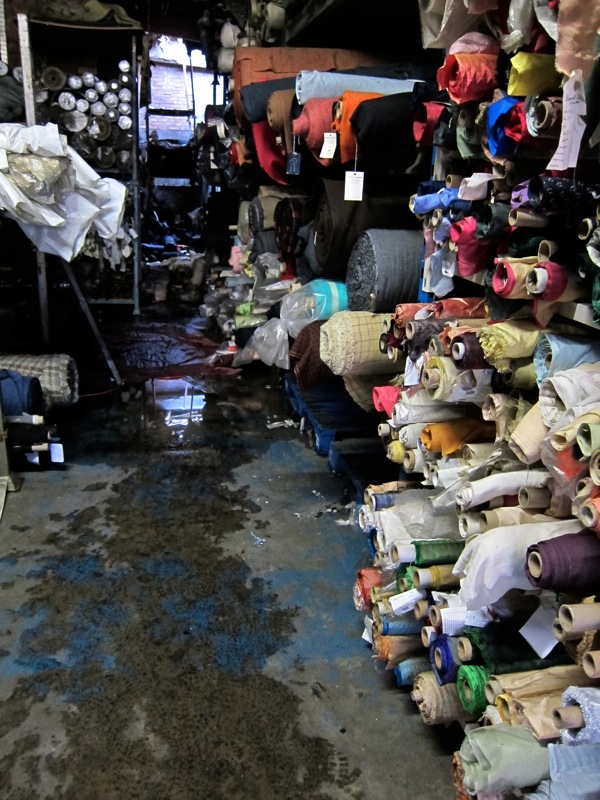
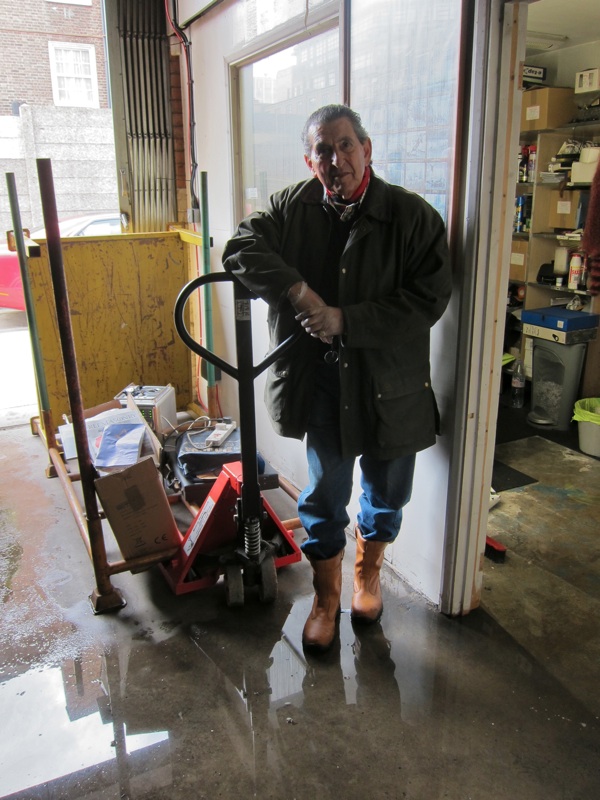
Martin White “I could easily get depressed but I’m not a miserable person.”
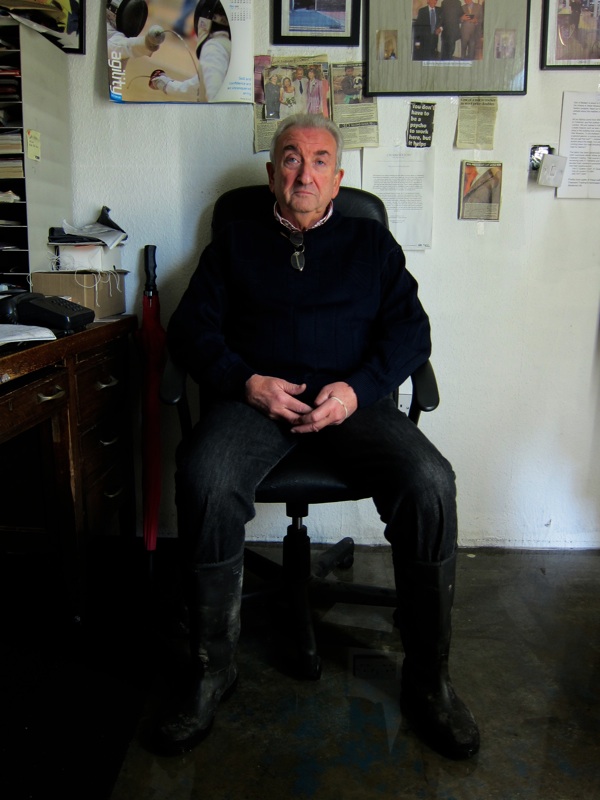
Philip Pittack – “I was in a terrible state for three days.”
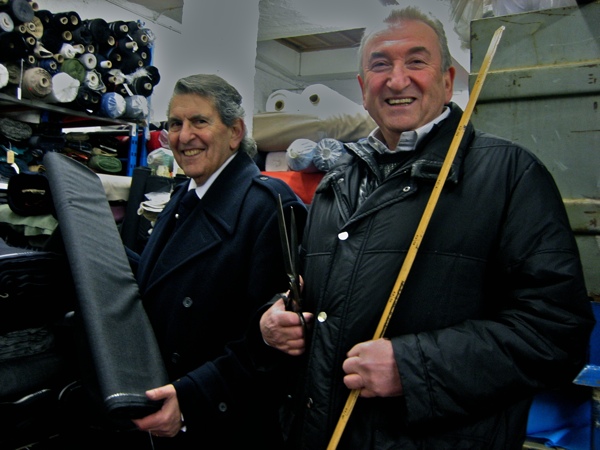
Philip & Martin in happier times.
If you would like to buy any of Crescent Trading’s stock of fabric call 0207 377 5067
You may like to read my earlier stories about Crescent Trading
The Pubs Of Old London

The Vine Tavern, Mile End
I cannot deny I enjoy a drink, especially if there is an old pub with its door wide open to the street inviting custom, like this one in Mile End. In such circumstances, it would be affront to civility if one were not to walk in and order a round. Naturally, my undying loyalty is to The Golden Heart in Commercial St, as the hub of our existence here in Spitalfields and the centre of the known universe. But I have been known to wander over to The Carpenters’ Arms in Cheshire St, The George Tavern in Commercial Rd and The Grapes in Limehouse when the fancy takes me.
So you can imagine my excitement to discover all these thirst-inspiring images of the pubs of old London among the thousands of glass slides – many dating from a century ago – left over from the days of the magic lantern shows given by the London & Middlesex Archaeological Society at the Bishopsgate Institute. It did set me puzzling over the precise nature of these magic lantern lectures. How is it that among the worthy images of historic landmarks, of celebrated ruins, of interesting holes in the ground, of significant trenches and important church monuments in the City of London, there are so many pictures of public houses? I can only wonder how it came about that the members of the London & Middlesex Archaeological Society photographed such a lot of pubs, and why they should choose to include these images in their edifying public discourse.
Speaking for myself, I could not resist lingering over these loving portraits of the pubs of old London and I found myself intoxicated without even lifting a glass. Join me in the cosy barroom of The Vine Tavern that once stood in the middle of the Mile End Rd. You will recognise me because I shall be the one sitting in front of the empty bottle. Bring your children, bring your dog and enjoy a smoke with your drink, all are permitted in the pubs of old London – but no-one gets to go home until we have visited every one.

The Saracen’s Head, Aldgate

The Grapes, Limehouse

George & Vulture, City of London

The Green Dragon, Highgate

The Grenadier, Old Barrack Yard

The London Apprentice, Isleworth

Mitre Tavern, Hatton Garden
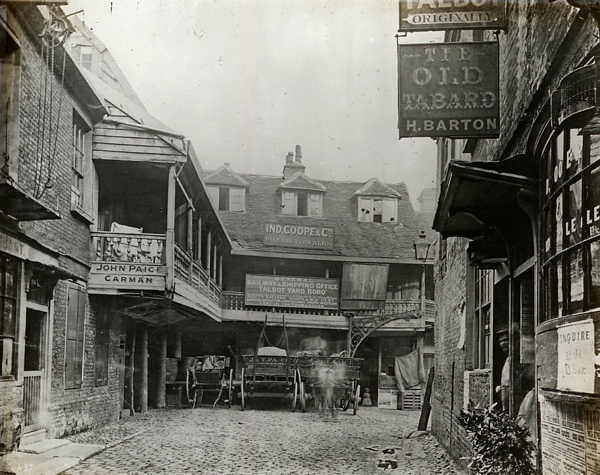
The Old Tabard, Borough High St

The Three Compasses, Hornsey

The White Hart, Lewisham

The famous buns hanging over the bar at The Widow’s Son, Bow

The World’s End, Chelsea, with the Salvation Army next door.

The Angel Inn, Highgate

The Archway Tavern, Highgate

The Bull, Highgate

The Castle, Battersea

The Old Cheshire Cheese, Fleet St

The Old Dick Whittington, Cloth Fair, Smithfield

Fox & Crowns, Highgate

The Fox, Shooter’s Hill


The Albion, Barnesbury

The Anchor, Bankside

The George, Borough High St
Images courtesy Bishopsgate Institute
You may also like to read about
Sandra Esqulant, The Golden Heart
The Carpenter’s Arms, Gangster Pub
Other stories of old London












