
Norman Riley, Metalworker
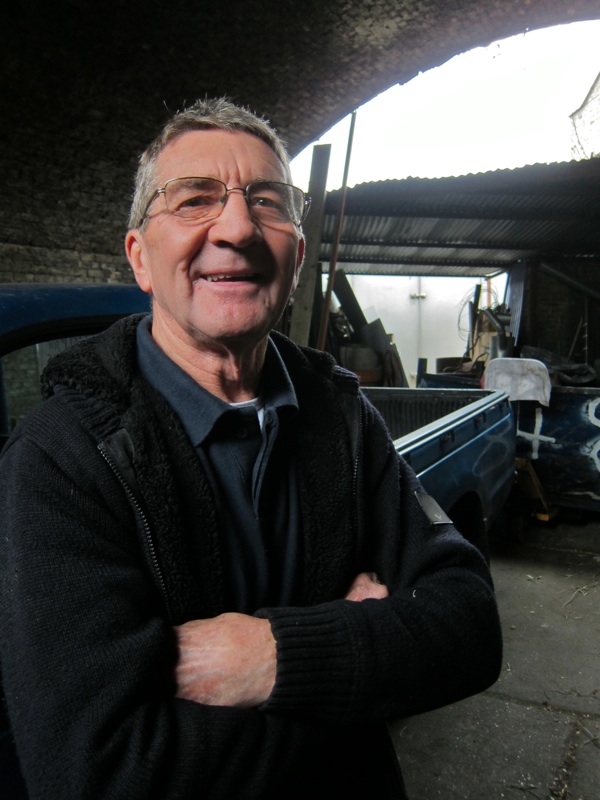
Norman Riley
If you are looking for a corner of the old East End, head over to Stepney where – just south of St Dunstan’s – you will find a few streets lined with neat terraces of brick cottages and a cluster of traditional businesses occupying the crumbling railway arches. This neglected enclave is a fragment that constitutes a reminder of how the entire territory used to be before the bombing and the slum clearances. And, at the heart of it, you will discover seventy-four year old Norman Riley, presiding over the family metal work business that he began under an arch forty years ago in a street that he has known his whole working life.
A notice in flamboyant fairground script, hanging beneath a wrought iron bracket which once suspended the pawnbroker’s sign in the Commercial Rd, announces “Riley & Sons, Metal Work,” and you step through a pillar-box-red metal door of Norman’s own construction to enter his world. “I thought I was going to be downtrodden,” Norman admitted to me later, once he had shown me round the beautiful metal works, “but I’ve come through.”
Energetic and brimming with generous sentiment, Norman occasionally had to break off his monologue whenever the intensity of emotion overcame him. From the stained glass windows that once adorned the bar at Baker St Station now gracing the kitchen, the vast collection of old tools and machines all maintained in working order and cherished, the crisp paint work in colours popular half a century ago and the overall satisfying sense of order and organisation, it was clear that Norman loves his workshop.
Yet I soon discovered that Norman is passionate about everything, eager to wring the utmost from all experiences, as revealed by his constant mantra during our conversation, “It’s part of life isn’t it?” This simple phrase, capable of infinite nuance and proposing a question that can only be answered in the affirmative, has become Norman’s philosophy and his consolation.
“I’m a Walthamstow boy and, although I was born in 1939, I was born lucky. When I go on holiday, people always ask, ‘What’s Norman been up to?’ because things happen to me. My father was a window cleaner but nobody wanted their windows cleaned during the war. I remember my mum said, ‘We’ve got to have some money for the kids,’ and she gave me and my brother an Oxo cube for dinner. The school I went to was rough and ready, but the policemen’s kids, they had lots of pocket money, and if a kind one was eating an apple, you’d say, ‘Two’s up?’ and they’d give you the core to eat. The only thing I had was football, we made a ball out of rags and bits of string. I was always filthy because we had no bath. I feel five hunded years old when I talk like this. Those were cup of sugar days.
We left and went to Nazeing to a live in a derelict cottage. We just put straw down on the floor with sacks and slept on it. I remember the first time I tasted an orange. The Italian Prisoners-of-War were allotted certain amount of fruit and big Tony, he cut his orange in half and gave it to me and my brother. When I was six, I drove up the cows up the lane to be milked and back again. I lay there feeding a lamb in the straw once and cried my eyes out at the beauty of it. I went to school at Bumble’s Green. I went back ten years ago to see the duck pond and they still had the register with me and my brothers name in it and I cried my eyes out again.
My first job, at fifteen years old, was just down the road from here at Bromley Sheet Metal in Lowell Rd. I was in a team of guys and we worked all over the East End, and lagging the gasometers down at Purfleet. We lagged asbestos with metal and we smeared asbestos on our heads to look like Geoff Chandler. I worked in six to eight different power stations in London.
We used to watch Sammy McCarthy box, he was the dockers’ boxer. The docks were going strong then and Sally who lived along the road, she decided to make a cafe in her house for the dockers. You went downstairs to the kitchen to get your food and then ate it upstairs in the living room. Only I never got to eat anything because there was all these dockers slinging it about, they made me laugh so much I couldn’t eat my lunch.
I did National Service and it changed my life. It took me out of my world and into a different arena. I’m still in touch with the guys I was in my tent with in Nicosia. I made friends with Martin Bell, he’s a smashing bloke. I’d never spoken to a kid from a posh school before and he’d never spoken to anyone like me.‘Up to those days, I’d always looked over the fence at real people,’ he said to me, ‘But when they told me to fuck off, I knew I was one of them.’ I met my wife after I came back but I had some problems staying indoors because I’d lived in a tent so long.
We got married the same day as my mother-in-law, she got married in the old church in Stoke Newington and we got married in the one opposite. We flew over to Majorca and took my bivouac with us. It was completely dark there and we were lighting matches to see, so we got over a wall and pitched the tent on the green with broom handles as poles. When we woke up, we were on a building site with four workmen looking down at us. But they let us stay, and we went down to the sea each day. And that’s how I started my married life. We lived on cornflakes we took with us because we had no spending money.
How I got this arch? It was for rent and I was here for a year and a half, and I loved it. After two years, I wanted to give the lady who owned it some flowers because I was so happy here. But they said, ‘She’s just passed away.’ I asked if it would be possible to buy it, and they said you pay seven years rent and I bought it. It touched me when I got the deeds because they were written on parchment and it was a stable with five stalls and a hayloft, 1849. There were two bombed cottages next door that were derelict because nobody wanted them so I was able to buy them and expand. My two boys came over and did welding when they were twelve years old, and now my son Chris works here with me.
I was always shy but the army opened me up, that and going to all different places. I never wanted to go out because I didn’t know what life held for me. I never thought I’d own a car, I never thought I’d own a house. I’m so lucky, I’m two pound less now than when I come out the army fifty-five years ago – I’m fit, because I’m here every day working.”
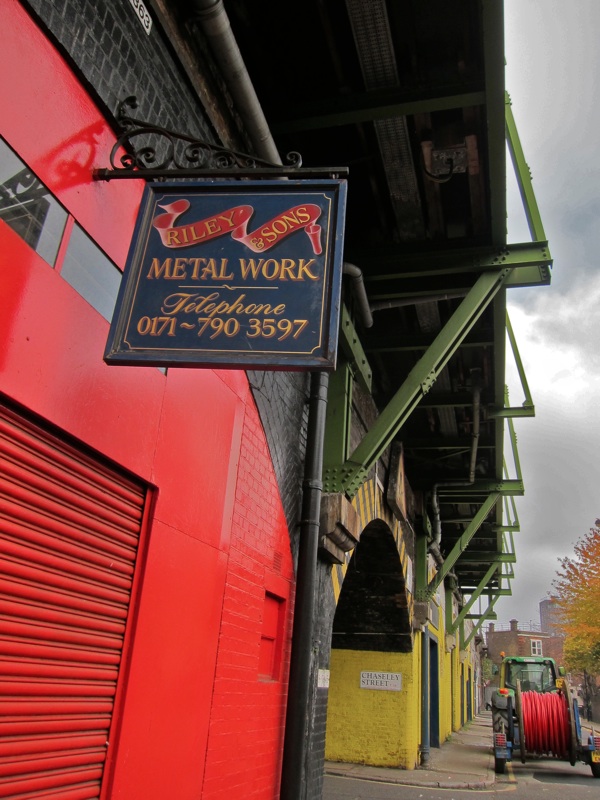
This bracket once suspended the pawnbrokers’ sign in Commercial Rd.
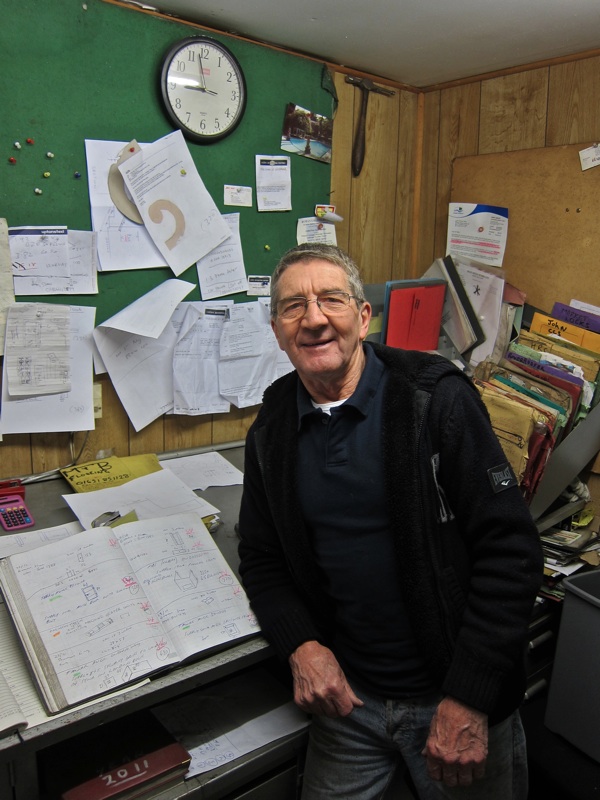
Norman in his office with his work book.
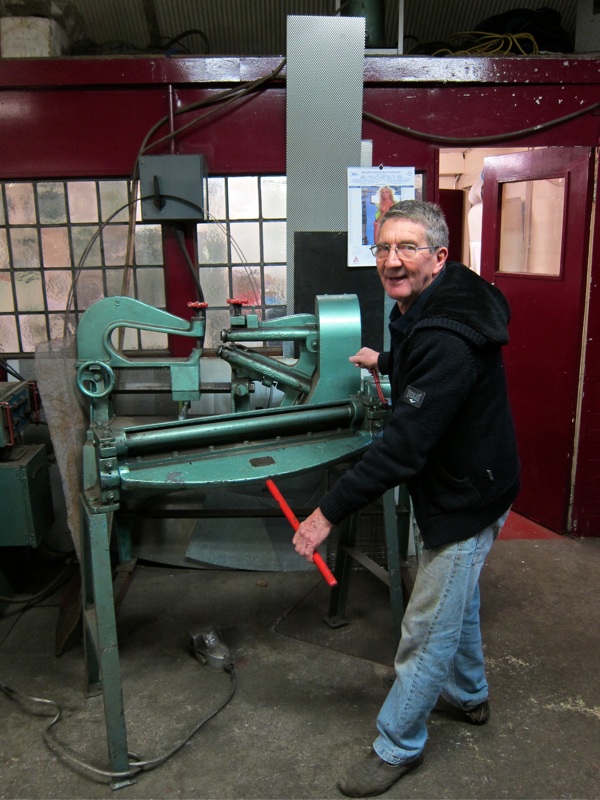
Norman demonstrates his pressing machine
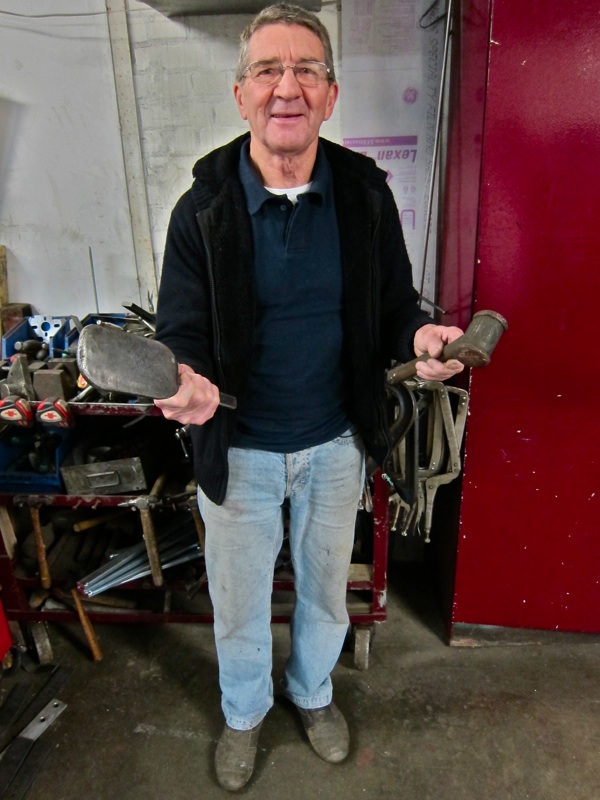
Norman shows off his flipper and his copper hammer.
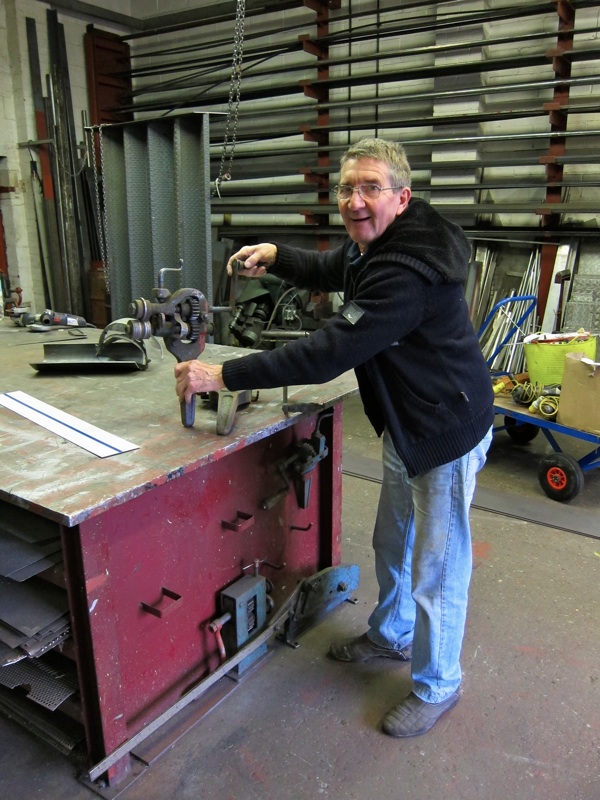
Norman demonstrates his antique jemmy.
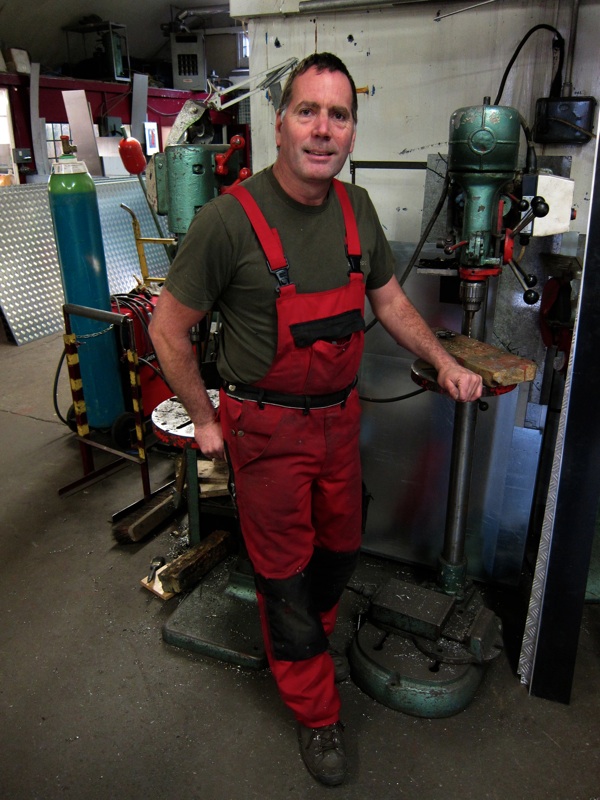
Norman’s son Chris and his drills.
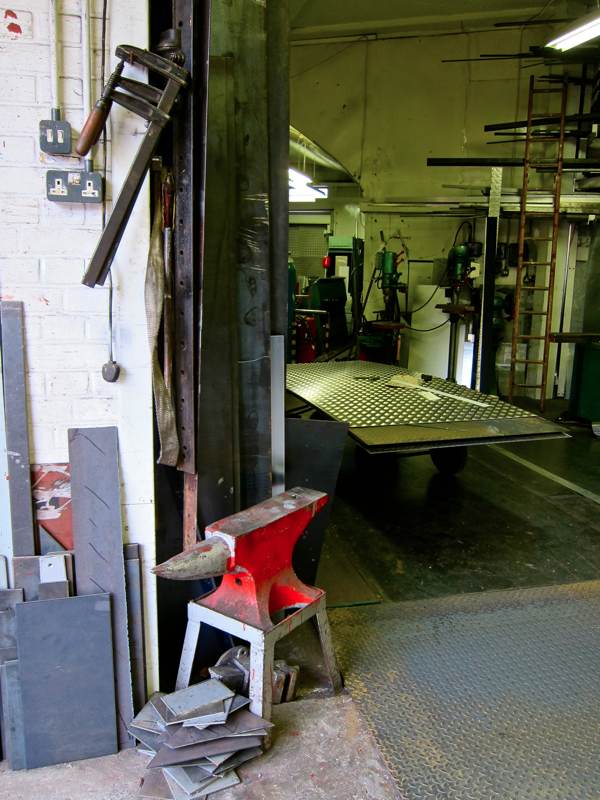
Norman’s anvil.
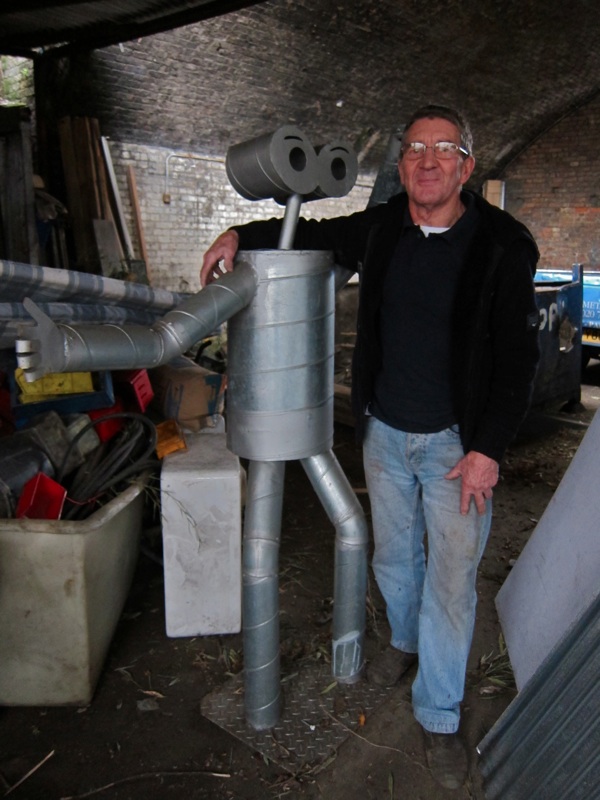
Norman with one of his creations.
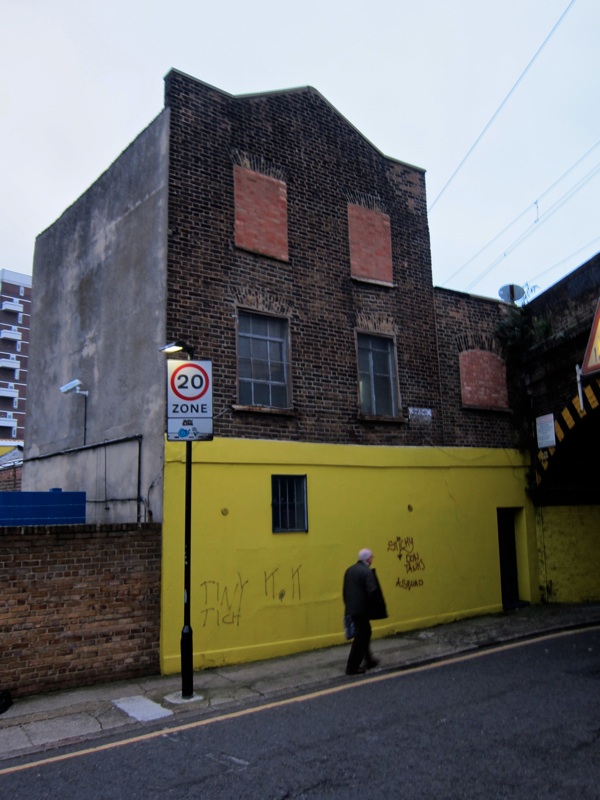
The former cork factory across the road.
You may also like to read about
Les Bobrow, Wood ‘N’ Things

One of the most popular shops in the Spitalfields Market is Les Bobrow’s Wood ‘N’ Things where you can buy traditional wooden toys, fancy dress and all kinds of party tricks and novelties. Of all the shops in the market, his is the one that serves the widest range of people – locals, City types and tourists – as well as appealing to children as much as to adults.
Universally appreciated for the playfulness he brings, in contrast to the mundanity of the chains that surround him, Les Bobrow is one of the last of the originals from when these shops first opened after the Fruit & Vegetable Market moved out and one of the few independent businesses to bring a distinctive quality to these former market buildings today.
Yet in spite of the success and drawing power of Wood ‘N’ Things, Ballymore, who manage the building, want to kick Les out when his lease expires in February and replace him with another High St chain store selling women’s fashion, in a further move towards rendering the market as generic any shopping mall. Naturally, Les is disappointed – after building up his business in the market over all these years – to be told he is no longer wanted. He is frustrated at the obtuseness of his landlords.
“My idea of a market is bit of everything,” he suggested to me,“We have a very busy website and a third of my customers come that way, so my shop brings people to the market. They come out of here and they go into the other shops, but nobody comes to Spitalfields to go to a chainstore – they can do that where they live.” Les told me that he believes the management want to maximize the number of High St brands in the market in order to increase the value of their asset for a potential sale of the building. The short-term nature of this thinking denies the economic reality – when Les’ business is thriving, enabling him to pay the inflated rent of £85,000 per annum, while many of the multiples have little turnover but are supported by their corporate owners who want to maintain a brand presence in the area.
A proud East Ender, Les revealed that his grandfather arrived from Poland as a refugee in the nineteenth century and opened a shop selling furniture in Fashion St in the eighteen eighties, just a hundred yards from Les’ current shop in Brushfield St. “I came down here as a child with my father to Club Row and then we used to walk through Spitalfields to Petticoat Lane, and I watched them loading up the trucks here in the market” Les recalled, “So when I heard that the Fruit & Vegetable Market had moved out, I thought this was the place to come. It was just eighteen months after they left and I started one Sunday selling seven items I had made out of wood, there was a key box, an egg box and a towel holder, and I never took a penny the first week. The stall cost me twenty pounds.”
Unemployed at the time, Les determined to persevere in Spitalfields and he made a few more items for the next Sunday, and he sold them. “Being on the stall gave me less and less time to make things, so I started buying handmade wooden toys. And it really took off because there was a niche in the market, so then I started looking around for a shop.” he explained, “But they were all out of my reach until a small one became available in 2001. Then, in 2004, I moved in here and I never looked back.”
The appeal of Wood ‘N’ Things derives from Les’s personal taste and idiosyncrasy, and reflects his cultural heritage too. He lives a mile from his shop and all his staff are local people, which means that they have a personal relationship with many of the customers and the profits stay within the local economy. The same is true of plenty of other independent shops, underlining the significance of these small businesses to the East End.
The London markets have always been an arena of possibility where people can create a living out of nothing but their own ingenuity, and the story of Les Bobrow’s shop is a classic example of a success story born of ingenuity and hard work. It is obvious that even the multiples require a vibrant culture of markets and distinctive independent shops surrounding them if they are to succeed, which makes Ballymore’s short-sightedness in the case of Wood ‘N’ Things especially frustrating.
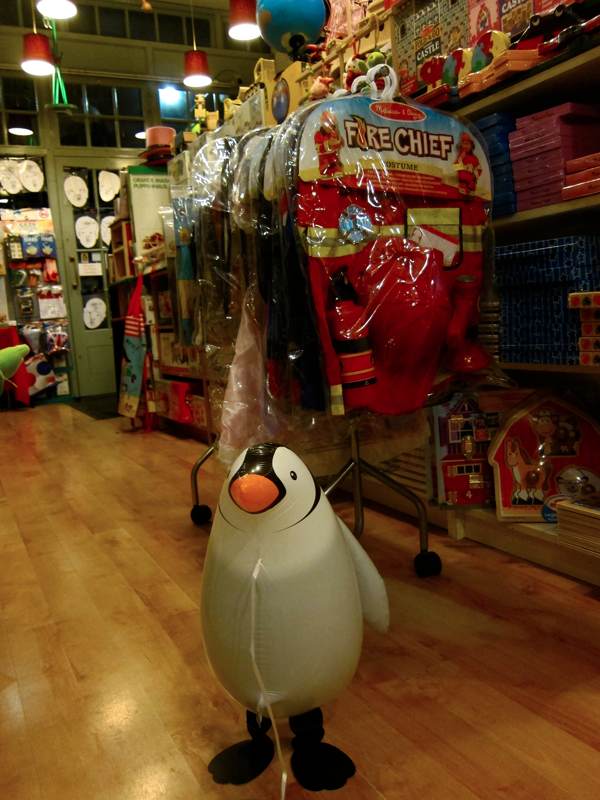

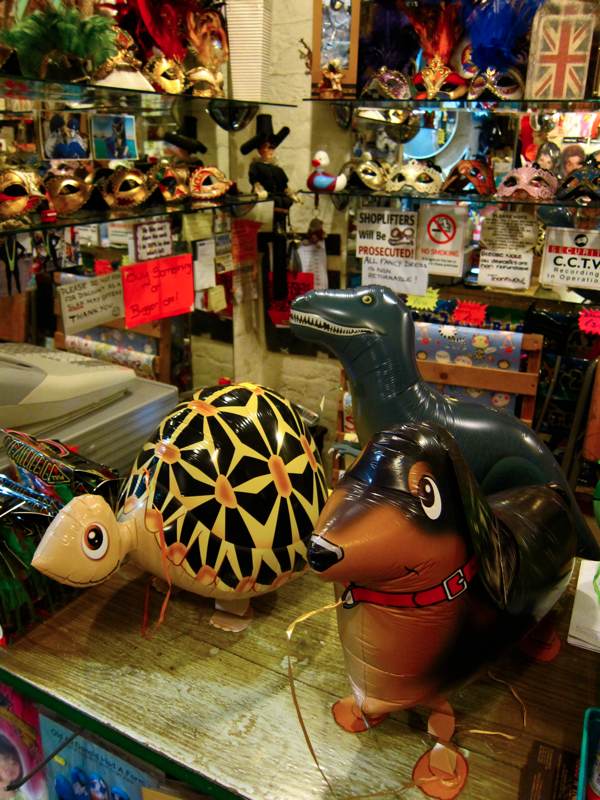
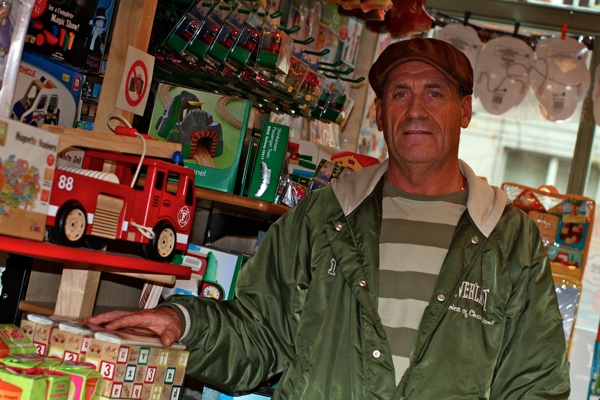
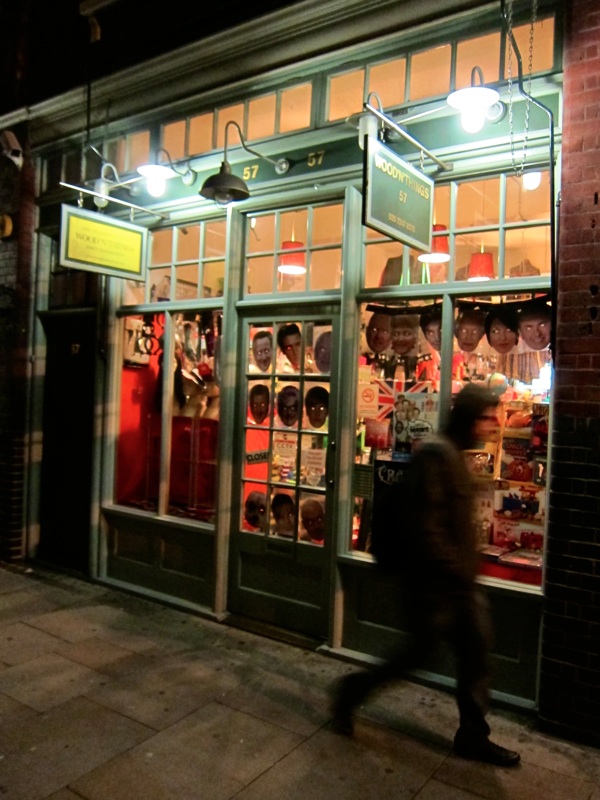
Wood ‘N’ Things, Old Spitalfields Market, 57 Brushfield St, E1 6AA
Portraits copyright © Phil Maxwell
Barn the Spoon, Spoon Carver

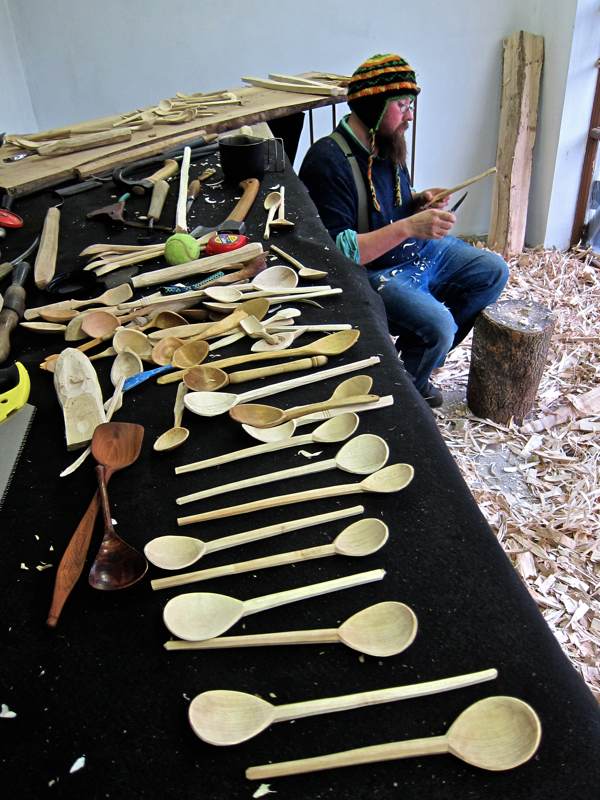
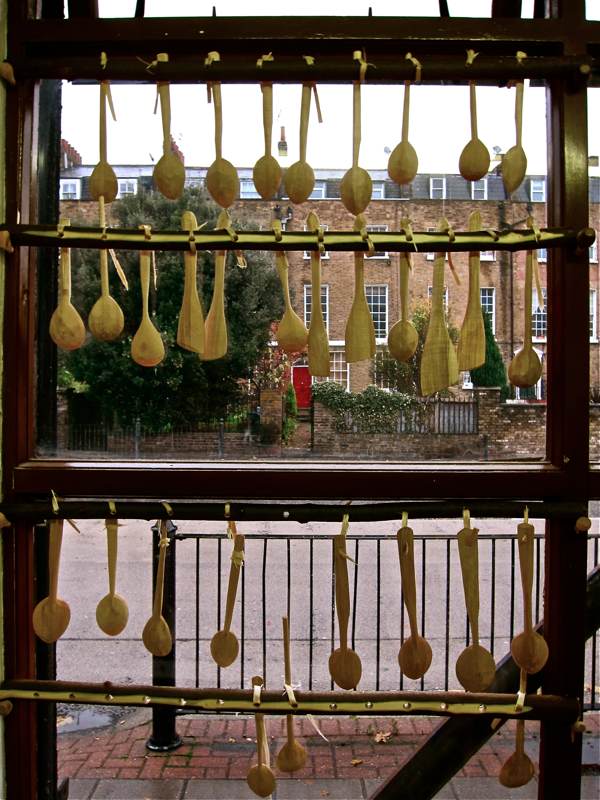
Barnaby Carder – widely known as Barn the Spoon – sits in the window at 260 Hackney Rd carving spoons for eight hours at a stretch. He sees the rush hour go one way and then he sees the rush hour go the other way, and in between friends pop in for a chat.
All this time Barn whittles away placidly, surrounded by an ever-growing tide of wood shavings as his pile of completed spoons increases. “I can’t imagine a life without making spoons,” he admitted to me when I sat down beside him yesterday while he worked, “I made my first spoon twelve years ago and now I’m addicted to making spoons. When I’ve made a good spoon I feel good within myself, but a good spoon doesn’t happen very often – maybe once a day. It’s a beautiful thing.”
In one sense – sitting here in the Hackney Rd in an area formerly renowned for its woodworking industry – this is natural place for Barn to be yet, in another sense, it is entirely un-natural because, given the choice, Barn would rather be out working in the greenwood. “Thirty-five years ago, all the guys who were doing this were dying out but thankfully it is being reborn,” he explained to me, “My great teachers have been old spoons, they’re full of information. I can look at any spoon made anywhere in the world and I know what tools have been used to make it. The stuff I do is really folksy and it goes back a long way.”
It all started for Barn when he was thirteen and his neighbour, who was a woodturner, taught him how to make bowls. “I really enjoyed it,” Barn recalled, “And I’ve done a lot of woodwork with twentieth century machines in the past, but I let go of it because it wasn’t right. People have got lost because of the industrial revolution when machines were designed to replace skills and it took away the dignity of the worker.” Instead, Barn did an apprenticeship with Mike Abbott, a greenwood chair maker in Herefordshire. “I learnt you don’t need a workshop, you can work outdoors,” Barn enthused, “The beauty of greenwood work is a deeper relationship with the material. I cut down the trees that need to be removed for the sustainability of the forest, chop them into sections, split them when they’re green, and then work them into spoons with an axe and a knife.”
After his apprenticeship, Barn tramped around the shires for three years, carrying his tools in a backpack, sleeping in the woods and carving spoons from timber growing there. “It’s the dignity of being able to make your own living. All I had in my life were my skills, but it has worked out for me.” he confided with a quiet smile of satisfaction. Lacking navigational abilities, Barn walked along canals thereby avoiding getting lost, and ending up in cities where he could find a market for his spoons. After street selling with a pedlar’s licence in the East End, Barn saved enough money to open his tiny shop three weeks ago. He has found a way to bring his greenwood skills into the city, teaching in a school a couple of days a week and using timber harvested from Tower Hamlets Cemetery Park to make his spoons. Becoming an evangelist of traditional spoon carving, Barn co-founded Spoonfest an international gathering of spoon carvers each summer in a wood in Edale.
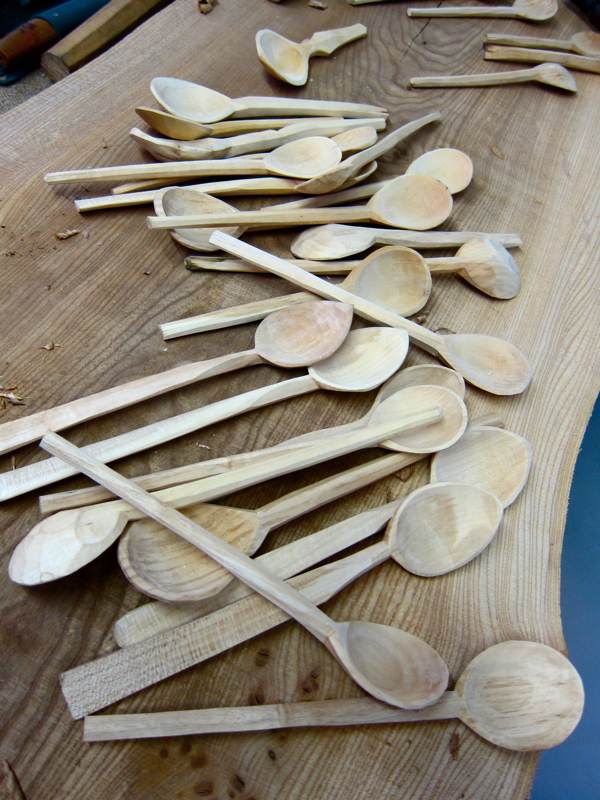
Barn operates in a vernacular tradition, working quickly to produce vigorous carving – creating functional objects of obvious utility and grace but that do not draw attention to their design. Starting with a twisted chunk of green wood – sycamore, birch, alder, cherry, french maple, hazel or willow – split from a tree, he places it on his block and chips away quickly with breathtaking confidence, using a razor-sharp axe to shape the outline of the spoon while chatting playfully all the time. “The function, the tools and the material create the design,” he revealed, taking out his knife, “The ones I get excited about are the Roma spoons where you know they’ve bashed out a lot of spoons, and I prefer those to the pricey ones produced by craftworkers, because they show an empathy with the material that others can only dream of.”
The next stage of the work is centred around carving the bowl and for this Barn uses a semi-circular-bladed knife to create a smooth surface which makes the spoon pleasant to eat from. Snatching up a couple from the pile on the bench, he showed me the two designs he prefers at present – one based on the Roma spoon with a flat handle in which there is a notch between the handle and the bowl, and another with an octagonal handle in which the neck connects smoothly to the bowl. “I’ve spent a lot of time making spoons,” Barn said, thinking out loud as he contemplated his handiwork, “I sit here for eight hours a day and what I’m thinking about is the shape of the spoon. They’re so completely fascinating to make. I could talk about spoons for hours. I would consider it an insult if somebody doesn’t use my spoon.”
Much to my delight, when I told Barn the Spoon about the former industry of woodworking in Shoreditch, he contradicted me. “But it’s all coming back,” he declared, “And with a passion.”




[youtube rmMVi_1WRU0 nolink]
Visit Barn the Spoon at 260 Hackney Rd, E2 7SJ. (10am-5pm, Friday-Tuesday)
You may also like to read about
John Claridge’s Boxers (Round Four)
Photographer and Ex-Boxer John Claridge has been making regular trips to the East End to take on members of London Ex-Boxers Association. John distinguished himself with some fine shots in Round One, proved a class act with a bravura display of his singular talent in Round Two, commanded the ring in Round Three with his spirit blazing, and now shows himself to be a potential champion in Round Four.

Len Wilson (First fight 1950 – Last fight 1963)

Charlie Oliver (First fight 1932 – Last fight 1952)

Charlie Wright, London Ex-Boxers Committee Member

Eddie Johnson, Ex- Landlord of the Two Puddings

Alan Docker, Trainer at Repton Boxing Club

Frankie Hewitt (First fight 1950 – Last fight 1952)

Geoff Born (First fight 1944 – Last fight 1957)

Joe Crickmar (First fight 1948 – Last fight 1956)
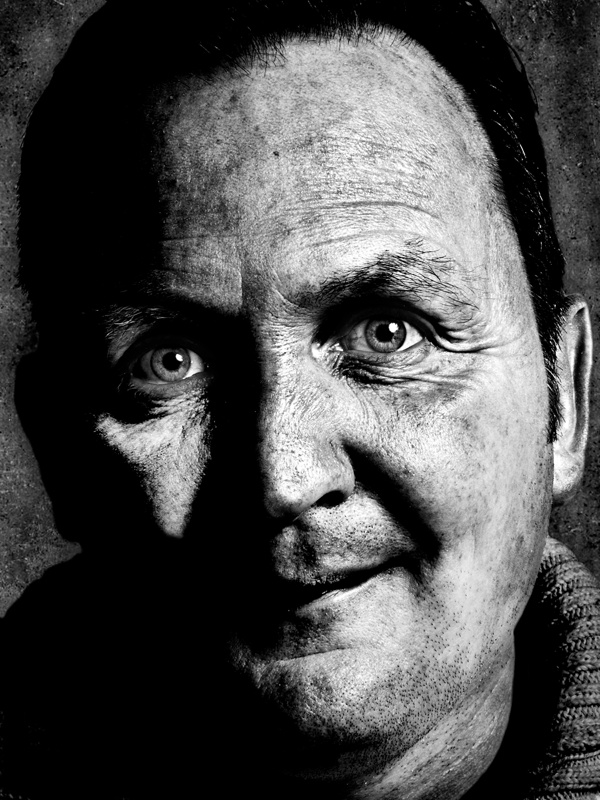
Mark Goult (First fight 1980 – Last fight 1990)

Mick Williamson, ‘The’ Cuts Man

Nobby Clarke (First fight 1948 – Last fight 1956)

Prince Rodney, Ex-British Champion 1980 (First fight 1978 – Last fight 1989)
Photographs copyright © John Claridge
Take a look at
John Claridge’s Boxers (Round One)
John Claridge’s Boxers (Round Two)
John Claridge’s Boxers (Round Three)
and these other pictures by John Claridge
Along the Thames with John Claridge
At the Salvation Army with John Claridge
A Few Diversions by John Claridge
Signs, Posters, Typography & Graphics
Views from a Dinghy by John Claridge
In Another World with John Claridge
A Few Pints with John Claridge
Some East End Portraits by John Claridge
Sunday Morning Stroll with John Claridge
The Dinners of Old London
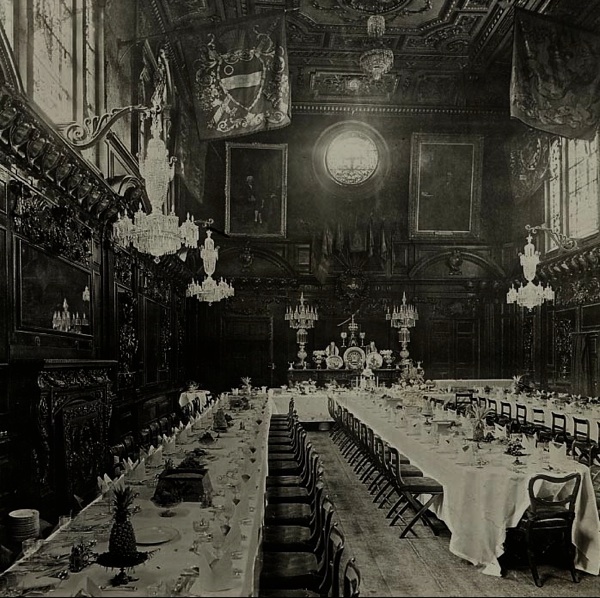
Dinner at the Mercers’ Hall, c.1910
Is that your stomach rumbling or is it the sound of distant thunder I hear? To take your mind off hunger, let us pass the time until we eat by studying these old glass slides once used for magic lantern shows by the London & Middlesex Archaeological Society at the Bishopsgate Insititute. Observe the architecture of gastronomy as expressed in the number and variety of ancient halls – the dining halls, the banquet halls and the luncheon rooms – where grand people once met for lengthy meals. Let us consider the dinners of old London.
The choicest meat from Smithfield, the finest fish from Billingsgate, and the freshest vegetables from Covent Garden and Spitalfields, they all found their way onto these long tables – such as the one in Middle Temple Hall which is twenty-seven feet long and made of single oak tree donated by Elizabeth I. The trunk was floated down the river from Windsor Great Park and the table was constructed in the hall almost half millennium ago. It has never been moved and through all the intervening centuries – through the Plague and the Fire and the Blitz – it has groaned beneath the weight of the dinners of old London.
Dinners and politics have always been inextricable in London – as in many other capitals – but, whether these meals were a premise to do business, make connections and forge allegiances, or whether these frequent civic gatherings were, in fact, merely the excuse for an endless catalogue of slap-up feasts and beanos, remains open to question. John Keohane, former Chief Yeoman Warder at the Tower of London told me that his troupe acquired their colloquial name of “beefeaters” because – as royal bodyguards – Henry VII granted them the privilege of dining at his table and eating the red meat which was denied to the commonfolk. In the medieval world, your place at dinner corresponded literally to your place in society, whether at top table or among the lower orders.
Contemplating all these empty halls where the table has not been laid yet and where rays of sunlight illuminate the particles of dust floating in the silence, I think we may have to wait a while before dinner is served in old London.
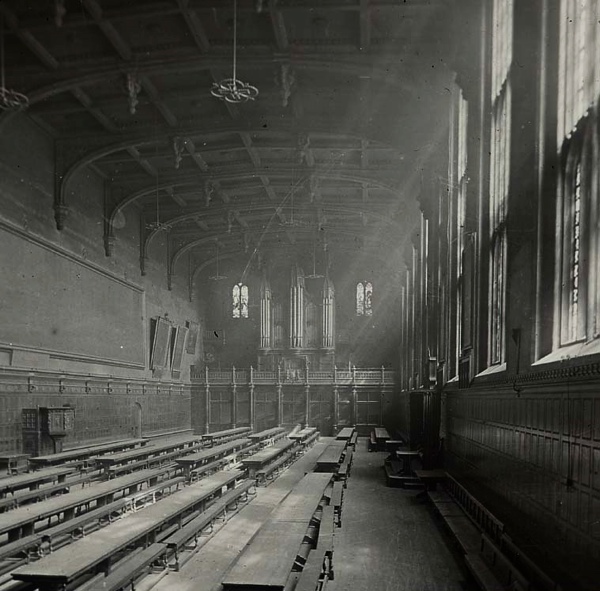
Christ’s Hospital Hall, c.1910
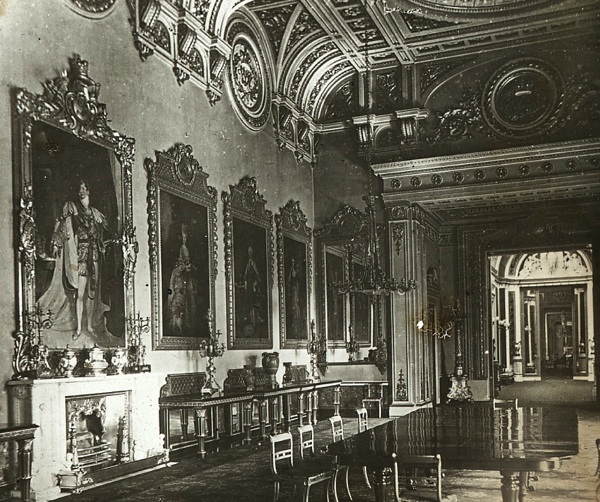
Buckingham Palace, State Dining Room, c.1910
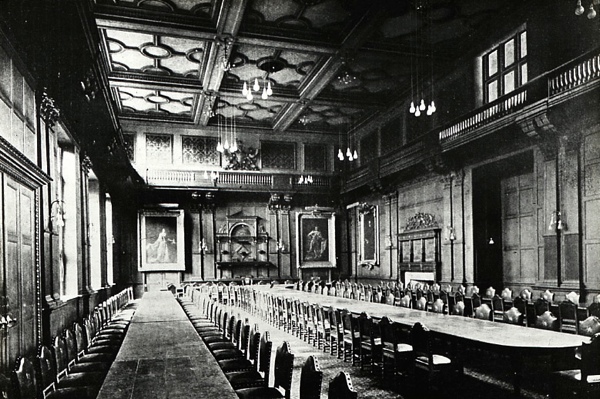
Grocers’ Hall, c.1910
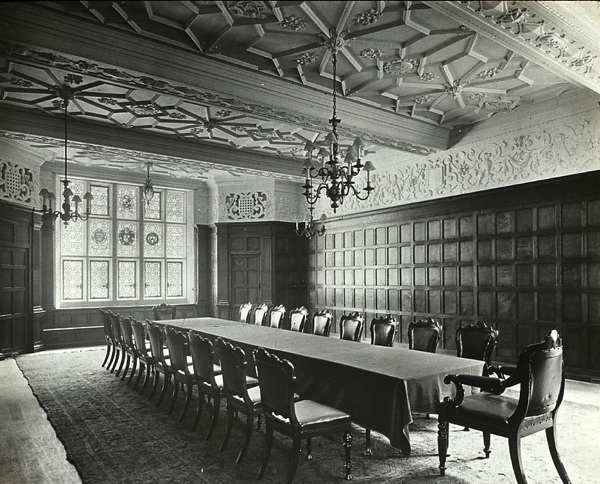
Ironmongers’ Hall, Court Luncheon Room, c.1910
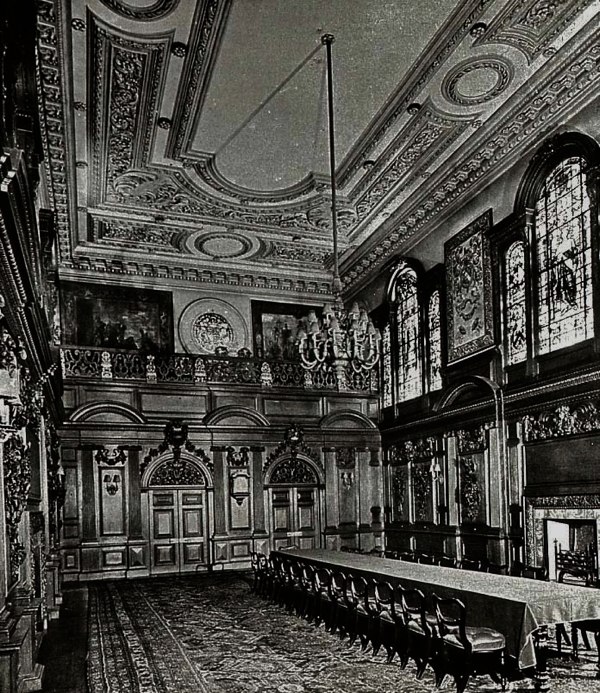
Mercers’ Livery Hall, 1932
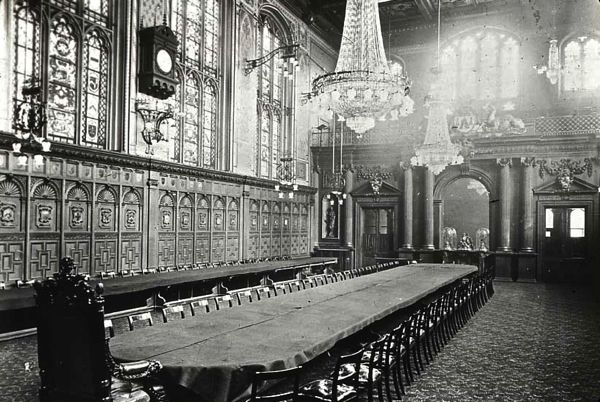
Merchant Taylors’ Hall, c.1910
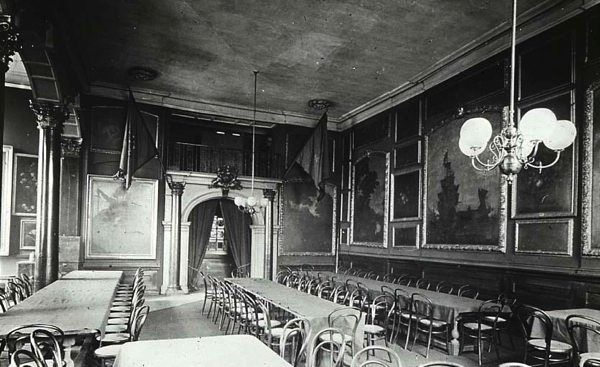
Painters’ Hall, c.1910
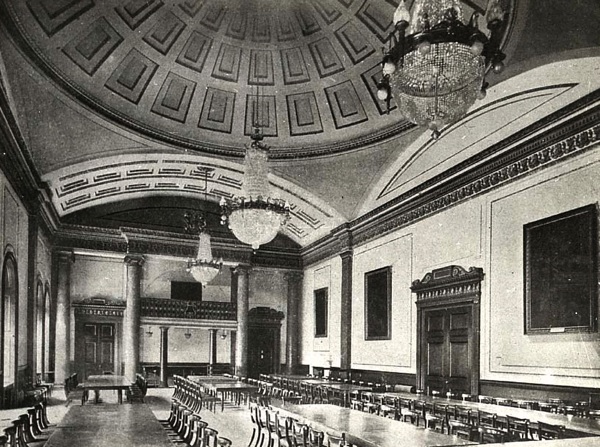
Salters’ Livery Hall, c.1910
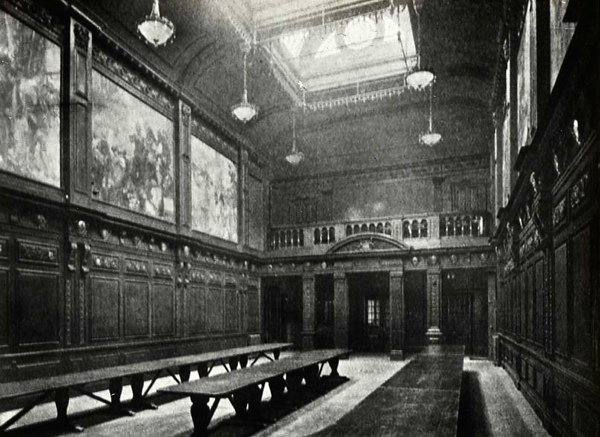
Skinners’ Hall, c.1910
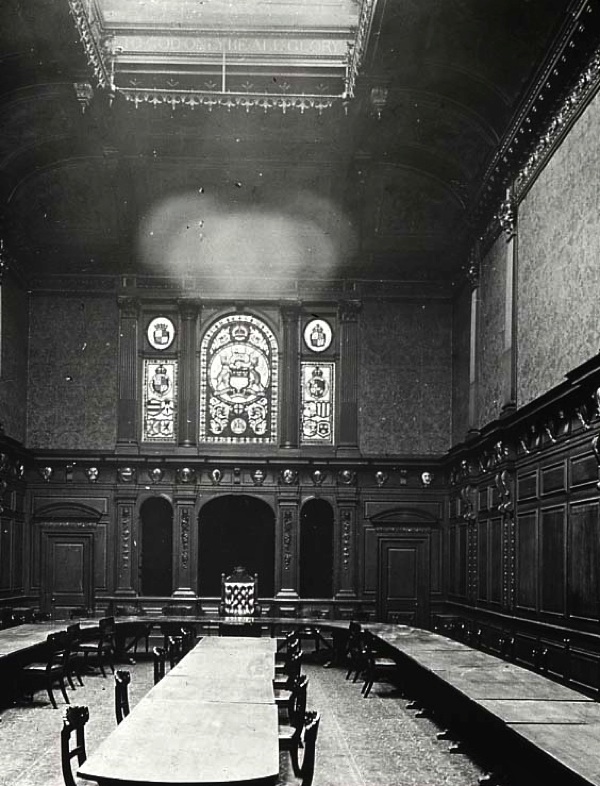
Skinners’ Hall, c.1910
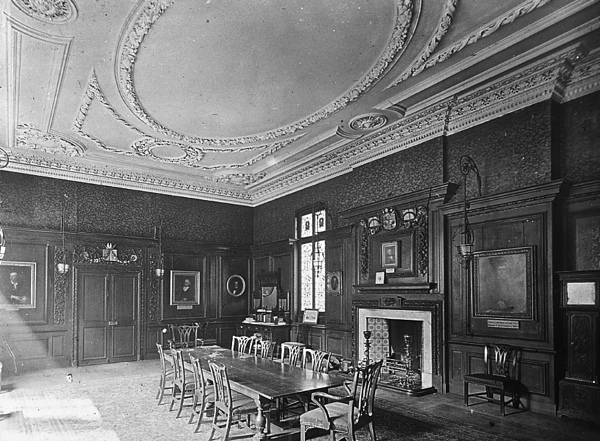
Stationers’ Hall, Stock Room, c.1910
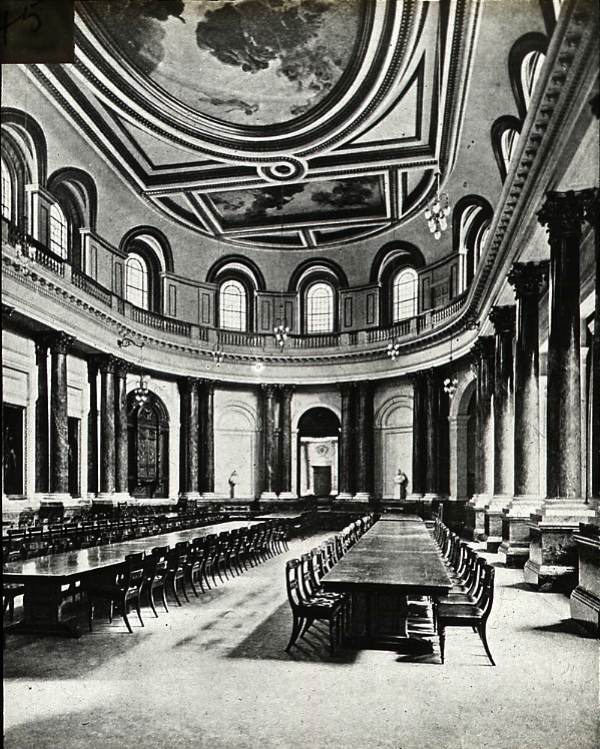
Drapers’ Hall, c.1920
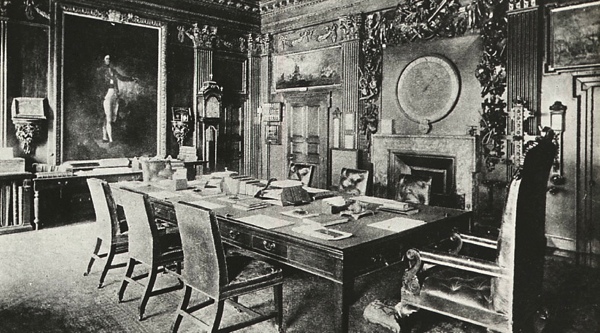
The Admiralty Board Room, c.1910
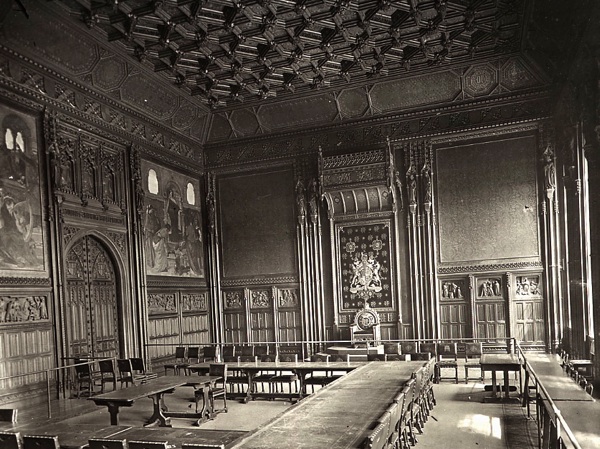
King’s Robing Room, Palace of Westminster, c.1910
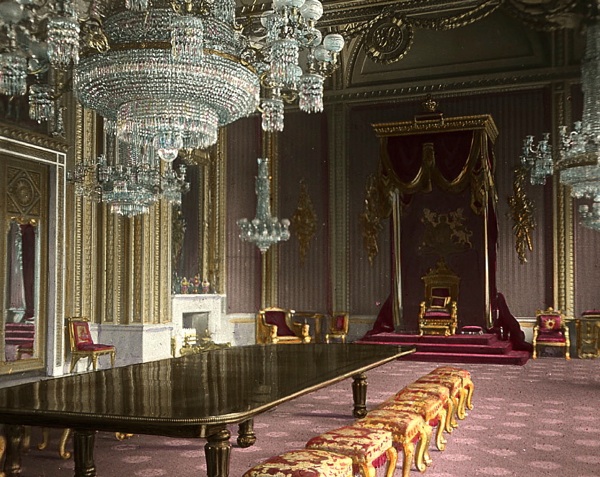
Buckingham Palace, Throne Room, c.1910
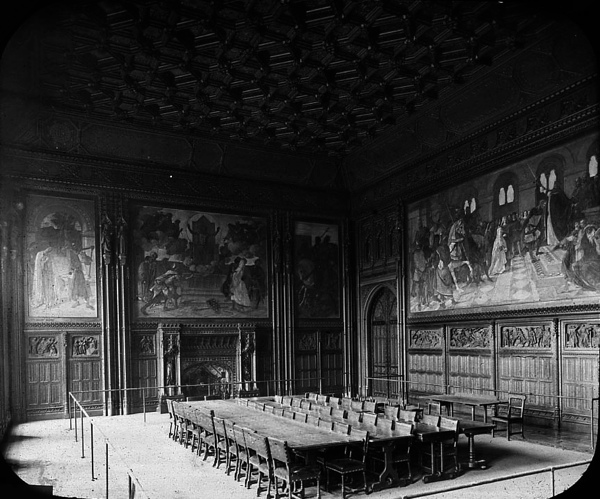
Houses of Parliament, Robing Room, c.1910
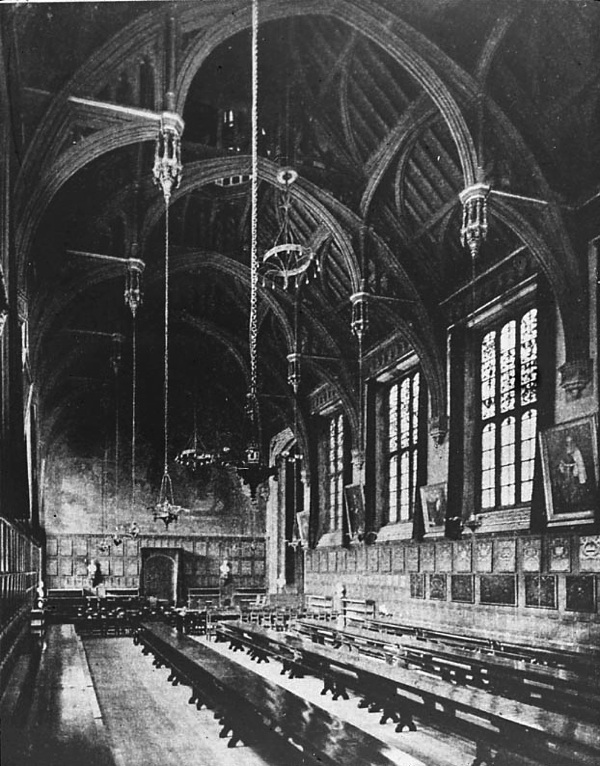
Lincoln’s Inn, Great Hall, c.1910
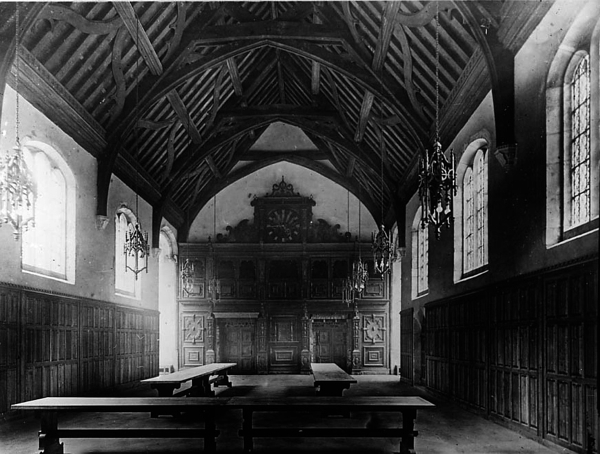
Lincoln’s Inn Old Hall, c.1928
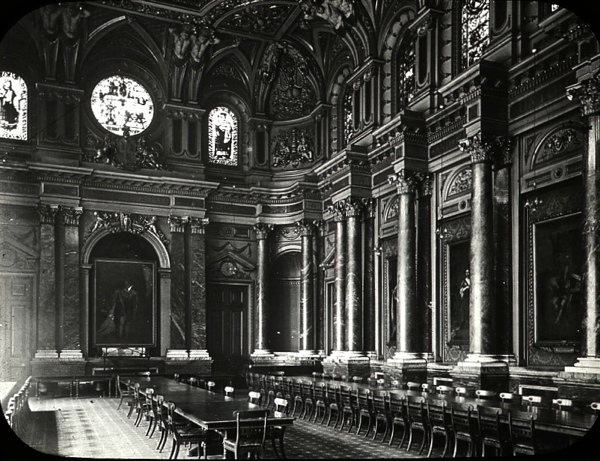
Drapers’ Hall, c.1920
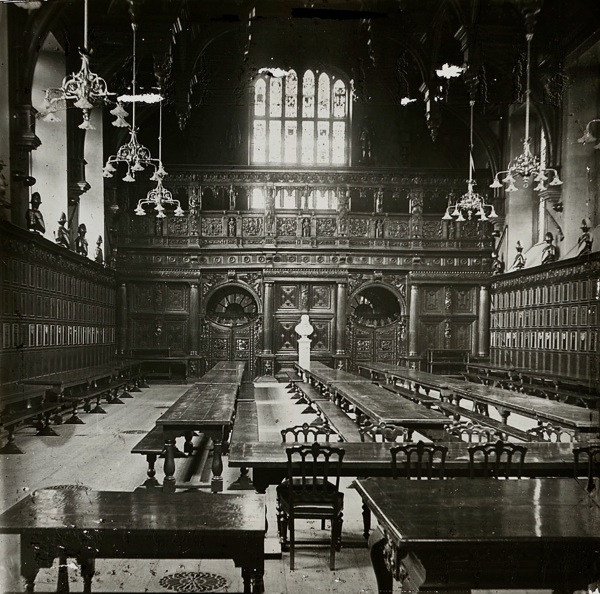
Middle Temple Hall, c.1910
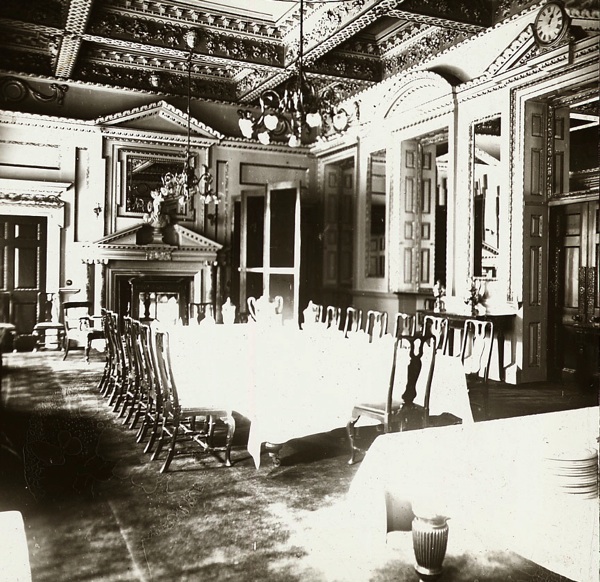
Mansion House Dining Room, c.1910

Ironmongers’ Hall, Banqueting Room, c.1910
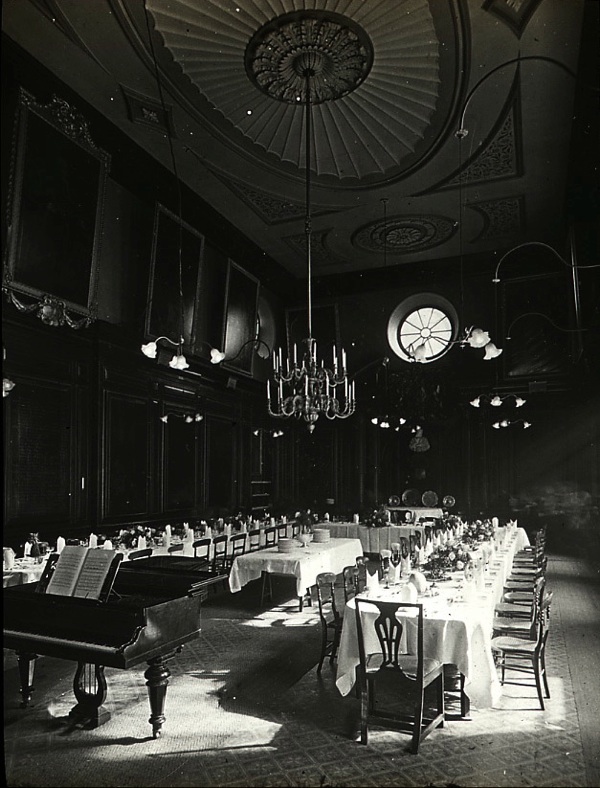
Apothecaries’ Hall, Banquet in the Great Hall, c.1920
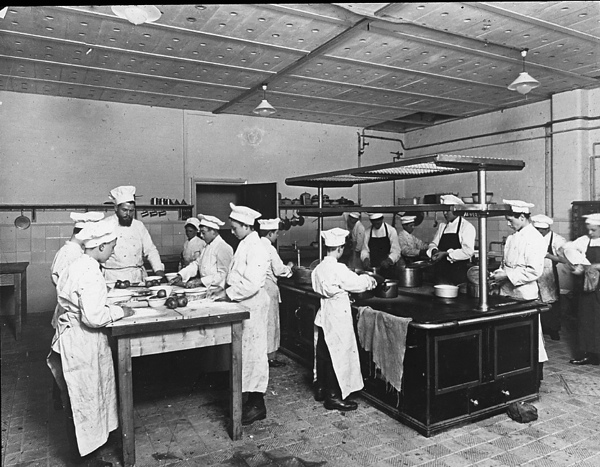
Boys preparing to cook, c.1910
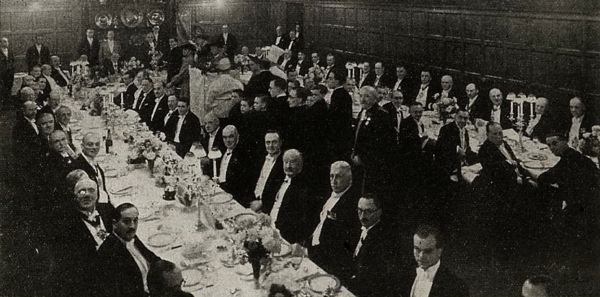
Boar’s Head Dinner at Cutler’s Hall, c.1910

Lord Mayor’s Banquet at the Guildhall, 1933
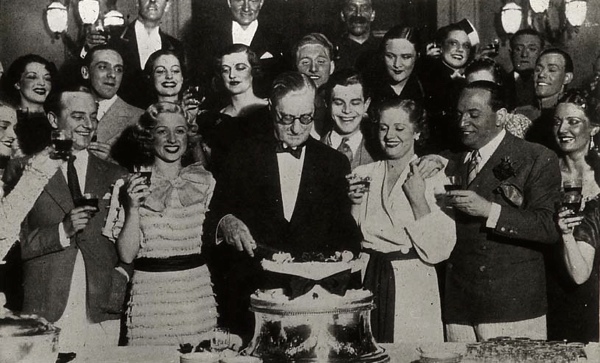
Baddeley Cake & Wine, Drury Lane, c.1930
Opening of The Artists of Spitalfields Life
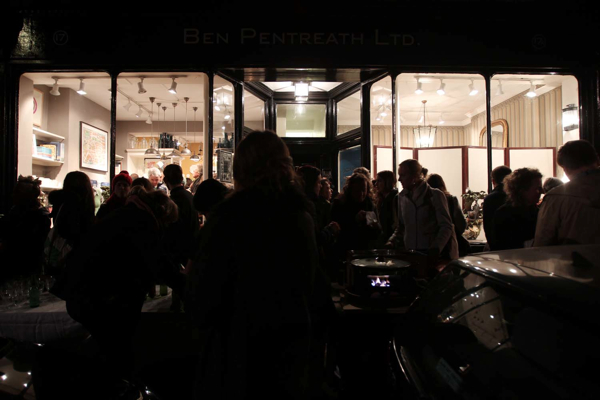
If you ventured out last Wednesday evening, through the narrow streets and dark old squares east of the British Museum, you might have caught a whiff of roast chestnuts in the frosty air and turned a corner to discover an excited crowd, clamouring at the entrance to a tiny shop with Ben Pentreath painted over the fascia. This was the opening night of The Artists of Spitalfields Life.
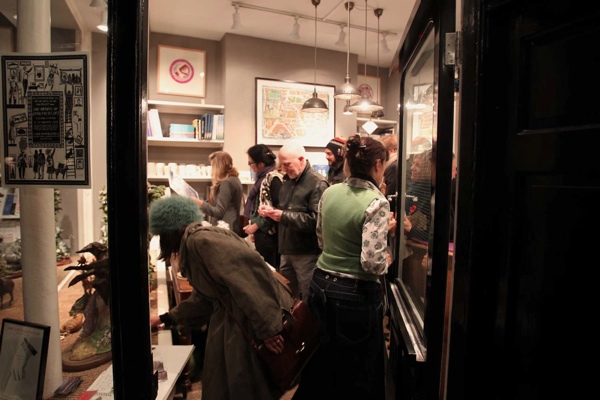
Spitalfields Life Contributing Photographer Simon Mooney, resplendent in a double-breasted pin-striped suit, produced a camera from on old leather case and slipped among the throng, discreetly recording the event in this atmospheric set of pictures – to give a flavour of proceedings for all those readers who were unable to make it over to Bloomsbury that evening.
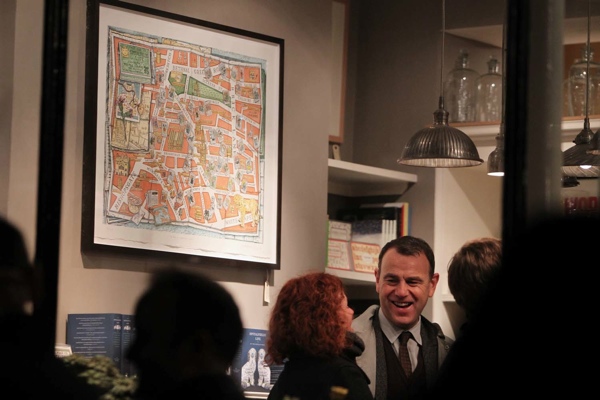
Adam Dant’s Map of Spitalfields Life adorned the chimney breast.
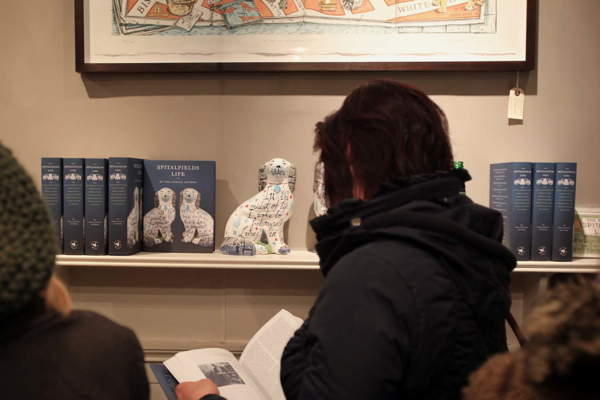
Rob Ryan’s Staffordshire dogs graced the mantlepiece.
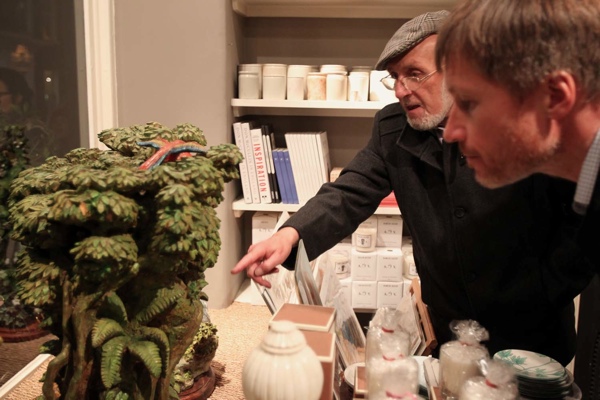
Roy Emmins points out his jungle sculpture.
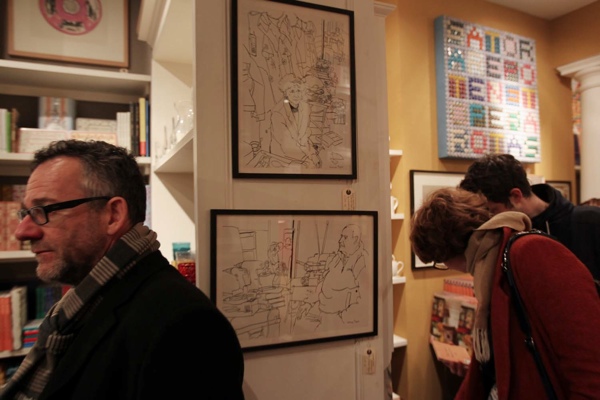
Drawings of Brick Lane traders by Lucinda Rogers and a bottletop picture by Robson Cezar
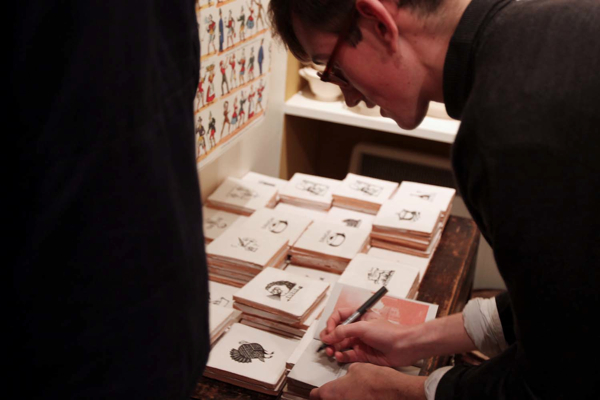
Sebastian Harding signs one of his Smithfield books on a table laden with Paul Bommer’s tiles.
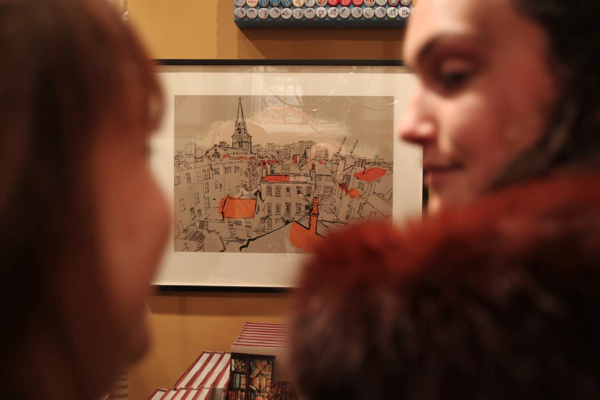
Rooftops of Spitalfields by Lucinda Rogers.
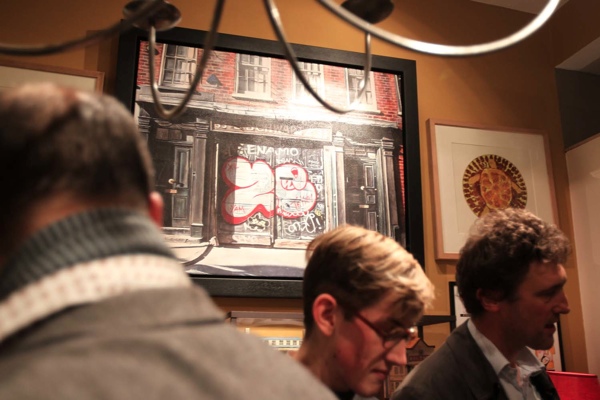
Painting of Fournier St by Marc Gooderham and Wheildon Tortoise by Laura Knight.
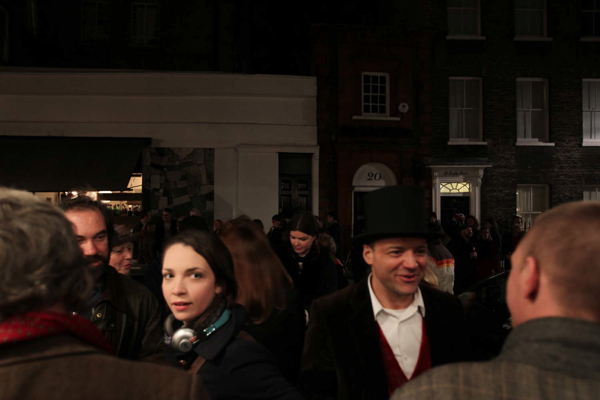
Robson Cezar, King of the Bottletops, sported a top hat.
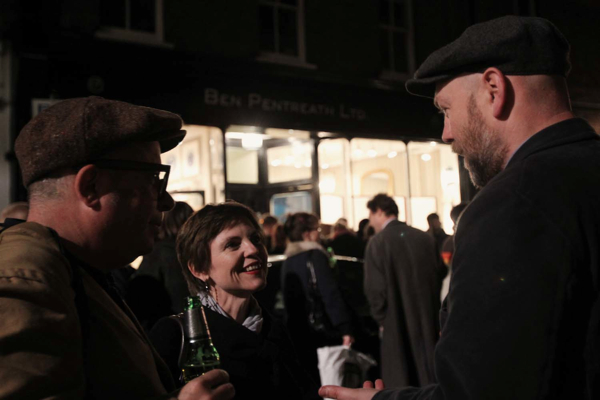
Paul Bommer greets admirers.
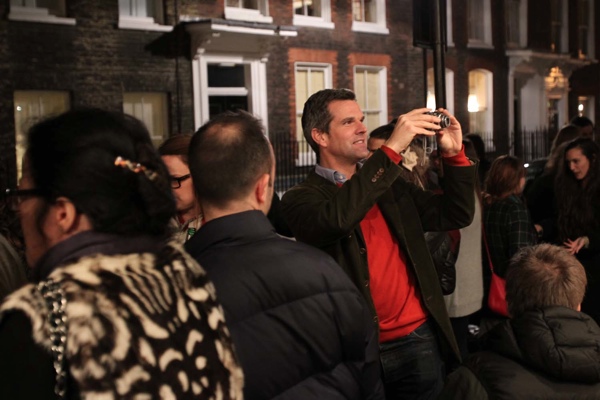
Ben Pentreath takes a snap.

Bloomsbury resident, Jimmy Cuba, a legend in the London markets.
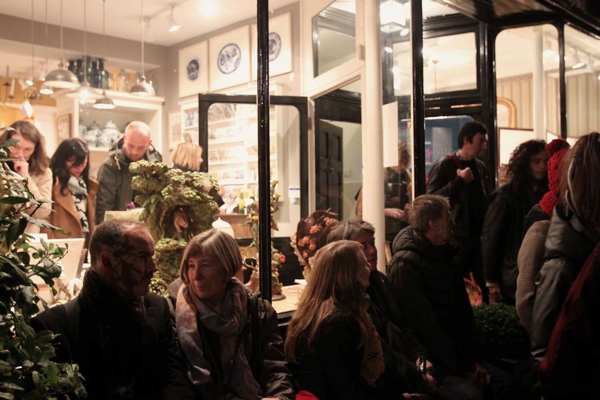
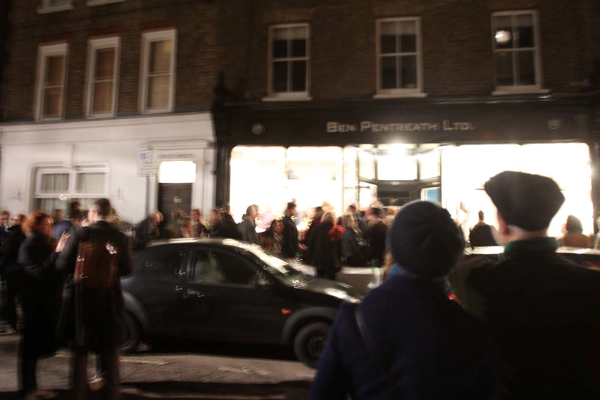
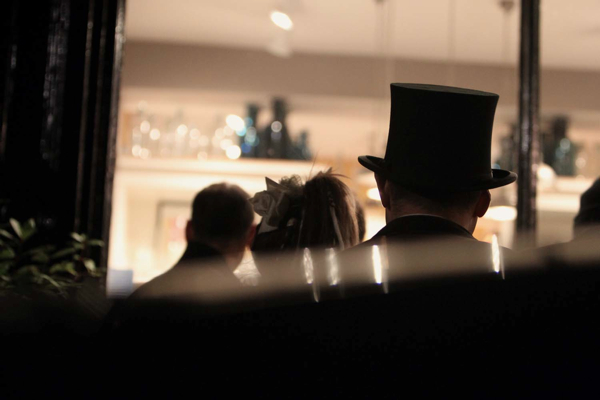
Photographs copyright © Simon Mooney
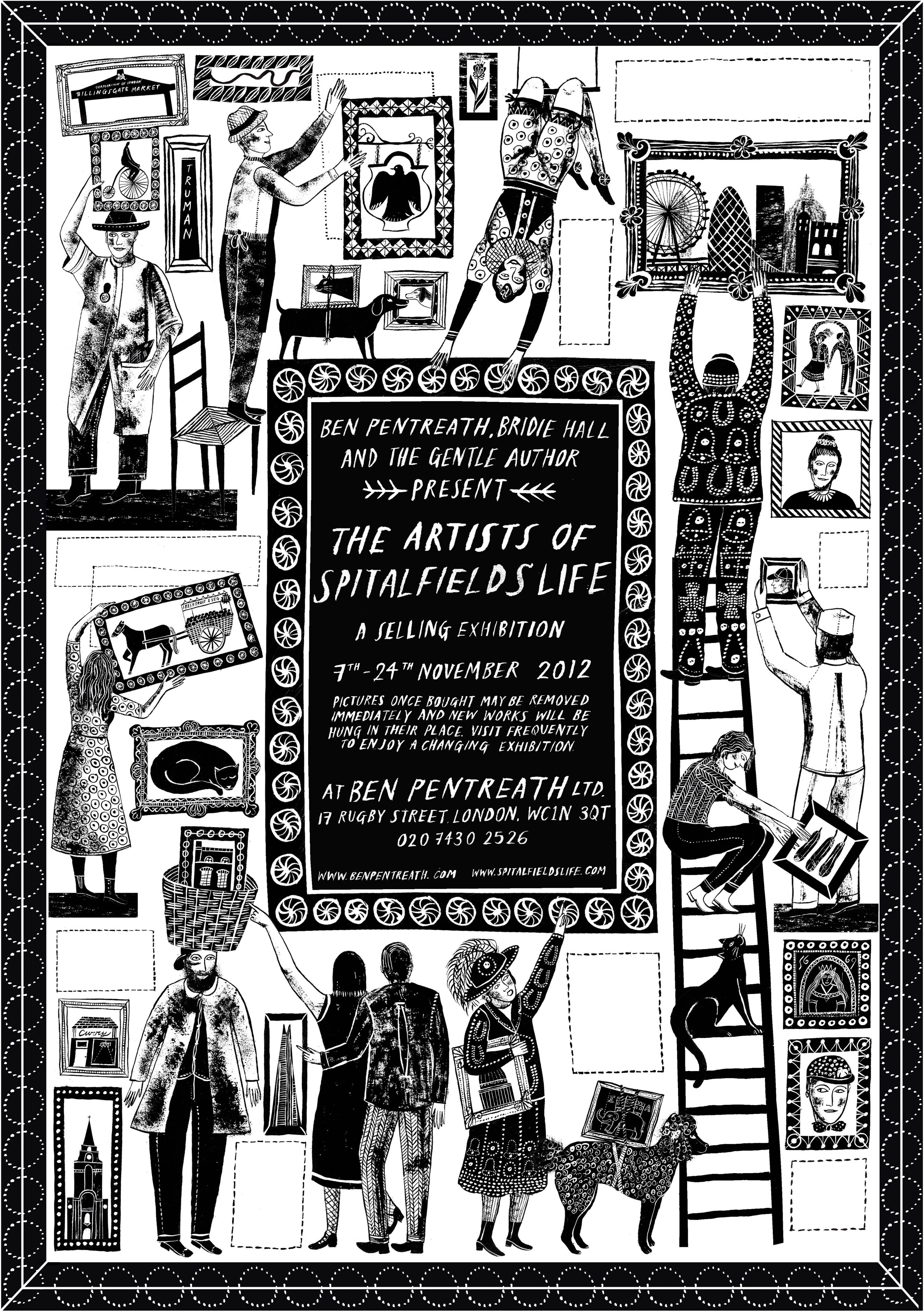
Click to enlarge this poster designed by Alice Pattullo
Sebastian Harding’s Latest Creations
Earlier this year, Sebastian Harding made models of the lost buildings of Smithfield that had important tales to tell, but now he has cast his sights further afield with these new creations that can be seen in The Artists of Spitalfields Life exhibition until 24th November.

The Saracen’s Head, 4-7 Aldgate High St.

The Saracen’s Head by Henry Dixon for the Society for Photographing the Relics of Old London.

Rear of the Saracen’s Head.
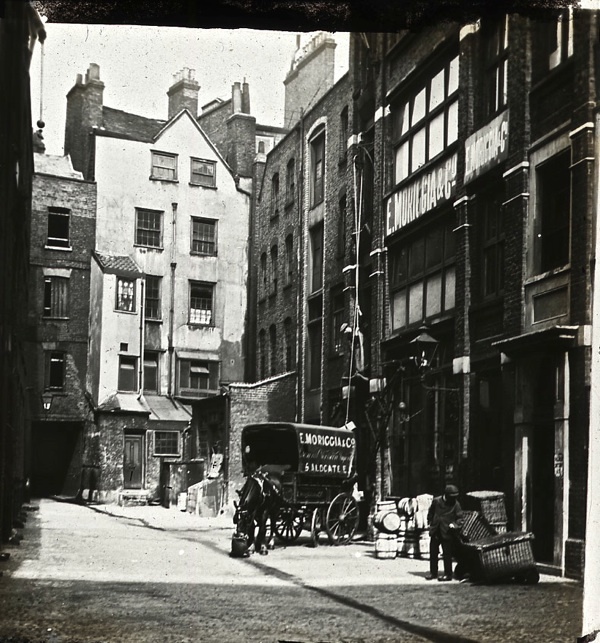
The yard of the Saracen’s Head from the London & Middlesex Archaeological Society glass slides.
The Saracen’s Head public house was demolished in 1913. Even in the late nineteenth century, Aldgate survived as a slice of sixteenth and seventeenth century London until the developers moved in from the eighteen eighties to modernize these streets. It was one of the few places to avoid the Great Fire of 1666, where the locals gathered to watch the conflagration. This makes the Saracen’s Head all the more important to the area’s history.
The area of Aldgate, first documented as Ealse Gate, centred around what is now Aldgate High St – still a vital artery into the city. This road predates the Normans and the gate itself which gives Aldgate its name was originally built by the Romans. It was subsequently rebuilt in the twelfth century, the thirteenth, and finally in the early seventeenth century. Though long gone, there is a plaque at No. 88 Aldgate High St commemorating its existence.
When poring through old photographs of Aldgate, I was struck by the architectural merits of the Saracen’s Head in particular. Founded in 1681, it operated as a coaching inn with a service that departed from the yard at the back, transporting Londoners to East Anglia – hence the building’s location on the main road eastward out of the city.
It was documented in the nineteenth century by Henry Dixon for Society for the Photographing the Relics of Old London. These records have allowed me to recreate the exteriors viewable from the street and yard. The frontage holds wonderful early examples of Baroque decoration and the ornate moulding echoes the decoration seen on the Baroque post-Fire churches – including St Paul’s – that emerged throughout London at the time. When the building was demolished, it was functioning as the Metropole Restaurant with the Ladies Select Dining Room housed on the first floor. After its destruction, the Guildhall Museum bought the intricate wooden pilaster capitals for their collection, confirming its aesthetic importance.
The Victorian buildings which replaced the Saracen’s Head and its neighbours were in turn bulldozed in the nineteen eighties to make way for the anonymous offices that dominate this once remarkable area today.
by Sebastian Harding

Nicholas Culpeper’s House, Red Lion Field, Spitalfields.
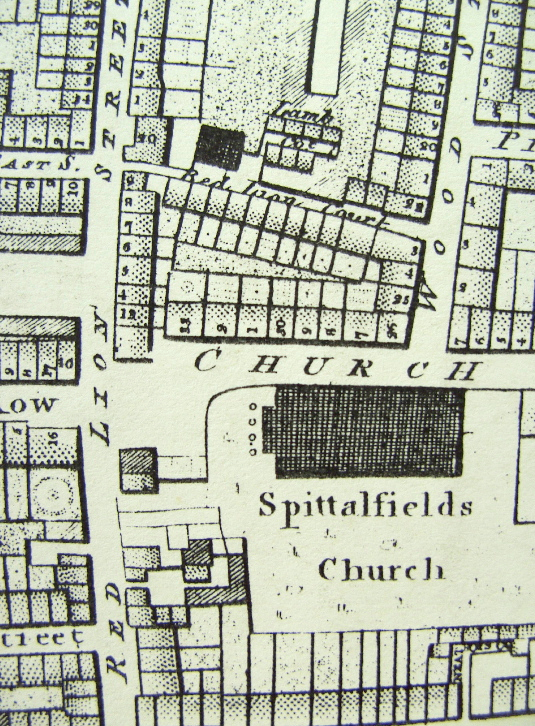
On John Horwood’s map (1794-99) Nicholas Culpeper’s house is clearly shown, sticking out on the corner of Red Lion St and Red Lion Ct.
In 1640, when Nicholas Culpeper, the herbalist, married Alice Field, aged fifteen, he was able to build a substantial wooden house in Red Lion Field, Spitalfields, with her dowry. Here, he conducted his practice, treating as many as forty citizens in a morning, and in the land attached he cultivated herbs – collecting those growing wild in the fields beyond. Since Culpeper never finished his apprenticeship, he could not practise in the City of London but chose instead to offer free healthcare to the citizens of Spitalfields, much to the ire of the Royal College of Physicians. In this house, Nicholas Culpeper wrote his masterwork known as Culpeper’s Herbal which is still in print today.
After Culpeper’s death, the building became the Red Lion public house, surviving into the nineteenth century when it was demolished, as part of the road widening for the creation of Commercial St to carry traffic from the London Docks. Although the site of Culpeper’s house is now in the middle of Commercial St, the replacement building which served as the Red Lion until 1917 is in use today – appropriately enough -as Spitalfields Organics, selling wholefoods and herbal products. Andy Rider, Rector of Spitalfields, keeps an old print of Culpeper’s House in the Rectory in Fournier St and we are grateful to him for allowing Sebastian Harding access to this image which served as the visual reference for this model.
Read the full story of Nicholas Culpeper in Spitalfields

186 & 184 Fleet St.

186 & 184 Fleet St photographed by Henry Dixon for the Society for Photographing the Relics of Old London.
If you were to take a stroll down Fleet St today, you might like to take a closer look at the buildings that stand at 186 & 184. They perch immediately to the right of St-Dunstan-in-the-West on the north side of the Street in a row of inconspicuous turn-of-the-century buildings. On closer inspection each appears distinct, but all three are somewhat tall and somewhat narrow. Their cramped proportions are explained by the fact they were built, like much of London, on the site of two ancient pre-fire buildings.
The history of the nineteenth century buildings that occupy the site today relates directly to the rise of the newspaper trade that proliferated in the area. Indeed, Fleet St is still synonymous with British journalism despite all major publications now being headquartered elsewhere.
Today the site of 184 & 186 is home to the Scottish firm D.C. Thomson & Co., who claim to be the last newspaper group to retain a base on Fleet St, and the titles of their publications, The Sunday Post and The Dundee Courier, are still proclaimed in mosaic on the façade of their neighbour at 188.
We know how the buildings that preceded them looked thanks to a photograph taken by Henry Dixon in the eighteen eighties for the Society for Photographing Relics of Old London. Remarkably ,the buildings date from before the Great Fire of London in 1666.
Thanks to the efforts of the Dean of Westminster and forty scholars roused from Westminster School in the middle of the night, the fire stopped at Fetter Lane, just short of St-Dunstan-in-the-West and these intervening houses. John Aubrey, who lived through the Fire, recorded in his Brief Lives that Michael Drayton, the great topographical poet and a contemporary of Shakespeare, once resided in the house in the middle of our group of three, ‘the bay-window house, next to the East end of St. Dunstan’s Ch. in Fleet-Street.’ Drayton is one of many significant writers who have gravitated towards the area since William Caxton’s assistant, Wynandus de Worden, set up shop nearby in 1500, thus beginning Fleet St’s enduring association with the printed word. In keeping with the tradition, Drayton’s house at 185 was, at the time of Dixon’s photograph, a bookseller and publisher.
The immediate area was also the setting for the story “The String of Pearls” which gave rise to the urban legend of Sweeeney Todd and his accomplice Mrs Lovett . The murderous barber in the story lived above his premises at No. 186. In the tale, he is said to have slit the throats of over one hundred and fifty customers. That a significant portion of them would have been lawyers based in the local area woud have delighted the original readership, as it still does today.
by Simon Wright

Part of the Rothschild Buildings, 1888
Coming across Thrawl St on a sunny summer day in 2012, the atmosphere is calm and quiet. Now home to a community centre, nature reserve and basketball court, it appears to the casual pedestrian as an oasis of green and open space in a dense urban neighbourhood. This could not be more different to how it was described a mere forty years ago. Before their demolition in the seventies, the Rothschild Dwellings were visited by historian Jerry White whose first impression of the buildings was that he had “never seen tenements, so starkly repulsive” and “so much without one redeeming feature” in his whole life.
The Rothschild Buildings were unveiled on the second of April 1887, less than a year before the onset of the Whitechapel murders, perpetrated in the area surrounding the Rothschild Dwellings, and illustrating very publicly the need for social improvement in this ramshackle district. Many believe the murders were a catalyst to change, but the Rothschild Buildings prove that even before that there were philanthropists and businessmen keen to support the area.
The policy of cleaning up the East End had been underway in the streets around Spitalfields since the eighteen sixties. The Rothschild Dwellings were erected by the ‘Four percent Industrial Dwellings Company’ and stood on the sight of what had once been respectable middle class residences in the seventeenth and eighteenth centuries, which had degenerated into lodging houses and slums. In the mid-nineteenth century, the old filthy streets with their myriad alleyways and courts were swept away. In their place, came the wide thoroughfare of Commercial St and large housing blocks such as the Nathaniel Dwellings (1892), the Lolesworth Buildings (1885) and, of course, the Charlotte De Rothschild Dwellings (1887). The tenants of these buildings were respectable working class tradesmen and craft workers able to pay the slightly higher rent. The area was heavily populated by Jewish immigrants who played a large part in instilling a sense of a prosperous community into what had been a lawless dangerous neighbourhood.
There is no need to glamorize the Rothschild Dwellings for we know that they were built on basic architectural principles and given absolutely no aesthetic embellishment. These buildings were designed less as homes and more as a way to contain the working classes. Built from yellow London brick with red lintels adorning the windows, this splash of colour provided the only visual break from the mass of sulphur-toned exteriors. In terms of layout there were three wings to the building, all arranged around a large courtyard which, in the few photographs available, appear ill-lit and oppressive.
But before we surmise that they were poor places to live for their inhabitants, I’d like to quote the late great Kenneth Williams when visiting the nineteenth century London council estate he grew up in – “I’m not trying to romanticize these living conditions and, of course, the rooms were cramped, but they were not jerry built and they’ve stood the test of time marvellously. On these balconies, there was a good deal of friendliness and probably a good deal more neighbourliness than you’d find on any high rise block” – Kenneth Williams, 1975.
By Sebastian Harding
Images copyright © Sebastian Harding
Archive images courtesy Bishopsgate Institute
Follow Sebastian Harding’s blog The Past in Paper, publishing his models as he makes them .
You may also like to take a look at Sebastian Harding’s Lost Buildings of Smithfield
You can see more pictures from the Society for Photographing Relics of Old London in A Room to Let in Old Aldgate and The Ghosts of Old London.












