
Save The Marquis Of Lansdowne

Tim Whittaker, Director of the Spitalfields Trust on the threshold of The Marquis of Lansdowne
Since 1839, The Marquis of Lansdowne has stood on a quiet corner in Hoxton round the back of the Geffrye Almshouses (which became the Geffrye Museum in 1914) and it is not unlikely that a few pensioners from the almshouses might have frequented the Marquis on occasion.
It is a quintessential London public house and, as in so many East End streets, forms the lynchpin of the neighbourhood. Historically, pubs stood as a counterpoint to the church – offering temples where men sought solace from the pressure of their working and domestic lives. Yet in recent years hundreds have gone, taking away community meeting places and impoverishing social life.
The Marquis of Lansdowne closed in 2000 and now belongs to the Geffrye Museum which describes itself as “the museum of the home.” Disappointingly, the Museum wants to demolish the pub and clear the site for a new building by architect David Chipperfield. They are passing over the opportunity to restore this dignified Regency building and include it as part of the museum, enriching their collection and broadening the story they tell of the lives of working people by showing “the home from home.” According to the Museum’s current plans, The Marquis of Lansdowne and the history it represents are destined to be erased, giving way to pavement widening and a plant room for the new structure.
In November, Tim Whittaker, Director of the Spitalfields Historic Buildings Trust (who won the Country Life Restoration of the Century Award for his outstanding work in renovating two modest early nineteenth century terraces in Whitechapel) wrote to the Geffrye Museum asking them not to demolish The Marquis of Lansdowne, and offering to take on the pub and restore it to its former glory. The Spitalfields Trust proposal included the option to work in partnership with the Museum or to buy The Marquis of Lansdowne, renovate it and lease it to a tenant. Since the Geffrye’s Museum’s projected edifice on this site is to include a bar and restaurant, you might hope that an architect could embrace the opportunity to make The Marquis of Landowne the starting point for the design of the new structure, finding a sensitive and ingenious way to connect the pub with the existing Museum buildings.
Yet the Geffrye Museum rejected the option of retaining The Marquis of Landowne, pursuing instead the notion of another signature building by a star architect to add to the one they opened in 1998. However, the application for £16.3 million funding for the new building has yet to be approved by the Heritage Lottery Fund and maybe questions will be raised about the validity of using Heritage Lottery money to destroy our heritage? Equally, Hackney Council Planning Department has not yet given its consent to the demolition of The Marquis of Lansdowne which they have identified as a “heritage asset” within a Conservation Area.
The Geffrye Almshouses were originally built by the Ironmongers’ Company in 1714 and the Museum itself was created as a result of a public petition when these historic buildings were threatened with demolition after the Ironmongers moved their almshouses to Kent one hundred years ago. In their enlightenment, the London County Council responded to the petition by creating the Geffrye Museum dedicated to the history of the furniture industry that thrived in Hoxton and Shoreditch at the time.
A century later, there is a new public petition addressed to the Geffrye Museum itself – asking them to grant a reprieve to The Marquis of Lansdowne, showing respect for the culture of the working people of London by integrating it into the museum, and thereby acknowledging the significance of the public house in all our histories.
I urge you to spread the word to your friends and family throughout the festive period.
Sign the Petition to save The Marquis of Lansdowne here

The Marquis of Lansdowne on the corner of Cremer St & Geffrye St


A local landmark in Hoxton since 1839.


Sketch by Tim Whittaker of The Spitalfields Trust illustrating his proposal to renovate the Marquis of Lansdowne.

The concrete box on the right is the proposed replacement for The Marquis of Lansdowne.
Colour photographs copyright © Colin O’Brien
Black & white photographs show former London pub interiors
Visit the Facebook page for the Campaign to Save The Marquis
You may also like to read about
Sandra Esqulant, The Golden Heart
Colin O’Brien’s Pellicci Portraits (Part 4)
Roast turkey with all the trimmings was the special of the day at E. Pellicci, 332 Bethnal Green Rd, all this week. In the midst of the pre-Christmas melee, Contributing Photographer Colin O’Brien & I dodged the fry-ups and plates of pasta to bring you another set of portraits of the lucky diners at London’s best-loved family-run cafe. Colin had his favourite ham, egg & chips again but Nevio Pellicci persuaded me to have the scrambled eggs with smoked salmon for a change, then we both finished it off with syrup pudding & custard as usual.

Teresa Kerry – “I’ve been coming to Pelliccis for twenty years but I don’t come as often as I should. When my friends get together, this is where we meet.”

Eric Hall of BBC Radio Essex’ Eric Hall’s Monster Memories – “I am told I was brought here in my pram, so I am probably the longest-running customer.”

Mandy Martin – “I first came to Pelliccis when I was fifteen and I come at least twice a week. I’ve been coming with my mum who’s eighty-eight, it’s a real community here.”

Josh Weller – “I live next door to Maria Pellicci and I’ve been eating at Pelliccis for a year.”

Sequin Tan – “This my first time at Pelliccis. It was recommended on Anthony Bourdain’s website.”

Alex Georgou – “For the last five years, I’ve been coming to Pelliccis at least once a week and sometimes I come every day – Monday to Friday.”

“Trendy Wendy” Rolt – “I first came here three years ago, since I started working with Arch 76.”

Darren Knotts – “I’ve not been coming to Pelliccis that long but I come twice a week – it looks good!”

Suraya Klein-Smith – “I’ve been coming to Pelliccis nearly every day since I was about nine.”

Ric Prescod – “I’ve been coming to Pelliccis every Wednesday for three years, since I started training regularly at the Repton Boxing Club.”

Peter Smith – “I come to Pelliccis twice a day – that’s ten times a week – ever since we started the contract with Hackney Council six months ago.”

“Birthday Girl” Hannah Voller – “Nevio’s wife Nicola is my best friend and I’ve been coming here every week for five years.”

David Robinson – “I’ve been coming to Pelliccis since I was four, that’s over sixty years. I remember Nevio’s grandfather Primo. My mum used to bring us along when she did her weekly shopping.”

Graeme Walker – “This is my second time at Pelliccis.”

Silvia Pascalau – “I’ve been working at Pelliccis two years at Easter.”
Photographs copyright © Colin O’Brien
You may like to take a look at
Colin O’Brien’s Pellicci Portraits ( Part One)
Colin O’Brien’s Pellicci Portraits (Part Two)
Colin O’Brien’s Pellicci Portraits (Part Three)
and read these other Pellicci stories
Maria Pellicci, The Meatball Queen of Bethnal Green
and see these other Colin O’Brien stories
Colin O’Brien’s Clerkenwell Car Crashes
Colin O’Brien’s Kids on the Street
Travellers’ Children in London Fields
Colin O’Brien’s Brick Lane Market
Roll Up For Magic Lantern Shows!

Awaiting a Magic Lantern Show at the Bishopsgate Institute
It is my delight to collaborate with the Bishopsgate Institute, staging a return to the glory days of Magic Lantern Shows that were such a popular feature of the Institute in its early years.
We have invited Libby Hall, collector of dog photography, and two Spitalfields Life Contributing Photographers Phil Maxwell and Colin O’Brien to show their favourite pictures to an audience as modern day Magic Lantern Shows and talk about their work – to cheer up our evenings in January, February and March.
Admission is free but tickets must be reserved in advance and we expect to get booked out, so if you would like to come we advise you to book online sharpish through the Bishopsgate Institute or by calling 020 7392 9200.
[youtube VYXUJvTQ9IM nolink]
Libby Hall, Tuesday 29th January at 7.30pm
Between 1966 and 2006, Libby Hall collected old photographs of dogs, amassing many thousands to assemble what is possibly the largest number of canine pictures ever gathered by any single person. Libby began collecting casually when the photographs were of negligible value, but by the end she had published four books and been priced out of the market.
Yet through her actions Libby rescued an entire genre of photography from the scrap heap, seeing the poetry and sophistication in images that were previously dismissed as merely sentimental – and today, we are the beneficiaries of her visionary endeavour.

Brick Lane Laundrette Kiss
Phil Maxwell, Tuesday 26th February at 7.30pm
Phil Maxwell is the photographer of Brick Lane – no-one has taken more pictures here over the last thirty years than he. And now his astonishing body of work stands unparalleled in the canon of street photography, both in its range and in the quality of human observation that informs his eloquent images.
“More than anywhere else in London, Brick Lane has the organic quality of being constantly changing, even from week to week.” Phil told me when I asked him to explain the enduring fascination for a photographer. “Coming into Brick Lane is like coming into a theatre, where they change the scenery every time a different play comes in – a stage where each new set reflects the drama and tribulations of the wider world.”

Clerkenwell Car Crash, 1957
Colin O’Brien, Thursday 28th March at 7.30pm
Colin O’Brien grew up fifty yards from Hatton Garden in Victoria Dwellings, a tenement at the junction of Farringdon Rd and Clerkenwell Rd – the centre of his childhood universe in Clerkenwell, which Colin portrayed in spellbinding photographs that evoke the poetry and pathos of the forgotten threadbare years in the aftermath of World War II.
Over all this time, Colin has pursued his talent and taken more than half a million pictures, many of them in the East End. His work is barely known because he never worked for publication or even for money, devoting himself single-mindedly to taking photos for their own sake – yet over the passage of time, as a consequence of the rigour and purism of his approach, the authority of Colin O’Brien’s superlative photography stands comparison with any of the masters of twentieth century British photography.
From Bow To Biennale
David Buckman introduces his new book which recovers the lost history of The East London Group, one of the major artistic movements to come out of the East End in the last century yet – extraordinarily – almost forgotten until now.

The Arches, Mare St by Albert Turpin
How is it that one of the most innovative, commercially successful, and – in its time – hugely publicized British art groups of the twentieth century became neglected? That was the case until my book From Bow to Biennale: Artists of the East London Group was published last month. During the writing of it, whenever I mentioned the Group to experts in this period, the response was usually – East London Group, just a name.
My curiosity about the East London Group was aroused many years ago when I read an illustrated feature about it in the April 1931 issue of “Studio” magazine. As a private interest in early twentieth-century art developed over time and as I earned a living as a freelance journalist in a largely unrelated field, I would occasionally return to a photocopy of that article, which acted like a maggot in my mind.
At the end of the eighties, when I was researching my dictionary “Artists in Britain since 1945” in my spare time, I decided to call at the last known address in Hampstead of the painter Phyllis Bray to check if she was still active. By then Phyllis was suffering from Parkinson’s Disease but, as we chatted, the East London Group was mentioned. She had been a member and, for several years, was married to its founder, John Cooper. She directed me to her daughter, Philippa, also an artist, who held the Red Book of press cuttings about the Group’s activities during the twenties and thirties.
Thus began – when I could afford the time – the long, painstaking research to tell the Group’s story. As a start, the book of cuttings was photocopied to ensure a second copy existed and it became a collection that expanded as more cuttings were found. One of the problems for a researcher is that people who save cuttings sometimes do not date or source them or, if they do, someone else decides to tidy them up years later by snipping off these essential details. The Red Book had been subject to this treatment at some stage and, consequently, many weeks were spent in correspondence with likely helpers and in microfilm booths at the newspaper library in Colindale, pursuing clues on the back of the cuttings or the choice of typeface employed.
It emerged that the Group had achieved enormous, largely flattering press coverage, for its exhibitions, with the “Daily Mail” covering one show three times. Writing in the “Studio” in 1929 – as the Group forayed into the West End – F. G. Stone commented how its painters had found “beauty about the streets of the district that is known to the Post Office as E.3.” Just over a year later, the distinguished critic T. W. Earp in the “New Statesman” thought these artists “furnish the best exhibition of young English contemporary painting which has been shown in London this year.” Early in 1933, American writer Helen McCloy in the “Boston Evening Transcript,” judged that “Never has there been so peculiarly English a group in modern art as these young workingmen” who had been able to convey “the very spirit of the Cockney, the happy robust soul who is England.” By end, in 1936, when the Group was holding its eighth annual show at Lefevre Galleries, the “Sunday Times” termed it “the most interesting and promising of our younger art societies.”
By then, John Cooper was middle-aged and had only a few years to live, dying in 1943. As a charismatic young painter from Yorkshire, he had inspired such raw material as errand boys, shopgirls, basket-makers and window cleaners to give up their precious spare time several days a week to attend his East End classes. After teaching in Bethnal Green, he moved to a school in Bow where he attracted several dozen students. Many of these painters, showing as the East London Art Club, had an exhibition at the Whitechapel Art Gallery in December 1928. This prompted Charles Aitken, its former director, then in charge of what is now Tate Britain, to display some of the pictures at the Millbank gallery early in 1929, and that show lead to the Lefevre Galleries series, provincial shows, participation in mixed exhibitions in Britain and abroad, plus solo shows for many of the members.
At the 1936 Venice Biennale, two East London Group members, Elwin Hawthorne and Walter Steggles, participated alongside luminaries such as Frank Brangwyn, Barbara Hepworth, Gilbert Spencer and Philip Wilson Steer. Walter was one of the six surviving East London Group members that I traced, providing unique memories that otherwise would have died with him. When a small reunion was organized at Phyllis Bray’s house, Walter told her daughter Philippa – “John Cooper should have been decorated for what he did for artists.”
Walter, like his brother Harold, was grateful for the variety of teaching provided at Bow. John Cooper had been at the Slade School of Fine Art just after World War I and decided that a number of ex-Slade friends could aid his work and a few would later exhibit with the Group too. Phyllis Bray was one, William Coldstream another, but his real coup was to get Walter Sickert to make the trip into this unfashionable part of London to impart unique and often eccentric wisdom. Here was artistic royalty, and Lilian Leahy, who eventually married Elwin Hawthorne, recalled to me how as Sickert sat expounding, dressed in plus-fours and diamond-patterned socks, shopgirls would giggle with their hands over their mouths.
The East London Group website lists the thirty-five artists I claim as members. In addition to the history of the Group, the book contains biographical essays on more than twenty of these, including such colourful characters as Murroe FitzGerald, Irish Civil War death sentence escapee, eventually managing director in London of the Acme Flooring & Paving Co – and Albert Turpin, professional window cleaner, Anti-Fascist protestor and Labour mayor of Bethnal Green, whose passion was to record the disappearing End End that he grew up in. Yet many of the other members remain ghostly figures, despite my research into their personal histories.
As well as attracting Walter Sickert, John Cooper involve dozens of celebrities in his project. Charles Aitken encouraged the influential art dealer Joseph Duveen to buy paintings. Samuel Courtauld, Lord Melchett, Lord Burnham and the writer Arnold Bennett gave early financial help. Lady Cynthia Mosley and Osbert Sitwell opened exhibitions. The Prime Minister Ramsay MacDonald and Labour Party stalwart George Lansbury attended exhibitions and gave moral support. As their reputation developed over the years, the Group sold to influential collectors with the Lefevre Galleries welcoming extra, non-catalogue pictures, as sales rose and, on occasion, an exhibition’s term was extended.
As I investigated, I found that John Cooper and his Group became involved in more than exhibitions of paintings. It was these multifarious non-gallery activities that consumed my time, calling for detective work. It emerged that the Group was involved in making a documentary film about their activities. Also, members also painted pictures for stage plays and contributed to Shell’s popular range of posters. Phyllis Bray created three huge murals for the New People’s Palace in Mile End Rd and John Cooper revived mosaic teaching at the Central School of Art, becoming director of Courtauld-Cooper Studios and producing exciting Modernist work.
With such a large body of diverse work to its credit and dozens of works in public collections, the Group must take its place in any history of British Art in the first half of the century. Its omission would be scholarly negligence. And the story did not end with World War II as – thanks to the enduring inspiration of John Cooper – many members continued painting, long after the East London Group expired.

Trinity Almshouses, Mile End Rd by Elwin Hawthorne, c.1935 (Private collection)

Shoreditch Church from Hackney Rd by Albert Turpin, c.1955 (Private collection)

Cable St by Albert Turpin (Private collection)

Rebuilding St Matthew’s Church, Bethnal Green by Albert Turpin, c.1956 (Private collection)

Marian Square, Hackney by Albert Turpin, 1952 (Private collection)

Salmon and Ball, Bethnal Green by Albert Turpin, c.1955 (Private collection)

Old Ford Rd by Harold Steggles, c.1932 (Private collection)

Bow Rd by Elwin Hawthorne, 1931 (Walter Steggles Bequest)

Grove Rd, Bow by Harold Steggles (Private collection)

Devons Rd, Bow, E3 by Elwin Hawthorne, c.1931 (Private collection)

Sunday Morning, Farringdon Rd by Cecil Osborne, c.1929 (Royal Pavilion and Museums, Brighton & Hove)

North East Bethnal Green by George Board, c.1930, oil on canvas (Walter Steggles Bequest)

Interior by Brynhild Parker (Cheltenham Art Gallery & Museum)

Illustrated London News, December 29th, 1928.
From Bow to Biennale: Artists of the East London Group by David Buckman can be ordered direct from the publisher Francis Boutle and copies are on sale in bookshops including Brick Lane Bookshop, Broadway Books, Newham Bookshop, Stoke Newington Bookshop and London Review Bookshop.
Phil Maxwell At The Old Spitalfields Market

Since 1981, when he moved to London from Liverpool, Phil Maxwell has been taking pictures daily on Brick Lane, creating an unparalleled canon of photography that records the changing face of Spitalfields over the last thirty years.
So, in 1991, when the nocturnal Fruit & Vegetable Market which flourished here for more than three centuries was to be moved out, Phil turned his attention to capturing the last days of this unique phenomenon. These pictures compose Phil’s personal elegy to the Market which – along with the Truman Brewery – once comprised the core of Spitalfields’ historic identity as London’s first industrial suburb.
“It was a great place to wander around because there was so much life in it,” Phil recalled fondly, “The Market had its own ecosystem that surrounded it, including the homeless people who gravitated there, the ladies of the night who ran a cottage industry servicing the lorry drivers, the women from Hackney who came every day to scavenge discarded vegetables, and the twenty-four hour pub and cafe trade. A lot of different people came through Spitalfields then.
I think of the Fruit & Vegetable Market as a dynamic and energetic place in contrast to the City of London next door. It was a barrier, as if there was a wall preventing the City expanding any further. But since the Market left the City has moved closer, causing a large increase in the price of property and land which increases rents. You can see the result today – it’s become very difficult for small businesses to survive because rents have become so high. There is no comparison between the liveliness of the Fruit & Vegetable Market and what you have now”


Photographs copyright © Phil Maxwell
Follow Phil Maxwell’s blog Playground of an East End Photographer
See more of Phil Maxwell’s work here
Phil Maxwell & Sandra Esqulant, Photographer & Muse
More of Phil Maxwell’s Old Ladies
Phil Maxwell’s Old Ladies in Colour
and more pictures of the old Fruit & Vegetable Market here
Mark Jackson & Huw Davies’ Photographs of the Spitalfields Market
John Claridge’s Boxers (Round Eight)
And still they come, the members of London Ex-Boxers Association – like an endless horde of pirates out of Peter Pan. Yet Contributing Photographer & Ex-Boxer John Claridge is more than a match for them, as you can see from this latest gallery of handsome rogues comprising the Eighth Round in his ongoing portrait project.

Tony Garrett (First fight 1964 – Last fight 1971)

Bob Williams (First fight 1976 – Last fight 1987)

Chas Monksfield (First & last fight 1956)

James Clegg (Member of LEBA for forty-one years)

Dave Potton (First fight 1957 – Last fight 1959)

Frank Rock (First fight 1970 – Last fight 1985)

Mark Taha (Boxing enthusiast & LEBA member for nine years)

Dave Stone(First fight 1948 – Last fight 1964)

Eric Blake (First fight 1957 – Last fight 1973)

Alfie Hills (First fight 1943 – last fight 1951)

Roger Smith (First fight 1948 – Last fight 1958)

Vernon Sollars (First fight 1963 – Last fight 1974)
Photographs copyright © John Claridge
Take a look at
John Claridge’s Boxers (Round One)
John Claridge’s Boxers (Round Two)
John Claridge’s Boxers (Round Three)
John Claridge’s Boxers (Round Four)
John Claridge’s Boxers (Round Five)
John Claridge’s Boxers (Round Six)
John Claridge’s Boxers (Round Seven)
and these other pictures by John Claridge
Along the Thames with John Claridge
At the Salvation Army with John Claridge
A Few Diversions by John Claridge
Signs, Posters, Typography & Graphics
Views from a Dinghy by John Claridge
In Another World with John Claridge
A Few Pints with John Claridge
Some East End Portraits by John Claridge
Sunday Morning Stroll with John Claridge
Tony Hall, Photographer

Bonner St, Bethnal Green
Tony Hall (1936-2008) would not have described himself as a photographer – his life’s work was that of a graphic designer, political cartoonist and illustrator. Yet on the basis of the legacy of around a thousand photographs that he took – of which I publish a first selection of East End images today – he was unquestionably a photographer, blessed with a natural empathy for his subjects and possessing a bold aesthetic sensibility too.
Recently Tony’s wife Libby Hall, known as a collector of dog photography, has revisited her husband’s photographs before giving them to the Bishopsgate Institute where they will be held in the archive permanently. “It was an extraordinary experience because there were many that I had never seen before and I wanted to ask him about them.” Libby confessed to me, “I noticed Tony reflected in the glass of J.Barker, the butcher’s shop, and then to my surprise I saw myself standing next to him.”
“I was often with him but, from the mid-sixties to the early seventies, he worked shifts and wandered around taking photographs on weekday afternoons.” she reflected, “He loved roaming in the East End and photographing it.”
Born in Ealing, Tony Hall studied painting at the Royal College of Art under Ruskin Spear. But although he quickly acquired a reputation as a talented portrait painter, he chose to reject the medium, deciding that he did not want to create pictures which could only be afforded by the wealthy, turning his abilities instead towards graphic works that could be mass-produced for a wider audience.
Originally from New York, Libby met Tony when she went to work at a printers in Cowcross St, Clerkenwell, where he was employed as a graphic artist. “The boss was member of the Communist Party yet he resented it when we tried to start a union and he was always running out of money to pay our wages, giving us ‘subs’ bit by bit.” she recalled with fond indignation, “I was supposed to manage the office and type things, but the place was such a mess that the typewriter was on top of a filing cabinet and they expected me to type standing up. There were twelve of us working there and we did mail order catalogues. Tony and the others used to compete to see who could get the most appalling designs into the catalogues.”
“Then Tony went to work for the Evening News as a newspaper artist on Fleet St and I joined the Morning Star as a press photographer.” Libby continued,” I remember he refused to draw a graphic of a black man as a mugger and, when the High Wizard of the Klu Klux Klan came to London, Tony draw a little ice cream badge onto his uniform on the photograph and it was published!” After the Evening News, Tony worked at The Sun until the move to Wapping, using this opportunity of short shifts to develop his career as a graphic artist by drawing weekly cartoons for the Labour Herald.
This was the moment when Tony also had the time to pursue his photography, recording an affectionate chronicle of the daily life of the East End where he lived from 1960 until the end of his life – first in Barbauld Rd, Stoke Newington, then in Nevill Rd above a butchers shop, before making a home with Libby in 1967 at Ickburgh Rd, Clapton. “It is the England I first loved …” Libby confided, surveying Tony’s pictures that record his tender personal vision for perpetuity,“… the smell of tobacco, wet tweed and coal fires.”
“He’d say to me sometimes, ‘I must do something with those photographs,'” Libby told me, which makes it a special delight to publish Tony Hall’s pictures today for the first time.
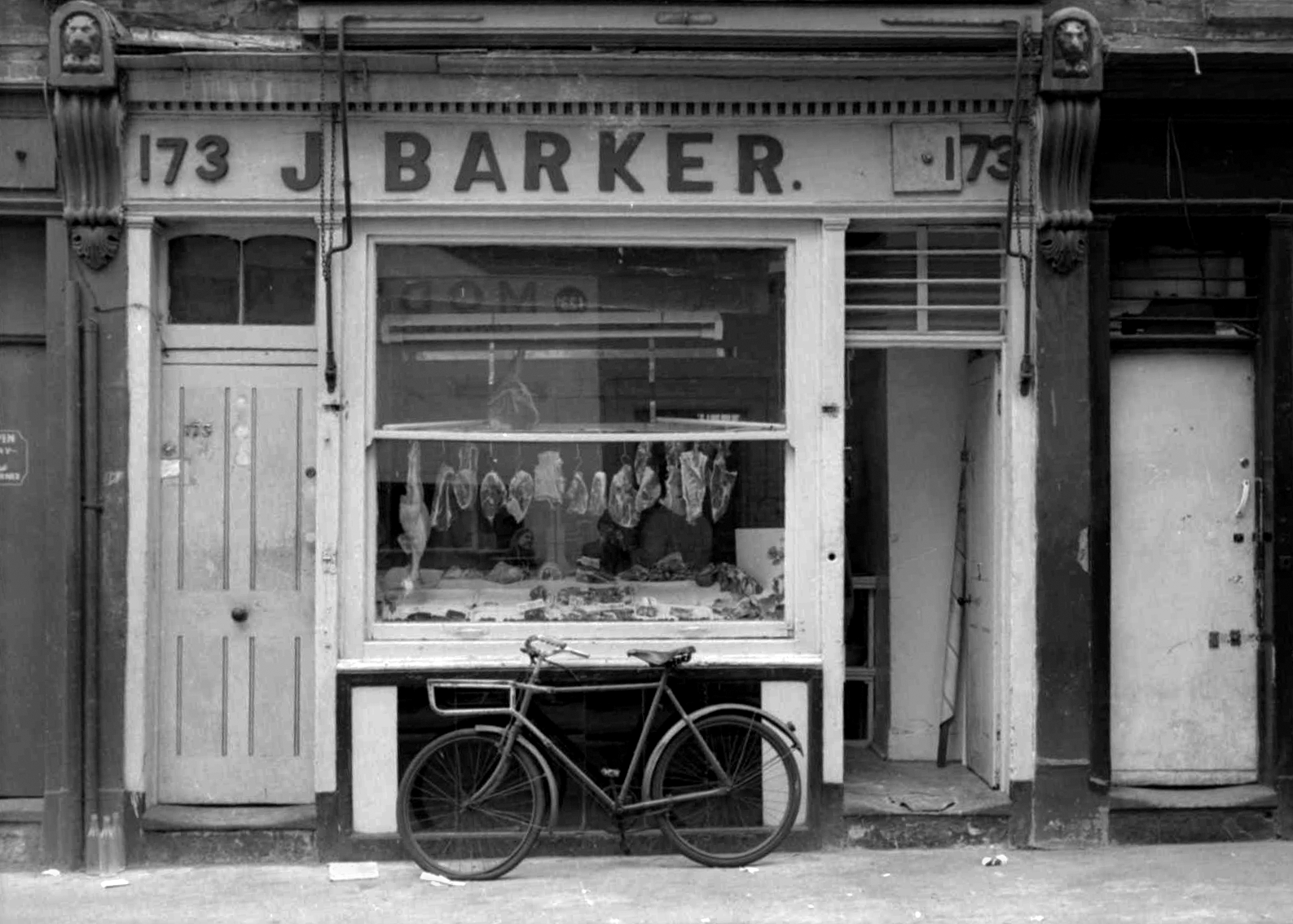
Click this picture to enlarge and see the reflection of Tony & Libby Hall in the window of J. Barker.

Children with their bonfire for Guy Fawkes


In the Hackney Rd

“I love the way these women are looking at Tony in this picture, they’re looking at him with such trust – it’s the way he’s made them feel. He would have been in his early thirties then.”


On the Regent’s Canal near Grove Rd


On Globe Rd

In Old Montague St

In Old Montague St

In Club Row Market

On the Roman Rd


In Ridley Rd Market

In Ridley Rd Market

In Artillery Lane, Spitalfields

 Tony & Libby Hall in Cheshire St
Photographs copyright © Libby Hall
Images Courtesy of the Tony Hall Archive at the Bishopsgate Institute
Libby Hall & I would be delighted if any readers can assist in identifying the locations and subjects of Tony Hall’s photographs.
You may also like to read


